The Watchtower, December 15, 1970
Download: PDF — The Watchtower, December 15, 1970
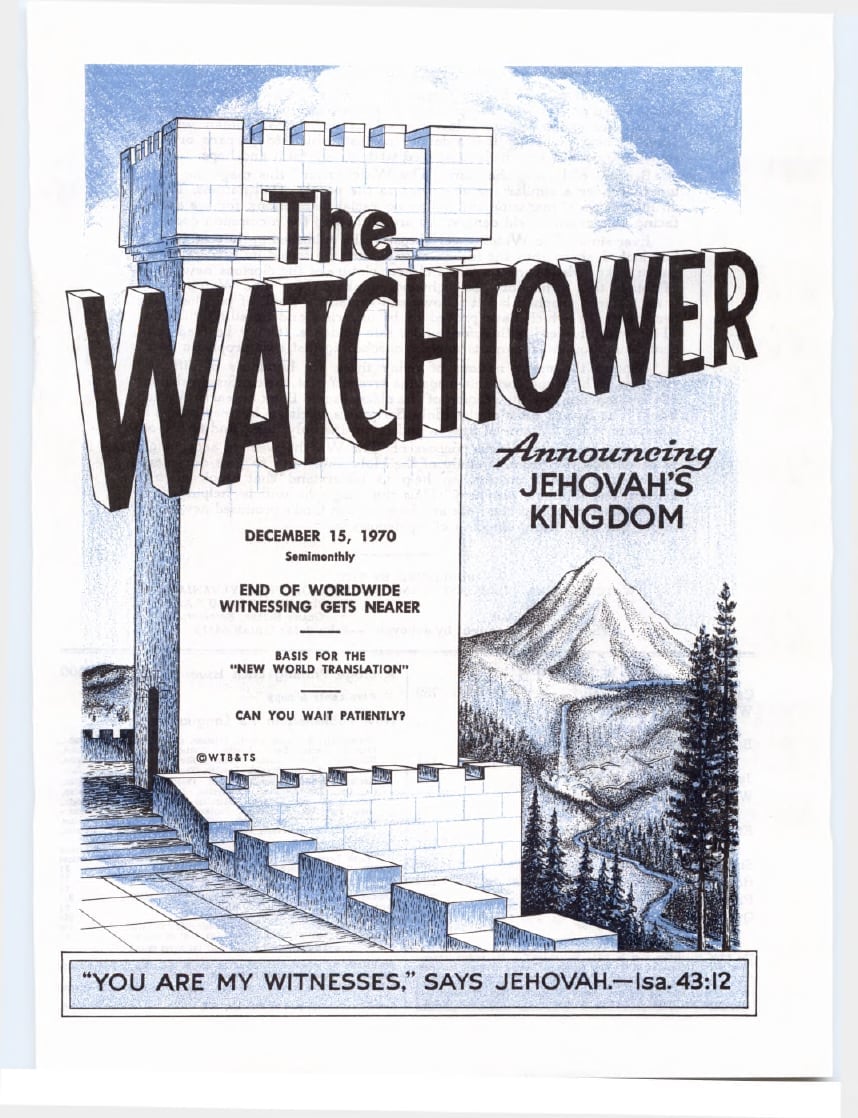
The Watchtower — December 15, 1970
Source: jw.org
Contents
Can You Wait Patiently?
Waiting Patiently for an End of Wickedness
Being Patient in Your Relations with Others
Jesus Teaches Us to Pray
Worldwide Witnessing versus World Conversion
End of Worldwide Witnessing Gets Nearer
She and the Children Had Changed!
Basis for the New World Translation
Pioneering—a Way of Life
Questions From Readers
Announcements
Can You Wait Patiently?
Can You Wait Patiently?
HAVE you learned to wait—to wait patiently? That is a lesson that the Creator, Jehovah God, might be said to be wanting to teach us earthly creatures. And this he does both by his Book of Creation and by his inspired Book, the Holy Bible.
You cannot speed up the days, seasons or years. Nothing that you or anyone else on earth may do can accelerate the revolution that the earth makes around the sun in 365 and one-fourth days. Neither can anyone hasten the seasons or the pace at which the earth rotates on its own axis. Each day takes twenty-four hours.
The farmer sows his seed, but then he too has to wait. He cannot hurry matters much, if at all. For some crops he has to wait several years. His exercise of patience is set before Christians as an example for them by the disciple James: “Exercise patience, therefore, brothers. . . . Look! The farmer keeps waiting for the precious fruit of the earth, exercising patience over it until he gets the early rain and the late rain. You too exercise patience.”—Jas. 5:7, 8.
Jehovah God himself sets us an example in waiting patiently. Thus the apostle Peter tells us that “the patience of God was waiting in Noah’s days, while the ark was being constructed.” Likewise God exercised patience with his ancient wayward people of Israel “until there was no healing.”—1 Pet. 3:20; 2 Chron. 36:15, 16.
Jesus Christ, God’s Son, also set a fine example of waiting patiently. He knew, as can be seen from the prophecies found at Revelation chapters 19 to 21, that it was God’s purpose for him to wipe out all of God’s enemies. And although upon his resurrection he had the will and the power to proceed against his enemies, he “sat down at the right hand of God, from then on awaiting until his enemies should be placed as a stool for his feet.”—Heb. 10:12, 13; Matt. 28:18.
Furnishing us another fine example of waiting patiently is David the son of Jesse. As a mere boy he was anointed by the prophet Samuel to be the future king of Israel. He showed himself to be Israel’s chief warrior by single-handedly slaying the giant Goliath, and in battles against the Philistines he slew ten times as many as King Saul. When hunted like a dog by envious Saul, David had several opportunities to slay Saul and so take possession of the kingdom that God had assured to him. But no, David was willing to wait patiently until the time when ‘Jehovah himself would deal Saul a blow.’
Waiting Patiently for an End of Wickedness
Waiting Patiently for an End of Wickedness
THE matter of patiently waiting has a direct bearing on the question many lovers of righteousness ask: “Why does God permit wickedness?” There are some who argue that wickedness proves that God is not deserving of worship. According to them, either God is unable to stop wickedness and therefore is weak and so not deserving of our worship; or he is unwilling to stop wickedness and therefore is not just and good and so likewise does not merit being worshiped.
What about these objections? Are they sound, incontrovertible? By no means! Jehovah God has a due time to end wickedness. His Word tells us that he had a certain time to destroy the wicked in the flood of Noah’s day. (Gen. 6:3) He had a certain time for freeing the Israelites from Egyptian slavery. That is why he did not at once destroy Pharaoh and his military might when that Egyptian king refused to let God’s people go. As God himself told Pharaoh: “For this cause I have kept you in existence, for the sake of showing you my power and in order to have my name declared in all the earth.”—Ex. 9:16.
Similarly, only when God’s due time came did he send his Son to the earth: “When the full limit of the time arrived, God sent forth his Son . . . that he might release by purchase those under law.” Truly, “for everything [God has] an appointed time, even a time for every affair under the heavens.” How wise it is therefore for us to wait patiently for God’s time for things to take place!—Gal. 4:4, 5; Eccl. 3:1.
ASSURANCES THAT WICKEDNESS WILL END
That God will, indeed, bring an end to wickedness he makes clear in his Word. Why, from the very beginning he gave a prophecy that righteousness would triumph, when he told the Serpent, Satan the Devil, that his head would be bruised by the seed of the woman, which seed proved to be Jesus Christ.—Gen. 3:15; Rev. 12:9; Rom. 16:20.
Thus God repeatedly assures us by means of his psalmists: “Just a little while longer, and the wicked one will be no more; . . . but the meek ones themselves will possess the earth.” “Come, you people, behold the activities of Jehovah . . . He is making wars to cease to the extremity of the earth.” “All the wicked ones he will annihilate.” And in the Bible’s last book we read that Satan and all his agents will be destroyed and that, not only wickedness, but even sorrow, pain and death will be done away with.—Ps. 37:10, 11; 46:8, 9; 145:20; Rev. 20:1–21:4.
Not without good reason therefore does Jehovah God tell us to wait patiently for him: “Keep silent before Jehovah and wait longingly for him.” Rather than rising up violently against wicked conditions, as so many are doing today, leave it to Jehovah to straighten out matters. As the prophet Jeremiah said after the destruction of Jerusalem: “Good it is that one should wait, even silently, for the salvation of Jehovah.”—Ps. 37:7; Lam. 3:26.
AIDS TO WAITING PATIENTLY
What will help you to wait patiently for Jehovah to act and to end wickedness? One great aid is hope, based on faith. To the extent that our faith is strong our hope will be bright. To keep our hope bright we must keep refreshing our minds on God’s promises regarding the future. Another aid is to appreciate the wisdom of waiting patiently. To chafe frustratingly or to take matters into one’s own hands can only make matters worse.—Rom. 8:24, 25; 12:19.
Another great help is joy. “The joy of Jehovah is your stronghold.” Joy gives one strength. It was joy that gave Jesus Christ the strength to wait and to endure. And even as hope is built on faith, so joy is built on appreciation. To the extent that you appreciate God’s goodness, your present blessings, the pleasures of association with fellow Christians, the privileges of telling others the truths of God’s Word as Jesus did, you will have joy and be able to wait patiently.—Neh. 8:10; Heb. 12:2.
Being Patient in Your Relations with Others
Being Patient in Your Relations with Others
THERE are other aspects of waiting. Waiting may well be the course of wisdom in one’s everyday relations with others. A young man may be courting a young lady. Either he or she may be hasty about getting married. But wisdom would indicate not hurrying matters unduly. Courting gives couples fine opportunities to get to know each other better and to adjust to each other. As has well been said, “Married in haste, we may repent at leisure.”
Then again, an employee may be very industrious and ambitious for advancement. Here again, instead of chafing impatiently, would it not be better to make the best of all opportunities that lie before one to prove one’s worth and to increase one’s skills? It often happens that when one no longer frets and chafes but becomes content, then a change for the better takes place.
Patiently waiting is also the course of wisdom in the family circle. Business matters, or other circumstances over which he may have no control, such as heavy traffic, may make a husband late in coming home. Instead of fretting impatiently, how much better for his wife to give him the benefit of the doubt!
On the other hand, in certain matters the wife may show herself slow, requiring the husband to learn to wait patiently. Being angry will not help. He may be able to help her to organize her affairs so as to be more punctual. But, when the schedule does not work as planned, rather than chafe impatiently, how much better for the husband to heed the advice of the apostle Peter and ‘deal with his wife according to knowledge, assigning her honor as to a weaker vessel, the feminine one.’—1 Pet. 3:7.
Or it may be that a fellow Christian alongside whom you are obliged to serve has a weakness that grates on you and of which he might not even be aware. Or he may repeatedly trespass, requiring you to forgive him, as it were, “seventy-seven times.” Here again it is well to learn to wait and have patience with him. He may not be making as rapid progress as you would like to see, but with the years there may be progress nevertheless. Also here God’s Word has wise counsel, namely, ‘with long-suffering put up with one another in love.’—Matt. 18:21, 22; Eph. 4:2, 3.
Truly it is the course of wisdom to learn to wait patiently. It results in benefits to ourselves and to those about us. Jehovah God has his laws governing the universe, and he has his own timetable for fulfilling his purposes. He will not change his timetable to suit us, any more than we can cause him to change or hasten the days, seasons and years. Faith, hope, joy and appreciation will enable us to follow the wise course of learning to wait patiently.
Jesus Teaches Us to Pray
Jesus Teaches Us to Pray
An article specially designed for parents to read with their children
DO YOU talk to Jehovah God? He wants you to talk to him. When you talk to God, this is called prayer.
Jesus often spoke to his Father in heaven. Sometimes he wanted to be alone when he talked to God. One time, the Bible says, “he went up into the mountain by himself to pray. Though it became late, he was there alone.”—Matt. 14:23.
Where can you go to pray to Jehovah alone? Maybe you can talk to God alone before you go to bed at night. Jesus said: “When you pray, go into your private room and, after shutting your door, pray to your Father.” Do you pray to God each night before you go to sleep? It is a good thing to do.—Matt. 6:6.
Jesus also prayed when other people were with him. When he had meetings with his disciples, Jesus would pray. You can go to Christian meetings where prayer is said. At these meetings usually an older person will pray. Listen carefully to what he says, because he is talking to God for you. Then you will be able to say “Amen” to the prayer.
Do you know what it means to say “Amen” at the end of a prayer? It means that you like the prayer. It means that you agree with it, and that you want it to be your prayer too.
Jesus also prayed at mealtimes. He thanked Jehovah for his food. Do you always pray before you eat your meals?
It is good for us to thank Jehovah for the food before we start eating. Your father may say the prayer when you eat together. But what if you eat by yourself? Or what if you have a meal with people who do not thank Jehovah? Then you need to say your own prayer.
Do you always have to pray out loud? No. Jehovah can hear your prayer even if you say it in your heart. So you can say a silent prayer to Jehovah when you are with people who do not pray to God. For example, you might say a silent prayer when you eat lunch at school.
Should you bow your head when you pray? Should you get down on your knees? What do you think?
Sometimes Jesus bent his knees when he prayed. At times he would lift his head toward heaven as he prayed. And he also spoke about praying to God while standing up.
So what does this show? It shows that it does not matter what position you are in when you pray. God can hear you no matter what position you are in. But at times it is good to bow your head when you pray. At other times you may even want to get down on your knees as Jesus did. But, remember, you can pray to God at any time during the day or night and he will hear you.
The important thing in prayer is that you really believe that Jehovah is listening. Do you believe that Jehovah hears you? It is also important that you mean what you say to God. Do you really mean what you say in your prayers?
What should you say in your prayers to Jehovah? Tell me: When you pray, what do you talk to God about?
Jehovah gives us so many good things, and it is right to thank him for them, isn’t it? We thank him for the food we eat. But have you ever thanked him for the blue sky, the green trees and the pretty flowers? He made those too. He also made dogs that wag their tails, kittens that purr and beautiful birds that sing. There are so many things to thank him for!
Jesus’ disciples once asked him to teach them how to pray. And the Great Teacher showed them what were the most important things to pray for. Do you know what these things are? Get your copy of the Bible and open it to Matthew chapter 6. In Mt 6 verses 9 through 13 we find what many persons call “the Lord’s prayer.”
Here we learn that Jesus told us to pray about God’s name. He said to pray that God’s name be sanctified or treated as holy. What is God’s name? The Bible tells us that it is Jehovah, and we should love that name. Second, Jesus taught us to pray for God’s kingdom to come. This kingdom is so important because it will bring peace to the earth and make it a paradise. Third, the Great Teacher said to pray for God’s will to be done on earth just as it is done in heaven. That means that we should do God’s will.
Jesus also taught us to pray for the food we need for the day. He said that we should tell God that we are sorry when we do things that are wrong. We should ask God to forgive us. But first we must forgive others if they do wrong to us. Do you do that? Finally, Jesus said, we should pray that Jehovah God will protect us from the wicked one, Satan the Devil. So, all of these are good things to pray to God about.
Jesus knew that some persons would forget to pray. They would give up in talking to God. So the Great Teacher told a little story about the need to keep on asking God for these right things and not to stop praying.
Jesus said to make believe that you have a friend who comes to visit you from far away. He comes in the middle of the night. Your friend is hungry after his long trip. But you do not have any food in the house and the stores are closed. What will you do?
Perhaps you decide to go to a neighbor to ask him to loan you some bread. But what if the neighbor says: ‘Let me sleep. It is late. I am in bed. I cannot get up and give you anything’? What will you do then?
Jesus said that if you beg that man over and over again to get up, he will do it. Even if he did not want to, he will get up and give you some bread. God is not like that man. God wants us to come to him in prayer. But Jesus says that we should keep on praying in order to show that we really believe in God and that we really mean what we say.—Luke 11:5-9.
So we should believe that Jehovah hears our prayers and we should keep on asking him. Then God will answer our prayers. Jehovah likes to hear us pray to him. He is happy when we mean what we say in prayer and when we ask him for the right things. And he will give us these things. Do you believe that?
Worldwide Witnessing versus World Conversion
Worldwide Witnessing versus World Conversion
1. Why does a command issued nineteen centuries ago deserve our looking at it very carefully today?
LOOKING at a command more than nineteen hundred years after it was first issued, a person can determine to what extent the command has been carried out and how well. If it is a command that is bound to have an effect on the whole world of mankind, then it deserves our looking at it very carefully. What has been done about that command until now? The situation is real, for there is such a command of worldwide importance. The carrying out of the command has affected the world. Whether we like the situation or not, we are involved, even today.
2. On what day of the week and month of what year was that command issued, and where?
2 When was the command issued, and by whom and to whom? It was issued on the fifth day of the week, or, as we would say today, on a Thursday, and on the twenty-fifth day of the lunar month of Iyar (or Ziv), in the year 33 of our Common Era, in the springtime of that year. Men have even tried to mark the place about where the command was issued, putting a shrine over it, for it was issued on a famous mountain to the east of Jerusalem, namely, the Mount of Olives.
3. Why was the Commander an unusual person, and what was his name?
3 The Commander was an unusual person, a person who had come back from the dead just forty days before that. Roman soldiers had been used to put him to death. He had been put to death because of the charge that his accusers made out against him, when they said to the Roman Governor Pontius Pilate: “This man we found subverting our nation and forbidding the paying of taxes to Caesar and saying he himself is Christ a king.” In order to urge on the execution of him by the Romans, the accusers said further: “We have a law, and according to the law he ought to die, because he made himself God’s son.” From these accusations you will recognize the man. He was Jesus Christ.—Luke 23:2; John 19:7.
4, 5. (a) What had the enemies done with regard to the fact of Jesus’ resurrection? (b) What did Jesus now tell his disciples to do as regards the facts about him?
4 The religious leaders of Jerusalem had tried to hush up the facts about his resurrection. They tried to falsify the facts, even by bribery. (Matt. 28:11-15) But, all the same, Jesus Christ was fully alive again on that Thursday, Iyar 25 of 33 C.E., making his last appearance in flesh to his faithful disciples. He gave them to understand that the kingdom of David was not to be restored to the earthly nation of Israel. Nor was it the time for the kingdom of God then to be set up in the hands of God’s Messiah or Christ. Well, then, were the disciples to let the case of Jesus Christ drop? Were they to let the distorted facts about him be broadcast world wide by the instigators of his death and let all mankind get no benefit from the life, death and resurrection of Jesus Christ? Were they to keep mum about the things that they had seen and heard and shared in so personally? Absolutely not! They were to be empowered to do something about this, but starting at the right time, namely, the day for the fulfillment of the prophecy of Joel 2:28-32 to begin. So he said to them:
5 “You will receive power when the holy spirit arrives upon you, and you will be witnesses of me both in Jerusalem and in all Judea and Samaria and to the most distant part of the earth.”—Acts 1:8.
6. So from when on were the disciples to be witnesses of Jesus, and to whom?
6 “Be witnesses!” That was what they were commanded to do, and they would be commissioned for this witnessing when the holy spirit of God was poured out upon them in fulfillment of Joel 2:28, 29, ten days later, on the festival of Pentecost of that same year, 33 C.E. They were to be witnesses of Jesus Christ, not just to the Jews who came to the festivals in Jerusalem from various lands inside and outside the Roman Empire and to all Judea and Samaria, but “to the most distant part of the earth.” That is, to the Gentile nations.
7. Was this witnessing to Jesus to cease with the death of those disciples, and how have we today got involved with it?
7 This witnessing was not to be dropped when those disciples there on the Mount of Olives died within that first century of our Common Era. This witnessing concerning Jesus Christ, of worldwide importance, was of vital interest for all generations to come, be it even the last generation of the twentieth century. The witnessing was to be continued through the centuries, to be taken up by Christian disciples whom those disciples there on the Mount of Olives would yet make, and then by the whole chain of disciples that would follow, till indeed the most distant part of the earth was reached with the witness. And thus it has reached us today. We have got involved. We are interested.
8. Under whose guidance was the worldwide witnessing to be done, and of what were the disciples assured concerning the departing Jesus?
8 This worldwide witnessing was to be done under the invisible guidance of the Lord Jesus Christ. Why so? Because, after issuing this command of such long-range, worldwide importance, Jesus Christ was seen by the disciples there present to ascend heavenward and disappear by God’s miraculous power. The book of the Acts of the Apostles, Ac chapter one, verses ten and eleven, informs us: ‘And as they were gazing into the sky while he was on his way, also, look! two men in white garments stood alongside them, and they said: ‘Men of Galilee, why do you stand looking into the sky? This Jesus who was received up from you into the sky will come thus in the same manner as you have beheld him going into the sky.’” The Messiah was to come again!
WHAT PROGRESS TOWARD WORLD CONVERSION?
9, 10. (a) Why does the question of world conversion here come up? (b) What does Dr. Adam Clarke’s Commentary have to say on the parable of the leaven?
9 But where is the world conversion today? Which “world conversion”? Why, do those words of command of Jesus Christ not mean the converting of the whole world of mankind to Christianity before the kingdom of God is set up in the heavens and the thousand years of Christ’s reign begins? That is the way some Bible commentators on those and other words of Jesus Christ have understood them. For instance, Jesus’ parable of the leavened dough: “The kingdom of the heavens is like leaven, which a woman took and hid in three large measures of flour, until the whole mass was fermented.” (Matt. 13:33) On this the comment in A Commentary and Critical Notes by Adam Clarke, LL. D., says:
10 “Both these parables are prophetic, and were intended to show, principally, how, from very small beginnings, the Gospel of Christ should pervade all the nations of the world, and fill them with righteousness and true holiness.”—Page 155, column 2.
11, 12. What does Clarke’s Commentary have to say about the stone that struck the metallic image seen in Nebuchadnezzar’s dream?
11 Regarding the stone that struck the metallic image that was seen in the dream of King Nebuchadnezzar, and that crushed the image and then became a great mountain filling the whole earth, Adam Clarke’s Commentary says:
12 “The stone began to strike the image, when the apostles went out into every part of the Roman empire, pulling down idolatry, and founding Christian churches. . . . But the great blow was given to the heathen Roman empire by the conversion of Constantine, .‹v›.‹v›. The conversion of Constantine took place while he was in Gaul, A.D. 312, . . . He terminated the reign of idolatry in A.D. 331, by an edict ordering the destruction of all the heathen temples. This made CHRISTIANITY the religion of the empire. .‹v›.‹v›. It is the kingdom which the God of heaven sets up. That this means the whole dispensation of the gospel, and the moral effects produced by it in the souls of men and in the world, needs little proof; for our Lord, referring to this and other prophecies in this book, calls its influence and his gospel the kingdom of God, and the kingdom of heaven; showing thereby that it is . . . a spiritual kingdom raised and maintained by the grace of God himself, in which he himself lives and rules, governing by his own laws, influencing and directing by his own Spirit; producing, not wars and contentions, but glory to God in the highest, and on earth peace and good will among men.”—Pages 3209, 3210, edition of 1836; Dan. 2:44, 45.
13, 14. Back in 1885 what did Methodist Bishop Foster have to say regarding the facts of the progress of Christianity and the work ahead for world conversion?
13 Less than a hundred years ago, in 1885, when the world’s population was smaller and did not present so big a task, the Methodist Bishop Foster, addressing the M. E. Church Conference, on November 9th that year, said, as reported in the public press:
14 “There is a lack of information on the progress of Christianity. The facts are misstated daily in pulpits all over the country. Ministers hesitate to present the worst side for fear of causing discouragement. They create hopes that are never to be realized. We are not at the dawn of the millennium. Compared with the work to be done, the past is nothing. Our children’s children for ten generations to come must labor harder than we are doing to accomplish the conversion of the world. The world’s population is 1,500,000,000. Of these Christians number less than a third. Half of that third belong to the Roman Catholic Church. The Protestants number 113,000,000. They are divided into 500 sects. And this number of their strength includes also all the thieves, ex-convicts, the debased, besotted, the speckled and streaked in Christendom. . . . before us we have the great problem—the 1,100,000,000 of pagans to convert to Christianity. That is the solid rock that looms up in our path. Look at it; see what work has been done in 1800 years, and how much is yet to be accomplished. . . . It is a big loaf to be leavened and it has been a long time working.”—See The Watch Tower, as of January 1886, pages 3-6, under “Blind Guides.”
15, 16. (a) After World War II what obstacles were removed from the progress of Christianity in Japan? (b) Reportedly, what offer was made for making Christianity the state religion, and how was the offer treated?
15 After World War II ended on September 2, 1945, it seemed as if Christendom was presented with the opportunity to expand its membership with a sudden spurt. On December 10 of that year the American General MacArthur as military supervisor of defeated Japan abolished Shintoism as the national religion. Later, freedom of religion was written into the postwar Constitution of Japan, this being patterned on the United States Constitution. Then on January 1, 1946, when the Japanese Emperor renounced the theory that he was a descendant from the sun goddess, so that he was not to be worshiped as a god, this further removed an obstacle to progress of Christendom in Japan. General Douglas MacArthur is reliably reported as having turned down an offer by Emperor Hirohito to make Japan a “Christian” country. The New York Times reports:
16 “The offer was rejected . . . because the general believed it was wrong to impose any religion on a people. General MacArthur . . . said that after the surrender of the Japanese the Emperor had privately declared his willingness to make Christianity the state religion. The general asked time to ‘think about it,’ . . . and after considering the proposal replied to the Emperor: ‘Never. No nation must be made to conform to any religion. It must be done on a voluntary basis.’ . . . General MacArthur rejected the Emperor’s proposal, . . . asking the American people instead to send 10,000 missionaries. ‘We responded with a handful of missionaries,’ Mr. [Billy] Graham said.”—N.Y. Times, as of April 7, 1964, under “General Told of Barring Offer to Create a Christian Japan.”
17. In comparison of the growth of the world population, does Christendom’s growth since that time prove her to be correct about world conversion or Jesus Christ?
17 Japan then had a population of 73,110,995. The world population had increased to 2,139,958,919. Although tens of millions of church members of Christendom had killed off one another in World War II, the membership of Christendom was then reported as being 592,406,542, or about a fourth of the world population. Today, in 1970, Christendom’s membership is rated at 924,274,000, which means less than a third of the world population of 3,483,263,000, with over one thousand million more non-Christians to be converted to Christendom than in the year 1946. Plainly, the growth of Christendom in its program of world conversion is not keeping up with the population explosion of the non-Christian world. Who, then, is wrong—Christendom or Jesus Christ and the Holy Scriptures of the Bible? The hard facts prove Christendom to be woefully wrong, but Jesus Christ and the Bible to be right.
18. (a) What work did Jesus Christ and the Bible predict would be done before the complete end of this system of things? (b) He predicted the destruction of Jerusalem and of this system for what reason?
18 Jesus Christ and the Bible never did predict world conversion to Christianity before the thousand-year reign of Jesus Christ. They predicted worldwide witnessing before the “great tribulation” with which this entire system of things, including Christendom, will disastrously end shortly. In his prophecy on the conclusion of the system of things Jesus said: “This good news of the kingdom will be preached in all the inhabited earth for a witness to all the nations; and then the end will come.” (Matt. 24:3-14) In his final word to his disciples on the Mount of Olives he said: “You will be witnesses of me . . . to the most distant part of the earth. (Acts 1:8) He did not say that Jerusalem or all of Judea and Samaria or the most distant part of the earth would be converted. They were not, and they have not been converted. He foretold the destruction of Jerusalem, that befell her in the year 70 C.E., and also the end of this present system of things in the approaching “great tribulation,” because they would not repent and be converted by the witness given to them. (Matt. 24:15-22) The witnessing world wide is still in progress.
WITNESSES OF WHOM?
19. What impression have the clergy of Christendom given regarding the place of God’s name in connection with the witness to Jesus?
19 When Jesus Christ told his disciples, “You will be witnesses of me,” did he mean to detract their attention from the Most High God? Did he mean that the name of God was thenceforth to be put in the background and that his own personal name was to be put to the fore and be used almost exclusively? The way in which the religious clergy of Christendom act tends to give the world the impression that that is what Jesus meant. But how could Jesus Christ ever tell his disciples not to be witnesses of the very One of whom he himself was a witness?
20. In Revelation 3:14, 21, how does Jesus Christ bear witness to God as his Creator and Life-giver?
20 In the very last book of the Bible, that is, in Revelation 1:5, he speaks of “Jesus Christ, ‘the faithful witness,’ ‘The first-born from the dead,’ and ‘The Ruler of the kings of the earth.’” But in Revelation 3:14 the glorified Jesus Christ himself speaks and says: “These are the things that the Amen says, the faithful and true witness.” The “faithful and true witness” of whom? Why, of no one else but God, and that is why in the very next phrase he gives further identification of himself by adding: “the beginning of the creation by God.” And the message that is introduced with those words Jesus Christ ends up by saying: “To the one that conquers I will grant to sit down with me on my throne, even as I conquered and sat down with my Father on his throne.” (Rev. 3:21) Jesus Christ thus bears witness to God, his heavenly Father, as being his Creator and Life-giver.
21. In Revelation 3:12, Jesus Christ mentions whom four times, and to indicate what relationship of this one to himself?
21 Jesus was the Original One of God’s creations. And some verses earlier, in Revelation 3:12, Jesus Christ says: “The one that conquers—I will make him a pillar in the temple of my God, and he will by no means go out from it any more, and I will write upon him the name of my God and the name of the city of my God, the new Jerusalem which descends out of heaven from my God, and that new name of mine.” In this promise he four times mentions “my God,” to bear witness to this One as being his own God, whom he himself worships. He also calls attention to God as having a name different from his own name, to denote two separate individuals.
22, 23. (a) In his Sermon on the Mount and in the midst of worshipers at Jerusalem in 33 C.E., how did Jesus show whether his name was to be put before that of God? (b) In his prayer after inaugurating “the Lord’s supper,” what prominence did Jesus give to God’s name?
22 Jesus could not possibly tell his disciples to put his own personal name before that of the God to whom he prayed. In his Sermon on the Mount he told his disciples: “You must pray, then, this way: ‘Our Father in the heavens, let your name be sanctified.’” Jesus prayed, not for his own name to be sanctified, but for the name of his Father and of their Father to be sanctified. (Matt. 6:9) In the spring of the year 33 C.E., after his triumphal ride into Jerusalem, Jesus prayed aloud in the hearing of a crowd of worshipers: “Father, glorify your name.” Was there an answer to Jesus’ prayer? The written account tells us: “Therefore a voice came out of heaven: ‘I both glorified it and will glorify it again.’” (John 12:23-28) Several days later, after Jesus had introduced what is called “the Lord’s supper,” he prayed to God amid his eleven faithful apostles, saying:
23 “This means everlasting life, their taking in knowledge of you, the only true God, and of the one whom you sent forth, Jesus Christ. I have made your name manifest to the men you gave me out of the world. . . . Holy Father, watch over them on account of your own name.”—John 17:3, 6, 11.
24, 25. (a) What, then, does Jesus’ command to his disciples in the mountain in Galilee indicate as regards his final command to them on the Mount of Olives? (b) According to Isaiah 43:1, 10-12, Jesus as a born Jew under the Law was obligated to be what toward Jehovah?
24 After Jesus’ resurrection from the dead, Jesus appeared to his disciples who had gathered together at a mountain in Galilee and said to them: “Go therefore and make disciples of people of all the nations, baptizing them in the name of the Father and of the Son and of the holy spirit.” (Matt. 28:18, 19) Thus all the record goes to prove that Jesus Christ did not tell his disciples to shove aside the name of God, his heavenly Father, and put his own name, the Son’s name, ahead of his Father’s name. So, in his farewell words to his disciples on the Mount of Olives, he was not telling them to be, as he said, “witnesses of me,” to the exclusion of being witnesses of God, his heavenly Father. We must remember that Jesus Christ, like those Jewish disciples of his, was born of a Jewish woman and “came to be under law,” that is, the law given through the prophet Moses. (Gal. 4:4) Consequently, Jesus Christ, like his Jewish disciples, was part of the nation of Israel (or Jacob), to whom God spoke these words by the mouth of his inspired prophet Isaiah:
25 “And now this is what Jehovah has said, your Creator, O Jacob, and your Former, O Israel: ‘Do not be afraid, for I have repurchased you. I have called you by your name. You are mine.’ ‘You are my witnesses,’ is the utterance of Jehovah, ‘even my servant whom I have chosen, in order that you may know and have faith in me, and that you may understand that I am the same One. Before me there was no God formed [by idol-worshiping nations], and after me there continued to be none. I—I am Jehovah, and besides me there is no savior. I myself have told forth and have saved and have caused it to be heard, when there was among you no strange god. So you are my witnesses,’ is the utterance of Jehovah, ‘and I am God.’”—Isa. 43:1, 10-12.
26. How does the last book of the Bible prove the resurrected Jesus to be still a witness to the name of Jehovah?
26 Unavoidably, then, as natural-born members of the nation of Jacob or Israel, Jesus and his disciples there on the Mount of Olives were obliged to be God’s witnesses, witnesses of Jehovah. Jesus, when in the flesh on earth, was a witness of Jehovah God, and so were his Jewish disciples. After his resurrection from the dead, Jesus Christ continued to be a witness of Jehovah. The very last book of the Bible, Revelation, which Jesus Christ was used to give the Jewish apostle John, shows the glorified Jesus Christ to be still witnessing to Jehovah God. Revelation 19:1-6 records four times the joyous cry, “Hallelujah!” which is a Hebrew expression meaning “Praise you Jah!” the name “Jah” being the abbreviation for Jehovah.—Rev. 1:1, 2.
27. (a) By his command in Acts 1:8 did Jesus lift from his disciples the obligation to be Jehovah’s witnesses? (b) Did this hold true even after they became spiritual Israelites at Pentecost of 33 C.E.?
27 To all eternity to come the heavenly Jesus Christ will be a witness of Jehovah God. Accordingly, by his words to his Jewish disciples, “You will be witnesses of me,” Jesus Christ did not lift from his disciples the obligation to be witnesses of Jehovah God in fulfillment of Isaiah 43:1-12. This held true even after the holy spirit was poured out upon them at Pentecost, for first then they became spiritual Israelites under a new covenant with Jesus Christ himself as Mediator between God and men.—Acts 2:1-38; Gal. 6:16; 1 Tim. 2:5, 6; 1 Pet. 2:9.
[Graph on page 748]
(For fully formatted text, see publication)
World’s Christendom’s
Population Membership
(3,483,263,000) (924,274,000)
4 Thousand Millions
3 Increase
Since 1946
Increase
Since 1946
[Picture on page 745]
“You will be witnesses of me in Jerusalem and in all Judea and Samaria and to the most distant part of the earth.”—Acts 1:8
End of Worldwide Witnessing Gets Nearer
End of Worldwide Witnessing Gets Nearer
1. (a) What additional witnessing was given to Jesus’ Jewish disciples from Pentecost of 33 C.E. onward? (b) What effect was this to have on their witnessing to Jehovah?
THE WORLDWIDE witnessing on the part of the disciples of Jesus Christ has been going on now for more than nineteen centuries. When, on the Mount of Olives in the spring of 33 C.E., Jesus Christ said to his Jewish disciples, “You will be witnesses of me,” he was speaking to natural-born witnesses of Jehovah. (Isa. 43:1-12; 44:8) But from then on, or from the outpouring of God’s holy spirit upon them ten days later at Pentecost in Jerusalem, they were also to be witnesses of Jesus. Why this additional witness? Was this meant to take away anything from their being dedicated witnesses of Jehovah or even to take the place of their being witnesses of Jehovah God? Rather than detract from proclaiming God’s name Jehovah and to put him in the overshadowed background, the bearing witness of Jesus was calculated to glorify Jehovah God yet more. It was to give more pointedness, more definiteness to the witnessing for Jehovah. It was to show that Jehovah had not lied, but that, after more than four thousand years, he at last had raised up his Messiah or Christ.
2. What provision, first referred to in the Garden of Eden, had now become of worldwide importance?
2 Jehovah’s providing of the long-promised Messiah or Anointed One was a matter of worldwide importance. It deserved to be made known to the whole world of mankind, even “to the most distant part of the earth.” What Jehovah God himself did deserved to be imitated by his faithful witnesses on earth. What was that? Why, bear witness of the actual, historical Messiah or Christ, Jesus the Son of God. About the year 4026 B.C.E., Jehovah God had said to the Serpent that had brought about man’s downfall in the Garden of Eden: “I shall put enmity between you and the woman and between your seed and her seed. He will bruise you in the head and you will bruise him in the heel.” (Gen. 3:15) This was Jehovah’s first reference to the Messiah or Christ.
3. Hence what did Jehovah have to do in order to show his word to be vindicated in this regard?
3 When God vindicated his word of promise by raising up his Messiah or Anointed One, it would be necessary for Him to identify his Messiah by bearing witness to him in a supernatural way. All mankind could repeat the request once made to him: “May Jehovah prove to be a true and faithful witness.” (Jer. 42:5) Jehovah did do so.
4. How did John come to be a witness regarding Jesus to those who came to him for baptism?
4 In the latter half of the year 29 C.E., after the baptism of his Son Jesus in the Jordan River, he gave a visible manifestation of his holy spirit descending upon the baptized Jesus, and John the Baptist heard God’s words from heaven: “This is my Son, the beloved, whom I have approved.” Thereafter John the Baptist, a Jewish witness of Jehovah, could bear witness of Jesus, that this one is the Messiah, as John himself said: “I have seen it, and I have borne witness that this one is the Son of God.” (Matt. 3:13-17; John 1:29-34) John from then on bore witness to those who came to him to be baptized, desiring to be prepared to become disciples of Jehovah’s Messiah or Christ.
5. Three years later, how and where did Jehovah again bear witness to Jesus, and how did Peter testify thereto in writing?
5 Three years later, at the Mount of Transfiguration, Jehovah again bore audible witness to his Messiah, Jesus. Three disciples of Jesus, who saw this vision of his transfiguration with supernatural glory, heard God’s voice from heaven say: “This is my Son, the beloved, whom I have approved; listen to him.” After Jesus’ being resurrected from the dead these three eyewitnesses told the vision to the other apostles of Jesus Christ. (Matt. 17:1-9) Years later the Christian apostle Peter wrote: “For he [Jesus Christ] received from God the Father honor and glory, when words such as these were borne to him by the magnificent glory: ‘This is my son, my beloved, whom I myself have approved.’ Yes, these words we heard borne from heaven while we were with him in the holy mountain.”—2 Pet. 1:12-18.
6, 7. (a) How did God bear witness to Jesus all through his public career? (b) How did Peter speak to Cornelius about the part that God took in connection with Jesus as the Christ?
6 All through the public career of Jesus Christ on earth Jehovah bore witness to the fact that that one was the foretold Messiah by giving him the good news of the kingdom of God to preach and by bestowing upon him miraculous powers. Hence, when the apostle Peter was bearing witness to the first Gentile converts to Christianity, he could speak about Jehovah’s Messiah thus:
7 “Jesus who was from Nazareth, how God anointed him with holy spirit and power, and he went through the land doing good and healing all those oppressed by the Devil; because God was with him. And we are witnesses of all the things he did both in the country of the Jews and in Jerusalem; but they also did away with him by hanging him on a stake. God raised this One up on the third day and granted him to become manifest, not to all the people, but to witnesses appointed beforehand by God, to us, who ate and drank with him after his rising from the dead. Also, he ordered us to preach to the people and to give a thorough witness that this is the One decreed by God to be judge of the living and the dead.”—Acts 10:38-42.
8. What witness did God give to Jesus that was extraordinarily powerful, as spoken of by Paul in Romans 1:1-5?
8 Extraordinarily powerful was the witness that Jehovah God the Almighty gave to his Messiah by resurrecting him from the dead. Calling attention to this overwhelming divine testimony, the apostle Paul could write to the Roman Christians: “God’s good news, which he promised aforetime through his prophets in the holy Scriptures, concerning his Son, who sprang from the seed of David according to the flesh, but who with power was declared God’s Son according to the spirit of holiness by means of resurrection from the dead—yes, Jesus Christ our Lord, through whom we received undeserved kindness.” (Rom. 1:1-5) Only God the Almighty could give such a witness to prove who was really Christ.
9. Upon whom did Jesus mainly depend for a witness respecting him, and how did he explain this to the Jews?
9 Jesus Christ himself depended upon the witness from God rather than on that of men. To the Jews who had remained unconvinced concerning his being the Messiah, Jesus said: “If I alone bear witness about myself, my witness is not true. There is another that bears witness about me, and I know that the witness which he bears about me is true. You have dispatched men to John [the Baptist, then in prison], and he has borne witness to the truth. However, I do not accept the witness from man, but I say these things that you may be saved. . . . But I have the witness greater than that of John, for the very works that my Father assigned me to accomplish, the works themselves that I am doing, bear witness about me that the Father dispatched me. Also, the Father who sent me has himself borne witness about me. . . . You are searching the Scriptures, because you think that by means of them you will have everlasting life; and these are the very ones that bear witness about me.” (John 5:31-39) In this way Jesus depended upon the most powerful and irrefutable witness, namely, that of Jehovah God and of his inspired Word, the inspired Bible.
10, 11. (a) How does the acceptance of testimony in human law courts contrast with accepting that of God? (b) If we reject God’s witness, what do we make Him, as argued by John in 1 John 5:9-12?
10 In law courts of today the judges and the jury are inclined to accept the witness given by mere men and women who are imperfect. Why should we not rather accept the witness of the perfect and never-mistaken Almighty God, Jehovah? Every legal reason exists for us to accept his infallible testimony. If we do not do so, it means that we are rejecting his testimony and we are making him a liar. This is the argument of the apostle John, in 1 John 5:9-12:
11 “If we receive the witness men give, the witness God gives is greater, because this is the witness God gives, the fact that he has borne witness concerning his Son. The person putting his faith in the Son of God has the witness given in his own case. The person not having faith in God has made him a liar, because he has not put his faith in the witness given, which God as witness has given concerning his Son. And this is the witness given, that God gave us everlasting life, and this life is in his Son. He that has the Son has this life; he that does not have the Son of God does not have this life.”
12. (a) Why is it unreasonable to take the attitude that God’s witness is impossible for us to accept? (b) What future of mankind depends upon the virgin birth of Jesus?
12 What if the witness that God gives far exceeds that which man could give? That does not indicate that God is a liar and that his witness is impossible. It is only to be expected that God would do a thing that would be impossible for mere man to do; just as the angel Gabriel said to the Jewish virgin Mary concerning the virgin birth of her Son Jesus (a thing that more and more of Christendom’s clergy claim it is impossible to believe): “With God no declaration will be an impossibility.” (Luke 1:26-37) And it did not prove to be an impossibility. The future everlasting life of all mankind in a paradise earth in perfect happiness depended upon that virgin birth of the Son of God. So it is a matter of everlasting life or everlasting death for us according to whether we accept or reject the witness given by God.
13. According to John 8:17, 18, what is the mightiest basis that we have for believing the witness given?
13 Jesus Christ the Son of God pointed to God’s law as given to the Jews by the prophet Moses and said: “In your own Law it is written: ‘The witness of two men is true.’ I am one that bears witness about myself, and the Father who sent me bears witness about me.” (John 8:17, 18) Here we have the mightiest basis for belief, namely, the concordant witness of the two greatest Personages in all existence, Jehovah God and Jesus Christ.
14. In order to imitate Jehovah God and Jesus Christ, and to do what Jesus told his Jewish disciples, what must we as true Christians do?
14 Certainly since Jesus Christ accepted and depended upon the witness given by his heavenly Father, Almighty God, all who want to be true Christians should also accept God’s own testimony, in order to imitate Jesus Christ. More than that, Jesus Christ bore witness concerning the truth because God his Father did so: like Father, like Son. (John 18:37) And inasmuch as Jehovah God himself has borne faithful witness concerning Jesus Christ, then all those who would imitate God, all those who claim to be witnesses of Jehovah, all those who claim to be followers of Jehovah’s only-begotten Son, should and must likewise do as Jesus Christ told his Jewish disciples on the Mount of Olives: “Be witnesses of me.”
15. (a) By his witness to Jesus, what does Jehovah do respecting his own name? (b) How are true Christians more privileged as witnesses than the pre-Christian witnesses of Jehovah?
15 By the marvelous witness that He gives concerning his Son Jesus Christ, Jehovah God magnifies himself more than ever. He glorifies himself all the more as the Almighty and true God who both promised and produced the Messiah. He gives all the more reason for his name as the heavenly Father to be sanctified. (Matt. 6:9) His name, Jehovah, still ranks above that of his Son, Jesus. Those who become witnesses of Jesus Christ still remain witnesses of Jehovah. They are first witnesses of Jehovah God before witnesses of his Son Jesus Christ. They are the Christian witnesses of Jehovah with a more wonderful message and in a more privileged position than were those who were faithful witnesses of Jehovah before the coming of his Son Jesus Christ.—Heb. 11:1 to 12:2.
THE CONTENT OF THEIR TESTIMONY, THEN AND NOW
16. Why was it necessary for Jesus’ Jewish disciples to wait in Jerusalem before entering in upon their work of bearing witness to Jesus?
16 Those disciples of Jesus Christ who heard his final command on the Mount of Olives and who saw him ascend heavenward faithfully obeyed what he told them to do. They waited at Jerusalem till they received the holy spirit from God through Christ with which to bear witness to Jesus, exalting Jehovah God still more by this witness concerning his Messianic Son Jesus. Not in their own strength, but in the help of Jehovah’s spirit they trusted in order to deliver their testimony, acting as Christian prophets. Just as the angel told the apostle John, in Revelation 19:10: “All I am is a fellow slave of you and of your brothers who have the work of witnessing to Jesus. Worship God; for the bearing witness to Jesus is what inspires prophesying.” So, when violent opposition arose against their testifying, it was that spirit that powerfully moved them; just as we read, in Acts 4:31: “And when they had made supplication, the place in which they were gathered together was shaken; and they were one and all filled with the holy spirit and were speaking the word of God with boldness.”
17, 18. (a) From where were those first-century disciples to start testifying about Jesus Christ and Jehovah, and after receiving what? (b) What did Peter testify about Jesus at Pentecost?
17 All those who became disciples of Christ back there in apostolic times during the first century C.E. were able to testify concerning Jesus Christ together with his heavenly Father, Jehovah God. Testify what? The written record that has the very thing that “inspires prophesying” tells us what they testified, what their testimony contained. It tells us that the resurrected Jesus said to his apostles: “Starting out from Jerusalem, you are to be witnesses of these things. And, look! I am sending forth upon you that which is promised by my Father [in Joel 2:28, 29]. You, though, abide in the city [of Jerusalem] until you become clothed with power from on high.” (Luke 24:47-49) True to those instructions, at Jerusalem, after the outpouring of holy spirit upon the disciples the apostle Peter said to more than three thousand Jewish celebrators at the feast of Pentecost:
18 “Actually David did not ascend to the heavens, but he himself says, ‘Jehovah said to my Lord: “Sit at my right hand, until I place your enemies as a stool for your feet.’” Therefore let all the house of Israel know for a certainty that God made him both Lord and Christ, this Jesus whom you impaled.”—Acts 2:1-36.
19. While bearing witness of Jesus at Pentecost, Peter continued to act as what and with greater glory to whom?
19 The record for that day continues on to say: “And with many other words he bore thorough witness and kept exhorting them, saying: ‘Get saved from this crooked generation’” (Acts 2:40) Let it here be noted that the apostle Peter, while faithfully bearing witness of Jesus Christ, did at the same time continue acting as a witness of Jehovah, giving the greater glory to Jehovah God for what he had done in connection with his Messiah.
20. How was the bearing witness to Jesus opened up in Samaria, and was it introduced without reference to God?
20 Regarding the province of Samaria, which bordered on the province of Judea, we read: “However, those who had been scattered [by the persecution under Pharisee Saul] went through the land declaring the good news of the word. Philip, for one, went down to the city of Samaria and began to preach the Christ to them. . . . when they believed Philip, who was declaring the good news of the kingdom of God and of the name of Jesus Christ, they proceeded to be baptized, both men and women. . . . When the apostles in Jerusalem heard that Samaria had accepted the word of God, they dispatched Peter and John to them; and these went down and prayed for them to get holy spirit. . . . Therefore, when they had given the witness thoroughly and had spoken the word of Jehovah, they turned back to Jerusalem, and they went declaring the good news to many villages of the Samaritans.” (Acts 8:4-25) The believing, baptized Samaritans received holy spirit when Peter and John laid their hands upon them. They received the witness of Jesus, but this was part of the preaching of the “kingdom of God.” It was the spirit of God that they got.
21, 22. How did the introduction of the witness to Jesus among the first Gentile converts result with reference to God?
21 Some time after that witness of Jesus was given to those circumcised Samaritans, the apostle Peter was sent to Caesarea at the northwestern tip of Judea to give the witness of Jesus to the Italian centurion Cornelius and his relatives and friends.
22 Later in explaining to the disciples at Jerusalem why he had baptized those believing Gentiles, the apostle Peter said: “If, therefore, God gave the same free gift [of holy spirit] to them as he also did to us who have believed upon the Lord Jesus Christ, who was I that I should be able to hinder God?” How did those disciples react to this report of the conversion of the uncircumcised Gentiles? The record says: “Now when they heard these things, they acquiesced, and they glorified God, saying: ‘Well, then, God has granted repentance for the purpose of life to people of the nations also.’” (Acts 10:1 to 11:18) Thus the giving of the witness of Jesus to the uncircumcised Gentiles resulted in the disciples’ giving glory to Jehovah God, the Father of the Lord Jesus the Messiah.
23, 24. (a) According to the record, concerning whom did the apostle Paul bear witness in Corinth and in Rome? (b) At the time of his imprisonment in Rome, how widely had the good news been preached?
23 Thereafter the apostle Paul was sent forth as an “apostle to the nations.” (Rom. 11:13; Acts 13:1-4; 16:6-12) Concerning his work in Corinth, Greece, we read: “Paul began to be intensely occupied with the word, witnessing to the Jews to prove that Jesus is the Christ [or, Messiah].” (Acts 18:5) When Paul was later held prisoner in Jerusalem, the Lord Jesus said to him: “Be of good courage! For as you have been giving a thorough witness on the things about me in Jerusalem, so you must also bear witness in Rome.” (Acts 23:11) Two years afterward, when Paul was held in custody in Rome, what did he do? The record tells us: “He explained the matter to them [his visitors] by bearing thorough witness concerning the kingdom of God and by using persuasion with them concerning Jesus from both the law of Moses and the Prophets, from morning till evening.” (Acts 28:23) From there in Rome Paul could write, even about the year 61 C.E., to the Christian congregation in Colossae, Asia Minor:
24 “The hope of that good news which you heard, and which was preached in all creation that is under heaven.”—Col. 1:23.
25. (a) How did that fulfillment of Jesus’ words in Acts 1:8 back there result as regards world conversion? (b) How did that worldwide witness back there result with regard to secular historians?
25 Thus, even back there in the apostolic days of the first century of our Common Era, the prophetic words of Jesus Christ had not proved to be false, namely, “You will be witnesses of me both in Jerusalem and in all Judea and Samaria and to the most distant part of the earth.” But that did not result in world conversion back there nineteen hundred years ago. Jesus’ words were never meant to signify that. But so mighty was the witness that was given about him that the records of the existence and early activities of the Christian congregation were not overlooked by secular historians, but these non-Biblical historians have borne witness to the reality of Christianity nineteen centuries ago.
TWENTIETH-CENTURY WITNESSING WORLD WIDE
26. What has Christendom done about spreading the Bible message, and has she at the same time given a true witness to Jesus?
26 How true, then, have the words of Jesus proved to be now, so long after he first spoke them? It is true and must be admitted that Christendom has spread the Holy Bible in hundreds of languages in more than two thousand million copies of all the Bible or parts of it. But has Christendom, in explaining those sacred Scriptures, given a true witness concerning Jesus Christ? The state of Christendom today, as well as the state of the world of which Christendom is a most powerful part, obliges honest examiners to answer, No!
27. What, then, must be said about the carrying out of Jesus’ words in Acts 1:8 in our time?
27 True Christianity is radically different from the confusing mixture of hundreds of sectarian religions that Christendom now practices. Nevertheless, the words of Jesus are being fulfilled today by the same class of disciples as the ones to whom he addressed his words back there on the Mount of Olives in 33 C.E. Those disciples back there were all witnesses of Jehovah God, and that is what those who today are bearing Scriptural witness of Jesus are, whether natural Jews or Gentile non-Jews.—Isa. 43:10-12.
28. What time period ended in 1914 C.E., and so what does the bearing witness of Jesus Christ include today?
28 Today one’s bearing witness of Jesus Christ means much more than it embraced nineteen centuries ago. History has not stood still. The fulfillment of Bible prophecy has not stood still. Today, according to the timetable of the Bible, the world of mankind is living in “the time of the end.” (Dan. 12:4; 11:40) Consequently, true witnesses of Jesus Christ have to bear witness of what has become true of Jesus Christ during this “time of the end” that began back in the year 1914, at the end of the Gentile Times, or “the appointed times of the nations,” in that year. (Luke 21:24; Dan. 4:16, 23, 25, 32) There the time came for Jehovah God to put an end to the trampling by the Gentile nations upon the Kingdom right of his Messiah, Jesus Christ. This he did by enthroning his Son Jesus Christ and commanding him to go subduing among his enemies until they are finally broken to pieces in the “war of the great day of God the Almighty” at Har–Magedon. (Rev. 16:14; Ps. 110:1-5; Heb. 10:12, 13) After his enthronement in heaven, World War I on earth was overshadowed by the fact that “war broke out in heaven” and Satan was cast down to the earth.—Rev. 12:1-13.
…