The Watchtower, June 1, 1968
Download: PDF — The Watchtower, June 1, 1968
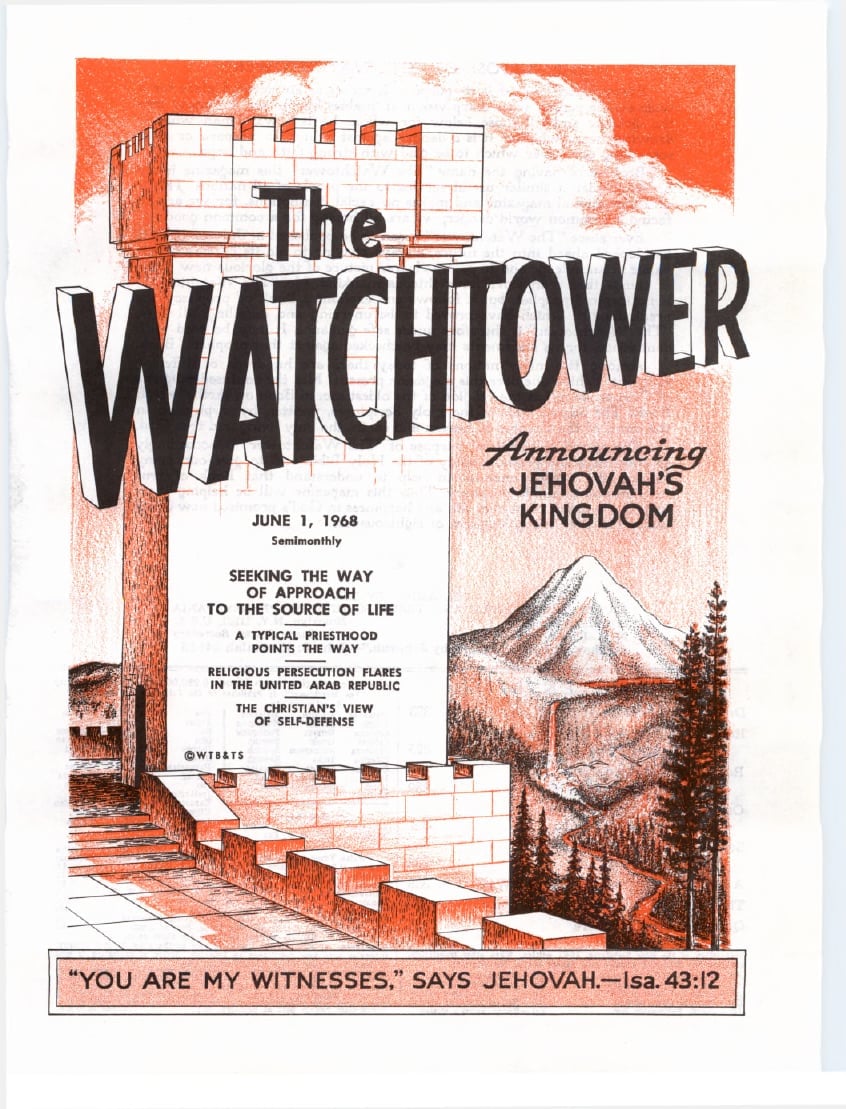
The Watchtower — June 1, 1968
Source: jw.org
Contents
Don’t Put It Off; Do It Now!
Religious Persecution Flares in the United Arab Republic
Results of Repeated Visits to One House
On the Joyful March to Mankind’s Millennium
Seeking the Way of Approach to the Source of Life
A Typical Priesthood Points the Way
The Christian’s View of Self-Defense
Questions From Readers
Announcements
Don’t Put It Off; Do It Now!
Don’t Put It Off; Do It Now!
HAVE we not all, at one time or another, made personal resolves to do something nice for someone we love very dearly? We promise ourselves that we are going to express our love and appreciation for that person, be it a friend, a marriage mate or our parents. We may plan to express our sentiments by means of a gift, a note, a verbal expression or some kind gesture. Yes, we want our loved one to know how much he means to us, how much we appreciate what he has done or is doing for us.
Such personal resolves are noble, for they reflect an unselfish frame of mind. However, it is one thing to make a personal resolve to do something and quite another to carry it out. This is because we may let other things cause us to keep putting it off. Unless we promptly carry it out while the desire is burning brightly in our hearts, we may find that we will be continually postponing it. This usually leads to our forgetting about our good intention or giving up the whole idea.
To avoid failing in this regard, we need to recognize that the complexities of modern-day living make our forgetting a good intention an easy course to follow. Matters do come up unexpectedly, some of which demand our immediate attention. However, by not letting small matters dictate our course of action, we will more likely fulfill our good intentions, much to the joy of our loved ones and ourselves.
The Holy Bible offers wise counsel on this matter. It says: “Always pursue what is good toward one another and to all others.” (1 Thess. 5:15) Notice that there is a need to pursue the doing of good, at all times making it our aim. Such counsel is given because humans tend to let other things crowd out this most desirable quality. Yes, we need to guard against the habit of postponing the doing of good to our loved ones and friends.
Further, procrastination or the putting off of matters for another time is nourished by the tendency to take things for granted. How is this? Well, let us say that a married couple has been planning for some time to have their aged parents over for dinner. However, something is always coming up that causes them to keep postponing it. Are they not taking for granted that they and their aged parents will be here next week or next month? Surely, and what does the Bible say about this? “You do not know what your life will be tomorrow. For you are a mist appearing for a little while and then disappearing.” (Jas. 4:14) How true that is! None of us knows what the next day will give birth to, let alone the next week.—Prov. 27:1.
Husbands and wives also need to guard against the complacent feeling of taking each other for granted. Take advantage of the numerous opportunities to do thoughtful little things for your closest companion in life. Do not get into the habit of delaying the doing of good that you plan for that one. One husband was left to care for two children when his wife suddenly died. He confessed that he took her for granted and now he wants so much to have the opportunity to tell her how much she meant to him and how good she was. What a lesson we can draw from his experience! In view of the transient nature of life, we should do now what we resolve in our hearts and not put it off.
To avoid putting off what we plan, we also need to guard against hobbling ourselves with the idea that we must make an elaborate gesture to express our sentiments. This, too, contributes toward postponing the fulfillment of our loving desires. Yes, planning to make it extraordinary may defeat our purpose. How? When little things come up that do not require much to accomplish, we will find ourselves tackling these and postponing the more complicated resolve.
Today there are many persons who are plagued with remorse and regret. Among them are those who never appreciated what they had until they lost it. Others kept putting off carrying out their noble intentions so long that suddenly death took away the object of their planned attention. They are haunted by memories of what could have been but was not. While it is too late to do anything to correct the matter now, such ones can learn from their experience. Yes, they can make changes, resolving never to let it happen again. Rather than torment themselves over the past unfulfilled resolves, they can positively take advantage of the opportunities they now have to do good to their living loved ones. The lessons here apply to all of us. We should do the good that we plan to do now while we have the opportunity. True, there is the hope of the resurrection, but we do not have to wait until then.
One daughter wisely responded quickly to her noble desire, and she wrote to her parents, saying: “Dear Mom and Dad. The Watchtower study yesterday was good. It caused me to reflect once again on my childhood and to give thanks to Jehovah for such wonderful parents who brought me up in the discipline and authoritative advice of Jehovah. Thank you both so very much. I appreciate it more and more as I grow older.” What joy that brought to her parents! How loving and wise not to hold back from telling your dear parents the deep appreciation you have for what they have done for you! Why not let them know now how much you appreciate their love, devotion and sacrifices for you?
Not only for our own good but for our own self-respect we need to overcome the tendency to put off doing things, especially that which is beneficial and good. We will be encouraged to do this if we keep in mind what God’s Word says about this. “Do not hold back good from those to whom it is owing, when it happens to be in the power of your hand to do it.” (Prov. 3:27) Have you resolved to do something kind for someone? Do not put it off; do it now!
Religious Persecution Flares in the United Arab Republic
Religious Persecution Flares in the United Arab Republic
THE London Daily Telegraph of April 14, 1967, reported: “Scores of Jehovah’s Witnesses have been rounded up and are being held in gaol [jail] pending trial or deportation, it was announced in Cairo today. The arrests were at the request of the Coptic Patriarchate. . . . A Cairo weekly published a photograph of 25 of those arrested including nine children, four of whom are under three.”
Thus, religious persecution flared again last spring in the United Arab Republic (previously called Egypt), and it still continues. Ceaseless harassment, loss of employment, arrests, confiscation of property, savage beatings, deportations, imprisonment in concentration camps—this is what sincere Christian families have experienced in this country during the past year. Mighty flames of persecution have been lit and continue to be fanned by malicious misrepresentation.
WHO IS RESPONSIBLE?
“The arrests were at the request of the Coptic Patriarchate,” the London paper reported. Yes, the churches of Christendom are particularly responsible. They have maliciously misrepresented Jehovah’s witnesses, and have long urged that official action be taken against them. As far back as March 17, 1955, the New York Daily News reported: “Roman Catholic and Greek Orthodox bishops today urged the Egyptian government to close down the Cairo branch of the American Watch Tower Bible and Tract Society on grounds that it is spreading Zionist propaganda.”
Finally, the government did this, officially banning Jehovah’s witnesses in the United Arab Republic on June 2, 1960. And what was the response of the churches? Note the answer given in the Arab weekly magazine Sabbah El-Kheir, of April 6, 1967:
“The opinion of the Egyptian Church was given right after the decree of banning of Jehovah’s witnesses. It says: ‘We congratulate the Minister of Social Affairs . . . and those government officials who stayed alert and suppressed this Society who are enemies of religion and who cause division and support Zionism. And we hope that they will pursue the rest of this Society into their holes and secret meeting places to put them out of existence forever.’”
The following week the Arab magazine Al-Mussawer interviewed Coptic priest Ibrahim Gabra, who was instrumental in having Jehovah’s witnesses banned eight years ago. He explained: “The High Court of Appeal as well as the Supreme Court confirmed the decree of banning this Society, based on the report I presented to the responsible ones at that time.” Then this priest asserted: Jehovah’s witnesses “are agents that Imperialism is using in defense of Israel . . . and [they] glorify the activity of Dr. Chaim Weizmann, the first president of Israel, and his efforts for the populating of Palestine with Jews.”—April 14, 1967.
MALICIOUS MISREPRESENTATION
What slanderous untruths! The claim that Jehovah’s witnesses are agents of imperialistic powers who seek to defend Israel is absurd. There is not the slightest evidence that they are Zionists, or are in any way working to support Zionism. In fact, Jehovah’s witnesses teach that efforts to establish a lasting Jewish political state in the Middle East are not in keeping with the fulfillment of Bible prophecy.
For example, back in 1958 Jehovah’s witnesses sponsored the widely delivered public Bible talk “Why Zionism Must Fail.” And an article published in The Watchtower of March 1, 1958, carrying that same title, said: “Zionism must fail because Jehovah is having nothing to do with it . . . Zionism is a part of this old world or system of things and therefore is doomed along with it.”
Also, The Watchtower of just last August 15 observed: “It is obvious today that modern Israel neither confesses Jesus Christ as Lord nor calls upon the name of Jehovah. It is not a religious, but a political state . . . it is evident that God is no longer dealing with the Jews as a nation.”
How clear, then, it should be that Jehovah’s witnesses are not supporters of Zionism! And how clear, too, that religious leaders have labeled them Zionists for the evil purpose of arousing Arab officials against them! Great difficulties were thus heaped upon Jehovah’s witnesses due to this wicked misrepresentation. They were closely watched by the secret police. Occasionally some were arrested, held for a few days, beaten, and released.
But then, during the fall and winter of 1966-1967, the pressures noticeably increased. In Alexandria alone, some forty Witnesses were summoned by officials and given warning to cease meeting together for Bible study and to stop speaking to others about the Scriptures. If they persisted, the officials threatened, they would be arrested and thrown into a concentration camp.
SEVERE PERSECUTION FLARES
On March 25, 1967, fifteen persons gathered in a private home in Cairo to celebrate the Memorial of Jesus Christ’s death. Suddenly four secret policemen and an officer belonging to the Cairo Investigations Department entered and ordered everyone to remain in his place. The house was searched and Bible literature was confiscated. Then all, except two younger children, were arrested and taken to the police station.
Through all of this the Witnesses remained calm. They knew that they were doing the right thing by meeting in obedience to Christ’s command to celebrate his death. (Luke 22:19) Al-Mussawer of April 14, 1967, observed: “The victims have a firmness of nerves that surpasses all description. When the agents of the fight against Zionism raided their last meeting, the night of the Jewish Passover, none of them was afraid.”
Down at the police station the officials sought to secure information from the prisoners as to how Bible literature is mimeographed and circulated among the Witnesses. When the Memorial speaker, Samir Yacoub Mikhail, refused to reveal this information, he was undressed, his mouth and eyes were banded, his feet and hands tied, and he was ordered to lie down on his belly. Then he was beaten unmercifully with a leather belt. This same brutal treatment was administered to sixty-four-year-old Nicola George Barghout, even though he suffers from Parkinson’s disease, which causes his right hand to tremble incessantly.
Finally, by such methods, the names of three persons, believed to be particularly responsible for organizing the activity of Jehovah’s witnesses, were obtained. It was decided to arrest these persons also. So four agents were sent out to bring them in. Little did these agents suspect the jolting surprise they were in for.
The report in Al-Mussawer explains: “At five o’clock dawn, a police car went out to arrest some other Jehovah’s witnesses, and at the cross-roads of Elfi and Emad el Din streets it was hit by a trolley bus.” The accident so shook up the men that they did not follow through with their plans to make the arrests, even though they were only a block from the home of two of the Witnesses. Apparently they believed that this accident might represent divine intervention in their plans.
Nevertheless, the thirteen Witnesses already under arrest were held for nearly two weeks. During this time they received little to eat and were kept in a small room with no beds or any normal comforts. After thirteen days, nine of them succumbed to the extreme pressures and hardships and signed a paper agreeing to cease attending meetings for Bible study and speaking to others about the Scriptures. These were women, youths and newly interested persons. They were released, while the four others were held.
These four were treated extremely bad. They were repeatedly flogged; very little food was given them, and no one was permitted to see them. On May 10 a court session was held, but the four defendants did not even attend! It seems that they had been so brutally beaten that the authorities did not want them to appear in court in such physical condition. Their lawyer protested vigorously, urging that they be brought in or the whole proceedings would be illegal, but to no avail. Another session was fixed for June 21, 1967, but it never took place. The defendants were thrown into a concentration camp!
PERSECUTION STEPPED UP
In the meantime, beatings, arrests and imprisonment of other Witnesses were taking place. In Cairo, Hanna Gad and his sister were summoned by the police one morning. He was severely beaten and ill-treated for three hours because he refused to sign a statement that he would discontinue being a witness for Jehovah. At 1 p.m. they were released in order to be given a final chance to think the matter over. That evening he was taken in again. But despite being stripped naked and beaten almost continuously for six hours, he did not renounce his faith.
In Alexandria, on the night of April 25, the police raided the home of Dr. Amin Mikhail Fanous and his wife, confiscating Bible literature and taking them to the police station. That same night Alphonse Michel Takla, his wife and eighteen-year-old son also were taken in. They, too, were fiercely beaten, including one of the women, because they refused to sign a declaration stating that they would not meet for Bible study or speak to others about the Scriptures. The next day all were released.
However, the following week these two couples were arrested and sent to the Hadara Penitentiary in Alexandria. Here all four were held until June 16, 1967, when the women were finally released, and the husbands were transferred to the concentration camp outside of Cairo. In this camp more than a score of Witnesses had been confined.
What precipitated the arrest and confinement of many Witnesses was the outbreak of the Israeli-Arab war the first week of June. At that time, one home after another of the Witnesses was raided, and the men were taken and thrown into the concentration camp.
CRUEL TREATMENT TESTS FAITH
Here in the camp Jehovah’s witnesses were cruelly treated. A principal reason is that they refused to share in the patriotic cries commanded by camp officials, such as: “Long live the president Gamal Abdel Nasser.” “Long live the United Arab Republic.” “Let Israel fall,” and so forth. The Witnesses showed from the Scriptures why they must remain neutral and not become involved in political affairs. They explained that to participate in such patriotic cries would be a violation of their Christian neutrality.—John 17:16.
Thus, the very night that Amin Mikhail Fanous and Alphonse Michel Takla arrived at the camp, they were viciously beaten for not giving the patriotic cries when ordered to do so. Amin, an elderly man, was struck so hard around the head that his vision became blurred. However, such brutal, inhuman treatment of the Witnesses became a common occurrence.
One of the methods of torture was to have the victim lie down with his face to the ground, and to raise his feet up. He was then beaten upon the back and feet. On one occasion this was done so ruthlessly that one of the prisoners looking on fainted. It was more than he could stand to see. Because of such treatment, even a few of the Witnesses succumbed to fear, and consented to shout the patriotic sayings in order to avoid the beatings.
However, the many Witnesses who faithfully endured proved that with trust in Jehovah it was possible to keep integrity to Him even under these severe tests. For example, the Witness who suffered the vicious beating that caused another prisoner to faint explains in what a wonderful way he was strengthened and comforted:
“While I was lying on the ground being beaten I was praying to Jehovah to help me endure this torture. I was very happy because Jehovah, the Almighty God, helped me. Afterward, I wet a handkerchief with water and put it on my back to absorb the heat. After three days I was in a very good condition, as if I had not been beaten on my feet or on my back. This was due to the help of Jehovah and the care shown to me by the brothers.”
Another Witness, who regularly visited congregations as a traveling representative before being put in the concentration camp on June 7, also observed: “Regardless of the amount of insulting and beatings that we received, a few seconds would pass and we would not feel anything more even though the beatings continued. We were feeling that Jehovah God was always with us.”
Yes, Jehovah did indeed prove to be with his faithful servants; his name is without question like a strong tower into which they can run for protection. (Prov. 18:10) When his people in the camp placed their trust in him, he made the way out so that they were able to remain steadfast. Even the severe pain of the beatings was softened, making it possible for them to endure savage treatment—to the amazement of camp officials and other prisoners.
A real witness was thereby given to the hundreds of prisoners and officials in the concentration camp. One of them told a Witness: “I am very happy to know persons who remind me of the early Christians and who are ready to endure all persecution for the sake of the faith. I will teach my children that in the concentration camp there were true Christians in the full sense of the word, and that these are Jehovah’s witnesses.”
The Witnesses appreciated fully that it was not by their own strength that they were able to endure, but that it was by the strength that comes from God. Therefore, they did not neglect a study of his Word, even though their Bibles had been taken away from them when they entered the camp. One of them explains how they arranged to take in the strength-giving spiritual food:
“Each morning we would discuss an appropriate Bible text, selecting one that would be encouraging to the brothers. We would also select two chapters from the Bible to talk about. Then each of us would draw from our memory the information we could remember from these chapters. Each evening, too, we would gather for a Bible talk. These daily Bible discussions and talks indeed proved strengthening to us. We also used to encourage one another with 1 Peter 5:8, 9, in order that we might not fail, but continue walking on the road to life.”
Finally, on November 14, 1967, after more than five months of confinement for most of them and even longer for some, the Witnesses were released. However, even after returning to their home cities, some were subjected to savage beatings by local officials because they refused to sign a declaration stating that they would cease serving as witnesses for Jehovah. And until this day, even though out of the concentration camp, they and their fellow Witnesses are constantly threatened and harassed by officials.
IS FREEDOM OF WORSHIP PROHIBITED?
A person might naturally assume from this account of religious persecution that freedom of worship is prohibited by the Constitution of the United Arab Republic. But it is not! To the contrary, observe these fine Constitutional guarantees:
Article 33: Homes have their sanctity and they may not be entered, except in the cases, and in the manner, prescribed by the law.
Article 34: Freedom of belief is absolute. The State protects the freedom of the practice of religion and creeds in accordance with custom provided this does not infringe upon public order or conflict with morality.
Article 35: Freedom of opinion and scientific research is guaranteed. Every individual has the right to express his opinion and to publicize it verbally or in writing or by photography or by other means within the limits of the law.
Article 36: Freedom of the press, printing and publication is guaranteed within the limits of the law.
Article 37: Egyptians have the right to peaceable assembly, without carrying arms and without the need for prior notice.
Also, the United Arab Republic is a member of the United Nations, and has endorsed the Universal Declaration of Human Rights, which upholds the right of all persons to freedom of thought, conscience, speech, religion, and peaceful assembly.
Does the United Arab Republic really stand behind these guarantees provided by her own Constitution and by the Universal Declaration of Human Rights? Or are they simply pleasant-sounding promises? Will President Nasser and his government officials endeavor to defend the constitutional rights of religious minorities? Or will they continue to be influenced by the obviously false charges of religious leaders that Jehovah’s witnesses are politically dangerous Zionists?
WHAT YOU CAN DO
If you are appalled by the religious persecution of Jehovah’s witnesses in the United Arab Republic, you can inform President Nasser and other prominent officials how you feel. At times those in positions of responsibility are unaware of the extreme injustice and brutality of some of their subordinates. You can also let them know about the activity of Jehovah’s witnesses in your own country; how it is carried on openly and constitutes no political threat. It is your privilege to speak out in behalf of those in the United Arab Republic who have been maliciously misrepresented and cruelly persecuted because of their religious faith. Address your appeal to:
Mr. Gamal Abdel Nasser
President of the United Arab Republic
Cairo, U.A.R.
Mr. Hussein El Shaffei
First Vice-President of the
United Arab Republic
Cairo, U.A.R.
Mr. Diaeddin Mohamed Daoud
Minister of Social Affairs
Cairo, U.A.R.
Mr. Abdul Mohsen Abul Nur
Minister of Local Administration
Cairo, U.A.R.
Mr. Mahmoud Riad
Minister of Foreign Affairs
Ministry of Foreign Affairs
Cairo, U.A.R.
Mr. Shaarawy Mohamed Gomaa
Minister of the Interior
Ministry of the Interior
Cairo, U.A.R.
Mr. Mohamed Fayek
Minister of National Guidance
Ministry of National Guidance
Cairo, U.A.R.
Mr. Mohamed Abu Nosseir
Minister of Justice
Ministry of Justice
Cairo, U.A.R.
Dr. Sarwat Okasha
Minister of Culture
Ministry of Culture
Cairo, U.A.R.
Results of Repeated Visits to One House
Results of Repeated Visits to One House
IT IS remarkable that a Christian minister would call almost continuously for some fifteen years to conduct Bible studies with the people of one house. However, in Akron, Ohio, this is what has occurred, as is explained:
“About fifteen years ago when I was preaching from house to house I placed the Bible-study aid ‘Let God Be True’ with a lady. I soon began a home Bible study with her, and after two years she was baptized in symbol of her dedication to serve Jehovah God. However, in time, this lady moved out of the house.
“Later, as I was again making ministerial calls in this neighborhood, I met the new tenants. These included a man, his wife and their children. This family, too, agreed to a Bible study, and we again used the study aid ‘Let God Be True.’ They progressed in Bible knowledge, and later the man dedicated his life to serve God. But this is not all.
“After a little while I was able to start a Bible study with several young people who had moved into the house. The message fell upon receptive hearts, because two of the young men finally symbolized their dedication to Jehovah God by water baptism. One of them eventually became a full-time pioneer minister.
“You might think that there could not possibly be anymore response from that one house. However, new tenants moved in, and one Sunday morning I was making ministerial calls in the neighborhood with my daughter. I said to her: ‘If anyone invites me in, I believe I will start a Bible study.’ The lady of the house invited us in, saying that she wanted to see Jehovah’s name in the Bible. A Bible study was started in the ‘Let God Be True’ book, and the householders progressed to the point that they dedicated their lives to God and were baptized in 1966.
“Still, this is not quite all. You see, there are now new tenants living in that house. And, recently, while making ministerial calls in the neighborhood I placed the Bible-study aid ‘Things in Which It is Impossible for God to Lie’ with the occupants, a man and his wife. I am now holding a home Bible study with them.”
On the Joyful March to Mankind’s Millennium
On the Joyful March to Mankind’s Millennium
AMONG the precious promises the Scriptures contain for the faithful footstep followers of Jesus Christ is the one found at Revelation 20:6: “Happy and holy is anyone having part in the first resurrection; over these the second death has no authority, but they will be priests of God and of the Christ, and will rule as kings with him for the thousand years.”
Are these thousand years to be understood literally or figuratively, and when do they take place? If anyone should know, it certainly would be the apostle John, to whom Jesus Christ revealed these things. And how did John view the thousand years? According to the testimony of Papias, a disciple of John, John believed these thousand years to be literal and in the distant future.a
The prospect of ruling as kings for a thousand years did not make Jesus or his faithful apostles anxious to rule before Jehovah’s due time, as was the case with some of the Christians at Corinth, whom the apostle Paul had to reprove. (Matt. 4:8-10; John 6:15; 1 Cor. 4:8-10) However, after the apostles fell asleep in death, grievous wolves entered into the Christian sheepfold, even as foretold. In time professed Christians were no longer willing to wait for a future rule of a thousand years but desired to rule as kings at once, in particular the bishops of Rome.
Thus it gradually came about that the teaching of Augustine prevailed. He taught that the thousand-year reign of Christ was figurative. But in what did their yielding to the temptation to rule as kings before God’s due time result? A glorious Messianic rule? Far from it! Instead, it brought about the Dark Ages!
Arguing against a literal future millennial rule by Christ, some have claimed that such a teaching would chill the missionary ardor of Christians to make disciples of all nations. (Matt. 28:19, 20) But not so! Today no people are more zealous in carrying out this missionary commission than are the Christian witnesses of Jehovah, who believe that the 1,000-year reign of Christ is literal and future. In comparatively few years these have grown to more than a million. Today they are carrying out this commission in 197 lands and islands of the sea and that in 169 languages. Last year they devoted 184 million hours to this work!
And no wonder. What good news they have to tell the people! They proclaim the good news that the millennial rule of Christ will begin with this generation and that it will mean ever so many blessings for the people: the binding of Satan and his demons for a thousand years; having a righteous heavenly government in full control of earth’s affairs. It will be an earth-wide rule of peace and prosperity; all mankind will learn righteousness. Even all the dead in Hades will be brought back to benefit from that Kingdom rule. Eventually there will be no more death, neither sorrow nor pain, neither mourning nor crying.—Isa. 26:9; Rev. 20:13; 21:4.
All who have made this hope truly their own might be said to be on a joyful march, in a victory procession, to mankind’s millennium, even as described at Psalm 68:24-28.b Yes, ever since 1919 the Christian witnesses of Jehovah have been marching in such victory processions. What victories Jehovah God has given them over their enemies, as can be seen by favorable court decisions and their great prosperity spiritually and numerically! And even as the women in ancient Israel played a prominent role in the victory processions, so today we find women have gained a prominence that cannot be overlooked or go unmentioned.—Ps. 68:11.
As Jehovah’s people share in this victory procession they keep feasting on God’s Word both privately and with one another at their congregational meetings and larger assemblies. At the same time they try to conduct themselves now as they know all will have to do when mankind’s millennium prevails under the beneficent rule of Jesus Christ and his Kingdom associates. More than that, they invite others to join them in this joyful march to mankind’s millennium by going from house to house, making return visits, conducting Bible studies, and incidentally as they have opportunity. And doing so gives them even more joy than did receiving the good news that was brought to them in the first place!—Acts 20:35.
[Footnotes]
For details see The Watchtower, April 15, 1967.
For details see The Watchtower, November 1, 1967.
Seeking the Way of Approach to the Source of Life
Seeking the Way of Approach to the Source of Life
“He decreed the appointed seasons and the set limits of the dwelling of men, for them to seek God, if they might grope for him and really find him.”—Acts 17:26, 27.
1. (a) Since Adam’s failure, about what have God-fearing persons wondered? (b) Why has Jehovah appeared to be so distant from them?
EVER since our first parents were driven from the garden of God into the unfinished wilderness the way of approach to the great Source of life has engaged the thoughts of God-fearing men and women. How to draw near again to their grand Creator and enjoy with him the intimate relationship originally enjoyed by Adam has been a matter of first importance to those of reverent mind. Such persons have somehow realized the truth that was later expressed by one of God’s prophets: “You [Jehovah] are too pure in eyes to see what is bad; and to look on trouble you are not able.” The memory of those cherubs stationed at the east entry of Eden with “the flaming blade of a sword” would long continue as a reminder to man that only cleansed and purified creatures can safely approach him. Moses later reminded the people of Israel about this when he declared: “Jehovah your God is a consuming fire, a God exacting exclusive devotion.” The imperfections and uncleanness of fallen man rendered him liable to the destructive fire of Jehovah’s just judgment of death. How could he ever safely draw near to the “long-lasting conflagrations” of the holy Sovereign of the universe?—Hab. 1:13; Gen. 3:24; Deut. 4:24; Isa. 33:14.
2. What has Jehovah done about man’s estrangement from him?
2 Man, left to his own devices, could never have discovered an acceptable way of approach to the Creator. Happily, he has not been left on his own. Jehovah demonstrated his great compassion for his handicapped creatures in that he prophesied about the eventual triumph of righteousness and at the same time held open for humans a means of communication with himself. In Eden there had been the “covering cherub,” who doubtless had some responsibility in the matter of protecting and promoting the interest of pure worship on earth. God now continued to use angelic intermediaries, offering ample evidence of the fact that he “makes his angels spirits, and his public servants a flame of fire.”—Gen. 3:15; Ezek. 28:14; Heb. 1:7.
3. What examples have we of Jehovah’s provision for communication with imperfect humans who seek him?
3 For example, it was by the hand of an angel that appeared to him in the burning thornbush that Moses was commissioned to be the ruler and deliverer of Israel. And on the occasion when Gideon received the divine appointment as liberator and judge, the angel messenger caused fire to come down and miraculously consume the proffered sacrifice. The heavenly messenger who appeared to Samson’s parents to announce the birth of a most unusual son, after delivering the good news, ascended in the flame of the altar upon which Manoah and his wife were rendering up a burnt offering to Jehovah. Back in Lot’s day it was angels who served as rescuers of that godly man and his daughters, when flaming destruction came upon the cities of the District. These are instances of God’s provision for godly humans to be in communication with him.
4. In what variety of ways has Jehovah employed angel messengers to lovers of righteousness?
4 The Bible’s accurate record reveals angels as ministering in a great variety of ways to the needs of man and the worship of God. They delivered and taught God’s words to humans (Luke 1:19); they drew near to God’s presence on behalf of humans (Matt. 18:10); they kept close watch over the divine interests here at the earth, reporting developments to the Sovereign Ruler. (Dan. 10:12-14; Zech. 1:10) And in vision they have appeared to favored humans, under compact symbol of four living creatures or in their countless myriads, congregated in the heaven of heavens before the King of eternity, worshiping him with paeans of thanksgiving. (Dan. 7:10; Rev. 4:6-8) We can be most thankful to Jehovah that mankind has not been cut off altogether from communication with him.
5. How did Jehovah show his approval of a righteous patriarchal system among men on earth?
5 The vital role of angels in linking man with God, while also shielding sinful man from direct exposure to the unmitigated justice of God, was doubtless impressed upon Jacob when he was privileged to behold in his dream a great ladder reaching from earth to heaven with angels ascending and descending upon it. Jacob was but one of a succession of faithful patriarchs or heads of families to whom Jehovah communicated his will and purpose through angelic ministers. Indeed, this very fact stamps Jehovah’s approval upon that ancient patriarchal system whereby men were to spread out in their family groups and populate the whole earth. Under that system the father of a family or tribe became its prince and priest, responsible for proper conformity to Jehovah’s principles of just rule and clean worship. As prince and priest each worthy family head would take the lead in dispensing justice patterned after God’s just dealings, in maintaining clean worship, offering sacrifices on behalf of the family, and in a general way serving as God’s representative to the family and mediating before God in its behalf.
6. What are some of the basic ideas connected with the Hebrew word that is translated “priest”?
6 The Hebrew word kohén, from which our word “priest” is rendered, is uncertain as to its derivation. To a certain scholar kohén contains the idea of “doing the business of, or acting as a mediator for, another.” The word signifies “priest” and, in some contexts, a “lieutenant; chief minister or official.” (2 Sam. 8:18; 1 Chron. 18:17) A related Arabic word means “to approach, draw near, have intimate access to.” A related Babylonian word has the meaning “votive, offering homage to the Deity.” Another authority states that the word “priest or president was a title often conferred upon princes and kings, something or someone consecrated to the Deity.” Noah, Shem, Abraham, Jacob, Job and Amram are but a few of those early patriarchs who presided faithfully in their respective families and at the same time showed concern for the interests of pure worship, but the Bible does not call them by the name “priest,” kohén (Hebrew) or hieréus (Greek).
INTRUDERS AND USURPERS
7. Name some of the ways in which Nimrod operated contrary to Jehovah’s will.
7 There were, however, those who greatly debased and abused the office of patriarchal religious head, and who rendered themselves unfit truly to represent the holy and loving Creator. They used the office for their own personal aggrandizement, and to leave behind them what they thought to be imperishable monuments of their own personal fame. Nimrod stands out as an early example of such ones who follow the Devil’s lead and strive to divert from God to themselves the worship and service of fellow creatures. It appears that he was not a firstborn son, and so very likely he usurped authority and position properly belonging to older sons of Cush. His contempt for the patriarchal arrangement may be seen in his invading and subjugating neighboring families and tribes, and by his herding men into compact and easily controlled city organizations.—Gen. 10:7-12.
8. What facts about Assyria and Babylonia indicate an example set by Nimrod?
8 Flouting God’s purpose for man, Nimrod instituted a religio-political dictatorship, with himself as chief of state. Relative to the working out of his ambitions and those of his successors, we have this historical note: “The theory of the ‘divine right of kings’ was rigidly adhered to in Babylonia and Assyria. When the monarchs speak of themselves as nominated by this or that god to be ruler of the country, this was not a mere phrase. The king was the vicar of the deity on earth, his representative who enjoyed divine favor and who was admitted into the confidence of the gods. In earlier days priestly functions were indissolubly associated with kingship. The oldest kings of Assyria call themselves ‘priests of Asshur.’”a
9. How does Egypt’s history bear out the fact that proper patriarchal rule was not practiced?
9 Nimrod’s course became the pattern for ambitious men in all those families who later migrated in all directions from Babylon when Jehovah confounded the language of the tower builders. (Gen. 11:5-8) Of the Pharaohs, we read: “The King remained in Egypt the only representative between gods and men. Even when the priesthood developed, and offerings were continually made to the gods on behalf of mankind, the priests were not the mediators, for they merely represented the King. . . . The priests offered sacrifices, approached the gods, mediated between man and god solely in the name of the King.”b
10, 11. Is Nimrod’s example to be noted in other lands?
10 As to the ancient empire of the Incas in the land we now know as Peru, scholars point to evidence showing that this line of rulers replaced an earlier system of belief embracing the idea of a supreme Being, Creator of all things. The new system “was founded in the particular interest of the royal family, and directed mainly to the support of their pretensions and authority. By means of it, they invested themselves with a power firmer and more extensive than that of the most powerful aristocracies of the East.”c “The priesthood was a complex hierarchy, which was headed by the Inca emperor, who was so divine that his sister alone was sufficiently sacred to be his wife. Principal positions under the emperor were held by members of the royal Inca family.”d
11 India’s history shows the same deterioration from patriarchal arrangements, for, in describing the ruling caste, one historian records that “they alone are qualified to superintend religious observances, and without them the intercourse between man and the gods cannot be kept up. From his birth the Brahman is a being of a superior holiness; he is destined to higher ends than other men, and the distinction between him and them must be manifested in all his acts and habits throughout life. He is the natural lord of all the classes.”e
12. What did selfish rulers constitute themselves?
12 Thus we note how throughout the earth selfish human creatures set themselves up as obstacles rather than mediators between God and man, and declared that only through their intercession and at their pleasure could men ever attain to the favor of heaven. By manipulation of mysterious religious power they have been able to establish and maintain oppressive rulership over their fellowmen. History books are filled with the record of the cruelties and miseries that have been heaped upon the enslaved subjects of those autocrats who masqueraded as ministers of righteousness.
FAITHFUL PATRIARCHS
13. Explain whether Noah measured up to God’s requirements for patriarchal priests.
13 By comparison, how refreshing to turn to the record of faithful patriarchs who discharged their responsibilities with honor to God and blessing to men! Consider Noah, for example. At birth it was prophesied of him that he would bring comfort to his family, and subsequent events proved that prophecy true. He was a seeker after God, so much so that he found great favor in Jehovah’s eyes. He showed himself anxious to attain to the righteousness of God, he dealt faultlessly with his fellowmen in contrast to Nimrod’s evil way, and he walked with God in humility. He was a preacher of righteousness to his contemporaries, so giving evidence of a deep concern for the welfare of humankind. Though ignored and ridiculed by the majority, he was blessed to see his own family respond to the teaching he had given and survive with him the global catastrophe. Coming forth from the ark of survival, he faithfully exercised the priestly function by conducting worship and offering grateful sacrifice to Jehovah for himself and his family.—2 Pet. 2:5; Gen. 8:20.
14. What are some of the facts about Abraham showing that he was anxious to carry out Jehovah’s will as to family heads?
14 Abraham’s history reveals him as an outstanding family head with a keen sense of his religious responsibilities, even though he was not the firstborn son, particularly from the moment when, his father Terah having died, he led his household into the land about which God had spoken to him. When Jehovah confirmed with him the covenant whereby his offspring were to possess the land of his sojourning, Abraham was called upon to perform priestly duties, setting in order the slain sacrifices. (Gen. 15:9-18) Again when he had raised a promising son and heir in his old age, by reason of God’s miraculous intervention, and then was commanded to sacrifice that only son, we see him in action as a family priest. Throughout his travels he raised altars for the worship of Jehovah, publicly calling upon the holy name of his God so that the peoples then in Canaanland got to hear about the true God. He also faithfully taught his household to reverence and love the Sovereign God. Remember, too, how he exercised the function of mediator when pleading with Jehovah on behalf of possible righteous inhabitants of the wicked city of Sodom near Gomorrah.—Gen. 12:8; 13:18; 18:19, 22-32.
15. What kind of a priest was Melchizedek?
15 We next encounter the record of Melchizedek. Here is one of whom the Bible gives no genealogy, nor any account of the length of his life or the time of his death. But he is the first one in the Bible to be called “priest,” specifically “priest of the Most High God,” from which we may conclude that he loyally maintained in the kingdom of Salem the worship of the true God, keeping separate from the filthy, degrading religious practices of the pagan Canaanites round about. He went out to meet and bless the victorious Abraham as he returned from the rescue of Lot. There is no doubt that he was directed by Jehovah to do so, and, indicating that Abraham also so understood the situation, that patriarch rendered to the priest-king of Salem a generous share, a tenth, of all the spoils he had taken from the defeated combine of kings from the north.—Gen. 14:18-20.
16, 17. What was pleasing to Jehovah about the course of Isaac and Jacob?
16 Isaac and Jacob both held tenaciously to the teaching of Abraham, each one in his own generation demonstrating loyalty to his ‘anointing’ from God, his commissioning to have some share in the preparation and building up of a seed or holy nation that would eventually inherit the land of promise. They were continually directed and protected by Jehovah as his special representatives. Of them, the Bible tells how Jehovah kept his eyes upon them for good: “He did not allow any human to defraud them, but on their account he reproved kings, saying: ‘Do not you men touch my anointed ones, and to my prophets do nothing bad.’” (Ps. 105:14, 15) They, for their part, kept strictly to God’s will for them, namely, to remain in the land as temporary residents, in contrast to the greedy, materialistic squatters in Canaan. They presided over and promoted true worship in their households. Wherever they went they presented a highly commendable reflection of the God they worshiped.
17 In his early manhood Jacob is described as “a blameless man, dwelling in tents.” (Gen. 25:27) That he, although not the firstborn son, had a high regard for the blessing and favor of Jehovah, and at the same time discerned the complete indifference of his brother Esau in such matters, may be understood from the bargain he made for possession of the birthright. Material advantage would not loom so large in his mind as the precious privileges and responsibilities that would properly devolve upon the heir to faithful Isaac. Jacob’s deep appreciation for all the protective care that Jehovah had thrown around him through all his times of trouble prompted him to vow one-tenth of his income regularly for the service of true worship. (Gen. 28:22) Not least among the special pronouncements of God given through this faithful representative were the blessings upon his sons just prior to his death.—Gen. 49:1-28.
18. How did Reuben disqualify himself from birthright privileges, and with what result?
18 According to patriarchal custom his firstborn son, Reuben, should have been the one to inherit the birthright in Israel. However, Reuben disqualified himself when he committed fornication with his own father’s concubine, the mother of some of his brothers. Thus he showed utter disregard for the sacred relationships right inside his father’s household. He was therefore unfit to give the proper lead as holder of the birthright. (Gen. 49:4) So, the double portion of the birthright went later to Joseph, rulership went to Judah, and the priesthood to Levi’s house. Even when Reuben’s descendants, Dathan and Abiram, endeavored in Moses’ time to assert the forfeited right of rulership, Jehovah acted swiftly to uphold his word given through Jacob. Those Reubenites paid with their lives for daring to challenge Jehovah’s prerogative to debase those who displease him and exalt those who bring him pleasure.—Numbers chap. 16.
19. What can we conclude about Job from the record of his experiences?
19 As one whose patience and godliness were truly put to the test by a combination of calamities that left him childless, friendless and suffering the excruciating pains of disease, Job shines forth as another true worshiper of God. To family and acquaintances he recommended the worthiness of his God, never charging him with folly in permitting the terrible blows Job had sustained. Unlike faithless priests of ancient and modern times he did not charge God with wrong in permitting wickedness. Even in his earlier state of prosperity he had always kept in mind the status of his children before God, diligently offering sacrifices on their behalf, just in case, as he himself said, “my sons have sinned and have cursed God in their heart.” (Job 1:5) When subjected to the slanders of his opponents he upheld the justice and the name of Jehovah. Finally, when Job was healed and delivered from all his troubles, the lives of his sharp-tongued critics depended upon his prayer for acceptance of the sacrifices of their repentance before God. The latter end of Job assuredly shows that he had pleased Jehovah in his service as priest and family head.—Job 42:8, 12.
20. Give the facts of Moses’ life that prove him to have been a faithful promoter of God’s purposes.
20 At the advanced age of eighty years Moses was commissioned by Jehovah’s angel to be prophet, deliverer, ruler, mediator and priest to the nation of Israel. (Ps. 99:6) His first assignment was to lead that typical nation out from Egypt’s bondage. As mediator between his stiffnecked fellow Israelites and Jehovah he had to step in, time and again, to deflect the devastating blows that Jehovah contemplated dealing out to a disobedient and ungrateful people. (Ex. 32:10-14; Num. 14:11-19) In this capacity also he mediated God’s covenant with the nation while yet no other provision had been made for a national priesthood. As a dependable messenger he communicated the whole counsel of God to the people, and insisted upon their compliance with the divine requirements. He spent himself willingly in the work of administering justice in their huge encampments. He was zealous in the defense of right worship and swift to act against those who impaired it. With all his responsibility and the God-given privileges he enjoyed, there is not a hint of selfish ambition to be found in the record concerning him. He could still be called “by far the meekest of all the men who were upon the surface of the ground.”—Ex. 18:17, 18; 32:32; Num. 12:3.
21. What choice did Moses have, and what proper choice did he make?
21 Moses, be it remembered, had been educated in all the wisdom of Egypt at the court of the Pharaoh. He had had opportunity to observe the priestly orders of that land with all their schemes for controlling the people and enriching themselves, while always upholding the oppressive ruler as the favored one of the gods. Even though the road of personal ambition might have brought him wealth and power in Egypt, he chose to identify himself with the people of Jehovah and accept the reproaches that must have been leveled at a people whose God had not even provided them with a country, of their own. Little did Egyptian scoffers realize what was in store for them and their proud land.—Heb. 11:24-26.
22. Though Jehovah continued to communicate through angels with lovers of righteousness, what questions called for answers, and what hope for approach to God was there?
22 Up to Moses’ time the favor of communication with the Creator with the help of angelic messengers was limited to but a few godly households. While this served to keep alive the belief in a great and beneficent God, yet there were so many questions unanswered. How could imperfect men become reconciled to their pure Creator? Would the barrier between them and God, that perfect angels and loyal but imperfect patriarchs had been unable to remove, ever be set aside? How could bondage to sin and death be removed? Would the generations of man just continue, like the grass, to sprout up and remain for a short time and then die? The faithful family heads themselves must often have pondered such questions as they looked up at the night sky and realized some of the immensity of God’s creation. They could but wait patiently until Jehovah revealed his purposes to them step by step. He had given his servants advance notice of the great Deluge, of the destruction of the land of Sodom and of certain deliverance from the land of Egypt. They did have a God who could and would fulfill his word. Surely that was sufficient basis for hoping that in due time He would reveal the way of approach to life and peace with Him!
[Footnotes]
Religion of Babylonia and Assyria, by M. Jastrow, p. 374.
Ancient Religions (1750 ed.), edited by V. Ferm, pp. 37, 293.
Harper’s New Monthly Magazine, June 1853, “Ancient Peru—Its People and Its Monuments.”
Ancient Religions (1750 ed.), edited by V. Ferm, pp. 37, 293.
History of Religion, Allan Menzies, p. 337.
[Picture on page 333]
In a dream Jacob was shown that angels have a part in God’s communication with man
[Picture on page 336]
Noah led his family in worship
A Typical Priesthood Points the Way
A Typical Priesthood Points the Way
“Israel is my son my first-born . . . a kingdom of priests and a holy nation.”—Ex. 4:22; 19:6.
1. In Moses’ time how did Jehovah refer to the people of Israel, and under what circumstances?
IN THE eighth generation from Abraham (to Nadab son of Aaron) his seed had grown to be a throng numbering into the millions, but serving as slaves to a harsh taskmaster, Pharaoh of Egypt. Their numbers had already exceeded the native population, so jealous fear dictated a policy of reduction through hard bondage. At this critical point Jehovah’s angel appeared to Moses at the burning thornbush and informed him: “Unquestionably I have seen the affliction of my people who are in Egypt, and I have heard their outcry as a result of those who drive them to work; because I well know the pains they suffer. And I am proceeding to go down to deliver them out of the hand of the Egyptians and to bring them up out of that land.” He instructed Moses to say to Pharaoh: “This is what Jehovah has said: ‘Israel is my son, my first-born. And I say to you: Send my son away that he may serve me. But should you refuse to send him away, here I am killing your son, your first-born.’”—Ex. 1:8-10; 3:7, 8; 4:22, 23.
2. Did Jehovah give proof of his being a God to the Israelites? How?
2 Pharaoh did prove foolhardy enough to refuse compliance with the demand for release of Jehovah’s firstborn, his people Israel, and so he had to pay the penalty. With a mighty hand Jehovah delivered his people, and in doing so smote the land of Egypt with heavy blows that doubtless crippled that nation for many decades. Not only were the cattle and crops severely damaged by a series of calamities, but the firstborn of every household and of every beast were slain by Jehovah’s angel, and finally the flower of Egypt’s warriors together with their horses and chariots were engulfed in the returning waters of the Red Sea. Jehovah could therefore with truth declare: “It was I who brought Israel up out of Egypt and who went delivering you from the hand of Egypt.”—1 Sam. 10:18.
3. What grand opportunity did God place before the people of Israel?
3 In the third month following that great liberation Jehovah’s firstborn people were encamped before Mount Sinai, and through his prophet Moses Jehovah there declared to them: “You yourselves have seen what I did to the Egyptians, that I might carry you on wings of eagles and bring you to myself. And now if you will strictly obey my voice and will indeed keep my covenant, then you will certainly become my special property out of all other peoples, because the whole earth belongs to me. And you yourselves will become to me a kingdom of priests and a holy nation.” (Ex. 19:4-6) Think of that! A nation of priests, and Jehovah’s firstborn, implying that they would constitute but the first of a family of nations that Jehovah would come to have! And this particular “son” would be highly distinguished as a priestly nation that in due time might have the privilege of representing all other national groups before Jehovah. This holy nation was to be heir of Jehovah’s blessings in a special sense, so that through it benefits might go to all other peoples in accord with God’s promise to faithful Abraham.—Gen. 22:18.
4. With what provisions did Jehovah arrange to weld the tribes of Israel into a theocratic nation?
4 With fascination, then, we go on to consider how God began to deal with this nation he was pleased to designate as his firstborn. From a loose association of tribal groups they were now to become one nation under theocratic rule, God-rule. To promote this purpose, a special arrangement was made for a system of national worship. To the requirements of pure family worship, already familiar through the instruction of faithful patriarchs, there were now to be added certain new and unique features, namely, a holy place of central worship, a priesthood, and regulations governing pure national worship of Jehovah their great Deliverer.
5. Why should we expect that the details of construction of the tent in the wilderness would be important?
5 The pattern Moses followed in construction of a portable temple or holy place was not based upon something that prophet had seen in Egypt. It was given him by Jehovah, for God’s angel messenger counseled Moses: “And see that you make them after their pattern that was shown to you in the mountain.” In view of this the details of this pattern were sure to be bound up with deep and significant implications for the future, particularly when we realize that this tent was but a temporary provision for the period of their journeyings on the way to the land promised to Abraham their forefather.—Ex. 25:40.
6. Describe the construction and the furnishings of the tent.
6 The curtains draped on posts around the courtyard of the tent separated that holy place from the surrounding encampment of the Israelites. The tent itself was divided into two parts, one of which was in shape an exact cube. This was the innermost or Most Holy compartment. It was screened from the anterior room by a curtain of beautifully embroidered material. Behind that curtain there was but one item of furniture, the ark of the testimony, with its lid of solid gold intricately fashioned into the shape of a throne-seat overshadowed by cherubims with outspread wings. Inside the Ark itself were the tablets of the Ten Words written by the finger of God, and, later, a sample of the manna from heaven in a gold container, as well as the almond rod that testified to God’s selection of Aaron’s house for the priesthood in Israel. In the front compartment there were a table for showbread, a lampstand of gold and an altar for incense. In front of the tent stood the large copper washbasin, while between it and the gate of the courtyard was located the large altar of sacrifice. Whether the nation was in camp or on the march, this holy place of worship was handled exclusively by a specially selected and sanctified priesthood.—Exodus chaps. 25, 26, 27.
A REPRESENTATIVE PRIESTHOOD
7. In what ways was the tribe of Levi particularly blessed and honored by Jehovah?
7 Jehovah directed his mediator Moses to form a priesthood that would be representative of the entire nation. Aaron and his male offspring were selected as a special priestly family through which a succession of high priests would be assured. Heretofore, under patriarchal provisions, the firstborn sons would have been in line to perform as priests, each one in behalf of his respective family group. Now, however, Jehovah directed that the entire tribe of Levi was to substitute for the firstborn of all Israel, and was to be formed into the congregation or tribe of the firstborn under the direction of the family of Aaron. (Num. 3:41) Their forefather Levi had been involved with Simeon in presumptuous and vengeful violence, for which they were to suffer. However, when Moses called for volunteers to serve as executioners against stubborn and idolatrous fellow Israelites, the tribe of Levi responded promptly. Now, see how Jehovah marvelously blessed them! As a tribe they were now privileged under Aaron to take the lead in matters of worship, just as did faithful firstborn sons or heirs under patriarchal custom.—Gen. 49:5-7; Ex. 32:25-29; Num. 3:5-51.
…