The Watchtower, August 15, 1967
Download: PDF — The Watchtower, August 15, 1967
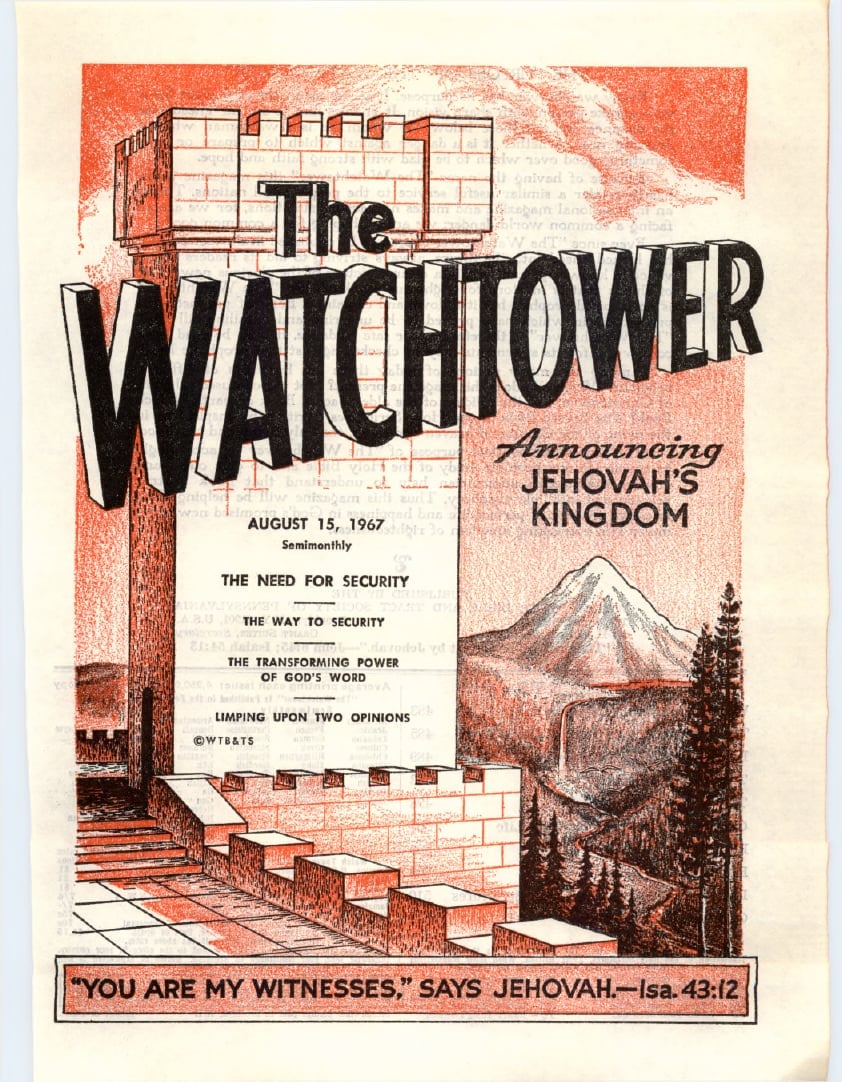
The Watchtower — August 15, 1967
Source: jw.org
Contents
Was It Foretold in the Bible?
The Transforming Power of God’s Word
Limping upon Two Opinions
The Need for Security
The Way to Security
Getting a Permanent Hold on Life
Benefits Recognized
Happy Coincidences
Latin and the Christian Greek Scriptures
Questions From Readers
Announcements
Was It Foretold in the Bible?
Was It Foretold in the Bible?
EARLY in June the news headlines proclaimed the swift developments of the war in the Middle East: “Israel Sweeps Ahead on All Fronts,” “Israelis Rout Arabs; Approach Suez.” Within a few days it was over. Israeli troops occupied all of Jerusalem, all Jordanian territory west of the Jordan and the whole Peninsula of Sinai.
Meanwhile there was widespread speculation about the significance of these happenings. Could it be that the ancient prophecies of the Bible are being fulfilled? many are asking. For example, these words of Jehovah God written down more than 2,500 years ago: “I will bring them back to the land that I gave to their forefathers, and they will certainly repossess it.”—Jer. 30:3; see also Ezekiel 37:21.
Not insignificant on this subject are the views and attitudes of the Israelis themselves. Has the dispersion of Jews ended? Do the Israelis claim to have in any sense a theocratic or God-ruled state, and do they depend upon God for protection? Consider some of the facts.
In the year following the declaration of Israel’s independence as a state, a prominent German rabbi, Ignaz Maybaum, made this pertinent admission: “Zion is not yet. We must still pray for it to be established. The Messiah has not yet come, only a Jewish State has been established. The world is not yet redeemed. We must still wait, hope and pray. We are still in the galut [exile]; the citizens of Israel as well.”—The Christian Century, April 3, 1963.
Former premier David Ben-Gurion has always opposed the idea of forming a modern theocratic state. And it is noteworthy that in his review of the first ten years of Israeli statehood he had nothing to say about the direction and help of God. He declared: “Israel is determined to strengthen her military preparedness and to persevere in her work of rebuilding and redemption; to bring in Jews from the lands of oppression and misery; to conquer the desert and make it flourish by the power of science and the pioneering spirit.”—New York Times Magazine, April 20, 1958.
The active, militant segment in Israel have no faith in the Bible accounts of God’s miraculous dealings with their ancestors. They do not accept them as historical. They insist that theirs is a secular state governed by secular laws enacted by their own Knesset (parliament) and not by the laws of the Torah. They disagree with the Scriptural principle: “Unless Jehovah himself builds the house [or state], it is to no avail that its builders have worked hard on it.” (Ps. 127:1) They trust in their own strength and ability for success.
But what does the Bible, God’s written Word, say about the matter of God’s dealing with the Jews? It reveals that he permitted their dispersion in 607 B.C.E. when the Babylonians destroyed Jerusalem and carried the Judean population into exile. After seventy years, and in harmony with Jeremiah’s prophecy, the Jews experienced a restoration to their land.—Jer. 29:10; Dan. 9:1, 2.
But is it possible there is still to be a larger fulfillment of restoration prophecies, this time upon the modern state of Israel? What do the Scriptures and the facts show? Certain it is that when the foretold Messiah arrived 1,900 years ago the Jews rejected him, and he, in turn, declared of them: “Look! Your house is abandoned to you.” “The Kingdom of God will be taken from you and be given to a nation producing its fruits.” (Matt. 23:38; 21:43) The final blow came in the year 70 C.E. when the Romans destroyed Jerusalem’s temple and dispersed the Jews.—Luke 19:43, 44.
God is no longer, since that time, dealing with a Jewish system of things. (Col. 2:14; Gal. 3:24, 25) Indeed, from and after the outpouring of God’s spirit on the followers of Jesus Christ at Pentecost of 33 C.E., he has been dealing with the Christian congregation, concerning which the apostle Paul wrote: “There is neither Jew nor Greek, there is neither slave nor freeman, there is neither male nor female; for you are all one person in union with Christ Jesus. Moreover, if you belong to Christ, you are really Abraham’s seed, heirs with reference to a promise.”—Gal. 3:28, 29.
The apostle Paul identified those who would receive protection and salvation when he wrote: “If you publicly declare that ‘word in your own mouth,’ that Jesus is Lord, and exercise faith in your heart that God raised him up from the dead, you will be saved. For ‘everyone who calls on the name of Jehovah will be saved.’”—Rom. 10:9, 13.
It is obvious today that modern Israel neither confesses Jesus Christ as Lord nor calls upon the name of Jehovah. It is not a religious, but a political state. Though individual Jews may accept Christ and be brought into the congregation of his followers, it is evident that God is no longer dealing with the Jews as a nation. Nor is the literal city of Jerusalem any longer significant in connection with true worship, for in all parts of the earth there are those who serve God and Christ, his appointed King.—John 4:21.
How, then, are we to view the current developments in the Middle East? As part of a global condition, foretold by the Bible, in which international strife, crime and violence would mark these as “the last days” of this wicked system of things. (2 Tim. 3:1-5) Yes, these events constitute definite evidence of the closeness of the end of this system of things. As all nations vainly seek for peace while at the same time they arm for war, they ignore the decree of the Sovereign Ruler of the universe giving Christ the power and authority to trample them all down in utter defeat. (Dan. 2:44; 1 Cor. 15:24, 25) ‘Submit to God’s Son!’ is the urgent appeal to men of all nations who would survive that greatest of all tribulations.—Ps. 2:12.
The Transforming Power of God’s Word
The Transforming Power of God’s Word
Can the Bible really transform people’s lives? What evidence is there that it can?
AMONG God’s creations there are many marvelous transformations that delight and astound. For example, if a person had not seen it or been told about it, could he ever imagine that an offensive-looking little caterpillar would change into a breathtakingly beautiful butterfly? Yet this is what occurs. Is it not also amazing that tiny seeds planted in the spring become nutritious red beets, green beans or ears of corn a short time later?
Despite the grandness of these transformations, there is another that is even more beautiful and desirable. It is the change made in a human whose former course of life was molded by the wicked environment of the world. The Christian apostle Paul calls attention to this marvelous transformation in a letter to personal friends in Corinth, Greece, writing:
“What! Do you not know that unrighteous persons will not inherit God’s kingdom? Do not be misled. Neither fornicators, nor idolaters, nor adulterers, nor men kept for unnatural purposes, nor men who lie with men, nor thieves, nor greedy persons, nor drunkards, nor revilers, nor extortioners will inherit God’s kingdom. And yet that is what some of you were. But you have been washed clean.”—1 Cor. 6:9-11.
Think of that! Some Christians in Corinth had formerly been fornicators, adulterers, homosexuals, thieves and drunkards. But then they abandoned that course of life and became upright men and women. What a remarkable transformation! How was it ever made? Was it a change then commonly experienced? Can such transformations be realized today?
EFFECT OF CHRISTIAN TEACHING
The transformation of those Corinthians was accomplished by their listening to and putting faith in the message about Jesus Christ. Evidence presented to them from the Scriptures convinced the Corinthians that Christ was indeed the Son of God, that he had been raised from the dead, and that by following his blameless example they, too, could win their Creator’s favor and blessing. Their convictions were so strong that, with the aid of God’s spirit, they put away their former bad practices and became footstep followers of Jesus.
This transformation, however, was not limited to persons in Corinth. Throughout the Roman Empire sexual abuses, “unrighteousness, wickedness, covetousness, injuriousness, . . . envy, murder, strife, deceit, malicious disposition” were prevalent. (Rom. 1:26-31) Nevertheless, the Christian message effected a change in many, including ones in the city of Colossae to whom the apostle Paul wrote: “In those very things you, too, once walked when you used to live in them.”—Col. 3:5-7; see also Ephesians 4:17-19.
The apostle Paul himself once had a malicious disposition and practiced wicked works, even being an instigator in the arrest and murder of Christians. (Acts 7:58; 8:1; 9:1, 2) Before becoming a Christian his fellow worker Titus, too, followed an unrighteous course, as Paul reminds him: “For even we were once senseless disobedient, being misled, being slave to various desires and pleasures, carrying on in maliciousness and envy, hateful, hating one another.”—Titus 3:3.
The apostle Peter also noted that many Christians had once “proceeded in deeds of loose conduct, lusts, excesses with wine, revelries, drinking matches, and illegal idolatries.” But then they changed, Peter explained. And what an effect it had! Others simply could not understand it.—1 Pet. 4:3, 4.
Many historians have well documented the tremendous transformation Christian teaching effected in the lives of people. Observed one of them in the book Readings in Ethics: “Christianity, within twenty-five years of its inception, gave a totally new life to thousands and thousands. This new life most noticeably expressed itself in a virtue which the Stoics condemned and which certainly was absent from the practice of the public.” And the noted historian John Lord observed in The Old Roman World: “The true triumphs of Christianity were seen in making good men of those who professed her doctrines . . . We have testimony to their blameless lives.”
WHAT ABOUT TODAY?
Is the Christian message now having a similar effect on the lives of men and women? Are people changing from their former immoral ways and patterning their lives in harmony with Jesus’ example? Does God’s Word truly have transforming power today?
A look at Christendom might indeed cause one to believe that the Bible no longer exercises beneficial effects on the lives of people. For everywhere there exists a cesspool of crime and immorality. Malicious disposition, hatred, strife, envy, murder, deceit, along with drunkenness, drug addiction and sexual immorality, are rampant.
This does not mean, however, that God’s Word has lost its transforming power. The fact is that Christendom is really not Christian. She has only assumed the name of Christ. Actually her principal teachings and practices are as pagan as those of ancient Rome. The Bible is not really accepted in Christendom as a guide by which to live. However, when individuals do embrace its teachings, God’s Word can transform their lives just as surely as it altered people’s lives in the first century. There is ample evidence of this.
POWER TO END IMMORALITY
The ministry of Jehovah’s witnesses is designed to acquaint people with this Book that has such tremendous force for good. Instruction in God’s Word has caused thousands of persons willingly to cease from immoral conduct. Typical is the example of the young woman who explained earlier this year:
“At the time I was studying the Bible with Jehovah’s witnesses I had a man rooming at my house. I had really grown fond of him. Although we didn’t share the same bed, there were times we did get together. We thought this was all right. But things changed when the minister of Jehovah’s witnesses that I was studying with read me the scripture at First Corinthians 6:9, showing that neither fornicators nor adulterers would inherit God’s kingdom. I realized that what we were doing did not meet the Bible’s high standards for Christians. I realized, too, that if I wanted to have God’s favor, if I wanted to tell others the good things I had learned, I would have to change my way of living. So I told him, No more sexual relations.”
She not only stuck to this decision, but later was honorably married, and now shares in teaching others the Bible’s righteous principles. Even as many in the first-century Christian congregation formerly had been fornicators and adulterers, the same is true in the Christian congregation today.
The extent of the Bible’s transforming power is seen in the fact that even harlots have been aided by Bible truths to give up their unclean activities. (Matt. 21:31, 32) Sometime ago, for instance, a woman in South America who ran a brothel began studying the Bible with Jehovah’s witnesses. Soon she realized that to be a true Christian she must make a radical change. And this she did! She gave up her business of prostitution, married the man with whom she had been living, was baptized, and now is actively engaged in helping others also to learn Bible truths.
POWER OVER ALCOHOL
One of the greatest causes of troubles in the family and community is alcoholism or drunkenness. In the United States it is considered the number four health problem, and in other lands of Christendom it is as bad a problem or even worse. Yet, God’s Word has time and again proved successful in transforming drunkards into upright, sober Christians, even as it did in the first century.—1 Cor. 6:10, 11.
In one instance an Oregon man, when under the influence of alcohol, would harshly mistreat his wife and four children. For years his drunken bouts continued, even after his wife started studying the Bible and became an exemplary Christian. Then, in 1957, he agreed to have a Bible study. His eldest son, now a member of the headquarters staff of Jehovah’s witnesses in Brooklyn, New York, observes:
“Within just a short time Bible principles started to affect my father’s life. He quit drinking, changed his bad habits and became a very good example to those in the small community where we lived. He was baptized in 1958, and now serves as a ministerial servant in the local congregation of Jehovah’s witnesses.” How happy this family is that God’s Word has such transforming power!
Even persons who have sunk to the depths of alcoholism on “skid row” have been transformed by the Word of God. One alcoholic spent thirteen years on the “skid row” of New York city. During this time he would, on occasions, obtain a copy of The Watchtower or Awake! and read it. The Bible articles impressed him. In 1954, when he went into the hospital for treatment, he swore never again to take another drink, and he never did. As soon as he came out of the hospital he located a Kingdom Hall of Jehovah’s witnesses and began to attend regularly. He explained: “For the first time in my life I truly began to live.” In 1958 he was baptized, and he has served as a faithful minister with a New York City congregation ever since.
TRANSFORMING HOSTILE ATTITUDES
How often hostile feelings develop between individuals, families and nations! And over such insignificant matters! Fights, feuds and wars then result, and much blood is spilled. Happily, God’s Word has the power to destroy these hostile attitudes, and replace them with feelings of love, peace and friendliness.
An interesting instance is that involving two neighbor ladies in Switzerland who for years had quarreled and feuded. All members of both families suffered from the resulting tensions. Then, not long ago, one of the ladies began a study of God’s Word. The minister studying with her explains the effect this had: “The day came when she had the courage to speak to her neighbor with whom she had hardly exchanged a cordial word for years, and asked her pardon, although she was certainly not alone to blame for the state of affairs. All concerned were happy and felt freed.”
But this was not the conclusion of the matter. Although the neighbor lady had previously rejected the Bible message, when a minister of Jehovah’s witnesses next called, her response was: “Please come in, I must quickly tell you something.” Then, after telling about her neighbor’s wonderful change of attitude, she said: “There is really something in your religion, because I am sure that my neighbor was encouraged by a woman in your faith to make peace with me. I have seen her going there regularly.” This lady also began studying the Bible with Jehovah’s witnesses. God’s Word truly does have the power to destroy hostile attitudes and to bring peace!
Although the Bible’s counsel to ‘beat swords into plowshares and spears into pruninghooks’ has not been heeded by the unchristian nations of Christendom, individuals and even entire communities have. (Isa. 2:4) A few years ago the people in two villages in Mexico were armed with pistols and rifles for use during feuds. As a result, slayings would frequently occur, but when the government would try to prosecute the guilty, no one would say anything. Then one family accepted a Bible study with a visiting minister of Jehovah’s witnesses. Eventually practically every one in the villages began studying and embraced the Bible truths. Hostile attitudes were soon replaced with friendly ones, and the weapons were sold and with the money Bibles were purchased.
POWER TO CREATE NEW PERSONALITIES
God’s Word truly has power to transform personalities! The change begins in the mind, as the Bible notes in the encouragement: “Quit being fashioned after this system of things, but be transformed by making your mind over.” (Rom. 12:2) So, first, knowledge of Jehovah God and his grand purposes must be taken into the mind through Bible study. But, then, to be rid of the malicious disposition and strife of this system of things, one’s heart must be moved by the information. He must have the desire to please his Creator, whose appeal is: “Strip off the old personality with its practices, and clothe yourselves with the new personality.”—Col. 3:9, 10; Eph. 4:22-24.
Everywhere God’s Word is transforming lives and making good people from bad, even as it did in the first century. A few years ago a minister was calling on homes in the Fiji Islands when he met a leading businessman who warmly welcomed him in and told him: “For years the village was plagued by a group of hooligans who caused the businessmen much trouble and loss of property. Then about a year ago Jehovah’s witnesses came to town. Before long certain of the leading ones of this band of hooligans became Witnesses and are now peaceable and respectable citizens. The entire situation has seen a great improvement within the past year because of this.”
Become acquainted with the power of God’s Word! Accept the offer of Jehovah’s witnesses to conduct a personal Bible study with you and your family free of charge. You will find that what an early president of the United States, Thomas Jefferson, once said is indeed true: “Studious perusal of the Sacred Volume will make better citizens, better fathers, better husbands . . . The Bible makes the best people in the world.”
Limping upon Two Opinions
Limping upon Two Opinions
MANY are the persons who are afflicted by a physical limp, often through no fault of their own, perhaps through some accident or defect at birth. Can it be rectified? Sometimes yes, but most often they have to make the best of the situation and let positive thinking offset the physical handicap. But did you know that there is a mental limping that constitutes a graver handicap to progress and happiness? May it never be your misfortune to become its victim.
But just what is this mental limping? How does it affect one? Can those affected throw it off? How can they be assisted to do so? And is it possible that one may suffer from this handicap without discerning the source of his difficulty? These are a few of the inquiries we might ponder, with benefit to ourselves and possibly also to others we may be able to aid.
First, consider the symptoms of this ailment. An almost continual state of hesitancy is one of the indications of mental limping. The person never seems to be able to make up his mind on any matter, be it ever so simple. Even when it is a question of deciding between two courses, and one of them is definitely proved to be undesirable, the irresolute person still seems to find a strong attraction toward going against his own better judgment. Strange, is it not?
Many and varied are the thoughts upon this subject that thinkers of all ages have come up with. Says one: “Irresolution is a worse vice than rashness. He that shoots best may sometimes miss the mark; but he that shoots not at all can never hit it.” And another: “A man without decision can never be said to belong to himself; he is as a wave of the sea, or a feather in the air which every breeze blows about as it listeth.” Indeed, several have concluded that irresoluteness, under circumstances that demand decision, is a sign of cowardliness.
Here is how another writer analyzes this mental weakness: “In matters of great concern, and which must be done, there is no surer argument of a weak mind than irresolution—to be undetermined where the case is plain, and the necessity urgent. To be always intending to live a new life, but never to find time to set about it.”
GOD’S WORD ON THE SUBJECT
The Bible, for its part, offers powerful instruction on the subject by way of illustration from real-life experience. Picture in your mind that crowd of Israelites assembled on Mount Carmel during the reign of wicked King Ahab. They were a badly confused people. For many years now, in spite of Jehovah’s law against image worship, they had been persuaded to worship calf idols set up at Dan and Bethel under the pretense that those idols stood for Jehovah, their deliverer from Egyptian slavery.—1 Ki. 12:28, 29.
As though this were not bad enough, King Ahab’s wife, Jezebel, had now introduced Baal worship into the kingdom in a big way. By coercion and persuasion she had induced most of the people to adopt this Canaanite cult, and to mingle its rites with those of their calf worship. Scores of priests of Jehovah had been slaughtered. The spirit of compromise was abroad in the land. Doubtless many reasoned that, since Baal signifies “owner” or “lord,” they could outwardly comply with the rites demanded by Jezebel, while mentally transferring devotion to the true God. They were willing to purchase a false peace at the price of truth and honesty.
Are we not reminded of people today who take refuge in the assumption that all religions are right as long as the adherents live up to them? Thus they feel they are saved the irksome responsibility of measuring their respective merits and determining which religion most nearly conforms to the requirements of true religion as set out in the Holy Bible. They think they are relieved from having to make a decision.
However, back there God’s prophet Elijah and seven thousand other Israelites had not succumbed to such crippled thinking. They knew their God and they refused to bow the knee to Baal or participate in any other form of false worship. (1 Ki. 19:18) And the prophet fearlessly challenged the compromising Israelites and their king: “How long will you be limping upon two different opinions? If Jehovah is the true God, go following him; but if Baal is, go following him.” (1 Ki. 18:21) Yes, he put his finger right at the root of the trouble—two opinions!
Jehu, an anointed executioner of Jehovah’s judgment, was another who despised the wavering course of the mental limpers. When confronted by the peace overtures of King Jehoram, son of Ahab and Jezebel, he stoutly declared: “What peace could there be as long as there are the fornications of Jezebel your mother and her many sorceries?” (2 Ki. 9:22) He knew that, as long as Jezebel lived, the murderous campaign against true worshipers of Jehovah would be maintained. Either she and her progeny must be executed or else all loyal servants of Jehovah would be marked for slaughter. There could be neither truce nor delay.
Doubtless Jehu called to mind the choice of religion offered by Joshua to his forefathers some years after they entered the land of their inheritance. He would vividly recall Joshua’s own unequivocal stand as he announced: “As for me and my household, we shall serve Jehovah.” (Josh. 24:15) There was no quibbling, no attempt to accommodate conflicting opinions, no giving place to interfaith ideas. His God was no God of confused religious cults. No, he was the God of truth, the God of Abraham, Isaac and Jacob, and he would never share his glory with false deities.—Isa. 42:8.
IN THE FIRST CENTURY C.E.
At the time Jesus Christ was on earth the spirit of compromise, of limping between two opinions, was very much in evidence. Religious leaders showed their preference for Oriental philosophy and Babylonish rites, yet still maintained an outward semblance of subjection to the Mosaic law. To them Jesus applied the scathing words: “You also, outwardly indeed, appear righteous to men, but inside you are full of hypocrisy and lawlessness.” (Matt. 23:28) To the people in general he said: “No one can slave for two masters; for either he will hate the one and love the other, or he will stick to the one and despise the other.”—Matt. 6:24.
He frankly announced that the purpose of his coming was not to initiate a peace based on compromise, but, rather, to make clear separation between those who would worship Jehovah with all their heart and those who would not do so. Said he: “I came to put, not peace, but a sword. For I came to cause division, with a man against his father, and a daughter against her mother.”—Matt. 10:34-36.
IN OUR OWN DAY
But, now, what of today? Can we observe the same spirit of indecision and compromise? Surely no one can deny that we are living in an era of compromise, when catholicity or ecumenism is in vogue, when interfaith seeks to build up one great conglomerate religion, when being frank and forthright about Bible truth is frowned upon! The “peace at any price” plea is to be heard on all sides. The seeds of compromise are being spread world wide by winds of false doctrine and are finding lodgment in unsettled, irresolute minds.
People who love God need to be on guard. They need to examine themselves and their motives from time to time, to be sure that they are not infected. To his true worshipers Jehovah reveals himself as no vague “Lord,” whose personal name can be forgotten and suppressed in favor of an artificial religion that will please everybody. He is not the God of all the confused sects with their contradictory teachings. He is not the God of those who deny, who add to or take from the words of his holy Book, the Bible. Nor is he the God of those who are halfhearted in their worship. Abraham, Moses, Joshua, Daniel and Nehemiah are a few examples of the worshipers Jehovah delights to own as his servants.
What makes the situation today most urgent is that God has made it plain that the time of his execution of judgment upon “Babylon the Great,” the world empire of false religion, is at the door. This is no time to be limping upon two different opinions. The warning from heaven for our day is: “Get out of her, my people, if you do not want to share with her in her sins, and if you do not want to receive part of her plagues.” (Rev. 18:4) There is no time for dallying. God will no more spare the organizations of false religion than he spared the glorious temple built by Solomon at Jerusalem.
And it is not only in the larger matters involving active support of Great Babylon’s religions that you must be on guard. Some of the smaller matters are those that appear harmless and yet do much to reveal where your heart is. Lot’s wife probably thought it could do no harm just to look back at Sodom. Yet she perished.—Gen. 19:26; Luke 17:32.
Some parents, though no longer members of a Babylonish church system, feel it is all right to send their children to Sunday school in one of those systems. They imagine that any Bible stories they will hear there will do them no harm. They overlook the danger that the foundation for some false doctrine may well be laid in their young minds and that the youngsters are being exposed to association with those who conform to Babylonish rites and religious duties.
Then, again, there are some who feel they can personally attend Christendom’s religious services from time to time just to keep up with what is going on or to please some worldly relative or acquaintance. Yet, the apostle Paul, following his conversion to the true faith, publicly denounced interfaith attitudes: “Do not become unevenly yoked with unbelievers. For what sharing do righteousness and lawlessness have? Or what fellowship does light [true Bible teaching] have with darkness [superstition and human tradition]. . . . And what agreement does God’s temple have with idols? For we [the apostle and fellow anointed Christians who abide by God’s Word] are a temple of a living God . . . ‘“Therefore get out from among them, and separate yourselves,” says Jehovah, “and quit touching the unclean thing.”’”—2 Cor. 6:14-17.
To still others it may seem a small thing to give time and attention to reading literature put out by Babylon’s false religions. Perhaps they feel strong enough not to be easily moved from their stand for Bible truth. Nevertheless, they will probably wonder why they do not get the same clear-cut understanding and the same positive attitude as others who are zealous in the worship of the true God. The fact is that they lack the wholeheartedness that is pleasing to Jehovah, and so cannot expect to enjoy his fullest blessing. They are in danger of developing a limp in their thinking.
NEED FOR RESOLUTE ACTION
Those who would please Jehovah and gain life cannot afford, in these “last days,” to hesitate long over the choice between light and darkness, truth and error, God’s congregation of servants and the organizations of their opponents. They must avoid the division of allegiance that results in “an indecisive man, unsteady in all his ways.” (Jas. 1:8) It takes only a little dabbling in false religious teaching to spoil one’s attitude and capacity for pure worship. (Gal. 5:9; Matt. 16:6, 12) “Keep making straight paths for your feet,” is the urgent counsel of the apostle Paul.—Heb. 12:13.
No longer should there be curiosity about or hankering after the nutritionless diet of Great Babylon’s religions. Especially so since it takes all available time to pursue a diligent study of the Bible and its message in order to get one’s feet fixed firmly on the pathway to life. We can avoid the dangerous limping upon two different opinions if we humbly recognize that lifesaving truth comes to us from Jehovah through the spirit-filled organization over which Christ Jesus presides. (Matt. 24:45-47) Progress and happiness will be the immediate reward for the single-minded ones.
So resolute action is what is called for in this vital time of decision. We dare not stand on the sidelines in this time when Christ Jesus is conducting the great work of dividing “sheep” from “goats.” If we would be gathered to the right side of the King’s favor, we must show ourselves to be “sheep” who refuse to listen to false shepherds or to wander away and depend upon our own meager resources. (Matt. 25:31-40) We must listen to and act upon the earnest counsel implicit in Elijah’s challenging question: “How long will you be limping upon two different opinions?”—1 Ki. 18:21.
The Need for Security
The Need for Security
“You yourself alone, O Jehovah, make me dwell in security.—Ps. 4:8.
1. What has made the life of man uncertain during almost all the time he has been on earth?
THE life of mankind has been marked by insecurity nearly all the time that men have lived on earth. History reveals the many dangers to which they have been exposed. Illness in all its forms has carried men off. Disasters and famines have taken their toll of unnumbered human lives. Wars, small and big, have devastated many countries and brought millions of men to an early grave. Crime also has been ever present, and multitudinous are the ones who have fallen victim to it.
2. How have the developments of science affected man’s security?
2 Although the progress due to science has provided men with many commodities not previously available—for example, medicines to treat some of his ailments—yet the life of man has not become safer in our scientific age. To the contrary. The scientific development in the field of armament is so colossal—just think of the atomic, biological and chemical weapons produced—that the life of men, not only in a few countries, but around the globe, is threatened to a degree never before known in the whole history of mankind. Truly, life has become more modern, but at the same time very uncertain and perilous. No wonder, then, that the speeches of statesmen and other prominent personalities, headlined in the world press, time and again revolve around the terms “peace” and “security.” They reflect clearly the prevailing uncertainty in the world.
3. How did the Bible foretell our days, which are marked by uncertainty?
3 In spite of all the efforts undertaken by worldly men, no real security is being reached. Hardly has one conflict been settled when another breaks out. Many people looking into the future see nothing but a big question mark. Insecurity and uncertainty are increasing. Here is how the Bible accurately foretold just these conditions in our day: “Also, there will be signs in sun and moon and stars, and on the earth anguish of nations, not knowing the way out because of the roaring of the sea and its agitation, while men become faint out of fear and expectation of the things coming upon the inhabited earth.”—Luke 21:25, 26.
4. (a) Why will this present world never find real peace and security? (b) Who is the source of true security?
4 According to the Bible we may never expect that the present agitated world will find peace and security. Why is this so? Because it is seeking security in the wrong direction and in the wrong manner. Men in general have not learned that humans and human organizations can never provide true security. They ignore the clear advice of the Bible: “Do not put your trust in nobles, nor in the son of earthling man, to whom no salvation belongs.” (Ps. 146:3) No man, regardless of how prominent he may be and with what power he may be invested, religious or political, no nation of this world and no international organization can provide true security and salvation for mankind. These precious, sought-after goals can derive only from one source, namely, God the Almighty, whose name is Jehovah, and only in harmony with the provisions he has made.—Isa. 43:11.
SECURITY IN ANCIENT ISRAEL
5. (a) What does Israel’s history show as to security? (b) Describe the blessed reign of King Solomon.
5 As is generally known, the Israelites, that is, the descendants of the Hebrew Abraham through his son Isaac and his grandson Jacob, were at one time the chosen people of Jehovah. In Jehovah’s dealings with Israel there are revealing foregleams of how security can be gained and how it can be lost. As the history of Israel shows, national security and individual security were very likely at their zenith during the reign of the wise, peaceful and famous king Solomon, one of the human kings who ruled representatively for the invisible King Jehovah. In impressive words a chronicler reports about that blessed time: “And peace itself became his in every region of his, all around. And Judah and Israel continued to dwell in security, everyone under his own vine and under his own fig tree, from Dan to Beer-sheba, all the days of Solomon.”—1 Ki. 4:24, 25.
6. (a) What were the factors contributing to Israel’s welfare and security? (b) But what does Israel’s later history show?
6 This peace, security and welfare during the reign of King Solomon were not the result of human wisdom. Rather, they resulted from heavenly wisdom. The people of Israel had received a fine code of laws. Centuries before, it had been made known by Jehovah to Moses and through him to the nation of Israel. This uniform legislation was to be applied throughout the whole territory of that nation, and it applied generally to Israelites and foreigners alike. It governed the relations of this people to its God and also the relations between individuals. It was a good law. To this the Christian apostle Paul testifies, when he wrote: “Wherefore, on its part, the law is holy, and the commandment is holy and righteous and good.” (Rom. 7:12) The more strictly the people observed this law, both rulers and subjects, the more they enjoyed the favor of their God, Jehovah, and the more they enjoyed peace and security. But the more they departed from the law, usually led on by a ruling class that had turned wicked, the greater their insecurity became. This is very tragically illustrated in what happened to Israel after the majority had rejected the Messiah, the one whom God had sent to them as their Redeemer. In 70 C.E., when the Romans destroyed Israel’s famous capital, Jerusalem, this highly favored people lost its national existence. The history of the Jews during the nineteen centuries that followed is unparalleled as far as insecurity and adversity are concerned. It all goes to show that true security can never be found outside of a proper relationship with man’s Creator.—Ps. 91:2.
THE CITY OF REFUGE—A PROTECTIVE PROVISION
7. Why is the law of Moses still of interest for us?
7 Let us now consider one of the provisions of the Mosaic law more closely. It is true that the Mosaic law with its many decrees and penal sanctions is no longer in force. When the Messiah, Jesus Christ, came, nineteen centuries ago, the time of this law was up. It had served its purpose. By its being fulfilled it was taken out of the way. The Bible so informs us in these words: “He kindly forgave us all our trespasses and blotted out the handwritten document [the Mosaic law] against us, which consisted of decrees and which was in opposition to us; and He has taken it out of the way by nailing it to the torture stake [of Jesus Christ].” (Col. 2:13, 14) But this old body of law, although no more being in force after Jesus Christ was used to bring it to an end on Nisan 14, 33 C.E., contains many instructive types or “shadows,” as well as principles, from which Christians may draw enlightenment and benefit. The weekly sabbath or day of rest, for example, which was stipulated in the Mosaic law, was such a shadow of good things to come, pointing forward to something in the future, namely, the thousand years of peace and tranquillity under the reign of Christ, the Messiah.—Col. 2:16, 17; Heb. 10:1.
8. How many cities of refuge were there, and what were their names?
8 A very interesting provision in the Mosaic law was that of the cities of refuge. Where were they located and what purpose did they serve? The Law provided for a total of six of these cities, three of them on the east side of the Jordan River and three on the west side. Concerning the names and geographical locations of these cities we are informed by Joshua, Moses’ successor as visible leader of Israel: “Accordingly they gave a sacred status to Kedesh in Galilee in the mountainous region of Naphtali, and Shechem in the mountainous region of Ephraim, and Kiriath-arba, that is to say, Hebron, in the mountainous region of Judah. And in the region of the Jordan, at Jericho, toward the east they gave Bezer in the wilderness on the tableland out of the tribe of Reuben, and Ramoth in Gilead out of the tribe of Gad, and Golan in Bashan out of the tribe of Manasseh.”—Josh. 20:7, 8.
9. (a) How were these cities distributed over the land? (b) What purpose did they actually serve?
9 A look at the map of the Promised Land shows that these cities were rather equally distributed throughout the land. Why was this so? These cities were to be within reach of any inhabitant—the Israelites as well as the alien residents and settler—who might need the city’s protection. These cities were havens of refuge, places of protection, open to persons whose lives were in danger, and therefore they were so located that the ones seeking protection might reasonably have the necessary strength and time to flee there. The national law ruled on who was eligible for protection. Anybody could flee to one of these cities who, due to accident, without any evil intent, had caused the death of another person or persons, be it while working or in any other situation.
10. Under what circumstances, for example, could a man flee there?
10 To illustrate, here is an example of such a situation, one that would make flight to the city of refuge necessary. “Now this is the case of the manslayer who may flee there and has to live: When he strikes his fellow man without knowing it and he was no hater of him formerly; or when he goes with his fellow man into the woods to gather wood, and his hand has been raised to strike with the ax to cut the tree, and the iron has slipped off from the wooden handle, and it has hit his fellow man and he has died, he himself should flee to one of these cities and must live.”—Deut. 19:4, 5.
THE SANCTITY OF HUMAN LIFE
11. (a) Why should a person have to flee to the city of refuge? (b) What do Jehovah’s words to Noah show?
11 But we might ask, Why should such a man have to flee to a place of protection? Because, after having caused the death of a fellowman, he was now himself in danger of losing his life. The nearest relative had the right to act as avenger of the blood of the person killed; he was entitled to act as executioner and in this capacity he could act swiftly, without delay. At that time this right of the avenger of blood was fully recognized. Undoubtedly it had its origin in the ordinance we find in the first book of the Bible, in Genesis 9, verses 4 to 6. There we find the words spoken by Jehovah to Noah and his sons, survivors of the global flood, and these words underscore the great value the Creator attaches to human life. “Only flesh with its soul—its blood—you must not eat. And, besides that, your blood of your souls shall I ask back. From the hand of every living creature shall I ask it back; and from the hand of man, from the hand of each one who is his brother, shall I ask back the soul of man. Anyone shedding man’s blood, by man will his own blood be shed, for in God’s image he made man.” From this old ordinance was derived the right to inflict the death penalty upon those who shed human blood illegally.
12. Was bloodguilt attached only to the willful murderer?
12 This old ordinance was recognized in the Mosaic law. Anyone who willfully and illegally shed human blood had to pay with his own life, after the murder had been proved and established by witnesses. (Deut. 17:6) Even a person who caused the death of a fellowman involuntarily, without evil intent, made himself bloodguilty. But then the Law provided that such an unfortunate person could escape death by fleeing into the nearest city of refuge. The relevant passage in the Law reads: “And Jehovah continued to speak to Moses, saying: ‘Speak to the sons of Israel, and you must say to them, “You are crossing the Jordan to the land of Canaan. And you must choose cities convenient for yourselves. As cities of refuge they will serve for you, and the manslayer must flee there who fatally strikes a soul unintentionally. And the cities must serve you as a refuge from the blood avenger, that the manslayer may not die until he stands before the assembly for judgment. And the cities that you will give, the six cities of refuge, will be at your service. For the sons of Israel and for the alien resident and for the settler in the midst of them these six cities will serve as a refuge, for anyone to flee there that fatally strikes a soul unintentionally.”’”—Num. 35:9-15; Josh. 20:1-6.
13, 14. (a) Was a willful murderer permitted to gain protection in the city of refuge? (b) How was the fugitive’s worthiness or willfulness determined?
13 It can thus be seen that, for everyone meeting its terms, this was a legal provision to save precious human life. These six cities were at the same time cities of the Levites, and one of them, Hebron, pertained to the Aaronic priests. But what about a person who made use of the legal protection in one of the six cities and who was actually not entitled to it, for example, a wicked murderer? The Law ruled out any protection for a murderer, such a person being considered unworthy to come within the protective shield of these cities. To ensure that no unworthy person would gain refuge, the law demanded that a hearing be held and the circumstances be examined, before a person was taken up definitely into the protective city. It was the elders of the slayer’s dwelling place who had to examine the case and render the final decision. If the decision turned out to be favorable for the refugee, then henceforth he was shielded by the sacred status of the city of refuge. Thus we read:
14 “But if it was unexpectedly without enmity that he has pushed him or has thrown any article toward him without lying in wait, or any stone by which he could die without seeing him or he should cause it to fall upon him, so that he died, while he was not at enmity with him and was not seeking his injury, the assembly must then judge between the striker and the avenger of blood according to these judgments. And the assembly must deliver the manslayer out of the hand of the avenger of blood, and the assembly must return him to his city of refuge to which he had fled, and he must dwell in it until the death of the high priest who was anointed with the holy oil.”—Num. 35:22-25.
15. How long must the unintentional manslayer stay in the city of refuge?
15 The last part of the scripture just quoted explains just how long the unintentional slayer had to remain in this legally provided asylum. He did not necessarily have to stay there for all his life, but only until the death of the high priest occurred, whichever high priest was in office at the time the refugee fled to one of these havens. When the high priest died, then at once all who had fled there were fully entitled to leave the city and return to their former dwelling places. Were they not in danger of being overtaken by the avenger of blood? No, not anymore. The avenger of blood now had no right to do harm to the released refugees. The case was closed. There was no longer any bloodguilt for which to account, “For he ought to dwell in his city of refuge until the high priest’s death, and after the high priest’s death the manslayer may return to the land of his possession.”—Num. 35:28.
16. What does the provision of the city of refuge teach us as to the value of human life?
16 The provision of the city of refuge teaches us more than one thing. It shows us clearly that the Creator of man, Jehovah, values human life as something precious. There is no question that He has the full and indisputable right to destroy human life, if men oppose his sovereign will and ignore his purpose. Man, however, certainly is not in the same position as his Creator and therefore has no right to snuff out human life just as he pleases. Life is so precious. In a way it is holy. The Mosaic law ruled that even the unintentional manslayer became bloodguilty, showing thereby the severity of God in matters of bloodshed. No doubt this rigor was to impress the Israelites and convey to their minds the proper appreciation for the sanctity of human life. It also taught them in all their dealings to give careful consideration to this most precious possession of their fellowmen—life. Pointing to the great Source, the psalmist wrote: “For with you is the source of life.”—Ps. 36:9.
17. Which two great qualities of Jehovah are reflected in this special legal provision?
17 On the other hand, the provision of the city of refuge shows that Jehovah is a God of mercy and that He, as the Supreme Judge, knows the hearts of men and makes a distinction between one who commits a wrong unintentionally and one who is wicked in heart and who willfully and presumptuously breaks the divine law. So the provision of the protective city as it existed in ancient Israel reveals two great attributes of Jehovah: his justice and his mercy. The psalmist wrote: “Righteousness and judgment are the established place of your throne; loving-kindness and trueness themselves come in before your face.”—Ps. 89:14.
18. Since that provision was a prophetic type, what questions now arise?
18 Since the provision of the city of refuge was of prophetic significance, pointing forward to greater things to come, the following questions arise: What does this city picture? Who is typified by the unintentional manslayer who was permitted to flee there and who by the avenger of blood who pursued the unintentional manslayer? What is meant by the road leading up to these cities? Who is the high priest? And what is shown by the fact that the refugees could leave the city after the high priest died? All these questions can be answered satisfactorily as we let God’s holy spirit ‘lead us into all the truth.’ (John 16:13) For further discussion of these questions we refer the reader to the following article.
[Map on page 495]
(For fully formatted text, see publication)
Cities of Refuge
KEDESH
GOLAN
RAMOTH-GILEAD
SHECHEM
BEZER
HEBRON
The Way to Security
The Way to Security
“I am the way and the truth and the life.”—John 14:6.
1. What do the cities of refuge typify?
AMONG the ancient people of Israel the provision of the cities of refuge must often have proved to be lifesaving. Their purpose was to grant protection and security to unintentional manslayers, in view of threatening death by the hand of the legal avenger of blood. These cities were not to offer protection to criminals. And since the provision of these cities, as with so many other “shadows” of the Law (Heb. 10:1), was a prophetic type, from which Christians may learn much, the conclusion is inescapable that it typifies the grand provision of salvation that God, Jehovah, brought into operation for the eternal benefit of men of all kinds, to relieve and save them from the penalty of bloodguilt. How so?
2. What were some of the reasons for Jesus Christ’s coming to earth?
2 God sent his highest Son, Jesus Christ, to earth to make known here the great truths of this provision and also that he might die a sacrificial death, in order to save those truly exercising faith in him from a certain and everlasting death, and give them life without end. Thus we read in Ephesians 1:7: “By means of him we have the release by ransom through the blood of that one, yes, the forgiveness of our trespasses, according to the riches of his undeserved kindness.”—Matt. 20:28.
3. What is shown by the fact that both Israelites and alien residents could find refuge in the city of refuge?
3 Even as with the typical city of refuge, so also the antitypical city of refuge is a merciful provision of God, to forgive repenting violators of His law on the basis of the ransom of Jesus Christ and to accept him into his care and protection. Writes the apostle Paul: “So that is why he is a mediator of a new covenant, in order that, because a death has occurred for their release by ransom from the transgressions under the former covenant, the ones who have been called might receive the promise of the everlasting inheritance.” (Heb. 9:15) In the literal city of refuge, both Israelites and alien residents could find refuge. (Num. 35:15) That pictures that the antitypical city of refuge offers its powerful protection, not only to spiritual Israelites, that is, those who become members of the heavenly class and rule and serve as priests with Christ Jesus, but also to all those who are in line to receive everlasting life on earth, “other sheep.”—John 10:16.
4. (a) What cannot be overlooked in the provision of salvation? (b) To what end do God’s spirit and his angels work?
4 The unintentional manslayer in Israel did not flee abroad, leaving his country, but headed for the city of refuge, which belonged to the nonpriestly Levites; the city of Hebron belonged to the Aaronic priests. This signifies that the provision of salvation is closely connected with Jehovah’s organization. A remnant of the spiritual priestly class is still on earth today, forming the nucleus of the congregation of Jehovah’s people. We cannot ignore the role the visible congregation of Jehovah’s witnesses plays in this provision of salvation. In Acts 2:47 we read: “At the same time Jehovah continued to join to them daily those being saved.” That means that those “being saved” were added to the visible body of the early Christian congregation. They were gathered together into one united family of faith. So the visible congregation of God’s people has something to do with the provision of salvation today. Indeed, it has an important place in that provision. Every congregation forms a small part of God’s people. We cannot remain outside the organization of God’s people, separated from it, if we want to have Jehovah’s protection. Jehovah’s spirit and his angels all tend to a bringing together in unity of thought, aim and action. So there is a vital connection between Jehovah’s protection in the antitypical city of refuge and His visible congregation of spiritual Israelites, supervised by the “faithful and discreet slave.”—Eph. 4:3-6; Matt. 24:45-47.
THE ANTITYPICAL UNINTENTIONAL MANSLAYER
5. Who was foreshadowed by the unintentional manslayer?
5 But who, then, actually is typified by the unintentional manslayer who found refuge in the protective city? He is a picture of all those who become conscious of the fact that they, in some way and from Jehovah’s viewpoint, share in bloodguilt. This fact becomes clear to them when such sincere persons come in touch with the enlightening message of God’s Word, the Bible, which teaches the sanctity of human life. As in ancient Israel, even so today, a person may have been the cause of an accident, fatal to some other person or persons. Year by year, tens of thousands of people lose their lives on the streets of the world due to traffic accidents. Although there is no evil intent present, nevertheless, there is a certain amount of guilt involved, and, as a rule, the law codes of the nations stipulate penal sanctions for such cases.
6. How have many persons shared in bloodguilt in our age?
6 But the application of the meaning of the unintentional manslayer in the present antitype is broader in scope and does not limit itself to those cases just mentioned. Our age is the period of the greatest wars in human history. Just think of World War I and World War II. Millions of men were forced to have a part in these bloody events, without actually wanting it. Tens of millions of men have thus died since 1914, due to the struggle for world domination and also in the course of cruel ideological revolutions. Indeed, since 1914 C.E. alone the blood account of mankind has mounted as never before in all history. It goes without saying that the Creator of man, the one who declared the sanctity of life, must have viewed all this with great displeasure.—Hab. 1:13.
7. (a) How has heavy bloodguilt become attached to false religion? (b) How does Revelation 17:5, 6 describe this?
7 The fact that religious leaders in all the world gave their blessing and support to such organized, mass spilling of human blood has led many persons to believe that it was indeed God’s will and even compatible with Christianity. So it can be presumed that many have done wrong while believing their course was right. The support of organized shedding of blood by the numerous churches and religions inside and outside Christendom reveals one thing very clearly: the immense bloodguilt that attaches to false religion throughout the entire world. This bloodguilt has accumulated, not merely in the past few decades, but also during the many centuries of the past. Blood indeed has flowed in streams in many religious wars, in wars inspired by religious leaders and supported by them, in crusades, during the so-called Inquisition and during the persecution of faithful servants of God before and after Christ. In Revelation, chapter 17, this world empire of false religion is signified or described in symbol as an immoral woman, called “Babylon the Great.” We read: “And upon her forehead was written a name, a mystery: ‘Babylon the Great, the mother of the harlots and of the disgusting things of the earth.’ And I saw that the woman was drunk with the blood of the holy ones and with the blood of the witnesses of Jesus.”—Rev. 17:5, 6.
8. How have churches misled the people?
8 How much the churches have misrepresented God’s purpose and justified wars is underlined by the following from a German Protestant Sunday paper during World War I: “Our combatants are not merely fighters for homeland and home, for king and fatherland, but they are God’s armies, fighting in his service as his instruments and administrators. It is good for our Christian soldiers to know that they really stand in a far higher service and office, that they take care of God’s business and that therefore the Lord has been so marvelously with us . . . to bring the war to a good end. Honor be to God alone! Also this war is a step forward on the way to the realization of the kingdom of God.” (Kirche, Krieg, Kriegsdienst, by Walter Dignath, page 51) How tellingly the words of the prophet Jeremiah apply to the bloodguilt attached to false religious systems of Christendom! Says the prophet: “Also, in your skirts there have been found the blood marks of the souls of the innocent poor ones.” (Jer. 2:34) But bloodguilt also attaches to pagan religious organizations.
THE ANTITYPICAL AVENGER OF BLOOD
9. (a) When will punishment come upon the bloodguilty? (b) Who is the antitypical avenger of blood?
9 Where there is so much bloodguilt, punishment is due and unavoidable. It will come without fail, swiftly, yes, within our generation. Speaking about this divine punishment, the prophet Isaiah wrote: “For, look! Jehovah is coming forth from his place to call to account the error of the inhabitant of the land against him, and the land will certainly expose her bloodshed and will no longer cover over her killed ones.” (Isa. 26:21) In ancient Israel it was the legal avenger of blood who settled the account and imposed punishment. Who, we ask, is the avenger of blood in the antitype? It is Jesus Christ, to whom ‘all authority has been given in heaven and on the earth.’ In Revelation, chapter 19, he is described as a rider on a white horse, carrying on war in righteousness. The armies in heaven follow him. About nineteen centuries ago Jesus was born on earth as a perfect human, and for this reason he often referred to himself as the “Son of man.” (Matt. 28:18; 25:31) Due to this he became, so to speak, the closest relative of mankind and is therefore fully entitled to be the antitypical avenger of blood.
10. Since when does the picture of the city of refuge apply in particular, and why?
10 In 1914 C.E. the “time of the end” came upon this order of human society, and particularly since that time the picture of the city of refuge has become timely and applicable. Why is this so? Because it is in our time, within this generation, that Jesus Christ will act as the great and powerful avenger of blood. He will make a complete end to this bloodguilty order of society. (Dan. 2:44) The avenger of blood and his vast army of holy angels will overtake each and every one who has not escaped in time to the shielding city of refuge. Absolutely nothing can stop this oncoming catastrophe. No nation will escape. But individuals can escape it.—Prov. 1:24-33.
…