The Watchtower, December 1, 1965
Download: PDF — The Watchtower, December 1, 1965
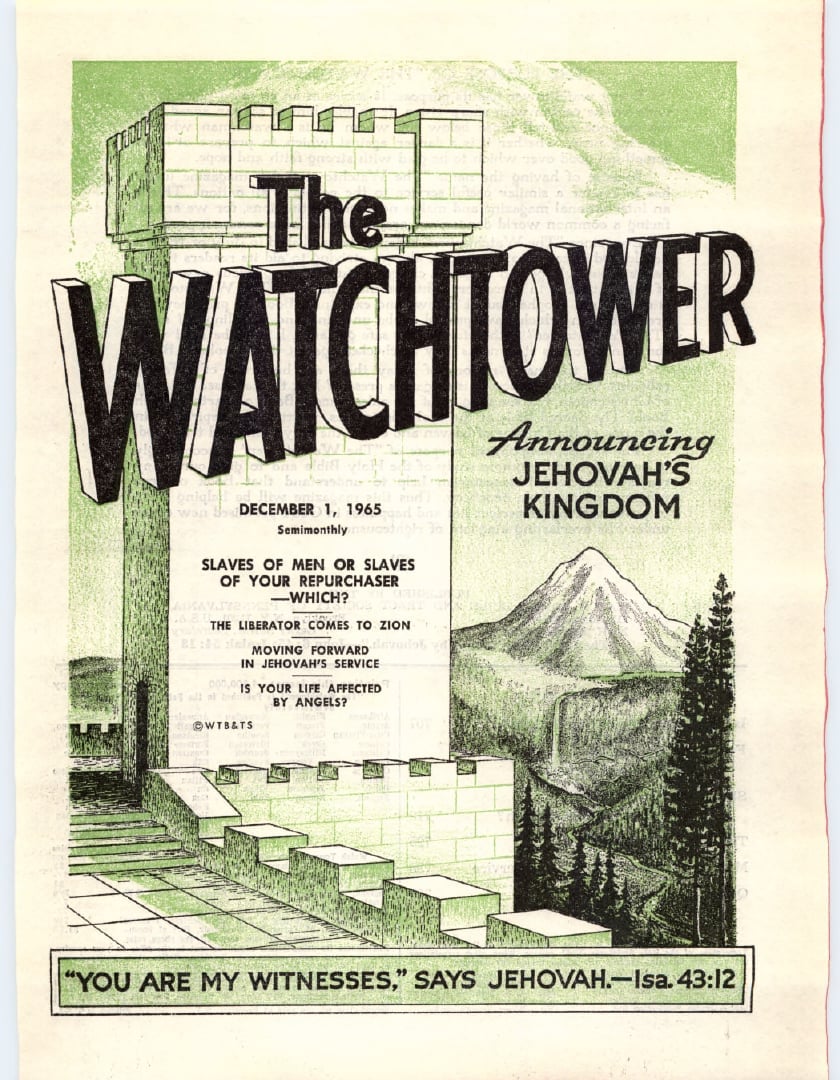
The Watchtower — December 1, 1965
Source: jw.org
Contents
Is Your Life Affected by Angels?
Fearless in Preaching God’s Disclosed Secrets
Slaves of Men or Slaves of Your Repurchaser—Which?
The Liberator Comes to Zion
Moving Forward in Jehovah’s Service
Questions From Readers
Announcements
Is Your Life Affected by Angels?
Is Your Life Affected by Angels?
Are angels merely figments of the imagination? Or do they really play an important role in the lives of men?
IT WAS a cool autumn night, and not far from the small Judean town of Bethlehem shepherds were in the fields tending their flocks. Suddenly the shepherds were shocked to full attention. A dazzling light gleamed all around them, and in the midst of the resplendent brilliance stood a creature such as they had never seen before. Great fear seized them all. Was the creature that stood in front of them merely a figment of their imagination?
No, clearly it was not, for it spoke to them, saying: “Have no fear, for, look! I am declaring to you good news of a great joy that all the people will have, because there was born to you today a Savior, who is Christ the Lord, in David’s city. And this is a sign for you: you will find an infant bound in cloth bands and lying in a manger.” What a thrilling announcement! The one long looked forward to who would become the Messiah had been born.
But this was not the conclusion of the glorious display or of the heavenly announcements. The faithful recorder of these events explains: “And suddenly there came to be with the angel a multitude of the heavenly host, praising God and saying: ‘Glory in the heights above to God, and upon earth peace among men of good will.’”—Luke 2:8-14.
The angels unquestionably affected the lives of these humble shepherds, resulting in their coming to be among the first ones to see the newborn babe Jesus, who was to become the heavenly King of God’s everlasting kingdom. What a marvelous privilege!—Dan. 7:13, 14.
This well-known incident raises important questions, such as: Who are angels? Where do they come from? Are they disembodied humans? What services do they perform in behalf of people on earth? Is your life affected by them?
ORIGIN AND CHARACTERISTICS
Many persons have been taught that angels are the departed dead that once lived on earth. The death of the body is said to release an immortal soul that lives on as an angel in heaven. At the funeral of a young ten-year-old girl a Roman Catholic priest some time ago explained, as reported in the New York Daily Mirror: “God wanted another angel and He took Dorothy. Dorothy had been picked by God to remain with her parents just this length of time. Then he called her to serve Him at this Christmas time.”
Is this true? Are angels persons who once lived on earth? Are they disembodied humans? No, not according to God’s Word the Bible. These inspired writings reveal that long before this earth had been prepared for human habitation Almighty God created spirit sons or angels. This is revealed by His inquiry made long ago of his servant Job, which, according to the Jewish Targum, reads: “Where did you happen to be when I founded the earth? Tell me, if you do know understanding. When the morning stars joyfully cried out together, and all the bands of angels began shouting in applause?”—Job 38:4, 7, 1957 Edition, footnote.
God not only created these spirits long before he did man, but he also made them a higher form of life than human. “Angels,” the Bible says, “are greater in strength and power.” And God’s Word explains that man was made “a little lower than angels.”—2 Pet. 2:11; Heb. 2:6, 7.
Not only were angels made superior to humans, but even among themselves there are various ranks or classifications. First in position is Michael the archangel, whom the Scriptures show is none other than the Word, or Chief Spokesman for God, who became the man Jesus Christ. (Dan. 12:1; John 1:1; Rev. 12:7) Then there are seraphs, whom the prophet Isaiah saw attending Jehovah in a vision of His temple. (Isa. 6:2, 6) Also described in the Scriptures are the cherubs, representations of whom were placed on the ark of the covenant housed in the Most Holy compartment of the wilderness tabernacle and later in the temple built by Solomon. (Ex. 25:18-22; 1 Ki. 8:6, 7; Ps. 99:1) And, finally, there is the great body of angelic messengers.
The combined number of these spirit creations of God reaches many millions. In a prophetic vision of Jehovah’s throne the prophet Daniel saw “a thousand thousands that kept ministering to him, and ten thousand times ten thousand that kept standing right before him.”—Dan. 7:9, 10.
Like humans, these spirit creatures can communicate in a spoken language; the Bible referring to “the tongues of men and of angels.” But, unlike humans, they are without sex and are, therefore, incapable of reproducing their own kind. Jesus revealed this when he explained that in the resurrection of the dead, men and women are not “given in marriage, but are as angels in heaven.” Each angel was a direct creation.—1 Cor. 13:1; Matt. 22:30.
Humans who have died could not be included among these angels, because at death a man’s personality does not continue to exist. “The living are conscious that they will die,” the Bible says; “but as for the dead, they are conscious of nothing at all.” And of the death of man, the Scriptures say: “His spirit goes out, he goes back to his ground; in that day his thoughts do perish.” No part of man continues alive. The Bible states emphatically: “The soul that is sinning—it itself will die.”—Eccl. 9:5; Ps. 146:4; Ezek. 18:4.
This does not mean that none from among mankind receive heavenly life. At his resurrection from the dead Jesus Christ was given a spiritual body, and did ascend to heaven. (1 Pet. 3:18; Acts 2:31-33) However, Jesus was exalted far above the angels, and those who are taken from among mankind to share heavenly glory with him will also be exalted far above the angels. The Bible shows that these members of Christ’s bride, who will share with him in ruling the earth and bringing it to a paradisaic condition, number only 144,000.—Heb. 1:4; Rev. 14:1, 3; 5:10; 20:6.
SERVICES PERFORMED
The Hebrew and Greek words translated “angel” in the Bible simply mean a messenger. Angels are God’s spirit messengers, and their services are often in behalf of humans. Jesus Christ described what great concern they have for God’s servants, when he said: “See to it that you men do not despise one of these little ones; for I tell you that their angels in heaven always behold the face of my Father who is in heaven.” The psalmists also gave the comforting assurance: God “will give his own angels a command concerning you, to guard you in all your ways.” And again: “The angel of Jehovah is camping all around those fearing him, and he rescues them.”—Matt. 18:10; Ps. 91:11; 34:7; Heb. 1:7, 14.
Two outstanding examples of rescue by God’s angels are recorded in the Bible book of Daniel. The first occurred when the Babylonian king Nebuchadnezzar had three young Hebrew servants of God seized and thrown into a superheated furnace because they would not bow down to his huge golden image. When a fourth figure appeared in the furnace to protect the men, Nebuchadnezzar said: “Blessed be the God of Shadrach, Meshach and Abednego, who sent his angel and rescued his servants that trusted in him.”—Dan. 3:19-28.
The other instance occurred when the aged Daniel, a friend of those three faithful Hebrews, was thrown into a pit of lions because he refused to stop praying to his God Jehovah. The next morning the king hurried to the lions’ pit and inquired: “‘O Daniel, servant of the living God, has your God whom you are serving with constancy been able to rescue you from the lions?’ Immediately Daniel himself spoke even with the king: ‘O king, live on even to times indefinite. My own God sent his angel and shut the mouth of the lions, and they have not brought me to ruin.’”—Dan. 6:16-22.
Angels also ministered in behalf of Jesus. After his being tempted by the Devil at the beginning of his earthly ministry, “look! angels came and began to minister to him.” And on the very last night of his earthly life, while he was praying to his heavenly Father, “an angel from heaven appeared to him and strengthened him.” The angels were right at hand to serve Jesus, causing him to say: “Do you think that I cannot appeal to my Father to supply me at this moment more than twelve legions of angels?”—Matt. 4:11; Luke 22:43; Matt. 26:53.
An outstanding example that shows in what particular activity the angels have been assigned to assist God’s servants is found in Acts chapter five. Jesus’ apostles had been zealously preaching the good news of God’s kingdom and of his Christ, and so to stop this activity the Jewish “high priest and all those with him, . . . laid hands upon the apostles and put them in the public place of custody.” Ah, but note what happened! “During the night Jehovah’s angel opened the doors of the prison, brought them out and said: ‘Be on your way, and, having taken a stand in the temple, keep on speaking to the people all the sayings about this life.’” God’s angel took an active part in seeing that the preaching work was not interfered with.—Acts 5:17-20; see also Acts 12:3-11.
But more than that, the angels even directed God’s servants to come in contact with righteously disposed persons. For example, on one occasion “Jehovah’s angel spoke to Philip, saying: ‘Rise and go to the south to the road that runs down from Jerusalem to Gaza.’ . . . With that he rose and went, and, look! an Ethiopian eunuch . . . was sitting in his chariot and reading aloud the prophet Isaiah.” Philip was directed to approach the chariot, and when he explained the Bible truths concerning Jesus, the man happily embraced them and was baptized.—Acts 8:26-38; see also Acts 10:1-22.
IS YOUR LIFE AFFECTED?
There can be no question that angels played an important role in the lives of men in times past, but what about today? Is your life affected by angels?
You may not think so, but it actually is. God’s Word makes clear that we have now reached the last days of this wicked system of things when, as the prophecy describes, Christ would “send forth his angels” to “gather his chosen ones together.” Not only have the angels been gathering the “chosen ones,” who will eventually become members of Christ’s heavenly bride, but they are also sharing in separating people of the nations, as Jesus explained: “When the Son of man arrives in his glory, and all the angels with him, . . . he will separate people one from another, just as a shepherd separates the sheep from the goats.”—Matt. 24:31; 25:31-33; see also Rev. 14:6-10.
Although remaining invisible, the angels are very active in this separating work, noting the righteously inclined hearts of sheeplike persons and, as they did in the first century, directing God’s earthly ministers to them. Undoubtedly experiences similar to one related by a Kingdom publisher in the central United States occur frequently. The Witness relates that, while engaged in the house-to-house ministry, this happened:
“She told me she had thought of taking her life that day, but instead was praying to God to help her some way when I rapped on the door. This was a miracle to her, because there I stood, with my Bible in hand ready to share God’s Word with her.” Arrangements were made for a return visit on the woman and her husband, with the following result.
“That evening is one we will never forget. They were so eager to hear God’s Word and when we explained how they could learn more by a systematic study of the Bible, they agreed that was what they wanted. . . . After four studies, they are witnessing to their families and neighbors, so eager to share the wonderful new truths they have learned.” Experiences such as this are an evidence that the ministrations of angels are still being performed in behalf of those who earnestly seek God.
But even those who do not exercise faith in Jesus Christ and in the everlasting Kingdom of which the angel Gabriel told Jesus’ human mother that Jesus would be ruler—those too will soon come in for angelic attention. However, it will be no more pleasant for them than it was for the 185,000 Assyrian warriors who in one night were struck dead by the angel of Jehovah. It will mean their destruction! “At the revelation of the Lord Jesus from heaven with his powerful angels,” the Bible tells us, “those who do not know God and those who do not obey the good news about our Lord Jesus . . . will undergo the judicial punishment of everlasting destruction.”—2 Thess. 1:6-9; 2 Ki. 19:35; Luke 1:28-33.
Certainly, then, now is the time to take steps so as to be affected beneficially by the angels. How? By heeding the “everlasting good news” that Jehovah’s witnesses are preaching under angelic direction. And by obeying the command of the angels, as recorded in Revelation 14:6, 7: “Fear God and give him glory.” Make it unmistakably clear that you have responded to this angelic admonition by your outspokenly encouraging others to worship God as he directs in his Word of truth; urge them to submit now to God’s reigning Son Jesus Christ. In that way you will prove that you are in harmony with God’s holy angels, and their service to God will also be a blessing to you.
Fearless in Preaching God’s Disclosed Secrets
Fearless in Preaching God’s Disclosed Secrets
NOT without good reason did Jesus Christ command his apostles when sending them forth to preach: “Do not become fearful of those who kill the body but cannot kill the soul; but rather be in fear of him that can destroy both soul and body in Gehenna.”—Matt. 10:28.a
That admonition implied that in going out to preach they would meet up with persecution. But why? Was not the message that they were to bring, “The kingdom of the heavens has drawn near,” good news? It was indeed. It consisted of God’s secrets that Jesus disclosed in the darkness, as it were, and which they were to tell in the light; the good news he had whispered in their ears, so to speak, they were to preach from the house-tops.—Matt. 10:7, 27.
Why would anyone want to persecute them for bringing good news, and especially when they, at the same time, performed miracles of healing? Why? Because this good news was light, and some preferred darkness to light; because this good news was the truth that set men free, and there were those who profited from keeping others in bondage.—John 3:19; 8:32.
That Jesus had good reason to tell them not to fear those who could kill only the body his disciples learned, at the latest, when Jesus was taken into custody, and all of them abandoned him and fled. And later, when persecution came upon them, when the apostle James was put to death and the apostle Peter was imprisoned, these words no doubt came to their minds.—Matt. 26:56; Acts 12:1-3.
The counsel that Jesus gave back there about not fearing men applies with equal force to us today, for “all those desiring to live with godly devotion in association with Christ Jesus will also be persecuted.”—2 Tim. 3:12.
But why not fear men when they can take our lives? For one thing, because they are mortal. As Jehovah reminded his ancient witnesses: “Who are you that you should be afraid of a mortal man that will die? . . . And that you should forget Jehovah your Maker?” Yes, persecutors may be here today, but they are gone tomorrow, dead and buried. Where today are those bitter persecutors of Jehovah’s people, such as Hitler, Stalin and Trujillo?—Isa. 51:12, 13.
But the chief reason for not fearing man is, as Jesus pointed out, that man can kill only the body, not the soul, whereas God “can destroy both soul and body in Gehenna.” More important than this life is our hope of everlasting life in the future, which, if men kill us while we are faithfully serving Jehovah, is made available to us by a resurrection. Men cannot prevent God from resurrecting us in his due time.—1 Cor. 15:58.
There is, however, One whom we should fear, namely, Jehovah God. If we displease him by yielding to fear of man and prove unfaithful, we may live a few years longer now, but then when we die, that will be finis as far as we are concerned. By proving faithful, we are assured of a resurrection in God’s due time—Rev. 2:10.
So let all dedicated Christian ministers fear Jehovah God, imitating his greatest Preacher, Jesus Christ, who showed no fear. Fearlessly keep preaching God’s disclosed secrets, warning people to flee from Babylon the Great before it is too late, and telling them also of the blessings in store for such obedient ones in Jehovah’s new system of things.
[Footnotes]
For details see The Watchtower, December 15, 1964.
Slaves of Men or Slaves of Your Repurchaser—Which?
Slaves of Men or Slaves of Your Repurchaser—Which?
“You were bought with a price; stop becoming slaves of men.”—1 Cor. 7:23.
1. How many of mankind have been born into slavery?
DID you know that you were born a slave? The fact of the matter is that all humankind born to earthly, human fathers have been born slaves, the children of slaves. If you look honestly into the facts of the case and see how it is true, it will help you to understand many things about yourself. It will lead to your understanding how to be freed from such slavery.
2, 3. (a) Among those who got free from this slavery was what noted worker in the cause of freedom? (b) How did this freedom worker refer to himself by name?
2 The doors of liberation from this house of worldwide slavery were opened up nineteen centuries ago. Away back there in the first century of our Common Era, among those who got free from this slavery was a man who has now become known around the globe. But he always had to keep watching and putting forth efforts in order to avoid being enslaved again. He enjoyed his own freedom very much, and he tried to help as many other persons as possible to gain such freedom. No, he did not fight a war against the Roman empire, the enslaver of millions; nor did he lead a Freedom March to Rome to protest against slavery. Why not? Because he was working in the cause of a freedom greater than what men can give.
3 Because of this man’s liberation work, some religious organizations have declared him to be one of their “saints” and so call him “Saint Paul.” But he spoke of himself as plain Paul. For instance, he said to people who wanted to make him their special leader: “Paul was not impaled for you, was he? Or were you baptized in the name of Paul?” “For when one says: ‘I belong to Paul,’ but another says: ‘I to Apollos,’ are you not simply men? What, then, is Apollos? Yes, what is Paul? Ministers through whom you became believers, even as the Lord granted each one.”—1 Cor. 1:13; 3:4, 5.
4. (a) What was Paul as to political status in the Roman Empire, and bow so? (b) In freedom from what slavery was Paul interested?
4 Paul had the rights of Roman citizenship. Because of this the Roman government considered him to be a free man. Once a Roman chiliarch, a military commander, asked him: “Tell me, Are you a Roman?” He replied: “Yes.” The military commander also claimed Roman citizenship, saying: “I purchased these rights as a citizen for a large sum of money.” Then Paul said: “But I was even born in them.” (Acts 22:27, 28) Paul was in fact a circumcised Jew. But as he was born in the Asiatic city of Tarsus, he was born into Roman citizenship, for, over a hundred years previously, the Roman politician Anthony had conferred Roman citizenship upon all the inhabitants of Tarsus, and later Emperor Caesar Augustus confirmed those privileges. (Acts 21:39; 22:3) So it was not from slavery to the Roman Empire that Paul was set free, nor did he enter the political arena to help others to get rid of such slavery. There was another slavery more far-reaching, one that resulted in death. In freedom from this slavery the Roman citizen Paul was interested.
5, 6. (a) In what letter did Paul explain this larger slavery? (b) What was at work in Paul to prevent his doing what he wished to do?
5 How had Paul come into this larger slavery? How did we all come into it? How has it affected us? Paul explained this very understandably, when he wrote to fellow believers of his in Rome, Italy. When speaking of God’s law, not Roman law, Paul said:
6 “The Law is spiritual; but I am fleshly, sold under sin. For what I am working out I do not know. For what I wish, this I do not practice; but what I hate is what I do. However, if what I do not wish is what I do, I agree that the Law is fine. But now the one working it out is no longer I, but sin that resides in me. For I know that in me, that is, in my flesh, there dwells nothing good; for ability to wish is present with me, but ability to work out what is fine is not present. For the good that I wish I do not do, but the bad that I do not wish is what I practice.
7. What undesirable law did Paul find in his members, and to what extent was he in subjection to it?
7 “If, now, what I do not wish is what I do, the one working it out is no longer I, but the sin dwelling in me. I find, then, this law in my case: that when I wish to do what is right, what is bad is present with me. I really delight in the law of God according to the man I am within, but I behold in my members another law warring against the law of my mind and leading me captive to sin’s law that is in my members. Miserable man that I am! Who will rescue me from the body undergoing this death? Thanks to God through Jesus Christ our Lord! So, then, with my mind I myself am a slave to God’s law, but with my flesh to sin’s law.”—Rom. 7:14-25.
8. Against what in himself did Paul have to fight, and what was the difficulty responsible for this?
8 Paul’s body, just like our own bodies, was “fleshly.” In his body of flesh he found a law operating, one that we can find operating in our own bodies also. It was the law of sin. Consequently, when he wished to do what is right and in harmony with God’s good law, he did not find the ability to do it perfectly and all the time. The sin that dwelt in his flesh took over control and prevented him from carrying out his wish. In heart and mind he was in harmony with God’s law, so that with his mind he was a slave of God’s law. But his flesh did not always agree with his mind, and he therefore had to fight against serving sin’s law within his flesh. What was the difficulty? Paul had been “sold under sin.” If that was true of Paul the apostle, it is true also of all of us.
9. Why is it not good for us to be willingly the slaves to sin’s law?
9 It is not good for us to be willingly the slaves to sin’s law, which always tries to operate without control through our flesh. If we let sin’s law operate unresisted through our flesh, it may result in some pleasure for the moment but it does not work for our gaining an eternal life of happiness. God’s law showed the Jews what sin is. His law condemned sinners to death. So Paul said that sin was working out death for him according to the condemnation that God’s good law pronounced upon sinners.—Rom. 7:13.
10. Like Paul, for what rescue do we long, and through whom will it come?
10 Hence, if we desire everlasting life in complete happiness, as Paul himself did, we long to be rescued from the sin in us that is causing our fleshly bodies to undergo death. Naming the one through whom this rescue would come to us, Paul exclaimed: “Thanks to God through Jesus Christ our Lord!” (Rom. 7:25) How, then, does this rescue come from God through Christ?
11. What needed to be done for Paul to become free from slavery “to sin’s law,” and what question arises about the sale of Paul?
11 Paul said that he was “sold under sin.” He was therefore a slave “to sin’s law.” To become free of this slavery, he needed to be bought back or repurchased. How did Paul, the freeborn Roman citizen, come to be “sold under sin”? Finding out the answer to that question will help us to understand how all the rest of us were “sold under sin,” so that now we find “sin working out death” for all of us. How was Paul bought back? How can we be?
ENTRANCE OF SIN’S LAW INTO HUMAN FLESH
12. According to the Bible record of creation, through whom did we all get our fleshly bodies?
12 Paul said he was “fleshly.” We today are all of the same flesh as that of Paul, who was an “apostle, separated to God’s good news, which he promised aforetime through his prophets in the holy Scriptures.” (Rom. 1:1, 2) Through woman we all got our fleshly bodies from the first man, Adam. His wife Eve, the first woman, was flesh of the first man’s flesh and bone of his bones. So the apostle Paul agreed with the Bible’s record of human creation and wrote: “Just as the woman is out of the man, so also the man is through the woman; but all things are out of God.”—1 Cor. 11:12.
13, 14. (a) Why should we not yield to the urge of nationalism or get puffed up nationalistically? (b) Why could God not be the one who sold us under sin?
13 Today, about six thousand years after God created man, modern science has never been able to disprove what the apostle Paul said to pagan Greek judges at Athens, Greece: “God . . . made out of one man every nation of men, to dwell upon the entire surface of the earth, and he decreed the appointed seasons and the set limits of the dwelling of men, for them to seek God.” (Acts 17:24-27) So why should any man proudly give way to the urge of nationalism?
14 Regardless of our present nationality, we are all “sold under sin,” we are all slaves “to sin’s law.” All being slaves, why should we boast or get puffed up, one nationality against another? We cannot do so in God’s sight and find special favor with him. So now we ask, Who sold all of us? Certainly God the Creator did not do so. Because of his own absolute righteousness, goodness and holiness, he could not create the first man and woman as creatures “sold under sin.” Well, then, what was the bodily or fleshly condition of the first man and woman when God created them? What does his own inspired Book, the Holy Bible, say about it?
15. (a) To make us creatures, what did God have to be? (b) How did God’s estimate of the human creation differ from that of Oriental religious philosophies?
15 To make us, who are such wonderfully constructed creatures, God had to be the greatest Scientist alive, at least six thousand years ahead of all earthly scientists of today. God’s scientific account of creation as written down in the Holy Bible does not agree with the human philosophy of Hindus, Buddhists and other religionists that all material things are sinful, gross, coarse, bad in themselves. The Bible says that, after God had created the first man and woman and blessed them and commanded them to fill the earth with their fleshly kind, “God saw everything he had made and, look! it was very good.” (Gen. 1:31) God is not a God that calls what is bad good, and what is good bad, and that puts darkness for light and bitter for sweet. He calls down woe upon people who twist things like that. (Isa. 5:20-23; Prov. 17:15) When He pronounces his work good, it has to be good. Accordingly, to be pronounced good by God, the first man and woman had to be good.
16, 17. (a) How does Doctor Luke trace the genealogy of a perfect man? (b) Because in this connection Luke calls Adam God’s son, what must Adam have been at his beginning?
16 Besides Adam, there has been another perfect man on earth. A medical doctor of our first century traces the genealogy of this other perfect man. First Doctor Luke says: “Now when all the people were baptized, Jesus also was baptized and, as he was praying, the heaven was opened up and the holy spirit in bodily shape like a dove came down upon him, and a voice came out of heaven: ‘You are my Son, the beloved; I have approved you.’” (Luke 3:21, 22) Then Doctor Luke proceeds to trace Jesus’ earthly genealogy, saying: “Furthermore, Jesus himself, when he commenced his work, was about thirty years old, being the son, as the opinion was, of Joseph, the son of Heli.” From there Doctor Luke moves back through more than seventy additional generations and ends up, saying: “the son of Enos, the son of Seth, the son of Adam, the son of God.”—Luke 3:23-38.
17 Thus, after speaking about the perfect, approved Son of God, Jesus Christ, Doctor Luke says that the first man Adam was “the son of God.” Since he calls Adam a “son of God” alongside of Jesus the perfect, approved Son of God, then Adam too, at his beginning, must have been a perfect human creature if he was to be rated as a “son of God.” Adam was, according to Bible measurements.
18, 19. (a) According to John’s stated rule for judging who are God’s children, why could Adam and Eve not have been sinful at their beginning? (b) Why were they not then lying under the wicked one’s power?
18 If, at his beginning, Adam had been sinful, imperfect, he would not have been a son of God. In proof of that the Christian apostle John writes under divine inspiration: “Everyone who has been born from God does not carry on sin, because His reproductive seed remains in such one, and he cannot practice sin, because he has been born from God. The children of God . . . are evident by this fact: Everyone who does not carry on righteousness does not originate with God, neither does he who does not love his brother. We know we originate with God, but the whole world is lying in the power of the wicked one.”—1 John 3:9, 10; 5:19.
19 According to this rule, the first man Adam and his wife Eve were not sinners or practicers of sin at their beginning, because they originated with God. They were God’s direct children. He does not create sinners, for he is not the source of sin. At their creation Adam and Eve were not lying in the power of any wicked one, but they were created to be the servants of the righteous God.
20, 21. (a) How does God’s blessing and commissioning of Adam and Eve argue against their then having been sinful? (b) What were God’s image and likeness, and how does this argue for Adam’s sonship?
20 This is why the creation account in Genesis 1:27, 28 tells us: “God proceeded to create the man in his image, in God’s image he created him; male and female he created them. Further, God blessed them and God said to them: ‘Be fruitful and become many and fill the earth and subdue it, and have in subjection the fish of the sea and the flying creatures of the heavens and every living creature that is moving upon the earth.’” Would the righteous God bless sinners and tell sinners to fill the earth with their sinful kind and at the same time have all the other living animals on the earth under sinful subjection? No! God made the first man Adam “in his image” and in his likeness. Since this image and likeness did not refer to Adam’s bodily shape and his vital organs, this image and likeness must have referred to Adam’s mental abilities and his moral qualities. He could reason and make intelligent decisions and feel the workings of conscience.
21 Besides physical power, Adam had the qualities of wisdom, justice and love in a perfect degree. This would mean that Adam was a son of God at his beginning, for this would be in line with the rule: “Love is from God, and everyone who loves has been born from God and gains the knowledge of God. He that does not love has not come to know God, because God is love.”—1 John 4:7, 8.
22. Why would God, when creating in his image and likeness, not create a sinner or imperfect man?
22 Since the man Adam, when created in God’s image and likeness, reflected God’s perfect qualities and attributes, he must have been perfect at his creation. When God created an earthly son in the divine image and likeness, he would certainly not create a sinner or imperfect man. A sinful, imperfect man would have been a discredit to God’s workmanship and a reflection against God’s mental powers and moral qualities.
23, 24. (a) Since no “son of God” gets sinfulness from God, what kind of human creature did God’s activity produce? (b) Since God cannot deny himself, what kind of representative human creature would he make?
23 No “son of God” inherits or derives sinfulness and imperfection from God. This fact is directly stated in Deuteronomy 32:3-6, where the prophet Moses says to the nation of Israel: “I shall declare the name of Jehovah. Do you attribute greatness to our God! The Rock, perfect is his activity, for all his ways are justice. A God of faithfulness, with whom there is no injustice; righteous and upright is he. They have acted ruinously on their own part; they are not his children, the defect is their own. A generation crooked and twisted! Is it to Jehovah that you keep doing this way, O people stupid and not wise? Is he not your Father who has produced you, he who made you and proceeded to give you stability?”
24 God’s perfect activity would never produce an imperfect creature. It would produce a perfect man, without defect, not twisted or crooked. Since God cannot deny himself, he would not have his works represent him as being a kind of person that he is not. His earthly human son would harmoniously have the qualities of his heavenly Father and be sinless, in order to represent his heavenly Father’s perfection in mind and morals.
WHY OUR PRESENT STATE MENTALLY, MORALLY, PHYSICALLY?
25. How did God provide a perfect start for the human family?
25 The perfect activity of God put this perfect man Adam in a garden spot on earth, “a paradise of pleasure” as the Douay Bible translators call it. (Gen. 2:7, 8, 15, 16, Dy) Later, God’s perfect activity created a perfect wife for the perfect Adam, that they might reproduce perfect children in this paradise of pleasure. (Gen. 2:18-23) God, as his heavenly Father, told Adam how he could live forever in this paradise of pleasure.—Gen. 2:17.
26. (a) All those things being so, what questions arise in view of the state of man and of the earth today? (b) To whom can this state of affairs not be charged?
26 All these things being so, how is it that all of us today are not living in a paradise of pleasure? Why is it that, after almost six thousand years of man’s cultivation of the earth, the earth is not subdued practically everywhere to a paradise state? Why is it that after about six millenniums of human procreation the billions of our ancestors are not alive with us today to fill a paradise earth but lie dead in the bosom of the earth or in the heart of the sea? Why is it that we billions of people alive today are not perfect in body, mind and heart but our imperfections seem to be increasing? Why is it that each of us must honestly say: “In me, that is, in my flesh, there dwells nothing good”? (Rom. 7:18) This state of affairs cannot be charged to God. All his written Word, the Holy Bible, testifies that he gave to mankind a perfect start. Does the Bible also explain our present state? Yes! How?
27. What was it God’s purpose that we human offspring should inherit, but from what generation of mankind did we inherit this state?
27 The Bible’s simple answer is that we inherited this state of affairs. But from which generation of our ancestors? The Bible answers, From our first human parents. That is why all of us, without exception, are affected. God purposed that we should inherit only good things from our first human parents, human perfection and godliness in a perfect paradise of pleasure and in peaceful, childlike relationship with Jehovah God our heavenly Father. We were finally to be one big human family, all of us practicing brotherly and sisterly love toward one another and having all other animal creatures on earth in loving subjection, without fear of injury. We were to inherit life uncondemned and free from the slavery of sin. Unhappily, we inherited the opposite things from our first human parents. How did this occur?
28. In the garden, what conversation took place between Eve and an animal?
28 The first woman Eve was not afraid of a snake or serpent. It was in subjection to her and her husband Adam. One day an animal talked to her. It was not a parrot. It was a snake or serpent. Though this was out of the ordinary, Eve listened unafraid. It asked whether God had really said what her husband Adam told her. Eve repeated God’s words to her husband Adam, saying to the serpent: “Of the fruit of the trees of the garden we may eat. But as for eating of the fruit of the tree that is in the middle of the garden, God has said, ‘You must not eat from it, no, you must not touch it that you do not die.’” Then the talking serpent said: “You positively will not die. For God knows that in the very day of your eating from it your eyes are bound to be opened and you are bound to be like God, knowing good and bad.”—Gen. 3:1-5; 2:16, 17.
29. (a) In what way did Eve let herself become enslaved? (b) In what sense did she sin, transgress and trespass?
29 Something new began working in Eve. It was desire of a selfish kind for what was not God’s will. Eve did not rebuke that serpent, which was subject to her, for saying that God her heavenly Father was untrue and was afraid of having other gods around. She let herself become enslaved to her selfish desire and ate the forbidden fruit. In doing so, she sinned, in that she now missed the mark or target of perfect conduct toward God. She transgressed, for she acted contrary to God’s law that had been published to her by her husband. She trespassed,a in that she fell in submission, whereas she should have stood upright in resistance to disobedience to God and in vindication of God as true and as supreme without a possible equal. In this way mankind’s mother went bad.
30. (a) Why was the tempter not satisfied to get just the woman to eat the forbidden fruit? (b) Why did the tempter not use the serpent to talk Adam into eating?
30 In the background of this situation there was a tempter. Who? It was not that visible serpent at the tree of forbidden fruit. The real tempter was not satisfied to get just the woman to eat the forbidden fruit. She was not the head of the human family. So the main thing to do was to get the man to eat. The man as the head of the family would determine the quality of the family. If Eve, now a transgressor, could not be used by Adam to bring forth a perfect human race, then God could, in His due time, create another perfect wife for Adam to mother his family in perfection. To get the man to eat, the serpent did not have to approach Adam and talk to him as it had done to his perfect wife Eve. The wily tempter that lurked unseen behind the serpent knew that Adam could not be deceived as Eve had been. Adam had got God’s law direct from God. So, deception by a serpent not being possible, the tempter would persuade Adam to eat at the invitation of his selfish wife. She would have more influence with Adam than a talking serpent.
31. (a) What did Adam let enslave him, with what action resulting on his part? (b) Why was Adam the one mainly responsible in the matter?
31 Eve aroused in Adam the selfish desire not to lose her as his wife. Adam too let selfish desire master him and enslave him into sin and transgression against his heavenly Father, Jehovah God. Genesis 3:6, 7 traces the order of events and shows the beginning of a bad conscience in mankind, saying: “So she began taking of its fruit and eating it. Afterward she gave some also to her husband when with her and he began eating it. Then the eyes of both of them became opened and they began to realize that they were naked. Hence they sewed fig leaves together and made loin coverings for themselves.” Thus mankind’s father went bad. He was the one mainly responsible, for the apostle Paul says: “The serpent seduced Eve by its cunning.” “For Adam was formed first, then Eve. Also, Adam was not deceived, but the woman was thoroughly deceived and came to be in transgression.”—2 Cor. 11:3; 1 Tim. 2:13, 14.
32. How does James 1:13-15 explain Adam and Eve’s becoming enslaved to selfish desire?
32 Adam and Eve let themselves become enslaved to selfish desire and they had to suffer the cost for satisfying selfish desire. The Christian disciple James (1:13-15) explains this source of temptation, saying: “When under trial, let no one say: ‘I am being tried by God.’ No; for with evil things God cannot be tried nor does he himself try anyone. But each one is tried by being drawn out and enticed by his own desire. Then the desire, when it has become fertile, gives birth to sin; in turn, sin, when it has been accomplished, brings forth death.” Death now awaited Adam.
33. What sentence did God pronounce upon Adam, and what action did God then take?
33 Frightened by a bad conscience and knowing that they must expect God’s condemnation to death, Adam and Eve tried to hide. But God called them to account and drew out their confession of wrongdoing. Proving true to his own law, God pronounced sentence of death upon the man Adam, saying: “You will eat bread until you return to the ground, for out of it you were taken. For dust you are and to dust you will return.” Then God dismissed them both from his family of children and drove them out of the paradise and away from its tree of life. The way back in was barred, and it would have meant instant death for them to try to get back in. Out into an earth now placed under curse they went.—Gen. 3:8-24.
34. As a proof of their passing on badness, what violence took place among the early offspring of Adam and Eve?
34 First outside the paradise of pleasure and in the cursed ground they began to have children. As a proof that they passed on selfish desire, sinfulness and imperfection to their children, their first son turned out to be a murderer of his God-fearing brother. This he did, although God told him that sin was crouching outside, trying to gain entrance into him, but that he should try to “get the mastery over it.” He did not do so. His great, great, great-grandson also turned out to be a manslayer. (Gen. 4:1-24) There was no so-called “evolution” or “ascent of man” operating here, but just the opposite. Heredity, according to the laws of genetics, was in operation. The world of mankind could not do anything but inherit sin and come under condemnation of death.
ENSLAVEMENT OF MANKIND
35, 36. (a) By one man’s sin, what entered, and to whom did this spread? (b) Who, then, of mankind does not sin, and why is it so?
35 Modern science, with its study of genetics, has been unable to set aside the truth of the words of the apostle Paul in Romans 5:12: “Through one man sin entered into the world and death through sin, and thus death spread to all men because they had all sinned.”
36 The faithful man Job spoke of “man, born of woman,” and asked genetically: “Who can produce someone clean out of someone unclean?” and answered: “There is not one.” (Job 14:1-4) The inspired psalmist David agreed and said: “Look! With error I was brought forth with birth pains, and in sin my mother conceived me.” (Ps. 51:5) David’s wise son, King Solomon, when dedicating his temple at Jerusalem for the making of atonement for sin, said in prayer to God: “There is no man that does not sin.” (1 Ki. 8:46) Later, when writing his book of Ecclesiastes, King Solomon said: “There is no man righteous in the earth that keeps doing good and does not sin. See! This only I have found, that the true God made mankind upright, but they themselves have sought out many plans.” (Eccl. 7:20, 29) Thus mankind’s sinfulness did not come from God.
37. (a) By whom were we sold under sin, and how? (b) How was the resulting sinfulness of all the world of mankind made more clear in Moses’ day?
37 Here we come back to the question, How did mankind come to be, as the apostle Paul says, “sold under sin”? Who sold us under sin? The sale of us was made by means of sin. Adam, the human first father of our race, was the one that sold us. At the time of his creation, Adam the first man was ‘the glory of God.’ (1 Cor. 11:7) By our birth from him after he sinned against his Creator, it became true that, as Paul says in Romans 3:23, “all have sinned and fall short of the glory of God.” This fact became still clearer after God raised up his prophet Moses and gave a wonderful body of laws through Moses to the nation of Israel. This law pointed out what sin was. It exposed the Israelites very plainly as being sinners, no better than the rest of the world of mankind. Because of that law, Paul saw even more clearly that he was sold under sin.
38. What did Adam want to buy through the sale of himself, and by reason of what fact did he sell us also?
38 So it took only one man to sell us all under sin. That one man, Adam, sold himself under sin first. What did he want to buy through selling himself? He wanted to buy the selfish pleasure of keeping continued company with the sinful transgressor, Eve his wife, and share the same condemned standing with her before God. To purchase this at the sale of himself, he sinned, surrendered perfect control of himself and yielded himself to the slavery of sin. It was as the prophet Elijah said long afterward to the king of Israel: “You have sold yourself to do what is bad in the eyes of Jehovah.” (1 Ki. 21:20) Ten tribes of the nation of Israel did the same thing as this King Ahab. (2 Ki. 17:17) Now, since all of us as Adam’s offspring were in Adam’s loins when he sold himself, he sold all of us with him under sin. Naturally we came to be born under sin. It took just one man to do this, by one act.
39. (a) What does human history from Adam down to our day testify as to our rescue from this “sold” condition? (b) What, therefore, did Paul testify regarding the Jerusalem of that day and her children?
39 Many righteously disposed persons may say as the apostle Paul did: “Miserable man that I am! Who will rescue me from the body undergoing this death?” (Rom. 7:24) By the proof of all human history from Adam down till now, man cannot by his own unaided efforts rescue himself or deliver himself from this “sold” condition, this slavery “under sin.” For 1,582 years (from 1513 B.C.E. to 70 C.E.), from Mount Sinai in Arabia to the destruction of their last temple in Jerusalem, the nation of Israel tried to deliver themselves from such slavery under sin by means of God’s law given through Moses. But they failed. So, about twenty years before the temple’s destruction, the apostle Paul said with regard to the circumcised Israelites: “Now this [slave girl] Hagar means Sinai, a mountain in Arabia, and she corresponds with the Jerusalem today, for she is in slavery with her children.”—Gal. 4:25.
40. By what other means, then, must our rescue be accomplished?
40 The Jews failed to make themselves righteous before God by trying to keep his Law given through Moses. Well, then, we need God’s help by some other way, in order to be rescued from being “sold under sin” and from suffering the penalty for sin, death. God did not owe it to us to do this. It all had to come forth from his undeserved kindness and by means of a gift that could buy us back or repurchase us. The apostle Paul points to God’s gift for accomplishing this. After he asks who would rescue him from the fleshly body undergoing death due to sin, Paul joyfully exclaims: “Thanks to God through Jesus Christ our Lord!”—Rom. 7:25.
HOW THROUGH ONE MAN
41. How many did it take to get us into our enslaved condition, and how many does God need to get us out of it without violating justice?
41 However, all of us are many in number, whereas Jesus Christ is only one. That is true. But it took only one man, Adam, to put all of us many persons into this enslaved, sold, sinful, dying condition. So by God’s marvelous wisdom and power for arranging the necessary things it takes only one person, Jesus Christ, to get us out of this miserable condition by a repurchase of us. In the same inspired letter to the Christian congregation in Rome the apostle Paul beautifully shows how the God of justice balances off one man against another man to accomplish the repurchase and deliverance without any violation of justice. Paul writes (Rom. 5:13, 14):
42. From whom forward did death rule as king, and why was sin chargeable to that one?
42 “Until the Law [of Moses, given in 1513 B.C.E.] sin was in the world [by inheritance from Adam], but sin is not charged against anyone when there is no law. Nevertheless, death ruled as king from Adam down to Moses, even over those who had not sinned after the likeness of the transgression by Adam, who bears a resemblance to him that was to come.” That is to say, Adam had a law given to him in the garden of Eden, namely: “From every tree of the garden you may eat to satisfaction. But as for the tree of the knowledge of good and bad, you must not eat from it, for in the day you eat from it you will positively die.” (Gen. 2:16, 17) So, when Adam did eat, he not only sinned by missing the mark of perfect obedience to God but also transgressed by going beyond or overstepping the limits of God’s published law. So sin was chargeable against Adam.
43. Why, down to the time of Moses, were sinful men not sinning “after the likeness of the transgression of Adam”?
43 Adam’s descendants became sinners by inheritance. But, as God did not give any code or systematically arranged body of law till he used Moses to do so, Adam’s descendants could not commit a transgression as Adam did. There was no published law for them to transgress. They could not be transgressors like Adam.
44. Who was the “one to come” to whom Adam bore a resemblance, but why does he produce opposite effects from what Adam did?
44 Jesus Christ was the one perfect man who “was to come” and to whom the first perfect man Adam bore a resemblance. But Adam and Jesus Christ produced opposite effects by their different courses of action. Adam committed a trespass and fell in the wrong direction when he should have kept standing upright. Unlike this, Jesus Christ maintained perfect obedience to God under trial and plays a vital part in connection with God’s free gift of unearned righteousness to us who are sinners. Hence Paul goes on to say:
45, 46. (a) What the one man Adam did affected how many, and in what way? (b) What expression did God make, through whom, and with the effects abounding to whom?
45 “But it is not with the gift as it was with the trespass. For if by one man’s trespass many died, the undeserved kindness of God and his free gift with the undeserved kindness by the one man Jesus Christ abounded much more to many.”—Rom. 5:15.
46 Yes, the one man Adam committed one trespass in Eden, and his many offspring have deservedly died till now. But there is the other “one man Jesus Christ.” By him the undeserved kindness of God and the free gift with the undeserved kindness came into play. Instead of many dying because of this, they are affected in the opposite way. They abound much more with God’s undeserved kindness and with his free gift of righteousness that comes along with His undeserved kindness. In each case, what one does affects many.
47, 48. (a) God’s judgment upon Adam followed from what and it resulted in what? (b) The need of a free gift arose from the existence of what, and the free gift resulted in what?
47 The apostle Paul continues on, saying: “Also, it is not with the free gift as it was with the way things worked through the one man that sinned. For the judgment [upon Adam] resulted in condemnation from one trespass, but the gift resulted in a declaration of righteousness from many trespasses.” (Rom. 5:16) That is to say, Adverse judgment by God followed from the “one trespass” of Adam. This judgment due to the “one trespass” resulted in condemnation for the many offspring of Adam. When, later on, God’s law through Moses came into action, “many trespasses” were committed by the Israelites, and all the rest of mankind were proved to be sinners.
48 This situation with many trespasses in evidence called for God to make a free gift of righteousness. If God were to put all men under Moses’ law and keep them there, they would there only commit trespasses instead of working out their own righteousness. But what was the effect of God’s gift that followed from the existence of many trespasses? This gift of righteousness resulted in the declaring of all persons righteous who accepted the gift.
49. Because of the trespass of the one man, what began to reign, and why, and over whom?
49 Note now how the apostle Paul balances off one man against another when he next says: “For if by the trespass of the one man death ruled as king through that one, much more will those who receive the abundance of the undeserved kindness and of the free gift of righteousness rule as kings in life through the one person, Jesus Christ.” (Rom. 5:17) A trespass is a form of sin; and the penalty for it is death. By the trespass of the one man Adam in Eden death began to reign not just over Adam. But through that one man Adam death began reigning also over all mankind, because they came into existence through Adam, as his offspring.
50. What things opposite to the one man’s trespass are offered, how do the receivers benefit, and all this is through whom?
50 Opposite to Adam’s trespass, there is the abundance of God’s undeserved kindness and of his free gift of righteousness. These things work in the opposite direction than to death. So what happens to those who receive the abundance of God’s undeserved kindness and of his free gift of righteousness? What happens is that, instead of having death continue to reign over them, they “rule as kings in life”! This arrangement of God is “through the one person, Jesus Christ.” So, whereas death has reigned over many through that one man Adam, the many receivers of God’s undeserved kindness and free gift reign in life through the one person, Jesus Christ. What a wonderful balance of things Almighty God brings about!
51. How much trespassing was there in Eden, who was affected by it, and in what way?
51 The apostle Paul does not stop at this point but adds: “So, then, as through one trespass the result to men of all sorts was condemnation, likewise also through one act of justification the result to men of all sorts is a declaring of them righteous for life.” (Rom. 5:18) That is to say, there was the one original trespass committed by the one man Adam in Eden. This affected “men of all sorts.” The result to them was condemnation, for they were the offspring of a condemned sinner and from him they inherited sin that brings condemnation from God upon them.
52. (a) How was the “one act of justification” accomplished? (b) Who are benefited by that act, and in what way?
52 To offset this, there was “one act of justification” by the one man who acted in righteousness on earth, namely, Jesus Christ. By his course of action on earth he proved himself to be righteous, perfect, holy. What results from this “one act of justification”? This: the righteousness of Jesus Christ that led up to his justification can be used to benefit men of all sorts without regard to race, color, nationality, tribe, language or social level. There is a “declaring of them righteous for life.” God no longer looks upon them as sinners but puts the righteousness of Jesus Christ to their account. This relieves them of the condemnation of death and makes them worthy of life, everlasting life.
53, 54. (a) By the disobedience of the one man Adam who were affected, and how? (b) Through the obedience of the one person Jesus Christ who are benefited, and how?
53 Following up this thought, the apostle Paul goes on to say: “For just as through the disobedience of the one man many were constituted sinners, likewise also through the obedience of the one person many will be constituted righteous.” (Rom. 5:19) That is to say: The one man Adam disobeyed God and became a sinner. As a consequence all his offspring inherited sin from him. In that way many “were constituted sinners.” However, by the obedience of the one person Jesus Christ to God the means were provided for many to “be constituted righteous.”
54 The first ones who get to be “constituted righteous” are those who make up the spiritual congregation of Jesus Christ. Through faith in the obedient Jesus Christ they are “constituted righteous” in order for them to be adopted as spiritual sons of God and as joint heirs of Jesus Christ. Since these spiritual sons of God at last number 144,000, “many” indeed are “constituted righteous.” (Rev. 7:4-8; 14:1, 3, 4) Furthermore, during the thousand-year reign of Jesus Christ many of the world of mankind, including those who are resurrected, will gain righteousness through Christ. Any not doing so will be destroyed in the “second death.”—Rev. 20:14, 15.
55. When the law of Moses came in alongside, what began to abound, and how so?
55 The apostle Paul has already pointed out that “sin is not charged against anyone when there is no law.” (Rom. 5:13) Hence, when the law of Moses was introduced in 1513 B.C.E., trespasses could be committed by the Israelites under that law. So, if the Israelites never saw themselves to be sinners before, they now could see themselves to be sinners, trespassers, in the light of God’s law through Moses. Having this in mind, Paul goes on to say: “Now the Law came in beside in order that trespassing might abound. But where sin abounded, undeserved kindness abounded still more.” (Rom. 5:20) Before Jesus Christ came on the scene, the law of Moses was slipped in alongside the already existing sinful state of affairs. But, instead of declaring the Israelites righteous, this Law proved them to be sinners to a greater extent, in that now they were trespassers against God’s published law.
56. Because in that way trespasses and sin abounded, what had to abound still more on God’s part, and could it do so?
56 Thus even after the law of Moses came in alongside, sin abounded even among the Israelites. This called for greater undeserved kindness on God’s part toward them. But God was equal to the need, and so his “undeserved kindness abounded still more.”
57. (a) After the law of Moses was brought in what still continued reigning, and with what penalty? (b) With Christ’s first coming, what began to reign, and for what did this provide?
57 “To what end?” the apostle Paul then asks. In answer to his own question he says: “That, just as sin ruled as king with death, likewise also undeserved kindness might rule as king through righteousness with everlasting life in view through Jesus Christ our Lord.” (Rom. 5:21) That is to say, Despite the bringing in of Moses’ law sin continued reigning over mankind and this was accompanied by death upon the slaves of sin. But now, in the year 33 C.E., everlasting life came to view “through Jesus Christ our Lord.” This was because of his perfect righteousness. This arrangement was not obligatory on God’s part; it all sprang from God’s undeserved kindness toward mankind. For more than four thousand years sin had been reigning and paying death to its slaves. But now with Christ’s first coming God’s undeserved kindness toward mankind began reigning. It provided for release from the slavery of sin. It provided for righteousness to be gained, that the person who gained righteousness might gain everlasting life.
58. God’s undeserved kindness began reigning with what in view for mankind, but what did men have to do to gain that?
58 Through the one man Adam sin had begun to reign over all mankind. But now through the one person “Jesus Christ our Lord” God’s undeserved kindness began reigning with the opposite of death in view, namely, everlasting life for mankind. Those gaining this everlasting life would have to turn from sin to righteousness. They would have to accept the righteousness through Jesus Christ.
REPURCHASE BY RANSOM
59. (a) How many on earth were dead because of Adam? (b) How did Jesus Christ counterbalance the effects of what Adam did?
59 Thus the one man Adam was counterbalanced by the Son of man, Jesus Christ. The effects of what Adam did are counterbalanced by what Jesus Christ has done. How could this be so? It is so because Jesus Christ died as a ransom sacrifice for all of Adam’s descendants, whom Adam had “sold” into slavery under sin with death as a penalty for such slavery. Adam brought death upon all. All were dead. As the apostle Paul says, “the love the Christ has compels us, because . . . one man died for all; so, then, all had died.” (2 Cor. 5:14) For those who were dead through Adam, Jesus Christ died as a ransom sacrifice, just as it is written: “There is one God, and one mediator between God and men, a man Christ Jesus, who gave himself a corresponding ransom for all.”—1 Tim. 2:5, 6.
…