The Watchtower, July 1, 1964
Download: PDF — The Watchtower, July 1, 1964
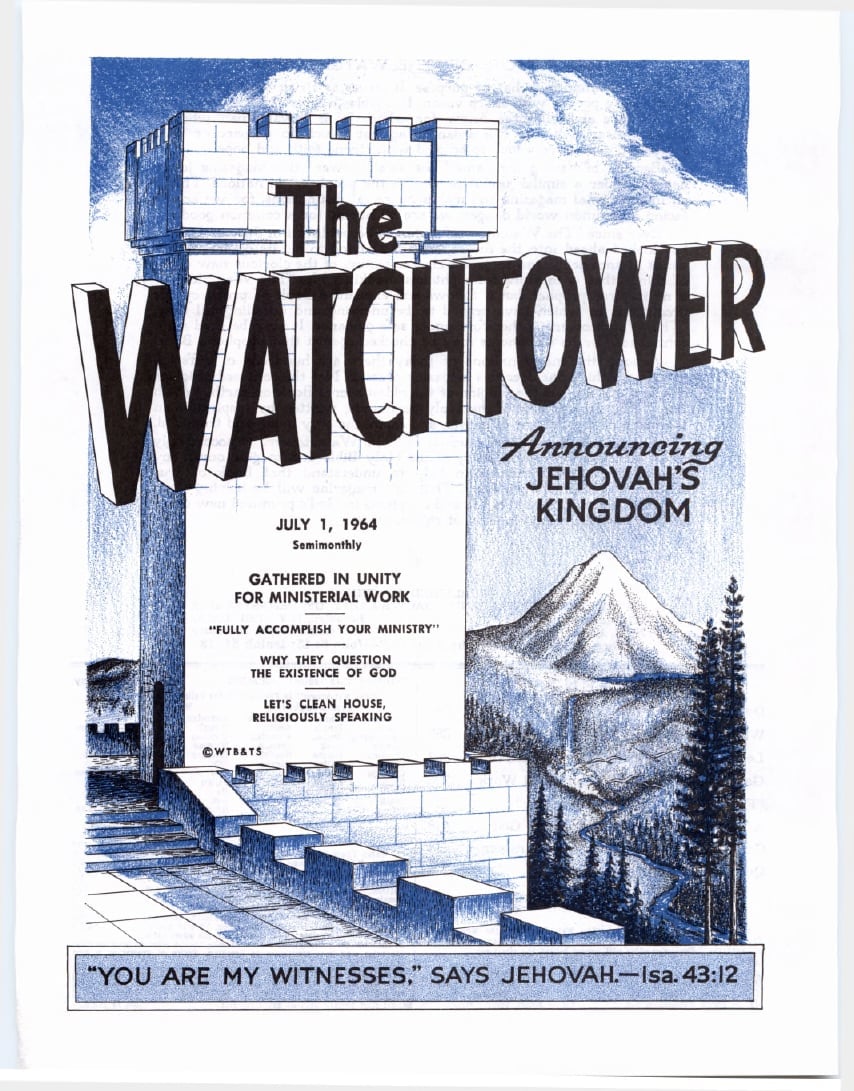
The Watchtower — July 1, 1964
Source: jw.org
Contents
Do You Provoke Others?
Why They Question the Existence of God
Let’s Clean House, Religiously Speaking
Gathered in Unity for Ministerial Work
“Fully Accomplish Your Ministry”
A Pattern of Action for Pleasing God
Gaining Strength by Mutual Encouragement
Questions From Readers
Announcements
Do You Provoke Others?
Do You Provoke Others?
NO DOUBT you have observed persons who, under provocation, did and said things they should not have. Perhaps they were even sorry and apologized afterward. Probably you have experienced such anger yourself and have seen the harm that can come by acting rashly when emotionally disturbed.
In the Bible there is an outstanding example of behaving rashly in a provoked state. It is that of Moses, who became provoked to anger with the Israelites on the way to the Land of Promise. These people were agitated and they demanded water from Moses. God told Moses to speak to a rock and water would issue forth. But Moses angrily said to the people: “Hear, now, you rebels! Is it from this crag that we shall bring out water for you?” (Num. 20:10) Here Moses made a grave error. In his provoked state he said “we shall bring out water,” thereby taking glory away from God. As God told him: “You did not show faith in me to sanctify me before the eyes of the sons of Israel.”—Num. 20:12.
Why did Moses sin with his mouth? Why did he behave rashly? Some are quick to put all the blame on Moses and say he just lost his temper. But was Moses an ill-tempered man, always looking for an argument? Just the opposite is true. The inspired Bible record informs us: “Moses was by far the meekest of all the men who were upon the surface of the ground.” (Num. 12:3) No, Moses was not a rash man, but he acted rashly on that occasion because of the unrighteous actions of others. Moses was provoked, yes, pushed into anger by the bad actions of a rebellious people.
That Moses was pushed to provocation is seen by the account at Psalm 106:32, 33, which states: “Further, they [the Israelites] caused provocation at the waters of Meribah, so that it went badly with Moses by reason of them. For they embittered his spirit and he began to speak rashly with his lips.” Yes, they were the root cause for his becoming angry.
On occasion the Israelites even provoked God to anger! “Now the people became as men having something evil to complain about in the ears of Jehovah. When Jehovah got to hear it, then his anger grew hot.” (Num. 11:1) Also, at Deuteronomy 32:21 we read: “They, for their part, have incited me to jealousy with what is no god; they have vexed me with their vain idols.” Yes, God himself was provoked. Why? Because of the bad ways of the Israelites. His anger was perfectly controlled, of course—something that was not true in Moses’ case.
All of this shows that one who provokes another is in the wrong. A person might get provoked and in this condition speak or act rashly, since he does not have the perfect control that Jehovah has. True, the person behaves wrongly. But why has he done so? Because someone provoked him! Things were said or done that stirred up his emotions. Now, then, is the one who causes the outburst innocent? Not at all! If he had not provoked the other, then that person might never have become angered to the point of behaving rashly. It is as in the case of Moses. He, being “by far the meekest of all the men who were upon the surface of the ground,” surely would not have lost his temper if the Israelites had not grossly provoked him.
So while you may recognize that one who becomes unduly provoked is falling short of exercising Christian love, you must also recognize the grave error of the one who causes another to become angered. It is true that in everyday life Christian love “does not become provoked.” (1 Cor. 13:5) But it is just as true that Christian love does not provoke others. Actually, provoking another needlessly is a manifestation of hatred: “Hatred is what stirs up contentions.” (Prov. 10: 12) Of course, there are times when those in positions of responsibility must give counsel or correction to others, which, even though done lovingly, may provoke. But this is not the unnecessary provoking in everyday life that is being here considered.
By speaking unkindly to others, by being critical instead of forgiving, by not considering the human imperfection of others, by continually rubbing people the wrong way, a person becomes provocative. Then he can hardly expect good to come to him, for he goes against the very nature of man, who does not like to have others provoke him unnecessarily. Hence, what is it like when one speaks thoughtlessly? The Bible answers: “There exists the one speaking thoughtlessly as with the stabs of a sword.” (Prov. 12:18) What can this result in? “A word causing pain makes anger to come up.” (Prov. 15:1) So if you provoke others, do not be surprised to see their anger aroused.
Hence, it really is unchristian for one needlessly to provoke others by what one says or does. This violates the great principle, the great commandment Jesus pointed to when he said: “You must love your neighbor as yourself.” (Matt. 22:39) It could cause one’s fellowman to be led into error, as was the case with Moses at Meribah. And how does God feel about those who cause others to err? His Word tells us: “He that is causing the upright ones to go astray into the bad way will himself fall into his own pit.”—Prov. 28:10.
Instead of provoking others, the wise person heals with his words and deeds. “The tongue of the wise ones is a healing.” (Prov. 12:18) The wise person realizes that provocative words and actions arouse others to anger, so he avoids saying or doing things that provoke. He works hard to control himself so as to bring benefit to his fellowman instead of bringing him pain. Before taking a course of action that might provoke others, the wise one asks himself: How would I like it if someone said or did that to me?
Be like the wise person. Work hard to avoid provoking others. Apply the principle Jesus laid down in regard to human relationships, when he said: “All things, therefore, that you want men to do to you, you also must likewise do to them.”—Matt. 7:12.
Pleasant sayings are a honeycomb, sweet to the soul and a healing to the bones.—Prov. 16:24.
Why They Question the Existence of God
Why They Question the Existence of God
More people are doing so today. Do their reasons justify the conclusion that God does not exist?
IN THE February 24, 1962, issue of Ave Maria the Catholic Cardinal Richard Cushing observed: “For the first time in the history of mankind, atheism is on the march; and the Church is helpless to prevent the advance of anti-Christ.” It is spreading rapidly throughout the world. The idea that there is no God not only has engulfed a large proportion of the more than one billion people ruled by communism, but it has made amazing inroads upon the thinking of persons in noncommunist lands.
But why do so many persons today question the existence of God? Why is atheism now on the march, and the church unable to stop it? What is responsible for this unprecedented disbelief?
BELIEF IN GOD’S EXISTENCE
Philosopher Celestine N. Bittle wrote in his book God and His Creatures: “No people has ever been discovered which, in the strict sense of the term, is ‘atheistic.’ Individuals may be atheists; but a people, never. This universal belief is a tremendous fact.” It is strong evidence that man was originally created with the inherent inclination to acknowledge God’s existence.
In order to satisfy man’s quest to know about Him, God provided man with an inspired record about Himself. In this account God also explains man’s origin, why sickness and death exist and what hope there is for the future. The collection of these inspired writings is now generally known as the Holy Bible or Scriptures.—2 Tim. 3:16.
The Scriptures are in harmony with man’s inherent inclination to acknowledge God’s existence and go to support it. They attribute the beautiful starry heavens, the marvelous earth and intelligent man to the handiwork of God. They state: “God created the heavens and the earth,” also, “God proceeded to create the man.” Yes, the evidence of the Scriptures, the natural dictate of human reason and the law and order that govern the universe all testify to the fact that God does exist.—Gen. 1:1, 27.
WHAT ABOUT HUMAN SUFFERING?
However, it is because of the unparalleled human suffering in the earth that many persons question the existence of God. This was pointed out by a retired Anglican medical missionary, Marian Sherman, who said last fall: “I became an atheist very largely because of the terrible suffering of Indian women who had never done anything to deserve it. How could an all-loving God allow this to happen? And we’ve had two ghastly world wars. It just doesn’t make sense.”
Not a few persons reason this way. A loving God, they feel, would not allow human suffering; and since suffering exists, they conclude, there must not be a God who is loving. Is this conclusion justified?
No, it is not. The existence of wickedness and the suffering it has brought to mankind does not arbitrarily rule that a God of love does not exist. Such a view overlooks entirely man’s responsibility. It is like a patient who ignores a doctor’s instructions, and then denies the existence of the doctor because he is suffering. Or it is like a machinist who refuses to follow the manufacturer’s advice, and then, when his tools do not function properly, denies that the manufacturer exists. In such cases it would be foolish to question the existence of a compassionate doctor or a skilled manufacturer. The individual himself is to blame for the suffering and trouble.
It is similar with mankind today. The inspired Scriptures show that Jehovah God created the first human pair perfect, with the prospect of enjoying life in an earthly paradise as long as they lived. This provision was an evidence of God’s love. But when mankind refused to follow God’s instructions, they suffered the consequences. This did not mean a loving God does not exist. God had warned them in advance what would happen; so it was man, not God, that was responsible for the suffering, sickness and death that followed.—Gen. 1:27, 28; Deut. 32:4, 5; Eccl. 7:29.
True, it would not be loving to allow this suffering to continue indefinitely. And this God has no intention of doing. Human wickedness and suffering have been tolerated only because an issue was raised in the garden of Eden. One of God’s spirit creatures, identified in the Bible as Satan the Devil, influenced the first human pair, Adam and Eve, to disobey God. This called into question God’s creatorship and his justice in demanding obedience as a condition for life and yet seemingly not creating man with the capability of remaining loyal to God.
So God has allowed a set period of time to settle this question of whether men can remain faithful under test. This period is now about up. Very soon Satan and all the human suffering he has been responsible for will be eliminated. It is the loving Creator who will provide this relief by ushering obedient mankind into a righteous new system of things.—2 Pet. 3:13; Rev. 12:12.
RELIGION’S RESPONSIBILITY
The churches of Christendom have not made clear to people why wickedness and suffering have been allowed to exist for a time on earth. Rather, they have taught lies about God, painting him as an unmerciful fiend who keeps humans alive in some subterranean lake of fire, where they cook and sizzle in excruciating pain throughout eternity. Such teachings have turned many away from God.
Many modern theologians and clergymen are even coming to terms with atheism. “I have preached more and more in the past decade on the values of atheism and agnosticism,” wrote Episcopal Bishop James A. Pike. “There has to be a large measure of agnosticism in true religion,” he asserted.a And Time magazine of June 9, 1961, observed that “Paul Tillich, America’s most eminent theologian, talks of God as ‘Being Itself’ or ‘Ultimate Reality.’” This characterization, however, says an article entitled “Is Modern Theology Atheistic?” appearing in the Protestant journal The Christian Century, “saves Tillich from the charge of atheism.” But is not this sort of theology that borders on atheism enough to cause a lot of persons to question the existence of God?
It is therefore apparent that the churches, instead of building faith in God, have been responsible for millions of persons turning toward atheistic communism. Their conflicting teachings, religious persecutions, warmongering and currying the favor of the rich and influential have caused many to reason that, if the churches represent God, then there must not be a God. Many responsible churchmen admit religion’s guilt.
“I know that it is we, we Christians alone, who are responsible for Communism,” admitted the dean of a European theological school. “Remember that the Communists once were Christians. If they do not believe in a just God, whose fault is it?”b And the dean of the faculty at New York City’s Union Theological Seminary acknowledged: “The very atheism of Communism is a judgment upon the churches, . . . which have usually been ornaments of the status quo, no matter how unjust it has been.”c
The failure of the churches to imitate Christ and to provide accurate knowledge concerning God has prepared the way for atheism.
ATHEISM’S ADVANCE
Hundreds of millions of persons in Communist lands are being systematically taught that God does not exist, and indoctrination is being stepped up. “Atheism will be taught more intensively at party training centers and in special courses for teachers, doctors and journalists,” Time magazine reported recently. This constant program of indoctrination, especially of the youth, has caused many to question the existence of God.
Often this propaganda reaches the West in newspaper reports. For example: “‘The Bible says the Creator sent manna to the Jews,’ Premier Khrushchev said. ‘I don’t know whether this is true, I did not see it happen. I don’t know whether the manna was of first quality or whether the Jews got enough of it. To find out, we sent Gagarin up there to take a look. But Gagarin reported he saw nothing but emptiness. So we sent Valentina Tereshkova and told her if she finds manna she should cook herself a meal, but she found nothing. So there is no hope that we can get manna from heaven. This means that we must trust our hard-working hands.”—New York Times, April 7, 1964.
What a foolish basis on which to question the existence of God! But these persons did not first give up belief in God after the trips into space. Rather, in Communist-controlled countries, faith in God is undermined in youth by constant repetition by teachers and educators that there is no God. Others question God’s existence because of seeing human suffering, and not receiving a satisfactory Scriptural answer for it. And still others have been turned away from God because of the conflicting teachings and the atheistic leanings of religious leaders.
But there is at least one more vital factor that is responsible for so many questioning the existence of God. That is because they want to believe the lie that there is no God. God’s righteous law is an uncomfortable restriction. They want to be free to pursue their selfish course without the pangs of conscience that would gnaw at them should they be accountable to God’s law. And so, because they do “not accept the love of the truth . . . God lets an operation of error go to them, that they may get to believing the lie.”—2 Thess. 2:10, 11.
A wise person who loves righteousness, however, will never be turned away from God. He will regularly study the Bible, and will grow to love God for the marvelous provisions that He has made for life in a righteous new system of things. Indeed, it is the fool that “hath said in his heart, there is no God.”—Ps. 14:1, American Standard Version.
[Footnotes]
The Christian Century, December 21, 1960.
Harper’s Magazine, August 1960.
Time magazine, November 10, 1961.
Let’s Clean House, Religiously Speaking
Let’s Clean House, Religiously Speaking
DATING back to the time of ancient Babylon and Egypt, the use of religious articles in homes has been popular. From the ruins of ancient homes archaeologists have unearthed all manner of religious images, statues, shrines, paintings and evidence of religious symbols such as the cross.
This may surprise you, but it is a fact that religious articles and symbolisms used in ancient pagan Babylon and Egypt are in use today in many “Christian” homes. It is high time for those who want to be true Christians to clean house, religiously speaking.—Acts 17:29-31.
Before we examine what the Holy Bible has to say about cleaning house, religiously speaking, let us take a look at a typical Latin-American home, similar in some respects to homes in the Dominican Republic, Cuba, Puerto Rico and elsewhere.
As we near the house we notice a shrine along the sidewalk at the corner. The small hole in the front is for an offering to the image. As we enter the yard we note another home shrine with the image of family devotion, usually the national goddess or saint, differing from country to country. Some are very elaborate and costly. Near the door a cross can be seen. On knocking, we are welcomed into the hospitable home by the expression, “Adelante, tomen asiento.” “Come on in, take a seat.” The householder is pleased to show us her home. Did you notice that small platform or shelf over your head as we entered? A religious picture with a glass of water or something to eat is placed on it. Often such small platforms can be seen in front of a picture of a deceased member of the family with flowers placed before it.
In a humble home with an earth floor we note the cross again painted on each door. An elaborate one of metal or wood will be found in other homes. As we follow the housewife we note this same religious symbol over the beds on the wall and upon the home altar, which at times occupies a corner of a room or even possibly an entire wall. This is usually decorated with shiny papers of many colors along with religious pictures, candles or colored electric lights and flowers. Religious pictures of the “Sacred Heart” and “The Last Supper” will also be found in the rooms.
What are we to think of the use of these many religious articles and symbols? We must think what God thinks.
RELIGIOUS IMAGES
We are not to think that there is necessarily something wrong with every art object, an image or statue. So we must differentiate between objects that are simply works of art and objects of religious devotion, images used to represent some saint or deity. If one takes a worshipful attitude toward any image, making it a religious object, then the possessor of such image ought to reflect upon God’s view of religious images. For instance, God commanded the Israelites of ancient time not to have any images to represent the true God. (Ex. 20:4; Deut. 4:15-19) Nor were they to bring the images or symbols of the pagan Egyptians and Canaanites into their homes. God’s clear-cut declaration was:
“The graven images of their gods you should burn in the fire. You must not desire the silver and the gold upon them, nor indeed take it for yourself, for fear you may be ensnared by it; for it is a thing detestable to Jehovah your God. And you must not bring a detestable thing into your house and actually become a thing devoted to destruction like it. You should thoroughly loathe it and absolutely detest it, because it is something devoted to destruction.”—Deut. 7:25, 26.
True Christians appreciate this same principle of a clean home, religiously speaking, especially in view of similar commands given in the Christian Greek Scriptures: “We ought not to imagine that the Divine Being is . . . like something sculptured by the art and contrivance of man.” “Little children, guard yourselves from idols.” (Acts 17:29; 1 John 5:21) So the early Christians kept their homes free of religious images. How, then, did images of Christ, for example, get started? By turning to history books dealing with the early Christians, you will learn this: “Heathens, who, like [Emperor] Alexander Severus, saw something Divine in Christ, and sects, which mixed heathenism and Christianity together, were the first who made use of images of Christ.”a Since no images of Christ were used by the early Christians, it is evident they had no images of Mary, Jesus’ mother, either.
So when an image becomes an object of religious devotion, it is time for the possessor of such, if he wants to be a true Christian, to clean house, religiously speaking—no matter what the image represents or who made it.
It is well for every Christian to remember what took place in connection with the figure of the copper serpent made by Moses. During the sojourn of the Israelites in the wilderness, God commanded Moses, who had led Israel out of Egypt, to make the figure of a copper serpent, which was a symbol and had prophetic significance, but it was not for religious worship. (Num. 21:4-9; John 3:14, 15) Thus the copper-serpent image was not adored or used for worship in Moses’ day. Though that image was made under proper circumstances, even at the command of God, yet, finally, it had to be destroyed. How so? Because centuries after Moses’ day the Israelites turned that same image of the copper serpent into an object of religious devotion, even burning incense to it. (2 Ki. 18:4) So when King Hezekiah purged the land of Judah of religious images, he had the copper serpent made by Moses crushed into pieces and utterly destroyed.
That destruction of religious images had God’s blessing, since the true God wants to be worshiped without images or not through images, as Jesus Christ himself stated: “God is a Spirit, and those worshiping him must worship with spirit and truth.”—John 4:24; 2 Ki. 18:1-7.
RELIGIOUS PICTURES
But what could be objectionable about pictures? After all, a Christian may properly have or display a photograph, a drawing or a painting. It may be of friends or relatives, of scenery or of Biblical subjects. Jehovah’s witnesses, for example, have a calendar with a different illustration each year of an important Biblical event. Well, then, what determines whether a picture is objectionable? This: Is the picture reverenced or worshiped, perhaps food placed before it? Does the picture have pagan symbolism? Does the picture misrepresent the Bible?
Take, for example, a picture that appears in many interpretations, the so-called “Last Supper.” Jesus instituted “The Lord’s Supper” or, as a modern Bible translation calls it, “the Lord’s evening meal,” on the date of Nisan 14, 33 C.E., after 6 p.m., on a Thursday. (1 Cor. 11:20, 23, 24) Just before the Lord’s Evening Meal, Jesus and his twelve apostles had eaten the annual passover lamb. But how many plates of fish do you see on the table of some paintings? Fish was not eaten by Jesus and his apostles that Thursday night, but, rather, the meat of a lamb. Pictures that show fish are misrepresenting the Holy Bible.
The Bible shows that, along with roasted lamb, unleavened bread was used for the passover. (Ex. 12:8-15) You will notice in some pictures that the buns, one for each apostle, are leavened or risen bread. The Bible account shows, too, that the faithful apostles ate from one loaf of unleavened bread; each did not have his own leavened bun.—Matt. 26:26.
The Bible also shows that all the faithful apostles were to drink from the same cup. (Matt. 26:27) In the pictures we usually are led to believe that after the passover meal and during the Lord’s Supper each apostle had his own glass, while Jesus alone had a special chalice of wine. Actually, they partook of the same loaf and drank from the same cup.
You will note, too, that in many pictures all are seated. The custom in Jesus’ day was to eat in a reclining position, as can be noted by reference to a Bible dictionary. The Bible itself shows that John was reclining on the bosom of Jesus, something he would be unable to do if seated while eating.—John 13:23-25.
How many apostles do you count? The Bible indicates that Judas left “immediately” after the passover celebration and hence before Jesus instituted the Lord’s Evening Meal with the faithful eleven apostles. (John 13:30) Pictures showing twelve apostles along with Jesus do not portray the truth.
Thus our example shows misrepresentation of the Bible with regard to the passover lamb, the unleavened bread, the one loaf and the one cup, the manner of reclining and the number of apostles. When a picture misrepresents God’s Holy Word, it is time to clear it out.
Then with regard to pictures of Jesus Christ, do you notice any halo or circle of light encompassing his head? This is called a “nimbus.” You will find it revealing to go to a good encyclopedia and look up the word “nimbus,” for you will learn that it was used by the ancient pagan Egyptians, Greeks and Romans in their religious art; such a symbol is of Babylonish origin, since it appears in artistic representations of the main deities of Babylon. The circle of light was the symbol of the sun-god, and thus it is paganism.
No picture that smacks of Babylonish paganism belongs on the wall of a Christian home.
THE CROSS
One of the symbols commonly seen in homes is the cross. Actually, the Holy Scriptures show that Jesus Christ was nailed to a tree or stake without a cross arm. The apostle Peter mentioned on at least two occasions that Jesus died on a tree (xýlon). (Acts 5:30; 1 Pet. 2:24) The other original Greek word used in the Bible is staurosʹ and means a stake without any cross arms of any kind.
Even if it had been a cross upon which Jesus was impaled, would that be a fitting religious symbol for Christians? No, no more than one would adore or worship a bullet or machete that had killed a dear loved one! No wonder the early Christians had no crosses in their homes! “There was no use of the crucifix,” says one historian of the early Christians, “and no material representation of the cross.”b
Where, then, did the cross come from? Centuries before Christ the cross was used by pagan religionists in India, China, Persia, Egypt and, of course, Babylon. The upright cross was the sacred symbol of the Babylonian god Tammuz. It was also the symbol of the sun-god Sol, in ancient Rome. Such a cross was the original form of their letter “T,” the initial letter of the name of the god Tammuz.
Further, encyclopedias will tell you that ancient Egypt had a cross that was a symbol of immoral sex worship. The Egyptian cross, the ankh (crux ansata or handled cross), consisted of a “T” with an oval handle on its top representing the male and female reproductive organs. The Israelites did not use this pagan symbol of the phallic cross in their homes.
As it was in pagan Egypt, however, so also the use of the phallic symbol is common in Latin America and elsewhere. Some church buildings are built on its “T”- shaped design. On the cathedral in San Pedro Sula in Honduras the shield over the doors uses the cross and oval. As the ancient Egyptian tombs and mummies contained many crosses, so today burial places are filled with crosses, some with the oval included.
LET’S CLEAN HOUSE
What, then, should be our attitude toward images, paintings and crosses? As for images and statues, the danger comes when people bow or pray before these lifeless idols, when they offer food before them, when they view them as something holy. Though there is nothing wrong with a picture correctly portraying a Bible event, yet if one gives a picture reverence and worship, that is wrong. If it is a picture of a deceased loved one, does the possessor give it religious devotion? Then, of course, it is wrong. And if a picture misrepresents the holy Word of God or contains pagan symbolisms such as the halo or nimbus and a cross, then why have it around the house?
So look around your house. Do you have any religious images? Do you have any religious paintings with the pagan halo encompassing the subject’s head? Do you have representations of a cross? Do you have any pictures toward which you have a worshipful attitude?
If you do, it is time to clean house. Your taking this positive step, without fear of man, toward the pure and undefiled worship of Jehovah God will mean obedience to the commandments of God. It will mean the end of all Babylonish paganism in artworks around your home. It will show your desire to worship God, as Jesus Christ stated, “with spirit and truth.” So let’s clean house, religiously speaking.
[Footnotes]
The History of the Christian Religion and Church, During the Three First Centuries, Dr. Augustus Neander.
History of the Christian Church, J. F. Hurst, Vol. I, p. 366.
[Picture on page 395]
Tammuz Wearing Crosses
Gathered in Unity for Ministerial Work
Gathered in Unity for Ministerial Work
“He [God] purposed in himself for an administration at the full limit of the appointed times, namely, to gather all things together again in the Christ, the things in the heavens and the things on the earth . . . that we should serve [or, be] for the praise of his glory.”—Eph. 1:9-12, NW; AV; AS.
1. In what ways is modern man at cross-purposes with himself?
MODERN man finds himself in a complex and difficult situation. He is at cross-purposes with himself. On the one hand, in the last half century he has learned how to harness the forces of God’s creation in a way and to a degree undreamed of in previous generations, or only dimly guessed at. Tremendous advances in means of communication and of travel, advances in the world of mechanics, also in the realms of medicine and of science—these have opened the door to wonderful possibilities. On the other hand, by those same means, under the direction and stimulus of ambitious and ruthless men, the door has also been opened to dreadful possibilities. Modern man can benefit himself in many ways hitherto unknown, but he also has within his grasp the means to just about ruin the earth and its inhabitants. Men are proud of their achievements, but at the same time, as foretold, “men become faint out of fear and expectation of the things coming upon the inhabited earth.” Self-assuming, headstrong men, are forced to admit that these are “critical times hard to deal with.” What a contradiction!—Luke 21:26; 2 Tim. 3:1-5.
2, 3. What fine contrast is seen when we turn to the Ancient of Days?
2 But when we turn our attention away from modern man to the Ancient of Days, the Creator, what a contrast! In chapter 7 of Daniel’s prophecy, Da 7 verses 9 to 14, he is described as being enthroned at Court, with many thousands standing before him and ministering to him.
3 In the context of that same prophecy it tells of fierce beasts, representing earthly kingdoms, striving against one another for preeminence and putting on great airs. But the solution of all their conflicts is in the hands of the Ancient of Days, the Supreme One. Judgment is given in favor of someone described as a “son of man . . . And to him there were given rulership and dignity and kingdom, that the peoples . . . should all serve even him. His rulership is an indefinitely lasting rulership that will not pass away, and his kingdom one that will not be brought to ruin.” Giving further detail, the prophecy later says that “judgment itself was given in favor of the holy ones of the Supreme One . . . And the kingdom and the rulership and the grandeur of the kingdoms under all the heavens were given to the people who are the holy ones of the Supreme One.”—Dan. 7:13, 14, 22, 27.
4, 5. Who are identified in Revelation as (a) the one enthroned (b) the one worthy to take the scroll, and (c) the holy ones who share the rulership with Christ?
4 The identification of these characters is not left in doubt. In the last book of the Bible the same theme is taken up and enlarged on. In Revelation, chapter 4, we find a magnificent description of the heavenly throne and the One seated upon it. It is awe-inspiring, but not terrifying. The One enthroned is mentioned twice by name: “Holy, holy, holy is Jehovah God, the Almighty . . . You are worthy, Jehovah, even our God, to receive the glory and the honor and the power, because you created all things, and because of your will they existed and were created.”—Rev. 4:8, 11.
5 In Re chapter 5, the only one who has the right of access to the throne and who is “worthy to take the scroll and open its seals” is identified as “The Lion that is of the tribe of Judah, the root of David,” that is, Christ Jesus. Along with him, mention is also made of those holy ones, persons redeemed or bought by the blood of the Lamb, and who, with Christ Jesus, are ‘made to be a kingdom and priests to our God, and they will rule as kings over the earth.’ These make up the true church, the Christian congregation, who have “part in the first resurrection,” and who will be “priests of God and of the Christ, and will rule as kings with him for the thousand years.”—Rev. 5:5, 9, 10; 20:6.
6. As the Supreme One, what qualifications does Jehovah possess?
6 These passages from God’s Word strongly impress on us the absolute sovereign right and unassailable position of the Supreme One, Jehovah. With him, all is harmonious and secure. There is nothing contradictory, as is painfully evident in the affairs of modern man. In his hands Jehovah holds the solution to all man’s problems and conflicts, seen in the rulership and kingdom which are safely entrusted to the Lamb, Christ Jesus, who is proved worthy to receive it. That others, a limited number of sinful humanity, are enabled to share in that rulership and kingdom is but an added, though wonderful, evidence of the riches of Jehovah’s undeserved kindness.
7. How is Jehovah’s undeserved kindness emphasized in the early part of the letter to the Ephesians?
7 It is this latter aspect that was evidently in the mind of the apostle Paul when writing to the Christians, “to the holy ones who are in Ephesus.” He prays on their behalf: “May you have undeserved kindness and peace from God our Father and the Lord Jesus Christ.” He then explains that their adoption as sons of God through Jesus Christ was “in praise of his [God’s] glorious undeserved kindness,” and that the ‘forgiveness of their trespasses,’ based on Jesus’ shed blood and ransom, was also “according to the riches of his [God’s] undeserved kindness.”—Eph. 1:1-7.
8, 9. (a) What attitude should we have toward life? (b) What disclosure did Paul make as to God’s will and purpose?
8 With this in mind, the apostle then discusses the same lofty theme as already mentioned, that of God’s sovereign will and purpose and the position of all his creatures in relation thereto. There are no exceptions or exemptions. A person will sometimes say, “I did not ask to be born,” as if thereby seeking to be relieved of any sense of responsibility in life. But no. We do not owe our existence to chance. Jehovah is the Supreme One and he created all things, including the human family in original perfection, possessing the marvelous power of procreation. Out of respect and appreciation for the Creator, we ought to say that it is because of his will that we have come into existence.—Rev. 4:11.
9 In this frame of mind let us listen to what Paul has to say. He explains that God caused his undeserved kindness to abound toward us by making known the “sacred secret of his will. It is according to his good pleasure which he purposed in himself for an administration at the full limit of the appointed times, namely, to gather all things together again in the Christ, the things in the heavens and the things on the earth.”—Eph. 1:9, 10.
10, 11. What meaning and importance are attached to the terms (a) “sacred secret,” and (b) “administration”?
10 The very language used by the apostle emphasizes the importance of Jehovah’s paramount will and purpose. It had been held for a long time as a “sacred secret.” How that expression appeals to us! What a pleasure it gives to be entrusted with a secret! Even a child, especially a little girl, loves to have a secret and, at the right moment, to whisper it into the ear of her best friend, keenly watching to see that no other child is within earshot. Her secret may not mean much to us grown-ups, but Jehovah’s secret is sacred and embodies his whole purpose and is all important, both to him and to us. To ignore it or stumble over it, as many have done, means the loss of everything.
11 Consider also the term “administration.” It too indicates something of real importance, as it is usually used with reference to such things as the effectual management of governmental and legal affairs. Many readers of The Watchtower, when visiting a big convention, enjoy a close look at the various departments, seeing all that can be seen, but they do not linger when coming to a door with a sign over it marked “Administration.” Ah! no, they do not want to become involved in that kind of responsibility.
JEHOVAH’S GREAT ADMINISTRATION
12, 13. As expressed at Ephesians 1:10, what is to be learned as to God’s administration?
12 What is this vital administration of Jehovah’s, held secret for so long? We are told the answer. It is Jehovah’s good pleasure, “at the full limit of the appointed times, . . . to gather all things together again in the Christ, the things in the heavens and the things on the earth.” (Eph. 1:10) From this we can at once learn several important things:
13 (1) There is but one gathering under the one administration. Man, however sincere, cannot build his own religious organization and claim that it is acceptable to God. (2) To be gathered in union with Christ calls for the spirit of willing submission to him as God’s Anointed One, also the spirit of unity and willing cooperation with all others who are thus gathered. (3) As subsequently disclosed, there is a ministry committed by God to those who are gathered. (4) The fact that Jehovah is “to gather all things together again” implies a former state of happy unity, which for some reason was not maintained, but is to be restored. (5) The time element comes in. This great work takes place “at the full limit of the appointed times.” So first we want to know, when is the full limit and when is the administration fully inaugurated?a
14. When is the “full limit of the appointed times,” and determined by what events?
14 The full limit is reached when, as Jesus said in his great prophecy, “the appointed times of the nations are fulfilled.” (Luke 21:24) This momentous turning point in the development of Jehovah’s purpose and in human history was reached in 1914, as abundantly testified by what took place here on earth in fulfillment of Bible prophecy. It was then that the rulership was given to Christ Jesus in heaven, as described at Daniel, chapter 7, despite the opposition of fierce, beastlike kingdoms on earth. As also prophetically depicted by the psalmist, the nations and their rulers “massed together as one against Jehovah and against his anointed one,” but Jehovah laughed at them in derision and declared: “I, even I, have installed my king upon Zion, my holy mountain.” When Jehovah’s anointed king, Christ Jesus, was installed or enthroned, that was when the administration was set up. This did not take place at Zion, or Jerusalem, yonder in Palestine, but, as the scripture says, at “Mount Zion and a city of the living God, heavenly Jerusalem.”—Ps. 2:2-6; Heb. 12:22.
15, 16. (a) When and how did the gathering in union with Christ commence? (b) What marks the full inauguration of God’s administration?
15 It may be argued that when writing to the Ephesians, Paul speaks of the gathering in union with Christ as having already commenced. That is true, as far as steps to that end are concerned. It began at Pentecost, 33 C.E., with the first members of the Christian congregation when God’s spirit was poured out upon them. (Acts 2:1-4) But neither while actively engaged in their ministry, nor at death, did they receive their full reward. As Paul wrote to Timothy: “From this time on there is reserved for me the crown of righteousness, which the Lord, the righteous judge, will give me as a reward in that day.” (2 Tim. 4:8) Jehovah’s great administration goes into full operation after the end of the Gentile Times in 1914.
16 “That day” having arrived, what do we see? In the words of the symbolic vision as described by John we can now say by faith: “And I saw, and, look! the Lamb standing upon the Mount Zion, and with him a hundred and forty-four thousand having his name and the name of his Father written on their foreheads.” It was after 1914 that the administrative “new heavens,” with the enthroned Jesus Christ as God’s Administrator, cast Satan the Devil and his demon angels down to our earth and proceeded to the work of unification, particularly from 1919 onward, as modern history of Jehovah’s witnesses shows. (Rev. 14:1; 12:1-13) Thus the work of the administration sweeps ever onward, completely fulfilling the will of the Supreme One exactly as he caused it to be recorded long ago in these words: “In the name of Jesus every knee should bend of those in heaven and those on earth and those under the ground, and every tongue should openly acknowledge that Jesus Christ is Lord to the glory of God the Father.”—Phil. 2:10, 11.
17. At this time what must we particularly heed?
17 So we are in the great day when we do well to heed those lessons pointing to the need for a clear vision of God’s theocratic organization, also to appreciate the purpose for which we are gathered in unity under its direction, namely, for ministerial work. Additionally, this emphasizes the need for the spirit of submission and cooperation. These lessons become more sharply defined as we look farther into what Paul says on this same theme.
THE RIGHT SPIRIT FOR THE RIGHT PURPOSE
18. On earth, how and why did the original state of unity come to an end?
18 To highlight the need for the right spirit, it will pay us to look back, particularly at the earthly scene, and see why the original state of happy unity was not maintained. When mother Eve listened to what the serpent had to say about the forbidden fruit, it became not only a test of obedience, but also one of humility. Deceived by what she was told, she began to look at that fruit from a new viewpoint. It would give her, so she thought, a newly found independence, and the idea appealed to her. This is shown by the fact that she did not even wait to ask her husband about it, but went ahead on her own initiative. We can imagine her saying: ‘Why not? I have a mind of my own, have I not? I know my husband has not had any of this fruit yet, but leave it to me; I’ll see that he has.’ And she did!—Gen. 3:1-6;1 Tim. 2:14.
19. How is the spirit of the world manifest today, and to what will this lead?
19 No, we did not hear mother Eve talking to herself in the garden of Eden, but it is not uncommon to hear some of her daughters talk like that. Is that not the spirit of the world today, both nationally and individually? Even the smallest nations are demanding their sovereign rights and independence. That same spirit, too, is often shown by individuals who say, in effect: ‘I have the right to live my own life my own way.’ That is the underlying reason why many will not heed the message brought to them by Jehovah’s witnesses. They know it will interfere with their independence. They and their rulers, similar to Eve, would rather listen to the boastful, froglike “unclean inspired expressions” that are inspired by the lying demons. Such propaganda stirs their spirit of proud independence and results in their being ‘gathered together to the war of the great day of God the Almighty.’—Rev. 16:13, 14.
20. What two alternatives face us today?
20 No wonder modern man is all at sea! Surely it is obvious that we must forego such a spirit of independence, however much we may have indulged it in the past. We are in the day when God is gathering “all things together again in the Christ,” gathering first to him the faithful Christians who have slept in death by resurrecting them to be with Jesus Christ in heaven. (Eph. 1:10; 1 Thess. 4:13-18) If we are not willing to be gathered under that righteous administration in the spirit of submission and loyal devotion, then, wittingly or unwittingly, we shall find ourselves gathered together with the opposing forces marching to Armageddon under Satan’s leadership to fight against God the Almighty. As Jesus pointedly said: “He that is not on my side is against me.”—Matt. 12:30.
21. As illustrated by Jesus, (a) who only are gathered to him, and (b) on what basis does Jesus render judgment?
21 Using Jesus’ illustration, we find that only the sheeplike ones are gathered to him; first, the “little flock,” the Christian congregation making up the “new heavens,” but now also since 1931 those “other sheep” who eagerly anticipate the blessings of the “new earth.” The “other sheep” are not dealt with separately, but all become “one flock, [under] one shepherd,” or administrator. Using Jesus’ other illustration, fulfilled in this day when he is enthroned as King, we see that he described the “other sheep” as those who support and give good cooperation to even the “least of these my brothers,” or followers. All others are judged by him as goats who, because of their stubborn independence, refuse or fail to give any such cooperation.—Matt. 25:31-46; Luke 12:32; John 10:16.
22. To what appeals in God’s Word should we now respond?
22 In this day when Jehovah will shortly ‘break and dash in pieces’ all those opposed to him and his anointed king, and will make “wars to cease to the extremity of the earth,” let all of us be wise and respond in the right spirit to the appeals made in the same Bible passages, where Jehovah says: “Give in, you people, and know that I am God.” “Serve Jehovah with fear . . . Kiss the son [Christ Jesus], that He may not become incensed . . . Happy are all those taking refuge in him.”—Ps. 2:9-12; 46:9, 10.
23, 24. What is God’s purpose for those gathered in union with Christ, and can they decide about this for themselves?
23 What is God’s purpose for those of us who do respond and are gathered under Christ’s administration? Is it just for our own blessing and salvation? Can we decide about this for ourselves? That would be most illogical, though some have made that mistake and have fallen out of the ranks. No, it is not according to what we may think, but, as Paul says regarding the foreordained 144,000, it is “according to the purpose of him [God] who operates all things according to the way his will counsels.” So what is God’s purpose? Notice the answer given: “That we should serve [literally, be] for the praise of his glory.” Then observe in what immediately follows that we are told how to serve God’s purpose acceptably. After speaking of himself and others who had been the “first to hope in the Christ,” Paul then says that “you [at Ephesus] also hoped in him.”
24 How had this been made possible? Paul explains that it was “after you heard the word of truth, the good news about your salvation.” This clearly defines for us the will of the Supreme One for those who are gathered. We must not keep the good news to ourselves, but must let others hear about it so that they too can share and rejoice in the same glorious hope. That is how we can be to Jehovah’s glorious praise, and this divine purpose must be served under the direction of a single administration.—Eph. 1:11-13.
25. What is the Christian’s proper viewpoint respecting himself and works?
25 From another angle, a little farther on, Paul again argues in favor of God’s supremacy and against our taking an independent view of things. He reminds us that we cannot take any credit to ourselves in becoming Christians. We have nothing to boast of. Rather, as Christians, “we are a product of his [God’s] work.” Nevertheless, though “saved through faith,” we cannot be idle and neither can we decide for ourselves how to work out our salvation. Instead, as Paul expressed it, we are gathered in union with Christ Jesus “for good works, which God prepared in advance for us to walk in them.”—Eph. 2:8-10.
26, 27. (a) How is the right spirit for the right purpose manifest? (b) How did Jesus make the issue plain?
26 From the scriptures discussed under this subheading, the lesson to be learned and the issue involved are made quite clear. We must have the right spirit for the right purpose, the spirit of unselfish, whole-souled devotion to Jehovah in order to ensure our prosperity in the right works he has prepared for us. We not only must be gathered in union with Christ ourselves, but under him must share in gathering others by letting them hear the good news.
27 Jesus said: “He that does not gather with me scatters.” That makes the issue plain. If we refuse to come under or stay within his administration, then it is manifest that we have the wrong spirit for the wrong purpose. Any gathering sought to be done apart from Christ’s administration must be in opposition thereto, however good the work and the motive may appear to be. As Jesus said in his previous comments, after being accused of expelling demons by means of Beelzebub, “Every kingdom divided against itself comes to desolation . . . if Satan expels Satan, he has become divided against himself; how, then, will his kingdom stand?” This explains why modern man is at cross-purposes with himself, in spite of his efforts toward unity. His motive is mainly a selfish one, and that is no basis for a genuine, lasting unity. Let us not be blinded or sidetracked into supporting the wrong administration.—Matt. 12:24-30.
THE GATHERING TAKES SHAPE
28. In what way is the Christian congregation seen to take shape?
28 Following up this same theme, the apostle discloses a further development that takes place under Christ’s administration. This is intensely interesting and gives a more exalted view of the administration. He explains that those who are gathered do not just crowd around a common center, as it were. Instead, they are seen to take definite shape, likened to a building. First, “Christ Jesus himself is the foundation cornerstone.” The apostles and prophets make up the rest of the foundation, on which the “whole building, being harmoniously joined together, is growing into a holy temple for Jehovah . . . a place for God to inhabit by spirit.” (Eph. 2:20-22) What a lofty conception! When attending a meeting of Jehovah’s witnesses at their Kingdom Hall, or a larger assembly, we may be tempted to look at them from a fleshly viewpoint, noticing just their outward appearance. Rather, we should view them and appreciate them as Jehovah does. Other scriptures using the same illustration of God’s temple stress the same thing, our need to keep the spiritual viewpoint, also the responsibility of those belonging to God’s temple to avoid becoming “unevenly yoked with unbelievers.”—1 Cor. 3:16, 17; 2 Cor. 6:14–7:1.
29. How is the great crowd of “other sheep” seen in the temple picture?
29 The entire Christian congregation of 144,000 together with Jesus Christ comprises the spiritual temple made up of “living stones.” (1 Pet. 2:4, 5; John 2:19-22) You may say you understand this, but that it does not have any connection with you as your hopes are not heavenly, like those of the “little flock,” but earthly. Many Watchtower readers might feel this way about it, but make no mistake. If you love Jehovah and have submitted yourself to him in dedication, symbolized by water immersion, then you come right inside the picture. For your encouragement we remind you that, after describing the formation of spiritual Israel, the temple or sanctuary class, John was given a vision of a great crowd of “other sheep” said to be “rendering him [God] sacred service day and night in his temple.” We could not imagine a finer picture of close unity and concord!—Rev. 7:15.
30. How has the gathering work today taken on a wider sweep, emphasizing what need?
30 In support of this we read that God’s “will is that all sorts of men should be saved and come to an accurate knowledge of truth.” (1 Tim. 2:4) Today all sorts of people are responding to the good news and bringing themselves into harmony with it, being gathered into “one flock” under “one shepherd.” The Scriptures make it plain that these all should by their conduct serve for the praise of God’s glory by unitedly sharing in the ministerial work due to be completed before the accomplished end of the present system of things. From the days of the apostles onward the emphasis has been on the gathering of the Christian congregation of Christ’s 144,000 joint heirs; but now, at the “full limit of the appointed times,” the gathering work has taken on a wider sweep since 1931, coupled with great urgency because the time is short. We need all the help and encouragement possible, and it will therefore be good to take a close look at our ministerial work, both inside God’s organization and outside.
[Footnotes]
See The Watchtower as of November 15, 1959, pages 688-690, paragraphs 15-23.
[Picture on page 400]
Froglike “unclean inspired expressions” gather rulers in opposition to God
[Picture on page 401]
Serving as a minister under Christ’s administration
“Fully Accomplish Your Ministry”
“Fully Accomplish Your Ministry”
1. How should the Christian’s ministry be viewed?
GOD has never left his people with nothing to do. He has put them to work, and as this comes as a commission from him it can properly be called ministerial work because it is in the nature of service rendered to him. Such work can therefore never be treated lightly, but should be viewed as a stewardship. It is a great privilege and brings much happiness, but it also carries a great responsibility. This should not deter us, for God well knows our imperfections and frailties, and in his undeserved kindness has made ample provision on our behalf.
2. Paul’s letters to Timothy show what spirit, and pointing to what foundation for the ministry?
2 Such thoughts as these were evidently in the apostle Paul’s mind when writing to Timothy, as found in his two letters forming part of the Holy Scriptures. Every page breathes the spirit of earnest exhortation and encouragement, coupled with timely warnings. For example, he wrote: “I solemnly charge you . . . preach the word, be at it urgently in favorable season, in troublesome season, reprove, reprimand, exhort, with all long-suffering and art of teaching.” Then, after warning that many “will turn their ears away from the truth,” he concludes: “You, though, keep your senses in all things, suffer evil, do the work of an evangelizer, fully accomplish your ministry.” Note, however, that preceding these words we find a reference to that which points to the essential foundation for fulfilling such a ministry. What is that? Paul told Timothy: “From infancy you have known the holy writings, which are able to make you wise for salvation.” Then he added: “All Scripture is inspired of God and beneficial for teaching, for reproving, for setting things straight, for disciplining in righteousness, that the man of God may be fully competent, completely equipped for every good work.”—2 Tim. 4:1-5; 3:15-17.
3. How do Jehovah’s witnesses stand out as distinct, and does this at all imply that they are superhuman?
3 We cannot overemphasize the need to keep close to God’s Word in all our ministry, both within his organization and externally in preaching and witnessing to others. These things are what distinguish Jehovah’s witnesses from the churches of Christendom. We do not look to traditions, or creeds, or ideas of our own. In all our arrangements, in the conduct of meetings, in matters of discipline and control and finance, also in what we teach and our methods of teaching, everything has a Scriptural basis. If any alteration is made it is because of a better understanding of the scriptures related thereto. The Bible, God’s Word, is the essential foundation for a successful ministry. There must first be a proper understanding of the Scriptures, backed up by a sincere and determined effort to put these things into practice, both in our lives and in aiding others who respond to the word of truth. Do not say it is beyond you. Many thousands of Jehovah’s witnesses worldwide are meeting these requirements, and no one pretends for a moment that he is superhuman. They have learned how to use and how to rely on Jehovah’s provisions, keeping close to him in prayer and keeping close to his Word and organization, which are the main channels of his holy spirit.—Phil. 4:13.
THE INTERNAL MINISTRY
4. How was the ministry of the sanctuary class well illustrated at the time of David and Solomon?
4 When we think of the Christian congregation likened to a “holy temple for Jehovah . . . a place for God to inhabit by spirit,” and that all sheeplike people are invited to render God sacred service in close association with the remnant of that sanctuary class still on earth, we are helped to envision the seriousness and scope of the ministerial work that must be done within God’s organization. This is well illustrated in one aspect alone in what happened when David was making intensive preparations for the building of the literal temple and its services. He made detailed Levitical service assignments, including “four thousand givers of praise to Jehovah on the instruments that David said ‘I have made for giving praise.’” These were duly put into effect by David’s son, Solomon, who provided for regular temple services, including “the Levites at their posts of duty, to praise and to minister in front of the priests as a daily matter of course.” That ministerial service of praise had to be performed in close unity, both in voice and action.—Eph. 2:21, 22; 1 Chron. 23:5; 2 Chron. 8:14.
5. What further illustration did Paul develop regarding the ministry?
5 When discussing the need for a similar requirement with regard to the spiritual temple, the apostle, in his letter to the Ephesians, uses the illustration of the human body. First, he relates how Christ, after ascending on high, “gave gifts in men,” including apostles, prophets, evangelizers, shepherds and teachers, “with a view to the training of the holy ones, for ministerial work, for the building up of the body of the Christ.” To begin with, the Christian congregation and its members are said to be in their infancy, like babes, but the whole objective is to grow up and advance to maturity, both collectively and individually. How this is done, under Christ the Head, is most fittingly expressed by Paul in these words: “All the body, by being harmoniously joined together and being made to co-operate through every joint that gives what is needed, according to the functioning of each respective member in due measure, makes for the growth of the body for the building up of itself in love.”—Eph. 4:8-16.
6. How is the illustration of the human body seen to apply today?
6 It is clear that here the apostle has in mind the ministerial work to be performed within God’s organization, “the building up of itself.” The same principle and methods of administration apply today just as with the early church or congregation. In the human frame, the joints, large and small, comprise the main links responsible for the smooth, harmonious working of the entire body. Likewise with the New World society of Jehovah’s witnesses as a whole, with its governing body, as well as with each of its congregations, the main responsibility for good cooperation rests with the appointed servants, the “gifts in men.” They are the joints.—Eph. 4:8.
7. The fact that “each respective member” plays its part serves for what encouragement?
7 But the apostle does not leave it there. As an additional factor he mentions the working or “functioning of each respective member in due measure.” (Eph. 4:16) This brings in everyone, male and female, however young and immature or however old and frail. Do not say you are of no account. That is not true. In fact, as soon as you come in contact with Jehovah’s witnesses you cannot fail to be a means of encouragement, if good progress is made by you. To find someone responding well in a home Bible study, or to see fresh faces at our meetings, not just once, but coming along regularly, is most encouraging to all the others and is an evidence of Jehovah’s blessing and spirit on our ministry. It is also very upbuilding to see those who are beset by old age and infirmity making efforts at great cost to themselves to attend the meetings and have some share, however small, in witnessing to others. As with the human body, the smallest member plays its part in due measure. We may not be conscious of it when things are going well, but let something go wrong with even one of the smallest members, say, a toe with an ingrown nail, and we at once know about it! It is good to face up to the fact that we each can have some share in due measure in the ministry to be done within God’s organization, or the local congregation to which we belong, “for the building up of itself in love.” There is much to be done and always further progress to be made. In both illustrations growth is emphasized: “The growth of the body,” and “growing into a holy temple for Jehovah.”—Eph. 4:16; 2:21.
…