The Watchtower, March 15, 1949
Download: PDF — The Watchtower, March 15, 1949
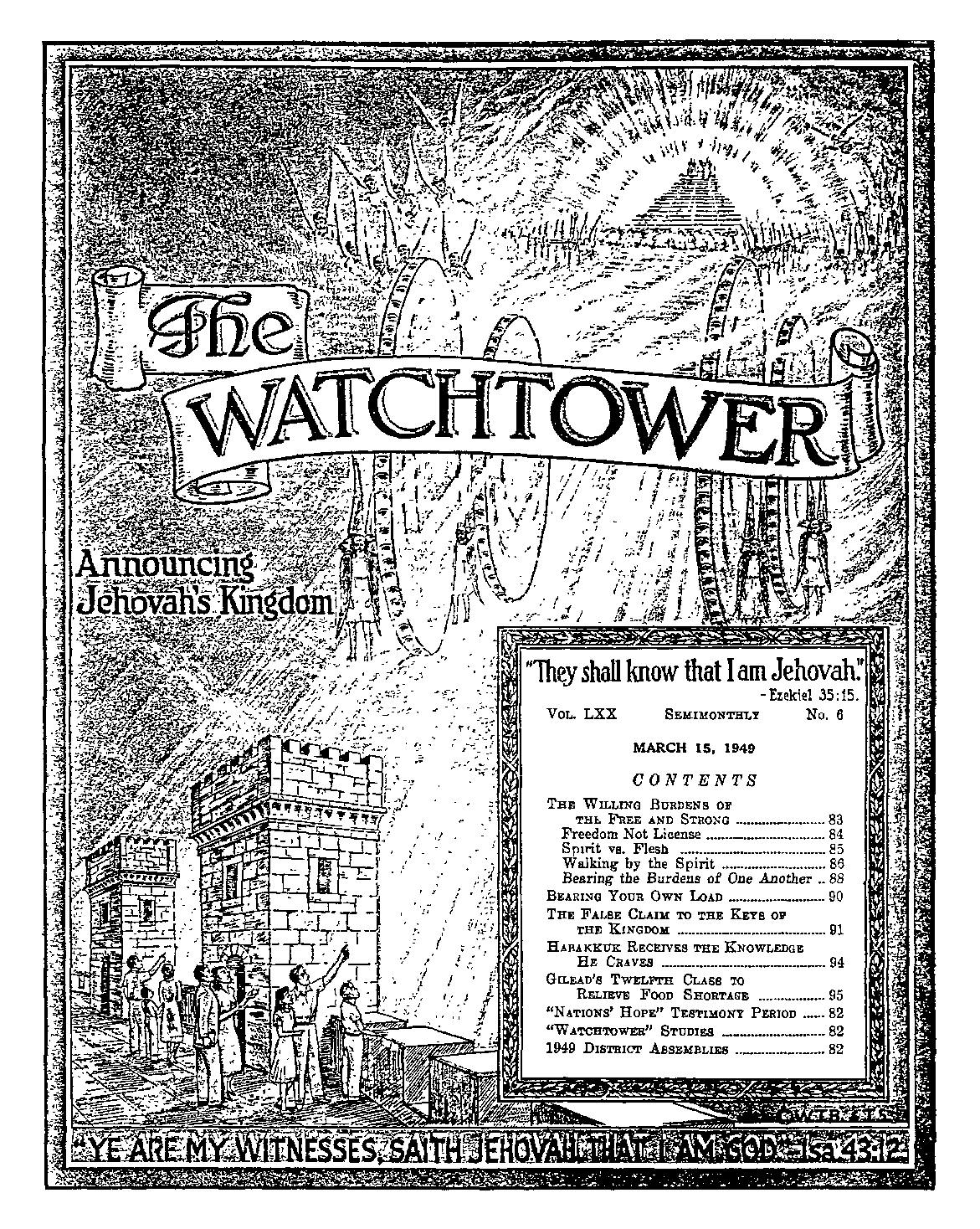
THE WATCHTOWER,
Published Semimonthly Bt
WATCH TOWER BIBLE & TRACT SOCIETY 117 Adams Street - - Brooklyn. 1, N.Y., U.SA.
OmoBBS
N. H. Knorr, President Grant Sutter, Secretary
“And all thy children shall be taught of Jehovah; and great shall be the peace of thy children.” - Iiaiah 54:13,
THE BIBLE CLEARLY TEACHES
THAT JEHOVAH is the only true God, from everlasting to everlasting, and Is the Maker of heaven and earth and Giver of life to his creatures; that the Word or Logos was the beginning of his creation and his active agent In creating all other things; and that the creature Lucifer rebelled against Jehovah and raised the Issue of His universal sovereignty;
THAT GOD created the earth for man, made perfect man for the earth and placed him upon It; that man yielded to unfaithful Lucifer, or Satan, and willfully disobeyed God's law and was sentenced to death; that by reason of Adam’s wrong act all men are born sinners and without the right to life;
THAT THE LOGOS was made human as the man Jesus and suffered death In order to produce the ransom or redemptive price for obedient men; that God raised up Christ Jesus divine and exalted him to heaven above every other creature and clothed him with all power and authority as head of God’s new capital organization;
THAT GOD’S CAPITAL ORGANIZATION Is a Theocracy called Zion, and that Christ Jesus Is the Chief Officer thereof and is the rightful King of the new world; that the faithful anointed followers of Christ Jesus are Zion’s children, members of Jehovah’s organization, and are His witnesses whose duty and privilege it is to testify to Jehovah's supremacy and declare his purposes toward mankind as expressed In the Bible;
THAT THE OLD WORLD, or Satan's uninterrupted rule, ended A.D. 1914, and Christ Jesus has been placed by Jehovah upon the throne, has ousted Satan from heaven, and now proceeds to vindicate His name and establish the “new earth”;
THAT THE RELIEF and blessings of the peoples can come only by Jehovah’s kingdom under Christ, which has begun; that His next great act Is to destroy Satan's organization and establish righteousness completely in the earth; and that under the Kingdom the people of good-will surviving Armageddon will carry out the divine mandate to "fill the earth” with righteous offspring, and that the human dead in the graves will be raised to opportunities of life on earth.
ITS MISSION
THIS journal is published for the purpose of enabling the people to know Jehovah God and his purposes as expressed in the Bible. It publishes Bible Instruction specifically designed to aid Jehovah's witnesses and all people of good-will. It arranges systematic Bible study for Its readers and the Society supplies other literature to aid In such studies. It publishes suitable material for radio broadcasting and for other means of public Instruction In the Scriptures.
It adheres strictly to the Bible as authority for Its utterances. It is entirely free and separate from all religion, parties, sects or other worldly organizations. It Is wholly and without reservation for the kingdom of Jehovah God under Christ his beloved King. It Is not dogmatic, but Invites careful and critical examination of Its contents In the light of the Scriptures. It does not Indulge in controversy, and its columns are not open to personalities.
Notice to Subscribers: Remittances xbould be sent to office in roar country in compliance with regulation* to guarantee safe delivery of monej. Remittances are accepted at Brooklyn front countries vhere no office is located, by international money order only. Subscription rates in different countries are stated below in local currency. Notice of es-piiation (with renewal blank) is sent at least two Issues before subscription expires. Change of address when sent to our office may be expected effective within one month. Send your old as well a* new address.
Please address the Watch Tower Society In every case.
Offices Yearly Subscription Rate
America [U.S.), 117 Adams St. Brooklyn 1, N.Y.
Australia, 11 Beresford Rd., Strathfield, N.S.W.
British West Indies, 21 Taylor St, Woodbrook, Port of Spain, Trinidad 51.25
Burma, 39 Signal Pagoda Road, Rangoon Rs. 3/8
Canada, 40 Irwin Ave., Toronto 0, Ontario
England, 34 Craven Terrace, London, W. 2
India, 167 Love Lane, Bombay 27 Ra. 3/8
Jamaica, 151 King St, K’ngston
Newfoundland, Post Box 521, St. John’s
New Zealand, O. P.O. Box 30, Wellington, C. 1
Nigeria, West Africa, P.O. Box 695, Inigos
Philippine Republic, 104 Roosevelt Road, San Francisco del Monte, Quezon City 2 pesos
South Africa, 623 Boston House, Cape Town
T. Hawaii, 1228 Pensacola St, Honolulu 14
Translations of this journal appear In many languages.
ALL SINCERE STUDENTS OF THE BIBLE who by reason of Infirmity, poverty or adversity are unable to pay the subscription price may have The Watchtower free upon written application to the publishers, made once each year, stating the reason for so requesting It. W e are glad to thus aid the needy, but the written application once each year is required by the postal regulations.
Printed in the United States of America
Entered as second-class matter at the post office at Brooklyn, N, Y„ under the Act of March 3, 1SW.
“NATIONS’ HOPE” TESTIMONY PERIOD
How will the nations be able to set their hope now on the great King whom God has raised up to rule the new world unless they learn about him t This is the question that will make each already informed person realize his responsibility during the month of April of taking part in the “Nations’ Hope” Testimony Period throughout that month. April brings to a close the four-month campaign for taking 500,000 subscriptions for the Watchtower Society’s magazines in the 22 languages in which they are published. Hence the special offer continues in force, namely, a year’s subscription each for The Watchtower and Awake! together with the premium gift of the latest bound book and booklet, to each taker, at the subscription rate of both for $2.00. All lovers of tbeir fellow man want the God of hope to fill as many others as possible with the joy and peace of believing in the Kingdom hope, and therefore we again remind all Watchtower readers of our readiness to help any that desire to have a hand in this hope-inspiring educational work. Let us hear from all such before this campaign ends, and also let every participant turn in his report at the close of the Testimony Period.
“WATCHTOWER” STUDIES
Week of April 24: “The Willing Burdens of the Free and Strong,” fl 1-20 inclusive, The Watchtower March 15, 1949.
Week of May 1: “The Willing Burdens of the Free and Strong,” fl 21-35 inclusive, also “Bearing Your Own Load”, fl 1-9 inclusive, The Watchtower March 15, 1949.
1949 DISTRICT ASSEMBLIES
That the brethren may arrange their affairs so as to attend their district assembly, announcement is now being made of the time and place of those assemblies for which preliminary arrangements have been completed.
Fort Worth, Texas: May 27-30, La Grave Field
Little Rock, Arkansas: June 3-5,
Robinson Memorial Auditorium, Markham and Broadway Sts.
New Orleans, Louisiana: June 3-5, San Jacinto Club 1422 Dumame St. (For colored)
Birmingham, Alabama: June 10-12, Alabama State Fairgrounds
Raleigh, North Carolina: June 24-26, Raleigh Memorial Auditorium
Detroit, Michigan: July 1-4,
Coliseum, Michigan State Fairgrounds
Portland, Oregon: July 1-4, Public Auditorium
1520 Southwest Third Ave.
Indianapolis, Indiana: July 8-10, Manufacturers Building Indiana State Fairgrounds
Sioux Falls, South Dakota: July 22-24, Coliseum
501 N. Main Ave.
The dates and places for other assemblies will be announced as soon as the information is available. All publishers and persons of good-will are urged to attend these assemblies. Brethren from the Society’s headquarters will serve on the program.
THE WILLING BURDENS OF THE FREE AND STRONG
“We who are strong ought to bear the burdens that the weak make for themselves and us. We are not to please ourselves.”—Rom. 15:1, Moffatt.
JEHOVAH God has willingly borne all the burdens that mankind, weakened by imperfection and sin, have made for him. Strongest of the strong, he is well able to bear them, but it has meant for him to exercise unparalleled patience, incomparable mercy and marvelous endurance of all kinds of false accusations, taunts, and reproaches, calling for the greatest amount of self-restraint on his part. All these burdens not of his own making he has voluntarily borne for a loving reason, namely, for the lasting good of his human creatures. His Son, the Messiah, whom Jehovah God promised to send as a Deliverer of mankind, was foretold as not pleasing himself but taking up the burden and sharing it with God his Father. Not wanting to add to the burden of reproach, but wanting to share in bearing it, the Messiah is foretold as saying: “Let not them that wait for thee be put to shame through me, 0 Lord Jehovah of hosts: let not those that seek thee be brought to dishonor through me, 0 God of Israel. Because for thy sake I have borne reproach; shame hath covered my face. I am become a stranger unto my brethren, and an alien unto my mother’s children. For the zeal of thy house hath eaten me up; and the reproaches of them that reproached thee are fallen upon me.” (Ps. 69: 6-9, Am. Stan. Ver.) In so bearing the burden of reproach Messiah would imitate Jehovah God.
2 In thus bearing an unpleasant burden out of love for God, the Messiah is a fine example for us in these days when selfishness is supreme on earth and strong men brush aside the weak and the pleasure-seekers try to shift the burden off onto others rather than restrain themselves and meet their own obligations. The inspired writer points to Messiah’s loving example and makes a practical application of it, saying: “We who are strong ought to bear the burdens that the weak make for themselves and us. We are not to please ourselves; each of us must please his neighbour, doing him good by building up his faith. Christ certainly did not please himself, but, as it is written, The reproaches of those who
1. Flow did tie Messiah imitate Jehovah in bearing burdens?
2, 3. How do few in Christendom imitate Messiah's fine example? denounced Thee have fallen upon me.—All such words were written of old for our instruction.” —Rom. 15:1-4, Moffatt.
8 Very few so-called Christians today make a real show of any Christlike strength by not pleasing themselves but willingly sharing the reproaches that fall upon Jehovah God. Even in Christendom the great Creator has been reproached by the religious clergy as though he were responsible for the condition in which this world finds itself in 1949. Embittered by the continuing of the distress of nations without God’s answering the hypocritical prayers of the religious clergy for relief, many men reproach him as being unable to rid mankind of their oppressive burdens. Hence countless men and women turn away from him as not worthy of worship. They assume they must work out their own deliverance. They consult the clergy, but not God’s Word, for information and guidance and do not rely upon him, waiting for him to work out his purpose. They put their trust in imperfect, dying fellow creatures and so follow human schemes and programs of relief. By this they merely prolong or create burdens for themselves and they blindly keep themselves in bondage to mankind’s great oppressor, Satan the Devil, and his minions demonic and human. Consequently the reproaching of God by those who are in bondage increases.
‘But are there no free people on earth today? Yes, there are. They are a small minority. Being free, they do not have the slavish spirit of this world which is in bondage. Though the world with its enslaving burdens is all around them, they do not share its mental darkness, its servile attitudes, and its selfish inclinations. The bonds of servitude to the “god of this world”, Satan the Devil, they have burst, and they follow and imitate the Messiah, the Son of God, who said: “Everyone who commits sin is a slave. Now the slave does not remain in the household for all time; the son of the house does. So, if the Son sets you free, you will be really free.” (John 8: 34-36, Moffatt) In devotion to the cause of freedom he died as a martyr on a torture stake. His heavenly Father
4, 5. How is there a free people on earth today?
Jehovah God accepted his precious sacrifice as the price for freeing all those who accept him as the Son of God and who accordingly believe in the liberating power of his sacrifice. There is no other way to gain freedom than by this Son of God.
s The Israelites of old tried to gain freedom and eternal life by keeping the law delivered to them through Moses. Obeying that law, they circumcised all their males in the flesh. But that mark of circumcision was no sign of freedom. It showed they were subject to God’s law through Moses, but that law condemned them as sinners and under a curse rather than as being free from sin. Not .circumcision, but trust in-Christ Jesus as the self-sacrificing Messiah is what now makes the free people.—Gal. 3:10-13.
FREEDOM NOT LICENSE
' The freedom that Jehovah God gives through Christ Jesus is not to be taken as a license to indulge in the “deeds of the flesh”. In so-called democratic lands there exists a freedom, but along with it there goes an indulgence in all kinds of selfish “deeds of the flesh”. For indulging in such a person is not punished by law. He may quarrel, envy, hate, blaspheme God, practice magic or demonism, engage in political rivalries with mudslinging, cut his neighbor’s throat commercially, etc., and yet be considered within his rights and exercising his full measure of freedom. But in the Christian realm the indulgence in such selfish practices of the flesh is an abuse of liberty. They are absolutely contrary to God’s spirit. Free the Christian is, but free to love God with all his mind, heart, soul and strength, and to love his neighbor as he does himself. Such love is the real purpose of freedom. Such love is the only safe expression of freedom. This the apostle Paul shows, saying: “For freedom did Christ set us free: stand fast therefore, and be not entangled again in a yoke of bondage. For ye, brethren, were called for freedom; only use not your freedom for an occasion to the flesh, but through love be servants one to another. For the whole law [of Moses] is fulfilled in one word, even in this: Thou shalt love thy neighbor as thyself. But if ye bite and devour one another, take heed that ye be not consumed one of another.” (Gal. 5:1,13-15, Am. Stan. Ver.) Love acts as a restraint against the abuse of liberty. It serves as a safe guide to freedom of action.
T This freedom with love is what differentiates the true Christian organization from so-called “Christendom” and the “democratic world”. The democratic world brags about its freedoms, but it has very little love for God, for Christ and for man to show. Its whole structure is built upon selfishness, and calling it “enlightened selfishness” does not improve it. As
6. Why do not the “deeds of the flesh” go with Christian freedom? 7. How do Christendom’s clergy not practice freedom with love? for the religious clergy, in times of political campaigns and elections they exhort their parishioners to take part and to engage in all the political quarreling, bickering, vilification, ambitious rivalries, things which lead to worldly division. Worse still, in times of war they bless the national armies equipped with carnal weapons, and, though on opposing sides, they pray to the one and the same God of heaven to help “Christians” to wound, maim and kill other “Christians” so as to conquer them and thus maintain the selfish political governments of this world. What do they care for the apostle’s warning: “But if you bite one another and eat one another, take care, or you will be destroyed by one another”? (Gal. 5:15, An Amer. Trans.) It was in Christendom, both in the First and in the Second World War, that there were the most nations involved and the most snapping and biting at one another and consequently the most human lives were destroyed. Certainly the religious clergy who have the apostle’s words before them and who are paid to teach, preach and live God’s Word are responsible. But, just so long as they have the approval of the political governments of this world, what do they care?
’ However, the true organization of consecrated Christians will take the apostle’s warning to heart. No one in a company of real Christians will try to take advantage of his Christian liberty to do injury to anyone else in the company. If we love one another as brethren, then we will not use our freedom as an opportunity to satisfy the selfish flesh, disregarding the rights and everlasting interests of our brethren. Our love will cause us to make ourselves the slaves of others in a spiritual way. Our freedom allows us the liberty to do so, and we do so willingly, that our brethren may remain in God’s favor, may serve him acceptably, and may gain eternal life in the new world. Free we may be from the Mosaic law, because God nailed that law to the, stake upon which his Son Jesus Christ died, but we are still obligated to the royal law of loye. (Col. 2:13,14 and 3:14,19) If we keep this law of love, then we do not have to worry about the Mosaic law. Our love will prevent us from doing the things the Mosaic law forbids. As for neighbors, no one is closer neighbor to us than our brethren within the Theocratic organization of Jehovah, and if we love them sincerely we will do in effect all that the Mosaic law required of the Israelites to do toward their neighbor. And if we love our close neighbors whom we have seen, we will love our God whom we have not seen.
’ How easy it is for a company of Christians to let some selfish thing divide them and set them to biting and snapping at one another, unmindful of the danger of at last devouring and destroying one
8. Why is our freedom from the law of Moses not Injurious?
9. How does a company of Christians get to consuming one another? another! It takes just some secret ambition to shine or to have power, some jealousy of the popularity of another, some envy of the high position and authority of another, some fancied injury that an introverted mind can nurse and magnify. There follow unloving actions toward one another. We will avoid one another, feel grudges, indulge in backbiting and casting of bad reflections upon another, and stir up rivalries and party-spirit. This will lead on to open breaks with one another and to public disputes, faultfinding, criticisms, and wrangling. The company becomes split over a personal issue that should be settled privately in a quiet, Christian way according to Jesus’ instructions. So disturbed do company members let themselves become over this personal matter of selfishness that they get their minds off the united service of God. The divisive thing becomes an obsession with them. They just cannot get their minds off it. It sours their disposition, it colors and distorts every thought, it disturbs their individual calm and the peace of the company. By keeping on in this way these fellow Christians do one another more and more spiritual hurt, while the Devil gloats. Beware! They are working to the spiritual destruction of one another. Likeness to God begins disappearing. Resemblance of Christ begins vanishing. Finally one-time Christians become not different from selfish worldly people in their thoughts, actions and methods.
10 On the other hand, if we love one another, if in love we seek to be the slaves of our brethren, then we will not try to make ourselves selfish masters or superiors over them. As free creatures, we will lovingly and willingly take on burdens so as to be of service to our brethren. Truly a big boss is not the most vital member of a company of Christians, but that one is who is rendering the most service. That the most serviceable one is the most essential one is the rule to remember everywhere, in our Christian congregations, in missionary homes, and in any other institution for unitedly carrying on the proclamation of God’s kingdom today.
SPIRIT VS. FLESH
11 While the peoples of the world fight among themselves socially, commercially, politically, militarily, and religiously in such a way as to destroy one another, the true Christians do not fight their fellow man but carry on a continual battle inside themselves. Ail that worldly people have to guide them as to conduct is a sense of decency, a feeling of selfrespect, differing moral standards of this world, and a fear of punishment for breaking the law of the land. As his guide to right conduct the Christian has the Word of God. As a force for righteousness he has
10 . How will we by love serve one another?
11 , 12. How do ChristUins have a continual battle and yet keep free? the spirit or invisible energy of God within him. God’s Word and his active force, these move the Christian, and they are both against the selfish physical cravings of our bodies. The passions of the fallen flesh are strong. No one on earth can escape these. As a result the Christian has on his hands a conflict between the inclinations that God’s Word and spirit cultivate within him and the inclinations of sinful flesh.
12 What is there to do! The apostle says: “I mean, lead the life of the spirit; then you will never satisfy the passions of the flesh. For the passion of the flesh is against the spirit, and the passion of the spirit against the flesh—the two are at issue, so that you are not free to do as you please.”(Gal. 5:16,17, Moffatt) Not free to do as we please! How so! In that we always have our sinful, depraved flesh with us in this world and hence we do at times the things we do not approve of ourselves’ doing, and the things we want to do we find ourselves failing to do. This makes us quite wretched at times. Being never free of our imperfect flesh and its passions, we can never do altogether as we should like. Hence, to maintain our Christian freedom, we must fight to let God’s spirit have the control of our lives. That spirit operates by love.—Rom. 7:15-25.
1S Having the Ten Commandments did not free the Israelites from doing the selfish, sinful deeds of the flesh. The law of Moses condemned, yes, cursed them as sinners and showed plainly their need of deliverance by Messiah’s ransom sacrifice and by the spirit of God. First the law of Moses had to be nailed as a canceled arrangement to the torture stake of Jesus Christ and he had to be resurrected and to ascend heavenward to God to apply the value of his sacrifice for the liberation of his disciples from the condemnation of sin and its penalty, death. Then, first, the spirit of God was poured out upon the remnant of believing Jews at Jerusalem on the day of Pentecost, in fulfillment of the prophecy of Joel 2: 28, 29. Hence, when the spirit of God was poured out, it came upon those who were free, free from the law of Moses and its curse and free from sin and its condemnation and the bondage to the world.
11 The law of Moses was given to people who were disposed to selfish sinful cravings and passions because of their fallen flesh. For that reason the Law forbade such things by name. But God’s spirit works for freedom from the physical cravings and fleshly passions. Since it was given to the free, to help them to keep free, then it is true, as the apostle says: “If you are under the sway of the spirit, you are not under the Law. Now the deeds of the flesh are quite obvious, such as sexual vice, impurity, sensuality, idolatry, magic, quarrels, dissension, jealousy,
13. Upon what free ones wu the spirit poured out, and free how? 14. If not undei the Law, under whai are they? temper, rivalry, factions, party-spirit, envy, murder, drinking bouts, revelry, and the like; I tell you beforehand as I have told you already, that people who indulge in such practices will never inherit the Realm of God.”—Gal. 5:18-21, Moffatt.
16 Do you belong to a Christian congregation ? Are you a member of a missionary home or one of a group of full-time pioneers that live and work together! Do you work with an organized unit of publishers of God’s kingdom ? Then by all means you must dismiss and lock out the above-mentioned “deeds of the flesh” from your midst, if you want to live and serve together now as brethren and if you want to attain to life in the new world, either in the heavenly kingdom of God or in the earthly paradise under that kingdom. There is no excuse for your being ignorant of what these deeds of the flesh are and the effect they have upon our Christian unity and our spiritual growth toward eternal life. We cannot .afford to indulge in them, even if we do not have the Mosaic law over us to name these works of the flesh and to forbid them. If consecrated to God, we are no longer the slaves of these things, and we should have no willful inclination to do them. We have the spirit of God. This spirit does not teach, lead or motivate a Christian to any of those fleshly works of selfishness. It works in the opposite direction. It is more potent in our lives than any law engraved on tablets of stone. By his spirit or active force God inscribes his law on our hearts, our seat of affection, to cause us to love his law.
18 How will it show itself that we are under the sway of God’s spirit and living by it? Why, by the fruitage or harvest that the spirit will produce in our lives. It will be a harvest of things in diametric opposition to sinful fleshly deeds. Listen: “But the harvest of the spirit is love, joy, peace, good temper, kindliness, generosity, fidelity, gentleness, selfcontrol :—there is no law against those who practise such things.” No, those who are living by the spirit are free to bring forth as large a crop of these godly things as they can. Not even the law of Moses prohibited such things. The Christians bring forth the fruitage of the spirit, not that they are under Moses’ law forbidding the works of the flesh, but because they love God and his people and the spirit of God is an active force for righteousness in their lives.
17 To cancel the Mosaic law with its curse, it was nailed to the tree upon which Christ Jesus was nailed. Now, in turn, those whom he has purchased with his ransom sacrifice and who have God’s spirit impale their flesh likewise on a torture stake, so to speak. The apostle, after differentiating the deeds of the flesh and the fruitage of the spirit, says further:
15. Why mutt we and will we Christians debar deeds of the flesh? 16. How will it be shown we are under the spirit's sway?
17, 18. What do those belonging to Christ do to the flesh, and how? “Those who belong to Christ Jesus have crucified the flesh with its emotions and passions.” (Gal. 5:22-24, Moffatt} A fleshly body, tied or nailed to a tree as Jesus was, would surely have no freedom of movement, not even to satisfy its barest necessities as a sip of water or a crumb of bread. Besides being exposed to public shame and contempt, it would be consigned to death, condemned like a menial slave for lawbreaking. To quote the apostle from this same letter: “Christ redeemed us from the curse of the law, having become a curse for us; for it is written, Cursed is every one that hangeth on a tree.” —Gal. 3:13, Am. Stan. Ver.
18 Just that way the Christians consider the deeds of the flesh as things accursed and to be consigned to death. And so they put it under control, in a position like a cursed criminal made fast to a stake of execution, that the fleshly emotions, passions and propensities may not be able to exert themselves and become our masters. We consider ourselves as dead to these selfish, sinful things, and try to deaden them in our lives. As it is written: “So put to death those members that are on earth: sexual vice, impurity, appetite, evil desire, and lust (which is as bad as idolatry), things that bring down God’s anger on the sons of disobedience.” (Col. 3:5,6, Moffatt) Hence, in place of being active in these condemned things, we use our bodies actively in God’s service and let his spirit be the controlling influence in our lives to move us according to his written Word. We cannot serve both the sinful flesh and Christ Jesus as Lord at the same time. He was never the servant of sin, but was Victor over it. As for us, sin claims us for death, but Christ Jesus bought us with his sacrifice for life. We belong to him. Since we do, then we must serve him, not serve our flesh.
WALKING BY THE SPIRIT
18 God’s spirit within us does not reduce us to mere mechanical creatures, operated by an outside power contrary to our will and requiring no effort and decision on our part. To live by the spirit, we must make a positive decision, to produce what are its manifestations. God’s Word describes how his spirit manifests itself and what its fruitage in our lives is. His spirit inspired the writing of that Word, and if we walk according to that Word and imitate Christ Jesus through whom the spirit is poured out, then we are walking according to the spirit, directed by it. Says the apostle: “If we live by the spirit, by the spirit let us also walk. Let us not become vainglorious, provoking one another, envying one another.” (Gal. 5: 25, 26, Am. Stan. Ver.) If we have resolutely crucified the flesh with its passions and lusts in order to restrain and deaden these selfish things, then we
10. In what way do we walk by the spirit? must live by the spirit. That means we should not be carousing and getting drunk and acting immorally and behaving ourselves as the world in general does, giving free play to the flesh and its sinful inclinations. No; but walking by that spirit means producing the things which show an indwelling of God’s holy active force, namely, expressions of love, joy, peaceableness, long-suffering, kindness, goodness, faithfulness, meekness, self-control, the things we are at perfect liberty to do.
20 If we are real Christians, then we have given ourselves to God in full consecration to do his will. By his spirit upon his faithful prophets and apostles he inspired the Holy Scriptures to be written, and in harmony with our consecration to God we should copy his Son Jesus Christ and say: “Lo, I come: in the volume of the book it is written of me, I delight to do thy will, 0 my God: yea, thy law is within my heart.” (Ps. 40:7,8; Heb. 10:7) So, if we want to walk by the spirit, then we must be guided by what it caused to be written in that holy book, the Bible. We must let that same spirit of God open up our minds to understand the truths contained in the Bible and which he makes clear to us through his Theocratic organization. That spirit must guide us to gatherings of fellow Christians where God’s Word is studied and his service is discussed and arranged for. To be plain, that spirit must guide us into the Watchtower studies; it must take us to the regular service meetings for instructions as to how to proclaim the Kingdom message to the community in which we live. That spirit must energize us to attend the weekly Theocratic ministry school to help us to improve our manner of presenting the truth to others as opportunity affords.
25 As Watchtower readers consider the lives and activities of the faithful witnesses of Jehovah, they see the blessing of heaven upon these obedient Christians who are so diligent and active in the work God has commanded for our day. When we read the 1949 Yearbook of Jehovah’s witnesses and peruse the accounts of their work in 96 lands, we are fairly stirred at the record of each land, showing the progress of the witness work there and the expansion of the pure worship of the living and true God there. We are constrained to say of his witnesses there: “The spirit of God is upon those brethren.” That is right. But that same spirit is able to operate upon us too. It will assist us to do as mighty a work in our territory as it is doing with those brethren in their territories. What we need is to yield ourselves willingly and trustfully to the Almighty and let his spirit work upon us and through us as we obey the instructions of his Word and the directions given us through his Theocratic organization. Do not say to 20. According to what, then, must we walk, and to what meetings? 21, 22, How can we be used as vessels just as our brethren elsewhere?
Almighty God: “Who! Me! Why, I can’t do that work.” But you can, too, if God asks you through his Word and his visible organization. He gives us his grace sufficient in every time of need; there is no question about that. Therefore, if the privileges of Christian service come your way, accept them.
22 Seek the assistance of his visible organization to help you. Co-operate with it. Believe that God’s active force, his spirit, will operate upon you, strengthening you, guiding you, activating you to fulfill his will just as much as when clay is molded into shape by a potter. The divine Potter can mold you. Just be pliable and willing to allow him to do so. You can, of course, be resisting, stubborn, and God can change his mind about you and cast you aside, because you do not turn out to be a good vessel for service. But you can be pleasing to God by being guided by his spirit and walking according to it, and in that way you will become a vessel for his honorable service, always to be used to his glory.
2S While we should seek to be used of God as his obedient servants, we should never be moved by a desire for empty praise, thus becoming vainglorious. We should not become excessively proud of how we perform or what we attain or accomplish, and get puffed up and try to entrance our importance in the eyes of fellow creatures. This trying to excel others for the purpose of winning praise and admiration from men is provocative. It arouses competitions, either between individuals or between Christian companies and units. It thus stirs up rivalries, emulations, envies and other selfish emotions. “Let us not be desirous of vain glory, provoking one another,” says the apostle. That is, “Let us not in our vanity challenge one another.” (Gal. 5:26, An Amer. Trans.} When we challenge others because of our ambitions for mastery over them, it makes our fellow Christians to be our opponents, and we provoke them to engage in a showdown contest to prove we are their betters, their superiors.
24 That is the sense of this law-term provoking which the apostle here uses, as when a legal contestant makes some offer or challenge to an opponent in order to bring about a decision or force it. We should never force the hand of our Christian brother so as to embarrass him and show ourselves off as better and thus be able to grin at his predicament. We should avoid all things that create party-spirit, factions, and internal divisions, with envies, jealousies and competitions resulting. We cannot afford to be divided. We are not in the Theocratic organization as independent members, each one out for his own interests regardless of those of others. We are not trying to get ahead of our brethren. We should be pleased and not envious over the blessings
23. How do we act vainglorious^; and provoke one another?
24, 2d. Why should we not thus provoke one another? that God has bestowed upon another individual. If other brothers qualify and show ability to speak publicly, or to teach, or to conduct Bible studies at Kingdom Halls or in private homes, showing excellence in these things over us ourselves, we should say: “Heavenly Father, I am thankful that these brethren are in our midst, and I want to learn from them, because I believe you have sent them or raised them up to help us.”
25 So, when the servant to the brethren who is visiting and assisting the organized companies in your circuit comes to your home or to your company, beware of saying: “I wish I had his job. I’m going to do something to crowd him out. I’m going to start a story about him that is not true, and then the Watch Tower Society will dismiss him and, if they do, likely I’ll be slipped into that vacancy in that capacity.” That is the envying of one another, the provoking or challenging of one another, that the apostle says we should not do. We will not indulge in such, if we are led by the spirit. We should fulfill the-law of loving one another. Let us realize that God places members in the “body of Christ” and in his service organization as it pleases him. He arranges this whole matter from the top down. Theocratically, we must be his willing servants.
BEARING THE BURDENS OF ONE ANOTHER
2‘ If we are of ill will, we will gloat over the fall of another against whom we have some grudge. If we are jealous or envious, we will find some inward satisfaction at his being caught off-guard and committing some mistake or taking some false step. But if we are led by the spirit, if we have the spiritual qualifications of love, patience, kindness, goodness, faithfulness, gentleness, self-control, then we will be anxious to set the erring brother right and to help him up out of his fallen condition. “Brethren,” says the apostle, “even if a man be overtaken in any trespass, ye who are spiritual, restore such a one in a spirit of gentleness; looking to thyself, lest thou also be tempted.” (Gal. 6:1, Am. Stan. Ver.) Yes, the brother was tempted. Before he was aware of it, he was yielding to temptation without proper thought of what his doing so meant. Now he is sorry. Well, we are all subject to temptation, and we should not act as though we could never fall ourselves. “Let him that thinketh he standeth take heed lest he fall.” —1 Cor. 10:12.
2T Hence those who are producing the fruitage of the spirit can exercise gentleness. They well consider their own weakness of the flesh and their being liable to fall and come into the same state needing mercy and brotherly help. The apostle Peter was overtaken at a time when he was so self-confident, thinking he was different and better than his fellow apostles. So 26, 27. Why should It be with gentleness that we try to restore one*1 he committed a serious trespass of three times denying Christ Jesus. But the resurrected Jesus Christ, who had now been made alive in the spirit, restored Peter because he repented and professed love and affection for Jesus. With what gentleness Jesus restored Peter! It was not that Jesus himself had ever yielded to temptation and was subject to it any more, but it was because he had the spirit of God and he loved Peter.—John 13:36-38; 18:16-27; 21:14-19.
28 The point is this: We want divine mercy extended to us. Then we must extend it to our fallen brother. Every one of us is certain to make mistakes some time in our lives, some bigger, some smaller, but we are going to make them. Our brethren will not like what we have done in the way of wrong, yet, when we ask them to forgive us, they will. That does not mean, though, that we can deliberately go back and do that wrong all over again, just keeping on getting their forgiveness time and time again and making no effort to control ourselves. No; we should show some improvement in conduct, even if our brethren are inclined to mercy. They show mercy so as to help us to recover, for us to grow stronger spiritually and show self-improvement.
22 In this way we should endeavor to safeguard those whom we have in God’s organization and hold on to them as brethren, and not merely go out witnessing about God’s kingdom in order to bring others into the organization. So, if our brother stumbles, we should show spiritual qualities and be there to help him up. If he has wronged us, then instead of nursing a grudge and stubbornly waiting for him to come penitently to us, we can do as Jesus instructed and settle the matter privately, avoiding publicity that would hurt or embarrass the wrongdoer. We can go to the offender and point out his wrong, trying to stir up in him a sense of righteousness. If this fails to show him he ought to right the wrong, we can take along some spiritually mature brethren. With their aid we can try to help the offender, but in a spirit of gentleness. Finally, if his eyes are still not opened to his wrong and the obligation to make matters right, then we can lay the matter before representative members of our local congregation and have these spiritual servants of our congregation use their special qualifications and the weight of their office to impress the offender. But these, too, must do so in a spirit of gentleness, because they themselves art liable to be tempted and need mercy thereafter.—Matt. 18:15-17.
20 Suppose, though, that the trespasser realizes he has been overtaken and needs the encouragement and guidance of others in order to approach God and
28 What is the point In this tnatter of extending mercy?
29. How did Jesus say to restore one by direct approach?
30, 31. What should one do who sees he is spiritually sick, and why? obtain forgiveness and reinstatement in the divine favor through Christ. Then he may not wait for his brethren to find out about his low state of spiritual health. He may see he is spiritually sick and in urgent need of help. He may send for his faithful, spiritually qualified brethren to come and help him. There is such thing as spiritual sickness. The apostle Paul mentions it in connection with the Memorial celebration each year with bread and wine, when the "body of Christ” should be discerned in the unleavened bread that is eaten. Paul shows how spiritual sickness may come and how it may be prevented, saying: “A man should examine himself, and only when he has done so should he eat any of the bread or drink from the cup. For anyone who eats and drinks, eats and drinks a judgment upon himself if he does not recognize the body. This is why many of you are sick and ill and a number have fallen asleep.” (1 Cor. 11: 28-30, An Amer. Trans.) Now concerning a person that recognizes his spiritually sick condition and longs to be healed of it, the disciple James says: “If any one of you is in trouble, he should pray. . . . If any one is sick, he should call in the elders of the church and have them pray over him, and pour oil on him in the name of the Lord, and the prayer offered in faith will save the sick man; the Lord will restore him to health, and if he has committed sins, he will be forgiven. So confess your sins to one another and pray for one another, so that you may be cured. An upright man can do a great deal by prayer when he tries.”—Jas. 5:13-16, An Amer. Trans.
11 Yes, send for spiritual help, if you need it, and confess your sin to those you call in for help, that they may know what is the matter with you and how you can be helped. Let them pour in the soothing oil of the spiritual Word of God to comfort you and fortify your mind and build up your spirits. They can do many things for a fallen and discouraged Christian who thinks, “I’m lost!” Let them help you to again believe God when he says he is just to forgive us our sins if we confess them through Christ Jesus, the Advocate of the Christian congregation. —1 John 1:9 and 2:1.
32 All this course of action imposes a burden upon us. It is a burden that the trespassing one has created for us or laid upon us. He has made difficulties for himself as well as for us. Nevertheless, we are under the sway of the spirit and thus free to take that burden upon us willingly, in love, or we can leave the trespasser to bear his own burden and struggle through his own difficulty. What shall we do? The spirit of God, speaking through the written word of the apostle Paul, says: “Bear ye one another’s burdens, and so fulfil the law of Christ.” (Gal. 6: 2) The
32. What does this course impose upon us? and why do we bear it? law that Christ Jesus laid down, both in word and in his course of action, was to love our brethren, even if it meant our own death. On the night before his own death he said: “A new commandment I give unto you, That ye love one another; as I have loved you, that ye also love one another. By this shall all men know that ye are my disciples, if ye have love one to another. . . . Greater love hath no man than this, that a man lay down his life for his friends.”—John 13:34,35; 15:12,13.
21 Someone, possibly we ourselves, spent time and effort with that trespasser to bring and teach him the truth and to show him his privilege of consecrating himself to God through Christ and becoming thus connected with his Theocratic organization. Are we going to let such time and effort of the past go to waste? No; we ought to want to show and we should show our love for our fellow Christian so far as to try always to keep him close to God’s organization. Think of all the time and effort you (or someone else) Spent to help this one to come to a knowledge of the truth. You may have spent hours in witnessing from door to door before you at last came upon this person like a lone sheep among a herd of goats. At first contact he showed some interest. You made note of that and made a return visit to him. This time you placed a Bible-study book with him, say, "Let God Be True". Next you call back on him to help him understand the Bible with the aid of the book, and you succeed in starting a weekly home Bible study. For a whole year or more you regularly go to his home. By now you have studied the Bible with him with the help of more than one study book. Think, now, of the time you spent with him, strengthening his faith, yes, stopping by and bringing him along to meetings at the Kingdom Hall, if not also furnishing transportation for him there in your car. He consecrates himself to God and becomes an active field publisher of God’s kingdom, and you are happy. But, alas, now he makes a mistake to your disgust. You might be inclined to say: “I’m finished with him.” But no! That is not the way God through his spiritual Word instructs you and leads you to act. Do not be hasty in a wrong way.
34 You once spent much time and energy upon your trespassing brother, do not forget. God’s spirit operated upon you to help him get associated with the Theocratic organization. Yes, that is true. Well, now continue to be led by that same spirit as it teaches you how to help that person to stay with the organization. What if he does make a mistake, being overtaken in a fault at times? Remember yourself. You, too, may be tempted and succumb. Then you could relish some spiritual help, even from the said brother. Yes, yes, all this imposes a burden upon
33. What past time and effort on such one do we not want wasted’ 34, 35. How do we bear the burden, possibly saving what alive? you that can be irksome. You might explode with a “Why doesn’t this brother go straight? Why does he trespass like this and make trouble both for himself and for others, including me?” But if you love your brother and want to see him keep his consecration vow and win eternal life to the vindication of God’s sovereignty and holy name, you will subdue your irked feelings and willingly take up the burden of restoration work, just to help restore the one whose eternal life interests are endangered.
“You are free to do this; there is no compulsion. So do it out of love. Use your Christian strength to help the weak. Then do you know what you are doing? Why, what? “My brothers, if any one of you is led astray from the truth, and someone brings him back, you may be sure that whoever brings a sinner back from his misguided way will save the man’s soul from death, and cover up a host of sins.” (Jas. 5:19,20, An Amer. Trans.) Is burden-bearing worth a soul's life?
BEARING YOUR OWN LOAD
IT STIRS a Christian to help his brother overtaken in a fault if he simply remembers what he himself is, namely, a person not better than the rest, of the same human race by nature, and subject to the same requirements for gaining salvation through Christ, and on exactly the same level as others before the one Supreme Judge, Jehovah God. So the apostle is really wise when, in addition to advising us to help our trespassing brother, he adds: “Again, if anyone imagines he is somebody, he is deceiving himself, for he is nobody; let everyone bring his own work to the test—then he will have something to boast about on his own account, and not in comparison with his fellows. For everyone will have to bear his own load of responsibility.”—Gal. 6: 3-5, Moffatt.
2 Every man has to carry his own load, does he? Yes, in connection with the test of his own work; and here the apostle Paul uses a word different from the one when he says: “Bear one another’s burdens.” (Gal. 6:2, Moffatt) So, when the apostle says we must shoulder our own load, it should sober us and keep us from thinking we are something, when there is no real foundation for it. Whatever a person is as a servant of God he has to be that in himself before the great Judge, and not in comparison with some fellow Christian.
’ Suppose we find a person associated with the witness organization for publishing the Kingdom and he falls victim to self-admiration. He does a lot of publishing and has good records and fine accomplishments to show for it. He looks the congregation over and is tempted to think: “Well, now, I am something. I’m a pretty good publisher. I’m actually better than everybody else here.” At the end of the service month, in his overflow of feelings, he forces comparisons by asking another: “How many hours did you put in in field service this month?” The modest answer is: “I put in fifteen, and made a few back-calls.” With an air of triumph, our vainglorious brother overwhelms his fellow publisher by saying: “Well, I put in twenty-five hours.” Secretly in his mind he says: “I
1, 2, What effect should having to bear our own load have upon us? 3. How may a good publisher come to think himself somebody? am somebody.” He circulates around the whole company. All comparisons favor him. The temptation increases upon him to think: “No joking; I am the best publisher in the whole company. Really I am, for didn’t I put in more time and make more back-calls than anyone else?” And by outward facts and figures he is the best publisher in the company.
‘ But what is the trouble with this publisher? Why, he is boasting, not on his own account, but in comparison with his brethren. The apostle warns that comparison of yourself with others may lead to wrong conclusions. Do not check up on yourself in comparison with other brethren. Do not measure your goodness by any brother as a standard of comparison. “Every man ought to test his own work, and then whatever satisfaction he has will be with reference to himself, and not in comparison with someone else.” (Gal. 6:4, An Amer. Trans.) Brother, or sister, it is all right for you to test your own work and check up on yourself; but what standard of judging are you going to use? Paul said: “Copy me, as I copy Christ,” (1 Cor. 11:1, Moffatt) Jesus Christ set down the pattern; he went from house to house. He spoke publicly. He carried on Bible study with individuals in their private- homes. Finally he laid down his life after more than three years of such Kingdom publishing. There is your straightedge! There is your pattern 1 There is your measuring rod: Christ Jesus! Now, if you want any due satisfaction out of your active service to God, you just stand right up there alongside Christ Jesus and say: “Well, how am I doing?”
5 So, then, do not compare yourself with some other brethren in God’s visible organization. We are not in competition with one another. We are not provoking anyone to a contest, challenging one another to a show of accomplishments. If you want satisfaction from your own service, follow the spiritual Word when it says: “Whatsoever ye do, do it heartily, as to the Lord, and not unto men; knowing that of the Lord ye shall receive the reward of the inheritance:
4. What mistake does each publisher make, leading to wrong ideas? 5, 6. How, with gone sense, do you find satisfaction in yourself? for ye serve the Lord Christ.”—Col. 3: 23, 24; 1 Cor. 10:31.
8 Do not go out into the field service, performing the various kinds of activity, just because till now this month you have no record of work to show. You are a minister of the gospel for just one reason, namely, for your love of the Supreme One of the Universe, Jehovah God, and you want to share with Christ Jesus in the vindication of the heavenly Father. He it is whom you are serving and before whom you must stand approved or fall rejected. Follow the instructions for his Theocratic organization as you find these written in his spiritual Word. Let these be your guide, your measuring rod, your straightedge. If you do this, you will get satisfaction out of considering yourself, because you realize in yourself you have done God’s work. Do not compare yourself with another fellow servant on earth. Have better sense than to do this. Paul said: “I do not indeed venture to class or compare myself with certain individuals who approve of themselves. But when they measure themselves by one another and compare themselves with one another, they do not show good sense.”—2 Cor. 10:12, An Amer. Trans.
11t is, therefore, before the Supreme Judge that you must bear your own load. That is the meaning when Paul refers to those who dog the steps of the organization just to make trouble and to unsettle some, and says: “He who is troubling you will bear his judgment, whoever he is.” (Gal. 5:10, Stan. Rev. Ver.) The great Judge will not hold someone else responsible for what you are when you finally appear before him for judgment. He does not compare you with some other fellow servant on earth, and then pass judgment upon you on that comparative basis. Outwardly you might be better than other brethren, but such comparison of creatures is riot the basis for him in judging. The question is, How far did you measure up to your own peculiar opportunities! To what extent did you use the faculties and knowledge with which you are endowed! To what degree did
7, 8. How. and before whom, must you bear your own load? you enter into your present privileges! Were pure love and sincere devotion to God and his kingdom by Christ the real motive for your active service to Jehovah rather than the ambition to make a somebody of yourself before others and to compete with others! Were you walking after the spirit and showing love by freely taking on willing burdens to help your fellow heirs of life! Besides preaching to others, were you keeping yourself under control, with all the affections and lusts of the flesh crucified, so that you, a preacher to others, might not yourself be rejected! Not for how much was the other fellow responsible, but for how much were you directly responsible to God! On this basis you must account for yourself to God, bearing your own load of responsibility to God.
8 No one else will be responsible for the judgment you get from Him, and no one else will share a part of your judgment as jointly responsible. You must bear your load of responsibility and the judgment alone.
8 May we, then, keep this sobering thought in mind as we continue to lead our Christian lives. It is our own manner of life that we now live in service to God that determines what judgment we are to receive, bearing our own load of responsibility. We want it to be a judgment in favor of our living eternally in the new world. May we have the good sense to walk humbly with God and lovingly serve him now. While we must ultimately bear our own load of responsibility before the Supreme Judge, may we be ready and willing now to bear the burdens of our brethren, even if they do make such for themselves and us by faults, weakness, and trespasses in which they are overtaken. We, too, make difficulties and burdens for others by our course of action. So it is in reality a case of ^bearing one another’s burdens’ and doing so to fulfill the law of the Greater Moses, Christ Jesus. Doing thus, we shall all be helping one another lovingly to an approved final stand before the Supreme Judge, to carry off the precious award of eternal life.
9. Why, with our own load, should we bear one another's burdens?
THE FALSE CLAIM TO THE KEYS OF THE KINGDOM
WHEN fisherman Peter was first introduced, Jesus said to him: "Thou art Simon, the son of John; thou shalt be called Cephas (which interpreted is Peter).” About three years later Jesus said to the same man: “And I say to thee, thou art Peter, and upon this rock I will build my Church, and the gates of hell shall not prevail against it. And I will give thee the keys of the kingdom of heaven; and whatever thou shalt bind on earth shall be bound in heaven, and whatever thou shalt loose on earth shall be loosed in heaven.”—John 1:42 and Matthew 16:18, 19, according to the Catholic Confraternity translation of 1941.
It is interesting to note the comment on Jesus’ words at Matthew 16:18 as found in the “Haydock’s Catholic Bible”, “according to the Douay and Rheimish Versions,” as approved by John Farley, archbishop of New York city 1902-1918. We quote: “And I say to thee, and tell thee why I before declared, (John 1:42) that thou shouldest be called Peter, for thou art constituted the rock upon which, as a foundation, I will build my Church, and that so firmly, as not to suffer the gates (that is, the powers) of hell to prevail against its foundation; because if they overturn its foundation, (that is, thee and thy successors) they will overturn also the Church that rests upon it. Christ therefore here promises to Peter, that he and his successors should be to the end, as long as the Church should last, its supreme pastors and princes.”
In the Watchtower issue of January 1 our article entitled “The Rock Foundation of the Church” proved that the above, construction placed upon Jesus’ words concerning “this lock” by the Roman Catholic Hierarchy is in direct contradiction of other scriptures in the Holy Bible bearing on the subject. That distortion and twisting of the Scriptures originated with the promoter of the antichrist, namely, Satan the Devil, and has been promulgated by religious men; and since Satan is the ‘father of lies’, the religious leaders who continue to teach such perversion of the Holy Scriptures are, according to the rule stated at Romans 6:16, the servants of Satan, whether they know it or not. It would be very strange on the part of Jesus to denominate Peter “this rock” upon which the church is to be built when right afterward in the same conversation Jesus said to Peter: “Get behind me, satan, thou art a scandal to me; for thou dost not mind the things of God, but those of men.” (Matt. 16:23, Cath. Conf rat.} And, moreover, about a year later, this same Peter denied Jesus three times. (Matt. 26:34, 69-75) No, this is not the conduct of the real one meant by “this rock”, but, as proved in our above-mentioned article, Christ Jesus meant himself when he said: “Upon this rock I will build my Church,” and to that fact the apostle Peter humbly agreed a number of times later on.
However, out of the clever religious lie concerning “this rock” the Hierarchy of the Roman Catholic religious system has been built up upon its pope. The Hierarchy explains the title “pope”, or “papa”, to mean “pater patrum”, that is, “father of fathers.” This is the title given to the man that is the head of the religious-political organization the capital of which is at Vatican City. To give an appearance of truth to their claims for their pope, the Hierarchy tries to show, but without real success, that Peter was the first bishop of Rome and hence the first pope and that he has had an unbroken chain of successors down till this year of 1949. But it is certain that Peter was never called a pope or father at any time. Because of the spiritual ties involved, Peter referred to John Mark as “my son”, saying: “The church which is at Babylon, chosen together with you, greets you; and so does my son Mark,” but there is no record that Mark once addressed Peter in a spiritual sense as “father”. (1 Pet, 5:13, Cath. Conf rat.) For Mark to bestow such a title and for Peter to accept such a title from other Christians would have been a violation of Jesus’ words to his disciples: “And call no one on earth your father; for one is your Father, who is in heaven.” And Jesus was there referring to calling any man “father” in a religious or spiritual sense, for the whole chapter shows he was discussing the Jewish religious leaders, namely, the scribes and Pharisees, whom Jesus called “hypocrites”. (Matt. 23:1, 2, 9, Cath. Conf rat.) Peter obeyed the Lord Jesus’ words, and it is certain he was not called “father”. Contrary to this emphatic command of the Lord Jesus all the clergy of the Roman Catholic Hierarchy follow the practice of the hypocritical scribes and Pharisees and insist upon being called “father” by the Roman Catholic population and even by non-Catholics, and the pope is called “the Holy Father” and is addressed as “Your Holiness” by the Protestant president of the United States of America. To excuse themselves for being called “father”, “master,” and “doctor”, the Roman Catholic Hierarchy say: “It would be blameworthy for Christians to give or receive such titles as ‘master,’ ‘father,’ ‘doctor,’ without recognizing that one is ‘father in Christ,’ that is, in union with and subordination to our Lord and to the Father.”—Catholic Confraternity Bible footnote on Matthew 23:8-11.
…