The Watchtower, May 1, 1947
Download: PDF — The Watchtower, May 1, 1947
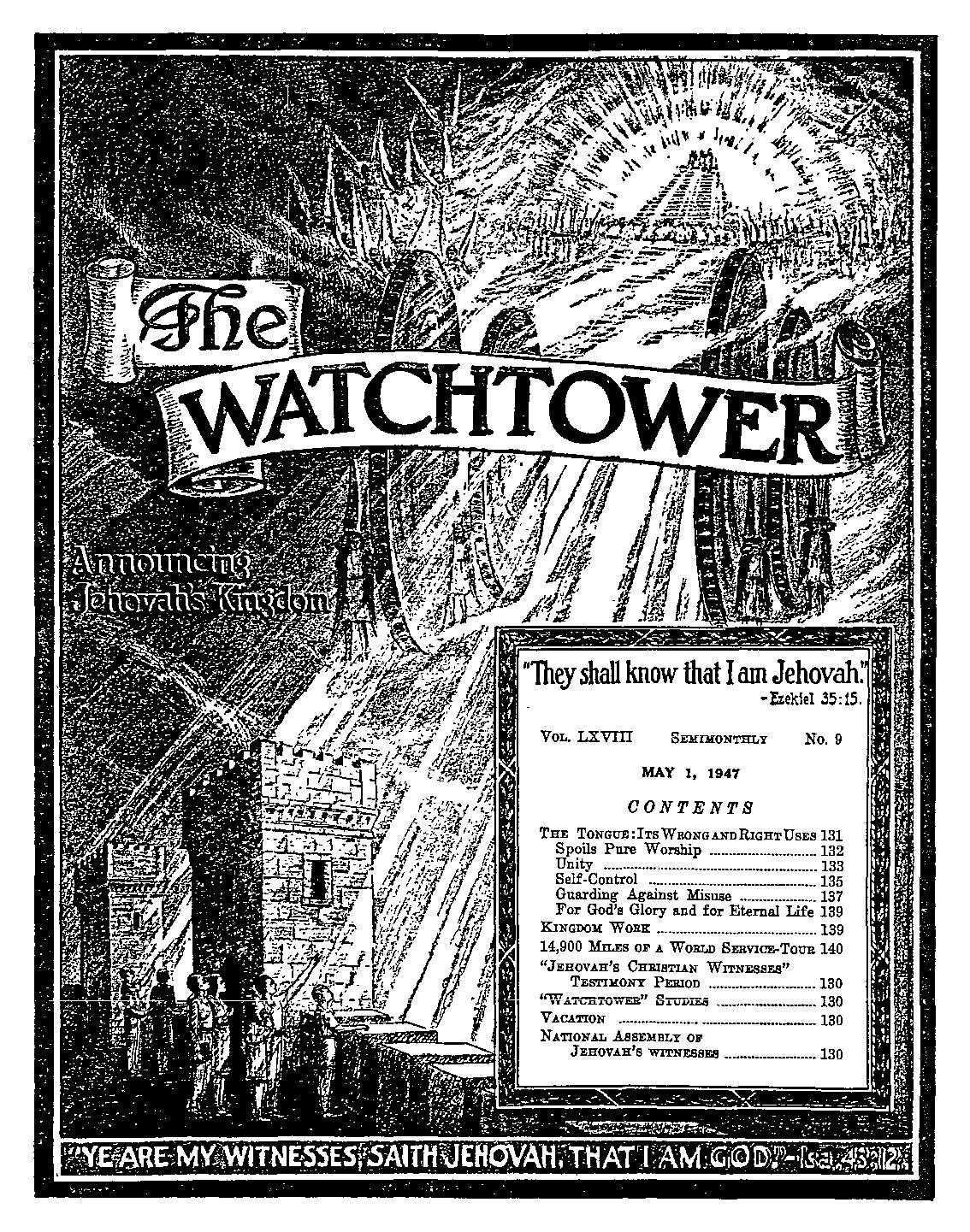
VOL. LXVT1I
MAY 1, 1947
CONTENTS
The Tongue-.Its WrongandRightUses 131
Kingdom Work
They shall know that I am Jehovah.
-Ezekiel 35:15.
Spoils Pure Worship Unity
Self-Control
1OU
“Jehovah’s Christian Witnesses”
Semimonthly
No. 9
Testimony Period
SiupIlb
Vacation
National Assembly op
Jehovah’s witnesses
[WATCHTOVVF^i
Guarding Against Misuse
For God’s Glory and for Eternal Life 139
14,900 Mn.ES of a World Service-Tour 140
tSt! S'
&
eg'
Published Semimonthly By
WATCH TOWER BIBLE & TRACT SOCIETY 117 Adams Street » • Brooklyn 1, N.Y., U.S A.
OrrrcEBs
N. EL Knobs, President Grant Suiter, Secretary
“And all thy children shall he taught of Jehovah; and great shall he the peace of thy children.” - Isaiah 54:13.
THE BIBLE CLEARLY TEACHES
THAT JEHOVAH is the only true God, from everlasting to everlasting, and Is the Maker of heaven and earth and Giver of life to his creatures; that the Word or Logos was the beginning of his creation and his active agent in creating all other things; and that the creature Lucifer rebelled against Jehovah and raised the issue of His universal sovereignty;
THAT GOD created the earth for man, made perfect man for the earth and placed him upon it; that man yielded to unfaithful Lucifer, or Satan, and willfully disobeyed God’s law and was sentenced to death; that by reason of Adam’s wrong act all men are born sinners and without the right to life;
THAT THE LOGOS was made human as the man Jesus and suffered death in order to produce the ransom or redemptive price for obedient men; that God raised up Christ Jesus divine and exalted him to heaven above every other creature and clothed him with all power and authority as head of God’s new capital organization;
THAT GOD’S CAPITAL ORGANIZATION is a Theocracy called Zion, and thut Christ Jesus is the Chief Officer thereof and Is the rightful King of the new world; that the faithful anointed followers of Christ Jesus are Zion’s children, members of Jehovah’s organization, and are His witnesses whose duty and privilege It Is to testify to Jehovah's supremacy and declare his purposes toward mankind as expressed in the Bible;
THAT THE OLD WORLD, or Satan’s uninterrupted rule, ended A.D. 1914, and Christ Jesus has been placed by Jehovah upon the throne, has ousted Satan from heaven, and now proceeds to vindicate His name and establish the “new earth”;
THAT THE RELIEF and blessings of the peoples can come only by Jehovah’s kingdom under Christ, which has begun; that His next great act is to destroy Satan’s organization and establish righteousness completely in the earth ; and that under the Kingdom the people of good-will surviving Armageddon will carry out the divine mandate to “fill the earth” with righteous offspring, and that the human dead in the graves will be raised to opportunities of life on earth.
ITS MISSION
THIS journal Is published for the purpose of enabling the people to know Jehovah God and his purposes as expressed in the Bible. It publishes Bible instruction specifically designed to aid Jehovah’s witnesses and all people of good-will. It arranges systematic Bible study for its readers and the Society supplies other literature to aid in such studies. It publishes suitable material for radio broadcasting and for other means of public instruction in the Scriptures.
It adheres strictly to the Bible as authority for its utterances. It is entirely free and separate from all religion, parties, sects or other worldly organizations. It Is wholly and without reservation for the kingdom of Jehovah God under Christ his beloved King. It is not dogmatic, but invites careful and critical examination of its contents in the light of the Scriptures. It does not Indulge In controversy, and Its columns are not open to personalities.
Notice to Subscribers: Remittances should be sent to office in your country in compliance with regulations to guarantee safe delivery of money. Remittances are accepted at Brooklyn from countries where no office is located, by International money order only. Subscription rates in different countries are stated below in local currency. Notice of expiration (with renewal blank) Is sent at least two Issues before subscription expires. Change of address when sent to our office may be expected effective within one month. Send your old as well as new address.
Please address the Watch Tower Society In every case.
Offices Yearly Subscription Rate
America (U.S.), 11T Adams St., Brooklyn 1, N.Y.
Australia, 7 Beresford Rd., Strathfleld, N. S. W.
British West Indies, 21 Taylor St., Port of Spain, Trinidad
Canada, 40 Irwin Ave., Toronto 5, Ontario
England, 34 Craven Terrace, London, W. 2
India, 167 Love Lane, Bombay 27 R»- 3/0
Jamaica, 151 King St, Kingston
New Zealand, O. P. O. Box 30, Wellington, S. 1
Philippine Islands, 2621 Int 2 Herran, Santa Ana, Manila
South Africa, 623 Boston House, Cape Town
Translations of this journal appear in many languages.
ALL SINCERE STUDENTS OF THE BIBLE who by reason of infirmity, poverty or adversity are unable to pay the subscription price may have The Watchtower free upon written application to the publishers, made once each year, stating the reason for so requesting it. We are glad to thus aid the needy, but the written application once each year i required by the postal regulations.
Printed in the United States of America
Entered as second-class matter at the post office at Brooklyn, N. Y., under the Act of March 3, 1879.
“JEHOVAH’S CHRISTIAN WITNESSES” TESTIMONY PERIOD
The month of June, designated as above, starts off the fourmonth campaign of reaching out into the extensive rural territory with the message of Jehovah’s kingdom by his Christ. The transition up north here from spring to summer beckons his Christian witnesses out into the countryside beautiful with opportunities for placing the message in print, in preference to city territory. The special offer featuring the campaign is that of three bound books on a $1.00 contribution, this to include, if possible, the Theocratic ministry school book “Equipped for Every Good Work” and “Let God Be True” along with one other Watchtower publication. Placed alone, “Equipped for Every Good Work” will continue to be offered on a half-dollar contribution. In view of all the things involved with pushing and following up this campaign worthily, preparations for this expansion work should go forward as early as possible, individually and collectively. A mere postcard or other request notice will call us to your aid and instruction if you, as a Watchtower reader, want to lend a hand in this work. A report of work during the June testimony period should be turned in at its close.
“WATCHTOWER” STUDIES
Week of June 1; “The Tongue: Its Wrong and Right Uses,” fl 1-20 inclusive, The Watchtower May 1, 1947.
Week of June 8: “The Tongue; Its Wrong and Right Uses,” fl 21-39 inclusive, The Watchtower May 1, 1947.
VACATION
In order that companies and pioneers may plan their work for about two months of the period affected, they should order literature well in advance of August 9. This instruction is given in view of the information we here give that the Brooklyn factory, office and Bethel home will be closed for the period of Saturday, August 9, to Sunday, August 24, inclusive. This vacation arrangement will allow for some members of the Bethel family who can so order their affairs to attend the national assembly of Jehovah’s witnesses in California, August 13 to 17. During the vacation period as little correspondence as possible should be sent to the Society, with the exception of report cards and subscriptions.
NATIONAL ASSEMBLY OF JEHOVAH’S WITNESSES
At the Cleveland assembly, the president of the Society, N. H. Knorr, told the brethren of the plans for a convention in California in 1947, following his world tour. We are now pleased to say that this will be held in California, with assembly in Wrigley Field, August 13 to 17, inclusive, Los Angeles being the city. Brethren making plans to go should arrange their vacations accordingly. Later announcement will be made as to rooming and other information. This notice now will aid those who plan to attend the California assembly to make their arrangements well in advance.
ANNOUNCING JEHOVAH’S KINGDOM
Vol. LZVIII
May 1, 1947
No. 9
THE TONGUE: ITS WRONG AND RIGHT USES
“The tongue of the wise is health. The lip of truth shall be established for ever; but a lying tongue is but for a moment. Lying lips are an abomination to Jehovah."—Prov. 12:18,19, 22, Am. Stan. Ver.
JEHOVAH God equipped man with a wonderful instrument when He created him with a tongue as one of the organs of speech. This small member performs an important part in nearly all the actions of the mouth, such as chewing, swallowing, etc., but it is an essential part of the human apparatus for speaking. Many of the lower animals created before man have tongues and can make sounds with or through the mouth, but man’s tongue is so superior that with it he can articulate speech, that is, divide up his vocal sounds into words and syllables and speak distinctly and connectedly. Thus thousands of languages are possible to him, 2,796 being the actual number of languages today as computed by officers of the French Academy. In the case of one of these languages, cutting out slang and vulgar ■words, the reputable English language contains about 700,000 words, including scientific terms and out-of-date words. With such a fund of words possible in thousands of languages the tongue is a powerful instrument for the passing on of thought and information to others and for the stirring up of thought and action in them. The Creator, Jehovah God, designed the tongue only for good, but in the mouths of selfish sinners and under the influence of malicious invisible demons the tongue’s very powerfulness makes it a potential danger, a mighty agent for the causing of measureless wickedness and injury.
2 All the world stands condemned for the misuse of the tongue. Among the Ten Commandments the supreme Lawgiver included these two commandments: “Thou shalt not take the name of Jehovah thy God in vain,” and, “Thou shalt not bear false wifnp<5<? thv Tipio’hhnr.” (Ex. 20:7. 16. Am.
Stan. Ver.) By those very prohibitions of improper speech the Lord God indicated the condition of the Israelites with whom he made his Law covenant. He showed it needed control and correction. “Knowing this, that the law is not made for a righteous man, but for the lawless and disobedient, for the ungodly
1. Why is man’s tongue a wonderful instrument, and why also a potential danger?
2. In the Ten Commandments how did Jehovah show the use of the tongue by the Israelites needed control and correction? and for sinners, for unholy and profane, for murderers of fathers and murderers of mothers, for manslayers, for whoremongers, for them that defile themselves with mankind, for menstealers, for liars, for perjured persons, and if there be any other-thing that is contrary to sound doctrine.”—1 Tim. 1:9,10.
’ Profane, liars and perjured! Those words point to the tongue as an offender among the Jews. They are no less sinners than the Gentiles in this respect. The Hebrew Scriptures bear witness to their failure on the right use of the organs of speech, so that a Jewish-Christian writer makes quotations from their Law or Holy Scriptures, and says: “We have before proved both Jews and Gentiles, that they are all under sin; as it is written, There is none righteous, no, not one: there is none that understandeth, there is none that seeketh after God. They are all gone out of the way, they are together become unprofitable : there is none that doeth good, no, not one. Their throat is an open sepulchre; with their tongues they have used deceit; the poison of asps is under their lips: whose mouth is full of cursing and bitterness : . . . there is no fear of God before their eyes. Now we know that what things soever the law saith, it saith to them who are under the law [the Jews]: that every mouth may be stopped, and all the world may become guilty before God.” (Rom. 3:9-19; Ps. 5:9; 10:7) Hence no mouth, of any race or nationality, can open itself in self-justification as sinless in its use of speech. Moses himself, by whom God gave the law to the Israelites, offended in speech on one recorded occasion: “They angered him also at the waters of strife, so that it went ill with Moses for their sakes: because they provoked his spirit, so that he spake unadvisedly with his lips.” (Ps. 106:32,33) On this account he lost the privilege of entering into the Promised Land.
‘ It does not matter whether one is a witness of Jehovah or not, it matters not whether one is a
3. How do the Hebrew Scriptures show the Israelites to have been sinners as to speech and so prove all the world to be guilty?
4. Why is perfection of speech not now expectable, and why do Christian teachers stand In a responsible position?
consecrated Christian or not, each and every one is liable to faults in the use of the tongue. We cannot look for perfection of speech among even the congregations of faithful Christians. The fundamental reason is that these are still in the imperfect flesh with its inclinations to sin, and perfection is not to be expected of them in word or in deed. Hence Christians that are teachers of others stand in a very responsible position and need to be very careful not to use their vocal powers for wrong purposes as well as not to teach false doctrine. In the time of Christ’s apostles itself, just about thirty years after the Christian church was started, the disciple James felt constrained to write to his Christian brethren as follows:
’ “Be not many of you teachers, my brethren, knowing that we shall receive heavier judgment. For in many things we all stumble. If any stumbleth not in word, the same is a perfect man, able to bridle the whole body also.” The tongue is a small member, but is mighty and can affect the whole body, the same as a horse’s bridle or a ship’s rudder is a comparatively small object. “Now if we put the horses’ bridles into their mouths that they may obey us, we turn about their whole body also. Behold, the ships also, though they are so great and are driven by rough winds, are yet turned about by a very small rudder, whither the impulse of the steersman willeth. So the tongue also is a little member, and boasteth great things. Behold, how much wood is kindled by how small a fire! And the tongue is a fire: the world of iniquity among our members is the tongue, which defileth the whole body, and setteth on fire the wheel of nature, and is set on fire by Gehenna.”
• As long as Christians are in the imperfect flesh, the tongue will remain beyond taming to perfection. Not that wrong speech is therefore to be lightly excused and is free to be indulged in loosely, but that this is a fact that we should not overlook, but that should put us on guard and also should stir us to mercy toward offenders, if repentant. “For every kind of beasts and birds, of creeping things and things in the sea, is tamed, and hath been tamed by mankind: but the tongue can no man tame; it is a restless evil, it is full of deadly poison. Therewith bless we the Lord and Father; and therewith curse we men, who are made after the likeness of God: out of the same mouth cometh forth blessing and cursing.!’ This is inconsistent, of course, especially among worshipers of Jehovah God; and James next points this out, saying: “My brethren, these things ought not so to be. Doth the fountain send forth from the same opening sweet water and bitter? can a fig tree, my brethren, yield olives, or a vine figs ? neither
5. What would perfection of speech mean? and how does James Illustrate the powerfulness of the tongue despite its smallness?
6. What stand should the tongue’s untamableness make us take? and why are opposite uses of the tongue improper for God’s worshipers? can salt water yield sweet. Who is wise and understanding among you? let him show by his good life his works in meekness of wisdom. But if ye have bitter jealousy and faction in your heart, glory not and lie not against the truth. This wisdom is not a wisdom that cometh down from above, but is earthly, sensual, devilish. For where jealousy and faction are, there is confusion and every vile deed.”—Jas. 3:1-16, A.S.V., margin.
SPOILS PURE WORSHIP
T An honest person worships God primarily because it is right to render worship to the loving Creator, but also because that is the way to eternal life in the new world of righteousness. A hypocrite will draw near to God in an outward, ceremonious way with his lips full of pious phrases, but his heart inclinations will be far from God and the divine will and commandments. A sincere person, however, will be wholehearted in worshiping God, not wanting to deceive himself. Nevertheless, he must be watchful not to spoil the effect and acceptableness of that worship by improper speech in the other affairs of life. Blessing God while at forms of worship, and cursing men or injuring by speech men who represent God, being in his likeness, are not in harmony with a pure worship of God. Being one thing at the one time and the opposite at another time, such a professed worshiper is deceiving himself if he thinks he is getting anywhere by what various forms of worship he offers to God. James, who gives us that superior statement on the evils of the ungoverned tongue, says in this regard: “If any one thinketh that he worshippeth God, and doth not restrain his tongue, but his heart deceiveth him; his worship is vain. For the worship that is pure and holy before God the Father, is this: to visit the fatherless and the widows in their affliction, and that one keep himself unspotted from the world.” For pure and undefiled worship in God’s sight, therefore, the servant of God must not only bless God but also cause his tongue to be a blessing to mankind as well.—Jas. 1: 26, 27, Murdock.
’ The world, from which God’s worshipers are warned to keep themselves unspotted, is full of slanderers, liars, talebearers, flatterers, evil-speaking conspirators, and false witnesses. Satan the Devil, “the god of this world,” would like to plant such evil-speakers among God’s consecrated people for the sake of causing hurt and damage to their organization. He is eager to infect various members of the organization with the spirit of the world which actuates a person to the many wicked uses of the powers of speech. Idleness from the good works
7. How can unrestraint of the tongue make one’s worship vain? 8. Why Is Satan anxious to influence the use of Christians’ tongues? and how does idleness leave an opening for him? of the Lord allows room for the tongue to wag in unprofitable ways. The apostle found it well to issue a warning in that regard, saying concerning selfseeking young widows: “And withal they learn to be idle, wandering about from house to house; and not only idle, but tattlers also and busybodies, speaking things which they ought not.” (1 Tim. 5:13) Instead of imitating the apostle, who taught “from house to house” as well as publicly, these young widows, growing careless of their responsibilities to the Lord God, went from home to home among their Christian brethren and carried gossip that pertained to other persons’ private affairs. This did not upbuild the listeners in a way that the discussion of the Kingdom truth and the service thereof would do. It tended to start the listener’s tongue to wagging.
’ A talebearer is not a faithful person, because he is prone to betray the private matters of neighbors, and usually with hurt to them in the estimation of the listeners. The proverb shows up the sharp contrast between the wise man and the thoughtless, oft-time malicious talebearer, saying: "He that des-piseth his neighbor is void of wisdom; but a man of understanding holdeth his peace [keeps silent]. He that goeth about as a talebearer revealeth secrets; but he that is of a faithful spirit concealeth a matter.” (Prov. 11:12,13, Am. Stan. Ver.) Understanding what harm it can do and how it displeases the Lord, a man that is faithful to the interests of his brethren will keep quiet on matters of private concern to them so as not to bring them into disrepute. He will also be careful not to divulge matters that are strictly the business of the Lord’s organization and that are confidential to him or his fellow workmen. He will not disclose these to others as general news for the public. He will keep such information to himself as a trust to be concealed till the time that the organization by its own means of publication sees good to make it known. A person may foolishly or thoughtlessly act as a talebearer, but his being thoughtless does not lessen the damage done. When the fact becomes known to a person that a talebearer has been spealdng ill of him to others, it can wound him deeply, almost to the point of never being able to be reconciled to the talebearer. The hurt is deep-seated and hard to get out of the system. "The words of a talebearer are as wounds, and they go down into the innermost parts of the belly.” —Prov. 18: 8.
10 Aside from likely causing much harm, a talebearer is wasting time. If he would settle down to some profitable work instead of talking about things that neither upbuild the hearer nor benefit the one talked about, he would get something worth-while done and would not make himself poor spiritually.
9. Why is a talebearer unfaithful, and productive of deep wounds? 10. Why is a talebearer wasting time and making himself poor? “In all labour there is profit: but the talk of the lips tendeth only to penury.” (Prov. 14:23) What is needed is deeds, not words. Idlers can indulge in many'-words,- but get nowhere as far as profiting themselves or others. Idle talk, and especially whispering about others, has been responsible for much harm, and therefore should be avoided. A wise person will first think before opening his mouth in such talk.
UNITY
11 Whether we seek to have it so or not, whispering can make the continuance of friendships difficult or can even break them up. Bang Solomon had no doubt observed this many times in Israel, God’s covenant people, and so he wrote: "A worthless man deviseth mischief; and in his lips there is as a scorching fire. A perverse man scattereth abroad strife; and a whisperer separateth chief friends.” If a person’s lips are hot with some tale or information about another, before telling it to another let him stop and ask himself why he wants to tell it. Is it intentionally to work mischief, such .as scorching one of the brethren or stirring up strife in the congregation or separating friends from each other? It may cause the talebearer himself to lose the friendship of the one of whom he gossips or the friendship of the one to whom he gossips. If he loves his brother or sister about whose faults and transgressions he knows, he will not be keen to publish such. He will keep quiet about them and so not put the brother or sister in difficulty by making either one an object of open shame. He will not make it hard for them to hold their friends. He will not strain his own friendship with them by talking about them. “He that covereth a transgression seeketh [procureth] love; but he that repeateth [or, harpeth on] a matter separateth very friends.”—Prov. 16: 27, 28, Am. Stan. Ver.; 17: 9.
12 If, then, you want to earn the love of another, you will overlook his transgressions or keep quiet about them or not make them a subject of common gossip. And if some gossiper pours into your ears a tale about others’ shortcoming, you will show love by not repeating and passing on the tale to others. Neither will you keep on bringing it up or harping upon it before others until you have made them despise others and quit their friendship. If you would befriend a brother at fault, remember this: “A friend loveth at all times, and a brother is born for adversity.”—Prov. 17:17.
13 For the sake of unity within the Lord’s organization and among its members we should not give way to idle talk, gossiping and talebearing. It does not deepen our love for our brethren to talk ill about
11. How do whisperers or repeaters separate close friends? and what ought they to do before speaking?
12. How, then, can we seek or procure love of others'7
13. For the sake of what should we keep from such Improper speech, and especially because of God’s attitude thereon? them, and especially to say something the truth of which we have not established and which may therefore be a lie. The Lord gives us the warning: “A lying tongue hateth those that are afflicted by it; and a flattering mouth worketh ruin.” (Prov. 26:28) Thus the tongue may lie about one person and may flatter another person to his face, but neither of these lingual practices is good. Among the seven prominent things that Jehovah God hates are the lying tongue, a false witness that speaks lies, and a person that sows discord among brethren in God’s organization. Those practicing these things are abominable in his sight.—Prov. 6:16-19.
14 After a lie has been told about another, the person may ask forgiveness of the one about whom he has lied, but by the time the forgiveness is asked and granted much damage may have been wrought, and almost beyond repair in some cases. The wise person will pause to look ahead to the evil consequences that may follow speaking untruths and will remember God’s commandment against lying, and will not foolishly spread a lie. He will spare himself later regrets and will keep himself inside the love of God. Evil-speakers may be sure their mischiefmaking will boomerang back and strike them smack in the face. They lay the snare for future trouble for themselves. “By the sin of his lips is the guilty man ensnared; while the innocent escapes from trouble.”—Prov. 12:13, An Amer. Trans.
15 Knowing there is a sure retribution according to God’s directing of matters, we ■will be careful to consider the effects of our speech, what they might be with reference to others and eventually to ourselves. Jehovah gave Solomon the wisdom to discern and to write down this hard, sobering fact: “Of the fruit of his mouth a man will have his fill; with the outcome of his lips will he be satisfied. Death and life are in the power of the tongue; those who indulge it must eat the fruit of it.” (Prov. 18: 20, 21, An Amer. Trans.) Yes, one’s own future life or everlasting death is largely determined by the use of one’s mouth or powers of communication.
16 If a man wants to use his tongue in a lot of talk he ought to remind himself he will have to bear the consequences from the way he uses his tongue. The speaker must eventually eat the fruit of what he has sown by his lips, regardless of how it affects other persons. If he uses his mouth and lips in proclaim-ing’the message of God’s kingdom he will find that the Lord will bless him with the supplying of his needs to keep on in preaching. “Even so hath the Lord ordained that they which preach the gospel should live of the gospel.” (1 Cor. 9:14) At length this beneficial use of one’s vocal powers and means
14. Why will a wise person pause before speaking untruths?
15, 16. (a) How are death and life in the tongue’s power? (b) Why, then, did Jesus warn the Pharisees that Ued against Him? of expression leads to eternal life. But if one uses his tongue for selfish, worldly purposes hurtful to other persons, his harmfully wagged tongue will be a power for his own final destruction at God’s hands. Without doubt, for this reason Jesus told the religious Pharisees that lied about him and misrepresented the power behind his works that they would be condemned by their words. He warned them that every word, not yielding good, that they spoke about him and his followers would be held against them. Without fail they would give account for it in the day of judgment. (Matt. 12: 36, 37) Nothing of lasting value to oneself is to be gained by lying against another. The outcome thereof may be everlasting death for the liar. The liar is merely chasing an unsubstantial vapor into the snares of death for himself. “The getting of treasures by a lying tongue is a vapor driven to and fro by them that seek death.” (Prov. 21:6, Am. Stan. Ver.) We should not seek to gain anything selfish by means of lying. The selfish enjoying of what is thus gained will surely be cut off in death.
” Lest a person should fall into the ways of a gossiper and take part in spreading the gossip, he will not entertain the speech of gossipers. He does not want to cause mischief, and be like a wicked man who finds pleasure in picking up information he can use against others. He knows crooked speech is certain to involve him in a mess. Because he wants primarily to do right and also to avoid trouble for himself and others he will not give ear to gossip and take tales to heart without direct investigation. He keeps in mind the proverbs: “A wicked doer giveth heed to false lips; and a liar giveth ear to a naughty tongue. He that hath a froward heart [or, perverse mind] findeth no good: and he that hath a perverse [or, a false] tongue falleth into mischief.” (Prov. 17:4, 20) The lips of a gossiper do not speak the knowledge of the Lord and of his instructions for his people; and the devoted person who loves God and his brethren in the Lord’s organization will not tarry in the company of the gossiper. He will not be enticed or won over to listening to gossip by the flattery of the gossiper. The wise instructions of the Lord God are: “Go from the presence of a foolish man, when thou perceivest not in him the lips of knowledge. He that goeth about as a talebearer revealeth secrets: therefore meddle not with him that flattereth with his lips.”—Prov. 14:7; 20:19.
18 Imagine it 1 The apostle Paul found backbiting to exist among the members of the Christian congregations. But he was plainspoken to express his disapproval of it. Being such a Bible student, he unquestionably knew what Proverbs 25: 23 says: “The
17. How will one loving God and his brethren deal with gossipers, and why?
18, 19. What did backbiting bring forth upon Paul? and what did he write about it to the Corinthians? north wind driveth away rain: so doth an angry countenance a backbiting tongue.” Or, “The north wind bringeth forth rain; so doth a backbiting tongue an angry countenance.” (Am. Stan. Ver.) The report and evidence of backbiting among his Christian brethren brought forth an angry countenance upon Paul, and through his letters of rebuke he displayed an angry countenance to them. The apostle himself was not exempt from being a victim of some backbiters. He was moved to write, therefore, as follows:
19 “Suppose I do boast a little too much of my authority—which the Lord gave me to build you up, not to pull you down—I will not have to blush for it. I do not want to seem to scare you with my letters. For they say, 'His letters are impressive and telling, but his personal appearance is insignificant and as a speaker he amounts to nothing.’ Such people had better understand that when I arrive and take action I will do just as I say I will in my letters when I am far away. For I think that I am not in the least inferior to these superfine apostles of yours. Even if I have no particular gifts in speaking, I am not wanting in knowledge. Why, I have always made that perfectly clear in my dealings with you. Do you think that I did wrong in degrading myself to uplift you, because I preached God’s good news to you without any compensation? ... I am afraid that perhaps when I come I may find you not as I want to find you, and that you may find me not as you want to find me. I am afraid that perhaps there may be quarreling, jealousy, bad feeling, rivalry, slander, gossip, conceit, and disorder, and that when I come back my God may humiliate me before you, and I may have to mourn over many who have kept on in their old sins and have never repented of the impurity, immorality, and sensuality in which they have indulged. . . . Any charge must be sustained by the evidence of two or three witnesses. Those who have kept on in their old sins and all the rest I have warned, and I warn them now while I am still away, . . . that if I come back I will spare nobody—since you demand proof that Christ really speaks through me.”—2 Cor. 10: 8-11; 11: 5-7; 12:20-13: 3, An Amer. Trans.
20 Paul knew it would do the congregation good to rebuke them, and he was courageous enough to do it as a member of the then governing body of the Christian chtirch. Flattering would have done no good to the Corinthian brethren in their poor spiritual condition, but rebuke would show them the right way. Of course, it might hurt their feelings for a while, but later it would be appreciated and win the favor of the right-minded brethren. “He that rebuk-eth a man afterwards shall find more favour than
20. With what In view did Paul rebuke them? and in what proper way should they have received it?
he that flattereth with the tongue.” (Prov. 28:23) The apostle was righteous in reproving his brethren. He did so to heal and build them up, and not to break their heads with discouragement and despair. The way they would take it should have been with a discernment of the kindness back of it, just as the psalmist David did with like reproof. Said he: “Let the righteous smite me; it shall be a kindness: and let him reprove me; it shall be an excellent oil, which shall not break my head: for yet my prayer also shall be in their calamities.” (Ps. 141: 5) David held no vindictive or vengeful spirit toward his loving reprovers such as would make him rejoice when trouble came upon them; but he gratefully prayed for them in their calamities. '
SELF-CONTROL
11 What shall a servant of Jehovah God do-when he finds himself being slandered, or that backbiting is going on about him? At first he might get all excited about it and might even fume‘about it. He might feel so surprised at having to suffer thus at the hands of those whom he recognizes as brethren that he would not know how to account for it. He may feel so deeply hurt., and grieved, that it momentarily takes.from him the joy he once had in going out into the Lord’s service. He cannot get his mind off his hurt. The injustice done him by some thoughtless one or ones within the organization may stir up doubts in his mind that an organization with such individuals associated with it could be the Lord’s organization. He may feel almost inclined to abandon it and go independent of such an organization. He may feel such contempt for that kind of slanderous action that he would not stoop to return slander with slander, whereas another person might feel pricked to do so, returning evil for evil. But whatever the emotions, it is a time for great selfcontrol against ill-considered action or mental conclusions.
22 Because some individual associates go contrary to the declared standard of God’s organization, it would be wrong to take it out on the Lord’s organization by forsaking it. Apart from the Lord’s organization, there is only one other organization to which to go, namely, this world, which is Satan’s organization. Wh.cn ccrtsin disciples of Jesus conceitedly took offense at the deep truths that he preached, and “went back, and walked no more with him”, Jesus said to his apostles, “Will ye also go away?” With good judgment and sense Peter replied: “Lord, to whom shall we go? thou hast the words of eternal life. And we believe and are sure that thou art that Christ, the Son of the living God.” (John 6: 66-69)
21. How may a slandered or backbitten person feel and think about it? and what specially does he need at the time?
22. Why will a faithful person, when hurt by slander or backbiting, not take it out on the Lord’s organization?
So, too, the faithful will hold on, waiting for time to straighten all things out. The conduct or speech of some does not alter the truth and the righteous service of the Kingdom that God has committed to his Theocratic organization. So keep your understanding of your relationship to God that you entered by consecration, and do not quit the Lord’s organization. Satan and his demons would like to have you do so, welcoming you to their embrace, hut to your everlasting death. “The man that wandereth out of the way of understanding shall remain in the congregation of the dead.”—Prov. 21:16.
23 Do not let the wagging tongues of some slap you out of the Lord’s service. Do not let hurt feelings so fill you that you can no longer find joy in God’s service. The active service of God in which you endeavor to justify God (not yourself) before others is your greatest relief and comfort under the circumstances, to get your mind off yourself and to make you see that other things of personal concern do not matter. Remember that Job was reproved for trying to justify himself because of the slander flung at him rather than to justify God first. However, in spite of the false charges of Satan the Devil and in spite of the sharp accusations of the hypocritical, self-righteous friends Job did not misuse his lips to curse God and thus break his integrity by bitter lips. “In all this did not Job sin with his lips.” (Job 2:10) He did not quit Jehovah’s organization because of the cutting speeches of his friends who claimed to be speaking for God. The merciful end that God gave Job for doggedly holding on regardless of his abject poverty of health, property and friends, proves the verity of the ancient wise saying: “Better is the poor that walketh in his integrity, than he that is perverse in his lips, and is a fool.”—Prov. 19:1.
24 How often have the hypocritical religious clergy tried to bring about the destruction of Jehovah’s witnesses by slandering and misrepresenting them to rulers, judges, politicians and the public. But by our knowledge of God’s Word which we have boldly proclaimed and by the knowledge of ourselves which we have caused the public to have by our Christian lives and activities, we have defeated the purposes of religious hypocrites and have been saved and delivered from destruction. “An hypocrite with his mouth destroyeth [or, would destroy] his neighbour: but through knowledge shall the just be delivered.” (Prov. IT: 9) The just ones, under stress of false reports, pray to the Lord God that he will help them not to take up, in turn, lying lips and a deceitful tongue. They know what will be the destiny of those who resort to such things, and so they refrain from answering lies and deceit with like weapons of
23. In that connection, why should one not quit God’s active service but remember the case of Job with his three false friends?
24. How have Jehovah’s witnesses been delivered from would-be destroyers? and for what help from above have they prayed? retaliation. “In my distress I cried unto the Lord, and he heard me. Deliver my soul, 0 Lord, from lying lips, and from a deceitful tongue. What shall be given unto thee? or what shall be done unto thee, thou false tongue?” The Bible answer is that sharp arrows and burning coals will be poured upon such tongue, for it was like a fire and shot out arrows of bitter words.—Ps. 120:1-4.
20 Let us look mercifully upon our brethren. Neither they nor we ourselves are perfect, and the tongue has been tamed not to the same degree by all, and to a perfect degree by none. The tongue is not entirely tamable by an imperfect human. It is bound to remain an unruly evil and to cause trouble and to poison the atmosphere and the lives of some now and then. Hence speech should not be hasty. To those who have been begotten by the great “Father of lights” with his Word of truth, the disciple James writes: ‘‘Wherefore, my beloved brethren, let every man be swift to hear, slow to speak, slow to wrath: for the wrath of man worketh not the righteousness of God.” (Jas. 3:8; 1:19,20) This is good instruction for times when we are under the fire of the arrows of slander and are inclined to wrath. Once the psalmist David’s heart was hot inside him, and while he mused the inward fires were burning fiercely. Then he spoke, but not with anger, however. Why not? Because here is what he did to himself first: “I said, I will take heed to my ways, that I sin not with my tongue: I will keep my mouth with a bridle, while the wicked is before me. I was dumb with silence, I held my peace, even from good; and my sorrow was stirred.” (Ps. 39:1-3) David checked himself by remembering his own imperfection.
28 Here David showed himself willing to put up with reproach and shame at the lips of the wicked reviler, because the Lord was permitting it for a test of David’s integrity. Anxious to keep from slipping into sin, he muzzled his mouth, not even speaking what seemed good. Within himself he spoke, but it was to God in prayer, and he confessed to being an imperfect creature subject to the control and disposition of his great Creator, Jehovah. So looking at matters, David did not charge God foolishly for letting him experience reproach on the part of the wicked enemy. The big thing that David wanted was not to be himself a reproach to God, and he grieved that others, the enemies, should cast reproach upon God.
2T Christ Jesus, who was typified by David, also knew how to be silent in excellent self-control. He did not sin by railing back at those who railed at him, even when he hung on the tree. He endured the
25. For what reason should we look mercifully upon our brethren? and how did David keep himself from hastiness of speech?
20. Why was David willing to put up with reproach and shame?
27. How did Jesus show control of speech? and to what did he thus hold on, in contrast with his big-mouthed reproachers? suffering and did not part his lips to let out any threatenings. Never could any of his enemies, not even the Devil himself, catch him in any of his words. He was obedient to God in word and deed, and kept his integrity as Job did. By guarding his mouth and moving his tongue always in the cause of truth and righteousness Jesus retained his hold on the right to everlasting life. The rule is perfectly exemplified in him in contrast with the transgressors and revilers that “a man shall eat good by the fruit of his mouth: but the soul of the transgressors shall eat violence. He that keepeth his mouth keepeth his life: but he that openeth wide his lips shall have destruction”. (Prov. 13:2,3) The persecutors that transgressed God’s law and reproached and accused Jesus falsely met with violent destruction in due time. But Christ Jesus lives forever by virtue of his resurrection out of death and eats the good fruits of his faithful preaching of the gospel on earth.
GUARDING AGAINST MISUSE
28 Under provocation, therefore, the follower of Jesus Christ will wisely muzzle his mouth and prevent a loose, uncontrolled torrent of words. “In the multitude of words there wanteth not transgression; but he that refraineth his lips doeth wisely.” If he talks at all it will be with measured words and according to the counsel of God’s Word. He will talk for edification of the provoker and of other listeners, rather than to make slips of speech that stir up more strife and contention. He knows and understands the power of words both upon the speaker and upon the hearers. “He that spareth his words hath knowledge ; and he that is of a cool spirit is a man of understanding. Even a fool, when he holdeth his peace, is counted wise; when he shutteth his lips, he is esteemed as prudent.”—Prov. 10:19 and 17: 27, 28, Am. Stan. Ver.
29 A witness of Jehovah has difficulties enough without having to pave the way for additional selfimposed troubles by rash speech. What he wants to get across to others with his lips is the message of Jehovah’s kingdom by Christ Jesus. He will shoulder all the trouble that proclaiming that message brings upon him from enemies of the truth, but he does not care to make trouble for himself by ill-advised words and so make obstacles for his service to God. “Whoso keepeth his mouth and his tongue keepeth his soul from troubles.” He may find pride or other evil thoughts putting his mind in a tumult, and undesirable words are at the tip of his tongue in position to be shot forth. But in such a mental condition he can hardly bring forth good things, and it is better not to talk. “If thou hast done foolishly in lifting up thy-
28. Under provocation, what will a Christian do as regards speech? 29. When presenting the message, how will a witness of Jehovah avoid making extra trouble for himself? self, or if thou hast thought evil, lay thine hand upon thy mouth.” (Prov. 21:23; 30:32) If you feel too weak in yourself to do this, you can take up the psalmist’s prayer: “Set a watch, O Lord, before my mouth; keep the door of my lips.” (Ps. 141:3) Humble yourself in the eyes of the Lord, as Job did after God showed Job he was too much interested in justifying himself and was overlooking Jehovah’s majesty. Then you will lay your hand upon your mouth and keep it shut from saying words without knowledge, as Job did.—Job 38:2; 40:4.
so Many persons, including religionists, are ignorant in their opposition to the Kingdom message. This may be due to being mistaught religiously and sincerely believing the error, or because enemies of Jehovah have grossly misrepresented His witnesses to them. They upbraid the Kingdom publisher and show him a hard front that seems almost impenetrable. This hard resistant front may be accompanied by hard words of denunciation and reproaches. The Kingdom publisher will graciously overlook such affronts, because he does not know the background of those to whom he is presenting the message. He knows he could not accomplish anything by being rough in return to such misguided persons. Returning like for like would merely widen the gulf in between, and make it difficult for a later re-approach or for the next Kingdom publisher coming along. In faith, therefore, he acts with kindness according to the proverb: “A soft answer turn-eth away wrath: but grievous words stir up anger. The tongue of the wise useth knowledge aright: but the mouth of fools poureth out foolishness.”—Prov. 15:1, 2.
31 Unbelievable as it may sound to the inexperienced, a soft or gentle answer in return for grievous words can break through the hard front of a person that is sincere in his opposition because he misunderstands or is misinformed. The tongue of the Kingdom publisher does well, then, to keep soft, not with flatteries, but with gentle, mild, and friendly responses. His forbearing from giving like for like, while it may be difficult for him under the circumstances, will be so disarming to the opposer that he will rarely know how to handle it. He is more than likely to be pacified. He may be as hard as a jawbone, but his tough outer covering is weakened or may be broken. Solomon, who was both a prince and a king, knew whereof he spoke when he said: “By long forbearing is a prince persuaded [or, pacified], and a soft tongue breaketh the bone.” (Prov. 25:15) When a person is pacified or softened in his attitude, we can the better get him to listen to what we have to say and can have it stick with him, to work on his
30. What accounts for some opposition to the message? and whv should a hard front be met with Kind, soft answer?
31. Why, then, is a soft tongue more effective? mind and heart. That is good, for we go forth, not to stir up strife, but to make an impression.
82 Always a proclaimer of the Kingdom tidings will try to sense the state of affairs and will call upon his store of knowledge and try to use knowledge aright. He uses tact in order to effect some good. He knows it does not do his own self any good to get angry and to answer in a provoked way. By keeping calm and thinking straight, he will be able to say something acceptable and in harmony with the truth. That is the course of heavenly wisdom. “The mouth of the righteous bringeth forth wisdom; but the perverse tongue shall be cut off. The lips of the righteous know what is acceptable; but the mouth of the wicked speaketh perverseness.” (Prov. 10:31,32, Am. Stan. Ver.) To the end that a Kingdom publisher may say what is tactful in difficult situations it is well for him to have the words of knowledge and wisdom fitted or firmly fixed upon his lips. The weekly service meetings and Theocratic ministry school meetings are good places where he can learn to fit these to his lips. As the wise teacher has said: “Bow down thine ear, and hear the words of the wise, and apply thine heart unto my knowledge. For it is a pleasant thing if thou keep them within thee; they shall withal be fitted in thy lips.”—Prov. 22:17,18.
38 Thus equipped, the servant of the Lord can go forth confidently from house to house. With his mind full of the heavenly knowledge he can speak pleasantly and intelligently and can add persuasive force to what his lips teach the people at their homes. In support of this observation the proverb says: “A wise man is esteemed for being pleasant; his friendly words add to his influence. Good sense makes men judicious in their talk; it adds persuasiveness to what they say. Kindly words are like a honeycomb, both sweet and healthful.” (Prov. 16:21,23,24, Moffatt) That is the best way to bear the fruits of the Kingdom forth to the people that they may feed on them. In that way, indeed, your tongue will be, as the writer of proverbs says, a “wholesome tongue”, a tree of life bearing good fruits. In that way all witnesses of Jehovah, as they go about from door to door offering the Kingdom fruits to the people, disperse knowledge by their lips and feed many. Their tongue is like choice silver, because it speaks forth the Bible truth, which is as silver refined in the fire and purified seven times. Although few persons m this world may appreciate these active, persistent ■witnesses of Jehovah, yet his Word describes them beautifully, in order to show how He appreciates them and prizes them and their faithful service for His name’s sake.—Prov. 15:4, 7; 10:20,21.
32. Why will a Kingdom publisher use tact, and how will he equip himself to do so ?
33. How can one add persuasiveness to his speech? and have his tongue be like a tree of life, and like choice silver?
84 The tongue and the mind are tied closely together. What our vocal organs put forth is practically determined by what is in our mind or heart. To have our speech right and profitable even under agitating conditions, we must in advance fill our hearts or minds with what is pure, true and edifying. Jesus made this fact very clear when he said: “Those things which proceed out of the mouth come forth from the heart; and they defile the man. For out of the heart proceed evil thoughts, murders, adulteries, fornications, thefts, false witness, blasphemies: these are the things which defile a man: but to eat with unwashen hands defileth not a man.”—Matt. 15:18-20.
88 The religious Pharisees washed their hands ceremoniously before eating in order not to defile the things they put into their mouth, but they could not keep their mouths clean from false accusations nor their hands clean from the blood of the falsely accused Jesus. Why not? Because their hearts or minds were unclean and defiled, being filled with hypocrisy and religious self-deceits and jealousy. How, then, could their mouths let out anything except what was contained in their hearts or minds ? When they yielded to the selfish impulses of their minds and then spoke what was therein, it just accentuated and deepened and ingrained in them more firmly the evil inside them. Thus the words of their mouth defiled them. They had no control over themselves because of lacking the truthful understanding of God’s Word. Jesus could not speak otherwise to them than to say: “0 generation of vipers, how can ye, being evil, speak good things? for out of the abundance of the heart the mouth speaketh. A good man out of the good treasure of the heart bringeth forth good things: and an evil man out of the evil treasure bringeth forth evil things.” Jesus also said that either you make a tree good or you do not get good fruit, because a poor, unsound tree cannot produce healthy, tasty fruit. —Matt. 12:33-35; 7:16-18.
88 In harmony with Jesus, the disciple James followed up his discussion of the unruly tongue by saying that what is needed for its control is the heavenly wisdom and God’s grace or favor. That wisdom from above comes through his recorded Word. We must study his Word and listen as it is explained through his Theocratic organization, in order to fill our hearts and minds with it and to shove out the earthly, sensual, devilish wisdom which breeds envying, strife, confusion and every evil work. Otherwise, the tongue will, though small in size, be in effect a world of iniquity and will defile
34. To have oar speech right, what la needful in advance?
35. Why coaid not the Pharisees keep from defiling their own selves with their months?
36. How can the tongue become a world of iniquity and be a fire set off by Gehenna? and what is the best safeguard against such? and soil our whole body, making our bodily presence disagreeable among God’s people. It will be set on fire of Gehenna, that ancient incinerator outside of Jerusalem that pictures everlasting destruction for willful liars, blasphemers and false witnesses. If, then, the heart goes after the things of this world and the mind digs up that which this world has to offer, the tongue that speaks for such heart or mind will be a fire to inflame the whole round or wheel of one’s nature. “An ungodly man diggeth up evil: and in his lips there is as a burning fire.” The result is destructive strife, disunity and the separating of onetime friends. (Prov. 16:27,28) The best safeguard for us is to go to the very heart of the difficulty and to keep the mind clean and pure by being careful that what it stores up within it is from God’s Word.
FOR GOD’S GLORY AND FOR ETERNAL LIFE
" Do we love life because by it we can serve and glorify God and his beloved King Jesus Christ? Are we seeking eternal life in peace, prosperity, and blessed relationship with God and his Christ? If so, the inescapable obligation upon us is to use our potent powers of speech aright, which means in harmony with God’s kingdom by Christ Jesus which has now begun. The apostle Peter tells us what right speech means, namely: “Not rendering evil for evil, or railing for railing: but contrariwise blessing; knowing that ye are thereunto called, that ye should inherit a blessing. For he that will love life, and see good days, let him refrain his tongue from evil, and his lips that they speak no guile: let him eschew evil, and do good; let him seek peace, and ensue it.” —1 Pet. 3: 9-11; Ps. 34:12-14.
38 Jehovah God, the King of eternity, now reigns by his anointed King Jesus Christ in the kingdom that came to birth in the heavens in the year 1914. It is ruling amid its enemies, all of whom are of this world and are under divine wrath and doomed to destruction. Now forsaking the side of these enemies and coming over onto the side of the heavenly Kings
37. If we love and seek life unselfishly, how does Peter say our speech should be?
38. Hnw can the heavenly Kings today reigning be made our friends? and how can we delight them? today reigning means life everlasting for us. Pleasing these Kings requires, among other things, right speech on our part, for it is written: “The Lord loves the pure in heart; and he who is gracious in speech —the king is his friend.” “Honest lips are the delight of a king; he loves the man who speaks aright.” (Prov. 22:11 and 16:13, An Amer. Trans.) The speaker of what is right will now make no mistake when he obeys the Lord’s command through Christ for this end of the world, namely, that the good news of the established Kingdom should be publicly proclaimed in all the habitable earth for a witness to all the nations. It is a gracious message, and those who take it on their lips in honesty and out of love for the reigning Kings will have them as their delighted Friends forever in the new world of righteousness.
39 It does us no good to dodge the truth concerning what is certain to be. We, if we love and seek eternal life, might as well reconcile ourselves now to the inevitable, and in faith accommodate ourselves to it now. The inevitable future for this earth and all the universe according to the declared purpose of Almighty God is this: “I am God, and there is none else. I have sworn by myself, the word is gone out of my mouth in righteousness, and shall not return, That unto me every knee shall bow, every tongue shall swear.” (Isa. 45:22, 23) Every one that gains life must line up with that decree. “For it is written, As I live, saith the Lord, every knee shall bow to me, and every tongue shall confess to God.” It is inevitable that all confession to God with the tongue must be made through his King Jesus Christ, for the apostle writes: “That at the name of Jesus every knee should bow, of things in heaven, and things in earth, and things under the earth; and that every tongue should confess that Jesus Christ is Lord, to the glory of God the Father.” (Rom. 14:11; Phil. 2:10,11) If we do this now and keep on doing it in love of God’s kingdom, it will glorify Jehovah God and his King Jesus Christ and will also win for us the prize of eternal life.—Rom. 10:9,10.
39. Throughout the earth what is certain to be as respects the tongue’ and how, then, can we glorify God and win eternal Ilie?
KINGDOM WORK
ATCH-TOWER readers now appreciate the fact that The Theocratic Government is functioning in the earth in so far as those who are consecrated to Jehovah are concerned. Both the anointed remnant and the Jonadabs have the privilege, by the Lord’s grace, of participating in bearing the legitimate expenses for carrying forward the Kingdom work. Their contributions made direct to the Watch Tower Bible & Tract Society, at 124 Columbia Heights, Brooklyn 2, N. Y., will be assurance to them that the money will be used to the best advantage in advancing the Kingdom interests.
This notice is not a solicitation of money, but a reminder to all who have a desire to support Jehovah’s kingdom that it is well to make advance provision to participate in the work and do so by laying aside a specific sum each week according to the manner in which the Lord prospers them financially. The work of the Watch Tower Bible & Tract Society is to use the money contributed in the most economical way to make known Jehovah’s name and his kingdom. Information in advance as to the probable amount that will be contributed during the year by those who are interested makes it possible for us to outline the work and the expense connected therewith accordingly. It is.therefore suggested .that upon .receipt.of this issue of The Watchtower you address a post card or letter to the Society and keep a copy thereof as a reminder to yourself as to the amount you have promised and post the card or letter to the Society immediately. Write nothing except the following:
By the Lord’s grace I hope to be able to contribute to the work of announcing the kingdom of Jehovah during the ensuing year the amount of $............................, which I will remit in such
amounts and at such time as I can find it convenient as the Lord prospers me.
[Signed] ......................................................................................
Address your card or letter to
Watch Tower Bible & Tract Society Treasurer’s Office 124 Columbia Heights Brooklyn 2, New York.
Those residing outside of the United States and who desire to participate in contributing to the necessary expense, please address letters or cards to the Society’s office in the respective country in which you live.
Have in mind our need for guidance by the Lord and present the matter before the throne of heavenly grace that the money contributed may be used to the best advantage to announce the Kingdom.
14,900 MILES OF A WORLD SERVICE-TOUR
THURSDAY, February 6, the president of the Watch Tower Society, N. H. Knorr, and his secretary, M. G. Henschel, started on a world tour that had been planned in connection with a great program for expansion of the Kingdom-witness work. Immediately after the Glad Nations Theocratic Assembly in Cleveland, Ohio, was concluded last August, plans were made for the Society’s president to visit many of its Branch offices and local publishers in different parts of the world, and it was only a week before their departure from Brooklyn, N.Y., that all arrangements for the trip were finally completed.
…