The Watchtower, June 1, 1944
Download: PDF — The Watchtower, June 1, 1944
“EDUCATORS IN FREEDOM" TESTIMONY PERIOD
Appropriate to the name of the June Testimony Period as above given, a new educational feature is being released then for initial introduction to the general public, namely, the booklet Religion Reaps the Whirlwind. This will go well with the bound book “The Truth Shall Make You Free” and the booklet The Coming World Regeneration, the three being offered in combination on a contribution of 30c. Otherwise, the bound book and a selfcovered booklet, The Coming World Regeneration, will be offered together on a 25c contribution, and the new 64-page colored-cover booklet alone on a 5c contribution. Preliminary arrangements are essential in order for each one to join in getting the Testimony Period off to an effective start. Those desiring to share in this educational campaign by means of circulating the printed message are invited to get in touch with us for instructions and references. A report is asked of all educators at the close of June on all their individual activities and the results.
“WATCHTOWER" STUDY
Week of July 16: "The Foolishness of Preaching,” U 1-24 inclusive, The Watchtower June 1, 1944.
“RELIGION REAPS THE WHIRLWIND”
Here is a new booklet for which we predict a good future in the “strange work” of striking the shackles of religious bondage
from multitudes of prisoners of “Christendom”. Its 64 pages put under the Scripture searchlight the fundamental doctrines of “organized religion" and show religion's responsibility for the present world conditions and the certain fate that awaits it in a near day. This booklet has a special three-color cover with a unique expression of the artist’s conception of the title. Religion Reaps the Whirlwind is due for release for public distribution June 1, and you may now get your advance personal copy and read it to prepare you for the general distribution, at 5c the copy, postpaid.
“THE WATCHTOWER”
The Watchtower is a magazine without equal in the earth, and is conceded this rank by all that have been faithful readers thereof during its more than sixty years of publication. The Watchtower has increased in importance with the progress of the years, and never has it been more valuable than today, at this world crisis, when the destiny of each intelligent human creature is being decided. The getting of correct information and instruction, just such as is required for the times, to decide your course wisely to a happy destiny, was never more vital than now, for “where there is no vision, the people perish”. Informed persons well acquainted with the consistent contents of The Watchtower agree that those who want to gain life in peace and happiness without end should (Continued on page 176)
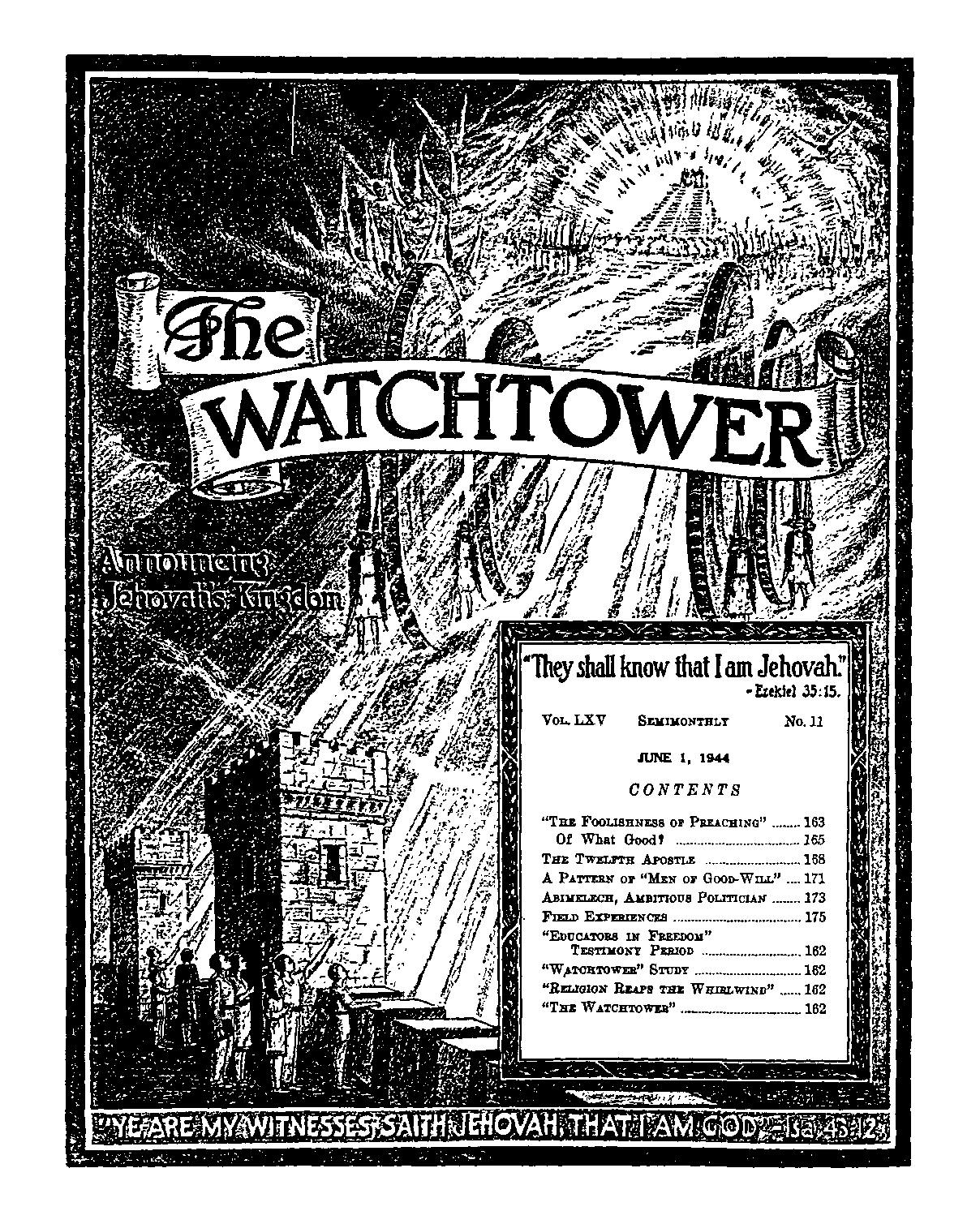
Vol. LXV
June 1, 1944
No. 11
“THE FOOLISHNESS OF PREACHING”
"It pleased God by the foolishness of preaching to save them that believe."—1 Cor. 1:21.
JEHOVAH differs from this world in his ways and methods. Will the postwar “new order” vindicate this world by crowning its ideas and ways with success? or will Jehovah God vindicate himself in the use of his ways and methods? That is the question that each one must settle to decide intelligently between the two.
2 Jehovah’s purpose is written down in his Word in simple terms and is understandable, at least now. His purpose is to vindicate his name as God and as the Supreme Sovereign of the universe. This he will do by setting up a righteous, uncorruptible Government that actually brings life in peace, happiness and prosperity to mankind on earth. The world, by those who take the leading part in its political, commercial and religious affairs, declares that its purpose is to civilize all peoples and to give them permanent peace, economic prosperity, social security, and good government, locally and internationally. On the surface, it would seem that the purposes of this world and of Jehovah God are running parallel with each other, or that they are in fact both one; and that this world is practically carrying out the purpose of God and should therefore have his approval and blessing. However, their purposes are not one, and Jehovah God has nothing in common with this world. That is why His ways and methods differ from the world’s.
3 The government which the world purposes to set up is a human government, a rule by imperfect, sin-spoiled, dying men. Hence it must be and always will be an imperfect government, making many mistakes and failing to give the people full satisfaction. However, the Government by which Jehovah God has purposed to vindicate his name is no mere government of, by or from men or from demons, but is a government from heaven, by perfect creatures with more than human power, wisdom and efficiency. The human government which this world is able to offer must be not only subject to human frailty and the ever-present danger of organized wickedness and power of revolution, but also subject to wicked superhuman powers, evil-minded spirit creatures, Satan and his demons, who do not have man’s interests at heart. The superhuman government which Jehovah establishes must be subject to and responsible to Him, the Almighty God of absolute righteousness and who has the highest everlasting welfare of humankind at heart. This world says its business is to take care of the people’s affairs and government in this life and that God can take care of the people’s matters in “the next life”. So this world presumes to take upon itself the right and authority to rule and govern all peoples and to run their affairs according to the way that pleases it. It resents and objects to any intrusion of Jehovah God into this field of human concern.
1. How does Jehovah differ from the world, and what question must each one settle before deciding between the two?
2. What is Jehovah’s purpose, and that of the world? and why are they not both one and the same?
3. (a) What kind of government is it this world's purpose to set up, and what kind does Jehovah purpose to set up? (b) what does this world presume to take upon itself with respect to man. and why?
4 This world claims to be very wise and to be growing wiser. It lays claim to brains and intelligence, especially in this “modern age” with all the progress it has made in human conveniences and discoveries of science. It claims to have the ability to make progress also in the art and wisdom of government and to be capable of providing men with a stable, satisfying system of global rule. It has its high-sounding philosophy and thousands of institutions of higher learning. It boasts of its free educational system for lifting the level of intelligence of the common people, and it trains its students to govern this world independently of God. In its libraries it has the accumulated knowledge of centuries of human experience. It does not believe that this knowledge is all vain, but that by it man has learned practical wisdom. Such is the wisdom of this world. Following that wisdom, the world fights, bleeds and tortures itself in order to run itself and govern without divine help and without care for the divine will. Thus it is that the world by wisdom of its own has not known God, but leaves Jehovah out of all its calculations and relies upon its own ability and schemes.
4 Why does this world claim to have wisdom? and by reason thereof whom does it not know?
5 Today, after about six thousand years of displaying the wisdom of this world, the peoples and nations are plunging about in a welter of blood, tears, sweat, self-slaughter. Why? The wisdom of this world says that it is in the interest of a “new order”, so that out of this furnace of affliction might come forth a fusion of all nations and peoples together under a global government that will bring permanent peace and order and security to all humankind. The world tries to comfort itself with its wise thoughts that the mountainous cost of this global conflict will not be wasted and that the dead will not have died in vain, but that all future generations shall benefit therefrom. At the present time the world is a sharply divided one. Each side in the conflict for world domination educates its regimented people as to the wisdom of backing up its respective theory of world rule and battling for it. All who are impressed by the glamor of the wisdom of this world and who know nothing of the wisdom of God engage, therefore, in the titanic struggle for world domination. Many do so, no doubt, in all sincerity. To refrain from doing so seems to them the height of folly.
6 In the midst of all the world turmoil there are those who show a different wisdom, the wisdom of God, and who choose to be guided by it, cost whatever it may in this world. If these are wise, what are they doing for the betterment of the world! Nothing; that is, nothing for this world, because it is a doomed world and is beyond bettering and preserving. But as for the groaning people, those who are led by the wisdom of God are doing what results in the real betterment of human creatures, preparing them for everlasting life in a new world of righteousness and peace. But that is not answering the question directly. What, then, are these doing! They are preaching, acting as preachers and ministers of the gospel.
7 These must not be confused with the ministers of organized religion, the clergymen of the many conflicting religious systems. In Germany and Axis- dominated lands the Roman Catholic priests and the clergymen of other religions are backing up the totalitarian dictator and his Nazi clique as against the democratic powers of the world. In other lands, whether belligerent or neutral, the clergymen of all religious systems are engrossing themselves in politics, social reform, and other mundane things, for the preservation of this world. They are showing themselves to be an integral part of this world. They salve their consciences with the self-assurance that their efforts are for the sake of a “better and finer world” created by men’s hands. Arguing that heaven only is the place of perfection, they profess to be realists, practical men, doing something now on this earth for the material benefit of man to improve his social conditions. Thus they expect to make man as comfortable as possible while he lives on this “proving-ground of the earth” before he ‘takes his departure for heaven, where everything to be expected is glorious and golden’.
5. What is the result today of six thousand years of worldly wisdom, bow does the world reassure Itself, and what do the worldly-wise do now?
6. What other wise ones are there on earth, and what are they now doing?
7. With whom are these preachers not to be confused? and what are such ones of the world doing and arguing?
8 That course of the religious priests and clergymen is not the course of the true preachers of the gospel, nor does it show the wisdom of God. It is by works and conduct that a person reveals which is the wisdom of which he is possessed and guided, God’s or this world’s. Contrasting each kind of wisdom, the inspired writer says: “Who is a wise man and endued with knowledge among you? let him shew out of a good conversation his works with meekness of wisdom. But if ye have bitter envying and strife in your hearts, glory not, and lie not against the truth. This wisdom descendeth not from above, but is earthly, sensual, devilish. For where envying and strife is, there is confusion and every evil work. But the wisdom that is from above is first pure, then peaceable, gentle, and easy to be entreated, full of mercy and good fruits, without partiality, and without hypocrisy. And the fruit of righteousness is sown in peace of them that make peace. From whence come wars and fightings among you? come they not hence, even of your lusts that war in your members?” (Jas. 3:13-18; 4:1) The envyings, strife, lying, confusion, evil works, lusts, wars and fightings make manifest that this world and the religionists who follow in its course do not have or exercise the wisdom which is heavenly but do have and exercise that wisdom which is devilish, sensual, earthly. And as long as men, political, commercial and religious, act from the standpoint of the wisdom of this world, the disastrous consequences of such wisdom are bound to befall humankind.
9 Those guided by the wisdom from above cannot go in the way of the religious clergy. They take no part in maintaining or furthering this world, but let it go its way to destruction at the forthcoming battle of Armageddon. In heavenly wisdom they apply themselves to preaching, preaching no religion or worldly philosophies or dreams of a transformed man-made world, but preaching the good news of God’s righteous government established in the hands of his Son Jesus Christ. In wisdom they have severed their connections with religion and the selfish organizations of this world, and have dedicated themselves to the Lord God through faith in Christ Jesus the Redeemer. In view of their vows to God they are under the obligation to do his will. And what is that will? It is to preach the good purposes of Jehovah God, and to do so in the way that his Son set the example. They therefore realize that they have a commission from the Most High God to be preachers of the gospel. Therefore they do not let the world-wise propaganda and slogans and appeals of this world draw or turn them aside from their vocation or calling. Diligently they do this one thing, and that is, to preach.
8. How does a person reveal the wisdom by which he is guided? and what now makes manifest that the world and Its religionists do not exercise the wisdom that is from above?
9. What course of action do those take who are guided by the wisdom from above?
OF WHAT GOOD?
10 The worldly-wise object: What good will preaching do, particularly now, when the earth is rent with strife and millions are dying and human suffering is most intense and there is need of something more practical than just talk? To such worldly-wise ones, preaching seems sheer foolishness and the gospel preachers are impractical fools. The worldly-wise look on them as parasites on human society, barnacles that weigh down the ship of state and slow its progress toward ideal political government, and leeches that suck the blood and vitality of humankind and give nothing practical and of material benefit in return. Then what about Jesus? In the midst of a dying race of mankind did he think it foolishness to preach? One who heard his call to follow him said to Jesus: “Lord, suffer me first to go and bury my father.” What did Jesus say to him? “Let the dead bury their dead: but go thou and preach the kingdom of God.” (Luke 9:59,60) That command of Jesus Christ holds good today. Although this is a time when the dead are being multiplied wholesale, those who show the wisdom of obedience to Christ cannot turn aside from fulfilling their commission to preach. Certainly, no matter what they might otherwise do of a practical kind from the world’s standpoint, it would not keep the people from dying or being made to die prematurely against their wills. What “practical thing”, so called, can restore life to those thus dying? Hence, although the gospel preaching does not seem of practical benefit to humanity, that does not mean it is not of the highest wisdom to preach, and to preach now in the midst of a global upheaval.
11 Not everything that mankind needs is of a material kind. More important is that which has to do with the mind and heart. If man had been supplied with and followed that which is most proper for the mind and heart, the peoples would not be in this terrible international mess of the present. Moreover, not everything that man needs pertains to the present living in the midst of this world. Life now is uncertain and short. Most important is that which has to do with the new world of righteousness where life will be everlasting amid joy, plenty and peace, not in heaven, mind you, but here on earth. “For what is a man profited, if he shall gain the whole world, and lose his own soul? or what shall a man give in exchange for his soul?” (Matt. 16: 26) No question could be more practical than that. If one loses or proves unworthy of the right to life in the new world, what does it profit him how much practical benefit he gains from this present selfish world-organization? His present enjoyment of practical, material things has been futile, vain, eternally. Life in the new world of righteousness will be enjoyed under The Theocratic Government, which Jehovah God sets up for the permanent rule of this earth. To prove worthy of life eternal in the Theocratic world it is necessary for life-seekers to get into harmony with that Righteous Government.
10. With what arguments do the worldly-wise object to the preaching? and what command, of Jesus applies now in this time of great mortality, and why is it wise to obey?
11 . What is that which is of most importance to life-seekers now, and why?
12 The wisdom of this world does not believe in or want that Government. The religious clergy and others who have the wisdom of this world do not tell the people anything in favor of that new world and its Theocratic Government. Therefore if the people of this generation are to gain life and if they are to prepare to live in the righteous Theocratic world they must first hear about it, and to that end someone must preach the true gospel to them.
13 In support of the above, it is written: “For whosoever shall call upon the name of the Lord [Jehovah] shall be saved. How then shall they call on him in whom they have not believed? and how shall they believe in him of whom they have not heard? and how shall they hear without a preacher? And how shall they preach, except they be sent? as it is written, How beautiful are the feet of them that preach the gospel of peace, and bring glad tidings of good things! But they have not all obeyed the gospel. For Esaias saith, Lord [Jehovah], who hath believed our report? So then faith cometh by hearing, and hearing by the word of God.” — Rom. 10:13-17.
14 The doing of practical things in harmony with the wisdom of this world and in order to gain the world’s cheap smile of approval is just to save this world organization. But this world organization cannot be saved by anything done now or in the postwar “new order”. Contrariwise, the preaching of the gospel is unto salvation; no, not salvation of this world, but salvation of all individuals that believe and act upon the gospel they hear. The gospel is not meant to transform or convert this world and its organizations and to save them from destruction at Armageddon.
12. What, therefore, is it necessary for the people first to hear, and why?
13. In support of the above, what does the apostle write to the Christiana in Romans, chapter 10?
14. For what are practical things done In harmony with worldly wisdom, and with what benefit? but unto what is the preaching of the gospel?
15 Completely out of harmony with the gospel message of Jehovah’s Word is the religious magazine which said, last March 15:
“But Christians cannot consent that the law of Christ is inapplicable in the secular order. The Christian faith can never be satisfied to be shoved off into a ‘supra-natural’ corner of the world. The law of Christ must proclaim itself as the true and only natural law by which men and nations must live and under which they are judged. The kingdoms of this world—that is, every corporate center of power, as well as every individual center of power—must become the Kingdom of our Lord and of his Christ.”—The C. C.
To the direct contrary, “every corporate center of power” of this world will be destroyed at the battle of Armageddon. It is the Kingdom of the New World of Righteousness that becomes the Kingdom of our Lord Jehovah and of his Christ, as stated at Revelation 11:15, Revised Version. This kingdom of the new world of righteousness is the central theme which the preachers of the gospel preach.
16 Is anything more practical and wise than preaching now the gospel? No. Instead, what is more foolish than to pursue things of this world and frantically to strive to spare them from destruction at Armageddon? During the final century before the great global flood, which was the more practical and wiser course? That of the people who simply ate, drank, married, bought, and sold? or that of Noah? What did Noah do? Most religionists think of Noah as only a boatbuilder; but the apostle Peter says of him that God “spared not the old world, but saved Noah the eighth person, a preacher of righteousness, bringing in the flood upon the world of the ungodly”. (2 Pet. 2:5) Through Noah’s preaching, seven other persons joined him in the boat. These were the only humans that gained salvation during that world catastrophe. Yet the whole world of the ungodly that then was called Noah a fool, unrealistic and impractical, and scoffed at his preaching. Gospel preaching is more than just talk.
17 Saul of Tarsus, who became Paul the apostle of Christ, was a man learned in this world. He said: “I am a Jew, born at Tarsus in Cilicia, but brought up in this city, educated at the feet of Gamaliel in all the strictness of our ancestral Law.” (Acts 22: 3, Moffatt; also Goodspeed) When Christ Jesus converted Saul to follow in His steps, instead of at his steps as a persecutor, did Jesus instruct Saul to engage in a foolish activity? Yes, in the eyes of the worldly-wise. What Saul (or the apostle Paul) did thenceforth he himself tells when speaking to the elder brethren from Ephesus. Paul said he preached from house to house: "I kept back nothing that was profitable unto you, but have shewed you, and have taught you publicly, and from house to house, testifying both to the Jews, and also to the Greeks, repentance toward God, and faith toward our Lord Jesus Christ.” (Acts 20:20,21) Paul’s course may have seemed still more foolish in that he was mobbed, stoned, beaten, imprisoned and persecuted in all manner of ways for his zealous ministry as a preacher of the gospel from house to house. But Paul was wise.
15. How did a religious magazine recently argue respecting the Christian faith and “every corporate center of power"? and what does the gospel message of Jehovah's Word say to the contrary?
16. Why is nothing more practical and wise than gospel preaching now! and how was this fact demonstrated In Noah's day?
17. Why could a man like Saul of Tarsus not be expected to be deliberately foolish, and how did be become wise and act wisely?
18 In Paul’s day the Greeks were the most intellectual people of the world and boasted of great scientists, philosophers and wise men. Paul was able to speak Greek, but did not follow the Greek philosophy and learning, because that was of the wisdom of this world. Paul took the seemingly foolish course of preaching from house to house because the greatest Preacher of all time, Christ Jesus, set him the example and also instructed him to do so.
19 His commission from Christ to preach, Paul describes, saying: “For Christ sent me ... to preach the gospel: not with wisdom of words, lest the cross of Christ should be made of none effect. For the preaching of the cross is to them that perish [the doomed ones] foolishness; but unto us which are saved it is the power of God. For it is written, I will destroy the wisdom of the wise, and will bring to nothing the understanding of the prudent. Where is the wise [the philosopher]? where is the scribe? where is the disputer [the critic, the reasoner] of this world? hath not God made foolish the wisdom of this world? For after that in the wisdom of God the world by wisdom knew not God, it pleased God by the foolishness of preaching to save them that believe. For the Jews require a sign, and the Greeks seek after wisdom: but we preach Christ crucified, unto the Jews a stumblingblock, and unto the Greeks foolishness; but unto them which are called, both Jews and Greeks, Christ the power of God, and the wisdom of God. Because the foolishness of God is wiser than men; and the weakness of God is stronger than men. For ye see your calling, brethren, how that not many wise men after the flesh, not many mighty, not many noble, are called: but God hath chosen the foolish things of the world to confound the wise.”—1 Cor. 1:17-27.
18 . What language besides Hebrew did Paul speak, and why did be not follow the philosophy and learning written in that language?
19 . Who sent Paul to preach, what did be preach, and how did the worldly wise of both Jews and Greeks respond or react thereto?
20 Such ones, whom the world calls foolish, weak, base, despised and of nought, are the ones Jehovah calls to be his preachers, in order “by the foolishness of preaching to save them that believe”. He thus arranges it in order that the preacher may not glory in himself and also that no other creature should glory in the preacher by whom he hears the gospel preached. (1 Cor. 1:29-31) The preacher is not the thing that counts. The message which he has been commissioned to preach is what counts and is what works to salvation, if believed. Those who desire wisdom that is from above will not despise the preacher because he seems to be foolish, weak, lowly, despised, persecuted and not of much account from a worldly standpoint, and because he goes preaching from house to house or by offering literature publicly on street corners. Instead, the meek ones will respect Jehovah, who has commissioned such preacher and in whose name the preacher comes, and they will attach importance to the message he brings by word of mouth and by printed word.
21 Those who are worldly-wise will look at the creature preaching, and then not listen to what he preaches. Religionists, like the Jews who asked Jesus for a sign from heaven, will ask for a sign. They will ask for some certificate or diploma or some title like D.D. or P.P. (pater patrum) or a collar and vest buttoned at the back and a black frock coat if Jehovah’s witnesses are to prove to them to be ministers of the gospel. But Jesus refused to give any sign. Likewise Jehovah’s witnesses give no outward, spectacular sign, but point to their commission to preach as recorded on the pages of the Bible, at Isaiah 61:1,2; 43:10-12; Matthew 24:14; Revelation 22:17; and elsewhere.—Luke 11:16; Matt. 12:38, 39; 16:1.
22 The learned politicians and commercial men. who cry for “more religion”, act like the Greeks of old and “seek after wisdom”, high education in the things of this world. They and their clergy allies poke scorn at Jehovah’s witnesses because these do not show off the wisdom of this world but are the class of Christians whom Paul says God has chosen to call into His service. Jehovah’s witnesses are, many of them, like Peter and John, who boldly preached before the learned Jewish Supreme Court: “now when they saw the boldness of Peter and John, and perceived that they were unlearned and ignorant men [uneducated men with no advantages (Goodspeed) ; uncultured persons and mere outsiders (Moffatt)], they marvelled; and they took knowledge of them, that they had been with Jesus.” (Acts 4:13) The apostle Paul was no uneducated man, and yet he refused to please the Greeks by a display of worldly wisdom. He spoke and wrote in the conversational Greek of the common people instead of the classical Greek. Says Paul: “And I, brethren, when I came to you, came not with excellency of speech or of wisdom, declaring unto you the testimony of God. . . . my speech and my preaching was not with enticing words of man’s wisdom, but in demonstration of the spirit and of power: that your faith should not stand in the wisdom of men, but in the power of God.”—1 Cor. 2:1-5.
20. (a) To do what does God call such ones, and why them? (b) How will the meek treat such ones in their work, and why so?
21. How will the worldly-wise act like the Jews of old toward such ones? and how must these preachers respond?
22. How do the learned of this world deal with Jehovah's witnesses, and with what surprise to themselves? and how did Paul refuse to please the Greeks on this issue?
23 Paul warned against the religious clergymen and other worldly-wise men, saying: “Beware lest any man spoil you through philosophy and vain deceit, after the tradition of men, after the rudiments of the world, and not after Christ.” (Col. 2:8) At the battle of Armageddon, not far distant, Jehovah God will destroy all ‘the wisdom of the wise’ which they will have demonstrated in the postwar “new order”. He will bring to nothing all ‘the understanding of the prudent’ who made predictions of what politics, commerce and religion could do to create a better and finer world for the common man. No such wisdom of the world will save them when the “battle of that great day of God Almighty” strikes. The only thing now being done that will lead to salvation and survival through that battle and unto life in the new world of righteousness is the thing which this world calls “the foolishness of preaching”. That is what Jehovah’s witnesses are doing, because they realize their commission from Him and they know what their commission requires of them.
24 Jehovah’s witnesses are not ashamed to preach because the world calls it “foolishness”. Instead of being worldly-wise, they have become ‘fools’ by taking up preaching, that they may be wise. “For the wisdom of this world is foolishness with God. For it is written, He taketh the wise in their own craftiness. And again, The Lord knoweth the thoughts of the wise, that they are vain.” (1 Cor. 3:18-20) Jehovah’s preachers know the value of their work, and they will keep on preaching the gospel, without stopping, until the final end of this world and of its wisdom comes at the battle of Armageddon. (Matt. 24:14) They rejoice, because they are now privileged to preach, not merely “Christ and him crucified”, as did Paul, but now Christ and him enthroned as Jehovah’s King of the new world.
23. (a) What warning did the apostle Paul write against the religious clergy and the worldly-wise men? (b) Why will the wisdom and understanding of the worldly-wise fall to save them at Armageddon' and what is now being done, and by whom, that will lead to survival then?
24. (a) How have Jehovah's witnesses become fools and yet shown wisdom? (b) Up until what point will they keep on in this course, and why do they now specially rejoice in their work?
THE TWELFTH APOSTLE
"APOSTLE” means, literally, “sent-forth one” or “envoy”. On the night when he was betrayed by one of his apostles Jesus Christ said: “Verily, verily, I say unto you. The servant is not greater than his lord; neither he that is sent greater than he that sent him.” These words of Jesus, at John 13:16, are rendered by The Emphatic Diaglott translation thus: “Indeed, I assure you, a servant is not greater than his lord, nor an apostle greater than he who sent him.” In the original Bible text the one word translated “he that is sent” is apostolos, meaning apostle.
The word occurs again at Philippians 2: 25, which reads: “Yet I supposed it necessary to send to you Epaphroditus, my brother, and companion in labour, and fellowsoldier, but your messenger, and he that ministered to my wants.” Instead of “your messenger”, The Emphatic Diaglott renders it “your apostle”. At Acts 14:4, 14 the title “apostle” is applied to Paul’s companion Barnabas; as it is written: “But the multitude of the city was divided: and part held with the Jews, and part with the apostles.” “Which when the apostles, Barnabas and Paul, heard of, they rent their clothes, and ran in among the people, crying out.” Barnabas and Paul were then apostles with relation to the church at Antioch in Syria, which church, under instructions of God’s holy spirit, sent them forth on missionary work. They were the “sent forth ones” of that church and were responsible to report to that congregation.—Acts 13:1-4.
The use of the term apostle with respect to Barnabas and Epaphroditus is not to be understood to mean they were members of the twelve apostles of Christ Jesus. Neither does it mean that there were more than twelve apostles specially chosen of him and having special relationship to him. The expression “twelve apostles” occurs only three times in all the Scriptures, namely, at Matthew 10:2; Luke 22:14, and Revelation 21:14. The expression “twelve disciples” occurs at Matthew 10:1; 11:1; 20:17; and Luke 9:1. “Disciple” means “learner”; and out of all of Jesus’ many disciples these designated “twelve disciples” correspond with the twelve apostles. After the death and resurrection of Jesus, and before his ascending to heaven, “eleven apostles” and “eleven disciples” are spoken of, at Matthew 28:16 and Acts 1:26. This is because one of the twelve proved unfaithful and dropped out as a traitor to his Master, namely, Judas Iscariot. In the list of names of the twelve disciples or apostles this Judas is named twelfth and last. (Matt. 10:1-4; Luke 6:13-16; Mark 3:14-19) The question therefore arises, Who took Judas Iscariot’s place and became the twelfth apostle?
In the consideration of this question Paul, the former Saul of Tarsus, may not be left out of account. Who was more a minister of Christ Jesus than he! At the very start of his ministry, immediately after his marvelous conversion to Christianity and without first a trip to Jerusalem to confer with the eleven certified apostles, “straightway he preached Christ in the synagogues, that he is the Son of God. . . . And after that many days were fulfilled, the Jews took counsel to kill him: but their laying await was known to Saul,” and he eluded their grasp. (Acts 9:20-25) In the strenuous career that followed as a witness of Jehovah, the apostle Paul suffered much harassment and persecution. These things came upon him at the hands of the Jewish religionists in particular, despite the fact that, as Paul testified, “they neither found me in the temple disputing with any man, neither raising up the people, neither in the synagogues, nor in the city.” (Acts 24:12) Yet, ask the apostle what he thought of this service to which he was commissioned and which entailed all such abuse and mistreatment upon him, and in reply he calls it a treasure, “this treasure in earthen vessels.”
That is why Paul clung to the ministry and ever engaged in it. He cared not that it involved him “in labours more abundant, in stripes above measure, in prisons more frequent, in deaths oft. Of the Jews five times received I forty stripes save one. Thrice was I beaten with rods, once was I stoned, thrice I suffered shipwreck, a night and a day I have been in the deep; in journeyings often, in perils of waters, in perils of robbers, in perils by mine own countrymen, in perils by the heathen, in perils in the city, in perils in the wilderness, in perils in the sea, in perils among false brethren; in weariness and painfulness, in watchings often, in hunger and thirst, in fastings often, in cold and nakedness. Beside those things that are without, that which cometh upon me daily, the care of all the churches.”—2 Cor. 4:7; 11: 23-28.
APOSTLESHIP DISPUTED
That Paul was appointed or “ordained” to be an apostle of Jesus Christ there can be no question. On the night of the betrayal and arrest, Jesus said to his eleven apostles that remained faithful: “Ye have not chosen me, but I have chosen you, and ordained you.” (John 15:16) What now can be said of Paul! Concerning him the same Jesus said to the faithful Ananias: “Go thy way: for he is a chosen vessel unto me, to bear my name before the Gentiles, and kings, and the children of Israel: for I will shew him how great things he must suffer for my name’s sake.” (Acts 9:15, 16) Thus Paul, too, was directly chosen and ordained of Christ Jesus.
In the Revelation, which the glorified Jesus gave to the apostle John, the Lord showed him the twelve foundations of God’s capital organization, “New Jerusalem,” and John says: “And the wall of the city had twelve foundations, and in them the names of the twelve apostles of the Lamb. And [the city] had a wall great and high, and had twelve gates, and at the gates twelve angels, and names written thereon, which are the names of the twelve tribes of the children of Israel.” (Rev. 21:14, 12) The twelve apostolic foundations served as bases to the twelve tribes of spiritual Israelites, “the Israel of God.” Beyond all doubt Paul’s was among those names of the “twelve apostles of the Lamb”, the Lamb being Christ Jesus, “the Lamb of God, which taketh away the sin of the world.” Paul’s name took the place which Judas Iscariot’s name might have had. But the religionists who claim that Peter was the first pope and the prince of the apostles will ask: What about Matthias, who was chosen by lot at the instance of the apostle Peter?
To this question the infallible Scriptures answer: Jesus did not choose his twelve apostles by casting lots; but afterprayer and under Jehovah God’s guidance Jesus made direct choice of them. Mark, the companion of Peter, says of Jesus: “He ordained twelve, that they should be with him, and that he might send them forth to preach.” (Mark 3:14-19; Luke 6:12-16) This was not so in the case of Matthias. It was before the day of Pentecost and before the outpouring of the holy spirit upon the faithful disciples, and hence it was not under the guidance of the holy spirit or comforter that the 120 brethren at Jerusalem chose Matthias by the casting of lots. In doing so, they took action in advance of the Lord Jesus Christ and without any instruction from him. Hence, in the Holy Scriptures no mention is made of Matthias as being one of the “twelve apostles of the Lamb”. The expression "twelve apostles” is not found in the book of Acts of the Apostles. True, the record at Acts 1: 26 says: “And they gave forth their lots; and the lot fell upon Matthias; and he was numbered with the eleven apostles”; but it does not say that Matthias was numbered as an apostle of Jesus Christ. Furthermore, Acts 6:2 says: “Then the twelve called the multitude of the disciples unto them, and said, It is not reason that we should leave the word of God, and serve tables,” but the record of that verse does not mention “twelve apostles”.
What, then, does the use of the expression “the twelve” mean, if not “twelve apostles”? This: Matthias, who was linked up with the “eleven apostles”, was a member of a committee of twelve special servants in the congregation at Jerusalem, but he was not one of the “twelve apostles of the Lamb”. “And God hath set some in the church, first apostles, secondarily prophets, . . . Are all apostles? are all prophets? ... do all interpret?”—1 Cor. 12:28-30.
What of Paul’s own statement at 1 Corinthians 15: 3-9? It reads: “Christ died for our sins according to the scriptures; and that he was buried, and that he rose again the third day according to the scriptures: and that he was seen of Cephas [Peter], then of the twelve: after that, he was seen of above five hundred brethren at once; of whom the greater part remain unto this present, but some are fallen asleep. After that, he was seen of James; then of all the apostles. And last of all he was seen of me also, as of one born out of due time. For I am the least of the apostles, that am not meet to be called an apostle, because I persecuted the church of God.” But again it is noted that Paul himself does not use the number “twelve” and the term “apostles” together with each other. His careful choice of language under inspiration serves to show that, out of the twelve who served together in the early church at Jerusalem, only eleven constituted “all the apostles” there; and thereafter Christ Jesus made direct choice of Paul himself by a personal appearance to him and a straight call to him for service. Thereby Paul became the twelfth or "least of the apostles”.
It would be contrary to Revelation 21:14 to argue that there were thirteen apostles of the Lamb. It would be contrary to the typical picture provided in the twelve sons of Jacob who were the foundation members of the twelve tribes of natural Israel. The twelve tribes of spiritual Israel are counterparts of those twelve tribal groups of “Israel after the flesh”. Hence there are fitly just twelve foundations to spiritual Israel, the twelve apostles resting on the Chief Foundation Christ Jesus. Whereas, after the choice of Matthias by lot ho personal mention is made of him in the early church, there was none that excelled Paul in building up the early Christians and in serving as an instrument of God to lay down the foundation truths of belief in Christ. — Acts 7:8; 1 Cor. 10:18; 1 Pet. 2:9; Gal. 6:15,16; Rom. 2:29; Rev. 7:4-8; 21:12-14; Eph. 2:20.
It must have been because Paul was the twelfth apostle, specifically chosen by Christ, that he could write concerning himself: “Paul, a servant of Jesus Christ, called to be an apostle, separated unto the gospel of God”; and, “Paul, an apostle, (not of men, neither by man, but by Jesus Christ, and God the Father”; and, “Paul, an apostle of Jesus Christ by the will of God”; and, “Paul, an apostle of Jesus Christ, by the commandment of God our Saviour, and Lord Jesus Christ”; and, "Paul, a servant of God, and an apostle of Jesus Christ.”—1 Cor. 1:1; 2 Cor. 1:1; Rom. 1:1; Gal. 1:1; Eph. 1:1; Col. 1:1; 1 Tim. 1:1; 2 Tim. 1:1, 11; Titus 1:1; 1 Tim. 2:7.
Nevertheless, Paul’s apostleship was disputed by some. It was necessary for him to declare frequently his appointment from the Lord and to point to the obligations that his commission laid upon him. Paul challenged his disputants, saying: “Am I not an apostle? am I not free? have I not seen Jesus Christ our Lord? are not ye my work in the Lord? If I be not an apostle unto others, yet doubtless I am to you: for the seal of mine apostleship are ye in the Lord.” (1 Cor. 9:1, 2) Evidently, one of the tests of being an apostle of the Lamb was to have seen the Lord Jesus Christ after his resurrection. Hence in this same epistle Paul repeats: “And last of all he was seen of me also, as of one born out of due time. For I am the least of the apostles, that am not meet to be called an apostle, because I persecuted the church of God. But by the grace of God I am what I am: and his grace which was bestowed upon me was not in vain; but I laboured more abundantly than they all: yet not I, but the grace of God which was with me.”—1 Cor. 15:8-10.
In a second epistle to the Corinthians Paul writes: “For I suppose I was not a whit behind the very chiefest apostles. But though I be rude in speech, yet not in knowledge; but we have been throughly made manifest among you in all things.” “I ought to have been commended of you: for in nothing am I behind the very chiefest apostles, though I be nothing. Truly the signs of an apostle were wrought among you in all patience, in signs, and wonders, and mighty deeds.” (2 Cor. 11:5, 6; 12:11, 12) To the church at Rome Paul further wrote: “For I speak to you Gentiles, inasmuch as I am the apostle of the Gentiles, I magnify mine office: if by any means I may provoke to emulation them which are my flesh, and might save some of them.” (Rom. 11:13) The Gentiles who believed on Christ Jesus and who consecrated themselves to God and were accepted of Him became members of the twelve tribes of spiritual Israel.
No one will argue that Matthias was one of the ‘very chiefest of the apostles’. Hence if Paul was not a whit behind the chiefest, that would cause Matthias to be left out as one of the Lamb's twelve apostles. Such fact, however, does not argue that Matthias was not a faithful follower of Christ Jesus and a zealous devoted servant of him. There is nothing to indicate that Peter infallibly applied his quotation of Psalm 109:8, “Let another take his office,” to Matthias. (Acts 1:20) It was proper to quote the scripture to show that Psalm 109 would be fulfilled; but it could not be correctly applied to any individual until after it was fulfilled. All the facts point to Paul as the one taking up the position vacated by Judas Iscariot. Both Judas and Saul of Tarsus persecuted Jesus, but Judas died an unfaithful outcast, whereas Saul was converted from his course and became the apostle Paul.
The situation back there in the first century after Christ manifestly presented a difficulty. It finds an interesting parallel in this twentieth century. The undisputed facts show that the Jewish clergy of priests, Levites, scribes, Pharisees and Sadducees did not recognize the ordination or apostleship of Paul and his fellow apostles. When Peter was going to places as far distant as Babylon, which was then in Parthia outside of the Roman Empire, the apostle Paul was active in performing his Christian commission in the territories of the Roman Empire. But not only Jewish religionists, but also Roman officialdom, refused to recognize the Christian ordination of Paul or that of his companions; they could not even comprehend it. (Acts 26:24-28) Also among those who professed to be Christians Paul had to contend earnestly for his service privileges and responsibilities. As an apostle of Jesus Christ, Paul was a witness of Jehovah God, according to his own testimony before the Roman Court, when he said: “Having therefore obtained help of God [Jehovah], I continue unto this day, witnessing both to small and great, saying none other things than those which the prophets and Moses did say should come: that Christ should suffer, and that he should be the first that should rise from the dead, and should shew light unto the people, and to the Gentiles.” At such testimony Governor Festus called Paul mad. —Acts 26:22-24; Luke 4:22, 28, 29.
Jesus forewarned his disciples that they would be cast out of synagogues and even be killed. His forewarning was meant to cover the entire period of the “Christian era”, including this “end of the world”. The casting out was to be not only from Jewish synagogues but also from the religious organizations of all those who think they are doing God’s service. (John 16:1-4; Mark 13:8-10) The word “synagogue” means a “gathering” or “meeting-place”. It applies to congregations of other religionists besides Jews. As to this the prophet Isaiah said: “Hear the word of Jehovah, ye that tremble at his word: Your brethren that hate you, that east you out for my name’s sake, have said, Let Jehovah be glorified, that we may see your joy; but it is they that shall be put to shame.”—Isa. 66:5, Am. Stan. Ver.
Such predictions prove that the clergy of religious organizations would dispute the divine ordination of the present-day witnesses of Jehovah. “The Faithful and True Witness” of Jehovah God is Christ Jesus, the Son of God, and his own ordination was disputed by the religionists. “When he was come into the temple, the chief priests and the elders of the people came unto him as he was teaching, and said, By what authority doest thou these things? And who gave thee this authority!” (Rev. 3:14; Matt. 21: 23) Not strange, then, that the religionists today decry the commission from God of all genuine followers of Jesus Christ, because the servant is not greater than his Lord. (Matt. 10:25) Paul’s commission and qualifications were disputed in his time. Likewise at this end of the world it could not be otherwise than that the commission of Jehovah’s witnesses, though perfectly Scriptural and valid from God, should be scoffed at and disputed by all the religionists of Jewry and “Christendom”. Hence it is that their being ministers of the gospel of God’s kingdom by Christ Jesus is denied and ignored by religionists.
At the same time that the strongest religious organization of “Christendom” denies the ordination of Jehovah’s witnesses in these days, it contends earnestly that its bishops are the successors of the apostles, and that the bishop of Rome is the successor of Peter himself. It therefore contends that it is the apostolic church. Chapter VII of the book The Faith of Our Fathers, by Cardinal Gibbons, says: “That the Church was infallible in the Apostolic Age is denied by no Christian. We never question the truth of the Apostle’s declarations; they were, in fact, the only authority in the Church for the first century. . . . There is no just ground for denying to the Apostolic teachers of the nineteenth century in which we live a prerogative clearly possessed by those of the first, especially as the Divine Word nowhere intimates that this unerring guidance was to die with the Apostles. On the contrary, as the Apostles transmitted to their successors their power to preach, to baptize, to ordain, to confirm, etc., they must also have handed down to them the no less essential gift of infallibility.”
A faithful examination of the inspired and infallible Scriptures shows the cardinal to be guilty of false reasoning. Also the history of his religious system and the teachings and pronouncements of its religious heads belie the cardinal’s wishful thinking. The sacred Scriptures nowhere mention successors to the apostles, nor even hint such a thing, but rather they teach against such a thing. When the apostle James was killed by King Herod, the book of Acts of the Apostles shows, no meeting was held of the surviving apostles to appoint a successor to James, because James had never vacated his apostleship, but finished it faithfully. (Acts 12:1-5) Certainly the so-called “successors" are not infallible in assuming the title “father”, for Jesus plainly told his true apostles: “Call no man your father upon the earth: for one is your Father, which is in heaven.” (Matt. 23:9) There is no Bible record that the faithful apostles called Jesus "Father”, nor did they violate Jesus’ commandment with respect to calling themselves “fathers”, or anybody else in the church by that name. At 2 Peter 3:15, the apostle Peter speaks of “our beloved brother Paul”, but not of “Father Paul”. Jesus’ apostles addressed their younger brethren in the truth in terms of affection, such as son or children, but they did not demand to be addressed by them as “father”. There is no scripture, either, that shows the Christians addressed the apostles or any others in the church as “fathers”. —1 Cor. 4:14, 15; 1 Tim. 1:1; Titus 1:4; 1 John 2:1, 12, 18, 28; 5:21; John 21:5.
Going beyond that, the religionist who claims to be the successor of the apostle Peter takes to himself the title of “father of fathers”, that is, papa, which the Roman religionists explain to mean pater patrum.. To this he adds to himself, as his predecessors have done, the titles: “Holy Father, His Holiness, Principal of the Apostles, the true Vicar of Christ, The Head of the whole church, the Father and Doctor of all Christians.” Paul, a true apostle, writes: “Wherefore, holy brethren, partakers of the heavenly calling, consider the Apostle and High Priest [Apostolus et Pontifex (Latin Vulgate)] of our profession, Christ Jesus.” (Heb. 3:1) But the self-styled “vicar of Christ” goes one better than Jesus himself and takes the title Pontifex Maximus. This Latin title is of no other than demon origin. According to Roman tradition, the pagan pontiffs were instituted by Numa, the second king of Rome (715-672 B. C.), and to him the origin of nearly all the religious institutions of pagan Rome is ascribed. Pontifex means bridge-builder or way-maker, and it has a source different from that of sacerdos, which Latin word means priest. During the Roman Empire the functions of Pontifex Maximus were discharged by the pagan Roman emperors. In A. D. 325 Emperor Constantine assumed the title. Gratian, the emperor from 373 to 383, was the last to bear the title. He refused to wear the insignia of Pontifex Maximus as unbefitting a Christian. But the pope promptly nabbed up such title of pagan origin.
Even in the Latin Vulgate Bible the term Pontifex Maximus is not found. In translating the Bible from the original Hebrew and Greek into Latin, Jerome translated “high priest” as summus sacerdos or princeps sacerdotum, except when translating Paul’s letter to the Hebrews. In that book, when “high priest” applied to Jesus, Jerome translated it by another Latin term, not pontifex maximus, but simply pontifex. At Hebrews 4:14, where the Greek text has “great high priest”, meaning Jesus, Jerome translated it merely pontifex magnus. Maximus is the superlative of magnus. There was no reason, however, for Jerome to change from summus sacerdos to pontifex, because in the original Greek there was no change to a different word for “priest”. At any rate, inasmuch as the disciple is not above his blaster, it is certainly not infallibly apostolic for a professed disciple of the Master to assume the title “Pontifex Maximus”, whereas the blaster is called only magnus.
In his own day Paul had to contend for his right to the position and responsibilities of an apostle of Jesus Christ. Not out of chagrin over that fact, but as a warning to Christians he wrote concerning deceivers: “For such are false apostles, deceitful workers, transforming themselves into the apostles of Christ. And no marvel, for Satan himself is transformed into an angel of light Therefore it is no great thing if his ministers also be transformed as the ministers of righteousness; whose end shall be according to their works.”—2 Cor. 11.13-15.
A PATTERN OF “MEN OF GOOD-WILL”
THE Bible is the Word of God, which he has provided for the instruction of the meek in the way of righteousness; and this God does that the man of God may be fully equipped for His service. Hence the man of good-will recognizes the Bible as the Word of Almighty God, and he accepts it as his true and proper guide. (2 Tim. 3:16, 17) “Thy word is a lamp unto my feet, and a light unto my path.”—Ps. 119:105.
God in ancient times used men and inanimate things to make patterns, types, models, and pictures by which to teach the meek and guide them in the way they should go The sacred Scriptures set out such patterns specifically for the aid of those who desire to learn For more than sixteen centuries God dealt with the twelve tribes of Israel, and with that people he caused things to come to pass by which he made types or patterns for the guidance of the people now on the earth. It is written: “Now all these things happened unto them for ensamples: and they are written for our admonition, upon whom the ends of the world are come.”—1 Cor. 10:11.
It is therefore seen that such “ensamples”, otherwise called “types” (marginal reading), are to be understood by those people on the earth at the end of the world. Now we have come to that time, and those who seek to know will learn. There would have been no purpose in making these types unless they were to be understood at some time; and now is the proper time. A type is an image or representation of something that comes to pass in some future time. An antitype is the reality of the thing of which the type is a representation. The type may properly be called a “shadow”; the antitype, the “reality”.
The type is also a pattern that serves as a guide by which others work. For instance, it is recorded concerning the men who served in the priesthood of the Israelites: “Who serve unto the example and shadow of heavenly things, as Moses was admonished of God when he was about to make the tabernacle: for, See, saith he, that thou make all things according to the pattern shewed to thee in the mount.” (Heb. 8:5; Ex. 25:40) Another instance is that case wherein Jesus is called “the Lamb of God, which taketh away the sin of the world”. The passover lamb killed as a sacrifice by the priests at Jerusalem was a type of the Lord Jesus.—Ex. 12:1-29; 2 Chron. 30:15-17.
The word pattern may properly be applied to anything designed to serve as a guide by which men are taught to walk in the right way. The tabernacle was built in the wilderness by Moses, according to the pattern which God revealed to him when he was in the mountain. God said: “Let them make me a sanctuary; that I may dwell among them. According to all that I shew thee, after the pattern of the tabernacle, and the pattern of all the instruments thereof, even so shall ye make it.”—Ex. 25:8, 9.
In times past God used animate and inanimate things, by which he made prophetic pictures or dramas. Thereby he disclosed in symbol his means to gather his “other sheep” of good-will and who shall receive the salvation that gives them life everlasting on earth to serve God and his King. Many persons regard that part of the Bible which has long been called “The Old Testament” as merely historical statements of the events that came to pass long ago. In this they greatly err. Whatsoever things have been recorded in the Holy Scriptures are for the aid of those who are devoted to Jehovah God, that they may learn the right way and thereby be comforted and receive a full assurance of God’s purpose to grant them salvation, with his attending blessings in abundance. (Rom. 15:4) The Bible is a great treasure house of truth; and happy is the man who gains a knowledge and understanding of it. To aid persons of good-will toward God our attention is now directed to a pattern, drama or prophetic picture recorded in the Bible long ago, namely, that of Jonadab.
God created the earth for man, and he created man to live upon the earth, and to enjoy the earth and the fullness thereof. By the permission of the Almighty God perfect man shall, in due time, enjoy that great favor and blessing. (Isa. 45:12, 18; Ps. 24:1) Those who will escape the terrible tribulation and destruction of Armageddon and who thereafter have the blessings from the Lord on the earth, will constitute the “great multitude” described at Revelation 7:9-17, and they constitute the Lord’s “other sheep”.
The Bible makes mention of a man whose name was Jehonadab, also called Jonadab; and the Lord’s “other sheep” are at times spoken of as “Jonadabs”. Of old the Israelites, or Jews, were God’s covenant people, and he dealt with them as such to the exclusion of other peoples, and that over a period of sixteen centuries. (Amos 3:2) Jonadab was a son of Rechab, the Kenite, the descendant of the patriarch Abraham through his concubine Keturah. (1 Chron. 1:32, 33 ; 2: 55) The name Jonadab means “Jehovah is bounteous”, evidently referring to the fact that Jehovah showed great favor towards Jonadab because he believed on God and refused to be drawn into the Devil’s trap. While the many nations of the earth practiced the Devil religion the descendants of Rechab, including Jonadab, refused to have anything at all to do with religion. (Ex. 3:1; Judg. 1:16; 4:11; 5:24) They were positively and unalterably against Baalism or devil-worship, the religion practiced by the Gentile nations, and into which great trap or snare of religion the Israelites fell.
The descendants of Jonadab were known as “the house of the Rechabites”. They were an honest and sincere people who stood always for what is right and refused to compromise with wrongdoers. When they made an agreement, they faithfully performed it. They kept their word. God spoke to his prophet Jeremiah, highly commending the “house of the Rechabites” because of their sincerity, honesty and faithfulness in keeping an agreement which they had made. “And Jeremiah said unto the house of the Rechabites, Thus saith the Lord of hosts, the God of Israel; Because ye have obeyed the commandment of Jonadab your father, and kept all his precepts, and done according unto all that he hath commanded you: therefore thus saith the Lord of hosts, the God of Israel; Jonadab the son of Rechab shall not want a man to stand before me for ever.” —Jer. 35:18, 19.
The Rechabites were men of good-will toward Jehovah God, and they loved righteousness, and therefore God used them as a pattern or picture of the people of good-will who now learn of Jehovah’s provision for mankind, and who love righteousness, and who show their love for God when they come to know him.
God commanded the prophet Elisha to anoint Jehu to perform a work specifically among the Israelites for the vindication of Jehovah’s name. Jehu was a captain in the Israelite army during the reign of Ahab, king of the ten tribes of Israel, and his wicked wife Jezebel, who practiced the Devil religion known as Baalism, and which religion pictured the modern-day religion and religious systems commonly called “Christendom” or “the Christian religion”. Jehu in the performance of his duty and commission pictured Christ Jesus, the great Executioner and Vindicator of Jehovah’s name. As a picture Jehu also included the faithful followers of Christ Jesus, particularly the remnant thereof from and after A. D. 1919.
…