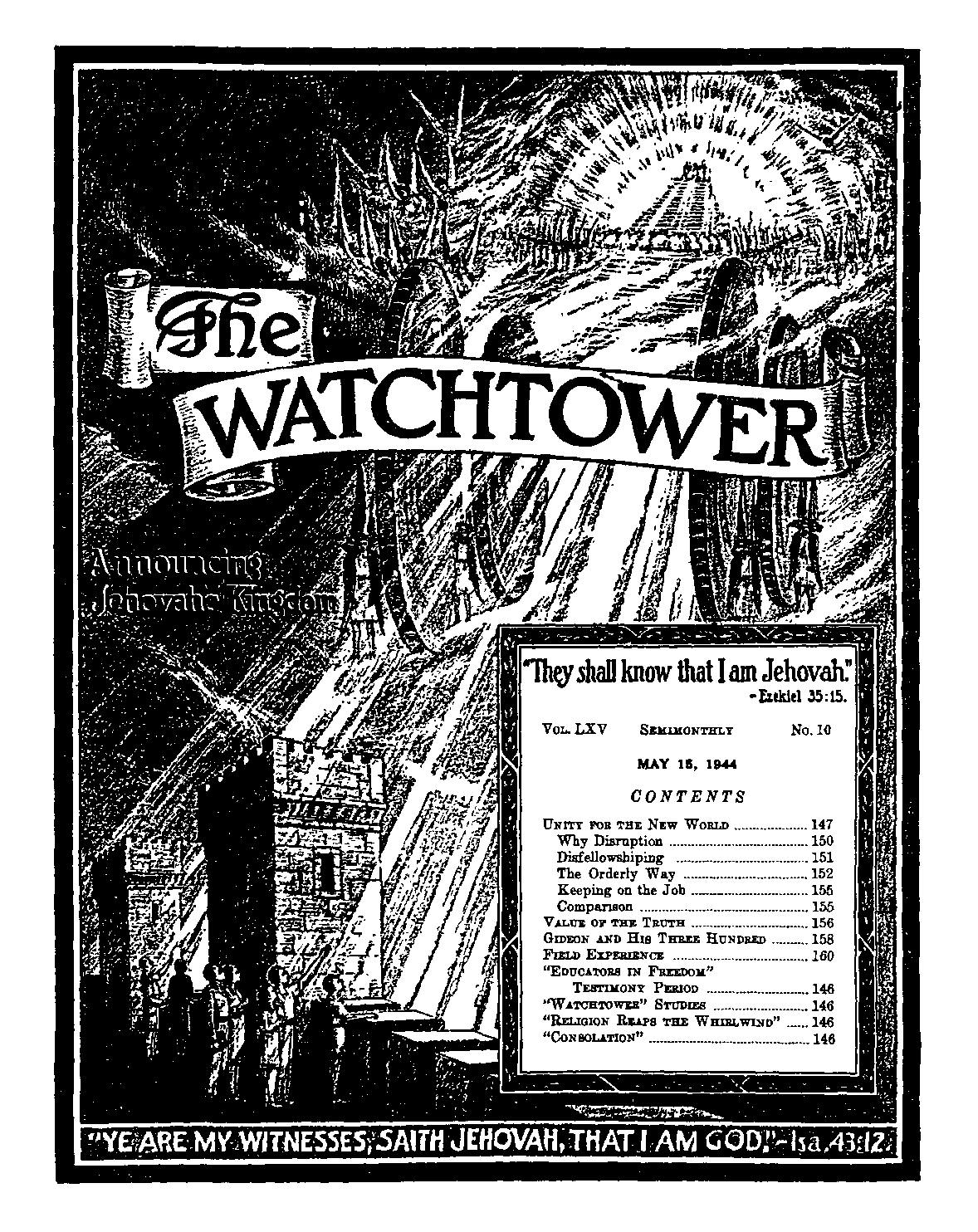
The Watchtower, May 15, 1944
Download: PDF — The Watchtower, May 15, 1944
“EDUCATORS IN FREEDOM” TESTIMONY PERIOD
Appropriate to the name of the June Testimony Period as above given, a new educational feature is being released then for initial introduction to the general public, namely, the booklet Religion Reaps the Whirlwind. This will go well with the bound book “The Truth Shall Make You Free” and the booklet The Coming World Regeneration, the three being offered in combination on a contribution of 30c. Otherwise, the bound book and a selfcovered booklet, The Coming World Regeneration, will be offered together on a 25c contribution, and the new 64-page colored-cover booklet alone on a 5c contribution. Preliminary arrangements are essential in order for each one to join in getting the Testimony Period off to an effective start. Those desiring to share in this educational campaign by means of circulating the printed message are invited to get in touch with us for instructions and references. A report is asked of all educators at the close of June on all their individual activities and the results.
“WATCHTOWER” STUDIES
Week of June 25: “Unity for the New World,” 1-13 inclusive, The Watchtower May 15, 1944.
Week of July 2: “Unity for the New World,” 14-28 inclusive, The Watchtower May 15, 1944. Week of July 9: “Unity for the New World,” 29-43 inclusive, The Watchtower May 15, 1944.
“RELIGION REAPS THE WHIRLWIND”
Here is a new booklet for which we predict a good future in the “strange work” of striking the shackles of religious bondage from multitudes of prisoners of “Christendom”. Its 64 pages put under the Scripture searchlight the fundamental doctrines of “organized religion” and show religion’s responsibility for the present world conditions and the certain fate that awaits it in a near day. This booklet has a special three-color cover with a unique expression of the artist’s conception of the title. Religion Reaps the Whirlwind is due for release for public distribution June 1, and you may now get your advance personal copy and read it in preparation for the general distribution, at 5c the copy, postpaid.
“CONSOLATION”
Do you find enlightenment and joy in reading The Watchtower? Then you are certain to find enjoyment and profit in reading its companion magazine, Consolation, put out by the same publishers. With many thousands Consolation serves a vital and important need in building them up in faith, hope and courage in these days of spreading infidelity, hopelessness and fear, and thus brings its readers solid comfort. It does not, of course, take the place of The Watchtower, which is devoted exclusively to Bible study and instruction. Consolation actually complements (Continued on page 160)
Vol. LXV
May 15, 1944
No. 10
UNITY FOR THE NEW WORLD
"Behold, how good and how pleasant it is for brethren to dwell together in unity!"—Ps. 133:1.
JEHOVAH has as His purpose to create a united world. The time is upon us for Him to do so. J It will be one New World. Both heaven and earth will have to be in tune with each other for it to be such, because it takes both to make a world. A man having greater vision and deeper insight than any politician and planner for the postwar “new order” on earth has written to those who understand Jehovah’s purpose, saying: “Nevertheless we, according to his promise, look for new heavens and a new earth, wherein dwelleth righteousness.” In view of such a prospect, what? This: “Wherefore, beloved, seeing that ye look for such things, be diligent that ye may be found of him in peace, without spot, and blameless.” It is therefore the time to be on guard against the pet theories and fancy notions of “new order” schemers. It is the time to be steadfast for the New World according to God’s pattern and purpose. “Ye therefore, beloved, seeing ye know these things before, beware lest ye also, being led away with the error of the wicked, fall from your own stedfastness. But grow in grace, and in the knowledge of our Lord and Saviour Jesus Christ. To him be glory both now and for ever.” — Quoted from 2 Peter 3:13,14,17,18.
2 For there to be a unified New World there must be one ruler over all humankind, and that one himself in perfect unity with the great Builder of the New World, Jehovah God. The one ruler whom the Creator has appointed and raised up for the rule of the undivided world is his obedient and faithful Son, Christ Jesus, whose unity with the Father was held fast even to the Son’s martyrdom on the tree at Calvary. It is of highest importance for us to know this. We today are living when times long in arriving are converging upon us, and those times were appointed by Jehovah, the God of purpose. Men and their organizations try to change His times and seasons, but fixed and unmovable these stand, his time for the end of the wicked, disunited world; his time for the reign of his appointed Ruler; and his time for blessing the faithful “men of good-will” with peace, prosperity and abundant life. Otherwise spoken, we have come to the “fulness of times”. Hence the season has arrived for the “dispensation” or administration of human affairs by his King of the New World. The unifying effect of this is foretold by the apostolic writer, at Ephesians 1: 9, 10: “Having made known unto us the mystery of his will, according to his good pleasure which he hath purposed in himself: that in the dispensation of the fulness of times he might gather together in one all things in Christ, both which are in heaven, and which are on earth; even in him.”
1. What is it God's purpose to create? and in view of such prospect how should we be conducting ourselves?
2. What Is the essential requirement for a unified New World, and why is it important for us who live in these times to know this?
3 As above stated, the gathering together in unity begins first with God’s own consecrated people that have been followers of Christ from the days of Jesus in the flesh down till the true followers today who are genuinely copying his example. The majority of such ones have died during the nineteen centuries past, but such a fact is no obstacle to God’s purpose. To gather all things in Christ together in one, including such dead ones that belong to the “body of Christ”, Jehovah has fulfilled his promise to resurrect the dead in Christ first. This is because the fullness of his time for such a miracle has come. It is here since A.D. 1918, according to Bible prophecy. “There is a natural body, and there is a spiritual body,” says the apostle Paul at 1 Corinthians 15:44; and because such dead in Christ have been raised as a “spiritual body", the modern, materialistic race of humankind has not seen or been aware of that spiritual resurrection.
4 The major portion of the “body of Christ” having already been gathered together in one with the new- world Ruler in the heavens, there remains but a remnant of such “body” members upon earth. These too must be gathered together in one under their Head Christ Jesus. They have been so gathered throughout the entire earth. Not physically so, but in oneness of purpose and effort, in oneness of organization, in oneness of action, and in oneness of understanding of the great Textbook of life, the Bible. For such reason they have not permitted the divisions of the religious sects and organizations to split them. Nor have they let the political squabbles and controversies of the nations rend them asunder. They recognize and abide by the principle set forth in the Bible concerning the “body of Christ”, namely: “There is neither Jew nor Greek, there is neither bond nor free, there is neither male nor female: for ye are all one in Christ Jesus.”—Gal. 3: 28.
3. With whom does that gathering together in unity begin first, and why has this modern generation not been aware thereof?
4. What part of the “body of Christ" yet remains upon earth, and how have those thereof been gathered into oneness with Christ Jesus?
5 The “body of Christ” has drawn upon many nationalities for its membership as regards their fleshly or natural connections, but the “body” members do not longer live according to the flesh. If they did, they could not be united. Especially not in this time when “nation shall rise against nation, and kingdom against kingdom”. As to one another, the remnant of true Christians live according to the unifying rule stated at 2 Corinthians 5:16-18: "Henceforth know we no man after the flesh: yea, though we have known Christ after the flesh, yet now henceforth know we him no more. Therefore if any man be in Christ, he is a new creature: old things are passed away; behold, all things are become new. And all things are of God, who hath reconciled us to himself by Jesus Christ.”
6 Here is a principle of living which the framers of the Atlantic Charter for the postwar era have not counted on nor embodied into their scheme for a “finer and better world”. The planners for an international peace machine, backed by an adequate police force, are working hard for international collaboration, but they do not propose to overstep national differences. National sovereignties are to be sacrificed as little as possible, and there is proposed a self-determination of peoples. Thus the “new order” draftsmen give in to a divisive force and barrier, and it will never be “one world” that will hold together for long. The fact stands settled, that it is humanly impossible to bring about a united world. Only God Almighty can and will create a united world of righteousness. Waiting on him to do so will not bring any disappointments.
7 Happily, there are today persons living on earth and made up of many nationalities that have not waited upon what worldly politicians promise to establish in the postwar period, but that have already begun to live together in an unbreakable unity. They are the companions of the above-mentioned “remnant”. These persons are not expecting to go to heaven with the remnant and be associated with the Ruler Christ Jesus in the Kingdom of the new world. Their hopes and expectation are of remaining on this earth and living in brotherly relationship and co-operation forever under the heavenly kingdom. Many centuries in the past it was revealed that at this time there should be such a class of persons found among all nations in spite of the global conflict. Their description is given in these words: “After this [that is, after seeing the 144,000 members of Christ’s body who shall reign with him in the Kingdom] I beheld, and, lo, a great multitude, which no man could number, of all nations, and kindreds, and people, and tongues, stood before the throne, and before the Lamb, clothed with white robes, and palms in their hands; and cried with a loud voice, saying, Salvation to our God which sitteth upon the throne, and unto the Lamb. Therefore are they before the throne of God, and serve him day and night in his temple: and he that sitteth on the throne shall dwell among them. They shall hunger no more, neither thirst any more.”—Rev. 7: 9, 10, 15, 16.
5. In spite of their national extractions, how hare the members of Christ's “body" been able to live united, especially now?
6. Why will that which is planned by the schemers for the postwar world not be "one world"?
7. Who make up the earthly class that have already begun to live together in unity, and in what prophetic language were they foretold?
8 These recognize the “throne of God”, that is, his Kingdom. They unitedly serve in his temple, which is a ‘house of prayer for all nations’. To Jehovah God and his Lamb, the Prince of Peace, they give the credit for salvation, and not to worldly rulers and their symbols and emblems. It is manifest, therefore, that they do not let themselves be divided and set at odds with one another because of the fact that they have come out of “all nations, and kindreds, and people, and tongues”. The unifying power in their lives is their attachment to the divine throne, the Kingdom of God. They stick to the principles stated in the Christian rule: “There is neither Greek nor Jew, circumcision nor uncircumcision, Barbarian, Scythian, bond nor free: but Christ is all, and in all. . . . forbearing one another, and forgiving one another, if any man have a quarrel against any: even as Christ forgave you, so also do ye. And above all these things put on [love], which is the bond of perfectness.” (Col. 3:11-14) Like the remnant of whom they are companions, these persons of earthly hopes are now seeking to live for the new world of righteousness. They realize that if they expect to live in unity in that righteous world they must prove they can live at unity now.
9 There will be no everlasting life in the postwar “new order”, but such will be only in the new world of God’s creation. It is time for all honest seekers of life to get at unity with those who are preparing to live in the righteous new world. Jehovah God is not at unity with this present wicked and imperfect world. He and it disagree thoroughly, and that is why he will destroy it at the battle of Armageddon, to which all nations are marching with quickening pace. This is a cause for alarm, even though it does not mean that the Almighty God will ever destroy this globe upon which we live. Only those now seeking to prove worthy of life in His new world have any assurances from his Word of getting through that battle alive and being admitted into the new world of endless peace. “The earth abideth for ever.” That statement of Ecclesiastes 1:4 holds good at the battle of Armageddon. Why should the Creator destroy his creation, our planet earth? It is not wicked. The Creator is not obliged to get rid of the earth just to get rid of the corrupt and degenerated human race upon it. At the time of preparing this earth for man’s dwelling-place, the Creator looked at his handiwork and, “behold, it was very good.” Humanldnd, departed from the Creator’s Theocratic law, are the ones that have defiled the earth. Hence, instead of destroying his very good global creation, Jehovah’s purpose is reasonable, namely, to “destroy them which destroy the earth”. (Rev. 11:18) After this has been done in the final end of the old world at the battle of Armageddon, this globe will be transformed everywhere into a paradise for the pleasurable home of those proving worthy to live in the new world, a “world without end”.
8. To what do they attribute protection and deliverance? and what la the unifying power in their lives, and by what principles do they abide together in unity?
9. Where will there be everlasting life? and with whom should seekers of life now get at unity, and why?
10 God cleanses the earth for the leading of clean lives by such humans. For humans, the earth is just the place for them to live in in God’s wide universe. God gives his word to this effect, saying: “I have made the earth, and created man upon it: I, even my hands, have stretched out the heavens, and all their host have I commanded. For thus saith the Lord that created the heavens; God himself that formed the earth and made it; he hath established it, he created it not in vain, he formed it to be inhabited: I am the Lord; and there is none else.” (Isa. 45:12,18) The “great multitude” of Armageddon survivors will not include any of those who now “destroy the earth” or who corrupt it. The divine mandate will be renewed, namely, to “be fruitful, and multiply, and replenish the earth, and subdue it”; and this mandate the favored multitude will gladly fulfill subject to the “new heavens” above, that is, the kingdom of God’s dear Son together with the “body” of his faithful followers and joint heirs. The visible ruling organization, which will represent the heavenly King, will be composed of the faithful men of old times before Christ, which men believed Jehovah’s promise of a new world and looked forward to its establishment, and who considered themselves strangers and aliens to this present wicked world. Such ancient prophets and righteous witnesses of Jehovah God will constitute the “new earth”. This new earth will be at complete unity with and faithfully represent the “new heavens”. Thus it will be “one new world”.
10. For whom will God cleanse this earth? and what will the Armageddon survivors do, and who will compose the "new earth" to make it one new world?
11 Not of that glorious future time, but of God’s devoted people living in this present epoch of total warfare, Jehovah’s inspired songster sang, saying: “Behold, how good and how pleasant it is for brethren to dwell together in unity!” (Psalm 133:1) Their dwelling so is in marked contrast with present world conditions, and hence its goodness and pleasantness stand out as worthy of amazed and admiring comment. Although this looked good to the psalmist who had the spirit of the Lord God, it does not look that way to God’s adversary, Satan the Devil, nor does it look good to those who have the spirit of the Devil. That wicked one is against God’s gathering together of all things in one both in heaven and in earth. His idea of a world is a total world; and the uniting of Jehovah God’s people is a tantalizing obstacle to his plans for such total world. He tries to break up their unity and thereby to render them weak and easily overpowered. To do this, he tries out against them the method of attack which he has used with such astounding effect by the totalitarian Nazi-Fascist-religious “fifth column”, namely, “Divide and conquer.” That is to say, Divide and split up your opponents by internal disagreements and isolate such split-off sections, and then with superior force and power finish off or liquidate each section one after another.
12 Were Jehovah’s remnant and their companions to yield to such invasion of their orderly and peaceful dwelling together in unity, it would mean their Theocratic organization would be broken up and their power for united action in Jehovah’s service would be weakened. They would be fighting one another, instead of the common wily foe, and their minds and attention would be monopolized with personal differences’ and disagreements and controversies. The faithful overseer, Paul, warned against this and pleaded for Christlike unity, saying: “Only let the lives you live be worthy of the gospel of the Christ, in order that, whether I come and see you or, being absent, only hear of you, I may know that you are standing fast in one spirit and with one mind, fighting shoulder to shoulder for the faith of the gospel. Never for a moment quail before your antagonists. Your fearlessness will be to them a sure token of impending destruction, but to you it will be a sure token of your salvation—a token coming from God.”—Phil. 1:27, 28, Weymouth.
13 When himself a prisoner in a Roman jail, he still pleaded for the unbreakable unity of his brethren outside, saying: “I, then, the prisoner for the Lord’s sake, entreat you to live and act as becomes those who have received the call that you have received—with all lowliness of mind and unselfishness, and with patience, bearing with one another lovingly, and earnestly striving to maintain, in the uniting bond of peace, the unity given by the spirit. There is but one body and but one spirit, as also when you were called you had one and the same hope held out to you. There is but one Lord, one faith, one baptism, and one God and Father of all, who rules over all, acts through all, and dwells in all.”—Eph. 4:1-6, Weymouth.
11. Why does the psalmist express amazement and admiration, at Psalm 133:1? and why and how does the adversary seek to break up such condition?
12. What would the adversary’s invasion of their dwelling together in unity mean, and with what language did Paul warn the Philippians against this?
13. In what language did the imprisoned Paul plead for such brotherly unity to the Ephesian Christians?
WHY DISRUPTION
14 How is unity among brethren disrupted! By the failure of any to show the spirit of the Lord, which spirit must be in harmony with His written Word. The disturbers of the peace and unity of the brethren within the Theocratic organization are hateful to God, and the practices of such disturbers are detestable to him. “These six things doth the Lord hate: yea. seven are an abomination unto him: a proud look, a lying tongue, and hands that shed innocent blood, an heart that deviseth wicked imaginations, feet that be swift in running to mischief, a false witness that speaketh lies, and he that soweth discord among brethren.” (Prov. 6:16-19) Whoever is haughty and thinks he is better than the rest of the company, such one the Lord hates. Properly, one should be common, normal, one of the group. Never try to be outstanding and to lift yourself (in your own estimation) above your brethren and then treat them from your conceited standpoint. Also the Lord God hates a lying tongue, because he is the Father of truth. With his whole being, therefore, he hates a lie. Contrary to Satan, the father of lies, it is “impossible for God to lie”; and that is why his Word is unchangeable and to be depended upon. —Heb. 6:18; Titus 1: 2.
15 The great Life-giver hates hands that shed innocent blood. He never made such hands to be the executioner of his justice or vengeance. Murder of a person can be committed without killing him physically, by bringing reproach and misrepresentation upon him and thereby stirring up hatred in the hearts of others against him. ‘Whosoever hateth his brother is a murderer: and ye know that no murderer hath eternal life abiding in him.” (1 John 3:15) Another thing God classes alongside of hands stained with innocent blood is a heart that deviseth wicked imaginations. This means not only plotting injurious, malicious schemes against another, but also conjuring up imagined things against him. This not only is a waste of time but also injures the one doing the imagining. If the imaginer does not have the full facts, if he does not see the case clearly before he himself or others can see it, then why should he imagine something of wicked implications against his brother! Instead of self-hurting imaginations, get down to doing the things that are essential and necessary. Then you will be blessed.
14. (a) How is unity disrupted, and what la God’s attitude toward the cause thereof? (b) Who are the haughty that God hates, and why does be bate a lying tongue?
15. (a) What hands does God hate, and how may murder be committed besides physically? (b) How does a heart devise wicked imaginations, and bow can such heart condition be avoided?
16 Another thing abominable to God is feet that be swift in running to mischief. Here mischief does not mean innocent fun and playing of practical jokes, but means evil, harm, damage, injury, and not mere vexation and annoyance. A person consecrated to God may lightly think he is not running to mischief by taking a certain course, but he does well to analyze first whether his feet are swiftly hastening to that end or result. He may like to go to places alone, free from observation by his brethren. Or he may choose to go to parties and get into the swing of the “jazz age”. As soon as he can get over with or off from what he considers the minimum requirements of serving God, he takes the rest of the time for him to do according to selfish, pleasure seeking inclinations. He may have sixty hours reported as a monthly publisher of the message, or he may have only about fifteen hours. But, whatever his time is that he “puts in” for the record’s sake, after that he feels he must get off and have a good time either with or like those who do not seek life in the new world. His feet are bearing him to a harmful end for himself, even though he may think that, on the surface, there is nothing wrong with it for him as a Christian. He forgets what Paul said at 1 Corinthians 9:27: “I keep under my body, and bring it into subjection: lest that by any means, when I have preached to others, I myself should be a castaway.”
17 Such feet are not pleasing to Jehovah God. It is not possible to please the Lord's organization and be at unity with your faithful brethren and at the same time play around with the Devil’s organization or run a course parallel with its course. The two things do not go together. “He that hasteth with his feet sinneth.” (Prov. 19:2) If a person’s feet are inclined to hasten in a certain direction that works mischief in the world; if he lets his feet bear him thither because he “likes to get away and do something else”, and he takes a chance amid unsafe circumstances, he is likely to find sometime that he has taken a losing chance. If we do not heed the Lord’s counsel, but imitate the mischievous course of this world, we cannot look for the Lord’s loving protection.
16. What are the “feet” that God hates, and how may one delude himself into walking with such “feet”?
17. Why cannot a Christian go in a course parallel with that of the world and do so with benefit and safety?
18 The sixth listed thing that God hates is a false witness that speaketh lies. If a brother is on trial, and a person appears to testify and tells falsehoods in order to get the defendant into trouble, rather than speak the truth about him, the falsifier becomes hateful to God. By his false testimony he may think to gain favor with the one questioning him, but he is certainly putting himself in disfavor with the Lord. One who pleases the Lord must come clean with his testimony. If such one’s brother is under accusation and a point-blank statement is asked for, that one will say the truth about his brother. Even if it should bring a little persecution or rebukes from the worldly-minded, he will still be honest and say the truth. The Lord does not like a liar whose false testimony may be bought for some selfish advantage or bribe.
19 Seventh, and finally, the Lord abominates one that soweth discord among brethren. This is so easily done, by gossiping or talebearing, by starting rumors or by finding fault. A person may hold a high position in the Lord’s organization and may think chiefly of using his office to make others think well of him. At the same time he tries to disparage others or create a poor opinion of them by looking around for things with which to find fault, with one purpose, to sow discord among the brethren. A very good example of this is found in the “evil servant” class, whom the Lord foretold as sure to arise at the end of the world and who would smite fellow servants but would eat and drink with the drunken ones of this world. (Matt. 24 : 48-51) “A froward [rebellious] man soweth strife: and a whisperer separateth chief friends.” (Prov. 16: 28) Whispering about any brother is to be avoided. If you think someone has done wrong, very well; if you want to say something about it, go direct to him. Do not start a whispering campaign. “The words of a talebearer are as wounds, and they go down into the innermost parts of the belly.” (Prov. 18:8) In plain English, the admonition here is that one should mind his own business, and his business should be in accord with the Lord’s Word. Then there will be no difficulty or trouble due to busybodying. — 1 Pet. 4:15.
20 It does not matter what problem comes up among those of the Lord’s organization, there is always a proper order to follow, and it is set forth in the Lord’s Holy Word. As long as we follow that, unity will be maintained; there will be no disruption. Those trying to bring about disruption the Lord God by His angels will clean out from his organization in due time, and it will be after those that are approved by Him under the test are made manifest. — 1 Cor. 11:19.
18. What does a false witness that speaks lies hope to gain, and why does the Lord God hate him?
19. How may discord be sown among brethren? who are a good example of doing this? and how may such course be avoided?
20. How may any problem be handled without disruption, and how does God deal with those trying to cause disruption?
DISFELLOWSHIPING
21 This brings up the questions: Is there anything in the Bible as to disfellowshiping brethren and as to a congregation’s taking a vote to have this done? Or, do the admonitions at Romans 16:17 and 2 Thessalonians 3:14 state the limit of what should be done, namely, to avoid those causing division and to have nothing to do with them! Such questions call for the consideration of the words of the Head of the church, Christ Jesus, to his disciples: “Moreover if thy brother shall trespass against thee, go and tell him his fault between thee and him alone: if he shall hear thee, thou hast gained thy brother. But if he will not hear thee, then take with thee one or two more, that in the mouth of two or three witnesses every word may be established. And if he shall neglect to hear them, tell it unto the church: but if he neglect to hear the church, let him be unto thee as an heathen man and a publican [a taxcollector].” (Matt. 18:15-17) Jesus’ words corresponding to these are found at Luke 17: 3, 4: “Take heed to yourselves: If thy brother trespass against thee, rebuke him; and if he repent, forgive him. And if he trespass against thee seven times in a day, and seven times in a day turn again to thee, saying, I repent; thou shalt forgive him.”
22 The course above outlined by the great Peacemaker is for the purpose of keeping peace and unity among the brethren, rather than stirring up discord by talebearing and whispering. In times past those words of the Lord have been interpreted to this effect: That, where one member of the church sins against another, the matter is, after due process, to be brought before a whole congregation. There it should be discussed and argued out. Then a vote should be taken by stretching forth the hand of each member of the congregation in a democratic-voting manner. Thus the congregation must indicate its determination of what should be done with the one found guilty.
23 Putting such a meaning into our Lord’s words, however, has served to cause more controversy and disruption among congregations in times past than almost any other thing. Undue heat of contrary opinions has been stirred up and undue measure of time and attention has been taken from the Lord’s work of preaching the good news of the Kingdom. Reasonably, that could not be what the Lord purposed by giving such instructions. When methods produce the wrong results, then it is wise and timely to examine the methods hitherto used to determine whether such are Scriptural or not.
21. What questions does this now bring up, and what did Jesus say to his disciples about settling trespasses by brethren against brethren?
22. What was the purpose meant to be served by the Lord's words, and what have they been interpreted in time past to mean?
23. What, however, has such an interpretation actually caused, and what therefore is it wise and timely to do?
24 It must always be kept in mind that God’s organization of his people is Theocratic, not democratic. The laws of his organization come from himself, the great Theocrat, Jehovah, the Supreme One. The laws of the organization do not draw their strength and validness from the voice or vote of the congregation and are not applied because of the consent of the governed. “For Jehovah is our judge, Jehovah is our lawgiver, Jehovah is our king; he will save us.” (Isa. 33:22, Am. Stan. Ver.) Quaintly put, a Theocratic organization is ruled from the top down (which means from the Most High God downward) and not from the bottom up (that is, from the people of the congregation upward). It is true that the Head of the church did say that the one sinned against, who fails to gain his brother, should at length tell the matter to the church or congregation. However, Jesus did not say that the entire congregation should sit like a body of Supreme Court justices of last appeal and should have the case fully aired, and then vote in democratic manner after hearing and arguing the case. The words of Jesus at Matthew 18:15-17, as above quoted, go farther than the like words at Luke 17:3,4, above quoted. Jesus’ words in both Scripture citations agree with the law at Leviticus 19:17, 18: “Thou shalt not hate thy brother in thine heart: thou shalt in any wise rebuke thy neighbour, and not suffer sin upon him. Thou shalt not avenge, nor bear any grudge against the children of thy people, but thou shalt love thy neighbour as thyself: I am the Lord.”
25 At 1 Corinthians 6:1-8, the apostle Paul argues against taking matters of difference between brethren into worldly courts, and says that the saints shall judge the world and angels and hence should be able to judge matters between themselves. Yet that is not saying that the entire congregation is constituted to sit as a court before which the cases of sin among the brethren against one another are to be submitted for final adjustment. Paul did not say that the entire congregation must consume time, attention and nervous energy in trying such cases, thereby focusing their attention upon sin and the due punishment of it. The congregation is the Lord’s own. Therefore, when a brother has been sinned against by another and he finally brings it to the congregation and tells it, the Theocratic rule should be observed in the congregation.
24 (a) What does It mean that God's organisation of his people Is Theocratic? (b) In a matter of trespass appealed to the church, what did Jesus not say respecting the course the church should take?
25. What is the apostle's argument at 1 Corinthians 6:1-8, and why is it not an argument for a congregation to sit as a court?
26 The matter for straightening out should not be aired before the whole congregation for judgment, and take up everybody’s time and consideration. It should be quietly laid before the representative members of the congregation or company, the ones that are charged with the responsibility for the spiritual welfare of the brethren and for the direction of their service to the Lord. The case recorded at Deuteronomy 21:18-21 illustrates this way of proceeding in an orderly, Theocratic manner. The record reads: “If a man have a stubborn and rebellious son, which will not obey the voice of his father, or the voice of his mother, and that, when they have chastened him, will not hearken unto them: then shall his father and his mother lay hold on him, and bring him out unto the elders of his city, and unto the gate of his place; and they shall say unto the elders of his city, This our son is stubborn and rebellious, he will not obey our voice; he is a glutton, and a drunkard. And all the men of his city shall stone him with stones, that he die: so shalt thou put evil away from among you; and all Israel shall hear, and fear.” According to this procedure, the hearing of the case and the rendering of the decision should be confined to the representative brethren, as pictured by the city elders, not elective elders as in religious organizations, but elders who are such due to Christian knowledge, growth and experience. Their decision must be according to Theocratic law. After they render the decision, the congregation may hear about the matter and may concur in the decision and in the action due.
THE ORDERLY WAY
27 This course is supported by the way the apostles John and Paul proceeded, with due consideration for Jehovah’s Theocratic arrangement. At 3 John 9-11 it is written concerning a disturber that wanted to shine and be boss and lord it over others: “I wrote unto the church: but Diotrephes, who loveth to have preeminence among them, receiveth us not. Wherefore, if I come, I will remember his deeds which he doeth, prating against us with malicious words: and not content therewith, neither doth he himself receive the brethren, and forbiddeth them that would, and casteth them out of the church. Beloved, follow not that which is evil, but that which is good. He that doeth good is of God.” In taking such action, John acted as a representative of the great Theocrat and as one of the twelve foundations of the church built upon Christ Jesus the Rock. (Rev. 21:14) The situation he took in hand was one where an individual was sinning against his brethren and thereby troubling the peace, unity and spiritual health of all the congregation. There was no congregational assembly and voting upon what should be done. The serious situation was brought to the attention of a most responsible representative of the Lord’s organization, possibly the sole survivor at that time of the twelve apostles. He advised what action he would take in behalf of the congregation.
26. How, then, should the matter for straightening out be laid before the congregation and handled, and how does the case at Deuteronomy 21:18-21 illustrate this?
27. What are the facts concerning the conduct of Diotrephes In the church, and how did the apostle John take care of the situation?
28 Another responsible servant of the Theocratic organization, Jude, writes about divisionists: "These be they who separate themselves, sensual, having not the spirit.” Or, rendered in plainer English: “These are those who cause divisions [make separations] : they are men of the world, devoid of the spirit. But do you, beloved, building yourselves up on your most holy faith and praying in the holy spirit, keep yourselves in the love of God, waiting for the mercy of our Lord Jesus Christ which issues in eternal life. On some who are in doubt you should have pity; others you must save, snatching them out of the fire; and on others have pity mingled with fear, while you hate even the garment stained by the flesh.” (Jude 19-23, Weymouth; Am. Stan. Ver.) Jude, the servant of Jesus Christ, does not include in his epistle any instructions for a congregational meeting and democratic voting.
29 At 1 Corinthians 5:1-7 the apostle Paul brings to view a case of sin between members of the congregation at Corinth, which case had become so notorious that it came within the knowledge of the congregation. However, it did not come to the congregation’s notice in the way outlined by Jesus at Matthew 18:15-17. The sin was between a mother and son, and the mother did not bring the matter before the congregation. Instead, it was an offense by both parent and son against the entire company. The record reads: “It is reported commonly that there is fornication among you, and such fornication as is not so much as named among the Gentiles, that one should have his father’s wife. And ye are puffed up, and have not rather mourned, that he that hath done this deed might be taken away from among you. For I verily, as absent in body, but present in spirit, have judged already, as though I were present, concerning him that hath so done this deed, in the name of our Lord Jesus Christ, when ye are gathered together, and my spirit, with the power of our Lord Jesus Christ, to deliver such an one unto Satan for the destruction of the flesh, that the spirit may be saved in the day of the Lord Jesus. Your glorying is not good. Know ye not that a little leaven leaveneth the whole lump? Purge out therefore the old leaven, that ye may be a new lump, as ye are unleavened.” Here the apostle Paul was duly handling “that which cometh upon me daily, the care of all the churches”.—2 Cor. 11:28.
28. What does Jude write regarding separators or divisionists, and what does be write concerning congregational meetings thereon?
29. How did the case brought to view at 1 Corinthians 5:1-7 come therefore the congregation's notice, and what did the apostle Paul write bout handling it?
30 As a representative of the Lord’s Theocratic organization Paul did, indeed, instruct that a congregational meeting be held, but not to vote with outstretched hand and indicate by a show of hands what was their judgment and decision on the matter. They were told to meet to confirm and apply the judgment already expressed by the Lord’s apostle. By putting from their midst this leaven of a case of fornication between mother and son it would tend to preserve the spirit of the Lord within the Christian congregation and would save it unto the day of the Lord Jesus Christ. The ones that had chosen to go in the way of Satan through committing fornication and to bring reproach upon the entire congregation thereby were to be ‘delivered over to the one they had elected to serve till at last their flesh was destroyed’. The good of the congregation and of the witness work which it was carrying on demanded this obedience to Theocratic instructions for the organization.
31 It is apparent, therefore, that the congregation had not acted upon the case. So Paul, as the authorized Theocratic representative of the Lord, took the matter in hand. He advised the company the proper action to take to preserve the Lord’s spirit among them. He instructed for the dismissal of the offender from their assembly, saying: “But now I have written unto you not to keep company, if any man that is called a brother be a fornicator, or covetous, or an idolater, or a railer, or a drunkard, or an extortioner; with such an one no not to eat. For what have I to do to judge them also that are without [the congregation] ? do not ye judge them that are within? But them that are without God judgeth. Therefore put away from among yourselves that wicked person.” (1 Cor. 5:11-13) Later, when the genuine repentance of the dismissed offender became known, it was not the congregation or ecclesia that decided the re-admitting of the repentant one; it was the apostle Paul that ordered the receiving of such one back to their midst, as stated at 2 Corinthians 2: 6-11 and 7: 8-12. The entire course taken by the Theocratic representative was, as he wrote, “that our care for you in the sight of God might appear unto you.” The congregation, by acting on the reproof given them, showed wisdom: “A reproof entereth more into a wise man than an hundred stripes into a fool.”—Prov. 17:10.
30. Did the apostle call for a congregational meeting to be held to judge and vote concerning the case? and why was it necessary to carry out his instructions?
31. (a) Why did Paul Issue Instructions in the first place, and what action did he instruct to take regarding the offender? (b) On the offender's repentance, at whose instance was be taken back and how far did the congregation act?
32 At 1 Timothy 5:19-21 the apostle writes: “Against an elder receive not an accusation, but before two or three witnesses. Them that sin rebuke before all, that others also may fear. I charge thee before God, and the Lord Jesus Christ, and the elect angels, that thou observe these things without preferring one before another, doing nothing by partiality.” Such are not general instructions to all the congregation, authorizing anyone therein to take it upon himself to hear accusations and to deliver public rebukes and so make himself a spiritual policeman of the congregation. Be it noted that the apostle Paul was writing to a specially appointed servant to the brethren and an overseer of their interests, namely, Timothy. This young man in his relationship to the apostle pictures the present visible organization, the Christian “society” the Lord is using, in its relationship to Christ Jesus, “the Apostle and High Priest of our profession.” (Heb. 3:1) The apostle directed the overseer of the congregations to entertain the accusations against elder servants, but only before the proper number of witnesses; and also to give out public rebuke to sinners, for the wholesome effect that it would have upon others of the congregation. No such authority to act was delegated to the entire congregation. In all cases the apostle recognized the Theocratic rule within God’s visible organization and instructed accordingly.
33 Jesus’ words at Matthew 18:15-17 and Luke 17:3, therefore, mean that the one sinned against should rebuke his brother who offends against him. This agrees with Proverbs 25:8-12: “Go not forth hastily to strive, lest thou know not what to do in the end thereof, when thy neighbour hath put thee to shame. Debate thy cause with thy neighbour himself; and discover not a secret to another: lest he that heareth it put thee to shame, and thine infamy turn not away. A word fitly spoken is like apples of gold in pictures [frames] of silver. As an earring of gold, and an ornament of fine gold, so is a wise reprover upon an obedient ear.”
34 If the sinner is wise, he will appreciate the calling of the offensiveness of his act to his attention privately instead of noising it about by talebearing and whispering, and he will ask forgiveness. (Prov. 17:10) If he does not respond to this direct personal admonition, the offended brother may next bring the matter to his attention again, for the sake of bringing about a reconciliation, if possible, but this time taking along with him two or three witnesses, not necessarily appointed servants in the congregation. These can witness the brother’s efforts at reconciling the offender and can add their weight to the admonition to him for his repenting and rectifying matters. As it is written: “Brethren, if any of you do err from the truth, and one convert him; let him know, that he which converteth the sinner from the error of his way shall save a soul from death, and shall hide a multitude of sins.”—Jas. 5:19, 20.
32 (a) What were Paul's instructions at 1 Timothy 5:19-21. and why were they not general instructions for any and all Individuals of a congregation? (b) Whom did Timothy picture, and by what rule was Paul abiding in so instructing him?
33. How, then, do Jesus’ words at Matthew 18:15-17 and Luke 17:3 agree with Proverbs 25:8-12?
34. What should the sinner, if wise, do? but, if he does not do so, what should the offended one then do?
35 If, now, the offender refuses to heed this second and reinforced admonition to a right course, then the offended one may tell it to the “church”. According to Theocratic order, this would not mean to a congregational meeting with all present, but telling it to those charged with the care of the congregation and representing it in special service capacities. If he refuses to hear the church through its representative servants, then what? Does the Lord say the church or congregation should excommunicate the offender? No; but the Head of the church says to the offended one, whose efforts at reconciliation have failed: “Let him be unto thee [not, unto the church] as an heathen man and a publican.” The offended one may refuse to have anything further to do with such one until he comes for a reconciliation. Only where the peace and unity of an entire congregation are involved, and its activity in the Lord’s witness work is being disturbed and hindered, there the Theocratic organization steps in and must take action in behalf of the congregation, as illustrated in the words and actions of the apostle Paul.
36 Paul’s instructions were offered after the Lord Jesus said what he did at Matthew 18:15-17. Hence Paul’s words show the proper procedure in congregational matters after Jesus had spoken as to personal matters. The point of the argument is, then, that brethren should seek to settle their personal matters between themselves rather than endanger and upset the good order, harmony, and united action of a congregation busy at getting Jehovah’s work done.
37 In all those cases of apostolic times it is the Lord, through his Theocratic organization as represented by its special servants, who instructs servants or congregations what to do. To the special servant Titus Paul wrote: “A man that is an heretick after the first and second admonition reject; knowing that he that is such is subverted, and sinneth, being condemned of himself.” That is: “After a first and second admonition, have nothing further to do with a man who causes divisions; for, as you know, a person of that sort has gone astray and is a sinner self-condemned.” (Titus 3:10, Weymouth) The servant acting for the Theocratic organization would give no assignments of service to such disturber of unity. To the church at Thessalonica Paul wrote: “And if any man obey not our word by this epistle, note that man, and have no company with him, that he may be ashamed. Yet count him not as an enemy, but admonish him as a brother.” (2 Thess. 3:14, 15) One refusing to obey organization instructions, as represented by the apostle’s epistles, should not be followed or imitated by others of the congregation, but should be helped to see the error of his way. If he falls into causing divisions in the congregation, then the Theocratic organization must step in through its authorized servants.
35. (a) If this fails, what should the offended one then do, and how so? (b) This falling, how should he deal with the offender, and where or when does the Theocratic organisation step in and act?
36. Why is It significant that Paul gave such instructions after Jesus had spoken? and what is the real point of the argument?
37. How, then. In apostolic times was the Theocratic rule carried out? and what did Paul write to Titus and to the Thessalonians concerning dealing with heretics and the disobedient ones respectively?
KEEPING ON THE JOB
38 A person that has been given an appointment of service in God’s organization should keep on the job until the Lord makes a change for him. If he leans to his own understanding and thinks he would like to do something else that attracts him off the job, and then he makes the change for himself, he may cause division in the organization for a time. An illustration of this is found in the case of “John, whose surname was Mark”. (Acts 12:12, 25) He left his mother at the house in Jerusalem and was sent out on the road with the apostle Paul and Barnabas to foreign lands. They all acted as special pioneers in the preaching service; “they had also John to their minister.” (Acts 13:1-5) When this party got into the Roman sub-province of Pamphylia, John Mark quit his part in the special pioneer service and left Paul and Barnabas without benefit of his ministry in their foreign assignment. This reflected unfavorably upon John Mark as to future privileges of service, and on one occasion it caused division in the pioneer ranks for a time. The account of this, at Acts 15:36-41, reads as below:
39 “And some days after Paul said unto Barnabas, Let us go again and visit our brethren in every city where we have preached the word of the Lord, and see how they do. And Barnabas determined to take with them [his cousin] John, whose surname was Mark. But Paul thought not good to take him with them, who departed from them from Pamphylia, and went not with them to the work. And the contention was so sharp between them, that they departed asunder one from the other: and so Barnabas took Mark, and sailed unto Cyprus; and Paul chose Silas, and departed, being recommended by the brethren unto the grace of God. And he went through Syria and Cilicia, confirming the churches.” John Mark thereby lost his privilege of accompanying Paul, due to falling down in his past performance, quitting the work while on the job. The privilege went to faithful Silas.
38, 39. What is the one who does not stay on his assigned job liable to cause within the organization, and how is this illustrated in the case of John Mark?
40 Only after Mark had proved himself by a continuous record of faithfulness was the rift healed and he came back into Paul’s confidence. He again became associated with Paul. During Paul’s imprisonment at Rome he writes: “Aristarchus my fellow-prisoner saluteth you, and Mark, the cousin of Barnabas.” (Col. 4:10, Am. Stan. Ver.) (Philem. 24) Then after a season of service with Peter at Babylon, Mark was summoned by Paul during his second imprisonment at Rome, Paul saying, “for he is useful to me for ministering.” (1 Pet. 5:13; 2 Tim. 4:11, Am. Stan. Ver.) All considered, the best course is not to risk such a strain on one’s relationship to the Lord’s organization, as Mark did. For unity, peace, and the operation of the witness work without interruption, the consistently faithful servant will stay on his assigned service appointment.
COMPARISON
41 The psalmist was inspired to describe the beneficial effects of unity now for the new world of life and righteousness. In beautiful verse he sings: “Lo! how good and how delightful for brethren to dwell together even as one. Like the precious oil upon the head, descending upon the beard; the beard of Aaron, which descended unto the opening of his robe: like the dew of Hermon which descended upon the mountains of Zion, for there did [Jehovah] command the blessing, life unto times age-abiding.” (Ps. 133:1-3, Rotherham) Such dwelling together in unity was in Theocratic territory, particularly at Mount Zion in the time of a national feast, when all twelve tribes of Israel and the strangers dwelling within their gates came together to the place, Jerusalem, where Jehovah had placed his name and where his temple stood.—Ps. 122:1-9.
42 Aaron was Israel’s first high priest, and was a type of Christ Jesus. As Aaron became a christ or anointed one by the oil’s being poured upon his head, so the Lord Jesus became the Christ of God by being anointed with the holy spirit from his heavenly Father. He received it in its fullness: “For God giveth not the spirit by measure unto him.” (John 3:34) The anointing oil upon Aaron was according to a special prescription, composed of pure myrrh, sweet cinnamon, sweet calamus, cassia, and olive oil, and was pleasantly fragrant. Being copiously anointed with it, Aaron exhaled a sweet and agreeable smell that was soothing, while he performed his priestly duties, being pleasing to God and acceptable to his brethren. Christ Jesus, the true High Priest, filled with God’s spirit, breathed out always an influence of peace and unity to his brethren, his disciples, and he prayed earnestly for the attaining and perfecting of their unity in him, particularly at this end of the world. (John 17:20-23) It is like such fragrant ointment, that is, Christ-like, for his brethren and their companions to abide in oneness of purpose, effort and service at the Theocratic organization.
40. (a) Only after what did Mark come back into Paul's confidence, and to what extent? (b) In the light of the foregoing, what is the best course for a servant to take?
41. What was the theme of the psalmist’s verses at Psalm 133, and where was such conduct carried out and observable?
42. With whom does the high priest Aaron with the anointing oil upon him compare? and how is brotherly dwelling together like such oil?
43 Such dwelling together is refreshing and reviving, like the heavy dews upon Mount Hermon during Palestine’s hot, dry season of six months’ duration. The dews were so heavy that their area of coverage extended from Mount Hermon down to Mount Zion, the capital city of the “nation whose God is Jehovah”. Zion, or Jerusalem, was therefore a symbol of Jehovah’s capital organization, of which His anointed Son is King and High Priest. There at the true Zion, the capital, the everlasting Life-giver commands his blessing to rest, the blessing of “life for evermore”. That life, the gift of God, resides in his High Priest, the King. None of earth can gain everlasting life save through the capital organization and its King, Christ Jesus. The dews of ancient Mount Zion were life-giving. At this scorching “end of the world”, the blessings unto life in the new world of righteousness descend like dew upon those who dwell together in brotherly unity by subjecting themselves to the Theocratic rule of the Greater Zion, Jehovah’s glorious capital organization.
43 How does the dew of Hermon that descended upon Zion picture such dwelling in unity? and what does God's commanding the blessing, even life forevermore, to be there picture?
VALUE OF THE TRUTH
IT IS nineteen centuries since the great Teacher of truth gave this parting instruction to his little band of disciples: “All power is given unto me in heaven and in earth. Go ye therefore, and teach all nations, baptizing them in the name of the Father, and of the Son, and of the holy [spirit] : teaching them to observe all things whatsoever I have commanded you: and, lo, I am with you alway, even unto the end of the world. Amen.” (Matt. 28:18-20) It is likewise nineteen centuries since the Roman governor asked that same Teacher, “What is truth!” and yet hundreds of millions in so-called “Christendom”, of all nationalities, continue to ask the question, ‘What is truth!” Religion is responsible for the lack of the knowledge of the truth by the common people. The hundreds of religious systems have taken away the “key of knowledge” by teaching religion in place of truth, and as a consequence the people have been prevented from knowing either the sound of the truth or its life-saving value. Hence the urgency of Jesus’ command to go forth and teach all nations whatsoever he has commanded becomes more pressing upon those now truly his followers.
One who has a clear perception of the truth possesses knowledge. To know means to perceive, grasp and clearly understand what is truth. Without the truth no one can properly be informed. Jesus, who spoke with complete authority, says concerning Jehovah’s Word, the Bible, “Thy word is truth”; meaning that Jehovah’s purpose, as recorded in his Book the Bible, is the truth. (John 17:17) It is by receiving a knowledge of the truth and by a full obedience to it that men may be qualified to be used in the service of the Most High God and to receive at his hands the great riches that come from his boundless treasure house.
Men have formed religious organizations and have caused such organizations to promulgate dogmatic statements, teachings or creeds, which are held up as a guide to the people, but by which millions of persons have been deceived.
There is, for instance, the Roman Catholic Hierarchy, which is made up of a few men comparatively that assume authority to rule and govern; and such Hierarchy rules and controls millions of persons who are submissive to the Hierarchy in blind fear. Such persons are not counted as members of the Roman Catholic Hierarchy or as of “the church”, but are designated by that organization as “the Catholic population”, meaning that they are the ones who bear up, support and furnish the money for such organization. The Roman Catholic Hierarchy has put before the people certain dogmatic statements and traditions and told the people that they must follow the same. Millions of good persons have been induced to follow and obey the Hierarchy, and by its doctrines they have been greatly deceived. They are deceived because such dogmatic statements and traditions put forth by the Hierarchy are not in harmony with Jehovah God’s truth.
The Hierarchy has been diligent to keep from the people the Bible in order that the people might be kept in subjection to the Hierarchy. Being in subjection to the Hierarchy, those millions of honest persons are not free, but are in bondage to a man-made organization. They can never be free until they break away and cease following the doctrines of men, and receive and follow the truth as set forth in the written Word of God. To such persons in bondage and who are honest the words of Jesus apply: “If ye continue in my word, then are ye my disciples indeed ; and ye shall know the truth, and the truth shall make you free. . . . If the Son therefore shall make you free, ye shall be free indeed.” (John 8:31-36) True knowledge, therefore, means to know the truth as spoken by Jesus and as set forth in the Holy Scriptures.
The value of the truth to man cannot be overstated. The Scripture texts which follow should be carefully considered by all who desire to share in the enduring riches which God has provided for obedient man. “The fear of the Lord [Jehovah] is the beginning of knowledge: but fools despisewisdom and instruction.” (Prov. 1:7) “Yea, if thou criest after knowledge, and liftest up thy voice for understanding; if thou seekest her as silver, and searchest for her as for hid treasures; then shalt thou understand the fear of the Lord [Jehovah], and find the knowledge of God. For the Lord giveth wisdom: out of his mouth cometh knowledge and understanding. He layeth up sound wisdom for the righteous: he is a buckler to them that walk uprightly. He keepeth the paths of judgment, and preserveth the way of his saints. Then shalt thou understand righteousness, and judgment, and equity; yea, every good path. When wisdom entereth into thine heart, and knowledge is pleasant unto thy soul; discretion shall preserve thee, understanding shall keep thee: to deliver thee from the way of the evil man, from the man that speaketh froward things.”—Prov. 2:3-12.
…