The Watchtower, April 1, 1944
Download: PDF — The Watchtower, April 1, 1944
“FREEDOM OF WORSHIP” TESTIMONY PERIOD
April is the month of the Testimony Period so named. This period concludes the three-month campaign in behalf of the subscription list of The Watchtower. Hence those jealously guarding as well as faithfully exercising the freedom of worship will continue their earnest efforts to secure new subscriptions for this journal of God-given freedom. A new feature of the campaign is added by the release this month of the booklet The Coming World Regeneration, and this, together with the book “The Truth Shall Make You Free”, will be offered as a premium to everyone giving a year’s subscription, at no more than the regular rate of $1.00. Our efforts are having God’s blessing, and co-operation by all our regular subscribers and all other believers in freedom of worship will be welcomed during the remainder of this campaign. Requests by all such for instructions will be gladly received and given prompt attention.
MEMORIAL
The date Scriptural arrived at for 1944 for celebrating the Memorial is Saturday, April 8. After 6 p. m. that day each company should assemble, and the anointed ones thereof celebrate the Memorial, their companions as the Lord’s “other sheep” being present as observers. Before the partaking of the Memorial emblems a competent brother may deliver a brief discourse or appropriate paragraphs may be read from Watchtower articles on the Memorial to those assembled. The bread-breaking and wine drinking both picturing the death in which Christ’s body-members partake, both emblems should be served together at partaking, namely, unleavened bread and red wine. Jesus and his apostles most certainly used red wine in symbol of his blood, and we should follow their lead. Report your celebration, the total attendance and partakers of the emblems to the Society, as instructed also in the Informant.
“THE COMING WORLD REGENERATION”
It is gratifying to announce the production of a new booklet of the above title. Its thirty-two pages set out the public address delivered by the Society's president to large audiences at various assemblies in the United States and Cuba. The speech gives for the first time, by the Lord’s grace, the full scope of the glorious regeneration promised in His Word, and the front-cover design artistically suggests this great event. Copies of The Coming World Regeneration are now available, at 5c a copy. Read it and prepare for its coming distribution as detailed elsewhere.
“WATCHTOWER" STUDIES
Week of May 7: “Destroying Man’s Last Enemy,” 1-21 inclusive, The Watchtower April 1, 1944. Week of May 14: “Destroying Man's Last Enemy,” 22-46 inclusive, The Watchtower April 1, 1944.
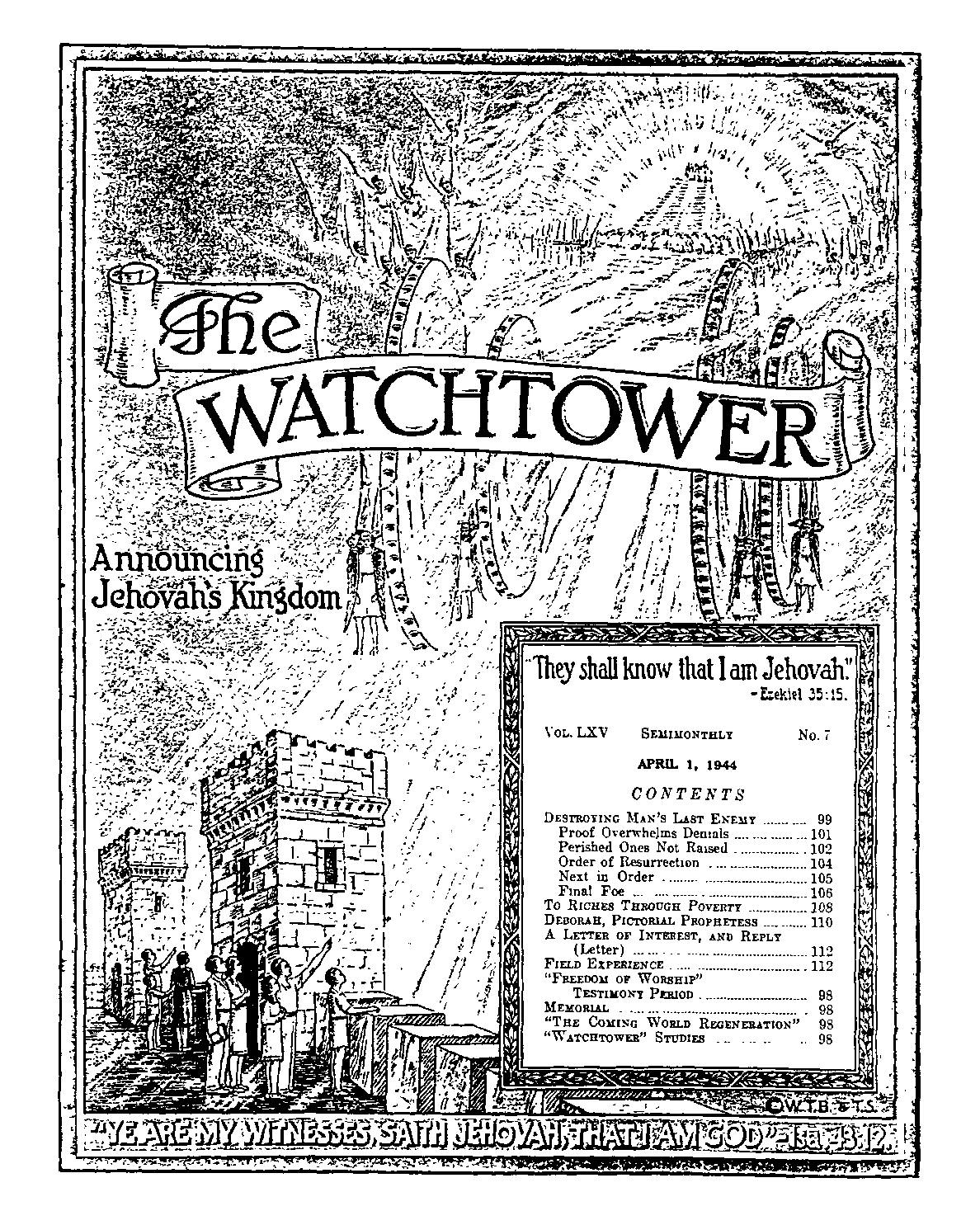
Vol. LXV
April 1, 1944
No. 7
DESTROYING MAN’S LAST ENEMY
"For he must reign, till he hath put all enemies under his feet. The last enemy that shall be destroyed is death.’’ — 1 Cor. 15:25, 26.
JEHOVAH’S King is reigning. This means a new force has been injected into the affairs of this world. The course of the nations in total war is one of inflicting death upon millions, and that with the blessing of religious clergy and hierarchs. The course of Jehovah’s reigning King is one of destroying death. Remarkable as it may seem, the Scriptures reveal that his work of resurrection has already gone forward. His work of making the dead to live again will not halt until it embraces the general resurrection of humankind and places the human dead that are in the graves back on earth, all subject to his disposition as King and Judge.
2 Such is good news. It is Scriptural gospel, and has been true since the active reign of the King began in A.D. 1914, and true particularly since 1918. This good news is no artificial attempt to meet the sorrows of our day with some imaginary comfort. It is founded on the fulfilled Word of God and upon the known facts since 1914, which facts are fulfilling his Word and prove that the time is at hand. Long ago a faithful follower of the King was inspired to foresee the portentous events of this time, and he set such down in writing as gospel or good news. We are living in the epoch when that apostle’s words are manifestly due of fulfillment, and it is our blessed privilege to examine his writing and to be thereby informed, consoled and filled with hope. Bringing his letter to a grand climax, the apostle Paul opens chapter fifteen of his epistle to the Corinthians writing: “Moreover, brethren, I declare unto you the gospel which I preached unto you, which also ye have received, and wherein ye stand; by which also ye are saved, if ye keep in memory what I preached unto you, unless ye have believed in vain.”—1 Cor. 15:1,2.
3 It should be held in mind that the apostle is writing his brethren in Christ; which does not include the race of mankind in general. Hence this fact helps us to rightly apply his use of the personal pronouns “we”, “our,” and “us”, and to restrict such to those whom he meant, namely, himself and his brethren of like precious faith in the gospel. In his words of salutation at the start of his epistle he identifies whom he means or names as his “brethren” by writing: “Unto the church of God which is at Corinth, to them that are sanctified in Christ Jesus, called to be saints, with all that in every place [Christians in all the earth] call upon the name of Jesus Christ our Lord, both theirs and ours.” (1 Cor. 1:2) Great confusion and misunderstanding of the truth of chapter fifteen of the apostle’s letter have existed, due to a failure by readers of the Bible in general to recognize or remember the ones to whom the apostle is giving such comforts of the gospel. Such failure has caused casual Bible readers and religionists to cast aside the restrictive bars which the apostle erects around the field of application of his words and to apply them to all men in general.
1. What new force has been injected into the affairs of this world, and how does its course differ from that of the nations?
2. Since when is such good news true, why is it no artificial attempt at comfort, and whose words especially do we examine in this regard?
3 Due to what misapplication of terms have misunderstanding and confusion respecting the truth of 1 Corinthians 15 existed?
4 To those who under religion’s misguidance have read the apostle’s words in such a loose, unlimited way the truth of those words may now come like a disappointment to “men of good-will” in this wonderful resurrection epoch. Really, though, it is no cause for disappointment, no more than the coming of the news of Christ’s resurrection causes disappointment. Despite its application, 1 Corinthians chapter 15 is of intense interest to all the Lord’s “other sheep”, because it sets forth irrevocable features of God’s purpose which merely precede marvelous earthly blessings for his “other sheep”. Those important features rest upon the foundation fact of Jesus’ own resurrection, and are an advance upon it, in the direction of eventual benefit for faithful “men of good-will” now living. It is all a part of the glorious vindication of Jehovah’s name and Word.
5 In declaring to his spiritual brethren a review of the gospel which he had preached and they had received, the apostle Paul says: “For I delivered unto you first of all that which I also received, how that Christ died for our sins according to the scriptures.” (1 Cor. 15:3) The apostle is not here overlooking that Christ Jesus is “the Lamb of God, which taketh away the sin of the world” and that “he is the propitiation for our sins: and not for ours only, but also for the sins of the whole world”. Paul is merely mentioning the benefit which he and his Christian brethren are the first ones to draw from Christ’s death for the sins of all who will eventually believe and obey. (John 1:29; 1 John 2:2) The multitude of “men of good-will” among our readers who devote themselves to the Lord God through Christ may be assured that Christ also died for their sins according to the sacred Scriptures. His death was primarily because of his unbreakable integrity toward God and his flat refusal to compromise with God’s enemies and their religion. Though able to call to his rescue twelve legions of angels against those who had come out to get his life, he submitted to the ordeal of a violent death, because it served the purposes of Jehovah God: first, to prove God’s universal sovereignty or domination as obeyed and adhered to unswervingly by his Chief Servant, Christ Jesus; and, second, to provide a ransom sacrifice for the redemption of believing sinners.
4. Why should the setting forth of the truth of 1 Corinthians 15 result in do disappointment to "men of good-will"?
5. At 1 Corinthians 15.3 why does the apostle refer to Christ's death for "our” sins, and for what two reasons did Christ submit to death?
6 To prove that Christ Jesus succeeded in both these parts of God’s purpose is important. Such proof of God’s full approval of Jesus as having served the divine will perfectly was displayed in his being resurrected. Hence his resurrection is of importance equal to that of his death. Not all the believing brethren of the apostle at Corinth had been Jews. Not all had had God’s written Word in Hebrew and believed its teachings that the dead are dead and that under Messiah’s rule there should be a resurrection of the dead. Many of those believers at Corinth who had accepted the gospel at Paul’s mouth had been Greeks or Gentiles. As such they had till then believed the pagan teachings that there are no dead and that death is unreal for the reason that man has within him an undying and indestructible soul, which escapes the body at death and lives on immortally in an invisible realm. (Acts 18:1-11) Hence it was necessary and important to prove or reaffirm to such pagan converts that man is not inherently immortal and that even Christ Jesus while in the flesh was not immortal; but that he died and was actually dead, only his lifeless flesh remaining during the time of his entombment; and that God’s miraculous power then acted and raised him to life eternal in the spirit or as a spirit, clothed upon with the gift of immortality and reflecting his Father Jehovah’s glory as the “express image of His person”. (1 Pet. 3:18; Heb. 1:3) It was strengthening to testify to Christ’s resurrection and to adduce more witnesses than the apostle Paul of that almost unbelievable fact.
6. Why is it Important to prove Christ Jesus succeeded in both these respects, and why was it Important for Paul to reaffirm that Christ actually died and was raised?
7 The apostle then gives an array of eyewitnesses of the fact of that first and most important resurrection in all creation and history. Continuing his declaration of the fundamental truths of the Christian gospel, he tells what followed Christ’s death at the hands of religionists: “And that he was buried, and that he rose again the third day according to the scriptures: and that he was seen of Cephas [Aramaic name for Peter], then of the twelve: after that, he was seen of above five hundred brethren at once; of whom the greater part remain unto this present, but some are fallen asleep [in death, including the martyr Stephen, the apostle James, and some whom Saul of Tarsus had delivered over to execution]. After that, he was seen of James; then of all the apostles. And last of all he was seen of me also, as of one born out of due time.” (1 Cor. 15:4-8) The apostle cites at least 501 witnesses, himself being the extra one, with many of which eyewitnesses he had conversed.
6 Paul’s own sight of the resurrected Jesus was as if Paul had been prematurely born, not so born in the flesh, but born in the spirit by a resurrection to life in the spirit and able to see spirit persons. When Paul saw the resurrected Jesus he saw no crucified body clothing Jesus as a spirit person. Jesus did not appear to Paul as he had appeared to his faithful disciples during the forty days following his resurrection and before ascending to heaven. On such occasions of manifesting himself alive unto his disciples Jesus materialized a human body of flesh and bones in order to give a visible manifestation to the apostles and the five hundred brethren, some of whom doubted. (Matt. 28:16, 17) But when Paul met up with the risen Lord, Christ Jesus permitted him to see the outward shining of His glory surpassing the noonday sun’s brightness and blinding Paul’s eyes for three days. Paul heard the voice from the brightness saying: “Saul, Saul, why perse- cutest thou met ... I am Jesus whom thou perse- cutest.” (Acts 9:1-5) For the moment Paul was as if he had been born from the dead as a spirit and was beholding another spirit invisible to human eyes. At that time Paul was generally known as “Saul of Tarsus”. By this great merciful act of Christ leading to his conversion, Paul was thenceforth obligated to be a convincing witness to Jesus’ resurrection.
9 Paul acknowledged his obligation, and his efforts to meet it, next writing: “For I am the least of the apostles, that am not meet to be called an apostle, because I persecuted the church of God. But by the grace of God I am what I am: and his grace which was bestowed upon me was not in vain; but I laboured more abundantly than they all: yet not I, but the grace of God which was with me. Therefore whether it were I or they, so we preach, and so ye believed.” (1 Cor. 15: 9-11) Paul was a special legate or apostle of Christ. He was chosen to be one of the “twelve apostles of the Lamb”, not, however, by the casting of lots under the supervision of Peter before the outpouring of the spirit of God at Pentecost. It was by the direct and personal choice of the risen Jesus; just as the other ranking apostles of the Lamb had been chosen directly and personally by Jesus when on earth. (Acts 9:11-16; 1 Cor. 9:1; Mark 3:13-19) Paul, by his continuous works of testimony both “publicly and from house to house”, by his miracles, and by his unique sufferings for his zeal and faithfulness, gave undeniable proof of his apostleship. His testimony was all the more reliable as to Jesus’ being alive from the dead and in spiritual glory, because prior thereto Paul had been a rabid persecutor of Jesus’ followers. According to his own estimate, Paul seemed deserving to be at most the least of the apostles; wherefore he bore fittingly the name Paul, which name means “little”. —2 Cor. 11:21-33; 12:10-12.
7. What witnesses does the apostle then proceed to give to the fact of Jesus' resurrection?
8. How was the risen Christ seen of Paul "as of one born out of due time”? and what was Paul thenceforth obligated to be?
9. What was Paul’s estimate of himself as to worthiness to be an apostle? and to what apostleship, and how, was he chosen?
PROOF OVERWHELMS DENIALS
10 Before carrying his missionary work to Corinth the apostle Paul preached in Athens, not a hundred miles away. When he preached Jesus and the resurrection, the Athenians thought “resurrection” (Anastasis) to be the name of a demon god, and some called Paul a babbler or a setter forth of strange gods. Others mocked; but some believed and accepted the resurrection doctrine, even though it exploded their previous belief in the demon doctrine of the immortality of all souls. (Acts 17:18-34) Whether some at Corinth were slipping back to their old belief in the deathlessness or inherent immortality of the human soul, Paul does not state. He simply discloses that some, associated with the congregation there, were questioning the resurrection of the dead, in fact, were denying the doctrine by which alone there is hope of a future life for those in the graves. Jesus’ deliverance from death was a complete proof of God’s power to raise the dead, but was just the first case of it. And since so much true testimony had been given of Christ’s resurrection as to make it beyond denial, how could any expect to succeed in destroying the truth of a coming resurrection of other dead ones?
10 How had the Athenians received the news by Paul of “resurrection”? and what does he indicate regarding the brethren at Corinth on the subject?
11 “Now if Christ be preached that he rose from the dead [ones], how say some among you that there is no resurrection of the dead [ones] ? But if there be no resurrection of the dead [ones], then is Christ not risen: and if Christ be not risen, then is our preaching vain, and your faith is also vain. Yea, and we are found false witnesses of God; because we have testified of God that he raised up Christ: whom he raised not up, if so be that the dead rise not.” (1 Cor. 15:12-15) Is Paul a false witness of Jehovah God, or true?
12 Jesus Christ’s resurrection from the dead is a proof of more than of his having kept integrity toward God unto the death and of having shown worthiness of life immortal as the Vindicator of Jehovah’s name and Word. His being raised out of death is a guarantee of a resurrection to come of others who are dead in the tombs. It guarantees that man’s terrible enemy death shall be destroyed, its companion, the grave, also being blotted out. Hence both resurrection facts are inseparably tied together, so that if the one is true, the other is also; if the one is denied, the other is also denied at the same time. To deny that Almighty God raised up Jesus from hell, the grave, would mean to deny his power to do so; but more: it would deny his purpose to raise other dead ones by Jesus Christ. “Because he hath appointed a day, in the which he will judge the world in righteousness by that man whom he hath ordained; whereof he hath given assurance unto all men, in that he hath raised him from the dead." (Acts 17:31) So said Paul to the Athenian philosophers, and he was not a false witness of Jehovah God in so saying.
13 “For if the dead rise not, then is not Christ raised: and if Christ be not raised, your faith is vain; ye are yet in your sins. Then they also which are fallen asleep in Christ are perished. If in this life only we have hope in Christ, we are of all men most miserable.” (1 Cor. 15:16-19) The religionists of “Christendom” say that in this chapter of his epistle what the apostle Paul is proving is the immortality of the human soul. The argument of the apostle is directly to the contrary, and he bases it on the Scriptural truth that the dead are out of existence and are dead souls, not immortal souls. In fact, in the Hebrew and Greek Scriptures which Paul used and quoted, the expression “dead body” is “dead soul” in the original text. (Num. 6:6; 9:6,7; Hag. 2:13; Num. 19:13; Lev. 21:11) If a soul is dead, it is perished, unless there is a raising of the dead from the graves. If the sleeper never awakes, he never returns to consciousness and active life. Such would be the destiny of those that have fallen asleep in Christ, if the dead rise not; and such could be only if Jesus himself was not raised from the dead. In that case, the Christian’s faith would be unfounded and to no purpose.
11. If there were no resurrection, what about Paul’s preaching and also our faith of future life?
12. Besides the matter of Jesus’ integrity, of what further is Jesus’ resurrection a proof or guarantee as testified to by Paul?
13. What do religionists claim that 1 Corinthians 15 proves concerning the soul? and what does the chapter really prove concerning the dead?
14 It is those who are left in their sins that perish; concerning which it is written: “The Father loveth the Son, and hath given all things into his hand. He that believeth on the Son hath everlasting life: and he that believeth not the Son shall not see life; but the wrath of God abideth on him. He that believeth on him is not condemned: but he that believeth not is condemned already, because he hath not believed in the name of the only begotten Son of God.” (John 3: 35, 36, 18) “He that hath the Son hath life; and he that hath not the Son of God hath not life.” (1 John 5:12) If Christ Jesus had not been raised, it would have been because he had not retained his integrity faultlessly toward God and had not proved acceptable as a ransom sacrifice for the cancellation of the sins of believers in Jehovah God and his provision. Hence all the dead being naturally sinners, there would be no means of removing the disability of sin from any of them. Furthermore, the followers of Christ would not be following a Redeemer, but would still be in inherited sin, not being washed from their sins in the blood of a Redeemer. All hope of future life would therefore be blasted.
PERISHED ONES NOT RAISED
15 In the above argument God’s inspired witness is not denying that some or many of the dead have perished and shall never have an awakening out of death. Paul does not argue contrary to Jesus’ judgment words against the religious clergy that maliciously caused his death on the tree despite Jesus’ proofs of his Messiahship to them, namely: “Wherefore ye be witnesses unto yourselves, that ye are the children of them which killed the prophets. Fill ye up then the measure of your fathers. Ye serpents, ye generation of vipers, how can ye escape the damnation of hell [or, how should ye flee from the judgment of gehenna]!” (Matt. 23: 31-33, and Rotherham's translation) Concerning the wicked brood of “that old serpent, which is the Devil, and Satan”, Jehovah God announced the destiny of destruction, saying to the Serpent in Eden: “And I will put enmity between thee and the woman, and between thy seed and her seed [Christ Jesus]; it shall bruise thy head, and thou shalt bruise his heel.” (Gen. 3:15) Such judgment utterance foretold destruction under the heel of Christ Jesus for those becoming Satan’s offspring as well as for Satan himself. Such ones take in Cain, regarding whom the inspired scripture says: “Not as Cain, who was of that wicked one, and slew his brother. And wherefore slew he him? Because his own works were evil, and his brother's righteous.” (1 John 3:12) What, then, of Cain's father, Adam, who rebelled against the law of God and plunged the entire race into sin, death and bondage to the Devil?
14. Who in general are the ones that perish? and what would a failure of Jesus to be resurrected have meant In that case?
15. Who have perished, or will perish, without benefit of resurrection, according to the words of Jesus to religionists, and of God In Eden, and of the apostle John?
16 Christ Jesus foretold that there would be goats at the end of the world, where we are now. He also foretold the eternal judgment to be rendered against them by himself as King and Judge, saying: “Depart from me, ye cursed, into everlasting fire, prepared for the devil and his angels: . . . And these shall go away into everlasting punishment: but the righteous into life eternal.” (Matt. 25:41-46) Certainly, then, all such on descending into death go down into destruction, as symbolized by “gehenna”, and therefore perish, because there will be no resurrection for suchlike.
17 As to such wicked seed of the Serpent the inspired Jude said: “Woe unto them! for they have gone in the way of Cain, and ran greedily after the error of Balaam for reward, and perished in the gainsaying of Core. These are spots in your feasts of charity, when they feast with you, feeding themselves without fear: clouds they are without water, carried about of winds; trees whose fruit withereth, without fruit, twice dead, plucked up by the roots; raging waves of the sea, foaming out their own shame; wandering stars, to whom is reserved the blackness of darkness for ever.” (Jude 11-13) Of the same class the apostle Peter wrote: “But these, as natural brute beasts, made to be taken and destroyed, speak evil of the things that they understand not; and shall utterly perish in their own corruption; for if after they have escaped the pollutions of the world, through the knowledge of the Lord and Saviour Jesus Christ, they are again entangled therein, and overcome, the latter end is worse with them than the beginning.”—2 Pet. 2:12, 20.
18 Concerning the destiny of Judas his betrayer, Christ Jesus said in the hearing of his disciples: “One of you is a devil.” “None of them is lost, but the son of perdition.” (John 6:70; 17: 12) The apostle Paul also spoke of the “man of sin” class as being in line for the same fate as Judas, saying: “Let no man deceive you by any means: for that day shall not come except there come a falling away first, and that man of sin be revealed, the son of perdition.” - 2 Thess. 2:3, 8, 12; see also Hebrews 6:4-8; 10:25-31.
16 What did Jesus say in his parable concerning the end of the world to show whether any will perish now?
17 What did the apostles Jude and Peter say as to such wicked seed of the Serpent?
18 What did Jesus say showing the destiny of Judas, and what class did the apostle Paul name as due to have the same fate as Judas?
19 Can it be Scripturally contended with success that all such wicked ones above described “are fallen asleep in Christ’’ on dying? Manifestly not. Therefore in 1 Corinthians chapter 15 the apostle could not be speaking of those that have gone down into perdition, symbolized by “gehenna”. What the apostle is pointing out is that, if Christ was not brought up from death, then the outcome to those that actually “are fallen asleep [with faith] in Christ” is as disastrous as that of the wicked ones who are in line for perdition or destruction. Of the more than five hundred brethren who were eyewitnesses at one time of Christ's being alive from the dead, “some are fallen asleep.” When the first martyr to suffer a violent death, Stephen, was dying, he said: “Lord Jesus, receive my spirit!” “And when he had said this, he fell asleep.” (Acts 7:59, 60) It is these sleeping ones that the apostle Paul is here discussing. Reasonably, then, he concludes that if there be no resurrection out of death, then his dead brethren are perished, and he and his living brethren, who suffer the assaults of Satan and his demons, are “of all men most miserable”. Be it observed that the apostle would not make such remark if he believed and if he was trying to prove that religious lie, namely, that ‘the dead are more alive than ever, being immortal souls in a spiritual realm’.
20 Paul assures us: “Yea. and all that will live godly in Christ Jesus shall suffer persecution.” (2 Tim. 3:12) But the faithful Christians, who endure the miserable time that Satan and his seed try to make for them and who endure it with blameless integrity toward God, have more than hope only in this life. They have hope of future life beyond the power of those demons to molest, not by reason of inherent immortality of soul, but by the power of God to raise them out of death. The certainty of this hope is proved by his raising his beloved and only begotten Son from the dead.
21 Triumphantly, therefore, the apostle wrecks all denials and all false conclusions based on such denials by citing this eternal fact: “But now is Christ risen from the dead, and become the firstfruits of them that slept.” (1 Cor. 15:20) Hence those that have fallen asleep in Christ are not perished, but at the coming of Christ Jesus to God’s spiritual temple for judgment in 1918 the time of their awakening to be with him arrived. The fact that the nations are raging at present, because of their opposition to the reign of God’s King, is no disproof of such resurrection, but rather the contrary: “We give thee thanks, O Lord God Almighty, which art, and wast, and art to come; because thou hast taken to thee thy great power, and hast reigned. And the nations were angry, and thy wrath is come, and the time of the dead, that they should be judged, and that thou shouldest give reward unto thy servants the prophets, and to the saints, and them that fear thy name, small and great; and shouldest destroy them which destroy the earth. And the temple of God was opened in heaven, and there was seen in his temple the ark of his testament.” (Rev. 11:17-19) Why the resurrection of those that slept in Christ has been invisible to human eyes, the apostle explains in later verses of his resurrection discussion.
19 Why could 1 Corinthians 15 not be speaking inclusively of those who go down into perdition? and what does the argument concerning those sleeping prove concerning the state of the dead?
20 What hope do the faithful ones have for whom the Devil and his seed try to make it miserable now?
21 Due to what eternal fact are the ones that are fallen asleep not perished, and why does the present anger of the nations not disprove the arrival of the time of their resurrection?
22 Paul’s use of the expression “firstfruits of them that slept” is noteworthy. Christ Jesus once slept in death. He being the firstfruits, then those sleeping in him must be the afterfruits of the “first resurrection” class and must become living fruit unto God by being brought out of the death-sleep. Hence the spirit of God caused the apostle to write further: “For since by man came death, by man came also the resurrection of the dead.” (1 Cor. 15:21) The repeated word came being inserted by the Authorized Version Bible translators, The Emphatic Diaglott reads more accurately: “For since through a man, there is death, through a man, also, there is a resurrection of the dead.” Verse 22 next adds: “For as in Adam all die, even so in Christ shall all be made alive.”
23 Are those two verses to be taken to mean a resurrection or even an awakening out of death for all the dead! To interpret verses 21 and 22 that way would mean disregarding the Scriptures that prove that many at death have perished, because they have gone down into destruction from which no recovery is possible. Certainly the apostle Paul was not disregarding such scripture texts, many of which he himself wrote. Under the divine inspiration he would not be guilty of contradicting himself. True it is that by Adam’s sin death passed upon all men descending from him, but not “second death”, which is the death of destruction in gehenna. (Rev. 20: 14; 21: 8) Hence those having only the inheritance of death that was unavoidable through Adam would be redeemable or be in line for a resurrection out of death. Those whose inherited condemnation to death had been added to by willful wickedness that brings the divine judgment of destruction have more than an inheritance from the first man. They go to gehenna, and are not among ‘all those that are in their graves’ and who ‘shall hear the voice of the Son of God and shall come forth’ in the resurrection time. — John 5:28, 29.
22. How is the expression "the firstfruits of them that slept" to be understood? and how are “death" and “resurrection of the dead" similar as to their beginning or first Instance?
23. Why may 1 Corinthians 18: 21. 22 not be understood to mean an awakening from death of all the dead?
24 “In Adam all die,” by reason of death’s passing from him onto all his offspring; but it is not true that all such eventually die with merely the condemnation they inherited from Adam resting upon them. The malicious, deliberately wicked and rebels against God die not merely as descendants of Adam the sinner, but also as the seed of the Serpent, the children of the wicked one Satan. Adam was not responsible for their dying as such workers of iniquity against God. Hence all such could not be included among all those who in Christ shall be made alive; for Christ’s ransom sacrifice does not cover or cancel such sin of rebellious iniquity and willful wickedness.
25 It is evident, therefore, that the apostle’s words at 1 Corinthians 15: 21, 22 are restricted in application, and that he has in mind all those he was writing about, namely, all those “which are fallen asleep in Christ”. (Verses 6,18) Without question, these were affected by the death that came by the first man, and they all died in Adam, because by him sin entered into the world and death by sin, and all these inherited sin from him and so death and its condemnation naturally passed upon them. But as in Adam they died, so in Christ they shall all be made alive. They shall come forth from the graves “unto a resurrection of life”, because of having done good in God’s sight. — Rom. 5:12; John 5:28, 29.
ORDER OF RESURRECTION
26 That the above is the correct presentation is made clear by the next verse: “But every man in his own order: Christ the firstfruits; afterward they that are Christ’s at his coming.” (1 Cor. 15: 23) Rotherham’s translation renders this same verse as follows: “But each in his own rank: a firstfruit Christ; after that they who are the Christ’s in his presence.” This states the resurrection order of Jesus and his church. He, as firstfruits, was foreshadowed by the barley-harvest firstfruits offered up by Israel’s high priest on Nisan 16, Jesus’ resurrection day, and he started off the resurrection. In accord with that it is written by Paul: “And he is the head of the body, the church: who is the beginning, the firstborn from the dead; that in all things he might have the pre-eminence.” (Col. 1:18) His was the beginning of the “first resurrection”. Hence after him properly come those who share with him in the first resurrection. Who are they! “They who are the Christ’s in his presence,” that is, his second presence, which is unseen to the natural eye because it is in the spirit. They that are then Christ’s are the members of his body, the church of which he is the head. He is the One foretold as “the Seed of Abraham”, in whom all the families and nations of the earth are to be blessed. (Gen. 12:1-3; 22:18) All his body-members, by being adopted as the spiritual sons of God, have been made a part with Christ Jesus as such “Seed of Abraham”.
24. To what extent is it true that “in Adam all die" and why does Christ's sacrifice not cover sin in the case of some that die?
25. To whom, therefore, must 1 Corinthians 15:21, 22 apply? and why?
26. What is the meaning of 1 Corinthians 15:23, proving that the above presentation is correct?
27 This agrees with Paul’s statement, at Galatians 3: 27-29, to Christ’s body-members: “For as many of you as have been baptized into Christ have put on Christ. There is neither Jew nor Greek, there is neither bond nor free, there is neither male nor female; for ye are all one in Christ Jesus. And if ye be Christ’s, then are ye Abraham’s seed, and heirs according to the promise.” At 1 Corinthians 3: 23 Paul says: “And ye are Christ’s; and Christ is God’s.”
28 The time of Christ’s presence is “that day” of which the apostle speaks, till which day he expected to sleep in death. He looked forward to be awakened from death in that day and to receive the prize for his faithful Christian course. He expressed this hope to Timothy in these words: “For I am now ready to be offered, and the time of my departure is at hand. I have fought a good fight, I have finished my course, I have kept the faith: henceforth there is laid up for me a crown of righteousness, which the Lord, the righteous judge, shall give me at that day: and not to me only, but unto all them also that love his appearing.” — 2 Tim. 4:6-8.
29 Christ’s second and invisible presence as the King in glory began in A.D. 1914. There is now but a faithful remnant of his body remaining on the earth, to serve as Jehovah’s witnesses in preaching the good news of the kingdom of God as having come and the destruction of all its enemies as being near. (Matt. 24:14) Such remnant of body-members must finish their earthly course faithfully as Paul did, that they may experience their resurrection to be with their Lord and King. Then all such resurrected members of the entire body of Christ, the true church, will sit with the “King of kings” in his throne and shall reign with him. — Rev. 20:4,6.
30 However, none of the religious clergy and hierarchy that have tried to run ahead of the Lord God and to reign visibly in glory and power on the earth as the spiritual overlords and advisers of the political governments, none of such will have any seat in that heavenly Government. In this time of his second presence as the Rightful Ruler of a New World of righteousness, such would-be governors of the nations of the world show they are not Christ’s. Their ambition to rule the earth instead of Christ Jesus himself, and their religious support to an international organization to keep the old political rule of worldly men in control, prove that they are opposed to Christ Jesus and his kingdom rule. Their worldly-wise activities to build a better world that will last a thousand years by human power will not entitle them to ‘live and reign with Christ a thousand years’ in his heavenly kingdom. They do not take to heart his words to a governor of this world: “My kingdom is not of this world: if my kingdom were of this world, then would my servants fight, that I should not be delivered to the Jews: but now is my kingdom not from hence.” (John 18:36) Their friendship with the ruling powers of this world for the earthly advantages they get therefrom makes them the enemies of Jehovah God and his King: “Whosoever therefore will be a friend of the world is the enemy of God.”—Jas. 4: 4.
27. How does Galatians 3:27-29 prove who are “they that are Christ's at his coming” also 1 Corinthians 3:23?
28. Till what day did the apostle Paul expect to sleep in death? and what did he then expect?
29. When did such presence of Christ begin, and what is the destiny of those of Christ alive on earth during his presence?
30. Why will none of the religious clergy and hierarchy 'reign with Christ a thousand years'?
NEXT IN ORDER
31 Does the resurrection of the dead end with those that are now Christ’s as members of his body? The Scriptures say not, and his apostle so indicates in the next words: “Then [Rotherham’s translation reads: Afterwards] cometh the end, when he shall have delivered up the kingdom to God, even the Father; when he shall have put down all rule and all authority and power. For he must reign, till he hath put all enemies under his feet. The last enemy that shall be destroyed is death.” (1 Cor. 15:24-26) Certainly the destruction of death will not be accomplished until all those who are in the graves solely as the result of Adam’s transgression in Eden have been brought forth as amenable to the benefits of Christ’s ransom sacrifice and as susceptible to righteousness. That will open up to them the way to everlasting life, if they will walk therein. The apostle’s words are clear-cut, that it is under the reign of Christ that the death which is by Adam is to be destroyed completely.
32 The coming of Christ Jesus into the Kingdom as the One whose right it is to rule marks the beginning of his “presence”. It is as King and Judge that he turns his face and attention to this earth and to the establishment of righteousness therein by the clearing out of the wicked. Thus he becomes present. His reign extends to the earth, upon which earth the Gentile governments have been subject, not to the will of Jehovah God, but to the “god of this world”, Satan the Devil. Christ’s presence will continue until death’s destruction. When during his presence comes “Afterwards the end”? (1 Cor. 15: 24, Rotherham) The apostle Paul does not state specifically whether it is the end of this world or the end of the thousand-year reign of Christ. However, the specification that “as a last enemy death is to be destroyed” would fix the end meant as the termination of Christ’s millennial rule.—Verse 26, Rotherham.
31 How do the apostle’s next words, at 1 Corinthians 15: 24-26, show that the resurrection does not end with those who are members of Christ's body?
32 Why and how does Christ become “present"? and when during bis presence applies the expression "Afterwards the end"?
33 It will not take Christ Jesus the entire period of ten centuries to “put down all rule and all authority and power”, or, to “bring to nought all rule and all authority and power” (Roth.), neither to show his power over death. When the end of this world, that is, the end of Satan’s uninterrupted rule, came, in A.D. 1914, then the coining of God’s Anointed One into the Kingdom of the New World took place. Without delay the King of righteousness proceeded to oust the host of wickedness, Satan and his demons, from their heavenly position. In the fight that ensued, Christ Jesus and his holy angels came off victorious. The “god of this world” and his wicked angels were forced down to the earth and there kept in custody, pending the final fight between Christ and all of Satan’s organized forces at Armageddon. The faithful members of Christ’s body that slept in death were not yet resurrected, and hence had no part in that “war in heaven”. (Rev. 12:1-12) Their awakening out of the sleep of death awaited his coming to the temple of God for judgment of the “house of God”. By the abasement of Satan and his spiritual hosts to the earth's vicinity they were put under the feet of God’s enthroned King, now ruling amidst his enemies, but were not destroyed.
34 After defeat and debasement, Satan was insanely mad and proceeded to organize, prepare and train “all rule, and all authority and power” under him for the final war, the battle of Armageddon. He has used these to persecute and make war against the remnant of the members of Christ’s body yet living on earth, because these are representatives of God’s universal organization, his “woman”, symbolically speaking. (Rev. 12:13-17) After Christ the King comes and appears at the temple in 1918, the nations under Satan are judged according to their attitude toward Jehovah’s King and his rulership of the earth. The proclamation of his reign is made by the faithful remnant unto all the nations, and thereby Christ Jesus the King at the temple is presented to all the nations of the world as the Rightful Ruler, to whom all other rule, authority and power must bow.
35 The nations have refused to accept the Kingdom message proclaimed by the remnant of Jehovah’s witnesses. Under the influence of Satan’s demons they have chosen for their “king” worldly politics under the “god of this world”. Their unfavorable decision and their continued opposition to the rule of Christ and the preaching of his remnant on earth do not, however, unseat the reigning rightful King. He continues to rule in the midst of his foes. The battle of Armageddon, “the battle of that great day of God Almighty,” becomes unavoidable, to remove all such opponents, who refuse to bow willingly.
33. Why does It not require the millennium to “put down all rule and all authority and power”? and when does Christ show his power over death as regards his body-members?
34 . What does the ousted Satan proceed to do respecting “all rule, and all authority and power” under him? and upon what basis have the nations been judged since 1818?
35. Due to what conduct of the nations has the battle of Armageddon become unavoidable?
36 By unsurpassed violence in that conflict, Jehovah God, through his King, will destroy Satan and all his demonic and human ‘rule, authority and power’. It is then that Christ’s thousand-year reign as King unopposed begins. By the binding of Satan before the millennial reign begins Christ accomplishes to “put down”, “bring to nought,” or abrogate all opposing rule, authority and power. He crushes them all out of existence under his feet. (Ps. 110:1, 2) Such accomplishment marks the final end of Satan’s world or organization. That final end draws near, as Jehovah’s witnesses hasten onward to finish the ‘preaching of this gospel of the kingdom in all the world for a witness unto all nations’.—Matt. 24:14.
FINAL FOE
37 All the powers under Satan the Devil have been the enemies of righteous men, from Abel on down to the present. Nevertheless, with the destruction of such powers at Armageddon not all of man’s enemies will have been wiped out. A last enemy remains, and that is death itself, the death concerning which Adam’s descendants had no choice, but which death was thrust upon them by that man’s transgression in Eden. The religionists should observe that the apostle Paul calls such death an enemy, and not ‘a friend that acts as a doorkeeper to open the way into life immortal in a higher, spiritual realm’. Christ Jesus was never subject to such death as is by Adam. His death was by self-sacrifice, according to the will of Jehovah God, and he permitted his enemies to put him to a violent death. His resurrection was not his own personal triumph over death, but that of Jehovah God, whose power raised his Son to life, breaking the bonds of the enemy death. It is when Christ Jesus reigns that he himself shows his power over death, to abolish it. Those whom he raised to life when he was on earth did not stay alive.
38 Less than a century after his resurrection he appeared to the apostle John in a vision and said: “I am he that liveth, and was dead; and, behold, I am alive for evermore, Amen; and have the keys of hell and of death.” (Rev. 1:18) His own resurrection to life from the dead was a sure guarantee that the death traceable to Adam’s disobedience and affecting all Adam’s offspring would be banished. Therefore it was written, at 2 Timothy 1:10: “But [grace] is now made manifest by the appearing of our Saviour Jesus Christ, who hath abolished death, and hath brought life and immortality to light through the gospel.”
36. How and when are all such 'rule, authority and power' brought to nought? and what do Jehovah’s witnesses do meanwhile?
37. (a) Thereafter what enemy, if any, remains? (b) What kind of death was that which Christ Jesus experienced, and when does he personally show his power to abolish death?
38. What did the resurrected Jesus say as to his power over death? and why was the abolition of death certain thereafter?
39 After his coming to the temple, which was in 1918, Christ Jesus begins the active abolition of death and hell. It is now under way. How? By the raising of his faithful body-members, who were sleeping in death up till his temple appearance. Concerning this he said: “And this is the Father's will which hath sent me, that of all which he hath given me I should lose nothing, but should raise it up again at the last day. And this is the will of him that sent me, that every one which seeth the Son, and believe th on him, may have everlasting life: and I will raise him up at the last day.”—John 6:39, 40.
40 When the last of the faithful remnant will have finished his earthly service and Christ Jesus will have raised him instantaneously from the dead to reign with him, then the enemy death will have been completely abolished, put down, rendered powerless and destroyed as far as the members of the body of Christ are concerned. “He that hath an ear, let him hear what the Spirit saith unto the churches; He that overcometh shall not be hurt of the second death.” (Rev. 2:11; 1 Cor. 15:54-57) This special demonstration of power over the enemy death does not wait till the thousand-year reign of Christ is finished, because his 144,000 body-members are appointed to ‘live and reign with Christ a thousand years’, while Satan is bound. (Rev. 20: 4, 6) Thereby they share with him in the “first resurrection”, and it is unto life immortal beyond the power of the “second death”.
41 Hope of life from the dead is not for only those who are Christ’s as members of his body, the church. Jesus foretold of his judgeship to come, and added: “Marvel not at this: for the hour is coming, in the which all that are in the graves shall hear his voice, and shall come forth; they that have done good, unto the resurrection of life; and they that have done evil, unto the resurrection of damnation [judgment].” (John 5:28,29) Other men besides Christ’s bodymembers are accounted in God’s sight as having done good in this life. Such ones are his approved faithful servants of old, such as John the Baptist, the last, and Abel, the first. They, having died before the calling to the heavenly kingdom was opened up to Jesus’ followers, do not attain to the “first resurrection”, but are promised a “better resurrection”, that is, better than that of the other human dead in the graves. They shall have a “resurrection unto life’’. At the beginning of Christ’s thousand-year rule they will be his visible representatives upon the earth, “princes in all the earth.” Thus, neither as respects them does the abolition of death wait till the expiration of his reign. — Heb. 11:1-40; Ps. 45:16.
39. How is the abolition of death and hell now under way, and how did Christ Jesus foretell it?
40. When is death completely abolished as far as concerns his body- members, and why then?
41. What must take place as respects those “that are in the graves”? and when does abolition of death over the faithful mon of old take place, and how?
42 Persons of good-will, who now give proof of such good-will toward Jehovah God and his reigning King by consecrating themselves to God and serving as witnesses to his King and kingdom, are in subjection to death, having inherited such from Adam. Now these may demonstrate their integrity toward God amid the present wickedness and the opposition of the old world to Jehovah and his purpose. By this they show their worthiness of everlasting life through Christ Jesus. A great number of these “other sheep” of the Lord will never go down into the tomb, for Almighty God will preserve a great multitude of this class through the destruction of the old world at Armageddon. They will then be adopted as children of the reigning King, “the Everlasting Father,” and will never die off the earth, because inheriting everlasting life from him, by the gift of the right to eternal life. — John 8:51; 11:26; Zeph. 2:3; Isa. 9:6, 7.
43 What a glorious outlook, that Christ Jesus must reign till he has put all enemies, including death, under his feet! Consequently, the coming forth of the rest of the dead, those that have “done evil”, unto a resurrection of judgment, must take place before the end of his thousand-year reign. Those who are already in gehenna are not among the ones that will come forth to a resurrection, for they are perished for ever. Those who are in the graves, who are in God’s memory, as covered by the propitiatory power of Jesus’ sacrifice, will then come forth. (Rev. 20: 11-13) If under the judgment they turn their backs on the evil they formerly practiced and now turn to righteousness of serving Jehovah’s King; and if they steadfastly persevere in righteousness and devotion to God, even though Satan the Devil be loosed at the end of the thousand years for a test of their integrity, then they shall enter into life eternal on a paradise earth. In such manner will be fulfilled the prophecy: “The rest of the dead lived not again until the thousand years were finished.” It is because they have to pass successfully the judgment test of Satan’s loosing before inheriting the right to life, eternal life in human perfection under God’s kingdom. — Rev. 20:5,7-10.
44 Then Christ Jesus will have reigned until he has put down and destroyed man’s last enemy, death, and its close attendant, hell or the grave. Destruction, in gehenna, with Satan and all his organization, will be the fate of all those who fail to be steadfast in righteousness and fail to keep their blamelessness during his brief loosing. (Rev. 20:11-13) That wicked rebel against Jehovah’s universal domination was responsible for the death that came upon all men through Adam. (John 8:44) “And there shall be no more death,” at the end of the thousand years, because all survivors of the final test arising from what Satan does during his short release, will be counted worthy to attain the New World of righteousness, which is everlasting. They will be graciously favored with the blessed gift of the right to everlasting life from God through his King.
42 That opportunity as against death is now open to the Lord’s "other sheep", and upon what conditions?
43 Who are the “rest of the dead”, when must these come forth, and when do they ‘live again’?
44 When will the last enemy be destroyed and there be “no more death”, and why?
45 Then, with all the wicked destroyed from all the universe, Jehovah God will reign as “King of Eternity” over all that live, including his kingly representative, Christ Jesus. This is the sense of the apostle’s words: “For he [Jehovah] hath put all things under his [Jesus’] feet. But when he saith all things are put under him, it is manifest that he is excepted, which did put all things under him. And when all things shall be subdued unto him, then shall the Son also himself be subject unto him [Jehovah] that put all things under him, that God may be all in all.” (1 Cor. 15:27,28) God’s purpose to put all things under Christ’s feet was foretold at Psalm 8, and the apostle in explaining the Psalm says: "For not unto messengers hath he subjected the coming habitable earth of which we are speaking. [Roth.] . . . But we see Jesus,” as the Son of man to whom God puts all things in subjection. (Heb. 2: 5-9) The Most High God has put the coming paradise earth into subjection to Christ Jesus the King as his place of dominion, in the New World.
46 Joyfully we look forward to when Christ Jesus, by Jehovah’s authority and invincible power, will have destroyed all enemies, including death and its sister, the grave. Then, having accomplished the divine purpose, Christ the King will turn over the paradise earth and its perfected righteous inhabitants to the Supreme One, Jehovah God. Thereby the earthly realm will become once again wholly a part of the universal organization of the Most High God. Humbly Christ will claim no independent sovereignty of his own. Having gloriously succeeded in his kingdom over the earth and fulfilled God’s will toward it, he will gladly submit himself in absolute allegiance and obedience to Jehovah God, to enter in upon the further work God has in readiness for him and his glorified body-members, the church.
45. Who puts all things under Christ Jesus, and when does be reign as “King of Eternity” over all that live?
46. When will Christ Jesus 'deliver up the kingdom to God, even the Father', and be subject unto Him? and how?
TO RICHES THROUGH POVERTY
ALTHOUGH God could not set aside his judgment against Adam and Eve and the effect of such judgment upon their descendants, yet God could and did provide in His law for the accepting of a ransom for everything that had been lost to their descendants and thereby relieve all believing men of the disability under which all find themselves. The unselfish provision made by the Lord God for humankind, therefore, was that a life might be given for a life, that is, a perfect sinless life be given as a corresponding price for the perfect life that Adam had forfeited for all his offspring. (Deut. 19:21) The sinless life that is accepted in that behalf must be a perfect human life. It could be nothing more, and certainly nothing less, in order to meet the requirements of God’s law. All the human race being the offspring of Adam the sinner, it is entirely impossible for any of Adam’s offspring to become the ransomer or redeemer of his fellow humankind. Ransom, as used by the apostle at 1 Timothy 2:6, means an exact corresponding price, that is, the price of exactly the same value as the law requires for that which has been lost and which is to be redeemed.
It was the perfect man Adam that sinned. God’s law required the forfeit of Adam’s life in death. The judgment of God took away from Adam his right to live, and he died, and his children were born without either perfect life or the right thereto. Nothing could become a ransom of such life right save a perfect human creature, possessing life on earth and the right to that life. The one who becomes the redeemer or ransomer of Adam’s offspring must stand exactly in the same position as occupied by Adam prior to sinning and at the time he was perfect when in Eden and before he had taken any wrongful steps whatever in the commission of sin. The one who would take the place of ransomer and suffer death in order to provide redemption must be a perfect human creature. If he were part spirit and part human, that would not be a price exactly corresponding to the perfect man Adam. In no creature was there the power to make this provision for redemption. Only God could provide such a ransomer or redeemer, and the Scriptures show he has provided for redemption. In doing this Jehovah God was moved entirely by unselfishness.
The spirit creature, the Logos or Word of Jehovah God, was exceedingly rich in heaven, because he was next to Jehovah and was His active agent in the creation of all other things. Consequently he enjoyed the fullness of riches of all creation. In order for him to become the redeemer of humankind he must become a man. Hence he must lay aside all of such riches and glory as he possessed and enjoyed in heaven and become just a man. In harmony with this it is expressly written that Jesus “was made a little lower than the angels, for the suffering of death, . . . that he, by the grace of God, should taste death for every man”. (Heb. 2:9) This proves that Jesus on the earth was not part spirit nor wholly spirit creature, like the angels, but was made human and lower than the angels, and made thus in order that he might become the redeemer or ransomer of humankind by taking the place as the sin-bearer and suffering death as a sinner. Laying aside his heavenly riches and glory, therefore, he became poor.
How was it that the Word or Logos, now called “Jesus”, was made a man? His father or life-giver was not a human creature, the descendant of Adam. Had he been the son of Adam, then he could not have been born a perfect man. The Scriptures point out that Joseph and Mary were espoused and before their marriage was consummated, that is, before there was intercourse between them, Mary “was found [to be] with child of the holy spirit”. That means that God’s invisible power, his spirit, had caused Mary to conceive in her womb a babe. Stated in other phrase, Jehovah God had exercised his power, and in the womb of Mary was a child before she was united with Joseph. The angel of God then transmitted to Joseph this message, to wit: “Joseph, thou son of David, fear not to take unto thee Mary thy wife: for that which is conceived in her is of the holy spirit. And she shall bring forth a son; and thou shalt call his name Jesus; for it is he that shall save his people from their sins. Now all this is come to pass, that it might be fulfilled which was spoken by the Lord through the prophet, saying, Behold, the virgin shall be with child, and shall bring forth a son, and they shall call his name Immanuel; which is, being interpreted, God with us.”—Matt. 1:20-23, Am. Stan. Ver.
In due time Mary gave birth to the child which she had conceived by reason of the miraculous power exercised by the great Creator. When the child was born God begat him, which means that He acknowledged the child as his Son and called his name Jesus. His name means he was born to be the Savior of the people believing on him. At the moment of the birth of Jesus a message of greatest importance to humankind was announced by God’s angels, which were sent from heaven. “And, lo, the angel of the Lord came upon [the shepherds], and the glory of the Lord shone round about them: and they were sore afraid. And the angel said unto them, Fear not: for, behold, I bring you good tidings of great joy, which shall be to all people. For unto you is born this day, in the city of David, a Saviour, which is Christ the Lord. . . . Glory to God in the highest, and on earth peace, good will toward men.”
Thus into the world came the perfect child named “Jesus”. “And the child grew, and waxed strong in spirit, filled with wisdom: and the grace of God was upon him.” (Luke 2:40) Under God’s law a man was required to be thirty years of age in order to qualify finally as a priest or servant in God’s organization among the Jews. Jesus grew to manhood's estate, and now he was ready and qualified to carry out the purpose of his Father, Jehovah God. He met John the Baptist at the river Jordan, and there John, at the request of Jesus, baptized him in the river This was done as an outward testimony that Jesus had agreed to do his Father’s will, whatsoever that should be. “And Jesus, when he was baptized, went up straightway out of the water: and, lo, the heavens were opened unto him, and he saw the spirit of God descending like a dove, and lighting upon him: and, lo, a voice from heaven, saying, This is my beloved Son, in whom I am well pleased.” (Matt. 3:16, 17) In this manner Jehovah acknowledged or begat Jesus Christ as his Beloved One sent to earth to accomplish his purpose. For three and one-half years thereafter the man Jesus was put to the most severe test, and under such test at all times proved his loyalty and faithfulness to God and maintained his integrity toward his Father.
…