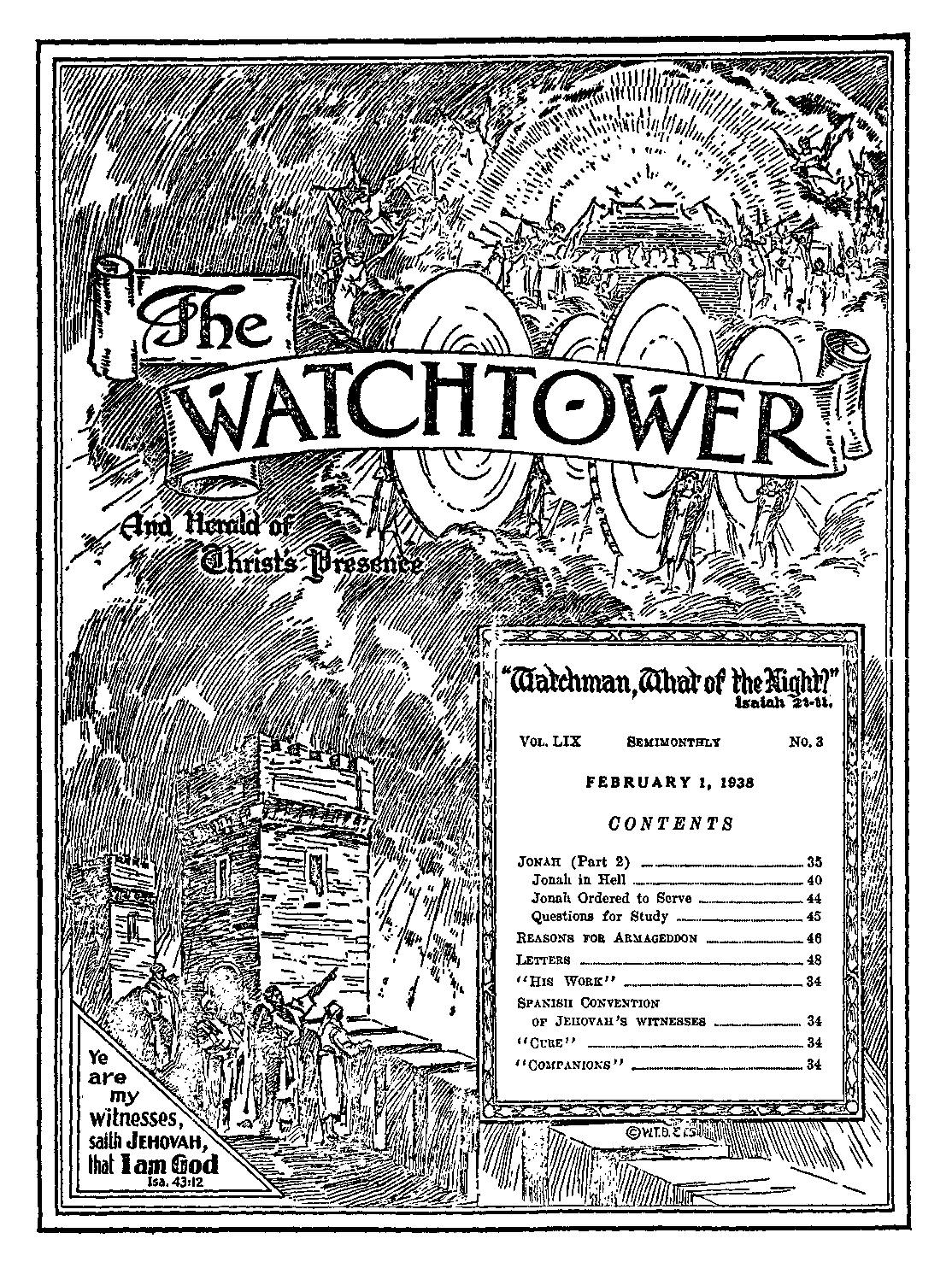
The Watchtower, February 1, 1938
Download: PDF — The Watchtower, February 1, 1938
“HIS WORK”
The term “His Work’’ applies to the nine days, February 5 to 13 inclusive, as the next period of special united testimony by all those who delight in Jehovah. It will feature the combination of the two latest books, Enemies and Riches, to be placed with all contributors of 50c. This testimony, taking place in midwinter, will require considerable planning and arranging, and all who give a part in Jehovah’s “strange work’’ first place will arrange all that is due. Detailed instructions appear in the Informant; which you should study and closely follow. Let each worker render a faithful report at the end of the period.
SPANISH CONVENTION OF JEHOVAH’S WITNESSES
The Society is arranging for a convention of Jehovah’s witnesses particularly for the Spanish-speaking brethren, to be held at San Antonio, Texas, April 15-17 inclusive. All Spanish speaking brethren who can reasonably attend should make it a point to do so. The local company at San Antonio will have "charge of the arrangements of the convention, under the direction of the Society. Brothers Montero and Keller will attend the convention. Brethren desiring to attend this convention may communicate with J. D. Carter, 517 Stonewall St., San Antonio, Texas.
“CURE”
Amid the vain pursuit by nations and individuals of a remedy the Society now brings forth a new booklet, entitled Cure, and written by Brother Rutherford. It is a most excellent short composition, enclosed in a striking cover. Release of Cure for campaign purposes will be duly announced. Preliminary thereto, all kingdom publishers will familiarize themselves with its interesting contents. Copies for your individual purposes may be obtained on contribution of 5c each.
“COMPANIONS”
The Memorial season this year will be marked by the testimony period named “Companions’’, from April 9 to 17, inclusive. The name indicates that all that are companions in Jehovah’s service, to wit, the anointed remnant and the Jonadabs, will signalize this period by intense united activity throughout all the world. The campaign strategy will offer the unusual combination of a year’s subscription for Consolation together with the book Enemies (or Riches) and the new booklet Cure, all on a $1.00 contribution. This announcement is supplemented by much detailed information in forthcoming issues of the Informant. The magnitude and scope of this campaign calls for careful planning and advance arrangements, losing no time. A faithful report in the regular way will be awaited from you at the close of the testimony.
Vol. LIX
February 1, 1938
No. 3
JONAH
PART 2
“For thou, Lord, art good, and ready to forgive, and abundant in loving kindness unto all them that call upon thee.”—Ps. 86:5, R.V.
JEHOVAH GOD is love, and his mercy endures for ever, and this his faithful servants realize and more fully appreciate the longer they are in his service. In the exercise of his loving-kindness he caused many prophetic pictures to be made that his people might now see and appreciate them and thereby be encouraged to press on in this time of greatest peril. The “evil day” is here; and as the days thereof increase, malice, hatred and viciousness increase amongst the Devil’s representatives on earth, which malicious hatred is manifested against Jehovah’s faithful ones. But with the advancing time God pulls back the curtain behind which many truths have long been concealed and permits his people to see how he provided for them and knew and foretold these days and made all necessary provision for their protection and comfort. When we have these prophetic pictures intelligently in mind we no longer criticize the men of old who were used to make them, such as Jonah, but we know that God had his prophets and others to play their respective parts for good and that good inures to the benefit of the servant class now on earth.
2 Continuing now with the prophecy of Jonah: He is found in the hold of the ship asleep, and there being awakened out of slumber and hearing the command of the ship’s master to “arise” and “call upon thy God”. The sailors were in great distress and were seeking some explanation for their distress. “And they [the mariners] said every one to his fellow, Come, and let us cast lots, that we may know for whose cause this evil is upon us. So they cast lots, and the lot fell upon Jonah.” (Jonah 1:7) Those sailors recognized that they had no power to still the storm. They did not use their own judgment nor lean to man’s opinion about what should be done. They saw the necessity of looking to the mighty One who brought on the storm because of his displeasure at something that had been done or had failed to be done according to his will, and that this offense was committed by someone in the ship. The casting of lots shows they were asking the mighty One to decide for them: “The lot causeth contentions to cease, and parteth between the mighty.” (Prov. 18:18) “The lot is cast into the lap; but the whole disposing thereof is of the Lord.” (Prov. 16:33) Those seamen desired to know upon whom the blame rested for their perils, and for that reason they cast the lots. Mark now the progressive steps in the fulfillment of this prophetic picture.
3 As far back as 1880 The Watchtower pointed to A.D. 1914 as the date marking the end of the world, at which time great trouble would come upon the nations; but at that time it was not seen by God’s people on earth that the trouble would be the battle of Jehovah against Satan’s organization. For many years it was believed by them, and so stated in The Watchtower, that “the time of trouble” would be a terrific clash between the various elements of the earth, such as capital and labor. Not until 1925 was “the time of trouble” Scripturally understood. The Watchtower in its issue of January 1, 1925, forcefully stated for the first time that the “time of trouble” would be the battle of the great day of God Almighty, led by Christ Jesus against Satan and all his forces, resulting in complete triumph of the Lord. In the May 1, 1925, issue of The Watchtower there appeared the article “For the Elect’s Sake”, showing the relationship of God’s servant class on earth to the great time of trouble upon the world and why and by what means it is shortened or “cut short”. Then followed the publication of the article “One Reason for God’s Vengeance”, December 15, 1927, Watchtower, further elucidating this matter. All this information was given out to the public by means of radio speeches, and by other discourses and by books. The Lord revealed to his people the meaning of the parable of the sheep and the goats, showing how the "sheep” only would be spared by Jehovah when his wrath is expressed at Armageddon. All this information came not from or by man, but by the Lord God, being given to his people gathered under Christ at the temple, and these things learned by them in the secret place or temple the Lord commanded should be told by them from the housetops, that is to say, publicly. (Matt. 10:27) Thus the Lord made known to his people the cause of the trouble, how it would come about, and what would be the result.
4 As the sailors cast lots and the lot fell on Jonah, so the true cause of the time of trouble is given by Jehovah, not by man. It was Jehovah who directed where the lot should fall, and it is Jehovah, through Christ Jesus, that reveals the cause of the trouble, as well as the result. The fact that the lots were cast by heathen men makes no difference, because they were merely performing their part in the picture. Those men were not particularly important, but the main thing is the prophetic picture in which they played a part. By causing the lot to fall on Jonah the Lord God directed the attention of those in distress to the one blamed for the distress. Antitypically he directs the attention of the people of good will and in distress to his elect servant, Christ Jesus, and his faithful followers on earth working under his command. In the year 1922 the faithful ones who had been gathered to the temple learned that the Lord had come to the temple, and that Jehovah had ‘poured out his spirit upon all flesh’, that is, all those devoted to him and of the servant class, thus causing the lot to fall upon them, and calling attention to his message, which his servant delivered to those who are seeking safety and security. These are directed to the proper source. This was somewhat similar to the casting of the lot by Jehovah in the hand of his priest, which falls upon the “Lord’s goat” class. (Lev. 16: 8, 9) It was in the year 1931 that the identification of his servant class on earth was definitely made certain by Jehovah’s giving to the servant class the “new name”, that is, “Jehovah’s witnesses.” Only upon those devoted to him and in the covenant for the kingdom is this name bestowed. Within a short time thereafter God revealed that Jehu pictured Christ Jesus, together with his body members, the church, and there the Jonadab class was identified and the relationship of the same to the Lord was shown. Thereafter began the work of receiving the Jonadab class into the “chariot”, that is, gathering those people of good will into God’s organization and putting them actively to work with the remnant in declaring the message of the kingdom. It is Christ Jesus and his faithful body members that thus inform the people as to who constitute the antitypical Jonadab class. At this point in the prophetic picture Jonah clearly represented Christ Jesus, the elect of Jehovah, and his associated servants, who lift up the standard of Jehovah for the aid, instruction and comfort of the people of good will.
5 The honest and sincere seeker for truthful information is disclosed by the action of the sailors at this point, and it foretells the people of good will, or Jonadabs, seeking truthful information concerning their salvation: “Then said they unto him, Tell us, we pray thee, for whose cause this evil is upon us; What is thine occupation? and whence comest thou? what is thy country? and of what people art thou?” —Jonah 1: 8.
6 The religionists, pretending to represent God but in fact representing the Devil, have greatly confused the minds of the people of good will, and the time comes when they seek true information. Jehovah’s witnesses at such time are in distress apparently and are being denounced by the religionists, but the people of good will, seeing their sincerity, seek truth at their hands. It was in the year 1922 that the first one of the symbolic “seven last plagues” began to be poured out by the publication of the Resolution, that is, “The Challenge,” adopted and sent forth from the Cedar Point, Ohio, convention; and thereafter, year by year, the other symbolic plagues were poured out. (Rev. 15: 6-8; 16:1-21) (See Light, Book Two, pages 7-67.) There the Lord used his faithful witnesses to carry information to the people of good will, which they desired, and caused them to want more. Those people of good will began to examine and consider the message brought to them by Jehovah’s witnesses, and their inquiries continue, and consequently they propounded many questions to the remnant, and received answers, something like the following:
Question: “Whence comest thou?”
Answer: From the temple of God, where his King has gathered his people and commissioned them to carry the truth to the people.—Isaiah 6:1-9.
Question: “What is thy country?”
Answer: Our citizenship is in heaven. We are members of Jehovah’s spiritual organization, and our allegiance is to him and his King.—Phil. 3:20, Roth.; Heb. 11:16.
Question: “Of what people art thou?”
Answer: We are Judeans; that is, we are those who praise Jehovah God and who are in a covenant with Jehovah God. We are followers of Christ Jesus, our great Redeemer and Leader, and therefore we are Christians. We are the people of God, whom he has taken out from the world as a “people for his name”. —1 Pet. 2:9,10; Acts 15:14.
7 These questions are similar to the ones propounded to Jonah by the sailors, who picture the people of good will. By observation and experience those people of good will were fully convinced that the religious leaders are not pleasing to God, and they did not go to them for information, but they sought information at the mouth of sincere ones who clearly manifested that they were serving God and suffering by reason of so doing. Seeing the truth then, as far as they could, the Jonadabs began to spurn religion and religionists, and to associate themselves with those who worship Jehovah in spirit and in truth. As they saw Jehovah’s witnesses are sincere and honestly representing God, they desired to associate themselves with such people and did so, and continue to do so.
8 Jonah then further enlightened those who inquired of him: “And he said unto them, I am an Hebrew: and I fear the Lord, the God of heaven, which hath made the sea and the dry land.” (Jonah 1:9) By the world-wide publication of the kingdom message like information has been given to the people of good will by the Lord’s faithful servant, as He commanded. The delivery of such message of truth has been made by radio, by sound equipment, and by the witnesses’ visiting the people in their homes and talking to them and exhibiting to them books containing the message, and thus they have carried out God’s commandment to mark those sincere ones of the world who really and honestly are seeking knowledge.— Matt. 24:14; Ezek. 9:4.
9 Jonah informed those sailors that he was a stranger, but no part of the organization engaged in traffic, which is Satan’s organization. He told them that he was a Hebrew. Abraham, the Hebrew, was Jonah’s forefather. (Gen. 14:13) Jonah was from “the land of the Hebrews’’. (Gen. 40:15) Abraham was called “the Hebrew” because he was a descendant of Eber or Heber, the son of Shem. (Gen. 10:21-24; Luke 3:35, 36) Jonah also told the mariners that he feared Jehovah God, and therefore he was a witness for Jehovah. Those sailors were not in a covenant with God, and hence pictured a people not in a covenant with God. When they come seeking information at the mouth of Jehovah’s witnesses, note how God caused his people to likewise testify to the peoples of the world who are not consecrated. The aforementioned resolution, “The Challenge,” published in 1922, contains these words: “We call upon all nations, peoples, kindreds and tongues ... to recognize and freely acknowledge that Jehovah is the only true God and that his beloved Son, Christ Jesus, is King of kings and Lord of lords.” (Light, Book One, page 111) By that resolution the remnant showed themselves to be witnesses for and servants of Jehovah God.
10 At this point in the prophetic picture Jonah played the part representing the Lord’s “faithful servant” class on earth. At the time the Resolution was drafted and adopted and published, no one on the earth knew that such constituted a fulfillment of a part of the prophecy of Jonah. None really knew that they were then sending forth a testimony as “Jehovah’s witnesses”, because that name was not revealed to them until long afterwards. Jehovah, in his loving-kindness, through Christ Jesus directed the entire matter. Instances of this nature serve to greatly encourage the servant class, giving them assurance that Jehovah uses them in performing certain things without their knowing just why they are doing so. Fifteen years after the adoption of the foregoing Resolution at the Cedar Point convention The Watchtower publishes the explanation of the prophecy of Jonah, and it would have been published earlier had it been understood and had it been God’s will that it should be published. Surely those who love God delight to acknowledge that he leads his people who are devoted to him, and that he bestows upon them his loving-kindness and that this is true with reference to all who sincerely and earnestly strive to serve him as he commands.
11 Jonah then told his story to the sailors, that is, that he fled from the presence of Almighty God in order to avoid going to Nineveh and there proclaiming against the city, as God had commanded: “Then were the men exceedingly afraid, and said unto him, Why hast thou done this? For the men knew that he fled from the presence of the Lord, because he had told them.”—Jonah 1:10.
12 Those sailors were horrified at Jonah’s action, thus further supporting the conclusion that they pictured men of good will of the present time in fulfillment of the prophecy. Those sailors began to realize that then they were helping Jonah in his effort to avoid doing his duty. They said to him: “What is this that thou hast done?” (R.V.) Jonah did not attempt to justify himself for taking the wrongful course, but freely confessed his error even to these non-Jews. God’s faithful witnesses often make mistakes, but when they see them they freely acknowledge them. Like Jonah, the people of God on earth, following their 1919 experiences, acknowledged their course of lawlessness, in this, that they had failed to give the witness to the name of Jehovah and his kingdom at a time when they might have been testifying. The fear of man or what men might do to them had held them back. This conclusion is fully supported by the facts and the prophecy of Isaiah 6:1-9. There the prophet Isaiah, representing the same consecrated ones of the Lord on earth, put these words in their mouth: “ Then said I, Woe is me! for I am undone; because I am a man of unclean lips, and I dwell in the midst of a people of unclean lips, for mine eyes have seen the King, the Lord of hosts. Then flew one of the Seraphims unto me, having a live coal in his hand, which he had taken with the tongs from off the altar; and he laid it upon my mouth, and said, Lo, this hath touched thy lips, and thine iniquity is taken away, and thy sin purged.’’—Isa. 6:5-7.
13 The persecution that had arisen against God’s people during the World War had filled them with fear, and they failed to perform their duty, and now, like Isaiah, we see that they failed to give the testimony and they cried unto the Lord. They acknowledged it also in the world. The people of good will then learned that during the World War they must have performed some part or had something to do in bringing about the undesirable conditions of the consecrated because they had backed up Satan’s commercial and religious and political organization, which had hindered God’s people from bearing the testimony, and therefore had made them negligent and, to a degree, unfaithful. Many of those people of good will had unwittingly assisted in heading God’s remnant in the direction away from the presence of the Lord in giving the testimony to his name and his kingdom. Thus it was seen that the sailors that were carrying Jonah away from the presence of the Lord and giving testimony as commanded were making a picture of the people of good will that had ignorantly helped the Devil to hinder God’s people. Learning the facts in the matter, the people of good will feared that they would suffer at the hands of Jehovah, and hence they sought information from Jehovah’s faithful witnesses after the war had passed.
14 The great storm at sea continued, and the mariners were alarmed, and so they further inquired of Jonah: “Then said they unto him, What shall we do unto thee, that the sea may be calm unto us? for the sea wrought and was tempestuous [the sea grew more and more tempestuous (R. V.)].” (Jonah 1:11) Not knowing how they could possibly be saved, the sailors inquired of Jonah what they should do. This part of the prophetic picture began to have its fulfillment at the conclusion of the World War. The war was over then, it is true, but the woes thereof continued and the people of good will learned from Jehovah’s servants that Armageddon is in the near future and that it will be far greater in trouble and distress to mankind than the World War. It was about that time that Jehovah’s witnesses began to see and to appreciate as never before that Armageddon will be the expression of God’s wrath, and, learning this, they transmitted the information to the people in general. As the mariners realized the increasing violence of the storm was evidence of God’s wrath against someone in the ship, so the people of good will on earth saw that the rebellious and stubborn attitude of “Christendom” toward Jehovah and his kingdom increased and that the religionists became more worldly and increased in ungodliness, and those sincere people became alarmed, and they sought information at the hands of honest Christians, trying to learn what they should do. Thus the Lord in his loving-kindness long ago showed how he can bring his witnesses and his kingdom message in close touch with the honest and sincere seekers of truth.
15 At this point Jonah began to realize what a great wrong he had committed, and it was then that he manifested some real courage. When a man realizes he is in the wrong, real courage is then required for him to acknowledge his wrong and to be ready to take the consequences, trusting everything to Jehovah God. Jonah did that very thing. He knew that only God could bring about the matter in a just and right way. “And he said unto them, Take me up, and cast me forth into the sea; so shall the sea be calm unto you; for I know that for my sake this great tempest is upon you.”—Jonah 1:12.
16 He did not show selfishness by asking those sailors to do their best to pull the ship through the storm. He knew that he was facing death and unless Jehovah saved him he was certain to perish. He did not further seek to justify himself. He therefore asked the mariners to yield him up to the hand of the Almighty God, who had caused the storm, to either be mercifully preserved by Jehovah or suffer destruction. He was courageous, in this, that he knew that whatsoever God would do must be for the best. He knew that he had started out as God’s servant and had failed to obey, and knew he must take the consequences. He was willing to put his life entirely at the disposal of Jehovah, and if his death in the sea would make it possible for others in the ship to be rescued he was willing for that. Here Jonah shows the spirit of Christ Jesus, who permitted himself without resistance to be led to execution that others might be saved. His action also sets a precedent for Jehovah’s witnesses, who must go forth in the service of Jehovah at this time, and that at the risk of life, that they may serve God and deliver his message in behalf of the people and thus afford them an opportunity to be saved. They must warn the people not to try to carry Jehovah’s servants off the course of strict observance of his commandments, but, on the contrary, they, being of good will toward God, must find the way of escape and safety only by cooperating with the faithful servant class in obeying God’s commandments. They must warn the people of good will to do good unto all as they have opportunity and, above all, that they must take their stand on the side of Jehovah and his kingdom and firmly remain there, thus showing their true courage by recognizing that everything is in the hand of the Most High. The goat class take exactly a contrary course: they interfere with the servants of Jehovah; but those who would have God’s favor must be as sheep and be obedient to the will of the Master. By doing as instructed the people of good will toward God have the promise of God that they may safely pass through the great storm of Armageddon and enter into the calm of the kingdom.
17 Jonah told the seamen that “because of me is this great tempest upon you”. (Leeser) Jonah did not say that the storm was for the purpose of punishing him. In fact, he was showing the urgency of doing the will of God when commanded to do so. Thus he shows that when God’s remnant on earth receive commandment or order to do certain things in his service they must act without delay and be diligent in the performance of assigned duty and not permit anything to hinder or interfere with the same. The prophetic picture was made for the benefit of Jehovah’s remnant on earth and their associates, and emphasizes the importance of willingness to obey; as it is written: “Thy people shall be willing in the day of thy power.” (Psalm 110: 3) No possible excuse or justification can be given for stubbornness or indifference to the commandment of the Lord. The thoughtful and careful servant of God watches, is circumspect, and forms a habit of obeying quickly; that is, hearing the command, they do it now and without delay. In this day of battle it is no time for sleep or to be negligent or indifferent, but everyone must be on the alert and act promptly and willingly in performing his assigned duty.
18 The great tribulation of Armageddon is not for the purpose of inflicting punishment on Jehovah’s people on earth, but Jehovah’s witnesses have a duty to perform in connection with Armageddon that must be performed. The impending disaster of Armageddon demands the setting up of a watchman in behalf of the people of good will. Christ Jesus is the great Watchman, and under him are those of the temple class who are made members of the Watchman and therefore are appointed to watch and care for the kingdom interests and to faithfully perform all service in connection therewith. They watch in behalf of one another and in behalf of those of good will who are seeking the way to Zion. Armageddon is certain to come, and the witnesses of Jehovah must not only inform themselves, but inform others, that they may have the opportunity of finding the way to escape. Not only will Armageddon vindicate Jehovah’s word and name, but it will also avenge the faithful remnant upon the “goat” class, and will at the same time make the way clear for those who will form the great multitude to walk in the light of the Lord.
19 The mariners heard the words of Jonah as to the cause of the storm, and his request to be cast by them into the sea, but still they were afraid that by doing as he requested they would be guilty of shedding innocent blood. This shows their good feeling toward Jonah and their desire to assist him, if possible, without sacrificing his life. Consequently the picture here shows a similar good feeling toward the class whom Jonah represented. Instead of immediately throwing Jonah overboard, they tried to bring the ship to land: “Nevertheless, the men rowed hard to bring it to the land; but they could not: for the sea wrought, and was tempestuous against them. ’’—Jonah 1:13.
20 The greater the effort they put forth to row the ship, the stronger the wind lashed the waves against it. It was not the will of God for those sailors to overcome the power of his storm. Jehovah was here making the prophetic picture, and it was his angel that injected into the mind of Jonah to request that he should be cast into the sea, and this, of course, for the purpose of making that part of the picture being fulfilled in later years.
21 At this point in the picture the mariners began to show their good will toward God. They did not wish to shed innocent blood, and yet they saw they must do the will of God, and, desiring to do so, they proceeded to carry out Jonah’s request; but before doing it they prayed unto Jehovah : “Wherefore they cried unto the Lord, and said, We bуseech thee, O Lord, we beseech thee, let us not perish for this man’s life, and lay not upon us innocent blood: for thou, O Lord, hast done as it pleased thee.”—Jonah 1:14.
22 Doubtless that was the first time they had ever tried to pray to Jehovah God, because they were heathen people. The false gods whom they served had failed them in the storm, and now they were “at their wits’ end”. “Then they [cried] unto the Lord [Jehovah] in their trouble.” (Ps. 107:27,28) Here the Lord by this picture shows non-religionists that are honest and sincere seeking the way that they might find God and his means of salvation. Seeing now the fulfillment of the prophetic picture, the proof is clear that before the beginning of the antitypical storm there was no “great multitude” in existence. For many years the consecrated understood that the “great multitude” constituted a secondary spiritual class; but in this they were wrong. Only in God’s due time could the matter be understood. Not until the King was enthroned, and probably not until he came to the temple and the storm began particularly upon God’s people, was there any “great multitude” in existence at all. Since the beginning of the judgment at the temple the people of good will have been hearing the kingdom message, and this has caused them to turn to Jehovah and his King and to take their stand on the side of the kingdom and to co-operate with the remnant by following organization instructions that come from the temple. Thus the prophetic picture of Jonah at this point is further proof that the Lord God’s great multitude must be gathered unto him before the expression of Jehovah’s wrath at the battle of the great day of God Almighty. That work is now in progress.
23 Praying to Almighty God, the mariners said: “We beseech thee, let us not perish for this man’s life, and lay not upon us innocent blood.” They wanted to do right and not suffer destruction like the “goats”, who will suffer because of their willful wrongdoing toward Jehovah’s witnesses. The six cities of refuge foreshadowed the provision that God has made in behalf of the people of good will. (Numbers 35) Only by forsaking the murderous “goat” organization, who persist in their attempts to destroy Jehovah’s witnesses, is it possible for those people of good will to begin to pray unto Jehovah and to have their prayers heard. The cry of the mariners to Jehovah represents the prayers of the people of good will who cry unto God for help. It shows that men must first forsake the Devil’s organization and trust in God and his King before they can flee to the city of refuge.
24 The mariners realized that God had sent the storm, and they said: “Thou, O Lord, hast done as it pleased thee.” They desired to do as it pleased Jehovah. Thus the prophetic picture shows that it pleases Jehovah that the people shall undergo some experiences that cause them to look for Jehovah for help, and that it is the will of God that the “other sheep” of the Lord called “Jonadabs” shall co-operate with Jehovah’s witnesses in proclaiming the kingdom, even though by so doing it may appear to them that the lives of Jehovah’s witnesses are being endangered. To go forward in the witness work in the face of the cruel persecution by the “goats” the witnesses of the Lord are in much danger of violent action’s being taken against them; but, as opportunity offers, the “other sheep”, that is, the people of good will, must assist the remnant and co-operate with them, even though it places the remnant in increased danger. This is clearly illustrated by the part of the prophecy in the foregoing verse fourteen.
25 The mariners decided to comply with Jonah’s request, which was in fact the will of God. So likewise the “other sheep” of the Lord see their privilege of doing the will of God: “ So they took up Jonah, and cast him forth into the sea; and the sea ceased from her raging.” (Jonah 1:15) It was not the judgment of the mariners that they were executing toward Jonah by casting him into the sea, but they were doing this as they were bid or commanded, that the will of Jehovah might be done to his own servant. Likewise, it is the will of God that the Jonadabs should fully cooperate with Jehovah’s witnesses in entering places of danger to bear the testimony concerning the kingdom. Immediately after casting Jonah into the sea the storm ceased and the sea became calm. “Then are they glad because they be quiet; so he bringeth them unto their desired haven.” (Ps. 107:30) The people of good will were in great distress until they saw the hand of the Lord being manifested in these troublesome days, and, seeing their privilege of serving Jehovah God, they proceeded to do so by fleeing to the “city of refuge”, that is, to God’s organization, and thus they are made glad, and they look forward with hope of being spared by Jehovah during the expression of his wrath at Armageddon and being brought safely into his fold for ever.
26 That doubtless was the first time those mariners had ever observed the manifestation of God’s power. They knew that no ordinary power could still a great storm. Therefore they knew the One who had stilled this storm was the Almighty God. “Then the men feared the Lord exceedingly, and offered a sacrifice unto the Lord, and made vows.” (Jonah 1:16) The sacrifice offered by them was a part of the picture and, being in harmony with the Scriptures, must have been a sacrifice of the lifeblood of some animal, for ‘without the shedding of blood there is no remission’. (Heb. 9:22) This part of the picture shows that those who cry unto the God, are heard and make vows and sacrifice pleasing unto the Lord, must exercise faith in the shed blood of Christ Jesus, because there is no other name whereby they must be saved. (Acts 4:12) The mariners here again pictured the people of good will, when they saw Jonah sinking beneath the waves of the sea. Whether they saw him swallowed by the great fish, the record does not disclose. Now as to the facts showing fulfillment.
27 In 1918 and thereafter many people of good will saw Jehovah’s faithful witnesses on the earth swallowed up by the mad waves of fanatical humanity, and no doubt that caused many of the honest people to look to the Lord God for help. During the World War many of Jehovah’s servants were wrongfully confined in prison, being thus swallowed up by fanatical ruling powers, and the people of good will circulated a petition for the release on bond of such imprisoned ones, and within a few days 700,000 of such persons signed that petition, thus expressing their good will toward those who serve the Lord. By signing this petition the people of good will were aiding the antitypical Jonah class to be released and go on into the service, even though it put the remnant in a position of great danger. The people of good will, by attempting to get Jehovah’s witnesses out of prison, were also seeking aid from such witnesses. This is similar to the Gibeonites when they were seeking aid at the hands of Joshua, and they sent a message to Joshua, saying: “Slack not thy hand from thy servants; come up to us quickly, and save us, and help us.” (Josh. 10: 6) Whether they knew it or not, the petitioners in behalf of Jehovah’s imprisoned servants were seeking in behalf of themselves the presence and aid of those who serve God.
28 Here one picture in the prophecy ends and another begins. The Hebrew text shows that chapter two of Jonah’s prophecy really begins with verse seventeen of chapter one as set forth in the Authorized Version. See Leeser.
JONAH IN HELL
29 Jonah now performs a part of the prophetic picture specifically relating to Christ Jesus, and also picturing his faithful followers who went into captivity during the World War. “Now the Lord had prepared a great fish to swallow up Jonah. And Jonah was in the belly of the fish three days and three nights.” (Jonah 1:17) The Hebrew word here translated “prepared” means “to allot, to constitute, to appoint, or to set”. Jehovah did not create a fish or great whale right then and there and for the purpose of swallowing Jonah, but he had appointed or constituted and had on the spot at the proper time a great fish, which had no doubt been in existence for a long while, and that fish performed its part in the prophetic picture. This shows that God can use any kind of creature in malting pictures of his purpose, whether that creature is aware of it or not. That the great fish swallowed Jonah was not for the purpose of punishing Jehovah’s servant, but as a means of Jonah’s safety. Jonah could never have gone to land in safety without the use of that fish. In the case of Christ Jesus the fish pictured the grave, where he was fully in the mind of Jehovah God: “For as Jonas was three days and three nights in the whale’s [great fish, as gaping for prey] belly; so shall the Son of man be three days and three nights in the heart of the earth.” (Matt. 12:40) In the case of the followers of Christ Jesus, the remnant now on earth, the fish pictures God’s provision for their safety in captivity or prison, shielded from the further vicious assaults of the enemy; which is also shown in the fulfillment of the prophecy of Revelation 11:3-11. (See Light, Book One, pages 190-212.) Jesus could not have been brought out of the grave and again to the land of the living except by the exercise of the power of the Almighty God, even as God exercised his power in causing the fish to land Jonah. The remnant, restrained or imprisoned, could never have gotten out and again engaged in the service of God except by the exercise of God’s power and loving-kindness toward them. The enemy would have kept God’s people in prison until they died, and that was their purpose; but God willed it otherwise. God brought them out in the face of all opposition.
30 For three days and nights Jonah was in the belly of the fish, and that was long enough for any man to be digested or absorbed by the fish, and hence a miracle was required to save him; and God performed that miracle, and thus he showed his loving-kindness toward his servant. Within those three days the huge fish swam northeast in the direction of Nineveh and there landed Jonah on the shore according to the will of God; and thus God was showing his merciful interest and loving-kindness toward Jonah. While taking that strange voyage Jonah bad ample time to think, and doubtless did so. While God’s remnant were restrained and imprisoned in 1918 and 1919 they had opportunity to meditate, and they did so: “ Then Jonah prayed unto the Lord his God out of the fish’s belly.” (Jonah 2:1) While Christ Jesus was in the tomb he was dead and could not pray, and therefore this part of the prophecy does not refer to Jesus. It does, however, apply to the faithful followers of Christ Jesus who were in captivity or in prison during the World War. Like Jonah, they prayed and cried unto God that they might be released and again given opportunity to serve him, and Jehovah heard those prayers. Many days thereafter Jehovah revealed to his people how he miraculously dealt with them and protected them from the enemy, the raging waves of the sea. Their restraint or imprisonment during that period doubtless caused their preservation and saved them from death at the hands of the enemy.
31 Jehovah heard the prayer of Jonah, and also of those whom Jonah pictured. “And said, I cried by reason of mine affliction unto the Lord, and he heard me; out of the belly of hell cried I, and thou heardest my voice.” (Jonah 2:2) This prophecy is further proof that its fulfillment was after the coming of Christ Jesus to the temple and to his exercising power and authority there as the representative of Jehovah. (Jonah 2:7) Jehovah had then built up Zion with Christ Jesus at the Head, and their prayer was heard: “When the Lord shall build up Zion, he shall appear in his glory. He will regard the prayer of the destitute, and not despise their prayer. This shall be written for the generation to come; and the people which shall be created shall praise the Lord. For he hath looked down from the height of his sanctuary; from heaven did the Lord behold the earth; to hear the groaning of the prisoner; to loose those that are appointed to death.”—Ps. 102:16-20.
32 The enemy meant the captivity and imprisonment of Jehovah’s witnesses to be their grave, with never a resurrection or release. The religionists, acting as the chief instruments of the Devil, had conspired to put Jehovah’s servants to death, and hence ‘appointed them to die’. “Let the sighing of the prisoner come before thee; according to the greatness of thy power preserve thou those that are appointed to die.” (Ps. 79:11) Then Jehovah’s witnesses were not sure that they would ever be released, knowing that only by the grace of Almighty God could they be released. The maliciousness of Satan’s religionists, that is, the priests and preachers, in this connection is shown in this day, when they continue to brand some of those men, imprisoned because of their faith in God, as “jailbirds”. Those clergy well know that they conspired against Jehovah’s servants and stirred up the people to have those servants destroyed, and, having failed in that wicked purpose, they now take advantage of their own wickedness and use their crooked methods to besmirch the name of those imprisoned ones, thereby acting as the Devil’s agents to cause the people to hate the message of the Lord by casting hatred upon those who, by God’s grace, tell that message. Otherwise stated, those religionists try to use their own crookedness for their own aid and against those who have been doing right. These things, however, do hot disturb Jehovah’s witnesses, but they do cause rejoicing in the Lord, since it furnishes evidence that they are permitted to be associated with Christ Jesus and suffer as he suffered. Thus Jehovah’s faithful witnesses have some opportunity of proving the Devil and his religious agents as great and fertile liars, and themselves to have some part in the vindication of God’s holy name.
33 Jonah says: “Thou heardest my voice.” God heard him because he spoke his heart’s desire to again engage in the Lord’s service, if possible. Jonah was now fully persuaded that, if he ever had opportunity again, he would go to Nineveh and do as God had commanded him. Only a great miracle being performed by Jehovah in his behalf would make it possible for Jonah to ever have the privilege of engaging in Jehovah’s service. Likewise Jehovah heard the cry of his people while suffering restraint and imprisonment, and he heard because those prayers were in accord with God’s will to have his name proclaimed throughout the earth before the final expression of his wrath at Armageddon. The faithful servants of God then confessed their own negligence and lawlessness in not boldly declaring the truth amidst great opposition (Isa. 6:7), and the prayer of Jonah foretold the same thing. “For thou hadst cast me into the deep, in the midst of the seas; and the floods compassed me about: all thy billows and thy waves passed over me.”—Jonah 2: 3.
34 The belly of the fish was Jonah’s preservation, while the wind-tossed waves passed over him. So likewise the remnant of God’s restrained people came to realize that God’s loving-kindness was manifested toward them by permitting their restraint and imprisonment, while the mad waves of an insane people passed over them. Although the great storm raged about them, God did not permit them to be wiped out of existence.
35 When dying upon the tree, Jesus cried: “My God, why hast thou forsaken me?” (Matt. 27:46) No doubt Jonah felt the same way: “Then I said, I am cast out of thy sight; yet I will look again toward thy holy temple.” (Jonah 2:4) Jehovah’s servant class had a like feeling for a time when they were plunged into darkness in prison cells, and yet they trusted in the Lord God and Christ Jesus and continued to pray. God was representatively at his temple in the person of Christ Jesus, and there the people of God found a place and means of intercession. For their benefit God caused Solomon to utter a like prayer.—1 Ki. 8:46-51.
36 Foreshadowing God’s faithful servant class Jonah continued to pray: “The waters compassed me about, even to the soul: the depth closed me roundabout, the weeds were wrapped about my head. I went down to the bottoms of the mountains: the earth with her bars was about me for ever: yet hast thou brought up my life from corruption, O Loud my God.” (Jonah 2: 5, 6) Here is a strong and forceful picture of how the Lord permitted the enemy during the World War to bring very low his “faithful servant” class. No human power could halt that terrible war-machine or the enemies’ cruel action; but God could do so, and he did cause it to cease ‘for his elect’s sake’. (Matt. 24:22) As Jehovah brought up Christ Jesus from the hand of the enemy, likewise he could bring his remnant again out of prison. The words of Jonah here recorded, “Thou [hast] brought up my life from corruption,” were doubtless said after Jonah was safe on the land, but they were prophetically recorded to be fulfilled for the benefit of those now having a vision of them. When in 1919 the servants of Jehovah were released, they began to give thanks and praise to Jehovah God in advance of preparations for the commencing of the witness work, which did begin to take on far greater momentum in 1922.
37 Continuing, the prophet says: “When my soul fainted within me 1 remembered the Lord; and my prayer came in unto thee, into thine holy temple.” (Jonah 2:7) Likewise the “faithful servant” class prayed and gave thanks, and continue to do so. The prayer was not merely to escape death to be able to lead a selfish existence, but that the servants of God might live and serve him and his King and maintain their integrity toward God and honor his name while on the earth. Each day the faithful continue to utter their prayers and thanksgiving unto Jehovah for his loving-kindness bestowed upon them in permitting them to be again engaging in his service. Their prayers then ascended, and continue to ascend, at his holy temple, where Christ Jesus, as the representative of Jehovah, presides, hears and answers the petition of the faithful ones, and directs them in the proper course in his service. This part of the prophecy definitely locates the time of the beginning of fulfillment as in 1918 and 1919. At that time the faithful apostles had been resurrected and gathered unto the Lord at the temple. The Lord then gathered his faithful on earth to his temple and there heard their prayers.
38 At this point in the prophecy those who prove unfaithful are made known: “They that observe [They that regard (R.V.)] lying vanities [or idols or images, representing false gods (2 Ki. 17:15,16; Jer. 10:8)] forsake their own mercy.” (Jonah 2:8) Another translator renders the text: “They that guard false vanities forsake (the source of) their kindness.” (Leeser) The “faithful and wise servant” utters this prayer: ‘‘ Into thine hand I commit my spirit; thou hast redeemed me, O Lord God of truth. I have hated them that regard lying vanities: but I trust in the Lord. I will be glad and rejoice in thy mercy: for thou hast considered my trouble; thou hast known my soul in adversities; and hast not shut me up into the hand of the enemy: thou hast set my feet in a large room. ’ ’ —Ps. 31: 5-8.
39 But not so with those who show a high regard for “lying vanities”, such as character building, religious formalism, human opinion as to the interpretation of prophecy, fear and subservience to political rulers, regarding them as the “higher powers”, and who for that reason decline to faithfully serve God in obedience to his commandments. It also includes those who continue to exalt human leaders and “elected elders ”, and hold only to such truth as was published prior to 1916. All such are in the dark and have no vision of the truth which Jehovah through Christ Jesus has revealed to his faithful people in recent years, and therefore they do not see that Jehovah and Christ Jesus are the only true Teachers. They have no understanding, but walk on in the dark: “Doth not wisdom cry? and understanding put forth her voice? . . . But he that sinneth against me wrongeth his own soul: all they that hate me love death.”—Prov. 8:1, 36.
40 In striking contrast with those who “guard false vanities” the faithful witnesses, like Jonah, say: “But I will sacrifice unto thee with the voice of thanksgiving; I will pay that that I have vowed. Salvation is of the Lord.” (Jonah 2:9) How do these faithful ones sacrifice unto the Lord? Not with such sacrifice as shown in the type, but with the praise of their lips proclaiming the name of Jehovah and his kingdom. (Heb. 13:15) Thus they “offer unto the Lord an offering in righteousness”. (Mal. 3:3) “I will praise the name of God with a song, and will magnify him with thanksgiving. This also shall please the Lord better than an ox or bullock that hath horns and hoofs. The humble shall see this, and be glad: and your heart shall live that seek God. For the Lord heareth the poor, and despiseth not his prisoners.” (Pss. 69:30-33; 51:15-17) The faithful servant class have vowed to do the will of God and, like Jonah, they say: ‘I will pay what I have vowed.’ For Jonah that meant that he must go to Nineveh and cry against it. For the faithful witnesses of Jehovah now on earth it means that they must no longer be held back by fear of Satan or of any of his agencies, but that they take up with renewed zeal and energy the preaching of "this gospel of the kingdom” and declare the “day of [the] vengeance of our God”, and that they do this regardless of the approval or disapproval of men, that they obey God in the face of all opposition. To the faithful ones “salvation is of the Lord”; and salvation is not of any earthly dictators, such as rule Germany and Italy, nor of any religious or political crowd of racketeers, such as the Roman Catholic Hierarchy.
41 The salvation of Jonah from the belly of that huge fish came and could come only from Jehovah God. Likewise the salvation of those who turn to God can come from him, and from no other source. “The Lord looseth the prisoners.” (Ps. 146:7) This truth must be presented to the “other sheep”, which form the great multitude. They must and do learn that truth, as shown by Revelation 7:9,10. To now see the loving-kindness of Jehovah foretold in prophecy, such as that of Jonah, brings real gladness to the heart of everyone who loves and serves the Lord.
42 Fools, by their course of action, say, “There is no God.” Therefore it is written: “The fool hath said in his heart, There is no God.” (Ps. 14:1) Jonah was commanded to go and preach the gospel to the Ninevites, and if Jonah had failed Jehovah God would have the gospel preached by some other means. Concerning the preaching of the gospel Jesus said: “I tell you, that, if these should hold their peace, the stones would immediately cry out.” (Luke 19:40) Nothing can resist the Almighty God. (Matt. 19:26) Even that fish must obey and did obey the Lord: “And the Lord spake unto [(Leeser) commanded] the fish, and it vomited out Jonah upon the dry land.” (Jonah 2:10) This is another proof that “salvation is of the Lord”, and it is according to the will of God. Worse than foolish, then, is it for man to attribute salvation to another. Says the psalmist: “Thou art my King, O God: command deliverances for Jacob [of whom Jonah was a descendant, picturing the anointed of God].” (Ps. 44:4) Jonah was delivered by Jehovah from the belly of the fish, and that foreshadows the delivery of God’s people from bondage, which occurred in the spring of 1919; and immediately there after his witnesses went to work to organize and carry on his service.
43 The people of Nineveh must have been fully informed that Jonah had been disgorged from the great fish. Surely the people along that coast of the sea not only would know about it but would talk much about it, and soon the miraculous appearance of Jonah would be convincing to the people of Nineveh. If only Jonah made the report there would necessarily have been much doubt in the minds of the people, and many would have denounced his report as a great “fish story”. But the related facts in the Scriptural account and the modern-day facts in fulfillment of the prophetic picture agree. In the fulfillment, first came the resurrection of Jesus from the grave, and concerning which he had spoken before his crucifixion; and by his resurrection was furnished overwhelming proof of his prophetic statement: “And [when the Greater- than-Jonah came forth out of the earth], behold, there was a great earthquake: for the angel of the Lord descended from heaven, and came and rolled back the stone from the door, and sat upon it. His countenance was like lightning, and his raiment white as snow; and for fear of him the keepers [who were eyewitnesses] did shake, and became as dead men.” —Matt. 28:2-4.
44 The prophecy is also properly applicable to Jehovah’s witnesses, the followers of Christ Jesus: “And after three days and an half the spirit of life from God entered into them, and they stood upon their feet; and great fear fell upon them which saw them. And they heard a great voice from heaven saying unto them, Come up hither. And they ascended up to heaven in a cloud; and their enemies beheld them.” (Rev. 11:11,12) Therefore the coming of Jonah from the belly of the fish constituted “a sign unto the Ninevites”, and this is clearly proved by the words of Jesus. (Luke 11:30) That miraculous deliverance of Jonah added force to the message which Jonah delivered to the Ninevites. As a coincidence the people of Nineveh worshiped a fish god, Dagon, and this is proved by a tablet excavated at Nineveh in recent years. Jonah appeared in Nineveh as a man who came from the belly of a fish, and probably that made the Ninevites take notice.
45 Jonah safely landed on the coast of the Mediterranean and immediately again received command from the Lord: “And the word of the Lord came unto Jonah the second time, saying, Arise, go unto Nineveh, that great city, and preach unto it the preaching that I bid thee.” (Jonah 3:1,2) Corresponding exactly to that command, the order is given to John, on the isle of Patmos, who there represented God’s remnant: “And he said unto me, Thou must prophesy again before many peoples, and nations, and tongues, and kings.” (Rev. 10:11) The fulfillment of this part of the prophecy as to the remnant began in the autumn of 1919, when the Lord directed the public address delivered at Cedar Point convention in September that year on the subject ‘‘ The Hope of Distressed Humanity”. The Golden Age magazine (now Consolation) was there announced for publication for the first time, and in the same year literature on the subject “Millions now living will never die” was, widely distributed, but no definite class was then in the mind of the persons on earth as to to whom that message referred. Mark that the work was begun and carried on there without reference to any particular class of persons; and the reason was, the great multitude was then understood to be a secondary spiritual class. But the work of bearing testimony continued under the direction of the Lord. At the second international convention at Cedar Point, in 1922, a Resolution was adopted and published, and from that time forward widely distributed, which was directed against the political elements as well as the religious elements of Satan’s organization; and this was in fulfillment of the cry against Nineveh.
46 The command of Jehovah to Jonah was to go to Nineveh and preach unto it as God had previously commanded him. “The kingdom” has always been opposed by Satan and his earthly ruling class, and therefore when the witnesses for the Lord go forth to preach the kingdom of God and of Christ, the issue involved necessarily is political, because it announces the kingdom which will destroy all of Satan’s power. Nineveh was a great city in size and capable of holding a great multitude; hence its fall would mean an enormous loss of life. Did that fact stir Jonah to be merciful as God was toward Jonah and who was calling the attention of Jonah to the greatness of the city? Jonah was to go there and tell, not his own message, but the message of Jehovah. God had not cast Jonah away. In view of Jonah’s prayer Jehovah would now mercifully tender to him the privilege of again engaging in his service. What would be the action of Jonah now? Would he show mercy to others when the opportunity should arise? Would he exhibit the zeal that is peculiar to those who joyfully obey the Lord? Would he regard all things as working for his good, or would he complain? All of these questions are answered in what followed.
JONAH ORDERED TO SERVE
47 The prophetic action of Jonah from that point on can be seen to have fulfillment in those who in recent years claim to be fully devoted to Jehovah. As long as conditions are favorable some obey, and when conditions become almost unbearable to human creatures many fall away: “So Jonah arose, and went unto Nineveh, according to the word of the Lord. Now Nineveh was an exceeding great city of three days’ journey.” (Jonah 3:3) Likewise in 1922, at the outpouring of the holy spirit and at the pouring upon “Christendom” the first of the symbolic “seven last plagues”, the consecrated ones rose up and went to work by ‘preaching this gospel of the kingdom’ as commanded. Now we can well see that the message proclaimed exactly corresponded to the message Jonah proclaimed to Nineveh. The Watchtower has often been used by the Lord to enlighten his people. In its issue of January 1, 1921, the League of Nations was identified as the “image of the beast” and the “abomination of desolation” (Rev. 13:14,15; Matt. 24:15), and therefore the preaching of the witnesses of the Lord was directed against politics and politicians, pictured by Assyria, and who are therefore the modern Assyrians. In the year 1922 the “Challenge” Resolution publicly exposed the League of Nations and produced the Bible evidence foretelling its failure. As Nineveh was a very large city, so “Christendom” embraces a large territory and requires time and much work to carry the message to its enormous population.
48 Jonah did not enter Nineveh secretly and unnoticed, because his strange experience with the sea monster had preceded him and therefore constituted a “sign” or proof to the Ninevites, of which they must and did take notice. Likewise the religionists, particularly, were amazed at the public appearance and bold preaching of Jehovah’s witnesses when they were released from prison and restraint, because “Christendom” (meaning her religionists and political and commercial allies) thought the earth had been made rid of that “pestiferous class” of Jehovah’s witnesses; but now to see advertised in the great daily newspapers the proclamation of God’s message, and that this would be spoken publicly by those who had been released from prison, made the gluttonous eyes of those religious politicians stick out. Not only were the clergy surprised, but they gnawed their tongues. “And Jonah began to enter into the city a day’s journey; and he cried, and said, Yet forty days, and Nineveh shall be overthrown.” (Jonah 3:4) Having reached the thickly populated part of the city Jonah began to preach. Mark that he did not ask permission of the police commissioner, the policemen, nor even the king, that he might there declare God’s vengeance against the city, nor did he submit his speech to the clergy to have them censor it that it might not shock their religious susceptibilities. He was there to obey God’s command; and in this he pictured those zealous souls who obey Jehovah without reference to what men may think or say. He told the people of Nineveh that within a definite time the city would be overthrown. That message was a warning and could well be taken as a threat and, of course, would be a test upon the Ninevites. Would they repent, or would they put a gag in the mouth of Jonah and prevent him from shocking their religious susceptibilities? It was also a test upon Jonah. Would he be frightened and stop preaching, or would he proceed? It is not at all necessary to find that the forty days referred to means a period of similar length in the fulfillment of the prophecy, but rather that it was a definitely stated time; and so in the antitype, the message of the Lord has fixed a definite time when “Christendom” shall be overthrown, and that time is at Armageddon. The warning to “Christendom” particularly was contained in the message of the “seven last plagues”; but it was several years after the delivery of those messages until the same were identified as the antitypical plagues. The real power of the message delivered was and is that, when the witness work in the name of Jehovah is completed, then “Christendom” and all of Satan’s organization shall be destroyed.
…