The Watchtower, July 15, 1931
Download: PDF — The Watchtower, July 15, 1931
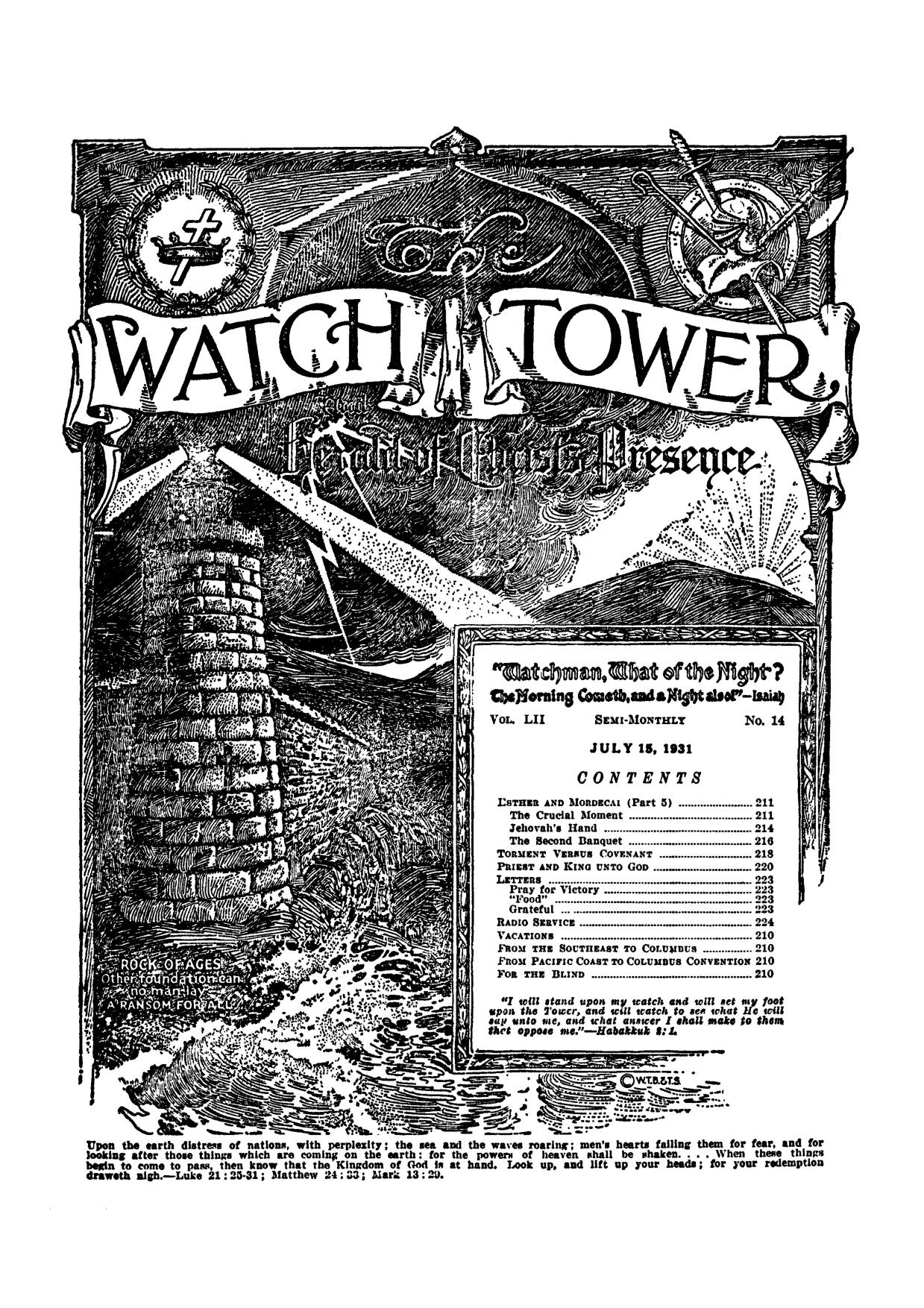
VACATIONS
The vacation for the Bethel family at Brooklyn and for the office force at the Canadian headquarters at Toronto will begin July 24 and end on August 8. During that period of time the office and the Bethel home at these points will be closed, and the members of the office forces and family will be privileged to attend the convention, and afterwards have part in the service as they may see fit.
Classes will please have these dates in mind and send any orders two weeks in advance, so that they can be filled prior to July 24, as no orders to either office will be filled during the time above mentioned.
FROM THE SOUTHEAST TO COLUMBUS
Notice has been received that the Virginia and North Carolina friends will travel to the Columbus convention over the Norfolk & Western, using train No. 3, called “the Pocahontas’’. This train will leave Norfolk July 23 at 12.15 p.m., Richmond 12.50 p.m., Petersburg 2.05 p.m., arriving at Columbus 7.25 a.m., July 24. Friends desiring to use this train will communicate with R. A. Gamble, 3701 Granby St., Norfolk, Va., or D. H. Selden, 3109 Floyd Av., Richmond, Va.
FROM PACIFIC COAST TO COLUMBUS CONVENTION
The Pacific Coast friends inform us that they are making arrangements to run either special cars or a special train from the Pacific Coast to Columbus. The proposed schedule is as follows:
Friends from southern California planning to travel on this train will communicate with Edward Stark, 332 El Camino Drive, Beverly Hills, Calif. Those planning to join the train at San Francisco will communicate with C. W. Gerdes, 61 Diamond St., San Francisco, Calif. Those in the vicinity of Portland will communicate with W. H. Bentley, 832 E. 29th St., Portland, Oreg.
FOR THE BLIND
For the benefit of those who are blind the book Reconciliation has been published in Braille, at a cost of $8.00 per volume. To those unable to purchase a copy, the book will be sent on loan. All orders and requests for copies on loan should be addressed to the Society’s Branch for the Blind at 1210 Spear St., Logansport, Indiana.
July 15, 1931
No. 14
ESTHER AND MORDECAI
“Ye lovers of Jehovah! hate ye wrong. He preserveth the lives of his men of kindness, from the hand of lawless ones he rescueth them.”—Ps. 97: 10, Roth.
PART 5
JEHOVAH counsels his people to pursue a wise course. That means to first seek to know the will of God and then do accordingly. No man is sufficiently wise in himself to know what to do without seeking the counsel and direction of the Lord. The foolish man is guided by his own conscience and without regard to Jehovah’s Word. The wise man is he who does not lean to his own opinion or understanding but looks to the Lord for guidance. Jehovah says to those who are in the covenant with him: “Trust in the Lord with all thine heart; and lean not unto thine own understanding. In all thy ways acknowledge him, and he shall direct thy paths. ’ ’—Prov. 3:5, 6.
2 In the last issue of The Watch Tower wherein is considered the divine drama of Esther, the Jews are seen in a position of great peril which threatened soon to fall upon them. Esther and Mordecai and the other Jews were fasting and praying according to their law and customs. Divine wisdom, guidance and help were being sought by them. Esther followed the counsel of the Most High, and he rewarded her faith and obedience. “He that handleth a matter wisely shall find good; and whoso trusteth in the Lord, happy is he.” (Prov. 16:20, 21) This scripture announces the divine rule, to which there is no exception.
3 When the great testing time began in 1918 some who had the truth acted foolishly and declined to learn wisdom from the Lord. It is now folly to try to instruct them. “Understanding is a wellspring of life unto him that hath it: but the instruction of fools is folly.” (Prov. 16:22) Some of these have with much vehemence said: ‘We will not be bound; we will be free to follow the course that seems right to us. We will not take any suggestions as to how the work of the Lord shall be carried on.’ They refuse to humble themselves under the mighty hand of God. “A wicked man hardeneth his face; but as for the upright, he directeth his way. There is no wisdom, nor understanding, nor counsel, against the Lord.” (Prov. 21:29, 30) Surely all these things were set forth in the Word of God for the special benefit of the remnant. (Rom. 15:4) The course that Esther pursued, being according to wisdom from on high, marks the way that those in the covenant with God should take. “Now it came to pass on the third day, that Esther put on her royal apparel, and stood in the inner court of the king’s house, over against the king’s house: and the king sat upon his royal throne in the royal house, over against the gate of the house. ’ ’—5:1.
4 Esther sought results, and therefore did not assume the attitude of a martyr that she might incite sympathy in her behalf. She was not like the hypocritical Pharisees; hence she did not advertise the fact of her fasting by a sorrowful face, but she put on her best, made her countenance bright, and her appearance pleasing, that she might appear before her master and king and appeal to his eye and gain his favor. All who appear before Christ Jesus and receive his approval must have on ‘the wedding garments’; and the remnant delight to be thus arrayed, which means that they are doing the work of the Lord wisely and in accordance with his way. Called upon to be the bride of Christ Jesus the faithful ‘arrayed themselves in fine linen, cl an and white, which is the righteousness of the saints’. (Rev. 19:7, 8) Their devotion is wholly to God and to his kingdom. They wear the royal insignia as prefigured by the “robe of righteousness”. Thus clothed and having the joy of the Lord they appear seemly and pleasing to the King of the Most High. The remnant encounter many hardships because they are in the land of the enemy and because of their faithfulness unto God, but they are joyful all the time for the reason that they know that they are doing right and following the course marked out for them by divine wisdom.
THE CRUCIAL MOMENT
5 Satan is a subtle and wily foe, but his schemes always fail when Jehovah interferes. To be sure, Satan knew of the unchangeableness of the laws of the Medes and Persians and that the appearance of the queen unbidden in the presence of the king would mean her death if the king did not approve. The king sat upon his royal throne at the entrance of the house. Esther, clothed in her royal apparel and wearing all her charms of beauty, entered and stood in the inner court, where the king could observe her from his position on the throne. The Devil, with all of his officers and angels, was doubtless right there, and in this critical and breathless moment was trying to induce Ahasuerus the king to become peeved and manifest his displeasure with Esther for thus unceremoniously appearing in his august presence. It was a crucial moment, and the Devil must succeed with his scheme now, if at all. But Jehovah was directing that great drama, and Esther was in his care. He had observed the fasting of Esther and Mordecai and the other Jews, and their entreatment of him for deliverance. God’s mighty angels would be there to push back Satan and his wicked crowd and prevent an unfavorable decision by Ahasuerus the king. The angels of the Lord would be there before Esther appeared, to see to it that Ahasuerus the king should not be disturbed or made sour or angry. No doubt the king was feeling at his best on that occasion. With pleasant thoughts in his mind the king looked around and saw his beautiful queen. “And it was so, when the king saw Esther the queen standing in the court, that she obtained favor in his sight; and the king held out to Esther the golden sceptre that was in his hand. So Esther drew near, and touched the top of the sceptre. ’ ’ (5:2) The Devil was dreadfully disappointed and angry just then. But he was powerless. Jehovah by his angels had prevented Satan from carrying out his wicked scheme, and the bride of the king was saved.
6 This was just as if Jesus Christ were there and drew around his bride “the garments of salvation”. Extending to Esther the golden scepter by the king meant her salvation. Upon the coming of the Lord Jesus to build up Zion the divine favor held out to the prospective bride of Christ meant the salvation of these; therefore the ones forming the bride of Christ were given the “garments of salvation”, and by the Lord were brought under “the robe of righteousness”. (Isa. 61:10) There must have been rejoicing among the angels of God when Esther was approved. There must have been great rejoicing in heaven when Jesus brought the remnant into the temple and gave to the bride class “the robe of righteousness” and these were safe in the secret place of the Most High.
7 Seeing the king manifest his favor by holding out to her the golden scepter, Esther drew near and touched it. In like manner Christ the King offers his favor to and shares his kingdom with the faithful bride class. “Then said the king unto her, What wilt thou, queen Esther? and what is thy request? it shall be even given thee to the half of the kingdom.” (5:3) The charming queen, having prepared a banquet for the king, answered his request by inviting the king to that banquet. “And Esther answered, If it seem good unto the king, let the king and Haman come this day unto the banquet that I have prepared for him. ’ ’—5:4.
8 That would tend to make the king even more desirous to bestow his kindness upon the queen. Furthermore, she showed consideration for the king by inviting his grand vizier to the banquet. She would leave no stone unturned to accomplish the desired end, and would trust in God to guide her in the right way. Esther handled the matter wisely and found good because she trusted in Jehovah.—Prov. 16: 20, 21.
9 The king, accompanied by Haman, went to dine with the queen. At the banquet table, and when the king’s heart was made merry with wine and his palate was tickled with the tasty food, he addressed Esther: “And the king said unto Esther at the banquet of wine, What is thy petition? and it shall be granted thee: and what is thy request? even to the half of the kingdom it shall be performed.”—5: 6.
10 Esther was playing her part, and she would proceed with caution and deliberation to reach the climax at the opportune moment. Divine wisdom was guiding her. Without a doubt she had carefully thought out her course and the action she should take and the words she should speak, and this she had done during the three days she was fasting. She had ‘studied to show herself approved’, by God first, and that she might receive divine guidance and have the favor and approval of her lord and king. This is a lesson to be followed by all those who are in the covenant with the Lord for the kingdom. All such should ‘ study to show themselves approved unto God’ and never try to accomplish something merely for a selfish reason. If there is a selfish motive prompting the course of action of one in matters pertaining to the kingdom, he is almost certain to fail.
11 The king had enjoyed the feast and was now pleased to have Esther make her further request: ‘ ‘ Then answered Esther, and said, My petition and my request is; if I have found favour in the sight of the king, and if it please the king to grant my petition, and to perform my request, let the king and Haman come to the banquet that I shall prepare for them, and I will do tomorrow as the king hath said.”—5:7,8.
12 If Esther had pleased the king up to this point (and she had), then her request was that she be permitted to prepare another feast for him and his favorite officer of state. This would put Haman off his guard and make him feel his own importance and that he was entirely safe in his position and justified in his scheme to kill Mordecai and the other Jews. Esther was following the divine rule by ‘being as sagacious as the serpent’. (Matt. 10:16) This same rule the remnant are admonished to observe.
13 Now the remnant is pleasing to the King, Christ Jesus, by bearing and holding forth his testimony, and at the same time requesting the enemy’s representatives to share in the feast, which shows that there is no secret method necessary in order for the remnant to accomplish God’s purposes concerning them. The testimony is given far and wide and with the announcement that it is done for the pleasure of the King and for the good of the people. The representatives of Satan the Devil hear the message and are permitted to partake of the feast if they so desire. To Esther the king Ahasuerus here represented the King Christ Jesus, whom the Esther class now endeavors to please. To Haman, Ahasuerus the king stood for all earthly power; and Haman, being next to the king, and being the honored guest at the banquet, would feel very much elated because of his favorable position, and would gloat over the fact that he was now in the king’s best favor and would be able to destroy all his enemies, the Jews, and particularly Mordecai. Even so now, the Haman class regard their honored positions in the world as proof that, when the due time comes, they can easily cause the extermination of the Mordecai class, and thus make their boast. What immediately follows supports this conclusion.
14 Haman had dined with the king and his queen, and that honor had swelled his head; and he went forth from the king’s presence in a merry attitude. But when he saw Mordecai, that increased his wrath and his desire to shed his blood. “Then went Haman forth that day joyful and with a glad heart; but when Haman saw Mordecai in the king’s gate, that he stood not up, nor moved for him, he was full of indignation against Mordecai.”—5: 9.
15 Mordecai was at the palace gate when Haman approached, and he treated Haman with silent contempt. This proves that Mordecai had not cried out and fasted because he regretted the course he had taken toward Haman, but that he was willing to die, if need be, that he might maintain his integrity toward God. His cries unto God had been for his provision for deliverance. Haman had murder in his heart when he saw Mordecai; but the opportune time had not arrived, so he hurried on home and called together his friends and Zeresh his wife for consultation. (5:10) First, Haman would tell his wife and friends about his great favor of being invited to the banquet. He boasted of his power and influence with the king. ‘ ‘ And Haman told them of the glory of his riches, and the multitude of his children, and all the things wherein the king had promoted him, and how he had advanced him above the princes and servants of the king. Haman said moreover, Yea, Esther the queen did let no man come in with the king unto the banquet that she had prepared, but myself; and tomorrow am I invited unto her also with the king. Yet all this availeth me nothing, so long as I see Mordecai the Jew sitting at the king’s gate. ” (5:11-13) He was a great man in the realm, great in his own estimation, great in the eyes of his own household, and now he had the despicable Jews where he could crush them, as he thought, and his joy would not be complete until this was accomplished.
16 The circumstances which God had arranged through Esther furnished Haman with a “strong delusion”, that he in his self-conceit and vanity “should believe a lie”, to wit, that his own high standing with the king fully assured him that he was taking the proper course in destroying the Jews. Even so today, there are those who call themselves God’s specially favored ones, and who exalt themselves, and who because of their high position justify themselves in their efforts to destroy the kingdom work and those that are doing it. They, therefore, have a “strong delusion”, which the Lord has arranged for them by his circumstances with the queenly class. They are anti-kingdom because they are against God’s kingdom and the kingdom work. (2 Thess. 2:4-11) Satan the Devil is the fertile liar and the father of the conspiracy to kill the remnant, and he directs the course of his earthly agents to accomplish that purpose, whether all of them are aware of it or not. These pat themselves on the back, because they are so highly favored by the Lord, as they believe, and yet they say: ‘We must get rid of that Mordecai class. ’ The clergy and the “evil servant” class, the “man of sin, the son of perdition”, all are being directed by Satan, and God is permitting all such to have a free hand to go their limit. These enemies see the remnant enjoying some freedom of speech amongst the people, and some opportunity of carrying on the work of preaching the gospel of the kingdom, and this increases their malice, even as the malice of Haman was increased against Mordecai because he was somewhat in the king’s favor.
17 Esther, by fasting with the other Jews and then appearing unbidden before the king, had burned all bridges behind her, and when these facts were known they would definitely identify her to all as a Jewess. But it seems quite probable that Haman had not yet learned that Esther was a cousin of Mordecai, and a Jewess. Of course, the Devil knew that fact; but the Devil himself cannot accomplish his design when Jehovah interferes therewith. Haman was absorbed with two things principally; namely, (1) his own importance and favorable position with the king, and (2) his design upon the life of Mordecai. The Haman class today are impressed with two things, to wit: their own importance and their influence with the powers of this world, and congratulate themselves that they are God’s people, favored ones, and about this they boast; and (2), the remnant class being an eyesore to the Haman crowd, their destruction is sought.
18 The Haman class of this day do not believe that the remnant, now on earth giving the testimony, is in line for membership in the bride of Christ. On the contrary, the Haman class believe the remnant are greatly in God’s disfavor. “Organized Christianity” and its clergy, and all who are pursuing a similar course, represent the Haman class, and these believe that “the higher powers” are the worldly governments. Seeing that the remnant class refuse to bow down to “Christianity”, tin’s is an evidence to the Haman class that the remnant has not the favor of God. They therefore mark the remnant or servant class for destruction, not considering that their design is against the bride of Christ, even as Haman apparently was not plotting for the death of the queen. Satan the Devil conspired to kill Esther; and today Satan has all the remnant marked for slaughter. Haman reasoned that, if he could hang Mordecai on a tree, that would make him an accursed person before his own God. (Deut. 21:22,23) That, in his opinion, would make him appear in the eyes of the Persians, and also under the law of the Jews, as justified in his action against Mordecai and the other Jews. Counting himself in the special favor of the mighty ruler and his queen, by reason of being the honored guest at the banquet, Haman listened with tingling ears to the counsel given by his wife and his friends: ‘ ‘ Then said Zeresh his wife and all his friends unto him, Let a gallows be made of fifty cubits high, and tomorrow speak thou unto the king, that Mordecai may be hanged thereon; then go thou in merrily with the king unto the banquet. And the thing pleased Haman; and he caused the gallows to be made.” (5:14) He therefore gladly followed their suggestions and proceeded at once to have the gallows built on which to hang Mordecai. He looked forward to the next day, when he would appear before the king and secure the royal approval to kill Mordecai the hated Jew.
JEHOVAH’S HAND
19 Probably Haman slept lightly that night, because he would visualize that gallows with Mordecai hanging high upon it. First, however, he must obtain the approval by the king, and, being a diplomatic tool of Satan, he would that night formulate his speech that he intended to make before the king to secure the approval for the shedding of Mordecai’s blood. Ahasuerus the king was troubled and did not sleep that night. Undoubtedly Jehovah sent to him an angel to keep sleep from the king and thus to give warning. A similar instance occurred at the time when Jesus was before Pilate and that mighty ruler received a warning by his wife’s having a dream and relating it to him. (Matt. 27:19) The Scriptures show that God remembers his faithful servants for good deeds that have been previously done, and rewards them in his own due time.—Acts 10: 4; Neh. 5:19.
20 “On that night could not the king sleep, and he commanded to bring the book of records of the chronicles; and they were read before the king. And it was found written, that Mordecai had told of Bigthana and Teresh, two of the king’s chamberlains, the keepers of the door, who sought to lay hand on the king Ahasuerus. And the king said, What honour and dignity hath been done to Mordecai for this? Then said the king’s servants that ministered unto him, There is nothing done for him.”—6:1-3.
21 Mordecai had rendered good and faithful service to the king, and this the record brought to the king’s mind, and also reminded him that Mordecai had received no recognition therefor. (2:21-23) Jehovah caused this matter to be brought to the attention of the king at this very urgent time, and doubtless had his angel on the spot for that very purpose. King Ahasuerus was informed that nothing had been done in recognition of Mordecai’s faithful service. A recognition of this faithful service God had kept in reserve for the opportune time, and then put it into the mind of the king to act accordingly.
22 The next morning the boastful and austere Haman appeared at the palace for the purpose of obtaining the final approval for the hanging of Mordecai. Being a great man and austere, doubtless some fuss was made over him in the court, and this attracted the king's attention. “And the king said, Who is in the court? Now Haman was come into the outward court of the king’s house, to speak unto the king to hang Mordecai on the gallows that he had prepared for him.”— 6:4.
23 Today it is well known that the clergy of “organized Christianity” exercise all the influence possible with the governments, and move with diplomacy to secure the sanction, or some lawful excuse, to get rid of the “Bible Students” who persist in going from door to door with the message of the kingdom. They deport themselves as exceedingly important, haughty and austere; they go about their work and make it appear that all who criticize them are against the laws of the land. At the same time these hypocritical clergy pray amongst themselves that the “Bible Students ’ ’ might be destroyed, and they justify themselves in their own minds and before one another on the ground that the “Bible Students” are “worse than Bolshevism”. To be sure, their prayers never reach Jehovah’s ears, because “the face of the Lord is against them that do evil”. (1 Pet. 3:12) Nor will they succeed with the earthly rulers in exterminating the “Bible Students”. The time will come when the worldly rulers will turn against the hypocritical clergy and the religion practiced by these so-called “Christians” and will destroy them. (Rev. 17:16-18) These Scriptural pictures were recorded in the Word of God manifestly for the purpose of disclosing to the remnant at the proper time the murderous spirit of the hypocritical clergy and “that man of sin, the son of perdition ’ ’.
24 The king was informed that Haman was in the court of the palace, and he commanded that Haman should approach. ‘ ‘ So Haman came in. And the king said unto him, What shall be done unto the man whom the king delighteth to honour? Now Haman thought in his heart, To whom would the king delight to do honour more than to myself ? ’ ’—6: 6.
25 Earthly kings do not desire to honor such as Mordecai, and this shows that the king Ahasuerus at this point pictured the Lord, the King of glory, because he expressed his delight to do honor to one that had rendered faithful service. Of course, Haman thought the king referred to him as the one whom he would delight to honor. Haman pictured a class of the present day who say: ‘Whom would the rulers delight to honor more than us?’ The Haman class conspire to destroy the Lord’s “servant” class, pictured by Mordecai, and in so doing expect to receive honor from earthly rulers and also from the Lord of heaven.
26 The present-day Haman class think that they are heaven’s favorites. Claiming to be the anointed representatives of God and Christ, they also claim to be God’s channel ordained to do all the preaching that is permissible in the world. Boastingly they claim to speak with divine authority and to be the only ones who can thus speak. They are, therefore, presumptuous before the heavenly King, and count too much on their influence with earthly rulers. Haman exhibited to Ahasuerus the king his covetous desire to be honored equally with the king himself, and this foreshadows that the Haman class of the present day seek earthly and political honors and glory that they might receive the plaudits of men.
27 Instantly Haman had a vision of himself garbed in the royal robes, seated upon the king’s fine charger, led by a servant of the king’s household through the streets of the capital city, and a crier proclaiming before him and to the people this mighty and honored one. He would thus appear to have the supreme favor of his royal highness, and this honor, in his mind, would make him doubly sure of obtaining the royal approval for hanging Mordecai. Likewise the Haman class of the present day greatly desire the honor of the earthly rulers that they may further impress the people with their own greatness and goodness, and they do receive such as a token that they are not only the favorites of the rulers of this world but the favorites of God, and that with impunity they could ask for the destruction of that “pestiferous class” on earth who go about giving testimony to the name of God and his kingdom.
28 Haman, with boastful confidence, made his speech before the king, pointing out to the king what should be done for the man whom the king would delight to honor; and immediately Ahasuerus the king adopted the suggestion of Haman and directed him, Haman, to confer this honor upon Mordecai, the one whom he hated the most. “Then the king said to Haman, Make haste, and take the apparel and the horse, as thou hast said, and do even so to Mordecai the Jew, that sitteth at the king’s gate; let nothing fail of all that thou hast spoken. ’ ’—6:10.
29 What a disappointment those words of the king must have brought to Haman! Stunned and chagrined, he dared not to refuse to obey the order of the king, because to do so would mean his instant death. Had he known what would shortly follow, he might have refused to obey the king and saved himself further humiliation. This further supports what other scriptures teach, that the clergy and their close allies will be humiliated by the Lord before they are destroyed.
30 He arrayed Mordecai in the royal apparel and brought him through the streets of the capital city on horseback, proclaiming before him and to the people: “Thus shall it be done unto the man whom the king delighteth to honour.”—6:11.
31 Will the Lord God make known to the common peoples that the Mordecai class now on earth is in the divine favor, and the representative of God and his kingdom in this world, and therefore has the approval of the Lord? Concerning the “faithful and wise servant”, which must include Christ’s body members now on earth, and who are faithful and true, it is written: ‘ ‘ Behold my servant, whom I uphold, mine elect, in whom my soul delighteth; I have put my spirit upon him; he shall bring forth judgment to the Gentiles.’ ’ (Isa. 42:1) “Behold, I have given him for a witness to the people, a leader and commander to the people.” (Isa. 55:4) Such facts made known to the people would be greatly to the humiliation and chagrin of the organized, hypocritical clergy and their close allies, who are in the conspiracy against the remnant of God. “Behold, I will make them of the synagogue of Satan, which say they are Jews, and are not, but do lie: behold, I will make them to come and worship before thy feet, and to know that I have loved thee. ’ ’—Rev. 3: 9.
32 Mordecai was returned in triumph to the palace gate; and Haman hastened, with covered head and in great distress, to his home to seek some consolation from his wife and his other advisers. (6:12) “Then said his wise men and Zeresh his wife unto him, If Mordecai be of the seed of the Jews, before whom thou hast begun to fall, thou shalt not prevail against him, but shalt surely fall before him. ’ ’—6: 13.
33 Again the hand of Jehovah is seen in this matter. The words uttered by Haman’s wife and his wise men were prophetic words, which without doubt were inspired by the angel of the Lord. Of course, they had heard prior to that time that God had pronounced the judgment against the Amalekites, the forefathers of Haman, which included Haman. This fact would be known by the advisers of Haman, and they would call it to mind at this time. (Ex. 17:16) Jehovah takes no positive action against his enemies by secret or in a corner. He affords them full opportunity to know what is coming. An instance is that of the prophecy of one of the Midianites who was a private soldier in the army, and had a dream, and told the coming destruction of the Midianite army. (Judg. 7:13, 14) The dream was no doubt inspired by the angel of the Lord and caused to be uttered.
34 Even so today, that class foreshadowed by Haman, to wit, the ecclesiastics, and including the “man of sin”, have no excuse to be ignorant of what is coming. They have the prophecies, which they claim to read. By radio and by printed message that is widely distributed they are informed of God’s judgment against them. Haman’s advisers doubtless were directed by the angel of the Lord to advise Haman what he might expect shortly to come to pass: “And while they were yet talking with him, came the king’s chamberlains, and hasted to bring Haman unto the banquet that Esther had prepared. ’ ’—6:14.
35 For Haman the drama was drawing to a climax, and to a close, marking his speedy and complete downfall. Since he ordered the building of the gallows on which to hang Mordecai, matters had speeded up, and Haman saw that now the opportunity to hang Mordecai thereon was gone. He would console himself, however, by the fact that the great slaughter of the Jews, definitely fixed for the thirteenth day of the twelfth month, could not be changed and that he would “get” Mordecai anyhow. His disappointment would greatly confuse his thoughts; and while he was in this condition of flurry the king sent for him to hasten to the banquet. This would also be arranged by the angel of the Lord, because the opportune hour for Esther had arrived. The confused and now deluded Haman would probably take some consolation from the fact that he was the only honored guest invited to the banquet of the king and his queen; and although he had conspired to shed the blood of one whom the king had honored, still he would go bravely to the banquet with the full purpose and intention of having some further part in the killing of the Jews on the day of slaughter.
36 This would indicate that when God humiliates the clergy and their allies, and openly shows his favor to the remnant, the clergy class and their allies in wrongdoing will not relent nor change their course of action but will still thirst for the blood of God's true witnesses. Haman did not see his desire accomplished in the shedding of the blood of the Jews; neither will the clergy and their allies be gratified by seeing their desire for the destruction of the remnant class accomplished. Haman was destroyed before the big fight on the thirteenth day of the twelfth month came to pass, seeming to indicate that the Haman class go down before the time of the battle of Armageddon.
THE SECOND BANQUET
37 Again the king and his grand vizier sat at the banquet table with the queen. The king again asked Esther to make known her petition. Mark now the fairness of Esther in having Haman present when she presented her charge against him. This is further evidence that God’s guiding hand was directing her, because his law judges no man without giving him a hearing. The beautiful queen, with studied and well chosen phrase, said: “If I have found favour in thy sight, O king, and if it please the king, let my life be given me at my petition, and my people at my request; for we are sold, I and my people, to be destroyed, to be slain, and to perish. But if we had been sold for bondmen and bondwomen, I had held my tongue, although the enemy could not countervail the king’s damage.”—7: 3,4.
38 Esther asked not only for her own life, but for the life of her people as well, thus disclosing to the king and to Haman that she was a Jewess. This was the crucial hour, and she met the test bravely. Today God’s remnant appeal to the heavenly King for the preservation of God’s people to his own honor. They do not appeal to Satan’s organization for protection from their enemies, yet they are plainly telling the political and commercial elements of the world that the clergy of so-called “organized Christianity” are hypocrites and are seeking the destruction of God’s witnesses who are espoused to Christ. The remnant must definitely identify themselves as members of the Lord’s ‘elect servant’ class. This they do not do egotistically, but do so in taking their firm and unequivocal stand for Jehovah.
39 King Ahasuerus then said to Esther: ‘Who and where is he who dares thus to do this terrible crime ? ’ With emphatic and dramatic speech Esther replied: ‘There is the man, the adversary and enemy, the wicked Haman.’ It was then that Haman showed fear. He knew that “the jig was up ’’ with him. May it not be that the Haman class will show some fear when they awake fully to the fact that it is by the hand and power of Jehovah God that the witness work of the remnant is now going forward in the land ? Seeing that their efforts to stop the work have been futile, and being exposed and humiliated, they will see that their end is come and that their destruction is at hand. It will be somewhat of a surprise to see themselves turned away by their worldly allies, the political and commercial rulers, as the Scriptures foretell will come to pass.
40 Greatly disgusted and angered, the king withdrew to the garden, while Haman stood up to plead with Esther for his life. Here the action of the king well pictures what righteousness there is left in the mind of imperfect men who rule the world. There are a great many men among the rulers of the world who hate hypocrites and men who hide behind the hypocritical garb of the clergymen while they carry forward a dastardly conspiracy to accomplish their wicked purposes. Such men in the affairs of the world will turn with disgust away from the hypocritical clergy, when their eyes are fully opened to the facts as they really exist.
41 For Esther to have shown mercy and relented toward Haman would have been displeasing to God, for the reason that Jehovah had declared that the Amalekites should be completely destroyed. King Saul had spared Agag, and God cast him away. Haman was an Agagite, and if Esther would be faithful she must show no quarter to him. This seems to foreshadow that, when the time approaches for the destruction of the Haman class at the hands of the Lord the King, the remnant will keep hands off and will not make any plea in their behalf. In the meantime the remnant cannot refrain from telling the truth and declaring the judgment of God against those who hypocritically and falsely claim to represent him.
42 Returning from the garden, Ahasuerus the king found Haman upon the couch whereon Queen Esther was, and making an appeal to her for some quarter. “Then said the king, Will he force the queen also before me in the house ? As the word went out of the king’s mouth, they covered Haman’s face.” It is not at all probable that it was Haman’s purpose to take advantage of the body of the queen at that time, but the words of the king on that occasion are significant.
43 The clergy of “organized Christendom” and their co-supporters have tried to “force” the bride of Christ, the witnesses of God on earth, into a compromising position of unfaithfulness and uncleanness toward the Lord. The clergy themselves are guilty of unclean conduct and are denounced in the Scriptures as adulterers. (Jas. 4:4) They have tried to compel God’s true children to take a like compromising position. The King Eternal is angry at such attempts of force. The clergy have put themselves in a very awkward position by trying to shield themselves and to seek protection from being exposed by the light of the truth delivered by God’s witnesses. They hate the light, because their deeds are evil. As Esther turned the light on Haman by telling the truth, and Haman begged her to desist, even so has the remnant turned the light on the clergy and exposed their duplicity and hypocrisy. They plead that they are being persecuted and ask for quarter and that they might be shielded from the so-called “bigotry” of the “Bible Students”.
44 Harbonah, one of the king’s counselors, must have been near at hand, even though he was not a guest at the banquet. Probably he appeared when the king went into the garden. When the king uttered the words in disgust concerning the unseemly conduct of Haman on the couch of the queen, Harbonah recommended that Haman be accommodated by being hanged on the gallows that he had built for Mordecai. “And Harbonah, one of the chamberlains, said before the king, Behold also, the gallows, fifty cubits high, which Haman had made for Mordecai, who had spoken good for the king, standeth in the house of Haman. Then the king said, Hang him thereon.”—7: 9.
45 Haman had prepared to destroy one who had rendered faithful service to the king, and, learning this fact, Ahasuerus the king was incensed against him and directed that Haman should be hanged on the gallows that he had built for Mordecai.
46 There are men in the control of the public offices of the governments of the world who tolerate the clergy but who will hardly be convinced at this time that the clergy conspire to destroy the humble remnant who are God’s witnesses. Brave and honest men laid the foundation of such countries as America, and provided in the Constitution of the United States that everyone should be privileged to worship God as he may choose. Religious liberty has ever been the pride of the American rulers. The clergy should have at all times encouraged a full and complete freedom in the preaching of the gospel and the explanation of the Bible, but they have been and are the most violent opposers thereof, and have diligently endeavored to prevent the people from getting a knowledge of the Bible. Their desire to get the ‘ ‘ Bible Students ’ ’ out of the way is entirely selfish. When the honest-hearted men of the governments learn that the real purpose of the clergy has been and is to destroy those who tell the truth of the Bible, and that for their own selfish ends, they will turn against the clergy and do unto them as the clergy have desired should be done unto the remnant. The law of retribution is a righteous law, because God has so provided. “He made a pit, and digged it, and is fallen into the ditch which he made. His mischief shall return upon his own head, and his violent dealing shall come down upon his own pate. ’ ’ (Ps. 7:15, 16) “The heathen are sunk down in the pit that they made: in the net which they hid is their own foot taken. The Lord is known by the judgment which he executeth: the wicked is snared in the work of his own hands.” (Ps. 9:15, 16) Thus Haman was hanged by members of his own organization. Even so the Lord permits some portion of Satan’s organization to destroy that class whom Haman represented.
47 The vindication of the Word and name of the King Eternal is the matter of greatest importance. “So they hanged Haman on the gallows that he had prepared for Mordecai. Then was the king’s wrath pacified.”—7:10.
48 Jehovah pictured the vindication of his name in the hanging of Satan’s representative, the wicked Haman. That, together with the hanging of his sons, cleared out the last of the Amalekites so far as mention in the Bible is concerned, and thus as God declared it should be. In recent years Jehovah has shown his people that the all-important thing is the vindication of his word and name. For their aid and comfort, and that they might keep bright their hope, he graciously reveals more clearly to them his purposes now, and this must indicate that the day is near when the name of Jehovah will be vindicated in the great battle of Armageddon.
(To be continued)
QUESTIONS FOK BEREAN STUDY
1. Distinguish between the wise and the foolish.
2. Show that Esther and Mordecai observed the divine rule and were following the counsel of the Most High.
3. Give illustrations of the application of Proverbs 16: 22 and 21: 29, 30.
4. Contrast the attitude of Esther (as described in Esther
5:1) and of the remnant (referred to in Revelation 19: 7,8) with that of the Pharisees (Matthew 6: 16).
5, 6. Describe Esther’s approach to the king, and his approval. How is this part of the prophetic picture fulfilled?
7, 8. How did the king here address Esther? How would her reply, as here recorded, naturally impress the king?
9-11. Relate how the banquet afforded opportunity for Esther to strengthen her position of favor and influence with the king, and how she used the occasion wisely.
12, 13. Why did Esther include Haman in the invitation to the banquet which she would prepare on the following day? What was the effect upon Haman? How does this part of the picture have fulfilment?
14-16. After the banquet, what took place to further embitter Haman against Mordecai? Just why did Mordecai so disregard Haman? What in the present situation was pictured therein?
17, 18. Did Haman know at this time that Mordecai and Esther were Jewish? At this point compare the position and attitude of Haman with that of the class whom he foreshadowed.
19-21. Account for the king’s sleeplessness that night. To what did this lead? This part of the record contains what lesson?
22, 23. How does Haman next come into the prophetic record? How does this have fulfilment?
24-27. Relate how Haman, in his pride and selfishness, prepared the way for Mordecai to be accorded the very honor that Haman coveted for himself. In what does that prophetic circumstance find a parallel at this time?
28-31. How did the king receive Haman’s suggestion as to ‘what should be done unto the man whom the king would delight to honor’? What did this mean for Haman? How does this have a fulfilment?
32-34. Show whether Haman had wise counselors. What is the lesson here?
35, 36. What consolation remained for the abased Haman? What was foreshadowed in that prophetic situation?
37, 38. What was the occasion which opened the way for Esther to present her petition to the king? What was her request? What did this mean for her? What is the application to the remnant?
39-43. Explain what was prophetically pictured in Esther 7: 6-8.
44-46. Haman’s plot, and the outcome thereof, pictured what present situation and what impending retribution upon the Haman class?
47, 48. Apply the statement that, upon their hanging Haman on the gallows that he had prepared for Mordecai, “then was the king’s wrath pacified. ’ ’ What is the lesson therein for the remnant?
TORMENT VERSUS COVENANT
JEHOVAH established the true religion in the earth, which was and is to worship him and glorify his name. Satan established a false religion in his attempt to be like the Most High. God established his covenant or solemn contract with the nation of Israel and commanded that they should keep themselves separate and distinct from the heathen nations round about. Satan established a false religion amongst the heathen nations and caused them to worship images and other things aside from Jehovah. These heathen idolaters built an altar in the valley of Hinnom for the purpose of offering sacrifices to their gods.
The Jews forsook their covenant with Jehovah and became worshipers of Baal, one of Satan’s deified ones. In practicing Baal worship they offered their children as sacrifices, and upon this has been based the doctrine of torture by fire, concerning which Jehovah says: “They have built also the high places of Baal, to burn their sons with fire for burnt offerings unto Baal, which I commanded not, nor spake it, neither came it into my mind.” (Jer. 19:5) Again, in Jeremiah, chapter thirty-two, verse thirty-five, the Lord said: “They built the high places of Baal, which are in the valley of the son of Hinnom, to cause their sons and their daughters to pass through the fire unto Molech, which I commanded them not, neither came it into my mind, that they should do this abomination, to cause Judah to sin.” The things which the heathen sacrificed they sacrificed to devils, and not to God. (1 Cor. 10:20) This false or devil religion established amongst the deluded people of the world was another means employed by Satan to blind the minds of men to the true teachings of the divine purposes.
In exercising divine justice, Jehovah at no time employs torture; but he denounces the doctrine of such as an abomination in his sight. Divine justice exercised destroys the evildoers; therefore that which is destroyed eternally is everlastingly punished. Some scriptures, quoted from Psalm thirty-seven (vss. 9, 10, 20, 22, 28, 34, 38), proving this, are: “Evil doers shall be cut off: but those that wait upon the Lord, they shall inherit the earth. For yet a little while, and the wicked shall not be; yea, thou shalt diligently consider his place, and it shall not be. But the wicked shall perish, and the enemies of the Lord shall be as the fat of lambs: they shall consume; into smoke shall they consume away. For such as be blessed of him shall inherit the earth; and they that be cursed of him shall be cut off. For the Lord loveth judgment, and forsaketh not his saints; they are preserved for ever: but the seed of the wicked shall be cut off. Wait on the Lord, and keep his way, and he shall exalt thee to inherit the land: when the wicked are cut off, thou shalt see it. The transgressors shall be destroyed together: the end of the wicked shall be cut off. ’ ’
The doctrine of eternal torment is a wicked defamation of Jehovah. It is a foul stain upon his lovable name. The chief purpose of man is to glorify God. It is therefore his privilege and duty to remove from the minds of others this misconception of Jehovah and enable others to understand that God is indeed love. An understanding of his purpose shows that everything he does is prompted by love. No sooner had he sentenced the man Adam to death than he began to reveal his provision for man’s redemption and ultimate deliverance. The more clearly we see and understand these great truths, the more do we rejoice in the divine attribute of justice and the divine arrangement in making it manifest.
Some time after Adam and Eve were driven from Eden children were born to them, who grew to the estate of manhood and womanhood and they in turn had children. Cain obtained his wife by marrying his sister. Thus the peoples of earth gradually increased. They all wandered about in the earth, earning their bread in the sweat of their faces. Some of these children were bad and some were good. God showed his favor to the good, as he always favors those who are good. Satan exercised his wicked influence amongst the people and most of them turned to wickedness.
Noah was a good man and he and the members of his family served the Lord Jehovah. Sixteen hundred years and more passed from the time of the judgment in Eden (during which time the people became very wicked) and there was great violence in the earth. God purposed to destroy all the wicked of earth; so he directed Noah to build an ark and to take into the ark the members of his family; and this done, a great flood of waters came upon the earth and all living creatures were destroyed except those in the ark. According to the Scriptures (Gen. 7:21-23; 1 Pet. 3: 20) there were only eight persons left on the earth after the flood. Noah and his sons begat children and the peoples of earth again increased. Amongst them were some good and some bad. Amongst those who tried to do the will of God was a man named Abram, whose name was later changed to Abraham. He is spoken of in the Scriptures as the friend of God. Abraham’s wife was named Sarah.
When Abraham was seventy-five years of age, Jehovah said to him: “Get thee out of thy country, and from thy kindred, and from thy father’s house, unto a land that I will show thee: and I will make of thee a great nation, and I will bless thee, and make thy name great; and thou shalt be a blessing: . . . and in thee shall all families of the earth be blessed.” (Gen. 12:1-3) Abraham with his wife and others left Haran for the land of Canaan. When they had reached a point in that land known as Sichem, the Lord appeared unto him and said: “Unto thy seed will I give this land.” Abraham builded an altar there, and the place has since been known as Bethel, which means the house of God. Afterward Abraham dwelt in the plains of Mamre, which is just above the present site of Hebron in the southern part of Palestine. While there, God made a covenant with him, saying: “Unto thy seed have I given this land, from the river of Egypt unto the great river, the river Euphrates.”—Gen. 15:18.
Thereafter, when Abraham was ninety-nine years old, the Lord appeared unto him and said: “I will make my covenant between me and thee, and will multiply thee exceedingly, . . . and thou shalt be a father of many nations. And I will give unto thee, and to thy seed after thee, the land wherein thou art a stranger, all the land of Canaan, for an everlasting possession; and I will be their God.”—Gen. 17:2, 4, 8.
Some time later, when Abraham was sitting at the door of his tent, which was pitched in the plains of Mamre, there stood before him three men, messengers from Jehovah. In the plains of Mamre, a short distance above the town of Hebron, still stands a very ancient oak tree. It is about thirty feet in circumference. It is claimed that this is Abraham’s oak, where he pitched his tent at the time these holy messengers appeared to him. Of course, we cannot believe this is true, because an oak would not live that length of time. It is interesting, however, to note this ancient tree standing approximately at the point where Abraham is supposed to have resided in his tent. Here it was that Abraham prepared refreshments for his distinguished visitors; and “he stood by them under the tree, and they did eat ’ ’. Here it was that the messenger of Jehovah told Abraham that he and his wife Sarah would be given a son.—Gen. 18:1-14.
In due time a son was born unto Abraham and Sarah and his name was called Isaac. (Gen. 21:1-3) Afterward, when the son Isaac had grown up, Jehovah put Abraham to a great test, and in doing so he made a picture which foreshadowed the redemption of the human race. This record appears in the twenty-second chapter of Genesis. God said unto Abraham: “Take now thy son, thine only son Isaac, whom thou lovest, and get thee into the land of Moriah; and offer him there for a burnt offering upon one of the mountains which I will tell thee of.” (Gen. 22:2) It is interesting here to note that Mount Moriah is inside of the walls of the present city of Jerusalem. It was the site of the temple of Solomon, and supposed to be the very spot where Abraham was met by Melchizedek, the mysterious king of Salem. It is the place where Abraham was directed to offer and did offer up his son Isaac.
Providing himself with wood to be used for the fire, Abraham and his son and servants journeyed for three days from the plains of Mamre to Moriah; and, arriving there, he at once prepared for the burnt offering. Isaac was not aware of the purpose of his father to offer him; so he said to his father: “Behold the fire and the wood; but where is the lamb for a burnt offering? And Abraham said, My son, God will provide himself a lamb for a burnt offering.” Abraham then informed his son that he was to be the offering. Then he bound Isaac and laid him upon the altar and stretched forth his hand and took the knife with which to slay his son. This was a great test to Abraham’s faith. Isaac was his only son and he loved him dearly; but Jehovah had commanded him to offer him up as a sacrifice, and because of his love for Jehovah he proceeded to obey God’s command. As he raised his hand to strike dead his only beloved son, “the angel of the Lord called unto him out of heaven, and said, Abraham, . . . Lay not thine hand upon the lad, neither do thou anything unto him; for now I know that thou fearest God, seeing thou hast not withheld thy son, thine only son, from me.” When Abraham looked he saw a ram caught in a thicket nearby and he took the ram and offered it for a burnt offering.
Then “the angel of the Lord called unto Abraham . . . the second time, and said, By myself have I sworn, saith the Lord; for because thou hast done this thing, and hast not withheld thy son, thine only son; that in blessing I will bless thee, and in multiplying I will multiply thy seed as the stars of the heaven, and as the sand which is upon the sea shore; and thy seed shall possess the gate of his enemies: and in thy seed shall all the nations of the earth be blessed: because thou hast obeyed my voice”.—Gen. 22:15-18.
In this wonderful picture Abraham was a type or prophetic picture of Jehovah, while Isaac was a type of Jesus, the beloved Son of Jehovah. Abraham's offering his beloved son on the altar pictured how God in due time would offer his only beloved Son as a great sacrifice that mankind might be redeemed from death and have an opportunity to live. Abraham did not, as indeed he could not, understand God’s purposes, for the reason that Jehovah did not reveal them to him; but he knew that God had here made a covenant with him and bound it with his oath; and that by these two certain and unchangeable things, his word and his oath, God would carry out his covenant in due time, and that covenant would result in the blessing of all the families and nations of earth.
God’s covenant with Abraham to bless all the families and nations of the earth is utterly opposed to the doctrine of eternal torment in literal fire and brimstone as taught by the religionists of Christendom. The Bible, God’s Word, could not teach God’s covenant with Abraham and his seed and at the same time teach eternal torment for anyone, without contradicting itself. Hence the doctrine of everlasting torment must be false; it is proven to be unscriptural. It is an ecclesiastical untruth.
PRIEST AND KING UNTO GOD
JEHOVAH GOD’s true and eternal Priest and King was foreshadowed thousands of years ago in the history of God’s ancient people, the children of Abraham, Isaac and Jacob. All this was done for the information and benefit of those living on earth now.
The high priest of Jehovah God is the one who serves him officially as his principal officer. The ceremony performed in connection with the sacred tabernacle of the Jews on the atonement day was a prophetic ceremony. The priest performed that ceremony. In substance that prophetic ceremony said: The time will come when the great High Priest, appointed by Jehovah, shall serve in that official capacity in making atonement before God for the sins of the world. A perfect human sacrifice must be offered up as a substitute for sinful man, thereby providing the cost price for the redemption of man, and must in due time be presented to Jehovah. Who would be the priest to perform that sacrificial work? Paul, the inspired witness of the Lord, answers the question and identifies Christ Jesus as the great High Priest who was faithful to God who appointed him. Read his statement in the book of Hebrews, the first six verses of chapter three.
The proof shows not only that Jesus was the Priest of God when on earth, but that he still occupies that high office in heaven itself. Hebrews, chapter four, verse fifteen, says: “For we have not an high priest which cannot be touched with the feeling of our infirmities ; but was in all points tempted like as we are, yet without sin.” Hebrews, chapter eight, verse one, says: “Now of the things which we have spoken this is the sum: We have such an high priest, who is set on the right hand of the throne of the Majesty in the heavens.” Jesus did not take that high office by his own appointment, but took it by appointment from Jehovah God. Hebrews, chapter five, verses four and five, even so states, saying: “And no man taketh this honour unto himself, but he that is called of God, as was Aaron. So also Christ glorified not himself to be made a high priest; but he that said unto him, Thou art my Son, today have I begotten thee.”
Once each year, on the atonement day, the high priest of Israel performed the prophetic ceremony by offering the lives of animals; but in fulfilment of that prophecy Jesus Christ, the great High Priest of God, offered his own life-blood once, and thereby provided the ransom price and sin-offering for mankind. The apostolic record in Hebrews, chapter nine (11, 12, 14, 24, 26), reads: “Christ being come an high priest of good things to come, by a greater and more perfect tabernacle, not made with hands, that is to say, not of this building; neither by the blood of goats and calves, but by his own blood, he entered in once into the holy place, having obtained eternal redemption for us. How much more shall the blood of Christ, who through the eternal spirit offered himself without spot to God, purge your conscience from dead works to serve the living God? For Christ is not entered into the holy places made with hands, which are the figures of the true; but into heaven itself, now to appear in the presence of God for us. For then must he often have suffered since the foundation of the world: but now once in the end of the world hath he appeared, to put away sin by the sacrifice of himself.”
As further proof that the Jewish ceremony on the atonement day was prophetic, the high priest of the Jews must be taken from the tribe of Levi; and hence it was called the Levitical priesthood. Jesus was from the tribe of Judah, about which tribe nothing was said concerning priesthood. There was another priesthood provided, which is designated in the Scriptures by the Lord as the priesthood “after the order of Melchisedec”. Paul, the apostle, quotes the words of the prophet, and then says concerning the lineage of this great priest, “Without father, without mother, without descent, having neither beginning of days, nor end of life; but made like unto the Son of God, abideth a priest continually. ’ ’—Heb. 7: 3, 11-17.
By this language is meant that this priesthood did not come into office by reason of birth, as did the priests of the Levitical order, and that therefore he had neither father nor mother; and since there is no record of the beginning of the Mighty One, and since there is to be no end of his priesthood, it is stated that he was without beginning of days or end of life. Therefore the Levitical priesthood prophetically referred to the work of the great Priest, Christ Jesus, to be performed in connection with the antitypical or true atonement day, but it, that is to say, this Levitical priesthood, did not foreshadow other work than the same great Priest does.
Another prophecy was made foretelling that great Priest and the nature of his work. When Abraham the Hebrew was returning from rescuing Lot he was met by Melchizedek, who was then king of Salem, which means that he was king of peace (for the name Salem means peace), and he was at the same time a priest of the Most High God; and he gave Abraham nourishing food and drink. The data covering this is located in Genesis, chapter fourteen. (Heb. 7:1) That prophecy foretold the coming of a Mighty One who would fill the office of Priest of the Most High God and who would minister life-giving portions to the peoples of the earth. Jesus Christ fulfilled this prophecy and is God’s great High Priest and chief executive officer for ever, and he gave unto the people that which will bring and sustain life. Romans, chapter six, verse twenty-three, tells us that “the gift of God is eternal life, through Jesus Christ our Lord”. Being God’s chief executive officer, he does and will perform all things for Jehovah and in the name of Jehovah. Concerning this it is written, according to Second Corinthians, chapter five, verse eighteen, and First Corinthians, chapter eight, verse six, that ‘all things are from Jehovah and all things are by Christ Jesus’.
…