The Watchtower, November 1, 1930
Download: PDF — The Watchtower, November 1, 1930
PITTSBURGH AND CHICAGO CONVENTIONS
We are pleased to call attention to two conventions which Brother Rutherford expects to address:
Pittsburgh, Pa., Oct. 31-Nov. 2. Convention opens at 2: 00 p. m. Friday. Friday and Saturday sessions will be held in the Carnegie Music Hall, Federal and Ohio Sts., North Side. Sunday sessions will be held in the Garden Theatre. For further information address E. I. Baxter, 413 Bailey St., Pittsburgh, Pa.
Chicago, Ill., Nov. 4, 5. Convention opens at 9: 00 a. m. Tuesday. All sessions of the convention will be held at 1016 N. Dearborn St. For further information write J. P. Holmes, Knickerbocker Hotel.
RADIO IN PARIS
This is to advise that the Society has an arrangement with a radio station in Paris to broadcast the truth at regular intervals, and the new equipment will be installed by the middle of October. This should broaden the field very much for the colporteurs, and afford an opportunity for other colporteurs to enter the service. A number of brethren have gone from England to Paris, and even though they cannot speak the French language they get on well in the colporteur work. The canvass is printed on a card in the French language and it is presented to the one called upon, and the results are good. Anyone desiring to enter the colporteur work and who now resides in England, please communicate with the British Branch Office at London.
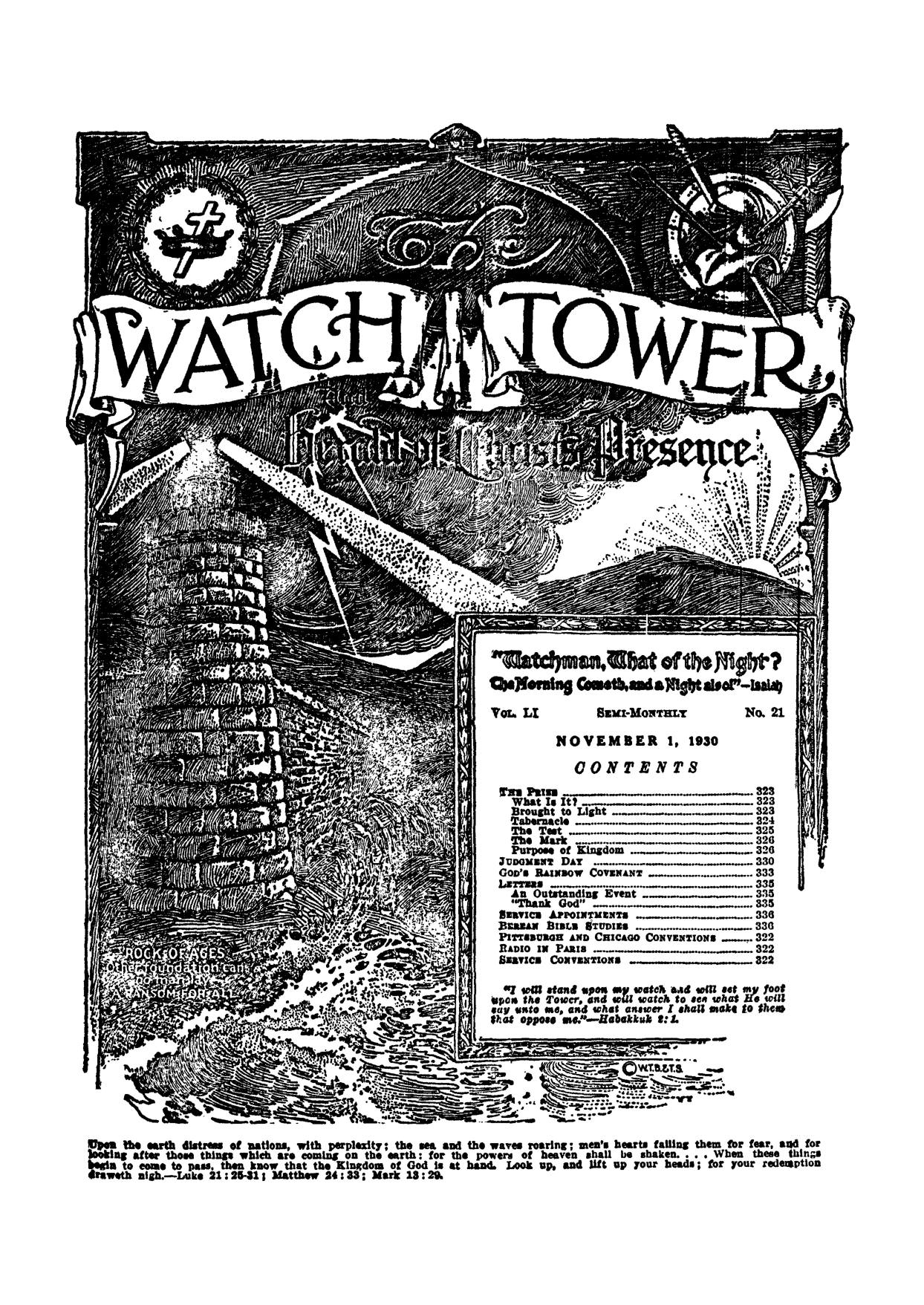
Vol. LI
November 1, 1930
No. 21
THE PRIZE
“I press toward the mark for the prize of the high calling of God in Christ Jesus.”—Phil. 3:14.
JEHOVAH awards the prize only to those who do his will. That would mean that whatever is done must be done lawfully. The motive inducing action must be unselfish. All who will ever receive the award of the prize must be governed by the same law. This conclusion is fully proven by the inspired words of the apostle: “And if a man also strive for masteries, yet is he not crowned, except he strive lawfully.’’ (2 Tim. 2: 5) The words of Jesus make the clear distinction between those who are lawless or workers of iniquity and those who strive in a lawful manner. Those who make up both classes are called to the high calling and are in line for the kingdom.—Matt. 13: 41-43.
WHAT IS IT?
2 It is important to have clearly in mind what is meant by the high calling and what is the prize. The church now discerns more clearly than ever before that God’s purpose from the beginning is to build a kingdom that will completely vindicate his name for ever. The call means an invitation. That is an invitation to the kingdom which will vindicate Jehovah’s name. Jesus was the first one called, and he was called after he was begotten at the Jordan. Others are called and they too must receive the call after having been brought forth as the sons of God. The high calling is to the kingdom, the seat of which is in heaven, and therefore is a call to a higher, heavenly place. Only spirit creatures would be called to that place, because none other could accept the call and it is certain that God would not issue a call to any creature who could not accept it. The first knowledge that any creature aside from Jesus had concerning the high calling was received by his disciples when Jesus said to them: “And I covenant for you, even as my Father has covenanted for me, a kingdom, that you may eat and drink at my table in my kingdom, and sit on thrones, judging the twelve tribes of Israel.” (Luke 22: 29, 30, Diag.) The high calling is therefore a place or position in the kingdom of Jehovah.
3 The prize is awarded to one (class or body) who strives lawfully and who wins. (1 Cor. 9: 24) Many are called, but few are chosen. Some respond to the call and are in line for the kingdom but do not win because they do not strive lawfully. Because they do not run lawfully they cannot be crowned. The prize is the crown of life to be awarded to that class of called ones who strive lawfully and are therefore faithful and true even unto death. It is to these Jesus said: “Be thou faithful unto death, and I will give thee the crown of life.” (Rev. 2: 10) The words both of Paul and of Jesus prove beyond all doubt that in order for the called ones to win the course of action taken by them must be a lawful one, that is to say, the one marked out by the Lord. Only the faithful followers of Christ Jesus take that course of action. Such faithful ones are designated “the elect of God”, and concerning which it is written: “Blessed be the God and Father of our Lord Jesus Christ, which according to his abundant mercy hath begotten us again unto a lively hope by the resurrection of Jesus Christ from the dead, to an inheritance incorruptible, and undefiled, and that fadeth not away, reserved in heaven for you, who are kept by the power of God through faith unto salvation ready to be revealed in the last time.”—1 Pet. 1: 3-5.
4 The faithful ones will be overcomers, and these will be rewarded with a seat on the throne with Christ in his kingdom and will be crowned with immortality. (Rev. 3: 21) The prize, therefore, is the reward given to the faithful and to none other.
BROUGHT TO LIGHT
5 The great and precious promises of the high calling which God gave to the church by Jesus Christ and his apostles were for a long while hidden under the rubbish of the false teachings of the clergy, which false teachings were inspired by Satan. During the period of the church foreshadowed by the Prophet Elijah the great truth of the high calling and other truths were restored to the church as Jesus had said would be done. (Matt. 17: 11) This bringing to light of the truths and restoring them was gradual, and the appreciation thereof by the church increased as the Lord caused the light to shine more clearly upon these truths.
6 In that restoration period it was first seen by those devoted to the Lord that Jehovah had made promise to bless all the families of the earth by and through the seed of Abraham and that the peoples of the earth are waiting for that seed to bring the blessings, even though they know not about it. This restitution coming in God’s due time revealed to the faithful the many errors of the clergy which they had for a long while been teaching. The faithful began to learn that God’s kingdom shall be set up for the benefit of his creatures, particularly man. They received the truth concerning hell and saw that the great ransom sacrifice makes it possible for all to have an opportunity for life.
7 These truths were received by God’s people on earth as an injunction to make their “calling and election sure” to a high place in God’s favor that they might reign with Christ for the purpose of blessing mankind in general. Such high place was the great objective set before them, the value of which could not be compared by them to anything else. The truths which stood out most prominent to them are these: The salvation of all the world by reason of the great ransom sacrifice, and the great restitution work that would be done in which work those called to the high calling would participate. These truths claimed the attention of the consecrated practically to the exclusion of all others. This clear distinction between the salvation of the world and the salvation of the church made it easy for the spirit-begotten ones to see that there must be a separation of themselves from the world in some form or measure. It was clearly understood that all of those called to the high calling must be consecrated to God even as Jesus was consecrated. Separation from the world was understood to mean that the consecrated must forego all rights and privileges that flow to the human creature and now the new creature must live a life of faith and piety with the expectancy that such course of action would bring about the perfection of the new creature and gain for him a position of honor with Christ Jesus in ruling the world.
8 The real purpose of the kingdom was not then understood. Salvation of the creature was conceived to be the all-important thing. Necessarily this led to selfishness on the part of many. Looking for what was conceived to be the prize led to pride on the part of others. They gloried in the fact that their position would be so much greater than that of others.
9 The consecrated were anxious to tell those who would listen of the second coming of Christ and his kingdom, and of the blessings that would flow to the people. These urged many to make a consecration to become runners in the race for the prize of the high calling. Because it was believed that God would find in the church denominations almost all of those whom he would take to heaven, for some time the message of the truth was carried by the Lord’s people almost exclusively to those who were members of the church denominations. This was largely due to the fact that it was the expectation that God would get what he wanted to go to heaven and then use them to give life to the rest of mankind. The consecrated ones who carried the message of truth to others were considered as angels who were gathering the wheat into the garner of the Lord. Frequently those of the consecrated who did this work would say with much pleasure and joy: ‘Today I found a real wheat head.’
10 These statements are made, not as criticism of anyone, but to show that God’s light has gradually unfolded his purposes to those devoted to him and now, by his grace, his purposes are more clearly seen than when first we came to a knowledge of the truth. Those who have walked in the light have every reason to rejoice, because these are granted partnership with the Lord according to his promise.
TABERNACLE
11 The book Tabernacle Shadows was given to the church and a study thereof became of great importance and resulted in much good to many and in mischief to others. The teaching of the tabernacle when understood gave help and strength to those really devoted to the Lord. It made clear the distinction between those who would receive the heavenly glory and those who would be restored to life on the earth. Undoubtedly it is the will of God to learn from the typical tabernacle and its ceremonies the necessity for the spiritual priesthood to cleanse themselves from all defilements and to perfect holiness in the fear of God. (2 Cor. 7: 1) Some erroneously concluded that this meant a personal “development of character” that would make them proper and qualified ones to reign with Christ. An improper understanding of what constitutes the world, and the continual thought of separation from the world, had much to do with many reaching the wrong conclusion. From much and continuous study of the Tabernacle Shadows a number reached the conclusion that God intended them to be shut in some quiet or secret place and to meditate and to grow in the “fruits and graces of the spirit” until ready to be taken to heaven. The point here emphasized is that their chief thought was to get to heaven in order that they might fill the office of ruling the world. Some are still in this condition and do not understand God’s purpose of establishing his kingdom, and therefore fail to get the real lessons that the tabernacle in the wilderness teaches.
12 That God did not prevent a test of the church in the matter of Tabernacle Shadows is quite evident. He permitted this test in order that the approved ones might be made manifest. This is supported by the conclusion announced in 1 Corinthians 11:19: “For there must be also heresies among you, that they which are approved may be made manifest among you.” The adversary aided some in getting the improper understanding because they were not induced by the right motive in taking the course of action they did take. It should be kept in mind that in the day when Tabernacle Shadows was the chief study of the church Satan was not yet cast out of heaven. He was continuously accusing the brethren and, to be sure, was using his subtle means to mislead them, and especially those who were induced by the wrong motive. The motive or heart condition is of vital importance, and this more clearly appears as we progress on the way.
13 Tabernacle Shadows doubtless provoked more discussion amongst the brethren than any other part of the truth. Thousands of hours were spent in discussing the minute details of the construction of the tabernacle and many futile attempts were made by these students to show the typical meaning thereof, while the greater and more important lessons taught by the tabernacle in the wilderness were overlooked or ignored. Some of the leaders in the church made a specialty of teaching Tabernacle Shadows and developed considerable pride and manifested it in this regard. By reason of the study of the details of the construction of the tabernacle, and the great stress laid upon the same, many were induced to believe that God’s purpose concerning them is that they should set themselves apart and perfect for themselves a character that would make them fit for heaven. The Lord foreknew and foretold by his prophet that some such would, with outward piety, ‘bow down the head like a bulrush’ while others would become wise in their own conceits. (Isa. 58:5; Rom. 12:16) Such were tricked by the adversary, and much mischief resulted to them by a wrong conception of the tabernacle. Because they were moved by a selfish desire they laid themselves open to the successful attack of the enemy. To be sure, the fault is not with the tabernacle nor with the book Tabernacle Shadows. The fault was in the hearts of those who studied the same for the purpose of justifying their course of action and in ignoring or overlooking God’s purpose in calling them to the high calling.
14 The faithful took a different course. Thankful to God for the blessed truths found in the study of the tabernacle these endeavored to serve God as true underpriests, to keep their hearts with all diligence, and to seek always to do that which would honor Jehovah and give to him all honor and glory. Their attention was not centered upon themselves. They realized their own imperfections and natural unworthiness of God’s great favor and that they could not make themselves perfect. They saw that to make themselves a “perfect character’’ is an impossibility; but, with Paul, ‘being confident that God, who had begun a good work in them, would perform it to a finish,’ they went on prayerfully and humbly seeking to know and to do the will of God. Their motive or inducing cause for pursuing their course of action was right, and therefore as the servant watches his master’s hand even so these waited upon the leadings of the Lord that they might know what his will would be concerning them. (Ps. 123: 2) These saw that the tabernacle in the wilderness was a detailed picture of the great sin-atonement arrangement that God has provided for the sins of the people through the sacrifice of Christ Jesus and they gave God the glory and praise for making this provision, and had a sincere and honest desire to serve him unselfishly.
15 Some have received the truth but have not received the love of the truth. (2 Thess. 2: 10) They received a knowledge of the truth in a spirit of selfishness and it is made plain by the Scriptures that such are not to be crowned with the prize. A mere mental knowledge of the truth does not prove at all that one will be in the kingdom. If one prides himself on the fact that his knowledge concerning the Bible is greater than that of his fellows and allows this to puff him up he looks upon himself with importance, thinks more highly of himself than he ought to think, and proves that he has not received the love of the truth. The energy of delusion comes in time and those who have had the wrong motive fall under the influence thereof and believe a lie rather than the truth.
THE TEST
16 The coming of the Lord to his temple and the gathering together to himself of his faithful is the time of the test. Such is the time when he sits as a great refiner and he makes clear the truth and separates the selfish from those who have had the right motive.
17 The Lord has disclosed the definite purpose of God in building his kingdom, and the humble and faithful ones now see that the chief purpose is the vindication of the Word and name of Jehovah.
18 They see that the purpose of the anointed’s being on earth at this time is that they might be God’s witnesses to give testimony that he is the Most High; that the world has ended, and that the time has come for the establishment of righteousness and therefore that according to the Lord’s commandment this good news must be preached to all the nations of the world as a witness. It is the called and chosen ones that must now be faithful and true witnesses. These faithful ones see that they must ‘cleanse themselves from all filthiness of the flesh and spirit, and perfect holiness in the fear of God’, and they see that this means much more than personal purity and chastity. They see that regardless of what they might do to make themselves perfect they cannot succeed. They clearly see that what is meant by holiness is a complete devotion to God in the doing of his will, and that the doing of his will means that they must obey his commandments joyfully. It is these that constitute the visible members of God’s organization on the earth and which for convenience is called “the Society”. Many might think themselves a part of the Society, but in the strict meaning of the word it applies to those who are really devoted to the Lord. By the fruits that these bear they may be identified; and the fruits that they do bear or bring forth are God’s fruits, and not fruits of any creature.
19 Others claiming to be in the truth have separated themselves into various companies and boldly announce that the Society has been cast off by the Lord. These companies have no agreement amongst themselves, and no unity except in one thing, and that is their opposition to the Society and the work it is doing in giving the witness to God’s name and kingdom. Satan is opposed to the Society and its work and seeks the destruction of those to whom the testimony of Jesus Christ is given. (Rev. 12:17) He uses various instruments to accomplish his purpose. Those making up the various small companies here mentioned are now trying to form an arrangement to more particularly oppose the Society and its work. At the same time these profess to be running for the prize of the high calling, and they hold that the mark is that of perfect love which they attain unto by advancing as on a race course, passing the quarter marks in the order named, and that this advancement is “character development”. They construe the words of the apostle to mean that they develop the character which is indicated by the mark of perfect love and that when reaching the mark they have to stand there and wait to be taken to heaven. It is certain that such have entirely the wrong conception of what is meant by the words of the apostle in Philippians 3:14.
THE MARK
20 There is nothing in the Scriptures to warrant the conclusion that the mark mentioned by the apostle in Philippians 3: 14 refers to perfect love and that the same is attained by passing through four stages, or four quarter marks. Perfect love means complete devotion to God. Surely Paul had perfect love for God from the time he began preaching the gospel to the Gentiles. The Lord would not have sent him forth and entrusted him with the great commission to the Gentiles to bear the gospel if he had not been completely devoted to God. It was years afterwards, and after Paul had endured all manner of persecution because of his faithfulness unto God, that he wrote these words: “I have fought a good fight, I have finished my course, I have kept the faith; henceforth there is laid up for me a crown of righteousness, which the Lord . . . shall give me at that day.” (2 Tim. 4: 7, 8) In his words there is not the slightest intimation that he had developed a perfect character and thereby reached the mark of perfect love and was waiting to go to heaven. What he did say is that he had taken the course of action the Lord marked out for him, and followed it, faithfully fighting always on the side of right, and that now he knew that the Lord had laid up for him the prize of the high calling, which he would receive in due time. He had finished the work which the Lord had commissioned him to do, and because of his faithfulness in so doing he would receive the crown of life.
21 This text in Philippians concerning the mark has been interpreted as meaning this: That when one is begotten of the holy spirit he starts to run for the prize of the high calling in heaven; that as one sees a ribbon stretched across a race track, marking the goal to be reached, so the Christian sees that goal or mark and that it is perfect love; that he starts in the course and makes the first quarter, then the second, and third, and finally reaches the fourth, which is the mark, and there stands and is tested as to his character and then taken to heaven. Such interpretation is wrong and is wholly unwarranted by any scripture. What Paul said was that he was following in the course of action outlined for him by the Lord and this he continued to do to the end, and, being faithful in so doing, would receive the prize of the high calling.
22 The text according to the Diaglott is: “I press along the line, towards the prize of the high calling of God by Christ Jesus.” This rendering expresses the apostle’s thought more nearly correctly. He did not mean that the follower of Jesus Christ is pressing forward to a mark or pressing down upon a mark, and he did not say so. Clearly the meaning of his words is that the course of action is set according to a line or mark and the faithful must pursue that course of action according to that line or mark in order to run lawfully and do God’s will. The line is from the beginning of the Christian’s course to the time of death, and that line or course of action is marked out by the Lord himself. It is the same line or course of action which Jesus took and which he described when he said: “If any man will come after me, let him deny himself, and take up his cross, and follow me,” and travel the same road that I have traveled. As Peter puts it: “For even hereunto were ye called: because Christ also suffered for us, leaving us an example, that ye should follow his steps.” (1 Pet. 2: 21) To each one who has been brought into the covenant for the kingdom the course is exactly the same. The new creature is called, and when he responds to that call and is taken into the covenant for the kingdom he then enters upon the race course, and he must follow that course definitely and lawfully to the end, which end comes at his death. The high calling is to the kingdom. The prize is the crown of life, and the mark is the roadway or course of action that must be followed by every one who gains the kingdom.
PURPOSE OF KINGDOM
23 The purpose of the kingdom of God is that the Word and name of God may be fully and completely vindicated. Everything else is merely incidental thereto. God gave his word that he would bring forth a “seed” that would stedfastly hold to a course of faithfulness with him and that such “seed” he would use to eliminate wickedness from the universe and to establish righteousness. Satan emphatically denied that God could do such a thing, and reproached God’s name for so stating. Therefore Satan put the question at issue which must be decided in due time. To accomplish his purpose God sent Jesus to earth as his representative and witness. So emphatic and definite was the instruction and commission that Jesus had received from his Father that he said: “My doctrine is not mine, but his that sent me.” (John 7: 16) “For I have not spoken of myself; but the Father which sent me, he gave me a commandment, what I should say, and what I should speak.” (John 12: 49) “I can of mine own self do nothing.” (John 5: 30) These scriptures show that Jehovah God had marked out the course that Jesus must take. Again Jesus said: “To this end was I born, and for this cause came I into the world, that I should bear witness unto the truth. Every one that is of the truth heareth my voice.” (John 18: 37) Jesus blazed the way, and all who receive the crown of life must travel in that same course and in none other.
24 Judas received the truth from Jesus, and he became the son of perdition because he did not receive the love of the truth. His motive or heart condition was wrong, and that was the reason for his fall. Because the eleven other disciples received the love of the truth and were faithful to Jesus he took them into the covenant with him for the kingdom. Many are called to the kingdom and respond to that call; but a much less number are chosen, for the reason that many do not receive the love of the truth. If selfishness is the moving cause of their course of action they have not the love of the truth. Anyone who stresses the necessity of perfecting his character in order that he might go to heaven and rule entirely ignores God’s purpose in calling him and presumes to do that which the Scriptures show he cannot do.
25 Jesus is the way, the truth, and the life. (John 14: 6) He is therefore the door or way into the kingdom. No one can enter who does not travel in the same course that God marked out for Jesus. If any man attempts to enter the kingdom in any other way he is a thief and a robber, which Jesus stated. Jesus said nothing about getting into the kingdom by developing a character. Those who think they can enter the kingdom of God by separating themselves from God’s organization and God’s appointed way and grow up into a perfect character that makes them fit for the kingdom are woefully deceived, to say the least of it. Such is an attempt to enter the kingdom in a way different from what God pointed out; therefore the words of Jesus apply: “He that entereth not by the door into the sheepfold, but climbeth up some other way, the same is a thief and a robber.” (John 10: 1) Satan coveted power and authority and adulation, and sought it unlawfully. The Scriptures emphatically state that thieves and covetous creatures shall not have eternal life or enter the kingdom of heaven.— Jer. 51:13, 18; 1 Cor. 6:10.
26 God gave Jesus the title: “Faithful and True Witness,” not because Jesus developed a character, but because Jesus was wholly faithful in performing the commission he received from Jehovah. Jesus was always perfect. He received the high reward because of his faithfulness. (Phil. 2: 5-11) Paul was given a dispensation, stewardship or commission, to wit, the preaching of the gospel of the kingdom of God, and especially to carry that message to the Gentiles. He states that he must do that work voluntarily and joyfully and faithfully if he would receive a reward. (1 Cor. 9: 17) He must follow exactly in the footsteps of Jesus and he must be a witness for God and for Christ. Such is the lawful way of striving to enter into the kingdom. In the same connection he makes the argument concerning the certainty of the course one must take and the faithfulness in following it in order to be crowned. “I therefore so run, not as uncertainly; so fight I, not as one that beateth the air; but I keep under my body, and bring it into subjection; lest that by any means, when I have preached to others, I myself should be a castaway.”—1 Cor. 9: 26, 27.
27 Paul was not trying to make a great name for himself amongst men. He was not yielding to the desires of the flesh to receive the plaudits of men and have them say, ‘What a beautiful character Paul has.’ He was not deceiving himself into believing that he must take such a pious and sanctimonious course in order that he might induce others to accept the truth. He was taking no uncertain course. He was not beating the air. One who beats the air deceives himself and deceives some creatures, but he does not deceive the Lord in the slightest. One may think his thoughts and actions are entirely pure and holy and at the same time they are an abomination in God’s sight because he is thinking how great and good and mighty he is and how desirable it will be to have him in heaven. Paul was stating that he had entered upon the race course which the Lord had marked out for him and that he kept himself in control in order that every faculty might be used and was used to doing the will of God.
28 A like argument he made in writing to Timothy, in which he said: “And the things that thou hast heard of me among many witnesses, the same commit thou to faithful men, who shall be able to teach others also.” (2 Tim. 2: 2) Clearly that means that Timothy must be a faithful witness to the Lord. Then the apostle adds: “Thou therefore endure hardness, as a good soldier of Jesus Christ.” (2 Tim. 2: 3) These words imply that the course of action laid out for the followers of Christ brings reproach upon them but that as the Master had trod that course and was reproached the servant must do likewise and be subjected to like reproach. The apostle then says that the man who enters into a covenant with God and has a real hope of winning and runs to win does not entangle himself with other matters, but is blind to everything except the Lord’s will, and bends every effort to please the Lord, and that he must pursue such a lawful course if he would be crowned. “No man that warreth entangleth himself with the affairs of this life; that he may please him who hath chosen him to be a soldier. And if a man also strive for masteries, yet is he not crowned, except he strive lawfully.” (2 Tim. 2: 4, 5) Such complete devotion to God shows perfect love for God. It is a pure heart condition and an entire devotion to Jehovah.
29 Paul entered upon the race course, or course of action marked out by the Lord for him, years before he wrote the epistle to the Philippians, here under consideration. He gave every evidence of being perfect in love throughout his entire ministry, because he was uncompromisingly for God and did not hesitate to preach the whole truth on all occasions. (Acts 20: 27) He was addressing his epistle to the Philippians, whom he dearly loved. He was giving to them wholesome advice, and such advice it is the will of God all in the covenant should take. His argument is, in substance, this: ‘Brethren, on account of the anointed One I have suffered the loss of all things of earth, and I count such loss as nothing. I know that I cannot be found in the kingdom because of my own righteousness, but I must attain to that by reason of faith in Christ and faithfulness in the performance of my covenant. My greatest desire is that I might be made conformable to the death of Jesus Christ that I might partake of his resurrection. God has laid hold upon me and called me to life and his kingdom, and now I am striving lawfully to lay hold upon the kingdom of Christ. I have not yet attained it. But there is one thing I do, and just one. I have laid aside and forgotten everything I have left behind, and now I am bending my every effort toward that which is before. I see the course of action which has been marked out for me by the Lord and which I must follow if I am to gain the prize. Therefore I press along that line or course that is outlined, reaching toward the prize of the high calling of God by Christ. Let all therefore who are mature in the faith be of this same mind. Brethren, mark the course that I am taking, and follow that same way. ’
30 Not one word is said about character development. On the contrary, he negatives that thought by saying that he could not attain the prize by his own righteousness. Then he adds: “Nevertheless, whereto we have already attained, let us walk by the same rule, let us mind the same thing. Brethren, be followers together of me, and mark them which walk so as ye have us for an ensample.”—Phil. 3:16, 17.
31 During the Elijah period of the church a line or course of action marked out for the church was to get a knowledge of the truth that had long been hidden and to tell these truths to others who would hear. The preaching of the message then was generally concerning the great ransom sacrifice and its resulting benefits to all; and the second coming of Christ and his kingdom, that all might then receive the benefit of the ransom. These fundamental truths being restored, the Lord came straightway to his temple. Among other things that he did was to refine the truth, that is to say, to cause the light to shine upon it more clearly; and this revealed more clearly God’s purposes. Then it was that the temple class saw the two great organizations marching on to the decisive day. They saw that the day of decision would for ever vindicate God’s name and his everlasting word. They saw this because they had received the love of the truth and were not looking merely for a selfish reward. The general course of action was not changed, but the way became clearer to the faithful from that time forward. That way points out that every one of God’s anointed must be a witness and bear testimony to the nations of earth that Jehovah is God, that the day of his vengeance is at hand, that the King is already on the throne, and that the faithful ones on earth form a part of God’s great organization, and that there can be no compromise between God’s organization and that of the enemy. There is no alternative. They must be witnesses for the Lord. God has made the line or course of action to travel, and the Elijah and Elisha periods only reveal that in a somewhat different manner. Now the way is so bright and clear that no one who loves the Lord need err therein. These revealed truths are not from man, but are from the Lord. He causes the flashes of lightning to illuminate the way.
32 No one who has received the love of the truth, and so held it, has been hurt by reason of the clear light shining upon the Word of God. Those who have stubbornly and persistently held to the old and less clear interpretations, even after God has given the clearer light, have injured themselves. Invariably are they found opposed to the work being done by the Society in obedience to God’s commandments; and just as surely as the Society is a part of God’s organization, just so surely are these opposing and fighting against God.
33 The very emphasis placed upon the Tabernacle Shadows teachings in respect to the individual life in the holy and “character development” caused many to turn their thoughts to themselves and self-righteousness, and they did not discern God and his purposes. They have constantly said, “Lord, Lord,” but they have failed to heed and to do his will. They have persisted in fighting against the light, and many such are now found putting forth their strongest efforts to destroy that which they once had a part in building up. They go about in the congregations of the faithful and endeavor to turn them away from their fidelity to God in being his witnesses. It seems that God had them in mind when he caused his prophet to write: “Thine enemies roar in the midst of thy congregations; they set up their ensigns for signs. A man was famous according as he had lifted up axes upon the thick trees. But now they break down the carved work thereof at once with axes and hammers. They have cast fire into thy sanctuary, they have defiled by casting down the dwellingplace of thy name to the ground. They said in their hearts, Let us destroy them together.” (Ps. 74: 4-8) But they will not succeed! The Lord foresaw this condition and he caused his faithful witness to write concerning it: “And then shall that Wicked be revealed, whom the Lord shall consume with the spirit of his mouth, and shall destroy with the brightness of his coming; even him whose coming is after the working of Satan, with all power and signs and lying wonders.”—2 Thess. 2: 8, 9.
34 The wrong interpretation of a scripture is not only misleading but often results in much injury. The interpretation of the “prize of the high calling”, as given and held for a long while, furnished an excuse for many to endeavor to attain a condition of self-righteousness by their own efforts, which is an impossibility. The enemy took advantage of this and caused many to waste time in a fruitless endeavor and at the same time grow proud of their supposed meekness and love, neither of which they possessed. God permitted this to make manifest the approved. Following this selfish course such have been led to harshly judge and criticize those who are faithfully endeavoring to keep the commandments of God. No one in the truth should be discouraged, however, seeing that God foreknew and foretold just such condition and made ample provision for the protection of his faithful ones.
35 Today the faithful are not doing so much talking about the high calling, because they see it is the Lord’s will that his name shall be declared and that he has called his people to be his witnesses and to show forth his praises. They have even a greater appreciation than ever of the high calling, and, as with Paul, their great desire is to gain the prize. Also, like him, they clearly see that the condition precedent to gaining that prize is complete obedience to God’s commandments, prompted in so doing by an unselfish devotion to him. Those who will partake of the resurrection of Christ Jesus must do as Paul did, to wit, lay aside everything and forget all that is behind and bend every effort to faithfully fulfil the commission God has given to them.
36 The climax of the apostle’s argument is reached. He warns his brethren against those who are selfish and classes those as the enemies of God because their belly (selfishness) is their god and their glory is their shame.(Vss. 18, 19) Then to the faithful he said: “Brethren, become joint-imitators of me, and watch those who are thus walking, as you have us for a pattern.” (Vs. 17, Diag.) Paul declared himself to have been faithful to the end of the course of action and to have won the victory because of his faithfulness. Every one who will be of the kingdom must now be faithful. Such faithfulness will be an expression of perfect love for God and concerning which it is written: “Herein is our love made perfect, that we may have boldness in the day of judgment: because as he is, so are we in this world.” (1 John 4: 17) This is the day of judgment. It is the day the Lord has made for the vindication of his word and name. Let his witnesses be faithful and true and have a part in Jehovah’s glorious work.
QUESTIONS FOR BEREAN STUDY
1. Jehovah awards the prize to whom? What is indicated in the expression “except ho strive lawfully’’?
2. What is the high calling? Who are called?
3, 4. What do the Scriptures show this prize to be? Explain whether all who are called receive the prize.
5-7. Account for the obscuring of the great and precious promises after the days of the apostles, and for the church’s coming again to an understanding and appreciation thereof.
8-10. Point out facts in this connection which show the gradual unfolding of Jehovah's purposes.
11, 12. What is one of the most prominent truths taught by the tabernacle in the wilderness? How did this subject become a test upon the church?
13-15. Describe how differently a knowledge of the tabernacle teachings affected two distinct classes of the consecrated. Why the difference?
16, 17. Since when has God disclosed his definite purpose in building his kingdom? Why then?
18, 19. What is meant by “the Society”? How is one identified as truly being a part thereof? What are the evidences of Satan’s opposition to the Society and its work?
20-22. Prove whether in the words of our text the apostle referred to perfect love or any manner of ‘attaining’ thereto. What did Paul mean?
23-25. What did Jesus teach and exemplify as to the course his followers must pursue and finish?
26, 27. Quote and apply Paul’s words in 1 Corinthians 9: 26, 27, as defining the course he pursued.
28. Explain Paul’s instruction to Timothy as recorded in 2 Timothy 2: 2-5.
29, 30. Give the substance of the argument Paul was here presenting.
31. Compare the course marked out for the church during the Elisha period with that during the Elijah period. Account for the increased light and the greater and more far-reaching activity during the later period.
32-34. Show that the teachings of the tabernacle in respect to the individual life in the holy brought blessing to some and injury to others. Account for these opposite results.
35, 36. What do the faithful now see as to the course marked out for them? How will they manifest their love of the truth and their appreciation of the prize of the high calling?
Give thanks unto Jehovah, proclaim his name, make known his deeds among the people. Sing unto him, sing psalms unto him, talk ye of all his wondrous works. Glory ye in his holy names let the heart of them rejoice that seek Jehovah. Seek Jehovah and his strength, seek his face continually.—David.
JUDGMENT DAY, WHEN PEOPLE WILL HAVE A CHANCE
[Thirty-minute radio lecture]
THIS is an age of speed. With airplanes flying more than three hundred seventy-five miles an hour, and a lighter-than-air ship cruising completely around our earthly globe in a few hours more than eleven days of actual flying time! But think of a speed of ninety-one miles a second or from New York city to San Francisco in thirty-five seconds! That is how fast all human creatures who have lived and died from Adam till now would have to pass by God’s judgment seat if mankind’s judgment day were to be only twenty-four hours long. At that rate each one’s eternal destiny would have to be pronounced in one two hundred and forty thousandth of a second. Such a pronouncement would be much too fast for a human ear to catch. Can you imagine it?
But is such a thing taught in that much misunderstood book, the Bible? First, however, let us reason together on this proposition, for God’s Word says: “Come now, and let us reason together, saith the Lord.’’
A judgment day properly includes a trial, during which the one on trial has a chance to answer for himself in his own defense. God’s law given to the Jews allowed such a chance of self-defense, as John’s gospel, chapter seven, verse fifty-one, points out, saying: “Doth our law judge any man before it hear him, and know what he doeth?’’ In a small fraction of a second no righteous trial could ever be conducted for a human creature and immediately thereafter righteous sentence be pronounced. True, “with God nothing shall be impossible’’ (Luke 1: 37); but God is reasonable with human creatures, and the Apostle Paul stated that God “will judge the world in righteousness’’. It is true that Paul stated also that God has appointed a day to do this judging. But how long has God appointed that day to last? The expression “day” in the Bible does not always mean a twenty-four-hour period, because, for instance, Genesis 2: 4 speaks of “the day that the Lord God made the earth and the heavens”; and Psalm 90: 4 says of God: “For a thousand years in thy sight are but as yesterday when it is past. ’ ’
The Apostle Peter, in his second epistle, chapter three, verses seven and eight, expressly mentions “the day of judgment and perdition of ungodly men”, and then to forestall any wrong views as to how long that day will be he immediately adds: “But, beloved, be not ignorant of this one thing, that one day is with the Lord as a thousand years, and a thousand years as one day.” A thousand years is also to be the length of Christ Jesus’ kingdom rule over mankind, as Revelation 20: 6 plainly states; and that thousand years of his reign must be the same as the day of judgment, for Christ Jesus will be both judge and king, as it is written: “And in mercy shall the throne be established ; and he shall sit upon it in truth . . . judging, and seeking judgment, and hasting righteousness.” (Isa. 16: 5) “For the Father judgeth no man, but hath committed all judgment unto the Son.” (John 5: 22) Though, as Jesus said, “the world seeth [him] no more,” and hence he will be invisible to mankind during the judgment period, yet his righteous judgments will be made clearly manifest from heaven toward men. His laws also shall be published throughout all the earth through God’s faithful prophets and servants of old, for they shall be resurrected from the dead and become children of Christ, “the everlasting Father,” and shall be made “princes in all the earth” and thus be Christ’s visible earthly representatives among the people.
Thus all the people, aside from the members of Christ’s true church (who will then be reigning with Jesus in heaven), will be on trial on this earth. Yet they will be appearing before Christ’s judgment seat, because he will turn his attention to judging them on earth and he will plainly see them and their acts although they do not see him. But will there be any literal earth then ? asks someone.
Most certainly! for the Revelation to John, chapter twenty-one, verse one, says: “I saw a new heaven and a new earth: for the first heaven and the first earth were passed away.” In the immediately preceding verses of Revelation John states that the first heaven and the first earth “fled away” from before Christ’s face when he was placed upon the throne at the time the judgment was to begin. (Rev. 20: 11-15) Not that our literal earth of soil, rocks, mountains, hills and valleys, rivers and oceans, actually “passed away”, or will pass and flee away then! Psalm 78: 69 calls our globe “the earth which he hath established for ever”. Also, Ecclesiastes 1: 4 is plain enough, which says: “The earth abideth for ever.” King Solomon was not unscientific when he wrote that; he was inspired by God’s infallible spirit. Hundreds of years later Peter was inspired to write: “But the heavens and the earth which are now . . . are kept in store, reserved unto fire against the day of judgment. . . . The earth also, and the works that are therein, shall be burned up. ’ ’ —2 Pet. 3: 7, 10.
Since God does not inspire contradictory teachings, it must be that the heavens which will pass away in fire must be the invisible heavenly governing powers, namely, Satan and his unseen demon organization that now misrule and corrupt mankind. The “earth” to be “burned up” (and which surely deserves to be) must be the present imperfect, unjust, ungodly organization of mankind under the human governments of earth, over all of which Satan is overlord. Zephaniah 3: 8 tells us that the “fire” which shall “devour” the symbolic earth is “the fire of [God’s] jealousy”, in other words, “the battle of that great day of God Almighty” to which battle all earthly elements and institutions opposed to God’s incoming kingdom are now hastening, for their destruction. In the climax
Christ Jesus, as God’s executive servant, will bind Satan for a thousand years, also destroying his demon government.
And then begins mankind’s judgment. But will they be judged according to past deeds or according to their deeds during the thousand years of judgment day? According to the latter deeds, answers God’s Word. People do not need a judgment day to be condemned to the grave. Billions have already gone there, and the millions alive today are surely on their way there. But the question is, How will mankind decide to live after their present experience with sin and evil and after their resurrection from the dead? Will they then turn away from sin and unto God, and accept his provision for life through Christ’s ransom, and determine to live worthy of life everlasting ? That is just what the day of judgment will decide according to their course of action then. As yet mankind has not had a chance to live everlastingly on this earth. They were born under condemnation to death. Aside from the true followers of Christ Jesus, to whom the lifegiving benefits of Jesus’ ransom sacrifice are now applied by faith, no others of mankind have escaped that condemnation to death. But how did all this originate ?
The Bible answers that our first father, Adam, had a test of his obedience in the garden of Eden and that he failed because he yielded to temptation and broke a law of God which he was perfectly able to keep. For his wilful disobedience the sentence of death was executed against him. Because all this happened before any of Adam’s offspring were born, the result was to us as is stated in 1 Corinthians 15: 21, 22: “By man came death. ... In Adam all die.” Romans 5: 18, 19, reads: “By the offence of one judgment came upon all men to condemnation;... by one man’s disobedience many were made sinners.” Thus the fact that death resulted to all Adam’s children, due to his offense and disobedience, made it possible and just for God to ransom Adam and all mankind by the atoning sacrifice of “the man Christ Jesus”. Hence the Apostle Paul goes on to say: “Even so by the righteousness of one the free gift came upon all men unto justification of life. ... So by the obedience of one shall many be made righteous.”
But how could the apostle’s words come true? Billions of heathen have lived and died without ever hearing of Christ, and hence have never had the chance to accept the free gift of God unto justification of life and have thus never had a chance to be made righteous? And before Christ’s coming to earth as a man and dying, all peoples and nations, including the Jews, were unchristian and therefore never had a chance to accept the free gift of God through Christ and to be made righteous and thus worthy of everlasting life on earth. And now when the larger number of so-called “Christian” clergymen pooh-pooh the teaching of a ransom through Christ’s sacrifice and teach evolution and other unscriptural doctrines, how many church-going people are having a true chance to accept that same free gift unto justification of life and to be made righteous? Are we going to insist that churchgoing people today and in previous centuries also have had a fair chance, when their church ministers go through a lot of unscriptural forms and ceremonies much like the heathen worship and preach politics, sociology, modern criticism, evolution, war, prohibition, and numerous other things which pertain to this evil world and are not in harmony with God’s Word nor with Christ’s teaching and example and his incoming kingdom?
Does God call this a chance? Those who try to get the people into their church systems would frighten the people into believing so; but the whole tenor of God’s Word is against such teaching, which misrepresents God and his purposes for mankind’s eternal salvation. God’s prophet Ezekiel speaks a proverb of the present time, saying: “The fathers have eaten sour grapes, and the children’s teeth are set on edge.” Then God points out that this proverb shall not always hold true regarding earth’s people. How then will this proverb ever be nullified, and how will the people be recovered from the death-dealing results of Adam’s sin and be given a chance to accept God’s free gift through Christ and be justified to life everlasting on earth?
The apostle’s words in 1 Corinthians 15: 21, 22 furnish us the answer: “For since by man [Adam] came death, by man came also the resurrection of the dead. For as in Adam all die, even so in Christ shall all be made alive.”
Revelation 20: 11-13 clearly shows that the resurrection of the dead will begin with the arrival of the judgment day and the setting up of Christ’s kingdom over earth. Then “the books” will be opened, not the books keeping a record of people’s past misdeeds, but the books of God’s truth and law, so that the people may know what is the truth concerning God and concerning the Redeemer Jesus and what is God’s law which must be kept in order to attain perfect and everlasting life on earth. Then will come the chance of all the peoples of earth, the living and the dead, for then Jesus will apply the merit or value of his human sacrifice to offset Adam’s wilful sin and its penalty of death. Then, as is stated in Isaiah 11: 9, “the earth shall be full of the knowledge of the Lord, as the waters cover the sea.” Satan will no longer be “the prince of [the] world” nor “the god of [the] world [age] ” and as such be free to blind the minds of the people, putting darkness for light. (John 12:31; 2 Cor. 4: 3, 4) When the wicked symbolic heavens are destroyed in the fire of God’s jealousy, Satan will be bound fast and imprisoned for the thousand years of judgment day. The new heaven will be in control; that is, the kingdom of heaven, composed of the heavenly ruler Christ Jesus and his glorified footstep followers, will have totally supplanted the old heaven. The present evil earth, that is, the present corrupt organization of mankind under unrighteous and oppressive perverted national governments, will have been displaced by a new earth, for the prophets and all God’s faithful and approved witnesses before Christ will be awakened from their sleep in the dust and will be made the earthly deputies of the invisible new heaven. This is what the apostle pointed to when he wrote: “Nevertheless we, according to his promise, look for new heavens and a new earth, wherein dwelleth righteousness.” (2 Pet. 3: 13) With such righteous heavens and earth in control the people will indeed for the first time have a chance. “And another book [will then be] opened, which is the book of life, ’ ’ and by pursuing the approved course in harmony with the kingdom laws they may have their names enrolled in that book as worthy of everlasting life on earth.
Thus the coming judgment day is the time when the entire human race, exclusive of Christians, will have the opportunity to gain eternal life on earth. That day is very near. World facts, interpreted by Bible prophecy, prove that Christ is even now invisibly present and is preparing to dash to pieces the political, financial, and religious systems and all parts of Satan’s organization, because they have been clearly judged by their conduct since 1914, have been weighed in the balance and been found wanting. On the ruins of these institutions of Satan Christ Jesus will erect his perfect government; and that within not many years, according to all indications. Then will begin mankind’s trial. Then the prophecy of Jeremiah 31: 29, 30 will apply: “In those days they shall say no more, The fathers have eaten a sour grape, and the children’s teeth are set on edge. But every one shall die for his own iniquity: every man that eateth the sour grape, his teeth shall be set on edge.” And, as Ezekiel 18: 3, 20 states: “As I live, saith the Lord God, ye shall not have occasion any more to use this proverb in Israel. The soul that sinneth, it shall die. The son shall not bear the iniquity of the father, neither shall the father bear the iniquity of the son; the righteousness of the righteous shall be upon him, and the wickedness of the wicked shall be upon him.”
Millions of people now living will be still alive on earth at that time. They are the ones called “quick” or living in 2 Timothy 4: 1, which reads: “Christ. . . shall judge the quick and the dead at his appearing and his kingdom.” Logically, then, by pursuing the divinely marked course of action these millions need never die off this earth. Speaking of world happenings since A. D. 1914, Jesus said (and his words apply to Christians living since that date): “When ye see these things come to pass [as prophesied], know ye that the kingdom of God is nigh at hand.” (Luke 21: 31) So, inside the lifetime of the present living generation the Lord Jesus will put into effect for all mankind the value of his ransom sacrifice which he laid down for all. (1 Tim. 2: 5, 6) Hence, just as everybody has tasted of the bad results of Adam’s sin, just so will everybody have the chance to taste of the eternal benefits of Christ’s sacrifice for sin. Jesus will offer the life benefits of his redemptive sacrifice to the living people first.
In God’s own time all the human dead, including Adam, will come back from the grave, and in the order that God chooses for them. So Jesus has assured us, saying: “The hour is coming, in the which all that are in the graves shall hear his voice, and shall come forth; they that have done good, unto the resurrection of life; and they that have done evil, unto the resurrection of [judgment].” (John 5: 28, 29) Those who have done good are the faithful Christians and also God’s faithful prophets and witnesses before the Christian era. Those who have done evil are all the rest of mankind. As to the position of Christians with reference to judgment then, the Apostle Paul says: “Do ye not know that the saints shall judge the world?” that is, judge all those who have done evil. Jesus will be the chief Justice; his footstep followers, the saints, will be his associate judges. And before this body of heavenly judges all who have done evil shall come forth unto the resurrection of judgment.
All people living are in a sinful condition; all the unchristian dead will be in the same condition when they come forth from the tomb. They will have undergone no moral transformation in their death state. But Christ will not condemn them, for “God sent not his Son into the world to condemn the world; but that the world through him might be saved.” (John 3: 17) Jesus will be the go-between or “mediator between God and man”. It is written: “Good and upright is the Lord: therefore will he teach sinners in the way.” (Ps. 25: 8) Jesus will be the great Teacher; having bound the deceiver Satan, Jesus as God’s prophet will teach mankind the pure truth. Only those then refusing to learn or obey the truth will be cut off in death: “for Moses truly said unto the fathers, A prophet shall the Lord your God raise up unto you of your brethren, like unto me; him shall ye hear in all things whatsoever he shall say unto you. And it shall come to pass, that every soul which will not hear that prophet shall be destroyed from among the people.” (Acts 3: 22, 23) But it is reasonable to expect that the great portion of the people will respond to the wise, truthful and healthful teachings of the great Prophet and come into harmony with God’s righteousness.
Isaiah 26: 9 states: “When thy judgments are in the earth, the inhabitants of the world will learn righteousness,” something they do not do now. Even those who have practiced evil more or less professionally will have some chance. For with the world in general all probation does not end at death. Ezekiel 18: 20-23, speaking of the judgment day, says: “But if the wicked will turn from all his sins that he hath committed, and keep all my statutes, and do that which is lawful and right, he shall surely live, he shall not die. All his transgressions that he hath committed, they shall not be mentioned unto him: in his righteousness that he hath done he shall live.”
But will there be no retribution for their wilful misdeeds and crimes of the present life? Yes; but the punishment will not be eternal torment in literal fire and brimstone. Instead, according to their wilfulness or the measure of mental understanding that they had they will have a harder time to clean themselves up than will those who have tried to live honestly in this life. Logically, more corrective stripes and much more painful effort will be required on their part, according to the rule laid down by Jesus in Luke 12: 47, 48. Heartless profiteers, grafting politicians, and religious “fakers” shall then be fully exposed. (Luke 12: 2) They may fool and defraud the people now, but not then. They will then come in for their deserved measure of public shame; some will bear their shame everlastingly because they will refuse to reform. Daniel’s prophecy (12: 2) reads: “Many of them that sleep in the dust of the earth shall awake, some to everlasting life, and some to shame and everlasting contempt.” Will this not be hard to bear? Will it not be ample retribution ? But it should have a good effect on such as it is still possible to rescue to righteousness. Those so degraded as to prefer sin or not taking advantage of the Lord’s help and provision to return to the earthly image and likeness of God will be destroyed, and that for ever. (Prov. 2: 21, 22) No more chance for such.
…