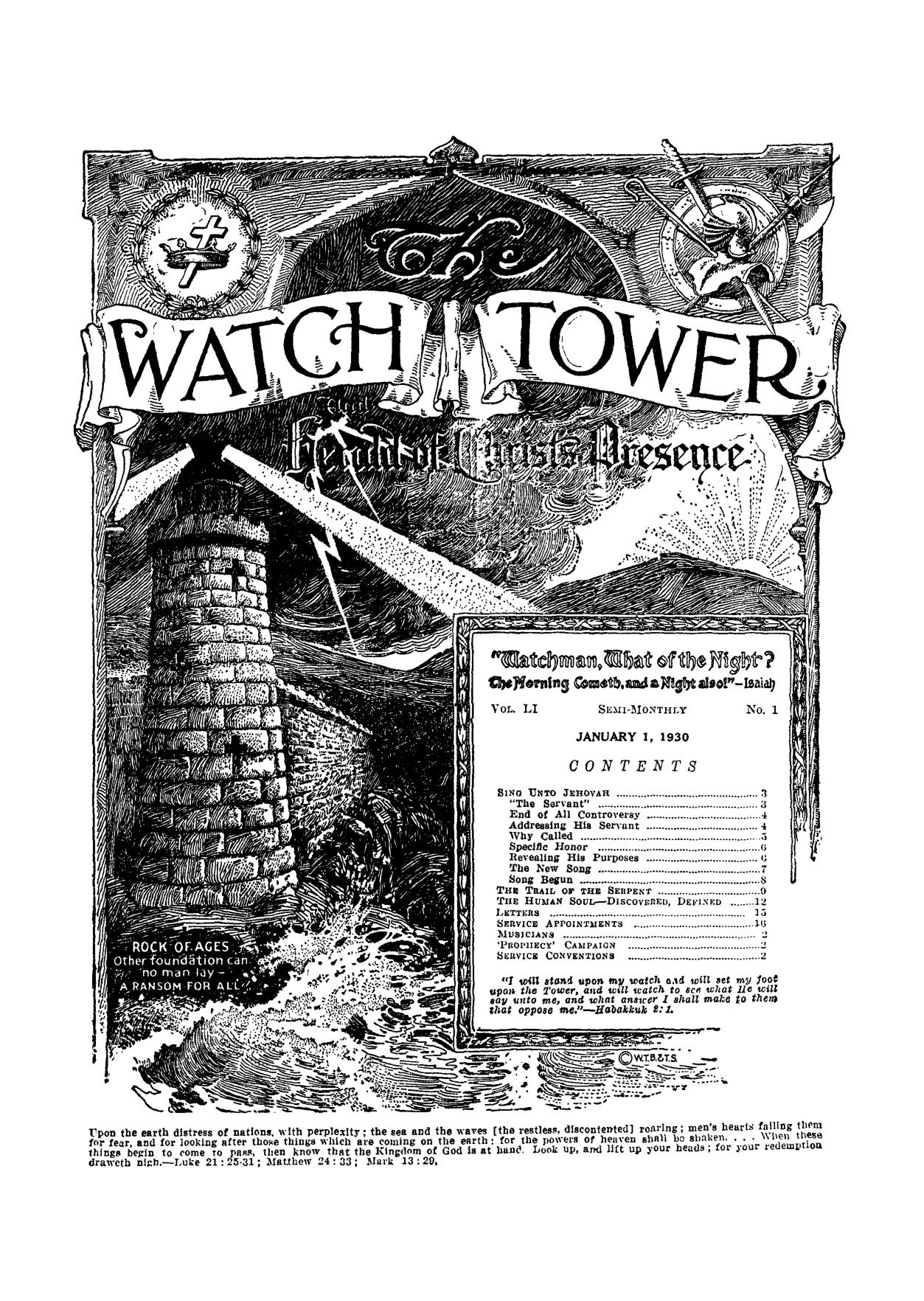
The Watchtower, January 1, 1930
Download: PDF — The Watchtower, January 1, 1930
MUSICIANS
Any of the brethren who are fully devoted to the Lord and who are competent musicians, please write to the Society at 124 Columbia Heights, Brooklyn, stating what instrument you play and what experience you have had.
‘PROPHECY’ CAMPAIGN
January 25 to February 2, inclusive, has been determined as a period in which all class workers are to concentrate on distribution of the new book, Prophecy. Our hope is that many thousands of this book will be disposed of during the time that in the past has been set aside for work with the five-cent booklets.
A consignment of Prophecy will be made to each class so as to be delivered in time for this special one-book campaign.
Pioneer and auxiliary colporteurs will find instructions for their part in this particular work in a special bulletin now in course of preparation.
Vol. LI
January 1, 1930
No. 1
SING UNTO JEHOVAH
“Sing unto the Lord a new song, and his praise from the end of the earth.”—Isa. 42:10.
JEHOVAH has taken his great power and begun to exercise it through his chief executive, Christ Jesus the beloved. He first reveals himself and his purposes to those who are in the covenant with him. He shows his strength in their behalf, and by his supreme power shields them from the enemy. Now the words of the prophet are the words of the anointed: “I will love thee, O Lord, my strength. The Lord is my rock, and my fortress, and my deliverer; my God, my strength, in whom I will trust; my buckler, and the horn of my salvation, and my high tower. I will call upon the Lord, who is worthy to be praised: so shall I be saved from mine enemies.”—Ps. 18:1-3.
2 Jehovah is supreme. He is the Most High, and his will expressed in his Word is final. He is the “King eternal” and ‘the Giver of every good and perfect gift’. Those who have been enlightened and have tasted of the heavenly gift and were made partakers of the holy spirit, who have tasted the good Word of God, and the power of his kingdom, have every reason to praise the name of the Most High. To the remnant has now been committed the great privilege of giving the testimony which was first delegated to Christ Jesus. Seeing their favored place in. the outworking of God’s purposes they break forth in joyful song.
3 As the church now enters upon another year it is fitting and appropriate to adopt as a year text the words which constitute a command from Jehovah: “Sing unto the Lord a new song.” The anointed will have this song in their hearts every day of the year.
“THE SERVANT”
4 The forty-second chapter of the prophecy of Isaiah opens with the words of Jehovah calling upon all creation to behold his servant. The words of description and identification used in the prophecy prove beyond all doubt that the “servant” is, not a man, but Christ the beloved One of Jehovah. The Lord God has honored him above all. The context shows that Jehovah has conferred upon his servant the greatest title at his disposal, and therefore the greatest possible. His words show that such titles are not properly given to man. (Job 32:21, 22) Those who insist on giving such flattering titles to men, God pushes away from him. Concerning his servant, Jehovah says: “Behold my servant, whom I uphold, mine elect, in whom my soul delighteth; I have put my spirit upon him; he shall bring forth judgment to the Gentiles [nations].” Let all creation take notice that Christ Jesus is the executive officer of the Most High, has been placed upon his throne of authority, has taken up his power and has begun operations, and that there is no opposing power that can hinder his onward march to complete victory. Jehovah takes great delight in him because he is always in harmony with his Father and has always delighted to do his Father’s will.
5 The servants of Satan, those who represent him, “rage in the streets,” with a great blare of trumpets blasphemously claiming to be messengers of light in order to deceive the people and turn them away from the true and only God. (Nah. 2:4; 3:1, 2) The servant of the Most High takes exactly the opposite course. When Christ Jesus was on earth in the flesh he was “meek and lowly in heart” and with becoming modesty and dignity spoke the words that his Father had sent him to speak. The time comes for his second appearing and he comes preparing the way before Jehovah, and comes calmly and quietly “as a thief in the night”, so little are he and his works observed by others. (2 Pet. 3:10; 1 Thess. 5:2) Christ does not make an exhibition of himself to attract attention to himself. He has always magnified his Father’s name. Completing the work of preparing the way before Jehovah, he then came suddenly to his temple and began judgment with the house of God, and this he has done in a manner observed only by those who love his appearing. Therefore it is written of him: “He shall not cry, nor lift up, nor cause his voice to be heard in the street.” (Isa. 42:2) This does not mean that one who is devoted to the Lord could not speak the truth in the open street or in the field, if the circumstances warranted it, but undoubtedly has the meaning that the work of Christ is done modestly, consistently, and always for the purpose of attracting attention to Jehovah and not to any creature.
6 Jehovah further speaking, as the record shows, says: “A bruised reed shall he not break, and the smoking flax shall he not quench: he shall bring forth judgment unto truth.” (Verse 3) This quotation from the Authorized Version is misleading. According to the better translations (Young), and consistent with the context, this text reads: “The bruised reed, he shall not break; the smoking flax he shall not quench.”
7 When Christ was on the earth he was “despised and rejected of men”; bruised, disesteemed and oppressed. (Isa. 53: 3-5) In the eyes of the world he has ever been as a bruised reed; and even the clergy, who claim to speak in his name, give neither Christ nor Jehovah credit for establishing the righteous rule on the earth. The Jews used flax in their lamps for wicks, and these, burning the oil soaked up by them, gave forth a faint light. Although Jesus is the light of the world, little heed has been given to that light. To “Christendom” so called he has been a faint light, merely as a smoking flax or wick in an oil lamp. The world lauds the deeds of Satan’s “valiant” agents, but Jesus Christ is regarded merely as a nice example of willing submission to the kicks and rebuffs of others. Because thereof many have been ashamed to acknowledge Jehovah and Christ as King and boldly proclaim the truth; and many others, who once started in the narrow way, have become discouraged and turned back. Many have come to the conclusion that the mission of Christ has failed, and that God has failed to bring about his expressed purposes.
8 On the contrary, Jehovah has bided his own good time, and now his time has arrived for positive action. He who has appeared merely as a bruised reed and a smoking lamp wick shall now accomplish the most marvelous work amongst the nations of earth that can ever be accomplished. So says Jehovah: “He shall not fail nor be discouraged, till he have set judgment in the earth: and the isles shall wait for his law.” (Isa. 42:4) The time has come when the supposedly “bruised reed” and 'smoking lamp wick’ shall light and enlighten the whole world and shall bring forth justice and truth unto all. These words of Jehovah spoken concerning his servant carry the greatest encouragement and comfort to those whom God has anointed. Paraphrasing Jehovah’s words he says: ‘Behold, my servant, he is meek and modest; you have regarded him as a bruised reed and as a smoking lamp wick that could accomplish nothing; but now I say unto all creation, He shall be used to set judgment and truth in the earth and vindicate my name.’
9 The following, it will be observed, corroborates the above conclusion. On one occasion Jesus healed an infirm man; and his good deed offended the clergy of that day, and they conspired to kill him. He withdrew himself and told the multitude that followed him not to make known his whereabouts. On that occasion he quoted the prophecy of Isaiah; and the Diaglott rendering is as follows: “He will not break a bruised Reed, and a dimly burning Taper he will not extinguish, till he send forth the judgment to victory. The nations also will hope in his name.” (Matt. 12:20, 21) The American Revised Version and Rotherham concur in the above rendering of the text. These translations show that “the bruised Reed” is the object which he “will not break”, and not the subject of the verb; and also that the “dimly burning Taper”, or wick, is the object which he “will not extinguish”, and not the subject of the verb. The text is seen to apply to each one of the faithful body members and to the entire body collectively. The faithful servants of the Lord appear in the eyes of the modern clergymen as weak, insignificant, and useless as a bruised reed and as “a dimly burning Taper”. But now the Lord announces that he will not favor “the big ones” of earth, but will show his favor toward his faithful servant class and use such to bring forth judgment and justice in the world. The text therefore applies to the servant as a whole and to each individual member that continues faithful.
END OF ALL CONTROVERSY
10 For a long period of time Satan, having made the clergy of “Christendom” his representatives, has caused great confusion and controversy and blindness among the people. The sacrifice of Jesus Christ has been ridiculed, and God’s announced purpose of salvation of the human race has been tabooed and spurned. The pious and hypocritical clergy, really representing Satan, have pushed Jesus Christ and Jehovah into a corner and have heaped reproach upon them. But the due time has come for the end of all controversy. The word and name of Jehovah shall now be exalted; therefore Jehovah speaks with absolute authority, as it is written: “Thus saith God the Lord, he that created the heavens, and stretched them out; he that spread forth the earth, and that which cometh out of it; he that giveth breath unto the people upon it, and spirit to them that walk therein.” (Verse 5) The words of Jehovah spoken concerning his servant, his mission, and his work, and addressed to all creation, are words of absolute authority and the end of all controversy. These words shall not return to Jehovah void. His purpose shall now be accomplished. Let all creation hear his words because Jehovah is supreme. Every one of his anointed should be encouraged and will rejoice at an understanding of his Word.
ADDRESSING HIS SERVANT
11 Having spoken his authoritative message to all creation, then Jehovah directs his speech to the “servant”. It seems clear that verses six to ten, inclusive, of this forty-second chapter of Isaiah are words of instruction, encouragement and comfort spoken in confidence to the “servant”. It is the act of a great loving Father to give courage and comfort to his own. It here seems appropriate to consider some scriptures bearing upon the “servant”; and if others are included with Christ, these scriptures must be of special comfort and encouragement at this time to such.
12 Many persons have received some knowledge of God’s Word, and have been begotten as his children and called to the heavenly calling; but Jesus is authority for the statement that only a few of such will be chosen for the kingdom. (Matt. 20:16) The time of the coming of the Lord to his temple is the date of vital importance to the called ones. Then Christ, as the great Judge upon his throne, began the examination of the called ones, and those that were approved were brought into the temple, under the robe of righteousness, into the secret place of the Most High, and made members of Zion. (Mal. 3:1-3; Ps. 11: 4-7; Isa. 6:1-3; 61:10; Ps. 91:1-3; 102:16; 110:3) Such are the ones whom the Lord declared that he would approve and invite, and has invited, to enter into his joy. (Matt. 25:21) Christ Jesus is the Head of the temple; and all who are approved are brought into the temple and built up as members of Zion, are made members of his body, and are therefore in and a part of him. By reason of being in Christ, and therefore of his body, such are a part of the elect “servant” of Jehovah. Jehovah chooses such by and through Christ Jesus and makes them members of the “servant”, and therefore it is written: “Ye are my witnesses, saith the Lord, and my servant whom I have chosen.” (Isa. 43:10) The approved and chosen ones constitute the remnant, to whom is committed a specific work in the name of Jehovah.
13 To his servant Christ Jesus God committed the great work of representing him, including the testimony that must be given concerning his name. He in turn conferred upon his faithful body members a portion of this work of giving the testimony. Therefore it is written concerning the remnant that such “have the testimony of Jesus Christ”, and it becomes their privilege and duty in obedience to God’s commands to give it. Because Christ is the “servant” of the Most High, and because God has anointed others as members of his body, there has been committed to the remnant this work and they have been commissioned to give the testimony. (Rev. 12:17) As his visible representatives on the earth, found and approved when he comes to his temple, Christ Jesus makes the remnant class the “ruler over all his goods”, that is to say, over all of his kingdom interests on earth, which, specifically, is the giving of the testimony that he has commissioned them to give. (Matt. 24:45-47) The faithful remnant is therefore a part of the elect “servant” of Jehovah only by virtue of the fact that such are in Christ, members of his body and faithful. Therefore when Jesus speaks of “a faithful and wise servant” he does not mean an individual, but means the members of his body collectively who are faithful and true.
14 Jehovah now addresses his beloved Son, Christ Jesus, the Head of his elect servant, and through him the members of his body, who are therefore in the temple, and such hear and heed the message. The almighty Jehovah graciously speaks and gives all of the “servant” full assurance that now his unlimited power shall be exercised in behalf of the “servant” and that his purpose shall be accomplished. No member of the “servant” who hears and understands these words of Jehovah could long be discouraged, because God says to them: “I the Lord have called thee in righteousness, and will hold thine hand, and will keep thee.” Every one who has the witness of the holy spirit that he is in Christ and in the temple may confidently claim these words of precious promise and apply them to himself; and thus doing he can not be discouraged, but must rejoice. The occasion is therefore furnished for participating in the new song.
WHY CALLED
15 Until the “servant” is identified and his position appreciated this prophecy could not be understood and appreciated. Continuing to address the “servant” Jehovah announces why he has called and commissioned that “servant”. “I . . . have called thee in righteousness.” This shows that God calls only those who have been brought forth as his sons; and these faithful ones he then makes a part of his organization and members of his “servant”. The apostle saw why God was calling these, and therefore said: “Symeon hath fully told how God first visited to take out of the nations a people for his name.” (Acts 15: 14, Rotherham) Later Peter under inspiration addressed the church and said: “Ye are . . . chosen . . . that ye should shew forth the praises of him who hath called you.” (1 Pet. 2:9) By his prophet it is made plain concerning God’s purpose in calling the “servant” and how the “servant” is to show forth Jehovah’s praises. There it is written: “I the Lord have called thee in righteousness, and will hold thine hand, and will keep thee, and give thee for a covenant of the people, for a light of the Gentiles; to open the blind eyes, to bring out the prisoners from the prison, and them that sit in darkness out of the prison house. ’’— Isa. 42: 6, 7.
16 Beyond all cavil these scriptures show that God has called men and made them members of his “servant”, not for the mere purpose of getting such into heaven, but that the “servant” may perform the duties which God has laid upon him, which duties must be performed among men on earth in making known the word and name of Jehovah. Long ago God made a covenant or unconditional promise through Abraham that he would bless all the families of the earth. In the prophecy under consideration, to his servant he says: ‘I will give thee for a covenant [a guarantee] to the people to enlighten them and to open the blind eyes and show them the right way.’ Open their blind eyes to what? To the truth that Jehovah is the only true God and that Christ is the Redeemer of mankind, the mighty and righteous servant of Jehovah who will, under Jehovah’s direction, establish righteousness and justice amongst the peoples of earth. The Most High would now have it told to the people that even though Christ Jesus has long been despised and rejected, and even though it appears from the hypocrites who have claimed to represent God that Jehovah’s purposes would not be realized, and even though the great name of Jehovah has been pushed aside, his purpose now is to establish justice and truth amongst men and that it shall be done without regard to opposition.
17 There is a great multitude of prisoners held in the religious systems of earth organized and carried on under the name of Christ and who sit in darkness concerning the purposes of Jehovah. The eyes of these blind prisoners must be opened that they may have the opportunity to come out of the prison houses and to take their stand on the side of Jehovah God. To the "servant” is granted the privilege of doing this work, and the remnant now on earth has a part therein and it is the privilege and duty of the remnant to carry the message of truth to these blind prisoners. It is a work of the present time, and this witness work must be done before the faithful will be changed into the glorious image of Christ Jesus. It is the most joyful work in which any creature could be engaged, and therefore it calls forth the song of praise to the great Giver of all good gifts.
SPECIFIC HONOR
18 There is only one almighty God; and all creation must come to know that truth. By his prophet he says: "I am the Lord: that is my name; and my glory will I not give to another, neither my praise to graven images.” (Isa. 42:8) The explanation of this text, as generally given, is that ‘there are many gods or mighty ones and that many have tried to exalt themselves, but that Jehovah declares that none shall have the honor except himself’. The context does not seem to support such conclusion. To be sure, no one could have Jehovah’s honor, because there is none other like unto him. He is from everlasting to everlasting and is the Creator of everything in heaven and in earth, and this he declares in this prophecy. The context must be considered in arriving at a proper understanding of this text.
19 Plainly the context and the text show this, that Jehovah has an elect servant in whom his soul delights; that although that servant has been misrepresented and belittled by Satan and his agents he is the highest official representative of the Most High God and that Jehovah’s time has arrived for him, as such executive, to carry out the purposes of Jehovah. Christ Jesus is the greatest of God’s creation, and there could be none above him amongst creation. By him Jehovah has opened ‘the way of truth and the life’ and there is no other way for men to obtain life. —John 14: 6; Acts 4:12.
20 God raised up Christ Jesus out of death and exalted him above all others and clothed him with honor and glory above all others. (Phil. 2:8-11) He is the elect servant of the Most High. To him God has given the divine nature. None aside from The Christ can ever have the divine nature. God has given him a glory separate and distinct from all others. Therefore Jehovah would have all creation know that he who is the Most High speaks with absolute authority and informs all that his name is Jehovah, which means that his purposes must be carried out. He would have all understand that he has made Christ his elect servant and that none other can have this honor. Therefore the eighth verse means that Jehovah has made Christ his elect servant next to himself and has given him glory and honor and will not give it to another.
21 The other words of the same verse, ‘‘neither my praise to graven images,” show that such is the proper meaning of the text. God would have it known that no graven image can have his honor and praise. Men have made their church organizations and their leaders in these organizations like unto God and have claimed to worship God by and through such church organization and their leaders. All such are abominable in the sight of the Lord. These come within the class ‘‘that swear by the sin of Samaria”, and therefore are disapproved. (Amos 8:14) No one aside from Jehovah could confer the honor upon his creatures. He has defined that his servant is The Christ and that no human being is that ‘‘faithful and wise servant”, and he says that he will not give his glory to another. If others are unwise and foolish enough to give honor, glory, and flattering titles to men and to designate any man ‘‘that faithful and wise servant” and insist on worshiping God by and through such, the Scriptures show God will not be pleased with such and will manifest his disapproval and take them away.— Job 32: 21, 22.
REVEALING HIS PURPOSES
22 Jehovah’s purposes mature and come to pass in his due time. But until his due time his purpose is not understandable by any creature, and particularly not by man. Prior to 1918 certain of the purposes of Jehovah unfolded and matured, and exactly on time. Some who had made a covenant with the Lord induced themselves to believe that the ‘‘faithful and wise servant” of Jehovah was one man, and they take an unwise course accordingly. In consequence they stumble into the error that no truth has been revealed by Jehovah to his people since 1916. Such have not seen the revealed truths that have been given to God’s anointed during the past few years and do not now understand present truth. Others in the covenant with God and who have carefully and earnestly sought to do his will and give God the glory and honor due his name have had a clearer vision of Jehovah’s purposes. The former things that have come to pass these have been privileged to understand.
23 In this connection consider now the words of the Lord through his prophet spoken to members of his servant: “Behold, the former things are come to pass, and new things do I declare: before they spring forth I tell you of them.”—Verse 9.
24 Former things concerning God’s purposes that did come to pass were understood after the Lord came to his temple and the lightnings of Jehovah illuminated his Word. This same class then see new things which God has declared. In the light of prophecy in the course of fulfilment, and of the further illumination thereof by Jehovah, the remnant class is permitted to see other things that are shortly to follow, concerning which the Lord says: “Before they spring forth I tell you of them.” Jehovah takes the remnant into his confidence in a measure by revealing to them the precious things that are in his keeping. These have a better understanding than ever before of what the great battle of God Almighty will mean and how Jehovah will vindicate his name. They understand that he has not restrained evil before this time and that the real purpose is that his word and name might be completely vindicated. Those who are not of the “servant” do not see and appreciate present truth, nor do they see or appreciate other things of the divine purpose that are about to come to pass.
25 Well do the facts as they exist fit this prophecy. Since the Lord came to his temple, assembled the members of Zion, and made them part of the servant of Jehovah, his purposes continue to unfold with clearness to the remnant. Such have the full assurance of God’s protecting care. No longer are they seeking to ascertain the will of God, but his will has been revealed to them and they delight to keep his commandments and their joy increases. The spirit of the Lord energizes them and they hasten to take advantage of opportunities to serve Jehovah and give praise to his name.
THE NEW SONG
26 Further addressing members of the servant, and particularly the remnant now on earth, Jehovah, through his prophet, says: ‘‘ Sing unto the Lord a new song.” Why a new song? Because Jehovah has revealed his purposes to his servant as never before. When Jesus was born God caused the holy angels to sing, “Glory to God in the highest, on earth peace, good will toward men.” (Luke 2:14) To the angels God had revealed the fact of his purpose at some time and in some way to establish peace on earth and good will toward men; but the angels did not understand when or how. The angels desired to know more, and sought to know, but it was not God’s due time to reveal it.. (1 Pet. 1:12) That great privilege he reserved for his elect servant. Into the hands of his elect Christ Jesus God committed all power in heaven and in earth. But even his beloved Son must wait until God’s due time to send him forth to carry out his purposes. The due time arrived. God placed Jesus upon his throne and Jesus began his reign; he cast the enemy out of heaven and then came to his temple and assembled the members of his body and made them a part of God’s organization.
27 When the time came for Christ Jesus to act and oust the enemy from heaven, and to vindicate his Father’s name, this he did with great joy, and doubtless this is what he mentions as ‘the joy of the Lord’. Coming to his temple to take account with his servant, to the faithful he said: “Enter thou into the joy of thy lord.” It follows that the less faithful were not invited to enter into the joy of the Lord, and did not enter. This explains why some who made a covenant with the Lord have since not been joyful but have busied themselves in finding fault with and slandering their “own mother’s son”.—Ps. 50: 20.
28 The temple being open, those of the temple class have beheld the two great wonders, to wit, Jehovah’s organization and Satan’s organization in opposition to each other. These faithful have been permitted to see and to understand the meaning of the “birth of the nation”, or beginning of the kingdom. The great Creator has revealed to such the meaning of his different names and what are some of his purposes. The faithful see, not that Jehovah’s purpose is primarily to get men into heaven, but that his primary purpose is the vindication of his word and his name, that creatures may see the way to life; and that to accomplish this purpose he has provided redemption through the blood of Christ Jesus, raised Christ up out of death, and made him the great executive officer of Jehovah, and his elect servant, and that it is Christ whom he will use to vindicate his holy name. Furthermore, they see that God has made the faithful remnant members of the servant class and has assigned to such the precious duty and privilege of proclaiming praises to the name of the great God. To the remnant class have been made known the truths that plainly reveal the will of God, and this revelation of truth has furnished them the new song which they delight to sing.
29 It is not at all surprising that there are those who claim to be in the covenant of God and in the truth who do not understand the truth and who have not entered into the joy of the Lord and who oppose his service. The Scriptures are explicit that no one aside from the servant class can understand and sing the new song. When the Lord says, “In his temple doth every one speak of his glory” (Ps. 29: 9), such is conclusive proof that those who do not speak of his glory are not in the temple. In further corroboration of this point it is written: “And I looked, and, lo, a Lamb stood on the mount Sion, and with him an hundred forty and four thousand, having his Father’s name written in their foreheads. And I heard a voice from heaven, as the voice of many waters, and as the voice of a great thunder; and I heard the voice of harpers harping with their harps; and they sung as it were a new song before the throne, and before the four beasts, and the elders; and no man could learn that song but the hundred and forty and four thousand, which were redeemed from the earth.’’ (Rev. 14:1-3) This new song must be sung by the remnant while on earth, and no others can know it or sing it.
30 The Lord furthermore identifies this remnant class by stating that “these are they which were not defiled with women”, meaning that they are not contaminated with the association of systems that defame his name and that are symbolized under an evil woman. The faithful delight to follow the Lord Jesus wheresoever he leads, and they do not follow any man. They see eye to eye because members of one body, and therefore they work harmoniously together. Those who have really entered into the joy of the Lord have no time to engage in controversy with others who oppose. The temple class will be busily engaged in keeping God’s commandments and in telling the testimony of Jesus Christ that has been committed to them.
SONG BEGUN
31 The new song has begun, and the harmonics thereof are reaching out farther each year into the earth. It is being sung as a world-wide witness to the name of Jehovah and his King, in harmony with the instructions Jesus gives to his faithful followers.— Matt. 24:14.
32 To the faithful, Jehovah says: “Sing unto the Lord a new song, and his praise from the end of the earth, ye that go down to the sea, and all that is therein; the isles, and the inhabitants thereof.”—Isa. 42:10.
33 The year text is chosen from these words of Jehovah because they are exactly in harmony and in keeping with the present work of the church on earth. The little remnant amidst humankind now tossed about and buffetted by the waves of the sea march confidently on to the day of the great battle of God Almighty. The highest or the stable places in the sea well represent those who trust in the Lord to a degree but who are not of God’s remnant. These have some hope, while the restless element of humanity has no hope. Under the final test those who compose this great multitude will stand on the side of the Lord and by him will be brought through great tribulation and receive God’s approval. (Rev. 7:14) The remnant now see that Jehovah has placed his beloved One upon the holy throne of Zion and in thunder tones calls upon all the rulers of the nations to obey him. They see that God’s time has come to establish truth and justice in the earth and that nothing shall prevent the accomplishment thereof. The heart of every one of the servant class is thrilled, and none can keep back the glad new song. It is God’s due time to sing the new song, and it must be sung preceding his destruction of the enemy.
34 “Let them give glory unto the Lord, and declare his praise in the islands. The Lord shall go forth as a mighty man, he shall stir up jealousy like a man of war; he shall cry, yea, roar; he shall prevail against his enemies. I have long time holden my peace; I have been still, and refrained myself; now will I cry like a travailing woman; I will destroy and devour at once.” —Isa. 42:12-14.
35 For many long centuries the name of Jehovah has been defamed. Satan has repeatedly and consistently cast reproach upon him. In turn these reproaches have fallen upon Jesus Christ, and then upon the members of his body; but the day of vindication has come. God will destroy the enemy and establish truth and justice in the earth. The Lord then discloses that his elect servant has but one single purpose, and that is to do the will of Jehovah.
36 Every one of the servant class must be in full harmony with the Head, Christ Jesus, and must likewise have and follow a single purpose. Concerning this it is written: “Who is blind, but my servant? or deaf, as my messenger that I sent ? who is blind as he that is perfect, and blind as the Lord’s servant?” (Isa. 42:19) The servant is blind to everything else except to do God’s will. The remnant therefore realize that the greatest privilege they could enjoy is to sing the new song of praise unto Jehovah, and this they do by giving testimony concerning God and his kingdom.
37 The years that are past have been filled with many opportunities of service, and these recent years have been attended with special joy in the service. The year 1930 should mark the greatest witness yet given and be attended by the greatest amount of joy to those who participate. Having a better understanding of God’s purposes the remnant will have greater joy in obeying his commandments. The anointed of the Lord are the ones commissioned to do his service. The anointed who continue faithful will do that service. While doing it they will be the targets for the poisonous darts of the enemy. They will not be discouraged or even disturbed by such opposition, however, because they have full assurance that Jehovah’s time has come for his anointed to stand victorious upon Mount Zion and that no evil can befall them.
38 The song which the servant now sings to Jehovah’s praise will not cease. The kingdom will soon be fully established and truth and justice will be enthroned in the earth. The praise of Jehovah will then be taken up by others and will not cease until “everything that hath breath shall honor and praise Jehovah’s glorious name”.
QUESTIONS FOR BEREAN STUDY
1, 2. Jehovah has taken what position in regard to the world and to his people? What are the particular benefits enjoyed by the anointed in their relationship to Jehovah and to Christ Jesus, and what is their responsibility?
3. Quote the year text for 1930. What is the purpose of a year text?
4. Identify the “servant” referred to in Isaiah 42:1. How does Jehovah “uphold” him? Account for the reference to him as the one “in whom my soul delighteth”.
5. Who “rage in the streets”? How, and for what purpose? Contrast therewith the manner and procedure of the servant of the Most High. What is the meaning of verse two of the chapter from which our text is taken?
6-9. Quote other translations of verse three, and give its application. Describe the circumstances under which Jesus quoted this prophecy, and show to whom the term “servant” applies.
10. Describe the method and results of Satan’s operation through his representatives among the people. What is now due in this regard?
11-13. Show to whom “thee” refers, in verse six. What is evidently the purpose of the words of verses six to ten? Point out the significance of the year 1918 in this respect. Explain how the anointed share in the commission given to Christ Jesus.
14. How is the assurance, “I . . . will hold thine hand, and will keep thee,” fulfilled to the anointed?
15. Explain, “I . . . have called thee in righteousness.” Called for what purpose?
16, 17. How and for what purpose is the “servant” given “for a covenant to the people”? To what class in particular is the ministry of the “servant” now to be directed? To what end is such witness given?
18-20. What is meant by “I am the Lord: that is my name”? What is the “glory” referred to in this verse, and to whom does Jehovah give it?
21. Why the expression, “Neither [will I give] my praise to graven images”?
22. What is now evident as to when Jehovah’s purposes can be understood? What benefit comes from the study of prophecy before the due time for its fulfilment? The spirit of truth requires what consideration of conclusions previously drawn? Point out the importance of a proper attitude in respect to the progressive revelation of Jehovah's purposes.
23-25. Explain verse nine. Show how the facts fit this prophecy.
26. Why the invitation and command, “Sing unto the Lord a new song”? With respect to the song and their understanding it, compare the position of God’s messengers at the time of Jesus’ birth with that of his witnesses when, at the end of the age, the “servant” class becomes manifest.
27. When and how have Jesus’ words, “Enter thou into the joy of thy Lord,” been fulfilled?
28. The opening of the temple revealed what two great wonders? To whom revealed, and to what advantage to them? Recall and mention many important truths made known to the faithful anointed since “the temple of God was opened in heaven”.
29, 30. Give scriptures which serve to identify the temple class. Explain Revelation 14: 4, as further distinguishing the remnant class.
31-33. When was verse ten fulfilled? Describe the manner of its fulfilment.
34-36. At what time, and how, do verses twelve to fourteen apply? What is the relation thereto of verse nineteen?
37. Since the kingdom, once begun, must increase until it fills the whole earth, to what may the faithful look forward in 1930?
38. The kingdom fully established and in operation, what will then be the greatness of Jehovah’s name and praise?
THE TRAIL OF THE SERPENT
[Thirty-minute radio lecture]
IN THE Scriptures the Devil is called by four separate and distinct names. He is called “Dragon”, “Satan,” “Devil” and “Serpent”. For instances see Revelation 12:9 and 20:2. These names were given him at the time he beguiled Eve in the garden of Eden, and through her led Adam into sin. They are used to describe four characteristics of Satan. “Dragon” means devourer, and pictures Satan as trying to devour and destroy the Lord’s people on earth. “Devil” means slanderer, and pictures Satan as charging that God is the author of false, wicked and malicious doctrines, and imputing evil and unworthy motives both to God and to his people on the earth. “Satan” means adversary, and pictures the Devil as the enemy of God, the enemy of the people of God, and the enemy of all righteousness.
“Serpent” means deceiver, and pictures Satan as lying to and deceiving the people about God, about the Bible, and about the people of God. In this lecture we are considering Satan from the standpoint of the “Serpent”, the great deceiver. A serpent is noted for its cunning, and glides about, shooting out poison at everybody. This is how Satan manifests the characteristics of a serpent. In sly and cunning ways he poisons the minds of people against God, against the work which God is doing in the earth, against the people of God, and against the Bible.
Satan is the most wicked creature living. He is totally depraved; by which we mean that there is no possibility of his being recovered from his wicked course. Jesus said that Satan is the father of all lies. (John 8:44) In Hebrews 2:14 we are told that Satan is to be destroyed. The sentence of everlasting destruction was pronounced against him in Eden when he led Adam into sin. This sentence, however, will not be executed until the end of the thousand year reign of Christ, as recorded in Revelation 20: 7-14, which reads: “When the thousand years are expired, Satan shall be loosed out of his prison, and shall go out to deceive the nations . . . And the Devil that deceived them was cast into the lake of fire and brimstone. . . . This is the second death.” The lake of fire and brimstone is a symbol of complete destruction.
Let us notice how, when, and why this great deceiver came into existence. God created Adam and Eve, placed them in the garden of Eden, and gave them a glorious and beautiful dominion over the earth, also over the birds, beasts and fish. He also created a wise and beautiful spirit being called Lucifer, which means bright shining one, and appointed him as a “covering cherub”, a sort of guardian angel, to Adam and Eve, to act as their caretaker, protector and overlord. Lucifer’s commission was a most wonderful one; and had he properly appreciated it and remained loyal to God and faithful to his trust, there would have been no sin in the world, and consequently no such thing as death, and Lucifer would now be the overlord and caretaker of approximately twenty billions of perfect, sinless and happy human beings, all of whom would have been the posterity of Adam.
But Lucifer committed the sin of treason against God and betrayed his trust, and was sentenced to destruction. He allowed selfishness to enter his heart. He coveted a dominion just like that one which God had. He desired to be a king and have subjects and to have these subjects recognize and acknowledge him as their lord and benefactor. Noting the prospects of an earth full of Adam’s posterity, he saw his opportunity. He reasoned that if he could lead Adam into disloyalty to God, and then persuade Adam that he (Lucifer) was his friend and benefactor and that God was his enemy, Adam and all his posterity would gladly become his subjects. The record of the creation of Lucifer, of his commission from God, and of his deflection and condemnation are found in Isaiah 14:12-19 and in Ezekiel 28:12-19.
Not only was it a diabolical plot, and involved the act of treason toward God, but it meant that he must plot to lead Adam into disobedience to God. It was in connection with this wicked plot to alienate Adam’s devotion from God to himself that Satan began to manifest the characteristics of a “serpent”. There the trail of the serpent began. There Satan began to shoot out the poison, which was intended to deceive mother Eve and later prove a temptation to Adam. This poison was in the nature of an effort to inject into their minds that which would poison their minds against God and lead them to distrust and disobey him. From that time until the present Satan has been using cunning, crafty, serpent-like methods, to poison the minds of the people against God. To do this he must resort to lies.
Among the beautiful creations in the garden of Eden was a serpent; and it is written in Genesis 3:1 that “the serpent was more subtle than any beast of the field”. The word “subtle” means cunning. We are to understand that the serpent did not use its cunning to the injury of others, but did use it in harmony with God’s laws. To carry out his wicked designs Satan used the serpent. He took advantage of it, obsessed it, and through it deceived mother Eve. The record is that he spoke to mother Eve through the serpent. Adam and Eve had been forbidden to eat of a certain fruit, on pain of death. Speaking through the serpent, Satan said to the woman; “Ye shall not surely die: for God doth know that in the day ye eat thereof, then your eyes shall be opened, and ye shall be as gods, knowing good and evil.”
This was the first lie ever uttered, and it was a direct charge that God had lied to mother Eve. Here the poisonous trail of the serpent began. It had its effect on mother Eve. Her mind was poisoned against God. She was deceived into believing that God was withholding from her something that was for her good, and, of course, she then regarded Lucifer as her friend for having revealed that God was deceiving her.
The effect of the poison is stated in Genesis 3: 6, as follows: “And when the woman saw that the tree was good for food, and that it was pleasant to the eyes, and a tree to be desired to make one wise, she took of the fruit thereof, and did eat, and gave also unto her husband with her; and he did eat.” The lie of Satan aroused the suspicion in the mind of Eve that God was not her friend and benefactor, but that Satan was, and thus she became the servant of sin and Satan instead of the servant of God. The apostle tells us that Eve was deceived, but that Adam was not deceived. Seemingly Adam ate of the fruit because he realized that his wife must die and he chose to die with her rather than to live without her. His course showed a lack of faith in his Creator; and since he was not deceived, his sin was wilful and therefore more reprehensible than that of Eve.
As a result of Satan’s lie, Adam and Eve were condemned to death and driven out of the garden and the condemnation was passed on to their posterity by the law of heredity. They lost the favor of God. The act of treason had been committed, and God said to the old serpent, called the Devil and Satan: “I will put enmity between thee and the woman, and between thy seed and her seed; it shall bruise thy head, and thou shalt bruise his heel.” In this statement are two things which it is quite important that we note at this time. First, that Satan would have a seed; and second, that Satan’s head should be bruised. The ‘bruising of his head’ would mean his death; and here is where God pronounced the penalty of destruction against Satan, which will be executed when he is loosed from his thousand years ’ binding.
The question now occurs, Who is the seed of Satan ? The answer is that it consists of those men who are under his control, who have his spirit of selfishness and disloyalty to God; those men whom he uses as he did the serpent in Eden, namely, to lie about God and to spread the poison of deception which is intended to lead people to repudiate God and to repudiate the Word of God. The seed of the serpent is the offspring of Satan, begotten by his lies, by his spirit of selfishness and his desire to be great and famous among fellow creatures. They are like their father, Satan, in these respects.
Satan’s dream of a kingdom over men was blighted by the fact that the race was born under the death penalty and was continually dying. This did not suit Satan; and so, with a malignant cunning, he conceived another plot, which involved the deception of some of the angels. The Scriptures reveal the fact that holy angels could materialize; by which we mean that they could instantly create human bodies and appear as men, and at will could dissolve those bodies and assume their former spirit bodies. We read that three angels appeared to Abraham in human bodies and ate a veal dinner. (Gen. 18: 6,7) Satan further deceived the angels into marrying the daughters of men and rearing families. Evidently his idea was that their offspring would not be under condemnation, because not Adamic stock, and would therefore live for ever and be Satan’s subjects. Thus he would realize his one great ambition to have a kingdom just like God’s.
The record of this attempt on Satan’s part is found in Genesis 6:1-4. The offspring of this unauthorized union of angels and women were giants, who were wicked and cruel, because they had the spirit of Satan. The result was a reign of wickedness and corruption on the earth, brought about by that “old serpent’’, called the Devil and Satan. At the time of the flood this wickedness had become so general that Noah and his wife and his three sons and their wives, were the only ones not involved in general corruption. It was then that God acted and destroyed all the offspring of Satan, including the giants, and kept Noah and his family alive through the flood and used them to start the race anew, after the flood, and gave them the same command that he gave to Adam, namely, “Be fruitful, and multiply, and fill the earth.”
Right after the flood Satan conceived another scheme to belittle God and to draw men away from the service of God. It was another cunning scheme and well worthy of its wicked promoter. It consisted of a plot to get men to worship a mythical God. Satan planned to form organizations of men on earth and to work through these organizations. The organizations have crystallized into the great heathen religious systems of earth.
This plot against Jehovah began in the days of Nimrod, who is mentioned in Genesis 10:8-10. We are told that Nimrod began to be a mighty hunter before the Lord. History gives us the thought that in his day the wild animals were a menace to the lives of the people and that Nimrod manifested great prowess as a hunter and delivered the people from the wild beasts. The statement “before the Lord” in the original Hebrew implies that the people held him in higher reverence than they did the Lord. Hence Nimrod ultimately became an object of reverence and worship.
According to tradition, it came about this way: The people regarded Nimrod as their savior and deliverer. Later he was killed and his mother made the people believe that he was resurrected as a spirit being and was now a god. He was thereafter called the “father of gods”, and his mother came to be known as the “mother of God”, and as such they came to be worshiped by the people as “the mother and son”. This mother-and-son idea spread throughout the world, among all the nations, and they have all worshiped a false god and his mother. This devilish substitute for Jehovah God, which Satan foisted on the people, was in existence in the days when Israel was God’s chosen people; and the reason why God forbade the Israelites to intermarry with the surrounding heathen nations was that they worshiped the false god called Baal and his mother Ashtaroth. All those heathen religions have this mother-and-son idea, the Devil’s miserable counterfeit of Jesus and his mother.
Thus Satan was mocking the great Jehovah and deceiving the people into worshiping something that did not exist. As a result, the trail of the serpent has made the condition of the heathen nations of earth one of darkness, gloom and despair; one of indescribable poverty and destitution. Thus has Satan, with cruel cunning, deceived and poisoned the minds of the heathen peoples of earth against Jehovah.
In the more enlightened nations of earth he has chosen a different but no less injurious and wicked method of deceiving the people. This method is to get them to worship men, the so-called great men of earth. Satan’s deception brought “hero worship” into existence. The apostle describes it in these words: “Men . . . changed the truth of God into a lie, and worshipped and served the creature [man] more than the Creator.” (Rom. 1:18,25) This means that Satan gathered men into a great organization and gave it a high-sounding name and represented it to be God’s organization. This organization has always been composed of the religious, political and financial elements of earth.
These have tried to arrogate to themselves the right to be God’s representatives in the earth, and claim that they, and they alone, are the ones who possess wisdom to represent God. These put forth doctrines and teachings that they claim have the divine approval, but which, in fact, misrepresent God and bring dishonor and reproach on his name. The great political leaders claim that the present governments of earth, which they have formed by the strong arm of force, called militarism, are God’s governments. They claim that God has set them the task of governing the earth and has authorized them to use force to keep the people in subjection, and that any resistance of their efforts is a resistance of God. The financial leaders claim that God has given them the right to control the wealth and all other resources of the earth. They claim that the masses do not know enough to handle these properly, and that any resistance to their assumed ‘‘ vested ’’ rights is a resistance of God himself. The great religious leaders put forth false doctrines, such as eternal torment, trinity, human immortality, human ordination, and urge the people to submit to the wicked governments and the wicked oppressive schemes of the financiers. These false doctrines are attributed to God and make reasonable and thoughtful men and women repudiate the Bible and its Author. These false doctrines belittle God and bring reproach upon his name; they make him appear wicked, cruel and unjust, and the men who are the authors of the false doctrines, and who are foremost in advocating militarism, and who set up the most wicked, autocratic and tyrannical governments are regarded as great men. Art galleries are filled with their pictures; street corners and parks with their statues; and libraries with books extolling their virtues. In many instances they are canonized, or sainted.
Their names are honored and revered far more than the name of Jehovah God. This organization was formed by Satan for the express purpose of deceiving the people about God, his wisdom, justice, love and power; with serpent-like cunning Satan has used these so-called great men to deceive the people. These classes, united and working together constitute Satan’s “seed”, his organization on earth. This organization oppresses, deceives and injures the people; it misrepresents God. It is the ‘seed of the serpent’ mentioned by Jehovah God in the garden of Eden.— Gen. 3:15.
When Jesus was on earth, nearly 1900 years ago, he found these three elements arrayed against him, namely, politicians, financiers, and the great religious leaders. Satan used these so-called great men to poison the minds of the people about God and the Bible.
Let us note some texts. Psalm 58: 3,4: “ The wicked . . . go astray as soon as they be born, speaking lies. Their poison is like the poison of a serpent.” Again, in Psalm 140:1-3, we read: “Deliver me, O Lord, from the evil man . . . which . . . have sharpened their tongues like a serpent; adders’ poison is under their lips. ’ ’ Again, in Romans 3:10-13, we read: “There is none righteous, no, not one: . . . there is none that doeth good, no, not one . . . the poison of asps is under their lips. ” And in James 3: 8 we read: “The tongue ... is an unruly evil, full of deadly poison.” These texts assure us that it is the tongue that the Devil uses to slander God and his people, and it is the tongue of those who constitute the ‘seed of the serpent’.
In Jesus’ day this ‘seed of the serpent’ was made up of the great leaders of that day, those who professed great piety and claimed to be the representatives of Jehovah God. Jesus called them hypocrites, and surely nothing could be more wicked and diabolical than to pose as the representatives of Jehovah God for the purpose of deceiving the people, while actually the representatives of Satan. Such are Satan’s methods.
Read Jesus’ own words addressed to these pious hypocrites, as recorded in Matthew 23:28-33. He said: “Ye also outwardly appear righteous unto men, but within ye are full of hypocrisy and iniquity. . . . Ye serpents, ye generation of vipers! how can ye escape the condemnation of gehenna?” “Gehenna” is a symbol of the second death. Again, John the Baptist, when he saw many of the Pharisees and Sadducees come to his baptism, said: “O generation of vipers, who hath warned you to flee from the wrath to come?”—Matt. 3:7.
A point worthy of special notice is that, while these hypocrites appeared righteous unto men, Jesus and the apostles knew that they were hypocrites. What was the poison they were broadcasting? Hear the words of Jesus on this point: “This people draweth nigh unto me with their mouth, and honoureth me with their lips; but their heart is far from me. But in vain they do worship me, teaching for doctrines the commandments of men. ” (Matt. 15: 8, 9) In verse 6 of this same chapter, Jesus said to these same hypocrites: ‘Ye have made the commandment of God of none effect by your tradition.’
It is even so today: the name of the Lord is blasphemed by the traditions of men. Among these traditions are such doctrines as “eternal torment”, “trinity,” “human immortality” and the “divine right” of kings and clergy. These are not found in the Bible. They are purely traditional, having come down to us as an inheritance from the dark ages.
Those who put forth these doctrines make void God’s Word; nevertheless they pose before the people as the only ones who can properly understand it, as did the Pharisees and others of Jesus’ day. The people’s minds are poisoned with these false doctrines. They are deceived into thinking that God is the author of these doctrines, when in fact they originated in the minds of blinded and deceived men. The doctrines that are deceiving the people today have crystallized into creeds, and are taught to the exclusion of the Bible.
We must bear in mind that Satan is God's enemy and that his one great purpose is to deceive the people about God, to misrepresent God; and that to do this he must of necessity lie about God. These lies are wicked slanders; they are put forth by the so- called great and wise men of earth, and hence carry far greater weight than if put forth by those who lack education and influence.
These slanderous, poisonous misrepresentations of God, of his people, and of the Bible, are claimed to be found in the Bible. It is charged that God is the author of these lies. The result is that people despise God and shun the Bible, and men have false and perverted ideas of justice, truth, honesty and patriotism, while ignorance and superstition hold sway everywhere.
In closing, attention is called to the fact that in the near future that “old serpent”, called the “Devil” and “Satan”, is to be bound for a thousand years, in order that he may deceive the nations no more till the thousand years are ended. During this thousand years Christ will awaken the dead, and they, together with those living, will be given a proper understanding of what the will of God is, and what are true and righteous doctrines. Satan and all his human agents will be exposed, and will be seen in their true light as hypocrites. All false doctrines will be exposed, and their authors will be made known. Those who still love that which is right, true, pure and good will quickly and readily fall into line with God’s arrangements and get everlasting life; while those who still love unrighteousness will be destroyed, together with the Devil, in the lake of fire and brimstone, which pictures second death. Thereafter righteousness, peace, justice and love will prevail on the earth for ever. Thus the poisonous trail of the serpent will for ever end.
THE HUMAN SOUL - DISCOVERED, DEFINED
[Fifteen-minute radio lecture]
OF GOD, Jehovah, it is written: “ In [his] hand is the soul of every living thing, and the breath of all mankind.” (Job 12:10) It is conclusive, therefore, that God, the Creator of souls, is the only authority on the soul question, and his Word, the Bible, is the only book that can give the true definition and description of the human soul.
Because not acquainted with the true teachings of the Bible, mankind in general, including practically all clergymen and church-going people, have a very uncertain idea of the human soul. To them it is a mystery. One Methodist bishop is reported to have said: “The soul is without interior or exterior, without body, shape, or parts, and you could put a million of them in a nutshell.” Under the word “soul”, The Standard Dictionary (1923 edition) gives various definitions, and says: “It was Augustine especially, who, in part on religious grounds and in part as the disciple of the later Greek philosophy, taught the ‘simple, immaterial, and spiritual nature of the human soul’, a view which has remained that of the scholastic philosophy and of Christian theologians down to the present time.”
The quotations just given raise the question: Is the soul something “immaterial and spiritual”, that we can not now see, hear, or feel?
What the human soul is, was no mystery to the faithful patriarchs, prophets, and writers of the Old Testament part of the Bible; neither did it mystify Jesus’ apostles and the writers of the New Testament, nor the Christians of their day. It was not until toward the end of the fourth century, when Augustine began to introduce Grecian philosophy instead of Bible doctrine, that Christian people began to get badly mixed up on the soul question. History plainly tells us that the Christians who held to God’s Word fought Augustine’s teaching as being unchristian, unscriptural, pagan, and subversive of true Christianity. And yet later generations have canonized Augustine as a saint; but, Has God? we ask.
The opinions of man laid aside, what does God’s written Word say of the human soul? In the Hebrew Old Testament the word which our English Bible translates “soul” is, with but two exceptions, the Hebrew word nephesh. This word occurs about 668 times, but not always does our English Bible translate it “soul”. Only 428 times is it translated “soul”. It is translated “life” 119 times, “person” 30 times, “creature” 9 times, “man” 3 times, “self” 19 times, “body” 7 times, “dead (body)” 8 times, “thing” twice, “mortal” once, and (horrors!) “fish” once. (Num. 6:6; Hag. 2:13; Isa. 19:10) Doubtless you are amazed at these English translations of this Hebrew word meaning “soul”.
…