The Watchtower, December 1, 1929
Download: PDF — The Watchtower, December 1, 1929
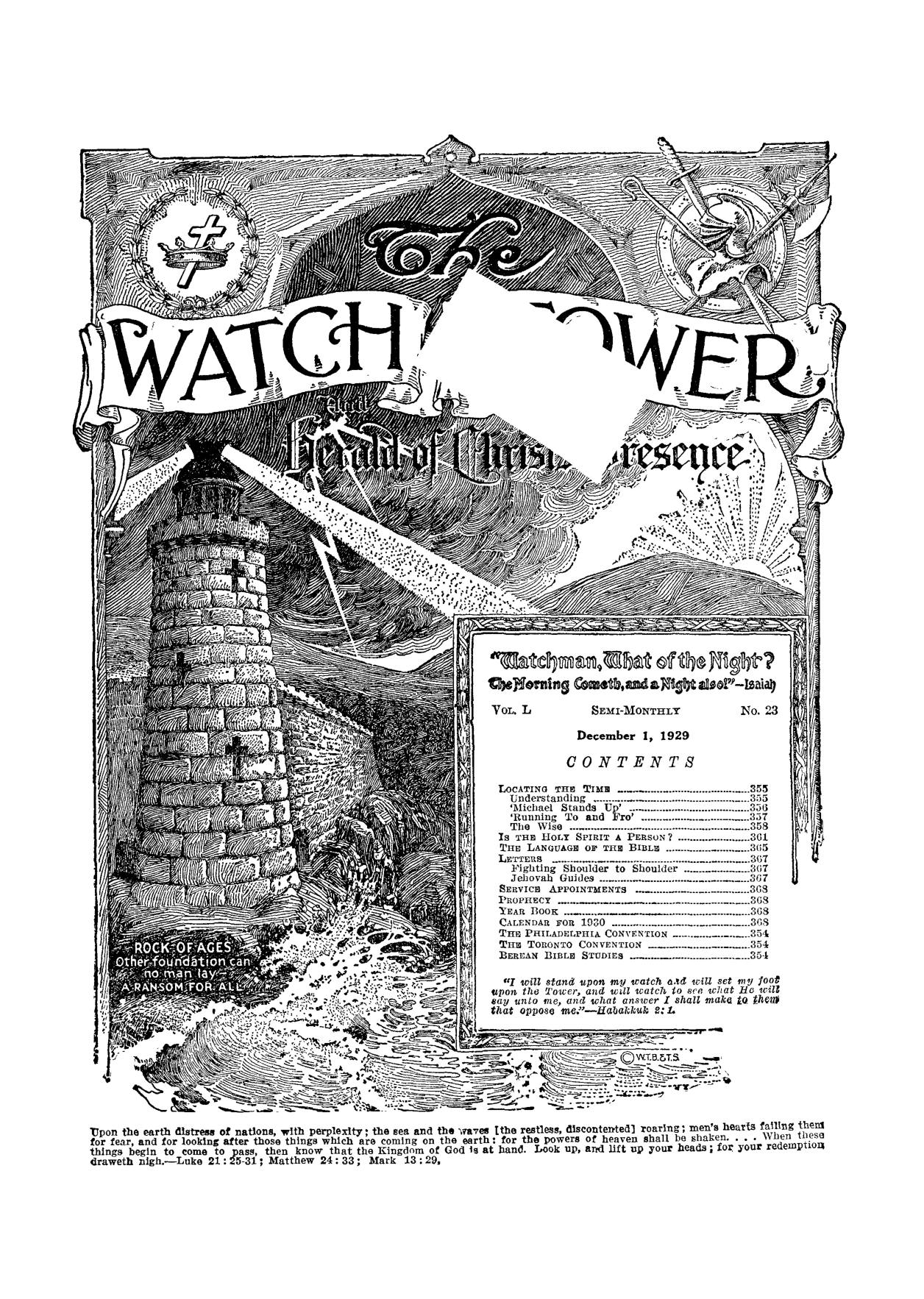
THE PHILADELPHIA CONVENTION
The annual meeting and convention was held at Philadelphia October 31 to November 3 inclusive. The largest attendance at the convention was approximately 1,500. On the first day, the president submitted the annual report. It is entirely too voluminous to set forth in The Watch Tower. Suffice it to say that it is, by the Lord's grace, the best report we have yet had, showing an increased interest and zeal in the Lord's work throughout the earth. This report will be published in full in the Year Book, which will be out and ready for distribution by the last of December. It is hoped that all the brethren will read the report with much interest.
The convention proceeded to vote upon a board of directors and officers, and the following were nominated: For the board of directors, J. F. Rutherford, C. A. Wise, W. E. Van Amburgh, R. J. Martin, A. H. Macmillan, H. H. Riemer, E. J. Lueck. For officers of the Society: J. F. Rutherford, president; C. A. Wise, vice-president; W. E. Van Amburgh, secretary and treasurer; H. H. Riemer, assistant secretary and assistant treasurer.
The greater portion of the time was occupied in listening to discourses by the various brethren, and particularly the field regional service workers. It was a most blessed convention, resulting in upbuilding and comforting those who were there and encouraging them to press on with greater zeal.
The field service yielded splendid results, and all who participated in it manifested great joy in the privileges they had.
THE TORONTO CONVENTION
A convention was held at Toronto, Canada, beginning Friday evening, November 8, and continuing until Monday afternoon, the 11th. About 800 attended the convention.
A good portion of the time was spent in field service, particularly on Sunday and on Monday morning, and with a splendid result. The brethren all greatly rejoiced in the part they had in the work and in their coming together and encouraging one another to press on in the Lord’s service. The Lord is pouring out his blessings upon his people at this time, even as he promised, and as is to be expected.
I.B.S.A. Berean Bible Studies
by means of
The WATCH TOWER
"The Day of His Preparation"
Issue of November 1, 1929
Week beginning January 5 . . . . . ¶ 1-33
Week beginning January 12 . . . . . ¶ 34-64
"His Name"
Issue of November 15, 1929
Week beginning January 17 . . . . . ¶ 1-26
Week beginning January 24 . . . . . ¶ 27-51
The WATCH TOWER
AND HERALD OF CHRIST'S PRESENCE
VOL. L DECEMBER 1, 1929 No. 23
LOCATING THE TIME
"But thou, O Daniel, shut up the words, and seal the book, even to the time of the end: many shall run to and fro, and knowledge shall be increased."—Dan. 12: 4.
JEHOVAH gave Daniel a vision of events that must come to pass, and caused him to make a prophetic record thereof. That Daniel did not make this record for his own benefit is quite sure, both from the facts and from the Scriptures. Daniel was wholly devoted to Jehovah, was one of God's holy prophets, and therefore stood for or represented God's anointed people who also are wholly devoted to Jehovah and who are on earth at the fixed "time of the end".
2 Students of prophecy are well aware that the facts often show more than one fulfilment of a prophecy. Some prophecies are fulfilled in miniature, and later on a far greater scale. Some prophecies have a partial fulfilment which illustrates the more complete fulfilment. For a long while it has been understood that "the time of the end" began with 1799 A.D. and continued until 1914, and that the beginning thereof is specifically marked by the fact that Papacy at that time received a severe blow. While many facts seem to support that conclusion, the proof is not by any means conclusive. Such may have been a miniature fulfilment.
UNDERSTANDING
3 When Daniel had received the vision he sought the meaning thereof. Concerning that he said: "Behold, there stood before me as the appearance of a man. And I heard a man's voice between the banks of Ulai, which called, and said, Gabriel, make this man to understand the vision." (Dan. 8: 15, 16) The understanding of the vision was what Daniel greatly desired. The time of understanding, and the understanding thereof, was the important thing. In his account of the vision he further says: "So he came near where I stood; and when he came, I was afraid, and fell upon my face; but he said unto me, Understand, O son of man: for at the time of the end shall be the vision. And he said, Behold, I will make thee know what shall be in the last end of the indignation: for at the time appointed the end shall be." (Dan. 8: 17, 19) It must be true that the meaning of these words are that at "the time of the end" the meaning of the vision would be understood, and that it would be understood by those persons on earth whom Daniel represented and who would be on earth at that fixed time. That Daniel did not understand the meaning thereof is made certain by his own words: "I heard, but I understood not."—Dan. 12: 8.
4 In further proof that the vision could not be understood until the "appointed time of the end", it is written: "And he said, Go thy way, Daniel; for the words are closed up and sealed till the time of the end." (Dan. 12: 9) Even when the appointed time should arrive not every one would be permitted to understand this prophecy, and that conclusion is supported by the words: "None of the wicked shall understand; but the wise shall understand." (Dan. 12: 10) "The wicked" must mean those who at one time had some enlightenment concerning God's purposes but who at "the time of the end" would be wicked by reason of having become unfaithful to the covenant; and they, therefore, would not be permitted to understand. "The wise" seems certainly to refer to those who take a wise course of being diligent in keeping the terms of the covenant and who are faithful unto God and are joyfully obedient unto his commandments. This would mean, not merely hearing the Word of the Lord, but putting forth the best endeavor to do his will.
MEANING
5 The phrase "time of the end" is therefore of great importance, and that time must correspond with the time of the understanding of the vision. It was at the time of the overthrow of Zedekiah and the carrying away of Israel into Babylon that Satan became the god of the entire world. Babylon, of which Nebuchadnezzar was the ruler, there became the dominant world power. That marked the beginning of the Gentile times. Daniel was particularly desirous of having more light upon the course of the Gentile powers and the duration of the times of the Gentiles. He prayed God for more light. God heard his prayer; but the answer given Daniel was a mystery which Daniel could not understand.
6 The angel of Jehovah at that time informed Daniel that he was greatly beloved and should understand; and this is further proof that what was then and there written was written for the benefit of God’s beloved ones upon earth and upon whom the end of the world comes, and that the understanding thereof would be for the aid, comfort and encouragement of God’s beloved people. (Rom. 15:4; 1 Cor. 10:11) When the angel spoke to Daniel of “the time of the end”, manifestly he was speaking of the time when God’s people should be delivered; that is to say, of the end of the Gentile times, or end of Satan’s world, when God’s anointed people would be completely separated therefrom.
7 Papacy is a part of Satan’s organization, and therefore of the Gentile powers, and it may be well said that the facts show a measure of fulfilment upon Papacy which illustrates the real fulfilment at ‘the appointed time of the end’. A distinction must be made, in the consideration of prophecy, between that which illustrates its fulfilment and the true exposition of the prophecy showing a fulfilment. Papacy does not seem to be specifically mentioned in the book of Daniel. It is true that 1799 A.D. marks an important point in the history of the world. The French Revolution, the things that came to pass in connection therewith, and the great blow that the Papacy then received, are facts of importance; but these do not seem to be sufficient to mark the real fulfilment of this great prophecy. To fix the beginning of “the time of the end” by the breaking of the Papacy’s domination, power, and sway in the earth, therefore, seems to be giving Papacy more prominence than the Scriptures warrant. It may be further said that the facts recorded in history concerning Napoleon’s campaigns, Papacy, and other attending circumstances were leading up to ‘the appointed time of the end’; but “the time of the end”, which is a time definitely fixed by the Lord, can hardly be said to be fixed by these facts of profane history.
'MICHAEL STANDS UP'
8 Specifically referring to the fixed “time of the end” it is written: “And at that time shall Michael stand up, the great prince which standeth for the children of thy people: and there shall be a time of trouble, such as never was since there was a nation even to that same time; and at that time thy people shall be delivered, every one that shall be found written in the book.” (Dan. 12:1) “Michael” signifies “who is as God”, and is therefore one of the names applied to Jesus Christ, God’s great executive officer. The fixed “time of the end”, therefore, corresponds with the time that Michael stands up or becomes active as God’s great officer. Upon this point the Scriptures are explicit.
9 When Jesus ascended on high, it is written of and concerning him, at that time “The Lord said unto my Lord, Sit thou at my right hand, until I make thine enemies thy footstool”. (Ps. 110:1) Therefore “the time of the end” is a definitely fixed time and must mean the time when Jehovah sends his executive officer forth to put down the enemy. It would definitely mark the end of Satan’s uninterrupted rule. That does not mean the immediate destruction of Satan and his power, but does mean that at that specific time God would begin action to oust Satan from power. From the beginning of the Gentile times until the end thereof Satan held sway as the god of the world, without interference or restraint from Jehovah. When God’s due time came, however, that would be fulfilled which is written of and concerning that time: “The Lord [Jehovah] shall send the rod of thy strength [his great executive officer] out of Zion [God’s organization, saying]: Rule thou in the midst of thine enemies.” That would mark the beginning of the activities of Christ Jesus against Satan.
10 Concerning the same period of time it is written: “We give thee thanks, O Lord God Almighty, which art, and wast, and art to come: because thou hast taken to thee thy great power, and hast reigned.” (Rev. 11:17) Then there immediately followed “a time of trouble such as never was since there was a nation even to that same time”. Mark, however, that the scripture does not say that such is the end or last of all trouble. The words of Jesus indicate that the final trouble comes later. (Matt. 24:21, 22) This latter trouble is specified as “the battle of that great day of God Almighty”, in which Satan’s organization in the earth shall be completely destroyed.
11 The disciples of Jesus Christ were Israelites, and they, with other Israelites, would be hoping for the end of the oppressive dominion of the Gentile powers. Jesus had taught them concerning the end of the world, which, evidently, they would understand to mean the end of the Gentile times and therefore “the time of the end” mentioned by Daniel the prophet. His disciples addressed Jesus to know what would be the proof of that time, and, among other things, he said that there would be a great trouble of world war, famine, pestilence, and distress of nations. He told them that such would mark the beginning of the trouble; and his words definitely settled that point. Jesus told his disciples, in substance, that the beginning of the trouble would mark the events of the end of the Gentile times, or Satan’s world, and that then there would be a cessation of trouble for a time, during which time of apparent peace “this gospel of the kingdom shall be preached in all the world for a witness unto all nations”. Then Jesus adds that after such witness is completed the final end would come in a time of “great tribulation, such as was not since the beginning of the world to this time, no, nor ever shall be”. His words therefore indicate the complete destruction of Satan’s organization at the time mentioned by him.—Matt. 24: 8, 14, 21, 22.
12 Taking all these scriptures together, and knowing that they must be in exact harmony with one another, and taking the well known facts in connection therewith, it is easy to be seen that the definitely fixed ‘‘time of the end’’ was and is 1914 A.D. Nothing came to pass in 1799 that corresponds so well with these prophecies as did in 1914.
13 God having told Daniel that the prophecy was sealed up and closed even until ‘‘the time of the end’’, it does not seem reasonable that the seals thereof would be broken and the prophecy concerning the exact fixed ‘‘time of the end’’ made clear until after the date 1914. Prior to that time some might, and some did, apply the historical facts that had come to pass in an honest endeavor to solve this mystery, and their efforts in so doing would be pleasing to the Lord because it showed a disposition to know God’s will. The facts might be taken as a partial fulfilment illustrating the deeper and more complete fulfilment and the understanding thereof when the due and definitely fixed ‘‘time of the end’’ should arrive. The historical facts prophetically recorded by Daniel show what would lead up to the fixed ‘‘time of the end’’ at which fixed time the vision would be made clear. It must be kept in mind that the understanding of the vision, as it relates to God’s chosen people, was and is the important thing. It was important to Daniel, but of much more importance to God’s anointed people whom Daniel represented. The vision was not given for the benefit of the world or those outside of God’s chosen people. It is noticed that there is nothing to show that in 1799 Michael stood up and that then a great time of trouble followed. On the contrary, all the facts show that in 1914 Michael did stand up, take his power and begin his reign, and that there immediately followed a time of great trouble.
‘RUNNING TO AND FRO’
14 At the same time God told Daniel that the prophecy would be sealed up ‘‘even to the time of the end [when] many shall run to and fro, and knowledge shall be increased’’. For a long while students of prophecy have limited the fulfilment of these words last quoted to the fact that men travel up and down through the earth by means of rapid machines, such as locomotives, steamships, automobiles, airplanes, and other like means; and that the great increase of knowledge relates to things of scientific investigation which synchronizes with the development of rapid transit in the earth. Apparently such interpretation is correct and full, because the physical facts seem to support that conclusion. That is to say, in recent years there has been great advancement in science, and at the same time much rapid transit.
15 But be it noted that it has not been God’s people that have been particularly connected with scientific development or the invention of machines. A careful reading of the context of this prophecy, however, shows that the prophecy must have a deeper meaning than that which has been given to it. This text has been repeatedly used to prove that Daniel was a true prophet of God, because there has been so much ‘running to and fro’ and advancement in science. It does not seem to be God’s purpose, however, to prove to his anointed ones who is a true prophet by any such means. There lived in modern times a woman named Mother Shipton who gave a somewhat similar prediction, and none of God’s anointed would be expected to receive her as a true prophetess. It seems proper, therefore, that we should look for a deeper and more significant meaning to these words of Daniel.
16 What is the meaning of the words ‘‘run to and fro’’? Do they mean that men are hurrying from place to place by means of rapid transit? Everybody in the world could see that. Could it therefore be of any special meaning to God’s anointed? The identical words are used in 2 Chronicles 16: 9, wherein it is written: ‘‘For the eyes of the Lord run to and fro throughout the whole earth, to shew himself strong in the behalf of them whose heart is perfect toward him.’’ Surely the words here can not mean that the Lord is in a hurry in his examination of some of those in whose behalf he might show his strength! On the contrary, clearly the thought is that God scrutinizes those who have been brought into the covenant with him. To this end his eyes carefully search out all those who are his, in whatsoever part of the earth they may be. It would, of course, be unnecessary for Jehovah to move at all; but, casting his eyes about, he would consider all people and would manifest his strength in behalf of those who are devoted to him.
17 Again, Jeremiah was caused to say: ‘‘Run ye to and fro through the streets of Jerusalem, and see now, and know, and seek in the broad places thereof, if ye can find a man, if there be any that executeth judgment, that seeketh the truth; and I will pardon it.’’ (Jer. 5: 1) Without a doubt the meaning of these same words used in this text is that diligent search should be made and all carefully scrutinized to the end that one might be found that is approved by the Lord. There is no thought in this text of making haste by rapid travel, yet the words used are exactly the same words used by the Prophet Daniel relative to ‘‘the time of the end’’.
18 The Prophet Zechariah makes this record by God’s direction: ‘‘The hands of Zerubbabel have laid the foundation of this house; his hands shall also finish it; and thou shalt know that the Lord of hosts hath sent me unto you. For who hath despised the day of small things? for they shall rejoice, and shall see the plummet in the hand of Zerubbabel with those seven; they are the eyes of the Lord, which run to and fro through the whole earth.’’ (Zech. 4: 9, 10) Here again the same words, “run to and fro,” are used, and there is a complete absence of any thought of hurrying from one place to another, or even of a hurried glance and a cursory examination. The plain thought is that of supervision, with an exact knowledge and a careful scrutiny and examination. It means knowledge perfectly applied, and suggests knowledge that is entirely applied in the right way. This begins to indicate a deeper meaning of the words of the Prophet Daniel.
19 The Prophet Amos (8:11, 12) tells of a time when there would be a famine in the land, not of material food, but a famine “of hearing the words of the Lord”. This would not mean a famine to those who would hear; but the famine would be on the part of those who do not hear. Then says the prophet that during such time “they shall wander from sea to sea, and from the north even to the east; they shall run to and fro to seek the word of the Lord, and shall not find it”. In recent years, as is well known, many professed Christians, led by their unfaithful clergy, have sought for knowledge everywhere except in the Word of the Lord, and have had their ears closed to the hearing of the Word of the Lord. Those, however, who have diligently sought the Word of the Lord have found it in that same time more than in any other. In this text the words “run to and fro” are used, but manifestly they do not indicate any rapid travel from one place to another or even in a hurried search. The words plainly indicate diligence, and not speed, in searching for something satisfying; and yet those who search other than the Lord’s Word find it not.
20 The German translation of Daniel 12:4, according to the Elberfeld edition, reads: “Viele werden es durchforschen, und die Erkenntnis wird sich mehren,” which, being translated into English, reads: “Many will make thorough study [or examination, search] of it, and knowledge shall be increased.” The Scandinavian Bible also renders this text in the same way.
21 Seeing the plain use of the phrase “run to and fro” by other prophets, we see also that the words of Daniel, both in the text and in the context, indicate an earnest and careful study of the Word of God at “the time of the end” by those who are devoted to the Lord God, because the time has come for the opening of the words of the prophet to God’s servant class. Since the Word of God was written for his covenant people (Rom. 15:4), and not for unbelievers, and since the prophet says that at “the time of the end” many shall “run to and fro, and knowledge shall be increased”, we should expect that the increase of knowledge mentioned would be had by those who are God’s anointed people, rather than that it would be an increase of knowledge by worldly persons.
22 The deeper meaning of the words of the Prophet Daniel seem to be this: At the stated and fixed time, to wit, “the time of the end,” God’s anointed people shall exercise diligence in searching the Word of God, then and there to be opened because God’s due time has come for them to understand, and his flashes of lightning will illuminate his Word and reveal his purposes; and thereby there is a corresponding increase of knowledge by and on the part of his anointed people. This exactly corresponds with the facts that those who have been devoted to the Lord have in this “time of the end” received a clearer vision of prophecy. The parable of the virgins supports this conclusion. —Matt. 25:1-8.
23 This conclusion is fully supported by the words of the Prophet Amos above mentioned. The prophecy of Amos was written 250 years before Daniel’s prophecy was written. Amos foretold the time coming when there would be a famine of the hearing of the words of the Lord, at which time many would run to and fro in search of something satisfying. Daniel’s prophecy written later must be consistent with that which the Lord had spoken by Amos. Amos referred to a specific time. Daniel’s prophecy covers the whole period of time concerning the times and seasons of the Gentiles, even to “the time of the end” of the Gentiles. When at the end of that specific time, not only would the prophecy of Amos be understood, and the prophecy of Daniel, but the meaning must be that until “the time of the end” none of the prophecies would be clearly understood, but that when the due time had arrived the prophecies of Amos, Daniel, Job and others would be understood. Who, then, would be privileged to have that understanding?
THE WISE
24 Daniel answers that question in these words: “Many shall be purified, and made white, and tried; but the wicked shall do wickedly: and none of the wicked shall understand; but the wise shall understand.” (Dan. 12:10) These words of the prophet limit the understanding of the prophecy to the “wise”, and the time thereof is “at the appointed time of the end”. The words of the prophet also show that those who would be wise and understand must first be “purified, and made white, and tried”. It necessarily follows, then, from the prophecy, that the following things must exist at the same time, to wit: the standing up of Michael; the running to and fro; the cleansing or purification of God’s people; and their understanding of the prophecies.
25 Without a doubt Satan used the Papacy to defile the professed people of God. Many attempts were made by good men to cleanse the people of God from such defilements. The so-called reformation by Martin Luther was doubtless prompted by good intentions, but the movement did not reform. The organization led by Luther became a part of Satan’s organization, and continued therein. Those who entered the organization, though then sincere, soon gave flattering titles to men, and God pushed them aside. The reformation movements led by such men as Wesley, Campbell, Miller and others, collapsed; and those making up such organized movements fell into the same trap of Satan and became a part of his organization. Surely it will not be insisted by any one who is devoted to the Lord that the organization of the Evangelical Alliance, in 1846, accomplished a complete reformation or cleansing and purifying of the people of God.
26 The greatest reformation amongst God’s professed people ever led by any man was that in which Brother Russell engaged, and both the facts and the Scriptures show that even that did not accomplish the complete cleansing of the people of God. The words of God’s prophet give a reason therefor, to wit: “Except the Lord build the house, they labour in vain that build it; except the Lord keep the city, the watchman waketh but in vain.” (Ps. 127:1) Without a doubt the Lord has been pleased with the honest and sincere efforts put forth by good men to bring about reformation and cleansing, but that work could not be made complete by men; it could be accomplished only by the Lord himself.
27 Daniel tells of a purifying work that must be done at the end of the world. Other scriptures show when it will be done and who does it. God, through his prophet Malachi, discloses that for some time prior to 1918 the Lord Jesus, as God’s Messenger and special representative, was ‘preparing the way before Jehovah’. At the proper and appointed time he ‘suddenly comes to his temple’. For what purpose does he come to his temple? The Scriptures answer, for the purpose of judgment and cleansing. “The Lord is in his holy temple, the Lord’s throne is in heaven; his eyes behold, his eyelids try, the children of men. The Lord trieth the righteous; but the wicked, and him that loveth violence, his soul hateth. Upon the wicked he shall rain snares, fire and brimstone, and an horrible tempest: this shall be the portion of their cup. For the righteous Lord loveth righteousness; his countenance doth behold the upright.”—Ps. 11: 4-7.
28 Malachi corroborates this last statement by showing that when he comes to his temple is the time of fiery trials and testings upon the professed peoples of God, “for he is like a refiners fire, and like fuller’s soap.” He sits to purify the truth, represented under the symbol of silver, in order that the truth may be made clear and understandable. Then the vision is to be understood. He sits to try, to purge and purify, those who are in the covenant with God by completely separating them from every part of Satan’s organization, that they may be wholly and completely devoted to Jehovah’s work. “And he shall sit as a refiner and purifier of silver; and he shall purify the sons of Levi, and purge them as gold and silver, that they may offer unto the Lord an offering in righteousness.” —Mal. 3: 3.
29 Those who come through the fire and are cleansed and approved and made white are made members of the servant of God. This work follows a fixed “time of the end”; and is done by the Lord, and not by man. It is apparent to all that man could not do this work, but that it must be done by the Lord himself. Compare the words of Malachi 3: 3 with the words of Daniel 12: 10, and it will be seen that they must refer to the same time and the same cleansing work. The Scriptural proof, taken together with the physical facts, shows beyond any doubt that the fixed “time of the end” means the time of the end of the Gentile dominion without interruption, and therefore the end of the world, or Satan’s uninterrupted rule, and is fixed at the end of 1914. It was then that God set his beloved Son upon his throne and sent him forth to begin ouster proceedings against the god of the Gentile powers. (Ps. 2: 6; 110: 2) It was thereafter, to wit, in 1918, that the Lord came to his temple and began the judgment or purifying work upon his professed people. The “wicked” mentioned by the Prophet Daniel would necessarily embrace those who had made a covenant with the Lord, who had received some enlightenment, and who upon examination would be disapproved by the Lord; and the verdict is: “None of the wicked shall understand.” The purified received the approval of the Lord, and, being wise, were permitted to understand, because it is the wise that understand.
30 Who are the wise? “My son, attend unto my wisdom, and bow thine ear to my understanding.” (Prov. 5: 1) “He that hearkeneth unto counsel is wise.” (Prov. 12: 15) The wise is strong in the Lord and increases his strength. (Prov. 24: 5) The wise man is he who hears the words of the Lord and heeds and joyfully obeys them. He diligently searches the Scriptures, scrutinizes the proofs, and thereby, within the meaning of the prophet, “runs to and fro”; and his knowledge of God’s purposes is increased. Such are the ones that Daniel declares will understand the unfolding of prophecy, and that after the purging which the Lord does at his temple.
31 The words of Daniel and of Jesus show that the wicked class is made manifest at the temple trial. (Dan. 12: 10; Matt. 24: 48; 25: 26) “None of the wicked shall understand.” “Fools despise wisdom and instruction.” (Prov. 1: 7) Such are wise in their own eyes. (Prov. 3: 7; 26: 12) Such foolish ones scorn knowledge and are an abomination unto men and unto the Lord. (Prov. 24: 9; 15: 9; 16: 5) In this connection it might be said that The Watch Tower is far from being perfect, but the Lord has used it as a means to communicate with his own people. It has enabled them to more diligently search the Word of God and to study the truth. No member of the Society on earth is perfect, and yet the Lord uses them that are devoted to him to be his witnesses.
32 Men who hold the privileged position of elders and counselors of the ecclesias are in a position of responsibility to the Lord, and for these to scorn The Watch Tower and to say it is "rotten and contains nothing but foolishness" shows a bad condition of heart. Some have taken exactly the position here described with reference to God’s means of feeding his people. Their offense is not really against The Watch Tower, but is against the Lord, who knows how to do his own business and employs his own selected means. These who thus become offended and pursue a lawless course the Lord says shall be gathered out from amongst his people at "the time of the end". (Matt. 13: 41, 42) It follows, then, that they would not understand. The words of Daniel concerning the wicked's not understanding could not apply to peoples of the world or of Satan's organization, who have never been in the covenant with Jehovah, but must of necessity be limited to those who once made a covenant and have been unfaithful thereto.
33 Referring again to the prophecy of Amos (8: 11-14): The language used implies a time of judgment upon God’s people and a disapproval of the unfaithful. The prophecy had a fulfilment, in a measure, upon natural Israel, but its full and complete fulfilment is upon spiritual Israel. Such fulfilment was and is emphasized by the attitude of those judged by Jehovah: "They that swear by the sin of Samaria, and say, Thy god, O Dan, liveth; and, The manner of Beer-sheba liveth; even they shall fall, and never rise up again."—Amos 8: 14.
34 The sin of Samaria was the sin of Jeroboam, who made golden calves and placed them at Dan and at Bethel. It was the sin of setting up a rival organization to that which God was using. Jeroboam made the golden images and then said to God’s chosen people, the Israelites: 'These be thy gods, O Israel, which brought thee up out of the land of Egypt.' (1 Ki. 12: 28) Jeroboam professed to serve Jehovah, but at the same time set up a golden image to represent Jehovah; therefore the prophet describes this as "the sin of Samaria".
35 Following the judgment that began in 1918 there have been and are those who have broken away from the Lord’s organization, and have scorned the Society and The Watch Tower, and yet who claim to serve Jehovah God. They say: 'There has been no truth in The Watch Tower in recent years.' They profess to still worship and serve Jehovah, but say that this can be properly done only through and by the teachings of that 'faithful and wise servant' who they claim is one man, and who they claim brought the people of God up out of antitypical Egypt. They give this credit to man, rather than to Jehovah God. They set up their way of worshiping God by and through a man-appointed way, and therefore their course is likened unto "the sin of Samaria". They have suffered under the famine of hearing the Word of God, and do not understand. God had caused to be written in his Word by one representing his faithful people, "Let me not, I pray you, accept any man's person; neither let me give flattering titles unto man; for I know not to give flattering titles; in so doing my Maker would soon take me away." (Job 32: 21, 22) It is manifest that God is not pleased with any one who gives flattering titles to any creature; and that which was said by Elihu applies to all who take a similar position.
36 In brief, "the time of the end" may be summed up in this manner: The Gentile times began in 606 B.C., and must end at a time certain, which time marks the end of the world under Satan as the god thereof. The year 1914 marked the end of the Gentile times, and therefore the end of Satan's world, and there began ouster proceedings against him by Jehovah through Christ Jesus. "The time of the end" is, both by the facts and by the Scriptures, definitely fixed at, to wit, 1914 A.D. It was then that Michael stood up, and there followed a time of trouble such as there never was before that time. Then it was that in the earth nation rose against nation, and kingdom against kingdom, as never before.
37 Thereafter, to wit, in 1918, the Lord came to his temple and began the purging and purifying of those who claimed to have made a covenant with Jehovah; then there were many running to and fro by diligently and earnestly searching for the truth, and carefully and with godly fear scrutinizing the truth brought to them by the grace of the Lord. As a result thereof there has been a great increase of knowledge amongst the truly anointed people of God. The wise have received this increase of knowledge joyfully, have heeded the counsel of the Lord, and have delighted to obey the commandments of God and put forth their best endeavors to glorify Jehovah God’s name by actively participating in his service. Being wise they understand and obey the Lord and shine forth as his witnesses.—Dan. 12: 4, 10; Matt. 13: 43.
38 One of the works of this anointed class has been, and is, to turn the prisoner class to a devotion to the Lord, that they might receive Jehovah's approval; and therefore says Daniel: "They that turn many to righteousness [shall shine] as the stars for ever and ever." If such continue to act wisely, by faithfully and joyfully giving witness to the name and works of Jehovah God, and thereby turning many others to righteousness, they shall shine for ever. The fixed "time of the end" marks the time when the prophecy must be unveiled, because the Lord so stated. God’s lightnings continue to flash and illuminate his purposes, as set forth in his Word, and in full harmony with his promise; and the wise see it and rejoice, and they respond by unstinted service, devotion and praise to the great Jehovah God.
QUESTIONS FOR BEREAN STUDY
¶ 1, 2. Who was Daniel? Whom did he represent? What is the nature and purpose of the record contained in the book of Daniel? What has been observed as to the manner of fulfilment of some of the prophecies of the Bible?
¶ 3, 4. Relate what took place after Daniel’s receiving the vision. Explain the meaning of the messenger’s words, as to when and by whom the vision would be understood.
¶ 5, 6. Describe the events marking the beginning of "the times of the Gentiles". What was it that Daniel there particularly desired? What information was given him? For whose benefit was it given?
¶ 7. How are the events of 1799 related to "the appointed time of the end"?
¶ 8-10. What is meant by the expression, "Michael shall stand up"? How is the time thereof related to the fixed "time of the end"? How is this related to that which is recorded in Psalm 110: 1, 2 and Revelation 11: 17?
¶ 11-13. Give the substance of Jesus’ answer to his disciples’ question recorded in Matthew 24: 3. In what manner, then, is the definitely fixed "time of the end" ascertained?
¶ 14, 15. State the application hitherto given Daniel 12: 4. Show whether it meets the requirements of the context.
¶ 16-20. By illustration with other texts in which "run to and fro" is used, show the true significance of the expression.
¶ 21-23. Quote another translation, and state the facts verifying the explanation here presented. How does the prophecy of Amos 8: 11, 12 serve to confirm the correctness thereof?
¶ 24. Quote Daniel 12: 10 to show when and by whom the prophecy would be understood. How would this class first be qualified? What are the circumstances necessary at that time to constitute fulfilment of this prophecy?
¶ 25, 26. Point out the chief instrument used by Satan to defile the professed people of God. What was clearly the purpose of the reformation movements? To what extent did they accomplish a cleansing of God’s people? Account for the measure of success or failure attending those efforts.
¶ 27, 28. Show the correspondency of Daniel’s and Malachi’s prophecies and Psalm 11: 4-7 in regard to a purifying work to be done at the end of the world, and the results of that work of cleansing.
¶ 29. State the time at which this cleansing work would be done, and give proof thereof.
¶ 30, 31. Quote scriptures to show who are the "wise", and account for their understanding the prophecy. Likewise show who are the "wicked", to account for their failure to understand.
¶ 32. Who, particularly, are in danger of falling into the "wicked" class, and why? How is it doubly important for these to have and manifest the spirit of complete devotion to God and his truth, and to the channel and means which God is using to communicate with his own people and through which the kingdom witness is being given? Point out the danger in taking offense and opposing the means which God has used and is using to feed his people.
¶ 33-35. What is meant by "the sin of Samaria"? Point out the fulfilment of Amos 8: 11-14.
¶ 36-38. In summary, briefly define or explain the following (and give time or duration thereof): "the times of the Gentiles"; "the time of the end"; Satan’s "world"; "Michael shall stand up"; "nation shall rise against nation, and kingdom against kingdom"; "my messenger . . . shall prepare the way before me"; "the Lord . . . shall suddenly come to his temple"; "many shall be purified, and made white, and tried"; "many shall run to and fro"; "knowledge shall be increased"; "the wicked shall do wickedly, and shall not understand"; "the wise shall understand"; "they that turn many to righteousness"; "shall shine as the stars."
IS THE HOLY SPIRIT A PERSON?
[Thirty-minute radio lecture]
IN 1 JOHN 5:7 we find these words: "There are three that bear record in heaven, the Father, the Word, and the Holy Ghost: and these three are one."
Nearly all professing Christians believe that this text mentions three separate and distinct persons or individuals, "the Father" referring to God Himself, "the Word" referring to Jesus, and "the Holy Ghost" referring to a third person. This interpretation is made the basis of one of the most revered doctrines held in common by all the denominations of Christendom, namely, the doctrine of the "trinity".
The "trinity" doctrine assumes that three distinct persons are mentioned in this text and that yet in some unexplainable way these three are one person. Just how three persons can be one person, is acknowledged to be a mystery. Strange as it may seem, it is nevertheless a fact that most people admire and love that which is mysterious and hoary with age; and since the doctrine of the "trinity" comes down to us from the beginning of the "dark ages", it is revered and venerated as no other doctrine is.
This doctrine is often mentioned as "the holy and blessed trinity", "the triune God," and "the three persons in one godhead". None of these expressions are found in the Scriptures, but they abound in sermons, theological works and hymn books. The majority of people, however, have been taught to believe that these are Bible expressions, and become very much excited and angry when any one attempts to show them that they are not Scriptural statements.
The word "trinity" is not found in the Bible, neither is there any word having the meaning of "trinity", which meaning is "three persons in one".
The idea that three separate and distinct persons can be one person, is unreasonable, unscriptural and utterly impossible. Yet to deny the doctrine, or even to question its reasonableness, is considered heresy, and will bring persecution on one daring to do so. During the "dark ages" many who dared to deny or question the doctrine lost their lives for so doing.
The "trinity" doctrine first came into existence about five hundred years after Jesus was on earth, and about four hundred fifty years after the Bible was completed. It originated at a time when the common people were forbidden to read the Bible, on pain of death or other horrible punishment, and those who inflicted these punishments of torture and death were the authors of the doctrine. While not found in the Bible, it is one of the most important of the "creeds" of Christendom, and originated during the same period in which all other "creeds" were formed, a period characterized by unparalleled prejudice, ignorance, superstition, bigotry, intolerance and persecution.
Bible Students agree with all professing Christians that "the Father" and "the Word" refer to two separate and distinct persons, namely, Jehovah God and the Lord Jesus. The student of the Bible can not agree, however, that these two persons are one, for the reason that it is impossible for two persons to be one, and for the further reason that the Bible clearly sets forth the fact that they are not one.
In the Scriptures, God is called "the Father of our Lord Jesus Christ", and Jesus is called "the Son of God". These words "Father" and "Son" are a most positive and emphatic contradiction of the doctrine of the "trinity", for, if Jesus was the "Son of God", "the only begotten of the Father," then it follows that he was not "from everlasting to everlasting" as was God. Jesus was a begotten being, "the firstborn of every creature" (Col. 1:15), "the beginning of the creation of God." (Rev. 3:14) If Jesus was begotten, created and born, as these texts state, then it follows that he could not be God, who was never created or born and never had a beginning.
Just now, however, we are considering the so-called third person of the "trinity", called the "holy ghost". Is the "holy ghost" a person? The word "ghost" is found ninety-four times in the Bible, eleven times in the Old Testament and eighty-three times in the New Testament.
Examining the eleven instances in which the word "ghost" is found in the Old Testament, we find that in no instance is there any reference whatever to God, but in every instance the reference is to men about to die. In Genesis 25:17 we read that Abraham "gave up the ghost and died". Again, in Genesis 35:29 we read: "Isaac gave up the ghost, and died." Strong, a Methodist authority, says that the word "ghost" means to "breathe out or expire". What Abraham, Isaac and others really gave up was the invisible power supplied by God for the purpose of keeping a person alive. This God-given, invisible power which keeps a person alive, is called "the breath of life", "the spirit of life," and is what the wise man referred to in Ecclesiastes 12:7 when he said that "the spirit shall return unto God who gave it". God supplies to every person the right to live, the privilege to live, and the power to live. When a person dies, this right, privilege and power return to God again. In not one of the eleven texts of the Old Testament does the word "ghost" mean a person.
In the New Testament we find the word "ghost" eighty-three times. The same Greek word is also translated "spirit" 246 times in the New Testament. The word "ghost" is a mistranslation. It should always be rendered "spirit". The translators of the Bible were taught and believed the doctrine of the "trinity". They used the word "ghost" because it has the idea of a person connected with it. It was a little piece of deception used to lend color to an unwarranted and unscriptural doctrine. Substitute the word "spirit" for the word "ghost" every time you find it in the Bible, and you will have a correct translation. The word "ghost" is absolutely incorrect.
To prove that the word "ghost" does not mean a person, and can not refer to one of a trinity of gods, let us note some of its uses in the New Testament.
In Matthew 27:50 we read: "Jesus, when he had cried again with a loud voice, yielded up the ghost." By no possible stretch of the imagination can this text be used to prove the doctrine of the trinity. It simply means that Jesus died, expired, ceased to live. His spirit of life, the privilege of living and the power to live, which he had received from God had returned to God who gave it.
In Luke 23:46 we read Jesus' own words, as follows: "Father, into thy hands I commend my spirit"; and the record is that "having said thus, he gave up the ghost". Jesus committed his right to live to his Father; and on the third day thereafter God restored to him the right to live and the power to live, by raising him from the dead. He gave back to Jesus his spirit or breath of life, not his "ghost".
In Mark 1:8 we read the words of John the Baptist, as follows: "I indeed have baptized you with water: but he shall baptize you with the holy ghost." Most surely no one would claim that Jesus baptized any one with the third person in a trinity of gods. Correctly translated, John's words mean that Jesus would baptize his followers with the holy spirit, not with the "holy ghost". The holy spirit which comes on the followers of the Lord Jesus simply means the holy and invisible power of God.
John's words were fulfilled on the day of Pentecost, ten days after the resurrection of Jesus, as recorded in Acts 2:1-4, which reads: "And when the day of Pentecost was fully come, they were all with one accord in one place. . . . And there appeared unto them cloven tongues like as of fire, and it sat upon each of them. And they were all filled with the holy ghost, and began to speak with other tongues, as the spirit gave them utterance."
Surely the waiting disciples of Jesus were not filled with a person. They were filled with the holy spirit or invisible power of God, which enabled them to speak languages unknown to themselves. It will be noticed that the text reads that "they were all filled with the holy ghost", and then adds that 'they spoke in other tongues as the spirit gave them utterance'. Thus we see that the "holy ghost" and "the spirit" are the same thing.
Another text where the words "holy ghost" and "spirit" mean the same thing is found in John 7:38, 39. Jesus had said: "He that believeth on me, . . . out of his belly shall flow rivers of living water." The next verse (39) explains this statement, as follows: "But this spake he of the spirit, which they that believe on him should receive: for the holy ghost was not yet given, because that Jesus was not yet glorified." Ten days after Jesus was glorified he sent the holy spirit (not the "holy ghost", for there is no such thing) on the waiting disciples as they were gathered in the upper room.
After Jesus' resurrection he appeared to the disciples who had met in a room and locked the doors for fear of the Jews. Jesus then spoke these words: "Peace be unto you. . . . And when he had said this, he breathed on them, and saith unto them, Receive ye the holy ghost." (John 20:19-22) It is manifest that Jesus did not mean that they should receive a person, a third person of a trinity of gods. We get the correct thought when we understand Jesus to say, "Receive ye the holy spirit."
What is meant by the holy spirit? It is the invisible power of God, which he uses in a great variety of ways. Whatever God does, the power which he uses to accomplish his purpose is called the holy spirit. Primarily, the word "spirit" means "wind", "air"; and since the wind or air is both powerful and invisible, it was used by the sacred writers to picture the invisible power of Jehovah God.
In Acts 2:38 we read that Peter, speaking to Jews, said: "Repent, and be baptized every one of you . . . and ye shall receive the gift of the holy ghost." Here again, it would be foolish to think of this gift as a person. But what gift was given to those who repented? The answer is found in Acts 1:8, which reads: "Ye shall receive power, after that the holy ghost is come upon you; and ye shall be witnesses unto me, both in Jerusalem, and in all Judæa, . . . and unto the uttermost part of the earth." The special power of the holy spirit (not the "holy ghost") enabled them to be witnesses for the Lord.
In Acts 19:1-3 it is written: "Paul . . . came to Ephesus; and finding certain disciples, he said unto them, Have ye received the holy ghost since ye believed? And they said unto him, We have not so much as heard whether there be any holy ghost." How foolish it would be to think that Paul asked them if they had received a person; but how reasonable, when rightly understood. Paul really asked them as follows: 'Since you have accepted the Lord, have you received the holy spirit; that is, have you been given special power from on high?'
Still another text that refutes the "trinity" nonsense is found in 1 Corinthians 6:19 and reads thus: "Know ye not that your body is the temple of the holy ghost which is in you, which ye have of God?" Most surely, if the bodies of the Lord's people are a temple of the holy spirit (not the "holy ghost") then it is self-evident that the "holy ghost" is not a person, much less one member of a trinity of gods.
In 2 Timothy 1:14 is a similar text, which reads thus: "That good thing which was committed unto thee, keep by the holy ghost which dwelleth in us." Here again the holy spirit (not the "holy ghost") is something that dwells in a devoted servant of the Lord.
There are many other texts which can be cited, but we believe that these will suffice to show that the so-called "holy ghost" is not a person; that this term is an incorrect translation; and that the reference is to the invisible power of Jehovah God, acting either upon a person or upon a thing. This being true, another human theory called a "creed" is exploded; another mystery explained, and the Bible vindicated and cleared of the charge of being the source of such a misleading doctrine.
The holy spirit is often spoken of as "the spirit of truth", the "spirit of promise", "spirit of wisdom," "spirit of understanding," "spirit of counsel," "spirit of God," and is contrasted with the spirit of Satan, which is called the "spirit of error", the "spirit of the world", and the "spirit of antichrist".
In John 16:13, and in other texts, the holy spirit is referred to by the pronoun "he", and many suppose that this is proof positive that the holy spirit is a person. John 16:13 reads: "Howbeit when he, the spirit of truth, is come, he will guide you into all truth: for he shall not speak of himself; but whatsoever he shall hear, that shall he speak; and he will shew you things to come." How is this to be harmonized with what we have heretofore considered? There are two answers, both of which are Scriptural. The first answer is this: The holy spirit is God's spirit, and since God is masculine, it would be entirely proper to speak of the holy spirit as "he". The second answer is that the Greek pronoun which is translated "he" can properly be translated "he", "she" or "it". Therefore it would be correct to translate the verse as follows: 'When it, the spirit of truth, is come, it will guide you into all truth: for it will not speak of itself, but whatsoever it shall hear, that shall it speak.' Either of these explanations is correct.
The question might be asked, Why has God permitted these mistranslations to be in his Word, and who is to blame for their being there? The answer is that God has an enemy, a wicked, malicious creature called Satan. For many centuries Satan has been misrepresenting God. His one purpose is to make God and the Bible appear ridiculous, foolish, unwise and cruel. He knows that if he can succeed in this, sensible people will recoil from worshiping God. Hence Satan has charged God and the Bible with setting forth certain doctrines repugnant to common sense. Satan has falsely charged God with being the author of the doctrine of eternal torment, and the Bible as setting it forth; and thus multitudes of thinking, intelligent people have been driven away from the Bible. Satan put forth the doctrine of the "trinity", because it belittles God in the eyes of reasonable, thinking men and women.
If the "trinity" doctrine were true, Jehovah would necessarily divide the honor of being the one and only God with two other persons.
If the "trinity" doctrine were true, people would be asked to believe that which is nonsense, namely, that three persons can be one person. Only those who love the mystical and the superstitious would believe any such doctrine.
It is the "creeds" which set forth these doctrines. The "creeds" are not found in the Bible. Satan is the author of the creeds. He formulated them during the "dark ages", when the Bible was not circulated and read as it is today; when there were no Bible helps, such as lexicons, dictionaries or concordances, to aid the student. In our day we have the help of hundreds who have spent a lifetime in Bible study and have given us the benefit of their studies in the form of lexicons, concordances and dictionaries, and these are found in millions of homes.
People are studying the Bible today with the aid of these helps, and are rapidly rejecting the creeds and repudiating those who hold to and teach the creeds. They are finding out that they have been deceived, and refuse longer to submit to the deception. We are today living in that time mentioned by Jesus, who said: "For nothing is secret that shall not be made manifest; neither any thing hid that shall not be known and come abroad." (Luke 8:17) The "dark ages" are mentioned in the Scriptures as a dark night. The Bible tells us that the night is to be followed by a day; and we are now living in the dawning of that new day. The Lord is now turning on the light, and the fogs and mists and darkness of ignorance, superstition and falsehood are rapidly fleeing away. The wood, hay and stubble of human traditions and creeds are now being consumed. The people are being disillusioned, and the reaction is turning them away from everything religious and, unfortunately, away from the Bible.
This explains why so few people go to church in our day. They have lost all confidence in the institution, as well as in their leaders. They know they have been deceived, and they resent it.
There was never a time in the history of the world when the trend of religious thought was so much toward doubt, skepticism and infidelity as at the present time. The people never needed help so much as at the present. Evolution, higher criticism and modernism are with united voice denying the inspiration of the Bible, the virgin birth of Jesus and the necessity for his death; denying the story of creation, and the miracles of both the Old and the New Testament, and exalting nature as god instead of the one and only true God, Jehovah, the Most High.
The trend of nearly all religious thought and study of our day is along the line of a destructive criticism of the Bible and an effort to exalt the opinions of men and to magnify the names of human leaders. The name and power of Jehovah God is belittled. His Word is openly ridiculed. Men openly and brazenly declare that they could write a better book than the Bible.
The worst feature of these attacks on God and the Bible is that they come from within, from those who claim to be servants of God and teachers of his Word. This fact makes the attacks more insidious and harmful than they otherwise could be.
To profess to be a servant of God and a teacher of his Word, and then to indulge in destructive criticism of God and his Word, is hypocrisy and treason. The result is that the masses of the people repudiate everything in the nature of religion; churches are empty; and crime, lawlessness, pleasure, folly and sin flourish as never before.
Who is to blame for the existing conditions? We answer that, primarily, Satan is to blame. He is the one who desires to reproach God and his Word. He desires to alienate men and women from the worship of Jehovah and to get them to worship himself. Secondarily, those men are to blame who, instead of preaching the Bible, have perpetuated and preached the creeds which have misrepresented both God and the Bible. Creedal doctrines, such as "eternal torment", "trinity," and "human immortality", are so unjust, unwise, unloving and unreasonable that they have driven people away from the Bible into skepticism and infidelity. It is claimed that the Bible supports these wicked teachings; and the people, believing this, have repudiated the Bible. These are exactly the results that Satan planned and expected.
The people need help in order that they may be delivered from the doubts with which their minds have been poisoned. The proper help will be something that will restore their confidence in the Bible; something that will show that the Bible does not teach the creedal doctrines, and that will show that the Bible is harmonious and beautiful in its teachings; that it magnifies truth, righteousness, love and justice; that it foretells blessings for all the race. The work of the International Bible Students is to help the people out of the bog of error, doubt and infidelity into which the creeds have led them. This lecture is given for that very purpose. Every week Bible Students use over 120 radio stations for the same purpose.
In closing, let us consider one more proof that the creedal doctrine that "the holy ghost is a person" is unscriptural and therefore untrue. It is this: In the text used at the beginning of this lecture, found in 1 John 5:7, and which reads, "There are three that bear record in heaven, the Father, the Word, and the Holy Ghost: and these three are one," the words "in heaven, the Father, the Word and the Holy Ghost: and these three are one", are not found in any of the old manuscripts. The Emphatic Diaglott translation, Rotherham's translation and the Revised Version all omit these words. A footnote found in the Diaglott reads as follows: "This text concerning the heavenly witness is not contained in any Greek manuscript that was written earlier than the fifth century." Thus we can see that the only text that gives color to the "trinity" doctrine is a spurious one, added by some writer about five hundred years after the Bible was written. Answering the question, then, we say without fear of successful contradiction that the "holy ghost", or, properly speaking, the holy spirit, is not a person.
THE LANGUAGE OF THE BIBLE
[Fifteen-minute radio lecture]
MANY conscientious people try to interpret the statements of the Bible literally. Others, equally sincere, try to "spiritualize" everything in the book. Strict adherence to either rule results in confusion and the loss of many blessings. The literalist, who believes that 'the Bible means just what it says', finds great difficulty in explaining statements like the following: "The heavens, being on fire, shall be dissolved." Taken literally, this would mean that the physical heavens were to be destroyed.
There are other texts which speak of "war in heaven"; "armies" in heaven; horses in heaven; a river in heaven; trees in heaven; a city in heaven, with walls, gates of pearl, and streets paved with gold, and in form a perfect cube 12,000 furlongs long, wide, and high; also the two great wonders in heaven, "a woman" and a "great red dragon". There will be found Paul's statement that he was caught up to the third heaven; also the parables of Jesus, wherein he mentions "wheat", "tares", "chaff", "fish", "vine" and "branches", a "camel" going through a needle's eye, and numberless other like statements. Interpreted literally, these would be foolish statements.
…