The Watchtower, April 1, 1928
Download: PDF — The Watchtower, April 1, 1928
SERVICE WEEKS
So many blessings have resulted from a week set aside for service that many of the friends are asking that two service weeks be set aside this year. We therefore name the week beginning May 13 and ending May 20, as the first service week; and the week beginning August 26 and ending September 3 as the second service week. Announcement is made at this time so the brethren can arrange their vacations accordingly and every one have a part in the wonderful privilege of exalting the name of Jehovah.
CALENDAR PICTURE
A limited quantity of the 1928 calendar picture (without the calendar pad), suitable for framing, can be provided at 25c each, or in lots of five or more, 20c each.
MEMORIAL REPORTS
Class secretaries will confer a favor by promptly reporting the attendance at the Memorial, so that these reports may appear in an early issue of The Watch Tower.
The time for commemoration of the death of the great passover Lamb, Nisan 14th, is calculated for this year as the evening of Wednesday, April 4, after sunset.
RADIO AND LECTURE DEPARTMENT
The radio has become so important in the kingdom witness work in conjunction with lectures that the Society has determined to change the name of the pilgrim department and radio department to that of radio and lecture department. All mail or communications having to do with the radio and lectures, which of course embraces the pilgrims, should be addressed Watch Tower Bible & Tract Society, Radio and Lecture Department.
“SONGS OF PRAISE TO JEHOVAH”
Songs of Praise to Jehovah is the title of a new song book which is now ready for shipment. On its 300 pages are many new songs and tunes, as well as old favorite selections. Retail price of the book, cloth-bound, is 75c, postpaid. Price to classes in lots of 20 or more, 69c each.
I. B. S. A. Berean Bible Studies by means of “The Watch Tower”
“Presence of Christ”
Issue of February 15, 1928
Week of May 6 . . . ¶ 1-26
Week of May 13 . . . ¶ 27-53
“Jehovah’s Covenants”
Issue of March 15, 1928
Week of May 20 . . . ¶ 1-27
Week of May 27 . . . ¶ 28-54
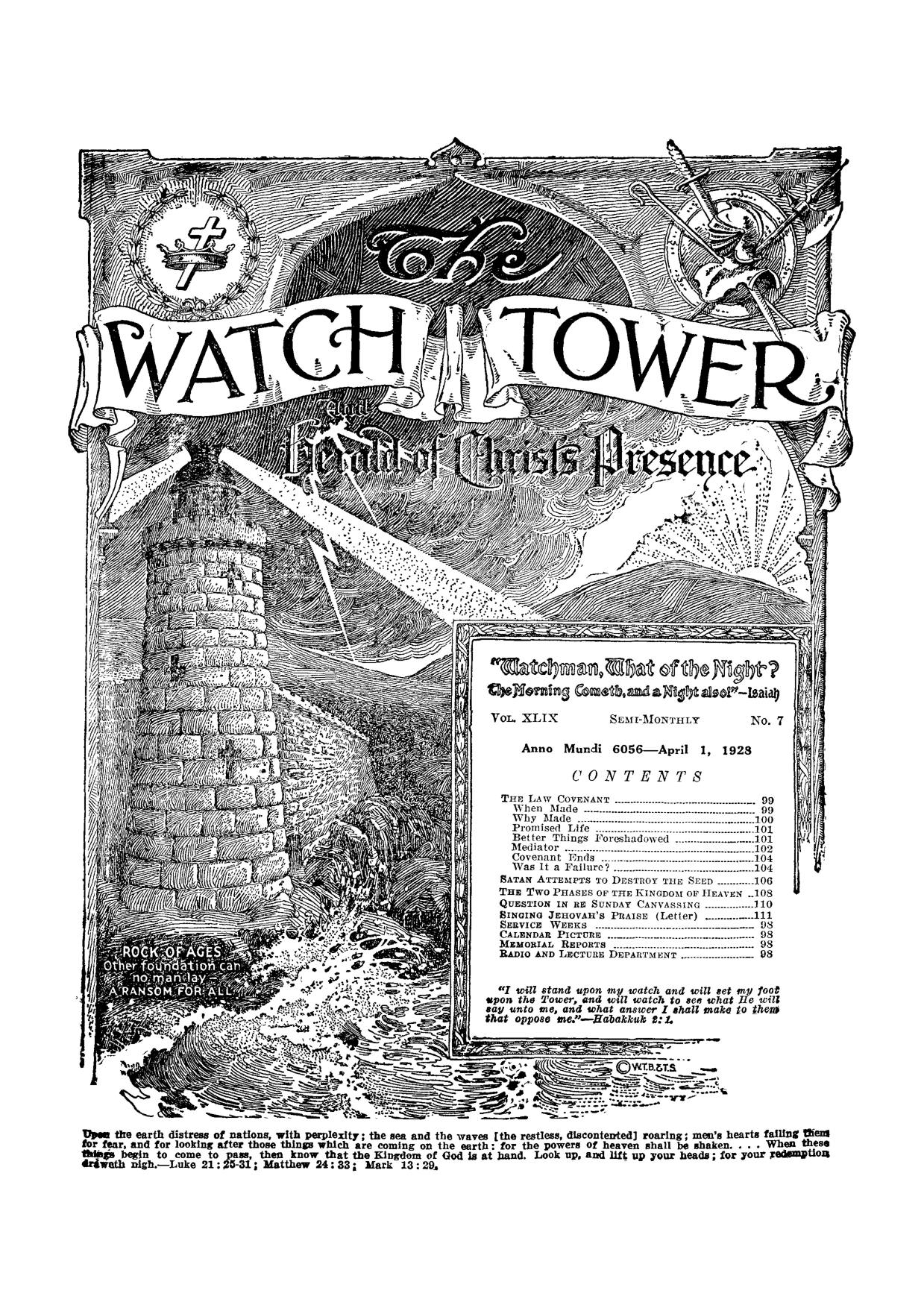
THE WATCH TOWER
AND HERALD OF CHRIST'S PRESENCE
VOL. XLIX APRIL 1, 1928 No. 7
THE LAW COVENANT
"Now therefore, if ye will obey my voice indeed, and keep my covenant, then ye shall be a peculiar treasure unto me above all people: for all the earth is mine."–Exodus 19:5.
JEHOVAH made a covenant with the nation of Israel which is designated in the Scriptures as the law covenant. (Galatians 3:17) A clear distinction must be made between the law of God and his law covenant which he made with Israel. The law of God concerning man is his expressed will. It is the rule of action which he provides and which commands obedience to that which is right and punishment for wrongdoing. Abraham kept God's law, namely his expressed will, as far as he knew it. But Abraham was not under the law covenant. "Because that Abraham obeyed my voice, and kept my charge, my commandments, my statutes, and my laws." (Genesis 26:5) "For what saith the scripture? Abraham believed God, and it was counted unto him for righteousness. . . . For the promise, that he should be the heir of the world, was not to Abraham, or to his seed, through the law, but through the righteousness of faith."–Romans 4:3, 13.
² Abraham, Isaac and Jacob were designated as fathers by the Israelites. The law covenant was not given to them. "The Lord made not this covenant with our fathers." (Deuteronomy 5:3) Their fathers were dead before the law covenant was made. The original promise made to Abraham, and which was confirmed to Isaac and Jacob, was specifically regarding the "seed" through which blessings should come to all the families of the earth. God's promise was not dependent upon any works of the law. His promise was unalterable, and the law added nothing thereto. Since Isaac was not under the law covenant, he pictured "the seed", which is not under the law covenant.
WHEN MADE
³ Hagar was an Egyptian woman. (Genesis 16:1) She pictured or represented the law covenant. (Galatians 4:24) It would seem appropriate therefore that the covenant which she represented should be made in Egypt. God's prophet Jeremiah wrote concerning that covenant: "The covenant that I made with their fathers, in the day that I took them by the hand, to bring them out of the land of Egypt." (Jeremiah 31:32) "According to the word that I covenanted with you when ye came out of Egypt, so my spirit remaineth among you; fear ye not." (Haggai 2:5) These scriptures show that the law covenant was made in Egypt in that day that the Israelites came out of Egypt, and that it was exactly 430 years from the time Abraham entered Canaan.
⁴ It was on the fourteenth day of Nisan, 1615 B. C., that the Israelites left Egypt. Their first passover was instituted and eaten on that day. "And it came to pass at the end of the four hundred and thirty years, even the selfsame day it came to pass, that all the hosts of the Lord went out from the land of Egypt." (Exodus 12:41) Paul corroborated this testimony when he wrote: "And this I say, that the covenant, that was confirmed before of God in Christ, the law, which was four hundred and thirty years after, can not disannul, that it should make the promise of none effect."–Galatians 3:17.
⁵ The Apostle Paul wrote: "For where a covenant is it is necessary for the death to be brought in of him that hath covenanted; for a covenant over dead persons is firm, since it is not then of force when he is living that hath covenanted." (Hebrews 9:16, 17, Rotherham) In this same text the Diaglott renders it, "is firm over dead victims." The passover lamb was the victim to be slain. Moses was represented in the passover lamb; and the lamb being slain, Moses was considered dead from that time. This is further proof as to the time of the making of the law covenant and that it was made in Egypt.
⁶ On the fifteenth day of the second month, after leaving Egypt and while in the wilderness (Exodus 16:1), the Israelites murmured against Moses because of their hunger. "Then said the Lord unto Moses, Behold, I will rain bread from heaven for you; and the people shall go out and gather a certain rate every day, that I may prove them, whether they will walk in my law, or no. . . . Six days ye shall gather it; but on the seventh day, which is the sabbath, in it there shall be none." (Exodus 16:4, 26) The law covenant was then in force. That was before the Israelites reached Sinai.
AT SINAI
7 Horeb is the general name for the Sinaitic mountains in Arabia. The two names as used in the Scriptures mean practically the same thing. Do not the following scriptures prove that the law covenant was made at Sinai and not in Egypt? “The Lord our God made a covenant with us in Horeb.” (Deuteronomy 5:2) “Remember ye the law of Moses my servant, which I commanded unto him in Horeb for all Israel, with the statutes and judgments.” (Malachi 4:4) “Which things are an allegory: for these are the two covenants: the one from the mount Sinai, which gendereth to bondage, which is Agar.”–Galatians 4:24.
8 What took place at mount Sinai in connection with the law covenant was about fifty days after the Israelites left Egypt. Manifestly at Sinai the action there taken was the dedication or confirmation of what had taken place in Egypt at the time of the passover. At Sinai the law of the covenant was specifically stated to the Israelites. First was given the fundamental law, which constitutes the ten commandments. (Exodus 20: 1-17) That was followed by the statutory provisions of the law. At the dictates of Jehovah Moses wrote the law and then it was delivered to the Israelites. Animals were sacrificed at that time and the blood thereof was sprinkled upon the altar and upon the people. (Exodus 24: 7, 8) This was a confirmation or dedication of what had transpired in Egypt. At the passover in Egypt the Israelites sprinkled the blood of the lamb upon their door posts and over the door; and all the family remained inside. That was equivalent to sprinkling all the members of the household. There the blood was a test upon each one of the household.
9 At Mount Sinai it was more of a national matter, confirming with all the nation what had been done with each household which constituted the nation. Because of the covenant made by the passover rite Jehovah immediately gave the Israelites the benefit of the covenant by delivering them from Egypt. That constituted the ransom of the Israelites from Egypt; as it is written: “I gave Egypt for thy ransom.” (Isaiah 43:3) “Art thou not it which hath dried the sea, the waters of the great deep; that hath made the depths of the sea a way for the ransomed to pass over?” (Isaiah 51:10) Egypt represented the world wherein the Israelites were. Horeb is the mount of God and represents heaven itself. In making the picture here it was only appropriate that the book of the law should be sprinkled with the blood at Horeb and not in Egypt. The evidence therefore shows that the covenant was made in Egypt and confirmed or ratified at Mount Sinai.
WHY MADE
10 Why should Jehovah make a covenant with the Israelites? Surely not because they were worthy or that God was under any obligation to them! They had defiled themselves with the idols of Egypt. When God was about to lead them out he said: “Cast ye away every man the abominations of his eyes, and defile not yourselves with the idols of Egypt: I am the Lord your God.” (Ezekiel 20:7) This proves that they were not deserving of God’s favor. This proves that they were not deserving of anything at the hands of Jehovah. Then why should God make a covenant with them at all?
11 Jehovah had made his covenant with Abraham, which must stand firm. He restated it to Isaac and Jacob. These men constitute the fathers of Israel. God loved Israel for their fathers’ sakes. The apostle writes: “As touching the election, they are beloved for their fathers’ sakes.” (Romans 11:28) “And I have also heard the groaning of the children of Israel, whom the Egyptians keep in bondage; and I have remembered my covenant.” (Exodus 6:5) It is here stated that God remembered his covenant. What covenant did he remember? The one with Abraham of course, because at that time the law covenant had not been made. “Wherefore say unto the children of Israel, I am the Lord, and I will bring you out from under the burdens of the Egyptians, and I will rid you out of their bondage, and I will redeem you with a stretched out arm, and with great judgments.”–Exodus 6:6.
12 Jehovah had promised that he would bless all the families of the earth and that the blessing of reconciliation and life he would extend to all the families and nations of the earth through the “seed of promise”. God could not and would not use any creature to carry out his plan of blessing mankind who was in league with or under the control of Satan the enemy. The Israelites had defiled themselves with idols which Satan furnished for the Egyptians. Now God would teach these natural descendants of Abraham that none of them could be of that promised “seed” unless he departed from iniquity. The Israelites must be informed as to what constitutes sin. God would now give them his law, whereby they would gain a knowledge of what constitutes sin.
13 “By the law is the knowledge of sin.” (Romans 3:20) “I had not known sin, but by the law.” (Romans 7:7) “For until the law, sin was in the world: but sin is not imputed when there is no law.” (Romans 5:13) “Sin is the transgression of the law.” (1 John 3:4) “Where no law is, there is no transgression.”–Romans 4:15.
14 Had the human race been sinless, there would have been no need for a law. The descendants of Abraham were and are children of Adam, who by reason of sin brought condemnation upon all. (Romans 5:12) Laws are not made for righteous men but for sinners. “Knowing this, that the law is not made for a righteous man, but for the lawless and disobedient, for the ungodly and for sinners, for unholy and profane, for murderers of fathers and murderers of mothers, for manslayers.” (1 Timothy 1:9) In discussing the law covenant Paul says this is the reason it was made, to wit: “Wherefore then serveth the law? It was added because of transgressions, till the seed should come to whom the promise was made; and it was ordained by angels in the hand of a mediator. . . Wherefore the law was our schoolmaster to bring us unto Christ, that we might be justified by faith.”–Galatians 3 : 19, 24.
15 Jehovah God is the source of all life, and none can have life everlasting who oppose him. Satan the enemy would turn all men against God; and that would result in man’s destruction, with no hope of life. Therefore God announced his law to the Israelites for their good and for the good of all mankind. It is noted that the first statement of the fundamental law is concerning Jehovah as the only true God. “I am the Lord thy God, which have brought thee out of the land of Egypt, out of the house of bondage. Thou shalt have no other gods before me. Thou shalt not make unto thee any graven image, or any likeness of any thing that is in heaven above, or that is in the earth beneath, or that is in the water under the earth.”–Exodus 20 : 2-4.
16 All his laws are consistent with and based upon the great truth that Jehovah is the only true God. Satan has forced the issue, “Who is God?” and that issue must be determined on the side of Jehovah; and all who ever get life must take that side. Jehovah is just and righteous. That great law God announced to Israel at Mount Sinai. From that time forward the law would serve as a schoolmaster to lead Israel in the way of righteousness until the coming of the promised “seed” through which the Jews would receive their blessing. Without the law, by the time of the coming of Christ Jesus, the beloved Son of God, every Jew would be turned away from Jehovah; and none would therefore have an opportunity to be made a part of the “seed”. The law covenant was given to Israel because of their sinful condition.
17 “The seed of promise” must be wholly and completely devoted to Jehovah God. If one knowing God turns his heart to Satan, then he is impure. By the law covenant God showed Israel what was required of her to be holy unto him. From the time the covenant was made with Israel until that people broke it they were holy unto the Lord. (Jeremiah 2 : 3) They were God’s chosen people, and not the Devil’s. Satan had all the other nations under his control. If Israel would obey the law unto the coming of the “seed” she would then have an opportunity to be a part of that “seed”. God said to them: “Ye shall be unto me a kingdom of priests, and an holy nation.”–Exodus 19 : 5, 6.
18 God warned Israel against making any contracts with their enemies and to keep themselves free from other gods, which gods were of the Devil. (Exodus 23 : 32) He told them that if a man or a woman among them should serve other gods and worship them, either the sun, or moon, or any of the host of heaven, they should be stoned to death. (Deuteronomy 17 : 2-5) The law provided that their first-born must be holy unto the Lord. God gave Israel the various statutes which instructed them in the way of righteousness. These laws served as a schoolmaster to keep them in the right way until the coming of Christ, the promised “seed”.
PROMISED LIFE
19 But did not the covenant promise life to the Jews if they would keep it? It did. “Ye shall therefore keep my statutes, and my judgments; which if a man do, he shall live in them.” (Leviticus 18 : 5) “For Moses describeth the righteousness which is of the law, That the man which doeth those things shall live by them.”–Romans 10 : 5.
20 Had the Jews kept the law of God perfectly, would they have been granted everlasting life? Certainly, because God had so promised and he always keeps his promises. (Isaiah 46 : 11) If there was any doubt in any mind the words of Jesus make the matter clear: “And, behold, a certain lawyer stood up, and tempted him, saying, Master, what shall I do to inherit eternal life? He said unto him, What is written in the law? how readest thou? And he answering said, Thou shalt love the Lord thy God with all thy heart, and with all thy soul, and with all thy strength, and with all thy mind; and thy neighbour as thyself. And he said unto him, Thou hast answered right: this do, and thou shalt live.”–Luke 10 : 25-28.
21 When Jesus came, did he keep the law perfectly? He did; and that proves that the law could be kept by a perfect man and that no one else could keep it. As Paul states, he who would keep the law would be righteous; and every righteous creature is entitled to life. Therefore had the Jews kept the law it would have proved their righteousness, which would entitle them to life. The reason the Jews could not keep the law was because of imperfection, the result of sin. Sin entered the world by reason of Adam’s disobedience; and all, including the Jews, were born sinners. (Romans 5 : 12) No sinner has the right to life. (Romans 6 : 23) The law therefore proved to the Jews and to all men that if the human family is ever given the blessing of life, as promised by the Abrahamic covenant, something must be done to remove the sin or make atonement for sin.
22 God, foreknowing the scheme of the Devil to bring forth amongst men a crop of evolutionists who would declare that men do not need a redeemer, demonstrated the falsity and foolishness of that position by the operation of the law covenant. No man can ever be heard to truthfully say: If I had an opportunity I could make myself perfect and live. The operation of the law covenant is absolute proof that the theory of evolution is from the Devil, and that those who advocate it are the instruments of the evil one, whether they know it or not.
BETTER THINGS FORESHADOWED
23 Paul declares that the law foreshadowed good things to come. (Hebrews 10 : 1) While the law covenant was made primarily because of the transgression, God employed it also to make shadows or pictures of his plan for the reconciliation of man to himself. The apostle further states: “Then verily the first covenant had also ordinances [ceremonies] of divine service, and a worldly [orderly arranged] sanctuary.” (Heb. 9:1) What were these ceremonies and orderly arrangements of divine service? At the time of making the covenant in Egypt a lamb without blemish, a male of the flock, was slain and its blood sprinkled upon the door posts, which served as a means of salvation to the Jews on the passover night. That lamb was eaten, together with unleavened bread. (Exodus 12:8) That ceremony must be repeated or performed once each year thereafter on the fourteenth day of Nisan.
24 The lamb represented the sacrifice of Jesus the beloved Son of God, who would redeem all mankind from sin. He was the Lamb slain from the foundation of the world. (Revelation 5:6) “As of a lamb without blemish and without spot.” (1 Peter 1:19) By this ceremony the ransom sacrifice was foreshadowed. God made promise that he would ransom man from death and the grave. (Hosea 13:14) This ceremony would teach the Jews, and others thereafter, that the Lamb of God would take away the sin of the world; and it was so announced by John at the beginning of the ministry of Jesus.–John 1:29.
25 After the confirmation of the covenant at Sinai Moses, under God’s instruction, erected the tabernacle. In the holy place thereof God showed his presence by the cloud and the light. (Exodus 40:34) Once each year there was a special divine service in connection with the tabernacle. On a day certain bulls and goats were slain, and the blood thereof carried by a priest into the Most Holy and sprinkled upon the mercy seat to make atonement. (Leviticus 16; Hebrews 9:6-8) That tabernacle service foreshadowed something better to come, and that the sacrifice of the reality would make atonement for the sin of man and make it possible for man to be reconciled to God, as he had promised. The sacrifice of these animals was done by a priest, for which the law made provision.
26 These ceremonies were to teach lessons to the Jews and others thereafter. The sacrifice of the paschal lamb referred to the sacrifice of Jesus Christ, and pictured the ransom; and the sacrifice of bulls and goats and the sprinkling of the blood represented the offering of the blood of Christ Jesus as a sin-offering for man. Furthermore, they taught that Christ, as the great High Priest appointed by Jehovah, would offer the sacrifice and make atonement for sin.–Hebrews 9:10-14.
27 The law covenant therefore shows absolutely the necessity for the great ransom sacrifice of Jesus Christ and for a sin-offering to be made by him first in behalf of the members of the “seed” and then in behalf of mankind in general. Also, that covenant foreshadowed a new and better covenant; and the ceremonies in connection therewith bore testimony to the fact that there would be a long period of time elapsing between the making of that new covenant and the time of its confirmation or inauguration.
BEST EFFORTS
28 Suppose the Jews had put forth their best efforts to keep the law covenant, would any special benefit have resulted to them? Yes. They would have shown their faith and confidence in God and his promises and their allegiance to him rather than allegiance to the Devil. The leaders of Israel did not try to keep the spirit of the law covenant. They kept it in form, with their mouths, and outward show, while their hearts were far removed from Jehovah. (Isaiah 29:13) They were frauds and hypocrites, making an outward show for a selfish reason. (Matthew 23:13-35) They claimed to be children of Abraham; but Jesus told them plainly they were liars and children of the Devil because they would do Satan’s will and not the will of God. (John 8:39-44) The fact that they were sons of the Devil shows that they had no faith in the law covenant and were not trying to keep it.
29 But some of the Jews did try to keep the law covenant. They had faith in God, and they did their best to obey him. When Jesus came, he found some of these who were looking for the coming of the Messiah and they accepted him. The leaders, looking to the letter of the law, expected the coming of the Messiah; but they were looking for him entirely from a selfish motive. They practised fraud and deceit. When “Jesus saw Nathanael coming to him, and saith of him, Behold an Israelite indeed, in whom is no guile!” (John 1:47) Nathanael then and there accepted him as the Son of God and the King of Israel. “Nathanael answered and saith unto him, Rabbi, thou art the Son of God, thou art the King of Israel.” (John 1:49) He had no deceit or subterfuge about him such as did the Pharisees.
30 This and other honest Jews kept the spirit of the law because of their faith in God and in the promised “seed”. They were pleasing to God and accepted by him, not because of their keeping the law perfectly but by reason of faith in Christ. Upon this point Paul says: “Knowing that a man is not justified by the works of the law, but by the faith of Jesus Christ, even we have believed in Jesus Christ, that we might be justified by the faith of Christ, and not by the works of the law: for by the works of the law shall no flesh be justified.” (Galatians 2:16) Those who did have faith in God and in his promises, and who tried to keep the law, to them the law served as a schoolmaster to lead them and safeguard them unto the coming of Christ.–Gal. 3:24.
MEDIATOR
31 The law covenant had a mediator. And why? Because the people of Israel were not competent to enter into a covenant with God. They were sinners by reason of inheritance from Adam’s sin. Moses was appointed the mediator between God and Israel in the covenant. (Galatians 3: 19) Was not Moses also born a sinner, and if so how could he be a mediator? Moses was born a sinner; but by reason of his faith in God and his obedience, thereby proving his faith, he was justified by faith and therefore accepted by Jehovah as a competent one to enter into a covenant as mediator for Israel. (Hebrews 11: 23-28; Exodus 3: 5) Concerning Moses Jehovah said: “My servant Moses . . . is faithful in all mine house.” (Numbers 12: 7, 8) “Remember ye the law of Moses my servant, which I commanded unto him in Horeb for all Israel, with the statutes and judgments.” (Malachi 4: 4) “This [Moses] is he, that was in the church in the wilderness with the angel which spake to him in the mount Sinai, . . . who received the living oracles to give unto us.”–Acts 7: 38, R. V.
32 Moses as mediator of the law covenant foreshadowed Christ the Mediator of the new and better covenant. “For the law was given by Moses, but grace and truth came by Jesus Christ.”–John 1: 17.
33 At the slaying of the passover lamb Moses represented Jesus, alone and exclusive of his body members the church. In the new covenant Jesus alone was and is all-sufficient for the office of Mediator to which he was appointed at the slaying of the antitypical lamb. It would not be necessary for him to wait until the establishment of the kingdom to make the new covenant. At Mount Sinai, when the law covenant was confirmed, Moses pictured The Christ, both Jesus and the members of his body. There the blood of bulls and goats was sprinkled both upon the book of the law and upon the people. The blood of the bullock pictures Christ Jesus, whereas the blood of the goats pictures the church sharing with Jesus in the ministration of the new covenant.
MADE UNDER THE LAW
34 Why was it necessary for Jesus to be born a Jew? God through his prophets foretold that the Redeemer would come from the seed of Abraham. That of itself would be sufficient. The Apostle Paul shows an additional reason when he says: “But when the fulness of the time was come, God sent forth his Son, made of a woman, made under the law, to redeem them that were under the law, that we might receive the adoption of sons.” (Galatians 4: 4, 5) The Jews’ being unable to keep the law covenant proved them to be sinners and therefore servants of sin. The law defines sin, and their inability to meet the terms of the law gendered them unto the bondage of sin. As sinners they could not become the sons of God. Of their own selves they could not get out from under this disability. They would therefore during their existence be subject to bondage.–Hebrews 2: 15.
35 In due time Jesus came. He was not a son of Hagar, and therefore can not be said to be the “seed of the law covenant”. The fact that he was made under the law evidently means that he was under the discipline of the law covenant from the time of his birth as a child until his consecration. In this same connection Paul says: “The heir, as long as he is a child, differeth nothing from a servant, though he be lord of all; but is under tutors and governors until the time appointed of the father.” (Galatians 4: 1, 2) Although the Son of God, from his birth until his majority at thirty years of age he was nothing different from a servant, because he was under the discipline of the law, which was his tutor. Clearly this is the argument of the apostle. As a direct Son of God Jesus was free as a man; but it pleased Jehovah to subject him to the discipline arrangement of the law covenant. The record is that Mary and Joseph brought the boy Jesus to Jerusalem and presented him to the Lord, as the law provided. (Luke 2: 22-24) Thereafter he was subject to his parents while a child, as the law provided. Being presented to Jehovah as a first-born of his Jewish parent, Jehovah had the legal claim upon Jesus from that time forward.
36 The apostle in this same connection says: “Christ hath redeemed us from the curse of the law, being made a curse for us.”–Galatians 3: 13.
37 Were the Jews, by reason of their covenant, under two death penalties, one as children of Adam, and another by their failure to keep the covenant? Such does not seem possible. As children of Adam they were sinners and must die. (Romans 3: 9; 6: 23) Abraham, Isaac, Jacob and all the prophets died because of inherited sin making them imperfect. Their deaths, however, were not ignominious. But if a Jew should wilfully violate the law covenant and be subject to death therefor, he should die an accursed death. How must he die an accursed death? “He that is hanged is accursed of God.” (Deuteronomy 21: 22, 23) The apostle evidently had this in mind when he said: “Christ hath redeemed us from the curse of the law, being made a curse for us: for it is written, Cursed is every one that hangeth on a tree.” (Galatians 3: 13) The curse can hardly be said to be death itself, but the ignominious manner of death by hanging.
38 The death of the perfect man Jesus provides the ransom price, regardless of the manner of his death. The man Adam had sinned, and all had come under sin. The perfect man Jesus tasted death for every man. (Hebrews 2: 9) It is the death of the perfect man that provides the ransom price. But dying in an ignominious manner by crucifixion, or hanging on a tree, was manifestly for the purpose of removing the curse from Israel. “Being made under the law” as a Jew in the flesh, by his ignominious death on the tree he removed the curse. Jesus fulfilled every requirement of the law, even dying as an accursed sinner. Thus he purchased Israel as a nation from that curse, and made it possible for the Israelites to become of the house of sons, of which he is the Head.–Hebrews 3: 6; John 1: 12.
39 The covenant being made with Israel as a nation, the curse upon that nation was the ignominious death of hanging on a tree, which was inflicted for a violation of the law and which called for the infliction of the death penalty. Jesus died on the cross as a sinner, yet without sin; that is to say, he died as an accursed one of God, yet holy, harmless and undefiled. Thereby he took away the curse. He relieved the Jews of the disability upon them as a nation by reason of the law covenant and their inability to keep it, and made it possible for those accepting Christ to become the sons of God.–John 1: 12.
COVENANT ENDS
40 The death of Jesus Christ upon the cross put an end to the law covenant. He in no wise annulled the law covenant, but he fulfilled it. “Think not that I am come to destroy the law, or the prophets: I am not come to destroy, but to fulfil.” (Matthew 5: 17) Being fulfilled, its abolishment was in order. The “seed” had come, and no longer was the covenant necessary. He magnified the law and made it honorable. (Isaiah 42: 21) The objective of the law covenant, as stated by Paul, was to operate until the “seed” should come to whom the promise was made. Christ the Seed having come, all now of the Jews who accepted him were made free from the law. “For Christ is the end [objective as well as the finis] of the law for righteousness to every one that believeth.” (Romans 10: 4) He put an end to the law by nailing it to the cross, that is to say, by dying as though he were a sinner. “Blotting out the handwriting of ordinances that was against us, which was contrary to us, and took it out of the way, nailing it to his cross.”–Colossians 2: 14.
41 The law was against Israel because she could not keep it. Christ by his death accomplished it to those who would believe and accept him as the Messiah. “Having abolished in his flesh the enmity, even the law of commandments contained in ordinances; for to make in himself of twain one new man, so making peace.” (Ephesians 2: 15) Again, the Apostle Paul says in Hebrews 8: 6 that Christ also “is the mediator of a better covenant, which was established upon better promises”, which is proof that the old covenant of the law was abolished at the time of the Lord’s death.
WAS IT A FAILURE?
42 Was the law covenant a failure? For the purposes for which God made it, the law covenant was not a failure. It failed to make men perfect because of weakness and imperfections of men. God promised that he would give life to all who would keep the law. But Paul says: “I found [it] to be unto death. . . . Wherefore the law is holy, and the commandment holy, and just, and good. Was then that which is good made death unto me? God forbid. But sin, that it might appear sin, working death in me by that which is good; that sin by the commandment might become exceeding sinful.”–Romans 7: 10-13.
43 Then adds the apostle: “For what the law could not do, in that it was weak through the flesh, God sending his own Son in the likeness of sinful flesh, and for sin, condemned sin in the flesh.” (Romans 8: 3) This can not mean that the law itself was weak, but the law covenant was weak because of Israel, who was on one side of the covenant. The Israelites were weak; and Moses, its mediator, was weak; and what the law could not do God did through his beloved Son.
44 It is manifest therefore that the purposes of the law covenant may be summed up as these: (1) It was made because of the weakness or sin of the Israelites, and it defines sin and shows the Israelites what would be required of any one to become of the “seed”; and knowing this, it operated as a teacher or schoolmaster to direct and lead the Jews in the right way until the coming of the Messiah. This was for the purpose of keeping the people free from the influence of the Devil, that not all might forget God. God had set a fixed time when he who was to be the “seed of promise” should come to earth, and until that time the law covenant would serve as a shield and protection and aid to the Jews. He selected the Jews as a people for himself. They became his peculiar people. They ofttimes fell away from their covenant, and he showed mercy toward them. The nation under their leaders fell entirely away from God; and when Jesus came, the nation rejected him. A few, however, of Israel accepted him as the Messiah.
45 (2) In addition thereto the law covenant demonstrated beyond a question that there could be no life granted to mankind without a ransom and a sin-offering. It foreshadowed the great sacrifice, and taught that there must be a sacrifice before the terms of the Abrahamic covenant could be fully carried out. It foreshadowed better things to come; and among these better things is the new covenant which God makes for the purpose of carrying out the promise made to Abraham.
46 The mediator of the law covenant was himself imperfect, and whatsoever he could do would be limited by his death. Moses died in the land of Moab, according to the word of the Lord. (Deuteronomy 34: 5) Christ Jesus is the great High Priest after the order of Melchizedek. He is the Mediator of the law covenant, and his ability knows no limitations. “But this man, because he continueth ever, hath an unchangeable priesthood. Wherefore he is able also to save them to the uttermost that come unto God by him, seeing he ever liveth to make intercession for them.”–Hebrews 7: 24, 25.
47 God selected from amongst the people of Israel a portion of those who shall be associated with Christ Jesus and members of the “seed of promise”. God foreknew that there would not be a sufficient number amongst the Jews who would accept Christ to make up the entire number required for the “seed”. Therefore God long in advance provided that a part of the “seed” should be taken from amongst the Gentiles, or non-Jews. The due time came that the Jews were cast off and "concerning the gospel, they are enemies for your [the Gentiles'] sakes." (Romans 11:28) That is to say, God made it possible for Gentiles to be brought to him through Christ and to be justified and begotten and made a part of the "seed" of Abraham according to the promise. It is from amongst the Gentiles that he takes out a "people for his name". (Acts 15:14) That "people for his name" are especially the Gentiles now on earth, and it becomes the privilege and duty of all such to glorify the name of Jehovah by singing forth his praises.
48 Soon the new covenant will go into operation for the purpose of carrying out God's promise to bless all the families of the earth. Then the remnant of the "seed", who keep the commandments of God and have the testimony of Jesus Christ, being faithful unto death, shall have a part in ministering the blessings through that covenant.
49 When the mind of Paul was illuminated he saw the wonders of God's plan. He exclaimed: "O the depth of the riches both of the wisdom and knowledge of God! how unsearchable are his judgments, and his ways past finding out!" (Romans 11:33) Now flashes of light come from the temple, showing the temple class more clearly the outworking of the divine program. These precious truths enthuse them to joyfully proclaim the honor of his name. "In his temple doth every one speak of his glory."–Psalm 29:9.
QUESTIONS FOR BEREAN STUDY
Distinguish between the law of God and the law covenant with Israel. On what basis did the "fathers" of Israel receive their justification? Isaac's not being under the law pictured what? ¶ 1, 2.
Who was Hagar, and what did she picture? Show by scriptures when and where the law covenant was made. What sacrifice was made, why necessary, and whom did it represent? State God's purpose in providing the "manna". ¶ 3-6.
In respect to the law covenant, explain the relation between the passover rite in Egypt and the action taken at Sinai. ¶ 7-9.
As to their meriting Jehovah's favor, what was the condition of the Israelites? Why, then, did he make a covenant with them? For what immediate purpose did God give them the law? What does Paul say to that effect? ¶ 10-13.
For whom are laws intended? What was the first commandment set forth in the law? Mention some of the details of that commandment. State the ultimate object in giving the law to Israel and what was their opportunity in connection therewith. ¶ 14-18.
Prove by scriptures whether the law truly promised life. ¶ 19, 20.
Did Israel keep the law, and why? What can be said of Jesus in that respect? In each case what was shown? What does that prove regarding the evolution theory and its origin? ¶ 21, 22.
What was the primary necessity for the law covenant? What further purpose did it serve? Explain the immediate purpose of the passover ceremony and of the tabernacle atonement-day service, and show the pictorial meaning and the application of each. ¶ 23-27.
What advantage would have accrued to the Jews from an effort to keep the covenant? Prove by scriptures what was their disposition toward the law. In this respect what may be said of a remnant thereof? ¶ 28-30.
Did the law covenant have a mediator, and why? Who served in that capacity, and how was he qualified therefor? Quote scriptures to support your answer. ¶ 31.
How was Moses represented at the slaying of the passover lamb? Whom did Moses there represent? At Sinai he pictured whom? As mediator of the law covenant whom did he foreshadow? The blood of bulls and goats sprinkled upon the book of the law and upon the people pictured what? ¶ 32, 33.
State the twofold reason for Jesus' being born a Jew. ¶ 34. With appropriate scriptures show whether Jesus was subject to the law covenant or free from it, and why. ¶ 35, 36.
Did the law covenant bring the Jews under an additional death penalty? How did it affect their condition in that respect? Explain the necessity for Jesus' dying by crucifixion. Just what did he thereby accomplish for Israel as a nation? ¶ 37-39.
What was the objective of the law covenant, and how was that covenant terminated? What new opportunity was thereby brought to the Jews, and on what condition available? Also what further great privilege opened up to Christ Jesus? ¶ 40, 41.
Was the law covenant a failure? What does Paul say of the effect of its operation? In what sense was it weak? How was that accomplished which the law could not do? ¶ 42, 43.
Sum up the subject of the law covenant with respect to (a) why it was made, (b) its expressing a standard for guidance, (c) its restraining influence, (d) why given only to Israel and (e) their measure of obedience thereto, (f) its showing the necessity for a ransom, (g) what it foreshadowed, (h) the limitations of its mediator in contrast with the qualifications of the Mediator of the new covenant. ¶ 44-46.
If the law covenant was intended to assist Israel to become "the seed of promise", why did God provide for taking from the Gentiles a people for his name? What lesson and what encouragement should the Lord's people now take from the fact that only a remnant of Israel entered into their available inheritance? ¶ 47-49.
God has now commanded
That there shall be light
Breaking through the shadows
Of earth's age-long night.
From his holy temple
Lightnings flash and shine,
That we may be guided
By the light divine.
With the kingdom message
We go forth to spread
Comfort for the mourners,
Hope for e'en their dead.
All our strength to witness
Comes from God alone;
He makes our commission
To us clearly known.
Set apart for service,
Lord, we pledge to thee,
In the name of Jesus
Our fidelity.
We, thy chosen people,
Will with joy proclaim
Glory, praise and honor
To thy holy name.
SATAN ATTEMPTS TO DESTROY THE SEED
IT IS evident that when God told Eve that her seed should bruise the serpent's head, Satan perceived in the words a threat to his power, and even to his existence. From that time on he made it his purpose to watch for the seed of the woman who would bruise him and perhaps become his destroyer. He could not tell how or when the seed would come. Satan would watch when Cain was born. Without doubt as Cain grew up into manhood, and manifested something of that disposition of mind which ultimately resulted in the murder of his brother, Satan watched him and fanned the evil flame. Satan had not the same control over Abel as over Cain; and when he saw that Abel sought to worship the Creator, to please him, then Satan, not knowing whether or not this one might be the seed to give deliverance from the bondage with which he had already encompassed the little human family, sought to destroy Abel, and succeeded in using Cain as his instrument. Cain made profession of worshiping Jehovah; but Satan knew Cain had no love for God, and knew that he could control him. The murder by Cain was really through the instigation of Satan, working out his own purposes.
From that time on there seems to have been no special seed in view who could be a deliverer, and who called for the special notice of Satan. Now he embarked on the desperate policy of fouling the whole human family with the seed of the disobedient angels, and that terrible thing came about which is recorded in the sixth chapter of Genesis. Spirit beings materialized and had illicit communion with the daughters of men; and so corrupt did the race become, that apparently, with the exception of the family of Noah, there was not a family of pure human stock left on the earth. See Genesis 6 : 9.
This superhuman attempt to foul the human race did not arise merely from desire on the part of spirit beings who were involved; it was undoubtedly a scheme of Satan to thwart the purpose of God. If the ravages of sin had been suffered to go a little further, Noah's family also might have been corrupted, and it would have been impossible for God to bring a pure seed out of the original stock. Satan would have effectively frustrated God in his purpose. God remedied the situation by the drastic means of sweeping the earth clean of the monstrous thing that had happened, and then beginning the race again in Noah and his family.
Again when God called Abraham, already married to Sarah, who was to share in the covenant God made with him, and when after the long time of waiting and testing of Abraham's faith the time had come that God would bless this barren pair with the seed of promise, it came about by an unusual circumstance that Sarah was taken from Abraham by Abimelech, king of the Philistines, and was in great danger of being taken as a wife by Abimelech. With the persistent malignity which was and is ever present in him, Satan at that time and by that means made an attempt to foul the fountain of life from which Abraham's promised child should come. God specially preserved her from that danger, and she was restored to Abraham unharmed.
Still again, in later days, when God had manifested his pleasure to have the whole family of Jacob taken as his special people, Satan turned his attention to them. Whenever God showed that he had a special representative, individual or collective, Satan sought to hurt that one and to destroy him. Unquestionably it was Satan's policy, rather than one local to the high powers of Egypt, which caused the Egyptians to treat the Israelites so hardly. The Devil would have the Israelites wasted. He could not know how long the Israelites were to be in bondage in Egypt; and he set his policy to cause Pharaoh by hard labor to crush them down and then, by the iniquitous measures which Pharaoh adopted, to destroy them; for there was an attempt to destroy all the male children at birth. The women of Israel would have married aliens, and Israel as a separate people would have ceased to exist. Thus the Israelites, the chosen people, according to the earthly promises, were in a bad way. How God delivered them, manifesting his power, and then made them a great people, every Bible student knows. Satan was again foiled.
He persisted, however, in his attempts to destroy the Israelites, sometimes by attacks on them as when the Amalekites tried to destroy them, sometimes by stirring Israel to temptations, and then to rebellion against Jehovah, so that they might become so rebellious that Jehovah would be compelled to destroy them. All were attempts on Satan's part to destroy this people whom Satan saw might possibly be the seed, or out of whom the seed might come.
When God made the house of David his permanent representative on the throne of Israel, and promised that David's seed should rule over all his enemies (See Psalm 72 : 9.) it must have become apparent to Satan that the seed of the woman was now for ever linked with David's royal line.
In the time of the kings of Judah, rather more than a hundred years after David's day, there was a very definite attempt engineered by the same great enemy Satan to destroy the house of David. The record is that Athaliah, the mother of Ahaziah, destroyed all the seed royal, or as the margin has it, "the seed of the kingdom." (2 Kings 11 : 1) For a time it seemed as if the enemy was surely about to accomplish his purpose; and outwardly it appeared as if he had done so. Athaliah, the daughter of Ahab and Jezebel of Israel, was married to Jehoram, king of Judah. This woman bore a shameful likeness to her mother. She led her husband away from fidelity to Jehovah, and introduced into Judah the degrading worship of Baal. When her son Ahaziah was slain by Jehu, she, an alien spirit to the land of her adoption, determined to keep the regal power in her own hands, and to this end she caused to be slain all her husband's family, and all the members of the seed royal of David's house. However, the youngest son of the king's family, a baby mite, was rescued from the heap of the dead, and was hidden, and after seven years was made king with great acclamation. (2 Chronicles 22: 11, 12) Except for that one child David at that time had no one in Israel who had the right to sit upon his throne.
Once Satan made an attempt to destroy at once the whole of the chosen people. This was in the days of the Persian empire, when it was the world power. Ahasuerus (the Xerxes of secular records) was the monarch. One of his chief officers, and a favorite, was Haman the Amalekite, a people who proved to be the first of the enemies of Israel. Probably his family had been taken captive during one of the raids of the eastern monarchs when they ravaged the whole of the lands of Canaan, and the south lands even to the borders of Egypt. Through the malice and hatred of Haman against Mordecai, because the Jew would not give him the honor he wished to have and expected to get, this hereditary enemy of Israel conceived the wicked scheme of destroying the whole of the Jews wherever they were in the empire, which then covered the "civilized" world.
This scheming, lying man represented to the king that there was a people scattered abroad throughout all the provinces (and all the more dangerous because of that) who persisted in following their own laws and had no respect for those of the king; that they were therefore pernicious to the interests of the empire and should be destroyed out of it. The king made no inquiry but took the advice of his minister and issued a decree ordering the destruction of these people. All the empire was laid under the burden of exterminating the people. Haman’s instructions were to be followed; the people were to be slain and their goods confiscated.
Never in all the varied experiences of their checkered history were the Jews in so desperate a condition as then. But, through the activity of Mordecai, and the consequent pleading of Esther the Jewish queen lately raised to that position, and by the overruling providence of Jehovah, the edict was frustrated. The king saw that he had been deceived by Haman; that it was Haman who was injurious to the interests of the empire, for he would have destroyed a multitude of law-abiding citizens to gratify his lust of revenge on one man. He saw that Mordecai was a faithful servant, and that the people of Esther his queen were faithful to the throne. He caused Haman and his family of ten sons to be hanged on the gallows which Haman had erected for Mordecai. Thus, though the Jews had been in danger of destruction as a people, the result of the affair was that the Amalekites ended their history on the gallows. Unquestionably Haman, a sample child of the Devil, was moved by that evil spirit.
The next attempt on the part of Satan was the greatest of all his endeavors. When Jesus was born, Satan saw that God was doing something specially affecting him. By using the deluded wise men from the east, he tried to destroy the young child Jesus. The child was saved from Herod's wild cruelty, and from Satan's murderous attempt. When Jesus was thirty years of age, and had presented himself at Jordan in consecration to his Father, he was led up by the holy spirit into the wilderness of Judea. It is recorded that this was for the special purpose of his being tempted of the Devil. There was no question here of Satan's trying to destroy Jesus by force. God would see to the care of Jesus. In his case it was necessary that God should bring Jesus and Satan into contact; for Jesus was set forth as God's representative. God would prove by him that through fidelity and loving devotion to Jehovah it was possible to resist the temptations of this evil one.
Thus in the series of temptations in the wilderness, Satan by subtle suggestions, and plausible though daring proposals, endeavored to destroy the faith and loyalty of Jesus, and to quicken pride in him. He failed. By the simple means of depending upon the Word of God, and in fullest devotion to his Father, Jesus proved that a man could withstand the great evil spirit, and resist the strongest attempts seduction could make upon the heart, affections, or the mind, or natural desires. Unquestionably on several occasions Satan afterward sought to destroy the life of Jesus, and sometimes to cause him to divert his attention from his Father's will. It is said that Jesus suffered being tempted. Undoubtedly the temptations were such as put Jesus to the test, which was the Father's will for him.
At last on the cross it seemed as if Satan and wicked men had succeeded; at least they thought they had. But, when God raised Jesus from the dead, Satan realized that to that immortal being he had no power to do hurt. He realized that God had outreached him. It could not have occurred to Satan that God would do this thing. He could know only of a revival of a life previously enjoyed. But he saw that with the exception of the one false disciple, Judas Iscariot, whom he had used to betray his Master, that little company were of one mind to serve Jehovah, following in the footsteps of Jesus. He had seen, too, that God had given these the spirit of Jesus to enable them to understand their work and their new relationship with God and with Christ; also to enable them to stand against him, their enemy. He saw that if he would gain his purpose he must destroy these, or there would be a combined effort against him and all his hosts which he could not expect to withstand. Probably he began to perceive that these, together with their Head, would prove to be the seed for which God's people waited and which he feared. He now turned his attention to the disciples whom Jesus had left behind, and to those who, believing the Word of God through them, were following in the footsteps of Jesus. He found that these having the spirit of God and of Christ were unconquerable by him. Then he followed his usual methods of seduction and temptation. The true-hearted resisted him, helped always by their aid in heaven.
As the little companies were planted here and there by the labors of the apostles, Satan tried to foul these sources of life by an admixture of his own wicked seed. Jesus said of those who were opposing him that they were of their father the Devil; also he said of the tares in the parable, that they "are the children of the wicked one". (Matthew 13:38) Satan would have the virgin class, who in the sacred symbology are the mother of the seed, debauched by the evil seed of his own, who, professing to serve God, were servants of the Devil, and were looking after his interests as he looked after theirs.
It has been Satan's purpose all down the age to try to wear out the saints of the Most High, to break their faith, to destroy them as the seed. With those who have not had the spirit of God he has succeeded; for they have taken the honors which the world can give; they have sought and taken the glory of the kingdoms of this world as Satan has offered them.
The present condition (as well as the past history of the great nominal churches) witnesses to the fact that they have succumbed to those temptations which their Master, Jesus, resisted and so became the world's Savior.
The 12th chapter of Revelation in vividly picturesque fashion tells of Satan's attempt to destroy this seed, the body members of Christ; and how by the same means the Master used, that is, simple loyalty, faith, and obedience to the will of God as expressed, they conquered him even as Jesus did. Thus Satan, foiled all down the age, has seen Jesus, the Head of the church, raised to divine power; and now sees that God already has in heaven a part of that company who follow the Lamb faithfully, they now changed into spirit beings to be like their Lord; and that on earth he has a company of people who are faithful to the Lord and to their covenant with Jehovah, who will neither fall to his temptations nor fear him, however much he rages against them. And the Christian now may see the seed emerging triumphant, God's purposes in them being accomplished. These are the spiritual seed to bruise the serpent's head, and to reign as king, and to bless all the families of the earth.
Satan is still very active against all who show any desire to serve God. In this day which sees faith fallen in the streets, and when gross darkness covers the earth, God has those who love him and who seek in all things to serve him, who seek the honor of his name above all things. Satan seeks to destroy all such, not only because he hates all those who love God, but because he knows that God has part of the seed amongst them, those who soon will be used to bruise Satan's head. The Scriptures show that he will be very active to the end against the woman and her seed, and the remnant of her seed.
But the saints of God take courage; they know that they are hidden in the secret place of the Most High, and that no harm can befall them there. They go forth, neither afraid of the arrows of Satan nor fearing his frown; and being warned by the Word of their Lord, they do not fear to be caught in Satan's snares.
THE TWO PHASES OF THE KINGDOM OF HEAVEN
THE hope for humanity rests in God, according to his purpose as it was expressed in his sentence on the serpent, when he said that the seed of the woman should bruise its head. (Genesis 3:15) The Christ, Jesus the Head and the church his body, is the seed which shall bruise Satan's head. As Jesus was not born of man, though he was true son of the race through his mother, the virgin Mary, so the members of the church, "which is his body," are not born of the flesh, but are begotten of the power of God. The church of God is in no sense a human evolution or production, in which of course it differs from the systems of organized religion. The seed which shall conquer is the man child of Revelation 12. The virgin class, the mother, is the company of the consecrated who follow God in Christ. The truly faithful of this company is in God's due time accepted as the man child which is to rule all nations. This whole company is The Christ, the great Messiah of whom the prophets spoke. See John 1:12, 13; 1 Corinthians 12:12; Ephesians 1:23; 2 Corinthians 11:2.
This great Christ which shall bruise the head of Satan, the great enemy of God, is the seed of the woman, the consecrated. (See Romans 16:20.) It is significant that the term "bruise" was used by Jehovah; for with the thought of conquest and consequent restitution of the transgressors in mind, it might have been expected that God would speak of the destruction of him who had attempted to withstand God and to destroy the hope of the human family. Why should God speak only of bruising the head of his enemy? Probably because God would not have Satan know what he purposed to do, and that the time of destruction might be hidden from him.
We now know that Satan is not to be destroyed immediately God establishes his kingdom. We know that he is to be bound at the beginning of the thousand-year reign of Christ. He is bound in order that the work of teaching the way of righteousness and truth and of restoring the resurrected human family under the great King, God's Messiah, may proceed unhindered; that men may not be distracted, thus affording them every opportunity of coming to full understanding and to a decision as to whether they will or will not resolve to live in harmony with the will of the Creator. Then after being loosed for a little season to try all those upon the earth in order to disclose lurking self-will in the hearts of any, Satan will be cast into the lake of fire, which is the symbolism for utter destruction. See Revelation 20.
The initial hope given was indefinite as to details of how the salvation of the race would be effected. It is only when we come to the knowledge of the covenant made with father Abraham that we discern that God intended to establish a rule on earth under his control; for inasmuch as Abraham was promised that he should be the blesser of all men, there was implication that he should have a place of power over all men to enable him to do his work.
We have seen that Jesus and his faithful followers are the seed of Abraham. The Apostle Paul states very definitely that the promises made to Abraham, and the oath which confirmed those promises, were really for them. (See Galatians 3:29; Hebrews 6:17, 18.) Therefore it follows that the Abrahamic covenant has two phases. It must be held that when God made a covenant with Isaac, as well as with Abraham, and in the same terms, Isaac had a permanent claim to the fulfilment of God’s word with him. There are then two phases of the work of blessing, two phases of the Abrahamic covenant.
Here in the Abrahamic promise began the mystery of God’s plan for the restoration of his human family. It lies in this, that there are two seeds, one spiritual, the other earthly; that is, one seed, Jesus and the church are raised to the divine nature. They are made great spirit beings in the image of God himself. The natural seed of Abraham, however, those known as the nation of Israel, though they are a chosen people are nevertheless not the seed chosen to bless. Paul argues this matter in Romans 9:6-8. While that people is for ever associated with the blessings which God has for the human family, it is only those out of that people who were faithful to the covenant, looking for its fulfilment in God’s due time, who are the seed. These, headed by Abraham and the patriarchs, end with John the Baptist.
…