The Watchtower, January 1, 1928
Download: PDF — The Watchtower, January 1, 1928
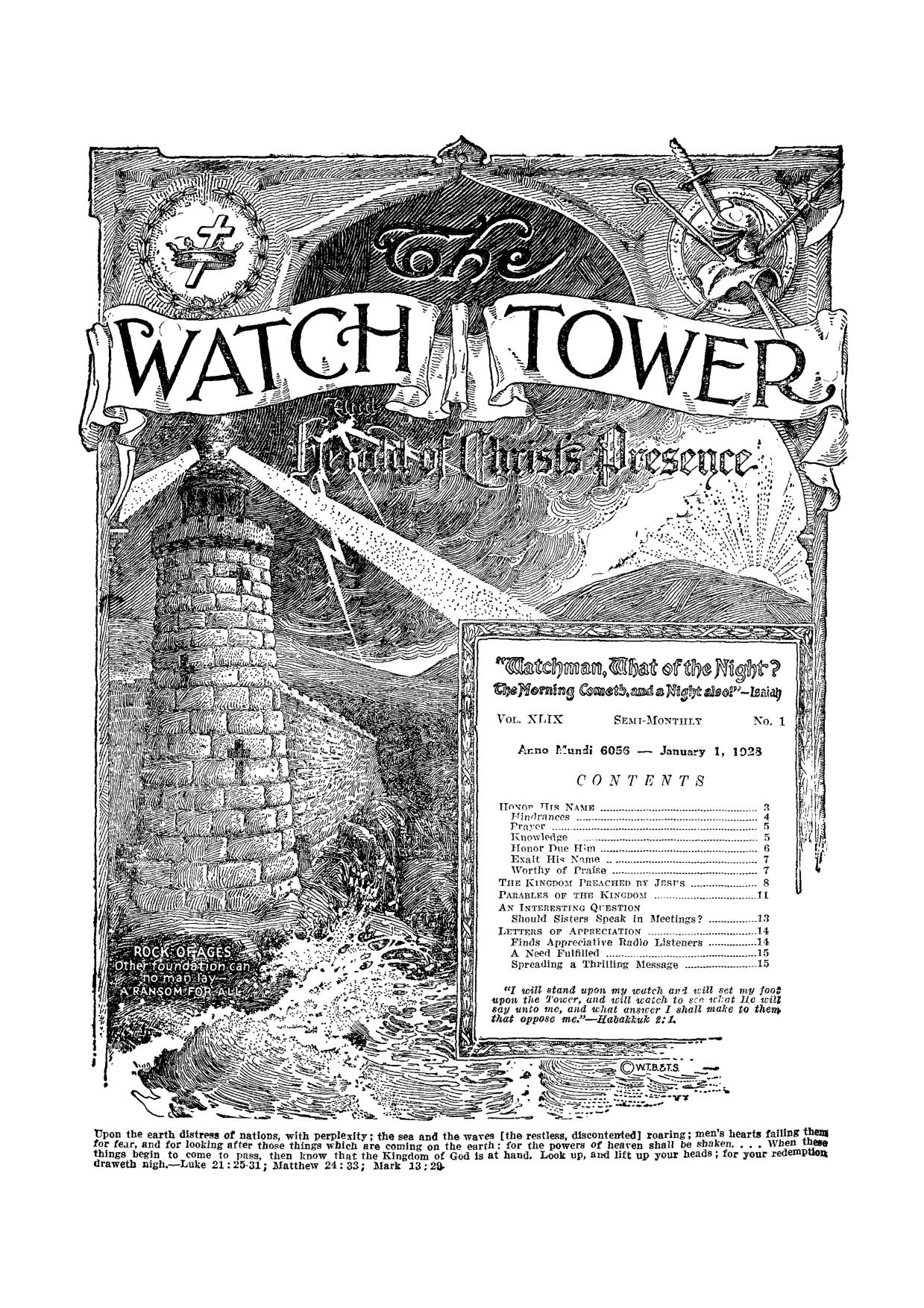
THIS JOURNAL AND ITS SACRED MISSION
THIS journal is published by the WATCH TOWER BIBLE AND TRACT SOCIETY for the purpose of aiding the people to understand the divine plan. It provides systematic Bible study in which all its readers may regularly engage. It gives announcement of the visits made to Bible classes by traveling speakers, announces conventions, and gives reports thereof. It announces radio programs and publishes suitable Bible instruction for broadcasting.
It adheres strictly to the Bible as God's revealed Word of Truth. It stands firmly upon the great ransom sacrifice as the fundamental doctrine by which all doctrines are measured. It is free from parties, sects and creeds of men. It does not assume a dogmatic attitude, but confidently invites a careful examination of its utterances in the light of the infallible Word of God. It does not indulge in controversies, and its columns are not open to personalities.
TO US THE SCRIPTURES CLEARLY TEACH
THAT JEHOVAH is the only true God, the Maker of heaven and earth, and is from everlasting to everlasting; that the Logos was the beginning of his creation; that the Logos became a man; that he is now the Lord Jesus Christ in glory, clothed with all power in heaven and earth.
THAT GOD created the earth for man, created perfect man for the earth and placed him upon it; that man wilfully disobeyed God's law and was sentenced to death; that by reason of Adam's wrongful act all men are born sinners and without the right to life.
THAT JESUS was made a human being in order that he might become the Redeemer of man; that he gave his life a sacrifice for man and thereby produced the ransom price; that Jesus the divine arose from the dead, ascended into heaven, and presented the value of his human sacrifice as the redemptive price for man.
THAT for many centuries God, through Christ, has been selecting from amongst men the members of his church, which constitutes the body of Christ; that the mission of the church is to follow in the footsteps of her Lord Christ Jesus, grow in his likeness, give testimony to the name and plan of Jehovah God, and ultimately be glorified with Christ Jesus in his heavenly kingdom; that Christ, Head and body, constitutes the "seed of Abraham" through which all the families of the earth shall be blessed.
THAT THE WORLD HAS ENDED; that the Lord Jesus has returned and is now present; that Jehovah has placed Christ Jesus upon his throne and now commands all nations and peoples to hear and obey him.
THAT THE HOPE of the peoples of earth is restoration to human perfection during the reign of Christ; that the reign of Christ will afford opportunity to every man to have a fair trial for life and those who obey will live on earth for ever in a state of happiness.
PUBLISHED BY
WATCH TOWER BIBLE & TRACT SOCIETY
117 ADAMS STREET - BROOKLYN, N. Y. U. S. A.
OFFICERS
J. F. RUTHERFORD President
W. E. VAN AMBURGH Secy. & Treas.
EDITORIAL COMMITTEE J. F. RUTHERFORD
W. E. VAN AMBURGH J. HEMERY R. H. BARBER E. J. COWARD
FOREIGN OFFICES: British: 34 Craven Terrace, London, W. 2, England; Canadian: 40 Irwin Avenue, Toronto, Ontario; Australasian: 495 Collins St., Melbourne, Australia; South African: 6 Lelie St., Cape Town, South Africa. Please address the SOCIETY in every case.
YEARLY SUBSCRIPTION PRICE: UNITED STATES, $1.00; CANADA AND MISCELLANEOUS FOREIGN, $1.50; GREAT BRITAIN, AUSTRALASIA AND SOUTH AFRICA, 7s. American remittances should be made by Express or Postal Money Orders, or by Bank Draft. Canadian, British, South African and Australasian remittances should be made to branch offices only. Remittances from scattered foreign territory may be made to the Brooklyn office, but by International Postal Money Orders only.
(Foreign translations of this journal appear in several languages.)
TERMS TO THE LORD'S POOR: All Bible Students who, by reason of old age or other infirmity or adversity, are unable to pay for this journal, will be supplied free if they send a postal card each May stating their case and requesting such provision. We are not only willing, but anxious, that all such be on our list continually and in touch with the Berean studies.
Notice to Subscribers: We do not, as a rule, send an acknowledgment of a renewal or a new subscription. A renewal blank (carrying a notice of expiration) will be sent with the journal one month before the subscription expires. Change of address, when requested, may be expected to appear on address label within one month.
Entered as Second Class Mail Matter at Brooklyn, N. Y. Postoffice. Act of March 3, 1879.
YEAR BOOK 1928
A new Year Book for 1928 has been prepared. It contains the complete report of the president to the annual meeting. It also contains a text for each day appropriate to the year text. A limited number has been printed. Classes should order through the service director. Price, 50c.
1928 CALENDAR
A calendar for 1928 containing the year text is now ready. It is made from an original painting showing the reflected light of God's glory upon the earth, with his servant calling upon the people and delivering to them the message of comfort and consolation. It is printed in four colors. Everybody will like this one. In lots of 50 or more 30c each; single copies 35c each.
LOCAL CONVENTIONS
For the mutual encouragement of brethren in the South, three mid-winter conventions have been arranged. A number of pilgrim brethren will take part in the program at each of these conventions.
San Antonio, Texas, January 13-15. For further particulars address Elijah Smith, Secretary, 134 Divine St., San Antonio, Texas.
Dothan, Ala., January 27-29. Address Dr. M. S. Stough, Secretary, 402 N. Foster St., Dothan, Ala.
Jacksonville, Fla., February 3-5. Address D. F. Johnson, Secretary, 1618 Liberty St., Jacksonville, Fla.
WATCH TOWER STUDY
A number of the brethren seem to be agitated about what the Scriptures say concerning our Lord's second coming. In the February 1st and 15th issues The Watch Tower will discuss the matter in detail. It is believed that this will help many to see the matter in the proper light. It is suggested that those who are in difficulty suspend their conclusion until these issues of The Watch Tower are printed and have been carefully studied.
I.B.S.A. BEREAN BIBLE STUDIES
By Means of "The Watch Tower"
"Christians' Mission on Earth"
Z November 1, 1927
Week of Feb. 5 . . . ¶ 1-23
Week of Feb. 12 . . . ¶ 24-46
"The Passing of the Powers"
Z November 15, 1927
Week of Feb. 19 . . . ¶ 1-21
Week of Feb. 26 . . . ¶ 22-43
the WATCH TOWER
AND HERALD OF CHRIST’S PRESENCE
VOL. XLIX JANUARY 1, 1928 No. 1
HONOR HIS NAME
“Sing forth the honour of his name.”–Psalm 66: 2.
JEHOVAH’S name is not comparable to that of any creature. He is the Almighty God beside whom there is none. Contrary to this great truth the name of Jehovah has been made an issue before the minds of creatures for the past six thousand years. One of his creatures called Lucifer forced the issue. In doing this he became God’s enemy and had his own name changed from that which means bearer of light to that which signifies everything that is evil. It has ever been the policy of this evil one to push the name of the great Jehovah God on the side, to ridicule his name, and to cause creation to defame God’s name and to regard him as a fiend unworthy of respect and praise. This the enemy has done in order to exalt himself that he might receive the worship of men and keep them in subjection to himself. God could have prevented the enemy from so doing but it is manifestly the purpose of Jehovah to permit the enemy to demonstrate his full and complete depravity. Thereby others of his creation may learn the evil effects of sin and the blessings resulting to those who are obedient to God and who honor his name.
2 Jehovah God has not pushed his name to the fore. At stated intervals he has brought his name prominently before his creation. This he has done by a demonstration of his unlimited power, which has always proved that the Devil is powerless against Jehovah when the latter deems it proper to exercise his great power against the evil one. At these stated intervals God has brought his name before his creation, not for a selfish reason but for the benefit of his creatures. Unselfishness has been his motive. This is another proof that “God is love”.
3 During the ages God has magnified his word of promise above his name. The time has come, however, when Jehovah’s name shall be exalted among all his creatures upon a parity with his word of promise. Then all creatures will know that the word of God is always true and that his name is above all and worthy to be praised.
4 When the Lord God was pronouncing the sentence against man for the violation of his law he took cognizance of Satan’s part in that evil course and he then and there gave his word of promise that at some future time “the seed of the woman should bruise the serpent’s head”. Time and again God magnified that word of promise.
5 Centuries later he began to foreshadow his plan for carrying into operation that promise. He called Abram and made to him the promise: “In thee shall all families of the earth be blessed.” (Genesis 12: 3) Here Abraham represented the Lord God, and God’s word of promise shows that the blessing of all the families of the earth must proceed from Jehovah because he is the great Life-giver. Later the Lord caused Abraham to present his son as a sacrificial offering and it was at that time that God made promise to him: “In thy seed shall all the nations of the earth be blessed.” (Genesis 22: 18) In this picture Abraham represented the Lord God, and his son Isaac represented Jesus the beloved Son of Jehovah. The promise shows that the blessings must come from Jehovah by and through his Son Christ Jesus. It also shows that “the seed of promise” which shall bruise the serpent’s head is Christ the beloved One of God and God’s great representative.
6 During all these centuries God has kept his word of promise to the fore in this, that he has always had some one on the earth who has borne witness to his word of promise. The faithful ones of Israel magnified God’s word of promise. When Jesus came he magnified the promise of his Father. The apostles magnified the word of promise, the faithful Christians throughout the Christian era have done the same thing. David foreshadowed the true Christians, and his prophetic words are placed in the mouth of such. Therefore it is written: “I will bow down towards thy holy temple, and thank thy name, for thy lovingkindness and for thy faithfulness. For thou hast magnified above all thy name, thy word !” – Psalm 138 : 2, Rotherham.
7 God’s word of promise is perfect. It is his expressed will. In the ages he has moved majestically forward in carrying out his will as expressed in his Word. At stated intervals to save the people from complete infidelity he has brought his name prominently before them. Now the “seed of promise” is about completed and the time is at hand when the Lord will magnify his holy name before mankind. The issue will then be finally determined against Satan in favor of Jehovah. He will have a witness given in the earth of his purpose and intention to magnify his name, and this witness must be given now. The faithful members of Christ on the earth are granted the privilege of bearing witness to that great fact. Therefore God says to them: “Ye are my witnesses, saith the Lord, and my servant whom I have chosen; that ye may know and believe me, and understand that I am he: before me there was no God formed, neither shall there be after me. . . . Therefore ye are my witnesses, saith the Lord, that I am God.”–Isaiah 43 : 10, 12.
8 There is no doubt as to the present mission of true Christians yet on the earth. All the prophetic evidences, viewed in the light of the physical facts, prove that the world has ended, which means that Satan’s organization has reached its fulness; that God has set his beloved Son upon his throne (Psalm 2: 6), which means that Christ Jesus has assumed his great authority and begun his reign; that Satan has been expelled from heaven and that all the forces are now gathering for Armageddon, which is the great battle of God Almighty against Satan and his organization; and that the Lord has come to his temple, which means that the Lord is gathering to himself his faithful servant class. To this class the Lord gives commandment to proclaim the great message of God’s truth to the nations of earth as a witness and then Armageddon shall quickly follow and that shall be the final trouble upon earth. In that great time of trouble Jehovah God will make for himself a name even as he did when he overthrew the Egyptians and delivered his chosen people from bondage.
9 Those now in the temple class God has called and taken out from the world as a people for his name. It becomes the privilege and duty of such to show forth his praises. The witness to his name must be done before Armageddon because it is God’s announced purpose that it shall be done. There would seem to be no reasonable cause for giving such testimony after Armageddon. The conclusion is therefore irresistible that now is the time for the temple class to magnify the name of Jehovah. This they do by beginning to sing forth the honor of his name. It is therefore appropriate that we open the year with the text which is virtually a call by members of the temple class to each other saying: “Sing forth the honor of his name.”–Psalm 66 : 2.
10 The prospect therefore is one of great activity on the part of the temple class in proclaiming the message of God concerning his vengeance and the blessings his kingdom will bring to the peoples of earth.
11 The issue is now clearly stated, to wit: Who is God? Who then is on the Lord’s side? Who will joyfully be a witness to the name of the Lord God? Let all who will answer “I” look well to the provision God has made for the giving of the witness and then quickly avail themselves of such provision and participate in singing forth the honor of his name.
HINDRANCES
12 This is the time when the enemy is making war against the remnant of the seed of promise which keep the commandments of God and have the testimony of Jesus Christ. (Revelation 12 : 17) That remnant makes up the wise and faithful servant class which gives the witness against the enemy and to the name of Jehovah. For this reason that class becomes and is the worst foe of Satan on earth, hence he wars against them. Be advised then that the witness work will not be without hindrances. The enemy is wily, subtle, and fraudulent. He will attack some from one position and some from a different position. Into the mind of some the enemy will inject the thought that greater material wealth would now be of advantage. Such will reason that if they could accumulate large sums of money, that would not only help themselves but help the Lord’s cause. Therefore some lay aside the service of the Lord for the time until they can accumulate great wealth and then expect to return. They seldom return to the service. Usually one who takes that course forgets God and the privilege of serving him.
13 Into the minds of others the enemy may inject the thought that all earthly substance must be put aside or given away that thereby one might live a life of sacrifice and silently wait for glorification. Others may become so lazy and dreamy that they will not provide the things decent and honest for themselves and their dependent ones, only waiting upon the Lord, as they say. Still others may fall into such great poverty that they would despair, thinking God had forsaken them.
14 Into the minds of others the enemy may inject vain thoughts causing such to magnify their own importance, thereby causing them to abandon the Lord’s appointed way of doing his witness work and into taking up some foolish way that they have gotten for themselves. The Devil will work every possible scheme to overcome the anointed ones. The Lord, foreknowing the schemes of the wily enemy, and for the good of his creatures, caused to be recorded in his Word that which expresses the true Christian heart’s sincere desire, namely: “Remove far from me vanity and lies; give me neither poverty nor riches; feed me with food convenient for me; lest I be full, and deny thee, and say, Who is the Lord? or lest I be poor, and steal, and take the name of my God in vain.”–Proverbs 30 : 8, 9.
15 The true child of God desires to be meek before the Lord. That means that he must not think too highly of himself but think soberly and remember that everything he has is the gracious gift from God. He desires to be humble under the mighty hand of God, which means that he wants to always be obedient to God’s commands. He sees that extreme earthly riches would tend to cause him to forget God and his own relationship to the Almighty One. He sees that extreme poverty might cause such discouragement that he would despair. Concerning these things he wants to have the spirit of a sound mind and to diligently and faithfully use whatsoever means is available to provide the necessities and then to use all of his endowments in the service of the Lord to his glory. He recognizes that God has only one way of doing his work in the earth, and the true Christian wants to keep in harmony with that way. Therefore he prays: "Feed me with food convenient for me." That which is fit and proper, which is strengthening and builds one up as a new creature in Christ, is convenient food.
16 Where would the new creature look for such food? For his physical needs he would carefully consider what natural food is best suited to give him strength of body and mind that he might serve. For his mind he would diligently seek the food which the Lord has provided for his own. Seeing that the Lord has led his people in the harvest period, and provided them with meat in due season through his chosen channel, the child of God has confidence that in the same manner the Lord will continue to provide for his own. Every dumb ox knows his master's crib, from whence comes his food. (Isaiah 1:3) Surely the Lord's people should now know from whence comes their food.
17 Let no child of the Lord be deceived by vain statements or doctrines that emanate from ambitious men; for instance, such statements or doctrines as announce the month and day when the last member of the church will be taken to heaven. Such doctrines are not only vain and foolish but are presumptuous before the Lord. Let every one be diligent to do what God has commanded his people to do, having full confidence that the Lord will glorify his children in his own due time. Whether one year or ten years are required to finish the witness work should not be material to the servant of the Lord. If he loves the Lord God he will joyfully keep his commandments by doing what his hands find to do. This done he will not take the name of the Lord in vain.
PRAYER
18 Prayers should not be made for a selfish purpose. The prayer set forth in the foregoing text (Proverbs 30:8, 9) is not a selfish prayer; because it asks God to keep his child in that happy condition that will enable him to glorify and honor the Lord's name. The true Christian will always keep uppermost in his mind the thought: What can I do to best honor my Father's name? All who are in the flesh are weak. Because thereof the Christian may commit some great blunder or find himself guilty of other dereliction. He may find he has taken a lawless course and his heart's desire is to be in full harmony with his heavenly Father. He desires to go to the throne of heavenly grace for help. Shall he go with the desire or request that he may be pardoned solely for his own benefit? No. He should have a higher motive than that. The true motive under such conditions is suggested by the words of the prophet: "For thy name's sake, O Lord, pardon mine iniquity; for it is great."–Psalm 25: 11.
19 The child of God realizes that his own dereliction or iniquity may bring discredit or dishonor to the name of God and he is prompted by the highest motive when he prays: "For thy name's sake, O Lord, pardon mine iniquity." God has put his name upon his anointed ones who are on the earth. His name is involved in their course of action. All who love the Lord are anxious that no dishonor shall come upon his name by reason of a wrongful course. Moses prayed unselfishly when he asked God to blot him out if that would make atonement for the Israelites. (Exodus 32:32) Paul expressed a like desire. (Romans 9:3) Surely then the true child of the Lord would rather be blotted out than to bring dishonor to his Father's name. The true and honest-hearted who loves God and strives to honor his name will be remembered in mercy by the heavenly Father; and the Lord will hear his prayer and for his name's sake restore such servant to himself.
20 Those who make up the faithful servant class, otherwise designated the remnant, must engage in the battle with the powers of evil. Sometimes the battle is pressed hard and God does not at once reveal how he will deliver his servant. The servant's discomfort may be because of some negligence, failure or refusal in the performance of duty. He therefore prays that he may be cleansed from all defilement to the end that he might get on in the service to the glory of God's holy name. His heart finds true expression in the words written: "Help us, O God of our salvation, for the glory of thy name; and deliver us, and purge away our sins, for thy name's sake."–Psalm 79:9.
21 The servant of the Lord must keep in mind his proper relationship to Jehovah his Father. Evidently such was the thought Jesus intended us to have when he gave the model prayer to his disciples. Often prayer is uttered to Jehovah in a perfunctory manner and sometimes with undue familiarity. The expression is used: "Lord, we come into thy presence," etc. That is not the way that Jesus taught one to pray. (Luke 11:2) "When ye pray, say, Our Father who art in heaven, Hallowed be thy name." Here the name of Jehovah God, the Father of the new creation, is involved. To the new creature that name is most sacred. He should regard, and will regard, that name with the highest degree of respect, reverence and awe. He should recognize the dignity, wisdom and superiority of God above all. The Lord is the source of life. He is the Father of the new creation. Every good and perfect thing proceeds from him. There is none like unto him. He is to be honored above all creation. The Christian must recognize this. The Lord, however, condescends to hear the petition of the imperfect creature. The proper reverence for God is shown by the Christian when he asks a favor that the holy name of Jehovah might be honored.
KNOWLEDGE
22 Knowledge is essential to life eternal. All men were born without the right to life. The way to obtain everlasting life is that which God has graciously provided. That provision does not force life upon anyone. It is offered to man as a gracious gift. No gift can be accepted without the receiver having knowledge of the offer. The gift of life is through the sacrifice of Jesus Christ and by exercising faith therein and obedience to God’s expressed will. For this reason it was declared by the great Master: “And this is life eternal, that they might know thee the only true God, and Jesus Christ, whom thou hast sent.”–John 17: 3.
23 All of mankind who will ever receive life must get it through Christ and must have some knowledge thereof before receiving it. The Lord in his Word reveals the importance of knowledge on the part of the new creation. The Christian is told to be transformed by the upbuilding of his mind. (Romans 12: 2) He is directed to add knowledge to his faith and by reason of knowledge to increase his wisdom and faith. (2 Peter 1: 4-8) It is in line with this request that the child of God prays his Father: “Feed me with the food convenient for me.” The Lord provides such necessary food for the new creation.
24 It is therefore important that the members of the temple class assemble themselves together for regular study of the Word of God by feeding upon the meat in due season and to encourage each other. Such food and such provision is through the Lord and it is upbuilding and helpful and therefore convenient for the Christian. As he continues to grow in knowledge he has a clearer vision of God’s purpose and a greater desire to enter into his service and faithfully perform that service.
SAFETY
25 Those of the remnant being advised that the enemy is bent upon their destruction know they must find a place of safety. Going forward to give witness to the name of Jehovah they encounter many agencies of the enemy. They are made the objects of reproach. They suffer much tribulation. They have many trials. This is the potion provided or cup poured for the servant class. It is the cup the drinking of which means salvation on the divine plane. The drinking of that cup or potion means obedience to the Lord. Naturally weak, being beset by the enemy and his many agencies, and having many trials and much opposition, such would tend to discourage the Christian when he faces the battle. He sees his duty and his privilege, however, and knowing that he can seek the throne of grace in every time of need he confidently says: “I will take the cup of salvation, and call upon the name of the Lord.” (Psalm 116: 13) Here again he is seeking the honor of Jehovah’s name by calling upon that name.
26 To all the faithful, true witness class God grants the privilege of calling upon his name with confidence that such call will be heard. He has put his name upon them and therefore he will honor his own name by hearing the petitions asked in a proper way. He who enjoys this privilege of prayer to the Father, and avails himself thereof in sincerity, finds a place of safety.
“The name of the Lord is a strong tower; the righteous runneth into it, and is safe.”–Proverbs 18: 10.
27 It is the temple class, the wise and faithful servant class, the remnant of his people, to whom God grants the privilege of being witnesses of his name. He offers such complete protection while engaged in the blessed performance of the duty of service. To them he says: “The Lord of hosts is his name. And I have put my words in thy mouth, and I have covered thee in the shadow of mine hand, that I may plant the heavens, and lay the foundations of the earth, and say unto Zion, Thou art my people.” (Isaiah 51: 15, 16) The blessed and sweet relationship between Father and children composing the servant class is here set forth.
COURAGE
28 To have courage means that one knowingly faces danger and walks directly into it in the performance of duty, at the same time confidently relying upon God for protection and deliverance. The child of God, who is engaged in singing forth the honor of the Lord’s name, has every reason to be of good courage. In fact only those who joyfully engage in the Lord’s service to the glory of his name have any assurance of protection in this time of peril. Such know they are on the Lord’s side and that the Lord is their strength and salvation. They therefore confidently say: “The Lord is my rock, and my fortress, and my deliverer; my God, my strength, in whom I will trust: my buckler, and the horn of my salvation, and my high tower. I will call upon the Lord, who is worthy to be praised: so shall I be saved from mine enemies.”–Psalm 18: 2, 3.
29 Such do not feel that they must appear before others in an apologetic manner when they go as representatives of the Lord. On the contrary, they go forth in the name of the Lord as the representatives of the Most High and by his authority and with full confidence they delight to sing forth the honor of his name and advise the people concerning his purpose. These faithful servants rally together around their standard and press the battle at the gate against the enemy. They rejoice in the fact that the time of salvation and deliverance is at hand. They encourage and cheer each other and together lift up the voice to the praise of God’s holy name. “We will rejoice in thy salvation, and in the name of our God we will set up our banners: the Lord fulfil all thy petitions.”–Psalm 20: 5.
30 A banner is not only a symbol of encouragement but it also is an expression of defiance to the enemy. It is an announcement that God’s anointed ones will stand shoulder to shoulder proclaiming the name of the Lord and never quail before the enemy. (Philippians 1: 27, 28) This is the reason why the servant class in this day of battle is strong in the Lord and in the power of his might.
HONOR DUE HIM
31 The true child of God is anxious to sing forth the honor of Jehovah’s name. It is due the Lord that his name be honored above all. It is due time to sing forth the honor of his name. The anointed ones are the only true representatives of God on earth and they are greatly honored by having the privilege of representing him. Speaking for them the Psalmist says: "Give unto the Lord the glory due unto his name." (Psalm 29: 2) This text is also a call by each member of the temple class to the other members of the temple class.
32 In line with this command it is proper that each member of the remnant class keep before his brethren the great importance of now having a part in the service of the Lord. While no one has a right to attempt to compel another to engage in the Lord's service, it is the duty and privilege of each one to point out to his brother the great advantage and favor resulting from participating in his service. It is impossible to sing forth the honor of the Lord's name now unless we avail ourselves of opportunities for serving him because this is the means that God has provided for the witness to his name to be given. Amidst great opposition the little company of anointed ones delight to encourage one another and together engage in singing the honor to the Lord's name.
EXALT HIS NAME
33 The ecclesiastical wing of Satan's organization in particular has taken the name of the Lord. They have taken it in vain because taking it for a selfish purpose. They defame his holy name. They are therefore the enemies of God. The true witnesses of the Lord are few on the earth. These are despised by the pretenders even as Jesus was despised by the ecclesiastics and their allies of his time. God foreknew the conditions that would exist at this time on earth and he caused his prophet to speak to his servants, saying: "Praise ye the Lord. Praise, O ye servants of the Lord, praise the name of the Lord. Blessed be the name of the Lord, from this time forth and for evermore."–Psa. 113: 1, 2.
34 This prophecy must have a fulfilment at some time. Its fulfilment has begun. From this time forward and for evermore the name of Jehovah shall be exalted and no power can possibly prevent it. Satan's organization must fail and then all will be brought to a knowledge of the true meaning of Jehovah's name. It is the blessed privilege of the feet members of the anointed to now begin the work of exalting Jehovah's name in the earth.
35 The servant class therefore sees that at this time there is a definite work to be done. This work now consists of proclaiming the glad tidings to the nations of earth that Jehovah is God, that Christ is King, and that the kingdom of God is at hand. The Lord has provided the machinery to print the message for wide circulation. He has provided the radio to send the message into the prison houses; having provided the ammunition and laid down the barrage he calls upon his servant to go forward and press the battle; and for their encouragement says to such that 'he will be for them a crown of glory, and for a diadem of beauty unto them'. He will be a shield and protector and comforter and the blesser.
36 The song of glory now begun shall go forward until it fills the earth. "From the rising of the sun unto the going down of the same the Lord's name is to be praised."–Psalm 113: 3.
37 This does not mean daily worship as some have erroneously construed it to mean. The sun rises in the east and goes down in the west, and from east to west is every place on the earth. Therefore the time must come when everywhere the sun shines the name of the Lord God shall be exalted in appropriate praise. All who live will honor his holy name. God's prophet was given a vision of the people relieved from bondage and all giving praise to God. It was a vision of the song of deliverance for humankind. The anointed ones now on earth begin that glad song which shall never end. This year of 1928 will be marked by a great witness of praise to the name of Jehovah.
WORTHY OF PRAISE
38 The name of Jehovah God is worthy of all praise. He is the complete expression of unselfishness. His loving kindness is beyond the expression of words. When the peoples of earth come to realize that the long dark night of Satan's rule has ended and their release from bondage has come; when they learn that the way to life everlasting is open to all mankind and that God in his loving kindness has made this provision for them, the multitudes will exclaim: "Who shall not fear thee, O Lord, and glorify thy name? for thou only art holy."–Revelation 15: 4.
39 The name of Jehovah will continue to be exalted. The creation invisible to man shall send forth his praises. All the visible governing factors of earth and all creation subject thereto will praise his holy name. The mighty mountains will lift their hoary heads in songs of praise. The broad fields will declare the honor of God's name. The trees of the wood clothed in garments of verdure and beauty will rejoice, and every creature that breathes and lives shall join in the grand hallelujah chorus to the honor and glory of Jehovah's holy name.
40 Out of darkness the Lord has called his people for a purpose and put his name upon them. In advance of others of mankind he has given his faithful ones a vision of his gracious purposes. These faithful ones are now made his witnesses. Every one now holding fast and remaining faithful to the end shall see the complete triumph of Jehovah and the issue finally and for ever determined to his glory and honor. Their own reward will be an everlasting dwelling place in the house of the Lord. It is their duty and blessed privilege to now beseech their brethren and fellow workers in the field to join them by participating in the service of the Lord in singing forth the honor of his name.
41 The prayer meeting texts for each week during the year 1928 have been selected in harmony with the year text. The comments have been prepared with the one thought in view, that of honoring Jehovah's name.
42 Each week the various ecclesias assemble for prayer and testimony. Let it here be suggested that time and effort be not wasted but be conserved and properly used. Do not go to the prayer and testimony meetings with the thought of relating only some experience that you have had with an individual. Rather let your testimony be along the lines of the text for the week, particularly magnifying the name of Jehovah. This will enable all who thus participate in the meeting to keep one thought uppermost in mind, that of honoring Jehovah's name. It will enable all to see in addition thereto that a climax in the ages has been reached; that now is the most blessed time the Christian has been on earth during the Christian era; that now the temple class has entered into the joy of the Lord, and that the chief joy is the vindication of Jehovah's name. That must have been the chief joy set before Jesus and to which the apostle referred when he says: "For the joy that was set before him [he] endured the cross." (Hebrews 12:2) He comes to his temple and those whom he finds faithful he invites to participate in his joy. These now are made to be partakers with Christ Jesus in proclaiming the name of Jehovah in saying that his name is to be vindicated and this brings to their heart an unspeakable joy.
43 Let no one engage in the service merely because he thinks he is compelled to do it. Let each and every one engage in the service of the Lord because he delights to do it. In this manner we prove our love for God. (1 John 5:2) The lead taken at the prayer meetings each week of magnifying Jehovah's name should be followed throughout the week; and each and every day in the service take occasion to magnify his name that others may know that Jehovah is God, and that the time for the exaltation of his name has come.
QUESTIONS FOR BEREAN STUDY
What has been the issue before the minds of God's creatures for the past six thousand years? Who forced the issue, and with what design? What course has Jehovah pursued down through the ages, and why? What is his present procedure, and to what end? ¶ 1-3.
What promise accompanied God's sentence against man for his disobedience? How was this "seed" foreshadowed? In what way has "the seed" been revealed? ¶ 4, 5.
How, and by whom, has Jehovah's name been magnified in the earth? How will the great issue be finally determined? ¶ 6, 7.
What is the duty and privilege of God's true witnesses at the present time? What is the testimony to be given? What may be said of the urgency of the occasion? Why are Christians granted this privilege? ¶ 8-11.
In what is the enemy particularly active at this time? Why do not all the Lord's people have the same experiences and difficulties in this connection? How should God's faithful witnesses consider the hindrances placed in their way? ¶ 12-15.
What provision has the Lord made for the guidance and assistance of his people? (Ephesians 4:11-16) How should such providence and ministry be received? ¶ 16, 17.
What is prayer? Why is it necessary and helpful? How should one pray, and for what? ¶ 18-21.
In what respect is knowledge essential to eternal life? How is knowledge related to faith? What is the purpose of class study? What is its relation to home study? ¶ 22-24.
For whom has Jehovah provided a place of safety? Why? How may the Christian continue to abide therein? ¶ 25-27.
What is true courage? Why is the Christian courageous? What is the source of his confidence and strength? By what means may his strength be increased? ¶ 28-30.
How may Jehovah's witnesses assist one another? Is this an obligation or a privilege? What can be said, in this regard, of the power of example? ¶ 31, 32.
Why has the influence of the ecclesiastical element been particularly harmful? What is the testimony now to be given regarding the Devil's kingdom? What is to be declared respecting the kingdom of God? What various means has the Lord provided for accomplishing this witness work? What is the true purpose of daily worship? ¶ 33-37.
Why is Jehovah God worthy of all praise? When will he receive the honor due his name? To whom and for what purpose has he given a vision of his plan? What may be said of the privilege now granted to the faithful servant class? ¶ 38-40.
Explain the true purpose of the praise and testimony meetings. How may the prayers and testimonies be made to contribute directly to that end? What should be the motive in service? How may one's zeal be increased? ¶ 41-43.
THE KINGDOM PREACHED BY JESUS
IT IS plain to all that in its statements regarding the kingdom of God the New Testament does not appear to say the same things about the kingdom as are said in the Old Testament. The prophecies of the Old Testament spoken by holy men of old concerning the kingdom of God told of the time when the enemies of Israel and of God's rule on earth would be destroyed and when God would extend the power of his kingdom throughout the whole earth. The Prophet Daniel was told that "the kingdom, and dominion, and the greatness of the kingdom under the whole heaven, shall be given to the people of the saints of the Most High, whose kingdom is an everlasting kingdom, and all dominions shall serve and obey him". In its establishment it would break in pieces and consume all the kingdoms of the earth.–Daniel 2:44; 7:27.
The Davidic kingdom was the basic picture of the prophecies. But the prophetic vision is much wider than that of a mere Jewish kingdom. The New Testament speaks of the kingdom of God, or the kingdom of heaven, as if it were something different from this. It has only little to say about any such organization established upon the earth for the rule over all mankind, but rather as if it had more particular reference to the state of heart and mind. This difference has led organized Christianity to say that the Old Testament is altogether wrong in its prophecies. They consider the idea of an actual visible organization upon earth as being crude although indeed they have endeavored to make and sustain such an organization for their own glorification. There has been no more domineering rule in the earth than that which has been attempted by the church systems, and which these systems have called the kingdom of heaven on earth.
Church members of almost all classes come to the conclusion that the prophets were not inspired and that these men merely visualized certain conditions which could arise if Israel were to have their long-looked-for dominion over the Gentiles.
Is this difference between the Old Testament and the New a vital one or is there something to be explained? The answer is: The New Testament reveals the ruler, while the Old Testament discloses the earthly representatives of the kingdom of heaven.
Matthew relates that when John the Baptist began his work the burden of his cry was, "The kingdom of heaven is at hand." (Matthew 4:17) Undoubtedly John's declaration that the kingdom of heaven was at hand, and also that he was the herald of a coming one, and was fulfilling the prophecy of Isaiah, 'making straight the way of the Lord' (John 1:23), stirred the people to unusual expectation. His coming would appear to them to be timely; for Herod the Great had already restored and enlarged the temple, giving it something of its first glory. The people began to think that the king so long looked for was now to be expected. But when John announced that Jesus of Nazareth was the one for whom he was forerunner, the Jews would have neither John nor Jesus. The carpenter of Nazareth was not one whom they would make their king.
John's ministry was soon brought to an end. Herod put him in prison and later killed him. Jesus took up the kingdom message. He also preached the good news of the kingdom of heaven and called the people to repentance. The Pharisees, who had early lost interest in John, as quickly discerned that Jesus had no use for them, nor they for him, and they became his enemies.
After a time Jesus was very busily engaged in Galilee teaching the people and healing their sick. Of what he taught there is no particular record but it is evident that he intended the people to understand that the kingdom of heaven was represented by him. In his talk with the people he turned their minds from any thought that he was about to set up such a kingdom as they conceived, and when after he had miraculously fed thousands of men and women with only five loaves and two small fishes they would have made him king, he quickly dispersed them.
Some time during that ministry in Galilee he spoke the parables, which are known as the parables of the kingdom, the most familiar of which is the Parable of the Sower, in which the kingdom of heaven is likened to a man sowing seed in his field. These parables show that whatever Jesus had to say concerning the prophecies which foretold the kingdom of God there was something to explain about the kingdom which had not hitherto been disclosed.
Jesus had, however, already begun to show that there was to be prepared the ruler of the kingdom, which work must be done before it could be set up in power. When Jesus was busily engaged in his work John had sent two of his disciples to ask him about himself; for John had expected that Jesus would increase and become a leader of a great company of people, and that a kingdom, the only kind of which he knew, would soon be established. John discerned that Jesus was not such a one as would take the sword against Rome, but probably he thought that God would stir the people up to place Jesus on the throne.
Jesus at that same hour worked many miracles and then told John's disciples to go and tell John that the scriptures spoken concerning the Messiah were being fulfilled by him. In Nazareth Jesus had read to his home town people Isaiah's prophecy: "The spirit of the Lord is upon me, because he hath anointed me to preach." Then he added: "This day is this scripture fulfilled in your ears." (Luke 4:18-21) Jesus said he was that Messenger. Thus it began to be seen that Jesus was telling of the ruler in the kingdom of God foretold by the prophets, which yet was not the same as that which was commonly understood as being referred to by the prophets, namely, a kingdom which should break in pieces all opposing forces and set God's people in peace and free the human family from its ills.
Jesus emphasized this when he told the Pharisees that the miracles he performed were evidences that the kingdom of God had come in their midst. Clearly he referred to the reigning one. His words were called forth by their sneering declaration that some of the miracles were wrought by the power of Satan. Jesus retorted that they were done by the finger of God and added that this fact was proof that the kingdom of God was present. He was the representative of the royal majesty of the heavens. The kingdom had come upon them unawares. Later to these same people, who so blinded themselves that they could not understand and demanded of him when the kingdom of God should come, Jesus replied, saying: "The kingdom of God cometh not with observation: neither shall they say, Lo here! or, lo there! for, behold, the kingdom of God is among you." (Luke 17:20, 21, margin) The latter word is translated in the King James Version as "within you", and a false Christianity has seized upon this word and taught that Jesus meant each person has something within him which is part of the kingdom of heaven. They teach that a man who would "reach out to higher things", who wants to "get into touch with the infinite", as another expresses it, has only to develop something he has within him and that this is really all that is demanded of the disciple of Christ. This deduction is contrary to everything declared in the divine revelation.
Human nature is fallen and its restoration comes from God and not from man. That there are very few men wholly depraved is true. Each has some of the original purity; but salvation comes by regeneration through Christ and not by self-endeavor. That the marginal rendering "among you" is correct is shown by comparison with John 1:26, where John the Baptist is reported as saying to some of the same class of people: "There standeth one among you, whom ye know not." The kingdom was operating before their eyes and they refused to see it. It is also claimed that Paul thought the same thing when he said: "The kingdom of God is not meat and drink; but righteousness, and peace, and joy in the holy spirit." (Romans 14:17) Paul does not argue that the kingdom of God of which Jesus spoke is only righteousness, joy, and peace in the holy spirit, but says that the kingdom of heaven in its then incipient or first phase is a kingdom of righteousness for everyone who accepts the teaching of the way of Christ.
If there is a kingdom there must be a king. Jesus did not in any sense draw the attention of the people to himself as king of the kingdom he proclaimed and spoke of as being then present. But when the last week of his life had come he entered Jerusalem in lowly yet kingly style, riding upon an ass, fulfilling the prophecy by Zechariah which said: "Behold, thy King cometh unto thee; he is just, and having salvation; lowly, and riding upon an ass." (Zechariah 9:9) Jesus there represented himself as the representative of Jehovah and the ruler of the kingdom of God then being prepared.
At the end of that same week when he was before Pilate, and Pilate asked him about the statement which the Jews attributed to him, namely, that he claimed to be Christ an anointed king, Jesus replied to Pilate acknowledging the fact by saying to Pilate: "Thou sayest it." The answer was indirect, but that Jesus intended so to be understood is evident from the fact that he further said: "My kingdom is not of this world." Interpreted, as they must be, by other words of Scripture the meaning is plain. His kingdom has no relationship to this world's order or ways. It is no result of any evolutionary process. The kingdoms of this world are of man, ruled by Satan, who is the invisible overlord and prince. The kingdom which God would set up by Jesus is the direct act of God through Christ; and neither human wisdom, nor policy, nor the Devil, has any part in its establishment.
But Jesus constantly directed the attention of his disciples to a future day for the establishment of his kingdom. He said: "Fear not, little flock; for it is your Father's good pleasure to give you the kingdom." (Luke 12:32) He showed there could be no inheritance of the kingdom for them until he should come again. He pictured himself going away to receive a kingdom and sharing it with his disciples on his return.–Luke 19:12-19.
It is apparent then that though the kingdom of heaven came with Jesus, the work that he did and began was preparatory to the later establishment of his kingdom in power. Those who became his close faithful followers were to share with him when that kingdom should be established. After Jesus was raised from the dead the disciples still with the expectancy of the kingdom, for that was ever before their minds, said to him on the last occasion they met with him before his ascension: "Wilt thou at this time restore again the kingdom to Israel?" (Acts 1:6) The Lord did not answer them directly, but intimated to them that they should receive understanding when they received the holy spirit. When the holy spirit came upon them at Pentecost they perceived that before the kingdom could be set up in power a work must be done which was a continuance of that which Jesus had begun. At first the apostles only perceived that work as it applied to the bringing of their own people into harmony with the teachings of Jesus. They expected that many of Israel would see the error of their ways, would repent, and accept Jesus as they themselves had done, namely, as the Messiah sent of God, sent to turn the people to repentance. Later the apostles discerned that before the full establishment of the kingdom that there was another work to be done, namely, that the gospel of the kingdom was to be preached amongst the Gentiles, that a people for the name of Jehovah might be gathered out of them. They did not know how long these things would take, and the length of time during which this work would be in motion was never revealed to them.
It is now the privilege of the servants of Jehovah to see the development of his purposes and to enter into his service under the glorified Jesus as the apostles did in the early days. Now the proclamation is made of the kingdom in power, and of the deliverance of those for whom Jesus died, to wit, all mankind, so that they may be free to serve God and attain to everlasting life on earth.
"Thy kingdom come, thy will be done,
Jehovah God, our King;
In glorious majesty shine forth,
And life and blessing bring.
Spread peace and plenty o'er the earth,
Enkindle love and joy.
Create each heart, endowed with grace,
And free from sin's alloy.
"Thy kingdom come, thy will be done
Through him who loved and saved,
Who conquered death that we might live,
Who triumphed o'er the grave.
Thy kingdom come, O wondrous One,
Ascend the ancient throne,
Light of the Gentiles, Israel's Hope,
Oh, hear creation's groan!"
PARABLES OF THE KINGDOM
WHEN Jesus began his work he called attention to himself as the Messenger of God by means of some miracles which he wrought. Then for a time he used John’s proclamation: “Repent: for the kingdom of heaven is at hand.” (Matthew 4: 17) Later he began to publish abroad the good news of the kingdom and ministered to the people, healing them of their sicknesses and diseases. When he began to teach the people about the kingdom he spoke to them in parables. That fact in itself would not be considered unusual, for it was and still is the custom of the East, but the disciples noted a difference between his manner of teaching them and the people, and they asked him the reason. They said: “Why speakest thou to them in parables?”
Jesus told them he had a definite purpose. He said: “Because it is given unto you to know the mysteries of the kingdom of heaven, but to them it is not given. For whosoever hath, to him shall be given, and he shall have more abundance: but whosoever hath not, from him shall be taken away, even that he hath. Therefore speak I to them in parables: because they seeing see not; and hearing they hear not, neither do they understand. And in them is fulfilled the prophecy of Esaias, which saith, By hearing ye shall hear, and shall not understand; and seeing ye shall see, and shall not perceive: for this people’s heart is waxed gross, and their ears are dull of hearing, and their eyes they have closed; lest at any time they should see with their eyes, and hear with their ears, and should understand with their heart, and should be converted, and I should heal them. But blessed are your eyes, for they see: and your ears, for they hear. For verily I say unto you, That many prophets and righteous men have desired to see those things which ye see, and have not seen them; and to hear those things which ye hear, and have not heard them.”–Matthew 13: 11-17.
In the gospel of Matthew a number of these parables are placed in sequence with evident intention of calling attention to them. In them Jesus said the kingdom of heaven is likened to a man sowing seed in his field and to a harvest growing to maturity. He likened it to a growth of a seed into a tree. Then he spoke of it as being like a man seeking goodly pearls and of buying one he found at extreme cost to himself.
It is plain that these pictures are different from the prophetic statements of the Old Testament which show that the kingdom of heaven, however beneficent its results, is established by violence. It is not surprising that those who are not instructed in the Word of God should make the mistake of thinking there can be no relationship between the Old Testament prophecies of a violent and even a catastrophic establishment of the kingdom and these New Testament declarations that the kingdom comes as quietly as nature carries on its work of producing the crop from the seed and that those who obtain its blessings gain them at great cost.
The explanation is in the fact that the development of the kingdom of God had its beginning with an advent of Christ. The part represented by the parables began with the first coming of Jesus. That part which is to be performed by the prophets begins after the second advent. The first work has for one of its objects the gathering out of the world those who are to be joint-heirs with Jesus in his kingdom and who, together with him, form the royal house of God. (1 Corinthians 12) This done, the earthly representatives follow, when the faithful ancients are resurrected. In the meantime events in the earth amongst the nations, and especially those nations which are called Christendom, have developed. These nations of earth have been brought into a readiness to be tested on their profession and brought to judgment. The time for the establishment of the kingdom of heaven in power has come.
There are two sets of parables which tell of the kingdom during the interval between the two advents of Christ. Both are seen in Matthew’s gospel. There is the cluster of parables in chapter thirteen, and another series spoken by Jesus at the close of his ministry recorded in the twenty-fifth chapter. They are not specially related to the church as such but tell of the kingdom as it would be seen among men. They are intended both as guidance and to give warning to the true disciples during the time of his absence.
The first of the first series is of a sower going forth to sow. Though it is not said of that parable that the kingdom of heaven is to be likened thereto, yet Jesus said that the word he spoke related to the kingdom. (Verse 19) It is evident that the work concerning the kingdom which began then was as a sowing of seed which in process of time should bring a harvest. This was made clearer by the next parable in which he likened his disciples to good seed and wicked men to evil seed. He showed how damage would be done by Satan and how a condition of confusion would arise which would be settled only in the time of harvest and then by fire which would consume the tares. He showed by the parable of the mustard seed that there would be an abnormal growth of that which appeared to some to be the kingdom. He showed that great religious systems, which would arise, after starting with the simple truth which Jesus spoke, would expand abnormally. This parable does not show that the kingdom which Jesus began was intended to grow to such huge dimensions as is claimed by orthodoxy. This is proven by the words of Jesus, who said the tree would give lodgment to the “birds of the air”, which in his first parable he declared were the agents of the evil one. The churches have grown and have indeed become nesting places for Satan’s agents. He showed by the parable of a woman with leaven how the truth which he gave to the disciples would be contaminated with evil. The false woman, “the mother of harlots” of Revelation 17, did hide her leaven of error in the food which Jesus gave to his people. This is a fulfilment of the prophetic parable.
Further Jesus showed that only those could be of the kingdom who paid a heavy price therefor. He represents himself as having found a treasure in a field, the field being the world, and that he to obtain that treasure sold all that he had. Christ made his great sacrifice to enter into the kingdom of God. He further showed how those who would share blessings with him must follow him in the way of sacrifice. These he likened to a man seeking goodly pearls, who when he found one of great price sold all that he had that he might possess it.
Here then in these parables is increase, with loss as well as gain; an admixture of evil men amongst the Lord’s disciples. There is an abnormal growth and there is the spoliation of the truth. At the same time those who seek the truth as God gave it in Christ must pay the costly price of full consecration to God, following in the footsteps of Jesus. These parables, in conjunction with those spoken by him concerning the end of the age when he comes again as a nobleman who has been in a far country and reckons with his servants, show that a work has been in process intended to gather to God through Christ a true people who will serve God at any cost to themselves. When Jesus returns he reckons with his servants; and those found faithful are apportioned the joy of continued service, entering into the joy of their Lord, that is, of being associated with him in the last great work which he is doing upon earth before the age comes to an end.
The purpose of sowing of truth in the earth has been to bring a people to God at the end of the age, “a people for his name,” to form the servant class of Isaiah’s prophecies (See Isaiah 43 : 10.), those who, representing Jesus, will complete the work which he began in his ministry in Palestine.
The kingdom of heaven in its beginning tested the Jews, in the person of Jesus and the truth he spoke; and at the end, the second advent, it tests Christendom, which professes the name of Jesus. Both Jews and Christendom failed. Christendom is found as unready for the message, and as unwilling to receive the representatives of Jesus, as the Jews were unready and unwilling to receive him and his truth.
…