The Watchtower, May 15, 1927
Download: PDF — The Watchtower, May 15, 1927
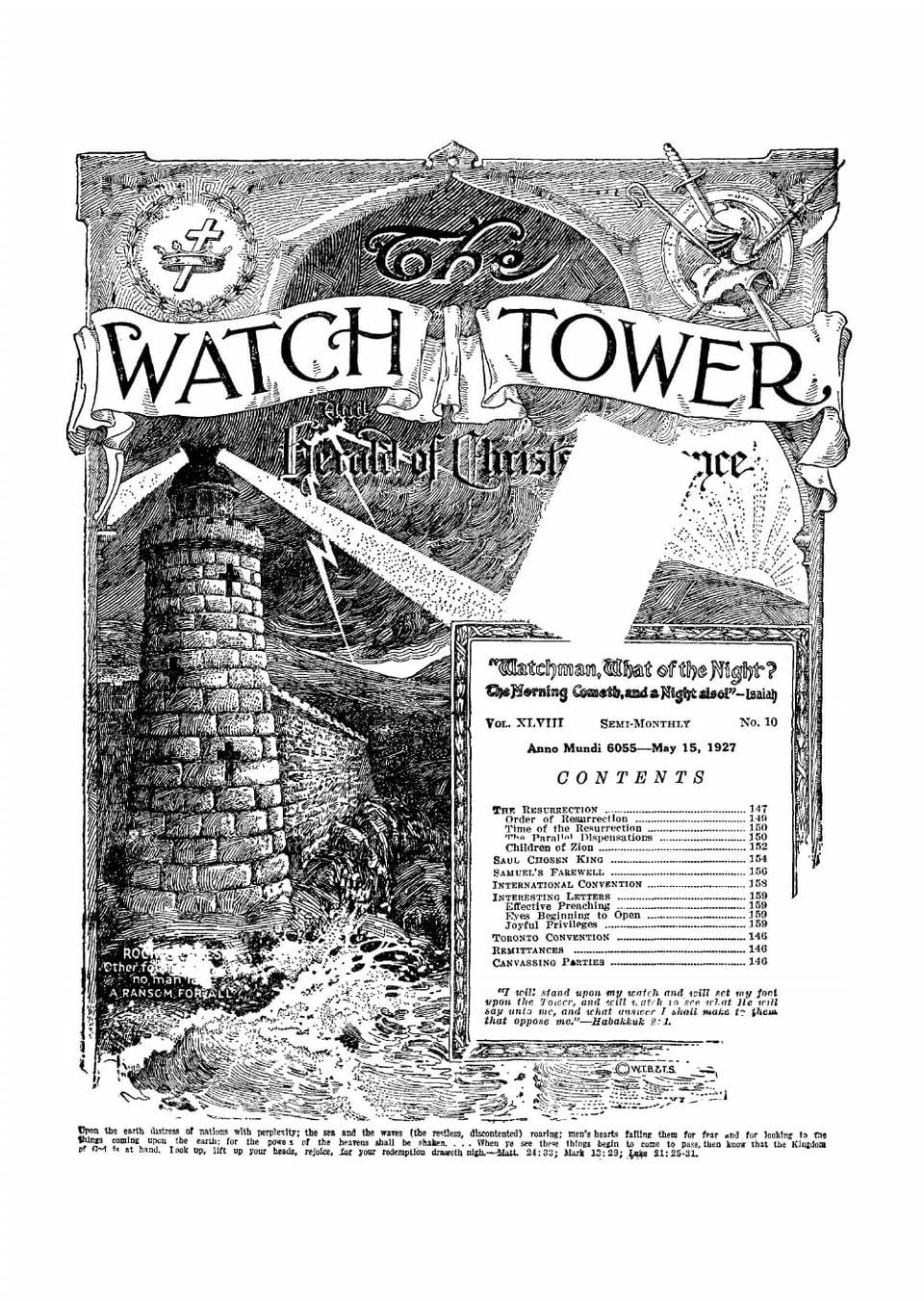
WATCH TOWER
The Herald of Christ's Presence
"Watchman, What of the Night? The Morning Cometh, and a Night also!"—Isaiah
VOL. XLVIII SEMI-MONTHLY No. 10
Anno Mundi 6055—May 15, 1927
CONTENTS
THE RESURRECTION .................................................. 147
Order of Resurrection ............................................. 148
Time of the Resurrection ......................................... 150
Three Parallel Dispensations ................................. 150
Children of Zion ..................................................... 152
SAUL, CHOSEN KING ............................................... 154
SAMUEL'S FAREWELL ............................................. 156
INTERNATIONAL CONVENTION ................................... 158
INTERESTING LETTERS ............................................. 159
Electoral Privileges ............................................... 159
New Beginning to Open .......................................... 159
Joyful Privileges ................................................... 159
TORONTO CONVENTION .......................................... 146
REMITTANCES ........................................................ 146
CANVASSING PARTIES .............................................. 146
"I will stand upon my watch and will set my fort upon the Tower, and will watch to see what He will say unto me, and what answer I shall make to them that oppose me."—Habakkuk 2:1.
Upon the earth distress of nations with perplexity; the sea and the waves (the restless, disconsolate) roaring; men's hearts failing them for fear and for looking to the things coming upon the earth; for the powers of heaven were shaken. When ye see these things come to pass, then know that the Kingdom of God is at hand. Look up, lift up your heads, rejoice, for your redemption draweth nigh.—Matt. 24:36; Mark 13:28; Luke 21:25-31.
THIS JOURNAL AND ITS SACRED MISSION
This journal is published by the WATCH TOWER BIBLE AND TRACT SOCIETY for the purpose of aiding the people to understand the divine plan. It provides systematic Bible study in which all its readers may regularly engage. It gives announcement of the visits made to Bible classes by traveling speakers, announces conventions, and gives the reports thereof. The International Sunday School lessons are treated in harmony with the Scriptures.
It adheres strictly to the Bible as God's revealed Word of Truth. It stands firmly upon the great ransom sacrifice as the fundamental doctrine by which all doctrines are measured. It is free from parties, sects, and creeds of men. It does not assume a dogmatic attitude, but confidently invites a careful examination of its utterances in the light of the Infallible Word of God. It does not indulge in controversies, and its columns are not open to personalities.
TO US THE SCRIPTURES CLEARLY TEACH
THAT JEHOVAH is the only true God, the Maker of heaven and earth, and is from everlasting to everlasting; that the Logos was the beginning of his creation; that the Logos became a man; that he is now the Lord Jesus Christ in glory, clothed with all power in heaven and earth.
THAT GOD created the earth for man, created perfect man for the earth and placed him upon it; that man willfully disobeyed God's law and was sentenced to death; that by reason of Adam's wrongful act all men are born sinners and without the right to life.
THAT JESUS was made a human being in order that he might become the Redeemer of man; that he gave his life a sacrifice that might thereby produce the ransom price; that Jesus the divine arose from the dead, ascended into heaven, and presented the value of his human sacrifice as the redemptive price for man.
THAT for many centuries God, through Christ, has been selecting from amongst men the members of his church, which constitutes the body of Christ; that the mission of the church is to follow in the footsteps of her Lord Christ Jesus, grow in his likeness, give testimony to the name and plan of Jehovah God, and ultimately be glorified with Christ Jesus in his heavenly kingdom; that Christ, Head and body, constitutes the "seed of Abraham" through which all the families of the earth shall be blessed.
THAT THE WORLD HAS ENDED; that the Lord Jesus has returned and is now present; that Jehovah has placed Christ Jesus upon his throne and now commands all nations and peoples to hear and obey him.
THAT THE HOPE of the peoples of earth is restoration to human perfection during the reign of Christ; that the reign of Christ will afford opportunity to every man to have a fair trial for life and those who obey will live on earth for ever in a state of happiness.
PUBLISHED BY
117 ADAMS STREET . . . BROOKLYN, N.Y. U.S.A.
OFFICERS
J. F. RUTHERFORD President
W. E. VAN AMBURGH Secy & Treas.
YEARLY SUBSCRIPTION PRICE: UNITED STATES 1.00. CANADA AND MEXICO1.25. FOREIGN $1.50; GREAT BRITAIN, AUSTRALIA, AND SOUTH AFRICA, 7s. American remittances should be made by Express or Postal Money Orders, or by Bank Draft. Canadian, British, South African, and Australian remittances should be made by branch offices only. Remittances from scattered foreign territory may be made at the Brooklyn office, but by International Postal Money Orders only.
(Foreign translations of this journal appear in several languages.)
TERMS TO THE LORD'S POOR: All Bible Students who, by reason of old age or other infirmity or adversity, are unable to pay for this Journal, will be supplied free if they send a postal card each May stating their case and requesting such provision. We are not only interested in helping the poor but wish our list continually and in touch with the Heretic studies.
Notice to Subscribers: We do not, as a rule, send a card of acknowledgment for a renewal or for a new subscription. A renewal blank (carrying notice of expiration) will be sent with the journal one month before the date of the expiration. Changes of address, when requested, may be expected to appear on address label within one month.
Entered as Second Class Mail Matter at Brooklyn, N. Y. Postoffice. Act of March 3rd, 1879.
TORONTO CONVENTION
If the Lord opens the way for you to attend the convention this year, do so. It will be a blessing to you. (Hebrews 10:25) To go may entail upon you some financial burden, but the Lord will make it up to you in some other way.
The brethren are coming from many parts of the earth. You will be glad to see and encourage one another. You will be better equipped for the service in the days that are to follow. There will not be many more conventions on earth. Each one further prepares the anointed for the general assembly of the first-born. Arrange your vacations suitable to attend the Toronto convention July 18th to 26th.
For rooming accommodations address the Convention Committee, 38-40 Irwin Ave., Toronto 5, Ontario, Canada.
EDITORIAL COMMITTEE
J. F. RUTHERFORD
W. E. VAN AMBURGH J. HEMERY R. H. BARBER E. J. COWARD
FOREIGN OFFICES: British: 34 Craver Terrace, Lancaster Gate, London W. 2; Canadian: 38-40 Irwin Avenue, Toronto, Ontario; Australasian: 495 Collins St, Melbourne, Australia; South Africa: 6 Lele St., Cape Town, South Africa. Please address the SOCIETY in every case.
REMITTANCES
For the benefit of our readers attention is again called to the fact that all remittances to the SOCIETY should be made by draft on New York or by postal money order. Currency sent in envelopes not registered is often lost. Make all drafts and money orders payable to the WATCH TOWER BIBLE & TRACT SOCIETY.
CANVASSING PARTIES
All canvassing parties and all individuals who canvass should mention the radio station in that vicinity that is broadcasting the truth. This often proves a means of opening the way to place the books into the hands of the people. Have it in mind that the chief purpose of the radio is to call the people's attention to the truth, and then furnish the opportunity for them to get a wider understanding of the truth by reading what is being printed.
BETHEL HYMNS FOR JUNE
Sunday
5 280
12 58
19 204
26 18
Monday
6 148
13 73
20 74
27 216
Tuesday
7 125
14 235
21 88
28 111
Wednesday
1 115
8 24
15 81
22 316
29 268
Thursday
2 287
9 195
16 36
23 223
30 238
Friday
3 270
17 333
Saturday
4 371
11 72
IBSA. BEREAN BIBLE STUDIES
By Means of "The Watch Tower"
"The Son and Servant" "Servant—Good and Evil"
Z February 1, 1927 Z February 15, 1927
Week of June 5...1 125 Week of June 19...1 1-32
The WATCH TOWER
AND HERALD OF CHRIST'S PRESENCE
Vol. XLVIII MAY 15, 1927 No. 10
THE RESURRECTION
"Blessed and holy is he that hath part in the first resurrection: on such the second death hath no power, but they shall be priests of God and of Christ, and shall reign with him a thousand years."—Revelation 20: 6.
RESURRECTION means "standing up again; being raised again to life". It is the very antithesis of death, because it means recovery out of death. The use of the word the emphatically in connection with the resurrection means the chief resurrection or that resurrection which is of greatest importance. The phrase "the first resurrection", used in the above text, means that it is first in importance and also first in time. The inference to be drawn therefrom of course is that there is a resurrection subsequent and to some degree less in importance than that which relates to the first.
THE FACT
2 Is it true that the dead are raised up again to life? Satan the adversary says it is not true. The clergy of the church systems say it is not true. God says it is true. All of God's faithful witnesses say it is true. Of course there are many agnostics, but the time comes when every one must believe it is true or not true. Proof is required, and God has provided in His Word an abundance of competent evidence by which the proof is made.
3 It is manifest that there could be no resurrection of the creature unless that creature first dies. If there is no death, then a resurrection would be not only useless but impossible. Immortality means that which is not subject to death. An immortal creature cannot die. At this time the clergy are especially emphasizing the statement that all men are immortal souls or that every man possesses an immortal soul. By their statement they deny the resurrection of the dead. Their conclusion finds support only in what Satan the Devil has said.—Genesis 3: 4.
4 For a long period of time the people have looked upon the clergy as the ones who speak with authority in matters of religion. Therefore the people have been led to believe that every man is an immortal soul or has an immortal soul. Such belief nullifies the doctrine of the resurrection of the dead. The mass of mankind believe the false doctrines because they do not know God and they do not know his Word.
5 It is the privilege, yea, the happy duty, of every true Christian to be a faithful witness for God and to tell the people the truth. To tell the people the truth one must know what is the truth. This is the time to know the truth, and there never has been a time more important for telling the truth. Everyone who has the spirit of the Master will now be using his or her opportunities to make known the truth of God's plan to others.
6 The law of God is his will, expressed or unexpressed. To Adam he made known his will when he said: "In the day that thou eatest thereof, dying thou shalt die." When man had broken the law God pronounced upon him the sentence of death. Satan said: "Ye shall surely not die." That is equivalent to saying: 'There is no death.' For a long time the clergy have been saying the same thing. Jesus said that Satan is a liar and the father of lies. By adopting Satan's lie and denying God's truth the clergy have taken their place on the side of Satan. They do the will of their father, even as Jesus said.—John 8: 44.
7 It has ever been the policy of Satan their father to deny the resurrection of the dead, and his purpose in so doing has been and is to turn the people away from Jehovah. He continues to use his visible instruments to the same end. Through his holy prophets God had taught the Jews that the dead would be brought back from the land of the enemy and placed in their former estate. Those prophecies had reference to the resurrection of the dead. (Jeremiah 31: 15-17; Ezekiel 16: 53-55) Not many of the Jews however believed in the resurrection of the dead.—Luke 20: 27; Acts 23: 8.
8 To the fact of the resurrection of the dead Jesus gave convincing testimony. His testimony consisted both of his spoken words and of his actions. He called Lazarus forth from the grave, but he did not resurrect Lazarus. He awakened Lazarus out of the sleep of death; which illustrates how, as the great Executive Officer of Jehovah, he will call forth all the dead from the tomb in due time. Later Lazarus died, and in God's due time he will participate in the resurrection. To Martha Jesus said: "I am the resurrection, and the life." (John 11: 25) By that he meant that God has provided for the resurrection of the dead from the condition of death, and that Jesus Christ is God's chosen means whereby he will accomplish that great work.
Jesus further testified that the time would come in which all in their graves shall be awakened out of death.—John 5:28, 29.
9 While hanging on the cross Jesus died. That was not a sham death but a reality. It was the soul that died. (Isaiah 53:10) Had Jesus been inherently immortal or possessed an immortal soul he could not have died. He was made a mortal man in order that he might die and by his death provide the redemptive price for the human race. (John 1:14; Hebrews 2:9) He gave his life by being put to death as a ransom for man, to the end that man may live. (Matthew 20:28; John 10:10) The soul Jesus went to hell, which is the grave. God had foretold that fact when he caused his prophet to write concerning Jesus: "For thou wilt not leave my soul in hell; neither wilt thou suffer thine Holy One to see corruption. Thou wilt shew me the path of life: in thy presence is fulness of joy; at thy right hand there are pleasures for evermore." (Psalm 16:10, 11) "He seeing this before spake of the resurrection of Christ, that his soul was not left in hell, neither his flesh did see corruption."—Acts 2:31.
10 Before Jesus' death God had promised Jesus that he would give him life inherent, or immortality, as a reward for his faithfulness. Jesus was faithful and true even under the greatest difficulties; and God, true to his promise, raised him up out of death to the highest position in his great realm. (Acts 2:32; Philippians 2:7-10) Concerning his death and his resurrection to immortality Jesus said: "I am he that liveth, and was dead; and, behold, I am alive for evermore, Amen; and have the keys of hell and of death."—Revelation 1:18.
11 The foregoing statement of Jesus Christ is conclusive proof that Jesus was mortal and did not inherently possess immortality; that as a mortal man he died; that God raised him up out of death and gave him life inherent, which is immortality; that he is alive for evermore, and that never again can death have any power over him. He is the head of the class who enjoy the blessings of the first resurrection, as mentioned in the first above text, and shall for ever live. Those who insist on teaching the doctrine of the immortality of all souls deny the death of Jesus and deny his resurrection, and therefore deny the resurrection of all the dead.—1 Corinthians 15:14-23.
12 When God raised up Jesus out of death he provided proof abundantly of the fact thereof in order that everyone who believes in the resurrection might have his faith completely established. Of course Satan tried to destroy this great truth and take it out of the minds of men. He caused the Jewish clergy to deny the resurrection. He even blinded Saul of Tarsus for a time as to the true import of the resurrection. When, however, Saul learned the truth and had his understanding illuminated, and God changed his name to Paul, he became the strongest witness in the name of God concerning the resurrection of Jesus Christ.
13 As relating to the resurrection Paul testified: "For I delivered unto you first of all that which I also received, how that Christ died for our sins according to the scriptures; and that he was buried, and that he rose again the third day according to the scriptures; and that he was seen of Cephas, then of the twelve: after that, he was seen of above five hundred brethren at once; of whom the greater part remain unto this present, but some are fallen asleep. After that, he was seen of James; then of all the apostles. And last of all he was seen of me also, as of one born out of due time."—1 Corinthians 15:3-8.
14 There is no part of the divine plan of more importance than the resurrection of the dead. It is evident that that is the reason why Satan so desperately attempts to keep the people in ignorance concerning the resurrection. Of course the ransom sacrifice is the great pivotal truth around which the plan of salvation is gathered, but if there were no resurrection of the dead the fact that the ransom sacrifice is provided would be of no value to those who have died. The fact of the resurrection of Jesus Christ should put to silence those who deny the resurrection. Satan has always been able, however, to keep his witnesses to the fore, and these have fraudulently claimed to represent the Lord and at the same time have denied the resurrection of the dead. It was so in the days of the apostles. The same condition exists today.
15 Now while the so-called famous preachers of the world are denying the resurrection it becomes the duty of every Christian to call attention to this great truth. The resurrection of Jesus was a complete guarantee that the dead shall be raised up. To this end the argument of the apostle is: "Now if Christ be preached that he rose from the dead, how say some among you that there is no resurrection of the dead? But if there be no resurrection of the dead, then is Christ not risen. And if Christ be not risen, then is our preaching vain, and your faith is also vain. Yea, and we are found false witnesses of God; because we have testified of God that he raised up Christ: whom he raised not up, if so be that the dead rise not. For if the dead rise not, then is not Christ raised: and if Christ be not raised, your faith is vain; ye are yet in your sins. Then they also which are fallen asleep in Christ are perished."—1 Corinthians 15:12-18.
16 The resurrection of Jesus Christ was of itself substantial and complete proof upon which to base the faith of man in the doctrine of the resurrection. The apostle declares that God has appointed a day in which all men shall have an opportunity to know and obey the truth and obtain life, and that of that fact God has given assurance by reason of the resurrection of Jesus Christ from the dead. (Acts 17:31) In that day both the just and the unjust shall be awakened out of death.
(Acts 24:15) In corroboration of this, Jesus declared that all in their graves shall hear his voice and come forth—one part to an instantaneous resurrection, and another class to a trial which will afford them an opportunity for being completely raised up out of death and given life everlasting.
ORDER OF RESURRECTION
17 When Jesus was on earth no one had been resurrected. He stated that at that time no one had ascended into heaven. (John 3:13) Later the Apostle Paul, as God's witness, gave testimony to the same effect. "But now is Christ risen from the dead, and become the firstfruits of them that slept." (1 Corinthians 15:20) This proves that Christ is the resurrection (John 11:25), that he is the beginning of the resurrection, and that aside from him there could be no resurrection, because such is the plan of God. Then that the fact of the resurrection of Christ Jesus is a guarantee that all shall have an opportunity for life, the apostle wrote: "For since by man came death, by man came also the resurrection of the dead. For as in Adam all die, even so in Christ shall all be made alive. But every man in his own order; Christ the firstfruits; afterward they that are Christ's, at his coming."—1 Cor. 15:21-23.
18 Christ means the Anointed of God. The Christ is composed of Jesus the Head and his body members which are the church. (Colossians 1:18, 24; Ephesians 1:22, 23) These scriptures prove that Christ is the beginning of the resurrection, that his resurrection precedes all others and is first in importance as well as first in point of time. It is manifest therefore that all who have a part in the first resurrection must be in Christ and therefore a part of Christ. To be in Christ means that one must be begotten to the divine nature and anointed by the spirit of Jehovah, and thereby adopted into the body of Christ.
19 The Scriptures are explicit as to the conditions that must be met and performed by all who will ever participate in the first resurrection. To merely profess to be a Christian will not suffice. One must make a full consecration; that consecration must be accepted, followed by justification by Jehovah; the one justified must be accepted by Jehovah as a part of the sacrifice of Christ Jesus, then begotten to the divine nature, called to the heavenly calling, and from that time enter upon his trial or test. He must be baptized into Christ's death by the sacrifice of his right to live as a human being, which right resulted by reason of his justification. He must become dead with Christ in order to live with him. Only those who are baptized into Christ's death can possibly partake of the first resurrection.
20 From Jehovah's side of the covenant the Christian is counted dead as a man from the time he is begotten of the holy spirit. The one thus begotten must finish his contract or covenant in actual death and there be actually baptized into the death of Christ Jesus. Such is the testimony of the apostle. "Know ye not, that so many of us as were baptized into Jesus Christ were baptized into his death? Therefore we are buried with him by baptism into death; that like as Christ was raised up from the dead by the glory of the Father, even so we also should walk in newness of life. For if we have been planted together in the likeness of his death, we shall be also in the likeness of his resurrection,"—Romans 6:3-5.
21 The Christian at the time of his consecration enters into a covenant with Jehovah. This is called a covenant by sacrifice and must be fully performed. The importance of the performance of that covenant is stressed by the apostle when he wrote: "Yea, doubtless, and I count all things but loss, for the excellency of the knowledge of Christ Jesus my Lord: for whom I have suffered the loss of all things, and do count them but dung, that I may win Christ, and be found in him, not having mine own righteousness, which is of the law, but that which is through the faith of Christ, the righteousness which is of God by faith: that I may know him, and the power of his resurrection, and the fellowship of his sufferings, being made conformable unto his death; if by any means I might attain unto the resurrection of the dead."—Philippians 3:8-11.
22 The apostle was determined that nothing should stand in the way of his full performance of his part of the covenant in order that he might partake of the resurrection of the dead. To this end he put everything else in the background and pressed forward that he might attain unto the prize. He was not willing to take any chance by being active for a time and then to rest upon what he had done, but he realized that he must continue faithful even unto death. There is a temptation to become weary in the service of the Lord, and for one to think that he has done enough; but such a one should remember that the Christian reaps in due time provided he does not relax in the performance of his covenant. (Galatians 6:9) The faithfulness of the new creature must continue even unto death if he would receive the crown of life, which means to participate in the first resurrection.—Revelation 2:10.
23 "Blessed and holy is he that hath part in the first resurrection." (Revelation 20:6) That means that such an one is wholly devoted to the Lord, and that his condition is happy because thereof; but this condition must continue unto the end of his earthly journey if he would participate in the first resurrection. The whole or complete devotion to the Lord cannot begin after one reaches the heavenly realm; there must be a complete devotion to God while the Christian is on the earth. It is only these who are granted the prize of immortality.
24 Since Christ means The Anointed, and is composed of the Head Christ Jesus and the many members of his body, it follows that the first resurrection, which had its beginning when God raised up Jesus out of death, will be completed only when every member of the body of Christ has been raised to glory and immortality.
And the completion of the resurrection of the Christ, as appears from the Scriptures, must precede the resurrection of all others. Of course God could exercise his power and raise those faithful witnesses, mentioned by the Apostle Paul in Hebrews the eleventh chapter, before the completion of The Christ; but that does not seem to be the order as outlined by the Scriptures. There hardly seems to be any reason to expect the ancient worthies to be resurrected until the last member of the body of Christ has been taken from earth to heaven.
25 At Pentecost the selection and begetting of the body of Christ began. Thereafter as each Christian finished his course, full in the faith, he went into the grave to await the Lord's time for the resurrection. Concerning this it is written: "Henceforth there is laid up for me a crown of righteousness, which the Lord, the righteous judge, shall give me at that day: and not to me only, but unto all them also that love his appearing." (2 Timothy 4:8) "That day," as used in this text, must mean the time when the Lord resurrects those saints who have been asleep in Christ Jesus, waiting for his appearing.
26 When the apostle wrote to the Philippians he had not then fulfilled his mission, but he was pressing on with zeal to complete his covenant. The one thing which he was making paramount to all other things was the gaining of the prize of immortality. To do this he stated that he was forgetting the things which he had left behind and, looking to those things which were before, he pressed forward in doing this one thing. The apostle loved all his brethren, and it was his desire that those who have been begotten of the holy spirit should win a prize like himself; therefore he wrote them beseeching words, encouraging them to render unto God their reasonable service in the performance of their covenant.—Romans 12:1.
27 At the time Paul wrote to Timothy his work was done. He was satisfied that he had been faithful. He had the testimony of the Lord that he had been true and had performed his covenant. He was ready to depart. His great desire, as he expressed it, had been and was at that time, that he might participate in the resurrection of Christ. Now he knew that he must die and wait until "that day" when the Lord would call him forth from the state of death and give him a crown of righteousness. That crown would be life on the highest plane. Then he would be victorious. Then he would put on immortality. He would then gain the victory over death and the grave, because no more should death have power over him.
28 Then, as he had written to the Corinthians, Paul could say: "O death, where is thy sting? O grave, where is thy victory?" The Lord had illuminated the apostle's mind and had made it clear to him at that time that he would triumph over death and the grave; and that that time would come in the future, when not only would the apostle triumph but all others of the saints who were sleeping in death would likewise be awakened and given the crown of life; that is to say, all of those saints who "love his appearing".
29 The apostle does not say that all who would be expecting the second coming of the Lord, or all who would desire to see him come, would receive the crown of life by participating in the first resurrection, but those who "love his appearing"; that is to say, those who would rejoice in the fact that the King has come and has taken unto himself his power and begun his reign. It follows then that all such who love the outward manifestation of the Lord's presence would prove their love by keeping his commandments. The time of the resurrection of the sleeping saints is the question we now desire to find answered in the Scriptures.
THE PARALLEL DISPENSATIONS
30 For many years Bible Students have held that the resurrection of the apostles and other faithful saints who slept in Jesus occurred in the spring of 1878. The chief support for this conclusion has been and is the parallel dispensations. The following quotation is pertinent to the question here under consideration:
31 To learn the date at which our Lord began the exercise of his power would therefore be to discover the time when his sleeping saints were awakened to life and glory. And to do this we have but to recall the parallelism of the Jewish and Gospel dispensations. Looking back to the type, we see that in the spring of A. D. 33, three and a half years after the beginning of the Jewish harvest (A. D. 29), our Lord typically took unto himself his power and exercised kingly authority. (See Matthew 21:5-15.) And evidently the only object of that action was to mark a parallel point of time in this harvest, when he would in reality assume the kingly office, power, etc.; viz., in the spring of 1878, three and a half years after his second advent at the beginning of the harvest period, in the fall of 1874. The year 1878 being thus indicated as the date when the Lord began to take unto himself his great power, it is reasonable to conclude that there the setting up of his kingdom began, the first step of which would be the deliverance of his body, the church, among whom the sleeping members are to take precedence.
32 And since the resurrection of the church must occur some time during this "end" or "harvest" period (Revelation 11:18), we hold that it is a most reasonable inference, and one in perfect harmony with all the Lord's plan, that in the spring of 1878 all the holy apostles and other "overcomers" of the Gospel Age who slept in Jesus were raised spirit beings, like unto their Lord and Master."—Vol. III, pages 233, 234.
33 The gist of the argument in the paragraphs above quoted is that three and one-half years after the Lord began his ministry he began to exercise kingly authority; that his second presence began in 1874, and that three and one-half years thereafter, to wit 1878, he took his power and began to reign as King; and that therefore he would resurrect at that time the faithful members of his body who had been dead.
34 A reexamination of the parallels may be of profit at this time. That which transpired concerning the nation of Israel was in the nature of a picture and foreshadowed other things of reality relating to the true followers of Christ Jesus. "Now all these things happened unto them for ensamples: and they are written for our admonition, upon whom the ends of the world are come." (1 Corinthians 10:11) By this scripture we understand that the events transpiring with Israel resembled or foreshadowed what would come to pass in the future in relation to Christians. (Hebrews 10:1) If there be a parallel as to the events that transpired, then it is reasonable that there is a parallel as to the time of the happening of those events.
35 Upon this point God's prophet wrote that the Lord would cast off the Jews for a time and that then he would bring them again unto his favor. The prophet then adds: "And first I will recompense their iniquity and their sin double." (Jeremiah 16:18) The word "double" here used means duplication or repetition, and strongly supports the conclusion that it refers to a double as to time. It is quite manifest that the events that transpired with natural Israel foreshadowed other and more important events to transpire later, and that there is a parallel as to time; but whether these events have any bearing upon the resurrection of the sleeping saints is another question.
36 Israel as an organized people had its beginning at the death of Jacob, to wit, B. C. 1813. Jesus, as the Executive Officer of Jehovah, pronounced the decree rejecting Israel in the spring of A. D. 33, when he said: "Behold, your house is left unto you desolate." (Matthew 23:38) The enforcement of that divine decree began that day, and its enforcement continued over a period of forty years and ended in the spring of the year A. D. 73. Numerous historians fix this date.
37 On the 15th day of Nisan, i. e., of April, in the year 73 A. D., the first day of the Easter [or Passover] festival, the same day on which, according to tradition, the God of Israel had led his people out of Egyptian bondage into freedom, the last bulwark of Israel's liberty had fallen, and Israel was delivered into bondage.—Cornil's History of the People of Israel.
38 From the organization of the nation to the time of the pronouncement of the decree of rejection was 1815 years, and the period of the enforcement of the decree was forty years more. It follows then that the "double" mentioned by the prophet must begin to count on the day that Jesus declared the decree of rejection, to wit, A. D. 33. Of course 1845 years from that date ends in 1878 A. D., which date should mark something concerning Israel; and forty years later, to wit 1918, should also mark the time of the manifestation of something of importance. Naturally then we look for the physical facts that may be taken as a fulfillment of these prophecies. What are the physical facts in support of the dates?
39 The Berlin Congress was held in June, 1878, at which time a provision was put in force looking to the establishment of the civil and religious rights of the Jews in Palestine. Arrangement for this congress was made some time prior thereto, in the same year. It seems certain that there God began to show some signs of his returning favor to Israel. Forty years thereafter, to wit, in the spring of 1918, a Jewish commission, with the approval of the British Empire and other leading nations of the world, landed in Palestine and began the building of the Jewish State. What then do these parallels show? They seem to be clearly in fulfillment of the prophecy uttered by Jeremiah, that God would punish the Jews for the same period of time that he showed his favor toward them.
40 It seems impossible to find anything in these parallel events to indicate the resurrection of the sleeping saints in 1878. The only way to interpret prophecy, so far as we know, is by fitting the facts that are known to the words of the prophecy. The known facts that apply to 1878 relate only to the beginning of God's favor to the Jews and seem to have no reference to the church.
41 Again referring to the quotation from Volume III: The conclusion there reached, that the parallels bear upon the resurrection of the saints, results from the assumption that the Lord was supposed to have taken his power and begun his reign in 1878, and that therefore he would resurrect his saints at approximately the same time. But there is nothing to indicate that Jesus Christ took his power and began his reign in 1878. He could not consistently do so until the expiration of the Gentile Times, and the Gentile Times did not expire until 1914.
42 When Jesus was on earth Satan was "the god of this world". Satan also had access to heaven, because he was the invisible ruler of the earth as well as heavens relating to the earth, and must continue in this position until God's due time for Jesus to assume power and act. God does everything in due time. His statement was that the Gentile Times should continue until he "whose right it is" should come. The Gentile Times began 600 B. C., and must continue for 2520 years and therefore end in 1914; and until that time Jesus must wait. Upon this point the Scriptures are explicit. "But this man, after he had offered one sacrifice for sins for ever, sat down on the right hand of God; from henceforth expecting till his enemies be made his footstool." (Hebrews 10:12,13) To the same effect is Psa. 110:1.
43 During a part of that "period of waiting" the Lord was doing a preparatory work. Until the end of the Gentile Times Satan was in possession by God's permission. When that time expired it was due time for Jehovah to become active against him and for Jehovah, through Christ Jesus, to take possession and oust the Devil from heaven.
The clear statement of the prophecy is that God would make the enemy his footstool, and since the prophet declares that the earth is the footstool of Jehovah we must conclude that God would cast Satan out of heaven into the earth. The prophecy then says that when God's due time had arrived he sent forth his beloved Son to do the work of ousting the enemy, saying to him, "Rule thou in the midst of thine enemies."—Psalm 110:2.
44 In what capacity did Christ Jesus go forth to do this work? In the capacity of the great Priest or Executive Officer of Jehovah God, which Priest was foreshadowed by Melchizedek. It was God doing the ousting, exercising his power against Satan by and through his beloved One, his great Priest. Since all things are from Jehovah and by the Lord Jesus Christ, his Executive Officer, it is proper to say that it was God's fight against the Devil, by and through Christ Jesus. This is corroborated by the statement of Revelation 11:17: "We give thee thanks, O Lord God Almighty, which art, and wast, and art to come; because thou hast taken to thee thy great power, and hast reigned."
45 It pleased God to cause a prophetic statement to be recorded whereby the followers of Christ on earth could locate the time when he would begin action against the Devil, and the fulfillment of this prophecy shows that it took place in 1914. It is written in the Scriptures, as relating to the same time, that "the nations were angry". The Gentile Times ended in 1914, and the nations were then angry, and it was the Lord's due time to take possession and oust Satan. Seeing then that the Scriptures conclusively prove that the Lord Jesus Christ did not take his great power and begin his reign in 1878, but that he did so in 1914, it follows that the resurrection of the sleeping saints did not take place in 1878.
46 Referring again to Revelation 20:6, it is stated that these blessed ones who participate in the first resurrection are made priests unto God and unto Christ. If they were resurrected before 1914 then they became an active part of the great Melchizedek priesthood prior to 1914; whereas the proof shows that Christ Jesus, as the Head of that priesthood, began his action against Satan after the Gentile Times ended, to wit, 1914. It does not therefore seem reasonable that these saints would be resurrected to the office of priesthood prior to the time that the Lord would begin the exercise of his priestly office against the enemy.
47 This text also says: "They shall reign with him a thousand years." It is manifest that the reign of Christ Jesus did not begin prior to 1914; and it is hardly reasonable to conclude that the saints would be resurrected to the position of kingship prior to the time that the Lord Jesus became active as against the enemy, as foreshadowed by the prophecy which began its fulfilment in 1914.
CHILDREN OF ZION
48 Zion means God's organization. Zion gives birth to the kingdom. She also gives birth to the members of the royal family. Jerusalem or Zion, which is above, is the mother of all the kingdom class. (Galatians 4:26) Does it necessarily follow that the sleeping saints would be resurrected simultaneously with the time when the Lord Jesus took his power and began his reign? Not necessarily. The weight of the evidence favors the conclusion that he first took his power, and that thereafter followed the resurrection of the sleeping saints. The words of Jehovah, through his prophet, are: "Before she travailed, she brought forth; before her pain came, she was delivered of a man child. Who hath heard such a thing? who hath seen such things? Shall the earth be made to bring forth in one day? or shall a nation be born at once? for as soon as Zion travailed, she brought forth her children?"—Isaiah 66:7, 8.
49 The woman referred to here is Zion, God's organization. The man child mentioned is the nation or government which shall rule the world in righteousness. That nation or righteous government rests upon the shoulder of Christ Jesus. "The government shall be upon his shoulder." (Isaiah 9:6) When Jesus was resurrected from the dead all power in heaven and earth was vested in him. The birth of the nation or kingdom would therefore mean that when God's time would arrive for Christ to function as King that would mark the birth of The Nation. A distinction must be made between the government, represented by the man child, and the individual members of The Christ.
50 It would not necessarily follow that the sleeping saints should be resurrected when the government is born, for the reason that the governing power rests upon Christ Jesus, and he could reign regardless of whether any members of his body were with him. It is a privilege for any of the body members to reign with the Head, but it is not a necessity. The scripture above quoted seems to indicate the following order, to wit: The birth of the man child, which is the government; then follows the period of pain or travail; and then the birth of the children of Zion. This is directly opposite to the natural birth, because in the natural birth the pain precedes the birth. Therefore the prophet asks: "Who hath heard such a thing? Shall a nation be born at once?" That is exactly what happened. The birth of the nation was instantaneous, while the birth of The Christ extends over a period of time.
51 When 1914 arrived, and the Gentiles Times ended and Jehovah's time had come to act, he sent forth his beloved Son; and that marked the beginning of the nation. The nation was born without pain and before travail. After the nation was born Christ goes forth to make war against Satan and to oust him from heaven.
That was the beginning of the controversy or travail. This fight must have been following 1914 or thereabouts. How long it lasted the Scriptures do not indicate. But the Scriptures do indicate that the fight had ended and Satan had been cast out of heaven before Zion gave birth to her children.
52 In Revelation 12:5 the statement is made: 'And she brought forth a man child, who was to rule all nations with a rod of iron; and her child was caught up unto God, and to his throne.' This is a description of the birth of the kingdom and not of the members of the body. Caught up to the throne of God would suggest the thought that the authority to rule proceeds from the throne of Jehovah, because it is time for Jehovah to act, as indicated in Revelation 11:17.
53 Then the account proceeds: 'And there was war in heaven: Michael and his angels fought against the dragon; and the dragon fought, and his angels.' (Revelation 12:7) In this fight between Christ on one side and the Devil on the other, Satan was cast out into the earth. The statement is that the angels fought with Michael. Who were the angels here mentioned? Are these angels children of Zion and part of the body of Christ? It seems that this question must be answered in the negative, for the reason that the children were brought forth after the angels participated in the fight. The battle took place, and then Zion gave birth to the children. The word here rendered angel means messenger. Now if the sleeping saints had been resurrected they would certainly be a part of The Christ, and not designated as angels of Christ.
54 At the time Jesus was unlawfully arrested by the agents of Satan, the clergy, Satan's agents, were then his visible angels on earth. Peter wanted to fight them. Jesus said to him: 'Thinkest thou that I cannot now pray to my Father, and he shall presently give me more than twelve legions of angels?' (Matthew 26:53) The word presently means now. So Jesus' words meant this: 'Peter, if I ask my Father he will now give me twelve legions of angels and more, to fight in my behalf.' That being true even before the death and resurrection of our Lord, it is entirely consistent that these same holy angels would participate with him in the great battle when the time came to fight.
55 It would seem then that Christ Jesus warred against the Devil, and that the holy angels assigned to him were with him in that fight; and when the fight was over then Zion brought forth her children. That would indicate that the resurrection of the saints was some time after 1914. Certainly the strong inference to be drawn from these scriptures is that the birth of the children of Zion, to wit, the resurrection of the sleeping saints, would not take place until after Satan is cast out of heaven.
56 There is a number of other scriptures bearing upon the question which should be considered; and since the space in one issue of THE WATCH TOWER is not sufficient to discuss all these texts, the subject matter will be considered in a subsequent issue.
(To be continued)
QUESTIONS FOR BEREAN STUDY
What do the words "resurrection" and "first resurrection" mean? How do the clergy deny the resurrection of the dead? What is our privilege and duty? ¶ 1-5.
How and why did Satan contradict God in Eden, and with what result? How did Jesus testify of the resurrection? Does the soul die? Quote and explain Rev. 1:18. ¶ 6-11.
How and why did God specially provide for the establishment of our faith in the resurrection? What is the apostle's argument in 1 Corinthians 15:12-18? Will everybody be resurrected? ¶ 12-16.
How is Christ the resurrection? (John 11:25) Who only can have part in the first resurrection, and on what conditions? ¶ 17-20.
What determination did Paul express in Philippians 3:8-11, and what lesson should we learn therefrom? Explain the text, "Blessed and holy is he that hath part in the first resurrection." When does the first resurrection begin and end? ¶ 21-24.
Did Paul expect to participate in the first resurrection at his death? Did he know prior to death that he would be triumphant? Who else did he say would gain the crown of life? What does it mean to "love his appearing"? ¶ 25-29.
Why have Bible Students assumed that the resurrection of the sleeping saints took place in 1873? ¶ 30-33.
How does the Jewish Age parallel with the Gospel Age, and when did each part of the "double" begin and end? When was Israel rejected, and how long did it take to enforce the decree? What are the parallel dates and physical facts at this end of the age? ¶ 34-39.
Is there anything in the parallels to show the resurrection of anybody in 1873? Did our Lord take his power and begin his reign at that time? If not, why? ¶ 40-42.
What did Jesus do during his long period of waiting for his kingdom, and what did he do when that period expired? ¶ 43, 44.
When did Jesus begin action as the Melchizedek Priest and King, and how do we know? Can you name any reason why the sleeping saints should be raised up several years prior to the time for them to begin the exercise of their kingly and priestly office? ¶ 45-47.
What is Zion? Does she give birth to the kingdom or nation, and to her children, at one and the same time? Who is the man child, and when was he to be born? When was the travail to come? Who are Zion's children, and when were they to be brought forth? ¶ 48-52.
When was Revelation 12:5-7 to be fulfilled? How was the man child "caught up unto God, and to his throne"? Who are the "angels" of Michael and the "angels" of the dragon? Give Scriptural support for your answer. What reasonable inference should we now draw from the Scriptures concerning the time for the resurrection of the sleeping saints? ¶ 52-56.
More glorious still, as centuries roll,
Shall truth's fair banner be unfurled,
Until in strength, from pole to pole,
Its radiance shall o'erflow the world—
Flow to restore, but not destroy;
As when the cloudless lamp of day
Pours out its floods of light and joy,
And sweeps the lingering mists away.
SAUL CHOSEN KING
—JULY 3—1 SAMUEL 9 TO 11—
"What doth Jehovah require of thee, but to do justly, and to love kindness, and to walk humbly with thy God?"
—Micah 6:8.
Saul, the first king in Israel, may be said to be the outstanding Old Testament example of the man of great opportunities who fails to make good. There were, of course, other men in high places in Israel who not only failed to rise to their opportunities but who were profligate and sometimes were leaders of these people into indifference toward or even rebellion to their covenant with God; as, for example, Jeroboam, son of Nebat, who gained a permanent addition to his name as the man "who made Israel to sin." —1 Kings 14:16.
2 But Saul's record is not that of a man who led God's people astray; and in that sense he was not a bad leader of the people. His failures were more personal to himself. His is a record of lost personal opportunities, and there is no record in the Bible which is so pathetic in its story of possibilities and failure. He is an example of those who, moved by self-interest, are found unworthy and are put out of their position of responsibility. This study, indeed, is intended not as historical of the times of Saul, but rather of Saul himself—that help may be gained by means of the record of his privileges, his good service, and his mistakes—that we may learn thereby how to make straight paths for our feet.
3 The circumstances surrounding Saul's elevation to be king of Israel were as follows: When Saul first appeared amongst them they were almost at the lowest ebb in the tide of their national life. The terrible corruption of the priesthood by the sons of Eli, through which came the destruction of Shiloh, so that Israel had neither tabernacle nor priesthood nor tribal centre, coupled with the extreme oppression of the Philistines even to the extent of destroying the local village forges so that there was hardly a smith to be found who could turn a ploughshare, brought the people to despair.
4 It was then that God gave them Samuel and spoke to them by him. Their spirit revived; and Samuel, ever seeking in the interests of the people to know and to do the will of God, became of such great service to them that under his guidance and ministry they grew strong and for a time threw off the yoke which the Philistines had fastened so tightly upon them. Samuel not only aroused their national spirit but introduced a system of education, and also established a system of judicature.
5 Israel had suddenly grown up into self-consciousness as a people; and, realizing themselves, they wanted more than they had. They wished to be like their neighbors—Moab, Ammon, Edom and the Philistines. So they said that they wanted a leader to help them fight their battles. They had forgotten God. This request surprised and pained Samuel. He had labored to build up a structure and had accomplished his purpose; and now, despite the help this had brought and the settlement it had given them, they were not satisfied; they would use his work as a stepping stone to something which they thought would benefit them more. They were feeling their strength and wanted to develop it.
6 God comforted Samuel, telling him that the people were not rejecting him nor his work but were really rejecting God as their King. (1 Samuel 8:7) He told Samuel that he would give the people what they asked for, and Samuel was to expect guidance from God as to whom he should appoint as king. Saul was God's choice, not because he was the best man for the work but because God would meet the desire of the people. He was a modest man and evidently had in him the making of a good servant for the people. There seemed no forwardness in his disposition but rather a shyness; when the time came that he should be openly chosen by lot and be presented to the people, he hid himself.
7 Hitherto Saul seems to have been a worker on his father's land and to have been content. Without any kind of governmental training and entirely without experience, he was thus put into an altogether unexpected position of great responsibility which called for qualities of judgment which he had not developed. If he failed ultimately it might be said that it was because he lacked experience to guide him, and that little blame could be attached to his failure. But that is no answer in his case, for it leaves God out.
8 It is said that God gave Saul another heart. This does not mean, as evangelists have said, that Saul there and then was converted from a bad condition of heart; but rather that God now gave him a mind and heart for greater things than those which hitherto had necessarily occupied his mind. The sheep and goats and asses which had been his particular care were no longer such; the purely local interests of the little homestead gave place to the interests of a nation. In other words, his mind was no longer that of a farmer but had become that of a ruler, that he might be able to do his work of looking after the interests of God's people. God would not call a man to be made king who lacked ability to carry out the duties of the task, and then hold him responsible for failure.
9 This in a measure is comparable to the position of the Christian. By nature he has been ruled by the ordinary passions of life; whether he be of low estate or whether he has attained to some measure of restraint, he is of himself unable to control and rule his spirit. No man can of himself overcome the will of the flesh.
But God gives his holy spirit to everyone accepted in Christ, and the necessity of walking according to the will of God becomes imperative. Like Saul his mind is turned, he becomes transformed; and to enable him to do the will of God, God gives him the holy spirit with all its power to rule his own spirit and overcome every opposition within or without.
10 Saul was not acceptable to everyone in Israel; for some said, "How shall this man save us?" They saw in him only one who hitherto had received no training other than that which his father's farm had given him, and they saw no reason for thinking that he could guide them in the affairs of the nation. These grumblers, like all others from that time till now, failed to see that such appointments are of God; and that if God chooses a man for a work for his people he will, so long as that man is willing to be used of God, give him ability to do it. Such see only the human side and do not consider the divine.—See Romans 12:3; Ephesians 4:7.
11 Saul's magnanimity toward the complainers and those who withheld seasonable presents for him, and who thus failed to acknowledge that he was the Lord's anointed, is commendable. The new king held his peace; he was as though he were deaf. (1 Samuel 10:27, margin) Than sneers there were few things harder to bear; but certainly sneering is most dangerous to those who indulge in it. It hurts the spirit as surely as it disfigures the face.
12 There came times later when Saul proved his worth and vindicated God's action in making him king. There is, however, an important lesson to note in this, namely, that it does not necessarily follow that because God appointed Saul to be king in Israel Saul was the one whom God would have given had the people not been wilful. God gave the people such a king as pleased them; yet it must be understood that God's will might have been worked out by Saul had the latter fully cooperated with Jehovah.
13 Saul's action in hiding himself while the lot was being cast by which God would indicate to the people who was to be king, thus relieving Samuel of any possible charge of partiality, throws an illuminating sidelight on the man. His unusual height of stature made him conspicuous, especially in the company of others, and made him somewhat self-conscious. But perhaps there was less of modesty in this man than at first appears; certainly the effect of his action resulted in a much more impressive and glorifying scene as he was dramatically brought from his hiding place with the eyes of the expectant people upon him than if he had merely been called out from where his family stood. It would have been more modest not to have hidden and thus assume that he would be chosen, but to have waited till the lot called for him. This may be said to be the first of that series of wilful acts which ultimately spoiled his life.
14 As Saul was brought before the people Samuel the judge said, "See ye him whom the Lord hath chosen, that there is none like him among all the people?" (1 Samuel 10:24) Samuel could not mean that there was no man so worthy as Saul among all the people, but none who came so near the ideal that the people had set before them; and the people with acclamation cried, "God save the king." Forthwith Samuel, who had been instrumental in giving the people educational facilities and had again set the law in active operation throughout the land, now wrote out a constitution for the kingdom, which King Saul accepted. Samuel, now a kingmaker, was one of the most remarkable men which that remarkable people produced.
15 Besides the lessons which may be taken as personal to every follower of Christ, and also those which are intended for the communities of saints, there is in these simple records of the past that which is of the nature of prophecy; for these incidents are illustrative or typical. Saul represents that great class who in "Christian" days have been elevated to service, but who have misused their privileges.
16 The clergy class started in the church with every opportunity of serving God and their fellows, but they developed into false stewards. Through wilfulness, following in the way of Saul their prototype, they have become perverters of the people, self-seekers rather than seekers of the good of the people and the honor of God; and the people who have supported them have been like Israel, who wanted a king whom they could see rather than have to think of their invisible King, Jehovah. It is easier for a man not quickened in the spirit to trust to something which organized religion gives than to dwell in a community of brethren such as the churches of God were intended to be—small, insignificant, unknown to the world. The churches have wanted to be like the nations, and they have gained a great place amongst them; but only to their hurt. They have climbed to a position in the eyes of men, but they have lost the favor of God.
QUESTIONS FOR BEREAN STUDY
How does the case of King Saul differ from that of other unworthy leaders of Israel? What was the condition of Israel when Saul became their king? What had Samuel done for the people up to that time? ¶ 1-4.
Why did the people want a king? How did Samuel regard their request, and what did the Lord then say unto him? Who was Saul, and why did the Lord allow him to be chosen? ¶ 5-7.
How did God give Saul another heart? How is this comparable to the experience of the Christian? ¶ 8, 9.
Why did some of the people object to Saul, and how did he deal with the complainers? Did Saul therefore fulfil God's purposes for him? ¶ 10-12.
Did Saul's action in hiding himself during the casting of the lots manifest humility? How did Samuel esteem and cooperate with the new king? ¶ 13, 14.
Who seems to be illustrated by Saul? Apply the picture. ¶ 15, 16.
SAMUEL'S FAREWELL
—JULY 10—1 SAMUEL 12—
"Thy lovingkindness is before mine eyes; and I have walked in thy truth."—Psalm 26:3.
THOUGH this lesson is named Samuel's farewell, because it is based upon his last address to all Israel, his service for his people was not at an end. His words were intended to be a reminder of Jehovah's faithfulness and, in a measure, a vindication of himself in reference to the people's request for a king and the resultant change in the form of their social order, which had now been granted to them.
…