The Watchtower, February 1, 1927
Download: PDF — The Watchtower, February 1, 1927
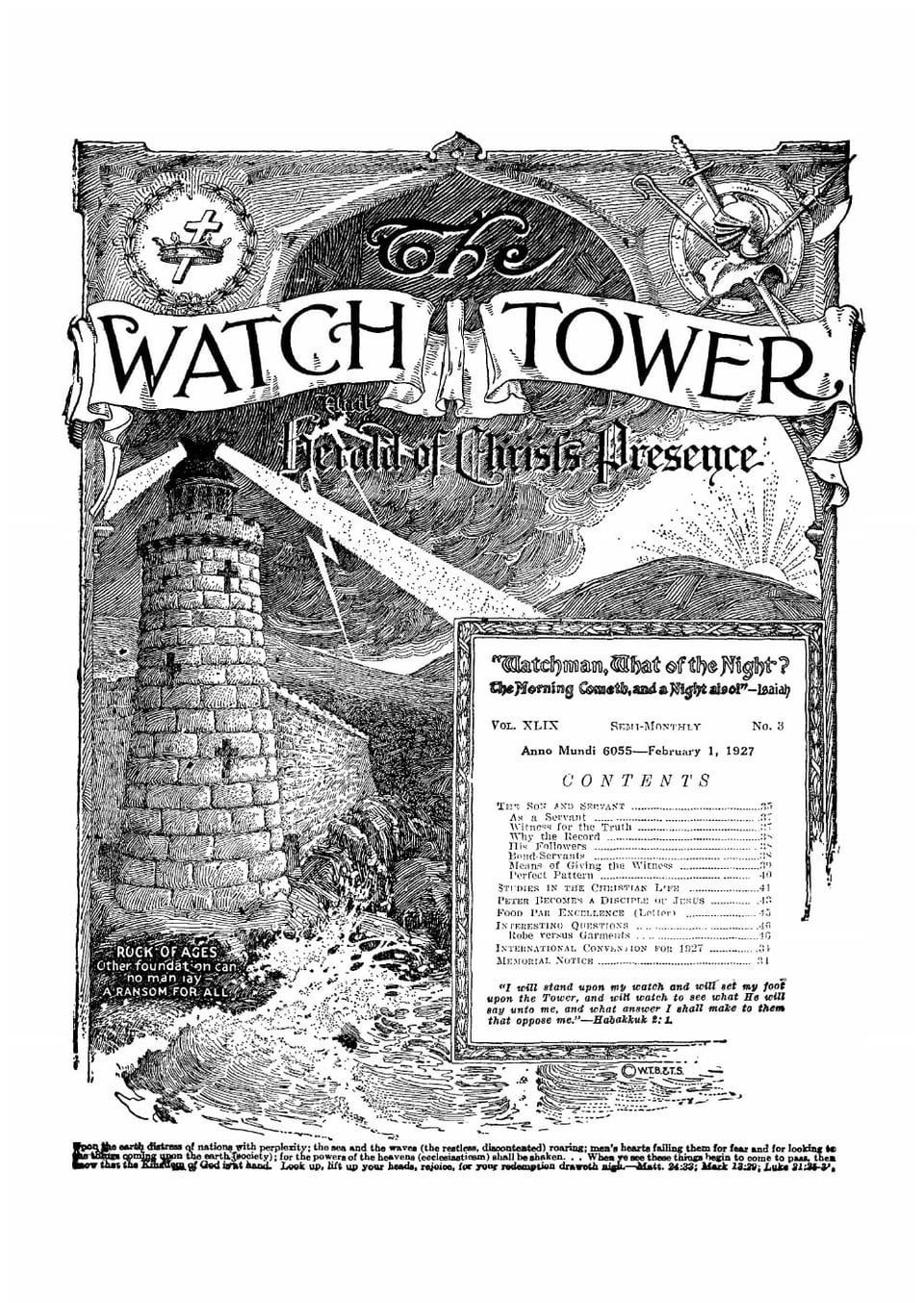
THE WATCH TOWER
Head of Christ's Presence
"Watchman, What of the Night?
The Morning Cometh, and a Night also!"—Isaiah
VOL. XLIX SEMI-MONTHLY No. 3
Anno Mundi 6055—February 1, 1927
CONTENTS
THE SON AND SERVANT .................................................. 35
As a Servant ................................................................. 37
Witness for the Truth ..................................................... 38
Why I am a Servant ...................................................... 39
His Followers ............................................................... 40
Bond-Servants .............................................................. 41
Means of Giving the Witness ........................................... 42
Portraits ................................................................. 43
STUDIES IN THE CHRISTIAN LIFE .................................... 44
PETER BECOMES A DISCIPLE OF JESUS ............................. 45
FOOD PAR EXCELLENCE (Letter) ..................................... 46
INTERESTING QUESTIONS ............................................... 47
Robe versus Garments .................................................. 48
INTERNATIONAL CONVENTION FOR 1927 ......................... 49
MEMORIAL NOTICE ....................................................... 51
"I will stand upon my watch and will set my foot upon the Tower, and will watch to see what He will say unto me, and what answer I shall make to them that oppose me."—Haggai 2:1
ROCK OF AGES
Other foundation can no man lay—A RANSOM FOR ALL.
From the earth distress of nations with perplexity; the sea and the waves (the restless, disappointed) roaring; men's hearts failing them for fear and for looking to the times coming upon the earth (society); for the powers of the heavens (ecclesiastical) shall be shaken. . . When ye see these things begin to come to pass, then know that the Kingdom of God is at hand. Look up, lift up your heads, rejoice, for your redemption draweth nigh.—Matt. 24:32; Mark 13:29; Luke 21:25-36 THIS JOURNAL AND ITS SACRED MISSION
THIS journal is published by the WATCH TOWER BIBLE AND TRACT SOCIETY for the purpose of aiding the people to understand the divine plan. It provides systematic Bible study in which all its readers may regularly engage. It gives announcement of the visits made to Bible classes by traveling speakers, announces conventions, and gives the reports thereof. The International Sunday School lessons are treated in harmony with the Scriptures.
It adheres strictly to the Bible as God's revealed Word of Truth. It stands firmly upon the great ransom sacrifice as the fundamental doctrine by which all doctrines are measured. It is free from parties, sects, and creeds of men. It does not assume a dogmatic attitude, but confidently invites a careful examination of its utterances in the light of the infallible Word of God. It does not indulge in controversies, and its columns are not open to personalities.
TO US THE SCRIPTURES CLEARLY TEACH
THAT JEHOVAH is the only true God, the Maker of heaven and earth, and is from everlasting to everlasting; that the Logos was the beginning of his creation; that the Logos became a man; that he is now the Lord Jesus Christ in glory, clothed with all power in heaven and earth.
THAT GOD created the earth for man, created perfect man for the earth and placed him upon it; that man wilfully disobeyed God's law and was sentenced to death; that by reason of Adam's wrongful act all men are born sinners and without the right to life.
THAT JESUS was made a human being in order that he might become the Redeemer of man; that he gave his life a sacrifice for man and thereby produced the ransom price; that Jesus the divine, rose from the dead, ascended into heaven, and presented the value of his human sacrifice as the true redemptive price for man.
THAT for many centuries God, through Christ, has been selecting from amongst men the members of his church, which constitutes the body of Christ; that the mission of the church is to follow in the footsteps of her Lord Christ Jesus, grow in his likeness, give testimony to the name and plan of Jehovah God, and ultimately be glorified with Christ Jesus in his heavenly kingdom; that Christ, Head and body, constitutes the "seed of Abraham" through which all the families of the earth shall be blessed.
THAT THE WORLD HAS ENDED; that the Lord Jesus has returned and is now present; that Jehovah has placed Christ Jesus upon his throne and now commands all nations and peoples to hear and obey him.
THAT THE HOPE of the peoples of earth is restoration to human perfection during the reign of Christ; that the reign of Christ will afford opportunity to every man to have a fair trial for life and those who obey will live on earth for ever in a state of happiness.
PUBLISHED BY
WATCH TOWER BIBLE & TRACT SOCIETY
117 ADAMS STREET . . . BROOKLYN, N. Y. U.S.A.
OFFICERS
J. F. RUTHERFORD President
W. E. VAN AMBURGH Secy & Treas.
YEARLY SUBSCRIPTION: PARIS, UNITED STATES, 1.00; CANADA AND MEXICO,1.25; BRITISH EMPIRE, 1.50; OTHER COUNTRIES,2.00. In South Africa, 7s. American remittances should be made by Express or Postal Money Orders, or by Bank Draft Canadian, British, South African, or American. Remittances should be made to branch offices only. Remittances from scattered foreign territory may be made to the Brooklyn office, but by International Postal Money Orders only.
(Foreign translations of this journal appear in several languages.)
TERMS TO THE LORD'S PEOP: All Bible Students who, by reason of old age or other infirmity or adversity, are unable to pay for this journal, will be supplied free if they send a postal card each May stating their case and requesting such provision. We are not only willing to help, but will do so on our list continually and in touch with the Berean studies.
Notice to Subscribers: We do not, as a rule, send a card of acknowledgement for a renewal or for a new subscription. A renewal blank (carrying notice of expiration) will be sent with the journal month before the annual date. Change of address, when requested, may be expected to appear on address label within one month.
Entered as Second Class Mail Matter at Brooklyn, N. Y. Postoffice. Act of March 3rd, 1879.
1927 INTERNATIONAL CONVENTION
The general convention of the International Bible Students Association for 1927 will be held July 18th to 26th, at Toronto, Canada. Announcement is made now to permit the friends throughout the earth to get ready. Brethren are expected from many countries.
Toronto is the capital of Ontario and has a population of more than five hundred thousand, with another hundred thousand in the vicinity. It is a railway center. It is only a short distance from Niagara Falls. The city has provided its beautiful fair grounds and all its buildings for the convention. One of the buildings has a seating capacity of ten thousand. The grounds are situated on the lake coast, segregated from the busy travel, and in a very pleasant location. It is expected that the entire proceedings of the convention will be broadcast from our own station, remote control being installed at the convention auditorium.
This will be the only large convention during the year. All classes desiring to hold local conventions should notify the Society as early as possible so that pilgrims may be routed in that way if at all possible.
MEMORIAL FOR 1927
The memorial of our Lord's death will be celebrated in 1927 on Friday, April 15th, after 6 p. m. The method of calculation is as follows: The new moon nearest the spring equinox occurs on the morning of April 2nd, which marks the beginning of Nisan at sundown on that day. Counting fourteen days thereafter the fourteenth of Nisan begins at sundown, about 6 p. m., April 15th, which is Friday. Announcement will be made at this time that the brethren may begin to make preparations.
BETHEL HYMNS FOR MARCH, 1927
Sunday
Monday
Tuesday
Wednesday
Thursday
Friday
Saturday
6 203
7 287
1 248
2 30
3 63
4 289
5 61
13 164
14 217
8 271
15 218
10 275
11 286
12 73
20 79
21 120
22 233
23 267
17 81
18 282
19 56
27 59
28 231
29 27
30 317
31 323
4 41
5 26 219
IBSA, BEREAN BIBLE STUDIES By Means of "The Watch Tower"
"The Servant and Service" Z August 15, 1927 Week of March 6...1-23 Week of March 13...14-24
"The Winepress" Z September 1, 1927 Week of March 20...1-23 Week of March 27...2-34 The WATCH TOWER AND HERALD OF CHRIST'S PRESENCE
Vol. XLIX
FEBRUARY 1, 1927
No.3
THE SON AND SERVANT
"But he that is greatest among you, shall be your servant. And whosoever shall exalt himself, shall be abased; and he that shall humble himself, shall be exalted."—Matthew 23:11, 12.
THE words of this text were spoken by the Son of God. He was also at the same time the Servant of Jehovah. He was and is the greatest of Jehovah's sons. As The Servant of Jehovah he is the greatest of all. No one could ever be accepted into the kingdom of heaven unless he is like that beloved Son and Servant.—Romans 8:29.
2 It seems strange that at this stage of the development of the divine plan there should be some who claim to be begotten of God's holy spirit and yet who at the same time make strenuous objection to the service of the Lord. When the facts, however, are known and understood in the light of the Scriptures, that which is transpiring now is not at all strange but rather to be expected. God foreknew and foretold the same in his Word. The matter is discussed here with the hope that some who have been stumbling may be benefited and fully restored to the Lord's favor. It is also hoped that this may aid those who are in the right way, and encourage them to continue joyfully in the service of the Lord.
3 Some who claim to have been begotten to sonship and anointed of the Lord deceive themselves into believing that they must be honored amongst the brethren now, and that their chief duty is to merely wait until God needs them in heaven and takes them there. They not only refuse to do anything in the service of the Lord but they discourage others from so doing, and even speak harsh words against some of the brethren who are engaged diligently in giving the witness to God's holy name.
4 When one seeks to honor himself he is selfish. When selfishness is invoked to clothe one with honor he thereby dishonors God. It means that he is turning away from God and toward himself. Such is manifestly the result of a wrongful influence, operating either directly or indirectly from the enemy. We do well to keep always in mind that he who is begotten of the holy spirit is the object of Satan's attack. That is especially true at this time. The method of the Devil's attack is diverse. One of his subtle ways is to instil selfishness and pride in the heart.
5 The Christian should keep before his mind the beloved Son of God and the course that he took, and then be diligent to walk in his steps. The Scriptures prove that Jesus Christ, the Son of God, was at the same time the bond-servant of God; that he performed every part of such service as a bond-servant; that he did not exalt himself but joyfully humbled himself under the mighty hand of Jehovah; and that what is true of the Lord Jesus must be true of all who are ultimately members of his body.
6 From the beginning the Logos was the Son of God. He was always in harmony with Jehovah, and always the delight of his Father. He was ever on the alert and active to do Jehovah God's will. In doing the divine will he therefore served his Father.
DEFINITION
7 A servant is one who works for or serves another, voluntarily or by compulsion. One who has no freedom of action, who is by force or coercion held under the control of another, and who is compelled to render service according to the will of another, is the bond-servant of his master. Any one who acts in behalf of another as a steward, agent or representative, is a servant.
8 Where one acts under the direction or control of another he is a servant of the one whom he serves. Whether he renders the service voluntarily or involuntarily, in either case he is a servant. One may voluntarily become the servant or slave of another, or he may be compelled to fill the position of a bond-servant. If of his own volition he binds himself to another, absolutely agreeing to do the will of the other, he thereby becomes the voluntary bond-servant of him whom he undertakes to serve.
9 Satan the enemy has forced the peoples of earth into involuntary servitude. God never compels anyone to become his servant, but he who voluntarily becomes the servant of God is bound to perform the duties which the will of God imposes upon him as such servant. One may become the servant of the Devil by coercion or compulsion. One becomes the servant of God by willingly entering into a covenant with God so to do.
Where one loves another and, because of his love and confidence in that one, voluntarily binds himself as his servant, then he is bound to carry out the obligations that are laid upon him by reason of his covenant.
10 An illustration of this is given in the law that God gave to Israel through Moses. If one Hebrew became a servant of another, then the law provided that he should serve for six years, and that on the seventh year he should go free. But if at that time, when set free, the servant refused to take his liberty, but bound himself to his master, the law provided a certain ceremony to be performed which bound him for ever to his master. "And it shall be, if he say unto thee, I will not go away from thee, because he loveth thee and thine house, because he is well with thee, then thou shalt take an awl, and thrust it through his ear unto the door, and he shall be thy servant for ever. And also unto thy maidservant thou shalt do likewise."—Deuteronomy 15:16, 17.
11 What could have been the purpose of putting this provision in the law? The individual Jew would realize that having voluntarily become the bond-servant of his master he was duty-bound thereafter to render complete service to the master and to safeguard every interest that the master might commit to his keeping. The nation of Israel would learn the same lesson, but on a far greater scale; namely, that the people, having entered into covenant with God, were duty-bound to fulfil that covenant in every manner.
12 As the mediator between God and Israel, Moses laid before them the terms of the law covenant; and after hearing those terms they said: 'All these things we agree to do, and will do.' By the terms of that covenant all the nation of Israel became the servants of God. Under the terms of the covenant they were duty-bound to do and perform. When they failed or refused to do the will of God they were subject to the punishment prescribed by the law of that covenant. The apostle says of these statements in the law that they foreshadowed better things to come. What good things then did this provision of the law foreshadow?
13 Jesus was born as a human Son of God. (Luke 3:38) Prior thereto he was possessed with the right to live on the spirit plane. Now he was born a human Son of God, with the right to live on the human plane. He did not, when the Logos, die as a spirit being; but his life, that is to say, his existence, together with the right to existence, was given to him on the human plane instead of the same thing on the spirit plane or as a spirit being. He was the spirit Son of God, and when born as a man child he was a human Son of God. As a Son in both instances he had the right to live. Life means existence, and the right to exist. Every righteous creature that exists has life, because he has the right to live. Every unrighteous creature is, in God's sight, without life, because he has no right to live. The Logos at all times had the right to live. Jesus at all times had the right to live.
14 The child Jesus was born under the law as a member of the nation of Israel. He was duty-bound, under the terms of that law covenant, to keep that law perfectly. When he arrived at the age of thirty years he was a perfect man mentally, physically, morally and in every way. Being a perfect man he was able to keep the terms of the law covenant, and did so. He did not gain the right to live by keeping the law, because he already had the right to life; but he proved by keeping the law that a perfect man can keep God's law. He arrived at complete manhood, under the terms of the law, when he was thirty years of age. Having complied with the terms of the law perfectly he was entitled to be completely free from that law.
15 The Jewish ceremony, mentioned above (Deuteronomy 15:16, 17), would therefore represent the perfect man Jesus entitled to be free from the terms of the law by reason of keeping it. He might have elected to remain for ever a man, and have filled the earth with a perfect race of people and have exercised his rights in harmony with the divine law. But he was not willing to do anything that might be selfish. Instead of taking a selfish course he said to Jehovah, in substance, what the law says: 'I will not go away from thee, because I love thee and thy house; I delight to do thy holy will; thy law is written in my heart.'—Psalm 40:8; Hebrews 10:7.
16 When Jesus came to the Jordan to be baptized he signified that he was surrendering himself to God to do whatever might be his will. Antitypically Jesus there submitted to having his ear pierced to the wall. That ceremony symbolically represented that from that time forward he would hear whatsoever his Father might command him, and would do it. Although he was a Son, and entitled to his freedom, yet he voluntarily became the servant of Jehovah God; and thereafter he refused to exercise his will in any way contrary to his Father's will.
17 It is recorded of Jesus: "Then answered Jesus and said unto them, Verily, verily, I say unto you, The Son can do nothing of himself, but what he seeth the Father do: for what things soever he doth, these also doeth the Son likewise. . . . I can of mine own self do nothing: as I hear, I judge: and my judgment is just: because I seek not mine own will, but the will of the Father which hath sent me."—John 5:19, 30.
18 As a perfect man Jesus was a Son of God. Being the only perfect One after Adam, one of his titles is "The Son of the man". That title means that the perfect man Jesus was entitled to everything that Adam was entitled to as a perfect man. His covenant at the Jordan to do the will of his Father then and there made him the voluntary bond-servant of his Father. God was pleased with his beloved Son in so doing, hence it is written: "And, lo, a voice from heaven, saying, This is my beloved Son, in whom I am well pleased."
(Matthew 3:17) God was now pleased with his beloved Son because he had willingly made of himself a bond-servant of his Father, because he loved his Father, and bound himself for ever to do his Father's will. His Father now must put him to the test. He was put to the test and proved his faithfulness.
19 Jesus was the most highly honored of all the sons of God. On the mount of transfiguration his disciples heard the voice of Jehovah out of a cloud, saying, "This is my beloved Son, in whom I am well pleased; hear ye him." (Matthew 17:5) By that we understand that God was pleased with his beloved Son, and that his beloved Son would tell his followers of the course that they also must take in order to be pleasing to God. He did tell them. He said: "If any man will come after me, let him deny himself, and take up his cross, and follow me." He told his followers that the course he was taking every one must take who would be associated with him in his kingdom.
AS A SERVANT
20 God, through his prophet, announced the commission of authority of his Anointed One, when he caused to be written: "The Spirit of the Lord God is upon me; because the Lord hath anointed me to preach good tidings unto the meek: he hath sent me to bind up the broken-hearted, to proclaim liberty to the captives, and the opening of the prison to them that are bound; to proclaim the acceptable year of the Lord, and the day of vengeance of our God; to comfort all that mourn."—Isaiah 61:1, 2.
21 When Jesus began his ministry he applied this prophetic statement to himself. (Luke 4:16-21) Here the Lord Jehovah had declared his will concerning his Son, who was now his bond-servant. This commission the Lord Jesus, as 'The Servant of God,' must carry out and perform. Immediately after his covenant he devoted forty days time in the wilderness to the study of the Lord's plan, and then began his ministry. Thereafter he went about healing the sick, opening the eyes of the blind, and comforting those that mourn.
22 But these things were incidental to our Lord's main work. The chief thing that Jesus did was to tell the good news to the people concerning the kingdom which his Father had appointed for him, and which was and is the divinely provided means for bringing lasting comfort, peace, health and life to the people. He taught them that God is the only source of life. What he did in the way of healing was merely examples of what he will do when his kingdom is in full operation.—John 14:12.
23 In obedience to his Father's will when the Logos left the heavenly courts he became a man. He took upon himself the form of a servant and performed the duties of a bond-servant. (Philippians 2:7, 8) Even though he was at all times the Son of the great Eternal God he was now the bond-servant of his Father. He came down from heaven, not to do his own will but to do the will of his Father. (John 6:38) He said: "My meat is to do the will of him [my Father] that sent me." (John 4:34) By his own words he thus declared himself the bond-servant of the One who sent him, and that he must absolutely perform the will of his Master. What then was the will of God concerning him?
WITNESS FOR THE TRUTH
24 As a Son of God, clothed with full right and authority to represent his Father, and as a bond-servant, Jesus stood before Pilate; and in answer to Pilate's question as to whether or not he was a King, he said: "To this end was I born, and for this cause came I into the world, that I should bear witness unto the truth. Every one that is of the truth heareth my voice." (John 18:37) Thus he testified that his chief purpose upon the earth was to be the witness of Jehovah, and that those who would hear and obey his voice would likewise be of the truth and witnesses of the truth. During the three and one-half years of his work as a bond-servant of God he gave witness to the truth. He gave this witness by the course he took—by his words, by his life, and by his death.
25 A servant must be humble. To be humble means that one must be wholly and completely submissive to the will of his master. Jesus was completely submissive to his Father's will. He did not seek to exalt himself at any time. Had he attempted self-exaltation he would have violated his covenant. It was the purpose of Jehovah to make him the Author of eternal salvation to all who believe, and to make him Head of the kingdom.
26 It was the will of God that before giving to his beloved Son this great honor, his Son, performing the duties of a servant, must prove his loyalty under the most adverse conditions. This entailed upon him suffering, therefore it is written: "Though he were a Son, yet learned he obedience by the things which he suffered; and being made perfect, he became the author of eternal salvation unto all them that obey him." (Hebrews 5:8, 9) That suffering was not for the purpose of perfecting his character, but was for the purpose of demonstrating his loyalty while acting in the capacity of a bond-servant. Thereby he proved that he would be loyal when exalted to the highest place in God's universe.
27 The covenant which Jesus had entered into with his Father was a covenant of sacrifice and by sacrifice, and this covenant he was performing fully and completely. He had good cause to fear that he might fail to meet some part of the requirements of that covenant, and knew that his failure would mean extinction. Therefore he cried unto God, and was heard and assured by the Lord Jehovah that he was faithful. (Hebrews 5:7) Having fully performed every obligation laid upon him by the terms of his covenant he was made perfect, and was rewarded by being made the author of eternal salvation to all who should thereafter believe upon him.
28 At the time Jesus spoke the words of the text first quoted herein (Matthew 23:11, 12) he was declaring the divine rule with reference to exaltation. He was speaking to his disciples, and his words apply to all who should thereafter become his disciples. He said: "Whoever will be chief among you let him be your servant." Jesus of course was chief amongst his disciples and amongst all of the kingdom class, and at the same time he was a servant of all and served all. That he might emphasize the rule, he then said: "And whosoever shall exalt himself, shall be abased; and he that shall humble himself, shall be exalted."—Matthew 20:27; 23:12.
29 That the Lord Jesus spent his earthly faculties and energies in service there cannot be the slightest doubt. During all that time he did nothing to indicate that he was seeking a place of honor. When he had completed the work which God had given him to do he did not even then claim a high place in the universe. He had been a faithful and true witness for his Father. He had been a true and faithful bond-servant. He said to his Father: "I have glorified thee on the earth: I have finished the work which thou gavest me to do. And now, O Father, glorify thou me with thine own self, with the glory which I had with thee before the world was."—John 17:4, 5.
30 Here Jesus expressed his willingness to be received back with his Father, into the same position that he had occupied before he began his service on earth. As a bond-servant he completely submitted himself to his Father's will. When that divine will required him to give his testimony by walking into the jaws of an ignominious death he did not falter. And for this reason Jehovah exalted him and gave him a name above every name, that at his name every knee shall bow and every tongue confess that he is Christ, to the glory of Jehovah.—Philippians 2:8-11.
WHY THE RECORD
31 What was the purpose of God in causing to be made the specific record of the course of his beloved Son as a bond-servant? Did that have anything to do with providing the ransom price? Certainly not; ransom means an exact corresponding price provided. The perfect man Adam had sinned and was put to death. He could be ransomed only by the perfect man Jesus voluntarily going into death. Had Jesus died instantly, without suffering at all, as a perfect man he would thereby have provided the ransom price. But, as stated, it was also Jehovah's purpose to exalt him to the divine nature. God's rule is that no one shall be exalted to the position of kingship and immortality without first proving complete loyalty and unselfish devotion to him under the most adverse conditions. Jesus, as a bond-servant, was required to fully comply with this rule.
32 But why make a record of it? In order that those who would become members of Christ's kingdom might know what is required. If God would require his beloved Son to become a bond-servant and to completely prove his loyalty under adverse conditions in order to be exalted to the divine nature, then with stronger reasoning would God require all others who would share with his Son in glory to prove their loyalty under adverse conditions. These also must become bond-slaves and fully perform the duties laid upon them.
HIS FOLLOWERS
33 When a man is justified by Jehovah that means that he has a right to live as a human being. He is a free man then; but the Christian, having agreed at the time of his consecration to do the will of God, whatsoever that might be, thereby makes himself the voluntary bond-servant of Jehovah God through Christ Jesus. He becomes the servant of Christ, because Christ Jesus is his Head; and he also becomes the bond-servant of God, because God is the Head of Christ.
34 Some who have long been acquainted with the truth seem to overlook the most important things that are required of a Christian. They seem to think that God is working hard to get them beautifully developed, in order to take them to heaven. They acquire the thought that all that the Lord requires of them is to profess to be a Christian, then meditate upon some part of his Word, and dream about how wonderful it will be for them to be in heaven.
35 Such do not stop to consider the obligation that must be performed by the bond-servant of Jehovah God. It is true that all who are begotten of the holy spirit are called to the heavenly calling, and to the hope of life on the divine plane reserved for them in heaven. But something is required before one can realize that hope. What is required of those who are thus called? The answer is: "For even hereunto we ye called: because Christ also suffered for us, leaving us an example, that ye should follow his steps."—1 Peter 2:21.
BOND-SERVANTS
36 All who are begotten and anointed are sons of God. (Romans 8:14; 1 John 3:1) But while such are sons they must also be bond-servants, even as Jesus was a Son and a Servant at the same time. In no other way could one follow in the footsteps of Jesus. As a bond-servant the will of the Christian must be to do the will of God. As Jesus said so must his disciple: "Of mine own self I can do nothing." The picture of the boring of the servant's ear with an awl (Deuteronomy 15:16, 17) now applies to Jesus' disciple; and symbolically he says: 'By my consecration I have agreed to be the bond-servant of my Master, voluntarily and for ever.' As such servant he must do the expressed will of Jehovah. Then, though the doing of the will of God causes him suffering in the flesh or suffering to his feelings, he must perform his covenant.
37 What would deter anyone from doing the will of God when the doing thereof would bring mental or physical suffering upon him? The answer is found in one word, Selfishness. Selfishness is the very opposite of love. Love is the expression of unselfishness. "If ye love me, keep my commandments." (John 14:15) The keeping of God's commandments by the bond-servant, under the terms of his covenant, is a condition precedent to having the Lord's approval. "If a man love me, he will keep my words: and my Father will love him, and we will come unto him, and make our abode with him. He that loveth me not keepeth not my sayings: and the word which-ye hear is not mine, but the Father's which sent me. These things have I spoken unto you, being yet present with you." (John 14:23-25) Jesus was laying down the rules that must govern all who become a part of The Servant class.
COMMANDMENTS
38 The proper course of a Christian therefore is to ascertain what are the commandments of God concerning him, and then do those commandments and do them joyfully. The commandments of God are not always the same at all times. When Jesus was on earth it was not then proper to declare the day of God's vengeance because it was not God's due time. Now the time has come to declare the day of the vengeance of our God. Now the world must be told that Jehovah is God, and that he will vindicate his holy name and make for himself a name in the earth. All those therefore who are in Christ and yet on earth are bond-servants, and they are the ones to whom the commandments of God now apply. To such Jehovah says: "Ye are my witnesses, saith the Lord, and my servant whom I have chosen. . . . Ye are my witnesses . . . that I am God."—Isaiah 43:10,12.
39 Satan the enemy has turned the minds of the people away from Jehovah, and many who claim to be God's children mock his holy name. There are many people on earth whom God would now have to hear the truth, for their benefit and to magnify his name; therefore he commands his witnesses thus: "Go through, go through the gates; prepare ye the way of the people; cast up, cast up, the highway; gather out the stones; lift up a standard for the people." (Isaiah 62:10) The doctrines which have furnished stumbling stones for the people must be removed from the people's minds. The people must be pointed to the highway that leads to life. God's standard must be lifted up before them, and the Lord God commands his Bond-Servant class to do this work. This is the good news of his kingdom that must be declared to all nations as a witness.—Matthew 24:14.
MEANS OF GIVING THE WITNESS
40 A faithful bond-servant of the Lord will avail himself of every means that his Master has provided for giving the witness. Some who profess to be fully consecrated to the Lord are saying: "I will not sell books. I have been a Christian a long time. I will preach from the platform occasionally, and tell the people of my experiences in the truth. My desire is to get rid of all these troublesome things and go to heaven and see the Lord. I will not humiliate myself by going from door to door and asking the people to buy books."
41 The WATCH TOWER has no desire to compel any one to sell books, and does not believe the same to be the Lord's will. But The WATCH TOWER, employing the language of St. Paul, does say: "Brethren, your reasonable service as the bond-servant of the Lord is to employ all of your faculties in his service according to his will.' (Romans 12:1) With each one the controlling question concerning books should be, Is it the will of God that this means be employed to give the witness to the truth? In arriving at a proper answer to that question let us look at the facts and conditions as they now exist.
42 The Lord Jesus is the great Master, and is now present conducting his work. We must give him credit for doing his work in his own good way. His way is God's way. Why has God made it possible for his consecrated people to have printing and manufacturing plants for the publication of the divine plan in book form, unless he wishes them to be used for that purpose? Why, during the period of the Elisha work, has the Lord permitted a greater number of books containing the message of truth to be placed in the hands of the people than at any other time? The only answer is, That the people might know the truth. This is a reading age. One might remark, "The Lord Jesus did not sell books." That is true; it was not then God's due time to have books printed and published. But the Lord Jesus employed every faculty and means then at the command of man to give a witness to the truth.
43 Again it may be asked, Why has the Lord brought the radio into action at this stage of his work, and why has he permitted his people to control and use a number of radio broadcasting equipments for proclaiming the truth? The only answer is, That by this means the witness might be given. There are millions of people who know something about the Lord, but who have been blinded to their privileges, having been held as prisoners and are yet thus held. It is manifest that since the Lord has permitted his people to see these truths at this time, and their privilege of giving a witness to the prisoners, that such a witness must now be given. The radio is furnishing the means of reaching them where they otherwise could not be reached; and, once hearing the message of truth, they are ready to read and learn more about it.
44 Thus the door is opened for the Lord's servants to go amongst the prisoners and tell them more and induce them to read, that they might know that Jehovah is God and that his kingdom is at hand.
To some it may be more humiliating to go from door to door and talk to the people than to stand upon a platform and address a larger company. It may entail some suffering mentally and physically, thus to do; but what is the Lord's will? If it is the will of God that the testimony must be given in this way the bond-servant has no alternative. It is his privilege to joyfully do the will of his Father.
45 Suppose one is anxious to get rid of the toils of this life and be exalted in the kingdom, and that he wishes to hear nothing about the service of the Lord. Does not that show a disposition to self-exaltation? Does not that, to a degree at least, show selfishness? The proper attitude of the servant is, What is my Father's will? This was the lesson that Jesus, the Son and Servant of God, was impressing upon his disciples, and upon the church now, when he said: "Whosoever shall exalt himself, shall be abased; and he that shall humble himself, shall be exalted." (Matthew 23:12) A full and complete submission to the will of God is here stated as a condition precedent to being exalted. Then in order to emphasize the lesson Jesus said: "For even the Son of man came not to be ministered unto, but to minister, and to give his life a ransom for many."—Mark 10:45.
46 The Lord does not compel any one to place books in the hands of the people. He does however require each bond-servant to meet his covenant. That covenant requires the servant to now be a witness to the Lord and for the Lord. If the Lord has chosen to send his message out in the form of printed books then the obligation rests upon the bond-servant to do his part in putting this message into the hands of the people. If one finds that he does not wish to engage in this manner of giving the testimony it would be much better for him that he does not oppose or discourage others who are engaged in the work. If this method of witnessing is pleasing to the Lord, then he who discourages others or opposes this method of witnessing is against the Lord. Jesus said: "He that is not with me is against me."—Luke 11:23.
PERFECT PATTERN
47 It is certainly the will of God that his servants on earth now should look to and copy the perfect pattern, Christ Jesus. His beloved and perfect Son voluntarily humbled himself and became a bond-servant. For three and one-half years he endured the contradiction of sinners, and patiently and persistently went about to give the witness concerning his Father's kingdom. As a bond-servant he implicitly carried out his Father's will. Those who have the spirit of the Head, Christ Jesus, will do the same thing. The Lord Jesus was the righteous Servant of Jehovah God. (Isaiah 53:11) All who are in Christ Jesus, and who are pleasing to the Father, must be likewise a part of that righteous Servant and follow the same course that he followed.
48 The chief duty and obligation laid upon all true Christians now on earth is to be faithful and true witnesses of Jehovah. One of the titles given to the Lord Jesus for his service was "The Faithful and True Witness". No greater honor can ever be conferred upon any man than to be called the faithful and true witness of the Lord. The WATCH TOWER urges the brethren to participate in giving this witness, because it is expressly the will of God concerning his people now. In corroboration of this the apostle says: "Be clothed with humility; for God resists the proud, and giveth grace to the humble. Humble yourselves therefore under the mighty hand of God, that he may exalt you in due time."—1 Peter 5:5, 6.
49 Beloved in the Lord, now are ye the sons of God; and now also collectively, as members of the body of Christ, ye are the servant of God. As a bond-servant let each one faithfully perform the obligation of his covenant. The Lord has thrown around those who love him his shield and protection. Those who continue to love him he will preserve and deliver, and grant to them an abundant entrance into his kingdom. "Herein is our love made perfect, that we may have boldness in the day of judgment: because as he is, so are we in this world."—1 John 4:17.
50 We are now in the day of judgment; because the Lord is in his temple, judging his people and judging the nations. Every one who loves the Lord will be eager to freely declare the message of truth concerning his kingdom. Only selfishness will cause any one to fear. When one is deterred by fear and reproach then he is not perfect in love, because one who loves the Lord perfectly is unselfishly devoted to the Lord and has no fear. If, in giving the witness for the Lord, we are reproached, then happy are we; for this is evidence that the spirit of God, that leads to glory, rests upon us. The world will speak evil of you, but on your part the Lord will be glorified, and in due time you will receive his complete approval.
QUESTIONS FOR BEREAN STUDY
Why is Jesus the greatest of Jehovah's sons? Can anyone be great in God's sight who is opposed to any part of the Lord's service? Why do some in the church disdain some forms of service for the Lord, and what does such attitude signify? How may we avoid Satan's snares along this line? ¶ 1-6.
What is a servant? Can one become a bond-servant voluntarily? Does God compel anyone to serve him? ¶ 7-9.
What was the Mosaic law relative to voluntary servants, and what lessons were thereby taught to the Jews? ¶ 9-12.
Did the Logos sacrifice his life when he became flesh? Did Jesus gain life by keeping the law? How was his course foreshadowed by the aforementioned provision of the law? ¶ 13-17, 23.
Why was Jesus called "The Son of the man"? Why was God well pleased with his beloved Son? What did he mean by saying, "Hear ye him"? ¶ 18, 19.
Where is recorded Jesus' commission of authority? What was his chief work when on earth? Why did he heal some of the sick and not all? What did he declare before Pilate to be his great mission? ¶ 20-24.
How was Jesus' great humility exemplified? Why did he need to suffer? ¶ 25-27.
What rule did our Lord announce concerning exaltation, and how did he follow that rule himself? Did he ask a reward for his service? ¶ 28-30.
Did the ransom require a prolonged course of servitude on his part? Why is his course as a bond-servant recorded? ¶ 31, 32.
After becoming justified what is then required of the Christian? Does the picture of Deuteronomy 15: 16, 17 apply to the disciple as well as to the Lord Jesus? ¶ 33-36. What would cause anyone to draw back from doing the expressed will of God? What are God's commandments for the Christian now? ¶ 37-39.
What special means is the Lord now pleased to use to disseminate his message? How do we know this? Should we deem it to be humiliating or an honorable service to follow the King and bear the kingdom message to those who sit in darkness? ¶ 40-44.
Can one be a bond-servant without serving? What did Jesus do to earn the title "The Faithful and True Witness"? To what time does 1 John 4: 17 apply? Explain fully. ¶ 46-50.
REVIEW: STUDIES IN THE CHRISTIAN LIFE
—MARCH 27—
"If ye love me, ye will keep my commandments."—John 14: 15, R. V.
THE lessons for the last quarter have provided a study in the life of a Christian. Though it is common to apply that name to all people of the western nations where the "Christian" religion is accepted, it is manifestly incorrect to do so. No nation is Christian; for all are governed by might and policy, and the thought of what Jesus taught or said has no bearing whatever in their counsels or purposes. Nor may the term Christian be properly applied to members of religious congregations, save as there is open and expressed profession by following the teaching of Jesus. He only is a Christian who thus follows Christ and endeavors to further the work which Jesus began to do.
2 The followers of Jesus were first called Christians in Antioch, and it would have been well if the name had been confined to the true disciples. It would have been well for the disciples, for they would have realized their separation to Jesus; and it would have been well for all men. There would have been much less hypocrisy abroad in the world.
3 The first study of the series was of Jesus calling some fishermen of Galilee to be his disciples; he said that they should become "fishers of men". These and the other apostles were called to do a special work for him. They had no successors in that office, though many have claimed to be such. But all believers in Jesus, whether apostles or not, are by their union with him set apart for God and are privileged to follow Jesus in the way of sacrifice. This way is through trial and difficulty, but it has his assurance that if faithful the disciple will have a place with him at God's right hand. The apostles were to be fishers of men, and in a measure each disciple is called to the same work. But there is no suggestion that they were set to catch in the gospel net all the fish of the human sea.
4 The followers of Jesus were to be a people apart from their fellows. Their lives were to conform to his in manner of service to God. It was therefore necessary to set a standard of living. The law of Israel could not help; indeed it rather retarded progress. Jesus therefore gave the standard of the Sermon on the Mount; it was the law of love, of reciprocity and of mercy. The children of God were to be like their Father in heaven, compassionate, gracious, and ready to do good to all—to the evil as well as to the just. Though apart from the course of the world they were not to consider themselves as aloof from the world.
5 With the coming of Jesus the Scriptures assumed an importance not hitherto discerned. It now began to be seen that they had been specially given for the purpose of giving instruction for those whom Jesus was calling to himself. It was indeed in great measure by those Scriptures that Jesus himself was guided; and it was by them as well as by the words of Jesus that the early church found its instruction. It is by them and by the added words of the apostles that the church has ever been guided. This is the lamp of truth by which the Christian must walk, and any lack of attention must mean corresponding loss or even disaster. Here is the cause of organized religion's lack; it has disregarded the Word of God, and now it has light neither for itself nor for others, but hastens to destruction.
6 Besides the gift of the understanding of the Word of God hitherto withheld, there was now given to the disciples the privilege of prayer in a way not hitherto available. Also the holy spirit was given to quicken the mind of each disciple, and special access to the Father was given to the church that they might pray in the name of Jesus. This is not to be understood as a liberty given to any individual member to selfishly ask what he would; it was a gift to the church. The individual Christian finds his prayers sometimes declined; as when Jesus prayed thrice and his request could not be acceded to, and as when Paul prayed thrice and could not have his request. (Matthew 26: 39, 42, 44; 2 Corinthians 12: 8) But there is no recorded instance of united prayer which was not responded to.
7 Further, Jesus showed that his followers must expect to be tempted; indeed this is part of God's plan for them. In times past God had brought his people into tests that they might prove their faith and develop therein. The follower of Jesus must be tempted, partly to prove loyalty, partly for the development of his life, and partly to manifest the power of the grace of God; for God is demonstrating that by his grace, and the strength given by the spirit, and the knowledge of the Word, that even a fallen man can resist the Devil. Adam was perfect and yet fell; Jesus was perfect when he repulsed Satan: but the follower of Jesus, though imperfect, can follow his Master in resisting Satan. Also partly by this means God demonstrates who are to form the seed which shall bruise the serpent's head.—Genesis 3:15; Romans 16:20.
8 The followers of Jesus (like their Master) are tempted as Eve was, viz., as to the lust of the eye, the lust of the flesh, and the pride of life. They are also tested and tried as to their fidelity, in that they are accounted stewards—particularly in this, that the Master commits to them the interests of the kingdom of heaven. Jesus retains his headship over the church, but in his going away he was as a man going to a far country who left his interests in the care of his servants. Thus the disciple of Jesus is not to think of himself as only a learner or a scholar; he has responsibility, for each disciple is expected to make some increase of that which the Lord has given into his care. Further, the disciple is responsible and is called upon to give an account for many things which he might consider as personal to himself; having given all things to God there is nothing left that he may claim as his own.
9 By the illustration of the relationship of man and wife Paul calls attention to the very close relationship which exists between Jesus and his followers; their spiritual union is illustrated by marriage. The church, when it is united in one, is to be married to the Lord; but there must even now, in each member, be faithfulness to such union as though the marriage had already taken place. Those who are husband and wife, both consecrated to God, should live with the ideal ever set before them that they are as one in God's purpose, as they are one in Christ—the husband as the head to care for the body, the wife as the body subservient to the head.
10 Further, the Lord said that his disciples are "the salt of the earth". There is nothing to indicate that he expected them, or the truth which he gave them, to bring the world out of its degradation. His disciples were also to be the light of the world, as a city set on a hill. (Matthew 5:13,14) The leaders of Christendom have led the people astray in this; they have considered themselves as a light set to illumine the world and lead it to God; but the light in them has become darkness, and they have led the people into error. They can guide neither themselves nor others. Also in them it is true that the salt has lost its savor and it cannot be salted.
11 Christendom rejected the word of Jesus which bade his disciples await his return from heaven; they have endeavored to set up a kingdom which they hoped he might acknowledge. It is at this time, when faith is failing and darkness is covering the earth, that God has sent the light of truth; and that as at the first, he has a people faithful to him. That light is now shining and will shine until its light covers the earth as the waters cover the sea.—Isaiah 11:9.
12 That it was never the Lord's purpose to have the gospel proclamation convert the world is certain, despite Christendom's claim to the contrary. Had this been God's purpose, without doubt corresponding arrangements would have been made. There would have been a set purpose to convert those in authority, in order to get hold of the masses of the people. This indeed is what the church organizations have tried to do, and have thereby fallen into Satan's trap set for them.
13 The truth began to spread from Jerusalem, though not by an organized movement of the church; it came about through the dispersion of the brethren. The fierce attack on the church through Saul was the immediate means used. That dispersion seemed to be the Lord's indication to the apostles that their witness should begin to go abroad. It began in Samaria, where many believed and turned to Christ. However it was chiefly by the Apostle Paul, after Jesus had met him and turned him to see the truth, that the witness was carried into the "regions beyond".
14 Except to the apostles and to those who with them were led of the holy spirit, the endeavor to scatter the truth abroad in the world must have appeared to be a very weak one; for there was no organized effort to start on the work. We must suppose that the disciples felt that they were under the care of the Lord. It was plain that the Lord was not making any effort to spread the truth abroad in the earth quickly. Even after Paul's conversion he was in loneliness many years before his work really began.
15 The means used for spreading the gospel were slow; the message seemed heaven-blessed only to the few who received it. Indeed to many the slowness of the movement must have been a test of faith. There were no ready means of transit; nor was there reading matter which the apostle could leave behind, that the brethren might get well instructed in the truth. It should be clear to all that God was making no attempt to convert the world. The early church got settled on this matter when, in conference in Jerusalem, it was seen that God was gathering out a people for his name. (Acts 15:14) Nor during all the long centuries which have passed has it pleased God to have his Word proclaimed to all, nor to have endeavor made to set truth in high places in the earth.
16 But the ministry of reconciliation which ultimately shall bring all men into the knowledge of the love of God was then begun. The first phase of its preaching, which has lasted all the time that Jesus has been away, provides the ministers for that ministry. These, trained in the school of Christ and with the love of Christ constraining them, are being fitted for service with the Lord in the kingdom. They are to be the priests for the people, and with Jesus are to reign as his joint-heirs.—1 Peter 2:9.
17 The Roman church has claimed that its priests have power to make sacrifice for and to forgive sins. It is a blasphemous claim; only those whom God has gathered out have that service, and they have it only when the kingdom is established under Christ. God has appointed the whole period of a thousand years of Christ's reign upon earth as the time for the full proclamation of his gospel, and for the operation of those remedial measures which shall restore all the willing of mankind to the glory and honor of a perfect human being.
18 Our lesson calls attention to the fact that this great place of honor and service is the Christian's hope. The life of the disciple on earth is like that of his Master; the course of consecration entails much suffering, both through the persecution of those who misunderstand and through the malignancy of the Devil. But the reward for the sacrifice is great. It is twofold; there is the present joy of harmony of spirit with God and of the consciousness of his care and blessing, and also the future joy of unlimited service for him, with which is associated the joy of the remedial service of bringing mankind into harmony with God.
19 But he who has this hope must cleanse himself from the defilements of the flesh and spirit, so that there may be now nothing in himself to hinder his service, and that he may keep himself pure for companionship with the Lord. He that hath this hope, says John, "purifieth himself, even as he is pure."—1 John 3:3.
QUESTIONS FOR BEREAN STUDY
What is the meaning of the term Christian, and how is it grossly misapplied? Did the apostles have any successors? Are all Christians "fishers of men"? ¶ 1-3.
To whom was the Sermon on the Mount addressed? For whom were the Scriptures specially written? How do we know this? ¶ 4,5.
Is the Christian's prayer always answered? Why does God allow his people to be tempted, and how? ¶ 6-8.
What human institution pictures the relationship of the church to her Lord? How have Christians been "the salt of the earth"? What has been their mission? ¶ 9-12.
How did the truth begin to be spread abroad, and what has it accomplished? ¶ 15-16.
How and for what purpose is the Christian being fitted? ¶ 17-19.
PETER BECOMES A DISCIPLE OF JESUS
—APRIL 3—MARK 1:14-19, 29-31—
"And Jesus said unto them, Come ye after me, and I will make you to become fishers of men."—Mark 1:17.
WITH this lesson a series of studies in the life and writings of Peter is begun. Of the band of twelve men whom Jesus called that they might be with him in his ministry and who, excepting Judas, became the leaders of the early church, Peter was the most forceful personality. His large measure of human nature, with its advantages and its disabilities, his ardor in all things he did and his great love for his Master, have ever endeared him to the church of Christ. He was and is a loved apostle.
2 It has not been the good pleasure of the Lord to give the church familiar particulars of the outward appearance of those who were called to be his chief servants, but of some there is so much said that it becomes comparatively easy to visualize them. When Jesus and Peter first met, the latter was not then the aged man whom artists portray; he should more probably be considered as a strong healthy man even younger than Jesus. He lived till "old" in the service of his beloved Master, aged by service; and died at the hands of cruel men, as Jesus had indicated.—John 21:18, 19.
3 There is no reason for thinking that when Jesus went to John to be baptized John's disciples knew anything of him, or that then John said anything to his disciples to tell them of Jesus and of what he had seen and heard when the visible evidence of the holy spirit had fallen in the shape of a dove, and the voice from heaven had spoken. But when some weeks later Jesus returned to the same parts, John then directed attention to him. Peter was not then present with them, though evidently he was a disciple of John. But Andrew his brother, knowing Peter's earnestness, went for him, saying, "We have found the Messias." (John 1:41) Peter immediately returned with Andrew; and Jesus beholding him said, "Thou art Simon the son of Jona: thou shalt be called Cephas." (John 1:42) Cephas means a stone, and this is also the meaning of the name Peter. Simon means, "One who hears or obeys."
4 Jesus saw in the hardy fisherman one who was very pliable to outside influences. But he saw Peter's heart; and as Peter had already shown his desire to honor God by becoming a disciple of John, Jesus saw too that Peter had such qualities within him as could be hardened into a set purpose for righteousness.
In the divine order it came about that this man had much to do with the establishment of the church of God. He became God's servant for the unlocking of the doors of opportunity which the passing of the age was giving, and which the opening of the new age was soon to produce.
5 In general characteristics Peter was amongst the early band of those whom the Lord drew to himself and who were so faithful to him, much as Jacob was amongst the worthies of old days. Both Jacob and Peter strike a responsive chord; every man feels that these men were so much like himself, men whose faults lay close to the surface, but whose hearts were right toward God. Peter made many mistakes; and, as our studies will remind us, he made one which might have taken him very far from the Lord. But his love and his loyalty, and the grace of the Lord, saved him from the natural consequences of his impulsive errors.
6 Though Peter and Andrew and James and John were with Jesus from the beginning, they were not at the first with him all the time. A considerable period passed before Jesus definitely called these four men to join him as his disciples, that they might be with him and help him in his ministry. They had seen him from the first days, and had fullest opportunities of seeing that he had a divine mission, and of learning from him by his life something of what that mission entailed.
7 Their call was a test; they had just gotten a miraculous draught of fishes; and while it was before their eyes Jesus called them to come to be with him, and said that he would make them fishers of men. Men of active life would be attracted by the possibilities of such service. Without hesitation the four of them left their means of livelihood and their home ties, so far as that was possible—for Peter was married—to enter into the service of the Lord under his direction. Peter, referring to this, said: "Behold, we have forsaken all, and followed thee."—Matthew 19:27.
8 Peter's home was in Capernaum, where Jesus did so many miracles and where after his rejection by his townsmen of Nazareth he also made his home. That Jesus was in friendly relationship with the families of these disciples is implied rather than stated. We know one incident, how after a miracle wrought in the synagogue in Capernaum one sabbath morning Jesus went to Peter's home and there healed his wife's mother, who was sick with a fever. Partaking of their hospitality that day must have been a happy experience in the fisherman's home; it was sanctified by the beloved Master's presence.
…