The Watchtower, October 1, 1926
Download: PDF — The Watchtower, October 1, 1926
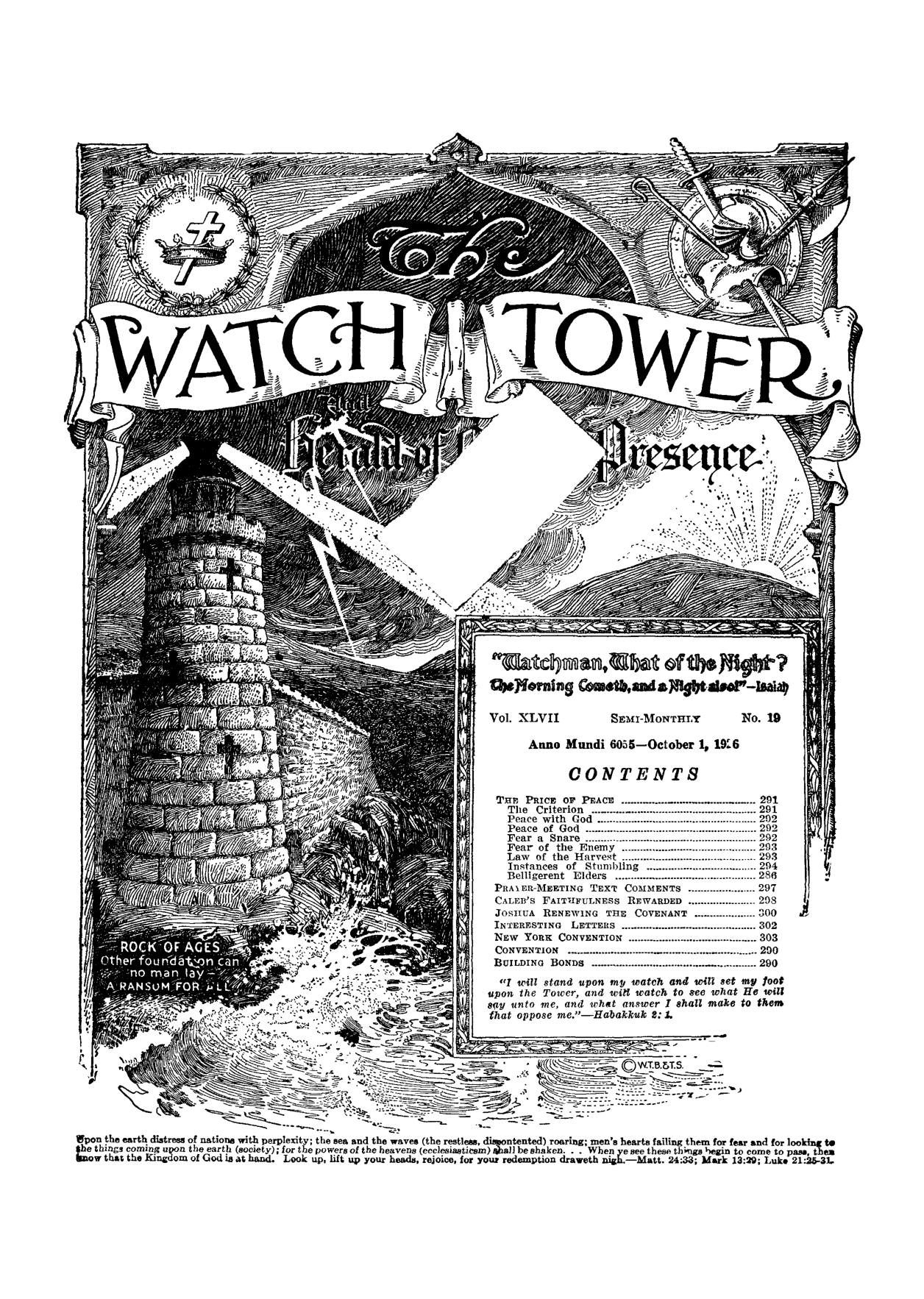
M0S2W
B.&T.S.
No. 1»
Vpon the earth distress of nations with perplexity; the sea and the waves (the restless, discontented) roaring; men's hearts failing them for fear and for looking t« the things coming upon the earth (society); for the powers of the heavens (ecclesiastiosm) fiihall be shaken. . . When ye see these things begin to come to pass, then ■now that the Kingdom of God is at hand. Look up, lift up your heads, rejoice, for your redemption draweth nigh.—Matt. 24:33; Mark 13:29; Luke 21:25-3L
iN
Wat
Vol. XLVII
Semi-Monthly
Anno Mundi 6055—October 1, 1926
CONTENTS
- ROCK OF AGES
Other foun'da'Vpn can '' , no man lay A RANSOM FOR
The Price or Peace _____________________
The Criterion ..............................
Peace with God ..............................
Peace of God ..................................
Fear a Snare ..................................
Fear of the Enemy ......................
Law of the Harvest ......................
Instances of Stumbling ..............
Belligerent Elders ........................
Praier-Meeting text Comments . Caleb’s Faithfulness Rewarded , Joshua Renewing the Covenant Interesting Letters ....................
New York Convention ....................
Convention ___________________________________
Building Bonds ................................
294 286
"I will stand upon my watch and will set my foot upon the Tower, and will watch to zee what He will say unto me, and what answer J shall make to them that oppose me.”—Hahakkuk 2: X
THIS JOURNAL AND ITS SACRED MISSION
THIS Journal is one of the prime factors or instruments in the system of Bible instruction, or “Seminary Extension”, now being presented in all parts of the civilized world by the Watch Tower Bible & Tract Society, chartered A. X>. 1884, “For the Promotion of Christian Knowledge”. It not only serves as a class room where Bible students may meet in the study Of the divine Word hot also as a channel of communication through which they may be reached with announcements of the Society’s conventions and of the coming of its traveling representatives, styled “Pilgrims”, and refreshed with reports of its conventions.
Our “Berean Lessons” are topical rehearsals or reviews of our Society’s published Studies most entertainingly arranged, and very helpful to all who would merit the only honorary degree which the Society accords, viz., Verbi Dei Minister (V. D. M.), which translated into English is Minister of (rod’s Word. Our treatment of the International Sunday School Lessons is specially for the older Bible students and teachers. By some this feature is considered indispensable.
This journal stands firmly for the defense of the only true foundation of the Christian’s hope now being so generally repudiated .—redemption through the precious blood of “the man Christ Jesus, who gave himself a ransom [a corresponding price, a substitute] for all”. (1 Peter 1:1'9; 1 Timothy 2:6) Building up on this sure foundation the gold, silver and precious stones (1 Corinthians 3: 1115; 2 Peter 1:5-11) of the Word of God, its further mission is to “make all see what is the fellowship of the mystery which. . .has been hid in God, ... to the intent that now might be made known by the church the manifold wisdom of God”—“which in other ages was not made known unto the sons of men as it is now revealed”.—Ephesians 3 : 5-9,10.
It stands free from all parties, sects and creeds of men, while it seeks more and more to bring its every utterance into fullest subjection to the will of God in Christ, as expressed in the holy Scriptures. It is thus free to declare boldly whatsoever the Lord hath spoken—according to the divine wisdom granted unto us Io understand his utterances. Its attitude is not dogmatic, but confident; for wo know whereof we affirm, treading with implicit faith upon the sure promises of God. It is held as a trust, to be used only in his service; hence our decisions relative to what may and what may not appear in its columns must be according to our judgment of his good pleasure, the teaching of his Word,- for the upbuilding of his people in grace and knowledge. And we not only invite but urge our leaders to prove all its utterances by the infallible Word to which reference is constantly made to facilitate such testing.
TO US THE SCRIPTURES CLEARLY TEACH
That the church is “the temple of the living God”, peculiarly “his workmanship” ; that its construction has been in progress throughout the gospel age—ever since Christ became the world’s Redeemer and the Chief Comer Stone of his temple, through which, when finished, God’s blessing shall come “to all people”, and they find access to him.—1 Corinthians 3:16, 17; Ephesians 2:20-22; Genesis 28:14; Galatians 3 : 29.
That meantime the chiseling, shaping, and polishing of consecrated believers in Christ’s atonement for sin, progresses; and when the last of these “living stones”, “elect and precious,” shall have been in axle ready, the great Master Workman will bring all together in the first resurrection ; and the temple shall be filled with his glory, and be the meeting place between God and men throughout the Millennium.—Revelation 15 : 5-8.
That the basis of hope, for the church and the world, lies in the fact that “Jesus Christ, by the grace of God, tasted death for every man,” “a ransom for all,” and will be “the true light which lighteth every man that cometh into the world”, “in due time”.—-Hebrews 2:9; John 1: 9 ; 1 Timothy 2:5, 6.
That the hope of the church is that she may be like her Lord, “see him as he is,” be “partakers of the divine nature’/ and share his glory as his joint-heir.—1 John 3 ;2 ; John 17 : 24 ; Roma ms 8 :17 ; 2 Peter 1 : 4.
Tnat the present mission of the church is the perfecting of the saints for the future work of service; to develop in herself every grace; to be God’s witness to the world; and to prepare to be kings and priests in the next age.—Ephesians 4 :12; Matthew 24: 14; Revelation 1:6; 20:6.
That the hope for the world lies in the blessings of knowledge and opportunity to be brought to all by Christ’s Millennial kingdom, the restitution of all that was lost in Adam, to all the willing and obedient, at the hands of their Redeemer and his glorified church, wh-en all the wilfully wicked will be destroyed.—Acts 3 :19-23; Isaiah 35.
PUBLISHED By
WATCH TOWER BIBLE & TRACT SOCIETY 18 CONCORD STREET n n BROOKLYN, NX U S A-FOREIGN OFFICES : British: 34 Craven Terrace, Lancaster Gate, London W. 2; Canadian: 38-40 Irwin Avenue, Toronto, Ontario; Australasian: 495 Collins St., Melbourne, Australia; South African: 6 Lelie St., Cape Town, South Africa.
Please Address the Society in Every Case
YEARLY SUBSCRIPTION PRICE : United States, $1.00 ; Canada and Miscellaneous Foreign, $1.50 ; Great Britain, Australasia, and South Africa, 7s. American remittan’ces should be made by Express or Postal Money Orders, or by Bank Draft. Canadian, British, South African, and Australasian remittances should be made to branch offices only. Remittances from scattered foreign territory may be made to the Brooklyn office, but by International Postal Money Orders only. (Foreign translations of this journal appear in several languages.)
EDITORIAL COMMITTEE : This journal is published under the supervision of an editorial committee, at least three of whom have read and approved as truth each and every article appearing in these columns. The names of the editorial committee are: J. F. Rutherford, W. E. Van Amburgh, J. Hemeby, R. H. Barber, E. J. Coward. TERMS”TO THE LORD’S POOK: All Bible Students who, by reason of old age or other infirmity or adversity, are unable to pay for this journal, will be supplied free if they send a postal card each May stating their case and requesting such provision. We are not only willing, but anxious, that all such be on our list continually and in touch with the Berean studies.
Notice to Subscribers: We do not, as a rule, send a card of acknowledgment for a renewal or for a new subscription. A renewal blank (carrying notice of expiration) will be sent with the journal one month before the subscription expires. Change of address, when requested, may be expected to appear on address label within one month.
Entered as Second Class Matter at BrooLlun, NY. P&sioffiee. Act -of March 3rd 1879.
CONVENTION
A local convention of the International Bible Students will be held at Huntington, West Virginia, Nov. 19th to 21st inclusive. The convention will be addressed by a number of the Pilgrim brethren; and Brother Rutherford will be present to serve the friends and the public at least one day of the convention. The public meeting will be held Sunday afternoon. For further information concerning accommodations at the convention please address B. F. Moore. 1691 Dalton Ave., Huntington, West Virginia.
BUILDING BONDS
One person writes objecting to the Society issuing building bonds saying that such a course is soliciting money for the Lord’s work. He is wrong. No one is being asked to take bonds. For several years the Society has been paying $15,000 per year for rent for the use of a building now entirely inadequate to handle the work. That amount of rent is equal to 5% on $300,000; and by issuing bonds for that amount of money together with other money available the building can be erected and $15,000 per year paid to the brethren as interest on their bonds. The security for the bonds is a first mortgage on the lots and factory building and a guarantee by the Society which carries al! the property the Society owns. The security for the bonds including the mortgage on the real estate and the guarantee back of it amounts to more than double the amount for which bonds are issued. It is a plain business proposition. The friends regard it as such. Many have asked why should not the Lord’s people handle their own business without going to the world for aid and without paying the world for the use of money or property. That conclusion is reasonable and proper.
The bonds will be issued bearing date of October 1st, 1926, bearing interest from that date. The subscription for bonds will be closed October 15th. As all the money will not be needed at one time payment may be made as late as December 1st. If you have subscribed for bonds you may remit the money by sending a draft on New York and your bonds will be mailed to you shortly after October 1st and upon receipt of the amount subscribed.
All communications concerning bonds should be addressed as follows: Watch Tower Bible & Tract Society, Treasurer’s Office, 124 Columbia Heights, Brooklyn, N. Y.
RADIO PROGRAMS
The following stations are now broadcasting the message of the kingdom :
WBBR, New York City, 416.4 meters, Sun., Tues., Thurs., Eri.
WORD, Batavia, Ill., 275 meters, daily.
CHUC, Saskatoon, Sask., 330 meters, Sun., Tue., Thursday.
KTCL. Seattle, Wash., 305.9 meters, Sunday, 9 to 10 p m.
KFWM, Oakland, Calif., 207 meters, Sun., Mon., Thurs. Sat
AND HERALD OF CHRIST’S PRESENCE
Vol. XLVII October 1, 1926 No. 19
THE PRICE OF PEACE
"Great peace have they which love thy law: and nothing shall offend them." — Psalm 119: 165.
THE law of God is the rule of action which he has prescribed for all of his intelligent creatures. His law is eternal. His law docs not change, even as God himself does not change. (Malachi 3:6) His will is his law, whether that be expressed or not. “The law of the Lord is perfect.” (Psalm 19: 7) The law of God applies to all of his intelligent creation, and in a particular sense to those who are in a state of peace with him. He has marked out a general course for all, and following that course leads one to a general result.
2 He who loves God’s will is possessed of great peace; and continuing to love that law, and to walk therein, his reward is life. Hence the instruction given: “My son, forget not my law; but let thine heart keep my commandments: for length of days, and long life, and peace, shall they add to thee. Let not mercy and truth forsake thee; bind them about thy neck; write them upon the table of thine heart: so shalt thou find favour and good understanding in the sight of God and man. Trust in the Lord with all thine heart; and lean not unto thine own understanding. In all thy ways acknowledge him, and he shall direct thy paths.”—Proverbs 3:1-6.
3 The wise man is he who diligently endeavors to apply his knowledge according to the divine standard. It is therefore essential that one carefully study the law of God, and then make an honest effort to deport himself accordingly. Such an one gets understanding and wisdom. “Happy is the man that findeth wisdom, and the man that getteth understanding: for the merchandise of it is better than the merchandise of silver, and the gain thereof than fine gold. She is more precious than rubies: and all the things thou canst desire are not to be compared unto her. Length of days is in her right hand; and in her left hand riches and honour. Her ways are the ways of pleasantness, and all her paths are peace.”—Proverbs 3:13-17.
4 God’s revelation to man opens with an anthem of praises sung by his two “morning stars”, which song evoked a joyful and tremendous applause from all his heavenly sons. (Job 38: 7) Then God caused to be recorded in his Word the course taken by each one of these great stars and the net result to each. Why this record? Manifestly one of the purposes thereof is that all of God’s intelligent creation might profit by knowing the truth. He who receives this knowledge and acts wisely thereon will follow the law of God and love that law. He who is selfish and ambitious will be unwise, take the wrong course, and fall.
5 Lucifer, one of these morning stars, knew the law of God; but he did not love that law. Selfishness, which is the very opposite of love, controlled him. Selfishness quickly defiled his heart, and the fruit of ambition resulted. To gratify that ambition he assumed to have cause for offense against God, denounced his great Creator as a liar, and set himself up in opposition to Jehovah. Since then he has ever pursued the course of strife and hostility to God and has gained for himself the titles of Prince of Darkness and the Prince of Devils; and his end will be everlasting death.—Matthew 9:34; John 12:31; Ezekiel 28:18,19.
THE CRITERION
6 The other of those two great stars always followed the course of righteousness. He knew the law of the Most High, loved that law, and delighted himself in obeying it. (Psalm 40:8) He was always the delight of his Father. (Proverbs 8: 30) He loved the law of his Father. (Psalms 119:97; 18:1) So complete was his devotion to the law of God that he could do nothing contrary thereto. (John 5: 30) His Father had provided and poured his potion for him, and that he would drink and did drink without offense. (John 18:11) His love for and complete obedience to the law of God continued even unto death. He gained for himself the title of Prince of Peace. He was given life on the highest plane and became the Author of salvation and the great Life-giver to man.—Isaiah 9:6; Hebrews 5: 8, 9.
7 The course taken by these two great creatures furnishes the criterion by which all of God’s creatures will be guided. The course of the disloyal son, who took offense against his Father, will lead him to endless death. The course of the loyal Son, -who loved his Father’s law and delighted therein, marks the way to everlasting life.
8 The church is now nearing the consummation of her hopes. The few remaining members on the earth must not only make sure of their high calling and election but unto them is given the gracious privilege now of lifting up the standard of God’s law. Joyfully conforming to the Lord’s commands leads these into the right course, and permits them to be used of the Lord that others may be led into the way of peace and everlasting life. A loving conformity to the law of God and the great peace of God is now vitally essential to every member of the church this side the vail. Each one should see to it that he permits- nothing to offend him within the meaning of this text.
PEACE WITH GOD
0 Peace means a condition of reconciliation, harmony and accord between those who were once at discord. It also means a state of quiet or tranquility; freedom from disturbance or agitation and strife; a state of mind resulting from a sense of absolute security in body, health, property, life and happiness. He who has such peace feels safe and well and joyful. Peace with God therefore means that condition of reconciliation, harmony and accord between man and God which has been brought about by God’s gracious provision.
10 The sin of Adam caused all men to be born sinners, and therefore at variance or out of accord with Jehovah. Through the death and resurrection of his beloved Son, God made provision for the reconciliation of all those who comply with the terms of his law. In order to be reconciled to God man must first exercise faith. Some knowledge is essential to faith. Man learns that he was born in sin and shapen in iniquity because of Adam’s wrongful course. He learns that Jesus Christ died and was raised from the dead that all who believe cn him as the great Redeemer and Savior may be reconciled to God. To have faith means to have a knowledge of God’s provision for salvation, and then to confidently rely upon it.
“The Word of God is an expression of his law. After receiving a knowledge of God’s gracious provision made for his reconciliation man must exercise faith by trusting implicitly in the merit of Jesus’ shed blood as the price of redemption and by fully agreeing to do the will of God. Upon the basis of the great sacrifice of his Son Jesus, and upon the faith of the believer, God justifies the man thus believing. He judicially determines that such au one who believes is in accord with him, and therefore such man is reconciled to God and at peace with God. “Therefore being justified by faith, we have peace with God through our Lord Jesus Christ: by whom also we have access by faith into this grace wherein we stand, and rejoice in hope of the glory of God.”—Romans 5:1, 2.
12 The one justified is justified for the purpose of enabling him to be a part of the sacrificial body of Christ. Being there accepted by the Father and begotten, such an one becomes a new creature in Christ. (2 Corinthians 5:17) He is now a sod of God (Romans 8: 14,15), and as such he must now be governed by the law of God. He cannot obey the law unless he knows something of that law. To gain such knowledge he must search the Scriptures, watch the unfolding of divine prophecy whereby the will of God concerning his creatures is made known. Some who make consecration to the Lord to do his will seem to think that thereafter all effort on their part to ascertain the law of God is unnecessary. The fact is that their efforts have just now begun, if they would be overcomers.
PEACE OF GOD
13 No one of the human race can have the peace of God except through Christ Jesus. Not every one who is begotten of the holy spirit, and thereby brought unto Christ, continues to enjoy the peace of God; for some such do not love the law of God. To continue in the peace of God is essential to the heavenly reward. When Jesus was about to finish his earthly ministry he spoke at length to his disciples, giving them some advice as to the course to take. Then he added: “These things I have spoken unto you, that in me ye might have peace.” —John 16:33.
14 These faithful disciples were received into Christ at Pentecost, and thereafter they enjoyed the peace of God that passeth all human understanding. They continued in that peace because they loved the law of God, and put forth their best efforts to obey that law. The same rule pursued by them must be observed by all who will ultimately receive the high favor of the kingdom. On that same memorable night Jesus told his disciples that his Father would send to them, in his name, the holy spirit; and that thereby they would be taught and comforted. Then he added: “Peace I leave with you, my peace I give unto you: not as the world giveth, give I unto you. Let not your heart be troubled, neither let it be afraid.” (John 14:27) His words are proof that only the Christian enjoys the peace of God.
FEAR A SNARE
55 The peace of God enjoyed by the Christian is the result of absolute faith in and unselfishness to God. He who abides in Christ and loves the law of God feels safe, secure, happy and well, and knows that all things shall work together for his good. He who continues in this happy condition knows no fear; for there is no fear in love. (1 John 4:17,18) Where the fear of man exists there is no great peace.
16 Some men in the church fear other men in the church. Where one occupies a higher position in the ecclesia than his brother there are times when there is a disposition manifested on the part of the one occupying the higher position to induce others to fear him. Such a course is contrary to the law of God. Then, again, there is one anxious to please a brother in a higher position than himself; and he renders service as unto man, as a man-pleaser. This is not pleasing in the sight of the Lord. The Lord himself is no respecter of persons. To him all the members of his body receive like consideration.—Ephesians G : 6-9.
17 The nominal Christians of Europe have especially suffered from this malady of fear of men and man-uorship. The clergy have induced the laity to fear them, and the elders have encouraged the more lowly to fear them. When those of present truth were brought out of ecclesiasticism some of the disposition of fear of men came with them, the meek and lowly ones fearing those above them in the church. Such fear of men led to a measure of the worship of the creature, contrary to the law of God. Those who have this fear have not enjoyed that great peace of God because they did not sufficiently know and fully love the law of God. Relating to this the Jaw of God is written: "The fear of man bringeth a snare: but whoso putteth his trust in the Lord shall be safe.”—Proverbs 29: 25.
18 Every Christian should love his brother and put forth his best endeavors to work in harmony with him, but the Christian who really enjoys the great peace of God fears no man. Seeing that where there is perfect love there can be no fear, we can appreciate the apostle’s words when he says: “And besides all these things put on love; it is the bond of completeness. And let the peace of the Anointed preside in your hearts, for which you were also called in one body; and be thankful.”—-Colossians 3:14,15, Diaglott.
FEAR OF THE ENEMY
19 Where there is fear of the creature there can be no great peace. Now the church has a clearer vision than heretofore of Satan and his organization. Being in the temple condition, these are aware that the Devil is now seeking to destroy them and would destroy them if not hindered in so doing. Knowing that Satan has many instruments in the earth which he is using to accomplish his purposes, some Christians have fear that he will use these instruments to their own injury or destruction. Having such fear they do not enjoy the great peace of God. The reason is that they do not love God’s law. Of course no one could love God’s law unless he knew about that law.
20 It is true that the church is now face to face with a great peril, but it is equally true that no faithful member of the church need fear. Concerning such the Lord expresses his law to them in these words: “But I am the Lord thy God, that divided the sea, whose waves roared: the Lord of hosts is his name. And I have put my words in thy mouth, and I have covered thee in the shadow of mine hand, that I may plant the heavens, and lay the foundations of the earth, and say unto Zion, Thou art my people.”—Isaiah 51: 15,16.
21 Knowing then that the law of the Lord concerning them is that they are covered under the shadow of his all-powerful hand, they have no occasion to fear the greatest of all enemies; but they enjoy sweet peace. Again the Lord says: “When thou passest through the waters, I will be with tb.ee; and through the rivers; they shall not overflow thee; when thou walkest through the fire, thou shall not be burned ; neither shall the flame kindle upon thee.” (Isaiah 43:2) Knowledge of this law and love for it bring peace; and love increases.—• 1 John 4:17,18.
22 There may be in one a knowledge of the Word of God, and he may render an outward obedience to the Lord; but in order to enjoy that great peace of God man must render service unto the Lord, out of love for God and love for his law. That means that he must be wholly and unselfishly devoted to the Lord. Such can rest confidently in the peace of God and rely upon his many promises, amongst which is this: “0 love the Lord, all ye his saints: for the Lord preserveth the faithful, and plentifully rewardeth the proud doer.”—■ Psalm 31: 23.
NOTHING SHALL OFFEND
23 Not only are the ones who love God’s law guaranteed great peace, but the Lord’s statement is that “nothing shall offend them”. The word offend here used means a stumbling block. It means, in the order given, to falter, to stumble, to cause to fall, and to ruin. That which keeps one from stumbling and falling is love for God's law. The text must refer to those who are reconciled to God, hence to the new creation. It must mean that if the new creature does not love God’s law he will falter, stumble and fall into ruin. Then of course that which causes the stumbling must be something lacking in him with reference to God’s rule of action given for the government of the new creation.
LAW OF THE HARVEST
24 The instrument through which the Lord will bless mankind is the “seed of promise”, which is the church, Christ Jesus the Head and his body members. (Colossians 1: 18; Galatians 3 : 16, 27-29) The Lord organized his church on earth to be his witness. (Acts 1: 8) The ministry of reconciliation was committed unto Christ Jesus, including the faithful members of his body. These faithful members of the body of Christ throughout the Gospel Age have served as the ambassadors of Christ. They have been the representatives of God and Christ on earth. (2 Corinthians 5:18-20) Throughout the age the Lord has caused these to preach the gospel, that those having a hearing ear might hear and come to him.
25 Jesus declared that the age should end with the harvest, at which time he would be present and directing it himself. (Matthew 13: 30-41) The first work of the harvest, as shown by the physical facts as well as by the Scriptures, has been the gathering together of those who have made a covenant to do the will of God, and who have been counted in as a part of Christ Jesus’ sacrifice. (Psalm 50:5) It necessarily follows that all of those in Christ, who have his Word in them, would be gathered together; and that these would stand together in one compact body as long as they remained in Christ. If any fell away, that would in no wise hinder the organization of the Lord. Only the one falling would Buffer injury.
26 The Lord himself is always faithful, and those who continue faithful will continue with him and stand together, working together harmoniously under his direction. What would hold them together? The apostle answers: “The love of Christ.” (2 Corinthians 5:14) There could be no division in the body of Christ. (1 Cor. 12:12-30) Those who are really devoted to God and who continue in that attitude will stand together.
27 The law of the harvest therefore is that God sent forth his beloved Son as Head of the church, to gather together under him his true people for the purpose of giving a witness in the earth; and that all who are the Lord’s will be witnesses in the name of God and to his name. These of necessity must love the law of God, Ind all who do will know of that law and joyfully obey It; and this law declares that they will be witnesses of the Lord and that they will see eye to eye and will harmoniously engage in the Lord’s service.—Isaiah 43: 10-12; 52: 7, 8; Matthew 24:14.
28 Now we know from the facts that such a class has Jxisted through the period of the harvest, and we have Jailed this organized body of Christians on earth “the Society”. It is understood that “the Society” is made Up of those who are begotten and anointed of the holy spirit and who love the law of God and who faithfully continue to labor together in his service. If from time to time some of these become offended and drop out, this would in no wise hinder the work of the Lord; but his organization would go straight forward in the performance of the work meted out for it. No one could hinder the work of the Lord. By withdrawing from his organization and his work such persons would do injury to themselves, but no injury to the Lord’s work would result. This is the rule or law of the harvest, as shown both by the Scriptures and by the facts in fulfilment thereof.
SOME OFFENDED
29 The facts unmistakably show that since the beginning of the harvest work a number have become offended and have fallen away. These have first faltered, then stumbled, become opponents, and ultimately have returned to the world. Surely some good reason for this should be found in the Scriptures, and we do find it there.
80 The Lord promised that greater light should come to his people at the end of the age, and the apostle warns that at that time there would be danger of falling. (1 Corinthians 10:11,12) With the coming of the light at the end of the age Christians began to be released from their place of bondage and captivity in the ecclesiastical systems. This gave them joy and, as the Psalmist expresses it, their mouth- was filled with laughter and their tongue with singing.—Psalm 126: 1, 2.
81 The light did not come to the Lord’s people all at once. Of course many errors clung to them, because they had been long mixed with ecclesiastics. They could not learn everything immediately. Those who are really devoted to the Lord believe that the Lord himself organized his harvest work and that he provided The Watch Tower as a medium through which to instruct his people; and that this, together with other literature and books in harmony with The Watch Tower, has furnished the “meat in due season for the household of faith”. The Lord himself has furnished this, but he has permitted imperfect men to have to do therewith, and of course it could not be served in any other way than imperfectly.
INSTANCES OF STUMBLING
82 The Watch Tower once taught that the church is developed under the new covenant. In due time the Lord permitted its editor to see that such is not true, but that the church is the offspring of the Abrahamic covenant. At the time of this change of position, as frankly published in 'The Watch Tower, some who professed consecration became offended. They turned away from the Society and from the Lord’s work, stumbled and fell. They assumed to have a cause for offense, but their offense was not against men. It was against the Lord and against his law. Had such loved the law of the Lord they would not have been offended.
83 For a long while The Watch Tower taught that he who becomes a Christian is first justified and then makes a consecration. Later the editor saw that this position was not a correct one, and set forth the Scriptural proof that consecration must take place first, and then justification; that it would be inconsistent for Jehovah to justify one who had not agreed to do his will. (W. T. 1916, p. 108) With this greater light upon the Word of the Lord some became offended, faltered, turned back, became opponents, stumbled and fell.
34 The literature of the Society once plainly set forth that 1914 would mark the complete glorification of the church. Many set their hearts upon that date. The time passed, and the church was not yet glorified. Then The Watch Tower began to set forth the truth as to where the mistake in calculation had been made, and that 1914 was in truth and in fact a correct chronological date, but that the mistake was as to what would transpire at that date. Because of this increased light others became offended, faltered, became opponents, turned away and fell.
35 Why did these fall ? The answer is, Because they did not love God’s law. Their peace of mind and their “peace of God” were disturbed because of lack of unselfish devotion to him. Had they loved the Lord’s law and taken heed thereto they would have known that the Lord declares: “But the path of the just is as the shining light, that shineth more and more unto the perfect day.” (Proverbs 4: 18) Since his law has declared that this light would increase from time to time, those who loved it rejoiced in the increased light as it was revealed.
“G With greater light, anything may be found to be of a different form from that which first was seen. For instance, if one observes an object when the first gray streaks of light appear in the oast in the early dawn, that object may appear to be a certain form; but within thirty minutes, when the light around it increases, a quite different form appears. Even so with the Word of the Lord. We first get a little light upon something; then, as the light increases, the divine plan appears far more wonderful to us, and we rejoice all the more. The vision of the one who loves the Lord broadens continually; and as his vision enlarges, his joy increases. Some had set their hearts on the fact that justification must take place before consecration, and others had set their hearts on the fact that the church must be glorified in 1914. It was selfishness that caused them to tenaciously held to these things and then become offended when greater light came upon them.
37 In 1917 the Seventh Volume of Studies in the Scriptures was published. It contained some rather startling statements. Again some became offended, stumbled and fell. Had these loved the law of God they would not have fallen. They would have concluded that the Lord permitted the Seventh Volume to be published for a good reason. Those who loved the Lord’s law said: “He is at the head of his work, and he knows how to guide it.” The Lord has provided his own way to carry on his harvest work and he has his organization. This work is done with imperfect men, of course, all of whom make mistakes. There are mistakes in the Seventh Volume; there are mistakes in all the other volumes of Studies in the Scriptures and in all the other publications of the Society, and in all versions of the Bible. It could not be expected otherwise, because each one is prepared by imperfect instruments; and God has permitted these things as a test of our love and loyalty for him.
38 Now The Watch Tower is publishing some articles that are somewhat different from what has heretofore appeared in the Society’s publications, and particularly in Volume Seven; for instance, the article on the twelfth chapter of Revelation under the title “The Birth of The Nation”. Does that mean that the Seventh Volume and the Society should be rejected because of this change? Is that any just cause or excuse to become offended and to withdraw? It should be remembered that the Seventh Volume contains a statement of the great fundamental truths of the divine plan; and merely because some parts of it are not in harmony with the greater light shed upon the Lord’s Word is no reason why it should be cast aside.
39 Now the church sees what it could not see until God’s due time; to wit, that the Lord came to his temple in 1918, and that it is the law of God that the church from that time forward should have a clearer vision upon his plan than before. (Revelation 11:19) Those who love the Lord's law know that the truth is his, not any man’s, and that what man says about it is not with absolute authority; but God permits his people to reason upon his Word and reach a conclusion. As his light increases they see his plan more clearly and rejoice exceedingly.
40 Lucifer assumed a reason for becoming offended at Jehovah. That was because of his own selfishness; his heart was not honest. He follows the same course in overreaching the Christian; if there is any dishonesty in the heart he will see that it is fed. Anyone who selfishly assumes a cause for offense against the Lord’s organization and his work, pretending to be offended at individuals who are doing the Lord’s work, is in truth and in fact offended at the Lord. The cause for this offense is a lack of love for God’s law. This is illustrated in the Lord’s dealing with Israel through Samuel.
41 Samuel was chosen as the Lord’s instrument to lead Israel. In similar fashion the Lord has chosen his organization, the anointed members on earth, as his representative to carry on his work; which organization we term “the Society”, irrespective of the individuals who are working in that Society. When the children of Israel called for a judge for purposes of administration Samuel took the matter to the Lord; and the Lord said to Samuel: “Hearken unto the voice of the people in all that they say unto thee: for they have not rejected thee, but they have rejected me, that I should not reign over them.” (1 Samuel 8:7) Even so, when one assumes a cause for offense and turns aside to start something in opposition to the Lord’s harvest work he is offended in truth and in fact against the Lord, and this offense is due to the fact that he does not love God’s law.
42 The Lord has only one way of carrying on his work. The Lord himself will be the judge of his people. This will not be committed to another. (Romans 14: 4) No one consecrated to the Lord can find a just cause or excuse to become offended at the Lord’s organization and withdraw therefrom. The fact that some do become offended, withdraw and become opponents, is conclusive proof that such do not love the law of God. One individual may become offended at another and have a just cause for such offense, but if so he will pursue the course directed by the law of the Lord to straighten out that difficulty. (Matthew 18: 15-18) He cannot assume that such a circumstance is valid reason for his becoming offended at the Lord’s organization and withdrawing from it.
43 Recently there was some disturbance in one of the branch offices of the Society. One ecclesia, without knowing the facts, proceeded to judge not only the brother or brethren in question but the entire Society, and to withdraw its support therefrom. Then it began to publish this to the church and even to the world and to set itself up in opposition to the work. Had this class really loved the law of God it would not have done this, even though there were some wrong doing on the part of some brother or brethren in the Lord's service. It is not the prerogative nor the duty of any one nor any class to pass judgment upon another. Especially is this true when they have neither the facts nor the jurisdiction to determine what action should be taken by the Society, as in this case. Had the aforementioned class loved the Lord's law they would have remembered what it said and followed it. Their excuse was that were they to continue to support the work others might think they as a class were endorsing an improper course, which they supposed had been taken by some individuals.
41 What could induce such a conclusion ? Selfishness, of course; and selfishness is a lack of love. The law of the Lord governing such cases plainly is: “Speak not evil one of another, brethren. Ho taat speaketh evil of his brother, and judgeth his brother; speaketh evil of the law, and judgeth the law: but if thou judge the law, thou art not a doer of the law, but a judge. There is one lawgiver, who is able to save and to destroy: who art thou that judgest another?”—James 4: 11,12.
45 Even though some brethren of the Society were guilty of some wrong, that would be no just cause nor excuse for our becoming offended at the Lord’s organization. The duty of every one who loves the Lord and his law is and should be to immediately set about to try to help the erring one, and meanwhile not to cease to sustain and support the work of the Lord. Where a course different from this is taken by individuals or by a class they lose their peace of mind, do not enjoy the peace of God, and are easily stumbled; and unless quickly recovered they fall away entirely.
46 It will be seen that the words of the Psalmist in our text do not refer to individual offenses. Such are treated in other parts of God’s Word. The offenses here referred to are those against the Lord. He who loves God’s law will be always unselfishly seeking to obey that law. He will rest in peace, in quietude, in tranquility; he will feel safe and secure, because he knows that the great God can make no mistakes and that he will cause all things to work out to his own glory and to the good of all those who love him. Not only will such have and enjoy the great peace of God but it is utterly impossible for anything to cause them to become offended and stumble and fall away from the Lord.
BELLIGERENT ELDERS
47 Sometimes there is a leader or elder of a ebss who does not agree with what The Watch Tower publishes. He is impressed with his own importance and wisdom and decides that The Watch Tower is grossly wrong, and he assumes this as a cause for offense against the Society. He becomes belligerent and sets about to draw others of the class away from the support of the Society and from the work that it is carrying on. He refuses to participate in the service and tries to discourage others from so doing. The adversary sees to it that his assumed cause for offense is cultivated, until such elder becomes really an opposer of the Lord’s work. What is the reason ? Because he does not love God’s law. He is selfish, proud, and does not wish to admit that he has been wrong in his understanding of some scriptures. He has imt been walking in the light as the Lord is causing it to shine upon his Word. The elder permits his selfishness to turn him away, causing him to stumble and fall away from the Lord and from his work.
48 What should the class do with such fin elder ? Upon the Society, that is to say, upon those Christians who are unreservedly devoted to the Lord, there is laid the privilege and obligation of giving the witness on the earth at this time concerning God and his kingdom. Those who are joyfully engaged in this work should not indulge in controversy with anyone who opposes, but let all belligerent ones alone. Those who really love the Lord should get on with his work. Any opposer to that work should be set aside as an elder and asked to refrain from interfering with what others are sincerely trying to do in serving the Lord.
49 But suppose there are some in a class who cannot see all matters as published in The Watch Tower, yet who honestly and sincerely desire to have a part in the Lord’s service; what should be the attitude of the class toward such? By all means one in that attitude should be treated with the greatest consideration and kindness. As long as he has a desire to cooperate in the service he should be encouraged to participate therein. He should be encouraged to attend the studies of The Watch Tower and should be helped if possible to a better understanding. Undoubtedly, where one keeps his heart right, in due time the Lord will more fully illuminate his mind.
50 If an cider cannot agree with The Watch Tower because he cannot understand it then he should not attempt to lead a Watch Tower study, but may lead other Berean studies with which he does concur. It is only when one becomes an opponent and tries to disturb the work of giving the witness of the kingdom that he should be set aside. One who is an opponent should not even vote at the class meetings, and surely he should never be elected as a servant of the church.
51 The obligation rests upon the faithful ones to carry on the Lord’s work. A minority of opponents in the class should not be permitted to thwart the purpose of the majority in loyally and faithfully serving the Lord. Under such circumstances the class should have all questions determined by a majority vote consisting of fifty-one percent of the members of the class. If all are in harmony they will all vote one way anyhow. If there are some who are purposely and wilfully opposing, then this minority should not be permitted to rule. All who really love the Lord and his law will be found working harmoniously together to the glory of the Lord as his witnesses.
52 Let all the consecrated ones who are anointed to be witnesses of God heed the admonition of the apostle, and at all times be found “standing fast in one spirit and with one mind, fighting shoulder to shoulder for the faith of the gospel. Never for a moment quail before your antagonists. Your fearlessness will be to them a sure token of impending destruction, but to you it will be a sure token of your salvation”.—Philippians 1: 28, Weymouth.
63 Such will have great peace and will be always rejoicing in the Lord. They will at the same time appreciate the fact that the joy of the Lord is their strength. The price of great peace therefore is unselfish devotion to the law of God. This is likewise a guarantee that you shall never stumble nor fall. All who maintain this attitude towards Jehovah “shall lift up the voice together with singing” as witnesses to the majesty of the great Jehovah God.
QUESTIONS FOR BEREAN STUDY
What is God’s law? How alone may real peace be enjoyed? What is the difference between knowledge and wisdom? f 1-3.
What is the theme of God’s revelation to man? Who were the two “morning stars” of Job 38: 7, and did each of them know and love God’s law? What will be their respective rewards? U 4-7.
What is now vitally essential to each member of the church?
What is peace? What is faith? 11 8-10.
How and why are we justified? U 11, 12.
How may We receive and retain the peace of God? 11 13, 14.
How and why is fear sometimes fostered in the church? Can those who fear have peace? 11 15-18.
How may the spirit of fear be overcome? H 19-22.
What is meant in our text by the word “offend”? H 23, 46.
What is the present mission of the church? What is the work and law of the harvest? How are the faithful ones held together? fi 24-27.
Of what does “the Society” consist? When any members drop out is the Lord's work ever jeopardized thereby? Why do some become offended? U 2S-30.
Did full light come to the church at the beginning of the harvest? Has “meat in due season” ever been served to the church in a perfect form? Cite instances of increasing light which offended some. H 31-34.
Why did these fall? Is it unusual for the form of anything to appear different under different degrees of light? H 35, 36.
Should the Seventh Volume, or any of the other volumes of Scripture Studies, or any of the versions of the Bible, all of which contain the fundamental truths of the divine plan, be cast aside because of certain mistakes they may contain? U 37-39.
How does Satan seek to cause offenses in our ranks? When anyone ceases to support the Lord’s work is his offense always against the Lord? H 40-42.
Cite a case in point. Even though certain brethren in the Lord’s service should do a great wrong, is that just cause for offense against the Lord’s organization? II 43-46.
What is a belligerent elder, and what should a class do with such? What should be their attitude toward those who are anxious to engage in the service but who may not be able to see all matters treated in The Watch Tower? If 47-50.
What special obligation now rests upon the faithful, and how shall they fulfil it? What is the divinely stipulated price of peace? V 51-53.
PRAYER-MEETING TEXT COMMENTS
TEXT FOR DECEMBER 1
’'The Lord hath anointed me.”—Isaiah 61:1.
THIS TEXT at once suggests to the Christian that the Lord God has something for him to do and that he will require of him faithfulness in the performance of such duty. To be anointed by the Lord means that the one anointed is officially designated to some service for Jehovah. His part of God’s service is important and cannot be neglected with impunity. Its importance is to the one who is commissioned to do it. Those who maintain the anointing will remain of the temple class and may expect their vision to increase as God’s plan unfolds. The time has come for God to make himself known. That means a manifestation of his divine power in such a marked degree that all must take notice thereof. The Lord does nothing in the dark. He gives notice in advance of his purposes so that all mouths may be stopped and precluded from ever saying that they had no notice of what God intends to do. It is therefore seen to be important to have a witness given. The giving of this witness he has committed to his anointed ones, and he who fails or refuses to perform the duty and obligation of his office as opportunity affords might expect that anointing to be taken away. The anointed class will delight to sound forth the praises of God out of Zion, and this they are doing by his grace.
TEXT FOR DECEMBER 8
“Trees of righteousness, the planting of the Lord.” —Isaiah 61: 3.
A TREE is a symbol of a creature possessing everlasting life. (Genesis 21:33) The trees of righteousness here mentioned in the text mean the various members of the new creation. These trees are planted by Jehovah and those who are faithful to the end will be granted life everlasting on the divine plane. They will have inherent life even as Jesus said that God had given him to have life within himself. (John 5:26) That wonderful grove of 144,000 and one trees, the one being the great Head, Christ Jesus, will be an everlasting monument to the glory of Almighty God. These trees of righteousness God will giva for the blessing and peace and life of the world. In the midst of the great highway and on either side of the river of truth these trees of righteousness will bear their fruit and will feed and heal and bless all the obedient ones of the families of earth
God has commanded that those of Zion shall now point out to the people the highway : that they shall gather out the stones that have caused the people to stumble; that they shall lift up his standard to the people and declare to them that Jehovah is the great God who has provided a way for their return to him that they may receive the blessings of life everlasting.
Those of Zion now see their privilege and delight to proclaim this glad news to the praise of Jehovah God, and this they are doing in the manner which he lias provided.
CALEB’S FAITHFULNESS REWARDED ---November 14—Joshua 14: 6-15--- “I wholly followed Jehovah my God.”—Joshua 1^:8.
WITH the fall of Jericho Joshua at once began the attack on Canaan in general. It is easy to imagine the zeal of the men of Israel as they set out from Gilgal to make the land of promise their own and to cleanse the land, which God had promised to Abraham, Isaac and Jacob, from the defilement it had suffered through its Canaanite inhabitants. It would be difficult to find any human record revealing greater debasement than that into which the Canaanites had fallen.
2 The manifestation of the mighty power of God in the collapse of the walls of Jericho showed the Israelites that God was fighting for them and that he had begun war. But at the next place they attacked, the small town of Ai, Israel was self-confident and met with a rebuff; the men of Ai drove them from before the wall and Israel fled for their lives. Joshua’s heart failed him, and he fell on his face in distress; for Israel had turned their backs to their enemies. But Joshua’s concern was not only because of the apparent catastrophe which had fallen upon them; he was concerned for the honor of God’s name. (Joshua 7: 6-9) In his fear he saw Israel defeated and cut off, and the peoples of the land exulting in their conquest and despising the name and power of Israel’s God.
2 The word of Jehovah came to Joshua with the sharp command, “Get thee up; wherefore liest thou upon thy face?” Then the Lord continued, “Israel hath sinned.” (Joshua 7:10,11) Apparently this fact had not occurred to Joshua. The Lord commanded that the people sanctify themselves; for he could not continue to give them victory unless an accursed thing was removed. In order to discover the sinner against Israel and against God, lots were cast; and ultimately Achan, of the tribe of Judah, was taken. At Joshua’s word he confessed that he had coveted some of the spoil of Jericho and had taken it and hid it in his tent. As those of his household must have known what he had done but had shielded him, he and all his household were stoned because of this sin against Israel.
4 After the accursed thing was removed from Israel and they themselves were sanctified, the warfare was continued; and Ai was soon subdued. Then for six years or more Israel fought till all Canaan was subdued. Sometimes, as in the case of the confederacy of the kings of Jerusalem, Hebron, Jarmuth, Lachish, and Eglon, led by Adonizedek king of Jerusalem (Joshua 10:3-5), he was helped by the combination; for the victory which God gave him at Beth-horon over those kings brought all of southern Canaan into subjection.
5 Joshua. ever fought under the direction of the captain of the Lord’s host, who appeared to him at the first but who is not again mentioned. How this angelic captain guided Israel we do not know; it is certain that Joshua did not look for any mystic guidance. He must be considered as a military general conducting his campaign on certain rules of war. The early battle of Beth-horon, fought for the relief of Israel’s allies the Gibeonites, shows him to be a man of energy and resource; yet the original cause of that battle, Joshua’s being beguiled into making an agreement with the Gibeonites, also shows that he had not that watchful care which is usually associated with a military commander.
6 At last the time came when the tribes of Israel were ready to divide some of the land. Reuben, Gad, and part of the tribe of Manasseh already had their portions on the east side of Jordan. Caleb, Joshua’s companion and faithful ally in the trouble which came upon Israel when the spies brought back their alarmist report, saying that it was hopeless to expect that the children of Israel could overcome the peoples of Canaan and secure their land for an inheritance, now came before Joshua supported by men of the tribe of Judah.
7 Caleb reminded Joshua of what had happened forty-five years previous when he, Caleb, was forty years of age, and how he had attempted to avert the disaster which then threatened Israel through the lack of faith in the people and their stubbornness in setting themselves against God. He reminded Joshua of the oath which Moses had then sworn, that because Caleb had wholly followed the Lord he should have for his inheritance in the land of Canaan the places on which his feet had trod.—Numbers 14: 24.
8 He further said to Joshua, “And now, behold, the Lord hath kept me alive as he said, these forty and five years . . . and now, lo, I am this day fourscore and five years old. As yet I am as strong this day as I was in the day that Moses sent me.” (Joshua 14:10,11) Perhaps it was his eighty-fifth birthday. He chose from Joshua the town of Hebron, the city of the giant Anakims; and full of faith and courage he said, “If so be the Lord will be with me, then I shall be able to drive them out, as the Lord said.”—Joshua 14:12.
9 Joshua blessed his old-time companion in tribulation and in fidelity, and gave him Hebron; and it became the inheritance of Caleb, because he wholly followed the Lord God of Israel. Caleb thus got a special inheritance, for Hebron was not only the center of fertile lands, but was Abraham’s burial place; and he had the pleasure of tilling the lands where Abraham had lived, and of caring for his burial place.
10 This incident reveals the fact that though Israel had brought the land of Canaan into subjection their enemies were not all destroyed, nor all their opposition broken. The land was conquered in the sense that it was no longer possible for set warfare to be made against Israel, nor for city to cooperate with city against Joshua and Israel. Caleb went down to his inheritance and drove out from it the three sons of Anak the giant. It was the sight of these three monstrous men, and perhaps their father, and the report of them, which had done much to strike fear into the hearts of the spies, and through them into the hearts of the people of Israel. But Caleb, though now eighty-five years of age but strong in the strength which true faith in God imparts, fearlessly attacked them and thrust them away.
11 The Bible student knows that these things are written for his instruction in the way of the Lord. They are to guide him as the pillar of cloud guided Israel, or for his assurance in the way he has taken, guided as he believes by the Lord. Paul says, “Whatsoever things were written aforetime were written for our learning, that we through patience and comfort of the scriptures might have hope.”—Romans 15 : 4.
12 This record of Caleb’s spirit and of his courage is surely an encouragement to every servant of Jehovah, and to take it to heart must be to anyone’s advantage. There had been many things during that long and wearying wilderness journeying which might have been allowed to depress him, as they must have depressed those who had not faith. But those things which depressed others were to him evidences of the watchful and certain purposes of God. Since those earlier days when he had expressed his faith, he had seen the word of God fulfilled in the death of that multitude who were unfaithful, and who were sentenced to die in the wilderness; he had seen Jordan turned back at its flood, and the walls cf Jericho fall; and he had experienced the constant and regular victories of Israel against peoples greater and mightier than they. He knew that God was ever true to his word.
13 As in courage and confidence his spirit retained its vigor, this in turn proved to be strength to his body, making him at eighty-five as strong as he was at forty. However, this, was not wholly the result of his own spirit, or the natural result of a clean and pure life and desire; it was a reward from the Lord, a contrast from the sentence of disfavor upon the many, to show that the Lord did reward those who were faithful to him. (Joshua 14: 8, 9,14) Every lover of God and of righteousness desires to have the same spirit as Caleb. This is particularly the case with those who see the things which God has now given to his people, who know that he is setting up the long-promised kingdom of his dear Son, and is establishing truth and righteousness in the earth.
14 True Christians perceive that there are two outstanding phases of service for God at this time, namely: (1) Individually witnessing for him, and (2) collectively campaigning, each one constituting a unit in his army, under the leadership of the Word of God. (Revelation 19:13-16) He sees that these correspond to the two outstanding incidents of Caleb’s life. Caleb came under notice and into immediate prominence when the spies were sent from Kadesh-Barnea, and when, contrary to the ten, he declared his faith in God, and at the risk of his life stood for God’s honor in the matter of Israel’s call and God’s purpose for them. It was then first said of him that he “fully” followed the Lord. —Numbers 14:24.
15 For our guidance and encouragement we ask, What is involved in fully or wholly following the Lord? In Caleb’s case we may say, first, that he very definitely believed God’s word of promise; second, as definitely he trusted in God, believed in God’s fidelity; third, he set his mind accordingly, and thus tried to see things always from God’s viewpoint. This really meant that he was a true servant of the Lord, one who sought God’s interests.
16 The second incident is that which gives us our present study and its lesson. Caleb did not now need to stand for God in opposition to his unbelieving brethren, yet his faith may be said to have been as inspiring when he requested Joshua to give him Hebron despite its difficulties and dangers as it could have been at Kadesh. Faith and courage came from his loyalty to God; at Kadesh he had courage to withstand the whole people; before Joshua he had faith to believe that no opposition could withstand an Israelite living according to his covenant. Instead of being tired with the rough fighting of the past six years of warfare, he was stimulated by its activity.
…