The Watchtower, September 15, 1925
Download: PDF — The Watchtower, September 15, 1925
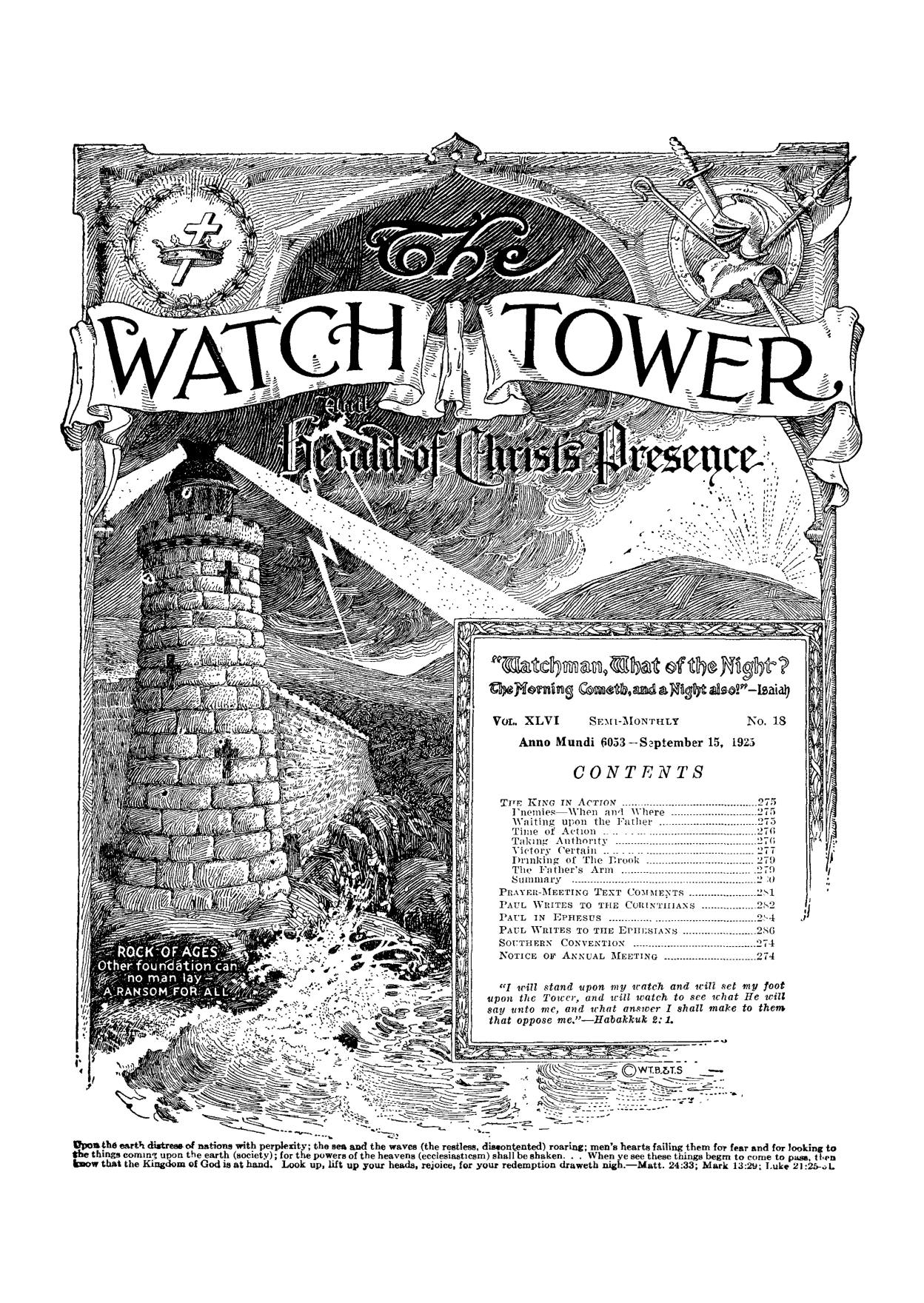
Oponthh earth diatresoof nations with perplexity; the sea and the waves (the restless, discontented) roaring; men’s hearts failing them for fear and for looking to things coming upon the earth (society); for the powers of the heavens (eccleaiasticsm) shall be shaken. . . When ye see these things begm to come to pass, then know that the Kingdom of God is at hand. Look up, lift up your heads, rejoice, for your redemption draweth nigh.—Matt. 24:33; Mark 13:29; Luke 21:25-uL
THIS JOURNAL AND ITS SACRED MISSION
THIS journal is one of the prime factors or instruments in the system of Bible instruction, or ‘‘Seminary Extension**, now being presented in all parts of the civilized world by the Watch Tower Bible & Tract Society, chartered A. D. 1884, “For the Promotion of Christian Knowledge”. It not only serves as a class room where Bible students may meet in the study of the divine Word but also as a channel of communication through which they may be reached with announcements of the Society’s conventions and of the coming of its traveling representatives, styled “Pilgrims”, and refreshed with reports of its conventions.
Our “Berean Lessons” are topical rehearsals or review’s of our Society’s published Studies most entertainingly arranged, and very helpful to all who would merit the only honorary degree which the Society accords, viz., Verbi Dei Minister (V. D. M.), which translated into English is Minister of God’s Word. Our treatment of the International Sunday School Lessons is specially for the older Bible students and teachers. By some this feature is considered indispensable.
This journal stands firmly for the defense of the only true foundation of the Christian’s hope now being so generally repudiated —redemption through the precious blood of “the man Christ Jesus, who gave himself a ransom [a corresponding price, a substitute] for all”. (1 Peter 1:19; 1 Timothy 2:6) Building up on this sure foundation the gold, silver and precious stones (1 Corinthians 3: 1115; 2 Peter 1:5-11) of the Word of God, its further mission is to “make all see what is the fellowship of the mystery which. . .has been hid in God, ... to the intent that now might be made known by the church the manifold wisdom of God”—“which in other ages was not made known unto the sons of men as it is now revealed”.—Ephesians 3 : 5-9,10.
It stands free from all parties, sects and creeds of men, while it seeks more and more to bring its every utterance into fullest subjection to the will of God in Christ, as expressed in the holy Scriptures. It is thus free to declare boldly whatsoever the Lord hath spoken—according to the divine wisdom granted unto us to understand his utterances. Its attitude is not dogmatic, but confident; for we know whereof we affirm, treading with implicit faith upon the sure promises of God. It is held as a trust, to be used only in his service; hence our decisions relative to what may and what may not appear in its columns must be according to our judgment of his good pleasure, the teaching of his Word, for the upbuilding of his people in grace and knowledge. And we not only invite but urge our leaders to prove all its utterances by the infallible Word to which reference is constantly made to facilitate such testing.
TO US THE SCRIPTURES CLEARLY TEACH
That the church is “the temple of the living God”, peculiarly “his workmanship” ; that its construction has been in progress throughout the gospel age—ever since Christ became the world’s Redeemer and the Chief Corner Stone of his temple, through which, when finished, God's blessing shall come “to all people”, and they find access to him.—1 Corinthians 3 :16, 17 ; Ephesians 2 : 20-22 ; Genesis 28:14; Galatians 3 : 29.
That meantime the chiseling, shaping, and polishing of consecrated believers in Christ’s atonement for sin, progresses ; and when the last of these “living stones”, “elect and precious,” shall have been made ready, the great Master Workman will bring all together in the first resurrection ; and the temple shall be filled with his glory, and be the meeting place between God and men throughout the Millennium.—Revelation 15 : 5-8.
That the basis of hope, for the church and the world, lies in the fact that “Jesus Christ, by the grace of God, tasted death for every man,” “a ransom for all,” and will be “the true light which lighteth every man that cometh into the world”, “in due time”.— Hebrews 2:9; John 1: 9 ; 1 Timothy 2:5, 6.
That the hope of the church is that she may be like her Lord, “see him as he is,” be “partakers of the divine nature’,’ and share his < glory as his joint-heir.—1 John 3 :2 ; John 17:24; Romans 8 : 17 ; 2 Peter 1 : 4.
Tnat the present mission of the church is the perfecting of the saints for the future work of service; to develop in herself every grace; to be God’s witness to the world ; and to prepare to be kings and priests in the next age.—Ephesians 4 :12 ; Matthew 24 : 14 ; Revelation 1:6; 20 : 6.
That the hope for the world lies in the blessings of knowledge and opportunity to be brought to all by Christ’s Millennial kingdom, the restitution of all that was lost in Adam, to all the willing and obedient, at the hands of their Redeemer and his glorified church, when all the wilfully wicked will be destroyed.—Acts 3:19-23 ; Isaiah 35.
Published By
WATCH TOWER. BIBLE & TRACT SOCIETY
18 CONCORD STREET a a BROOKLYN, NY, U S A-
Foreign Offices : British: 34 Craven Terrace, Lancaster Gate, London W. 2; Canadian: 38-40 Irwin Avenue, Toronto, Ontario; Australasian: 495 Collins St., Melbourne, Australia; South African;
6 Lelie St., Cape Town, South Africa.
Please Address the Society in Every Case.
YEARLY SUBSCRIPTION PRICE: United States, $1.00 ; Canada and Miscellaneous Foreign, $1.50; Great Britain, Australasia, and South Africa, 7s. American remittances should be made by Express or Postal Money Orders, or by Bank Draft. Canadian, British, South African, and Australasian remittances should be made to branch olfices only. Remittances from scattered foreign territory may be made to the Brooklyn office, but by International Postal Money Orders only. (Foreign translations of this journal appear in several languages)
Editorial Committee: This journal is published under the supervision of an editorial committee, at least three of whom have read and approved as truth each and every article appearing in these columns. The names of the editorial committee are: J. F. Rutherford, W. E. Van Amburgh, J. Hemery, R. 1-1. Barber, C. E. Sie wart. Terms to the Lord’s Poor: All Bible students who, by reason of old age or other iniirinity or adversity, are unable to pay for this journal, will be supplied tree if they send a postal card each May stating their case and requesting such provision. We are not only willing, but anxious, that all such be on our list continually and in touch with the Berean studies. ____________________________
Notice to Subscribers: We do not, as a rule, send a card of acknowledgment for a renewal or for a new subscription. Receipt and entry of renewal are indicated within a month by change in expiration date, as shown on wrapper label. - ----:------------------------=-----------------. _ -- •
Entered ar Second Class Matter at Brooklyn. N.Y Postoflice., Act of March yd iBrg.^
RADIO PROGRAMS
The following stations are now broadcasting the message of the kingdom :
WBBR, New York City, 272.G meters, Sun., Mon., Thurs., Sat, WORD, Batavia, Ill., 275 meters, daily.
KFKB, Milford, Kans., 28G meters, Sunday, 8.30 to 9.30 p. in. CIIUC, Saskatopn, Sask., 330 meters, Sun., Tue., Thursday. KNX, Los Angeles. Cal., Sunday, 7 to 8 p. m.
KIIJ, Los Angeles, Cal., 405 meters, Sunday, 7.30 to 8.15 p. in.
KTCL, Seattle, Wash., 305.9 meters, Sunday, 0 to 10 p. m.
ANNUAL MEETING
Notice is hereby given that the annual meeting of the Watch Tower Bible<: & Tract Society, as provided by law and the charter of said Society, will be held at the Soldiers and Sailors Memorial Hall, Fifth Avenue and Bigelow Boulevard, Pittsburgh, Pennsylvania, at 10: 00 o'clock a. m., Saturday, October 31, 1925, to transact any business that may properly come before the said meeting.
[Signed] W. E. Van Amburgh, Secretary, Brooklyn, N. Y. September 1, 1925
SOUTHERN CONVENTION
As heretofore announced the Society will hold a convention at Wilmington, N. C., October 22nd to 25th, inclusive. It is expected that this convention will be addressed by Brothers Rutherford, Wise, Van Amburgh, Martin, Barber, and others. It will serve for the fellowship and benefit of the brethren living in the South. It is held at a season of the year when the climate is delightful. For the benefit of those who may wish to arrange their railroad transportation we make the following announcement:
Special rates of one full fare going and half fare returning have been granted by the railroads in the following territory; viz : Alabama, Florida, Georgia, North Carolina, South Carolina, Virginia and from Washington, D. C. Going ticket must be purchased on the dates October 19th to 24th, and all tickets expire at midnight October 28th. At the time of purchase of going ticket be sure to ask the ticket agent for a certificate for each member of your party, including children between the ages of five and twelve years. (Do not ask for a receipt.) This certificate will be endorsed by Brother R. IL Barber at the convention and validated by the special agent of the railroads, Mr. C. M. Acker, depot ticket agent at Wilmington. N. C. The validation dates are October 22nd to 24th. When properly endorsed these certificates will entitle the holder to purchase a return ticket at one-half of going fare, over the same route traversed on going trip. Children between five and twelve years will be charged one-half of the adult fare, but must have a' certificate in order to secure the special return rate. No certificates will be validated after October 24th.
Some of the smaller railroad stations will not have the certificates on hand. In such cases you will need to purchase a full fare ticket to the nearest point where ticket agent will have certificates on hand. Ask your ticket agent about this in advance. It will also be necessary to be at the ticket office early so as to give the agent time to make out the special tickets and fill in the necessary information on the certificates.
For information concerning hoard and lodging write Miss Mary L. Orrell, GOG Orange St., Wilmington, N. C.
AND HERALD OF CHRIST’S PRESENCE
Vol. XLVI Seitembeb 15, 1925 No. i£
THE KING IN ACTION
“The Lord at thy right hand shall strike through kings in the day o] h is wrath.”—Psalm 110: 5.
MANY of the Psalms are prophecies relating to the second presence of our Lord. They were written for the benefit of the church. (Romans 15: 4) God intends the church to have some understanding of them at the end of the world.—1 Cor. 10: 11.
2 From the Scriptures and extraneous evidence we note, that the Lord is present; that we have come to the end of the world and that he has begun to exercise his power as King. We know that the Lord has come to his temple and that it is due time for some clearer understanding of God’s great plan. (Revelation 11: 1719) When a prophecy has been partially fulfilled, and other portions are in course of fulfilment, the Bible student may draw a conclusion as to its true meaning and approximate what will be the result of its complete fulfilment.
3 There is a close relationship between some of the Psalms, picturing the King and the kingdom from different viewpoints. Psalm 2:6 pictures Christ Jesus, the King, seated upon his throne of glory. “Yet have I set my king upon my holy hill of Zion.” “Gird thy sword upon thy thigh, 0 most Mighty, with thy glory and thy majesty. And in thy majesty ride prosperously because of truth and meekness and righteousness; and thy right hand shall teach thee terrible things.” (Psalm 45: 3, 4) This Psalm shows the glorious King girded for battle. “The Lord at thy right hand shall strike through kings in the day of his wrath. He shall judge among the nations.” (Psalm 110: 5, 6, A. S. V. ) This relates to the King of glory in action.
4 That the 110th Psalm applies to the Lord Jesus there cannot be the slightest doubt. Jesus quoted the first verse and applied it to himself. (Matthew 22: 44) St. Peter applied it to the Lord Jesus in Acts 2: 34, 35. St. Paul applied it to the great Master in Hebrews 1: 13. It therefore definitely appears that this is a key scripture by which we are enabled to understand other scriptures. The Prophet David is the speaker and says in substance: ‘Jehovah said unto his beloved Son, Jesus Christ, Sit thou on my right hand until I make thine enemies thy footstool.’
ENEMIES—WHEN AND WHERE
5 What enemies are here included and when were they manifested? When Jesus was on earth his enemies were Judas, the Pharisees and others of the clergy; and all of these1 were permitted to persecute him by reason of the great influence of th1 great enemy Satan. All of these proved that they were enemies of God and of righteousness. Jesus, when on earth, possessed gnat power; but he did not use that power to fight against his enemies. He resisted evil only. God honored him for his fidelity. Because he was willingly submissive to the will of God. suffering the ignominious death of the cross, God exalted him and gave him a name above all other names.—Flnlippians 2:8-11.
6 Psalm 109 undoubtedly refers to the enemies of Jesus and shows that Jesus was addressing his heavenly Father ami recounting why the enemy was working against him. This Psalm shows Jesus cut off and then exalted. Then the 110th Psalm opens with a statement after Jesus had been exalted to the highest place in heaven at the right hand of his Father. He was then and there told by his Father to sit down until he, Jehovah, made these enemies the footstool of Jesus, his beloved Son.
WAITING UPON THE FATHER
7 God took Jesus away from earth, the place of activity of his enemies, and seated him m the position of fa cor in heaven. The enemy Satan continued h.s mlarious operations v ithout interference; but this was to be permitted only until a fixed time in the Father's plan. Jesus, of course, observed the efforts of the enemy; but he must patiently wait upon the Father until the due time to act. He must see, and did see, centuries of the Devil’s arrogant, wicked and defiant action against God. He must see all the nations of earth turned against God, and the church, established by himself, defiled bv the wicked one. Still he must wait. He possessed all power in heaven and in earth, but he was not to use it against the Devil until the order for action came from God.
8 Jesus’ confidence in his Father being compkte he
could with patience wait. That this conclusion is correct beyond a doubt is proven by the words of St. Paul, as well as by those of the psalmist: “But this man, after he had offered one sacrifice for sins for ever, sat down on the right hand of God; from henceforth expecting till his enemies be made his footstool.” (Hebrews 10:12,13) Herein is the plain statement that after Jesus had offered the groat sacrifice for sins for ever then he “sat down at the right hand of God; from henceforth expecting [meaning to wait for or tarry.— Strong] till his enemies be made his footstool”. The fact that the apostle says, “Till his enemies be made his footstool,” is further proof that Jesus must remain inactive as against the Devil up to a time certain, vliich time was fixed by his Father.
9 Nor is it certain, as revealed by the Scriptures, that Jesus knew when he ascended on high just when the time would arrive for him to take action against the Devil. A few days before, when Jesus arose from the dead, he declared, “All power in heaven and in earth is committed unto me” (Matthew 28: 18) ; but he did not say that all knowledge was committed unto him. Jesus had finished his work of sacrifice and had been placed by his Father’s side to wait further orders against the Devil. From that hour forward time w’th him was no more. Gladly would he leave all in his Father’s hands and wait, knowing that his Father doeth all things perfectly.
10 Psalm 27:4 reads: “One thing have I desired of the Lord, that will I seek after; that I may dwell in the house of the Lord all the days of my life, to behold the beauty of the Lord, and to inquire in his temple.” Surely this Psalm applies to the Lord Jesus and expresses his complete satisfaction to dwell in his Father’s house, beholding his Father’s beauty, and continuing to learn from the Father. Each one of the followers of the Lord Jesus can now learn a special lesson from this. With the anointed ones now on earth time is no more. We know the King is here and that he has begun his great kingdom work. With happiness and joy let us wait and watch developments of God’s wonderful plan. Just what day the glorification of the church will be completed no one on earth knows and there is no good reason why any loyal and faithful Christian should ask tc know. For more than 1800 years Jesus patiently waited for orders from his Father. Let each member of his body patiently and joyfully wait for orders from the Head, the King.
TIME OF ACTION
The Scriptures reveal that the order of carrying forward the Father’s plan of redemption is this: (1) Providing the great purchase price; (2) waiting until due time to take possession of the purchased possession; (3) taking possession by force as the Father’s active agent and destroying Satan’s works; and (4) restoring mankind to his inheritance. Although clothed with full power to destroy the Devil’s works Jesus must remain inactive against the enemy until due time. This explains why Satan has prosecuted his nefarious work throughout the age without hindrance or interference from the Lord. God permitted him to go to the full end of his tether until the due time for the Lord to take charge.
12 Amongst other wicked things which the Devil has done throughout the Gospel Age has been to accuse the brethren before God day and night (Revelation 12: 10); but God gave his beloved Son full assurance that he would undertake the work of subduing his enemy and that he would bring the Son to a complete victory. Thus we see that when the time comes for the conflict it is really Jehovah’s fight against the Devil’s organization, with his beloved Son as the great Field Marshal I >ading the forces in battle.
13 The time comes v hen he who is seated in the place of honor in heaven must take the aggressive and rule among his enemies. Up to that time he must remain at the right hand of God, and when the time arrives he must do something before permanently assuming his position as Restorer of the human race. When the time limit expires he must go forth to clear out the Devil’s organization, destroy his works and bind the arch enemy. “He that committeth sin is of the devil; for the devil sinneth from the beginning. For this purpose the Son of God was manifested, that he might destroy the works of the devil.” “And I saw an angel come down from heaven, having the key of the bottomless pit and a great chain in his hand. And he laid hold on th dragon, that old serpent, which is the Devil, and Satan, and bound him a thousand years, and cast him into the bottomless pit, and shut him up, and set a seal upon him, that he should deceive the nations no more, till the thousand years should be fulfilled.”—1 John 3:8; Revelation 20: 1-3.
14 The clear inference is that when the enemy is made the footstool of Jesus Christ, then the Lord will begin his great work of restoring the human race. His first act on the arrival of the due time would be to take possession. The important questions then arise: Did the world end in 1914? Did that date mark the fulfilment of the time limit, “till he comes whose right it is”? (Ezekiel 21:27) All the anointed Bible students believe that 1914 is the correct date. Is not that the time then when Michael stood up? (Daniel 12:1) If so then we must expect the fight would begin then and there. The facts show that it did begin there. Does this not show why the conflict began in heaven, from which point Satan has been directing his government, exactly as set forth in Revelation the twelfth chapter, and as explained in The Watch Tower of March 1st?
15 The first part of the work of the King after taking his power is to throw the Devil out of heaven. St. Peter describes this conflict and its results, saying, “The heavens being on fire shall be dissolved.” (2 Peter 3:12) Fire represents destruction; therefore it pictures the destroying of the Devil’s power to rule from his heavenly position. The apostle then adds: “And the elements shall melt with fervent heat.” The elements are the commercial, political and ecclesiastical elements, which form the unholy alliance, composing the earthly part of Satan’s organization, which now must melt and flow together in one common melting pot in the great time of trouble in the day of God’s wrath. The Devil, expelled from heaven, begins to rally his forces to make his final stand on earth; and this is the great battle of God Almighty.—Revelation 1(>: 13, 16.
TAKING AUTHORITY
16 The time must come when God would subdue the enemy; hence “the Lord [Jehovah] shall send the rod [sceptre of authority and power rightfully reposed in his beloved Son] of thy strength out of Zion [God’s organi-; ation | ; [saying] rule thou in the midst of thine enemies.” (Psalm 110:2) Jesus Christ, the King, now stands up and assumes his power and authority and begins his reign even w’hile his enemies are still exercising power, although the enemy’s right to exercise that power lias expired. Necessarily this marks the beginning of the battle in heaven by the King of glory, the loyal Son of God, and his angels on one side, and Satan, the old Dragon, God’s disloyal son, and his angels on the other side. It is the fight of God Almighty in heaven against the Devil, led by his beloved Son; the purpose being to subdue the enemy and make the enemy the footstool of Jesus Christ the King.
17 In substance, Jehovah says: “This is my fight. I am going to accomplish this work for you and those who shall willingly follow you.” No member of the body would be willing to follow the King to battle until God’s due time, because he must be in harmony with the will of God. When the battle in heaven begins, then is the time for the fulfilment of verse three of this Psalm, which reads: “Thy people shall be willing in the day of thy power, in the beauties of holiness from the womb of the morning: thou hast the dew of thy youth.” These are now willing because the due time has come for Jesus Christ to take his power and begin his reign; therefore they joyfully follow him. This is exactly in harmony with the statement in Revelation 19:11,14: “ And I saw heaven opened, and behold a white horse: and he that sat upon him was called Faithful and True, and in righteousness he doth judge and make war. . . . And the armies which were in heaven followed him upon white horses, clothed in fine linen, white and clean.”
13 Note that the psalmist says: “Thy people shall be willing ... in the beauties of holiness from the womb of the morning.” Surely this means, from the time of the birth of the nation. It is the woman, God’s organization, that gives birth to the nation. The birth of the nation must necessarily take place at the time when J esus Christ, the great King, stands up and. assumes his regal power. As an illustration, the American nation was born at two o’clock in the afternoon of July 4th, 1776. at which time the people, through their duly constituted representatives, assumed the power of government. For several years thereafter they warred against the enemy, who was in wrongful possession of their country. The new nation was born at the time when Jesus assumed his power to reign, but after that the great fight takes place and continues until the enemy is ousted and made the footstool of the King.
19 The psalmist continues: “Thou hast the dew of thy youth.” The resurrected ones beyond the vail, and th? faithful ones this side the vail, compose the armies of the Lord; and they are strong, youthful, vigorous, and therefore joyful and confidently engage in the battle. They willingly and joyfully carry out their part, as commanded in Matthew 24:14; Isaiah 43:10; 51: 16.
THE EXECUTOR
20 For the evident purpose of identifying who is doing the work in Jehovah’s name the psalmist says: “The Lord hath sworn, and will not repent, Thou art a priest for ever after the order of Melchizedek.” (Psalm 110: 4) Melchizedek was a priest of the great Most High. He pictures the one who is bringing everything into harmony with God Almighty. Therefore Melchizedek is a type of the Logos, of Jesus, of Christ Jesus, of the Redeemer, of the Prophet, of the Priest and of the King. Stated in briefer phrase Melchizedek is typical of the great Executor of the divine plan.
21 In the prophecy of the 110th Psalm the great antitypical priest, of whom Melchizedek was a type, is shown as taking his power and authority and beginning operations to carry out the divine plan as related to man. It is Jehovah’s work with the Lord Jesus as Executor; and the willing ones, members of his body, are privileged to participate therein. None but those who stand sted-fastly on the ransom, which is the basis of the priestly work, could participate.
22 Nominal Christendom claims that with the coming of the Lord the priestly work is done, but m truth and in fact it has just begun. As King and Ruler he clears out the enemy, and as Priest he ministers unto those who desire comfort. There is therefore a twofold work at this time. This is the time when the spirit of the Lord raises up a standard unto the people. God is subduing the enemy and making him the footstool of his beloved Son, and the Lord Jesus is his executive officer in carrying out the work.
VICTORY CERTAIN
23 Where two armies are in action and one charges the other and strikes through the ranks of the latter, the one striking through usually gains the victory and destroys the opposing army and takes as prisoners the soldiers of the vanquished army. This is exactly what is pictured by verses five and six of the 110th Psalm. “The Lord at thy right hand shall strike through kings in the day of his wrath. He shall judge among the nations, he shall till the places with the dead bodies; he shall wound the heads over many countries.” Jehovah is here shown at the right-hand of Christ Jesus and as using Christ as his great Arm and Power to destroy Satan’s organization. The time is shown to be “in the day of Jehovah’s wrath”. This is surely “the battle of that great day of God Almighty”.—Revelation 1G: 14.
24 Jehovah undertakes the work of subduing the enemy, and in doing so he uses Christ Jesus as his mighty Field Marshal to lead the tight. Psalm 45: 3-6 pictures this mighty Field Marshal, fully equipped for the great battle, with his sword on his thigh, clothed with glory and majesty, riding prosperously and to certain victory. The time has come for him to take his throne for ever; and the sceptre, or authority for taking the kingdom, is his by right.
25 This great and victorious warrior and rightful ruler is pictured in Revelation 19 :11-15 : “And I saw heaven opened, and behold a white horse: and he that sat upon him was called Faithful and True, and in righteousness he doth judge and make war. His eyes were as a flame of fire, and on his head were many crowns [meaning complete and absolute authority to rule] ; and he had a name written, that no man knew, but he himself. And he was clothed with a vesture dipped in blood; and his name is called The. Word of God. And the armies which were in heaven followed him upon white horses, clothed in fine linen, vhite and clean. And out of his mouth goeth a sharp sword, that with it he should smite the nations; and he shall rule them with a rod of iron; and he treadeth the winepress of the fierceness and wrath of Almighty God.”
26 In this same 19th chapter of Revelation Christ Jesus, the mighty Warrior, is shown as going forth to judge and to make war. The revelator and the psalmist are in exact harmony: “He shall judge among the nations; he shall fill the places with dead bodies.” (Psalm 110: 6) The judgment of God is upon the nations; and this must continue until the final conflict, the great time of trouble which will end the day of God’s wrath.
27 The statement of the psalmist concerning the filling of the places with dead bodies is in exact harmony with that given by the prophet concerning the great day of God’s wrath: “A noise shall come even to the ends of the earth; for the Lord hath a controversy with the nations, he will plead with all flesh; he will give them that are wicked to the sword, saith the Lord. Thus saith the Lord of hosts, Behold, evil shall go forth from nation to nation, and a great whirlwind shall be raised up from the coasts of the earth. And the slain of the Lord shall be at that day from one end of the earth even unto the other end of the earth: they shall not be lamented, neither gathered, nor buried; they shall be dung upon the ground.”—Jeremiah 25: 31-33.
2S The Revised Version of Psalm 110:6 reads: “He shall strike through the head in many countries.” Rotherham says, “Wound the head." It will be ncted that the “head” is in the singular. Since this is the battle of God Almighty against Satan’s organization, and since to wound means to render inactive or to subdue, and since the head well represents the power to direct the forces of earth, we may be warranted in the conclusion that this means that the Lord will wound Satan, the head over the wicked nations, and will subdue him and bind him; and this he will do in the great and final conflict.—Revelation 20: 1-3.
23 In Genesis 3:15 we read concerning the woman (typical of God’s organization) ; that the seed (Christ) “shall bruise thy head, and thou shalt bruise his heel”, which means that Satan, the head of the Devil’s organization, is to be bruised. Speaking to the church St. Paul says: “The God of peace shall bruise Satan under your feet shortly.” (Romans 16:20) Then St. John writes: “For this purpose the Son of God was manifested, that he might de: troy the works of the devil.” (1 John 3:8) These texts show’ that it was the purpose of God from the beginning to use his beloved Son to destroy the works of his disloyal, treacherous son.
30 In the twelfth chapter of Revelation we have a picture of the battle in heaven between the Lord and Satan. Dragon is one of the names of the Devil, symbolizing his organization bent upon the destruction of “the seed of promise”. The seventeenth verse of that chapter shows that the Dragon, after being cast out cf heaven, is wroth with the woman (God’s organization which produces the seed) and goes forth to make war against the remnant of the seed which keep the commandments of God (that is to say, those who joyfully do what God commands them to do) and “who have the testimony of Jesus Christ” that they hare been brought into the temple condition and have entered into the joy of the Lord.
31 “Beast” is a symbolic term applied to the visible part of the Devil’s organization. The war between th< beast and the Lamb seems clearly to be confined to the earth. This is another picture of Jehovah using his beloved Son to destroy the beastly organization and to permit the faithful ones to participate with him therein. “These shall make war with the Lamb, and the Lamb shall overcome them: for he is Lord of lords, and King of kings: and they that are with him are called, and chosen, and faithful.”—Revelation 17: 14.
32 The question may arise: Has Jesus known at all times since his resurrection every detail of the Father's plan? Of course we cannot answer that question dogmatically, but it seems reasonable that it might have pleased the Father to keep some things to himself until due time for them to be known, even by the beloved Son. It is quite certain that Jesus was commanded by the Father to wait when he was invited to sit down at his right hand; that he has waited in patience, and thar the due time has come for him to take action against Satan, and that this action of the King has begun. Satan’s time limit as overlord of man has ceased and at that time it is right for the King to take possession. To do so he must, as Executor of his Father’s plan, clear out the disloyal one and destroy his wicked works. This of necessity would bring great joy to the Lord because it means the time for the vindication of his Father’s name and the establishment of his kingdom of righteousness for the blessing of all the families of the earth.
33 Jesus says to the faithful: “And when these things begin to come to pass, then look up, and lift up your heads; for your redemption draweth nigh.” (Luke 21: 28) When the Lord came to his temple he invited those found faithful up to that time to enter into his joy, and those so doing find great joy in participating in the Lord’s work.
DRINKING OF THE BROOK
34 The closing words of Psalm 110 are: “He shall drink of the brook in the way; therefore shall he lift up the head.” (Verse 7) He who drinks at the brook seems to be the same one who, as the active agent of Jehovah, judges amongst the nations; viz., the Lord Jesus, the Executor of the divine plan. Since the Lord counts as a part of himself the faithful members of his body, whether in heaven or on earth, the word “he” as used in this verse would include all the members of the Christ body. Psalm 69 is a proof text that the Lord Jesus Christ counts his body members as a part of himself, including those this side of the vail as well as those on the other side.
33 The speaker in verses three, five, seven, eight and nine of Psalm 69 is surely the same and undoubtedly refers to the Lord Jesus. Verse five of that Psalm reads: “0 God, thou knowest my foolishness; and my sins are not hid from thee.” This could not refer to the Lord Jesus himself but of necessity must apply to the members of his body, and he speaks there for his body members. In Psalm 110 under consideration the word “head”, referring to the Lord Jesus, would seem clearly therefore to take in the body members, because they are associated with him.
33 A brook is a little stream in the valley. It pictures blessings and refreshment that result to those who drink of its cooling waters. He who does the will of God joyfully experiences refreshment and blessing. For many centuries Christ Jesus waited for the maturity of his Father’s plan, marking the due time for him to take his power and to begin and to undo the wickedness of God’s nefarious son. Now the time has come for him to act in obedience to the Father’s will, and he knows that the result will be beneficial to mankind and the vindication of his Father’s name and therefore to the glory of his Father. As he proceeds to thus execute his Father’s plan, which will bring such great and immediate results, he is refreshed and blessed and made joyful.
37 The members of the Christ body likewise appreciate the privilege of doing the Father’s will, participating with the Lord in declaring the day of the vengeance of our God and the incoming of his kingdom, and are also refreshed, blessed, and are made joyful in the Lord. These members look up and lift up their heads because their own deliverance is nigh and because the time for the world’s blessing has come. As the work of ousting the Devil and his institutions, and the bringing in of the kingdom of righteousness progresses, the joy and refreshment increases and the head is lifted up, which is symbolic of confident and certain victory.
38 Confidently therefore the Lord Jesus goes forth as the Executor of his Father’s plan to complete the work of making his enemies his footstool; and each member of the body joyfully participating with him, looks up into the Father’s face and rejoices, being refreshed by drinking at the brook; that is to say, they are refreshed by the blessings which come as a result of doing God’s will. Hence each one finds his heart expression in the words of the psalmist, which say: “For in the time of trouble he shall hide me in his pavilion; in the secret of his tabernacle shall he hide me; he shall set me up upon a rock. And now shall mine head be lifted up above mine enemies round about me: therefore will I offer in his tabernacle sacrifices of joy; I will sing, yea, I will sing praises unto the Lord.”—Psalm 27: 5, 6.
THE FATHER’S ARM
39 The chief objective of Jesus Christ has always been the honor and glory of his Father. Everything else has been made subservient thereto. When he was on earth he said: “I can of mine own self do nothing.” (John 5: 30) He did not say this because he did not have the power, but because he would not and could not consistently do anything but his Father’s will. When about to take his departure in Gethsemane he prayed: “Father, I have manifested thy name unto the men which thou gavest me out of the world.” (John 17: 6) For centuries Jesus has observed the enemy slandering and defaming the good name of Jehovah. For many centuries he has known that at some time God would grant to him the privilege of vindicating his name. Now the time has come for him to do that work. As he proceeds with the work he is refreshed and rejoices. His body members participating are also refreshed and rejoice. This is in harmony with the statement of God to the saints, through his prophet: “Ye are my witnesses . . . that I am God.” There are no other witnesses to him on earth.
40 While the Fundamentalists claim to believe and serve God they ignore Jehovah and willingly join hands with the Devil’s institutions and claim that they will set up God’s kingdom by their own efforts. Such is their fundamental error, and therefore they are well named “Fundamentalists”. Claiming to be Christians they persecute the members of the body of Christ who testify concerning the Lord’s presence and his kingdom.
41 The Modernists deny God, deny his Word, and deny the blood of his beloved Son, which is the redemptive price of mankind. Only those who are in Christ, and who have his word abiding in them and who joyfully participate in the work assigned to the church are, together with their great Master, vindicating God’s name. These are drinking at the brook and are lifting up the head with confidence, thanksgiving and praise. These have entered into the joy of the Lord and fully appreciate that “the joy of the Lord is your strength”.
SUMMARY
42 Summing up the 110th Psalm we understand it to teach this: That after Jesus had finished his great sacrifice and ascended on high Jehovah seated him at his right hand and directed him to remain inactive against the Devil’s institutions until his due time, at which time God would make the Devil the footstool of the King of glory; that the due time arrived in 1914, and then Jehovah sent forth out of his organization his beloved Son to rule amongst his enemies; that the first work to be done was to subdue the enemy; that the battle began in heaven; that this fight has been completed, and Satan and his angels were ousted from heaven; that now the Lord Jesus Christ is the great antitypical Melchizedek priest and, as the Executor of the divine plan, goes forth to destroy Satan’s organization and to minister to the people; that the members of his body, the faithful, willingly and joyfully participate in the work by the grace of the Lord; that Jehovah is now at the right hand of the Lord Jesus and as the great Author of the divine plan is acting through his Arm, his beloved Son, who strikes through the Devil’s organization in the day of his wrath and who will take Satan captive in the great time of trouble and wound his head; that while the Lord Jesus is executing his Father’s plan in this behalf he is greatly refreshed and blessed by the experience and greatly rejoices because the time has come to vindicate his Father’s name, oust the Devil, destroy his unrighteous works, and erect God’s kingdom of righteousness; and that his body members joyfully participate with him, thereafter as they drink at the brook they confidently and joyfully look up to the heavenly Father and praise his name.
43 Truly then we are reaching a climax in the great plan and with the body members time is no more. Our part is to joyfully participate in whatever work the Lord assigns us to do ; and so doing we honor our King and our Head, Christ Jesus, and prove to be true and faithful witnesses.
QUESTIONS FOR BEREAN STUDY
To what great event do many of the psalms prophetically point? For whom were they especially written? fl 1. 2. Do all of the “Messianic" psalms picture the same thing?
Exemplify. How do we know that Psalm 110 applies to the Lord Jesus? fl 3,4.
Who are the enemies referred to in Psa. 109 and 110? fl 5. 6. Why have not Satan's nefarious operations been made ro cease? Has Jesus’ patience been tested thereby? fl 7.8.
D1<*1 Jesus possess all knowledge at the time of his ascension ? What does Psalm 27: 4 indicate in this regard? fl 9, 10, 32.
What are the four principal steps in the Father’s plan of redemption? What is one of the wicked things Satan has been doing throughout the Gospel Age? fl 11, 12.
Is Christ Jesus now taking the defensive or the offensive in the conflict with Satan? fl 13.
What was to be the first act on the part of earth’s new King? When did Michael “stand up”? What are the “heavens'’ and the “elements” mentioned in 2 Peter 3:12? fl 14, J3.
Explain verse 2 of the psalm under consideration. What is the Lord’s “rod of strength”? How does this verse harmonize with Revelation 19:11,14? fl 16, 17.
What is meant by “the womb of the morning” and “the dew of thy youth” mentioned in verse 3? fl 18. 19.
Why is the Executor of the divine plan likened unto Melchizedek? When will his priestly work be complete? fl 20-22.
When and how will the Lord “strike through kings” as indicated in verses 5 and 6? fl 23.
How do Psalm 45: 3-6 and Revelation 19:11-15 synchronize with the above? fl 24, 25.
What is signified by the statement, “He shall fill the places with dead bodies”? What other prophet portrays this matter, and how? fl 26, 27.
What is meant by wounding the “head of many countries” (Rotherham) ? fl 28, 29.
How is the final conflict between Satan and the Lord depicted in Revelation 12 and 17? fl 30, 31.
What important fact now causes us special rejoicing? fl 32, 33. To whom does the psalmist refer as drinking of “the brook”?
Are the body members included with the Head in this psalm? How may we know? fl 34. 35.
What does the brook represent? What is meant by lifting up “the head”? fl 36-38.
What has ever been the chief objective of Jehovah’s beloved Son? Quote passages in support, fl 39.
How do Fundamentalists and Modernists deny the precious blood? fl 40, 41.
Summarize the teachings of the 110th Psalm. In view thereof what should be our attitude ? fl 42, 43.
SOLDIERS OF CHRIST
Soldiers of Christ, arise, And put your armor on,
Strong in the strength which God supplies
Through his eternal Son;
Strong in the Lord of hosts, And in his mighty power;
Who in the strength of Jesus trusts
Is more than conqueror.
Stand, then, in his great might, With all his strength endued;
But take to arm you for the fight The panoply of God;
That having all things done, And all your conflicts past,
Ye may o’ercome through Christ alone, And stand entire at last.
PRAYER-MEETING TEXT COMMENTS
TEXT FOR OCTOBER 21
TEXT FOR OCTOBER 28
"Thy watchmen shall lift up the voice; . . . together shall they sing/'—Isaiah 52: 8.
THE word watchmen properly defined means to lean forward, to penetrate into the distance, to observe and take heed to orders and act accordingly.
It was Jesus who said that not everyone who shall say Lord. Lord, shall enter into the kingdom, but they that ('o t’’O will of h.s Father. Many have conceived the thought that God’s chief purpose is to search amongst the human family to find some to take to heaven; and that these m order to g.t to heaven must be pious-faced, without regard to their heart s devotion to the Lord. What Jehovah is r ally doing is selecting from amongst men those who under th> test prove loyal and faithful to him. Through his beloved Son he has put on guard the anointed ones as watchmen to watch the interests of his kingdom a.id to testify from time to time to the unfolding of his plan. These are not looking for self-int-rests, nor are they making a studied effort to reach some easy place in the heavenly kingdom. They forget self; they lean forward; they peer into the distance; they observe the. commands of the Lord; and seek always to honor his name and serve him.
The word “voice” is a symbol of a message. Here it signifies that those who are really watchmen, and who have the King’s interest fully at heart, are proclaiming the message concerning his kingdom. The text also shows that these are acting harmoniously in proclaiming the message; that they are doing it joyfully. They are singing in their hearts, and singing the praises of Jehovah God and his great and might}' and beloved Son. They are doing this by joyfully obeying the commands of the Lord.. They are diligently striving to bo faithful to him in representing His cause. These have the spirit of the Master. ’They appreciate the fact that their consolation is coming daily and hourly from Jehovah, through the head Christ Jesus; and that the holy spirit is the channel of communication. Consoled by the blessedness of their position they heed "the command to comfort all others that mourn, and do this by harmoniously declaring the message of the kingdom to them.
At this particular time the command to the church is to give a witness to the nations, to be witnesses to the name of Jehovah and to his beloved Son as the King, that this is the day of vengeance of God upon the wicked institutions, and the time when Jehovah will make himself a name in the earth.
Do not be content with merely believing on the name of the Lord. If you would be a watchmen, then watch for the interests of the kingdom and seize every opportunity to serve those interests to the best of your ability and to the glory of the Lord. It is sweet indeed to be an ambassador of our King and to know that we have been accepted of him and therefore assured of victory.
"The Lord will be a refuge for the oppressed.” —Psalm 9:9.
TIE great oppressor of men is Satan, the Devil. He acts through divers instruments. The ruling factors of the world are the commercial, political and ecclesiastical men of power and influence, acting for a long while as the instruments of oppression. Even many of the people have had instilled in their hearts a disposition to oppress others. At the present time there are millions on earth who are in great distress because of injustice and oppression. They are sad and mourn. Because of their desire for relief their oppressor, the adversary, increases their burdens and makes those grievous to be borne.
God's time has come to bring about a change. As the enemy now comes in like a flood, bringing a multitude of errors to divert the minds of the people away from God. the spirit of the Lord begins to lift up a standard against him. The witnesses of God are those who are begotten and anointed of the spirit, and who joyfully obey his commands. These the Lord is using in lifting up his standard.
To these the Lord has said : ‘I commission you to comfort those that mourn.’ Do this by lifting up before them the standard of the kingdom of righteousness. Show them that there is a rallying place where those who have a desire for the Lord and his kingdom may gather and be guided into peace and truth. Comfort those, therefore, that mourn by pointing to them that the Lord is their refuge in this time of distress. Remind them of the precious promises even to the world, amongst which is the text under consideration, “The Lord will be a refuge for the oppressed, a refuge in times of trouble.” (Psalm 9:9) The Lord's kingdom, when in operation, will judge the people in righteousness and minister unto them their needs. It is the precious privilege of the anointed ones to now bear this message of consolation to the peoples of earth. Let each one who is favored with this opportunity be faithful to his commission.
For nineteen hundred years Christians have had the protection of the Lord as new creatures. All their interests have been overruled for good by teaching them to put their trust implicitly in the Lord, and they have been greatly encouraged by the divine promises. But in the Millennium the people's interests of a temporal kind will also have the supervision of the Lord; for we read of that time that “they shall not hurt nor destroy in all my holy mountain”. People will not labor in vain, nor will they be oppressed. With the knowledge of truth will come justice administered to all. Those who love righteousness will be exalted, and the oppressor will be cut off.
PAUL WRITES TO THE CORINTHIANS
-——October 18—1 Corinthians 12:1 to 13:13---
THE CHURCH LIKENED TO HUMAN BODY—THE GREATEST MOTIVE DOWER IS LOVE--THE LIFE OF LOVE LIVES IN GOD.
“Now abideth faith, hope, love, these three; and the greatest of these is love.”—1 Corinthians 13:13, 4. S. V.
PBOBABLY no oilier church gave Paul so much concern as the church in Corinth. His first entrance to them was at a time when he had some mental distress; and meeting with little to encourage him to stay there it is very probable that had he not been specially directed of the Lord to the contrary he would soon have left for other fields of service. (Acts 18: 10) His stay there was one which called for the endurance of love; and even after he had left he heard of the endeavors of enemies who sought to injure both his work and his name. Yet Corinth drew from Paul some of his best service and sacrificial love. He gave of himself to them very freely, even though he had cause to say, “The more abundantly I love you, the less I be loved.”—2 Corinthians 12: 15.
2 The epistle occupies its own place amongst Paul’s v riiings, and it is specially helpful to the church of God. Indeed in his two letters to the Corinthians a greater number of doctrinal and experimental matters are dealt with than in all the other epistles. The church in Corinth had not realized the oneness of the body of Christ, nor the need for living in harmony with the spirit of that body, the spirit of the living God. Besides this the Corinthians were enamored with, or bewitched by, the outward manifestations of the holy spirit. They paid altogether too much attention to the gifts wherewith the Lord blessed the early church. They prized the demonstrations of the miraculous more than that for which the gifts of the spirit were given; namely, the blessing of help to a holy life and the privilege of service that they might thereby witness to the pow'er of the risen Christ to those who were in heathen darkness.
3 The passage set for study brings these things to our attention. In the 12th chapter Paul emphasizes the oneness of the body of Christ. He speaks of the diversities of the gifts of the holy spirit, but states that they are all for one purpose, that the body may be realized as one. He shows that the Christ is like the human body; it is one, though composed of many members. And as the various members of the human body have different services to render to the body, so with the Christ and the gifts of the holy spirit. Each is to serve in its own place; but in all the diversity there is one purpose desired, the unity of the body and the building up of the. body into one whole.—1 Corinthians 12: 4-7.
4 If the Corinthians had realized this they would never have allowed division amongst themselves, saying, “I am of Paul, I of Apollos.” (1 Corinthians 3:4) This truth realized would bring the church either in Corinth or in any other place into fullest harmony with each other and with the Lord. Paul exhorts therefore that the brethren should see that there is no schism in the body and that all should have care one for another. Division and strife meant breaking down the health of the body as well as hindering its wealth. But even to these who are divided he writes: “Now ye are the body of Christ, and members in particular.” (1 Corinthians 12: 27) He would have each serve according to his gift; some in one sphere, some in another, all cooperating for the welfare of the body. Without envy he would have them covet earnestly the best gifts. And yet he says: “I show unto you a more excellent way.” (1 Corinthians 12:31) And immediately Paul writes a passage which is one of the greatest in all his writings, and is amongst the greatest sayings which have come from the human mind; he gives an analysis which certainly will remain as long as human words shall be of value.
5 As if without premeditation Paul now sets forth that which to him and to every other child of God must ever be the highest and noblest force which can be known or experienced. It is the power which lies deepest with God and which ultimately will be all prevailing. Love is the fulfilling of the law of God; for if a man loves his neighbor he cannot do him wrong. If he loves God he cannot sin against God. And love is not a mere negation. Absolutely unselfish it expresses itself in desire to increase the joy and happiness of others. If then the Corinthians had known and taken the better way the contentions they had in the church would have disappeared, and their regard for each other would have been manifest. They would have seen that they were called into one body, and that they must have both the unity of the body and unity in love.
6 Paul immediately places the things of which he has been speaking in perspective with this highest and greatest of all motive powers. As to the ability to orate, he says that though he may speak -with the tongues of men and of angels and have not love, he is as sounding brass or a tinkling cymbal; and though he were to prophesy, and have understanding of all mysteries and were full of knowledge, and even though he had that faith which could remove mountains, and had not love, “I am nothing.” Again he says: ‘If I bestow all I have to feed the poor, or give my body to be burned, and have not love, this profiteth me nothing.’—1 Cor. 13: 1-3.
’ There is a revelation in these passages of the possibilities which yet fall short. Had these things not been written in Scripture we could hardly have believed it possible for a man to give all his wealth and even life itself and yet love be absent. It is clear that a man may have natural talent, and by study have knowledge of
deep things; he may even have faith, he may be of such disposition of mind as to give all he has, and to sacrifice life it.-elf. and yet not have in his doing that true motive which will bring the_ reward of God.
8 No more sweeping statement could ever be made. What are gifts and sacrifices if the necessary essential be lacking? On the other hand it must be true that however poor the ability to speak, however small the understanding, however little the gift, however unable one may be to make what seems a great sacrifice, if ttrre is love it is accepted. The widow’s mite cast of her poverty into the treasury counted in the sight of God for more than the total of all the gifts of the rich. —Luke 21:3.
9 Paul proceeds to give an analysis of love. It is not an essav; it is, as. it wore, as if he strikes the things off as they come upon his mind, but it is the best that has ever been written. He says: “Love suffereth long and is kind”: Docs someone injure or treat slightingly and cause pain? Love bears it and still is kind. Paul himself in his relation with the Corinthians may be taken as an illustration. “Love enviith not”: Has someone a position vhich could be envied were, natural impulse allowed to rule? Love will say: I am glad my friend has this advantage. “Love vaunteth not itself”: It neither looks enviously upon another’s advantage nor boasts of its own. Boasting is not allowable for the Christian except as the psalmist says: “My soul shall make her boast in the Lord.” (Psalm 34:2) He who loves respects his neighbor.
10 “Love is not puffed up”: It is lowly-minded. No man who has love in his heart allows himself one moment the indulgence of thinking that he is better than his fellows. Love is an exalted thing; it never needs to inflate itself. “Love docs not behave itself unseemly” : It is courteous; it never says: “I am rough; you must take me as I am.” It is modest and does not seek to call attention to itself. It is always tactful.
11 “Love seeketh not her own”: What it has of its own it seeks to hold so that as there may be need it can give to others; for love realizes that life is given for the benefit of the community. “Love is not easily provoked” : Is not easily stirred to bitterness or indignation or removed from its balance. If there is contention and necessary dispute, love still rules. “Love thmketh no evil”: There may be evil present, but love is not ready to think evil. Love is not blind when evil is present. Love must discern it; but love will put the best construction upon an action, and is not ready to think evil of another’s doings. There are some so suspicious that no action of any one passes them without the mind quickening as to what selfish or evil motive is in operation. Such minds rejoice when they find some grounds for concluding that another has an evil motive and when they can bring others down to their level. Love knows no such rejoicing. It rejoices in the truth, and knows no rejoicing except in that which is hallowed and sacred. If it is subjected to suspicion it beareth all things; it believeth that all things will be for its best interests. It hopes all things; it endures all things; it never fails.
12 Miraculous gifts or natural abilities, whether they be prophecies or tongues or knowledge, all shall cease, fade, and vanish. They are but for a time, and will soon have served their purpose. The present life of the Christian is of necessity lived in outward things; but he has a life which finds its center in God, and the life that lives in lote lives in God.—1 John 4: 16.
13 Paul urged the Corinthians to reach forward to these higher things. They would then realize that outward miraculous gifts are, after all, but child life compared with the maturity which comes when faith and hope and love are realized. At the best we now know but in part, but the day is coming when even our knowledge and experience of life will seem but as a child’s life compared with maturity; we now see as through a darkened glass compared with the glorious light when we shall know even as we are known, when we have entered into the divine nature.
14 The church lias now come to the time of its earthly maturity. In the earliest days it had the manifestation of the spirit to help it to realize that it was set apart for God. Its infancy is passed; it has now come to manhood and no longer needs the kindergarten object lesson of outward gifts of the spirit. It lives by faith, hope, love, and -well knows the life which soon will be manifested in the greatest of all powers—love divine.
QUESTIONS FOR BEREAN STUDY
Which church gave Paul the greatest concern? What lesson did Paul learn at Corinth? fl 1.
What particular knowledge was lacking in the Corinthian church? In what other matters did they need correction? 112.
What illustrates the unity of the church of Christ? Are there different ministrations of the spirit? If so, should harmony or discord result? fl 3, 4.
What is the highest and noblest force which can be known or experienced? How does this force operate? fl 5.
How important is love? What is the value of natural talent, of all knowledge, of giving oneself in sacrifice, if love is absent? fl 6, 7.
If love is the prompting motive behind every act, yet there is frailty in the doing, or stammering in the speech, or imperfection in the results, what is the value in God's sight? V 8.
In the analysis of love, what is meant by “love suffereth long and is kind”? By “love euvieth not”? By “loxe vaunteth not itself”? fl 9.
…