The Watchtower, August 1, 1923
Download: PDF — The Watchtower, August 1, 1923
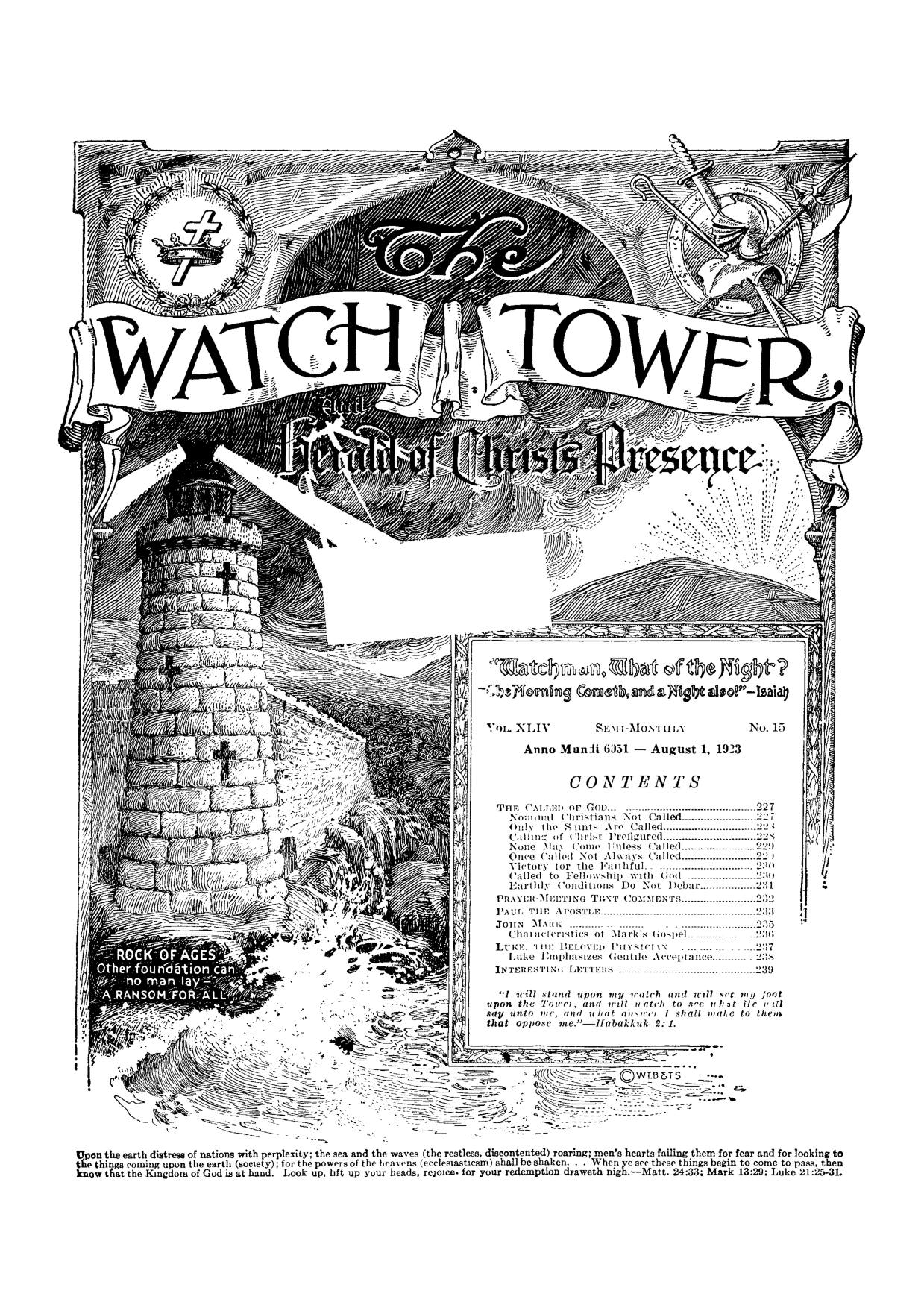
Upon the earth distress of nations with perplexity; the sea and the waves (the restless, discontented) roaring; men’s hearts failing them for fear and for looking to the things coming upon the earth (society); for the powers of the heavens (ecclesiasticsm) shall be shaken. . . When ye sec these things begin to come to pass, then know that the Kingdom of God is at hand. Look up, lift up your heads, rejoice, for your redemption draweth nigh.—Matt. 24:33; Mark 13:29; Luke 21:25-31.
THIS JOURNAL AND ITS SACRED MISSION
FpHIS journal Is one of the prime factors or instruments in the system of Bible instruction, or “Seminary Extension*’, now bei&g presented in all parts of the civilized world by the Watch Tower Bible & Tract Society, chartered A. D. 1884, “For the Promotion of Christian Knowledge”. It not only serves as a class room where Bible students may meet in the study of the divine Word but also as a channel of communication through which they may be reached with announcements of the Society’s conventions and of the coming of its traveling representatives, styled “Pilgrims”, and refreshed with reports of its conventions.
Our “Berean Lessons” are topical rehearsals or reviews of our Society’s published Stidies most entertainingly arranged, and very helpful to all who would merit the only honorary degree which the Society accords, \iz., Veibi Dei Minister (V. D. M.), which translated into English is Minister of God’s Word. Our treatment of the International Sunday School Lessons is specially for the older Bible students and teachers. By some this feature is considered indispensable.
This journal stands firmly for the defense of the only true foundation of the Christian’s hope now being so generally repudiated —redemption through the precious blood of “the man Christ Jesus, who gave himself a ransom [a corresponding price, a substitute] for all”. (1 I’eter 1:19; 1 Timothy*2 : G) Building up on this sure foundation the gold, silver and precious stones (1 Corinthians 3: Ills ; 2 Peter 1:5-11) of the Word of God, its further mission is to “make all see what is the fellowship of the mystery which. . Jias been hid in God, ... to the intent that now might be made known by the church the manifold wisdom of God”—“which in other ages was not made known unto the sons of men as it is now revealed”.—Ephesians 3 : 5-9,10.
It stands free from all parties, sects and creeds of men, while it socks more and more to bring its every utterance into fullest subjection to the will of God in Christ, as expressed in the holy Scriptures. It is thus free to declare boldly whatsoever the Lord hath spoken—according to the divine wisdom granted unto us to understand his utterances. Its attitude is not dogmatic, but confident; for we know whereof we affirm, treading with implb it faith upon the sure promises of God. It is held as a tiust, to be used only in his service; hence our deci-ions relative to what may ami what may not appear in its columns must be according to our judgment of his good pleasure, the teaching of his Word, for the upbuilding of his people in grace and knowledge. And we not only invite but urge our readers to prove all its utterances by the infallible Word to which reference is constantly made to facilitate such testing.
TO US THE SCRIPTURES CLEARLY TEACH
That the church is “the temple of the living God”, peculiarly “his workmanship” ; that its construction has been in progress throughout the gospel age—ever since Christ became the world’s Redeemer and the Chief Corner Stone of his temple, through which, when finished, God's blessing shall come “to all people”, and they find access to him.—1 Corinthians 3* , 17; Ephesians 2:20-22;
Genesis 2d : 14 ; Galatians 3 : 29.
That meantime the chiseling, shaping, and polishing of consecrated believers in Christ’s atonement foi ^.ogresses; and when the last of these “living stones”, “elect and precious,” shall have been made ready, the great Master \\ «>. >iuan will bring all together in the first resurrection; and the temple shall be filled with his glory, and be the meeting place between God and men throughout the Millennium.—Revelation 15:5-8.
That the basis of hope, for the church and the world, lies in the fact that “Jesus Christ, by the grace of Cod, tasted death for every man,”, “a ransom for all,” and will be “the true light which lighteth every man that cometh into the world”, “in due time”.— Hebrews 2:9; John 1: 9 ; 1 Timothy 2:5, G.
That the hope of the church is that she may be like her Lord, “see him as he is,” be ‘ partaker of the divine nature,’ and share Lia glory as his joint-heir.—1 John 3.2; John 17:24; Romans 8:17; 2 Peter 1:4.
That the present mission of the church is the perfecting of the saints for the future work of service; to develop in herself every grace; to be God’s witness to the world ; and to prepare to be kings and priests in the next age.—Ephesians 4:12; Matthew 24: 14 ; Revelation 1:6; 20 : 6.
That the hope for the world lies in the blessings of knowledge and opportunity to be brought to all by Christ’s Millennial kingdom, the restitution of all that was lost in Adam, to all the willing and obedient, at the hands of their Redeemer and his glorified church, when all the wilfully wicked will be destroyed.—Acts 3: 19-23; Isaiah 35.
■Published ay
WATCH tower. BIBLE & TRACT SOCIETY/
18 CONCORD STREET O 0 BROOKLYN. NY. U SA
Foreign • Offices : Bntish ' 34 Craven n.i.n-e, -Lancaster Gate, London W. 2 ; Canadian: 270 Dundas St., W., Toronto, Ontario ; Australasian: 495 Collins St., Melbourne, Australia ; South African: 6 Lelie St., Cape Town, South Africa.
Pi.i.ist. Auunr.oS the Society in Every Case.
YEARLY SUBSCRIPTION PRICE: United States, $4.<>0 ; Camio and Miscellaneous Foreign, ?1.50 ; Great Britain, Ai stiiat vsiv, and South Africa, Ss. American remittances should be made- by Express or Postal Money Orders, or by Bank Draft. Canadian. British. South African, and Australasian remittances should be made to b> am h offices only. Remittances from scattered toreigu territorj may be made to the Brooklyn olhee, but by International Postal Money Oidi-is only (Foreign tianslalions of this journal i.piicar in several langmmml
Editorial Committee: This journal is published under the supervision of an editorial committee, at least three of whom lune read an 1 approved as truth each and every article appearing in these column-The names of the editorial committee are; J. F. lit thi.i-.i mm W, E. Van Amburgh, J. Hemep.y, G. H. Fisher, It. H. Barbli:. Terms to the Lord’s Poor- All Bible students who by reason < f old age or other infirmity or adveisity. aie. unable to ; ay lor tin-journal, will be supplied free if they send a postal < . -i each M.ij staling their case and ieipn-stinK such provision. We are not only willing, but anxious, lb.it till such be on our list continually and in touch with the Berean similes_____
Notice to Subsci ibers: We do not, as a rule, send a caid of acknowledgment for a renewal or for a new subscription. Receipt and entry of renewal are indicated within a month by change in expiration date, as shown on wrapper label.
Entered as Second Class Matter at Brooklyn, N.Y Posto/Jice 2 Act of XI ar ch 3rd 1879.
HYMNS FOR SEPTEMBER
Sunday
2(56 30 26
Monday
4(5
IO
30!)
Tuesday
Wednesday
8.5
Thursday
.83
Friday
Saturday 1 10
CONVENTION IN NEW YORK
The International Bible Students will hold a five-day convention in New York City October IS to 22, inclusive.
For Sunday, October 21, Madison Square Garden, America’s greatest assembly hall, has been taken. In the ;i.,er-noon the public will be addressed there by Brother Rutherford.
Monday, October 22, will be a service day. All who attend the convention will be given an opportunity to participate in actual canvassing for the books. All who intend to engage in this service should file their names with the Service Director on or before October 19, and have their territory assigned. Address E. J. Lueck, 241(1 Seymour Avenue, Bronx, New York.
Friends in the vicinity of New York are earnestly requested to actively participate in this convention and make it a great witness for the King and his kingdom.
For information concerning hotel and rooming accommodations please address T. 11. Bedwin, 8118 95th Avenue, Woodhaven, L. I., New York.
IN RE LOCAL CONVENTIONS
A number of the classes arrat for a local convention, and then request the office lo st nd Pilgrims. While we are anxious to cooperate and send the speakers, this is not always possible: for it is necessary for the office to make the appointments several weeks in advance; and this being done it is often true that we are unable to furnish the Pilgrims when desired for local conventions. The better plan would be for any class anticipating a local convention to write first to the office to see whether it will be convenient to send speakers for the time desired; and if not, then another date can be fixed. In tills way we shall be able to cooperate in a better manner.
(Conventions continued on page 239)
AND HERALD OF CHRISTS PRESENCE
Vol. XLIV
August 1, 1923
No. 15
THE CALLED OF GOD
"Judas, a servant of Jesus Christ, and brother of James, to them that are called, beloved in God the Father, and hept for Jesus Christ."—Jude 1, B. V.
THE revised rendering of this passage is a little better than the King James version; for it shows more accurately to whom the epistle is addressed. It is addressed to the New Creation.
2Before we came into the light of the truth now shining for the people of God, there were probably some of us who had the thought that everybody is called by the gospel. We had a way of arguing to ourselves that not only were ah people living in so-called Christian lands called to be followers of Christ, but that even those who had never heard of Christ were responsible because they had the light of conscience and that thus, in. a way, they were called to do the best they could, and perhaps if they did this they might be saved. All this is very unscriptural, hence untrue; but it helped us to bear the thought that most of the heathen must suffer eternally because of the failure of ourselves and others to take to them the message of salvation.
3As the eyes of our understanding opened wider we came to appreciate the full significance of the statements of the Scriptures that “all have sinned and come short of the glory of God,” and that the only effect of the law of conscience written in the heart of the heathen is to make them feel their undone condition, their alienation from God. Travelers in heathen lands confirm this. The heathen instinctively know that they are cut off from God; and hence, as the Apostle declares in the first chapter of his epistle to the Romans, they are given over to idolatry and every form of defilement of mind and body. They cannot in any sense of the word be considered as called. None are called until they have heard; and the heathen have never heard. “Whosoever shall call upon the name of the Lord shall be saved. [And he will not be saved otherwise.] How then shall they call on him in whom they have not believed? and how shall they believe in him of whom they have not heard? and how shall they hear without a preacher?” •—Romans 10:13,14.
4The apostle Paul was a real Bible student; and in his epistle to the Romans he was writing to Bible students who, like himself, were familiar with the Word of God. After making the statement just quoted from the tenth chapter of Romans he corroborates it by two quotations from the prophecy of Isaiah, to the effect that the gospel will some day be preached to all men; and then he clinches his argument and shows the uncalled condition of the heathen by concluding that “faith cometh by hearing, and hearing by the word of God.”—Romans 10:17.
5There is not the slightest intimation in the Scriptures that there is salvation to any without faith in the promises of God’s Word. It is as true of the heathen as it was of the Jews on the day of Pentecost that “there is none other name under heaven given among men, whereby we must be saved” (Acts 4:12), but the name of Jesus only.
6Not only have the heathen not been called during the Gospel age, but the gospel call was turned away from them, deliberately and intentionally. St. Paul and Silas “were forbidden of the holy spirit to preach the word in Asia”; and it was when they had thought to go into Bithynia they were also forbidden. (Acts 16: 6, 7) This must seem strange to those who feel that the most important obligation laid by the Lord upon his people is to proclaim the gospel among the heathen.
NOMINAL CHRISTIANS NOT CALLED
7It is easier to prove that the heathen are not called than it is to prove that nominal Christians are not called, but that seems to be the purport of the Scriptures. The Greek words kletos and Iclesis, translated called and calling, seem to have the thought of invitation; and it is quite plain that hosts of nominal Christians have never heard the call to the high calling, for they do not even know what it is.
8The Lord is authority for the statement that “many are called” (Matthew 22:14), many are invited; but this is far from saying that all are invited, even all in Christian lands. The Apostle narrows, or seems to narrow, the call to a certain class when he says: “Ye see your calling, brethren, how that not many wise men after the flesh, not many mighty, not many noble, are called; but God hath chosen [to invite] the foolish things of the world, to confound the wise; and God hath chosen [to invite] the weak things of the world, to confound the things which are mighty; and base things of the world, and things which are despised, hath God chosen [to invite |. yea, and things which are not [of consequence] to bring to nought things that are: that no llesh should glory in his presence.”—1 Corinthians 1: 26-29.
22T
9It is obvious, then, that if God has chosen to limit largely his invitation to certain classes his ultimate choice will be found in those same classes. Many of the class named have been called with tin' heaienly calling; many have understood; many have accepted: and a few of them—144,000 in all—wdl be chosen to the high position to which all wore called in the one hope of their calling, the high calling.—Ephesians 4: 4.
“The apostle Peter also circumscribes the calling of God when he says: “The promise [of the holy spirit] is unto you [Jews who are already in covenant relationship with God] and to your children [who have the next best opportunity of being invited], and [after that] to all that are afar off, even as many as the Lord our God shall call.”—Acts 2: 39.
“The narrowing-down process is continued by the apostle Paul in Romans 8: 30, where he shows that none are really called with the heavenly calling except those who are justified; and as Watch Tower readers are aware we hold. Scripturally we think, that consecration precedes justification. “Moreover, whom [as a class] he did predestinate, them he also called: and whom he called, them he also [previously] justified.” —Romans 8:30.
ONLY THE SAINTS ARE CALLED
12By a gradual process we have now arrived at the base of the matter; namely, that the only ones to whom the heavenly Father graciously extends an invitation to be of the bride of Christ are his saints, those who are wholly devoted to the doing of his will. And this is as we should expect. It will appeal to all as eminently fitting that an invitation to the highest place in the universe should be reserved for those alone whose gratitude to the Father for all his blessings so wells up within their hearts that they can do no less than give to him their all. And now let us note some Scriptures that show that God’s calling is to his saints, and to them only:
““Paul, a servant of Christ Jesus, a called [invited] Apostle, separated unto God’s joyful-message . . . . among whom are ye also, called ones of Je-us Christ: To all those who are in Rome, beloved of God, called [invited] saints—favor to you, and peace, from God our Father, and the Lord Jesus Christ." (Romans 1: 1, 6, 7, Rotherham’s Translation) In this translation the words in italics are set off in the Greek as requiring special emphasis. It is apparent that great emphasis is laid by the Apostle upon the fact that he was invited to his high station as an apostle, and that he was limiting his epistle to a class similarly invited, a class whom he designates as saints. In the same translation the same thought is conveyed in the translation of the familiar passage. Romans 8:28: “But we do know that to those who love God, all things are working together for good—to those who, according to purpose, are called-ones [invited ones|.”
“Looking forward to the work of the Millennium, and the part that will then be played by Zion, the heavenly phase of the kingdom, and Jerusalem, the city of the great King, from which latter the law of the Lord is to issue at the hands of the ancient worthies, the Prophet says: “In mount Zion and in Jerusalem shall be deliverance, as the Lord hath said, and in the remnant whom the Lord shall call.” (Joel 2: 32) Thus we have additional evidence of uhat we know to be a fact, namely, that it was only the saintly among the fle-hly Israelites that wore really called to be of the bride of Christ. The red claimed to be the covenant people of God, but they were really not such. Only the saints, the truly consecrated, were actually in covenant relationship. And, as we have seen, the same principle applies in the case of nominal spiritual Israel. The Apostle reminds us that some of the called wore Jews and some Gentiles when he says: “What if God, willing to shew his wrath, and to make his power known, endured with much longsuffering the vessels of wrath fitted to destruction: and that he might make known the riches of his glory on the vessels of his mercy, which he had afore prepared unto glory, even us, whom he hath called, not of the Jews only but also of the Gentiles?”—Romans 9: 22-24.
CALLING OF CHRIST PREFIGURED
“The calling of our Lord Jesus was a little different from the calling of any that will go to make up the members of his mystical body. The heavenly Father knew when Jesus divested himself of the glory which he had had with him before the foundation of the earth was laid, that Jesus would be the Christ. He knew that Jesus would be faithful; and so, in Jesus’ case, he was called, in <ome sense of the word, from the moment of his birth. This was illustrated in the tabernacle arrangements.
“When the time came for the building of the tabernacle in the wilderness God called by name, and particularly and specially designated and invited, one individual to have charge of the work of preparing the tabernacle furnishings. This one represented Christ; and the spirit or power which came upon him, illuminating and fecundating his mind mechanically, without affecting him in any moral sense, illustrated the holy spirit which came upon Christ at the time of his anointing. The account reads:
““And the Lord spake unto Moses, saying, See, I have called by name Bezaleel [Shadow of the Almighty: what a beautiful title for the Almighty to give to his first and best loved son!] the son of Uri [Light—the light of the world], the son of Hur [Grave—in which the Son of man lay for three days asleep in death], of the tribe of Judah [Praised—in his pre-human existence] : and I have filled him with the spirit of God, m wisdom, and in understanding, and in knowl dm', and in all manner of workmanship, to devise cunning works, to work in gold [symbol of divine nature], and in silver [svmbol of truth and of spirit nature], and in brass [copper—perfect humanity], and in cutting of stones [jewels—the Lord’s jewels] to set them, and in carving of timber [pillars in the Holy], to work in all manner of workmanship.” (Exodus 31:1-5) What a calling; what an invitation 1
lsAnd the call of the church is not less noble, not less thrilling. It is made softly. It is a call to the heart, not merely to the cars. It may not bo in the palace, or the softly carpeted church with its stained glass windows and entrancing music. It may bo in the loneliness of a life which has little of real companionship in the world except that to be found in fellowship with the Lord. It may be in some little hall the furnishings of which are few and simple; it may be when some child has gone wrong, and the broken heart has turned at last to the fountain of life and peace. The call is so sweet, so tenderly phrased, that none that have heard it can ever forgot its effect upon their hearts:
’““Hearken, 0 daughter, and consider, and incline thine ear [to the call] ; forget also thine own people [earthly ties], and thy father’s house | the earthly hopes of Adam’s children] ; so shall the King greatly desire thy beauty; for he is thy Lord; and worship thou him.” (Psalm 45:10,11) All that Christ was called to. the bride is called to; all that he is to have, the bride is to have; in all that he is to do, the bride is to lune a share. But he wdl always be the Hoad of the body; and she will always wish to have it so, that in all things he might have the preeminence, whose it justly is.
NONE MAY COME UNLESS CALLED
200ur Lord Jesus did not invite himself to be man’s redeemer and re'-tori r. The imitation to this exalted office came from God, not from man. Even in the Aaronic priesthood the Lord reserved to himself the right to designate who should serie him in holy things. “And no man taketh this honor unto himself, but he that is called of God, as was Aaron. So also Christ glorified not himself to be made an high priest; but he that said unto him, Thou art my Son, today have I begotten thee.”—Hebrews 5 : 4, 5.
2’We can see an illustration of this principle in the attempt of the once wise and great King Uzziah. “His name spread far abroad; for he was marvelously helped, till he was strong. But when he was strong, his heart was lifted up to his destruction: for he transgressed against the Lord his God, and went into the temple of the Lord to burn incense upon the altar of incense. And Azariah the priest went in after him, and with him fourscore of the priests of the Lord, that were valiant men: and they withstood Uzziah the king, and said unto him. It appertameth not unto thee, Uzziah, to burn incense unto the Lord, but to the priests the sons of Aaron, that arc consecrated to burn incense: go ' lit of the sanctuary; for thou hast trespassed; neither shall it be for thine honor from the Lord God. Then Uzziah was wroth, and had a censer in his hand to burn income; and while he was wroth with the priests, the leprosy even rose up in his forehead Irfore the priests in the house of th" Lord, from beside the incense altar.”— 2 Chronicles 2G : 15-19.
22What lie see illustrated in the case of King Uzziah is also an underlying principle of the book of Esther. Much of the interest in this book centers in the fact that none could enter the presence of the king without being called, without being invited. The opening chapter is the account of the beautiful Vashti, who spurned the king’s invitation to come before him, and whose failure to do so led to her degradation and expulsion from the royal palace. The picture of fleshly Israel’s failure to listen to the heavenly message seems here in evidence. Then comes the beautiful story of the lowly Esther’s selection and exaltation, representing apparently the true church, gathered out from both Jews and Gentiles.
23A wicked conspiracy had been made against the Jews, to put them all to death. Esther, a beautifu. voung Jewess, had been urged to go before the king and plead for her people. Sho finally did so, and with success, but pleaded with her Jewish brethren meanwhile to fast in her behalf, reminding them that •’all the king's servants, and the people of the king’s provinces, do know, that whosoever, whether man or woman, shall come unto the king into the inner court, who is not called, there is one law of his to put him to death, except such to whom the king shall hold out the golden seentre, that he may live.”—Esther 4: 11.
ONCE CALLED NOT ALWAYS CALLED
21Xone need get the thought that became they hive once been called with the one hope of our calling tii y are always called. There is a limit to God’s favors. He is not calling into the bride class any who have once known him and then have mea.-urably forgotten h.m. The Scriptures define these as wicked. The wicked are not the godless who have never heard; they are designated as those who have heard and have turned back, turned awav from the truth, turned again to the dmim
. * . ' - o
of their own wills. These the Psalmist addresses:
2”‘AVhat hast thou to do, to declare my statutes, or that thou shouldest lake my covenant in thv mouth? seeing thou hatest instruction, and easiest my words behind thee. When thou sawest a thief [a self-seek er, looking out for his own fame and pelf instead of the feeding of the Lord’s flock] thou consentedst with him, and hast been partaker [engaged in similar work] with adulterers [Babylon and her sectarian daughters, organizing additional sects]. Thou givest thy mouth to evil, and thy tongue frameth deceit. Thou sittest and speak-est against thy brother; thou slanderest thine own mother’s son. These things hast thou done, and I kept silence; thou thoughtest that I was altogether such an one as thyself; but I will reprove thee, and set them in order before thine eyes. Now consider this, ye that forget God, lest I tear you in pieces, and there be none to deliver.”—Psalm 50: 16-22.
VICTORY FOR THE FAITHFUL
20Those who have been invited to Jehovah’s great feast of love, and who remain in the heart relationship with him in which they were at the time when they heard and responded to his gracious call, will be the ones upon whom the laurels of victory will ultimately rest. Just at this time these called ones have a mighty message to deliver, a mighty work to perform. It is their privilege, it is their duty, to proclaim that gentile times have ended, that the time of God’s anger is here, and that earth’s new King, her rightful ruler, is even at the door, nay is even now setting up his kingdom. Hear the Prophet:
27“I have commanded my sanctified [consecrated— R. V.] ones, I have also called my mighty ones [mighty in the Scriptures, mighty toward God] for mine anger [to declare that the day of wrath is here], even them that rejoice in my highness.” (Isaiah 13:3) It is to this class of called ones that rejoice in God’s highness at the same time that they are profoundly impressed with their own and other men’s littleness that God will give the great victory. And so we read that in the Lamb’s hour of victory over the beast and his image all those who share the victory with him “are called [remain called, continue to appreciate their invitation] and chosen [become God’s final choice for the greatest of all high honors], and faithful [rejoicing in God’s highness and in their own littleness even to the end].” —Revelation 17: 14.
28While the bride will be with her Lord in the hour of victory, and while she will participate in the victory, yet the real victor in the conflict is Jehovah himself, the one who called his people to himself. See how this is expressed by the Prophet:
29“Fear not: for I have redeemed thee; I have called thee by thy name; thou art mine. When thou passest through the waters, I will be with thee; and through the rivers, they shall not overflow thee: when thou walkest through the fire, thou shalt not be burned; neither shall the flame kindle upon thee. For I am the Lord thy God, the Holy One of Israel, thy Savior. . . . Since thou wast precious in my sight, thou hast been honorable, and I have loved thee: therefore will I give men for thee and people for thy life. Fear not: for I am with thee: I will bring thy seed from the east, and gather thee from the west; I will say to the north, Give up; and to the south, Keep not back: bring my sons from far, and my daughters from the ends of the earth; even every one that is called by my name; for I have created him for my glory; I have formed him; yea, I have made him.” (Isaiah 43:1-7) This prophecy applies to both the houses of Israel, fleshly and spiritual.
CALLED TO FELLOWSHIP WITH GOD
S0Though the passage be a familiar one to the readers of The W’atch Tower, we cannot forbear to quote again a passage from the pen of Pastor Russell which has led many to a deeper walk with God because it has helped them to better understand the heart of the Infinite One, whose life is love:
sl“0ur recovery cost the sacrifice of the dearest treasure of his heart, and the subjection of this Beloved One to the most abject humiliation, ignominy, suffering and death. Ah, did the Father let him go on that errand of mercy without the slightest sensation of sorrowful emotion? Had he no appreciation of the pangs of a father’s love when the arrows of death pierced the heart of his beloved Son? When our dear Lord said: ‘My soul is exceeding sorrowful, even unto death,’ and again: ‘Father, if it be possible, let this cup pass from me: nevertheless, not as I will, but as thou wilt,’ did it touch no sympathetic chord in the heart of the Eternal? Yea, verily.”—Z’95-154.
32It is to fellowship with this infinite heart of Love that the saints are called, fellowship with the One who for thousands of years has been reproached by evil angels and evil men, who have not understood or who have sought to thwart his benevolent designs and thus have caused him sorrow. These sorrows, these reproaches, came upon Jesus and have come upon us.
S3That one of the conditions of our call is that we must suffer here, is the testimony of many passages in the Word. And we are even to suffer for doing that which is right. “If when ye do well, and suffer for it, ye take it patiently, this is acceptable with God. For even hereunto were ye called.”—1 Peter 2: 20, 21.
34In this call to suffer we are called unto fellowship with both our Lord Jesus Christ and our heavenly Father; for so the Scriptures declare: “God is faithful, by whom ye were called unto the fellowship of his Son Jesus Christ our Lord.” And in the’Sinaitic text of 2 Peter 1: 3 we are told that God “hath called us to his own glory and virtue,” by his very willingness to share present reproaches with us that he may the more abundantly bless us hereafter. If we evade the suffering and the reproaches here, we shall also escape the chief blessing and glory hereafter.
S5Notice how in the Diaglott rendering of Romana 8:17 the thought is borne out that the suffering and the future inheritance are shared jointly by the Father and the Son and the church: “The spirit itself testifies together with our spirit, that we are children of God. And if children, also heirs, indeed, of God, and joint-hen^ with Christ; if indeed, we suffer together, so that we may be also glorified together.”
EARTHLY CONDITIONS DO NOT DEBAR
3fiThe Lord has called, invited, his people from every condition of earthly environment. The Apostle has discussed this whole subject plainly in 1 Corinthians 7: 17-24 and his language is so clear that we reproduce it: “But as God hath distributed to e\ery man, as the Lord hath called every one, so let him walk. And so ordain I in all churches. Is any man called being circumcised? let him not become uncircumcised. Is any called in uncircumcision? let him not be circumcised. Circumcision is nothing and uncircumcision is nothing, but the keeping of the commandments of God. Let every man abide in the same calling | occupation— if it is honorable] wherein he was called [in which he was at the time he was called with the heavenly calling]. Art thou called being a servant? care not for it: but if thou mayest be made free, use it rather. For he that is called in the Lord, being a servant, is the Lord’s freeman: likewise also he that is called, being free, is Christ’s servant. Ye are bought with a price; be not ye [at heart] the servants of men. Brethren, let every man, wherein [in whatever estate or occupation] he is called | with the heavenly calling], therein abide with God.”
37The Lord’s saints are called unto liberty, although they are to use that liberty not for an occasion to the flesh, but to serve one another. (Galatians 5:13) They are called to peace in their homes if that is obtainable (1 Corinthians 7:15) ; but if it is not, they are called to peace in their hearts anyway. (Colossians 3:15) They are called to holiness, as opposed to uncleanness (1 Thessalonians 4:7); they are called to holiness because they are called to be God’s children, members of his family (1 Peter 1:14-17); they are called to be saints. (1 Corinthians 1: 2) There is an implication in this verse that this particular epistle was addressed to some who were not called, some who were not saints, but who had faith in the Lord and were associated with the Lord’s people and were ble»ed thereby. Or it may be that the reference is to all other called ones, all other saints, elsewhere than at Corinth.
ssThe Lord has called his people to such good things. In the first place all who have been called throughout the Gospel age have been called in one hope of their calling. (Ephesians 4:4) ’They have been called to eternal life. (1 Timothy 6: 12) They have been called
to obtain the glory of the Lord Jesus Christ. (2 Thessalonians 2:14) They have been called to obtain the glory of the God of all grace. (1 Peter 5:10) They have been called to a place in God’s kingdom. (1 Thessalonians 2: 12) They have been called to receive an eternal inheritance. (Hebrews 9:15) They have been called to inherit the greatest of blessings, the privilege of blessing all the families of the earth. (1 Peter 3:9) Hence the Lord’s saints have been called according to a purpose (2 Timothy 1:9); they have been called to be earth’s future kings and priests (1 Peter 2:9, ; and it is this blessing of the
■world that is the hope of their calling.—Ephesians 1:18.
•"■"What wonder, then, that the apostle Paul besought the Ephesian church to walk worthy of the vocation wherewith they were called (Ephesians 4:1); and that he prayed for the Thessalonian brethren that they too might be worthy of that same calling I—2 Thess. 1: 11.
40What wonder that St. Peter urged the brethren to give diligence that through their good works they should make their calling and election sure (2 Peter 1:10, Sinaitic text) ; and what wonder that, as our opening text (Jude 1) declares, such a class of called ones are beloved in the Father (in his heart) and that he is keeping them, keeping this jewel class for Jesus Christ, to be his eternal companion, the joy and satisfaction of his heart!
QUESTIONS FOR BEREAN STUDY
Is the “light of conscience” a guide to salvation? H 1, 2.
What should the conscience do for the heathen, and what is a prerequisite to salvation? II 3.
How doos the Apostle conclude that the heathen are not called? U 4.
Thiough what name only must all be saved? 1j 5.
What is the significance of the gospel message traveling west from Palestine'' 1' (>.
Do the masses of so-called Christians know of the “high calling?”
Is there a great response to God’s invitation to salvation? If 8.
Docs God make choice from amongst the called ones, thus further restricting the salvation of tin* Gospel age*' ,9.
How is the narrowing dow n process further shown? 1]10,ll.
Wlmt class, then, does the heavenly Father delight to honor? U 12,
Wlmt is meant by the “deliverance” being made “in the remnant"? II 14.
Is there any difference between the calling of Jesus and of his both ■' 11 15.
Show how God prefigured the coming of Chiist. T1G, 17
In what thrilling phrase does God call the church? i| 18,19.
Did Jesus call himself and aspire to be God’s High Priest? 1120.
How did God show disfavor toward one who aspired to function in a place where he was not called? 1J 21.
How is this principle set forth in the Book of Esther? H 22. 23.
When once in grace, what are the conditions of remainin'1’ in grace ’ 1124.25. =
To whom will the laurels of victory finally go? 1[ 2G, 27.
To whom does the glory go, and who is the real victor’' U 28 29.
What^gracious^words have been uttered showing the tenderness of
whose sorrows and reproaches do the saints privilege? 1| 32, 33.
share, and is this a
Where and how is this specially shown? 1134.35.
Are earthly conditions and environments barriers II 35
to God’s call?
Wlmt kind of “liberty” do God’s saints exercise themselves in and how ? 1! 37. ’
To what are they called, and how honorable is this’ U 38 How are the saints admonished by Paul and Peter? U 39, 40.
“To do thy will is more than praise, As words are less than deeds;
And simple trust can find thy ways We miss with chart of creeds.
“Apart from thee all gain is loss, All labor vainly done;
The solemn shadow of thy cross Is better than the sun.”
PRAYER-MEETING TEXT COMMENTS
TEXT FOR SEPTEMBER 5
"Be filled with the spirit."—Ephesians 5:18.
EVERY new creature in Christ must have some measure of the holy spirit. “If any man have not the spirit of Christ, he is none of his.” (Romans 8:9) Being filled with the spirit is the result of the divine power and holy influence working in the creature. It creates in such the holy influence and disposition. In order for one to grow up into Christ Jesus the process of filling with the holy spirit must continue until transformation into the likeness of the Lord is complete. One’s ability in the sight of the Lord is determined by the degree of the. holy spirit possessed by him. If the creature is uncertain as to whether or not he has the truth, he cannot develop in the spirit or disposition of the Master. Having once settled it in his mind that he is a child of God, then it behooves him to go on zealously to the completion of his course.
The words of the text, “Be filled with the spirit,” suggest progression from the beginning of the Christian’s career until the full consummation of his hope. The process of filling with the holy spirit may be briefly summed up thus: Knowing the will of God and continuously doing his will with a joyful heart. The will of God is made known to us by the study of his Word and the watching of his providences. “Sanctify them through thy truth: thy word is truth.” (John 17: 17) How true this statement: “It is in vain that we seek to be filled with the holy spirit if we do not give attention to the divine arrangement provided for this very purpose” I (E-245) The Lord has revealed to his people his provision for their being filled with his holy spirit; namely, by the study of his Word and of the Bible helps provided by him; by prayer and fellowship with the Lord through the spirit; by assembling together with others of like precious faith, and together feeding at his table and building one another up; and by keeping the mind and the hands engaged in things pertaining to the Lord’s kingdom.
We must realize that our participation in the work of looking after the interests of the Lord’s kingdom is a real thing; and we should be particularly enthused with the things pertaining to the King's business. By these means we arc gradually filled with the spirit of the Lord; and persisting in this course, the ultimate result will be a complete change into his likeness.
TEXT FOR SEPTEMBER 12
"Because ye are sons, God hath sent forth the spirit of his Son into your hearts, crying, Abba, Father."— Galatians h: 6.
FATHER means life-giver. The realization that one has life brings joy of heart with gratitude and thankfulness to the Giver. The ideal relationship between the father, the life-giver, and the son is a sweet and blessed one. There is a perfect confidence on both sides. There is true fellowship between them. Each one delights in the other. We have become sons of God because Jehovah has freely justified us upon the basis of the precious blood of Christ Jesus, has accepted us as a part of his sacrifice, and begotten us to the same nature of our Lord, thereby adopting us into the body of Christ, making us members of the house of sons, if so be that we continue to fulfil our covenant, rejoicing in the hope even to the end.
Now we can truly and joyfully say: filehoiah. thou art my Father, and thy will I delight to do.’ This is the spirit or disposition of his beloved Son; and this spirit he hath sent forth into our hearts. One possessing that spirit or disposition loves the Lord. He who loves the Father joyfully keeps his commandments (l.John 5 : 3), and he has the assuiance of the lo\e of the Father and of Christ Jesus. (John 14:21,23) It was the spirit and disposition of Jesus when on earth to give all credit and honor to the Father, taking none to himself. “I can of mine own self do nothing.” (John 5 : 30) “For I came down from beaten, not to do mine own will, but the will of him that sent me.” (John 6: 38) It was not his spirit or disposition to seek his own glory, but the glory of his Father. (John 7:18) Because ho delighted in the Father’s will the Father lo\ed him. (John 10:17) The perfect, ideal relationship existed, and always will exist, between the Father and the Son.
The degree of our enjoyment of this sweet fellowship with our Father in heaven depends upon our being filled with the holy spirit. The Christian who increases in the spirit of the Lord enjoys that calm, trustful and abiding confidence in the Lord that brings complete rest and peace, and with joy he cries out: “My Father, my Father!” This spirit or disposition impels him to look about earnestly to see what he can do to glorify the Father's name.
‘Were half the power that fills the world with terror,
Were hull the wealth bestowed on camps and courts, Civen to redeem the human mind from error, There were no need for arsenals or forts.
The warrior's name would be a name abhorred I
And every nation that should lift again
Its hand against a brother, on its forehead
Would forever wear the curse of Cain 1
‘'Down the dim future, through long generations, The echoing sounds grow fainter and then cease.
And like a bell, with solemn, sweet vibrations, I hear once more the voice of Christ say, ‘Peace 1’ Peace! and no longer from its brazen portals
The blast of war’s great organ shakes the skies!
But, beautiful as songs of the immortals, The holy melodies of love arise.”
PAUL THE APOSTLE
----Si.ptf. viber 2----Acts 22:3, 6-10; Phil. 3:7-14----
PAUL BECOMES HUMBLE FOLLOWER OF JESUS—COD BESTOWS GREAT HONOR UPON PAUL—PAUL SWEETENS HIS MESSAGES.
“I press on toward the goal unto the prize of the high calling of God in Christ Jesus.”—Philippians 3:14.
NEXT to his Master the apostle Paul is the greatest figure of the New Testament. His place there corresponds to that occupied in the Old Testament by Moses. As Moses was the chiel'est exponent of the will of Cod for Israel, so Paul was the chiefest exponent of the doctrine of Jesus, the Head of the church. But these two men, who in the providence of God have most influenced the world, were very different in character and in bodily presence, even as their work differed. Moses was called to lead Israel like a shepherd, whereas Paul was sent abroad to find the sheep of his Master’s flock. In Moses Israel had a tine personal presence suited to the office; but for the saints who followed the way of truth there was neither such need nor any preparation. The truth which came by Jc'-us was to be received in spirit: that which made spiritual Israel one flock did not call for such leadership as was nec.'ssiry in fleshly Israel. It is not without meaning that Pa-1 had not much bodily presence. He was probably small in ' mature, and not specially good-looking; his enemies spoke of him as being wink in bodily presence. (2 Corinthians 10: 10) Nor was he robust; indeed, he was often ailing and needing care. Yet few men have endured more than he: only an indomitable spirit, and an ardent love for God and the Lord could have enabled him to bear the hardships of his ministry. Very fittingly he had the power of attracting men to himself, and of drawing their love to him. Indeed, he was loved beyond ordinary, both because he himself v is a lover and because he was so devoted.
-When Paul was called (Galatians 1:13) the church in Jerusalem was provided with leaders and teachers, Peter being the foremost apostle and the church’s leader.
PAUL BECOMES HUMBLE FOLLOWER OF JESUS
■;The apostles were grand men ; but as a company they were not naturally fitted for the great work which was to be done amongst the Gentiles, nor for the special work of instructing the church of God. As God uses natural means for his purposes ■whenever possible, he raised up a man better fitted to be the teacher of the whole church than any of the already chosen apostles, and one who should in a special sense be the planter of churches in the regions beyond Palestine.
“To the apostles the Lord's choice must have seemed a strange one; probably all were in some measure tested by it. No one could hate thought that Paul, the hard Pharisee, the persecutor of the church, would be chosen to be the greatest apostle of the Lamb. But “God motes in a mysterious way his wonders to perform.’' Most things, even in th" realm of grace, seem to go in natural order; but God knows liotv to touch the unexpected and the unlikely at the ri' lit moment and to produce his desired results. The Lord spoke to Paul not a moment too soon nor too late, and it came about in the providence of God that Paul the blas-]>■ emor and opponent of Jesus of Nazareth became, the chiefest exponent of the gospel of Jesus Christ.
•"’Though Paul’s conversion was sudden, there was some preparation for it. Paul had not been so certain of his course as he professed to be; he had found it “hard to kick against the goads.” l’aul could not forget the sweetness of Stephen’s face before his accusers, nor his prayer, nor the superhuman features of that event; and every follower of Jesus whom he haled to prison was a witness to him that he was wrong and they right. And Paul being a student and well versed in Scripture, Stephen’s arguments must have had weight with him. He came near to sinning against light, and therefore near to destruction. His statement about himself is not mere hyperbole. (1 Timothy 1: 13,15) Thus when the -vision came outside Damascus it was timely; he was ready and yielded himself. He was not merely a changed man ready to cease persecuting the saints; he gave himself as an instrument for the Master’s use. His consecration was absolute. Though he bad seemed so hard, the love which in later davs so wonderfully held his colaborers must have been in him even then. If the well did not overflow, its waters were sure. Very soon a commission was given to him. He was told he was a chosen vessel to the Lord, and that a great work in life awaited him. He immediately began to preach in Damascus that Jesus of Nazareth was the Messiah; for the truth had broken upon his mind and was in his heart.
cNo man could be prepared for such service as awaited Paul without severe testings; but he could hardly have expected the schooling he was to get. lie escaped from the Jews of Damascus by being lowered down the wall in a basket; and his entrance into Jerusalem was chilling, for the church was suspicious of him. The great Apostle to the Gentiles got no special introduction to the church of God. —Acts 9:26,27.
7Paul’s decision of character, and his earnest desire to help those with whom he had associated, sent him to the synagogue where he had worshiped, and to those leaders who were the a "sers of Stephen. To them he spoke boldly n the name of the Lord Jesus. (Acts 9:29) They laid Mans to kill him; but the brethren, hearing of this, took him down to Caesarea and sent him to Tarsus in Cilicia, his home. For some years Paul labored in Cilicia; but the Scriptures give no account of those labors, nor make more than indirect reference to his work. (Acts 15:41; Galatians 1 : 21) But it seems certain that some of the many hardships he enumerates must have been experienced during that period of lonely service. It was while there he was sought out by Barnabas, and returned with him to Antioch. There he and Barnabas were set apart by the holy spirit for missionary work. Bui Paul was named second to Barnabas: the record is, “The holy spirit said, Separate me Barnabas and Saul for the work whereunto I have called them.” (Acts 13:2) It is hardly possible that Satan would allow this to pass without making it a means of temptation to l’aul. But l’aul was lowly in mind, and was ready to serve in whatever order his Lord should desire, and to use su opportunities as his circumstances and the providences of God provided. His lowliness of mind was not merely subservience to circumstances—a condition which is often accepted as humility. When they were out on the work In Cyprus, the spirit of God moved him to his place; and henceforth, with his name changed from Saul to Paul, he was the most prominent of the Lord’s servants.
GOD BESTOWS GREAT HONOR UPON PAUL
8It would not be extravagant to say that no servant of Jesus ever got more service out of a consecrated body than did the apostle Paul. His partial account of his sufferings causes surprise that he could liear so much and yet keep up with bis labors. (2 Corinthians 11:23-28) He counted it a great privilege to spend and be spent for the Master he loved, and for the brethren so dear to him, (2 CorinthIans 12:15; Philippians 3:8) It pleased the Lord to let this honored servant be much misunderstood. Called to serve in the highest place next to Ins Master, like his Master Paul received no special introduction to bis work. He had to prove himself by his mini': rj ; but his works witnessed to his aposthship, a.s Jesus' works were his witness.—1 Corinthians 9:1,2; John 10:38.
BJesus taught no doctrines. The truths which were “in him” were to be declared by his apes. les. and it pleased the Lord to have the doctrines set in order ami ex-pmuted by Paul. To this end Paul was imide thu reCpi mt o; many visions and special revelations. The oilier aposiles of necessity learned of Paul, and some of the things he taught they found hard to understand. (2 Peter 3:16) It was from Paul that the apostles and the church learned of the true meaning of the breaking of the bread and the sharing of the cup; that not only was the Lord bioken for the clmr.-h, but that the church was a sharer with him as one loaf, while the sharing of the cup was as it were his life and theirs poured out. (1 Corinthians 10: 16) It was from Paul that the church learned of the mystic body of Christ; that the Christ was not only Jesus their blessed Master, but was composed of all those who were quickened by the holy spirit, at last found faithful. (1 Corinthians 12:12) It was from him that they learned of the mystery hidden from the ages, Of the church composed of Gentiles as well as Jew's (Colos-sians 1:27) ; that the church were the firstborn who were specially saved, as were the firstborn in the houses of Israel on the night when the destroying angel went forth. (Hebrews 12: 23) That there was a second Adam being formed Of the Lord and the church (1 Corinthians 15:45), and that the reign of sin and death was to be swallowed up by the power of the grace of God in Christ Jesus. (Romans 5: 21) Also it was he who taught the church about baptism into Christ, and of the life in Christ. (Romans 6:4) Indeed, he was the Lord’s channel of truth to the church.—Rom. 2: 16.
10Paul’s tenderness and lovableness and humility are always manifest. Like his Master he was a gracious servant of God, and he could properly say: “Become imitators of me, even as I also am of Christ.” (1 Corinthians 11:1, Dtaglott) These graces were never more clearly demonstrated than in the relationship between himself and Onesimus. Between these two, the foremost Apostle of Jesus and a runaway slave, there was a bond of tender love; for Paul spoke of him as “my son Onesimus, whom I have begotten in my bonds.” (Philemon 10) This is the outstanding example of the oneness of spirit which is possible to those in Christ, a oneness not affected by age, ability, or station in life.
PAUL SWEETENS HIS MESSAGES
T1Paul is also an example to the church in his constant prayers for those who were steadfast in the faith as well as for all the churches. (Philippians 1:3-5; ct al.) A true caretaker and shepherd, he sought by prayer the interests of all the flock. His personal remembrances are in every epistle, and he loved to dwell upon personal matters m> as to sweeten his messages of love. (See Romans 16) But Paul’s strict care for the church is as his love; it was definite. He would have no compromise nor looseness in regard to the truth—“let him be cut off" is his word concerning any who would introduce false doctrines. (Galatians 1: 9) And he earnestly besought the faithful brethren to avoid those who brought dissension into the church. (Bomans 16:17) He would bear the weak and feeble in faith as tenderly as a mother bears her child (2 Corinthians 11:2); but he had no sympathy to waste on those who were not true at heart.
'-The church of God now upon earth cannot fail to see that there is in this day a wonderful, almost strange repetition of Paul's ministry, whether of instruction, or doctrine. or service. Our beloved Brother Russell was God’s gilt to us, as Paul was to the early church. He was used to give again to the Lord's people those truths which Paul gate, but which had been buried deep under creedal rubbish heaps. The doctrines previously mentioned were again made plain, and now sei in clearer light. Paul was not allowed to tell of the things he saw (2 Corinthians 12:4) ; but now m every meeting of the brethren the church speaks op'lily of them. And it v..is given to Pastor Russell more than to any other man to serve in exact measure the prescript ion of the ministry of Christ given by Paul when des -ribing his own ministry.—2 Corinthians 7.
11'od could hardly have spoken more plainly to those who proiessed to follow Christ than he lias done by Pastor Hu sell's tem-hing and as well in the manner of his service as in its effect, both in the believer and in the community of saints. Theie can be no question that these two sonants of Jesus Christ are the nearest correspondency in matter, maimer, devotion. ami in result of ,-erv ice which the history of the church a Hords.
'♦Excepting his Master, Paul's vas perhaps the most triumphant spirit of all time. But he too had his tears. He tells the Corinthians that ho served amongst them with much tear and trembling. 11 Corinthians 2:3) If he boasted, he was like the Psalmist, he boasted in the Lord. (2 Corinthians 12: 10, 11) But he was a man of like passions with those to whom he ministered the things of God. and Ills strength was gained only as he realized his weakness and his dependence on ills Master. His was a life of happy, even joyous service wrought often under most painful circumstances to body and mind. Ever keeping before him the purpose expressed in the Golden Text, he ended his course triumphant in faith. (2 Timothy 4:8) Ills earthly end was lonely; so far as we ilia) know he was beheaded by Nero. He is now amongst the glorious company who are with the Lord, triumphs of his grace.
QUESTIONS FOR BEREAN STUDY
Who is the greatest figure in the New Testament, next to our Lord? His corresponds to whoso place in Ilie Ohl To lament? What was Paul’s probable physical appearance? V- li.it makes him lovable to Christians? Til.
Who was foremost among the aposiles before Paul was called? •; 2.
Was Paul evidently better qualified lor the work anion-; the Gentiles and establishing churches beyond Palestine than the other apostles? 1)3.
Did Paul’s call seem strange? Was it a probable test to the others? Why should this be? II4.
Was there a preparation for Paul's sudden conversion’ What is meant in Paul’s statement that he was chief of sinners (1 Timothy 1:15)? Was Ins conversion timely '- What did he immediately proceed to do? T 5.
Did the Apostle receive some severe testings? TO.
Was Paul a brave brother? Whole did he labor for some time? What induced him to go to Antioch? Who was mimed fust by the holy spirit? Why would this he a test of Paul’s humility? When was Paul advanced bv the spirit to his true position? Ti 7.
Did Paul get much service out ot his consecrated body? What was it that proved his apostleship? TI 8.
What is the contrast in the type of ministry of Jesus and Paul? From whom did the apostles and the early church learn about doctrines ? 1J 9.
What characteristics enter into the nobiiily of Paul'' In what incident is the oneness of the body of Christ beautilully exemplified ' How may we follow Paul.' T 10.
In what other ways is Brother Paul our example? Was he a strict caretaker of the churches and of the brethren? For v.hom did he not care to waste his valuable time? f 11.
As the Gospel age has special light at both ends, who serve I as a great illuminator at the beginning? Who serves at its (lose? Is the Bilde becoming an open Book? T 12.
What noble thing can be testified of these loving, humble sen anta of the Lord ? T 13.
Who, perhaps, had the most triumphant spirit of all time, m-xt to Jesus? IIow did Paul’s earthly career end? Where is he now? 114.
JOHN MARK
----September 9----Acts 12:12, 25 -13:13 ; 15 : 36-40; 2 Timothy 4:11---- BT. PETER’S ENDEARING NAME FOB MARK—MARK TELLS OF JESUS’ MINISTRY—SPECIAL CHARACTERISTICS OF MARK’S GOSPEL. “Whatsoever thy hand findeth to do, do it with thy might.’’—Ecclesiastes 9:10.
k S THE writer of the second gospel, Mark has an hon-ZX ored place in the New Testament; for his name is
x thus forever associated with that of Jesus our Lord. God made Mark great by using him for the edification of the church, and by thus using him as a part of his arrangements for the establishment of the church. He was not an apostle, but he shares with Matthew and John, who were apostles. Mark is an honorable example of one who, failing in his work, afterwards uses the favors of God to his reestablishment in the Lord’s favor and service; or, to use the expressive term of our own day, Mark was one who made good. He is first introduced in the New Testament in Luke's account of Peter’s release from prison. When Peter was freed and the angel had left him, he was as one dazed; for the act of freedom and his deliverance was as a vision to him. When he came to himself in the city, he went to the home of Mary, who is distinguished from the other Marys by being styled the mother of Mark. (Acts 12:12) It is evident therefore that Mark lived in Jerusalem, and it is very probable that he was one of the earliest of those who in Jerusalem believed on the Lord. As Mark’s mother wms sister to Barnabas (Colossians 4:10) Mark was nephew to that good man, a connection which meant much to Mark; for it meant that all his home influences were good. As no mention is made of his father, we must presume that he was dead.
2It is thought that Mark’s mother’s house was the one where Jesus kept the Passover, and that Mark was the man with the pitcher whom the two disciples followed. (Mark 14:13) Further it is suggested, and we think with a good measure of probability, that Mark was the young man who was seized by the rabble which took Jesus from Gethsemane, but who escaped naked, leaving his solitary linen garment behind him. (Mark 14:51,52) It may very easily have been the case that Judas took at least some of the leaders of the Pharisees to the house where he had left his Master with the other disciples and, finding Jesus gone, led them to Jesus’ wonted place; and that the young man Mark, who we may suppose would be about twenty years of age at the time of our Lord’s crucifixion, followed the rabble and thus got into the garden amongst the disciples. We may think of him as of a sensitive, quick nature, timid, yet venturesome; a man who would hardly make a leader or a pioneer, but one who would serve best under direction, and perhaps in sheltered conditions.
3In a previous lesson we suggested that Barnabas may have made his home at his sister’s house. Whether that were the case or not it is certain that he would frequently be with the one who was sister both in the flesh and in the Lord, and Mark therefore would enjoy many advantages, both of learning and of training in character. We may properly think of him as having a good ordinary education.
…