The Watchtower, May 15, 1923
Download: PDF — The Watchtower, May 15, 1923
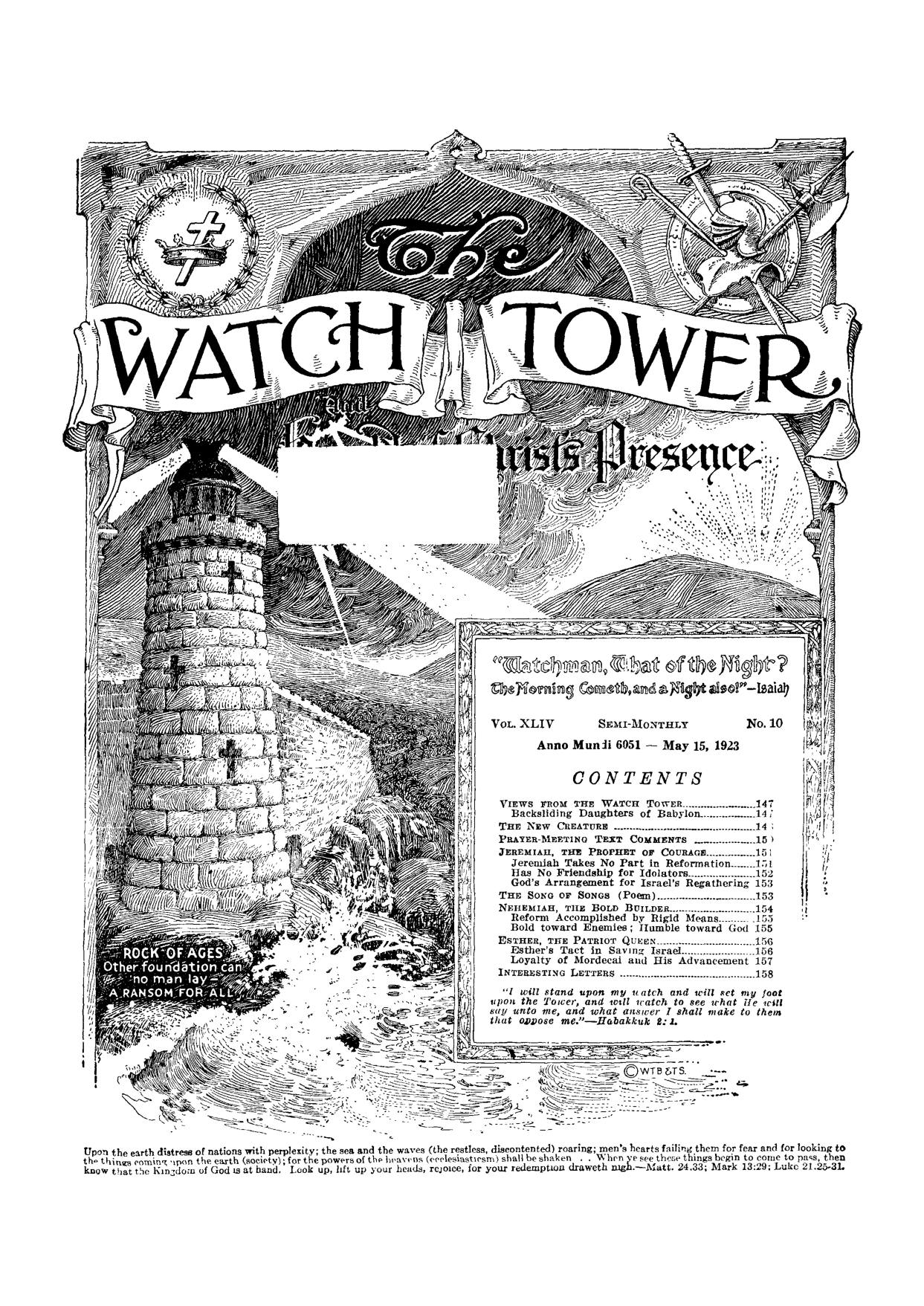
Loyalty of Mordecai and His Advancement 157
Interesting Letters
Reform Accomplished by Rigid Means.......... .155
Bold toward Enemies; Humble toward God 155
Esther, the Patriot Queen..........
Esther’s Tact in Saving Israel..
No. 10
.158
...156
..156
...152 ; 153 ...153 ..154
...147 ...14;
...14 :
...15 )
Upon the earth distress of nations with perplexity; the sea and the waves (the restless, discontented) roaring; men’s hearts failing them for fear and for looking to th- things coming npon the earth (society); for the powers of the he avens (ceelesiastwsm) shall be shaken . . V. hen ye see these things begin to come to pass then know that the Kingdom of God is at hand. Look up, lift up your heads, rejoice, for your redemption draweth nigh. Matt. 24.33; Mark 13ix.9; Luke 21.25-3L
IIW, illliu
g Ctaamd a!s©8”-l2aial;
r., rogkofages;^
Other foun'dation can ’/ no man layy'yS^.’ A RAN SO M FO Ft AL lW;
Vol. XLIV
Semi-Monthly
Anno Mun di 6051 — May 15, 1923
CONTENTS
Views from the Watch Tower....................
Backsliding Daughters of Babylon,.............
The New Creature ......................................
Prayer-Meeting Text Comments.............
Jeremiah, the Prophet of Courage.............
Jeremiah Takes No Part in Reformation.....
Has No Friendship for Idolaters...................
God’s Arrangement for Israel’s Regatherin; The Song of Songs (Poem)..........._......_........
Nehemiah, the Bold Builder.........................
“I will stand upon my Hatch and will set my foot upon the Tower, and will watch to see what Ue will say unto me, and what answer I shall make to them that oppose me.”—Habakkuk £-• I.
©WTB&TS.
THIS JOURNAL AND ITS SACRED MISSION
THIS Journal is one of the prime factors or instruments in the system of Bible instruction, or “Seminary Extension”, now being presented in all parts of the civilized world by the Watch Tower Bible & Tract Society, chartered A. D. 1884, “For the Promotion of Christian Knowledge”. It not only serves as a class room where Bible students may meet in the study of the divine Word but also as a channel of communication through ■which they may be reached with announcements of the Society’s conventions and of the coming of its traveling representatives, styled “Pilgrims”, and refreshed with reports of its conventions.
Our “Berean 'Lessons” are topical rehearsals or reviews of our Society’s published Studies most entertainingly arranged, and very helpful to all who would merit the only honorary degree which the Society accords, viz., Veibi Dei Minister (V. D. M.), which translated into English is Minister of God’s Word. Our treatment of the International Sunday School Lessons is specially for the older Bible students and teachers. By some this feature is considered indispensable.
This Journal stands firmly for the defense of the only true foundation of the Christian’s hope now being so generally repudiated —redemption through the precious blood of “the man Christ Jesus, who gave himself a ransom [a corresponding price, a substitute] for all”. (1 Peter 1:19; 1 Timothy 2:6) Building up on this sure foundation the gold, silver and precious stones (1 Corinthians 3: Ills ; 2 Peter 1:5-11) of the Word of God, its further mission is to “make all see what is the fellowship of the mystery which. . .has been hid in God, ... to the intent that now might be made known by the church the manifold wisdom of God”—“which in other ages was not made known unto the sons of men as it is now revealed”.—Ephesians 3 : 5-9,10.
It stands free from all parties, sects and creeds of men. while it seeks more and more to bring its every utterance into fullest subjection to the will of God in Christ, as expressed in the holy Scriptures. It is thus free to declare boldly whatsoever the Lord hath spoken—according to the divine wisdom granted unto us to understand his utterances. Its attitude is not dogmatic, but confident; for we know whereof we affirm, treading w’ith implicit faith upon the sure promises of God. It is held as a trust, to be used only in his service; hence our decisions relative to what may and what may not appear in its columns must be according to our judgment of his good pleasure, the teaching of his Word, for the upbuilding of his people in grace and knowledge. And we not only invite but urge our readers to prove all its utterances by the infallible Word to which reference is constantly made to facilitate such testing.
TO US THE SCRIPTURES CLEARLY TEACH
That the church is “the temple of the living God”, peculiarly “his workmanship” ; that its construction has been in progress throughout the gospel age—-ever since Christ became the world’s Redeemer and the Chief Corner Stone of his temple, through which, when finished, God’s blessing shall come “to all people”, and they find access to him.—1 Corinthians 3:16, 17; Ephesians 2:20-22; Genesis 28:14; Galatians 3 : 29.
That meantime the chiseling, shaping, and polishing of consecrated believers in Christ’s atonement for sin, progresses; and when the last of these “living stones”, “elect and precious,” shall have been made ready, the great Master Workman will bring all together in the first resurrection; and the temple shall be filled with his glory, and be the meeting place between God and men throughout the Millennium.—Revelation 15:5-8.
That the basis of hope, for the church and the world, lies in the fact that “Jesus Christ, by the grace of God, tasted death for every man,’’ “a ransom for all,” and will be “the true light which lighteth every man that cometh into the world”, “in due time”.— Hebrews 2:9; John 1: 9 ; 1 Timothy 2:5, 6.
That the hope of the church is that she mav be like her Lord, “see him as he is,” be ‘ partaker of the divine nature / and share his glory as his joint heir.—1 John 3 :2 ; John 17 : 24 ; Romans 8 :17 ; 2 Peter 1: 4.
That the present mission of the church is the perfecting of the saints for the future work of service; to develop in herself every grace; to be God’s witness to the world * and to prepare to be kings and priests in the next age.—Ephesians 4 :12 ; Matthew 24: 14 ; Revelation 1:6; 20 : 6.
That the hope for the world lies in the blessings of knowledge and opportunity to be brought to all by Christ’s Millennial kingdom, the restitution of all that was lost in Adam, to all the willing and obedient, at the hands of their Redeemer and his glorified church, when all the wilfully wicked will be destroyed.—Acts 3:19-23; Isaiah 35.
8^—^- ~~ — ■' ' ~ ■ -------- ■ ' _ ■■ ~ ~ ~ ; , ZT ; — ~ ' r— _ —?
'Published By
WATCH TOWER.BIBLE bTRACT SOCIETY
18 CONCORD STREET O O BROOKLYN, N-Y. U-SA
Foreign Offices : British* 34 Craven Terrace, Lancaster Gate, London W. 2; Canadian: 270 Dundas St., W., Toronto, Ontario; Austtalasian: 495 Collins St., Melbourne, Australia; South African : 6 Lelio St., Cape Town, South Africa.
Please Address the Society in Every Caste
YEARLY SUBSCRIPTION PRICE; United States, $1.00; Canada and Miscei landous Foreign, $150; Great Britain, Australasia, and South Africa, 8s. American remittances should be made by Express or Postal Money Orders, or by Bank Draft. Canadian, British, South African, and Australasian remittances should be made to branch offices only. Remittances from scattered foreign teintoiy may be made to the Brooklyn office, but by International Postal Money Orders only.
(Foreign translations of this Journal appear in several languages)
Editorial Committee: This journal is published under the supervision of an editorial committee, at least three of whom have read and approved as truth each and every article appearing in these columns. The names of the editorial committee are: J. F. Rutherford, W. E VinAmburgh, J. itemery, G. H. Fisher. R, h. Barber. Tertr.;. .o ife Lord’s Poor: AH Bible students who, by reason of old age or other in-firr-'-Uv or alvervy, are unable to pay for this journal, will be supplied free if they send ft po tnl card each J!ay stating their case and requesting such provision. We are not only w illing, but anxious, that all such be on our list continually and in touch with the Berean studies.
Noit-p tn Wc do not, as a rule, send a card of acknowledgment for b renewal or1
OSCri°" a ntW Fubf-rnntfou. Rece.pt and entry of renewal are iaaieatU
w’. *n a month by change in expiration date, as shown on wrapper label.
En ered at Second Clatt flatter at Brooklyn, N.Y.. Pottoffiee undor the Act of MarehSrd. 1979. J
PRICE OF BOOKS REDUCED
Inadvertantly there appeared In the April 1 issue of The Watch Tower a statement that the reduced prices of the books apply to Canada. We wish now to correct that error. There must be added to this the price of transportation, duty, and the difference in exchange. The Toronto office will announce to the friends the Canadian prices by special circular letter.
STUDIES IN THE SCRIPTURES
Tho^e S'iniiEb ai< i »■< uiiinieixh i to >tadenih as veritable J'.ihle keys, discussing topically every vital doctrine of the Bible. Mora than eleven million copies are in circulation, in nineteen languages. Two sizes are issued m English only : The regular maroon c'oth, gold stamped edition on dull finish paper (size 5/zx7g"), and the maroon cloth pocket edition on thin paper (size 4"x6g") ; both sizes are printed from the same plates, the difference being in the margins. Questions in both editions. The pocket edition—Volumes I, II, III, 75c each ; Volumes IV, V, VI, VII, 85c each.
Series I, The Divine Plan of the Ages, giving outline of the dhine plan revealed in the Bible, relating to man’s redemption and restitution: 350 pages, plus indexes and appendixes, 35c. Magazine edition 2Oc. Also procuiable in Arabic, Armenian, Dano-Norwegian, Finnish, French, German, Greek, Hollandish, Hungarian, Italian, Polish, Roumanian, Slovak, Spanish, Swedish, and Ukrainian; regular cloth stjle, price 75c.
Series 11, The Time is at Hand, treats of the manner and time of the Lord’s second coining, considering the Bible testimony on this subject: 333 pages, 35c. Obtainable in Arabic, Dano-Norwegian, 1’iniush, French, German, Greek, Polish, and Swedish. 75e a viu'? •
Series III, Thy Kingdom Come, considers prophecies which mark etents connected with “the time of the end”, the glorification of the church and the establishment of the Millennial kingdom ; it also contains a chapter on the Great Pyramid ol Egypt, showing its corroboration of cerium Bible loathings. 380 pages, 35c. Furnished also in Dano-Norwegian, Finnish, French, German, Greek, Polish, and Swedish, 75c.
Series IV, The Battle of Armageddon, shows that the dissolution of the present order of things is in progress and that all of the human panaceas offered are valueless to avert the end predicted in the Bible. It contains a special and extended tieatise on our Lord’s great prophecy of Matthew 24 and also that of Zechariah 14:1-9: 656 pages, 40c. Also in Dano-Norwegian, Finnish, French, Greek, German, Polish, and Swedish, 85e.
SERIES V, The Atonement Between God nnd Man, treats an all important subject, the center around which all leatures of divine grace revolve, This topic deserves the most careful consideration on the part of all true Christians : 618 pages, 40c. Procurable likewise in Dano-Norwegian, Finnish, French, German, Greek,
Polish, and Swedish. 85c.
Series VI, The New Creation, deals with the creative week (Genesis 1, 2), and with the church, God’s new creation.lt examines the personnel, organization, rites, ceremonies, obligations, and hopes appertaining to those called and accepted as members of the body of Christ: 730 pages, 40c. Supplied also in Dano-Norwegian, Finnish, French, German, Greek, Polish, and Swedish,
85c. ,
Series VII, The Finished Mystery, consists of a verse-by-verse explanation of the Bible books of Revelation, Song of Solomon, and Ezekiel: 608 pages, illustrated. 40c in cloth, 25c in magazine edition—latter treats Revelation and Ezekiel only. Dano-Norwegian. Finnish, French, Greek, Polish, and Swedish, 8fic.
Vol. XLIV
May 15, 1923
No. 10
VIEWS FROM THE WATCH TOWER
r J 111ERE is a growing demand for a “church,” a I real church where people may worship God, serve their Creator, nourish the soul, comfort the heart, and satisfy the head. Sqme noble hearts are longing for such a place to fill what is recognized as an aching void. What incalculable distress has been brought to the human family through the erroneous teaching that the church only is to be saved, and that all the salvation there ever shall be is limited to the present life! Could not every one have comfort in the thought that God is making choice of a company to be associated with Jesus in the spirit realm; that this selection is not made arbitrarily, but according to heart devotion to God and character development in harmony with him who is Love; and that after this company is rewarded in the first resurrection with glory and honor and immortality, being made priests and kings unto God to reign with Christ a thousand years, comes the general resurrection of the whole world to the attaining of everlasting life on this earth, if they will cooperate with the Lord in their own uplift out of sin and death 1
The “church” systems collectively are referred to as “Babylon”; and our Lord shows that the time would come when they would be “spewed out,” forsaken, when his spirit would be taken away, and when as a result the blind and the blind leaders would fall into the ditch of despondency and want, and be left to the ravages of mental and moral diseases, the worst the world has ever known.
The truth alone will save the world from the engulfing perplexity. But the situation has gone so far and the conditions are so complex that before the truth can bring the necessary succor to restore comfort and peace of mind and heart the Sun of Righteousness must needs shine forth in all its effulgence and bring the world to a recognition of the change of dispensation now being stealthily brought about by the presence of our glorious but unseen King and Savior.
Says Gerald Mygatt in the Delineator:
“Several million Americans are looking for a church. They want a church that will mean something to them, not a day a week but seven days a week—a church which they can belong to without having to believe or disbelieve petty creeds—a real church of all faiths.”
Being disgusted with all creeds and craving something somewhere to worship, men begin to cry aloud: “Oh, for a real church!” A church of all faiths will never be found. Bedlam would reign if such should be. But a church of one faith will be found, a church glorified, containing the called and chosen and faithful; and the entrance thereto shall then be forever closed. The happifying message that mankind shall have the opportunity of becoming children of the church shall then be heard. Then shall “the Spirit and the bride say, Come. And let him that heareth say, Come. And let him that is athirst come: and whosoever will, let him take the water of life freely.”—Revelation 22: 17.
Gradually, as the dark night settles over humanity, it will be recognized more and more that the only comfort and consolation to be had from the Word of God is through an understanding of the plan as outlined by Pastor Russell in his Studies in the Scriptures. These volumes furnish the only interpretation which harmonizes the Bible and demonstrates the truth of the Book of books.
The demand is made for the churches to “meet them half way.” The churches have gone all the way to meet mankind. Therein lies the trouble. The standards have been lowered at such an alarming rate that now there are none—in the “churches.” In the publications of the Watch Tower Bible & Tract Society are to be found the standards of righteousness and the banners of love unfurled; and many, many are drinking the waters of truth and are being refreshed. Some of these are rejoicing in the prospect of the wonderful inheritance of the divine nature (2 Peter 1:4), and some are happy in the thought of the coming “times of restitution.” (Acts 3:19-21) What a marvelous truth it is, and what a glorious blessing it is, to be favored with a knowledge that there are two salvations, one to spirit nature confined to the Gospel age and one to human nature confined to the Millennial age; and that we are now in the transition period.
BACKSLIDING DAUGHTERS OF BABYLON
That the “churches” have ceased to be Christian is evident. It must be conceded by every thinking person who is acquainted with the Scriptures that the spirit of Christ is no longer to be found there; but that the devil’s spirit of piety and holiness and truth — false piety, sanctimonious holiness, and theories based upon
false premises—therein is manifest. Heathendom from the days of Semiramis has worshiped the sun-god under various names, perhaps the most prominent of which is that of Baal. Christian missionaries have gone to heathendom to convert it from sun-god worship and other forms of idolatry. But now we have sun-god religion introduced into the “Christian” churches ! For what purpose? We suppose that it is an effort to establish a religion to meet the demands of a “church of all faiths.” Think of a Paul, a John, a Peter, or any other Christian bowing down to Osiris! But we think that Hymeneus and Alexander, Philetus, Judas, and Ananias may worship whom they will. The New York Times says in part:
“An Egyptian service portraying the worship of Amen-Ra and Ati'n as a ‘preparation for Christianity’ was held . . . at St. Mark’s-in-the-Bouwerie [New York], The service was prepared from the religious writings of ancient Egypt, and including the reading of a cento from the ‘Gospel of Osiris,’ which gives a character portrayal of Queen Isis, who is sometimes referred to as a prototype of the Virgin Mary.”
“‘Hail to thee, beautiful god of every day! Beautiful is thy arising in the horizon of the sky.’ read Dr. Guthrie.
“ ‘Beautiful is thine arising, O living Aten, orb of light, O first beginning of life,’ replied the people. ‘When thou arisest in the eastern horizon thou flllest every land with thy beauty. Thou art beautiful to behold, great, glistening high above the whole earth. Thou art Ra, the sun-god; and thou earnest all away captive. Thou bindest them fast with thy love.’ ”
This was in an Episcopal church in New York City; and the rector said that the object of the service, “in common with our other studies of comparative religion, is to draw upon the past treasures of spiritual experience and arrange them in harmony with our own religion.” It was an effort “to make the people feel the unity of religion.”
The Times later says, to the shame of the congregation:
“The parishioners seem to have viewed and partieip.iled in the repetition of the old invocations without shock or tremor."
The services were elaborate, and the decorations and lightings were of a nature to awe those present and create a profound impression, so lasting in fact as to make the simple, childlike, trustful service of the real Christianity appear dull, uninteresting and unimportant. How the poor human family have ever sought the spectacular and ostentatious to their hurt!
The Lord is willing to have the people see they have been trapped by the adversary, who has been ruli.’g in the hearts of the children of disobedience for many centuries, and whose methods have always centered around mythology and astrology. But Satan is to be bound for a thousand years, and the children of men liberated in the kingdom which is even now at the door. Then all superstition and ignorance is to be cleared away.
THE NEW CREATURE
Question: Concerning the new creature at the time of begetting, would this be the proper thought, correctly expressed, namely, that at the time of consecration the one consecrating surrenders or sacrifices unto God all of his faculties, including the will, the mind and the heart; and that Jesus then imputes to such a one his own merit and presents him to Jehovah, and that God then justifies and begets that one by his holy spirit, and that then God gives back to the new creature there begun all the faculties so surrendered by the old creature, including his will, his mind and his heart?
Answer: No; this would not be the proper thought, nor is the thought correctly expressed. A practical illustration may aid in understanding this matter. For this purpose we take an imaginary person, whom we call John. He is a man of good organism, possessing what is generally termed a sound mind, a strong will, and an honest heart. Yet he is following after the world. What do we mean by these terms—mind, will, and heart?
3The mind is that faculty of the being by which one searches out facts, weighs these facts, and reaches a conclusion. The will is that faculty of the being by which one determines to do or not to do a certain thing; and when he is convinced in his mind of what is the proper course, he wills to act and does act accordingly. By heart is meant the faculty of the being that induces action. It is the seat of motive and the seat of affections.
‘John has employed his mind in searching out seiem e so-called, following the course of evolution regarding man. His determination is to try to lift himself up and to lift up the human race by a process of evolution. His real motive is to shine amongst men as a groat benefactor and to make for himself a great name. He has no knowledge of God’s arrangement. In course of time, he reasons upon his theories and is dissatisfied with them. He hears of God's provision for man'- salvation through Christ Jesus. This upsets all of his theories of evolution. He begins to investigate. He uses his mind for this purpose. He comes to tire conclusion that his evolution theory must be wrong. He realizes that he is a sinner, born as such; that he needs a savior. He has now had a change of mind; and this is properly called repentance. He determines to change his course and does change his course and seeks the Lord. This is properly called conversion. Up to this point he has used his mind to ascertain these facts which have changed his conclusions, and now he uses his will and determination to follow a different course. He is drawn to Jesus. Thus the Father draws him. (John G: 44) He is yet unaware of what he must do, but seeking the Lord he begins a study of the Bible and receives some instruction on it from others. He learns that he is alienated from God because of the sin of his first parent Adam. He desires to get back into harmony with God. He learns from Jesus that “no man cometh unto the Father but by me; I am the way, and the truth, and the life.” (John 14:6) He begins to ascertain the terms of coming to Jehovah. To him Jesus says: ‘Sit down and count the cost.’ John is Using his mind now to ascertain the cost. He uses his mind by getting further knowledge; and this knowledge he receive’ from the words of Jesus: “If any man will come after me, let him deny himself, and take up his cross, and follow me.” (Matthew 16:24) This self-denial means the surrender of oneself; otherwise stated, full consecration and unconditional surrender of self to the Lord.
3John's will now acts, and he says: ‘I am determined to do what my Lord would have me do. Hence I give myself entirely to the Lord.’ Here he uses his faculty, to wit, the will power, in taking the step of an unconditional consecration. He did this because he believes that Jesus is his Savior, who died to save him from his sms; and that by believing upon the Lord and obeying hnn he may be saved.
’’Because of John’s faith now exercised by this full and unconditional surrender of himself Jesus imputes to him his own merit. Merit means that valuable thing resulting from the sacrifice of our Lord, to wit, the value of a perfect human life, which he deposited with Jehovah when he ascended on high, to be used throughout the Gospel age as a basis for the justification of all who come to God through him. Jesus now presents John to the Father, tuning imputed to him his own merit. Because of John’s full surrender of himself, ba-cd upon his faith in the merit of Jesus as his Redeemer, and because of the merit imputed to him by the Lord Jesus. Jehovah judicially determines that John is right; therefore justified before him.
TThe three steps to this point are proven by the following scriptures: The first step is the exercise of faith, a? M. Paul lays down the rule in Romans 4: 20-25 and 5:1. The next step is the imputation of Christ’s merit. The merit is in the blood, his life poured out. (Romans 5:91 The third step is the act of justification, which is performed by Jehovah. “It is God that justifieth.” (Romans 8:33) Every creature that is justified, and therefore righteous before Jehovah, is entitled to live. Consequently there resulted to John at the moment of his justification the right to live as a human being. That right to live on earth as a human being is what he really sacrifices. He agreed to do this before he got it. When he made an unconditional surrender to Jehovah that was an agreement to do whatsoever Jehovah would want him to do. The terms and conditions of his justification are clearly implied by the words of the Master: “Whosoever will save his life shall lose it; and whosoever will lose his life for my sake shall find it.”— Matthew 16: 25.
8Otherwise stated, John was certain to die as a human being because of inherited imperfection. Now if he were to live at all he must have this right granted unto him by Jehovah; and if he would willingly lose that right to live as a man after its being granted to him, by sacrifice, then he would find the right to live on a higher plane, to wit, the divine plane.
9The justification of John was for the purpose—and that only—of enabling him to become a part of the sacrifice of our Lord. That is the only purpose of justification during the Gospel age. Why should he be justified at all if he is to lose this right to live which results from justification so far as the human plane is concerned? The answer is, that no sacrifice which is imperfect is acceptable unto Jehovah. John is made perfect, counted thus before God, through the merit of Christ Jesus, in order that he might be an acceptable sacrifice as a part of the body of Christ.
10Jehovah now begets John by his own will, by his Word of truth, and by giving to him his exceeding great and precious promises, that he shall be a partaker of the divine nature. (James 1:18; 2 Peter 1:3,4) He is thereby inducted into the body of Christ. Being in Christ he is now a new .creature, “old things are passed away; behold, all things are become new.”—2 Corinthians 5: 11.
“In order for John to become a new creature he must make a covenant with the Lord Jehovah by sacrifice. The word covenant means contract. He could not make a contract himself, because imperfect. God would not make a contract with an imperfect creature except by the intervention of Jesus, the groat High Priest, as his advocate. John’s part of the contract was the exercise of faith in the blood of Jesus and a full and unconditional surrender of himself; and in order that he might be received by Jehovah, Jesus, as his advocate, stands sponsor for him by imputing his own merit and presenting him to the Father. The Father’s part of the contract now is that he gives to John his exceeding great and precious promises, by which he assures him that he shall be a part of the divine body of Christ, upon the condition that he (John) perform his part of the contract by being faithfully obedient unto death. When the time comes for gathering all the saints unto the Lord Jehovah he says: “Gather my saints together unto me, those that have made a covenant with mo by sacrifice.”—Psalm 50: 5.
12In this sacrifice John did not sacrifice his will, nor his mind, nor his heart; for to sacrifice a thing means to part with it completely, with no hope of recovery. He retained these faculties of his being, agreeing that they should be used in whatsoever way Jehovah would direct. Now he begins to exercise his mind, which the Lord has illuminated by the power of his holy spirit, in searching out the deep things of God’s Word, in order that he might ascertain what is God’s will. (1 Corinthians 2:10,11; Romans 12:2) As he searches God’s Word and has his mind filled with things pertaining to the Lord’s plan, the Lord reveals to him his good and acceptable and perfect will.
13The will of God is his expressed law toward man. John now uses his own will, or his faculty of determination in doing that which he ascertains to be the will of God concerning him. Henceforth his motives are to glorify the Lord and to do good unto all as he has opportunity. His affections are set upon things above and not upon things of the earth; and thus he has a change of heart. This treasure now he has, as St. Paul puts it, in an earthen vessel. His organism is the body of flesh. His will is to compel the flesh to do God’s will and not permit the desires of the flesh to get the upper hand of him as a new creature.
14In making this covenant with the Lord by sacrifice John does not sacrifice his will, nor his mind, nor his heart. But his covenant is, that he would use these faculties in harmony with God’s will. His constant use of these faculties, according to the terms of his covenant, will determine what shall be the result finally. If he is faithful in the performance of his part of the covenant, God is always faithful to his; and, as St. Peter puts it, if he does his part he is certain to have an abundant entrance into the everlasting kingdom of our Lord and Savior Jesus Chrn-t.
15What John really sacrifices, then, is that which results to him by reason of the merit of Christ’s sacrifice, namely, restitution rights, or the right to live on earth as a human being. This he receives at the moment of justification and receives such right instantly, and which corresponds to that which the world will receive at the end of the thousand years of trial. Now he sacrifices such right to live and receives from Jehovah the promise of life on the divine plane; and during his trial time all of his faculties—will, mind, heart, body, everything—must be used in harmony with the divine will; and being thus used is a living sacrifice (daily), and is his reasonable service.
QUESTIONS FOR BEREAN STUDY
What is the mind? What is the will? What is the heart? 1 3.
Does one at consecration surrender his mind and will and heart? J 1. 2.
What is repentance? Conversion? How does John exercise his mind in the transition process from a false premise to a true one? 14.
After John has arrived at a conclusion as to what he should do, what faculty is then called into action? 1 5.
What is Christ’s merit? Is it the human life or the value of it? How is it made available for justification? 1 6.
What are the three steps to this point, and how proven? What is the result of justification? What does John really sacrifice? 1 7, 14, 15.
To have life eternal, wrhy is justification imperative? What is the purpose of justification during the Gospel age? 18,9.
How is John inducted into the body of Christ, and what is the result? 110. .
What is a covenant? As John cannot make the contract himself, how is it made? What is John’s part? Jesus’ part? Jehovah’s part? 111. .
Did John sacrifice his will, his mind, or his heart? How is the mind now exercised? 112.
What is the will of God, and how is John’s will exercised? What is the heart, and how’ and where does it operate? V 13.
What did John covenant to do? 114. .
Docs justification mean the right to human life upon the earth?
Does the sacrifice of John then mean the surrender of this? 115.
The faithful performance of his covenant, consummated in death, results in what great inheritance? 115,14.
PRAYER-MEETING TEXT COMMENTS
TEXT FOR JUNE 6
"Grieve not the holy spirit."—Ephesians 4:30.
GRIEVE means to cause distress; to make sad; the power invisible that begets, anoints, and to cause heaviness. The holy spirit of God is seals us. Since God is love, his holy spirit or invisible power is always used in love. Since we have become children of his he loves us as members of his household. Dutiful children desire to please and strive to please their father. As members of the house of sons we should always strive to please both our heavenly Father and the Head of that house, Christ Jesus.
If an earthly parent had committed certain interests to his son, and that son should become indifferent, careless, negligept, and even speak disrespectfully of the cause for which his father stands, -would that not bring grief to the father’s heart? Our heavenly Father, through his beloved Son, has committed to each one of his children who are members of the house of sons certain interests concerning his kingdom. His is the cause of righteousness. Satan and his representatives have always reproached Jehovah and his cause of righteousness. We should see to it, then, that we serve our Lord and our God and lend none of our faculties to the devil, by which he could reproach the truth and thereby cause our Father to be sad. If we do take a wrongful course, it brings sadness to our own mind and heart; and we are in grief.
Wc may avoid grieving the holy spirit by carefully and prayerfully watching for opportunities to glorify our Lord and joyfully to represent him, striving always to please him; and thus doing, we shall be happy and come confidently to the throne of heavenly grace, knowing that the Lord will grant our every need as members of his holy family. “And whatsoever we ask, we receive of him, because we keep his commandments, and do those things that are pleasing in his sight.” (1 John 3:22) We shall be happy in trying to please the Lord; and thus the transformation into the likeness of his beloved Son will progress. It was he who said: “I delight to do thy will, 0 my God; yea, thy law is within my heart.”—Psalm 40: 8.
TEXT FOR JUNE IS
"Quench not the spirit."—1 Thessalonians 5:19.
ESITS said to his followers: “Ye are the light of the world. . . . Let your light so shine before men, that they may see your good works, and glorify your Father which is in heaven.” (Matthew 5: 14,16) It is the holy spirit of the Lord shining forth in our hearts that leads us to be faithful representatives of his, and thus makes us the light of this dark world. The people can see the difference between one who honestly and faithfully represents the Lord and the one who does not ; and the day is not far distant when even those of the world will give glory to God that he has had some faithful witnesses in the world.
Our privilege now is to be such witnesses or representatives of our Lord. The more we are transformed into the likeness of our Head and King, the more brilliantly will our light shine.
Quench means to extinguish the light. If we fail or refuse faithfully to represent out Lord, and on the contrary give ourselves mer to things pertaining to the devil’s organization, our light will go out. Thereby we shall quench the holy spirit. To have our light shining we must keep it trimmed and burning. A sour disposition which indulges in fault-finding, evil-surmising, and evil-speaking will soon find bitterness in the heart. The Apostle warns against such a root of bitterness springing up in the heart. (Hebrews 12:15) If that bitterness develops, love will disappear and darkness will ensue. (Colos.dans 2:1-3, Diaglott') Following this course, the truth will soon lose its attraction. “If therefore the light that is in thee be darkness, how great is that darkness 1”—Matthew 6: 23.
To safeguard ourselves against such a disaster we must keep our Lord’s commandments with a joyful heart, doing with our might what our hands find to do; and see to it that our action in this regard is prompted always by love. A joyful activity in the Lord’s service will feed the flame of sacred love and cause our light to shine with increased brilliancy; and the transformation into the likeness of the Lord will be the ultimate result.
JEREMIAH, THE PROPHET OF COURAGE
■---June 3--Hook of Jeremiah---
jiEimreii nuts no pari in ri : orm ai ion—.teremiati msn.-,n i.mi:i» 'sitvrinhs—has no friendship fob idoi.atobs
—GOD'S AKBANGEAIENT JOB ISRAEL’S REG Al HERING.
“Walch ye. stand fast in the faith, quit you like men, he stiony.’’—1 Corinthians IS: IS.
JEREMIAH was called to serve the Lord as his prophet m what were perhaps the most difficult circumstances of any in which such servants were called to minister; and for at least forty years he was a faithful mouthpiece for Jehovah. He was called in the thirteenth year of Josiah’s reign, and continued through the reign of Jehoia-kim and until the destruction of Jerusalem in the eleventh year of Zcdekiah. His period of ministry therefore coincides with the last forty years of the kingdom of Judah, vlien its iniquity was being visited upon it and it was hastening to destruction. (2 Chronicles 36:16) Every well-instructed Bible student knows that the fall of Jerusalem at the hands of Nebuchadnezzar, with the consequent transference of the crown of Israel into gentile powers, besides being the point which marks the commencement of the Times of the Gentiles, is typical of the downfall of organized religion at the hands of dark world-forces of this present day. The overthrow of Jerusalem well represents the overthrow of organized religion now due. This being the case, it is clear that Jeremiah’s forty years of service which synchronized with Israel’s last forty years as a kingdom must have special meaning for us.
2Jeremiah was called when very young; indeed, he himself says: "I am a child” (Jeremiah 1:6), thereby probably referring to his youth as well as to a felt immaturity. The work he was called to do needed an extraordinary character; and Jeremiah came to perceive that God had specially prepared him for his work, even as he said. (Jeremiah 1: 5) Jeremiah reveals much of himself. He was of a nervous and highly-strung temperament, -with much self-disesteem; but it is apparent he was just the man for the work which God required to be done.
’Jeremiah was instructed in his office and work by two visions. He was made to see a rod of an almond tree, the tree which hastens to flower out of the winter’s sleep; God indicating by this that he intended hastening his word to perform it. (Jeremiah 1:11,12) He also saw a seething pot with its face turned as from the north; and the word of the I,ord came to say this represented a great evil which was about to break forth from the north upon all the inhabitants of the land, and against Jerusalem and all the cities of Judah; for the judgments of the Lord were coming upon all these because of their wickedness and Idolatry. (Jeremiah 1:13-16) The Lord touched his mouth, bade him be dismayed by none—else God would confound him before them ; told him he should be a defenced city; that the kings, and Ilie princes, and the priests, and the people would fight against him but should not prevail.—Jeremiah 1:17-19.
JEREMIAH TAKES NO PART IN REFORMATION
4At the time of Jeremiah's call Josiah was king, and was endeavoring to bring about a revival of true worship. Subsequent events show that the revival did not affect the people's hearts, and that it resulted in little more than a deeper step into formalism. The reformation was but on the surface, and Jerusalem became in its hypocrisy and pride worse in the sight of God than idolatrous and wicked Samaria. (Jeremiah 3:11) Truth seekers were few: Jeremiah searched Jerusalem and failed to find one.—Jeremiah 5:1, 31.
’There Is no record of Jeremiah’s taking any part in the reformation under Josiah, though he could not fail to have been sympathetic with every good work. It is in this connection that the value and meaning of the two visions which gave him his call are seen. Knowing what he did, Jeremiah could not very well enter into these works of reformation. He knew that nothing that was going to happen would really alter the hearts of the people, and therefore he could take no part in that reformatory movement. Even so now, the Lord’s people who have been so clearly and definitely charged with a mission of heralding a message concerning the destruction of Christendom refrain from entering into any schemes which are intended to bring about a revival of religion. After the death of Josiah, who was slain in a misguided encounter with Pharaoh, Jeremiah was a lonely man In a wicked, hypocritical city. But the message he had from God, and the clear conviction of his call, enabled him to persist despite the growing opposition.
6After Josiah died Jeremiah began to declare his message more definitely, and it was not long before everyone was against him. (Jeremiah 26; 7-11) None of the people cared to have his witness against their wrong-doing and their wrong attitude towards God. Jeremiah told them of the desolation which must surely come. The king of Babylon, now dominant in the east, would come and carry them away captive; for the days of Jerusalem were numbered. Both city and temple would be destroyed; for this was the purpose of God, and if they would save their lives they must submit. Jeremiah urged the people not to fight against Babylon, but to accept the conqueror’s power. He declared that it was God's purpose to have the land desolate for seventy years in order that it might fulfil its sabbaths, which either the greed of the people had prevented them from giving the land or else in their carelessness they had neglected. He advised them not to resist deportation, but to settle in Babylon; and that at the end of the time appointed God would return them from captivity.—Jeremiah 27:12-22.
JEREMIAH DISESTEEMED BY ISRAELITES
7This “word of Jehovah” was not at all acceptable to Jerusalem. Jeremiah was considered an evil adviser. They were God’s people; why should they be directed by a supposed word of the Lord to look for residence in Babylon? Jeremiah's task was not the easiest; for his message seemed contrary to everything which their history led them to expect. Moreover, Isaiah, Jeremiah’s great predecessor, under somewhat similar circumstances had advised Jerusalem not to make any compact with any enemy, but to trust in God for deliverance; and God had delivered them from the Assyrian power. Jeremiah’s message seemed contrary to all this. The reason for this difference is, of course, that circumstances were different. In Isaiah’s time it was not God’s purpose to give Jerusalem over to the hands of Babylon ; but in Jeremiah’s time his forbearance had come to an end, and then such was his Intention.
’God's messages are not always uniform. His servants are called to present the message he gives them without respect as to whether or not it conforms to something which has gone before. There are those who claim that every message of God must be consistent with whatever has been known of God’s providences. Those who demand such consistency really want their own way. God's servants are called to obey, not to demand uniformity in the providences or service of God. Not only were the circumstances different, but it pleased God to use his servants in different ways. Isaiah and his children were for signs in Israel; but Jeremiah was not allowed to marry, nor to have the consolation of a wife and family and home life—equally a sign from God, who thereby signified the desolation which was coming upon Jerusalem.—Jeremiah 16:1-4.
’Jeremiah’s message in itself was no more pleasurable to him than to Jerusalem; for like all true servants of God he was an ardent lover of his people and nation. He was a true patriot, but was treated as an enemy. He was filled with sorrow because of the iniquity of the people, and his mission was all the more difficult to him because God would not permit him to plead for them. (Jeremiah 7:16) He wept much (9:1), and his sorrow was great; not for himself, but because of the wrong condition of his people, and because of the trouble he saw coming upon them. Men speak of Jeremiah as the weeping prophet, as if he were weak. He wept because he had strength of courage to show his sorrow. Not many servants of God rose higher in courage than did faithful Jeremiah.
10So keenly did Jeremiah feel his message that on one occasion he left Jerusalem to go to Anathoth, his native village, three miles northeast from Jerusalem. He intimated that God had led him into something he did not expect. But he could not stay; for his message burned in his bones (Jeremiah 20:7,9), and he came back to Jerusalem to continue his witness. At a certain stage in his witness he was told to go to the temple courts, and there in the presence of all the people declare his message; as if God would give them a last chance to repent. If they refused, they were to be told that the desolation which should come upon Jerusalem and the temple should be like the desolation of Shiloh—God would sweep it all away. The people refused to listen, and their leaders sought to have Jeremiah put to death. A division took place amongst the crowd. The priests and those who styled themselves the prophets of the Lord were set against Jeremiah, and would have put him to death for speaking evil against the city and the temple. But some of the princes, perhaps sons of Josiah, and many of the people took the part of Jeremiah.— Jeremiah 26: 7-11.
HAS NO FRIENDSHIP FOR IDOLATERS
“That Jeremiah was no friend of Babylon is clear. He saw that dark power would sweep over all the world; for the nations were away from God. All were transgressors through pride. In words which admirably fit the world situation of the present day he spoke against all the surrounding nations, saying that ail of them should drink of the bitter cup of God’s wrath in righteous retribution for all their iniquity. None should escape, but Sheshach (Babylon, the instrument who should make them drink) should not escape; indeed, he should drain the cup.—Jeremiah 25:15-38.
12In Jeremiah’s day the world was In a state of unrest comparable only to the unrest of today. There were the three great world-powers, Egypt, Assyria, and Babylon, in competition for power. This caused the world to be kept in commotion, so that every country was unsettled; and Jerusalem, God’s own city, was filled with corruption, and was being brought to desolation.
“Besides the mental suffering which Jeremiah’s mission entailed he had also much physical suffering to endure. Pashur, a priest, smote him and put him into the stocks all night. On another occasion he was smitten by the princes, and thrust into prison. Very probably both these smitings were beatings, “forty stripes save one,” such as Paul also suffered. (2 Corinthians 11:24) He was publicly rebuked by the priests and the prophets as a depressor of the people: indeed they demanded that he be put to death because, they said, he “weakened the hands of the people.” (Jeremiah 28:4) Jeremiah and his message were as up-popular, and in the eyes of the people of Jerusalem as unwholesome and harmful, as the message of truth and its messengers are today. “Your message is harmful,” say the leaders of Christendom; “it depresses the people; you would serve the world’s cause better if you would join with us in something helpful.” But Indeed they have nothing which promises to be of any more service to the present world condition than those princes of Jerusalem had as to any project which would cause the army of Babylon to loosen its death grip on the city. The Jeremiah class of this day will continue faithful to its Lord, as he did; and God will vindicate it, as he did Jeremiah.
14But Jeremiah was not only a messenger of coming trouble. He was to plant as well as to pluck up. He planted the seed of hope; they should return from Babylon after seventy years of captivity. And to confirm that hope he purchased from his cousin a piece of land in Anathoth. He had the transaction duly witnessed; thus expressing his confidence that Israel would return and again enjoy those fields and vineyards. (Jeremiah 32:6-15) But above all others he was the prophet of the New Covenant, that gracious provision whereby God will not only restore scattered Israel, but will by them bless all the nations. Jeremiah saw that the coming desolation was a figure of a greater trouble: that there would be another captivity, with a dispersion of Israel to the ends of the earth; but that in later days God would regather his people for final settlement.
GOD’S ARRANGEMENT FOR ISRAEL’S REGATHERING
15Jeremiah foretold that then God would make a New Covenant with the house of Israel and with the house of Judah ; one which should be better than that made with their fathers at Sinai, which because of their weakness they could not keep. God would gather them out of all countries whence they had been driven, would reestablish them in the land that he had given to their fathers, and would write his law in their inward parts. He would then by the manifestation of his love, and by the operation of his spirit, give them an innate desire to serve him, and a love for righteousness which would enable him to bless them further until they had come to that mental, moral, and physical perfection which is God’s blessing for the restored human family. These things Jeremiah set forth in detail in chapters 31 to 33.
leLike all the other holy prophets Jeremiah tells of the times of restitution. (Acts 3:19-21) On one occasion he took some of the elders of Israel out of Jerusalem into the valley to watch a potter busy with his clay. The potter placed some clay on the wheel and shaped a vessel; but just as it was coming to perfection of shape, almost ready to be taken away to the kiln, a flaw was found. The work was wasted; the vessel in making was destroyed. But instead of casting away the clay the potter gathered it up, worked it together again, and again put it on the wheel. “He made it again,” says Jeremiah ; and by this illustrative act tells how God will restore his people Israel. By this beautiful symbolic picture Jeremiah showed that Jacob was God’s chosen people; that though they proved to have defective matter in them, and the potter’s plans were apparently spoiled, and the clay waste, and despite all that had happened and would happen, God nevertheless would carry his purpose through, and would re-make them by the New Covenant which his love had designed. And this as truly illustrates God’s dealings with the whole human family. Moreover, every child of God can comfort himself by it with the assurance that God can re-make an apparently waste life if the heart is fully submitted to him.
17When at last the city fell, Jeremiah was specially eared for by the order of Nebuchadnezzar. His life was preserved, and he was left in the land with the remnant. But even these who had been saved from the Babylonian destroyer would not listen to the word of the Lord. They were for going to Egypt for safety. Jeremiah urged them not to do so; but they persisted and carried him with them. It is recorded that at last he was slain because he persisted in declaring that their way was contrary to the will of Jehovah.
18.Teremiah’s is a faithful record of hard service, lovingly and loyally rendered. He is one of those of whom it is recorded that time would fail to tell of their services to Jehovah.
19It would appear as if the Lord’s people of this day could not have a finer example than Jeremiah. There are powers in this day which would destroy the message of truth as Jehoiakim, that evil king, tried to destroy Jeremiah’s message when he cut up the roll of the prophecies and cast them into the fire. Jeremiah went away and was for a time hidden from the king’s anger. But it was in order that he might have time to rewrite and add to the things already written. We believe that the Lord has already wrought out a similar circumstance in the persecution of 1918; for truly out of the sharp experience of some of the brethren “words have been added” to the former message which have been as the point of the sword. God will keep his own and will preserve them until they have completed their ministry.
QUESTIONS FOR BEREAN STUDY
The ministry of Jeremiah coincides with what period of time in antitype? 11.
What is the meaning to us of Jerusalem’s overthrow in G06 B. C.l H 1.
What did Jeremiah say concerning himself? 1] 2.
How was Jeremiah Instructed? How was the information imparted? 113.
Who was king? For what did Jeremiah search without result? H 4.
Why could not Jeremiah enter into the work of reformation? { 5.
Why did not the people receive Jeremiah’s message? i;
Why was the land to lie desolate seventy years ? 1J 6.
Why was Jeremiah’s task a hard one, and why were the people loath to accept his message as being from Jehmuli.' Il 7.
Are God’s messages always uniform? If not, why not? ij 8.
What is pictured by Jeremiah not being privileged to marry? U 8.
Why was the Prophet filled with sorrow? Is weeping an indication of weakness ? U 9.
Was God good to the Israelites in having Jeremiah repeat his message? U 10.
Who were the chief objectors to the Lord’s message? U 10.
Why was not Jeremiah a friend of Babylon? Would he be a friend today? UH.
What caused the commotion back there? What causes it today? H 12.
Did the priests magnify their office by showing kindness to Jeremiah? U 13.
Is there any truth in Christendom’s estimation of “present truth”? U 13.
In what way did Jeremiah demonstrate he had faith in Israel’s restoration? H 14.
Under what terms shall Israel’s restoration take place? H 15.
By what symbolic picture did God show forth the times of restitution? 1[ 1G.
What is the process by which God will re-make the human family? II H>
What happened to Jeremiah when the city fell, and by whose hands did he meet death? H 17.
Is Jeremiah yet to be rewarded for his faithful service? When? V 18.
When was the “roll of prophecies” in antitype "burned,” and how wore they rewritten ? U 19.
THE SONG OF SONGS
“Reassurance I can claim
Of our Father’s power
As I sing the Song of Songs Sweetly, hour by hour.
Since I know that I am his, Naught can do me harm I
“He has set me as a seal Upon his heart and arm.
Waters cannot quench his love, Many though they be!
Neither can the floods prevail O’er his love to me.”
NEHEMIAH, THE BOLD BUILDER
---June 10---Book of Nehemiah--- NEHEMIAH THE FAITHFUL SERVANT-BOLD PROPHET INSPIRES LIFE IN JERUSALEM—REFORM ACCOMPLISHED BT RIGID MEANS,
“Be not ye afraid of them: remember the Lord."—Nehemiah 4:14.
THE destruction of Jerusalem by Nebuchadnezzar was almost absolute. Its walls were broken down, and its gates burned; the palaces of its princes were destroyed ; and the splendid temple of Jehovah was burned to the ground. And for the long period of the seventy years of captivity, the city of David was little more than a heap of ruins. The foxes made their home in it, and now and again the wandering Arabs would go through its lonely streets. (Lamentations 5:18) The surrounding hills no longer resounded with the hallelujahs of the temple service, nor with the wild cries of the faithless Jews as they reveled in their idol worship. For God had determined to waste both it and the cities of Judah and to leave the land desolate, without an inhabitant.—Jeremiah 4:7.
2When Gyrus gave the captives freedom to return to their homeland and rebuild the temple, it was not a great number who took advantage of the offer. Those who did so were led by Zerubbabel of the. royal line, and naturally they headed for Jerusalem. On their arrival they rebuilt the altar, and once again offered sacrifices to the Lord. The people immediately separated, “every one unto his own city,” and doubtless spent about three months cleaning and repairing their old homes. By the seventh month they were sufficiently settled; and then they “gathered themselves together as one man to Jerusalem,” and rebuilt the altar, and once again offered the regular sacrifices. (Ezra 2: 1,70; 3: 1) No attempt seems to have been made to restore either the city walls or the gates; and Jerusalem still-presented a scene of desolation to the eye of the traveler, and of reproach to the faithful of Israel.
3The people, well pleased to be back and to settle' in their farms and homesteads, appeared to be but little concerned about the honor of their God. Now and again there appear to have been revivals of religious fervor; but Jerusalem, the city of their songs, the city of the great King, beautiful for situation, remained to outward appearance a desolated City. It was open to the attacks of any robber bands ; and its inhabitants were not protected from the wild beasts which sometimes came up from the Jordan valley.
4It was eighty years after the time of Cyrus’ decree when Nehemiah was brought into immediate connection with the desolation of Jerusalem. He was in Persia, evidently born there, and apparently had not had the privilege of leating the land of captivity for the homeland of his fathers.. He was a trusted personal servant of the king, was one of his cupbearers, and evidently was known as a man of ability. He tells how he came to be associated with the rebuilding of Jerusalem. His brother Hanani (Nehemiah 7 : 1,2) either had visited Jerusalem and seen its condition or had heard from some who had recently arrived from there. It was reported that the inhabitants were in affliction and reproach ; the city walls wore still broken down ; the gates were burnt, and there was no security for the people. Nehemiah's heart was touched as ho hoard this. For some days he wept, and fasted, and prayed.
6Our lesson draws attention to Nehemiah as a bold builder. He certainly proved to be that; he was also a man of deep feeling, but Ills short memoirs reveal him first as a man of prayer. Concerned for the honor of God as well as for his people, his concern became one for prayer. He knew that his people were suffering for sins, but he did not wait to try to bring about a general confession. He realized that whoever sees should act. He confessed for himself. “Both I and my father’s house have sinned,” he said. (Nehemiah 1:6) Here is a good example for all God’s people, especially for those who see and charge themselves with God’s interests. Each should seize his opportunity to be an intercessor.—1 Timothy 2 : 1-4.
NEHEMIAH, THE FAITHFUL SERVANT
6Nehemiah was a Bible student, and was therefore acquainted with the word of God through Moses. Day and night he pleaded the promises which he saw applied to the circumstances. (See Leviticus 26:40-46; Deuteronomy 4: 25-31) ; and a few kindred spirits shared in fellowship with him. (Nehemiah 1:6-11) Feeling within himself the ability to do something, he wished to do what was possible; and so he placed himself in the proper attitude of heart before God. Like all other faithful servants of God he said: “Here am I, Lord; if it please thee, send me.” Differing from Isaiah and Jeremiah, who were specially called of the Lord, Nehemiah was more like Elijah, who sought the honor of his God and prayed for it, and whom, because of this, God used to his service. There are many who feel that they would like to do something for God, but who get little further than the desire; for they neither pray nor try to prepare themselves for service. These should follow Nehemiah's example.
^Nehemiah continued to serve, saying nothing to his royal master of that which was upon his heart, but waiting on God. One day the king spoke to him because he noticed that Nehemiah’s countenance was sad. Unknown to him his heart was making its plea. This led the king to give Nehemiah a commission to go to Jerusalem, and at the king's expense to build the walls of the city. This was a notable thing; for it discloses a very large measure of liberality of mind, as well as a great trust in Nehemiah. This was no light thing even in the matter of expense; but it was known that the Jews were very patriotic, and it might easily have been supposed that if Jerusalem weie rebuilt they might rebel against Persian rule. But partly because of his confidence in that matter, partly because of his great confidence in Nehemiah, and because God’s time had come, the king gave the decree. Nehemiah left Persia for Palestine, and in good time he and his little company arrived in Jerusalem.
…