The Watchtower, May 1, 1923
Download: PDF — The Watchtower, May 1, 1923
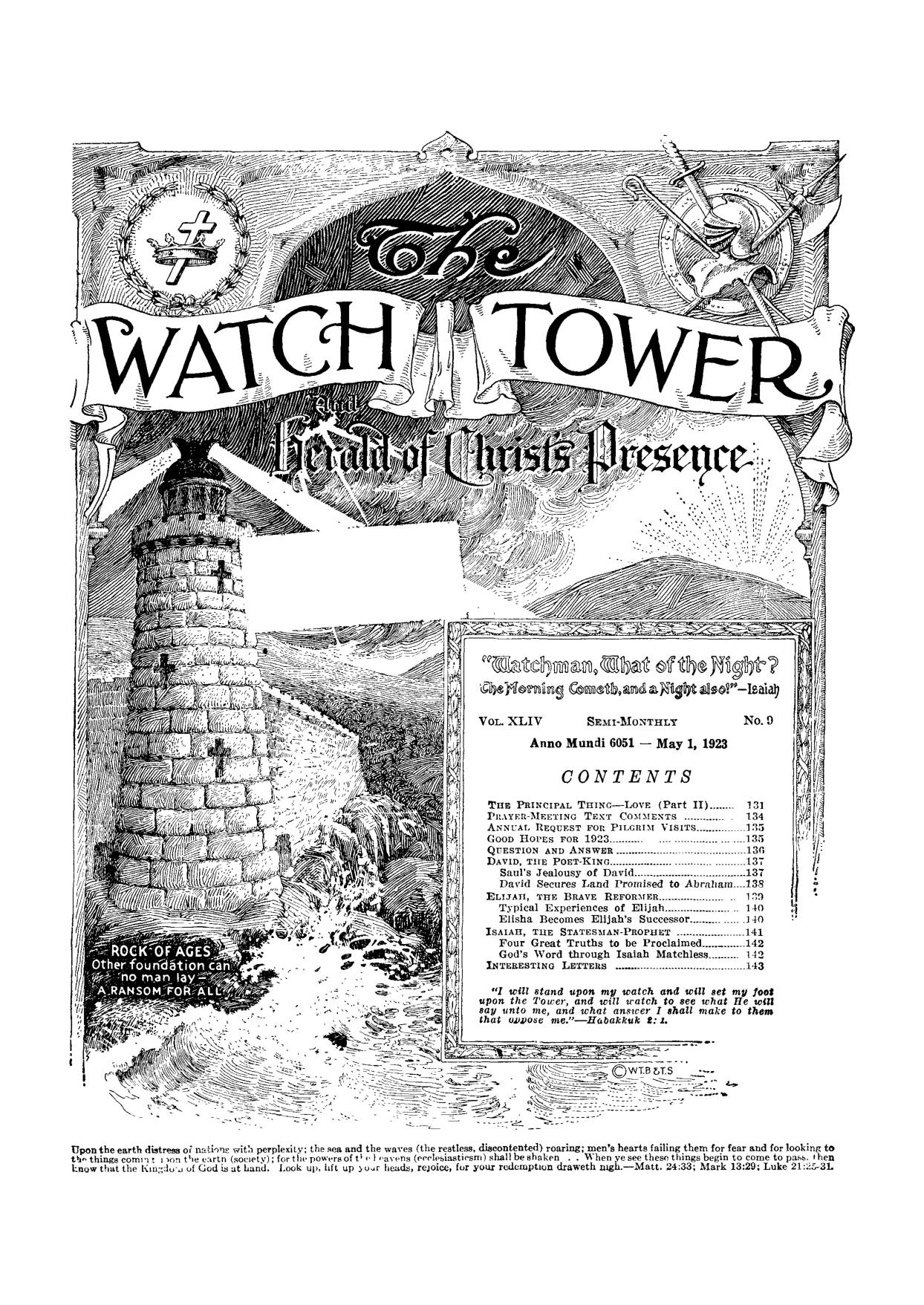
Vol. XLIV
Semi-Monthlt
No. 9
Anno Mundi 6051 — May 1, 1923
CONTENTS
The Principal Thing—Love (Part II) Prayer-Meeting Text Comments .........
Annual Request fop. Pilgrim Visits.....
Good Hopes for 1923...........................
Question and Answer...............................
David, the Poet-King................................
Saul’s Jealousy of David.........................
134 .....135 ....135 .....136 .....137 .....137
David Secures Land Promised to Abraham....l38
Elijah, the Brave Reformer.................
Typical Experiences of Elijah...............
Elisha Becomes Elijah’s Successor.......
Isaiah, the Statesman-Prophet ...........
Four Great Truths to be Proclaimed...
God’s Word through Isaiah Matchless.
Interesting Letters ..............................
139 140
. .140 ..141 ...142 . 142 ...143
“I will stand upon my watch and will set my foot upon the Tower, and will watch to see what He will say unto me, and what answer I shall make to them that twvose me.”—Habakkuk 2:1.
©WT.B 6T.S
Upon the earth distress or nations with perplexity; the sea and the waves (the restless, discontented) roaring; men’s hearts failing them for fear and for looking to th*' things comin ? i von the eartn (society); for the powers of t1 e 1 ‘-avens (ecclesiasticsm) shall be shaken . . When ye see these things begin to come to pass, then know that the Km-’do u of God is at Land. Look up, lift up }our heads, rejoice, for your redemption draweth nigh.—Matt. 24:33; Mark 13:29; Luke 21:25-3L
THIS JOURNAL AND ITS SACRED MISSION
THIS journal is one of the prime factors or instruments in the system of Bible instruction, or “Seminary Extension ’, now bein? presented in all parts of the civilized world by the Watch Tower Bible & Tract Society, chartered A. D. 1884, “For the Promotion of Christian Knowledge”. It not only serves as a class room where Bible students may meet in the study of the divine Word but also as a channel of communication through which they may be reached with announcements of the Society's conventions and of the coming of its traveling representatives, styled “Pilgrims”, and refreshed with reports of its conventions.
Our “Berean Lessons” are topical rehearsals or reviews of our Society’s published Studies most entertainingly arranged, and very helpful to all who would merit the only honorary degree which the Society accords, viz., J’erdi Dei Minister (V. D. M.), which translated into English is Minister of God’s Word. Our treatment of the International Sunday School Lessons is specially for the older Bible students and teachers. By some this feature is considered indispensable.
This journal stands firmly for the defense of the only true foundation of the Christian’s hope now being so generally repudiated -—redemption through the precious blood of “the man Christ Jesus, who gave himself a tansom [a corresponding price, a substitute] for all”. (1 Peter 1:19; 1 Timothy 2 : C) Building up on this sure foundation the gold, silver and precious stones (1 Corinthians 3: Ills; 2 Peter 1:6-11) of the Word of God, its further mission is to “make all see what is the fellowship of the mvstery which. . .lias been hid in God, ... to the intent that now might be made known by the church the manifold wisdom of God”—“which in other ages was not made known unto the sons of men as it is now revealed”.—Ephesians 3:5-9,10.
It stands free from all parties, sects and creeds of men, while it seeks more and more to bring its every utterance into fullest Bubiection to the will of God in Christ, as expressed in the holy Scriptures. It is thus free to declare boldly what:-sen- the Lord hath spoken—according to the divine wisdom granted unto us to undeistand hi utterances. Its attitude is not dogmatic, but confident ; for we know whereof we affirm, treading with implicit faith upon the sure promises of God. It is held as a trust, to be u.~cd only m his service; hence our decisions relative to what may and what may not appear in its columns must be according to our jud-ment of ins good pleasure, the teaching of his Word, for the upbuilding of his people in grace and knowledge. And we not only invite but urge our readers to prove all its utterances by the infallible Word to which reference is constantly made to facilitate such testing.
TO US THE SCRIPTURES CLEARLY TEACH
That the church is “the temple of the living God’’, peculiarly “his workmanship” ; that its construction has been in progress throughout the gospel age—ever since Christ became the world’s Redeemer and the Chief Corner Stone or his temple, through v>liich, when finished, God’s blessing shall come “to all people”, and they find access to him.—1 Corinthians 3:16, 17; Ephesians 2:20-22; Genesis 28:14; Galatians 3 : 29.
That meantime the chiseling, shaping, and polishing of consecrated believers in Christ’s atonement for sin, progresses ; and when the last of these “living stones”, “elect and precious” shall have been made real., Hie great 31a>ter Workman wfil bring all together in the first resurrection ; and the temple shall be filled with his glory, and be the meeting place between God and men throughout the Millennium.—Revelation 15:5-8.
That the basis of hope, for the church and the world, lies in the fact that “Jesus Christ, by the grace of God, tasted death for every man,” “a ransom for all,” and will be “the true light which lighteth every man that conieth into the tcoild”, “in due time”.— Hebrews 2:9; John 1 : 9 ; 1 Timothy 2:5, 6.
That the hope of the church is that she may be like her Lord, “see him as he is,” be partaker of the divine nature,’ and share his glory as his joint-heir.—1 John 3:2; John 17:24; Romans 8:17; 2 Peter 1:4.
That the present mission of the church is the perfecting of the saints for the future work of service; to develop in herself every grace; to be God’s witness to the world; and to prepare to be kings and priests in the next age.—Ephesians 4:12; Matthew 24: 14 ; Revelation 1 : G ; 20 : G.
That the hope for the world lies in the blessings of knowledge and opportunity to be brought to all by Christ’s Millennial kingdom, the restitution of all that was lost in Adam, to all the willing and obedient, at the bands of their Redeemer and his glorified church, when all the wilfully wicked will be destroyed.—Acts 3 :19-23 ; Isaiah 35.
PUBLISHSO By
WATCH TOWER BIBLE 6-TRACT SOCIETY
18 CONCORD STREET O 0 BROOKLYN, NY. U-SA
Foreign Offices : British: 34 Craven Terrace, Lancaster Gate, London \V. 2 ; Canadian: 270 Dundas St., W., Toronto, Ontario; Australasian: 495 Collins St., Melbourne, Australia; South AjrU can : 6 Lelie St., Cape Town, South Africa.
Ple xse Address the Society in Every Case,
YEARLY SUBSCRIPTION PRICE; United States, $1.00; Canada and Miscellaneous Foreign, $1.50; Great Britain, Australasia, and Sot tit Africa, 8s. American remittances should be made by Express or Postal Money Orders, or by Bank Draft. Canadian, British, South African, and Australasian remittances should be made to blanch offices only. Remittances from scattered foreign territory may be made to the Brooklyn office, but by International Postal Money Orders only.
(Foreign translations of this journal appear in several languages)
Editorial Committee: This journal is published under the supervision of an editorial committee, at least three of whom have read and approved as truth each and every article appearing in these columns. The names of the editorial committee are: J. F. Rutherford, W. E. Van Amburgii, j. iikmuy, G. H. Fisher, r. h. Barber.
Terms to the Lord** Poor: All Bible students who, bjrreason of old Bpre or other In* C.-.tx‘y or adversity, are unable to pay for this journal, will be supplied free if they send • postal card each May statin? their case and requesting such provision. We are not o"ly willing, but anxious, that all such be on our list continually and in touch with the Berean studies.
fn We do not. as a rule, seOda card of acknowledgment for a renewal or
notice IO ZfUOSCnoera. for a new’BUbBcr«ption. Receipt and entry of renewal are indicauj within a month by ehangre In expiration date, as shown on wrapper label.
---- ■ - ... - ■■ —----- -■ - ■ , ,
Entered aa Second Claes Matter at Brooklyn, N.Y., poctoffico under the Act of March 3rd, 1979, ‘
CONVENTION AT RICHMOND, VIRGINIA
A three-day convention will be held at Richmond, Va , June 8, 9, 10. Brother Rutherford and Pilgrim brethren w ill be present. For further information write W. B. Sutton, 3519 Carolina Avenue, Richmond, Va.
GERMAN CONVENTION
The German brethren of New York City will hold their annual convention at Apollo Auditorium, Carlton and Greene Avenues, Brooklyn, N. Y., on Saturday and Sunday, May 5th and 6th. Please address all inquiries to Brother J. Umlauf, 124 Columbia Heights, Brooklyn, N. X.
STUDIES IN THE SCRIPTURES
These Sirn’i’s .He i (‘commended to students as veritable Bible keys, discussing topically e\ery vital doctrine of the Bible. More than eleven million copies are in circulation, in nineteen languages. Two sizes are issued in English only : The regular maroon doth, gold stamped edition on dull finish paper (size 5"x7|"), and the maroon cloth pocket edition on thin paper (size 4"x6j"); both sizes are printed from the same plates, the difference being in the margins. Questions in both editions. The pocket edition—Volumes I, II, III, 75c each; Volumes IV, V, VI, VIL 85c each.
Series I, The Divine Flan of the Agen, giving outline of the divine plan revealed in the Bible, relating to man’s redemption and restitution : 350 pages, plus indexes and appendixes, 35c. Magazine edition 20c. Also procurable in Arabic, Armenian, Dano-Norwegian, Finnish, French, German, Greek, Hollandish, Hungarian. Italian, Polish, Roumanian, Slovak, Spanish, Swedish, and Ukrainian; regular cloth style, price 75c.
Series II, The Time is at Hand, treats of the manner and time of the Lord’s second coming, considering the Bible testimony on this subject: 333 pages, 35c. Obtainable in Arabic, Dano-Nor. wegian, Finnish, French, German, Greek, Polish, and Swedish. 75e
a cupy.
Series III, Thy Kingdom Come, considers prophecies which mark events connected with “the time of the end”, the glorification of the church and the establishment of the Millennial kingdom ; it also contains a chapter on the Great Pyramid of Egypt, showing its corroboration of certain Bible teachings: 380 pages, 35c. Furnished also in Dano-Norwegian, Finnish, French, German, Greek, Polish, and Swedish, 75c.
Series IV, The Battle of Armageddon, shows that the dissolution of the present order of things is in progress and that all of the human panaceas offered are valueless to avert the end predicted in the Bible. It contains a special and extended treatise on our Lord’s great prophecy of Matthew 24 and also that of Zechariah 14:1-9: 656 pages, 40c. Also in Dano-Norwegian, Finnish, French, Greek, German, Polish, and Swedish, 85c.
Series V, The Atonement Between God nnd Man, treats an all important subject, the center around which all features of divine grace revolve. This topic deserves the most careful consideration on the part of all true Christians: 618 pages, 40e. Piocurablf likewise in Dano-Norwegian, • Finnish, French, German, Greek, Polish, and Swedish. 85c.
Series VI, The New Creation, deals with the creative week (Genesis 1, 2), and with the church, God’s new creation. It examines the personnel, organization, rites, ceremonies, obligations, and hopes appertaining to those called and accepted as members of the body of Christ: 730 pages, 40c. Supplied also in Dano-Norwegian, Finnish, French, German, Greek, Polish, and Swedish.
85e.
Series VII, The Finished Mystery, consists of a verse-by-verse explanation of the Bible books of Revelation Song of Solomon, p„/i Uze'-iel : GOS pages, illustrated. tOc ’n cloth. 25c in magazine edition—latter treats Revelation and Ezekiel onlv_ Dano X’orw ogian* Finnish, French, Greek, Polish, and Swedish. 85c.
Vol. XI.IV
May 1, 11)23
No. 9
THE PRINCIPAL THING-LOVE (PART II)
A PROOF of agape is mentioned by the apostle Paul in other words and in other connection. On account of the abu.m of the spirit of liberality by mendicant friars, monks, and nuns, by begging priests and clergymen, and by open ami in-isteni colhetion and ‘‘drive” methods it is considered by the true church inexpedient to follow such methods as are commonly pursued by the nominal churches. In the primitive church the needs of the church and of the necessities among the friends had only to be mentioned, often privately, and there was—-wherever the spirit of the friends was right—a private, unostentatlous outpouring of whatever was required. Rather than call upon the disciples for assistance, St. Paul endured hunger and nakedness, and worked with his hands, that he might not be chargeable to them, however much of this world’s goods they might possess. However, there were groups of the consecrated, who not merely waited for suggestions and invitations, but sought to do good as they had opportunity to the household of faith.
44The churches in Macedonia were composed of poor people and were despoiled of their goods in persecutions, but they insisted in sending material aid to the Apostle. In appreciation, he has engraved the record of their kindness imperishably upon the pages of the Word of God. He speaks of their goodness as a manifestation “of the grace of God bestowed on the churches of Macedonia.” He records “how that, in a great trial of affliction, the abundance of their joy and their deep poverty abounded unto the riches of their liberality; for to their power, I bear record, yea, and beyond their power, they were willing of themselves [without solicitation] ; praying us with much entreaty that we would receive the gift, and take upon us the fellowship of the ministering to the saints.” St. Paul points out that this was a consequence of their genuine and whole-hearted consecration to the will of God, of a free will, and not from any sense of obligation: They “first gave their own selves to the Lord, and unto us by the will of God.”-—2 Corinthians 8:1-5.
45The church in the wealthy city of Corinth had formerly been like the poor churches in Macedonia in spirit, but had fallen away measurably in zeal and in seeking of opportunities to do good, so that the entire burden of supporting the then chief witness work had fallen on the poorer Macedonian brethren, who had even dis-palmied a brother to administer the fund lor the benefit of th<> little company of the Apostle. St. Paul related the circum-tancos to the Corinthian brothers. He showed an opportunity to aid the poorer Macedonians, witli the kindly v>ord that “I moan not that other men be ui od, and je burdened: but by an equality, that now at this time your abundance may be a supply for their want, that their abundance also may be a supply for your want: that there may be an equality.” (2 Corinthians 8: 13,11) In plain language, the Christians in different localities were admonished to share their abundance of the things of this world with one another, in order that there might not be want among the friends in one locality and superfluity in another, a practice which wa.i can led out more or less generally throughout the Christian church for three centuries, until the true church was overthrown by Constantine and by the and it ions and worldly ecclesiastics associated with that evil gmius.
4GSt. Paul had formerly boasted of the liberality > f the Corinthian friends, but now urged them to resume their labors of love, and stated positively that such a spirit was one of the tangible proofs of an overcoming agape. “Wherefore shew ye to them and before the churches, the proof of your love.” (2 Corinthians 8:24) Quite evidently those that lack in the spirit of liberality and hospitality — mingled with the spirit of wisdom and justice lack seriously in “the most important thing.” and deceive themselves in an expectation of or hope for any high place in the kingdom, or any share at all in the Lord's great promises in the second and third chapters of Revelation. Sons and brothers in a family seeic opportunities to do good to one another; but servants have to be reminded, urged and commanded. This would indicate that the non-liberal and unhospitable in spirit among the consecrated, unless they change for the better, are doubtless destined for places “before the throne.”—Revelation 7: 9.
47In the fully consecrated, divine love is a function of the new mind, which is exercised the same as the natural body automatically exercises its functions of breathing and digestion. Those who have it love others instinctively—at least they have the constant spirit or disposi-
tion so to do. If temporarily overcome by evil, they quickly return, as does the compass in its pointing toward the 1’ole Star. This disposition will waver in degree as the flesh wars with the spirit; but the fully faithful new creature endeavors to keep the spirit of love at its brightest, knowing that those are most pleasing to Christ who v>i>el\ and justly love most in spirit, and that they aloi •' will reign with him. The earnest desire of the apostle Paul is a> timely now as then that “the Lord make you to increase and abound in love one toward another, and toward all men, even as we do toward you; to the end he may establish your hearts unblamable in holiness before God, even our Father, at the coming of our Lord Jesus Christ with all his saints."’ —1 Thessalonians 3 : 12,13.
“Some may suppose that divine love may be withdrawn from an object of love—not wholly reprobate -who docs not reciprocate the affection. N ■: this highest love shines, like the goodness of God. who ‘'nmkefh his sun to rise on the evil and on th • go, ' and sendeth rain on the just and on the unjust ’’ I’e . 'chon in love —an out-spreading love like that of the father—was exemplii'ed in the Lord Jesus who. while cognizant of the perfidy of Judas, never even to the moment when he asked: “Betrayest thou me with a kiss?” treated the one that wa< “'a devil” differently from the other disciples. Impartiality in the shining forth of love—with proper differences in expression according to the reciprocation of the affection or relationship—is one of the characteristics of divine love. “For,” says Jesus, whose words the fully consecrated do, “if ye love them which love you, what reward have ye? do not even the publicans the same? And if ye salute your brethren only, what do ye more than others ? do not even the publ ieans so ? Be ye therefore perfect [in the spirit of love], even as your Father which is in heaven is perfect.”—Matthew 5: 4G-18.
“This high manifestation of love divine gleamed forth in the daily walk of St. Paul. In writing to the relatively rich eeclesia at Corinth, which of all others might have exercised the privilege of caring for the Apostle in material things, and thus promoting the witness work, that glorious overcomer said: “The third time I am ready to come to you; and I will not be burdensome to you [in respect to the things of this life] : . . . for the children [the Corinthians were his spiritual children] ought not to lay up for the pa rents, but the parents for the children. And I will very gladly spend and be spent for you.” Thus the gentle-hearted child of God—all things to all men—sought to help the less faithful Corinthians, by assurances appealing to their selfishness that he would not expect them to spend any money on him while he was there. In this as in many other circumstances he sought to catch by harmless guile. The divine impartiality of a love that endured all things that he might win others, shone splendidly in the words with which he closed the sentence: “Though the more abundantly I love you, the less I be loved.”—2 Corinthians 12: 14 15.
’’Sometimes divine love speaks in words of reproof, which may cause grief and sorrow to the beloved but erring recipient. Such a letter from St. Paul was rare but was as unavoidable as a surgical operation to a patient. It was designed to stir up a brother doing wrong to the point where he would himslf. by the Lord’s assisting grace, leave off the >m that might bring a loss of the Savior’s favor, or even lead to destruction. Such an epistle was written by St. Paul to the brothers at Corinth; it cut and pained, but >aved them from the consequences of continuance m an evil course. “Though I made jou sorry with a letter,” .-ays the Apostle. "I do not repent, though I did repent: for I perceive that the same epi.-tle hath made you sorry, though it were but for a season. Now 1 rejoice, not that ye were made sorry, but that je soi roved to repentance. . . . What carefulness it wrought in you, yea what clearing- of yourselves, yea v.hat indignation, yea vvluit vein me: t desire, yea what zeal, yea what revenge. | vindication, piutisl nvnt. Cl reck | ! In all things \e have approved yourselves to be clear in this matter.’’—2 Cor. 7:8-11.
51Love loves to be with a loved one. When two that love each other are together, their affection, unhindered by dneitmg -ngmestions and heightened bv the evidence and mamfc'tations of love by one another. Iiiiru the brighter. Nothing provokes or incites a warmer love than the close association of gathering- of the enumerated. Anger provokes to anger, like to like, love to love. So St. Paul beseeches us of today: “Let us consider one another to provoke unto love and to good works: not forsaking the assembling of oursebe- together, as the manner of some is; but exhorting one another: and so much the more, cu ije see f>e key approach ingHow important it is to obey thi- word of Jesus through his Apostle, now at a time when even the natural eye discerns the evidences of the fact that that day has dawned! More and more love is called for, now that it is but a few short years until the glorious Sun of Light will shine in full brightness for the ingathering and reconciliation of the willing and obedient of the whole' world.
’’When Jesus said: “I am come that they might have life, and that they might have it more abundantly” (John 10: 10), the primary reference was to the immortal life beyond the vail in heaven itself, and to the fully restored life of humanity on the earth. But we who are in him testify already to the greater abundance of the life of which St. Paul speaks: "The life' which I now live in the flesh, I live by the faith of the Son of God.” (Galatians 2: 20) While the imperfect flesh, the instrument and abode of the new' creature in Christ Jesus, retains its imperfections, the new mind possesses the character attributes of the divine, ready to be clothed upon with the house not made with hands, eternal in the heavens. In it are the potentialities of the more abundant life of the intimate family of Jehovah, which extend the heights and depths and lengths and breadths of thought, sentiment, outlook, and eternal prospect far bevond the limitations of time and visible space, making for a rich and abundant life this side the vail.
5AVhere and when does this begin? At one time wo were in and of the world, doing the deeds and working out the loveless purpose.- of the evil one. (2 Timothy 2:26) Our horizon then vas indeed contracted, our minds and affections narrow, centered upon one individual—self and the things and persons belonging to self. But ulion we were admitted into the mystical body of Christ, the horizon broadened to include all things visible and invisible, and our affections began to go forth to include the whole family of God on earth and in heaven and all that ultimately shall become members ol that holy family. It was when we began to have the fir t motions of divine love that the new life of the tramformed mind began. With our begettal began love and life; for in the kingdom ndo which we were then translated by Jehovah’s dear Son, there is no life without love. St. John writes to us: Everyone that loveth is begotten of God.” The same Apostle exhibits the contrast between our former dead condition and our present living state: “He that loveth not his brother abideth in death. We know that we have passed from death unto life, because we love the brethren.”—1 John 4: 7; 3:14.
5iAgape seeketh not its own (1 Corinthians 13:5); it looketh upon (regards, looks out for, Greek) not only its own things to watch and care for, but also the things of others; it is equally concerned for the welfare of brother and sister as for its own. To those bound by ties of the fleshly family, and those knit together by the bonds of the family of God. agape especially manifests itself and its watch-care. This is particularly so among those that seek most to walk in agape.—Philippians 2:4.
55As might be expected, the highest manifestation of agape is not to be found even in these members of the divine house of sons who are still on this side of the vail. They are subject yet to temptations that more or less draw them from the shining mark of agape; in them the selfish flesh wars against the unselfish spirit of divine agape; each of them says with St. Paul: ‘•'That which I do I allow not; for what I would, that do I not; but what I hate, that I do.” They know that, until they put on the “house” not made with hands, they can never escape from the workings of the “law in my members, warring against the law of my mind, and bringing me into captivity to the law of sin which is in my members.” (Romans 7:15-23) It is among those members of the Christ body in heaven itself that the limitations of the fallen flesh have been fully put off and the pure fellowship of the spirit exists. There divine agape shines forth in pure brilliancy and warmth. What heavenly oneness exists today among the twelve apostles of the Lamb and the seven messengers to the churches!
56There, too, in its highest possible exemplification, divine agape is exercised in the person of Jehovah himself. Love divine in utmost degree radiates forth from him in every direction and toward every being, not reprobate, in the heavens and on the earth. Divinity awaits the reconciliation of all, among men and fallen angels, who in the day of their visitation will repent with a godly repentance, turn their faces toward the righteousness that is in Christ Jesus, and learn the lessons of agape which all will master who are to be fully restored to the divinely intended places in the family of God.
07What will divine agape do for such? Though something is revealed to us by the spirit, even the fully consecrated still see as through a glass darkly, and none can appreciate the blessed future in its fulness. Indeed, “it doth not yet appear what we shall be,” and we cannot even imagine such hidden, unrevealed mysteries. But concerning the preparation by divine agape for the beings that love Jehovah it is written, “Eye hath not seen, nor ear heard, neither have entered into the heart of man, the things which God hath prepared for them that love him.”—1 John 3:2; 1 Corinthians 2: 9.
58 For the faithful house of sons are reserved the most superlative blessings. They shall lie forever with him whom they love, and with the beloved friends in the body of Christ. At his right hand, whore they shall be, are pleasures for evermore. And in the ages to come he will shew the exceeding riches of his grace in his kindness toward us through Christ Jesus.—Ephesians 2: 7.
59Then from every part of the infinite ocean of divine agape, undisturbed longer by the eddy of evil upon the planet earth, will swell forth the blessed song, of beings in heaven and on earth: “I heard the voice of many angels round about the throne and the beasts and the elders: . . . saying with a loud voice, Worthy is the Lamb that was slain to receive power, and riches, and wisdom, and strength, and honor, and glory, and blessing. And every creature which is in heaven, and on the earth, and under the earth, and such as are in the sea, and all that are in them, heard I saying, Blessing, and honor, and glory, and power, be unto him that sitteth upon the throne, and unto the Lamb for ever and ever." ■—Revelation 5 : 11-13.
QUESTIONS FOR BEREAN STUDY
How did the early disciples supply the needs of their brethren? fl 43. How did the churches of Macedonia send their gift to the apostle
Paul ? fl 44.
What commendable custom did the early church practise? fl 45. How do those who lack liberality deceive themselves9 fl 46.
Why is the advice of the Apostle timely in the present day? fl 47. How does divine love show mercy to the unjust? fl 48.
How did the apostle Paul manifest divine love? 1149.
In what way did he seek to “catch” the selfishly inclined by guile? ..A49-......... . _____
What end is sought Tvhen divine love prompts a reproof? fl 50.
How does association among the brethren stimulate this love? fl 51. How are love and life related ? fl 52.
When do divine love and life begin to operate in the individual? fl 53.
How does “agape” love seek the welfare of others? fl 54.
Why is it impossible for “agape” love to express itself fully this side the vail ? fl 55.
Why will God rejoice in the harmony of all obedient creatures? fl 56. Why cannot we approximate and appreciate the Father’s future blessings? fl 57.
What are some of the blessings beyond the vail? fl 58.
How will praise be manifest at the end of the Millennium? fl 59.
PRAYER-MEETING TEXT COMMENTS
TEXT FOR MAY 23
"Sow to the spirit; of the spirit reap life.’—Galatians 6: <9.
WHEN one becomes a new creature his mind will be exercised in one of two ways, either according to the tendencies of the flesh or according to the spirit of the Lord. As a creature he has but one mind, and that mind must be occupied at something. Sowing to th? spirit means occupying the mind with tilings p rtaining to the spirit of the Lord, thereby ascertaining the will of God : and then by exercising one’s own will, to bring oneself into conformity to the will of God. This is a real task. It does not mean to be idle, but it does mean to be diligent. It means to refuse to permit the mind to entertain things that are selfishly wicked, such as malice, hatred, ill will, pride, ambition, etc. Sowing to the flesh means to yield to these fleshly tendencies. In proportion as we resist the fallen, fleshly tendencies, in proportion as we fix the mind upon the things pertaining to the Lord and his kingdom, in that proportion shall we be sowing to the spirit.
The mind searching out the will of God by studying his Word and meditating upon it is working in the right direction; and then if one exercises his will to do God’s will and brings himself in conformity to God’s will, he is thereby sowing to the spirit. Hence St. Paul says: “Walk in the spirit, and ye shall not fulfil the lust of the flesh.”
The importance of having the mind occupied with things pertaining to the interests of the Lord’s kingdom cannot be overstated. For this reason activity in the Lord’s service is vitally essential. This text is really one of hope and good cheer. A person battling for the right will make mistakes, and is certain to come short of even his own conception of the perfect standard. But if he is conscious of the fact that he is striving to do that which is pleasing in the sight of the Lord, that his heart is right toward the Lord, then he may know he is sowing to the spirit; and if he persists in this course it will result, according to the promise, in life everlasting.
God judges us according to our motives; and for this reason we say that he judges according to the heart, the heart being that which induces action. The proper course, then, is to have a loving heart toward God and toward his cause, a loving heart toward Jesus and his brethren, and then to use the mind to search out God’s Word and watch his providences and thereby ascertain the will of God, and then exercise our own will in carrying out the will of God. By this means we are sowing to the spirit. Thus the transformation is going on from one step to a higher degree of transformation; and this is being accomplished by the Lord’s spirit. In due time we shall reap if we faint not, and this reaping will consist of life everlasting on the divine plane.
This course must be persisted in, not for a time, but until the very end of our earthly journey. The reward is not to the swift for a time only, but to those who are faithful even unto death.—Revelation 2:10.
TEXT FOR MAY 30
“The spirit of glory . . . resteth upon you.”—1 Peter 4-
WHEN a Christian suffers because of his faithfulness as a Christian, he has reason to rejoice. Does he rejoice in the fact that he is suffering? Not at all; but he rejoices because the reproach has fallen upon him as a result of faithfully representing the Lord, his King, and the interests of his kingdom. No one takes a delight in physical or mental pain. His delight and joy, however, is in the testimony afforded to him by reason of these things, that he has the Lord’s smiling approval.
The word glory as used in this text means honor. A Christian pursuing the way to his heavenly home could not be more highly honored than to suffer reproach for Christ’s sake. Satan and his emissaries have reproached Jehovah from the very beginning of man's career. When Jesus came to earth he suffered these same reproaches because of his loyalty to God. His zeal and loyalty brought upon him these reproaches. (Psalm 69: 8,9) And so St. Peter here, and also St. Paul in another place (Romans 15: 3), point out that the true follower of Christ must likewise suffer reproach. It is the spirit of Christ exercised and made manifest that brings this reproach. And this reproach is a testimony of and by the spirit, that the Christian thus reproached for faithfulness occupies a place of glory; that is to say a place of honor in God’s arrangement. Let every one, then, engaged in the Lord’s service who is reproached by the evil ones because of faithfulness, rejoice and be glad, knowing that the Lord is thus testifying to them that they are following in his footsteps. Then if this course is followed until the transformation is complete, such a one will be granted an abundant entrance into the everlasting kingdom of our Lord and Savior Jesus Christ.
Let no Christian, then, slack his hand at this time; but persistently and faithfully look well to the interests of the Lord’s kingdom, being a true and faithful witness under all circumstances.
“Christ is thy peace;
From penalty and stain he sets thee free;
And in the white robe of his righteousness, Before the approving God presenteth thee.
“Christ is thy all ;
Forget thyself, and In him sweetly rest;
And thou shalt enter, whatsoe’er befall, The everlasting mansions of the blest.”
ANNUAL REQUEST FOR PILGRIM VISITS
THE visit of the Pilgrim brethren results in a double blessing. It blesses linn who serves and blesses them that are served. It is in obedience to the Apostle's admonition concerning the a'.'ombling of ourselves together. The laird has blessed thi- branch of the work, thereby 'tam:>..’a it with hi- approval. The class that fails to haw1 these \wt' iui-W' a blo-imr. The Society route' the Pilgrim-. however, in harmony with the requests; and thi' request is expected to be made once annually.
In making these requests postal cards should lie used, for coineinence in our files. The questions herewith sot forth should be answered, numbering your an~wer to correspond with the number of the question. The question itself not'd not be repeated. Please write the min es distinctly.
We advise that the chi' - secretary be not changed any oftener than neces-ary. Each change requires a now stem it to be cut in our office and a change in our records. But when a charge i< made, plca-e notify us promptly. Failure to do thi' often causes inconvenience, both to the class and to the Pilgrims, as well as to this office, and thus hinders the work.
In giving the name of the secretary or any other address, do not give a post-office-box address, but give the street number. Telegrams and other messages cannot be delivered when sent to a post-office-box address. It is aho very inconienient for the Pilgrim brethren to find the secretary when such address is gnen. and sometimes necessitates the missing of a meeting.
The Society is anxious to serve all the via was, regardless of size, insofar as it is possible; and believing that all the consecrated anxiously desire the visit.' of the Pilgrim brethren wc are pleased to have the information requested in order to facilitate our routing ol these brethren. Where there are isolated friends, only one or two, and you would desire a Pilgrim visit, please send in your request; and if possible the Pilgrim will call on you w hen passing your w ay.
Great care is used in selecting brethren for the Pilgrim service. In a special sense they are represent.! 11 ■> es of the Walch Tower Bible & Tract Society, as it represents the Lord. They therefore represent the kingdom now so close at hand. Their diPics are to sene the friends in spiritual matters, to advise, aid and comfort them for their development as new creatures. They come prepared to hold two meetings each day. one in the afternoon and one in the evening.
The friends everywhere take pleasure in entertaining the Pilgrim brethren as sonants of the Lord. The; do not expect luxurious entertainment, but only wholesome food and a comfortable room when' the nece -ary rest can be had. They travel at the expeii-e of the Society; hence are its representatives.
Because of th.' importance of the time, there is now an increased desire on the part of the public to heai the truth. Therefore we urge the friends to arrange for at lea-I one public meeting during the visit of the Pilgrim. To this (>nd a good, well-located, reputable hall should be provided. special efforts being made for the public witness Sundav afternoon or evening, as it may be coin ‘i . ,t to the class. Bemember, dear brethren, the bles-.'d prix ilege we have to be coworkers with the Lord in the proclamation of the message now due. Hence wo ask your Cooperation with us and with the Pilgrim brethren in this behalf.
We ask you to answer the following questions, which information i~ needed for our immediate guidance in preparing the Pilgrim routes:
(a) State number of Bible Students in your class who accept the complete series of Studies ix the Scriptures.
(b) Are weekly meetings held?
(c) Whore do you now meet on Sunday? (Give full -trcct addre-s and name of auditorium, hall, 01 homo. Notify us of changes.)
(d) At what hours are the Sunday meetings held?
(e) Was a vote taken on the Pilgrim invitation?
(f) If a Sunday appointment is made, will a thoroughly advertised public meeting be arranged ?
(g) Have the members of your class chosen leaders in accordance with Volume VI, chapters 5 and G?
(h) Give name and address of one member of class (other than Secretary) whom we may notify in re Pilgrim visits.
(i) Give the. name of proper railroad station at which to .'top.
(j) How- many miles from station is meeting place?
(k) If at a distance from railroad station docs some member of class have a conveyance to transport the Pilgrim?
(1) Gi\e full name and address of Class Secretary (always notify us of changes).
GOOD HOPES FOR 1923
THE work of the Watch Tower Bible & Tract Society is the preaching of the gospel ot Me— siah’s kingdom Every consecrated cluld of God IS privileged to participate in this work. Brother Ku-sell always outlined the work during the year in proportion a- the Lord provided the money through his consecrated children. We continue to follow that example, as appropriate in the church.
Each one who has been enlightened by the truth appreciates the fact that this blessing came to him as a gracious gift; and as he has a zeal for the Lord he appreciates his privilege of using time, energy, and money in telling the message to others. Some are not blessed with endowments for going about and telling it to others, while they are blessed with some money which they desire to use in the Lord’s service, to the end that hungry souls might be fed upon the precious truths, as we have been fed.
The custom of setting aside each week so much to be used in the Lord’s service has always proved beneficial to the giver. A notice to the Society that you hope to give so much enables us to outline the work, based upon what is expected.
Since a large portion of such donations are used to defray the Pilgrim expenses, we have thought it wise to let the notice for Pilgrim requests and the “Good Hopes’’ notice appear in the same issue of The Watch Tower.
Heretofore it has been our custom to print one page in Tun Watch Tower to he clipped out by the friends and sent to us; but this defaces the issue, and some of the brethren have complained about this; hence wo arc adopting the present method. Upon receipt of this issue
of The Watch Tower kindly write two cards, exactly alike. One of these put aside for your own record of what you have promised; the other send to us. Or, if you prefer, put it in the form of a letter, keeping a copy of the letter for your own convenience. We suggest that it be brief and that nothing else be written exept the following: “By the Lord’s grace I hope to be able to give to his work for spreading the gospel during the ensuing year the amount of $................. I will remit in
such amounts and at such times as I can find convenient, according as the Lord prospers me. (Signature) .................. ” Kindly address this card to the Watch Tower Bible & Tract Society, Financial Department, 124 Columbia Heights, Brooklyn, N. Y.
Brethren residing outside of the United States may write their respective offices in the countries where ihoy reside, and remit their “Good Hopes’’ to such offices, thus saving time and work for us.
Of our own selves we can do nothing, but we are assured that the prayers of the righteous avail much. Hence we ask the brethren to daily present us before the throne of heavenly grace, that we may bo gnen wisdom and grace to use the money to the best advantage in spreading the gospel to the Lord’s glory, and to do the work entrusted unto us.
QUESTION AND ANSWER
SHOULD AVOID PRESUMPTION
QUESTION: We have a class with five elders and one deacon, and other class members, numbering in all about twenty-one. We have no chairman nor business meetings, and the election of servants is held only once a year. There is a secretary and treasurer; but he neither takes minutes of meetings nor makes report of how much money there is on hand. One of the elders just takes action on matters pertaining to the class, without consulting any one else; and when spoken to about it he becomes very angry. He takes his chair and sits up in front as though ho were leading the meeting, when another elder is leading. Would we not be in bettor position to receive the Lord’s blessing if we had an election of class servants twice a year? and an election of a class chairman, as well as a secretary who would take minutes of all business transacted during the month? and a treasurer who would report to the class all money on hand, rcc< ived and paid out, at a regular monthly business meeting?
Answer: Answering your question directly, the class makes a great mistake in permitting any one elder to assume the authority that the one spoken of does assume. Our Lord is orderly in everything, and he is surely pleased to have his people act orderly. The organization of the class in an orderly manner is not only proper, but essential to development and progress. Some classes make the mistake of letting thffir ;.ffii rs drag along in an indifferent manner. We should remember, however, that the Lord’s business requires the strictest observation and should be conducted in the most orderly manner that we do anything.
No older should assume to be chairman or try to act for the class in the manner that you mention in the question. Our advice is that you have an election every six months, and at this election some one be elected to act as chairman for six months. Then let the class have a business meeting once a month to transact any and all business that may come before it; that you have a secretary who will keep the minutes of all the business meetings; a treasurer who will keep an account of all monies received and paid out; and that the work be kept in an orderly way, as a successful business person would conduct his business. Any other course is, to say the least of it, neglect and indifference on the part of the class, and surely could not be pleasing to the Lord.
Should it be necessary to have a special business meeting, the class should pass a resolution and such a meeting might be called by the elders; and at this meeting if no one is chairman a chairman might be elected for the occasion. By all means conduct your affairs in an orderly way; and, as the Apostle saysj “Let everything be done decently and in order.”
DAVID, THE POET-KING
---May 13---1 Samuel, 2 Samuel---
haul’s JEALOUSY OE DAVID—DAVID’S LOVE FOR GOD'S SHEEP--DAVID SECURES LAND PROMISED TO ABRAHAM—DESTRUCTION 0"
GOD’S ENEMIES PREFIGURED—MUSIC GOES WITH THE KINGDOM.
“Surely goodness and loving kindness shall follow me all the days of my life.”—Psalm 23: 6.
OUR lesson is of David, the Poet-King, the sweet singer of Israel, and a king after God’s own heart. The life of David to Israel is something like the Lake of Galilee to the river Jordan. As the lake receives the head waters of the Jordan, holds them, and pours them out in flood, so the history of Israel seems to center in David, who receives it, and pours it forth in fresh flow. In David the life of Israel revived; and the hope of Israel and the reason for their separation from the nations of the earth were again clearly seen. From David came the pomp and the power, as well as the sweet music of Israel. Like all men of God in Israel whose works are recorded David is a “sign-man” ; that is, one used as a type or illustration. See Zechariah 3 : 8, margin.
2David’s call to prominence in Israel was unexpected. While his father Jesse was a man of some importance in Bethlehem, yet there was no expectation of anything special happening to the family. But Saul had failed ; he was a self-willed man with much appearance of humility, but of much pride of heart, and, manifesting considerable hypocrisy. Saul well represents the human ideals of the people, and the human will operating contrary to God. Because of his self-will he was not allowed to establish a dynasty: no son of his must reign upon Israel’s throne. On Saul’s rejection years before his death, Samuel was sent to Bethlehem to Jesse’s family to anoint a new king. The family of sons came before him ; and Samuel’s choice was falling upon one of the fine young men, when God stayed him. Probably Samuel thought that as God had previously selected a tall man for king, he would want another of the same kind. His love for and fear of Saul interfered with his judgment. Even Samuel must be reminded that God looks upon the heart. God saw in the young lad David one whose heart would be true towards him. David’s readiness to go back to care for his father’s sheep even though anointed to be king in Israel is an example to all who desire to keep a right attitude of heart. The lad was not only lowly of mind and faithful, but healthy, strong, and industrious; he was also musical, poetic, and devout.
SAUL’S JEALOUSY OF DAVID
sOur space does not allow us to tell in detail of the circumstances which took him away from the sheepfolds to Saul’s court. Some of the experiences there were hard to bear; for Saul got bitterly jealous of him, and often would have slain him. Indeed, David says that he was hunted like a partridge in the mountains. (1 Samuel 26: 20) The true-heartedness of the young man was revealed then; for during those days David had several opportunities of slaying Saul; but to him Saul was the Lord’s anointed, whom he would not hurt. These trying experiences were all to David’s advantage; for they gave him many opportunities of developing character, and by them he was prepared for his responsibility as king of Israel.
4As the persecution did not cease, David joined himself to one of the Philistine nobles. It was a serious error of judgment; for he became so far involved as actually to join the Philistine army on the march to Gilboa, where Saul lost his life. But God intervened (1 Samuel 29) ; and David was saved from the calamitous error of fighting with the foes of Israel against the Lord’s anointed. His mistake brought him into trouble with his followers, even to so sharp a pinch that they came near to stoning him, their beloved leader. (1 Samuel 30:6) Here again God saved him, and brought him out of his distress.
5On the death of Saul David’s own tribe Judah made him king. But the northern tribes, perhaps suspicious because of his union with Israel’s enemies, refused to accept him as the Lord’s anointed, and made one of Saul’s sons king. This led to civil war in Israel, and to the first real division between the tribe of Judah and the other tribes of Israel.
"David reigned in Hebron seven and one-half years. (2 Samuel 5:5) At the end of that time the northern cause collapsed, and all Israel went to Hebron to make David king. Following a wise policy he removed his seat of government from Hebron in Judah to Jerusalem in the tribe of Benjamin. As Jerusalem is built on a hilly formation which juts into the portion of Judah, David served the two purposes of remaining practically in Judah, while being actually in Benjamin.
7It is at this juncture that one of the most familiar names of Scripture is first mentioned; that of Zion, the name of the highest hill in Jerusalem. It was held by a colony of Jebusites, who derided David’s attempt to dislodge them. The account of its capture is interesting and typical. David established himself there. He built a house, and a citadel, and immediately began that series of activities which placed his name foremost amongst the kings of Israel, and made him a type of the great King of the kingdom of God. David’s opportunity as king in Israel had come in due time. The seventeen years or so since as a boy Samuel had anointed him had been a long time of somewhat bitter experiences. Now, in God’s own time, he was ripe in experience and ready for his work. He came to the throne well equipped both with experiences in life and with true ideas of the honor, privilege, and power of his position as God's representative. It is altogether to David’s honor that he had waited God’s time instead of endeavoring to force the situation. And because David’s heart was loyal, God saved him from the serious consequences of his error of judgment. God is very gracious to the loyal heart.
DAVID’S LOVE FOR GOD’S “SHEEP”
8As a boy keeping sheep in the fields at Ephratah, David had thought of w hat he would do when king in Israel—of the house he would build for the ark of God then hidden, as it were, in the home of Abinadab in Kirjath-jearim. (1 Samuel 7:1; Psalm 132: 6) There, too, he had thought of Israel as God’s sheep, and his warm loving heart was stirred for them. As he tried to be a faithful shepherd of the sheep, so would he as king endeavor to care for God’s sheep. And this idea remained witli him. (1 Chronicles 21; 17) Also his experiences with the courageous yet somewhat wild and unruly men who came to him in the mountains of Judea fitted him for leadership among men. Ha had an attractive personality; and those who came in contact with him became his devoted friends or servants. As king he was God’s choice; he was the choice of the people; and God had trained him.
9The ideals then before David were: (1) To find a place for the ark, that Israel’s worship might be restored: (2) to build a representative city; and (3) to erect a noble temple for the Lord, that the ark of God should no longer dwell in a tenl, liable to all vicissitudes. It was really the jealousy of tire ten tribes which caused him to go to Zion, hut that mean spirit was used by God for the good of his people. Without doubt the spirit of God directed David thither. After lie had established himself in Zion he immediately prepared a place for the ark, and it was brought from Kirjath-jearim to Zion with shoutings and acclamations of praise. Probably the Twenty-fourth Psalm commemorates this. On this occasion all Israel were gathered together and had a happy time of feasting; and David now the king in power in Zion fed the people and blessed them with bread and wine, acting in type the part of King Melelnzedek in the greater Zion now soon to be established. —1 Chronicles 16:1-3.
DAVID SECURES LAND PROMISED TO ABRAHAM
“David was a true Bible Student. (Psalm 1:1,2) He saw that the kingdom over which he ruled was only a small portion of the land which God had given to Abraham by promise (Genesis 15:1S-21), and which had not yet become theirs, partly through their lack, and perhaps because God's due time had not come. But now as God’s king in Zion lie saw the time had come; and he entered upon a series of wars with the nations that occupied that terrilory, and that were the enemies of Israel, with the result that all the land which God had given to Abraham was brought under the rule of Israel. Thus David, God’s king in Zion, first brought the Abrahamic covenant -is relating to Israel’s land into realization; and the kingdom was established in power.
1:lBut David’s reign in Zion does not represent the rule of the Prince of Peace; for David was a great fighter, and there are to be no wars when the kingdom of peace is established. (Psalm 46:9) What then does it represent? We answer: There are two phases in the work of establishing the kingdom of heaven upon the earth ; the first a comparatively short one, while the wars of the Lord are fought, and all opposing forces whether of error or wrong are rendered powerless; the other the long period, during which the redeemed human family will be blessed with those things whicli God has in reserve—lasting life in peace and happiness. The first phase is represented by David’s reign and work; the second, by the reign of Solomon. David as a boy represents the anointed of the Lord mt dilating upon the Lord and seeking to be faithful. David as a young man limited by Saul represents the church in the bitter experiences in the present evil world hunted by Satan, but gladly waiting God’s time for exaltation, and in the meantime learning the lessons which will fit them for their highly exalted position when raised to be joint-heirs with Christ. But David as king represents the Lord from the time of his return, until the time when the reign of peace shall come, as represented by Solomon.
“The first phase began witli our Lord’s return in 1874. Its marked periods are 1878, 1881, 1914, 1918, 1925. Zion represents the place of power out of which light shines (Psalm 50:2; Isaiah 2:3), whether now or in the established kingdom. Present truth has shone forth clearly from 1879, when Zion’s Watch Tower and Herald of Christ’s Presence was first published. From the standpoint that the King had returned in power, present truth was proclaimed; and God’s messenger, Pastor Russell, led its attack against all forms of error until all the truth belonging to Spiritual Israel had been made plain. Then, for the first time in the history of the church of God, the Abrahamic covenant as respects the spiritual promises became the inheritance of God's people. Never until then did the church Bee clearly all that God had given them in that covenant.
The battles of truth against error were fought, and truth won its victories. For the first time the spiritual Israelite was free to walk through all the land of the promises, tha truth.
DESTRUCTION OF GOD’S ENEMIES PREFIGURED
“But tliis is not all: There remains another sei of enemies of the kingdom who must be brought to nought before it can be established. These we know under the names of the beast, the false prophet, big business, and all those institutions which are opposing the kingdom. The fight is on. The Word of God is marshaling his hosts and sending them forth into battle. Soon all these enemies will be reduced, and the David phase of the establishment of the kingdom of heaven will be concluded. These giants are probably represented in David’s last conflicts, a fight against giants, the Inst one being a monster branded with "11." the murk of Ilie beast; he had six toes on each fool, and <ix fingers on each hand. (1 Chronicles 20:6) Those : .’iis exterminated the race of giants, just as the present »..n,ae will exterminate all the monsters which ha\e oppressed humanil y.
“When David had conquered the seven peoples—I’hilistia. Edom, Moab, Amnion, Syria, Zobah. Hamath—he dev.bed considerable time to preparation for the building of the temple and its service. Because he was a man of war he was not allowed to erect the temple of peace: but as he was God's servant doing his will, he was allowed to pi epare materials for the temple. (1 Chronicles 22:5) God also gave to him the minute details of ils construction (1 Chronicles 2S: 19), and David prepared the musical service- and arrangements.—IChronicks 25:1.
MUSIC GOES WITH THE KINGDOM
“Until David’s time music had had little place in Israel's worship. Correspondingly it was not until the true kingdom came that the Harp of God could give forth its sweetly solemn sound. Music goes with the kingdom. Weeping endures for the night of sorrow, but joy and the new song come with the morning. And David not only was musical, he was poetical. His poems are the finest expressions of thought which the world possesses. There are no words like his for expressing the emotions and desires of God’s people. They are, of course, specially expressive of the Christ life rather than of human devotion; but every honest heart who has gone to the Psalms has found that by which he can draw near to God. That these things were in the mind of David as a young man before he came to the kingdom is revealed by 1 Chronicles 9: 22. It seems clear from this scripture that in those early’ days when David fled from Saul he spent a considerable time at Samuel’s house. There the old man who loved music, and the young man who had it in his soul, talked together of what was to be when David should come to the throne, and his heart’s desire could be accomplished. Every phase of tins full life provides some lessons for the church of God, particularly in this day when courage is so necessary. Here again shines forth clearly the fact that God blesses those who are loyal to his arangements.
“David as a boy and youth is a fine example for every youth. After his anointing by Samuel he was as willing to keep his father’s sheep as before. As a boy lie was industrious; for no man could have a full life such as he had who has not been industrious as a boy. He was faithful to his trust. Envious arrows were shot at him, but lie kept his honor because he always set God before him. Than David's there is no fuller, busier, more eventful life in Scripture. His life was one of ceaseless activity, improving himself, making use of his talents, studying the work of the
Lord or. as frequently happened, kept busy by his enemies.
17Towards the end his life went somewhat into the shadows. Yet there were bright gleams, and the glory of God is seen shining on him. His life's tasks had been accomplished and everything was ready for the establishment of the kingdom of peace. In all his desire for the honor of God, and in his care for God’s people, he was a man after God’s own heart.
QUESTIONS FOR BEREAN STUDY
Hnw may the hie of David be pictured in the lake of Galilee? KI. What were Hie characteristics of Saul*' Of David? ^2.
What wore some of the experiences of David? Why was Saul jealous of him ? 3.
What smimis error did David make, and how did God save him? 1(4. What led to the first division of Israel? U 5.
What (aimed the reunion of Israel? How long did David reign ta 1 lebion ? 51 6.
Where did David next establish his government, and how did he do it? ‘ 7.
In what way was David trained for leadership, and did he make friends? H 8.
What three things were on David’s mind at this time, and why? 1 9.
…