The Watchtower, January 15, 1922
Download: PDF — The Watchtower, January 15, 1922
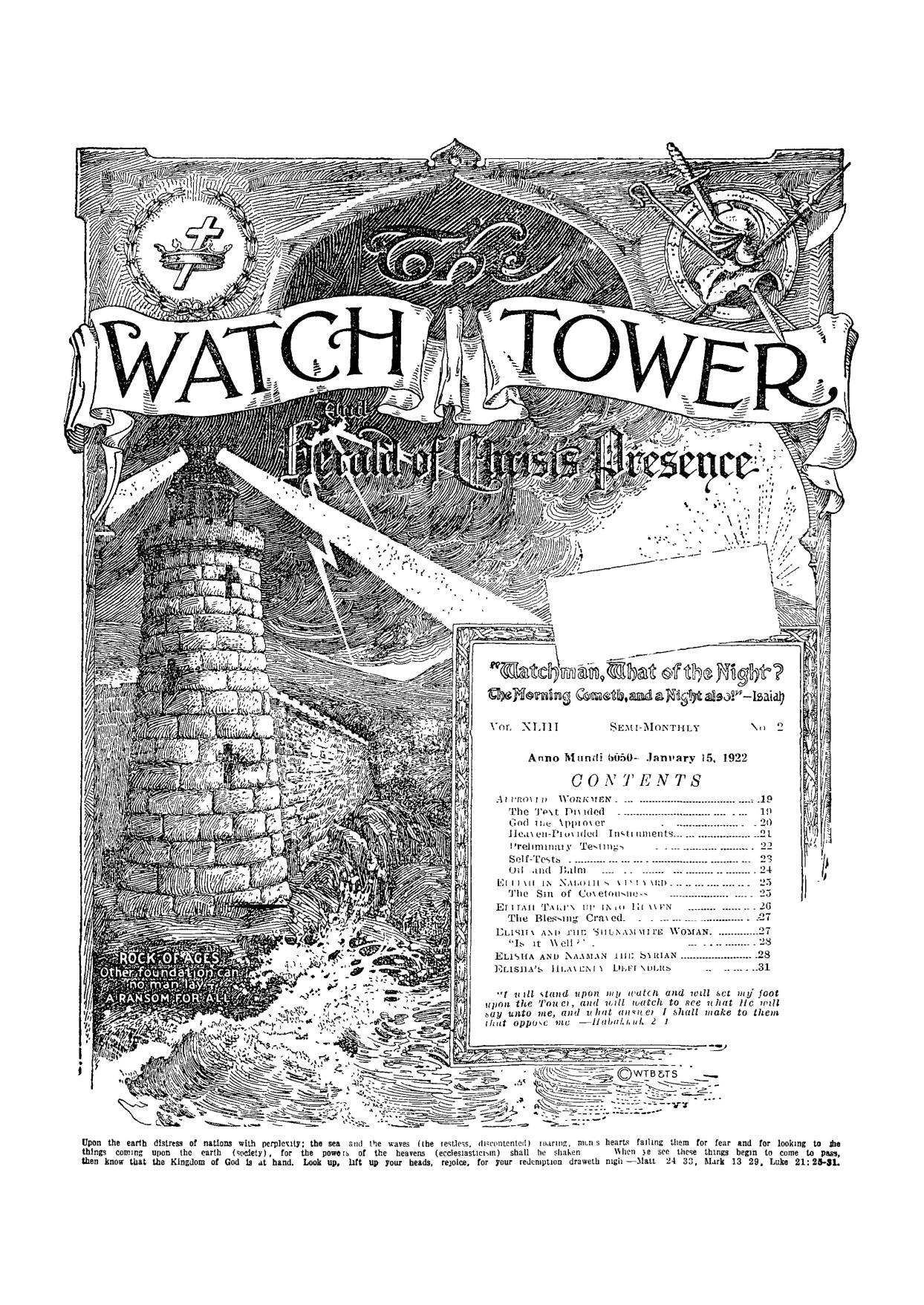
. . 26
The Blesxinir Crated..................
am mi PE Woman.
tand upon my watch and will set my foot
>'l u ill
.. . 28
.....31
to them
Upon the earth distress of nations with perplexity; the sea ami the waves (the restless, discontented) lo.iring, mins hearts failing them for fear and for looking to the things coming upon the earth (society), for the powers of the heavens (ecclesiasticnin) shall he shaken When ye seo these things begin to come to pass, then know that the Kingdom of God Is at hand. Look up, lift up your beads, rejoice, for your redemption drawetb nigh—Matt 24 33, Mark 13 29, Luke 21:2&>S1.
Gsffl&lila.aiad a aSso!”-Isaiaty
Semi-Monthly
Anno Mundi bu50~ January
G 0 N T E N T S
Other,foundation can< ’■&< r=wnd' rria h j»
■ a,ransom,for aVl^^
At prox 11> Workmen...............
The 'J’p\t Pn uled .................
God ujc \ppio\er .
JIea\ en-1‘1 u\ ided In««ti unients
I’reliminaiy rJ Self-Testb .... Oil .ind B.ilm
upon the Touci, and will Mitch to see it hat He will toy unto me, and uhat an^nei I shall make to them
THIS JOURNAL AND ITS SACRED MISSION
THIS journal Is one of the prime factors or instruments in the system of Bible instruction, or "Seminary Extension”, now being presented in all parts of the civilized world by the Watch Tome Bible & Tract Society, chartered A. D. 1884, “For the Promotion of Christian Knowledge”. It not only serves as a class room where Bible students may meet in the study of the divine Word but also as a channel of communication through which they may be reached with announcements of the Society’s conventions and of the coming of its traveling representatives, styled “Pilgrims”, and refreshed with reports of its conventions.
Our “Berean Lessons” are topical rehearsals or reviews of our Society’s published Studies-most entertainingly arranged, and very helpful to all who would merit the only honorary degree which the Society accords, mz., Veibi Dei Minister (V. D. M.), which translated into English is Minister of God’s Word. Our treatment of the International Sunday School Lessons is specially for the older Bible students and teachers. By some this feature is considered indispensable.
This journal stands firmly tor the defense of the only true foundation of the Christian’s hope now being so generally repudiated —redemption through the precious blood of “the man Christ Jesus, who gave himself a ransom [a corresponding price, a substitute] for all”. (1 Peter 1:19; 1 Timothy 2:6) Building up on this sure foundation the gold, siher and precious stones (1 Corinthians 3: 1115; 2 Peter 1:5-11) of the Word of God, its further mission is to "make all see what is the fellowship of the mystery which. . .has been hid in God, ... to the intent that now might be made known by the church the manifold wisdom of God”—"which in other ages was not made known unto the sons of men as it is now revealed”.—Ephesians 3:5-9,10.
It stands free from all parties, sects and creeds of men, while it seeks more and more to bring its every utterance into fullest subjection to the will of God in Christ, as expressed in. the holy Scriptures. It-is thus free to declare boldly whatsoever the Lord hath spoken—according to the divine wisdom granted unto us to understand his utterances. Its attitude is not dogmatic, but confident; for we know whereof we affirm, treading with implicit faith upon the sure promises of God. It is held as a trust, to be used only in his service; hence our decisions relative to what may and what may not appear in its columns must be according to our judgment of his good pleasure, the teaching of his Word, for the upbuilding of his people in grace and knowledge. And we not only Invite but urge oub readers to prove all its utterances by the infallible Word to which reference is constantly made to facilitate such testing.
TO US THE SCRIPTURES CLEARLY TEACH
That the church is “the temple of the living God”, peculiarly “his workmanship” ; that its construction has been in progress throughout! the gospel age—ever since Christ became the world’s Redeemer and the Chief Corner Stone of his temple, through which, when finished, God’s blessing shall come “to all people”, and they find access to him.—1 Corinthians 3 : 16, 17 ; Ephesians 2 :20-22; Genesis 28:14; Galatians 3:29.
That meantime the chiseling, shaping, and polishing of consecrated believers in Christ’s atonement for sin, progresses; and when the last of these “Jhing stones”, “elect and precious,” shall have been made ready, the great Master Workman will bring all together in the first resurrection ; and the temple shall be filled with his glory, and be the meeting place between God and men throughout the Millennium.—Revelation 15:5-8.
That the basis of hope, for the church and the world, lies in the fact that “Jesus Christ, by the grace of God, tasted death for every man,” “a ransom for all,” and will be the true light which hghteth every man that cometh into the world”, “in due time”.— Hebrews 2:9; John 1 : 9; 1 Timothy 2:5, 6.
That the hope of the church is that she may be like her Lord, “see him as he is,” be “partakers of the divine nature’,* and share his glory as bls joint-heir.—1 John 3.2; John 17:24; Romans 8:17; 2 Peter 1:4.
That the present mission of the church is the perfecting of the saints for the future work of service; to develop Jn herself every grace; to be God’s witness to the world; and to prepare to be kings and priests in the next age.—Ephesians 4:12; Matthew 24s 14 ; Revelation 1:6; 20:6.
That the hope for the world lies in the blessings of knowledge and opportunity to be brought to all by Christ’s Millennial kingdom, the restitution of all that was lost in Adam, to all the willing and obedient, at the hands of their Redeemer and his glorified church, when all the wilfully wicked will be destroyed.—Acts 3:19-23; Isaiah 35.
Published oy
WATCH TOWER. BIBLE 6-TRACT SOCIETY
124 COLUMBIA HEIGHTS a a BROOKLYN, NY U S A
Foreign Offices : British 34 Craven Terrace, Lancaster Gate, London W. 2; Canadian 270 Dundas St., W., Toronto, Ontario; Australasian • 405 Collins St, Melbourne. Australia; South African: 123 Hein St., Cape Town, South Africa.
Pi ease Address the Society in Every Case. _______
YEARLY SUBSCRIPTION PRICE. United States. $1.00; Canada and Miscellaneous Foreign, $150; Great Britain. Austraiasia, and South Africa, 8s. American remittances-should be made by Express or Postal Money Orders, or bv Bank Draft. Canadian, British, South African, and Australasian remittances should be made to branch offices only Remittances from scattered foreign territory may be made to the Brooklyn office, but by International Postal Money Orders only.
(Foreign translations of this journal appear in several languages)
Editorial Committee: This journal .is published under the supervision of an editorial committee, at least three of whom have read and approved as truth each and every article appearing in these columns. The names of the editorial committee are- J F Rutherford, W. E. Van Ambubgh, F. H. Robison, G. H. Fisher, E. W. Brenisen. Terms to thoLcrriFo Poor: AH Bible students who. by reason of olAage or other iu* Mrmity or adversity, arc unable to pay for this journal, will be supplied free if they send a postal card each May stating their ease and requesting such provision. We are not only willing, but anxious, that all such be on our list continually and in touch With tba Berean studies.
Notice tn • We de not, m • role, send a card of acknowledgment for a renewal or
tlQllCOTO&UOSmoen. for a new enbeeriptfon. Receipt and «ntry it -enewal are indicated Wfthtn a month by ehanse In axptration date, aa anown on wrapper label*
JAdered <u Seeoad Oaae Matter tU Brooklyn, N.Y., Patiofflce wider the Act of March 3rd, 1879
IBSA. BEREAN BIBLE STUDIES
By Means of “The Plan of the Ages”
Chapter V: The Hidden Mystery
Week of March 5........ Q. 1-7 Week of March 19 .. . Q 15-20
Week of March 12 Q S-14 Week of March 26 Q 21-26
Qucsunn books on "The Divine Plan", 15c postpaid
STUDIES IN THE SCRIPTURES
These Studies me lemuiweuueu io veritable Bible
keys, discussing topically eveij vital dotuiue ui the Bible. More than eleven million copies are m circulation, in nineteen languages. Two sizes are issued (in English only) . the regular maroon cloth, Eobl stamped edition on dull finish paper (size 5'”x7jj"), and the maroon cloth pocket edition on thin paper (size 4*x6g*) ; both *Qzes> are printed from the same plates, the difference being in the margins; both sizes are provided with an appendix of catechistic questions for convenient class use Both editions uniform in price.
Series I, The Divine Flan of the Ages, giving outline of the divine plan revealed in the Bible, relating to man’s redemption and lehtitution. 350 pages, pins indexes and appendixes, 75c. Magazine edition 20c Also procurable in Arabic, Armenian. Dano-Norwegian Finnish, French, German, Greek, Hollandish, Hungarian. Italian Polish, Roumanian, Slovak, Spanish, Swedish, and Ukrainian; regular cloth style, price unrfoim with English.
Series'II, The Time is nt Hand, treats of the manner and time of die Loid’s second coming, considering the Bible testimony on this'subject • 333 pages, 75c Obtainable in Dano-Norwegian, Finnish. German, 1’olish, and Swedish
Series III, Thy Kingdom Cont?, considers prophecies which mark events connected with "the time of the end”, the glorification uf the church and the establishment of the Millennial kingdom; it also contains a chaptci on the Great Pyramid ot Egypt, showing it* corroboration of ceitam Bible teachings’ 380 pages, 75c Furmchefl also in Daiio-Noi'wegian, Finnish, German, Polish, and Swedish.
Series IV, The Bottle of Armageddon, shows that the dissolution of the present order of things is:in progress and that all of the human panaceas offered are valueless to avert the end predicted in the Bible. It contains a special and extended treatise on our Lord’s great propheev of Matthew 24 and also that of Zechariah 14 1-9. 656 paff^s S5c Also in Dano-Norwegian, Finnish, Greek, German, and Swedish.
series V, The Atonement Between God and Man, treats an all important suuject. the center around which all features of divine grate revolve This topic deserves the most caieful consideration on the part oL all true Christians. 618 pages. 85c. Procurable likewise in Dano-Norwegian, Finnish, German, Greek, and Swedish.
Series VI, The New Creation, deals with the creative week (Genesis 1, 2), and with the church, God’s new creation It examines the personnel, organization rites, ceiemomes, obligations, and hope^ appertaining to those called and accepted as members of the body of Christ* 730 pages, spe Supplied also in Dano-Norwecian, Finnish, German, and Swedish.
Series VII, The Finished Mystery, consists of a verse-by-verse explanation of the Bible books of Revelation Song of Solomon, and Ezekiel: 608 pages, illustrated, 85c. in cloth, 25c. in magazine edition—latter treats Revelation and Ezekiel only.
AND HERALD OF CHRISTS PRESENCE
Vol. XLIII Januaby Io, 1022 No. 2
APPROVED WORKMEN
"Study to show thyself approved unto God, a workmen that needeth not to be ashamed, rightly dividing the word of truth.”-—2 Timothy 2 15
ONE of the beauties of the Word of God is the brilliant light often found in a simple expression or sentence. Though some light may be apparent to all, there is such a brightness as exceeds the range of vision of the natural man. The natural ear is deaf to sounds too low or too high, and the natural eye is blind to light too dim or too bright; even though the ear or the eye may be trained beyond the usual limits. The ear can also be assisted by megaphones, and the eye by magnifying glass and telescope, yet be unable to detect the high-powered light or hear the heaven-tuned voices of angels or spirit beings or conditions. Something more is needed. The Apostle explains that “the natural man receiveth not the things of the spirit of God; for they are foolishness unto him; neither can he know them, because they are spiritually discerned”. He also tells us that God dwelleth m unapproachable light, and that no man hath seen or can see him. However, during the gospel age God has been willing to give a high-powered sight to such as will comply with the conditions, full consecration and a faithful keeping of the contract unto death. Speaking of this he says: “But God hath revealed them unto us by his spirit; for the spirit searcheth all things, yea, the deep things of God”.
The perception of the natural man might be likened, unto an oil lamp, and the spirit-illuminated mind to the electric search-light, which clearly reveals distant objects, not otherwise discernable. Thus we “look . . . at the things which are not seen” to the natural eye. The difference is largely in the reflector behind the light. So with the spiritual perception, the Reflector, Christ, brings the hitherto hidden things to light.
The above text is one of those brilliant search-lights of Scripture thrown upon the pathway of all whose spiritual eyes have been opened and who endeavor to follow in the footsteps of their Lord. Even the natural man may be able in a general way to see some good in the suggestion of the Apostle to Timothy; that he should be diligent, earnest, faithful, and zealous in his God-appointed work. But few indeed have ever had the eyes of their understanding opened to see where the Lord’s path really leads to. Let us examine it more carefully with the aid of other Scriptures.
The words themselves are all simple and need no special definitions. It is their setting that gives the text its brilliancy. Even a piece of common glass may be so cut by the skilled lapidist that it sparkles like a diamond. The diamond is made of common coal dust crystalized.
THE TEXT DIVIDED
As a ray of sunlight divides into the beautifully colored rainbow under the refraction of the mist, so this text divides into a seven-fold spiritual bow under the Lord’s prism of spiritual discernment.
“Study — to show thyself — approved — unto God — a workman — that needeth not to be ashamed — rightly dividing the word of truth.”
“Study”] Erom the Greek word speudo, to make an effort, be prompt or earnest, give diligence, endeavor, labor. Same word is found in 2 Timothy 4: 9 and 21, also in Titus 3 : 12 and 2 Peter 1: 4. All imply earnest action, intensity of effort.
“To show thyself”] The application is personal. Throw the search-light of the Scriptures upon self, not upon another. (1 Corinthians 11:31) Note the Apostle’s further instructions: “Having therefore these promises, dearly beloved, let us cleanse ourselves from all filthiness of the flesh and spirit, perfecting holiness in the fear of the Lord”. “But let every man scrutinize his own conr-duct, and then shall he find out, not with reference to another, but with reference to himself, what he has to boast of.” (Weymouth) “Test yourselves to discover whether you are true believers; put your own selves under examination. Or do you not know that Jesus Christ is within you, unless you be insincere?” (Weymouths “Work out your own salvation.” (2 Corinthians 7:1; Galatians 6: 4; 2 Corinthians 13:5; Philippians 2:12) The concentrated rays of these and many similar texts focus to an intense light in the simple statement, “To show thyself”.
Many can remember when a harangue to go and “save souls” was considered a “good gospel sermon”, and the most important work for the Lord; the implication being that the speaker and hearers were saved, of course, and therefore all energies should be concentrated to help the Lord save others. What a wily trick of the adversary! There is but one soul for each person to save, and that cannot be done without assistance from God. “For by grace are ye saved, through faith; and that not of yourselves: it is the gift of God.”(Ephesians 2:8) “For it is God which worketh in you both to will and to do of his good pleasure.” (Philippians 2:13) How necessary for each one who hopes to receive the promised reward to “give the more earnest heed to the things which we have heard, lest at any time we should let them slip”. (Hebrews 2:1) We should not neglect doing good to all as we have opportunity, specially to the household of faith, but first and foremost is the work of self-development.
■‘Approved”] Tested, tried; one who has been thoroughly examined by a skilled expert. Approved for w hat ? To receive glory, honor, and immortality. “Blessed is the man that endureth temptation; for when he is tried, he shall receive the crown of life, which the Lord hath promised to them that love him.” (James 1:12) Weymouth renders it, “When he has stood the test”. The following texts amplify the thought. “The true character of each individual's work will become manifest, for the day of Christ will disclose it, because that day is soon to come upon us clothed m fire, and as for the quality of every one’s work, the fire is the thing which will test it.” (Weymouth) “But the God of all grace, who hath called you unto his eternal glory by Jesus Christ, after that ye have suffered awhile, make you perfect, stablish, strengthen, settle you.” “For our light affliction which is but for a moment, worketh out for us a far more exceeding and eternal weight of glory.” (1 Corinthians 3:13; 1 Peter 5:10; 2 Corinthians 4: 17) Each apprentice must be passed upon individually before he can receive the diploma of approval.
GOD THE APPROVER
“Unto God” God is the Master Workman beloie whom all must stand approved, if at all; for “every one of us shall give an account of himself to God”. “It is God that worketh in you to will and to do of his good pleasure.” “Now that God of peace, that brought again from the dead our Lord Jesus, . . . make you perfect in every good work to do his will, working in you that which is wellpleasing in his sight.” “That ye may stand perfect and complete in all the will of God.” “Wherefore let them that suffer according to the will of God commit, the keeping of their souls to him in well-doing, as unto a faithful Creator.” (Romans 14:12; Philippians 2:13 ; Hebrews 13 : 20, 21; Colossians 4:12; 1 Peter 4:19) God’s will is the standard by which all are to be guided, trained, tested, and approved.
“A workman”] One who works, and works at something definite. “I therefore so run, not as uncertainly; so fight I, not as one that beateth the air.” (1 Corinthians 9: 26) The implication of our text is that it designates an apprentice, one who is learning a trade. The trade or vocation of the follower of Christ is “to do the will of God”, to grow in love, perfecting holiness, without which no one shall see God; “to give diligence ta make your calling and election sure”.
“That needeth not to be ashamed”] “So that you may be men of transparent character, and may be blameless, in preparation for the day of Christ.” (Weymouth) “Now unto him that is able to keep you from falling, and to present you faultless before the presence of his glory, with exceeding joy.” “Wherefore, beloved, seeing that ye look for such things, be diligent that ye may be found of him in peace, without spot and blameless." “According as he hath chosen us in him before the foundation of the world, that we should be holy and without blame before him in love.” “That he might present it to himself a glorious church, not having spot, or wrinkle, or any such thing; but-that it should be holy and without blemish."—Philippians 1:10; Jude 24; 2 Peter 3 : 14;'Ephesians 1:4; 5 : 27.
“To present you holy and unblameable and unreprove-able in his sight.” (Colossians 1: 22) In other words a perfect workman, one who will stand every test.
“Rightly dividing the word of truth”] Every workman needs tools, and tools suited to his vocation. Here the Apostle calls attention to the tools of the Christian, the Word of God. As a workman needs to understand the use of each tool in his list, and become skilled m its use, so it is necessary for every Christian to become familiar with his tools; how and when to use each one; how to divide rightly between them; how to use them singly or jointly. No needless tools,have been supplied by the Lord; every one is for use; and sooner or later the Lord will apply the test. The tools are also of the best material, and peculiar in one respect: they never need sharpening. “The Word of God is living and active and sharper than any two-edged sword, piercing even to the dividing of the soul and spirit, of both joints and marrow, and quick to discern the thoughts and intents of the hearts.” (Hebrews 4:12) These tools in the Word of God might be likened to the electrically-driven tools now' being used very generally, such as electric hammers, saws, planes, bits, riveting machines, etc., which exert a power far above the power of the workman himself. They might be said to be alive with energy; so the power or spirit of God works through his Word. The Word of God can cut between the “soul”—-the being, the personality with all its powers—and the “spirit”—the motive, the purpose, the why of each action; and between the joints and marrow, very close-fitting parts of the natural body. So the Word cuts between close-related members of the mystical body if necessary. “And this I pray, that your love may abound more and more in knowledge and wisdom, that ye may try [put to the test] things that differ”—or which are not m harmony with the truth. (Philippians 1:9, 10) Knowledge may be likened to an accumulation of facts, and wisdom the ability to use the facts. Thus the Apostle prays that the church may have the necessary knowledge to work with and the wisdom to use the knowledge properly in order that all may develop the necessary result, love.
HEAVEN-PROVIDED INSTRUMENTS
One might have a beautiful set of tools, of the finest quality, and be very proud of them and always desirous of exhibiting them; but if he knows not how to use them of uhat benefit are they to him? So the Apostle says the possession of knowledge alone “puffeth up”. A wise workman will not need to show his tools as his chief recommendation as a skilled mechanic, but will rather let his v\ork speak for him, as the Psalmist reminds, ‘’The heavens declare the glory of God, and the firmament showeth his handiwork”.
Tools are of little value without the skill to use them; They cannot use themsehes. So knowledge without wisdom is of little practical use. Restating our text in the words of another, "Earnestly seek to commend yourself to God as a servant who, because of his straightforward dealing with the word of truth, has no reason to feel any shame”.—Weymouth.
Before a workman is employed he must be entered upon the ‘‘pay-roll”; before he is entered upon the pay-roll there must be an agreement or contract, written or implied, stipulating the conditions of employment and the consideration of remuneration. Our Lord says: “Many will say unto me m that day, Loid, Lord, have we not prophesied m thy name ? and in thy name cast out devils and m thy name done many wonderful works? And then will I profess unto them, I never knew you; depart from me, ye that work iniquity.” (Matthew 7: 22, 23) In other phrase, many will ask the Lord, Why are w’e not receiving our wages? Surely we have worked hard enough to entitle us to good wages. Just look at the works, surely you must have seen them, they were not done in private. The answer will be, You never made any contract with me, nor worked under my directions. You must have been working for some one else; or possibly you were working for your sympathies, your pride, your desire to shine in the sight of others, or some denominational system. Therefore you cannot expect me to pay you; you are unjust to expect it of me; you are not in line with the law, therefore violators, transgressors, workers of iniquity.
ARE WE THE LORD’S?
We need first of all to ascertain if we are on the Lord’s pay-roll. Have we made a contract to enter his service? This must be a definite act of consecration to do his will. As recorded of our Lord at Jordan, “Then said I, Lo, I come ... to do thy will, o god”. (Hebrews 10: 7) That was the contract Jesus made with the heavenly Father; no stipulations or limitations whatever. Every one who ever obtains eternal life, whether as a member of the bride class, of the great company, or of the restitution class, will have to make that simple, yet all-inclusive contract. It will be for God to determine what the remuneration shall be. All who understand God’s glorious arrangement must acknowledge that restitution will be a far greater reward than the best service could merit; hence no one should stop for an instant to contend for “better wages”. To do so would be very improper and in the nature of an insult to God. Even Jesus did not stop to inquire ‘what the wages would be’. His faith in his Father was sufficient to know that he would receive no injustice, and that his reward would doubtless be far above what he could ask or expect.
Some have the idea there must be some sort of feeling or inward “push” before they can be sure it would be proper to take the step of consecration. They feel it might be improper, or self-assertive, to come and offer themselves without this “evidence” that he desires them. Such have an erroneous idea of God’s methods. Jesus says, “Come unto me, all ye that labor and are heavy laden, and I will give you rest”. (Matthew 11: 28) Then we are to sit down and count the cost, estimate as far as possible the value of the “exceeding great and precious promises”, the amount of faith-stock we have in God’s Bank of Grace, and then come to a definite conclusion, irrespective of any feeling or non-feeling. “And whosoever doth not bear his cross and come after me [make the contract] cannot be my disciple. For which of you, intending to build a tower, sitteth not down first, and eounteth the cost, whether he have sufficient to finish it?” (Luke 14:27, 28) Let each answer the question for himself ot herself, whether such a contract has been signed. If so let this check of faith be cashed: “Him that cometh to me I will in no wise cast out”.
We will suppose that each one has thus entered into covenant relationship with the Lord and been started as an apprentice. What next? “Looking unto Jesus the author and the finisher of our faith” we find that the first thing he did after taking the vow of full consecration was to go to the wilderness. He did not fully understand the contract when he signed it at Jordan, for he was only a “natural man” and “the natural man re-ceiveth not the things of the spirit of God; . . . neither can he know them, because they are spiritually discerned”. He immediately went to the wilderness, to be alone and unmolested, that he might study the agreement he had already signed. Did he not act unwisely by signing something he did not fully comprehend? That would have been true had he not had sufficient faith in his Father to believe that he would not ask him to undertake anything but what would be right and proper. His faith was thus severely tested at the start. How diligently he studied may be known by the fact that after forty days of fasting, when he was weak in mind and body the adversary was permitted to test him on the points which would appear to be the most pregnable. Note the devilishness of the adversary in attempting thus to take advantage of the weakness of another. How did our Loi cl meet the attack? Always, “It is written”. Where? In the contract. How did he know? By forty days’ diligent study with the aid of the holy spirit. So, the admonition in our text, “study,” applies individually to the Lord’s followers. If we are to be ‘sanctified through the truth’ how can we know unless we also ‘give the more earnest heed to the things which we have heard, lest at any time we should let them mn out’ as leaking vessels ?—Hebrews 2:1.
PRELIMINARY TESTINGS
Suppose a man advertises for a mechanic, and one applies for the position. The man asks the applicant, “What can you do?” He might reply, “Anything desired of a first-class mechanic”. The employer desires to have first-hand knowledge, not mere statement. He determines to test the man. He gives the man a piece of work to do, the doing of which will test the man as to his knowledge of machinery and tools. He may put him at half a dozen jobs and not let him complete one of them. He just lets him go far enough to demonstrate his ability in each department, until the workman may come to the conclusion that his employer does not know his own mind, is erratic or something wrong somewhere, and possibly has decided to seek employment with a man who knows what he wants. Then the employer calls him into the office and lays before him specifications for an intricate machine which would test an expert’s ability. He explains: “I have here some very important work. Here are the plans in detail, and in that large shop you will find all the machinery and tools necessary, also all the materials. I desire you to do the work for me.” “But,” says the workman in astonishment, “I have not completed any of those other jobs you started me at.” “Never mind them. I did not care for any of them.” “You did not! Then why did you have me waste so much time on them?” “Oh, you said you were a mechanic that could do any kind of work, but I did not know whether you could or not, so I determined to find out for myself. I would not think of entrusting such a job as this to any one until I was fully satisfied whether it would be safe or not. So I tested you on all lines and found you competent. So now, go ahead. I know you can do it.” What before appeared foolishness to the workman now was seen to be wisdom itself. “The Lord your God proveth you, to know whether ye do love the Lord your God with all your heart and with all your soul.”—Deuteronomy 13 : 3.
So to the Christian. God desires some master workmen to do a very important work in the future. He has all the materials and machinery necessary, but no one can receive an appointment for that work until he has been thoroughly tested. “For when he is tried, he shall receive the crown of life, which the Lord hath promised to them that love him.” Sometimes he places us at a work which seems to us to be very important, and we exert our zeal and ability to “make good”. Soon the Lord may send us off to something entirely different, which does not appeal to us at all. We wonder why. Surely we had not made many mistakes. The work seemed prospering under our hands. Then we are not fitted for the new work, and are liable to make many blunders and little if any progress. Was he dissatisfied with us, and is this change given in the nature of a punishment for some unintentional mistake? Ho"r such thoughts are apt to trouble us. It is here we need to know how to properly “divide the word of truth”,
HOW KNOW THE RIGHT?
Then comes the adversary with his suggestions: ‘How do you know that you are right, anyway ? Do you not know many who apparently are as conscientious as yourself, who are endeavoring as loyally as you are to serve God? How do you know’but that they are right and you wrong after all ? Pretty hard for some one who is changing your work all the time, apparently not knowing what he wants himself.’ The skilled workman will immediately reply: I “know that all things work together for good to them that love God, to them that are called according to his purpose” (method and object); therefore God must be trying me out in the use of some instructions (tools) with which I may not be so familiar. But, then, how may I be' sure that I really love him?
God has fully supplied “all things necessary” (2 Peter 1:3) if we but look for them. So over in one corner we shall find a pair of perfect balances by which we may weigh ourselves at any tune. Put a tag on it so we can always find it. Alcove 1, shelf 2, box 3— 1 John 2: 3. “And hereby we know that we know [some people have a knowledge but do not know that they have it, and when some one tells them their knowledge is no good they believe him and throw it away] him, if we KEEP HIS COMMANDMENTS.”
How simple-! Not our feelings, nor the amount of work done. Not how well we can answer questions or lead a class- Not how many books we can sell or how good a discourse we can give. Not how much or little we think of ourselves or how many flaws we can find in another. Not how much we have given to the Lord or how many aches and pains we may have physically. (1 Corinthians 13:1-3) Simply, Are we keeping his commandments to the best of our ability. “If ye-keep my commandments, ye shall abide in my love, even as I have kept my Father’s commandments, and abide in his love.” (John 1'5: 10) How did Jesus know he was keeping his Father’s commandments? Because he “felt good”, or because he exerted every last oune-> of energy every day, or because he was making such great impressions upon the people? Oh, no. God’s commandments were his meditations day and night. (See John 8:28) He stood the test in every department. He was tried in all points like as we are.
Let us note carefully the little instrument in the adjoining box. (1 John 2: 4) “He that saith, I know hnn, and keepeth not his commandments, is a liar, and the truth is not m him.” Is every one who claims to be a followers of Christ, or a Christian, who does not keep his commandments a liar? Having made a full consecration to do God’s will, are we not under obligation to obey? It may not be amiss to test ourselves.
SELF-TESTS
We «ill Likc a simple test first. “Moreover if thy brother shall trespass against thee, go and tell him his fault between thee and him alone; if he shall hear thee, thou hast gamed thy brother. But if he will not hear thee, then take with thee one or two more, that in the mouth of two or three witnesses ever}- word may be established. And if he shall neglect to hear them, tell it unto the church; but if he neglect to hear the church, let him be unto thee as a heathen man and a publican.”(Matthew 18: 15-17) Have we had a brother trespass against us? How did we meet the situation? Did we first go round and tell many others, until we had a good deal of sympathy, and then go to the brother and demand an open apology? If so what were we doing? The Apostle says that those who do not keep God’s commandments are liars. Is that a commandment or not? Did our actions prove us to be liars? Will God accept liars into his kingdom ? Who knows but that God permitted that brother to commit some act of trespass against us? It may not have had any willfulness m it. It may have been done in ignorance. At any rate we were given an opportunity to use that “'tool”. Suppose we reply, “Well, that brother can out-talk us three to one, and no doubt he would have proven us to be in the fault, Wouldn't that have been a fine situation!” Well, what of that? The question is, Did vc obey the command or not? If not, what did we do' Can we expect to pass approval if we are so carries.-, about the commandments?
Let us try another: “Therefore all things whatsoever ye would that men should do to you, do ye even so to them; for this is the law and the prophets”. (Matthew 7: 12) Suppose in the course of a class election some brother who is not quite up to our elite standard as to ability as a public speaker, and whose grammar “murders the queen’s English” and his manners are not as genteel as desired. Withal a good brother, and has much of the spirit of the Lord, but we would never have voted for him if we had been present at the meeting. We think, What did the class elect him for? We should think they would be ashamed of themselves. We never get any good whenever he tries to explain anything. We will not go to any classes he leads. Ah, suppose the matter were just turned around, and the class had thought well to elect you as elder, how would you like to have him act towards you? Would you like to have him go around and show up your short-comings and make deprecatory remarks regarding you ? Would it not be nice if he were to ask the Lord to bless your ministry, and endeavor to study his lessons that whenever he were
asked a question you could always depend upon getting a studied answer, one that showed thought and care ? If we criticize and find fault what are we doing ? “And keepeth not his commandments is a----?” Possibly the Lord
overruled that that brother should be elected that we might be tried on that very point. Again, suppose the class were to elect another instead of reelecting us to eldership. Then we determine to “let the class go to pieces, if they do not appreciate that only by our untiring efforts it has been kept going as long as it has. It will teach them a lesson.” Would we have liked it if others were to act that way when we were elected elders? The same command applies to all the relationships of life. From the elder to the class; from the husband to the wife, from the wife to the husband; the test is a broad one.
THREE IMPORTANT INSTRUMENTS
There seem to be three “tools” with which more of the Lord’s people have cut themselves than any others in the whole list. Many seem to have been so badly cut that they have spiritually bled to death. How can one bleed to death spiritually ? If we see some one cut with a sword or knife, and he bleeds until there is no more activity left, we conclude he has bled to death physically. If one is cut spiritually and loses all activity in the Lord’s service, is it unreasonable to conclude such a one has bled to death spiritually ? Let each reader recall the personal misunderstandings, class controversies, divisions among‘the workers, as far as personal knowledge may cover, and ask how many of these could easily have been avoided if the following “tools” had been carefully handled: “Humble yourselves therefore under the mighty hand of God, that he may exalt you in due time.” “Let none of you suffer as a murderer, or as a thief, or as an evildoer, or as a busy-body in other men’s matters.” “Study to be quiet and do [mind] your own business.” (1 Peter 5:6; 4:15; 1 Thessalonians 4:11) Rather hard for a ‘Busy-body” to be classed with murderers, thieves, and evil-doers. If the above had been carefully heeded, all ambition, haughtiness, pride, desire to lord it over others, effort to run some one else’s affairs, and the troubles that follow in their wake would have been eliminated. It was lack of humility that caused Lucifer to fall. If we seek to exalt ourselves; if we go nosing around in other people’s business; if we do not study to be quiet, and a long list of other questions, what are we doing? Keeping his commandments or not? If not what are we proving ourselves to be? Let us recall the text again, “Study to show thyself approved”.
BLEEDINGS FROM CUTS
We might cite an instance or so from the history of the harvest period. Those who have been long in the work can remember the sifting of 1894. Some of the office force at the Bible House, then at Allegheny (now N. S. Pittsburgh), Pa., became impressed with their own importance and concluded that Brother Russell was taking “too much of the authority and honors” upon himself, and that they were not receiving proper credit for what they were doing. It reminds us of Numbers 16:3. They wrote a very scurrilous pamphlet accusing Brother Russell of many things. Having access to the Watch Tower list they mailed the pamphlet to all the Tower subscribers. It struck the church like a bolt of lightning from a clear sky. It shivered from stem to stern. Could Brother Russell be such a man as there insinuated? Many went immediately to the Lord for the promised grace to stay their faith. Brother Russell had not harmed any member of the church, but had been a messenger at the hands of the Lord for tluur blessing. Nevertheless, some were eager to “busv-body” in other men’s matters ; it was not long until they began to show signs of loss of spiritual blood, and later all signs of vitality vanished. Neglecting the commandment of the Lord, they laid themselves open to attack by the poisonous darts of the adversary, who was quick to note their shattered defense of faith. What was the result? So far as we have been informed none of those who were thus disobedient to the Lord’s Word ever became interested again in the active work of the harvest. We are not judging, but our Lord advises us to note carefully the fruit on a tree.
Again in 1908 when the vow was brought forth many gave themselves much trouble m busy-bodying and evilspeaking about Brother Russell, accusing him of immorality and of then bringing out the vow and demanding that others take it in order to cover his own sms. What was the result? The same as in 1894. Apparently “the earth [business and worldly cares and interests] opened her mouth, and swallowed them up,” as far as any further spiritual activity in the harvest is concerned. Many can recall more recent trying experiences. Again the ship of church was struck and shivered from stem to stern. Again many sought the Lord for strength of faith to trust him amid the storm. He answered the prayers of all such. Others seemed not to manifest the same spirit. What has been the result? We see a large number of divisions, and these are subdividing, again and again, apparently so interested in personal or class affairs that but little if any time is left for the Lord’s work. But it is not for us to find out where any one else stands. Our contract reads: “Test yourselves to discover whether you are true believers: put your own selves under examination". Again, “Judge not that ye be not judged”. The moment we attempt to pass judgment upon another we disobey our Lord’s commandments and place ourselves in line to be counted liars. We doubt not that most of those who were formerly with us are still conscientious and think they do God’s service. To think otherwise would be to accuse them of hypocrisy, and many who have been pleased to work with us again have assured us they were thoroughly convinced that they were pleasing God when they separated from us, but have been veiy thankful that they saw differently later on. If the Apostle Mould not even judge himself, much less another, and cautioned us to “form no premature judgments, but wait until the Lord returns [who] will both bring to light the secrets of darkness and will openly disclose the motives that have been m people’s hearts,” we should carefully heed the words. We may take warning from the experiences of others a» the Apostle suggested m his dav. (1 Timothy 1:19; 2 Timothy 4:14, 15) Some of these-’dear friends tell us they thought they were standing for principle but forgot that principle is a rule of action, and that God’s principle is his rule for our action, and anything contrary to that is disobedience, irrespective of our own private impressions or prefeiences.
OIL AND BALM
What then should be our attitude towards those who claim to be able to pass judgment as to who are of the little flock, and who are of the great company and who are elsewhere? Simply follow instruction: “Now I beseech you, brethren, mark them which cause divisions and offenses contrary to the doctrines which ye have learned, and avoid them”.(Romans 16: 17) Simple enough. Nothing further is incumbent upon us. This does not mean that we are to brand them as culprits, or liars, or say that are worthy of the second death, or even speak evil of them in any way. That is not our business. Let others do as they think best. “As for me and my house, we will serve the Lord,” should be the heart attitude of every child of God. We all have sufficient to do to “cleanse ourselve from all filthiness of the flesh and spirit,” otherwise we shall miss the mark, and find ours Ives unapproved of God.
“Not neglecting, as some habitually do, to meet together, but encouraging one another, and doing this all the more since you see the day of Christ approaching.” This does not mean that we shall get up from sick beds and go whether we are physically able or not, but to use the spirit of a sound mind and come together as often as we can within all reasonable limitations.
We merely call attention to a few of the paragraphs of the contract, or some of the “'tools” if we like the illustration, as an indication how we may be able to study to show' ourselves approved unto God, workmen that need not to be ashamed, rightly dividing his Word of truth. By this simple rule we shall neier go far astray; for The spirit itself will bear witness with our spirit that we are the children of God,’ and. “as many as are led by the spirit of God, they are the sons of God,” for “it is the spirit that quickeneth . . . the words [sayings] that I speak unto you, they are spmt and they are life”. (John 6: 63) If we carefully endeaior to follow the Lord’s commands we may be sure he wnll never permit us to go far from the path that loads to the crown.
God has not overlooked supplying some “oil” and “halm” in case we get hurt with the tools, on account of not knowing how to use them well. “If any may sin we have an advocate with the Father, Jesus Christ the righteous.” “If we confess our sms, he is faithful and just to forgive us our sms, and to cleanse us from all unrighteousness.” “That by two immutable things, in which it was impossible for God to lie, we might hate strong consolation, who have fled for refuge to lay hold upon the hope set before u=.” “'Wherefore seeing we also are compassed about with so great a cloud of witnesses, let us lay aside every weight, and the sm which doth so easily beset us, and let us run with patience the race set before us, looking unto Jesus, the author and finisher of our faith; who for the joy that was set before him endured the cross, despising the shame, and is set down at the right hand of the throne of God.” “Wherefore the rather, brethren, give diligence to make your calling and election sure; for if ye do these things, ye shall never fail; for so an entrance shall be ministered unto you abundantly into the everlasting kingdom of our Lord and Savior Jesus Christ.” “If children, then heirs: heirs of God, and joint-heirs with Christ; if so be that we suffer v ith him, that we may be also glorified together.”
ELIJAH IN NABOTH’S VINEYARD
--January 29 — 1 Kings 21:1-29--
AHAB’S SELFISH GREED-HIS BABYISH PETULANCE — AHAB’S APPARENT TRIUMPH-ELIJAH’S COMMISSION — GOD’S JUDGMENT.
“Be sine your sm will find you out”—Numbers 32:23.
NO ONr. can so inspire a man to noble purposes as a noble woman, anti no one so thoroughly degrade a man as a wife of unworthy tendencies. All that was worth admiration in the chaiacter ot Henry VI was a le-reflection of the heroics of his wife Margaret. William, Prince of Orange, it as i estored to the right path by the grand qualities of his wife Mary. Justinian, the Roman emperor, confessed that his wise laws were the suggestion of his wife Theodora. Andrew Jackson, the warrior and president, had his mightiest reenforcement in his plain wife, whose inartistic attire was the amusement of the elegant circles in which she was invited Washington, who broke the chain that held Americh in foreign vassalage, wore for forty years a chain around his own neck, the chain holding the miniature likeness of her who had been his greatest inspiration, whether among the snows at Valley Forge or the honors of the presidential chair." While this is but a bit of worldly observation and leaves small room for the virtues of a Joseph, still there is much truth in it.
Jezebel is maiked by the incidents of this lesson, if we had no other record of her evil way, as being a most diabolical woman. The tenderness which belongs to her sex had entirely given place to the feeling of envy, pride, and ambition, incident to her great exaltation to power as the wife of king Ahab She was ready to instigate perjury, and the foulest of murder, to gratify her whims, or to please those who truckled to her vanity And the terrible degradation to which the people of Israel and their elders, who were presumably of average or more than average intelligence, had descended, is show n by their willingness to obey their wicked queen, in utter disregard of their own consciences and of Justice. It is doubtful whether our disgust should be greater with the queen, who instigated the evil, or with the elders, who so supinely became her tools to accomplish it. This shows, howeier, that where a people lose sight of the grand teachings of the law of the Lord, and come under the influence of the devil, through other religions, there is no knowing where the corruption of morals will end: all seuse of justice and right seems to become obliterated in propmtion as people are willfully separated from the Lord and from the word of his testimony.
THE SIN OF COVETOUSNESS
The beginning of this crime perpetrated by Jezebel and the elders of Israel—the murder of Naboth and his sons (•2 Kings 9 : 26)—was Ahab’s sin of covetousness. He coveted Naboth’s vineyard, and wished to purchase it, and, as the sequel shows, although he did not perpetrate the crime of murder himself, he was quite satished wuth the crime and its results, and hastened to appropriate the murdered man’s vineyard at the earliest opportunity. There is a great lesson here for Christian people today. While the crime of murder is recognized and thoroughly reprobated, the crime of covetousness is now not only general and common, but almost approved as proper. It seems to be generally practised, and almost without a suspicion as to its being wrong, sinful, condemned of the Lord, and fruitful of many evil works of the flesh and of the devil.
Nor is the church of God free from those who have this spirit of covetousness. It inspires many petty jealousies and envyings and strifes as to which should be greater, for honorable positions, etc. And how many large and small scandals have been the lesults of covetousness, and a desire to break down the influence of one, for the purpose of establishing the influence of another, or of himself or herself.
Ahab cot eted the vineyard of Naboth. He wanted it for a truck garden. And when Naboth declined to part with his inheritance Ahab was childishly petulant about it. He pouted. Jezebel found him pouting and said : Why don’t you be a man with some stamina and backbone! Stand by: I’ll show you how' to get your truck gaiden in no time. And she did.
From Samaria, Ahab’s capital, Jezebel “wrote letters in Ahab’s name, and sealed them with his seal, and sent the letters unto the elders and to the nobles that were in his city, dwelling with Naboth,” i. e., to the elders and nobles that were in Jezreel, the summer capital of king Ahab, about twenty miles north of Samaria. “And she wrote In the letters, saying, Proclaim a fast, and set Naboth on high among the people, and set two men, sons of Behal, before him, saying, Thou didst blaspheme God and the king: and then carry him out, and stone him, that he may die." The law required two witnesses, at least, in all cases where the punishment was death. (Deuteronomy 17:6; 19:15; Matthew 26 60) The witnesses required by Jezebel were men of no character, w’ho would take bribes, and swear to any lie. We are reminded of the two false witnesses set up by the Jews to convict Jesus—and on the same charges as those brought against Naboth.
That Ahab was not displeased at the conduct of Jezebel Is shown by his ready acceptance of the fruits of her villainy; and this fact, in connection with the fact that the Lord sent the reproof as much to Ahab as to Jezebel, leaves room for the inference that he had intentionally worked upon the feelings of Jezebel, with a view to getting her (more courageous for wickedness than himself) to devise and carry out plans for the satisfaction of his covetousness. Ahab may have thought Jezebel a wee bit rough, but—‘she gets there’.
So some today seem, to feel free to covet the possessions of others, social, religious, financial, or otherwise, and to take possession of these, if possible, but they strive to have the dirtiest part of the work done by others, or at least not directly by themselves. But such unquestionably are sharers in every crime to which their covetousness by any road may lead others.
“LOVE ENVIETH NOT”
Let all who have named the name of Christ be especially on guard respecting this deceptive covert sm ; and the best ounce of protection that «e can take against it (far better than any pound of cure after it has entered in) is to have our hearts peimeated with the spirit ot love, of which we are told, “Love woiketh no ill to his neighbor”. And more than this, “Love is kind. . . envieth not; . . . seek-
eth not her own” interests merely, but is concerned for the interests of others, love is helpful, generous, good.-—1 Corinthians 13: 4, o.
As an illustration of how hypocrisy usually accompanies covetousness, seeking to cover up the real motives and intentions not only from fellow creatures, but from one's own conscience, and from the Lord, note in this lesson how Jezebel accomplished her purpose through the appointment of a least, and the giving of Naboth, the victim, the seat of honor in connection therewith.
But while the Lord did not interfere to protect Naboth nor to prevent the machinations of the evil one and his servants, he nevertheless took note of the evil, and did not permit it to pass unpunished. Accordingly, when Ahab went ip to take possession of the vineyard, and to rejoice his heart that his covetous desires had reached accomplishment, the Lord sent Elijah to meet him in the vineyard. Ahab recognized the Prophet at once, and, evidently smitten by conscience, exclaimed: “Hast thou found me, O mine enemy?” How prone we are to mistake our enemies. Ahab thought Elijah was his worst of foes, but had he known it, he was his best of friends. Elijah answered, “I have found thee; because thou hast sold thyself to work evil in the sight of the Lord”. Then follows the prophecy of violent deaths to his children; foretelling also how that the dogs should eat Jezebel: all literally fulfilled later. Out of twenty bad kings, Ahab was the worst.
REPENTANCE AND A SLEEPING JUDGMENT
However, Ahab was learning to have great confidence in the word of Elijah, and in the power of Jehovah; and when he heard this prophecy, “he rent his clothes, and put sackcloth upon his flesh, and fasted, and lay in sackcloth, and went softly”. On account of this degree of repentance the Lord sent word through Elijah that the calamities prophesied would not be in Ahab's day, but in the days of his sons. The fact that sinners may for a time go unpunished, the apostle Peter shows us, is a mark of God’s patience and forbearance, and not an indication that he will not reward both the welldoer and the evildoer.
Someone has said, “The covetous person lives as if the world were made altogether for him, and not he for the world; to take in everything, and to part with nothing”. The only covetousness encouraged by the spirit of righteousness and the Word of the Lord is that mentioned by the Apostle, “Covet earnestly the best gifts”—the gifts of divine grace, which neither rob others, nor make'God the poorer.— 1 Corinthians 12: 31.
“How Ahab longs! Ahab must be possest Of Naboth’s vineyard, or can find no rest. Ahab grows sullen; he can eat no bread: His body prostrates on his restless bed. Ahab’s desire must not be withstood, It must be purchas’d, though with Naboth’s blood Unlawful pleasures, when they jostle further Than ordinary bounds, oft end in murther.
Methinks the grapes that cluster from that vine Should (being prest) afford more blood than wine.”
ELIJAH TAKEN UP INTO HEAVEN
--Febbuaby 5 — 2 Kings 2:1-18--
ELISHA’S CONSTANCY — THE JOUBNEY TO JERICHO IN REVERSE OBDEB TO THAT OF ORIGINAL ENTRANCE OF ISRAELITES — TAKEN UP BY WHIRLWIND-THE MANTLE OF ELIJAH.
“Be thou faithful unto death, and I will give thee the crown of life."—Revelation 2:10.
THE words, “When the Lord would take up Elijah,” suggest that Elijah had a specially protected life, that it was not subject to the power of his enemies, that he was wholly under divine control. This was true, we lemem-ber, of Jesus in the flesh. The scribes and Pharisees made many attempts at his life before the successful one, but could not harm him previously because “his hour was not yet come”. So with every member of his body in the flesh, not even a hair of their heads could fall without divine notice and permission. These are not to esteem that any of their affairs are accidental, for being fully consecrated to the Lord and fully accepted by him, all of their affairs, great and small, are under divine supervision—their health or sickness, their rights or privileges, their joys or sorrows.
Elijah and Elisha were at Gilgal, one of the cities at which was located a “school of the prophets”, where piously-inclined young men sought instruction respecting the divine law' under the supervision of those who were recognized as prophets, and with a view to become doctors or expounders of the law of God in the various cities in which they lived. Elijah and Elisha had been at this place for some time, and now Elijah proposed a journey, suggesting that Elisha go not with him. The latter, however, would not forsake the older prophet, whom he styled his master, and toward whom he performed the duties of a body-servant So they went together to Bethel, at which was located another school of the prophets. We are not told how long was the stay at Bethel, nor what the prophets did or said at the school, but we do know' that the pupils, known as the sons of the prophets, came privately to Elisha and in confidential whispers asked him if he was aware that the Lord w'as about to take from him his master Elijah.
Elisha’s answer was that he did know It, but did not wish to discuss the matter. Evidently he was filled with sorrow at the thought of the loss he was about to sustain, for everything indicates that during the ten years or more that he had been Elijah’s servant and co-laborer in pie prophetic office a deep personal attachment had sprung up between the two men. who in some respects were very dissimilar. Again Elijah suggested that Elisha should tarry while he would go on to the city of Jericho; but again, with strong vociferations of his earnestness, Elisha declined to leave his master.
When they arrived at Jericho Elisha had a similar experience, the sons of the prophets again asking him whether or not he had heard of the Lord’s intention to take up the Prophet, and again he refused to discuss the matter. For the third time Elijah suggested to him that lie tarry while he would go farther under the Lord’s direction, not to a city but to the river Jordan, but Elisha would not tarry, and they went on. Apparently the prophets of this last school, fifty in number, while modestly refraining from following with Elijah and Elisha, nevertheless were deeply interested in the event they knew was about to take place. They went to a prominent point near Jericho, high above the river Jordan and overlooking it, and there witnessed w’hat occurred. In the distance they beheld Elijah take off Ins mantle and roll it into something resembling the form of a club, and therewith smite the waters of the river Jordan, dividing them so that the two passed over as the Israelites had long before done by the miracle which the Lord wi ought tluough Joshua nt very nearly the same point. On the prophets went, up the steep hillside beyond Jordan —quite possibly Mount Nebo, where Moses died.—Deuteronomy 32 -19, 50.
THE BLESSING CRAVED
As the two prophets went on Elijah asked Ehsha what blessing he would most desire at his hand before their separation. The latter requested a double portion of Elijah’s spirit. This was the familiar way of expressing an elder son’s portion — a double portion as compared with other members of the family. Elisha aspired to have of the Lord a recognition as the Lord’s special representative instead of Elijah when the latter was gone The answer was that Ins request would be granted if he should see Elijah at the time of his inking. This seemed to imply that circumstances or conditions would tend to separate the two, and if they were separated from any cause Elisha would fail of the blessing desired.
…