The Watchtower, December 1, 1921
Download: PDF — The Watchtower, December 1, 1921
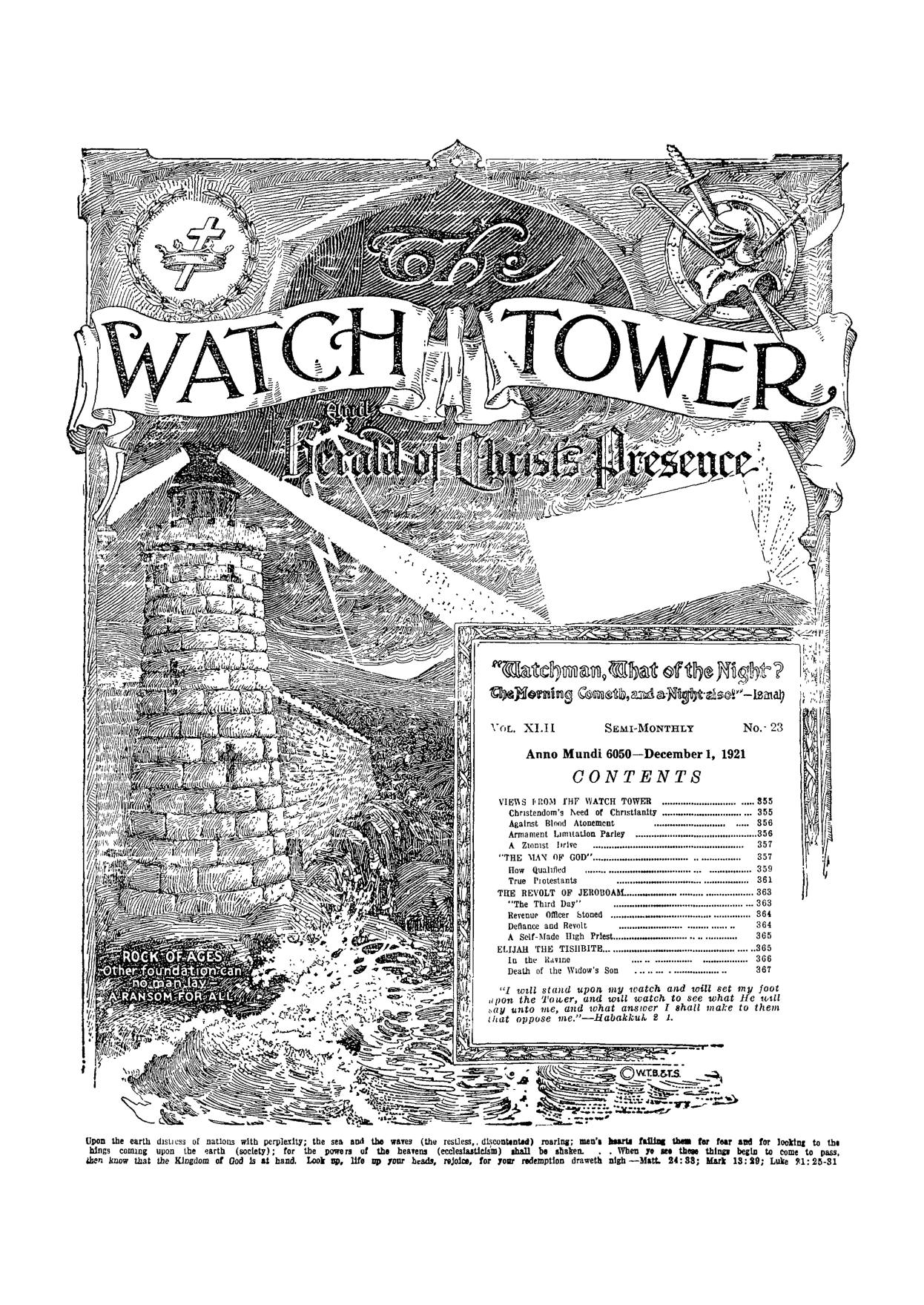
No. - 23
Mtejsfeirmirog teatalj
Vol. XI.II
Semi-Monthly
Anno Mundi 6050—December 1, 1921
CONTENTS
...... ROCK OF-AGE-SJ^
-Other fou'n'clatiQn'can'V'j
VIEWS PROM 1'HF WATCH TOWER Christendom’s Need of Christianity Against Blood Atonement ..
Armament Limitation Parley .........
A Zionist Drive .........................
"THE MAN OF GOD”.........................
How Qualified ....................
True Pio test ants ...............
THE REVOLT OF JEROBOAM.............
"The Third Day” ................
Revenue Officer Stoned ..................
Defiance and Revolt ...............
A Self-Made High Priest.................
ELIJAH THE TISIIBITE.....................
in the Ravine ........
Death of the Widow’s Son .......
355 355
S56 .356
357 357
359 361
363 363
364 364 365 .365 366
“I will stand upon my watch and will set my foot upon the Tower, and will watch to see what He will t-ay unto me, and what answer I shall make to them that oppose me.”—Habakkuk 2 1.
Upon the earth disticss of nations with perplexity; the sea and the waves (the restless,, discontented) roaring; men’i hurts falling titan ter fear and for looking to the hings coming upon the earth (society); for the powers of the heavens (ecdesiastleis'm) shall be shaken. . . When ye see these things begin to come to pass, then know that the Kingdom of God Is at hand. Look up, life np your heads, rejoice, for your redemption draweth nigh—Matt. 24:38; Mark 13:29; Luke 21:25-31
THIS JOURNAL AND ITS SACRED MISSION
THIS Journal la one of the prime factors or Instruments in the system of Bible instruction, or "Seminary Extension”, now being presented in all parte of the civilized world by the Watch Tower Bible & Tract Society, chartered A. D. 1884, "For the Promotion of Christian Knowledge”. It not only serves as a class room where Bible students may meet in the study of the divine Word but also as a channel of communication through which they may be reached with announcements of the Society’s conventions and of the coming of its traveling representatives, styled “Pilgrims”, and refreshed with reports of its conventions.
Our “Berean Lessons” are topical rehearsals or reviews of our Society’s published Studies most entertainingly arranged, and very helpful to all who would merit the only honorary degree which the Society accords, viz., Ferbi Dei Minister (V. D. M.), which translated Into English Is Minister of God's Word. Our treatment of the International Sunday School Lessons is specially for the older Bible students and teachers. By some this feature is considered Indispensable.
This journal stands firmly for the defense of the only true foundation of the Christian’s hope now being so generally repudiated —redemption through the precious blood of “the man Christ Jesus, who gave himself a ransom [a corresponding price, a substitute] for all”. (1 Peter 1'119; 1 Timothy 2:6) Building up on this sure foundation the gold, sliver and precious stones (1 Corinthians 3: Ills ; 2 Peter J: 6-11) of the Word of God, its further mission is to “make all see what is the fellowship of the mystery which. . .has been hid in God, ... to the intent that now might be made known by the church the manifold wisdom of God”—“which in other ages was not made known unto the sons of men as it is now revealed".—Ephesians 3:6-9,10.
It stands free from all parties, sects and creeds of men, while it seeks more and more to bring Its every utterance Into fullest subjection to the will of God In Christ, as expressed in the holy Scriptures. It is thus free to declare boldly whatsoever the Lord hath spoken—according to the divine wisdom granted unto us to understand his utterances. Its attitude Is not dogmatie, but confident; for we know whereof we affirm, treading with implicit faith npon the sure promises of God. It is held as a trust, to be used only in hie service; hence our decisions relative to what may and what may not appear In its columns must be according to our judgment of his good pleasure, the teaching of his Word, for the upbuilding of his people in grace and knowledge And we not only invite but urge our readers to prove all its utterances by the infallible Word to which reference is constantly made to facilitate such testing.
TO US THE SCRIPTURES CLEARLY TEACH
That the church is “the temple of the living God”, peculiarly "his workmanship”; that Its construction has been In progress throughout the gospel age—ever since Christ became the world’s Redeemer and the Chief Corner Stone of his temple, through which, when finished, God’s blessing shall come “to all people”, and they find access to him.—1 Corinthians 3:16, 17; Ephesians 2: 20-22; Genesis 28:14; Galatians 3 : 29.
That meantime the chiseling, shaping, and polishing of consecrated believers In Christ’s atonement for sin, progresses; and when the last of these “living stones”, "elect and precious,” shall have been made ready, the great -Master Workman will bring all together in the first resurrection , and the temple shall be filled with his glory, and be the meeting place between God and men throughout the Millennium.—Revelation 15 : 5-8.
That the basis of hope, for the church and the world, lies In the fact that “Jesus Christ, by the grace of God, tasted death for every man,” “a ransom for all,” and will be "the Hue light which hghteth every man that cometh into the world”, “in due time”,— Hebrews 2:9.; John 1:9; 1 Timothy 2:5, 0.
That the hope of the church is that she may be like her Lord, "see him as he is," be “partakers of the divine nature’,' and share his glory as his joint-heir.—1 John 3.2; John 17.24; Romans 8:17; 2 Peter 1:4.
That the present mission of the church is the perfecting of the saints for the future work of service: to develop In herself every giace; to be God’s witness to the world; and to prepare to be kings and priests in the next age.—Ephesians 4:12; Matthew 24s 14 ; Revelation 1:6; 20:6.
That the hope for the world lies in the blessings of knowledge and opportunity to be brought to all by Christ’s Millennial kingdom, the restitution of all that was lost in Adam, to ail the willing and obedient, at the hands of their Redeemer and his glorified rhirmh. when all the wilfully wicked will be destroyed.—Acte 3; 19-23; Isaiah 36.
•Published ey
WATCH TOWER. BIBLE &-TRACT SOCIETY
124 COLUMBIA HEIGHTS a a BROOKLYN, NY U-S A
Foreign Offices: Biittsh: 34 Craven Terrace, Lancaster Gate, London W. 2 ; Canadian 270 Dundas St., W, Toronto, Ontario; Australasian. 495 Collins St., Melbourne, Australia; South Apt-can 123 Plein St., Cape Town, South Africa
Please Address the Society in Every Case.
YEARLY SUBSCRIPTION PRICE. United States, $1.00; Canada and Miscellaneous Foreign, $150, Great Britain. Australasia, and South Africa, 8^ American remittances should be made by Express or Postal Money Orders, or by Rank Draft. Canadian, British, South African, and Austialasian remittance otild be made to branch offices -only. Remittances from s^rtiered foreign territory may he made to the Brooklyn ’Office, but by International Postal Money Orders onlj.
(Foreign ti anslation* c] this journal appear m 'several languages)
Editorial Committee.* mijiq journal is published under the supervision of an editorial co .mittee, at least three of whom have read and approved as truf'r. each and every article appearing in these columns. The names of the editorial committee are: J. F. Rutherford, W. E Van Ai;p,fRGH, F. H. Robison, G. H. Fisher, B. W. Brbnisen. Terms to the Lord Poor: AB Bible students who, by reason of old a^e or other infirmity or adversity,iare unable to pay-for this journal, will.be supplied free If they send • postal card each Jtfay stating their case and requesting such dto vision. Weare Dot only willing, but anxious, that all such be on our list continually and in touch with tbs Berean studies.
to Subscribers:
within a month by change la aiowallao as shown on wrapper label.
AUsrsd « SeooRd CSaw MatUr aUrtrifan, N.Ye, Ffiafte* under the Ac* qf Manrib Jrd,
HYMNS FOR FEBRUARY
Sunday .... ... _
19 Vow
Monday _______
20 103
Tuesday ........
21 251
Wednesday ___
1 195
22 J46
■ .. -
Thursday ______
2 192
23 242
3 49
IO
24 54
Saturday --------
4 12
25 148
——
After the close of the hymn the Bethel family listen, to the reading of "Mv Vow Unto the Lora”, then joins in prayer. At the breakfast table the Manna text is considered.
STUDIES IN THE SCRIPTURES
These Studies are recommended to students as veritable Bible keys, discussing topically every vital doctrine of the Bible. More t! m eleven million copies axe in circulation, in nineteen languages. Two sizes are Issued (in English only) . the regular maroon cloth, gold .-.tamped edition on dull finish paper (size 5"x7J*), and the maroon doth pocket edition on thin paper (else 4*x6fi*) ; both sizes me printed from the same plates, the difference being in the margins; both sizes are provided with an appendix of catechistic questions for convenient class use. Both editions uniform in price.
Series L 'The Divine Plan of the -Agen, giving outline of the <Jivine plan repealed in the Bible, relating to maxi’s redemption and restitution : 350 pages, plus indexes and appendixes, 75c. Magazine edition 20c Also procurable m Arabic, Armenian, Dane-Norwegian, Finnish, French, German, Greek, Hollandish. Hungarian, Italian, Polish, Roumanian, Slovak, Spanish, Swedish, and Ukrainian; .regular cloth style, price uniform with English '
Series II, The Time Is at Hand, treats of the manner and time of tiae Lordls seco..il coming, considering the Bible testimony on .this subject: 333 pages, 75c Obtainable m Dane-Norwegian. Finnish, German, Polish, and Swedish.
Series HL Thy Kingdom Come, considera prophecies which mark events connected with "the time of the end”, the glorification of die church and tile establishment of the Millennial kingdom; it also contains a chapter on the Great Pyramid of Egypt, showing its corroboration of certain Bible teachings: 380 pages, 75c. Furnished also in Dano-Norwegian, Finnish, German, Polish, and Swedish.
Series IV, The Battle of AraiBgfrtdoa. shows that the dissolution of the present order of things is in progress and that all of the human panaceas offered are valueless to avert the end predieted in the Bible. It contains a special and extended treatise on .our Lord’s great prophecy of Matthew 24 and also that of Zechariah 14:1 9 : 656 pages, S5c. Also in Dano-Norwegian, Finnish, Greek, German, and Swedish.
SERIES V, The Atonement Between God and Man, treats .an all Important subject, the center around which all features of divine grace revolve. This topic deserves the most careful consideration on the part of all true Christiana: 618 pages, 85c. Procurable likewise in Dano-Norwegian, Finnish, German, Greek, .and Swedish.
Sbribs VL The New Creation, deals with the creative week (Genaate -1. 2), and with the church. God’s new creation It examines the personnel, organisation, rites, ceremonies, obligations, and hopes appertaining to those called and accepted as members of the body of Christ; 730 pages, 88c. Supplied also in Dano-Norweginn, Fbmish, German, xma Swedish.
Sebabb VII, The Finished Myatery, consists of a verse-by-verse explanation of the Bible books «f Revelation, Song at Solomon, .and Ezekiel: 608 pages, lllustMited, 85c. in cloth, 2Sc. in magazine edition—latter treats RevdaSini and Ezekiel only.
AND HERALD OF CHRISTS PRESENCE
Vol. XLII
December 1, 1921
No. 23
VIEWS FROM THE WATCH TOWER
FROM denim to silks; from ox-carts to limousines; from poverty to wealth—this is the experience of the last three generations. But the world is not one bit happier; and almost everyone will admit that the world is very much unhappier. The grasping disposition is observable in places where it would not be expected. For instance the following, published in the Philadelphia North American:
“Annapolis Royal, a sleepy, venerable, dignified, and historic city in Nova Scotia, the second oldest settlement on the North American continent, suffered a disastrous Ine a few weeks ago. The business center of the city was destroyed, along with many residences. But the fire was attended by incidents of more sinister significance than the destruction of property. For the occasion lifted the lid off an ugly phase of contemporary life to which we are usually blind During the conflagration, and immediately following it, when the noblest sentiments of neighborliness should have ruled, there was widespread looting of salvaged goods.
“Tins was no sudden outbreak of lawlessness by aliens; the men caught were of the old British breed, who settled the maritime provinces in the long ago. They typify a fact of the times; namely, that the spirit of disregard for law and right has eaten like a canker into the very heart of oak of our civilization. Dark and hidden forces of anarchy and crime burst out with alarming frequency in all sorts of unexpected places. What happened m staid old Annapolis Royal is close kin to what happened in Chicago and New York and San Francisco. The papers talk of a ‘crime \\ ave’, whereas they really mean something more than a wave— a rising tide of lawlessness which is menacing the whole world Russia and Great Britain, Germany and the United States, Japan and France all are being inundated by this perilous spirit.”
That this condition is prevalent throughout the whole structure of “Christendom” is understood by all careful Bible students, and occasionally by other observers. One of these is the Reverend Thomas B. Gregory, writing in the Arkansas Democrat:
CHRISTENDOM’S NEED OF CHRISTIANITY
“The Rev. Dr. Baxter P. Fullerton, of St. Louis, speaking the other day before the ‘World’s Alliance of Presbyterian and Reformed Churches’, at Pittsburgh, delivered himself of this tremendous statement: ‘The greatest problem before the agencies of the Christian church is to Christianize the church itself’.
“Dr. Fullerton is right, absolutely and unqualifiedly right, and in defending his position he can hold his ground against all possible opposition.
“To those who know history, the great outstanding fact Is none other than this, that our so-called ‘Christianity’ is not Christian if by Christian we mean the teachings laid down in the gospels by Jesus of Nazareth.
“Between the system of ritual and dogma known as Christianity, and the simple teachings of Jesus as recorded in the three little memoirs known as ‘Matthew’, ‘Mark,’ and ‘Luke,’ (saying nothing about John), there is as much difference as there is between Darkness and Light, Fiost and Sunshine, Falsehood and Truth.
“Not only are they radically different, but they are uncompromisingly antagonistic. If the Christianity of the creeds is true, the Christianity of the gospels is false; if the Christianity of the gospels is true, the Christianity of the creeds is false; for the two are as opposite to each other as are the centrifugal and centripetal forces in mechanics.
“If Jesus of Nazareth could come back to us He would undei stand our Christianity to about the same extent that the average man on the street understands Einstein’s doctrine of ‘Relativity’.
“If the men who made our historical Christianity had deliberately set out in cold blood and with malice aforethought to champion the very things that Jesus preached against, and to cry down the very things that He advocated and loved, they could not have more completely succeeded.”
Failure to discern between a church Christian and a Bible Christian has been a fruitful cause of error, and it is not yet done bearing fruit. Not only have Baptists had difficulty in their ranks (or more accurately among their commissioned officers) from those who discredit the Bible, but Methodists are having similar troubles, it seems. The San Antonio Express reports the doings of the West Texas Conference, Methodist Episcopal Church, South, among which doings were extensive debates on the Conference’s attitude toward higher criticism in the Methodist schools of that state. A member of the faculty of the Southern Methodist University wrote a book on the Old Testament from the standpoint of a higher critic, which roused the feelings of such a large poition of the conference that a strong resolution was drawn up and presented by a group of laymen, headed by Judge M. A. Childers of Sinton. A part of the resolution reads:
“Your board of education has had under consideration the recent agitation tlnoughout the state on account of the charge of unsound teaching by a professor in one of four educational institutions. But as the president of said institution announced officially that this professor has tendered his resignation and which he advises will be accepted, therefore we do not think it wise to take further action in this particular case.
“Nevertheless we believe that this conference should express Itself in no uncertain terms on the principles involved and we therefore submit the following resolution :
“Whereas, Our church has always regarded the Holy Scriptures as the word of God, Inspired in that unique UI
sense in which no other literature, ancient, or modern, is Inspned, and that they are the one infallible, authoritative, and final revelation of divine truth to the world, and,
•‘Whereas, There have crept in among us unawares and found lodgment m many high places of influence in our church certain views and propaganda regarding the Scriptures, which, under the guise of modern scholarship, assails much ,of the historical and miraculous elements of the Bible; therefore,
“First, We wish to express our flrm faith in and allegiance to the Bible as the inspired Word of God as taught and earnestly contended for by our fathers in Methodism down through the years.
“Second, We do not believe that our holy Christianity has suffered or ever can suffer from the discovery of truth, and we wish it understood that we do not in the least degree discourage scholarship and extensive research. We welcome devout scholarship and investigation, but we repudiate that so-called scholarship which goes to the extent of assailing or calling m question the divine origin and integrity of the Holy Scriptures.”
The various dissenting bodies seem to have been called into being by the apostasy of the national churches. But apostasy has grown like weeds in those dissenting bodies themselves, and almost wholly because of failure to give heed to the Word of God. Constant testimony along this line is being still noted in the public press. A recent issue of the Tacoma News Tribune speaks:
AGAINST BLOOD ATONEMENT
“The statement made by Dr. Hawkins in a sermon Sunday, October 9, sets forth the belief that God demands no blood sacrifice for the redemption of man.
“ ‘Blood sacrifice is a common idea among primitive people,' he said. ‘The early Jews believed that the death of Christ was a price paid to an angry God to buy him off that he might not show his vengeance on his sinful people. A modern study of the Bible has clearly shown that Jesus never set forth any theory of blood atonement, but everywhere he emphasized the fact that men ought to be right with God by living right Ilves.’ ”
ARMAMENT LIMITATION PARLEY
All the eyes of Christendom are just now turned toward 'Washington because of the international parley on limitation of armaments; although varying sentiments lie at the bottom of the attention drawn. A clipping from the Cleveland Plain Dealer tells of an appeal to the Ohio Federation of Churches to pray for the success of the disarmament project. The Federal Council of Churches is likewise sending forth appeals for special services. Many of these people doubtless have a sincere desire to see the great burden of war preparations removed from the earth. But they do not realize the divine method of establishing peace.
A much saner view of the conference has been expressed in an editorial in the Farmer and Stockman-.
“In a statement to newspaper correspondents at the national capital, Secretary of State Hughes has taken pains to make plain the fact that the conference to be held November 11 is not to be a ‘disarmament' meeting, but a conference for the ‘limitation of armaments Undoubtedly, Gieat Britain will favor ‘limitation of armaments’, provided she is permitted to retain and maintain the largest navy in the world —which she contends is necessary to the protection of her Interests and possessions in the different parts of the earth. And no doubt, Japan will agree to any ‘limitation’ that will permit her to have as large a navy as the United States possesses. So, likewise, with France, and possibly with Italy and other countries. Secretary Hughes and his associates will likely assert the right of the United States to build a navy equal in size and strength to that of Great Britain, and they will probably contend for a limitation in naval construction by Great Britain and the United States to the present existing or planned strength of the British navy. Whether or not the representatives of the United States will take the position that Japan and other powers shall not be permitted to build navies equal in strength to those of Great Britain and the United States remains to be seen ; and whether the powers other than Great Britain will support the United States in this view of just ‘limitation of armaments’ is a question.
“But the main thought is that none of the powers, and least of all, the United States, appear to be thinking of disarmament. The plain fact is—and nothing is to be gained by disguising it—that neither Great Britain, Japan, nor France, nor the administration at Washington, believes in or favors disarmament. Each and all want strong navies, each desiring a navy equal in strength to that of the others. They are not necessarily seeking wars, but each is affected by those motives and controlled by those policies that are sure to produce wars, always have produced wars, and always will. Each power is seeking, by force or a display of force, to extend not its trade or its commercial interests— for no government is supposed to be engaged in trade or commercial transactions on its own account—but to extend the financial, commercial, and trade interests of particular classes of its subjects or citizens in foreign countries, and especially in those weaker countries which are unable to protect themselves from exploitation by imperialistic nations such as England, France, Japan, and such as the United States appears to be rapidly becoming.
“I regret to say that I do not expect much real or far-reaching good to come out of this much-heralded conference, and I do not expect any good to come out of it if its deliberations and proceedings are to be cloaked with secrecy. Agreements may be leached by which competition in armament may be limited to some extent, but I do not expect any action that will eien tend in the direction of lessening or minimizing imperialistic exploitation of the weaker nations by the stronger. Quite the contrary
“The trouble is that our political rulers at Washington seem to have entirely lost sight of the fundamental principles of true Americanism, and to have become strangely enamored of the world-grabbing policies of the imperialistic nations—policies that ever have been the fruitful and Inevitable causes of wars. They appear to he hopelessly imbued with the idea that the office and function of our government, in all its foreign relations, is to back the business enterprises of our exploiting financiers in all parts of the earth, by force of arms if necessary, and to act as a sort of national collection agency, court and sheriff combined for the protection of the speculative investments of our financial magnates and commercial princes in foreign lands.
“Such policies require navies and armies and heavy taxation for their maintenance, and so long as our political rulers at Washington pursue and enforce such policies, it cannot be expected that they will in good faith seek ‘disarmament’ or favor any material lessening of taxation for military purposes. On the contrary, it is to be expected that they will do just what they are doing today—budding a navy for the protection of the exploiting inteiests and ‘talking limitation of armaments’. The United States government is not making the world safe for democracy’ these days; it is making it safe for plutocracy in general and for the American plutocracy in particular.”
A ZIONIST DRIVE
The Zionist news these days is rather meager. A recent dispatch from London conveys some information, however:
‘‘There are now barely 700,000 people in all Palestine, a population much less than that of Galilee alone In the time of Christ, says Sir Herbert Samuel, the British high commissioner there, in a report just made public.
‘‘Ten thousand immigrants arrived in Palestine in the seven months between September, 1020, and May, 1921, he reports.”
As a supplement to this item is the following, which shows that some movement is under way toward the assembling of funds for the needed developments in Palestine:
“Plans for raising $15,000,000 during the coming year for the rebuilding of Palestine and for the reception to be tendered the visiting delegates of the Zionist Organization of the World on November 11 were formulated yesterday at an all-day meeting held in the Board room of the Hebrew Immigrant Aid Society. Prominent Zionists from all parts of the country attended the meeting, which took up most of the afternoon and evening.
“To raise the required quota for the United States the ancient Hebrew ‘Maaser’ or personal income tax will be instituted. This is an age-old custom whereby the Jews contribute ten percent of their income to the cause The system of raising funds in this manner was done in Germany recently with great success. In addition to this a nationwide drive will be instituted and contributions solicited from prominent Zionists throughout the country. It was the organizing body of the drive which met yesterday.”
It seems that the writers of the New Testament and of the Old are wrong—if the anti-Semitic writer in Mr. Ford’s Dearborn Independent has the right view of matters. It seems, also, that International Bible Students constitute a very doubtful asset to the communities in which they live—all judged, of course, from the standpoint of anti-Semitism, the anti-Jewish movement. A part of one article says:
“In all this work the Jewish Idea has the assistance of certain Christian sects who gloss over the inhumanity and Immorality of certain courses of actions by saying that ‘these are doubtless the means by which God Is giving the Jew his promised control of the world’. This is one form of the un-Biblical conception, the un-Scriptural teaching, that the Jews are God’s Chosen People.
“Of all the sects following this error, none is more active than the so-called ‘Russellites’, the followers of Pastor Russell, and oflicially known as the International Bible Students Association.
“It has been reported to The Dearborn Independent by numerous witnesses that Jewish interpreters at points of debarkation in Canada and the United States have circulated Russellite literature. The fact that a Jew would circulate any kind of Christian literature is sufficiently astonishing to cause inquiry. It is explained by the elaborate pro-Jewish propaganda which Russellism Is conducting.”
But, despite the smallish views of those who have no faith in God’s true purposes, we feel more honored in being counted in with that race of which Jesus and the apostles were members, than in being counted in with those who have prostituted the name of Christ for the sake of commerce and war and earthly power.
THE MAN OF GOD
"All scripture is given by inspiration of God, and, is profitable for doctrine, for reproof, for correction, for instruction in righteousness, that the man of God may be perfect, thoroughly furnished unto all good works.’’ — £ Timothy 8:16, 11.
JUST before his death in Rome the apostle Paul wrote the above words to Timothy, his beloved colaborer and child in the faith. The inspiration of the Scriptures is a fact which is denied in its existence, in its universality, and in its plenitude. That is, some deny that there is any such thing at all; some deny that the whole of Scripture is inspired, admitting only certain parts so to be; while others, granting that the whole is inspired, deny that it is fully so, admitting it as regards the sense but not the words. It is not the purpose now to enter into this subject separately, but only sufficiently to show that the Apostle says what he appears to say, and that he means what he says.
The Apostle was here speaking of the Old Testament Scriptures, those Scriptures which Timothy had known “from a child”. (2 Timothy 3:15) Abundant evidence is available for the inspiration of the New Testament writings also, but those are not spoken of here. This statement about the inspiration of the Scriptures is like that of the apostle Peter: “No prophecy of the scripture is of any private interpretation;” that is to say, it was not the product1 of the individual’s imagination, not the outgrowth of his own interpretation of events. And why is this so? The next verse goes on to explani to us: “For the prophecy came not in old tune by the will of man, but holy men of God spake as they were moved by the holy spirit”. (2 Peter 1: 20, 21) That is why it did not come of the prophets’ own sending forth. Ancient men of God were borne along by the holy spirit. And just as the wind in bearing along among the trees of the forest causes each tree to produce its own peculiar sound, making the aspen to rustle, the elm to moan, the oak to groan, and the ash to shriek, so the wind of the spirit, in bearing along through each writer, caused him to write divine truth in divine words (1 Corinthians 2:13), while it at the same time brought forth the peculiarity of each individual writer, and preserved what we are accustomed to call that writer’s personal style.
But to return to the passage in 2 Timothy. Various abortnc efforts have been made to nullify the plain teaching of this text. One of such efforts is in the Revised Version, which, often an advantage over the King James, is here a decided disadvantage. The Revised Version reads: "Every scripture inspired of God is also profitable/’ etc. This is not acceptable English, to say nothing of the Greek. In this case it is not necessary to know anything of the Greek language to be able to judge of the consistency of the rendering. Now the word “is” is admittedly wanting in the original, but that is nothing unusual. It is wanting in letter, but implied in sense. Fortunately there are many similar passages which plainly illustrate this point. The various forms of the verb to be are wanting in all of these following citations, and in each case the structure is followed by “and”.
Here are the passages:
Romans 7: 12
“The commandment is holy and just.” 1 Corinthians 11: 30 “Many are weak and sickly.”
2 Corinthians 10:10
“His letters are weighty and powerful.”
1 Timothy 1:15 ; 4:9
“Faithful is the saying and worthy of all acceptation.” 1 Timothy 2:8
“This is good and acceptable.”
1 Timothy 4: 4
"Every creature of God is good and nothing to be refused.” 2 Timothy 3:16
“All scripture is given-by-lnspiration-of-God2 and is profitable.”
Hebrews 4:13
“All things are naked and opened.”
So much to establish the correctness of the passage as quoted at the head of this article.
The structure of the words is as follows:
A a All sci iptiue is given by inspiration of God, b and is profitable
B foi doctrine,
C for reproof,
C for correction,
B for instruction In righteousness, A a that the man of God may be perfect, ti thoroughly furnished unto all good works.
This structure shows in A and A those things connected with God, and in B 0 and C B those things connected with God’s Word.
The following explanatory key may be of help:
A a the divinely inspired Word of God b its profit
B positive: teaching what is right C negative: correcting what is wrong C negative: correcting what is wrong B positive: teaching what is right A a the divinely fitted man of God 6 his profit
In addition to the perfection of structure there is a figure of speech employed here which gives a certain emphasis. Without bothering about the technical names for these things, it is enough to say that sometimes no ands are used to join several nouns, or names of things or qualities in a sentence; sometimes there are many ands. When many ands are used it is to show us that we are to dwell on each thing or point mentioned. Each is of equal importance; there being no climax at the end. When no ands are used, it is to show us that we should not dwell on the seveial points enumerated; but we are hurried along to some climax which is the important thing in the passage. An example of the “many ands” figure of language may be seen by reference to 2 Timothy 4:17,18, and many other Scriptures. On the other hand, look at 2 Timothy 3:10 for an example of “no ands”.
faith
works
“But thou hast fully known my doctrine,
—manner of life,
—purpose,
—faith,
—longsuffering,
—charity,
—patience,
—persecutions, afflictions, which came unto me
—at Antioch,
■—at Iconium, ■—at Lystra;
—what persecutions I endured :
BUT OUT THEM ALL THE LORD DELIVERED ME.”
Again, in our own text:
“All scripture Is given by Inspiration of God, and Is profitable
—for doctrine,
— for reproof,
— for correction,
— for instruction in righteousness,
THAT THE MAN OF GOD MAY BE PERFECT, THOROUGHLY FURNISHED UNTO ALL GOOD WORKS.”
And before we go further it must be noted that the words for “perfect” and “thoroughly furnished” are cognate, or closely related words from the same root. Whatever the one is rendered, the other should be rendered similarly. If the one is made perfect, the other should be perfected. If the one is rendered fit, then the other should be rendered fitted. Perhaps this latter word is the more illuminative. It suggests the furnishing of a house, the preparing for war, or, better, the fitting out of a ship for a long voyage at sea. When a vessel is fitted out, everything must be thought of; every emergency must be provided for; every contingency must be considered. Storm and calm, cold and heat, accident and fire, war and peace; everything from the least conspicuous to the most evidently needful must be furnished. So the man who has the word of God hidden in his heart is thoroughly furnished and ready for any emergency — for prosperity or trouble, for friend or foe, for joy or sorrow, for defense or attack. Only such a one is prepared to meet the trials of life and fitted out for its emergencies.
The expression “the man of God” occurs in the New-Testament only in the epistles to Timothy. (1 Timothy 6:11; 2 Timothy 3:17) In each of those cases it is in connection with the Word of God. But the expression is frequently made use of in the Old Testament. It is first found in Deuteronomy 33:1: “This is the blessing wherewith Moses the man of God blessed the children of Israel before his death”. The first occurrence of any word in the sacred writings is significant and usually gives a key to its meaning and teaching in other parts of Scripture. So here we find the expression connected with Moses; not with the blessing, but with the man. He is the first one who is definitely called “the man of God”.
But why was this expression used of Moses? The answer is that Moses was preeminently the prophet. To him Jehovah had said: “I will raise them up a Prophet from among their brethren, like unto thee”. (Deuteronomy 18:18) Although Jesus himself was the Prophet, yet by the divine description he was “like unto” Moses rather than Moses being like unto him, as one would naturally expect. Doubtless this is so stated in order to point Moses out clearly and cleanly as a type.
Moses was preeminently the prophet of the Old Testament; just as Noah was preeminently its preacher. Thus the first use of the expression, “the man of God”, identifies it with the thought of a prophet. Next: What is the meaning of the word prophet?
The common Hebrew -word for prophesy signifies to speak clearly, to bubble up, and then to issue forth. It was used of all formal announcements. The Greek word is practically the same as our English word prophet; prophet being merely a transliteration of the Greek word, or a spelling of it with the English letters. This word means literally to speak before, that is, to speak while before another. It was used prior to the New Testament times exclusively for those who officiated at the heathen oracles. The evil spirits who gave forth the utterances m those places spoke often in almost unintelligible jabberings, which the ordinary visitor could seldom make out. By way of getting the message to the inquirer, a spokesman stood before the curtain which hid the oracle from the people, and that spokesman professed to interpret what the oracle said. It is not the thought that the Lord adopted any of the devil’s ways and means and used them in the church, but rather that the devil made use of divine ways and means which had long before been established. We are merely getting at the meaning of the word in Greek.
In the New Testament the word prophet is used of a man who stands before God, of a man who speaks before him; and thus it is connected with “the man of God”. The word prophesy does not mean merely to foretell events, but to speak before, to speak for, to announce.
And where does the word prophet first occur in the Scriptures? Who was first called a prophet?
Perhaps many will be able to answer and say that Abraham was the first one called a prophet; and the appellation is given not by man but by God himself. In Genesis 20: 7 God says to Abinielech: “Now therefore restore the man his wife; for he is a prophet, and he shall pray for thee”.
Where are the prophecies of Abraham? There are none, in the customary use of the term. But Abraham walked with God (Genesis 17:1), and witnessed for God. He was generally recognized as God's man by the men of his time, much as a servant is identified with his master. He lived, walked, and spoke before God; he acknowledged the constant oversight of Jehovah and his own constant responsibility to him.
It was in the same sense that John the Baptist waa a prophet. Our Lord bears testimony concerning him that he was “more than a prophet” (Matthew 11:9); he was “called the prophet of the Highest (Luke 1: 76); and in another place: “Among those that are born of women there is not a greater prophet than John the Baptist”. (Luke 7:28) And yet, where are John’s prophecies ? There are none, as that word is generally used. But he was known and recognized as God’s man, ‘for all held John as a prophet’ (Matthew 21:26); he spoke for God, he reproved, rebuked, exhorted. In short, he was God's spokesman in the world, and hence he was truly a prophet.
When our Lord Jesus said to the woman at Jacob’s Well, “Go, call thy husband,” and revealed the fact that he understood her past as well as her present life, she responded: “Sir, I perceive that thou art a prophet”. (John 4:19) He had not spoken of the future at all, but had looked at her present and back into her past. His words reproved her of sin, as the words of John had reproved Herod. (Luke 3: 19) ; thus by the same sign Jesus was marked as a prophet.
Another instructive illustration is found in Exodus 7:1. Here Jehovah, speaking to Moses of Aaron, says: “Aaron thy brother shall be thy prophet?’. But in another place the same Hebrew word is used, and the same facts and circumstances are referred to, although a different word is used in the English translation: “He shall be thy spokesman".—Exodus 4:16.
That is the exact signification of the word. Spokesman is just what it means in both the Old Testament and the New. A prophet was a man who spoke for God, witnessed for God, was recognized by the people as a man whom God had called, whom God had qualified, whom God had sent forth to be his spokesman in the world. He was, therefore, a “man of God”.
HOW QUALIFIED?
To be a spokesman of another, certain qualifications are requisite. If a man were to appoint a deputation to wait upon a certain person or group of persons on his behalf he should have to appoint a spokesman; and he should have to see that his spokesman understood perfectly what he wanted him to say, that he understood the case, and that he would put it exactly as his authonzer wished it to be put. In other words, the spokesman would have to be instructed with words and would have to be filled with the spirit and enthusiasm pervading the one to be represented.
But how could a man be qualified to speak for God? If we turn to Numbers 11 we have God’s own answer to this question. The Lord had instructed Moses to appoint seventy men, who should assist him m bearing the burden of the people. God told him that he would put his spirit upon these helpers (verses 16, 17), and accordingly we read: “The Lord came down in a cloud, and spake unto him, and took of the spirit that was upon him, and gave it unto the seventy elders: and it came to pass, that, when the spirit rested upon them, they prophesied, and did not cease [1. e., it was no passing or temporary gift]. But there remained two of the men in the camp, the name of the one was Eldad, and the name of the other Mcdad; and the spirit rested upon them; and they were of them that were written, but went not out unto the tabernacle: and they prophesied in the camp, and there ran a young man and told Moses . . . and said, My Lord Moses, forbid them. And Moses said unto him, Enviest thou for my sake? Would God that all the Lord’s people were prophets, and that the Lord would put his spirit upon them.”
Hence, it is evident that a prophet was a man upon whom God had “put his spirit”, and whom he had thus taught what was to be said, in the witness for him.
Furthermore, a prophet was one to whom the Lord had made himself known: “Hear now my words: If there be a prophet among you, I the Lord will make myself known unto him”. (Numbers 12:6) A prophet was also known as “a man of the spirit”.—Hosea 9:7, margin.
Again it is written: “Yet many years didst thou forbear them, and testifiedst against them by thy spirit in thy prophets”. (Nehemiah 9:30; 2 Chronicles 36: 12) Hence it was the Lord who spake by his spokesmen, it was he who testified against his disobedient people, speaking by his spirit in his prophets.
He it was who said to Ezekiel: “Son of man, I have made thee a watchman unto the house of Israel: therefore hear the word at my mouth, and give them warning from me”. (Ezekiel 3:17) It was Jehovah who said to Jeremiah: “Thou shalt stand before him, and if thou take forth the precious from the vile thou shalt be as my mouth”.—Jeremiah 15 :19.
The next point to be noted concerning the prophets is this, that there was no original provision for them under the law. Every other office was defined, and its duties were prescribed. The persons who were to perform those dihties were appointed, even down to those who carried the minutest parts of the Tabernacle, down to the hewers of wood and drawers of water for the service of the Lord. But there was no place named for the prophet. And if Israel had walked in the way of God’s commandments, if they had proven faithful to the trust committed to them, there would not have been any need for prophets to be raised up.
But the priestly party in that day did exactly what the priestly party in every day has done—whether in false religions or true. The fallen propensities of men have ever inclined to use the influence and position which religion has given, for selfish advantage. The priests of Israel were no exception. They forgot the end and soon became absorbed in the means. They were soon involved in controversies as to the right mode of dividing the sacrifices, and as to the performance of their various duties. Hence the prophets were raised up, and the shortcomings of the established religionists were the constant theme of their testimony. The written record refers to this more than once when it is said: “I will have mercy and not sacrifice”.—Hosea 6: 5,-6; Matthew 9:13; 12:7; 1 Samuel 15:22; Ecclesiastes 5 : 1, 2; Micah 6: 6, 8; Isaiah 1:11-20; Psalm 50 : 8, 9, 11,16; Genesis 6:20; 7:21; Amos 5 : 21, 22.
It was for this reason, then, that the prophets were raised up; and it was for this reason, too, that they were always specially regarded as the opponents of the priestly party. Those who will be faithful spokesmen for God must appear to be “against” man. It cannot be otherwise; because Jehovah’s thoughts are not man’s thoughts, nor are man’s ways like his ways.—Isa. 55: 8.
It is impossible, therefore, for anyone to be a faithful witness for God without appearing to be against man. This fact is clearly stated in the opening words of the prophecy of Jeremiah: “Thou, therefore, gird up thy loins, and arise, and speak unto them all that I command thee: be not dismayed at their faces, lest I confound thee before them. For, behold, I have made thee this day a defenced city, and an iron pillar and brazen walls against the whole land, against the kings of Judah, against the princes thereof, against the priests thereof, and against the people of the land. And they shall fight against thee; but they shall not prevail against thee; for I am with thee, saith the Lord, to deliver thee.”—Jeremiah 1: 17-19.
The prophets were never popular. And the above commission shows why they were not popular. What with speaking against the whole land, the kings, the princes, the priests, and the people, they would be just about as popular as a skunk at a garden party. The prophets must be men who would never shrink from danger; must never mind reproach; must never be too careful of their own. reputation; they could never swim with the stream; their path could never be easy and smooth; they could never court success nor look upon it as their end; they could not make popularity their aim. The measure of their success was the measure of their faithfulness before God, whom they served as his spokesmen. It would not do to measure their success by the way in which their testimony was received.
They could neither regard the “fear of man” nor seek and be swerved by the “praise of man”. They were distinctly men of God, God’s men; and they were to fear only him and seek only his approbation.
And now, this important link m this chain of testimony is: this is exactly our position here in this world today. In a sense the Bible is God’s prophet, for it contains the completed prophetic revelation for the present time. But we are witnesses for God in the measure that we have his Word. The last words of Jesus our Lord come echoing down the centuries, “Ye shall be witnesses unto me”. (Acts 1:8) When he had spoken these words he was immediately taken up to heaven, and received out of their sight. Thus his last instructions were: “Ye shall be witnesses unto me”. This shows that God’s people now are his spokesmen, during the time when he is silent. God is now silent, but the time is near when he will again speak from heaven.—Psalm 50 : 1-3; 83 : 1.
Note the emphasis which is laid upon this fact. When Paul was raised up and sent forth to be an apostle his commission was: “Thou shalt be his witness unto all men of what thou hast seen and heard”. (Acts 22: 15) Again, this time by the Lord, it is said to him: “I have appeared unto thee for this purpose, to make thee a minister and a witness". (Acts 26:16) Peter also spoke of himself as “an elder and a witness".—1 Peter 5: 6.
But there is only one who could be called “The Faithful Witness”. (Revelation 1:5) We may be witnesses, but only the Lord Jesus can be called unqualifiedly faithful. In this, as in all else, he has the preeminence. (Colossians 1:18) When Jesus stood before Pilate, he said: “To this end was 1 born, and for this cause came I into the world, that I should bear witness unto the truth”. And without stretching the facts we may say: For this end have we the new life as new creatures, and for this cause are we sent into the world, to bear witness unto the truth. This is our commission, our work, our office, our duty, to bear witness to the truth, to Jesus Christ who is the Truth, the living Word (John 14:6), and to that Word which is truth—the written Word.-—John 17:17.
We are to be witnesses unto him. That is to say, we are to be witnesses to a person; not merely to a creed, or to doctrines, or even to a system of Scripture interpretation, but to him, the living, crucified, risen, and coming-to-rule Savior. “Ye shall be witnesses unto me.”
The gospel is the good news about this Savior. We are not commissioned to adapt the gospel to every creature, but to preach it to every creature. (Matthew 28: 19) This witness is to be unchangeable; it is one witness for all countries, and for all ages, and for all conditions of men. Then the Lord goes on to define the spheres of this witness—three concentric circles. First of all was the innermost circle, “Jerusalem and all Judea”; that was the place where they-‘had the Scriptures and professed to know them. There was the Temple; and the people professed to draw nigh to God, though it was only with their lips and not with their hearts. This was the circle of piosity, religiousness. The next circle of witness was large enough to take in “Samaria”. Now it is written of the Samaritans that “they feared the Lord [Jehovah] and served their own gods”. (2 Kings 17:33) That is, they knew about Jehovah and his power but did not go up to Jerusalem to serve him, out of political reasons. This, then, was the circle of corrupt religion.
Then there was a wider sweep—“the uttermost part of the earth”. This was the realm of no religion or else of false religion. But observe that there was not one witness for one of these fields and another witness for another. No: it was the same witness for each; the same witness for the places steeped m religion, for the places of corrupt or faithless religion, and for the domains of false and no religion. “Ye shall be witnesses unto me."
Thank God, we have the same promise that Jeremiah had. The Lord promised to be with him, therefore he was not to fear kings, princes, priests, or people. They would try to kill him; they would put him in prison, and in the dungeon, as they did; but The Lord was with him, and delivered him’. (Jeremiah 1:19) That was the gracious promise. And do not present-day wit-nessers have the same promise from their Lord? They are commanded to go into all the world, preaching the good news to every creature and, “Lo, I am with you alway [all the days], even to the end of the world”— the consummation of the age.
TRUE PROTESTANTS
Strange to say, the very word which most nearly describes the work and position of the Lord’s people in the world is the word protestant. The first syllable “pro” is the same as the first syllable of the word prophet. It means before or for, just as does the prefix pro in the word prophet. Testes is the Latin word for witness, and testans signifies witnessing. The same elements are discernible in our words testify and testimony. Therefore a true protestant is one who witnesses for God. He protests for God and against whatever God has pointed out in his Word as evil and displeasing to him. The one who thus witnesses is God’s protestant, God’s prophet, God’s spokesman, God’s man, “the man of God”. He is not growling or grumbling out of personal crabbedness and dissatisfaction; rather, he protests or witnesses because he has the word or message of God, and, having that word, he is authorized to speak it. “He that hath my word, let him speak my word.”—Jer. 23: 28.
The one who protests against Rome and against nothing else may be doing so out of personal animosity. While that should not be forgotten, neither should anything be overlooked which stands against Christ’s perfect order.
Many names are cherished in Christendom; but they are not the divinely-given appellations. We call ourselves most easily “Christians”, but that is not the distinctive name of the Lord’s people. In the Scriptures they are called Christians only three times, but not by the Lord. Once we read that disciples “were called Christians first at Antioch” (Aets 11: 26); once the term is used as a reproach by Agrippa, “Thou wouldst fain make me a Christian” ''hets 26:28); and once when St. Peter exhorts those who suffer as Christians. (1 Peter 4: 16) This word was itself the basis of the charge against the early church and later the actual charge, the word used in the indictment. In the midst of the persecutions under Nero early believers were wont to hear the cry: “The Christians to the lions”. So, “if any man suffer as a Christian, let him not be ashamed". It was the name of reproach and derision which waa given to God’s people by others.
But there are two words used in New Testament Gieek which are very similar in their meaning. One of them signifies io be a prophet; the other to be a witness — piophets and martyrs, spokesmen and witnesses. These taken together are used upwards of eighty times to describe God’s people of the grace dispensation. And both of these ideas are combined in the word prot-istant. This word does not date from the Eeformation. It is at least as old as the fourth century; for it is found in the Latin Vulgate of Jerome, which was the version made in the year 385 A. D. It stands today in every papal Latin Bible in 2 Chronicles 24: 19. “Yet he sent prophets to them to bring them again unto the Lord; and they testified against3 them; but they did not give ear.” The word for testified against is pi otestantes; in other words, 'they protested to them’. Thus the word protestant is identified with the old prophets of Jehovah who were sent to witness for him where so many were witnessing against him.
Now, as the last point, let us see how it is that this term is connected with the words, “the man of God”. “The man of God” was the people’s name for the heaven-sent and heaven-directed prophet in Old Testament times. Most other men were for themselves, but this one was for God, worked for him. All through the historical books this name is met with, used in a popular way. This is the meaning of the expression as we find it in the letters to Timothy.
Now we are prepared to understand why it is that this expression is used in connection with Timothy. JIow is anyone qualified to be God’s spokesman? If we are disposed to be faithful witnesses for God how shall we know what he would have us say? Where is the testimony that he would have us give ? Only in ths Word of Truth! That is why the expression “the man of God” is found connected with the declaration: “All scripture is given by inspiration of God, and is profitable for doctrine, for reproof, for correction, for instruction in righteousness”. And why has God taken pains to inspire the Scriptures? Why is it that they are profitable? It is because God’s spokesman is to be thoroughly furnished, completely fitted out.
It is now seen how “the man of God” having the Scripture hidden in his heart is like a vessel equipped for every emergency. Only he, and he only, is fitted out and thoroughly furnished so as to be able to meet the dangers of these last days which are referred to in the foregoing verses of this chapter.—2 Tim. 3:1-9.
And why is the term “the man of God” used in connection with Timothy? Because he from his youth up had known the Scriptures. Only those who have them, who have learned them, and who have been assured of them(2 Timothy 3:14)are qualified to be God’s spokesmen, can know what God wishes them to say. If we are to be God’s witnesses now we must be acquainted with the teachings of God’s Word, so that others seeing and hearing us may take knowledge of us that we have been with Jesus, and may recognize us as men of God. Studying the books of men one can become a man of men, but only by studying the Book of God can one become a "man of God”. Of course, this is not disdaining any help from ethers who are likeminded toward God’s Word; for Timothy had the early help of his mother and grandmother, and the later help of the apostle Paul.
“It is required in stewards that a man be found faithful.” (1 Corinthians 4: 2) Faithfulness is the only standard which will be used to judge us when we stand before the seat of Christ to be reckoned with as his own servants. To no one will it be said, ’Well done, good and successful servant,’ but, “Well done, good and faithful servant”. Even this faithfulness cannot be so wise and flawless as was that of our Master; but he calls it faithfulness none the less.
To be popular is not our aim; to be successful is not our hope; we are not to be guided by visible results; we are called to be faithful in our testimony, regardless of, yes, in spite of results. If faithfulness is the guide of our conduct this will be true success.
The Apostle charges Timothy: “If thou put the brethren in remembrance of these tilings, thou shalt be a good minister of Jesus Christ”. (1 Timothy 4:6) Whatever these things were, they were a test of Timothy’s ministry. What were they? They are found in the verses just preceding: “Now the spirit speaketh expressly, that in the latter times some shall depart from the faith, giving heed to seduemg spirits [deceiving spirits, evil angels] and doctrines of devils [“Ye shall not surely die” and “Ye shall be as gods”], speaking lies in hypocrisy; having their conscience seared with a hot iron; forbidding to marry, and commanding to abstain from meats”
While all these principles are observable in the false Bomish religion of today, it would be a mistake to suppose that they are found nowhere else. To forbid anything which the Bible does not forbid, to command to abstain from anything which the Bible does not command, and to do these things as in the nature of religious ordinances, would be equally dangerous ground to that occupied by Rome.
To sum up the various links in this chain of evidence and testimony we find: (1) that “the man of God” was a prophet; (2) that the prophet was a spokesman; (3) that the office and duty of a spokesman was and is the duty of all whom God has called and sent; (4) that this duty has its necessary qualifications, which consist of the spirit of God and the Word of God.
To have the Scriptures of truth so hidden in our hearts that we may be faithful witnesses for God and against all that is causing the ecclesiastical, commercial, and political corruption of the present day is the worthiest ambition we can have. But to go through L e motions without the motives will be of no avail. A hatred of evil that does not have rootage in the fear of the Lord is not acceptable to him.—Proverbs 8:13.
THE REVOLT OF JEROBOAM
--January 1 — 1 Kings 12:1 —13: 6----
TWO KINGS WHO LOST THEIB OPPORTUNITIES —OPPOSING WISE COUNSEL — THE PUNISHMENT OF PBIDE-THE DIVIDED KINGDOM
— THE RELAPSE INTO IDOLATRY
“Thou shalt not make unto thee a graven image, nor any likeness of any thing that is in heaven above, or that is in the earth beneath, or that is in the water under the eaith thou shalt not bow down
thyself unto them not serve them:'—Eiodus 20Ji.!>
WITH this lesson is commenced a nine-months course of study in the later leaders and prophets of the Jewish nation. The first quarter of this series deals with the northern kingdom of Israel, the ten tribes; the second quarter with the southern kingdom of Judah; and the third quarter with the exile and restoration.
Upon the death of Solomon Rehoboam his son came into the kingly power. Although Solomon had a thousand wives, he was not blessed with a numerous offspring. Only one son is ever mentioned. This son’s mother was an Ammonites?, and had influenced her royal spouse to build for her a temple to Moloch on Mount Olivet, facing the Temple. The many wise counsels of Proverbs were doubtless uttered in the first instance for the benefit of Solomon's son, who was seen by his father to be developing anything but wisdom. “A wise son maketh a glad father.” But the unwisdom of Rehoboam must have caused many a heavy hour to King Solomon.
Several months passed after Solomon’s death, and Rehoboam, possibly fearing to call the northern tribes to Jerusalem for his own installation as king, went himself with a retinue to Shechem, a historic place within the realms of Manasseh. Shechem had been In fact a national sanctuary (Joshua 24:1), the site of Abraham’s altar. It was likewise Jacob’s first home. It was where the tribes met. It was where Joseph was buried. It was where Ablmelech’s plot to gain control of the judgeship of all Israel was hatched. Later it fell to the degraded name of Svchar, drunkenness. (Isaiah 28:1-13) It was where Jesus talked with the woman at the well. Yet here alone in all the world is the paschal lamb still slain, in any official way. The long-standing envy of Ephraim against Judah (Isaiah 11:13), is thus still manifested by the Samaritan priests
…