The Watchtower, September 15, 1921
Download: PDF — The Watchtower, September 15, 1921
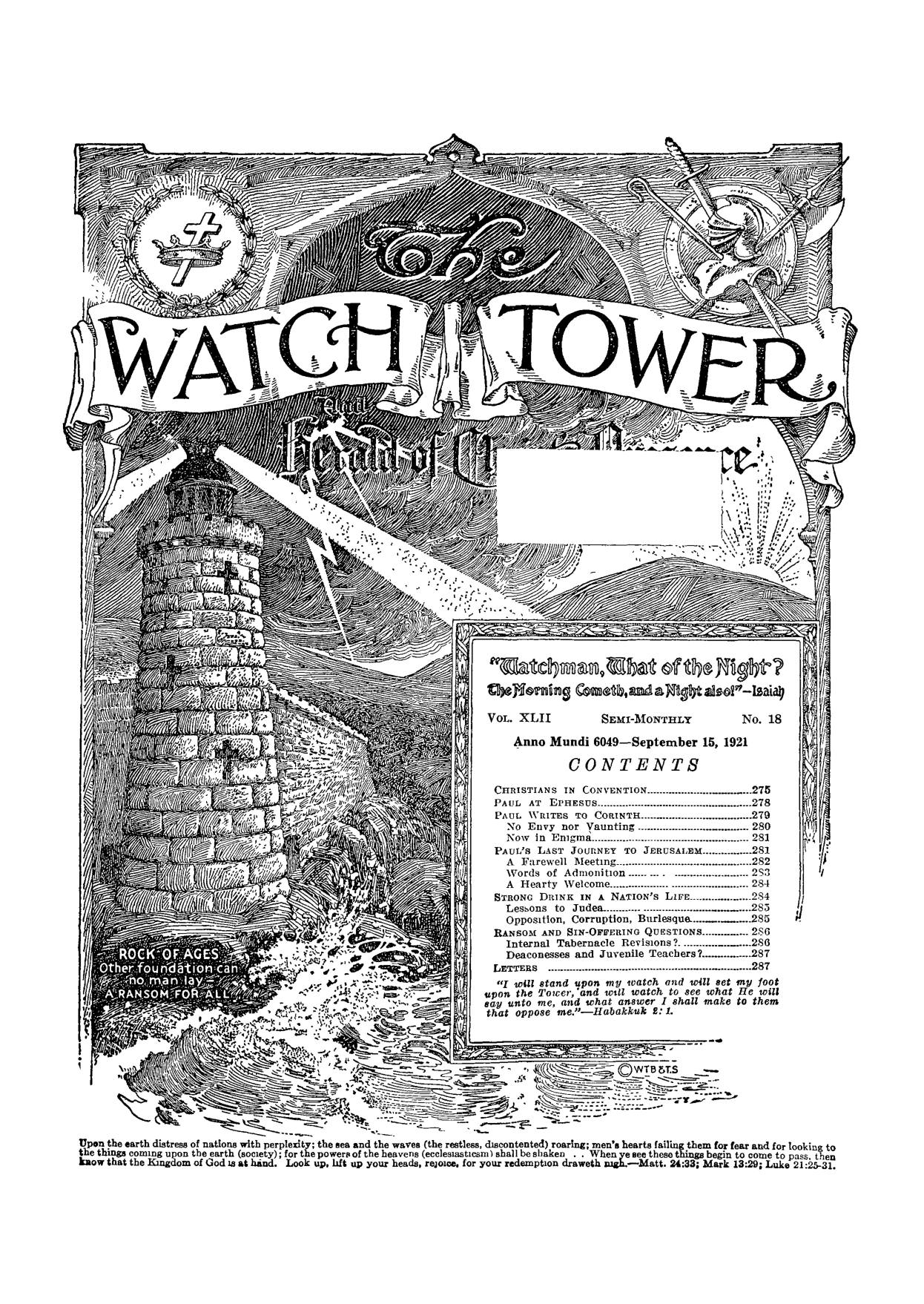
No. 18
Upon the earth distress of nations with perplexity; the sea and the waves (the restless, discontented) roaring; men’s hearts failing them for fear and for looking to the things coming upon the earth (society); for the powers of the heavens (ecclesiasticsm) shall be shaken . . When ye see these things begin to come to pass, then know that the Kingdom of God is at hand. Look up, lift up your heads, rejoice, for your redemption draweth nigh.—'Matt. 24:33; Mark 13:29; Luke 21:25-31.
SSSSEBi
taljejffleraimg &)toj@®1aEda^gIyta!s©!1’-l2aial)
Vol. XLII
Semi-Monthly
Anno Mundi 6049—September 15, 1921
CONTENTS
-""ROCKrOF AGES 3^ Otherfouriclatroncan^
' Ai.RANSOM'FOfi'ALL'^W^
Christians in Convention...................
Paul at Ephesus...................................
Paul Writes to Corinth....................
No Envy nor Vaunting......................
Now in Enigma.....................................
Paul's Last Journey to Jerusalem.
A Farewell Meeting.............................
Words of Admonition....................
A Hearty Welcome..............................
Strong Drink in a Nation's Life.....
Lessons to Judea................................
Opposition, Corruption, Burlesque.....
Ransom and Sin-Offering Questions.
Internal Tabernacle Revisions?........
Deaconesses and Juvenile Teachers?.
Letters .................................................
...275
...278 ...279 .. 280 .. 281 ...281 ...282
. 284 ..284 ..285 ..285 . 2S6 ..286 ..287 ..287
rM?
“I will stand upon my watch and will set my foot upon the Tower,'and will watch to see what He will say unto me, and what answer I shall make to them that oppose me.”—Habakkuk 2:1.
THIS JOURNAL AND ITS SACRED MISSION
THIS Journal Is Of fha prime factors or instruments- in the system of Bible instruction, or “Seminary nutensinn*’^ naw being
presented In all parts of the dvilized world by the Watch? Towun Bibt.b; & Tract- Society; chartered A. Eh. 1884'„ “Ibr the- Promotion of Christian Knowledge,”. It not only serves1 as a class room where Bible studentsi may meet in the study of' the divine- Word" but also as a channel of communication- through which they may he reached with announcements' of the Society’s, conventions and; of. the coming of its traveling representatives, styled “Pilgrims”, and refreshed! with: reports, of its conventions.
Our "Berean Lessons” are- topical rehearsals or reviews of our Society’s' published! Studies most entertainingly arranged, and1 very helpful to a-11 who would merit the only honorary degree-which the Society accords, viz., Verbi Dei Minister (V. ID: M.)>, which translated into English, is Minister of God’s Word. Our treatment of the International Sunday School Lessons is specially for the older Bible students and teachers’. By some this feature is considered indispensable:.
This journal stands firmly for the defense of the only true- foundation of the- Christian’s hope now being, so generally repudiated —redemption through the precious blood of “the-roan Christ Jesus, who. gave himself a1 ransom [a- corresponding price,, a substitute] for all”. (1 Peter 1:19; 1 Timothy 2 : G) Building up on this sure-foundation the gofdi silier- and’ precious stones (1 Corinthians 3‘: Ills ; 2. Peter 1:5-11) of the- Word of God, its further mission’ is- to. “malre- ail' see what is the- fellowship of the. mystery which.. . .has been hid m God', .... to the intent that now might be made known’ by the- church' the manifold wisdom of God!’—“which in- other ages was not made known unto- the- sons of men as it is now revealed”,—Ephesians 3: 5-0,10.
It stands free from1 all1 parties, sects and creeds of men, while it seeks more and more to bring its every utterance’ into fullest subjection to the will of God in Christ, as expressed in the holy Scriptures; It is thus, free- to declare boldly whatsoever the Lord hath spoken—according to-the divine wisdom granted unto us to understand! his. utterances. Its. attitude-is not dogmatic, but confident; for we know whereof we affirm, treading, with implicit faith upon the sure promises:of God. It is held as a trust, to be used' only in hia service; hence our decisions relative- to what may and what may not appear in its columns ust be according to our judgment of hia good pleasure,, the teaching of his Word, for the upbuilding of his people: in' grace1 and1 knowledge. And1 we not only invite but. urge our readers to prove- an its utterances by the infallible Word, to which reference is constantly made, to facilitate such testing.
TO US THE. SCRIPTURES CLEARLY TEACH
That the- church is- “the temple- of the living God”, peculiarly “his- workmanship”;, that its. construction’ has beem in progress, throughout' the gospel age—ever since. Christ became the world’s Redeemer and! the1 Chief Corner Stone, of hisi temple; through which1, when finished, God’s, blessing shall come “to all people”,, and they find! access: to him.—I Corinthians: 3'.::1'6„ 1-7’;. Ephesians 2:,20l22,; Genesis: 28 :14 ; Galatians 3.: 29.
That meantime the chiseling, shaping, andl polishing of consecrated’ believers in’ Christ’s atonement for sin1, progresses:;, and when- the last of these “living- stones”’, “elect and precious,” shall’ have been: made1 ready, the great SI'asrer Workman will! bring, all together in the first resurrection ;, and the temple shall' be filled with1 his1 glory, and be. the1 meeting, plhce1 between God' and' mem throughout the Millennium.—Revelation 15 : 5-8.
That the basis of hope, for the church and the world', lies in the fact that “Jesus Christ,, by the grace of God, tastedl dentin for. every man,” “a ransom, for all,” and will be "the true light which lighteth’ every man that com-eth into the world!”,, "m1 due ume”!— Hebrews 2:: 9’; John, 1.9; 1 Timothy 2:5, G.
That the- hope of the church is that ’lie may be like her Lord', “see- him as he is,”' be “partakers of the divine nature’;!' andl share his glory as his jornt-lieir.—1. John 3.2; John 17.:,24';, Romans: 8': 17 ;. 2, Peter 1:4.
That the present mission- of the church1 is the perfecting of the saints for the future, work, of service;; to develop, in herself every grace; to be God’s witness to the world; and to prepare to be-kings and priests in the next age.—Ephesians: 4’: IT; Matthew 24': 14; Revelation- 1': 6; 20:6.
That the hope for the world- lies in- the blessings of knowledge and- opportunity to be brought to. all by/ Christ’s JliRenmal1 kingdom1,, tho restitution of all' that was lost in Adam, to all the willing and obedient, at the hands of their Redeemer and’ his. glorified: church; when all tha wilfully wicked will be destroyed'.—Acts 3 :19-23; Isaiah 35..
•puBUSHE-D BV
watch tower, bible 6-jract society
124 COLUMBIA HEIGHTS n o BROOKLYN, NY U SA
Foreign. Obliges : British: 34 Craven Terrace, Lancaster Gate, London W. 2; Canadian: 270 Dundas St, W., Toronto, Ontario; Australasian: 495 Collins St, Melbourne; Australia; South African: 123 Plein St, Cape Town, South Africa.
Please Address m Society in Every Case.
VEARU SUBSCRIPTION PRICE'- United States', $T00‘- Canada and Miscellaneous Foreign, $1(70; Great Britain, Ausjrxlasia, and South Africa, 8s American remittances should be made by Express or Postal- Money Orders, or bv Hank Draft Canadian, British; South African, and Australasian remittance^ should! be* made to branch offices only Remittances- from* scattered foreign territory may be made to the Brooklyn office,, but by International Postal Money Orders only.
(Foreign translations of this journal appear in several lanquaaes)
Editorial-Committee: This- joumnl' is published' under- the- suyi-i kimod of an editorial committee, at least three' of whom have read- and approved as truth each and every article appearing inithese columns. The names of the editorial committee are'* J. F Rutherford, W. E. Van Amburgh, F. H. Robison, G. H. Fisher, E. W. Brenisen. Terms to the &>rd*e Poor: All Bible Btadrato-whos by/reasono£o!d age or other in-Irmity or adversity, are unable to pay for this journal, will be supplied free ifthey send a postal card each May stating their case and requesting1 such provision. We are- noC «nly willing, but anxious* that all Buch be on our hat continually and in’touch with-the Berean studies.
fn fSiihofrihwno We do cot. aa a rtrfe. Bead a card of acknowledgment for a renewal or lwiKVlOi3UO8CHOen. a naw Bobacziptfon. Receipt ani-ntry •»£ enewal are tadiaand within a month by ebaaaeln expiration date, aa shown on wrapper label.
Kntfrtd ao Second Matter at Brooklyn, NY , Portofflec under the Aet'of March 3rd‘,1879.
■ — ■ ■ • ~ — ——;.^i
REPORTS OF SEPTEMBER 25 MEETINGS
In our issue of September 1 we urged the classes everywhere to make special effort on Sunday, September 25', to arrange' for, advertise, and conduct as many public meetings as the finances and speaking talent of the classes would permit, the topic everywhere to be ‘‘Millions Now Living Will Never Die”
Speakers under the direction of the Society will, of coarse, report the numbers in attendance at meetings addressed- by- them’; but we would very much like to have reports from all the class secretaries as to the numbers in attendance at meetings addressed by local speakers on this particular date and’ topic. Will class Bcretaxies kindly favor us in this respect as, promptly as, possible?
STUDIES. EN» THE’ SGBUPTURESl
These Studies, are- recommended1 to students as veritable1 Bible' keys, discussing topically every/ vital! doctnne’ ofc nite Bible* More* than- eleven- imlliont copies, are* in* circulation,, m- nineteeui languages. Two sizes are' issued (in- Engiisln onl^-)).. the* regular moroom clotilr. gold’, stamped edition on- dull flnisln paper (size* 5"x7ii}"X andl the; maroon cloth- pocket edition on< thun paper (tsize* 4/'x64")lboth, sizes, are* printed! ftom> the- same* plates,, tile diffeiencei Uei-ntr mw the. margins; both! sizes are- provided' with an* appendix- of ca-tJechistie questions, for. con\enient class* use; Both) editions; uinfomm m* price
Series I,, The Divine: I?tan <rC the* Aig:ew„ giwmg outline- of* tb’ divine plan revealed- m* the Dibit**, relating toi mani*^ redemption; air lebtitmion JoO’ pngi*" phi** indexes and appendi-xe*. 775c Magazine edition- 20<- Shn ptoep i able* j.il Ahabur,, Ainneni.Tiu Dano-Noiiweg-iaii’, Finnish, French-, German, Gieelr. UloUkimdiwh ITirngainan*, I’taliaau Polish-, Roumanian. SToxak Js-paui-Jh. a-ndl Rkrainiani;
regiil.iii cloth stile puce uniform- w ixlu Enghslh.
Series II, The Time i<< at MaanT,, tieats of the* manner andl time of the Lords mjuhnii tomuia,, cousidbring the* Bilil'c testimony on this subject 3 13 p.mos, 75a Obtainable im Dano-Nonwegian;, Finnish. Get man, Polish, .uid’ Swedish-
Series HI. Thy Kiitgclonu Come, considersi propheciesi whichi mark events connected' ith> “the* time* of. the* endf the* glbrnficatioiu of the church1 ami the establishment ofc the- MilTenma'll kingdonu,, it also) contains, a chapter-on rile Great Pvramndl at Egypt,, showing; irtsi corroborations of- certain Bible te icluugs 38i-» paces,, 7-oe-. Fuuniahedi also in Dano-Novwegiait', I-mmslr.. Germam, Polish,, and» Swedish:
Series. IV,, The Battle, of Armayed'dbn\ showsi that the* dissolution- of' the- present ord'er of things is in progress; and! tflisutl aJJi of the human panaceas offered are vaiuelteFt to- invert tee' end! predicted! im tee* Bible. It contains, a <i»ecin>li annil extended’ treatise* om our Eordfsi great prophecy of Matthew 2.4! and! alfeoi that of Zechariain 14-1-9’ 656- pages, 85c.. Also im Dano*-Norwegian'. Finnish1. Gieek,, German, and’ Swedish!.
Series* V„ The- Atonement Between. Gkuflamd Mon-, treats* am alii important subject,, tee center around which- aJtl features* of. divine grace revolve-. This topic- deserves the- most careful! canBidteEa.’tnori) on* the.* part of alL true* Christians.:, 61’3' pages1. 85b:. Procurable likewise in Dano-Norwegian;. Finnish,,. German*., Greek,, and Swedish^
Series VI,. The New Creation, deal® withi tee* creative' week (Genesis T., 2)>, and- with, the- church’, GodN, new- creation’. It examines the personnel, orgoiuzationu cites, cenemonies’, obligations, and hopes appertaining, to* those' called! and! aceepiedl as’ members of the* body of Gin 1st 730 pages 85c: Supplied, also* in De.no-Nbrwegian, Finnish, German; and. Swedish
Series VII, The Finished Mastery,, consists of a verse-by-verse explanatioui of cliei Bible* hooks- Re.vela»tRon,. Sbng, of. Solomon; and< Ezekiel • 608: pages;, illnatraited’,, 35ci. Ini cloth,. 25c. im magazine edition—latter- treats.* Revelation! andi Ezekiel! only.
AND HERALD OF CHRISTS PRESENCE
Vol. XLII September 15, 1921 No. 18
CHRISTIANS IN CONVENTION
"Not forsaking the assembling of ourselves together, as the manner of some is; but exhorting one another; and so much the more, as ye see the day approaching "—Hebrews 10r25.
JEHOVAH established the true religion among the people of Israel when he made a covenant with that nation, commanding that they should worship him, the true and only God. He caused them to be instructed in his law. The devout people of Israel regularly assembled themselves together for the purpose of acquainting themselves more fully with the divine law.
Jesus was born under the law, and as a man was an Israelite. It is to be presumed that his devout parents saw to his early instruction in the Scriptures; and it became a habit or custom with him to go to the place where the Scriptures were read. It is written of him that, “as his custom was, he went into the synagogue on the sabbath day”. (Luke 4:16) Without a doubt his love for the heavenly Father and for his law, and his love for the people, constrained him to observe faithfully this custom.
A true Christian is one who having made a full consecration to the Lord strives, insofar as lies within him, to follow in the footsteps of the Master, learning the lessons that he taught both by precept and example.
Likewise St. Paul was born a Jew and strictly observed the laws and customs of that nation. When he became a Christian, both custom and loxing zeal combined impressed his mind with the great importance of personal fellowship with others of like precious faith. Like the great Master, he possessed a loving zeal for the cause of righteousness and a deep, unselfish, loving interest in his brethren. He recognized the mind as the battleground; and if the mind is directed into the right channels for the understanding of the Word of God and is filled with holy meditation upon his Word, the opportunity for the adversary to do injury to such Christians will be greatly reduced. In his epistle to the Hebrews he gives much valuable and loving advice. He emphasizes the fact that as the earthly experience of the church nears a close the perils will greatly increase; hence the greater importance that the followers of Jesus assemble themselves ofttimes together. In another epistle he called attention to the efforts that would be put forth by the enemies of the church at the end of the age; and to the necessity of having on the whole armor of God and of using it for defense and for progress in the narrow way. Christians coming
together and hearing the divine plan explained from various viewpoints, considering the diverse expressions and experiences of the brethren, and expressing their heart sentiments in testimony and in song, are greatly strengthened, enabled to oxercome, and thus assured of winning a place in the kingdom.
One of the prophets speaking of loving zeal for the cause of righteousness describes it as a fire in his bones, compelling him to go forth and tell the message of Jehovah. The truly consecrated children of the Lord who appreciate his loving kindness may well be likened unto living coals of fire. If live coals of fire be separated, not only will the heat from each one rapidly diminish, but soon the fire will die out entirely. If brought together, the heat of each one will greatly increase until there is a glow of the whole mass. And so it is with Christians. If they forsake the assembling of themselves together, gradually there is a cooling off and lack of interest in the truth, a decrease in zeal and a danger of drifting back into the world. Brought frequently together in the love and spirit of the Lord, their zeal and fervency for the Lord and his cause is greatly increased, and individually and collectively they are strengthened.
We now see that the day of the final earthly experiences for the church is here. Hence it is of the greatest importance that the members should assemble themselves together, and with unselfish love build each other up on our most holy faith. It is the love of Christ that draws and holds together; and those having his spirit will desire this unity and fellowship. In the unity of the spirit there is that strength which gives full assurance of victory through Christ Jesus, our Captain and Deliverer.
With these thoughts in mind a series of conventions of Bible Students was arranged for the year. Because of the increased cost of transportation and the great amount of unemployment, it was deemed for the best interest not to attempt one large general convention in some central part of the country, but to have a number of smaller conventions. The Lord has manifested his blessing upon these assemblies of the brethren.
During the year conventions have been held at Norfolk, Atlanta, Chicago, Omaha, Los Angeles, Oakland, San Antonio, Houston, New Orleans, Tampa, Waslnng-275
ton, Richmond, Philadelphia, Brooklyn, Oklahoma City, Lincoln (Nebr.), Buffalo, Louisville, Detroit, and other places. At all of these conventions there has been a wonderful manifestation of loving zeal peculiar to the house of the Lord. Quite a number at these various conventions have symbolized their consecration and given evidence of spirit-begetting and growth in grace.
Tt would not seem to be the proper thought that the spirit-begetting has ended. While it is true as we believe that the forty-year harvest period ended with 1918, yet this would not militate against the thought that others coming to a knowledge of the truth might not be begotten thereafter and received into the kingdom. It will be recalled that the Lord used the natural harvest to illustrate the harvest of Christians. In the natural Jewish harvest the custom long has been to do a gleaning work following the general harvest. Hence we may properly liken the gathering in of some Christians since the close of the harvest period to the gleaning work; and this would explain why some are still consecrating and giving evidence that the Lord has justified them and begotten them by the holy spirit. At least it is not the prerogative of any one to attempt to say just when spirit-begetting will cease; and we deem it very improper for any speaker >to advise his hearers that there is no opportunity now to be begotten to the divine nature. Since the Dord has not authorized any one .so >to state, it would seem presumptuous to attempt to tell others that the Lord has ceased to do a certain work when such a conclusion would be based merely upon conjecture or opinion.
It is always proper to advise consecration and the symbolizing of consecration, leaving the result with .the Lord himself, as he .alone must determine. In fact, it seems quite reasonable that throughout the Millennial age people will continue to symbolize their devotion to the Lord by water immersion. Whether this is true or not, we do well to leave the matter with the Lord.
Quite a number at these conventions have announced that they first came to a knowledge of the truth by reading “The Finished Mystery” or The Golden Age, or something else .that has been published since 1918. Let us all rejoice and be glad that the Lord is still pleased to bring a knowledge of his truth to hungry souls and to bless them in their hearts when they respond by making a full consecration to do his holy will.
For the midsummer a transcontinental tour was arranged and a series of conventions followed one after the other. The .first of this series was held ,at Winnipeg, Manitoba, August 5-7. About five hundred of the consecrated attended this convention. Brother Pickering was chairman, and additionally the convention was served by Brothers Marshall, Howlett, Salter, Van Am-burgh, and Rutherford. It was a season of great rejoicing among the brethren. This was the first time a convention had been held in Winnipeg at which many of the brethren attended since the trying experiences of 1918. It will be recalled that at Winnipeg resides the nominal minister and politician who instigated in that city the persecution of the brethren which spread to other parts, which experiences, according to the promise made by the Lord, are now serving as a witness in behalf of the brethren (Luke 21:13) and “for a testimony against them”—the persecutors.—Mark 13: 9.
A public lecture which was given by Brother Rutherford had been well advertised, and the public responded with keen interest. This meeting was attended by about 2,700; while another opera house across the street was filled with an overflow meeting, which was addressed by Brother Pickering; and in still another hall an elder of the Winnipeg Class addressed a third gathering. It was estimated that there was a total of six thousand people who came to this public meeting. There was great interest manifested and it is hoped that much good resulted.
At Saskatoon, Saskatchewan, a convention was held August 6-8. The chairman, Brother Thrutchley, as well as Brothers Williams, Salter, Van Amburgh, and Rutherford addicssed the convention. About one hundred of the consecrated attended this convention; and while the number was small, the zeal and love manifested by all present was very marked. It vas a happy season of fellowship together. On the evening of the eighth a public meeting addressed by Brother Rutherford at the Machinery Hall in the Exhibition Grounds was .attended by more than a thousand of the public. Great interest was manifested at this meeting. We quote a pari .of the report given by the Saskatoon Phce-ntx of August 9:
“An .audience that would have filled the largest church in Saskatoon and more listened to a lecture last night in the Machinery Hall of the Exhibition Grounds, by Judge J. F. Rutherford, President of the International Bible Students Association, who sought to prove by Biblical prophecy fulfilled during the past few years that millions now living will never die. A huge pant of this audience was obviously in sympathy vt ith the teachings of the I. B. S. A., organized by the late Pastor Russell.
’“At the outset an attempt was made by the Reverend Professor L. H. C. Hopkins of Emmanuel College to obtain from .Judge Rutherford the privilege of asking questions at the close ot his address; otherwise. Mr. Hopkins stated, he would be obliged to interrupt the speaker as he went along. To this Judge Rutherford replied in a preliminary statement that he purposed proving every proposition he made from the Bible, believing the Bible to be God’s Word of truth. If the united clergy of Canada, he further announced, would select the most celebrated man they had and fix the time and place, he promised he would meet him in debate. A'clergyman ought to know, he said, with reference to Prof. Hopkins’ intention, that a religious meeting is not to be interrupted, and he served notice that if he disturbed that meeting he would not disturb another. ‘I purpose to take up the time of this meeting,’ Judge Rutherford firmly said. Professor Hopkins, who was seated in the middle of the audience with several other clergymen and who had come apparently prepared to refute the teachings of the Bible Students, did not interrupt.”
A large amount of literature was sold at the conclusion of this meeting.
At Edmonton, Alberta, a convention was held August 8-10. The speakers at this convention were Brothers Thrutchley, Williams, Van Amburgh, Branscombe, Salter, and Rutherford. About 125 of the consecrated attended this convention. The addresses were all helpful and every one recognized that it was good to be there. A public meeting was held on Wednesday evening in an opera house seating 1,500. It was packed to its full capacity, splendid interest being manifested, and a large number of the “combinations’'’ sold at the conclusion of the meeting.
At Calgary, Alberta, August 9-11, a convention was held, attended by about 125 of the consecrated. This convention was addressed by Brothers Williams, Salter, Thrutchley, Van Amburgh, and Rutherford. The dear friends in this section manifest a great deal of loving zeal for the Lord and his cause, and are putting forth their best efforts to give the witness. The season of fellowship together strengthened the faith and hearts of all present, who went away rejoicing in the privilege of having been permitted to assemble again this side the vail. On the evening of the eleventh a public meeting addressed by Brother Rutherford in the opera house was attended by 1,700, while others were turned away. The usual interest was manifested by the public and a large number of the “Millions” booklets sold at the conclusion.
At Vancouver, British Columbia, a convention was held August 12-14. This gathering was attended by approximately 500 of the brethren. The chairman of the convention was Brother Howlett; and besides him, the friends were addressed by Brothers Rutherford, Van Amburgh, and Salter. A number of our brethren, who for a time were associated with some generally known as the “Standfasters”, attended this convention and manifested a determination thereafter to remain with their first love, realizing their mistake of having turned aside.
In his address to the friends, Brother Rutherford pointed out that the Lord had selected Brother Russell to fill the office described by the prophet Ezekiel in the ninth chapter as the ‘one clothed with linen, with a writer’s inkhorn by his side’; and that Brother Russell had faithfully performed that service and reported it, as the Prophet had foretold; that the Prophet further designated ‘six men that came from the way of the higher gate, which lieth toward the north, and every man with a slaughter weapon in his hand’. “And to the others [the six] he said in mine hearing, Go ye after him through the city, and smite; let not your eye spare, neither have ye pity; . . . but come not near any man upon whom is the mark.” It was pointed out that six is symbolic of incompleteness from the divine viewpoint; and that since Brother Russell fiRed the office of the one specially mentioned, the six represented all of the truly consecrated members of the body, incomplete on this side the vail, who are unitedly performing the commission given by the Lord; that these saints are commissioned and authorized to do a slaying work with the message of truth, but are specially warned not to interfere with those who have the mark, 1. e., those who have been sealed with an intellectual understanding and appreciation of the divine plan.
The speaker then pointed out that this would seem strongly to indicate that it was not pleasing to the Lord for brethren to attempt to start a separate organization and draw followers after them. Furthermore, that it had been stated by our “Standfast” brethren that there is no work to be done by the saints; whereas the Scriptures clearly point out that there is much work to be done; that it had been intimated by some that those now engaged actively in doing the witness work throughout the world are of the ‘foolish virgin’ class; but it would seem rather strange that ‘foolish virgins’ would be delegated to give wise advice. All the consecrated were admonished to seize the opportunity of participating in the witness of the incoming kingdom, and to look well to themselves in making preparation for entering into the kingdom. This convention was a great blessing to all who attended and will long be remembered by those who had part in the sweet fellowship there.
On Sunday evening a public meeting was addressed at the Arena by Brother Rutherford, at which the attendance was about 4,500. It was freely stated by the brethren that this was the most extensive witness that had ever been given at one time in the city of Vancouver.
Seattle, Washington, was the place of a convention of the Bible Students held August 18-21. The attendance of the consecrated at this convention was between 800 and 1,000. Brother Van Amburgh was chairman, and the assembly was addressed also by Brothers Howlett, Salter, MacPherson, Baker, and Rutherford. This was a most blessed convention; and the remark was frequently heard: “This is the best convention I have ever attended”. In fact, at all these conventions there was a sweet spirit manifested, and the friends gave evidence of growth in grace and in the knowledge of the Lord.
The friends stated that the largest number that ever attended a public meeting in Seattle responded to the advertisement for the public lecture on Sunday. The subject was, as usual, “Millions Now Living Will Never Diet”. Brother Rutherford addressed the public in the main auditorium of the Masonic Temple; while Brother MacPherson addressed an overflow meeting in another hall, and great numbers were turned away. The papers announced that four thousand people heard the lecture. Quite a number of prominent citizens were present, and on the day following some of these asked for a private conference with Brother Rutherford. As a result a conference was held in a lawyer’s office, attended by lawyers, judges of the courts, and businessmen; and for more than two hours these gentlemen propounded questions relating particularly to the time of trouble and the restoration blessings for the world. They showed a keen interest in the truth message. By their request their names are not disclosed for the present. The opinion is ventured that there are many friends of the truth who do not feel disposed as yet to take an open stand. Glad we are, however, that the time is soon coming when all will rejoice to acknowledge publicly that Jesus is the Christ and that his kingdom is the hope for humankind.
On Thursday night, August 25, a public meeting was held at Everett, Washington. About one thousand crowded into a small theatre and listened to Brother Rutherford ; while Brother Howlett addressed an overflow meeting of some 400 in another hall, and fully a thousand were unable to gain admittance. The friends sold many of the books to people on the curb who were unable to get to the door.
Portland, Oregon, was the next place of convention, where the friends assembled from August 25 to 28. Brother Van Amburgh was chairman of this convention, which was attended by 350 of the consecrated. The speakers were Brothers Van Amburgh, MacPherson, Goux, Baker, Howlett, and Rutherford. We believe this convention resulted in much good. Several of our “Standfast” brethren attended and signified their purpose to meeting hereafter with the regular class of Bible Students. The discourses were all helpful and the testimonies gave evidence that the friends are profiting in their Christian experience. It was a happy season of fellowship.
The public meeting Sunday afternoon in the Auditorium was attended by about three thousand, with the usual keen interest manifested; and a goodly number of the combination booklets was sold at the conclusion.
On the Monday following Brother Goux and Brother Rutherford held meetings with the friends at Ashland, Oregon. The number here is small, but that same loving zeal that is manifested by the Lord’s little ones everywhere was in evidence. We bade the friends good-bye, marking their bright and smiling countenances, rejoicing in the fact that we again had some fellowship together this side the vail.
On Tuesday, August 29, a one-day convention was held at Fresno, California, addressed by Brothers Gerdes, Sexton, and Rutherford, a public meeting being held at night, at which there was an attendance of about two thousand, with the usual interest manifested. It is noticeable at these public meetings that many intelligent business men and women are attending, indicating that they are looking for something explanatory of the present conditions and for some hope of relief. We rejoice that the witness of the kingdom is having a greater scope than ever.
A convention of Bible Students was held at Los Angeles, California, September 3, 4, and 5. This convention was presided over by Brother F. P. Sherman, and additionally addressed by Brothers Pollock, Goux, Stark, Gerdes, Magnuson, Sexton, Taliaferro, Seklem-ian, and Rutherford. About 1,200 friends w'ere in attendance. It would be impossible to express in language the joy manifested by those present. It was a quiet, sweet and happy spirit that pervaded the whole gathering; and the light of joy was upon every countenance.
These conventions serve as a great stimulus to the brethren and inspire them to engage more actively in the proclamation of the message of the kingdom. Truly now is the time when all who love the Lord may look up and lift up their heads as the day of deliverance nears.
PAUL AT EPHESUS
I" concluded")
In order to announce the matter of the collection and to give the brethren time to lay by in store such means as they had to spare against the day of his own arrival, Paul sent ahead Timothy and Erastus. Timothy had already been over the ground, parts of it twice, and was able to minister to the friends in a spiritual way. Erastus had been treasurer of the city of Corinth (Romans 16:23), no small office, and was therefore familiar with the handling of financial matters. Paul showed wisdom In selecting an experienced man, when one was available.
Having sent these two brethren ahead, Paul tarried yet a while In Ephesus; and it was during the period of this tarrying that a great commotion arose in the city on account of the gospel activities there.
SILVERSMITHS ALARMED
A certain Demetrius, a silversmith, who made his living by the manufacture of small statues and shrines for the worship of Diana, noticed that there had begun to be a decline In business. He was farsighted enough to observe that if this thing went on the silversmiths would have to go Into the hands of a receiver, their respectable station, in the social structure would be gone, and who could tell what would become of them then? Accordingly, Demetrius called together other members of the silversmiths’ board of trade and delivered himself of a little “patriotic” oration shoving how the Lord was to blame for interfering with the devil’s business. He charged Paul with interfering, first, with business, and, second, with religion. Business came first and the religion was to serve the purpose of business. Religion, according to his estimate, was a kind of rear guard for business.
There was some truth in the statements of Demetrius. The Apostle’s activities were actually showing some effect on the Idol business. But the time is coming when not only the literal idol business will be supplanted by something vastly better, but also all things which have worked for the advancement of Satan’s empire will be suppressed by the omnipotence of Messiah’s kingdom. All socially artificial things shall be put down. This may include ninety percent of all the books and papers and magazines and productions of art and statues and entertainments in the world. One of the first lessons necessary for mankind to learn is to look the facts in the face and not to befool or befuddle themselves with fancies, however roseate.
The business associates of Demetrius thought as he did, or rather he thought for them and they acquiesced in his decisions, very much as is the rule among men. They all joined In the general hubbub and a mob formed, collecting in the usual place for public concourse, the theatre, which was not only the place of entertainment but also of public elections. As Is usually the case with mobs, few knew why they had come, and they added to the noise and yelling simply because they were there and had gotten into the spirit of the thing. Many Jews were present, and some of these thought to shift the responsibility for the dislike away from themselves and onto Paul and his friends. The Ephesians had not been much inclined ro distinguish between Judaism and Christianity. The Jeus souglit to set forward one Alexander, but when the crowd noticed that he was a Jew they would have none of it. They shouted all the louder and continued for about the space of two hours to say nothing but “Great is Diana of the Ephesians”. Early in the meWe Gaius and Aristarchus, brethren who had been more or leas with Paul from the time of his first visit in Macedonia, had been seized and held by the mob. Paul was minded to enter into the crowd and speak to them, but was deterred by both brethren and friendly pagan Asiarchs, or men who were appointed to see that the public festivals in Asia were observed according to the law.
WEARINESS AND PEACE
Understanding the psychology of a mob, the town clerk waited until the multitude had exhausted Itself yelling; then went to the speaker’s platform and addressed tliem. Weariness has had much to do with keeping the world in a peaceable state. Many a who has been a thoroughgoing malcontent and breeder of trouble in the morning, has dwindled down to a weary little piece of humanity by night, having no desire but to get something to eat and get to bed.
The town clerk addressed the wearied crowd in this wise: Everyone in the city has heard you shouting for the last two hours that Diana of the Ephesians is a great goddess. If there was ever any doubt about that fact. It should be quite well established by this time, and there is therefore no need to continue your clamor. Anyway, no one called the greatness of Diana in question, nor has this I’aul done any act of desecration to our temple or to the Egyptian hieroglyph which Is generally understood to have been sent down from heaven. For what purpose have you seized these men? You have placed not only yourselves but the whole city in a precarious sitn.-P'on If Demetrius and his fellows have uni occasion for complaint against the Christians, let them present them in an orderly manner, make out an indictment against them, and the case will be taken up in the regular and prompt sessions of court If it Is not a question of personal loss or injury, but one of city policy, those questions naturally come up at the regular town meetings. Indeed, there is danger that the city lose its franchise because of this illegal concourse. What kind of report can we send to Borne? It will look very strange to say that thousands of people had shouted for two hours about something which was well known in the first place. You all know the Roman law says: “He who raises a mob, let him be punished with death”. Now we had better close this incident and get home as quickly as possible.
The mob, having said all they knew, dispersed.
The word for assembly in verse 39 is ckkl<xia, the same word used in New Testament writings lor church. It means simply convocation, or, it we had such an anglicized Latin word, it would be literally, exvocatiou.
THE TEMPLE OF DIANA
Those who are mechanically inclined may gain some idea of the size and importance of the Temple of Diana in Ephesus by knowing that 220 years were required in bringing it to completion. It was 425 feet long, 220 feet in width. There were 127 pillars, each GO feet high. Each pillar with its base contained 150 tons of Parian marble. Thirty-six of these pillars were curiously carved, the others plain. But so thoroughly was this great temple destroyed that no kind of certainty is entertained as to its exact location. The ancient city is a mass of ruins, almost Impossible of dts-tinguishment.
PAUL WRITES TO CORINTH --October 16 — 1 Corinthians 1 : in. 11 ■ V". • l.v — — CONTENTION AT CORINTH--DIVISIONS IN THE CHURCH-LIFE WITHOUT LOVE — LIFE WITH LOVE — LOVE’S SUPREMACY.
"Hut now abidcth Jaith, hope, love, these three; and the firealvst oj thixi e, /<,, .. '—j Corinthians 13;IS.
SOME time during the near three-year stay of the ajios-tle Paul in Ephesus he must have paid a very brief visit to Corinth. (2 Corinthians 2:1; 12:14. 21: 13:1) Apollos, who had gone from Ephesus to Corinth in order in refute the arguments of the synagogues- at that place .luaiust the messianic group, returned to Ephesus during Paul’s stay there, bearing news of unhappy conditions in the Corinthian church. The Apostle wrote them a (probably ) brief letter which the Lord hus not seen fit to preserve tor us. m which he reproved them for their profligacy ano nought to bring them to the better way. (1 Corinthians 5: <>12) This letter was quite possibly borne by Titus.
Before Titus returned with the Corinthian answei. some members of the household (whether trusted slaves or sous or daughters is not knownlof Chloe, a distinguished woman of Corinth, but not certainly herself a believer, arrived at Ephesus: and from them St. Paul received fuller information than he had before jiossessed concerning the condition of the Corinthian church. The spirit of parry and of division had seized upon the congregation, well nigh destroying the spirit of love.
About the same time that all of this disheartening intelligence was brought to Ephesus by the household of Chloe, Titus or other messengers arrived bringing with them the answer of the church to Paul s previous letter, of which they requested an explanation. At the same time they referred to his decision several questions which had given occasion for dispute and which had caused difficulty. The subjecr-inarter of tins leiter and the controversies and be-serment- nf the Corinthian church generally we hope, if space permit, io treat m re at length soon: because those difficulties covered nearly, if not all of the internal faults of the church from that day to tins. Meanwhile let it he simply noted that there were di"erences and threatened divisions and that some of these c .mhtions were due to the tendency to < t.alt diflerent brethren of prominence to the position of he ,d
Some of the Corinthian ecclesia had been carried away by the eloquent expoundings of Apollos and were inclined to the vain philosophizings of the Greeks and Alexandrians, some were anti-hiw-ers. clustering around one single statement of Paul s that ‘all things were Inwfnl for him’, letting themselves go into various kinds of debauchery because they were free from the Jewish law: some were Cephasites. a Hebrew faction winch insisted on using St. Peter’s Hebrew name and claimed him to be the only true head of the church: still others boasted themselves under the very name of Christ: they were Messialntes. having seen Jesus |>ei-sonnlly or been on familiar terms with "the b ethren of tin-Lord", especially James, the special Apostle to Jerusalem and Judea.
Thu- there were two Hebrew factions nud two gentile groups: und it was doubtless because he did not wish apjiear in the light of a rival that Apollos refused to return to Corinth at this time, lest he should seem to countenance the factious spirit of his adherents — although the Apostle urged him to go and do what he could to build them up Paul doubtless mentioned his refusal so that the Apollos-ites could not accuse him of keeping Apollos away twin them.—1 Corinthians 16:12.
TACTFUL COMMENDATIONS
The first nine verses of this epistle are taken up with greetings and commendations, such as the Apostle could honestly make. He thought best to mention these things first; there would be enough of other things later on. Some, even of the Lord’s people, would think the Apostle’s course heie to be dishonest Not all have learned that to be honest does not necessarily mean to be disagreeable about it. Squeekv hoe honesty (so to speak) that prefers to advertise its presence and its virtue is not necessarily better than the quiet, tactful, unobtrusive kind.
In the name of the Lord Jesus the Apostle urged the bietlnen to speak the same thing, to live and work in unison . to be not cleft asunder in factions, but to adhere together as the elements of one vessel. ‘There are contentions among you now; but see that they do not go as far as divisions ’
Then after dealing specifically with some of the points at issue and answering some of the questions of the Corinthian brethien, St Paul tells them what will salve their sores and build up the waste places in their midst. There was too much philosophizing and not enough faith; and there was not enough faith because there was not enough love to inspire it
He tells I hem what adherence to and even participation in Christian forms means without love—nothing Even if one should be able, like Apollos, to speak with remarkable flower and fluency in Greek (the language of men, the gentiles) or even in Hebrew (the language used by angeis to convey the law—Galatians 3:19—and to record the pio-pliecies), as some of them had the special gift to do (1 Corinthians 14:1), yet without a true motive to glorify God and to edify his church in the whole matter the one achievement would sound in God’s hearing like the huckster’s pieces of brass which he beats together to announce his wares, and the other power, at best, like the clanging, sonorous cymbals, used in the Temple choir (Psalm 150:5), having a certain share in divine service and praise, but not notably musical in the heavenly corndors So much for the tongues, natural and inspired, about which they were inclined to boast.
Next he speaks of prophecy. Prophecy means expounding, forthtelllng, but not always foretelling. The gift of prophecy was one of the miraculous endowments quite common in the early church. It is Included in the three separate classifications of these gifts which are given in the preceding chapter. By a comparison of this passage in our lesson with the wording in chapter 14: 6 it will be noted that “the mysteries, all of them” are associated with “revelation” and “prophecy”, while “knowledge” is associated with the gift of “teaching”. In other words, in order to prophesy in the miraculous manner here referred to it was necessary that things generally hidden be miraculously revealed to the minds of the church prophets. A mystery is a secret made known to a few. But neither mysteries nor knowledge, miraculous and profound though they doubtless were, amounted to anything apart from heart harmony with Him who gave those gifts. That is, they did not amount to anything for the speaker himself; they might work indirectly for the benefit of others listening.
MIRACULOUS FAITH
Faith is here referred to as one of the gifts. This is not the ordinary conviction of the believer, but a supreme confidence that the spir t-powers would give heed to the commands of those endowed with the gift of inii.ieles Tins gift of faith gave its possessor great boldness to call lor the accomplishment of unprecedented things. But even the supreme gift of miraculous faith would work nothing to the eternal benefit of its possessor apart from love. The ordinary faith of the believer would not be present without love; for faith works by it.—Galatians 5: 6.
The expression “bestow all my goods” means literally to ‘dole away in moutliluls all my property’. It implies the extreme of charity, humanitarian beneficences. Even these good deeds would work nothing of themselves in character.
Even if some among the Corinthian brethren were to give their bodies in a spectacular way as testifiers for the truth, that would not of itself mean much in God’s sight. In fact, the use of the word give implies that the initiative is on the individual’s part. No one should of himself run into dramatic martyrdom. Instead ot giving one’s body, let them' take it, if such a thing must be. The expression in the Authorized Version “to be burned” is erroneous and should read “that I may glory”, as in the three oldest manuscnpts. The dilt'erence in the two Gieek words is merely one letter. All these four English woids are contained in one Greek word. This supports the thought suggested under the word give. The self-glorying motive might find expression in many other ways than on a self-chosen funeral pyre. It refers to any kind of ambitious martyrdom.
Having told of the inter emptiness of the Christian lite —the Chnstian life, mind you. not the pagan lite—without love, we are now' told wliat the Christian life wall mean with love, as its constant motive, its ever-present incentive to act.
Love is long-suffering. Love does not seek any dramatic martyr poses, but it endures persecution when it comes, it forgives enemies, bears wrongs patiently, and keeps on doing it.
The root for the Greek word which is used for A ma sounds exactly like and differs only in one letter from the word for Christ. It is a happy coincidence; for to be kind is to be Christlike. The word really means serviceable, but with more tenderness than that expression conveys to the present-day commercially-influenced mind. It means disposed to serve, in spite of having to suffer a good many things from the loved object.
NO ENVY NOR VAUNTING
Those in whom love reigns are not envious of the gifts of other brethren. They are glad that the holy spint has so distinguished various members of the body of Christ— or had so distinguished during the period of miraculous endow meats in the Corinthian church. There was envy in their midst. Some were envious of the gilts ot other brethren and this led them on to boasting, to artificial dilating upon those things which they themselves possessed with a view to minimizing the endowments of others. It was not love that caused them to do this. Love’s nature is to give. It has no envy; for that feeds on vanity and acquisitiveness.
This disposition to envy had led some of them on to vaunting. To vaunt is to brag in an outward way. This is something that love does not do, because to boast is to make some less-favored brother feel unduly humiliated. This point was being overlooked in Corinth and there was much boasting about the miraculous gifts, as if they were in some wmy responsible for them. Those gifts had all come from God, who alone made them to differ from each other. (1 Corinthians 4:7) Love does not even boast about the way or the length of tune it has suffered.
Not only is the individual in whom love dwells richly not a braggart, but he is not even puffed up; he does not even have the inward disposition which sprouts the root of braggadocio. He does not boast over his brethren because he loves them, but more than this, he does not feel superior, esteem mg. as he does, his brethren better than himself, .Innin mg them as recipients of divine grace.
The word “easily” as connected with provoked is superfluous. The thought is, love is uot exasperated. The Greek word is the one from which our word paroxysm comes. Love does not get “mad”, does not “pitch into” folks; does not “give them a piece of its mind”.
The expression “thmketh no evil” is so desirable that one almost wishes it had been correct. That 1 bought is thoroughly Scriptural and is expressed elsewhere: “Let none ot you imagine evil against Ins bi other m jour he.ut”. (Zechariah 7:10) But the translation lieie h properly “taketh not account of evil”. Love makes no debit entries in its account books, does not keep a list ot evils done against it, and thus always has something to the debit of brethren m personal relations, or at least keeps no i ecord of discredits.
Love lejoices with the truth. This is another proof of the inseparability of love and justice in actual practice: for truth is merely Justice in precept, here set ovet against “unrighteousness”. Truth is personified, as is also love. Compare Psalm 85:10.
SUFFERING, BEARING, ENDURING
Love Jems- all things. It keeps out resentment as the ship keeps out the water or the loof i.mi. But love is not merely negative. It has something to do, it is the mainspring of both faith and hope. Without love vvliat would be the object of faith? Final love is the thing hoped for of which faith is the foundation; but love supplies the dynamics even now. Without it faith vvaveis and hope dies down.
Love endures all things. This is a step further than bearing, and both constitute an advance on long-suffering. First, love bears much. It keeps out resentment. Thus the channels for the feeding of faith aie kept open; the wicks in the lamp of hope are kept trimmed ; and with faith and hope and love the individual can actually endure, patiently acquiesce, hold his ground, because he can both believe in and hope for the adjustment of all wrongs by a perfect Judge, to whom he has committed his cause.
The word for “faileth” means to fall off — literally, fall out. Love never falls off like a leaf or a flower. Love is an evergreen. It holds its color, its vigor, and hence its place.
Miraculous prophecies, tongues, and knowledge were all to cease in the Corinthian church; and have all long since ceased. These wonders would all come to an end, but not so love. Why fuss and have divisions over something that would pass anyway? If contentions were ever justifiable they would not be so in this case. It was like children fighting over an apple core when the whole orchard was full of apples.
The Apostle says that our knowledge at present is piecework, it is fragmentary. But when that which is perfect is come, that which is fragmentary will be supplanted. It is a question whether the Apostle is referring exclusively to the grand future beyond the vail or whether he is not also including the thought of the perfection of divine revelation for the church, such as he soon afterwards had— “the whole counsel of God”. (Acts 20:27) Up to a certain point the figure fits either way. The Corinthian brethien were bickering about childish pratings. They were in the “da da” st.ige. Using himself as an example, the Apostle speaks ot three stages of natural development and implies as much in the Christian life. First, there is the incoherent and irresponsible prattle of a child; whether in anger or conleinmeni, it does not mean much. Then there is the time when it Inn- conceptions, but not well joined together. crude general notions. Finally (let us hope) theindividu.il teaches the stage wheie he has consecutive reasoning, knows how to ib-iuup the responsibilities ot life in the case of the nattnal man, and knows how to divide and apply the Woid ot truth, if a new cieature.
NOW AN ENIGMA
“Thiough a mirroi '' is not very accurate. The thought is “by means of a mirror”. Mirrors in olden times weie not so good as ours, but even now a familiar landscape looked at by means of a mirror takes on a different aspect One’s judgment of distances is found to be far less accurate than with the naked eye. Therefore the Apostle says that we •see “in an enigma”. The word for mirror is used only here and in James 1:23. The word for darkly expresses the obscure form In which the revelation appeals. This wording and that immediately following leminds one of the Lord’s commendation of Moses as a faithful servant in his house. He said that he spoke to Moses not in ‘dark sayings’ but ‘mouth to mouth’. (Numbers 12:8) In tins expression “face to face” the scene rises clear of the strifeladen fog and the ‘fragmentary’ treetops of I he Corinthian hill into the pure ether of the heaven of heavens
Now all is piece-work, here a little, there a liule. but then all will be complete; and the measure of its completeness is no less than that possessed by God in Ins knowledge of our present state. Concerning this knowledge we are told: “There is no creature that is not manifest in Ins sight: but all things are naked and laid open before the eyes of him with whom we have to do”. (Hebrews 4:13) So shall our knowledge be.
“But now.” The word but brings out the contrast with the transient gifts. The now is logical and not temporal; that is, it is the kind of now that brings the argument to a head, but does not indicate time. The time is in the verb.
The things which are abiding, however, are faith, hope, love. They do not abide merely in this life, for the csvcatiul permanence of all three graces is asserted. In their nature they aie eternal. Twice befoie and once aftei this the Apostle joins the same giaces—1 Thessalonians 1’3; 5:8; Colossians 1 4, 5.
Love would setlie every' strife in the Corinthian church; and it will settle every' strife, yes, it will obviate every serious contention in every ’other chuich. It might not remove every difficulty tn the shape of varying temperaments, pieferences, natural endowments, expeilences, and breeding, but it will cover these and bury' them to the point wheie love is more evident than those things are. Like the waters of a pond, love coveis much of moss and twigs and snags and tree stumps, which cling to the fleshly oigamsm; but love still holds together, still seeks its level, still tends to assemble togechei, and to be fed by fresh streams of divine grace, still coveis a .multitude of things undesirable and unedifying to see.
So is eveiyone m whom love dwells.
PAUL’S LAST JOURNEY TO JERUSALEM
--October 23 — Acts 20:1 - 21: 17--
TO GBEECE AND BACK-A SERMON AND A SLEEPEB— PAUL’S REVIEW OF HIS MINISTRY— ONWARD UNDAUNTED.
“Let us not be weary in well doing; for in due season we shall reap, if we faint not."—Galatians 6:9.
EPHESUS might be termed the crest of the wave of St. Paul’s apostolic activities. Difficult though his course had been up to that time, still more ominous clouds loomed on the horizon after he had finished his three years work in Ephesus. Having written the first epistle to the Corinthian church about the time of (apparently the very week of) the Passover, the Apostle finally left Ephesus about Pentecost (1 Corinthians 16:8) ar J p . <e<<le<l to Troas, where he stopped for a tkbile (2 Corinthians 2: 12), rather hoping that Titus would have been able to make the trip to Corinth and back by that time. But Titus seems to have found no ship bound directly for Troas and there-foie either went on foot to Thessalonica or Philippi, or by ship to the latter place.
When. Titus did not appear in Troas Paul went on alone to Philippi, where Luke was and had been for seven years. Either here or in Thessalonica the Apostle wrote his second letter to the Corinthians, after having heard from Titus their comments on his first epistle, and learned of the misconstruction which some m their midst placed on his failure to visit Corinth on his way to Macedonia, as he had at first thought to do.
The particular object of this trip into Macedonia and Achaia was to take up the collection for the poor believers in Jerusalem, in the interests of winch collection Timothy and Erastus had been sent ahead and insanotions given all the churches that they should lay by on the first day of the week such amounts as they were able to give for the purpose.—1 Corinthians 16:1, 2.
AGAIN AT CORINTH
Passing on from Macedonia, Paul came, late in the autumn to Corinth. Having written them that ‘when he came lie would not spare 12 Corinthians 13:2), and having indicated his intention to winter with them (1 Corinthians 16 6), he doubtless kept both promises, surely the second. (Acts 21 -3) It was during this winter that the letter to the Romans was written, wherein St Paul spoke of his cherished plans for the collection and of his hopes to come to Rome, and go on to Spain.—Romans 15: 22-26, 30-32.
Paul had his plans laid to sail on a ship bound for Palestine, evidently having with bun all the contributions from Galatian, Ephesian, and Macedonian bretlnen. But there was a plot hatched by those Jeus ni Corinth who had old grievances against him. This plot was to arrest or kill him or otherwise interfere with his journey at the time of his embarkation ; and learning of this plot he changed Ins plans and proceeded by foot back to Macedonia by way of Athens, Berea. Thessalonica, etc , much as he had come only a few months before
Those Jews who may have intended to sail on the same boat and do some kind ot desperado woik en route were disappointed at not finding the much-hated Saul on board; and it is more than piobable that his would-be harmers w’ent right ahead to Jerusalem in order to have the stage set for trouble when he should arrive, now working all the more fervidly because of having been outwitted.
…