The Watchtower, February 1, 1921
Download: PDF — The Watchtower, February 1, 1921
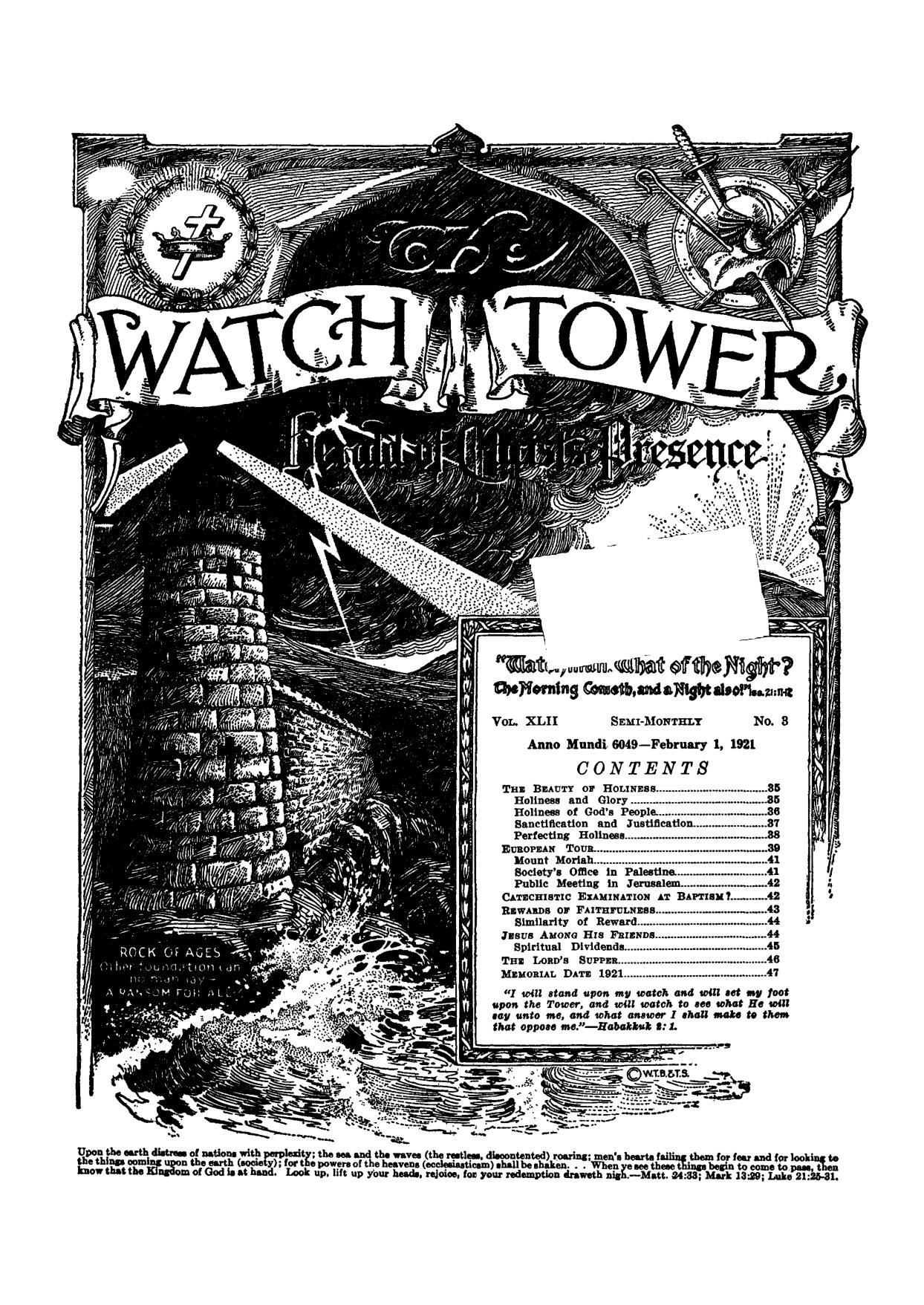
ROCK Of
AG E S
! 3 #
No. 8
P7pJ“i5ir: the *“ "“B*** WBVe» (‘he restless, discontented) roaring; men's hearts failing them for fear and for looking to knolthS (l!Te{X): 1* ‘r poTe.r8 of tF!e he?ve5‘ (“ccteBiaaticsm) .hall be shaken. . When ye see theeethings begin to c^e to pam, then
know that the Kingdom of God is at hand. Look up, lift up your heads, rejoice, for your redemption draweth nigh.—Matt. 24:33; Mark 13:29; Luke 21:25-31.
TO
Wi,7uu^®w
Qpyforning GMaj<$tb,and&}ng^tal90!,1sa2i:n«
Vol. XLII
Semi-Monthly
u.
t,
Anno Mundi 6049—February 1, 1921
CONTENTS
The Beauty or Holiness.................................
Holiness and Glory.......................................
Holiness of God’s People...............................
Sanctification and Justification....................
Perfecting Holiness_________________________________________
European Toub----------------------------------------------------
Mount Moriah...............................................
Society’s Office in Palestine.________________________
Public Meeting in Jerusalem_____________________
Catechistic Examination at Baptism?._______
Rewards or Faithfulness____________________________
Similarity of Reward...................................
Jesus Among His Fbibnds...............................
Spiritual Dividends.........................................
The Lord’s Supper.............................................
Memorial Date 1921.............................-............
.35 .35 .36 .37 .38 .39 .41 .41 .42 .42 .43 .44 .44 .45 .46 .47
"I will stand upon mp watch and will sot mp foot upon the Tower, and will watch to see what He will sap unto me, and what answer I shall make to them that oppose me."—Habakkuk t:l.
THIS JOURNAL AND ITS SACRED MISSION
THIS Journal Is one of the prime factors or instruments in the system of Bible instruction, or “Seminary Extension**, now bein?
presented in all parts of the civilized world by the Watch Tower Bible & Tract Society, chartered A. D. 1884, “For the Promotion of Christian Knowledge”. It not only serves as a class room where Bible students may meet in the study of the divine Word but also as a channel of communication through which they may be reached with announcements of the Society’s conventions and of the coming of its traveling representatives, styled “Pilgrims”, and refreshed with reports of its conventions.
Our “Berean Lessons” are topical rehearsals or reviews of our Society’s published Studies most entertainingly arranged, and very helpful to all who would merit the only honorary degree which the Society accords, viz., Verbi Dei Minister (V. D. M.), which translated into English is Minister of God's Word. Our treatment of the International Sunday School Lessons is specially for the older Bible students and teachers. By some this feature is considered indispensable.
This journal stands firmly for the defense of the only true foundation of the Christian’s hope now being so generally repudiated —redemption through the precious blood of “the man Christ Jesus, who gave himself a ransom [a corresponding price, a substitute] for all”. (1 Peter 1:19; 1 Timothy 2 : G) Building up on this sure foundation the gold, silver and precious stones (1 Corinthians 3: 1115; 2 I’eter 1:5-11) of the Word of God, its further mission is to “make all see what is the fellowship of the mystery which. . .has been hid in God, . ♦ . to the intent that now might be made known by the church the manifold. Wisdom of God”—“which in other ages was not made known unto the sons of men as it is now revealed”.—Ephesians 3:5-9,10.
It stands free from all parties, sects and creeds of mon. while it seeks more and more to bring its every utterance into fullest subjection to the will of God in Christ, as expressed in the holy Scriptures. It is thus free to declare boldly whatsoever the Lord hath spoken—according to the dh hie wisdom granted unto us to understand his utterances. Its attitude is not dogmatic, but confident; for we know whereof we affirm, treading with implicit faith upon the sure promises of God. It is held as a trust, to be used only in his service; hence our decisions relative to what maj and what may not appear in its columns must be according to our judgment of his good pleasure, the teaching of his Word, for the upbuilding of his people in grace and knowledge. And we not only invite but urge our readers to prove all its utterances by the infallible Word to which reference is constantly made to facilitate such testing.
TO US THE SCRIPTURES CLEARLY TEACH
That the church is “the temple of the living God”, peculiarly “his workmanship” ; that its construction has been in progress throughout the gospel age—e\er since Christ became the world’s Redeemer ami the Chief Corner Stone of his temple, through which, when finished, God's blessing shall come “to all people”, and they find access to him.—1 Corinthians 3:16, 17; Ephesians 2:20-22; Genesis 28 : 14 ; Galatians 3 : 29.
That meantime the chiseling, shaping, and polishing of consecrated believers in Christ’s atonement for sin, progresses; and when the last of these “living stones", “elect and precious,” shall have been made ready, the great Master Workman will bring all together in the first resurrection ; and the temple shall be filled with his glory, and be the meeting place between God and men throughout the Millennium.—Revelation 15:5-8.
That the basis of hope, for the church and the world, lies in the fact that “Jesus Christ, by the grace of God, tasted death for er try man," “a ransom for all,” and will be “the true light which hghteth every man that cometh into the world'*, “in due time”.—. Hebrews 2:9; John 1 : 9 ; 1 Timothy 2:5, 6.
That the hope of the church is that she may be like her Lord, “see him as he is,” be “partakers of the divine nature’,’ and share lug glory as his joint-heir.—1 John 3:2; John 17:24; Romans 8:17; 2 Peter 1:4.
That the present mission of the church is the perfecting of the saints for the future work of service: to develop in herself every grace ; to be God's witness to the world ; and to prepare to be kings and priests in the next age.—Ephesians 4 : 12 ; Matthew 24 : 14; Revelation 1: G; 20:6.
That the hope for the world lies in the blessings of knowledge and opportunity to be brought to all by Christ’s ■Millennial kingdom, the restitution of all that was lost in Adam, to all the willing ami obedient, at the hands ot their Redeemer and his glorified church, when all the wilfully wicked will be destroyed.—-Acts 3:19-23; Isaiah 35.
PUBLISHED By
WATCH TOWER, bible b-TRACT SOCIETY
124 COLUMBIA HEIGHTS □ □ BROOKLYN. NY. U S A
Foreign Offices : British 34 Craven Terrace, Lancaster Gate, London W. 2: Canadian: 270 Dundas St., W., Toronto. Ontario; Australasian: 495 Collin** St., Melbourne. Australia; tiouth. African: 123 Plein St., Cape Town, South Africa.
Please Address the Society in Every Case.
YEARLY SUBSCRIPTION PRICE. United States, $1.00: Canada and Miscei laneous Foreign, $1.50: Grevp Britain. Australasia, and Soi til Africa, 8s. American remittances should be made by Express or I’ostal Money Orders, or by Bank Draft. Canadian, British, South African, and Australasian remittances should be made to branch offices only. Remitlanres from scattered foreign territory may be made to the Brooklyn office, but by International Postal Money Orders only.
(Foreinn translations of this journal appear in several lanauaaes)
Editorial Committee: This journal is published under the supervision of an editorial committee, at least three of whom have road and approved as truth each ami every article appearing in these columns. The names of the editorial committee are: J. F Ri therford, W. E Van Ambi rgh, F. II. Robison, G. IT. Fisher, E. W. 11 renisen. Terms to the Lord's Poor: AH Bible students who, by reason of old age or other infirmity or adversity, are unable to pay for this journal, will be supplied free if they send a postal card each May stating their case and requesting such provision. We arc not only willing, but anxious, that all such be on our list continually and in touch with the Berean studies.
Notify //* Rukni-rihera- We do not, as a rule, send a card of acknowledgment for a renewal or llOllCv IO &UD8CTlO€rS. a ncw 8Ubacrlptjon. Receipt and -n try of renewal are indicated
within a month by change In expiration date, as shown on wrapper label.
Entered aa Second Class Matter at Flrooklwn, N. Y., J’ostoffiee under the Act of March 3rd, 1879.
CONVENTIONS
Houston, Texas. The International Bible Students Association will hold a four-day convention at Houston, March 3-6, Inclusive. This convention will serve for the friends of Texas, Oklahoma, Louisiana, and any other part of the United States from which any can attend. A number of the Pilgrim brethren will be present; and Brother Rutherford will be there a portion of the time, addressing the public Sunday, March 6. For further Information concerning accommodations, etc., address Joseph Isaac, Jr., 905 Thompson Street, Houston, Texas.
Tampa, Flobida. Tampa is an ideal spot for a winter convention. We are pleased to announce that a convention of the International Bible Students Association has been arranged for Tampa, March 10-13, inclusive. It is expected that friends from the southern states east of the Mississippi River, as well as some from other parts of the country, will attend. Several Pilgrim brethren will be present and address the gathering. Brother Rutherford will also be there during a part of the convention. Address all communications concerning accommodations, etc., to Edward F. Limpus, 510 Curry Building, Tampa, Fla.
CONCORDANT NEW TESTAMENT
In our issue of June 15, 1920, announcement was made of an arrangement to supply the friends with the Concordant Version of the Sacred Scriptures. This arrangement has not been entirely satisfactory. Some of the friends have been sending orders for future translations. This office will not further handle those. We have on hand a limited supply of the translation of Revelation, designated “The Unveiling”, and when this stock is exhausted we will discontinue handling this work.
WATCH TOWER REPRINTS—INDEX
Many of the friends are inquiring when they may expect to receive Volume Seven of the Watch Tower Reprints. That volume when finished will contain a complete index of the entire set. To prepare this index requires a great amount of work—much more than could be appreciated until the work was well in hand. Also some delay was occasioned by the special Golden Age work of last summer. The work on the index has now been in course of preparation for several months and will require several months longer before the copy Is complete. Then it will have to be set up and manufactured in book form.
We are unable to say at this time just how long it will be, but in view of the delays incident to the publication of the other volumes, it may be six months before this last one is ready for delivery. We ask the friends, therefore, to be patient. This work is being pushed as rapidly as it can be, and as quickly as It is finished the books will be shipped out. The Index will be a very valuable one and will enable the possessor of the volumes to refer readily to any topic or text of Scripture discussed in this library of Biblical Information.
AND HERALD OF CHRISTS PRESENCE
Vol. XLII
February 1, 1921
No. 3
THE BEAUTY OF HOLINESS
"Worship the Lord in the beauty of holiness.”—Psalm 29:2.
WHATEVER holiness is, God is it, in the purest and most unequivocal meaning of the term; for Jehovah was and continues to be “the Holy One of Israel”. (Psalm 71:22; 89:18) Holiness implies transcendant purity of character; but it really means much more than that, as we shall come to see.
Holiness, that basic concept of divine revelation, is not found at all in its Scriptural signification among the heathen, either of ancient times or of the present. They do have what are called “holy men”, in whom a certain idea of remoteness or separateness is to be found exemplified; but that separateness is merely a physical state and does not reach very far into the realm of character. The “holy men” of China, of India, of Thibet, of Africa, live in caves or in the open field, religiously abstain from bathing and from many other conventional things, but the inner cleanness and abhorrence of evil which the Bible word holy conveys is often quite foreign to them.
TO WHOM HOLINESS IS ASCRIBED
In the Bible holiness is ascribed to or mentioned as being an attribute or condition of (1) God and (2) his Son Jesus—and, as a matter of course, of that spirit which emanates from either or. both of them— (3) of the angels, (1) of God’s people, and (5) things dedicated to God or his service.
“I am holy,” says the Lord God of Israel. (Leviticus 12:44; 1 Peter 1:16) This testimony is sufficient for every child of God, but there is a vast deal more given from almost every quarter of creation. We read of how the Prophet Isaiah received his commission from the Holy One. He was standing, it seems, at the threshold of the Temple; in front of him stood the door leading into the inner shrine. His vision is sharpened and enlarged, and the cherubim on the vail are transformed, as it were, into glorious seraphim, singing Jehovah’s praise. The smoke of the sacrifice undergoes a change and fills the new and vaster Holy of Holies. The relatively feeble light of the Shekinah presence opens out into a blaze of effulgence and of dazzling splendor. The seraphs sing, and the burden of their song is “Holy, holy, holy is the Lord of hosts; and the whole earth is full of his glory”. (Isaiah 6:3) Thus did Isaiah have borne home to him in music the pervading thought of his future ministry. For him Jehovah was to be throughout “the Holy One of Israel”. In the very be-
3S ginning he throws down the charge: “They have forsaken the Lord, they have provoked the Holy One of Israel to anger”. (Isaiah 1:4) Further, he wrote of how the purged remnant of Israel should learn to “stay upon the Lord, the Holy One of Israel, in truth”. (Isaiah 10:20) Again, the judgments of the Lord will be so searching and so effective that the terrible one and the scorner shall be consumed, “and the poor among men shall rejoice in the Holy One of Israel”. --Isaiah 29 :19.
HOLINESS AND GLORY
The separateness in God which the word holy suggests is not isolation from the world or from his creation generally as such, but it is an apartness, a disunit-edness, an aloofness from evil. According to the seraph’s song, glory is the other side of holiness. Seemingly it was considered that when they had proclaimed Jehovah to be holy they had said enough. Holiness must therefore either involve or imply the very height of moral excellence. The effect of God’s holiness is shown to be a glorified earth. Jehovah’s incomparable sanctity is so pure, so penetrating, and so cleansing that when his plan of the ages is finished it can be said, and said aloud to all the universe: “The whole earth is full of his glory”. Glory is the flower of holiness, as beauty is the Hower of health.
A faint foreshadowing of this glory is given in the song of Moses and the children of Israel at their deliverance from the land of Egypt: “Who is like unto thee, 0 Lord,., .who is like thee, glorious in holiness?" (Exodus 15:11) Again, a cry goes up from the Lord’s people for Jehovah to “look down from heaven, and behold from the habitation of [his] holiness and [his] glory".—Isaiah 63:15.
It was suggested above that holiness in God means more than, or at least something other than, moral perfection, although it always implies perfect virtue. Holiness suggests the idea of that peculiar attitude and sentiment with which perfect virtue regards moral evil. This is so true that it can be said that if there never were any evil, either active or conceivable, in the universe, there could not have been any holiness; for there would have been nothing to recoil from. There would have been perfect truth, and perfect righteousness, but not holiness. This word, it will be seen, denotes neither any one of the virtues in part nor the whole group of them merely, but the sense of repulsion which these virtues engender toward their opposites, an abhorrence which could never have been felt had evil been so far a nonentity as never to exist in fact or as an object of thought.
These thoughts are substantiated by the complaint of the Prophet: “Thou art of purer eyes than to behold evil, and canst not look on iniquity: wherefore lookest thou upon them that deal treacherously, and boldest thy tongue when the wicked devoureth the man that is more righteous than he?” (Habakkuk 1:13) That is, God’s whole nature was known to recoil from evil and iniquity, but in this instance he suffered it, as he has suffered the whole reign of evil on earth for certain instructive purposes, that his own holiness might shine the brighter in the end.
PROPRIETOR OF GOODNESS
God only is absolutely good. (Luke 18:19) That is to say, he is the sole proprietor of goodness as he is also of immortality. (1 Timothy 6:16) All others who have either goodness or immortality have them because of God’s grace in dispensing his bounties. It is for this reason that Jehovah demands and commands the supreme veneration of those who would themselves become good.—Luke 1:49; John 17:1; Acts 3:14; Hebrews 7:26; 1 John 2:20; Revelation 4:8.
The holiness of God, then, is that moral perfection of his phis that attribute by which all moral imperfection is removed from him. The holiness of God’s will, therefore, is that by which he invariably chooses what is good and refuses what is evil. It will be noted that God’s holiness and his justice are very intimately associated. Holiness is the effect which justice has upon his desires, the internal inclination of the divine will; truth is the effect which justice has on his volition; while righteousness is the outworking of justice in his conduct, in his actions. (Psalm 145:17) It is because of this intimate association of holiness and truth, that truth is used as the agency in the holifying or sanctifying of the members of Christ’s body.
This attribute of Jehovah’s implies that no sinful or wicked inclination can be found in him. Hence it is said of God that he is incapable of being tempted to evil. (James 1:13,17) He can no more be tempted to evil than a piece of gold can be drawn by magnetism. There is simply nothing responsive there. God is also described as being light, and entirely without darkness; i. e., all holiness and no sin. As for example: “I have sworn by my holiness,. .. I will not lie.”-—Psalm 89 : 35 ; Amos 4:2.
Jehovah never chooses what is false or deceitful— falsity and deceit are the devil’s tools—but only what is truly good, what his perfect intelligence recognizes as such. This naturally makes of him the most perfect teacher and the highest exemplar of what is good. “God hath spoken in his holiness.” (Psalm 60:6) In harmony with this, we find the Bible to declare that he looks with displeasure upon wicked and deceitful courses (Psalm 1:5; 5:5—“Thou hatest the workers of iniquity”); but he regards the truly pious with favor.— Psalm 5:7,8; 15:1; 18:26; 33:18.
HOLINESS AND DIVINE SOVEREIGNTY
As justice is the foundation or establishment of God’s throne, so holiness is identified with his matchless sovereignty, for we read that “God sitteth upon the throne of his holiness”. (Psalm 47:8) This holiness extends to his whole mountain or kingdom, the kingdom of Zion. He is “greatly to be praised in the mountain of his holiness”.-—Psalm 48:1; Jeremiah 31:23.
Holiness is an essential, that is, a non-acquired attribute of Jehovah, and it adds glory and lustre to all his other perfections. (Exodus 15:11) He could not be God without it; “For all his ways are justice, a God of truth, and without iniquity, just and right is he”. (Deuteronomy 32:4) The holiness of God is visible through his works; he made all things holy (Genesis 1:31): by his providences, all of which are calculated to produce and to promote holiness in the end (Hebrews 11:10) : by his grace, which influences the subjects of it to be holy (Titus 2 :10,12): by his general Word, which commands holiness (1 Peter 1:15): by his specific Word, as sometimes sent through his prophets, with the end of holiness in view (Jeremiah 44:4,5): by substitutionary punishment of sin in the death of Jesus (Isaiah 53) : and by the second death penalty for the willfully wicked.—Matthew 25 :41.
THE SON ALSO THE HOLY ONE
Since there is such oneness between the Father and the Son, we would expect to find the same holiness in him as in the Father, except that he is not the original proprietor of it, having received it as a part of his princely inheritance from the Father at the time of his creation. Accordingly, the divine Word refers to God’s Son also as being the “Holy One”. In the annunciation of Jesus’ birth the angel said to Mary: “That holy thing which shall be born of thee, shall be called the Son of God”. (Luke 1:35) During our Lord’s ministry on earth even the demons recognized and uttered unwelcome testimony to his holiness, one of them saying, “I know thee, who thou art, the Holy One of God”. (Luke 4:34) And concerning our Lord’s most crucial test of faith he had long before prophetically said: “Thou wilt not. .. suffer thine Holy One to see corruption”. (Psalm 16:10) And the Apostle Peter, speaking under the fresh inspiration of the holy spirit, laid at the door of the Jews the charge that they had “denied the Holy One and the Just, and desired a murderer to be granted unto” them.—Acts 3 :14.
Jesus is the great Holy Angel of God, but the lesser kinds of angels are likewise holy, as is implied by the fact that they are many times referred to as “his angels” (Psalm 148:2), and also as having access to the Father’s face.—Matthew 18:10.
HOLINESS OF GOD’S PEOPLE
Since there is and can be no reasonable doubt as to Jehovah’s holiness or of that of his Son, our inquiry naturally runs to the holiness of God’s people. What can that mean?
First, we find it said even regarding God’s fleshly people that he had sanctified (Zioly-fied) them; that they were all called to holiness, which they were to endeavor to acquire and which many in reality did attain to under the Law.—2 Peter 1:21.
Hoses was instructed by Jehovah to say to the people of Israel: ‘‘Ye shall be unto me a kingdom of priests and an holy nation’’. (Exodus 19:6; comp. Exodus 22:31; Leviticus 11:44,45; Numbers 16:3) But only in the future, when the New Law Covenant is established, will the Jews attain that holiness which they must have to be the permanent fleshly people of God. Concerning that time it is written: “Thy people offer themselves willingly in the day of thy power, in the beauty of holiness’’. (Psalm 110:3) Again, the earthly people are finally addressed in the same words as our head text: “Give unto the Lord the glory of his name: bring an offering and come unto his courts. 0 worship the Lord in the beauty of holiness: fear before him, all the earth.” (Psalm 96:8,9) Moreover, the way of progress over which mankind will be required to walk if they would have the riches of divine favor is called a “way of holiness”. (Isaiah 35:8) In short, no one will ever have life who is not holy, every fiber of whose being does not loathe, despise, abhor the thought of sin, disloyalty, rebellion,
God’s revelation of his holiness has much to do with the holiness of his people. He reveals his holiness partly through judgments. in which he rejects sin as a thing utterly discordant with his being and to which he becomes a consuming fire (Ilabakkuk 1:13; Hebrews 12:29), partly through redemption, insofar as this is a separation, a cleansing from the defilements of the world and of sin. In connection with this last, God’s holiness is at once the fountain head of the whole redemptive revelation, both in its preparatory stage of choosing out his Israel to be a holy people, and its fuller developments through the atoning work of Christ and the sanctifying work of the holy spirit, yes, even in its completion in the heavenly Holy of Holies, where everything is called holy (Revelation 15:4) and is holy. (Revelation 21:27; 22:14,11) Whether we look upon God’s redemptive work as an outflowing of his benevolent love or of his beneficent justice, it is nevertheless a revelation of his holiness; for it is throughout a holy and holifying, a purifying love, which makes itself known in the giving of his Son and in the sending forth of his spirit.
PRIMARY LESSONS IN HOLINESS
Jehovah’s choosing of Israel to be a holy people and every divine activity designed to further that end—the giving of the law, the instructing, helping, and protec-ing of Israel—were evidently all planned with the grand purpose in view of revealing himself as the holy God, the Holy One of Israel. The deepest import and sense of the Sinaitic Law was that the people in their putting oft of everything unclean and sinful should thereby become like God. Of course, as a child is obliged to start at the bottom of the ladder of education and must first learn the letters or words before he can use the language extensively, so it was with the holiness which the Jews saw; it had chiefly to do with external customs, Usages, and separations, as prescribed by the ceremonial law. Those stipulations had to do principally with food, raiment, with washings and separations from everything in the realm of death, disease, and sexual irregularities anil abnorinalties. But the moral law of the ten commandments and elaborations ef those laws in the Book of Deuteronomy, the messages of the prophets, and the utterances of the psalms all show a gradual expanding of the idea of holiness as a sanctity of heart and life and as a hatred of evil. This expansion was not due to any “evolution” on the part of the Jews themselves, but rather to a careful and gradual instruction by the Master Teacher.
This sanctity of heart is most noticeable in the New Testament, where the underlying theme of all the preaching of our Lord and the apostles leads away from the merely formal holiness of the Pharisees and toward the inner purity of a life like that of the Father and the Son. It is true that the word holy occurs less frequently in the New Testament than in the Old, but the thought unquestionably runs throughout all God’s revelations by Jesus and his apostles.
The Lord’s people of this gospel age, Christians, are much more particularly declared to be holy than were his fleshly people of times past. Now we have received the earnest of the holy spirit (2 Corinthians 1: 22), or the holy spirit as an earnest of the future inheritance. In Acts and quite generally in the Epistles believers are referred to as “saints”, holy ones. Ananias, in demurring to the commission to go visit Paul, said: “Lord, I have heard from many of this man, how much evil he bath done to thy saints”. (Acts 9: 13, 32, 41) The Apostle Peter came down to the saints which dwelt tn Lydda; he raised Tabitha from the dead and presented her to the saints. (Acts 9:40) The Apostle Paul directs his Epistle to the Romans, “to the beloved of God, called to be holy ones”.—Romans 1:7.
SANCTIFICATION AND JUSTIFICATION
God’s people of this age are holy (1) by separation and choice (1 Peter 2:9); (2) by the imputation of Christ’s righteousness to them (Ezekiel 16:14; 2 Corinthians 5: 21) ; and (3) by the work of sanctification proper, by exposure of themselves to and conformity with the holy principle of divine grace whereby (a) the heart is renewed in holiness and both (b) mind and (c) body are transformed by degrees in the direction of perfection.—Colossians 1:28; 4:12.
It is in this third sense to which we can look with greatest profit, while not minimizing the first two at all. The second is really justification, which while closely related to sanctification and having a distinct bearing upon the development of the holy horror of sin, is still to be distinguished in the following points:
(1) Justification is the making or declaring of the ■inner to be right or free from the guilt of sin and the penalty of death; whereas sanctification is an alteration or transforming of qualities from evil to good.
(2) Justification consists in remission of sins through or because of the imputation of Christ’s righteousness; sanctification is the renovation of the whole being by the holy spirit.
(3) Justification is perfected at once; sanctification only gradually approaches perfection.
(4) Justification naturally precedes sanctification (though not consecration) ; for God sanctifies only those who have some relation to him, and the basis of all his relations with human beings is some kind of justification.
The Lord through the Psalmist informs us: “Holiness bccomoth thine house ... for ever”. (Psalm 93 :5) If this is true, if our hearts are to be established “unblamable in holiness” (1 Thessalonians 3:13), if we are not calhul “to uncleanness, but to holiness” (1 Thessalonians 4:7), then there is no more vital subject than this, to find out how we can become holy, or if already holy in some senses, to become still more holy. The new creature is “created in righteousness and true holiness”, we are told. (Ephesians 4: 24) The thought here, seems to be that the creative work under which the new creature is being developed is retarded by unrighteousness and unholiness, but is forwarded by that which is right. Conscious, habitual determination to be and to remain separate from sin is engendered by the presence of positive graces, which not only tend to sharpen the discernment of evil, but which also beget an abhorrence of that evil. One who is born and reared in abject poverty cannot feel as great a recoil from it as one who is reared in affluence and to whom every evil smell, every unlovely sight, every greasy stair-rail and creaking step, every discordant sound, every uncertain taste is loathsome. So it must be with God, with Jesus, with the holy angels. But we are born in moral poverty, more or less squalid: ours is an uphill work, the first act of which is to get the concept of holiness, then to strive for it by making use of such sanctifying agencies as the Father has provided for that purpose.
PERFECTING HOLINESS
To perfect this holiness is not to perfect the flesh, as some have mistakenly supposed, but it is to render firm, fixed, and established our love of righteousness and hatred of iniquity, so that we can be trusted with glory, honor, and immortality. The fear of the Lord is a strong factor in this; for we read that we are to perfect “holiness in the fear of God”. (2 Corinthians 7:1) “The fear of the Lord is to hate evil,” it is elsewhere stated. (Proverbs 8:13) We cannot have a wholesome fear of God without hating that which is his opposite.
Sincerity is absolutely inseparable from the idea of holiness. It is first of all a “sanctification of the spirit”, or mind. (2 Thessalonians 2:13; 1 Peter 1: 2) This is accomplished by God’s mind meeting our own, by means of his expressed will. So we can well “give thanks at the remembrance of his holiness” (Psalm 30:4; 97:12); hence, also, the encouraging words in which we are told that “being made free from sin [through justification] ye have your fruit unto holiness, and the end everlasting life”.—Romans 6:22.
The process by which we are made holy is called sanctification. Unfortunately we are obliged to jump from an Anglo-Saxon word (holy, i. e. halig, helig, which means whole or sound) over to the Latin word sanctification, when we need a verb. This has a tendency to break the continuity of thought and the really close connection between many Scripture statements. But this difficulty can be overcome if heed is paid. Sanctify means to make holy; holiness is the native attitude which virtue has toward sin; therefore to make holy means to engender, develop, or to contribute to that love of righteousness and hatred of iniquity which must distinguish the followers of him who was exalted above his fellows because of those virtues.—Psalm 45 :7.
JESUS’ PRAYER FOR OUR HOLINESS
In harmony with the Father’s will elsewhere expressed, Jesus considered the work of sanctification in his church to be of sufficient importance to mention it in his high-priestly prayer, just before the ending of his earthly career. He prayed to the Father: “Sanctify them through thy truth: thy word is truth”. (John 17: 17) In passing, it is necessary to remark that the words holy and sanctify have a very wide range of meaning. Almost everything which is tinged by sacredness, either subjective or objective, is described by the words holy and sanctify. We might be inclined to separate these meanings and to attach different words to them. But it is for us to accommodate our phraseology to that of the Lord himself. Doubtless he did this with a view to calling attention to the all-pervasive need of holiness by the very general pervasion of the word throughout his various messages and instructions. There are several shades of meaning, for instance, to the word sanctify as used in the Bible, but the principal of them are these:
(1) To confess, declare, and celebrate that to be holy which in itself is so and was so before our declaration. (Matthew 6:9) This is the meaning wherever God is said to be sanctified.
(2) To separate persons and things from common or unholy conditions and install them for holy uses, as the Tabernacle and its furnishments, the Temple, the typical priests, etc.
(3) To employ a thing, ordinance, or institution in holy and religious exercises in the worship of God in either public or private and in the celebration of his works. In this and in the second sense the seventh day is sanctified.—Exodus 20: 8.
(4) To make persons holy who were not so before. (1 Corinthians 6: 11) And this is the sense of the word in those passages of Scripture w’here the footstep followers of the Lord are said to be sanctified.
Our Master’s prayer for the church’s sanctification was addressed to the heavenly Father. God is to do this work. He will not and cannot do it without our cooperation, but given proper conditions in our own hearts, the responsibility is with him. This is a work which we cannot do alone; for it requires superhuman wisdom and superhuman power. We cannot be sure, for instance, of choosing the right experiences for even one day which would work to our eternal interests. We might pick out those things which would be too difficult for us or, more likely, things which would be so easy as not to develop the vital strength of the new creature.
SANCTIFICATION FOR THE CHURCH
This prayer implies relationship with God through consecration; it does not apply to the world in this age; for in the same connection our Lord prayed: “I pray for them: I pray not for the world, but for them which thou hast given me”. (John 17: 9) Our Master did not mean to limit the force of his prayer to those who were at that time his followers, because he himself explained: “Neither pray I for these alone, but for them also which shall believe on me through their word”. (John 17:20) This sanctifying to which the Master referred cannot mean a mere setting apart or dedication to the Lord’s service; for the apostles were already thoroughly devoted to the Lord and thoroughly desirous of being guided by his will, even at that time. There was a certain designation of these apostles and other believers at Pentecost by the sending of the holy spirit, but this sanctification of the Master’s prayer is a great process which is to be accomplished by the Lord’s Word. And Jehovah is to do it, even as prayed by the Apostle: “The very God of peace sanctify you wholly”—that is, confine with the good work which he has begun in you until there is not a vestige of heart attachment to anything worldly, sensual, or devilish.
God’s Word is spoken of as being the means for accomplishing this work; but it is not the literal or literary Word merely. Many men have been most familiar with the Sacred Scriptures in a literary way and have never been sanctified by them. The truth is the active agency in the Lord’s Word which is to accomplish this work. The truth is the characteristic influence of Jehovah which pervades his message. It is like the personal and unstudied touch of a dear friend’s letter. A stranger would miss it.
How sublime is the prospect, “That we might be partakers of his holiness”. (Hebrews 12:10) We know this sanctification is the Lord’s will for us (1 Thessalonians 4:3); for he distinctly commands, "Be yt holy, for I am holy”.—1 Peter 1:16.
A PHOTOGRAPH AS ILLUSTRATION
As a photographer exercises great care in the portraiture of a distinguished personage, as he places the cloth over his head, brings the camera into general line of vision and then into focus, as he sees that the lens is clean and properly inserted, as he gives care to the placing of the plate and jealously guards it until it is developed; so we are sanctified by the truth through the Word. It is Jehovah’s love of right and abhorrence of evil which we wish to copy. “He dwelleth in light” and this light has a potency for transforming us—“even as by the spirit of the Lord”. (2 Corinthians 3: 18) By the act of consecration we shut off the sidelights from the world and the alluring things of the flesh and bring ourselves into general alignment with the Lord through the privileges of justification in Christ. We adjust our attitude before him to that of humility. Only in this proper focus can we see him as he is and get what we so much need. The lens, the Bible, God’s message, is perfect in itself, though it may have some dust specks of mistranslation or interpolation which would tend to render less perfect the picture.
But the main point in photography, the point without which all the preliminary arrangements are futile, is to expose the plate. The coating of the plate is exceedingly sensitive to light. That is our hearts. If the light of divine truth from God himself floods through the lens of his Word into our hearts, that light will have a transforming effect upon our hearts, even though it is difficult for the beholder to discern. To make the plate really useful it must be submerged in a chemical bath, which developes and fixes it. So we must be immersed in death before we can be used in printing or impressing this idea of holiness, God’s holiness, now also become ours, upon the minds and hearts of mankind in the future.
With these glorious prospects before us we can well “follow peace with all men, and holiness, without which no man shall see God”.—Hebrews 12.T4; Matthew 5:8.
EUROPEAN TOUR
[continued]
SINCE Captain Joshua marched his forces around the walls of ancient Jericho and, as a reward for his faith, the walls fell down at the blowing of the rams’ horns, this has been a famous spot in the land of Canaan. Many events of great interest have transpired in this vicinity, and every one who has a keen interest in the divine plan takes advantage of an opportunity to see Jericho. It lies about eight hundred feet below the sea level at the very edge of a plain or valley some sixteen miles wide, with the Jordan eight miles distant and the mountains of Moab on the east.
In ancient times men who journeyed from Jerusalem to Jericho made the trip either on foot or by donkey, and often fell among thieves. It is a country well suited for robbers. Our party journeyed from Jerusalem to Jericho in a Ford car over a road built in recent years. We observed that the owner of the car would not permit the driver to start until he had armed himself with a good revolver, and on inquiring the reason we learned that robbers still infest the hills on either side of the roadway. The road is almost a constant descent from Jerusalem to the Jordan and is skirted on both sides by rugged hills rising perpendicularly, sometimes to a height of more than a thousand feet above the road.
The present city of Jericho is some two and one-half miles south and west of where the ancient city stood. The present inhabitants are Arabs and Bedouins, with a few Jews. Without doubt, however, this land will some day in the near future be wonderfully productive and provide food for a great number of people. The entire valley of the Jordan on both sides from mountain to mountain is very fertile, and with irrigation it will produce abundantly.
Elijah and Elisha journeyed together from Bethel down to Gilgal, then to Jericho, and from Jericho about eight miles further east to the Jordan, crossing the river. When returning to Jericho from the other side of Jordan, Elisha healed th'e fountain of water and made it sweet. Our party drank at this fountain, which gives forth an abundant supply of very fine drinking water. The overflow is used for irrigating gardens nearby. We visited some of these gardens and found them to be exceedingly productive. Here within a radius of a few yards are grown many kinds of fruits and vegetables, such as bananas, oranges, lemons (both sweet and sour), grapes of various kinds, pomegranates, figs, dates, sugar cane, pumpkins, beans, peas, eggplant, citrons, sweet melons, watermelons, etc. While it is located below the sea level, the climate is not oppressively hot. The soil is so rich and the climate such that with proper cultivation the soil would produce several crops each year. Great caravans of camels transport the food and grain now raised in this valley up to Jerusalem and on to the Mediterranean Sea; and we confidently predict that within a few years there will be modem means of transporting the great quantities of grain that will be produced in the vicinity of Jericho. Even now the desert is beginning to blossom as the rose.
From Jericho we journeyed to the Jordan, visiting the spot where, according to the best evidence obtainable from the Scriptures, our Lord was immersed by John the Baptist. While, of course, no one can definitely locate the exact spot, the Biblical account is that John was teaching in the wilderness and all people came out from Judea and from Jerusalem to be baptized of him in the Jordan. And Jesus came also. It was a solemn yet thrilling moment as we stood by the swift current of the Jordan and remembered that the precious feet of the Master had once gone into that stream and there his body was immersed, symbolizing his death. This was the same stream where Jehovah performed a great miracle, holding back its rushing waters until the people had passed over, and from the bottom of which they afterward carried twelve stones and set up a monument to commemorate the goodness of the Lord.
It was in this same stream, and probably in the same vicinity, that the Lord again performed a miracle in behalf of Elijah and Elisha. The two stood by the rivpr’s edge and Elijah, taking his mantle, smote the waters and they divided, and .the two went over on dry ground. Afterward Elisha returned, and taking the mantle which had fallen from the shoulders of Elijah, smote the waters and they divided again and he crossed to the other bank. While this experience has always been of interest to Christians, it is of peculiar interest to Bible students just now because we are reminded that Elijah and Elisha there were performing pictures which have had a partial fulfillment in the last two years and are still in course of fulfillment. The writer walked over the Jordan and came back dry shod; but lest any one might mistake this remark, we mention the fact that in the year 1919 General Allenby built a bridge across the Jordan at this point, over which the crossing was made. The British army now carefully guards this bridge at both ends; and on inquiring of the officers in charge, we learned that the particular reason for guarding this entrance was because of fear of approach of the Turks and Persians. Verily the armies of the British Empire are guarding the approach to Jerusalem from every point of the compass; and while Great Britain maintains control over the land of Palestine at this time ostensibly in behalf of the Jew, it is quite evident that the real purpose is to protect the interests of the British Empire. Palestine is a key to the situation. Its loss now might mean the loss of the Suez Canal, and the loss of the Suez Canal would mean the loss of Egypt and probably India.
After the baptism of Jesus in the Jordan he was led up of the spirit into the wilderness to be tempted of the devil. He remained in the mountains forty days and nights and the tempter came unto him. Immediately west of Jericho and about ten miles from the Jordan are some very high mountains, and it is probable that in one of these the Lord abode for forty days and nights. One of them, indeed, is designated the Mount of Temptation. Whether this is the proper designation or not, without doubt it was in that vicinity.
The return journey from Jericho to Jerusalem was attended with some danger and some anxiety. The difference in the elevation of the two points is approximately twenty-five hundred feet and the roadway traversed by automobiles covers a distance of twenty-five to thirty miles. Our party started back in the Ford car about three in the afternoon, in ample time to reach Jerusalem before night. But we soon realized that this would be impossible. Several times trouble occurred with the tires, and our Arabian driver attempted to repair them and then moved on again. We had gotten well into the mountains and were still some twenty miles away from Jerusalem when we had about the fourth puncture and it developed that this was the last inner tube that our driver had. The evening was rapidly coming on. Some of our party started to walk. The hills were very steep and we made slow progress. After going on for a short distance the driver wanted to return to Jericho; to which we objected, and he pushed on again. Another breakdown suggested to us that we might have to remain in those mountains overnight at the mercy of the Bedouins, or other robbers. An Arab driving a military car passed us and we called on him for relief, but without any response. Darkness came on and our driver protested against going further and insisted on sleeping with the Bedouins until morning. To this we objected. He pointed to his car and we saw that he had no lights on it. Then he gave us to understand that if he drove into Jerusalem without lights he would be sent to jail for three months or more.
The moon was shining, but being yet young was up only for a short while. We suggested to the driver that he could get on by moonlight and if he would drive to the Mount of Olives we would walk in from there. He mended the last tire he had by stuffing it full of burlap, strapping it on in some way with cords, and we continued our journey over the perilous road. In many places the road went around the mountain side, with a deep precipice below, and it required a close outlook to keep the car from going over. It was not far distant from this place that Joshua called to the sun to stand still until he could administer punishment to the five kings and their armies who had come up to battle against him and his ally. As we looked at the moon fast going down we thought of Joshua and his experience, and we earnestly wished that the moon would shine until we could get out of this mountainous region, and we asked the Lord, if such were in harmony with his will, to permit it to shine and light our way. On our car pushed, as we asked the Lord to get us out of the peril. Each mile of the road left behind was one mile less to walk in case the car could go no further. But after three hours of this exciting drive, we passed through Bethany and we knew we were near the Mount of Olives; and a short time afterward we turned at a point on the western slope of the Mount of Olives and at that moment the moon sank out of sight beyond Mount Zion. Our car crept cautiously down the side of the Mount of Olives and across the brook Cedron and up Mount Moriah, until we reached Damascus Gate. Here our driver went forward, found a policeman, explained our dilemma and asked for permission to go into the city. This was refused, but at the suggestion of the policeman a bottle was obtained by the roadway, the bottom broken off and a candle inserted in the neck and lighted. One of our party held this behind the windshield while we drove on into Jerusalem to our hotel, and we were safe.
MOUNT MORIAH
For many years the Mohammedans have had possession of Mount Moriah and prior to the war they refused to permit any Christian to approach the site of the Temple, where now stands the Mosque of Omar. This point is of great interest to all Christians. It seems quite probable that this is the very spot where Melchisedec met Abraham when he returned from the slaughter of the kings and administered unto Abraham bread and wine, and Abraham paid tithes unto Melchisedec. It is the spot to which Abraham journeyed from Hebron three days, and there, on the top of the mount, offered his only beloved son, Isaac—a type of the sacrifice of the Lord Jesus. It was on this spot that Solomon built his glorious Temple. It was the place where Jesus taught the people and rebuked the hypocritical priests. It may yet be the site of the Temple of Ezekiel’s vision, because it is not improbable that such a temple may be erected during the reign of Christ. It seems not at all unlikely that the city of Jerusalem will be the site of the executive offices of the earthly phase of Messiah’s kingdom. ’The prophet Isaiah tells us that the law shall go forth from Mount Zion and the word of the Lord from Jerusalem. Mount Zion is just across the little valley from Mount Moriah.
It was in this place also that Jeremiah was imprisoned, and while there gave his prophecy against the ecclesiastical system of Jerusalem, which more particularly pictured the denunciation of the Lord against Babylon at this time and foreshadowed the downfall of the Babylonish systems. Since the war it has been made possible to enter the place of the site of the Temple, and as we stood on the site of this memorable structure many things of the past concerning God’s dealings with his people were vividly called to mind. It is strictly against the rules of the Mohammedans to make photographs of the Mosque, either inside or outside; but, seemingly, almost by miracle we got photographs of both the inside and the outside.
Jerusalem is a very crowded city, particularly inside the walls. It is said of David Street that it is the busiest point in the world. While this can hardly be true, the street— a very narrow one—is always crowded, from early morning until late in the evening, with human beings and donkeys. It is the chief street of traffic in the city and every available space is taken up by shops, and trading goes on inside the shops and out on the narrow street.
We observed that there is practically no improvement in progress within the walls of the city, while outside the walls many modern buildings have been erected. It seems not at all improbable that the Lord will not permit the rebuilding of Jerusalem until the return of the ancient worthies. It seems wholly improbable that he will permit the old city in its present state to stand, since Jerusalem is to be the capital of the world. Our opinion is, therefore, that with the return of the ancient worthies the whole of the city inside the walls will be reconstructed and beautified and made the site for the executive offices of the earthly phase of Messiah’s kingdom.
SOCIETY’S OFFICE IN PALESTINE
One of the objects of the visit to Palestine was to establish in that land a branch office of the Watch Tower Bible & Tract Society, especially a point where literature might be stored and from which it might be distributed. We searched diligently for several days both within and without the walls in order to find a vacant room where an office could be established, but wholly without success. Everything in Jerusalem is crowded full, with little or no prospect of an office soon to be obtained. We finally concluded that probably it was not the Lord’s will that the office be established in Jerusalem at this time, but somewhere else nearby. We, therefore, visited Ramallah, nearby and in sight of the city, and where there is now a class of some ten or twelve Bible Students. All these brethren are either Arabs or Syrians. Here we found without difficulty what seems to be a desirable place for the establishment of a branch office.
A brother who owns a large house situated on a hill in a part of Ramallah was glad to have the office in a room of his building. We therefore are pleased to announce that arrangements were made for the establishment of a branch office. The address will be:
Watch Tower Bible & Tract Society, Ramallah, Palestine
Brother Abed Mansour will be in charge, assisted by Brother F. M. Akel and Brother Salem Ganaem.
We have already considerable literature printed in the Arabic language and in the Yiddish, and more is being prepared and published in these languages and in the Hebrew. Ramallah is situated about halfway between Bethel, meaning the house of God, and Mizpah, meaning watch tower. Ramallah means mountain of God. Wc see a wide field for witnessing the truth among the Christian Syrians, Arabs, and Egyptians, over a space of territory from Damascus in the north to Egypt in the south; and we ask the brethren to join with us in petitioning the Lord’s blessing upon the effort to give to the people who dwell in this favored land, a witness to the incoming kingdom.
PUBLIC MEETING IN JERUSALEM
Halls for public meeting in Jerusalem are very scarce. We succeeded in obtaining the best hall available, known as Feingold’s Hall, which is situated on the Jaffa Road, outside the walls of the old city. A public meeting was advertised for Sunday afternoon, October 17, and held at three o’clock on that date. The subject announced was: “Millions Now Living Will Never Die”. The announcement was made in Hebrew, Arabic and English through the local newspapers and by means of special circulars. The hall was comfortably filled and much interest was shown from the beginning. Fully half of the audience could understand English and all could understand Arabic, so the interpretation was in Arabic. The interpreter claimed to be a Christian, yet evidently not very fully advised as to the teachings of the Lord and the prophets.
In giving the evidence concerning the end of the world, particular stress was laid upon the return of the Jews to Palestine and the restoration of that land. The interpreter himself became offended and left the platform, which caused some excitement and quite a number withdrew from the hall; but in a few momenta some of these and others returned and the lecture proceeded. The interest was unusual and at the conclusion of the meeting about seventy left their names, and these with many others waited behind to ask questions.
It is quite manifest that the Greek and the Roman Catholic priests and other clergymen in Jerusalem dominate the minds of the so-called Christians there, and have prejudiced these against the Jews; and it is easy to be seen how this prejudice may be fanned into greater anger, causing many who claim to be Christians to join hands with others in an assault upon the Jews in the time of Jacob’s trouble. It will probably require this trouble to open the eyes of many besides the Jews concerning the Lord’s presence and his kingdom. However, there are many others who are calm, reasonable, and who give evidence of an earnest desire to know about the truth. We have great hopes of much good being done in Jerusalem and vicinity in the near future.
Several prominent Jews were present at the meeting and manifested a great deal of interest. Among these was Dr. Levy, Manager of the Anglo-Palestine Company’s bank, who requested all the literature that we would let him have. The next day we furnished him a copy of the lecture and he asked permission immediately to furnish it to the press, which was granted, of course.
Many other points of Biblical and historical interest in and about Jerusalem were visited and photographed. On Mount Scopus is laid the foundation for the new Hebrew University, to which all the Jews who have returned to Palestine point with great pride and look forward to the time when it will be completed as the seat of learning for the returned Jews. From this spot we had a most beautiful view of the city of Jerusalem. It affords a splendid view of the Mount of Olives, the valley of Jehoshaphat, the walled city, the city outside the walls, and the surrounding mountains. And truly as one stands on this spot and looks away, he recalls the words of the Psalmist: “Beautiful for situation is the city of God”. A panoramic view was made from this spot, which we are sure will be of interest to all Bible students.
CATECHISTIC EXAMINATION AT BAPTISM?
Question: Is it the thought of the Society that candidates for immersion should be subjected to elaborate questionings on doctrinal points before they should be immersed in water? It seems to have developed into a custom in our class for the elders to question each candidate thoroughly. It has proven to be very discouraging to some who are nervous. I do not find Brother Russell to say anything of this kind.
Answer: We were not aware of the fact that any such practice was being carried on by any readers of The Watch Tower. The responsibility for consecration, and consequently also for the symbol of consecration, lies with the candidate himself. We still think the simple method outlined in the Sixth Volume of Scripture Studies to be the preferable one and the one most pleasing to the Lord in every way. Entrance into the body of Christ is not made on the basis of logic or philosophy, but is made on the basis of faith in Christ Jesus and whole-hearted devotion to him. We think by far the better way, the Scriptural way, is for the one who conducts the baptismal service, or the one who gives the Scriptural talk on such an occasion, to ask merely the simple questions: (1) Do you believe in Christ Jesus as your Redeemer, and your personal Savior from sin and death? (2) Have you presented your heart and life to God, to follow the indications of his will under the headship of Jesus his Son?
If more is attempted, it has not only the effect of discouraging those who are inexperienced speakers, but whose hearts may be thoroughly trustful toward and devoted to the Lord, but also the further effect of setting up an intellectual standard for membership in the body of Christ. Beyond the simple and basic confession of faith there might be all kinds of judgment aa to the range advisable to be covered by doctrinal inquiries. The Society, under Brother Russell’s direction, did put out and does still put out what for convenience are called the V. D. M. Questions. But these are not intended to be used as a standard for admission into the body of Christ. The Lord himself chooses his own members in harmony with divine principles. If we are faithful to the Lord and his message we are not likely to be popular enough to attract any except those who truly love his Word. We foresee no immediate danger of any grand rush into our ranks on the part of worldly-minded people.
REWARDS OF FAITHFULNESS
--February 27 — Matthew 25 : 14-30--
DISTINCTION TO HE MADE BETWEEN THE POUNDS AND THE TALENTS — THE MASTER’S LONG ABSENCE AND FINAL RECKONING — DANGER OF NEGLECTING OPPORTUNITIES.
“H'cZZ done, good and faithful servant; thou hast been faithful over a few things, I will set thee over many things.’’ —Matthew 25:23.
IT WAS on the way from Jericho toward Jerusalem that our Lord gave the parable of the ten pounds, delivered one each to ten servants. (Luke 19:11. 12) The parable of the talents which we are now considering is a different one in several particulars, though bearing close resemblance to the other. It was part of our Lord's teaching to his disciples during the few days preceding his crucifixion, probably the Tuesday preceding it, on the evening journey from Jerusalem to Bethany. This parable illustrates to us the differing abilities of God’s people in respect to his service, and how each is accountable according to his ability, and how that the same results are neither required nor expected from all, but simply faithfulness by each in the use of that ability and opportunity which he possesses.
…