The Watchtower, December 1, 1920
Download: PDF — The Watchtower, December 1, 1920
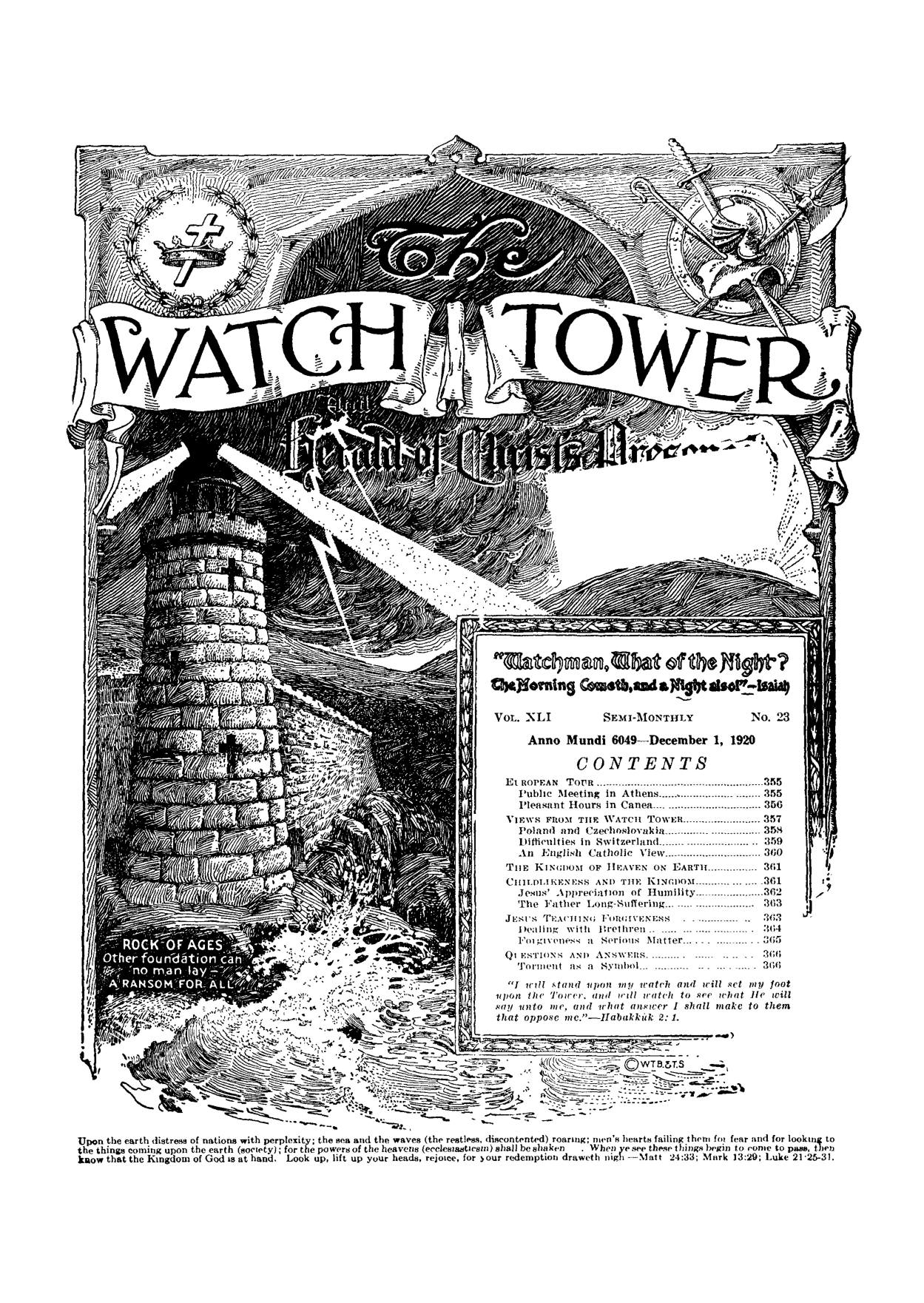
I will stand upon my watch and will set
and will watch to see what
Dealing with Brethren...........
Foigiveness a Serious Matter....
Qt estions and Answers.............
No. 23
my foot tie will to them
. . 366
.. . 366
Upon the earth distress of nations with perplexity; the sea and the waves (the restless, discontented) roaring; num’s hearts failing them foi fear and for looking to the things coming upon the earth (society); for the powers of the heavens (ecclesiasticem) shall be shaken . When ve see these things begin to rome to pass, then know that the Kingdom of God is at hand. Look up, lift up your heads, rejoice, for >our redemption draweth nigh —Matt 24:33; Mark 13:29; Luke 21 -25-31.
"Wldjmro, Wat
Vol. XLI
Anno
ElROPEAN
Semi-Monthly
Mundi 6049—December 1, 1920
CONTENTS
Tour....................................
J
Public Meeting in Athens......-..........
Pleasant Hours in Canea.................
Views from the Watch Tower.........
Poland and Czechoslovakia..............
Difficulties in Switzerland...............
An English Catholic View..............
The Kingdom of Heaven on Earth.
Childlikeness and the Kingdom.....
Jesus’ Appreciation of Humility.....
The Father Long-Suffering.............
upon the
say unto me, and what answer I shall make that oppose mc.>>—Ilabakkuk 2:1.
©WT8.5T.S
.355 355
. 356
359 . 360
361 .361 .362
THIS JOURNAL AND ITS SACRED MISSION
THIS journal 18 one of the prime factors or instruments in the system of Bible instruction, or “Seminary Extension”, now being presented in all parts of the civilized world by the Watch Tower Bible & Tract Society, chartered A. D. 1884, “For the Promotion of Christian Knowledge”. It not only serves as a class room where Bible students may meet in the study of the divine Word but also as a channel of communication through which they may be reached with announcements of the Society’s conventions and of the coming of its traveling representatives, styled “Pilgrims", and refreshed with reports of its conventions.
Our "Berean Lessons" are topical rehearsals or reviews of our Society’s published Studies most entertainingly arranged, and very helpful to all who would merit the only honorary degree which the Society accords, viz., Verbi Dei Minister (V. D. M.), which translated into English is Minister of God’s Word. Our treatment of the International Sunday School Lessons is specially for the older Bible students and teachers. By some this feature is considered indispensable.
This journal stands firmly for the defense of the only true foundation of the Christian’s hope now being so generally repudiated —redemption through the precious blood of “the man Christ Jesus, who gave himself a ransom [a corresponding price, a substitute] for all”. (1 Peter 1:19; 1 Timothy 2:6) Building up on this sure foundation the gold, silver and precious stones (1 Corinthians 3: Ills ; 2 Peter 1:5-11) of the Word of God, its further mission is to “make all see what Is the fellowship of the mystery which. . .has been hid in God, ... to the intent that now might be made known by the church the manifold wisdom of God”—“which in other ages was not made known unto the sons of men as it is now revealed”.—Ephesians 3:5-9,10.
It stands free from all parties, sects and creeds of men, while It seeks more and more to bring its every utterance into fullest subjection to the will of God in Christ, as expressed in the holy Scriptures. It is thus free to declare boldly whatsoever the Lord hath spoken—according to the divine wisdom granted unto us to understand his utterances. Its attitude Is not dogmatic, but.confident; for we know whereof we affirm, treading with Implicit faith upon the sure promises of God. It is held as a trust, to be used only in his service; hence our decisions relative to what may and what may not appear in its columns must be according to our judgment of his good pleasure, the teaching of his Word, for the upbuilding of his people in grace and knowledge. And we not only invite but urge our readers to prove all its utterances by the infallible Word to which reference is constantly made to facilitate such testing.
TO US THE SCRIPTURES CLEARLY TEACH
That the church is “the temple of the living God”, peculiarly "his workmanship”; that its construction has been in progress throughout the gospel age—ever since Christ became the world’s Redeemer and the Chief Corner Stone of his temple, through which, when finished, God’s blessing shall come “to all people”, and they find access to him.—1 Corinthians 3:16, 17; Ephesians 2:20-22; Genesis 28:14; Galatians 3 : 29.
That meantime the chiseling, shaping, and polishing of consecrated believers In Christ’s atonement for sin, progresses; and when the last of these “living stones”, “elect and precious,” shall have been made ready, the great Master Workman will bring all together in the first resurrection ; and the temple shall be filled with his glory, and be the meeting place between God and men throughout the Millennium.—Revelation 15 : 5-8.
That the basis of hope, for the church and the world, lies in the fact that “Jesus Christ, by the grace of God, tasted death for every man,” “a ransom for all,” and will be “the true light which lighteth every man that cometh into the world", “in due time”.—■ Hebrews 2:9; John 1: 9 ; 1 Timothy 2:5, 6.
That the hope of the church is that she may be like her Lord, “see him as he is,” be “partakers of the divine nature’,’ and share his glory as his joint-heir.—1 John 3:2; John 17:24; Romans 8:17; 2 Peter 1:4.
That the present mission of the church is the perfecting of the saints for the future work of service: to develop in herself every grace; to be God’s witness to the world ; and to prepare to be kings and priests in the next age.—Ephesians 4:12; Matthew 24; 14 : Revelation 1: 6 ; 20 : 6.
That the hope for the world lies in the blessings of knowledge and opportunity to be brought to all by Christ’s Millennial kingdom, the restitution of all that was lost tn Adam, to all the willing and obedient, at the hands of their Redeemer and his glorified church, when all the wilfully wicked will be destroyed.—Acts 3:19-23; Isaiah 35.
Published By
WATCH TOWER. BIBLE & TRACT SOCIETY
124 COLUMBIA HEIGHTS a a BROOKLYN. NY, USA'
Foreign Offices : British: 34 Craven Terrace, Lancaster Gate, London W. 2 ; Australasian: 495 Collins St., Melbourne, Australia; South African: 123 Plein St., Cape Town, South Africa.
Please Address the Society in Every Cash.
ANNUAL SUBSCRIPTION PRICE $1.00 IN ADVANCE CANADIAN AND FOREIGN SUBSCRIPTION PRICE $1.50 SEND MONEY BY EXPRESS OB POSTAL ORDER, OR BY BANK DRAFT FROM FOREIGN COUNTRIES BY INTERNATIONAL POSTAL ORDERS ONLY (Foreign translations of this journal appear in several languages)
Editorial Committee: This journal Is published under the supervision of an editorial committee, at least three of whom have read and approved as truth each and every article appearing in these columns. The names of the editorial committee are: J. F. Rutherford, W. E. Van Amburgh, F. H. Robison, G. H. Fisher, W. E. Page.
Terms to the Lord*» Poor: AD Bible students who, by reason of old age or other infir r.ity or a! versify, are unable to pay for this journal, will be supplied free if they send • postal card each May stating their case and requesting such provision. We are not willing, but anxious, that all such be on our list continually and in touch with the Berean stacics. __________________________________
Nnt iaa ia Suhiwrihm • We do not, as a role, sends eard of acknowledgment for a renewal or notice to ouoocnoerea 1nT s newsubacription. Receipt and entry oFrenewa} are indicated within a month by change in expiration date, aa anown on wrapper label.
Entered ac Second Claaa Matter at Brooklyn, N. Y., Poetoffioe under the Act of March 8rd, 1879.
1921 ART CALENDAR
WITH COLORED COVER AND DAILY TEXTS
These daily text, art calendars are very desirable for those who prefer large date figures. There are twelve sheets, or inside pages, each x 16| inches. At the head of each of these monthly sheets is a reproduction of some appropriate painting illustrative of Bible events. These inside views are printed in a special double-tone photographic sepia, and embordered with an attractive but modest design. The calendar part occupies two-thirds of the page; under each date is a Scripture text.
The cover is symbolic of the parable of “The Ninety and Nine”, and is a reproduction in four colors of A. U. Soord’s famous painting “The Lost Sheep”.
Immediate delivery can be made on these wall calendars. The price is 25c each, carriage prepaid, for single copies; 20c each, in lots of five.
STUDIES IN THE SCRIPTURES
These Studies are recommended to students as veritable Bible keys, discussing topically every vital doctrine of the Bible. More than eleven million copies are in circulation, in nineteen languages. Two sizes are issued (in English only) : the regular maroon cloth, gold stamped edition on dull finish paper (size 5"x7g"), and the maroon cloth pocket edition on thin paper (size 4"x6g") ; both sizes are printed from the same plates, the difference being in the margins ; both sizes are provided with an appendix of catechistic questions for convenient class use. Both editions uniform in price.
Series I, “The Divine Plan of the Ages,” giving outline of the divine plan revealed in the Bible, relating to man’s redemption and restitution: 350 pages, plus indexes and appendixes, 75c. Magazine edition 20c. Also procurable in Arabic, Armenian, Dano-Norwegian, Finnish, French, German, Greek, Hollandish, Hungarian, Italian, Polish, Roumanian, Slovak, Spanish, Swedish, and Ukrainian; regular cloth style, price uniform with English.
Series II, “The Time is at Hand,” treats of the manner and time of the Lord’s second coming, considering the Bible testimony on this subject: 333 pages, 75r. Obtainable in Dano-Norwegian, Finnish, German, Polish, and Swedish.
Series III, “Thy Kingdom Come” considers prophecies which mark events connected with ‘ the time of the end”, the glorification of the church and the establishment of the Millennial kingdom; it also contains a chapter on the Great Pyramid of Egypt, showing its corroboration of certain Bible teachings : 380 pages, 75c. Furnished also in Dano-Norwegian, Finnish, German, Polish, and Swedish.
Scries IV, “The Battle of Armageddon,” shows that the dissolution of the present order of things i> in process and that ad of the human panaceas offered are valueless to avert the end predicted in the Bible. It contains a special and extended treatise on our Lord’s great prophecy of Matthew 24 and also that of Zechariah 14:1 - 9 : (156 pages, 85c. Also in Dano-Norwegian, Finnish, Greek, German, and Swedish.
Series V, “The Atonement Between God and Man,” treats an all important subject, the center around which all features of divine grace revolve. This topic deserves the most careful consideration on the part of all true Christians: 618 pages, 85c. Procurable likewise in Dano-Norwegian, Finnish, German, Greek, and Swedish.
Series VI, “The New Creation,” deals with the creative week (Genesis 1, 2), and with the church, God’s new creation. It examines the personnel, organization, rites, ceremonies, obligations, and hopes appertaining to those called and accepted as members of the body of Christ: 730 pages, 85c. Supplied also in Dano-Norweglan, Finnish, German, and Swedish.
Series NII,‘“The Finished Mystery,” consists of a verse-by-verse explanation of the Bible books of Revelation, Song of Solomon, and Ezekiel: 608 pages, illustrated, $1.00 in cloth, 20c in magazine edition—latter treats Revelation and Ezekiel only.
Vol. xi.i.
DECEMBER 1. 1920
No. 23
EUROPEAN TOUR
| CONTINUED]
ON TUESDAY. September 28, about 11: 30 a. m., the Simplon-Orient Express, alter a long and tedious journey, pulled into the station at A then.-,. There we were met by a number of Greek biethren. Some of these had come many miles from other towns and had been waiting for three days, having received no word concerning the delay of our train. Meetings had been arranged for the preceding Sunday and. of course, these were not held. After some rest at our hotel, the party visited Mars Hill, which holds great interest for all Christians, because St. Paul taught upon that place centuries ago. A number of people being gathered on Mars Hill, Brother Rutherford was invited io address them. The occasion was a very solemn one n. memory of the great Apostle Paul. Brother Rutherford spoke at some length to those assembled, using the text of Acts 17 : 31, and in summing up said :
“Yesterday as 1 stood amid the crumbling tombs of tin' Athenian philosophers and looked away at the ruins of the once glorious Parthenon, the words of St. Paul wore vividly recalled. Nineteen centuries ago, upon the vcrv spot where 1 now stand, St. Paul taught these heathen philosophers that there is one God. who created the first man, from whom men of all nations sprang; that he made man to dwell upon the earth forever and appointed a time for such habitation; that the death and resurrection of Christ Jesus provided redemption of all from death, which came upon all because of sin; that the appointed time of this opportunity for life everlasting is during the reign of Christ; that the resurrection of Jesus guarantees thi- opport unity to .all men. And row I declare unto you that the appointed time of Christ’s reign is at hand, and that millions now living on earth will never die. The philosophers who were here taught, to whose memory yonder decaying monument was erected, and whose bones mingle with the dust of that cemetery, shall be awakened and live again. ‘All that are in the graves shall hear his voice ami come forth’ for such opportunity.”
VARIOUS ATHENIAN ANTIQUITIES
Mars Hill was a noted place in ancient Athens. It was in fact an open forum on one part, and on another part the law courts were held and certain cases tried. The place is marked on the rock where the chair of the distinguished Dionysius sat; and it was near the same spot that St. Raul stood when delivering his memorable address to the Athenian philosophers.
On the hill to the south and overlooking Mars Hill ■is built a monument to the memory of these philosophers. which is now crumbling because of age. Further down the same hill chambers have been cut out of the solid rock, which give every evidence of being many centuries old. They were used at one time as prisons. In one of these chambers Socrates spent two years. At that time the Athenians had many gods which they worshipped. Socrates taught that there is but one true God; and Irecause of this he was considered a dangerous man. upsetting the doctrines of the Athenians. He was tru'd and condemned to die and did die a martyr’s death because he believed and taught that there is but one God.
Years afterward heathen philosophers, who had erected a monument to “the unknown god”, hearing what St. Paul was teaching in Athens, invited him to Mars Hill to speak to them and that was the occasion of his declaring unto them the true God. An old cemetery lies just west of Mars Hill, which has been excavated in recent years; and from inscriptions upon the monument.-, found this was the burial place of the Athenian philosophers. It was interesting to visit these tombs and have in mind that God’s appointed time for the resurrection of the dead, of which St. Paul taught, is near at hand, and that ere long, by His grace, these Athenian philosophers, together with others of earth’s million--, will be awakened out of death to learn the true doctrine of salvation; and accepting and obeying it, shall be restored to perfect humanity.
PUBLIC MEETING IN ATHENS
Thai evening a public meeting wa< held in the same hall in Athens where Brother Russell had spoken. The subject for the occasion was “Millions Now Diving Will Never Die”. When the speaker announced that Socrates and other Athenian philosophers and wise men would be l ack in Athens before many years, several of the people were seemingly startled and sat up and listened with the keenest interest. The meeting was one of unusual interest, although it was not attended by a large number, the hall being small and only a half day’s notice of it having been given. Not a single person left the hall during the meeting and at its conclusion many desired to ask questions, and about half of those present left their names and addresses. The interest was so marked that it was deemed wise to announce another meeting at the same hall for 12 o’clock the next day. This was done; and all those who were able to get away from their work who had attended the night before came io this meeting.
Among those attending both of these meetings was a Captain of the Greek army. He showed an unusual interest at the first meeting, came again to the second, asked many questions, and expressed his delight that the Lord’s plan provided for the blessing of the whole world. He expressed a keen desire to pursue the studies and it is his intention so to do. He came to our hotel to bid us good-bye.
Another gentleman who attended both these meetings is a Judge of one of the courts of Athens. He expressed keen interest at the first meeting, coming the next day and asking many questions. When he bade us good-bye the expression ’ on his face showed that he had been thinking seriously concerning the Lord’s arrangements. We hope these meetings did much good. At least they afforded the opportunity of announcing to some of the peoples of Athens that the Lord’s kingdom is at hand.
Many other points of interest in Athens were visited, among them the Acropolis, upon which was budded the Parthenon, in which was erected the temple to Minerva. The Parthenon was erected shortly after the beginning of the gentile times. It must have been a magnificent structure. The ruins show how massive the building was and upon what a grand scale it was constructed. Its crumbling ruins, however, and its passing glory are suggestive of the passing of the gentile times, to make way for the establishment of the better order of things.
OFF ON THE “SPARTA”
On Thursday afternoon, September 30, a number of the Greek brethren accompanied our party to the boat. The Greeks seem to be a very affectionate people, and when they bade us good-bye they kissed each one, first on one cheek and then on the other. We boarded our ship, a Greek vessel named the Sparta. This vessel, however, does not maintain the reputation of the Greeks for hospitality. It is a small boat of about five hundred tons displacement, overcrowded, with little or no accommodation, and making but slow progress. However, it has afforded some experiences along the way that a faster boat would not have given.
We are glad to report that while in Athens arrangements were made for a wider distribution of the message of the. kingdom, particularly the book entitled “Millions Now Living Will Never Die”. We feel quite sure that it is the Lord’s will that this message should now go to all the nations of Christendom as a final witness before the final end of the present order. Greece is a priest-ridden country, but we believe the people are awakening to the fact that they have been duped and misled by their blind guides. We believe there is a wide field for a witness to the truth here; and by the Lord’s grace we hope to see much more done in the near future in giving testimony to the incoming of Messiah’s kingdom.
It was about 8:30 Thursday evening when our ship left Piraeus, the port of Athens. The moon arose over the mountains behind us, giving a wonderfully beautiful sight of the harbor, the city and the surrounding country. The boat was so crowded that only one of the four cabins had been set aside for our party of six; and by the time we had our baggage piled in it there was little room left. We found it necessary for some to sleep on deck; so we drew lots as to who should take the deck the first night. The three who drew the lots gladly went to the deck, wrapped up in their overcoats and spent the night there. Women and children slept on the deck; men and women slept in the dining room and on the dining table; in fact, every available space on the vessel was occupied. A heavy wind made the sea somewhat choppy and the next morning found a good many of the passengers considerably disturbed. About two o’clock in the afternoon our boat anchored in the harbor of Canea, on the Isle of Crete, and soon there came aboard our Brother Bosdoyannes, who bears all the marks of a true Christian. Gracious in his manner, he extended a very warm and affectionate greeting. Two of our party were quite ill as a result of the toils of the sea. As our ship was to remain in port a few hours, Brother Bosdoyannes invited us to go ashore, which we did; and after having some refreshments and walking about, we learned that the next port was some fifty miles away and that we could take an automobile and drive across the mountains and reach there before the boat arrived. Our party decided to do this in order to get a change of environment.
PLEASANT HOURS IN CANEA
While in the port we had a very pleasant visit with Brother Bosdoyannes, who at one time was an ordained Presbyterian preacher and for some ten years a representative of a British Bible society on the Isle of Crete. During that time he was a very popular man, but after embracing the truth and teaching that with the fervor and zeal befitting a follower of Christ, he incurred, of course, the displeasure of the priestly order. This has only sharpened the interest of others and we find the brother is giving a good witness to the truth. We promised to supply him shortly with some books on “Millions Now Living Will Never Die”, that he may proceed with the witness on this memorable island. We met and conversed with several Greeks, Turks, and Egyptians while in Canea, Brother Bosdoyannes acting as interpreter in most instances. Some of the people were able to speak English.
Brother Bosdoyannes arranged with a young Cretan to drive us in an automobile over the mountain range fifty miles to the next port, Retimo. It was a thrilling and interesting trip. Having in mind the experiences of the previous night, we had provided ourselves with some bed-clothing, which was loaded into the motor car. and our party of six and the driver began the trip about 5:40 p. m. We passed through many old and interesting settlements. As the day faded away and evening came on, the road was lined with native men, women, and children, taking their flocks and herds to their homes. Is was a picturesque and interesting sight. A simple folk they seemed to be, and living about the same as people must have lived more than two thousand years ago.
The driver of our automobile could not speak a word of English; but he proved to be a young man of real character, whom none of our party will ever forget. While riding along in the country one of the front springs of the car broke, making it necessary to proceed slowly until we reached the next village, where he carefully utilized a piece of rope obtained from the native^ to repair the defect. The lights on the car would not work, so he improvised a light by the use of a tallow candle anil an old carriage lamp. After traveling for another half hour into the mountains, the rear axle of the car broke. This happened approximately twenty miles from our destination. Three members of our party si aided out to walk, while the other three remained with the young man while he tried to repair the machine. This seemed to be a forlorn hope and we made signs to him to go with us on foot so that we would not get lost. He shook his head and declined to go. Digging down in his tool box, he found a new axle and after more than an hour’s hard work he succeeded in replacing the worn out part and the car started off once more. We soon overtook the three members of the party who had been walking, much to their delight, as well as our own. The young Cretan would not abandon us, nor would he forego any possible effort to get us to the port, at which we finally arrived shortly before midnight and in ample time to get aboard the Sparta, which was still loading cargo.
DEAR BRETHREN OF CANDIA
The next day our ship cast anchor in the harbor of Candia, Crete, a very ancient city. It is claimed to be more than four thousand years old. We did not know that any brethren were here, but decided to go ashore in order to get some food. As we stepped out of the landing boat we were met by three brethren, who had received word by telegram from Brother Bosdoyannes that we were aboard. These dear brethren entertained us at breakfast and then with them we visited the museum in this city, which is of very great interest. Among other interesting thing.- exhibited there were a number of copper discs used centuries ago for mirrors and are evidently the same kind of "lookingglasses'' referred to in Exodus 38:8 as having been used for making the laver in the court of the Tabernacle. Instruments of copper, tempered to take a keen edge, were al-o here. This art of tempering copper has long since been lo.-t.
There are many beggars in the towns on the Isle of Crete, as well as many poor and deformed people, who will doubtless rejoice greatly when they know that restitution is a surety for them. The peoples of the island seem to be very honest, which will make them ready subjects for restitution blessings. As an illustration of their honesty we cite one of the native customs. A man who keeps a store goes away on errands and leaves his place of business wide open with no one in charge. He places a chair at the entrance on going out and this is a sign to everybody that there is no one in, and no one will enter the store while the chair remains in that position.
The dear brethren in this ancient city showed great appreciation of our visit and fellowship with them. They requested that their names be written in our memoranda books so that we could remember them in prayer while on the journey. Surely these experiences demonstrate that there is no tie that binds together the hearts of men as does the tie of love among those who are in Chri-t Jesus. While they seemed to have little of this world’s goods, they insisted on providing every little comfort that we had while in the town ; and when we parted from them, they expressed their deep regret at not having been able to do more for us and to have more fellowship with us.
VIEWS FROM THE WATCH TOWER
VATICAN efforts are being directed into channels of publicity. A news bureau has been established by the Pontifical See, and such news or items of opinion or information which the Vatican authorities desire to have promulgated in Christendom are handed out through various news channels. The Syracuse Post Slomtanl recently contained an item conveying information to this effect:
“By smrting a regular news bureau, the Vatican has sisloni-hed newspaper men in Koine. The agencies, especially the three big ones representing America. Britain, am! France, get the pick of the new-; eorre-pondents of papers get wlmt is left : all the ‘exclusive’ stall goes to the agencies.
“Of course, Ilie bureau does not work up to the lines of an American's idea of news, and much that is given out with great llouri-h of trumpets to the agency reporters is useless from a news point of view. Nevertheless some plums arrive.
"Another practical proof of the IToly See's desire to keep up with the times is the fact that the Pope lias permitted JIgr. Pucci, who is at the head of the bureau, to accept the reportershiii of the American Catholic news agency, known as the Catholic Press Association. Tins is quite a revolution in Vatican traditions.”
Various Roman Catholic agencies are also quite active in securing the projection of pictures, containing news value, but of particular interest to the Catholic Hierarchy, upon the motion-picture screens of the country. We are not at all sure that this publicity, or “propaganda’’. activity is a sign of great strength on the part of the Vatican. On the other hand, it may quite as plausibly be a sign of conscious weakness. We are reminded of the fact that Jezebel, after she had lost such womanly charms as she once possessed, went to considerable1 effort in painting up her face. She was conscious of the fact that her charms were gone, and she strove by artificial means and by special effort to supply them and to keep up appearances. In the heydav of Rome's power it was not necessary for her to engage m va-t publicity campaigns. She could spend her money and center her endeavors on more tangibly gratifying things.
REPUTED INCREASE IN POLITICAL POWER
In view of the fact that Romanist news is especially directed and that unusual efforts are being made to elicit the cooperation of gifted writers in various parts of Christendom, one must take with a grain of salt the
statements in the public press seemingly favorable to Catholicity. They may not be directly untruthful, but a certain ilorescent glamour is cast over the facts, as would naturally be the case under the circumstances.
A writer in the New York Sun is of the opinion that the political power of the Vatican is on the rise:
"At no time since the papacy was deprived of its temporal power and secular sovereignty, in 1S70, that is to say, some fifty years ago. has it lieen able to boast of so large a diplomatic corps accredited to its court—acknowledgment of the importance of the Holy See as a sovereign power in the political system of the universe.”
After naming over twenty-two countries which have envoys or ambassadors at the Papal Court, this writer expresses the belief that both France and the United States will soon come into line with the rest. The following remarks aie also made:
“For years past the papacy has maintained in Washington a pontifical delegate, but lie is not accredited to the United States Go'ernineni a- a diplomatic representative. The importance ot in- olii<-e tn the eyes of the Holy See may be seen Irani the fact that on the completion of his term of office the papal delegate to this country is elevated to the Sacred College as a Cardinal, in accordance with the custom of recognizing the sen ice* of prelates who have tilled the office of Nuncio, that is to say, of papal ambassador to a first class Power. The non-ofiicial intermediary of the United States at Home is the rector of the American College there. He usually takes charge of the presentation of distinguished Americans to the 1’ontifl. either in private or public audience.”
Great Britain, although a Protestant power, the sovereignty of which is so closely identified with Protestantism that Roman Catholics are still barred from many public offices, has found it advisable to maintain a diplomatic mission at Rome, formally accredited to the Vatican. This, of course, is merely a coup de politique—one of England’s long-headed political moves. This costs Great Britain $126,000 a year, despite the fact that members of her reigning family are forbidden to wed Roman Catholics under the penalty of forfeiture of right of succession to the throne.
FRENCH AND GERMAN RELATIONS
At this writing the question of renewal of diplomatic relations between the Republic of France and the Papal Court is undecided. Much debate has been had on the subject, both for and against. We translate two paragraphs from the Paris Journal, which read as follows: “After having renewed diplomatic relations with Germany for the excellent reason that when war no longer exists one must perforce live in peace, will the French Republic take up again relations with another power, which calls itself the Catholic Church, a relationship which has been interrupted for now fifteen years?”
“Is it reasonable, some sav. that France, who is so directly interested in gaining jieacefu) profit from her victory in the world war. will neglect and feign to ignore a moral power so considerable as that of the Catholic Church? Have we not suffered enough from our lack of representation at Rome? Am we to let our rivals benefit by this source of secret information and especially of formidable influence without having a share m it? The power of the Papacy is a positive fact which it would lie senseless, and at the same time puerile, to lail to take into account.”
The “rivals" mentioned in this paragraph can refer only to Germany and England. While England ha= been regularly gaining such advantages as were to be had
from representation at the Vatican, Germany has now consummated an even closer alliance. A few weeks back diplomatic relations were opened up between Rome and Berlin, as was quite generally reported in the public press. We take the following quotation from the IVestem Watchman, a Catholic journal of St. Louis:
“One of the most important political facts since the war is the new diplomatic relation between Germany and the Holy See, a relationship which could never be obtained under Hohenzollern rule, but which President Ebert and the new Reichstag have seen good to establish.
“The fact is regarded here, even by those most hostile to the Church, as a great victory for the diplomacy of PopeBenedict on the one hand and the new German Government on the other, liecause it shows that both sides have grasped the opporumiiy of the moment. Ebert has now a big asset, because he is sure of the moral support of the Catholic clergy throughout Germany in his fight against Bolshevism ; and the patriotic spirit of the German Catholics, not to mention their iron discipline, is well known to friends and foes. No better weapon, therefore, could Ebert have than this in his mighty task of reconstruction.”
We are not inclined to share the view that this newly established relationship is one of the most important political events since the war. It does not strike us as particularly significant that two drowning men should grasp for one another. It is true that this arrangement places the Catholic clergy in Germany on about the same footing with their fellow priests in Austria, but the standing of Romanist clergymen in Austria is of very doubtful value.
POLAND AND CZECHOSLOVAKIA
In Poland and in other smaller European states varU ous political tactics are being employed by the Romanists. The following extract taken from the Washington Evening Star is illuminative:
“Catholic Poland, it is declared, is the center of the-Vatican’s actions in the east. In return for the Vatican’s jsilitical support of the idea of a greater Poland, Ignace-Paderewsky is said to have promised to try to make Roman Catholicism the sole established religion in Poland. InAustria and Hungary, where many observers agree there is still a strong probability of a popular monarchistic reaction, the Vatican is said to be supporting the debris of the ancient regime.
“In southwestern Europe, including Germany, the Vatican lias seemingly entered upon a movement of the greatest importance, namely, open cooperation not only with Protes-ant Christians and all Christian sects, but even with the •lews, to combat the anti-religious spirit as manifested by the socialist communism. Mgr. Kordstch, Archbishop of Prague, is quoted as having said in a recent conference of Czechoslovak Catholics:
“ ‘As Catholics we will even go so far as to hold out our hand for political action. We will extend our hand e'en to faithful Protestant* who. like us. believe in the divinity of Jesus Christ and the decalogue — these ten commands of God. We will work witli them in politics; we will work io construct states even with lielieving Israelites and even with liberals. I have expounded these principles to the representative of Jesus Christ, to Pope Benedict XV. who ha* absolutely approved them.’
"In pursuance of this new policy it is declared that the Vatican has favored a union of Catholics and Protestants in Germany for Christian’ action."
This is not an unknown tack for the Vatican to take, but under all of the circumstances it is rather an indication of fear, of a willingness to concede a great dea)
rather than lose ail. That there is genuine fear in the hearts of a good many farseeing Catholics is hardly to be denied. The following account of anti-Catholic activities in Home we take also from the Western II atch-
man:
“Celebrations of the ‘Twentieth of September’ on last Monday received additional significance this year from the fact that it was the fiftieth anniversary of the entry of Italian troops into Borne through the ‘Porta Pia’. An attempt was made to give a deliberate antipapal character to the ceremonies. Tiie Giordano Bruno Society held a congress of •free-thinkers’ to which were invited all the Masonic organizations. The program also included one or two minor items of anti-clencal flavor.”
“In view of the presence of two Catholic city councilors, who are now members of the ‘Popular Party’ at the public ceremony at ‘Porta Pia' and the malevolent insinuation on the part of a certain section of the press, the Osserratore Romano published a significant note dissociating the Holy See in the most formal way from these and any other actions of members of the ‘Popular Party’, and gave place in its columns to an authoritative article, showing how in 1870. the Holy See was deprived of its necessary liberty and independence. and how the ‘Law of Guaranties’ did not in any way remedy the wrong tints done, but that the problem remains today as then. Several authoritative communications have appeared lately, repeating in a most explicit way, that the ‘Popular Party' must not lie taken to represent the Vatican's views, the latter having no responsibility for the former's actions, and that, indeed, the party cannot be ussumed to represent all Italian Catholics.”
The seriousness of the anticlerical feeling in Italy is mirrored by the following editorial from the public press:
“The most serious Italian trouble appears to be an outbreak of the most radical element against religion and all that represents it. as shown in the effort to break into churches. There is more danger of trouble, serious and not to be remedied, from that direction, than from any temporary outbreak of ‘Sovietism’ in the factories.”
‘MACHINE GUNS OUR REFUGE*
That the Vatican itself considers the local situation to be dangerous appears from the fact that the picturesque antique halberds of the Swiss Guards of the Vatican, which have long been the object of awe or amusement on the part of tourists, have been exchanged for rifles and machine guns. The Pope evidently means to rely on adequate material defenses. IVe take the following account from a widely published dispatch:
“Armed guards are on duty at the Vatican today. Ball cartridges have been issued to the gendarmes and the Swiss Guards and the officers have been ordered to be on the alert if there are any further industrial riots or if any attempt is made to invade the Vatican premises.
“These precautionary measures were taken as the result of reports that Communists planned to occupy the Lateran Palace, which is the property of the Holy See. These reports were current during the recent occupations of palatial estates liy peasants and homeless workers.
“The official organ of the Vatican. < ixxerratorc Romano. reminds the Italian government that, under the law of guarantees, the government is responsible for the safety of the pojie and of all pontifical property. The newspaper declares that ‘if the crowd is impregnated with Bolshevism it cannot be expected to retrain from invasion of the Vatican premises'.
“Tiie newspaper advises the government 'to take steps if it would avoid a world scandal'."
Religious Rome is not entirely free from danger within her own ranks, if the covert fears expressed by Bishop Gallagher of Detroit are well founded—and we believe they are. Some time back Bishop Gallagher addressed a letter to the clergy and laity of his diocese regarding the Knights of Columbus organization, which was to be read at all the masses. Part of the letter reads:
“We are confronted on all sides with organized Hostility to Christianity and to Government. The rising tide of un-lielief thieatens to engulf the world. The murderous hand of anarchy is raised against all lawful government. Thinking men look into the future and are filled with dreadful apprehensions. But what a sense of security and hope comes over us when we contemplate a society of one million men loyal to God and Country, pledged to stand as an irresistible bulwark, as a tower of strength against the roaring waves ol anarchy that da-h against us from below and the blinding storms ot materialistic infidelity that beat upon us from above.
“Every month sees the birth in our midst of some nefarious league organized to destroy some of the fundamental principles of our constitution and deprive Catholics of their civil and religious rights. They combine together in order more easily io eflect their ignoble designs.”
The Bishop's words are not well calculated to inspire confidence despite certain sanguine remarks. As a boy whistles with a view to creating self-assurance as he enters the grewsome shadows of a wood at night, so the Bishop is striving to reassure himself that all is well. But the following remark conveys the impression that he is by no means sure that all is well:
“We give this approval of the Knights of Columbus on the well-founded supposition that they will maintain in the future the loyal Catholic spirit they have displayed in the late war. They are a creation of the Church and draw their strength and influence from the Catholic body. If they should assume an attitude of antagonism to the divinely constituted authority, their value and usefulness as a Catholic organization would be at an end; they would undermine their own foundation and destroy the reason for their existence.”
Since the writing of that letter a certain attitude of antagonism has developed in the Knights of Columbus against ‘'divinely constituted authority”, that is. against the clergy. No small percentage of the Knights‘of Columbus have become essentially anticlerical. They have tired of priestly domination in respect to affairs political.
DIFFICULTIES IN SWITZERLAND
Die Schildivache, organ of the Young Catholic Party of Switzerland, says in a contributed editorial:
“The war which the intelligent world has declared against the churcli of Christ does not come as a flash of lightning out of a clear sky. It has been lowering for decades. Such a weather sign is the removing of charitable activities from ecclesiastical supervision. Let me explain: There are various ways and means which can be employed in this war-lo-the-deatli against tilings Christian. The usual nay is either by force or by falsehood. But there is no way which is surer of its mark than that of the slow poisoning of the Catholic spirit and of the silent, insidious penetration of error. This method is now the one commonly used. In the employment of this mental gas-and-poison warfai, they are capturing one redoubt after another and taking them aw ay from u-. while apparently leaving our faith untouihed. They have taken from us the school, science, politics, our means of livelihood, art. under the specious claim that those were purely neutral realms of human interest which iiad nothing to do witli religion, so that one could be a good Catholic and still go his own way in these matters. Just one province was left us, after all the others were withdrawn from churchly influence. We still had charity. We could still line our neighbor. It was till rigid for us to pick up the orphan children from the streets, to care for the injured, to nurse the sick, and to support the poor. It was all rigid to build hospitals, poorhouses, and orphanages, after we had been driven out of the schools and city halls.
“Whoever litis eyes to see and ears to hear can perceive that the anti-ecclesiastical offensive is now being directed against our last stronghold. Titis offensive is being conducted by the long-headed, clear-sighted, internationally antagonistic forces of Free Masonry, of liberalism, and of socialism, against church charities. The gospel of love, that for two thousand years was looked upon as the great message of Christ and the church, is now, as Pope Benedict XV expresses It, lauded as the great achievement which the education of our time has brought. Love, the daughter of the church, is not supposed to be Catholic any more.”
But what the Pope fears most immediately is Zionism. The return of the Jews to Palestine as an indication of recurring divine favor, strikes at the very foundation of the Catholic Hierarchy—the thought that Christ’s kingdom is now established and that the Pope is his representative on earth. It is naturally awkward to have signs of the near establishment of Messiah’s real kingdom staring one in the face while claims are still made to being that kingdom. Another quotation from the Syracuse Post Standard describes the trepidation of the Romish See on this point:
“Methodist activities in Italy, which Include the establishing of homes and war orphanages, give the Holy See far less anxiety than the Zionist movement in Palestine, which is the subject of frequent articles and protests in the columns of the Vatican organ, the Osservatore Romano. Pope Benedict desires the patriarch of Jerusalem to start organizing propaganda for the promotion of Catholic interests and faith in the holy city. The Vatican makes no secret of its uneasiness at the Zionist and Protestant activities all through the holy land.
AN ENGLISH CATHOLIC VIEW
From the Glasgow (Scot.) Daily Record and Mail we reprint a digest of an address by Cardinal Bourne, Archbishop of Westminster. In this address the Cardinal expresses no little fear at the rising star of David-Zionism : ■
“The Catholic Church had entered upon a new phase, and in that phase the influence of the English-speaking peoples had received a wide development. None would forget that thrill of triumph which filled all hearts when Jerusalem was freed from the domination of the Turk.
“Mr. Balfour had promised that the British Government would favor the establishment In the Holy Land of a Jewish National Home. This promise, frequently renewed, had now received formal sanction at San Remo.
“The scheme was unique, said Cardinal Bourne, and he could not believe that the statesmen who conceived it realized its immediate, and still less its ultlpiate, consequences.
“The salient fact that a new non-Christian influence was being deliberately set up in that land whence countless generations of Christendom had striven to oust a non-Christlan Power, was so tremendous in its Import that, without the smallest antl-Jewish prejudice, men of every Christian nation were justified in asking the purpose and outcome of such a grave political departure.
“He knew that definite assurances had been given that nothing of political domination would be granted to the new immigrant population, but he knew also that these assurances had completely failed to satisfy either the original occupiers of the Ile-'y I,and or the European Christians uho had made their homes there.
“The resistance of Christian and Moslem to the invasion of Zionism, far from decreasing, tended to become even more acute.
“Zionists disposing of large funds were buying from Palestinians impoverished by the war property which they were almost compelled to sell; for while the Jews could easily obtain loans at low Interest, Christians and Moslems could obtain them only upon terms far too onerous for acceptance.
“There was every danger of the establishment of a Zionist economic and financial domination, which would be no less unacceptable than direct political control.”
“A peculiar liability to make mistakes In things Catholic, Cardinal Bourne continued, was one of the penalties which Britain paid for isolation from the vital elements in continental thought.”
From the New York Times we reproduce the following:
“The Qulrinal and the Vatican have at last found a subject whereon they can sympathize and work together, namely, In the protection of the holy places in Palestine which the rising flood of Zionism threatens to overwhelm or purloin.
“The Carriere d’Italia, semi-official organ of the Vatican, publishes a history on the question, stating that from the Apostolic times until the middle of the sixteenth century the site of the house where the Lord’s supper was instituted has been accepted as authentic, and that Christian worship has been uninterruptedly celebrated there.”
“The King of Italy, as heir to the rights of the sovereigns of Naples, has claimed ‘Cenacolo’ from the International Commission with a view to restoring It to Catholic worship and consigning it to the custody of the Franciscans. Although in April, 1919, the Sultan of Turkey agreed to publish an irade restoring ‘Cenacolo’ to the kings of Italy, It is now said that England refuses to accede to this arrangement from a consideration of the religious interests of the Hebrews and Mohammedans, although the Jewish idea of the sanctuary being the site of David’s tomb has long been proved an unfounded legend and the Mohammedans have shown how little they valued the spot since, in 1898, they ceded the site of the northern part of the Crusades Building to the German Emperor, whereon a grandiose Christian monument was erected.
“The Carriere d’Italia says England can have no reason for this action but a desire to prevent any other influence than her own in Palestine.
“Meanwhile communications from Palestine report a dangerously excited state of feeling on the part of the inhabitants of the country, where the Jews number only one in ten of the population and only the schismatic Greeks side with the Jews.
“The Jews,-however, have possessed themselves of all the public offices, while the English governor of Jerusalem, Herbert Samuel, is both a Jew and a fervent Zionist.”
Altogether we see no reason to envy the position of the Man of the Tiber or of Catholic hierarchical claims in general. They are making strenuous effort to nullify the influence of Zionism, and as a sequel to* their fears a very considerable anti-Jewish campaign has been launched even in this country. All sorts of wild stories have been set afloat, calculated to inflame the popular mind. The same jingoists who were busy sowing the seeds of hate during the time of the world war are now taking up with this pusillanimous stuff. And, what is stranger to relate, some whose minds sqemed to prefer peace have been led into the anti-Semitic propaganda net.
THE KINGDOM OF HEAVEN ON EARTH
- I >i < i.mi'.i K 26 - - Is mmi 25 : 1 - S--
1IIH KINGDOM or HEAVEN ON EARTH A FBUIT10N OF JEHOVAH'S PURPOSES— HU: JIasI'II III! \i IIV1 VCI'XI IX 1UOSE PI UPOSES. "And hl Unit xittith on the throne said: Itehold. / niul.c nil Ihini/i n< n r< latum 21:'>.
LIST issue we indicated our expectation of treating the whole clmpler in which this week's lesson is found; but hick of space makes that impossible at this time.
When, in the Lord's providence we come in our consideration of Isaiah's prophec.v to the group of chapters in winch the twenty-fifth is located we shall endeavor to take up the Chapter more thoroughly than is now possible. This will doubtless be more satisfactory than a cursory examination would be. Just now let us look more particularly at verse 6.
The mountain referred to is Mount Zion, last mentioned in 24 :23. But Mount Zion is the exalted condition on which the glorified members of the body of Christ are represented as standing. (Revelation 14:1) So, then, the word mountain •evidently pictures the kingdom of Christ, the kingdom of Jehovah, the kingdom of heaven. During the thousand .years of that celestial sway over the affairs of earth mankind will be blest with a great feast, a mighty banquet, at whose boards there will be room for all. Jesus will be the Master of Ceremonies and the members of his body, like the disciples of old, will participate in the dispensation of blessings to a needy world—the great company and the ancient worthies acting in their capacities as servants and ministrants.
An important item to be noted is that Jehovah is to do this great work. Man cannot do it for himself. All of man’s efforts have resulted in anything but a feast; rather have his six thousand years of mussing ended in a veritable mess. What is the matter? He 1ms left God out of his schemes aiul device-.; he has not recognized either the Host or the Master ol Ceremonies. Instead of asking to be served with heavenly wisdom and blessings, men have been scrambling over the table each after his own portion or after what he thought lie wanted most, even if it belonged to his neighbor. Six thousand jears of this maudlin debauch have left the tables full of vomit, all that is left of the all-night revelry in sin and selfishness.
Jehovah's feast will be orderlj. it will be perfectly appointed, hut above all it will he wholesome, il will be nourishing. Instead of the lean diet which has been able not for long to support the human mind and body, man is to have rich, upbuilding provender; for we read that Jehovah will open his hand and satisfy the desire of every living thing. (Psalm 145:16) Yes, there will be wine there too. But the most strait-laced prohibitionist will have no ground for finding fault with that wine. This wine Is a symbol of doctrine; for sis wine is a temporary stimulus to the nervous system, so doctrines, heavenly instructions, are a stimulus to the whole life. They not only raise and broaden the sco|>e of vision, but there is a power in them to generate a will to attain. Titis power lies in the fact that they tell us about better things than we have ever known, and the mind is thus made to reach out for them in strong desire. This wine, these doctrines which Jehovah of Hosts will dispense to the people will be on the lees, settled, and refined. Everything that will be taught men then will be free from the dregs of human tradition and from every injurious thing.
CHILDLIKENESS AND THE KINGDOM
--January 2 — Matthew 18:1-14—■—
OlSPt TATIONS AS TO WHO SHOULD BE GREATEST — SIMPLICITY, CHII.DLIKENESS, AND HUMILITY AT A PREMIUM IN THE MASTER'S SIGHT — THE GREAT RESPONSIBILITY FOR STUMBLING-BLOCKS-THE OFFENDING EYE, HAND, AND FOOT—THE HUMBLE SHEEP.
“Whosoever therefore shall humble himself as this little child, the same is the greatest in the kingdom of heaven."— Matthew 18:4.
IT WAS apparently after the journey back from the Mount of Transfiguration to Capernaum that the discourse of this lesson occurred. Comparing the accounts as given by Mark and Luke, we gather that the apostles on the way had a discussion respecting who of their number were the greatest, and who would be the greatest or most honored in the kingdom which the Lord had promised and in which they hoped to share. This discussion quite probably was instigated by the fact that only three of their number had been especially favored by being with the Lord in the mount. The discussion between them, although carried on probably in subdued tones, not intended for the ears of Jesus, had become animated as the various sides and claims were advocated. It was a little later that our Lord inquired of them what had been the subject of their earnest and animated converse as they followed him in the way. According to Luke's account they were reticient, not liking to answer his question and to tell of their dispute, no doubt feeling rather ashamed of it. But. realizing that they could not hide the matter from the Lord, and some of them evidently anxious to have Ids decisive word on the subject, they asked him to setlie the question for them.
A LITTLE CHILD IN HIS ARMS
Our Lord desired just such an opportunity for presenting to his faithful ones a needed lesson along this line; and according to his usual custom he illustrated it. Calling a little child and seating it in the midst, he made the astounding declaration that only such as would become childlike could enter the kingdom at all. Mark adds the beautiful touch that the Savior took the little child in his arms. (Mark !): 36) As natural men, and most of them rather unlearned, the disciples had no doubt been aiming as far as possible from childlike simplicity, and striving rather to assume the dignity of mind and of bearing which would suggest itself to the natural man as being appropriate to those who hoped soon to share regal honors in the kingdom of God. What astonishment it must have caused them to learn that the Lord was looking rather for simplicity, meekness, teachableness, childlikeness, than for astuteness, wisdom. dignity, etc I
Yel, our Lord’s words were not merely a condemnation of the spirit which they had been cultivating, but a lesson of instruction regarding a change in this respect; his words intimating not merely the possibility, but the necessity of a change of course on the part of those who desired a share in his kingdom. If. instead of reading our Lord’s words as in the Common Version, “Except ye be converted,” we read I hem as in the Revised Version, “Except ye turn,” more will gel the true thought our Lord wished his followers to learn, Ilie word convert having lost its primary meaning to the minds ot many, by reason of its misuse. The disciples were to turn their ideas on the subject, and study and practice lessons in Ilie opposite direction—lessons of meekness, of humility, of childlikeness: and our Lord’s declaration that those who attain to the greatest development in meekness and simplicity of heart will be greatest in the kingdom, implies that those who strive sifter simplicity and meekness will be granted a share in the kingdom, but that none who are self-seeking and boastful will have part or lot in this matter.
Having thus defined the humble-minded and unostenta-
tious among his followers as those upon whom he would bestow the highest honors and dignities of the kingdom, Jesus proceeded to give a general lesson respecting such “little ones” of his followers, saying, that all who receive such humble disciples in his name will be reckoned as having received him, and whosoever stumbles or Injures one of these humble or “little ones” will thereby commit a crime so serious that it would be better for him to have lost-his life—better that a mill-stone were fastened to his neck and he be cast into the sea, and thus till hope of saving his life effectually destroyed—better that this great calamity should come upon one thun he should do an injury to one of the Lord's “little ones”—one of the humblest of the disciples, childlike, meek, following in the way of the Lord.
JESUS’ APPRECIATION OF HUMILITY
As we thus see how great a value the Lord places upon humility it should encourage till true disciples to cultivate tills finality daily, that tints they might grow more and more guileless, honest, truly humble, and in the sight of the great King become more and more great, more ami more fit for the high exaltation of the kingdom to come. Seeing that without meekness none can enter into this kingdom, we need not wonder that the Scriptures everywhere exhort the Lord's people to humility : "Humble yourselves therefore under the mighty hand of God |now|, that he may exalt you in due time." in tile kingdom. (1 Peter .■>:(>) Yet. notwithstanding all these exhortations of the Scriptures ,he perversity of liunmn nature seems to be such that those who become the Lord's people and who engage to run in this way seem to find more trouble, more to contend against, in this matter than in any other. And some who feel themselves to be little enough seem very anxious that others of the brethren shall esteem them very highly. Would to God that, all of the Lord's dear people, and especially all who seem to be leaders, and who have some natural qualifications for leading and helpfulness in the church would study well this lesson, and learn from it how to advance themselves in the Lord's favor, and how to be truly great according to bis standard, which alone shall prevail.
The word rendered “offend” in verse G tmd onward would be better rendered “stumbled”, the thought being that of placing a stumbling-block in the path. The Lord intimates most distinctly that there will lie plenty of such stumblingblocks in the way of those who are truly his. and that, too, in proportion as they are “little”, humble. He declares it necessary that these difficulties, these trials, these “offenses” shall come. It is necessary because it is the divine will that all the elect, church shall be tested and developed in character, that thus they may become strong characters, copies of God’s dear Son, willing to suffer the loss of earthly things for the truth’s sake, and that gladly, joyfully, that thereby they might please the Father which is in heaven, thus developing humility’ and obedience, that bye and bye they’ may be ready for the exaltation which lie has promised to those only who faithfully’ follow in the footsteps of Jesus.
…