The Watchtower, September 15, 1920
Download: PDF — The Watchtower, September 15, 1920
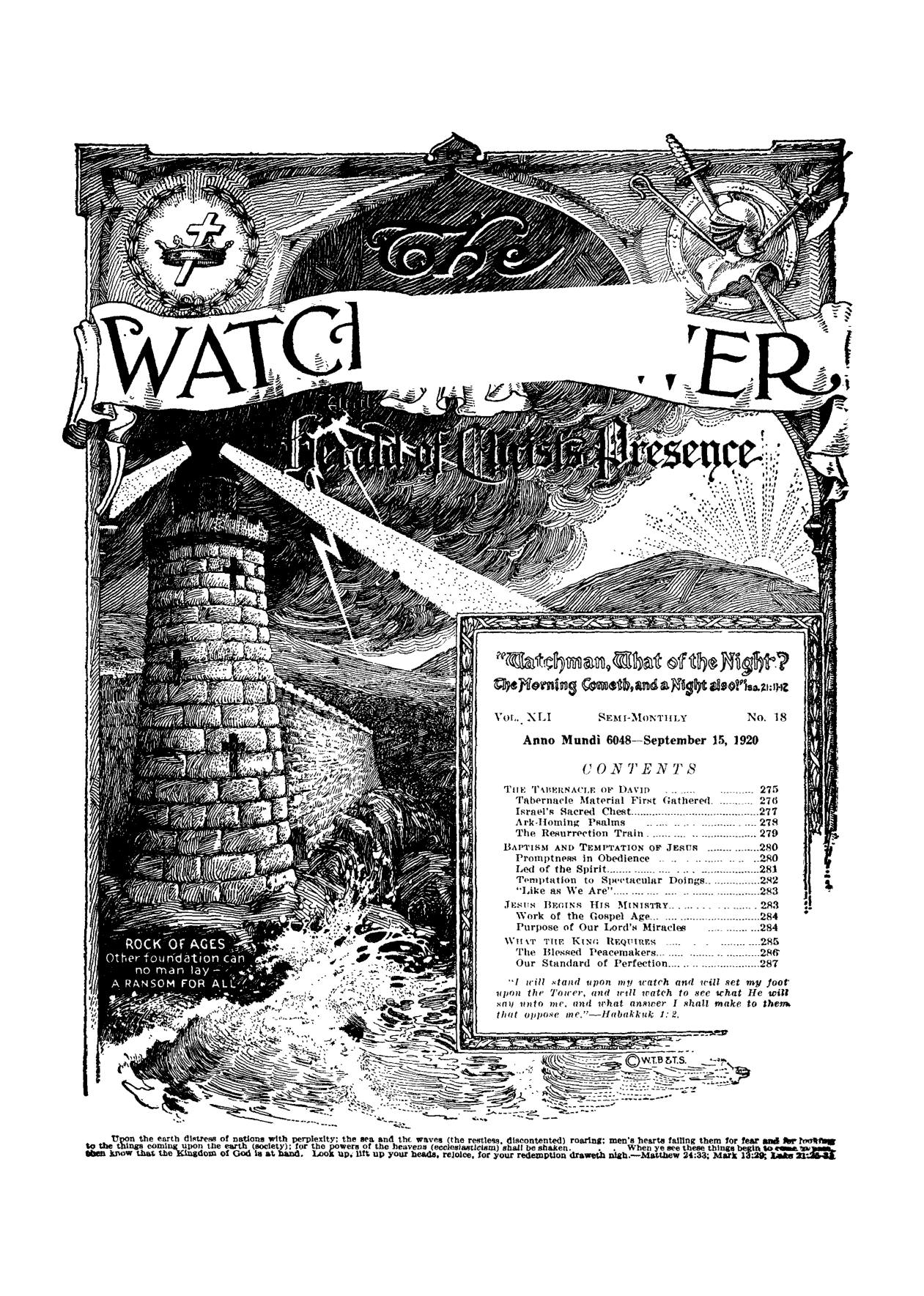
No. 18
'Sswe^anda^Bjtalls^’UziiiHJ
Semi-Monthly
Anno Mundi 6048—September 15, 1920
C0NTENT 8
The Tabernacle of Davip . .. ..... Tabernacle Material First Gathered. Israel’s Sacred Chest............................
Ark-Homing Psalms ...............
The Resurrection Train.................
Baptism and Temptation of Jesus ... Promptness in Obedience ..........
Led of the Spirit...........................
Temptation to Spectacular Doings..
“Like as We Are”..........................
Jesus Begins His Ministry.........
Work of the Gospel Age..................
Purpose of Our Lord’s Miracles .. nvr the King Requires .......
The Blessed Peacemakers................
Our Standard of Perfection............
..... 275
.... 276
......277
.....278
......279
.......280
.. ..280
.......281
.......282
.......283
.....283
.......284
......284
......285
.......280
.......287
"I will stand upon my watch and will set my foot' upon the Tower, and will watch to see what He will sat/ unto me. and what answer I shall make to then* that oppose me.”—Habakkuk 1:2.
.. S*?! P.cn>!<?*lW the aea and the waves (the restless. discontented) roaring: men's hearts falling them for fear and *rfoo<tr»w
to the things coming tn>on the earth (society), tor the powers of the heavens (ecclesiastleism) shall be shaken. . . When ye see these things begin to been know that the Kingdom ox God is at hand. Look up. lilt up your beads, rejoice, for your redemption draweth p<gh -—Matthew 24:33; Mark 13:29; Late
____ THIS JOURNAL AND ITS SACRED MISSION
■IU11B joemal is one of the prime factors or Instruments In the system of Bible instruction, or “Seminary Extension”, now being J. presented ,jn all parts of the civilized world by the Watch Tower Bible & Tract Society, chartered A. D. 1884, “For the Pro-■BsOon of Christian Knowledge”. It not only serves as a class room where Bible students may meet in the study of the divine Word but alas as a channel of communication through which they may be reached with announcements of the Society’s conventions and of the coming of Its traveling representatives, styled “Pilgrims”, and refreshed with reports of its conventions.
Our “Berean Lessons” are topical rehearsals or reviews of our Society’s published Studies most entertainingly arranged, and very Mpful to all who would merit the only honorary degree which the Society accords, viz., Verbi Dei Minister (V. D. M.), which translated
ISiRlish is Minister of God’s Word. Our treatment of the International Sunday School Lessons is specially for the older Bible ■talents and teachers. By some this feature is considered Indispensable.
This journal stands firmly for the defense of the only true foundation of the Christian’s hope now being so generally repudiated —redemption through the precious blood of “the man Christ Jesus, who gave himself a ransom [a corresponding price, a substitu >e] for all”. (1 Peter 1:19; 1 Timothy 2 : 6) Building up on this sure foundation the gold, silver and precious stones (1 Corinthians 3: 11M; 2 Peter 1:5-11) of the Word of God, its further mission Is to “make all see what is the fellowship of the mystery which. . .has teen bid in God, ... to the Intent that now might be made known by the church the manifold wisdom of God”—“which in other ages was not made known unto the sons of men as it is now revealed”.—Ephesians 3: 5-9,10.
_ It stands free from all parties, sects and creeds of men. while it seeks more and more to bring its every utterance into fullest ■objection to the will of God in Christ, as expressed in the holy Scriplures. It is thus free to declare boldly whatsoever the Lord bath spoken—according to the divine wisdom granted unto us to understand his utterances. Its attitude is not dogmatic, but confident; for we know whereof we affirm, treading with implicit faith upon the sure promises of God. It is held as a trust, to be used only in his -service; hence our decisions relative to what may and what may not appear in its columns must be according to our judgment of his bood pleasure, the teaching of his Word, for the upbuilding of his people in grace and knowledge. And we not only invite but urge our readers to prove all its utterances by the infallible Word to which reference is constantly made to facilitate such testing.
TO US THE SCRIPTURES CLEARLY TEACH
■baL the church is “the temple of the living God”, peculiarly “his workmanship”; that its construction has been in progress throughout the gospel age—ever since Christ became the world’s Redeemer and the Chief Corner Stone of his temple, through which, when finished, God’s blessing shall come "to all people”, and they find access to him.—1 Corinthians 3:16, 17 ; Ephesians 2:20-22; Genesis 28 :14 ; Galatians 3 : 29.
•tat meantime the chiseling, shaping, and polishing of consecrated believers in Christ’s atonement for sin, progresses; and when the last of these “living stones”, “elect and precious,” shall have been made ready, the great Master Workman will bring all together fa the first resurrection; and the temple shall be filled with his glory, and be the meeting place between God and men throughout the Millennium.—Revelation 15 : 5-8.
•tat the basis of hope, for the church and the world, lies in the fact that “Jesus Christ, by the grace of God, tasted death for every man,” “a ransom for all,” and will be “the true light which lighteth every man that cometh into the world", “in due time”.— Hebrews 2:9; John 1: 9; 1 Timothy 2:5, 6.
•tat Hie hope of the church is that she may be like her Lord, “see him as he is,” be “partakers of the divine nature’,' and share his (lory as his joint-heir.—1 John 3 :2 ; John 17 : 24 ; Romans 8 :17 ; 2 Peter 1: 4.
•tat the present mission of the church is the perfecting of the saints for the future work of service: to develop in herself every grace; to be God’s witness to the world; and to prepare to be kings and priests In the next age.—Ephesians 4:12; Matthew 24: 14; Revelation 1:6; 20: 6.
•bat the hope for the world lies in the blessings of knowledge and opportunity to be brought to all by Christ’s Millennial kingdom, the reotitauon of all that was lost in Adam, to all the willing and obedient, i the hands of their Redeemer and his glorified church, when all the wilfully wicked will be destroyed.—Acts 3:19-23 ; Isaiah 35.
pUBLlSHE.0 By
WATCH TOWER. BIBLE & TRACT SOCIETY fMOOLUMBIA HEIQHTS a o BROOKLYN, NY U S A jlnssiui Offices : British: 34 Craven Terrace, Lancaster Gate, tjeaton W. 2 ; Australasian: 495 Collins St., Melbourne, Australia; Heat* African: 123 Plein St., Cape Town, South Africa.
Please Address the Society in Every Case,
ANNUAL SUBSCRIPTION PRICE $1.00 IN ADVANCE CANADIAN AND FOREIGN SUBSCRIPTION PRICE $1.50 SEND MONEY BY EXPRESS OR POSTAL ORDER, OR BY BANK DRAFT araoM foreign countries by international postal orders only (foreign translations of this journal appear in several languages)
•IWorfnf Committee: This journal is published under the supervision of an editorial committee, at least three of whom have read and approved as truth each and every article appearing in these columns. 'Ine names of the editorial committee are: J. F. Rutherford, W. BL Van Amburoh, F. H. Robison, G. II. Fisher, W. E. Page.
'Iteamfo the Lord’s Poor: All Bible students who, by reason of old sge or other in-Andm or adversity, are unable to pay for this journal, will be supplied free if they send a Baalal card each May stating their case and requesting such provision. We are not aemwflling, but anxious, that all such bo on our list continually and in touch with the Henna studies^_____,______________________
SKsHm to Subscribers: % by chance tn expiration date, as shown on wrapper label.
ftSwWas Seconddan Matter at Brooklyn, N. Y., Postoffica ttndsr tha Act of March 8rd, 1879.
ANNUAL MEETING
Agreeable to the terms of the by-laws, annual meeting of the Watch Tower Bible & Tract Society will be held at Pittsburgh, Allegheny County, Pennsylvania, on the 31st day of October, 1920, at ten o'clock in the forenoon, for the purpose of transacting such tartness as may be brought before the meeting. The 31st this year being Sunday, such business matters as may be transacted will be tranaarted on the succeeding day, as the by-laws provide.
The Board of Directors and Officers of the Society having been elected at the last meeting for a term of three years, there will be na election held on the said date, but only such other business ■Batters as may come before the meeting.
W. E. Van Amburgh, Secretary.
_ SAME CUSTOM PREVAILING
Hear Brethren:
Owing to the high cost of living, our class thought it would be egprapi late to make a small donation to each Pilgrim brother as ta serves us, and we would be glad to know if this is in full tarerony and meets with the approval of the Society.
Yanni in Christian love,-------------------, Secretary.
Barer: Our reply to the above and similar inquiries is that the Badeity provides things necessary for the Pilgrim brethren, and it ■a understood by them and the Society that all contributions ■eerteed are to be reported to the Society and credited to the
Hopes” fund,
CONVENTION AT WASHINGTON
Washington, D. C„ October, 8-10. For full information com-OMsierte with A. L. Smith, 126 Tenth St., N. E.» Washington, D. C.
STUDIES IN THE SCRIPTURES
These Studies are recommended to students as veritable Bible keys, discussing topically every vital doctrine of the Bible. More than eleven million copies are in circulation, in nineteen languages. Two sizes are issued (in English only) : the regular maroon cloth, gold stamped edition on dull finish paper (size 5*x7i*), and the maroon cloth pocket edition on thin paper (size 4*x6j*) ; both sizes are printed from the same plates, the difference being in the margins ; both sizes are provided with an appendix of catechietic questions for convenient class use. Both editions uniform in price.
Series I, “The Divine Plan of the Ages,” giving outline of the divine plan revealed in the Bible, relating to man's redemption and restitution: 350 pages, plus indexes and appendixes, 75c. Magazine edition 20c. Also procurable in Arabic, Armenian, Dano-Norwegian, Finnish, French, German, Greek, Hollandish, Hungarian, Italian, Polish, Roumanian, Slovak, Spanish, Swedish, and Ukrainian; regular cloth style, price uniform with English.
Series II, “The Time is at Hand,” treats of the manner and time of the Lord’s second coming, considering the Bible testimony on this subject: 333 pages, 75c. Obtainable in Dano-Norwegian, Finnish, German, Polish and Swedish.
Series III, “Thy Kingdom Come,” considers prophecies which mark events connected with ‘‘the time of the end”, the glorification of the church and the establishment of the Millennial kingdom; it also contains a chapter on the Great Pyramid of Egypt, showing its corroboration of certain Bible teachings : 380 pages, 75c. Furnished also in Dano-Norwegian, Finnish, German, Polish, and Swedish.
Series IV, “The Battle of Armageddon,” shows that the dissolution of the present order of things is in progress, and that all of the human panaceas offered are valueless to avert the end predicted in the Bible. It contains a special and extended treatise on our Lord’s great prophecy of Matthew 24 and also that of Zechariah 14 : 1 - U : 656 pages, 85c. Also in Dano-Norwegian, Finnish, Greek, German, and Swedish.
Series V, “The Atonement Between God and Man,” treats an all important subject, the center around which all features of divine grace revolve. This topic deserves the most careful consideration on the part of all true Christians: 618 pages, 85c. Procurable likewise in Dane-Norwegian, Finnish, German, Greek, and Swedish.
Series VI, “The New Creation,” deals with the creative week (Genesis 1, 2), and with the church, God’s new creation. It examines the personnel, organization, rites, ceremonies, obligations, and hopes appertaining to those called and accepted as members of the body of Christ: 730 pages, 85c. Supplied also in Dano-Norwegian, Finnish, German, and Swedish.
Series VII, “The Finished Mystery,” consists of a verse-by-verse explanation of the Bible books of Revelation, Song of Solomon, and Ezekiel: 608 pages, illustrated, $1.00 in cloth, 20c in magazine edition—latter treats Revelation and Ezekiel only.
Vol. xii Si:i-iembih 15, 1!>2il No. 18
THE TABERNACLE OF DAVID
“/ will build attain the Tabernacle of Daritl, uhicli is fallen down.—Acts 15:16
JAM ICS the Less, the half brother of our Lori], swms to have been prominent in the affairs of the early church in and around Jerusalem. This is implied by St. Peter's words in Acts 12: 17, St. Luke's in Acts .21: 18. and St. Paul's in Galatians 1: 19 and 2: 9. At all events he was the chairman of the conference which was calk'd at Jerusalem to determine, if possible, what was the Lord's will in respect to the Gentile believers in Christ, and the relationship of those believers to the obligations, hopes, and promises of the Mosaic1 law covenant. The Syriac version of this passage is rendered as follows:
“Simon lint!) related to you, how God hath begun to elect a people for lii< name from among the Gentiles. And with this the words of the prophets agree, as it is written:
after these things i will return, (Jeremiah 12: 15) AND Will. SET UP THE TABERNACLE OF DAVID, THAT HAD kali ex ; (Amos 9:11, 12)
AMI WILL 111 ILD THAT WHICH WAS IN 111 INS IN IT, ANU WILL RAISE IT UR:
SO THAT T1IK K1IS1I11E OF MEN MAY SEEK THE LORD ANTI ALL THE NATIONS UPON WHOM MY NAME IS CALLED," BAI’Ul THE l.OKU WHO IIOETH ALL THESE THINGS.
Known, from of old. are the works of God. (Isaiah 45:21) Therefore I say to you. let them not crush those who from among the Gentiles Imre turned unto God.”
It. is not astonishing that the early Jewish believers found it difficult to understand how God would deal intimately with the Gentiles, when he had so carefully instructed them that they only were his chosen people. (Amos 3:2) The explanation lay in the fact that Jehovah had terminated his period of special favor to the Jews three and one-half years after the cross—at the conversion of Cornelius, the first Gentile to be admitted into the privileges of the gospel dispensation. This explanation was only gradually working its way into the consciousness of the early Christians of Jewish extraction, and this conference was one of the means used by the Lord for the clarifying of the problem. The first connected remarks on the occasion seem to have been made by the Apostle Peter. These were followed by testimonies of actual experiences by Paul and Barnabas. Then it was that James summed up in the language above quoted. The courtesy and decorum observed in this meeting of foundation stones of the mystic temple of Christ is worthy of being noted and emulated. There was no heckling or rude interruptions of the speaker. They all gave silence during the addresses. It was not known in advance whether they would agree with the remarks or not, but they were determined to give each one a courteous hearing.
FAVOR TO THE GENTILES
It was the Apostle Peter who had had the privilege of opening up the kingdom-of-heaxen opportunities to the Gentiles, as he had three and one-half years previously opened these up to the Jews at Pentecost. These two occasions completely fulfilled for him the Master's promise that he should be ‘given the keys of the kingdom of heaven’. (Matthew 16: 19) The heavenly calling, once opened up for both Jew and Gentile, could not be opened any wider. In fact, the time would come, and now soon will come, when those special kingdom honors and privileges--jointheirship with Christ, the. glory of position, the honor of divine fellowship, the immortality of life— are to cud for ever. (Luke 13 : 24, 25) The dispensing of this unusual reward for unusual faithfulness will end when opportunity for displaying extraordinary loyalty and perseverance shall have passed.
On this occasion St. Peter had doubtless recounted, at more length than is recorded in the Acts, the same stoiy he had told the Jerusalem church several years before and which is related in the tenth chapter of the Book of Acts The sturdy Apostle had not forgotten the heavenlv vision, nor the lessons it showed to him : that divine favor in the shape of the gospel was intended to go to the Gentiles, and that Jehovah had indicated his acceptance of the Gentiles by the usual signs and gifts of the spirit. As to just how all this should be linked up with the Mosaic dispensation, Simeon (Simon Peter) was not so clear; for years afterward he was uncertain on some phases of the subject and had to be set right by the Apostle Paul.—Galatians 2:11- 21.
After Peter had told the circumstances surrounding the conversion of Cornelius and the undeniably providential leadings and indications of the divine approval and acceptance of the Gentiles; after Paul and Barnabas had told of Gentiles turning to the gospel ; the spirit of insight into and interpretation of prophecy, which was doubtless a gift possessed by the Apostle James, brought to his mmd the remembrance of certain prophetic statements which corroborated the evidence presented in their conference, namely, that God intended to deal with and to bless some Gentiles.
Had we been there and had we had a sufficient illumination of the Lord’s spirit through his Word our course of thinking would probably have been somewhat like this: This does seem strange; here, we and our fathers have been taught for centuries that only the blood lineage of Abraham stands in the path of divine blessings— yet, here we are confronted with indisputable evidence of Jehovah’s blessings upon and recognition of Gentiles
in this matter of the gospel; and this all dates from the time of the conversion of Cornelius, as Brother Simon has been telling us. Can it be that we have been measurably wrong; have we had overdrawn views of the exclusiveness of the divine favor ? Perhaps so; yes, now that we think of it, there are indications in the prophets that God had in store for the nations some blessings which were worthy of special mention. There, for instance, is God’s first clear pronouncement of the good news to Abraham, in which he said that all nations should be blessed. (Genesis 12: 3; Galatians 3: 8) That certainly looks as though non-Jews would have some blessings. Now I wonder about the time of that blessing. Does Jehovah mean to bless the Gentiles ahead of Israelites ? Oh, no, that can hardly be; for that same promise speaks of the Seed as the means or channel of blessing. Evidently it is to the Jew first. Another phase of this thought seems to be hinted at in the words of the Prophet Jeremiah. He speaks about the Lord returning, or turning his favor again to the people of Jacob. That certainly implies a period of disfavor preceding the return. Then there is the still plainer word of Amos, who, as the fjord’s mouthpiece, spoke quite distinctly of the Gentiles seeking after God. But there, too, it is to the Jew first—first the residue of men (Jews), then even the Gentiles, the heathen or non-consecrated nations. Now is it just possible that this divine o der observed in blessing Israel and the nations is also observed in matters relating to the church of Christ in this gospel age? So it seems; so it seems; for here are Gentiles coming into the church before the time for the general blessings to the world. What can this mean but that the time of Israel’s preferential opportunity for constituting the “Seed” class has gone?—a sad but sublime thought!
Along some such lines the Apostle’s thoughts must have been running during the conference. But they would not run thus except by special illumination on the hitherto declared but not well understood prophecies. It will be noted that James quoted these prophecies, which are manifestly restitutionary in their character—the one in Jeremiah speaking of restitution for the Jews and that in Amos of restitution for both Jew and Gentile— to establish the possibility of membership in the body of Christ on the part of those who had been born Gentiles. The prophecies distinctly establish two facts: (1) that God intended to bless some Gentiles some time; and (2) that that some time would be subsequent to the blessing of the Jews. These prophecies only inferentially establish anything respecting this age; yet the proof was strong enough for those early warriors of faith.
With eighteen centuries of divine dealing with the Gentiles and of “blindness in part” over natural Israel * Romans 11: 25, 26) it does not seem necessary to our minds to establish the possibility of things which are so apparent as to be discernible by every unprejudiced mind. But then it was different. It took more proof to show that God was going to let the Gentiles into the church of Christ than it does now to demonstrate that the times of the Gentiles have ended and that the Jews will be again in the ascendancy.
The Amos quotation is from the Septuagint Version, as practically all of the New Testament quotations from the ancient sacred writings are. It is but natural that the apostles and other New Testament historians writing in the Greek language should make use of the only Greek version of the Old Testament then in use, when they wished to quote passages from the Jewish Bible; but it would not be natural or reasonable to suppose that either St. Luke or St. Paul would use the Septuagint Version when it would not correctly convey the meaning of the original Hebrew writings. In cases like this one and in Hebrews 10:5-7, where the Hebrew and Greek Old Testament passages do not now correspond and where the Septuagint Greek rendering has been incorporated into the sacred New Testament writings and, in the case of Hebrews 10:5-7 (quoted from Psalm 40:6 ff.), forms the very kernel of the argument, our only safe supposition is that the Hebrew and Greek did conform at one time, but that some’ of the Hebrew text has become corrupt since then, though not to the same extent as corruption has befallen the Septuagint. Evidently Jehovah has allowed these loopholes so that the wise ones, the scribes and doctors of the law of Christendom, would slip out into doubt and higher criticism. Those who slip out thus would not be suitable for the kingdom, anyway.
The passage in Amos is manifestly in a harvest setting. The ‘famine for the hearing of the Word of the Lord’ (Amos 8:11) is mentioned; further particulars of the time of trouble upon Christendom (9: 1,4) are given; the scattered condition of the true Israel is foretold; then the reestablishment of David’s Tabernacle, the reestablishment of the Jewish national hopes (later the dominion), is next in order. Thereupon mention is made of the plowman of trouble overtaking the harvest reaper, and the winepress work the sowing of the Millennial hopes of everlasting human life. Both mountains and hills shall be bathed in the juice of the vine of the earth. Israel shall be established in fact; the pristine loveliness of the promised land shall be restored, and its inhabitants shall be happy and blessed, as further described in the parallel passage in Isaiah 65.
TABERNACLE MATERIAL FIRST GATHERED
The expression, the Tabernacle of David, is evidently broad in its signification. Perhaps it would be better to say that various phases of God’s work, inseparably connected with this ultimate Tabernacle, are of such a nature as to spread over the activities of this gospel age, as well as the future. Insofar as the Tabernacle thought applied to the time when the Apostle was quoting £he expression (and he did use it to establish an immediately present question), it must have referred to the gathering-together first of the fragments, pieces, or remnants (Isaiah 1:9 ; 11: 11, etc., etc.) out of fleshly Israel which were worthy to become parts in the spiritual Israel class. As it has applied to the harvest period of this gospel age, it would seem to refer to the reestablishing of Millennial or Messianic hopes in the minds of spiritual Israelite^ the stimulating and thrilling thought that the Lord is here and that it is only a question of a brief space of time until the knowledge of the Lord shall become universal. The material phases of this Messianic hope have also affected the fleshly Israelites with fresh expectation and courage, as shown, in another figure, in Ezekiel's vision of dry bones.
But the real and full application of the prophecy is one, which fits only to the glorious reign of Messiah. When this Tabernacle of David is fully established it will mean that dominion over earth’s affairs which will work for earth’s blessing; as it is written: “And a throne shall he established in loving kindness; and one shall sit thereon in truth, in the tent [tabernacle] of David, judging, and seeking justice, and swift to do righteousness”.—Isaiah 16: 5.
In other words, the present and past centuries of this age have been given over to seeking out and shaping the various structural elements which will soon be used in the “raising”, or glorification, of the heavenly phase of this dominion, and the honoring of its earthly representatives. The Tabernacle itself is the dominion of the earth as exercised by the representative of Jehovah, for David 'sat upon the throne of the Lord’. It is called a Tabernacle, or tent, because, blessed though it will be, it is a temporary arrangement for the exercising of the “first dominion” (Micah 4: 8) “over every living thing that is in the earth” (Genesis 1: 28) by those of a higher plane, merely long enough to bring man back to the point where he himself can be entrusted with that dominion again.
“The Tabernacle of David” is plainly a reference back to the Tabernacle which David built and into which he placed the ark of God. (1 Chronicles 15, 16) The day of the installation of the ark in this Tabernacle was one of the greatest days in David’s history; and so much detail is given concerning the order of procession, so many Psalms were written for use on that occasion, that the whole procedure was evidently intended to be strongly pictorial. Apparently there was nothing distinguished about the Tabernacle itself which David constructed. It must have corresponded in all essential details with the one built in the wilderness according to the hoavenlv pattern showed Moses in the mount. Had there been anything exceptional, it would surely have been mentioned. The ark which was installed in this Tabernacle was the original one built in the old wilderness days. The notable thing therefore must have been the installation of the ark under the particular circumstances and conditions described by the sacred historians.
Many had been the vicissitudes of the ark. After the entrance of the children of Israel into Canaan it resided, appareiit 1 y. in the original Tabernacle or tent, at Shiloh ; for ye read that “the house of God was at Shiloh”. (Judges 18:31) After hundreds of years the ark was unadvised!} taken into battle by the Israelites and captured ii> booty by the Philistines. In seven months the Philistines were glad enough to get rid of it, and the ark found its way in romantic fashion to Beth-shemesh. Through a lack of reverence and through an overweening amount of curiosity the Beth-shemeshites got into serious trouble through the presence of the ark in their fertile lowland fields. Instead of blaming themselves for their disaster, they seem to have thought that perhaps the trouble had been due to the fact that the ark was on low ground and that it should have been taken to some eminence; and they bethought them of the gibeah, or hill, at Kirjath-jearim, close by. A plea to the Kirjath-jearimites resulted in the transfer of the ark to the house of Abinadab, who lived on a considerable rise in the neighborhood of Kirjath-jearim. We are told that the hallowed chest, with its lid of mercy, abode1 there twenty years. About sixty-two years elapsed from the termination of that twenty-year period until the time when David finally placed it in Jerusalem, but the assumption is that, even after the death of Abinadab, it rested in his house; for it was still there when David went for it the first time.—1 Chronicles 13: 7.
Long separation from its proper tabernacle and frpm the order of services connected with that divinely appointed abode, had led to carelessness or ignorance respecting the method of handling the ark. Even David erred by placing it on a cart (agalah, cart, wain, or wagon, not rekeb, which is used for chariot) as the heathen Philistines had done, instead of having it borne by the Kohathites, as Jehovah had enjoined upon Moses. The death of Uzzah brought the illy-planned procession to a halt, and the ark was turned aside and placed in the house of Obed-edom, a Levite of the family of Kohath. After three months watching and considering and searching of the law David determined to proceed with the project before undertaken, but now to be carried out more closely in accordance with the divine precepts.
ISRAEL’S SACRED CHEST
The ark itself, be it remembered, was the central feature of the Mosaic ceremonies and polity genenally. It was the most sacred thing in the midst of the Israelites. It was a moderate-sized, rectangular chest, covered with a golden lid, part of the material of which was worked up into figures of two cherubim with outstretched wings and faces turned somewhat downward toward the lid or mercy seat. Between and above these cherubim was the special presence of Jehovah among his people. This was the throne of God, the real King of Israel (1 Chronicles 16 : 6, It. V., margin), while the ark itself more nearly corresponded to the base or foundation of his throne, which in fact is justice and judgment. (Psalm 89 ; 14; 97 : 2) Even the heathen looked unon the ark as representing Jehovah in a special way;.for when the Philistines heard that the ark was come \ito the camp of the Israelites they “were afraid, for Aiev said, God has come into the camp”. (1 Samuel 4:7) Tin1 ark was therefore the embodiment of Jehovah’s sovereignty in Israel and. indirectly, of Israel’s sovereignty among the1 nations. In harmony with this thought we find that the original ark disappeared from history with tin1 fall and sack of Jerusalem at the overthrow of- Zede-kiali ami the beginning of Gentile Times.
Into tin1 ark Moses was instructed to place the sacred tables of the law (Exodus 25: 16,21), spoken of as the testimony. The account in 1 Kings 8: 9 informs us that at the time of Solomon “there was nothing in the ark save the two tables of stone which Moses put there ar Horeb”. Hebrews 9 : 4 plainly conveys the thought that the ark was also a reliquary for the “pot of manna” and “Aaron’s rod that budded”—these, apparently, being lost during the period of the Judges, possibly during the ark’s sojourn in Philistia. Evidently the tables of the law were intended to constitute the outstanding feature in such lessons as might attach to the contents of the ark. It is notable that while the prophecy in Amos lays special emphasis on the Tabernacle, the historical account in 1 Chronicles lays most stress on the ark. The installation of the ark is the crowning feature of the establishment of the Tabernacle, without which the Tabernacle would have been no Tabernacle.
The account in 1 Chronicles 15 tells of the order of march observed during the traverse of the eight or nine miles of distance to Jerusalem.
ARK
SHEMINITH
ALAMOTH
First, David himself marched and danced, clad in a special linen robe and linen ephod, or surplice. Next came six groups of members of the house of Levi, of the families of Kohath, Merari, Gershom, Elizaphan, Hebron, and Uzziel. Since “all Israel” was gathered together for this festive occasion (1 Chronicles 15: 3) and since this group of six subdivisions were picked or representative men, it seems reasonable to conclude that these six divisions of Levites stood for the twelve tribes of Israel. We have precedent for the thought that six groups may represent twelve tribes in the parable of our Lord concerning the rich man and Lazarus. There the rich man pictured Judah and Benjamin, while the other ten tribes were represented in the five “brethren” of the suffering and submerged royal two tribes. Again when our Lord sent out his twelve apostles to the “lost sheep of the house of [all] Israel” he sent them in six groups of two each.
Following the Levites came the alamoth, or maidens’ choir; followed in turn by the sheminith, the eighth division in the procession (sheminith means eighth), but the third general group; and the ark itself, accompanied by its doorkeepers and trumpeters.
David, we know, pictured the glorified Jesus, the great Messiah, him who is “David’s Son and David’s Lord”, who shall sit upon the throne of David. (Isaiah 9: 7) The twelve tribes may well picture the twelve mystical tribes of spiritual Israel, under the headship in all things of the future King of Israel. Then come the virgins of the great multitude class, who follow. Next in order of resurrection, the ancient worthies. And then, all the machinery of the kingdom of Christ being present and in working order, the dominion itself shall be exerted, or practically exercised.
ARK-HOMING PSALMS
On examination we find that there were several psalms dedicated to this sublime and gladsome occasion. Some of these were evidently sung in concert; some of them were sung by special groups; and some were sung after the ark was actually set within its sacred cube. Psalms 87 and 132 were evidently sung by the first of these divisions ; and, as there were six subdivisions in that group, so there are six subdivisions to Psalm 87. Bullinger’s translation brings out this fact a little more clearly than the Common Version:
i 1 “His foundation upon the holy mountain doth Jehovah love.
2 “[He loveth] the gates of Zion more than all the dwellings of Jacob.
n 3 "Glorious things of thee are spoken, O thou city of God.
“selah [I. e., that being so, note well what follows]: nt 4 “I will make mention of Egypt and Babylon to them who know me:
“Lo! Phillstla and Tyre, with Ethiopia [say]: This one was born there.
iv 5 “But of Zion it shall be said: Generation after generation was born in her;
“And the Most High himself shall establish her.
v 6 “Jehovah will record when he enrolleth nations: this one was born there.
“selah :
vi 7 “Both they that shout and they that dance [shall say of Zion]:
“All my descendants shall be in thee [O thou city of God].”
In this Psalm the previous dwellings of the ark among the Jewish people are brought into strong contrast with the one to which it was then journeying, in Zion. It was now about to be placed where it would fill out the most colorful part of the picture, which, after all, was but a panoramic representation of the things connected with the enthronement of God’s will as the most sacred and most vital factor in the dominion of the earth.
It was the custom, and is still the custom, for nations to point with pride to their distinguished sons. But Zion shall be the mother of thousands of millions, and every one will be distinguished, every one brought to the fullness of restitution, where he will be a wondrous image of his Maker. Earthly boasts of earthly origin will all pale into nothingness, and every one that receives everlasting life will be truly proud to acknowledge his source of life, his Life-Giver.
The alamoth, or maidens’ choir, sang on that momentous day the Forty-fifth Psalm, the maiden’s psalm. Probably those Hebrew maidens who sang had in mind their noble king, fairer and more gracious than most of the sons of men; one, moreover, who was able to enter into the problems and vexations of the people, from the near-bandit to the members of the supplanted family of the former king. They could well sing of David; for he was the happiest and most active one in all that tuneful train. But the real One concerning whom they sang was unknown to them, fairer, more gracious, more righteous, more victorious, more kingly than even David, the king.
As the maidens’ choir was the seventh division in the line of march, so we find seven divisions in Psalm 45. Dr. Young’s translation reads as follows (the sub-heads being added):
“A SONG OF LOVES
i His Beauty
“My heart hath indited a good thing,
I am telling my works to a king,
My tongue is the pen of a speedy writer.
Thou hast been beautified above the sons of men, Grace hath been poured into thy lips, Therefore hath God blessed thee to the age.
ii His Victory
"Gird thy sword upon the thigh. O mighty,
Thy dory nnd thy mnjesty!
As to thy mnjesty—prosper I—ride
Because of truth, and meekness—righteousness, And thy right hand showeth thee fearful things. Thine arrows are sharp.—peoples fall under thee— In the heart of the enemies of the king.
in His Bight to Rule
“Thy throne. O God, is age-enduring, and for ever,
A scepter of uprightness
Is the scepter of thy kingdom.
Thou hast loved righteousness and hatest wickedness, Therefore God. thy God. hath anointed thee, Oil of joy al>ove thy companions.
Myrrh and aloes, cassia! all thy garments, Out of palaces of ivory
Stringed instruments have made thee glad.
rv His Bride
“Daughters of kings are among thy precious ones,
A queen hath stood at thy right hand.
In pure gold of Ophir.
Hearken. O daughter, and see. incline thine ear. And forget thy jieople. and thy father’s house, And the king doth desire thy beauty. Because he is thy Lord—bow thyself to him, And the daughter of Tyre with a present, The rich of the people do appease thy face.
All glory is the daughter of the king within, f)f gold-embroidered work is her clothing.
In divers colors she is brought to the king, v Her Companions
“Virgins—after her—her companions, Are brought to tliee.
They are brought with jot and gladness, They come into the palace of the king.
vi Their Children
“Instead of thy fathers are thy sons,
Thou dost appoint them lor princes in all the earth, vti Their Renown
"I make mention of thy name in all generations ;
Therefore do peoples praise thee, To the age. and for ever!’’
The same generations are referred to here as mentioned in the Eighty-seventh Psalm—“Generation after generation was born in her’.
To the sheminith. the eighth division, the men’s chorus, were assigned at least two psalms on this occasion. We know this in the same way that we know Psalm 45 to be assigned to the alamoth; the psalms themselves bear the sub-scriptions which indicate their original use. But as heretofore remarked, the subscriptions are. in the Common Version and in most other versions, erroneously placed so as to form part of the superscriptions to the following songs. For instance, over Psalm 46 we now find, in Young’s version, the inscription. “For the Virgins”, though Psalm 46 is evidently not the virgin psalm. It belongs to Psalm 45.
We turn to the two Psalms. 5 and 11, which were ascribed to the sheminith, naturally expecting to find some reference to the great event. We do find such reference, both in the structure and in the words. The structure of both psalms very particularly contrasts the righteous worshippers of Jehovah with the wicked. Very fitting they are to those noble heroes of faith who endured so much and understood so little.
PSaLM 5
i Vss. 1 - 3 Prayer to Jehovah.
n 4 Reason (“For”) : character of Jehovah.
in 5, 6 The wicked, and their wickedness.
iv 7 The righteous worshippers contrasted—“But" v 8 Prayer to Jehovah.
vi 9 Reason (“For”). Character of the wicked.
vti 10 The wicked, and their destruction.
vni 11.12 The righteous worshippers contrasted—“But”
PSALM 11
i 1 Trust in Jehovah, the Defender of the righteous.
ii 2 The wicked. Their violence manifested.
in 3 The righteous tried,
iv 4 Jehovah’s throne in heaven.
v 4 Jehovah’s eyes on earth.
vi J The righteous tried.
i n 5. G The wicked. Their violence revenged, tin 7 Trust in Jehovah, the lover of the righteous.
THE RESURRECTION TRAIN
So it wended its way, that grand cavalcade, over the hills and valleys of Judea, up to Zion, the holy mountain of God. And so is wending its way. through ups and downs though it may be. the grand purpose of the Lord Jehovah respecting the establishment of his kingdom among men. First in the grand resurrection train is our Lord Jesus, who was ‘not possible to be holden of death’. (Acts 2:24) Since his second advent and with thebeginning of the first resurrection he, as David's Lord,, has begun leading a multitude of those held captive in death. The first of these are his body, the twelve times-twelve thousand that shall stand with him upon Mount’ Zion. As it is written: “Thy dead shall live: my [hitherto] dead body shall they arise”.—Isaiah 26:19.
When all the members of the body of Christ shall have passed beyond the vail then, next in order of resurrection, will be the great multitude which come up out of the great tribulation, washing their robes and making them white through the blood of the Lamb. (Revelations 7:14) Then will come the ancient worthies, the visible and working phase of the kingdom on earth. When all’ these elements of the kingdom are ready, the antitypicab ark. God's will as expressed in his law, shall be enthroned as the sole arbiter and as the absolute monarch in the dominion of earth. That will shall be express’ d through-Jehovah’s wise, loving, honored, and trusted Son; for he is worthy, having given himself a ransom for all.
It will be noted that exactly the same order of events as is described in 1 Chronicles 15, 16 is observed in the Forty-fifth Psalm, which contains hidden in its structure the order of the procession bearing up the ark.
When the ark was finally installed in the Tabernacle,, then Psalm 68 was evidently sung as a memorial. ;n addition to the song recorded in 1 Chronicles 16. P.-abn 68 opens with the Mosaic formula for the breaking of camp. Moses, addressing the ark, was accustomed to say: “Rise up, Jehovah, and let thine enemies be scattered, and let them that hate thee flee before thee”.— Numbers 10:35.
The blessings to mankind, as well as the Tabernacle of David, are associated with Mount Zion, and not with Mount Moriah: “Out of Zion shall go forth the law. and the word of the Lord from Jerusalem.” (Isaiah 2:3) Then “the Tabernacle of God [shall be] with men. and he will dwell with them, and they shall be his people, and God himself shall be with them, and be their God”.— Revelation 21:3; Exodus 25: 8.
BAPTISM AND TEMPTATION OF JESUS
--October 10 — Matthew 3:1 — 4:10--
JOHN’S EMINENCE, HIS ODDITIES, HIS MODESTY, AND HIS FAITHFULNESS--HIS BAPTISM OF JESUS UNDER PROTEST--WITNESS
W ANB TO JESUS-THE HEAVENS OPENED-.DB1VEN INTO THE WILDERNESS AND TEMPTED LIKE AS WE ABE.
“This is my beloved Son, in whom I am well pleased."—Matthew 3:17
JOHN the Baptist was the last of the prophets and, as Jesus declares, one of the greatest. To him was committed the honorable service of directly announcing the Savior, who said of him: ‘‘Verily I say unto you, Among them that are born of women there hath not arisen a greater <han John the Baptist: notwithstanding, he that is least In the kingdom of heaven Is greater than he”. (Matthew 11: 11) The last representative of the “house of servants”, he discharged the duties of his office with dignity, declaring Jesus to be the long-promised Messiah-King, who was about to select a bride class to be his joint-heirs In the kingdom. The Prophet recognized that he himself was not eligible to this class, yet rejoiced in his privilege of announcing the Bridegroom, saying, “He that hath the bride is the bridegroom: but the friend of the bridegroom, which standeth and beareth him, rejolceth greatly because of the bridegroom's voice: this my joy therefore is fulfilled”.—John 3:2».
John's mission was to arouse the people of Israel to the fact that Messiah had come, that the time of the inauguration of the long-promised kingdom of God was at hand, and that if they, as a people, desired to share In It, in harmony with their long-cherished hopes, they should at once begin preparation. Not as a whole would the favored nation be accepted, but as. individuals. All, therefore, should make a searching of their hearts, and if they found themselves to be careless respecting the Messianic hope, which was the central teaching of the Law, they should repent and tjirn 'from that sin, and they should symbolize their reformation in the presence of witnesses by baptism which symbolically ■represented the putting away of this sin. Other sins were taken care of by the trespass offerings, peace offerings, etc.
A RUGGED CHARACTER
God chose a strong, rugged character to bear this message. Providentially, John’s experiences In the wilderness specially ■Qualified him; and his peculiar raiment and food enabled ■him to be independent of all religious sects and parties among the Jews and gave him freedom of utterance, which he might not otherwise have had. At the same time, these peculiarities made his message all the more striking to the minds of the people.
As an illustration of his boldness, he challenged some of the prominent religionists of his time who came to his preaching and baptism. He declared that they were the offspring of vipers and that their repentance would not be ■considered genuine without certain proofs, and that they might rid themselves of the delusion that they could Inherit ■any share in the kingdom merely because they were the natural children of Abraham, since God was able to fulfill tils promise to Abraham along other lines.
Jolin's declaration that now the axe was laid at the roots of the trees and that all not bringing forth good fruit would be hewn down and cast into the fire, was merely a figurative way of saying that the testing time for the Jewish people bad come, that it was an individual matter, and that only such as bore good fruit in their characters and lives would any longer lie recognized of the Lord as Israelites and Identified with the kingdom. All the remainder, cut off from those privileges, would go into the fire of tribulation and ■destruction with which their national existence would cease.
He was faithful In telling his hearers that his work and bls baptism were merely preparatory; that the greater teachings and higher baptism Messiah would institute. The honor and dignity of Messiah were so great that in comparison he was not worthy to be his most menial servant, .to care for his shoes. Messiah’s baptism would be of two parts, the one upon the faithful, the other upon the unfaithful. ■“Israelites indeed” he would baptize with the holy spirit: and subsequently the unworthy, the non-fruitbearing, would experience a baptism of fire, of trouble, of national destruction.
Again he illustrated the character of Messiah’s work in their nation, comparing It to the winnowing of wheat from chaff. The entire mass, the entire nation, would be tossed about by the great Winnower, In.order that every grain of wheat might be found and separated from the chaff. The wheat was cared for, garnered, to a new state or condition at Pentecost and subsequently. The chaff of the nation was cast Into a fire of trouble, insurrection, and anarchy, which consumed them as people, as a nation, A. D. 70 - 73. That fire was unquenchable In the sense that It was the divine Intention that the nation should be consumed and it was not in the power of the ablest of statesmen and rulers to prevent this—to quench the fire. It burned Itself out, as stated.
PROMPTNESS IN OBEDIENCE
After John had been preaching and baptizing for about six months, about September, A. D. 29, Jesus, who had been residing in Galilee and was nearing his thirtieth birthday, set out to find John and to be baptized of him and to begin his public ministry at the earliest possible moment. He was to be a Priest as well as a King for his people, a “Priest forever after the order of Melchizedek”, and the law required of a priest that he be at least thirty years of age. Hence Jesus’ ministry was hindered from beginning until this age was attained, but he was free to begin it at the earliest possible moment after that time.
He was of course acquainted with his second-cousin, John the Baptizer, who evidently well knew of his upright life and unimpeachable character and who was astounded to have Jesus apply for baptism; since the class John sought was the backsliding and sinful. According to the original reading, John "would have hindered him, saying, I have need to be baptized of thee, and comest thou to me?” Realizing that Jesus had no sins to wash away, It seemed to John Inappropriate that this ceremony should be performed upon Jesus, for we are to remember that John’s baptism was merely a baptism illustrating repentence, reformation, and not Christian baptism.—Acts 19: 4, 5.
Our Lord did not attempt to explain to John that he was introducing a new baptism, not for sinners but exclusively for holy ones, and not, therefore, in any sense of the word symbolic of the cleansing from sin, but symbolic of a sacrificial death for the sins of others. It was not then due time to explain Christian baptism, and to have done so would merely have confused John and those who might have heard, without profiting him any, because the new baptism belonged to the new dispensation which did not begin until Pentecost, except in the person of our Lord Jesus himself. And in any case the force and meaning of the symbol is merely what Is understood by the baptized one.
Our Lord, being free from sin, required no justification by another, and when he had reached manhood’s estate presented himself wholly and unreservedly to do the Cather’s will. At the moment of consecration his earthly life, was yielded up as a sacrifice for the sins of the whole world, and this was symbolized by his immersion in water. The remaining three and a half years of his life were already on the altar, and he merely waited for his sacrifice to be consumed, crying with his last breath, “It is finished!” Likewise he has invited all of his faithful, elect church to become joint-sacriflcers with him, and ultimately to become also joint-heirs in the kingdom to be given to the Royal Priesthood. As Jesus’ baptism, therefore, signified his death sacrlficlally for sins, so the baptism of Christians symbolizes their participation with the Lord In his sacrifice, after they have been justified by faith freely from all things by the merit of his blood. In our Lord’s case the consecration was quickly followed by the symbol, and with ins followers the consecration should lie followed by the symbol as quickly as they recognize the meaning of the symbol, which for centuries lias iiee.n beclouded and obscured.
LED OF THE SPIRIT
Quickly following our Lord’s consecration and its symbolization came the evidence that his sacrifice was accepted of God: the heavens were opened unto him. This probably signifies that he was granted a heavenly vision, confirming to him his relationship to the Father, and connecting up the interim of his experience as a man with his prehuman experiences: and there came a voice declaring him to be God’s well-beloved Son, and he as well as John (John 1: 34) witnessed a manifestation of the divine blessing descending upon 1dm like a dove. We are not informed that the people saw the heavens opened, heard the voice, and saw the dove; on the contrary, the records seem to indicate that only Jesus and John saw and heard, and that the latter was granted the privilege to the intent that he might bear witness to the fact.
Jesus was led of the spirit—his own spirit, illuminated by the spirit-baptism which he had just received—to go apart from John and the concourse of people into quiet solitude; and for this purpose he chose a wilderness place. Mark says he was impelled or “driven” of the spirit into the wilderness. The thought we get is that there was a great pressure upon our Lord’s mind at this time. The momentous time for which he had been waiting for eighteen years had come. He had hastened to present himself at the earliest possible moment, that his service should not be delayed; but, now, under the enlightenment of the holy spirit, instead of beginning his ministry precipitately, he felt that he must know definitely the proper course to pursue: lie must not make a mistake at the very outstart of his service ; he must know 1 lie Father’s will, that he might render his service in harmony therewith. Such motives impelled him to seek solitude for thought and prayer, and for reviewing the various Scriptures which hitherto he had studied and but imperfectly comprehended, but which now began to be luminous under the influence of the holy spirit which he had received.
It was not the boy Jesus, nor the youth Jesus that was tempted “like as v:e are, yet without sin”. And our Lord's temptations after his consecration were not like the temptations which beset the world; but they were like the church’s temptations. In other words, our Lord was a neic creature from the time of his consecration at Jordan, and we are new creatures in him from the time of our accepted consecration ; and it was the consecrated Jesus who was tempted and tried like as his consecrated followers are tempted and tried. We shall see further evidences of this as we proceed to notice the character of our Lord’s temptations and to compare them with the temptations which come to his consecrated “brethren”. Many have wondered why their temptations seemed to begin after their consecration to the. Lord, rather than before: seemingly they expected that after consecration the adversary would fall from them and they should have little or no temptation—totally misunderstanding the divine arrangement. Such temptations or tests of character as come to the consecrated are not appropriate to the unconsecrated : the present is not the judgment day of the world, but the testing time for Ilie church.
It would appear that our Lord’s temptations progressed throughout the entire forty days, but that the three temptations specifically described were the culmination of that period of testing. We may well suppose that adjustment and re-adjustment, fitting and refitting, with much reflection and prayer, occupied many of the forty days, and there must have been temptations mingled with these all; as, for instance, questionings respecting the necessity of those features represented in the types and specified in the prophecies of the sufferings of Christ which must take precedence to the glories that would follow. There may have been temptations, too, to deal dishonestly with the records, to “wrest the Scriptures”, and thus self-deceived, to choose a way not in fullest conformity to the divine outline; but we may safely suppose that as soon as such suggestions, one after another, presented themselves, they were promptly rejected, our Lord being fully determined that he would be absolutely obedient to the Father’s will and accomplish the work which lie had sent him to do in exactly the manner prescribed.
So intent had been his study and so earnest his desire for quiet fellowship with the Father and his law. that forty days were spent under such conditions; and apparently so deeply absorbed was our Lord that he did not even think of food. Nor does this appear so strange to us when we remember that he was perfect, while we are imperfect, physically as well as otherwise. “He afterward hungered.”
It was at the close of this period of Bible study annd prayer, when our Ixird was weak from fasting, that tha adversary assaulted him with three temptations, particularized in our lesson.
SATAN, ADVERSARY, THE DEVIL
The word here translated “devil” is diabolos, and is used with the definite article—the devil. The arch-deceiver is thus Scripturally distinguished from the fallen angels, who throughout the Scriptures are spoken of in the plural, designated by another word, signifying demons. Here, then, is one place in the Scriptures where the personality of the prince of devils is definitely affirmed, and his person and power acknowledged by our Ixird himself. It is not necessary for us, however, to assume that Satan appeared to our Lord in human form : he may or may not have been thus personally manifest. If personally manifest, we may rest well assured that he presented himself in his very best appearance, as an angel of light. Indeed, wo may well remember that our Lord, in his prehuman condition, had, as the Father’s agent, been the Creator of Satan, and we remember that Satan was an angel of very high order, whose sin consisted in an attempt to usurp authority and to become the potentate of earth, by stealing the sympathy, affection, and fealty of humanity, and that on this account he fell under divine reprobation. We can imagine that a visit from him to Jesus would not be at all inappropriate, as he undoubtedly knew the facts of our Lord’s consecration, and to some extent kne.w of the work which the Father had given him to do in the redemption of the fallen race of men. We can imagine him even presenting himself in a friendly manner, and assuring our Lord Jesus that he felt a great interest in him and ids work; that he himself had been painfully surprised to note the penalty of sin upon mankind, and the dreadful degradation which had resulted; and that now he would lie glad indeed to have something done by which poor humanity might be delivered from its groaning, travailing, dying conditions. As a friend, thoroughly versed in the situation all round, and interested in its success, and thoroughly conversant with the mental moods and foibles of humanity, lie was in a place where he felt qualified to offer some suggestions respecting the very work which our Lord Jesus wished to perforin, the plan, for the welfare of which he was now considering.
FALSE INTEREST IN JESUS’ COMFORT
First, Satan manifests personal interest in our Savior by suggesting his weakness from lack of food and the necessity' for taking proper care of his physical health if lie would do the great and noble work he had undertaken. He reminded our Lord of his present power—that lie had just been imbued with divine power, and that he had now full ability to supply his wants, and need only to speak the word and have the stones turned into food. Thus, also, he suggested, Jesus would lie demonstrating to himself the verity of the new power he had witnessed coming upon him and had subsequently felt. What more cunning temptation than this could be devised? Compliance with it not only evidently meant the relief of his hunger and the strengthening of bls physical frame, but additionally it apparently meant the conversion of Satan, who now seemingly was in a repentant attitude and desirous of cooperating with him in the undoing of the evil work of the long ago. It was a strong temptation.
Such temptation comes also to all the consecrated; not in exactly the same form nor the same language, but somewhat similarly — suggestions that the new relationship with God, and the strength which it brings, the new acquaintanceship incurred, etc., may be used to seme extent at least in creature comforts; may be make us shine before men as very honorable and favored of God; may be used to command large salaries, or at least as a means for seeking them, even if never found. We may then all note carefully how our Lord resisted his would-be friend and his worldly-wise suggestions. He flatly refused the suggestion of using his spiritual power to serve his temporal wants. The spiritual gift could no more be used to procure temporal comforts than it could be sold for money to Simon (Acts 8:18-24) ; but without going into details, and without boasting that he was too holy to think of such a sacrilegious use of the power entrusted to him, Jesus simply answered the adversary in Scriptural language, that man’s life was not wholly dependent upon what he should eat, but that obedience to the Word of God would be a surer guarantee of life. And after this manner each of the Lord’s followers should answer every question which in any manner proposes the acquirement of earthly blessings and comforts at the sacrifice of the spiritual.
Our Lord’s positiveness of reply shut off the temptation quickly, and discouraged the adversary from further proceeding along that line. And so it is with us, his followers: if we are positive in our rejection of temptation it increases our strength of character, not only for that time, but also for subsequent temptations; and it disconcerts to some extent our adversary, who, noting our positiveness, knows well that it is useless to discuss the matter with persons of strong convictions and positive character; whereas, if the question were parleyed over, the result would surely be the advancing of further reasons and arguments on the adversary’s part, and a danger on our part that we would be overmatched in argument; for, as the Apostle declares, the devil is a wily adversary, and “we are not ignorant of his devices". Prompt and positive obedience to the word and spirit of the Lord is the only safe course for any of the “brethren”.
…