The Watchtower, May 15, 1920
Download: PDF — The Watchtower, May 15, 1920
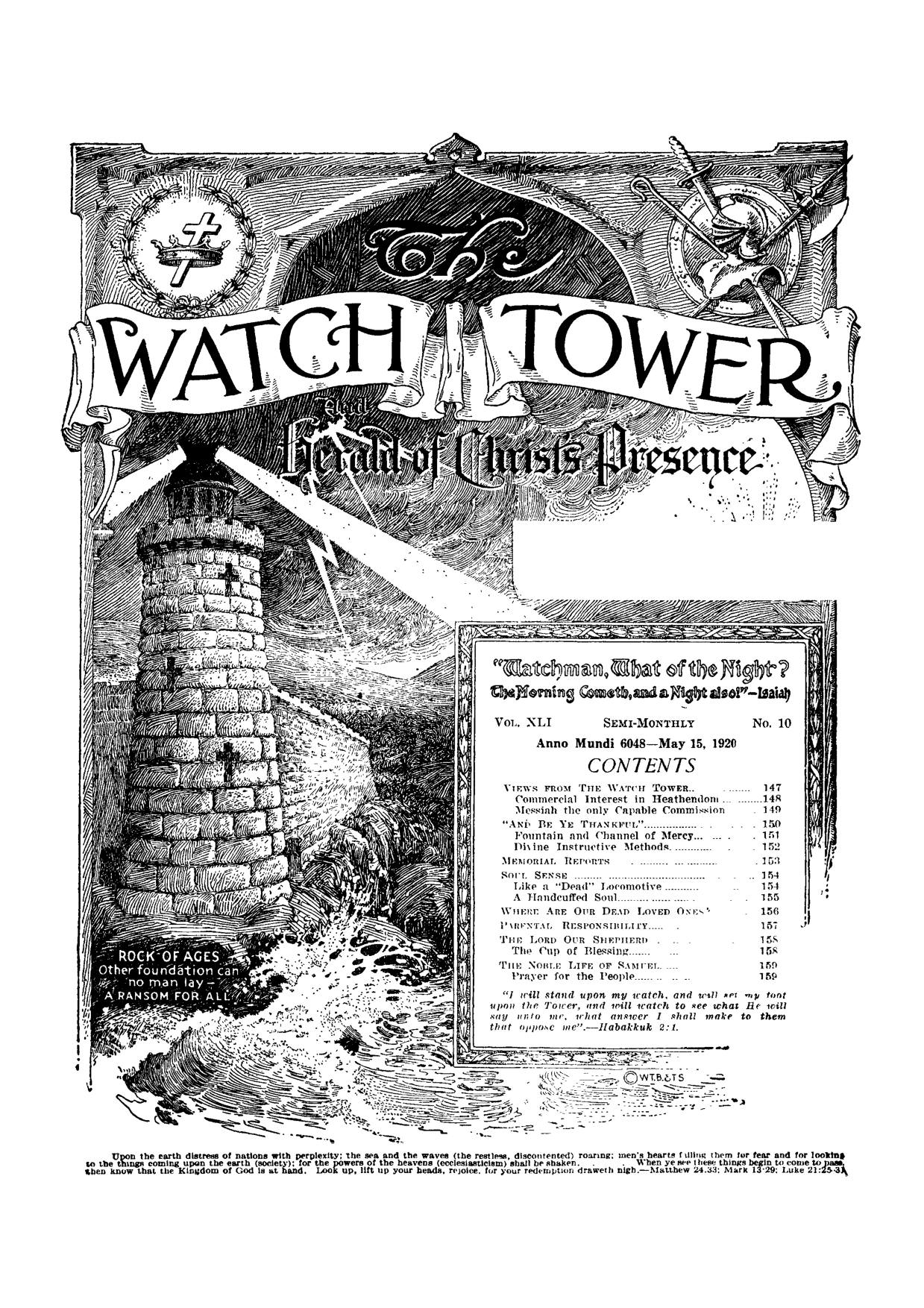
and will to see what
“I will stand upon my watch, upon the Tower, and will watch
No. 10
.. 154
’MJ/ toot Re will
15*
Upon the earth distress of nations with perplexity; the sea and the waves (the restless, discontented) roaring; men’s, hearts filling them for fear and for looktnf to the driing* coming upon the earth (society): for the powers of the heavens (ecclesiasticism) shall be shaken. When ye see these things begin to come to pass,
then know that the Kingdom of God is at hand. Look up, lift up your heads, rejoice, for your redemption draweth nigh.—Matthew 24.33: Mark 13*29: Luke 21:25-31^
alse!v- laaiaty
Vol. XLI
Semi-Monthly
Anno
Mundi 6048—May 15, 1920
CONTENTS
The Watc h Tower..
Views from
Other foundation cahA 'no man lay
A RANSOM FOR ALUr^ii
Commercial Interest in Heathendom . Messiah the only Capable Commission “And Be Ye Thankful”................. .
Fountain and Channel of Mercy......
Dhine Instructive Methods.............
Memorial Reports . ......................
Sort Sense ........................................
Take a “Dead” I locomotive...........
A Handcuffed Soul..................... .
Where Are Our Dead Loved Ones'' puiFNTAL Responsibility......
The Lord Our Shepherd . .. .
The Cup of Blessing..........
The Noble Life of Samuel. ....
Prayer for the 1’eople............
...14* 149
nay unto me. what answer 1 shall make to them that oppose me”.—llabakkuk 2:1.
QwT.B.tTS
THIS JOURNAL AND ITS SACRED MISSION
THIS journal is one of the prime factors or instruments in the system of Bible instruction, or “Seminary Extension”, now being presented in all parts of the civilized world by the Watch Tower Bible & Tract Society, chartered A. D, 1884, “For the Promotion of Christian Knowledge”. It not only serves as a class room where Bible students may meet in the study of the divine Word but also as a channel of communication through which they may be reached with announcements of the Society’s conventions and of the coming of its traveling representatives, styled “Pilgrims’, and refreshed with reports of its conventions.
Our “Berean Lessons” are topical rehearsals or reviews of our Society’s published Sti dies most entertainingly arranged, and very helpful to all who would merit the only honorary degree which the Society accords, viz., Verbi Dei Minister (V. D. M.), which translated Into English is Minister of God's Word. Our treatment of the International Sunday School Lessons is specially for the Older Bible students and teachers. By some this feature is considered indispensable.
This journal stands firmly for the defense of the only true foundation of the Christian’s hope now being so generally repudiated -—redemption through the precious blood of “the man Christ Jesus, who gave himself a ransom [a corresponding price, a substitute] for all”. (1 Peter 1:19; 1 Timothy 2:6) Building up on this sure foundation the gold, silver and precious stones (1 Corinthians 3: 1115; 2 Peter 1:5-11) of the Word of God, its further mission is to “make all see what is the fellowship of the mystery which. . .has been hid in God, ... to the intent that now might bp made known by the church the manifold wisdom of God"—“which in other ages was not made known unto the sons of men as it is now revealed”.—Ephesians 3 : 5-9,10.
It stands free from all parties, sects and creed* of men. while it seeks more and more to bring its every utterance into fullest subjection to the will of God in Christ, as expressed in the holy Scriptures. It is thus free to declare boldly whatsoever the Lord hath spoken—according to the divine wisdom granted unto us to understand his utterances. Its attitude is not dogmatic, but confident; for we know whereof we affirm, treading with implicit faith upon the sure promises of God. It is held as a trust, to be used only in his service ; hence our decisions relative to what may and what may not appear in its columns must be according to our judgment of his good pleasure, the teaching of his Word, for the upbuilding of his people in grace and knowledge. And mp not only invite but urge our readers to prove all its utterances by the infallible Word to which reference is constantly made to facilitate such testing.
TO US THE SCRIPTURES CLEARLY TEACH
(That the church is “the temple of the living God", peculiarly “his workmanship”; that its construction has been in progress throughout the gospel age—ever since Christ became the world’s Redeemer and the Chief Corner Stone of his temple, through which, when finished, God’s blessing shall come “to all people", and they find access to him.—1 Corinthians 3 : 16, 17 ; Ephesians 2 : 20-22 ; Genesis 28:14; Galatians 3 : 29.
That meantime the chiseling, shaping, and polishing of consecrated believers in Christ’s atonement for sin, progresses : and when the last of these “living stones”, “elect and precious,” shall have been made reads. the great Master Workman will bring all together in the first resurrection: and the temple shall be tilled with his glory, and he the meeting place between God and men throughout the Millennium.—Revelation 15 : 5-s.
That the basis of hope, for the church and the world, lies in the fact that “Jesus Christ, by the grace of God. tasted death for ereiy man,” “a ransom for all,” and will he “the true light which lighteth eiery man that cometh into the world", “in due time".— Hebrews 2:0; John 1:9; 1 Timothy 2 : 5, 6.
That the hope of the church is that she may bo like her Lord, “see him as he is.” bp “partakers of the divine nature’,' and share his glory as his joint-heir.— 1 John 3:2: .John 17:24: Romans 8:17; 2 Peter 1:4.
That the present mission of the church is the perfecting of the saints for the future work of service; to develop in herself every grace; to be God’s witness to the world ; and to prepare to be kings and priests in the next age.—Ephesians 4 : 12 ; Matthew 24 : 1 1 : Revelation 1:6; 20 : 6.
That the hone for the world lies in the blessings of knowledge and opportunity to be brought to all by Christ’s Millennial kingdom, the restitution of all that was Jost in Adam, to all the willing and obedient, at the bands of their Redeemer and his glorified church, when all the wilfully wicked will be destroyed.3: 19-23; Isaiah 35.
pUBLISHE-D Oy
WATCH TOWER. BIBLE tr TRACT SOCIETY
124 COLUMBIA HEIGHTS *□ □ BROOKLYN, NY. USA
Foreign Offices: British: 34 Craven Terrace, Lancaster Gate, London W. 2 ; Australasian: 495 Collins St., Melbourne. Australia; South African: 123 Plein St., Cape Town, South Africa.
Please Address the Society in Every Case.
ANNUAL SUBSCRIPTION PRICE $1.00 IN ADVANCE CANADIAN AND FOREIGN S URSt'R 1PTION PRICE $1.50 REND MONEY BY EXPRESS OR POSTAL ORDER, OR BY BANK DRAFT FROM FOREIGN COUNTRIES BY INTERNATIONAL POSTAL ORDERS ONLY (Foreign translations of this journal appear in several languages)
Editorial Committee: This journal is published under the supervision of an editorial committee, at least three of whom have read and approved as truth each and every article appearing in these columns. The names of the editorial committee are: J. F. Rutherford, W. E. Van Amburgh, F. H. Robison, G. IL Fisher, W, E. Page.
Terms to the Lord*8 Poor: All Bible students who, by reason of old age or other Infirmity or adversity, are unable to pay for this journal, will be supplied free if they send a postal card each May stating their case and requesting such provision. We are not only willing, but anxious, that all such be on our list continually and in touch with the Berean studies.
hfotiee to Subecnben: do a? a rnle? send a card of acknowledgment for a renewal or
for a new subscription. Receipt and entry of renewal are Indicated (rlthln a month by change tn expiration date, as shown on wrapper label.
Entered at Second Clatt Matter at Praokbrn, NY . Pnnfoffiec v-cdrr the Act of March 3rd. 1879
IN RE CONVENTIONS
Many of 1lie dear friends are anxious to know about convention dates for the summer in order that they might make arrnim<*men(* tor their vacations. Our Coin ention Committee has decided that it will not attempt a big convention such as was held at Cedar Point last year. Such entails a great deal of expense, both in transportation and hotels, besides the long travel. It seems to be the consensus of opinion that it would be much better for the friends this year to have a number of conventions than to attempt one Uirgo general convention.
it is the present purpose to hold a convention at Denver, Colo., for three days. Juno 11-13 This convention would sene the friends In Colorado, Kansas, Texas, Nebraska. Wyoming, and oilier points.
At San Francisco tor Oakland). Cai.if., June 25-27; Los ANGELES. Calif., July 3 5.
At Tacoma, Wash., July 8-11. The purpose is to make this the convention for all the Northwest: and all classes in this territorv will have the privilege of joining with the Tacoma fiiend* for a big public meeting. At Minneapolis. Minn.. July 16-18. This convention will serve the friends for Northern Central States.
At each one of these conventions it is expected that Brother Rutherford will be present and address both the friends and the public, and a number of the Pilgrim brethren will aKo be there. A more detailed statement will probably appear in our next issue. We may be able then io announce another com ent ion for the Middle West or Last for the first week in August
At each one of the conventions at least a portion of one dav will be devoted specially to the Golden Age. Colporteur, and other field workers.
Other local conventions. May 29-31, as follows: Sr. Louis and St. Joseph, Mo., and Columbus, Ohio.
STUDIES IN THE SCRIPTURES
These Studies are recommended to students as veritable Bible keys, discussing topically every vital doctrine of the Bible. More than eleven million copies are in circulation, in nineteen languages. Prices are net, postpaid, and barely cover cost of production and handling. Two sizes are issued (in English only) : the regular maroon cloth, gold stamped edition on dull finish paper (size 5"x 7i"), and the maroon cloth pocket edition on thin paper (size 4" x 6j") ; both sizes are printed from the same plates, the difference being in the margins ; both sizes are provided with an appendix of catechistic questions for convenient class use. Prices for both editions are uniform. The leather bound and fine India paper editions formerly issued are permanently out of stock.
Series I, ‘‘The Divine Plan of the Ages,” giving outline of the divine plan revealed in the Bible, relating to man's redemption and restitution : 350 pages, plus indexes and appendixes. 75c. Magazine edition 15c. Also procurable in Arabic, Armenian, Dano-Norwegian, Finnish, French, German, Greek, Hollandish, Hungarian, Italian, Polish, Roumanian, Slovak, Spanish, Swedish, and Ukrainian; regular cloth style, price uniform with English.
Series II, ‘‘The Time is at Hand,” treats of the manner and time of the Lord’s second coming, considering the Bible testimony on this subject: 366 pages, 75c. Obtainable in Dano-Norwegian, Finnish, German, Polish, and Swedish.
Series III, “Thy Kingdom Come,” considers prophecies which mark events connected with ‘ the time of the end”, the glorification of the ehureh and the establishment of the Millennial kingdom; it also contains a chapter on the Groat Pyramid of Egypt, showing its corroboration of ce-t.iin Bible teachings : 3S0 pages, 75c. Furnished also in Dano-Norwegian, Finnish, German, Polish, and Swedish.
Series IV, ■■The Pattie of Armageddon,” shows that the dissolution of the present <u-der of things is in progress and that all of the human panaceas offered are valueless to avert the end predicted by the Bible. It contains a special and extended treatise on our Lord’s great, prophecy of Matthew 2t and also that of Zechariah 14:1-9: 656 pages. Sac. Also in Datto-Norwegian, Finnish, Greek, German, and Swedish.
Series V, “The Atonement Between God and Man,” treats an all important subject, the center around which all features of divine grace revolve. This topic deserves the most careful consideration on the part of all true Christians: 61S pages, Sac. Procurable likewise in Dane-Norwegian, Finnish, German, Greek, and Swedish.
Series VI, “The Kern Creation,” deals with the creative week (Genesis 1,2), and witli the church, God's new creation. It examines the personnel, organization, rites, ceremonies, obligations, and hopes appertaining to those called and accepted as members of the body of Christ : 7111 pages, s5<- Supplied also in Dano-Norwegian, Finnish, German, and Swedish.
.Vo foreign editions in the pocket size.
AND HERALD OF CHRISTS PRESENCE
Voi. XLI May 15, 1920 N<». 10
VIEWS FROM THE WATCH TOWER
IT IS not tin' buHiiev of tin1 Lord’s people to feed on the cariioi. of the dead and decomposing world that was. Their food is more akin to the ’feast of fat things and wines on the lees’ which Jehovah has prepared for the strengthening and enthusing of the world under Messiah’s kingdom of peace and plenty. But while the Lord’s people do not feed upon the current affairs of the world. they are deeply interested tn watching and in observing them, because in them th'y see fulfillment of prophecy and signs of the activities of their Lord and Head.
The Reverend William Allan, Pastor of the Metropolitan Tabernacle in New York, in asking the question, “Is the Lord among us or not?" is reported by the New-York American as saving in reply:
" ‘You will observe that the question is not. ‘Are the rich among us or not ?’ The value of riches we would not dispute, especially when, in the >ame person, you have gold wedded to grace. Neither is it, ‘Are the talented among us or not?’ although when talent i-, laid at the feet of Christ a valuable as.-»et is added to the power of the gospel. However, if the Lord is not among tn, none of these—riches, talents, or anything else—can take his place or do what he alone can do.
'To have him among us we must be prepared to pay the price. There must be no half-measures; no compromise with the enemy; no flirting with the world. Christ must be master; and the kev-note of our lives, ‘Tie must increase; I must decrease'.
‘‘‘When the Lord is among us the spiritually dead will be quickened into newness of life: the near-sighted will have length anti breadth of spiritual vision; the fearful Ite made bold as lions, fearing not the frown of man, but courting only the favor of God. . . .
“ ‘One reason why there is so much cause for complaint about poor attendance at most churches is because the Lord is not. among us. In too inanj cases Christ is on the outside seeking to gel in. while we are proud of the large sums of money we are able to raise by our great mass movements, acting all the lime as it silver and gold could take the place of spiritual power mid Ilie grace of God. both of which only come when the Lord is among ns. When he is among us ‘it will be noised abroad that he is in the house' and the weld will once more Hock to the place where Jesus is.
"'<>11. for !I return nt Ilie old days, with the Lord in the midst of the assembly of his people, directing and dominating the manifold activities of the churchy"
They are missing the voice of the Bridegroom
THE WORLD IN THE CHURCH
The Interchurch World Movement, alluded to in the above quotation, is having a great deal of publicity these days. Indeed the movement publishes a paper of its own. If the support of the great and mighty and astute ones of the world could bring success, this World Movement would surely be crowned with glory. But we fear that the movement is too nearly just what its name implies
the world moving among the churches, a movement on the part of the world in and among the professed church of Christ to dominate its policies and to determine its course in harmony with worldly wisdom.
In Canada it is called the Interchurch Forward Movement and for the first time in the history of that country the Anglicans have joined with four other large denominations--the Baptist, the Methodist, the Presbyterian, and the Congregaiionalist--in a simultaneous drive. There have been two sets of objectives, spiritual and financial. The results, financial of course, have been much to the gratification of the participants, and the rejoicing of the leaders is great.
But all the denominations do not. look with equal approval upon the Inierchurch World Movement as being a panacea for all the church’s ills. Some of them seem to think that it is an added ill. The Southern Baptists have rejected its approaches kindly but firmly. The Shreveport (La.) Times reports the action of seven local churches, endorsing action previously taken by the Southern Baptists in Louisville, as follows:
“ ‘Inasmuch as the Interchurch World Movement is seeking to superintend and direct the energies of all evangelical denominations;
“ ‘And inasmuch as pastors and churches are being called upon to join in plans and programs for promoting this superchiirch organization ;
“ ‘We. the pastors, deacons, and members of the seven Baptist, churches of Shreveport, Louisiana, in mass meeting assembled, deem it wise Io faithfully, frankly and fraternally state our position upon this movement.
“ ‘first of all, we would declare our sincere Christian affection for all peoples of whatever name or faith who love our Lord Jesus Christ in sincerity and would give grateful thanks for that spiritual unity which can neither be made nor marred by mere mechanical union;
“‘We rejoice also in the privilege of cooperating with those of any ffaithl or of Christian faith, in the promotion of such humanitarian Interests as do not impinge upon the fundamental principles of conscience and conviction:
“ 'And wo hereby allirm as the supreme standard of our conduct, not sentiment, nor elticiem-y. nor the united powers of divergent organiz:ilions, hut the law of the Lord Jesus as expressed in the New Testament ;
“‘Wo cannot look with favor nor cooperate in conscience with Ibis inlerchurch movement.'"
AN INTERPRETATION DESIRED
The Cincinnati Christian Standard, a Disciple organ, wishes that someone would be so kind as to come along and interpret the movement. It says:
“When men organize u stock company, they work out the details of their enterprise and give the public definite information concerning it. A religions movement, in which the public is asked to invest sentiment and time ami money, should operate upon a like basis. Information respecting an enterprise is the nugget of gold greatly desired.
“The Interchurch World Movement is an enterprise, speedily launched, with trumpets at its lips and bells on its fingers. No other religious movement in the history of the church has ever made so much noise in such a short time as has the Interchurch Movement. On borrowed capital, it has hired a thousand and one brass bands which have been sent marching down the various streets—all the musicians playing on their instruments until they are red in the face. The attention of the public has been enlisted—a noise always attracts attention. And when the public looks It sees the extraordinary—if the extraordinary is in sight. Conventions, conferences, state ‘set-ups’ (each affair costing a fortune), an army of high-salaried men on Pullman trains and in first-class hotels, a rental of ,$350,000 per annum for office space in New York, and other odds and ends of glint and glare too numerous to mention—it is all passing in bold relief before the astonished gaze of the world. Naturally, people everywhere are asking: What’s it all about?
“A sympathetic editor answers: ‘It is God’s after-the-war program.’ Another editor avers that it is Christian union in active operation—union that has unexpectedly and spontaneously appeared just at the psychological moment when all the denominations are ready to drop their differences and join hands in the ta^k of saving the world. On the other hand, platform men (especially at the Atlantic City Convention) have gone out of their way to explain that the Interchurch World Movement is not endeavoring to promote Christian union, and that it exists primarily to strengthen denominationalisin. Again, bulletins anil other official literature have encouraged federation, even to the extent of announcing it as a part of the program, and at the same time Interchurch leaders are on record as having insisted that the movement is minus the very suspicion of federation. And so it goes—official interpretations of the Interchurch Movement are cross-wired, evasive, noncommittal, and, as a whole,they are about as clear as a London fog.”
It cannot be gainsaid by the most ardent friend of the movement that commercial and financial interests are strong therein and that these are much more pronounced than any spiritual phase of the matter. There is of course <?t«z«i-spiritual work for those who are spiritually inclined; but that does not stand out prominently. The New York News rather implies that besides being a financial movement in the name of Christ it also has a strong political coloring, when it states:
“Directors of the Interchureh World Movement announced today that ‘Big Business’ and ‘Wall Street’ are behind the nationwide movement to combat bolshevism and the ‘Reds’, and that various multi-millionaires are pledged to support the campaign of education and relief directed against radicalism."
COMMERCIAL INTEREST IN HEATHENDOM
From the Interchureh Bulletin we take the following paragraphs which are intended to impress upon the mind of the reader the fact that missionaries have been a real aid to commerce in pagan lands:
“To the missionary China owes her expertness in printing, as well as cotton and fruit agriculture.
"Siam has become proficient in tanning leather through the scientific aid of missionaries.
“Brazil and India have increased the food production of their soils through the guidance of men of the missions.
“Japan is richer through the introduction of American fruit trees by the advance agents of Christianity and progress.
“Natives of South Africa, formerly unemployed, now earn wages in sugar plantations and in the cultivation of cocoa beans, introduced by missionaries.”
Christianity would seem to be but another name for good business, as another extract from the same paper tends to show. At all events it shows that Christianity, as is, goes hand in hand with big business:
“George W. Wickersham, formerly United States attorney general, says in an interview that there is nothing incompatible between Christianity and modern business methods. A leading lay official of the Episcopal Church declares that what the churches need more than anything else is a strong injection of business methods into their management."
The Bible strongly suggests that there arc several things more needed in the church than modern business methods, useful though those might be. A paragraph from the Cincinnati Christian Leader on “The Coming of Our Lord” is willing to go half way and admit that some other things are at least as important:
“Disciples generally do not wish 10 see him come; seldom if ever, mention Ids coming, and never, as Paul and John did. pray for him to come. No subject is given greater prominence in the sacred Oracles than the coming of our Lord, and no other subject is as sadly neglected, unless it lie ’he subject of ‘church finance’. This sfaiement is based upon and measured by our deportment and our speech, our teach ng and preaching, and our prayers, belli privately and puhla-ly '
A VOICE IN PROTEST
The Leader, however, is far from being in favor of the Interchureh World Movement. Editorially it says on that subject:
“The Interchureh World Movemen-t seems Io be one v, uh jingling bells on its neck and loud-sounding trumpets in iis mouth. W hile it proposes great things ( ?) it is yet appear that it proposes Scriptural unity and organize’ mi among the denominations taking a part in it. It is nt being received everywhere with open arms, even among tlio-.e named as the ones to form Ilie merger. 'J'hc Journal nnii Messent/cr, a Baptist paper, says editorially:
“ ‘It is coming more and more to look as though the Baptist*, the Congregationalists and a section of the Disciples are to be the principal supporters of the Interchureh World Movement At least three of the Presbyterian papers are either lukewarm or positively arrayed against it. The Episcopalians have aslwil to he counted out. The Southern Baptists are positively against it. The Methodists put their own church interests before it, and many of the Disciples are quite indifferent to it. Some of the smaller sects, with possibly the Lutherans, may be counted on to support it, but so far as now appears, the Baptists have the laboring oar, and are expected to do a very large proportion of the work. Mr. John D. Rockefeller, Jr., and a few wealthy men in New York, are standing by, financially, and so long as they are willing to foot the bills, the machinery, at least, will he kept in motion?
“In nil that we have read thus fur concerning it and u hat is proposed to be accomplished by it, we have, yet to see the Bible teaching on the question of becoming a Christina and living the Christian life mentioned ns the standard by which all faiths and practices are to be tried and maasuted. The policy seems to be. ‘We'll be as you are, ami you bo as we are: we'll say nothing about your teaching and practice, however absurd and un-Scriptural it may bo, and you are to say nothing about our faith ami practice, lie it ever wi carnal and un-Scriptural'."
“Any effort to secure apparent unity m sentiment and organization apart from the doctrine of Christ is wholly unworthy of the indorsement of any one who professes tn acknowledge the sovereignly of our I.ord ami Savior. Neither the unity for which be so fervently prayed, nor the oni.iii-ization which meets his approval, nor the spirit of his life, can be obtained by rejecting the doctrine of Christ. Th* spirit and life of the Christ can not be manifest in the individual or in the organization of individuals unless there first be the doctrine of Christ. All talk therefore about accomplishing a union in spirit and organization without appealing to all to obey the gospel of Christ, is a cheat, a fraud, a deception, a device of Satan to deceive the unwary. It is a conglomerate farcical union for the purpose, chiefly, to bring the church of Christ into a compromising position and thus break the force of the distinctive gospel which she preaches, or to make her so odious in the sight of all denominationalists for not uniting in the Movement that all a ill shun her.”
■Shortsightedness, or the inability to ‘see afar off, but only the things that are near,’ may lead to a failure to see the proper model and will lead to ‘measuring ourselves by ourselves, and comparing ourselves with ourselves,’ which is not recommended as a wise thing to do. The proper model is pointed out to us.
"The beloved Apostle John, in his first epistle, says: ‘That which was from the beginning, that which we have heard, that which we have seen witli our eyes, that which we beheld concerning the Word of life, that which we have seen and heard declare we unto you also, that ye also may have fellowship with us; yea, and our fellowship is with the Father, and with his Son Jesus Christ’.—1 John 1:1- 3.”
WHISTLE STOPS BOAT
The Continent, a leading Presbyterian journal, contains some significant words:
“What is the matter, anyway? Never did we have so much money. Never so many great secretaries I Never so much talk, and a 28,000 slump in membership. Has it taken all our strength to keep the machine going? I fear we are in the position of Lincoln's steamboat that had such a small engine and big whistle that every time it blew the whistle the boat had to stop.”
The Aberdeen (Scot.) Daily Journal in giving an editorial review of an address by a Scottish missionary to China reveals the fact that the commercial tinge of "C/irtsf-ianity'’ and of "Christian” activities is by no means limited to this side of the Atlantic or of the Pacific. Some of its paragraphs read:
“When we say that the address delivered by Dr. Dugald Christie on China yesterday to the members of the Aberdeen Chamber of Commerce is the most interesting that the members have yet heard we are not detracting in any way from the high standard maintained since these luticlieon-address gatherings were instituted. The subject cannot be regarded as a particularly absorbing one, yet Dr. Christie convinced those present that China has trade possibilities in directions which are worth the attention of the whole British commercial community, and also closely touch Aberdeen itself, which has already a Chinese tradition built up by the famous Aberdeen-Line clippers.
“Dr. Christie is the head of the Moukden Medical College, Manchuria, and lie is proving himself during his visit to this country to be a missioner in two ways. He desires the development of the Manchuria College, witli which he has been connected for thirty-eight years, but he also pleads for the extension of our commercial relations with that vast tableland of Eastern Asia over which there are spread four hundred million people.”
There is no doubt at all that missionaries have aided commercial advancement in heathen countries. Neither is there any doubt that such commercial or industrial advancement has sometimes worked for the benefit of the natives. That is not the question: the question is whether these things should be flouted as visible and tangible fruits of Christianity with a view to cajoling -hekels from the reticent and retiring pockets of the man of affairs.
The China manager of the Standard Oil Company, for instance, is, or was recently, an ex-missionary who had learned the language and the people. All the evidence goes to show that the Doctor is a very capable manager and that he has more statistical information on the Chinese Empire than the Pekin government itself has. But what has that to do with missions? Nothing at all; unless the missions themselves be, as many people suspect them to be, really commercial missions instead of Christian missions. They have not, as a rule, been established as commercial missions. There are doubtless many earnest and honest missionary workers, but they are just as often indebted to commercial or semi-religious powers for protection or favors, and this fact tends to minimize their influence for good.
MESSIAH THE ONLY CAPABLE COMMISSION
A special issue of Babson's Reports, devoted to the interchurch cause, suggests how nice it would be if everything were only nice in the world:
“The question arose as to how to interest the wageworkers of the country in the church. Also how to re-create in these wage-workers a desire to produce and take joy in service. I stated that this could be done only when we Christian business men, who could afford It, would make a real demonstration of public service from the employer's standpoint. I suggested that we could operate our industries as a public trust the same as we do our library associations, hospital boards and charitable institutions.
"The answer was made that if any one business man did this at the present time he would be severely criticized by his associates and perhaps would be misunderstood by his wife and children. This probably is true, hut would it be true if a large group did it! If a thousand manufacturers and merchants, with a gross business of a billion dollars a year, should agree to use their profits as some impartial commission might deem best for the community, I am sure that none of these thousand men would be criticized. Instead. I believe that they would go down into history like the signers of the Declaration of Independence. They would do for industry what our forefathers did for democracy.”
And who would constitute such an “impartial commission” ? Impartial means, naturally, that the members of such a commission would be of known sympathy with the donors and not partial to some lower element of society. If any other stratum of society even intimates the desirability of the very thing Air. Babson has here suggested, that stratum of society at once becomes dangerously radical, red, bolshevistic, etc., etc. But Mr Babson is perfectly safe in his offer; for no thousand business men are going to resign their holdings in favor of an impartial commission.
The Reverend Colonel David Carnegie in an article in the Toronto Globe remarks:
“All organized Christianity, which I regard as the ‘Church', is involved in the great industrial issues of today. The way out of the present industrial tangle is the problem. The increasing dillleulty of living decently and with reasonable comfort, is a disturbing element in the consideration of plans for procuring and maintaining industrial peace. Few people are normal. Some despair of reaching any just and equitable settlement. Others are bent on revolution, considering it inevitable. Well-balanced judgment, courage and common sense are at a premium. Never before has been such a sense of insecurity in the plans of men.”
“The Church, on this side of the Atlantic, at any rate, has taken sides with the employing and governing classes because of .-elf-interest. She has been disloyal and faithless to the charge committed Io her, but. in spite of all, she remains the one great avenue through which all that Christianity stands for is expressed. She alone has the spiritual message for the regeneration of industry.
“How can the Church discover and u-e I he secret of her power? She 1ms to discover that society and industry are inseparably linked together, that underlying both are fundamental principles of which she is the exponent.
"She has Scriptural warrant for taking her place in industry. and she holds the only ‘rules of the game’ in commeri e and manufacture which matter. She cannot escape from her rightful place in industry.”
THEOLOGICAL SCHOOLS AND HIGHER CRITICISM
The Chicago Herald and Examiner reports an address by a Methodist minister thus:
“Methodist ministers were told yesterday that the theological schools of America are drifting away from the teachings of Christ, and that the Bible is no longer regarded by many preachers as the standard of faith.
“Dr. Henry Paul Sloan of the New Jersey annual conference of the Methodist Episcopal Church spoke at the ministers’ meeting held at First Church, Clark and Washington Sts., on the course of study required by the church for every minister. He said twenty-five annual conferences had sent a petition to the coming general conference to be held at Des Moines next May, demanding the course be revised.
“ ‘Many Methodist ministers disbelieve some of the fundamental conceptions of Christianity and teach the higher criticism, which is destructive of the foundations of evangelical belief.’ said the speaker.”
At least one preacher had more religion than he could comfortably hold, according to the statement in the Hamilton (Ont.) Herald of the Reverend Mr. F. W. Holl inrake upon resigning his pastorate of twenty-six years:
“ ‘Inasmuch as many friends are asking why I have decided to withdraw from the pastorate of Barton street church this coming conference, it seems only fair that I should make some explanation. This local action became a necessity because of my decision to withdraw from the Methodist church, and this latter decision has been reached after much conflict of soul, because I find myself out of harmony with the polity and teachings of the church in which I was brought up, and with which I have been connected as a student and minister for 29 years.
“ ‘My acceptance, teaching and preaching of the premillen-nlal view of Christ’s coming kingdom is the primary reason for my action. Since Jesus and his apostles all taught that he was coming for his church and then afterwards for the purpose of establishing the kingdom of God on earth, I cannot do otherwise than believe this. The acceptance of this teaching brings joy to my soul and is the main inspiration of my preachings.
“‘On the other hand the teaching and preaching of this premillennial truth the Methodist church repudiates and will have none of it. While individuals in other communions do not hesitate to combat this interpretation of Scripture, yet Methodism acts as though it were commissioned with the divine task of rooting out premlllennialism as a noxious growth from the theological field. Interpreting the Scriptures as I do, I am forced to two conclusions:
“‘(1) That present-day church agencies are not intended in the plan of God to bring about the conversion of the world, but rather the evangelization of the world that a people may be called out from all nations to form the church which is his body.
“‘(2) That this age of grace will end in judgment as other former dispensations, because of the sin of the world and the apostasy of the professing church. Taking this position and accepting the Scriptures just as they read, I find myself out of harmony with my church on the question of the inspiration and divine authority of the Word of God.’”
" ‘Implicitly do I believe that holy men of old wrote as they were moved by the Holy Ghost, and when they say that Jesus is coming again I cannot do otherwise than believe, teach and preach it, even though the position created be so uncomfortable as to lead to my going out of my church. The whole question of the supernatural stands or falls with the acceptance or rejection of the words of Jesus and Paul as being inspired of the Holy Ghost.
“ ‘Coincident with this all but general challenging of the Inspiration and authority of the Word of God, there ha» come to pass a decided doctrinal declension in the church. The deity of our Lord is being denied. The substitutionary sacrifice of Jesus on the cross for our sins through the shedding of his precious blood is relegated to the heap as a worn-out doctrine. . . .
“ ‘This doctrinal declension is becoming so marked today that it would seem impossible to hope for improvement by remaining in the denomination.
" ‘The blessed hope as bound up in the premillennial position accentuating, as it does, the spiritual in all my inner life and outward activity, forces me to pronounce the stresss-laid on social service by my church a mistake.’ ”
“ ‘Since preaching boldly the truth, as God has given me to see it, means constant friction, locally as well as in wider circles, resulting in breaking of fellowship, life is thus robbed of much of its real joy. I must now seek fellowship among those who sympathize with my views.’ ”
‘AND BE YE THANKFUL”
"In every thiny yire thanks: for this is the will of (lod in ('hrist .Im eoneerniny you."—1 Th< ssalonians 5: IS.
THANKFULNESS is here described as being a part of God’s will for us. In another place the same Apostle impresses upon our minds the importance of gratitude by saying. “Let the peace of God rule in your hearts, to the which also ye are called in one body ; and be i/e thankful". (Colossians 3 :15) One of the most reprehensible things in the world is ingratitude. Indeed, ingratitude stands out as a most prominent factor in human experience. The Apostle says as much in describing the causes which have contributed so largely to human depravity. Concerning the Gentiles he says: “When they knew God, they glorified him not as God, neither were thankful; but became vain in their imaginations, and their foolish heart was darkened”.-Rom. 1:21.
Gratitude is like a box of ointment which blesses not only the possessor but fills the room and the whole house with its pleasing aroma. It is suggestive of the finer things of life. Gratitude is a humble recognition and heart acknowledgment of benefactions received or of benevolent intentions exercised on our behalf. We find it springing forth (1) when we are not expecting such good deeds or good wishes, (2) when we have no legal claim to them, or (3) when we had expected bare justice and got mercy or clemency instead. Gratitude is a special affection which seems to combine kindly feeling with some sort of emotional recognition of superiority, in one act at least,
GOD’S GOODNESS APPRECIATED
Gratitude begins with appreciation. We come to appreciate God’s goodness, as revealed in his Word. Our minds grasp some of the facts involved; we con them over; we reflect upon and admire them; we appreciate God’s wisdom and God’s interest in mankind as manifested in his wonderful provision for their blessing. If this mental appreciation of God’s qualities finds i espouse in our hearts, then appreciation sinks down into and takes hold of our inmost all’ections. Appreciation thus grows into gratitude, and gratitude is merely a modern word for thankfulness.
If the heart be full of gratitude it will seek avenues of expression. At (‘very appropriate opportunity, at every reasonable opening, the grateful heart will seek to call attention to the goodness of God as it shines in the face of Jesus Christ. The thankful person will not be among those who “give not God the glory”.
We find our gratitude going out first toward God Jehovah. Thankfulness is a part of our devotional attitude toward him. As the Apostle expresses it: “In every thing by prayer and supplication with thanksgiving let your requests be made known unto God”.
Philippians 4: 6.
“Fountain of mercy. whose perv mliim eve ('an look wil liin and see what passes there.
Accept m.v thoughts for thanks: 1 have no words -My soul, o'erfratight with gratitude.
Rejects the use of language: Lord, hehold my heart!"
Secondly, our gratitude goes out not only to Jehovah and to his Son Jesus, who are vastly our superior in every respect, but also toward our equals, toward those on the same plane of being, for deeds of benefaction and sympathy. Thirdly, it is not an unknown thing that our gratitude go out to inferiors. It is hard to imagine ourselves being grateful to a hog. but we might under certain circumstances be verv grateful to a dog or to a horse.
In respect to those on the same plane of being as ourselves, the Apostle gives us a recipe whereby appreciation and gratitude may develop. He says: "Let each esteem other better than themselves". (Philippians 2: 3) If we have a true appreciation of our own shortcomings and an equally true appreciation of the points of virtue in other members of the body of Christ we can honestly look about us and say to ourselves: 1 wish that I had the fortitude of that sister, the courage of that brother, the generosity of mind of this one, or the kindness of heart of that one. If we are unable to see some admirable fruit of the spirit in other members of the body of Christ it is an unfavorable sign a> re-jiects our own spiritual health. "He that loveth not his brother whom he hath seen, how can he love God whom he hath not -eim ? " 1 John 4 ■ ?<>
FOUNTAIN AND CHANNEL OF MERCY
But though there are । ontinually occasion-- for gratitude toward our brethren, toward members of the human lace, or toward lower orders of animal life, there can be no quest ion that the chiel recipient-- of our thankfulness are Jehovah God and hi> Sou Je-iis ('christ our Savior. As the author and source of everv bounty Jehovah deserves all the grat itudc we । an muster As the channel for conveying those blessings to u.~ our Lord Jesus should be likewise honored. 'This is not a mere matter of court etiquette or set form. It is not an unpleasant duty to perform in any perfunctory manner. It is a genuine attitude of heart toward God for his goodness toward ns. or it is nothing at all. Doubtless one of the reasons why Jehovah -o approved of King David, lay in the fact tba! he was grateful, thankful, tilled with appreciation of his own unworthiness and of God’s great kindness. On one occasion he said: “Bless the Lord, 0 my soul, and forget not all his benefits”. (Psalm 103:2) Divine benefits, heavenly boons, are so numerous and ever present that we are sure to forget some of them, but it is a matter wholly without excuse if we forget them all. Some go much further than this and say. "There is no God” (Psalm 53:1), even while subsisting on the very benefits which God has provided, even while employing the very breath and the very power of speech which his wisdom made possible for man.
lien all tliy mercies. <) my God.
M.v rising soul surveys.
Transported with the view I’m losi In wonder, love, and praise.’
'I’ho tendency to ingratitude is attributable to Satan, the father of it. When he was set as the covering cherub in Eden, instead of using bis extraordinary opportunities for glorifying God and for strengthening in man the tendency toward thankfulness, he misused his powers and succeeded in impressing on Mother Eve’s mind an ungrateful thought. This thought was to the effect that God was trying to keep some blessing from them and that he was doing so with jealousy as a motive.
INGRATITUDE AND ISRAEL
Ingratitude lay at the base of the sms of fleshly Israel. In Deuteronomy 8; 9:5, 6, and in other places, the Lord through Moses strove to impress upon the minds of the Israelites the blessings of gratitude and the baneful results of unthankfulness. He says: “Beware lest thou forget Jehovah thy God, . . . [and] thy heart be lifted up, and thou forget .Jehovah thy God, who brought thee forth out of the land of Egypt, and out of the house of bondage ; who led thee through the great and terrible wilderness, wherein were fiery serpents ano scorpions, and thir-ty ground where was no water; wno brought thee forth water out of the rock of flint; win ted thee in tb.e wilderness with manna, which thy fathers l;new not; that he might humble thee, and that he might prove thee, to do thee good at thy latter end: and lest thou ,-ay in thy heart. Aly power and the might of my hand hath gotten me thi< wealth But thou shall remember Jehovah thy God, for it is he that giveth fliei' power to get wealth."
The I’-almist David in a hur<t of gratitude devotes the whole thirty-third Psalm to reviewing the benefaction-, of Jehovah. Among other things he says: “Til* earth i.~ full of the loving kindness of Jehovah. . Let all the eaifb fear Jehovah; let all the inhabitant of the woild stand m awe of him. Eor he spake, and r. wa- done; he commanded, and it stood fast. Jehovah In i ngel h the counsel of the nations to naught; he maketr the thought.- of the peoples to be of no effect. [But] the eoun.-el of Jehovah standeth fast for ever, the thoughts of ln< heart to all generations. Blessed is the nation whose God i< Jehovah, the people whom he hath chosen1 lor Ins own inheritance. . . . Gui soul hath waited for Jehovah; ho is our help and our shield. For our heart shall rejoice m him. because we have trusted in his holy name. Det thy loving kindness, 0 Jehovah, tie upon u--. a.iording as we have hoped m thee.”
There are many occasions for our gratitude toward Jehovah. Some of them may bo profitably mentioned: We can and should be thankful for the support of our being—for life, even fragmentary life.
■‘Lord, I am glad for the great gift of living:
Glad for life’s day of bright sun and of rain ; Grateful for toil, with an endless thanksgiving;
Grateful for laughter, and grateful for pain.”
What if the life which we now have is beset with all manner of imperfections and difficulties? It is the only life we have; and it behooves us to make use of this much of divine favor. Surely we cannot be ungrateful toward him who “holdeth our soul in life, and suffereth not our feet to be moved”.—Psalm 66: 9.
FOOD, RAIMENT, SHELTER, SENSE
As contributing to the support of our being, and as making possible a continuance of the lessons and experiences which the Lord would have us learn as new creatures, we have the divine provision for food, for raiment, and for shelter for the natural body. Without Jehovah’s wonderful provision for productiveness of the earth’s surface we could not have any of these things, unless special miracles were worked on our behalf. Bible history shows us that even when as marvelous a thing tis bread from heaven was given the Jews the time came when their appreciation lagged and even died. There is great danger of overlooking God’s provision for our daily needs and of thinking or saying that our own astuteness and energy have brought us these things.
Again, we can and should be thankful to the Lord for the delight of our senses—for the privilege of seeing, hearing, tasting, touching, and smelling. These are the inly avenues by which sense perception can reach us. If all of these things were suddenly removed from us we vould be in a veritable living death. Indeed, it is ioubtful whether the body would continue to function for any length of time. All of these senses have been used of the Lord as figures of speech to convey to our til-too-dulled perceptions some idea of the truth which he wished to bring to us. Even the natural and daily exercise of these senses becomes a delight to the thankful heart.
“There Is -.omethiiig in the sunlight Which I never saw before;
There’s a note within the robin's song I did not hear of jure."
And again:
“Sweet prospects, sweet birds, and sweel flowers.
Have all gained new sweetness to me.”
Another occasion for gratitude is the privilege of agreeable exercise of our rational faculties. We are invited to do this by none less than Jehovah himself: ‘‘Come now, and let us reason together”. (Isaiah 1:18) All the sublime subjects, all the exalted prospects brought to our attention in the Lord’s Word could not be considered by us if the human organism had not been endowed with such faculties as make it possible for us 'o think in some degree from God’s standpoint.
EARTHLY HOME AND FRIENDS
We can be grateful for earthly home and friends. Not ±11 of the Lord’s people have an earthly home; but all of them have friends. Nearly, if not quite all, have had some kind of home in their lifetime. They can be thankful for this because it furnishes a basis of comparison with the heavenly home, the home that is to be, and where no difficulties and no imperfections, no death, no unhappiness shall enter. The highest form of friendship is that which exists between those of similar characters; and since all the Lord’s people are striving to please the same Lord and have more in common than any other group of people on earth they have a basis for the truest, most lasting, and most fruitful friendship. This friendship is sorely tried; it is constantly put to the test because of imperfections in the organisms of those whom the Master has called friends. But there is unspeakably \aluable practice in it all, to say nothing of the joys of gratitude toward God that he has not left us alone in the narrow way.
We will not overlook nor fail to be thankful for the privilege of having responded to the high, the heavenly calling.
“Not alone hath grace redeemed me. Bought me with Christ’s precious blood.
Sought me out when I a stranger
Wandered from the fold of God : But beyond this great salvation God hath shown me wondrous grace. Called me with a heavenly calling Ever to behold his face.”
In running for the prize of this high calling we have many privileges of divine service. In the first place we have the incomparable honor of being brought into the divine family through Jesus, the only means of access to God. Then we have the privilege of practicing with certain possessions. None of the Lord’s people has vast possessions; but each has something. And with that something we can demonstrate either our faithfulness or unfaithfulness so thoroughly that the King of kings and the Lord of lords will determine our destiny in harmony, with our conduct. Suppose we had absolutely nothing, hot even a pocket knife or a watch or a lead pencil: how would we practice? We can surely be grateful for possessions, though they do increase our responsibility. Likewise, we all have some time, some personal influence, some education, some experience, some power of utterance with which we can practice and demonstrate to the Lord our good intentions and the honesty of our desire to serve him.
DIVINE INSTRUCTIVE METHODS
Perhaps we are not always grateful enough for the methods which the Lord uses in instructing us. Surely we should Im thankful for the freedom he allows us in our conseciated vay. He deals with us in such a manner as not to i: al?> automatons out of us, but rather in such a way a- enable us to worship God in spirit and in truth. The instructive providences which he gives us are with a \ iew to convincing us of the desirability of his way, and of the inferiority of our own. Sometimes this end is best accomplished in us by letting us have our way, just to show us how miserable our judgment or our taste is, just to let us see how unutterably better it had been to have followed more carefully the Lord's instructions. If we try long enough and hard enough to have our own way very likely he will let us have it, but there will bo corresponding leanness of soul.-Psa. 106:15.
The grateful, thankful heart may go on from grace to .grace, from strength to strength, from knowledge to knowledge, from attainment to attainment; but if gratitude begins to wane and our advantages are accepted either as matters of our own attainment or of good luck, in that same proportion we will find ourselves growing ■cold spiritually; and with unthankfulness will come unholiness, spiritual conceit and pride, and all of this will lead to spiritual dearth, and, if persisted in, to spiritual death.
It is plain, therefore, that in the cultivation of the spirit of praise, thanksgiving, and loving appreciation of the manifest goodness of God, is the Christian’s secret of a happy life. And in order to the cultivation of such a spirit it is necessary that we continually call to mind Jehovah’s acts of mercy and of grace; that in our prayers we frequently tell him how all his goodness is remembered, how every fresh evidence of his love and care causes faith to take deeper root and makes the sense of his presence and favor more fully realized.
Thankfulness will make every trial and sacrifice on our part seem small and proportionately easy to be offered; and it will make all of God’s mercies and favors toward us proportionately grand and great and inspiring.
“Blessed be the Lord God, the God of Israel, who only doeth wondrous things. And blessed be his glorious name for ever: and let the whole earth be filled with his glory ; Amen, and Amen.”—Psalm 72:18, 19.
. "Father, whate’er of earthly bliss Thy sovereign will denies, Accepted at thy throne of grace, Let this petition rise.
"Give me a calm, a thankful heart b rom every murmur free:
The blessings of thy grace impart.
And make me live to thee.
“Let the sweet thought that thou art mine Sly every hour attend;
Thy presence through my journey shine, And crown my journey’s end.”
MEMORIAL REPORTS
A FTER sundown on the evening of April 2, A.D. 33, ZA our blessed Lord Jesus instituted a Memorial of ■A A his antitypical fulfillment of the Jewish Passover Supper. To his followers he said: “This do in remembrance of me”. After sundown on the evening of April 2, A. D. 1920, brethren and followers of the Lord who appreciate the significance of the antitype met
Brooklyn, N. Y........
London, Eng
Chicago, Ill
■Glasgow, Scot
Los Angeles, Calif. _____ .
Cleveland, Ohio.......
Pittsburgh, Pa. ...
Helsingfors, Finland
Boston, Mass
Detroit, Mich..........
Liverpool, Eng
Vancouver, B. C
•St. Louis, Mo. . ..
Philadelphia, Pa...........
Toronto, Ont
Port of Spain, Trin.....
Winnipeg, Man
Baltimore, Md
Stockholm, Sweden
Washington, D. C. ...215
Manchester, Eng
Seattle, Wash
■Roseland, Ill
Columbus, Ohio
Buffalo, N. Y
Denver, Colo
Dayton, Ohio
•Copenhagen, Denmark .... 175 Indianapolis, Ind..........
San Francisco, Calif
Cincinnati, Ohio
Oakland, Calif
Manor Park, (Lon. E.) Eng. 15*
Edinburgh, Scot
San Antonio, Tex........
Spokane, Wash
Tacoma, Wash. . ........... .
Toledo, Ohio
Minneapolis, Minn
Milwaukee, Wis
Leeds, Eng. .
Bristol, Eng
•Georgetown, B. G...... . .112
Akron, Ohio
Oldham, Eng. ______ . ..... 107
Louisville, Ky
Erie, Pa
St. Joseph, Mo
Oklahoma, City, Okla
Duluth, Minn
San Diego, Calif
Jacksonville, Fla. .
Victoria, B. C............
Belfast, Ire. . .. .. .. .. .
Leicester. Eng
Lancaster, Pa
Worcester, Mass
Binghamton, N. Y
Chicago, Ill. (Lithuanian).
Everett, Wash
Bridgetown, Barbados ...
Richmond, Va
Youngstown, Ohio ..
Santa Ana, Calif
Nottingham, Eng
Paterson, N. J
Duquesne, Pa
East Kirkby, Eng
Rochester, N. 1. . ..
London, Ont
Wichita, Kans
Edmonton. Alta . ...
Bridgeport, Conn
Allentown, Pa
Pasadena, Cal
York, Pa..........
Bay City, Mich
Panama, R. P
Fresno, Calif
Croydon, Eng.........
Hull, Eng......
Sharon, Pa
Southend-on-Sea, Eng
Donain, France ..
Hamilton, Ont
Wallasey. Eng......
.......55
......55
.......55
.......54
.......54
.......54
.......53
......53
.......53
.......53
.......53
.......52
.......52
......52
.......52
.......52
......50
.....50
.... 49
.... 48
.......47
.......47
.......47
.......46
_______46
.......46
.......46
. . .4o
.......45
.......45
.......45
.......44
.......44
.......42
.......42
......41
.. 41
. ...41
. 41
.......41
.......40
.......40
......40
in scattered groups m many parts of the earth to obey the Master's behest and to remind themselves by symbols of some of the most precious and intimate facts relating to their Christian experiences.
At the time of going to press we have heard from only part of the classes, but such as have reported we list below—all those whose attendance was thirty or over:
New Brighton, Pa.......
Springfield, Mass.........
Watertown, N. Y.........
Flint, Mich...................
Jackson, Mich...............
Paris, France ..............
Aurora, Ill...................
Dallas, Tex...................
Long Beach, Calif.......
Lynn, Mass...................
Topeka, Kans...............
Altrincham, Eng.........
Atlanta, Ga.................
Norfolk, Va. .................
Omaha, Neb. ...............
San Jose, Calif.............
East St. Louis, Ill.......
Lincoln, Eng.................
Schenectady, N. Y. .... Mattoon, III. .. ...
Lima, Ohio ....................
Niagara Falls, N. Y. .. Saskatoon, Sask...........
Cumberland, Md...........
Montreal, Que...............
Scranton, Pa.................
Tulsa, Okla................
Elizabeth, N. J. ..........
Ft. Worth, Tex.............
Kalamazoo, Mich.........
Rockford, Ill...............
Auburn, Ind.................
Kingston, Jamaica .....
Iola, Kan....................
Springfield, Mo.............
Clydach, Eng..............
Colon, R. P............
Sacramento, Calif.........
Syracuse, N. Y. ..... . Warren, Ohio ..............
East Liverpool, Ohio . Fall River, Mass........
Nashville, Tenn.......
St. Petersburg, Fla
Bloomfield, bt J
Burlington, Wash
Canton, Ohio
Elizabeth, N. J
Port Huron, Mich
Brockton, Mass
Champaign, Ill
Cromwell, Conn
Hartford, Conn
Brazil, Ind
Calmar, Alta
Camden, N. J
Easton, Pa
New Haven, Conn.
Wilmington, Del
Barnoldswick, Eng
Chatham. Ont
Newark, N. J
Newcastle-on-Tyne, Eng
Portsmouth, Ohio
South Bend, Ind.....................
Ft. Smith, Ark.........................
Lawrence, Mass.......................
Crooksville, Ohio ....................
Dubuque, Iowa ........................
Knoxville, Tenn.......................
Oxford, Eng.............................
Quincy. Mass.............................
Tonawanda, N. Y.....................
Wolverhampton, Eng...............
Danville, III.............................
Lincoln, Neb.............................
Saginaw, Mich.........................
Abilene, Kans...........................
Elgin, Ill...................................
Springfield, Ill.........................
Stockton, Calif.........................
Airdrie, Scot.............................
Kingston, N. Y.......................
Mansfield, Eng.........................
Paso Robies, Calif...................
Tiffin, Ohio ..............................
35 34 34 33 33
33 33 33 33 33 32
32 32
31 31
31 31
30 30 30
30 30
BROTHER GILLESPIE’S COURSE ENDED
MANY of our readers have known Pilgrim Brother J. A. Gillespie, as he lias tnitelled from town to town and from city to city with words of comfort and cheer from God’s Word. We are just informed that he has finished tiis course of sacrifice, faithful in embracing opportunities for service of the truth till the last.
He died in sleep at Akron, Ohio, Friday evening, at 6 o’clock, April 23. The immediate cause of deatli was described as being high blood pressure and exhaustion. Up to within a few days of his demise Brother Gillespie was serving both friends and public with the truth in both the oral and the mute languages. The following brief information was found in his pocket:
…