The Watchtower, November 15, 1919
Download: PDF — The Watchtower, November 15, 1919
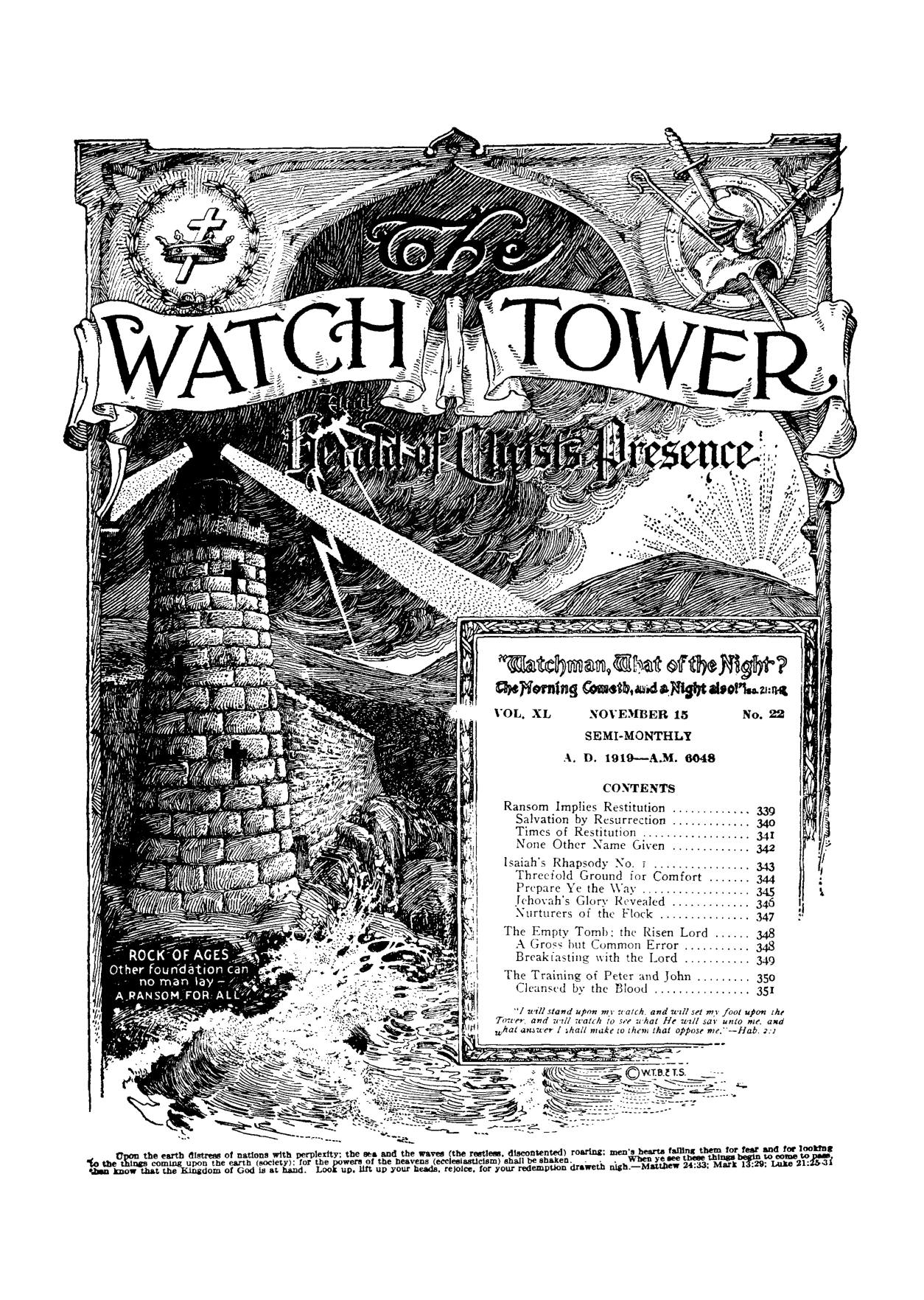
THIS JOURNAL AND ITS SACRED MISSION
THIS Journal is one of the prime factors or Instruments In the system of Bible Instruction, or “Seminary Extension,” now Maf.
presented in ail parts of the civilized world by the Watch Tower Bible & Tract Society, chartered A. D. 1881, “For the Promotion of Christian Knowledge." It not only serves as a class room where Bible Students may meet in the study of the Divine Word, but also as a channel of communication through which they ma, reached with announcements of the Society’s Conventions and of the coming of its traveling representatives styled “Pilgrims,” and refreshed with reports of its Conventions.
Our “Berean Lessons" are topical rehearsals or reviews of our Society’s published Studies, most entertainingly arranged, and Very helpful to all who would merit the only honorary degree which the Society accords, viz., FerM Dei Minister (V.D.M.), which, translated Into English, Is Minister of the Divine Word. Our treatment of the International 8. 8. Lessons Is specially for the older Bible Students and Teachers. By some this feature is considered Indispensable.
This Journal stands firmly for the defense of the only true foundation of the Christian’s hope now being so generally repudiated— Redemption through the precious blood of “the Man Christ Jesus, who gave Himself a Ransom [a corresponding price, a substitute] tor *11." (1 Pet. 1:19; 1 Tim. 2:6.) Building un on this sure foundation the gold, silver and precious stones (1 Cor. 3:11-15; 2 Pet 1:5-11) of the Word of God, its further misslou is to—"Make all see what is the fellowship of the Mystery which . . . has been hid in God, ... to the intent that now might be made known by the Church the manifold wisdom of God”—“which In other Agev was not made known unto the sons of men as it is now revealed.”—Eph. 3 :5-9, 10.
It stands free from all parties, sects and creeds of men, while it seeks more and more to bring its every utterance into fnllest objection to the will of God in Christ, as expressed in the Holy Scriptures. It is thus free to declare boldly whatsoever the Lord hath spoken—according to the Divine wisdom granted unto us, to understand. Its attitude is not dogmatical, but confident; for we mow whereof we affirm, treading with implicit faith upon the sure promises of God. It is held as a trust, to be used only in His service ; hence our decisions relative to what may and what may not appear in Its columns must be according to our judgment of His good pleasure, the teaching of His Word, for the upbuilding of His people in grace and knowledge. And we not only invite but urge our readers to prove all its utterances by the Infallible Word to which reference Is constantly made, to facilitate such testing.
TO US THE SCRIPTURES CLEARLY TEACH
that the Church is “the Temple of the Living God”—peculiarly “His workmanship that Its construction has been In progress throughout the Gospel Age—ever since Christ became the world’s Redeemer and the Chief Corner Stone of His Temple, through which, when finished, God’s blessing shall come “to all people,” and they find access to Him.—1 Cor. 3:16, 17 ; Eph. 2 :20-22; Gen. 28 :14 ; Gal. 3 :29.
That meantime the chiseling, shaping and polishing of consecrated believers in Christ’s Atonement for sin, progresses; and when ths last of these “living stones," “Elect and precious,” shall have been made ready, the great Master Workman will bring all together in the First Resurrection ; and the Temple shall be filled with His glory, and be the meeting place between God and men throughout the Millennium.—Rev. 15 :5-8.
That the Basis of Hope, tor the Church and the World, lies in the fact that “Jesus Christ, by the grace of God, tasted death for man,” “a Ransom for all,” and will be “the true Light which lighteth every man that cometh into the world,” “In due time.”— Heb. 2 :9 ; John 1 :9 ; 1 Tim. 2 :5, 6.
That the Hope of the Church Is that she may be like her Lord, “see Him as He is,” be “partaker of the Divine nature,” and share Hto glory as His joint heir.—1 John 3:2; John 17:24; Rom. 8:17; 2 Pet. 1:4.
That the present mission of the Church is the perfecting of the saints for the future work of service; to develop In herself every grace;
to be God's witness to the world ; and to prepare to be kings and priests In the next Age.—Eph. 4 :12 ; Matt. 24 :14 ; Rev. 1 :6 ; 20 :& That the hope for the World lies In the blessings of knowledge and opportunity to be brought to all by Christ's Millennial Kingdom— the Restitution of all that was lost in Adam, to all the willing and obedient, at the hands of their Redeemer and His glorified Church—when all the wilfully wicked will be destroyed.—Acts 3 :19-23 ; Isa. 35.
PUBLISHED BV
WATCH TOWER BIBLE AND TRACT SOCIETY
119 FEDERAL STREET, PITTSBURGH. PA., U. S. A.
The Watch Tower Edttortal Committee:
This journal is published under the supervision of an Editorial Committee at least three of whom have read and approved as truth each and every article appearing in these colums. The names of the Editorial Committee are: J. F. Rufherford. W, E. Van Ambvrgh, F. H. Robison, Geo. H. Fisher. W. E. Page..
ANNUAL SUBSCRIPTION PRICE $1.00 IN ADVANCE.
SEND MONEY BY EXPRESS, BANK DRAFT. POSTAL ORDER, OR REGISTERED
Ttmu to the Lord’s Poor as follows—All Bible Students who, by reaso" of old age or other infirmity or adversity, are unable to pay for this journal, will be supplied Free if they send a Postal Card each May stating their case and requesting its continuance. We are not only willing, but anx ious, that all such be on our list continually and in touch with tffe Studies, etc.
NOTICE TO ALL TOWER SUBSCRIBERS—Please remember that as a rule we no longer send a card of acknowledgment for a renewal or tor a new subscription. Receipt and entry of renewal are indicated within a month by change in date of expiration of the subscription on the Tower wrapper.
When requesting change of address, please give old address as well as new. This is very important, saving us much time and unnecessary correspondence,_________________________________________________________
ENTERED AS SECOND-CLASS MATTER AT PITTSBURGH, PA.. POSTOFFICE UNDER THE ACT OF MARCH 3RD.
LOCAL CONVENTIONS AT THANKSGIVING SEASON
Chicago, Ill., November 27-30. Brother Rutherford and several pikrini brethren \\ul be present. Fer further information address Entertainment Committee, 1305 Masonic Temple. Chicago, Ill.
Grand Rapids, Mich.. No\ember 27-30 Brother Rutherford hopes to be present on the 2Sth. For further, information address S. C. DeGroot, 55u Lyon Street, N. E., Grund Rapids, Mich.
Cincinnati, O., November 29. 30. Address 1 ictor Schmidt, 545 \Ve<t 7th Street. Cincinnati, 0.. for information concerning this convention.
Toledo, O., November 27-30. For further information address C. W. Smith, 1021 Varland Ave.. Toledo. Ohio.
St. Louis, Mo., November 27-30. J. B Bernoudy, 7033 Lindell Ave., can be addressed for further information regarding this convention.
CONVENTIONS TO BE ADDRESSED BY BROTHER J. F. RUTHERFORD
Brooklyn, N. Y.......Nov. 23 Grand Rapids, Mich...Nov. 28
Chicago, Ill........... “ 80 Cleveland, O.........Dec. 7
RE BEREAN BIBLE LESSONS
The October 15th issue erred in duplicating questions. Correction is made on pg. 351 by forwarding questions two weeks.
Lectures and Studies by Traveling Brethren
BROTHER J. A. BAEUERLEIN Scranton, Pa.........Nov. 23 Carbondale, Pa.......Nov.
BROTHER E. W. BETTER Valley Stream, N. Y...Nov. 30 Bayonne, N. J........Dec
BROTHER L. T. COHEN E. Stroudsburg, Pa....Nov. 16 Hicksville, NY. ..Nov 30
BROTHER E. L. DOCKEY Kingston, N. Y.......Nov. 23 Newburgh, N. Y.......Nov.
BROTHER A. DONALD New Britain. Conn.....Nov. 16 N. Bergen. N. J......Nov.
BROTHER A. D. ESHLEMAN Patterson, N. J.......Nov. 16 Taunton, Mass .. . .Nov.
BROTHER A. R. GOUX Hicksville, N. Y......Nov. 16 Newark, N. J.......Nov. 30
BROTHER G. H. FISHER Pittsburgh, Pa.......Nov. 23 Columbus, O .......Nov. 30
BROTHER H. E. HAZLETT Stamford, Conn.......Nov. 16 Taunton, Mass.....Nov. 23
BROTHER T. H. HOEVELER Johnstown. N. Y......Nov. 16 Philadelphia, Pa .....Nov. 23
BROTHER W. F. HUD GINGS Brooklyn, N. Y.......Nov. 16 Spring City, Pa......Nov.
BROTHER A. H. MACMILLAN Waltham, Mass ......Nov, 23 Cincinnati, O.....Nov
BROTHER R. J. MARTIN Washington, D. C. . . . Nov. 16 Baltimore, Md .....Nov.
BROTHER C. E. MYERS Bayonne, N J.......Nov. 16 Hartford, Conn.......Nov. 23
BROTHER F. H. ROBISON Cromwell, Conn......Nov. 16 Paterson, N. J.......Nov. 23
BROTHER H. A. SEKLEMIAN Granville, N. Y.......Nov. 16 Springfield, Masa.....Dec. 7
BROTHER W. E. VAN AMBURGH Taunton, Mass.......Nov. 16 Allentown, Pa........Nov. 28
BROTHER R. VAN HYNTNG Atlantic City, N. J....Nov. 23 Pomerania, N. J......Nov. 23
BROTHER O. A. WISE
St. Joseph, Mo.......Nov. 23 Muneie, Ind.........Not- 80
BROTHER O. H. ZOOK
Washington, D. 0.....Nov. 23 Baltimore, Md........Nov. 23
WATCH TOWER
AND HERALD OF CHRISTS PRESENCE
Vot. xi November 15, 1919 No. 42
RANSOM IMPLIES RESTITUTION
"There is one God, and one mediator between God and men, the man Christ Jesus, who gave himself a ransom for all, to be testified in due time"—I Timothy 2:5, 6.
~1 UR text declares a great fact which j. Christian people generally ignore, if in-XvV deed they do not directly deny it. It is ■EgJ the fact that our Lord Jesus was a ransom price, the scope of which includes W benefits broad enough to take in the entire © family of Adam. Many people have been 1*1 confused as to the real scope of the ran--’ som by various Scripture statements concerning the church. The Scriptures do speak of a special elect class, which is being gathered out of the world during this Gospel age and which is promised joint-heirship with Christ in his mediatorial kingdom. The Scriptures do also speak of the fact that the great mass of mankind at the present time and throughout the six thousand years of man’s history has been "without God, and without hope in the world,” because without a knowledge of “the only name given under heaven and amongst men whereby we may be saved”. These facts have led many people to the erroneous conclusion that our Lord’s death has not been and never will be a ransom price, or off-set price, for the cancellation of the sins of mankind in general.
There are certain features to this kind of reasoning which are logical; for if the world in general has not received a blessing at the Lord’s hands, it seems like a reasonable conclusion to say that Justice has not received a full ransom price for original sin. In seeming harmony with this thought is the fact that only a small proportion of humanity have been favored of the Lord with the opening of their eyes of understanding, and with the privilege, through faith, of coming back into harmony with their Creator. In seeming support for this fact also are the Scripture statements respecting the present “narrow way” and “strait gate”, which “few” can find, and the many references to the elect as constituting only a little flock.
Building upon these facts and failing to take into proper consideration the whole counsel of God, our forefathers of the dark ages and since have proceeded to give various explanations of what they suppose will happen to the remainder of mankind, the non-elect, those not favored by the Almighty with the knowledge of the only name efficacious for salvation. They built various false doctrines, such as the eternal torture of all save the church, or of long-lasting purgatorial sufferings for the great majority of human beings— according to whether the fathers were Protestant or Romanist. These “traditions of the elders” have had a nauseating effect upon intelligent minds. They contradict the Scriptural declaration that God is just, loving, wise, and powerful. What we need in order to correct the nausea, to refresh the heart, to inspire a love and zeal for the Lord and his Word, is to see with clearness what are the true doctrines of the Scriptures respecting these matters.
"TASTED DEATH FOB EVEBY MAN”
The Scriptures tell us that our Lord Jesus “by the grace of God tasted death for every man”. (Hebrews 219) They show conclusively that through his death he became a “propitiation [satisfaction] for our sins [the church’s sins] ; and not for ours only, but also for the sins of the whole world”. (1 John 2:2) But to appreciate these statements, to see how they can be and are true, it is necessary to know that the Scriptures nowhere declare that the present Gospel age is the only period of divine favor, the only period for the forgiveness of sins, the only period for reconciliation with God, the only period of opportunity for being taught of God and of obtaining his blessing and favor, lost through original sin in Eden. As soon as we grasp this great fact our eyes begin to open to other facts:
(1) That prior to this Gospel age, during the Jewish age and previously, all the world, except that one little nation, were aliens, strangers, and foreigners from God and his promises, “without God and without hope in the world” (Ephesians 2:12);
(2) That the Scriptures clearly indicate a “world to come”, a future epoch, in connection with the affairs of this world, under new and better conditions than now prevail (Hebrews 2:5) ;
(3) That that future epoch is called the “day of Christ”, the “day of the Lord”. It is indeed the Millennial day, the thousand years of Christ’s reign for the very purpose of blessing and uplifting the world of mankind, for whose sins his death was the atonement price and who are to be healed by his stripes.
(4) We find that every invitation and injunction of the Gospel age is with a view to the selection of an elect class, who shall be joint-heirs with Christ during that Messianic reign, to share with him in the great work of true and general human uplift.
At this point many good people, laboring under a degree of blindness, caused by the smoke of the dark ages, feel disposed to believe and to insist that there can be no future probation. If we ask them why, they reply that the entire Scripture teaching contradicts the thought of a future hope, a hope beyond the tomb. To this we are obliged to reply, It is an error; the very reverse is true, as we shall show. We ask them for a single Scripture on their side of the subject. To their amazement they find none, but as a last resort quote from Ecclesiastes the words: “Where the tree falleth, there shall it be”. (Ecclesiastes 11:3) A very slim text indeed to raise up as a barrier against the entire voice of the Scriptures, against all the demands of reason and logic, and against the eternal welfare of the human race!
The Scripture they quote is in full accord with what we claim; namely, that as a tree when it is fallen is lifeless and powerless and cannot raise itself up—so 'S man in death, under the sentence and wage of original sin. The Scripture argument is that the whole race of Adam was thus dead, without life, without power to raise itself out of its fallen condition, without any claims upon eternal life or divine favor in any sense. But, as our head text declares, our Lord Jesus “gave himself a ransom for all”, for Adam, the transgressor in particular, and for all of his race who share in his penalty, and the all redeemed is the same all which shall have the blessed opportunity for release from sin-and-death bondage.
It is because man is in this helpless condition, dead, powerless to revivify himself, that God has gone to his relief through Christ and caused the great ransom price to be provided nearly nineteen centuries ago. Our text assures us that the ransom sacrifice finished at Calvary was on behalf of all mankind, and is, consequently, to bring a blessing to all mankind.
SALVATION BY BESUEBECTION
We are not arguing that all who have died have gone to heaven; quite to the contrary. We adhere to the Bible teaching that “the dead know not anything” (Ecclesiastes 9:5) ; that a resurrection is necessary to any future living. We hold with the Scriptures that at the end of this age the first resurrection was to take place, the resurrection of the “blessed and holy”, of those who have pleased God by both their faith and their obedience. These, the Scriptures tell us, shall be “kings and priests unto God and shall reign on the earth”. (Revelation 5:10) The object of their reign will be to bring blessings of knowledge and opportunity to “every creature”, to the “residue of men”. These participators in the first resurrection are the spiritual “seed of Abraham”, our Lord Jesus the head and his church, the members of his body. Thus the Apostle declares: “If ye be Christ’s, then are ye Abraham’s seed and heirs according to the promise”.— Galatians 3:29.
The promise to which Christ and the church are heirs is that they shall be God’s instruments for the blessing, instruction and uplift of all the willing of the world of mankind. To be heirs of this promise made to Abraham (that in his seed should all the families of the earth be blessed), would be a meaningless farce and jest on the part of the Almighty had he not arranged for the purchase or ransom of all men and provided the time and means by which his blessings could accrue to the world. Thus we perceive that he has arranged a time for granting the world a trial for life, a trial respecting their willingness to abandon the ways of sin and death and to walk in the ways of righteousness under the enlightenment of the truth, which, we are assured, shall shine forth as the sun and whose beams shall heal humanity. (Malachi 4:2) The means for the blessing we see provided in Christ and in his bride, the elect church of this Gospel age; but the guarantee of the whole is fixed beyond peradventure in the fact that "Jesus Christ by the grace of God tasted death for every man”; here, as our first text says, he became the mediator between God and man by giving himself a ransom for all.
The point we desire to emphasize here is that the giving of this ransom price and the acceptance of it by Justice implies divine intention for the blessing of all mankind, in full accord with the various testimonies of the Scripture. Why let a ransom be given for all if it were not God’s intention that all should benefit by it? We hold that it is beyond dispute that the giving of the ransom for all, and God’s acceptance of it in harmony with the divine promises, are the sure guarantee that ultimately a blessing must come to every member of Adam’s race as a result.
The fact that this knowledge has not reached all mankind in the past and is not reaching all mankind today, but, on the contrary only a small minority, and the fact that the knowledge of God’s favor and an intelligent acceptance of it on faith and a reasonable obedience in harmony with that faith are the demands of the divine Word, require no proof. Proof couid be given on almost every page of the Scriptures that faith and effort at obedience, in harmony with that faith, are necessary to salvation, but we will content ourselves with mentioning a few citations.
The Apostle Paul says: “Faith cometh by hearing, and hearing by the word of God”; “How shall they believe on him whom they have not heard?” (Romans 10:14-17) “Without faith it is impossible to please God.” (Hebrews 11:6) “All that are in the grave shall hear his voice [that of the Son of Man] and shall come forth.” (John 5:28, 29) “The knowledge of the Lord shall fill the whole earth as the waters cover the great deep.” (Isaiah 11:9) “The eyes of the blind shall be opened, and the ears of the deaf shall be unstopped.” (Isaiah 35:5) “They shall no longer teach every man his neighbor, saying, Know the Lord: for all shall know him, from the least of them unto the greatest of them, saith the Lord.”—Jer. 31:34.
TESTIFIED IN DUE TIME
Our ground text is in full accord with all of these statements, when it says that our Lord Jesus gave himself a ransom for all to be testified “in due time”. The present, then, is the due Lime for the church, the household of faith, to hear the voice of the Son of God; for they who now hear, live, pass from death unto life, to newness of life, into the begetting or beginning of a new nature. Bye and bye, when the present class of called, elect ones shall have been glorified with their Lord, all the remainder of mankind shall hear, "all that are in the grave shall hear his voice,” and come forth for the very purpose that they may hear, may understand, may appreciate, and may be assisted to obey the voice of him that speaketh from heaven, the great ransomer, who in that day will be the king over all the earth and will bind Satan and will put down every opposing influence, to the intent that all may come to a full appreciation of God and his righteous laws and to full obedience thereto.
This is the Apostle Peter’s argument in Acts 3:22, 23: he points us to the fact that Moses was a type of Christ (Jesus the head and the church his body), and that this antitypical priest is being raised up by God from among Christ’s brethren, raised up to the glory, honor, and immortality of the divine nature and to the power and authority of the kingdom. The intent of all this is that as the seed of Abraham this great Messiah shall bless all the families of the earth with knowledge and every opportunity for return to all that was lost in Adam in the shape of divine favor. All of those who will refuse to hear or obey that great Prophet, Priest, and King during the Millennial age—what of them? The Apostle answers: “It shall come to pass that the soul that will not hear [or obey] that prophet shall be destroyed from amongst the people”; he shall be cut off in the second death, from which there will be no hope of recovery, no resurrection.
TIMES OF RESTITUTION
In full accord with this view is the Apostle Peter’s statement respecting the blessings that are to come to mankind during the Millennial age, following our Lord’s second advent and the glorification of his church to joint-heirship with him. The Apostle calls that period “times of refreshing from the presence of the Lord, when he shall send Jesus Christ,” at his second advent. The Apostle declares that in the meantime the heavens will receive or retain him “until the times of restitution of all things spoken by the mouth of all his holy prophets since the world began”. Tn other words, he assures us that those restitution times, or years of uplifting mankind, will follow as a result of the Lord’s second coming and the establishment of his kingdom in glory and in power.—Acts 3:19-21.
That the times of restitution signify years of restitution we need not state; nor need we point out that the thousand years of Christ’s reign are here referred to. The word restitution is more or less familiar to everyone as signifying to put back or bring back something to an original or previous condition. The Apostle is speaking of humanity, and hence the suggestion is that the work of Christ and his church in gloryr during the Messianic reign will be to restore mankind to the condition and privileges and blessings and favors enjoyed before sin entered the world, before the curse passed upon all because of one man's disobedience.—Romans 5:12, iS.
Evolutionists will have little sympathy with the Apostle’s statement here, for, according to their erroneous theory restitution to an original condition would be the last thing for humanity to desire or hope for, or for God to promise as a blessing. But much more happiness is had if we do not consult evolutionists in this matter, but the Word of God, that liveth and abideth forever. In harmony with his promise we are to anticipate, therefore, that as the world of mankind has been in a falling and fallen condition for six thousand years, and that when the Lord’s time shall come and times of restitution shall begin, so the present downward or fallen conditions will give place to upward conditions and to restitution activities for the general happifying of all mankind.
BECAUSE “CHRIST DIED FOR OUR SINS”
The Lord's ransom sacrifice finished at Calvary is the basis upon which God can be just in maintaining the integrity of the original sentence of death against sinners and yet be the justifier of those who believe on him through Jesus (Romans 3:26) and release them from the sentence of death which was justly upon them as the imperfect posterity of the fallen Adam and as those who are unworthy of life eternal.
The more we look into this matter the more logical, reasonable, and satisfying we see the divine plan to be. The first man was perfect, made in the image of God, having the same character poise as God and, within his limited sphere, having the same appreciation of moral, intellectual, and social principles as God has. This first man sinned with deliberation and received as a penalty the death sentence. After waiting more than four thousand years God sent a redeemer in the person of his Son. Since man was not a spirit being but a human or earthly being, therefore, as the Apostle explains, Christ took not hold on the nature of angels but humbled himself and came to the human plane, lower than he had enjoyed, and became the “man Christ Jesus”. But since his life was not derived from the polluted Adamic fountain, he did not bear the marks of imperfection which mar all the children of Adam. Though a human being, yet he was “holy, harmless, undefiled, and separate from sinners”. Then, as the man Christ Jesus he gave himself a ransom for all, though the testimony or general knowledge concerning this fact was not to be known by all at once but only “in due time”. It was a perfect man who had sinned and who had been condemned; therefore only a perfect man could be a ransom price or exactly corresponding price. The fact that all of Adam’s children were condemned in him, or inherited his condemnation with the measure of life which he imparted to them through procreation, makes possible the fact that all may be redeemed by one man.—1 Corinthians 15 :i9, 22.
The testimony of this great event has already been in the world for nineteen centuries and it has selected the very class which God foreknew and foretold—a little flock of footstep followers who are to be joint* heirs with their Redeemer and Lord. Next in order, then, will come the testimony to the remainder of mankind, first, to those who will not have gone into the tomb, and secondly, to those who have already gone into the tomb but who will be awakened for the very purpose of receiving this testimony and being tested by it. In accord with this, the Apostle informs us that the church is “a kind of first fruits [unto God] of his creatures”. The expression “firstfruits” implies an after-fruitage.—James 1 :i8.
Here we notice the difference between the blessing God designed for the elect church being selected during this Gospel age, and the blessing he purposes for the obedient of the world of mankind in general. The church’s blessing is not restitution; we do not see restitution work in the church. The restitution work waits for the restitution time, which begins with the establishment of God’s kingdom. Believers of this present time indeed enjoy by faith such a reckoned righteousness as makes them acceptable sacrifices in the eyes of Jehovah, but they do not experience restitution. They are reckoned as having their sins covered with the robe of Christ’s righteousness, as being passed (in response to their faith and by virtue of the merit of Christ’s ransom sacrifice on their behalf) from under the sentence of death in Adam to a share of life in Christ, receiving again the fellowship and communion with God lost by Adam through his disobedience in Eden. All of this in a sense serves as an equivalent to the restitution which is to come to the world in its due time. But the world will not get these things merely by faith; they will get them actually, gradually attaining to them more and more during the thousand years, until at its close all who shall have appreciated God’s favors and obeyed the voice of the Great Prophet, Priest, and King will be actually perfect, as perfect as Adam was in every talent, quality, power, and capacity, but with increased capacity through increased knowledge gained through experience.
HEAVENLY BEWABD FOB ELECT ONLY
Not so the church of this Gospel age. She gets none of these restitution blessings actually. She merely has them by faith, and this for the special purpose of having them sacrificed under the direction of Jesus, the great High Priest. She is thus allowed to participate in the glories of his heavenly nature and his heavenly work. The Gospel invitation to the church is to lay down her life, to exchange these earthly privileges and blessings, secured by the precious blood of Christ, for heavenly privileges offered her as an extraordinary reward for extraordinary obedience; even as the Master said: “To him that overcometh will I grant to sit with me in my throne, even as I also overcame and am set down with my Father in his throne”. —Revelation 3:21.
Glory, honor, and immortality, the divine nature, will be the great reward bestowed upon the church at her great change from present earthly conditions to heavenly conditions, far beyond anything possible for the natural man to appreciate, and which even the saints can see but obscurely, as through an imperf' mirror. This great change is to come to the faithiui bride by her participation in the first resurrection, the resurrection to spiritual perfection, and is the great hope and ambition set before us. It is for this that we are exhorted to lay aside every weight and every besetting sin and to run with patience the race set before us, sacrificing earthly things and treasures that we may have this better treasure, this pearl of great price, this share in the kingdom of our dear Redeemer.
HOLY PBOPHETS FOBETOLD THIS
The Apostle declares that these “times of restitution” that are coming were spoken of “by the mouth of all his holy prophets since the world began”. Suffice it now that we take the Apostle’s word, calling to mind the various statements and promises of the Lord and of the prophets, pointing out these glorious good things for the world of mankind, that are delayed only until the completion of the elect church. The prophets spoke of the restoration of Israel to divine favor, of how their blind eyes shall be opened, how they shall see in very truth that he whom they pierced is Messiah indeed, who gave his life for their ransom. It is clearly pointed out in the ninth, tenth, and eleventh chapters of Romans that not only the falling away of Israel was foretold by the prophets, but also their regathering, their restoration to divine favor. But this, the Apostle shows us, will be after the completion of the Gospel church, spiritual Israel. Again he informs us that “they [the Jews] shall obtain mercy through your mercy”. The glorified church, with Christ at her head as the great King, is
LET THERE
Let there be light. From out the obscure darkness, here below
I long to know thy present perfect will, and then to see
Thy full completed purposes in me.
Supply the want that fills my longing heart;
Show me the part that I should work for thee: And with my might .
I’ll serve thee as I may. Let there be light. to dispense the mercies of God to the Jew first, and also to “all the families of the earth”.
Let us hold fast to the doctrines of Christ as set forth in his own teachings, that he “came to seek and to save that which was lost” (Luke 19 :io); that he beheld mankind as a treasure in a field and bought the whole field that he might develop the treasure. Let us note that the same Gospel is set forth also in all the declarations of the apostles and of “all the holy prophets since the world began”. While the doctrines of men would be inclined to lead us away from God, to make us think of the Almighty as unjust and cruel, heartless, loveless, and powerless, the doctrines of the Scriptures open the blind eyes and give us the power to see the King in his beauty, the glorious majesty of the God of love, the God of wisdom, the God of justice, and the God of power. They give us to see, as explained by the prophet, that as the heavens are higher than the earth, so are God’s ways higher than man’s ways and God’s plans than man’s plans.
From this standpoint of greater enlightenment respecting the divine character, we shall have greater desire to serve and please him, esteeming it a great privilege to lay down our very lives in his service, accounting all things as but loss and dross for the ex-ce’lency of the knowledge of Christ Jesus our Lord, that we might know him intimately and be found in him, as his members, and be made sharers in his resurrection, the first resurrection.—Philippians 3:8-11.
"NONE OTHEB NAME GIVEN"
All those who have died outside of Christ, outside of membership in his true church, are safe in the care of him who died for all. They are safe in that they are guaranteed full opportunity for life everlasting under the most favorable conditions. They are not safe in the sense of having salvation forced upon them. God will not torture even his enemies to all eternity, as once we feared, but now find to be unscriptural. Let us see that while the Scriptures teach that the worst that can befall any of his enemies will be "everlasting destruction’’ without hope of a future life, there is a grand hope taught for the ignorant, for those who now know little or nothing of God’s purposes. All such shall be saved from their ignorance and be brought to an accurate knowledge of the truth, that they may be saved, in God’s due time.—1 Tim. 2:4.
Let us recognize the truth of the Master’s words and build a proper faith in accordance with its statement: “He that hath the Son hath life; he that hath not the Son shall not see life” eternal (John 3:36), because salvation is by knowledge and not by ignorance, "through faith” in the precious blood, and not in ignorance of it. Salvation comes by a resurrection and by the Messianic kingdom in which the church of this Gospel age is invited to share with her Redeemer as his bride and joint-heir to accomplish the blessing and happification of all who will then prove willing and obedient.
BE LIGHT
I see it now: The first gray shafts of morn are breaking through—
’Tis joy to find thy boundless love for me and all mankind. And as the shadows flee, with morning light
Give me a spirit broken, heart contrite—a zeal to show Thy praise with keen delight. Prepare the way Unto that glorious day—to clear undimmed light.
ISAIAH’S RHAPSODY NO. 1
“Comfort ye, comfort ye my people, saith your God."—Isaiah 40:1.
HE prophecy of Isaiah is unique from several standpoints. One thing which makes it of special interest to the Lord’s people is the fact that it is more frequently quoted by our Lord and the apostles than all of the other prophecies combined. The generally exalted character of the prophet’s language and the clearness of vision granted him as a seer is another item of deep interest. And, thirdly, the physical structure of the prophecy is such as to demand special attention, because of the elaborate division and subdivision of its subject matter.
We offer a brief outline of the prophecy which confirms this remark. When divisions and subdivisions are indicated, it does not mean that these are made arbitrarily, but that the subject matter itself is divided, a fact which is easily demonstrated by anyone who cares to take the trouble to examine into it. It will be noted that the third division contains by far the major portion of the book and that the third subdivision of that division contains probably a half of the prophecy, viewed as to bulk. This third subdivision is specially Messianic in its character and begins with the fortieth chapter. At this time we offer some comments on the first eleven verses of the fortieth chapter. But first is inserted the general outline of the book:
Division I: Chapter 1, which acts as a preface for the whole work; contains a brief outline of the subject matter to be discussed.
Division II: Chapters 2 to 27, dealing, historically, with the testing of King Ahaz.
Subdivision 1, Chapters 2 to 12
Subdivision 2, Chapters 13 to 23
Subdivision 3, Chapters 24 to 27
Song 1, Chapter 25
Song 2, Chapter 26
Song 3, Chapter 27
Division III: Chapters 28 to 66. dealing, in so far as history is involved, with the testing of King Hezekiah.
Subdivision 1, Chapters 28 to 35
Subdivision 2, Chapters 36 to 39
Subdivision 3, Chapters 40 to 66, Messianic :
Portion 1. Chapters 40-48: Treating on the Messiah (here called “the servant of the Lord”) in his evangelistic activities, or in the work of heralding the good tidings of Messiah's oncoming kingdom— the work of this Gospel age.
Section 1, Chapters 40 to 42.
Section 2, Chapters 43 to 45.
Section 3, Chapters 4G to 4s.
Portion 2, Chapters 49 to 57: Dealing with Messiah in his official capacity in the Millennial age.
Section 1, Chapters 49-52 :12, as Prophet.
Section 2, Chapters 52 :13 to 54, as Priest.
Section 3, Chapters 55 to 57. as King.
Kingly work No. 1, Chapter 55.
Kingly work No. 2, Chapter 5G :S.
Kingly work No. 3, Chapter 56 :9 to 57.
Portion 3, Chapters 58 to 66: Dealing with the Messiah in his paternal relationship toward mankind during the Millennium.
Section 1, Chapters 5S to 60.
Section 2, Chapters 61 to 64.
First work, Chapters 61. 62.
Second work. Chapters 63.
Third work. Chapter 64.
Section 3, Chapters 65, 66.
FRAGMENTARY THREEFOLD INTERPRETATION
These elaborate divisions and subdivisions can hardly have been by accident. They were doubtless intended of the Lord, under whose influence or power Isaiah was directed to speak and write. (2 Peter 1:2i) This three-fold system of its structure suggests to us the possibility of a three-fold application of the prophet’s utterances; but no effort should be made to strain any passage. On examination we do find that there are many passages of the prophecy which have an application (1) to fleshly Israel in connection with the Babylonian captivity, either oncoming or experienced; (2) to fleshly Israel after the time of her long period of disfavor; (3) to spiritual Israel, especially after the time of her captivity in antitypical Babylon. There are other passages which are plainly applicable to two of these classes. Still other parts of the prophecy seem to apply only to spiritual Israel, while occasionally are found remarks apparently intended only for natural Israel.
The fortieth chapter is one freighted with special interest, because parts of it stretch over a long period of time—from about the time of the Babylonian captivity to the present day. Isaiah’s prophecy was delivered about 150 years prior to the captivity, and this fact must be borne in mind in thinking of any of its historical aspects.
In these first eleven verses of the fortieth chapter we have three pictures of Jehovah given to us: first, he is depicted as a Comforter after protracted suffering; second, he is represented as being the True One, whose word abides though all else fail; third, as the Shepherd who leads his people with paternal care. The first two verses announce comfort. The following nine verses contain three voices, or messages, each composed of three verses.
The chapter opens with the familiar words: "Comfort ye, comfort ye my people, saith your God”. Three imperatives or commands are given: (1) “Comfort ye”; (2) “speak ye”; (3) “cry”. It will be noted also that the thing to be cried, or proclaimed, is three-fold in its nature: (1) “that her warfare is accomplished”; (2) “that her iniquity is pardoned”; (3) “that she hath received of the Lord’s hand double for all her sins”. Our King James version gives this last clause, “for she hath received,” but the grammatical structure in all three cases is the same, and the rendering should be the same in each instance.
ONLY HEART CLASS COMFORTED
The Hebrew word here translated “comfortably” is rendered in the margin “to the heart of”. God’s message of comfort did come to the heart of Jerusalem as soon as the seventy years of Jerusalem’s captivity had expired. The great mass of Jews who had been carried away captive into Babylon had become very comfortably situated there. They doubtless had social and commercial ties which they did not care to break. The homes, friends, and pleasant associations seemed very real and desirable to them; whereas Jerusalem seemed distant and as a thing belonging to the past. Doubtless they argued that a return to rebuild the temple and city of Jerusalem and to rehabilitate Judea was foolish, impractical, visionary. But about 50,000 souls so much appreciated the promises which God had given them through the prophets, were so keen in discerning the fact that those promises were associated with Jerusalem, that they were willing to forego any temporal advantages which might accrue from their remaining in Babylon and to return and undertake the hardships and physical disadvantages of entrance into a ruined and devastated country.
This was the heart class of the Jews—here represented by the word Jerusalem. Without that "remnant” the Jewish race would have been lost to history. Their hearts burned at the prospect of participation in the blessings God had promised them. This message of comfort did not come to the majority of the Jews, for the simple reason that they had no need for it. Whoever tries to comfort those who are already comfortable is wasting his time and energy.
Furthermore, this message of comfort has come to God’s fleshly people Israel after their 1845-year period of divine disfavor and of spiritual blindness. Here too it is only the heart class, the Zionists, who have been comforted by these words of cheer from Jehovah’s prophet. Here too the majority of Jews have been too comfortably situated to be in need of prophetic comfort. The Zionist movement started with the humbler. Jews who needed the very encouragement contained in these verses. The Lord provided them with it. They have been cheered, encouraged, and strengthened thereby.
Likewise there has been a heart class of spiritual Israel who have been cheered and comforted by the Lord’s message, especially since the time of spiritual Israel’s captivity, ending in the year 1799.
THREEFOLD GROUND FOR COMFORT
The causes or grounds for comfort are then stated in threefold manner. The word cry here means to make public by proclamation. It has no connection whatever with the word weep. The thing to be proclaimed was, first, the fact that “her warfare is accomplished”. The Hebrew word here rendered warfare is one which applies not to the actual hostilities but to the period of time during which warfare is active. Literally it means “period of conscription”. It refers, therefore, to time; and as respects the fleshly Israelites at Babylon it meant seventy years were expired. When that time was over, a knowledge of the fact that the desolation was to be seventy years (as foretold by Moses) would constitute a great comfort to them. Likewise, the knowledge of the fact that fleshly Israel’s period of dispersion was to equal their period of national favor (viz., 1845 years) would be a cause for comfort to God’s fleshly people at this end of the age. It has proven true. The Lord through his servant has explained to the Jews the meaning of the “double” mentioned by three of the Old Testament prophets. And when spiritual Israel found herself at the end of the 1260 years of Papal supremacy she could be and has been comforted by that knowledge.
The second cause for comfort lies in the words “that her iniquity is pardoned”. God in his wisdom saw that the seventy years of national humiliation suffered by the Jewish people would be a sufficient off-set on the books of divine justice to atone for the tendency which they had manifested for many centuries to go into idolatry, or to worship other gods than Jehovah. Evidently God’s wisdom calculated with accuracy on this point; for ever since the time of the captivity the Jews, as a people, have displayed no tendency whatever to lose sight of the fact that Jehovah is one God. A conviction as to the oneness of God constitutes the whole of the average Jew’s religion. Everything else in matters theological seems like speculation to him.
The third basis for comfort we find in the last clause of the second verse: “for she hath received of the Lord’s hand double for all her sins”. On first reading this seems to indicate that some persons are to be punished twice as much as they deserve. But we know that Jehovah would never inflict unjust punishment. He cannot deny himself. The word double here really has the significance of counterpart, or equivalent portion. There may be counterparts in value or counterparts in time. One hand may be said to be a counterpart of the other. With fleshly Israel at the time of the captivity the seventy years were doubtless deemed to be a counterpart in value for their national carelessness of centuries. Fleshly Israel has also experienced another counterpart, not only in value but also in time. God gave them special privileges as a nation and singled them out from other nations to be recipients of his favor for 1845 years. We find also, as a counterpart to this period, that there have been 1845 years of national disfavor, beginning with our Lord’s declaration to the Jews that their house was left unto them desolate (in the year A. D. 33) and lasting until the year 1878, when divine favor began to be manifested again to fleshly Israel in the first notably favorable international legislation, which was enacted at the Congress of Berlin that year.
VOICE IN THE WILDERNESS
We now come to the first of the three voices mentioned in the subsequent nine verses: “The voice of him that crieth in the wilderness”. In the poetic and symbolic books of the Bible, especially of the Old Testament, the word voice does not refer to the literal sound produced by the vocal organs of the body, but to the message conveyed by the voice. In prophetic writings, naturally, the word applies to messages from God. It will be remembered that some nine years ago the Society published papers in Yiddish, which conveyed the message of comfort contained in this very chapter. Suggestions from prominent Zionists as to a name for the paper brought out the fact that the Yiddish equivalent of “the voice” would be understood at once by all Jews to designate some special message from Jehovah. Subsequent experience proved the suggestions of those Jewish gentlemen to be correct.
We are, then, about to listen to the message of him that proclaimeth in the wilderness. There can be no doubt that these words found a literal fulfillment in John the Baptist. (Matthew 3:3) But inasmuch as he himself was a figure of the church, a composite body, it seems reasonable to give the words a wider scope than could be done if they applied solely to John as an individual. In Scripture symbology the earth represents human society, organized and established and understood to have a degree of stability. But even in the earth there are varying degrees of fertility, of prominence, and various other differences and distinctions. Part of the earth’s surface is made up of desert or, in Scriptural language, wilderness. From God’s standpoint the earth, or human society, is now one vast wilderness. It is dry and devoid of those refreshing experiences and happifying companionships which would have been man’s portion had sin not entered and selfishness not reigned. Human beings come in contact with each other, but there is very little true social intercourse. Especially is the earth dry and barren in respect to its companionship with Jehovah, the Creator.
The same prophet informs us that this desert state of humanity is attributable to the influence of Satan as the god of this world. He “maketh the world a wilderness”. (Isaiah 14:17) This wilderness condition is not always to prevail for “the whole earth [shall finally be] full of his glory”.—Isaiah 6:3; see also Isaiah 51:3; 32:2; Deuteronomy 32:10.
“PREPARE YE THE WAY’’
In this wilderness or desert condition of human society God’s message has gone forth, especially throughout this Gospel age, proclaiming the fact that a certain preparatory work is necessary to be accomplished before the grander scope of the Abrahamic promise can be fulfilled. (Acts 15:14-17) “Prepare ye the way of the Lord, make straight in the desert a highway for our God.” The “way” and “highway” are both mentioned here, as is also true in the thirtyfifth chapter of this same prophecy. There the prophet says: “And an highway shall be there, and a way, and it shall be called the way of holiness; the unclean shall not pass over it; but it shall be for those”. In ancient times highways were government roads, carefully built, but to be used only on strictly official business, for the use of imperial couriers, movement of troops in war time, etc. There were also the much-traveled caravan roads, referred to by the prophet under the ordinary term way. Both thoughts are evidently intended to be combined in the promise concerning the highway, for after mentioning both the highway and the way he says: “and it shall be called the way of holiness”.
What is the purpose of a road? It is simply a means or agency to enable one to arrive at a desired destination. Then, what is the means or agency to be employed by Jehovah in enabling mankind to arrive back at the desired destination of paradise restored? Is it not the church, the Messiah class in glory, Christ the head and the church his body? And is not this highway class being prepared throughout this Gospel age? And is not this church class in, though not integral parts of, the barren and wilderness state of human society?
Surely any class which is to be used by Jehovah for such an exalted purpose as joint-heirship with Christ is in need of extensive preparatory experiences before being made “meet for the inheritance of the saints in light”. Those who are called to this exalted position are not more noble of character than others. Indeed the Apostle’s remarks in 1 Corinthians 1 :2g, 28 seem plainly to correspond with our own observation to the effect that the Lord’s people are less wonderfully endowed than perhaps the average of mankind. The Apostle further explains that God’s purpose in choosing the mean things of the world is that the glory shall redound to him, where it belongs.
Before we shall be prepared for that glorious position we need to be straightened out in our heads. Crooked or distorted conceptions of God’s character will have to be replaced by at least fairly accurate appreciation of the beauty and balance which inheres in God’s being. We must learn to think of God and to deal with him not as though he were merely wisdom, or justice, or love, or power, singly; but we must come to considerable appreciation of the fact that all of these characteristics work in harmony and produce symmetry in God and in all creatures made in his image. In order to straighten us out while we are still in this desert condition God has given us the precepts of his Word. But in order to impress these lessons on our minds he supplements the precepts with practical experiences which demonstrate to us the necessity and desirability of perfect balance in character.
When all the church is instructed and when the last one has graduated, having been found faithful even unto death and having been glorified with his Lord and Head, then shall be inaugurated the stupendous changes in earth's society which are mentioned in the fourth and fifth verses.
GREAT SOCIAL CHANGES
After God has finished dealing with the church, and when the merit of Christ’s ransom sacrifice has been applied for the benefit of all mankind, when the new government is established with a view to blessing all the families of the earth, then “-every valley shall be exalted, and every mountain and hill shall be made low”. Retaining the figure of the earth, as representing human society, we observe that some portions of the earth are relatively- submerged. They are valleys and low places. These would picture the submerged portions of humanity, those'who live below a reasonable and fair average of happiness. It is a fact that probably two-thirds of the present inhabitants of the earth live much below what we would term a reasonable average of comfort and blessing. The vast populations of China, of India, parts of Africa, and other places experience great difficulty in keeping alive physically, not to mention exercising their powers of mind in realms which are enjoyed by most of European and American peoples. These submerged valley classes of humanity are to be exalted; not exalted unduly, nor to their injury, but raised from the position which they now occupy to a fair average opportunity for life, liberty, and the pursuit of happiness. The most benevolent economists that have ever lived never had so grand and comprehensive a view of blessing for the masses as is here intimated in these few words.
But the other side of this question is also worthy of special note. “Every mountain and hill shall be made low.” As we look back over human history, we see that certain limited classes of mankind have stood out very prominently in earth’s affairs. They have occupied prominent positions in respect to their fellowmen. They have stood out in human society very much as the mountain peaks and hills stand out. These shall be made low. We are not to understand that anyone will be humiliated unduly or unjustly, but rather that, in comparison with the balance of mankind, they shall occupy a lower position than they do at present. Evidently God never intended one human being to worship another and some very fallible human beings have demanded and received considerable worship. It w’ill not be respecting the opportunities for attaining perfection of mind, of body, of environment, etc., that they will be debased, but merelv in respect to this undue and inappropriate homage rendered by the humbler masses of mankind toward a limited dominating class. It shall be terminated, to the blessing and satisfaction of all.
The straightening out of heads, of minds, which is going on now in the church under the Lord’s direction will be carried on in the Millennial age in harmony with the same principles now revealed to the church. Not only will the crooked conceptions of God be dispensed with in the minds of the people but also all crooked or perverse dealings and conduct shall be finally banished from the earth. Moreover, the rough places shall be made plain. Whoever now attempts to walk in the way of holiness finds many difficulties. It is a narrow way and purposely stiewn with many things intended to discourage those not possessed of sufficient faith and love for the Lord to enable them to fulfill the Father’s demands in such manner as to be worthy of the glorious reward promised to the church. But then the stones and stumbling blocks of ignorance and superstition shall be gathered out of the way. When the government shall be upon Christ’s shoulders and he shall be the Prince of Peace righteousness shall become popular and unrighteousness visited with summary chastisement and correction.
JEHOVAH’S GLOBY BEVEALED
The glorious result of all this grand leveling process in human society, of all this making of the crooked things straight, of all this smoothing of the rough places for mankind, will be that God’s glory, God’s beauty and poise of character, shall be revealed to the minds and hearts of the now troubled, but then happy, residue of mankind. All flesh shall see that glory together. By the end of the thousand years of Messiah’s beneficent reign no more ignorance will remain concerning God’s true character. The last vestige of that darkness which now covers the earth will have been dispelled by the glorious light of the Millennial day. "All shall know him, from the least of them unto the greatest of them.”—Jeremiah 31131, 34.
“For the mouth of the Lord hath spoken it." While these few clauses foregoing contain promises of blessing first for the church and then for all mankind, fulfilling, in fact, the desire of all nations, though the things promised are so great as to stagger the imagination, we have God’s assurance that he will carry them out. He signs his own name and endorses all that the prophet has uttered. This, like the signature on the check of a reliable business man, whose assets are practically inexhaustible, makes all that is written above it thoroughly dependable. All omnipotence is pledged to the fulfillment of that which he has purposed through Christ Jesus.
We now look at the second voice or message. As the first message calls strongly upon our faith and constitutes something of a test to it, so the second message constitutes a test to hope. Throughout this Gospel age those who have read this wonderful prophecy of divine blessings have doubtless looked upon them as desirable. The question would naturally arise in our minds: How long until these blessings are inaugurated? It has now been 2600 and more years since the Lord gave these promises; are they ever to be fulfilled? This second message seems to be given with a view to revealing to us the fact that the Father knew the time would seem long.
The illustration is here given us of grass and flowers of the field. In the springtime they grow up and no special attention or account is taken of them. The hot spring wind1 blows over them and they are withered. If the spring wind spares them, then in a few months they wither and die in the ordinary course of nature. Such would seem to be the case with humanity. Generation after generation would rise up, wither, and die, to be replaced in turn by other generations. To the casual observer it would seem as though God paid no more attention to humanity or their eternal interests than he does to the grass and flowers of the field. But as a double reassurance of the fulfillment of the things above promised Jehovah again affixes his name, or endorses his own check— “the word of our God shall stand forever,” irrespective of the obstacles, real or imagined.
CALL AND MESSAGE TO ZION
Then comes the third voice or message, addressed, apparently, to the church class during the harvest period of this Gospel age: “O Zion, that bringest good tidings, get thee up into the high mountain”. The four words in our English text, “that bringest good tidings,” are all one word in Hebrew, which word means both evangelizer and evangelized. This description would fit no other class but the church, for she is evangelized by the Gospel and becomes an evangelizer or proclaimer of the Gospel to others. Three things are suggested to her: (1) “get thee up into the high mountain”; (2) “lift up thy voice”; (3) and a triple headed command, (a) “lift it up”, (b) “fear not”, (c) “say”. Then the thing to be proclaimed is a three-word message: “Behold your God!”
Zion, or the church class, is first to get up into the high mountain. As mountain in one of the foregoing verses refers to dominating classes, so here the mountain, kingdom, or dominating class over mankind throughout the Millennial age will be the glorified Christ, head and body. During this harvest period those members of the church whose trial time was finished prior to 1878 got up into the mountain condition in a very real sense of that word, for they experienced the first resurrection to glory, honor, and immortality. But those this side the vail have been granted a clearer, sharper and more exalted understanding of what the kingdom class is, what the kingdom glories are, and the stipulation for membership therein, than has ever been granted the church before this time. With this vantage and with the exalted vision vouchsafed her from this high point of understanding, she has been able, under the Lord’s direction, to respond to the other commands given. Just as though one. desiring to address a large concourse of people, might go part way up the slope of a hillside, so the Lord’s people during the last forty or fifty years have been enabled to see human affairs with a clearness not excelled, or even approached, by the wisest of the world. This clearness has been due merely to the fact that God’s due time had arrived for the further unfolding of his Word.
…