The Messenger—1928
Download: PDF — The Messenger—1928
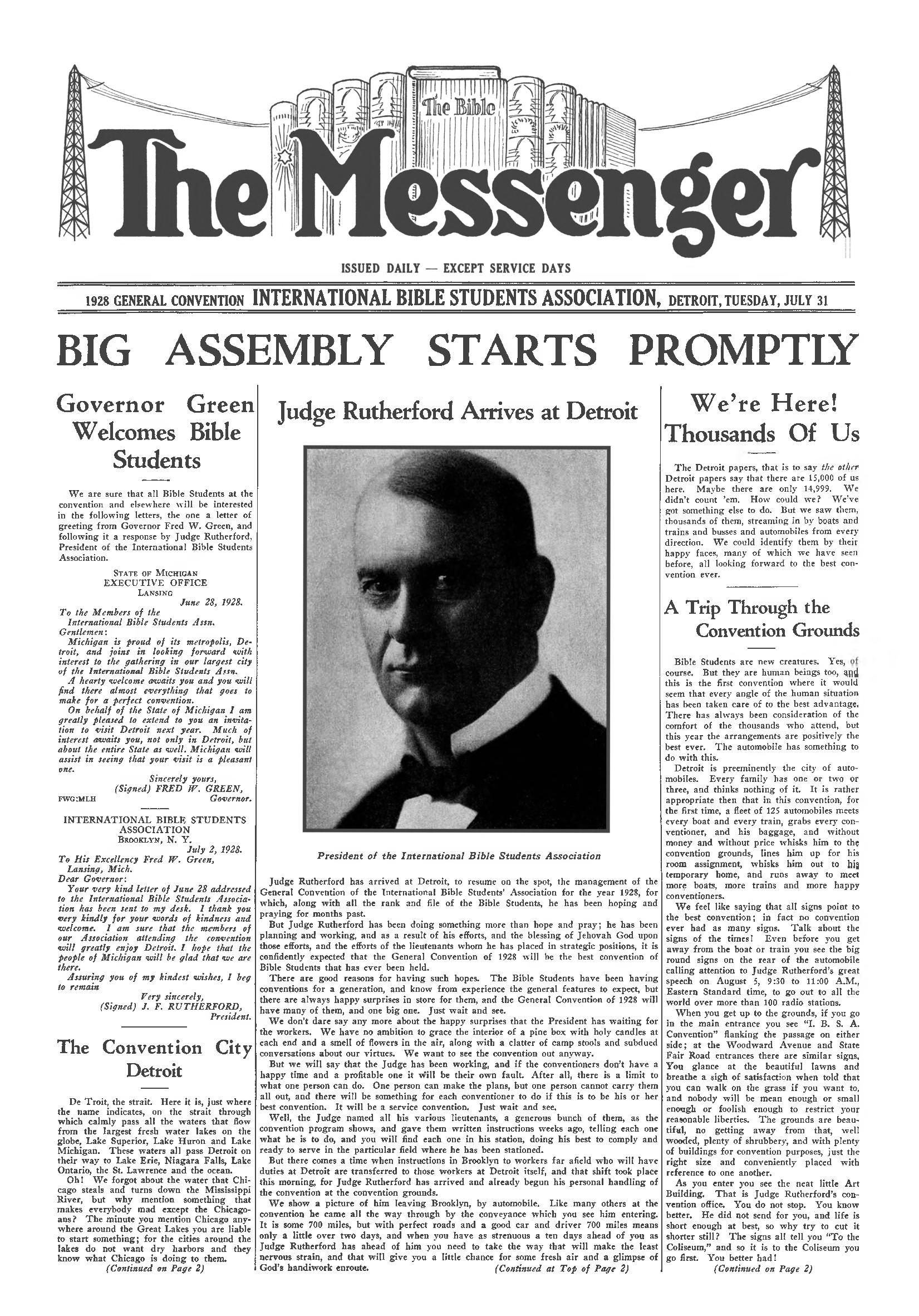
ISSUED DAILY — EXCEPT SERVICE DAYS
1928 GENERAL CONVENTION INTERNATIONAL BIBLE STUDENTS ASSOCIATION, Detroit, Tuesday, july 31
BIG ASSEMBLY STARTS PROMPTLY
Governor Green Welcomes Bible
Students
We are sure that all Bible Students at the convention and elsewhere will be interested in the following letters, the one a letter of greeting from Governor Fred W. Green, and following it a response by Judge Rutherford, President of the International Bible Students Association,
State of Michigan EXECUTIVE OFFICE Lansing
June 28, 1928.
To the Members of the
International Bible Students Assn. Gentlemen'.
Michigan is proud of its metropolis, Detroit, and joins in looking forward with interest to the gathering in our largest city of the International Bible Students Assn.
A hearty welcome awaits you and you will find there almost everything that goes to make for a perfect convention.
On behalf of the State of Michigan I am greatly pleased to extend to you an invitation to visit Detroit next year. Much of interest awaits you, not only in Detroit, but about the entire State as well. Michigan will assist in seeing that your visit is a pleasant one.
Sincerely yours,
(Signed) FRED IV. GREEN, FWG:mlh Governor.
Judge Rutherford Arrives at Detroit
INTERNATIONAL BIBLE STUDENTS ASSOCIATION Brooklyn, N. Y.
July 2, 1928.
To His Excellency Fred W. Green, Lansing, Mich.
Dear Governor:
Your very kind letter of June 28 addressed to the International Bible Students Association has been sent to my desk. I thank you very kindly for your words of kindness and welcome. I am sure that the members of our Association attending the convention will greatly enjoy Detroit. I hope that the people of Michigan will be glad that we are there.
Assuring you of my kindest wishes, I beg to remain
Very sincerely, (Signed) J. F. RUTHERFORD, President.
The Convention City Detroit
De Troit, the strait. Here it is, just where the name indicates, on the strait through which calmly pass all the waters that flow from the largest fresh water lakes on the globe, Lake Superior, Lake Huron and Lake Michigan. These waters all pass Detroit on their way to Lake Erie, Niagara Falls, Lake Ontario, the St. Lawrence and the ocean.
Oh! We forgot about the water that Chicago steals and turns down the Mississippi River, but why mention something that makes everybody mad except the Chicagoans? The minute you mention Chicago anywhere around the Great Lakes you are liable to start something; for the cities around the lakes do not want dry harbors and they know what Chicago is doing to them.
(Continued on Page 2)
President of the International Bible Students Association
Judge Rutherford has arrived at Detroit, to resume on the spot, the management of the General Convention of the International Bible Students’ Association for the year 1928, for which, along with all the rank and file of the Bible Students, he has been hoping and praying for months past.
But Judge Rutherford has been doing something more than hope and pray; he has been planning and working, and as a result of his efforts, and the blessing of Jehovah God upon those efforts, and the efforts of the lieutenants whom he has placed in strategic positions, it is confidently expected that the General Convention of 1928 will be the best convention of Bible Students that has ever been held.
There are good reasons for having such hopes. The Bible Students have been having conventions for a generation, and know from experience the general features to expect, but there are always happy surprises in store for them, and the General Convention of 1928 will have many of them, and one big one. Just wait and see.
We don’t dare say any more about the happy surprises that the President has waiting for the workers. We have no ambition to grace the interior of a pine box with holy candles at each end and a smell of flowers in the air, along with a clatter of camp stools and subdued conversations about our virtues. We want to see the convention out anyway.
But we will say that the Judge has been working, and if the conventioners don’t have a happy time and a profitable one it Will be their own fault. After all, there is a limit to what one person can do. One person can make the plans, but one person cannot carry them all out, and there will be something for each conventioner to do if this is to be his or her best convention. It will be a service convention. Just wait and see.
Well, the Judge named all his various lieutenants, a generous bunch of them, as the convention program shows, and gave them written instructions weeks ago, telling each one what he is to do, and you will find each one in his station, doing his best to comply and ready to serve in the particular field where he has been stationed.
But there comes a time when instructions in Brooklyn to workers far afield who will have duties at Detroit are transferred to those workers at Detroit itself, and that shift took place this morning, for Judge Rutherford has arrived and already begun his personal handling of the convention at the convention grounds.
We show a picture of him leaving Brooklyn, by automobile. Like many others at the convention he came all the way through by the conveyance which you see him entering. It is some 700 miles, but with perfect roads and a good car and driver 700 miles means only a little over two days, and when you have as strenuous a ten days ahead of you as Judge Rutherford has ahead of him you need to take the way that will make the least nervous strain, and that will give you a little chance for some fresh air and a glimpse of God’s handiwork enroute. (Continued at Top of Page 2)
We’re Here!
Thousands Of Us
The Detroit papers, that is to say the other Detroit papers say that there are 15,000 of us here. Maybe there are only 14,999. Ws didn’t count ’em. How could we? We’ve got something else to do. But we saw them, thousands of them, streaming in by boats and trains and busses and automobiles from every direction. We could identify them by their happy faces, many of which we have seen before, all looking forward to the best convention ever.
A Trip Through the
Convention Grounds
Bible Students are new creatures. Yes, of course. But they are human beings too, and this is the first convention where it would seem that every angle of the human situation has been taken care of to the best advantage. There has always been consideration of the comfort of the thousands who attend, but this year the arrangements are positively the best ever. The automobile has something to do with this.
Detroit is preeminently the city of automobiles. Every family has one or two or three, and thinks nothing of it. It is rather appropriate then that in this convention, for the first time, a fleet of 125 automobiles meets every boat and every train, grabs every conventioner, and his baggage, and without money and without price whisks him to the convention grounds, lines him up for his room assignment, whisks him out to his temporary home, and runs away to meet more boats, more trains and more happy conventioners.
We feel like saying that all signs point to the best convention; in fact no convention ever had as many signs. Talk about the signs of the times! Even before you get away from the boat or train you see the big round signs on the rear of the automobile calling attention to Judge Rutherford’s great speech on August 5, 9:30 to 11:00 A.M., Eastern Standard time, to go out to all the world over more than 100 radio stations.
When you get up to the grounds, if you go in the main entrance you see “I. B. S. A. Convention” flanking the passage on either side; at the Woodward Avenue and State Fair Road entrances there are similar signs. You glance at the beautiful lawns and breathe a sigh of satisfaction when told that you can walk on the grass if you want to, and nobody will be mean enough or small enough or foolish enough to restrict your reasonable liberties. The grounds are beautiful, no getting away from that, well wooded, plenty of shrubbery, and with plenty of buildings for convention purposes, just the right size and conveniently placed with reference to one another.
As you enter you see the neat little Art Building. That is Judge Rutherford’s convention office. You do not stop. You know better. He did not send for you, and life is short enough at best, so why try to cut it shorter still? The signs all tell you “To the Coliseum,” and so it is to the Coliseum you go first. You better had!
(Continued on Page 2)
Not saying anything against traveling by train, but it seems as if it had passed its heyday, doesn’t it, when you see the millions of automobiles scurrying everywhere and traveling at almost the speed of your train? Many of the trains that used to be loaded with passengers now have few. Great busses speed everywhere. It is a new day.
The Bible Students have the message of the new day. They are glad to be in convention, the long-looked-for General Convention of 1928. They have confidence in God that they will get some wonderful blessings and some wonderful thrills out of this convention. They have had some already and will have more. They are sure of happy surprises, plenty of them. They are glad to greet Judge Rutherford, their President They know that he has been thinking for them and planning for them for months. They welcome his arrival. Hurrah for the Judge!
The Advance Man
He Will Now Have a Chance to Catch Up on His Sleep
Here we see the President’s advance representative, sent to Detroit six weeks ago. In conjunction with Alexander Macmillan he has been busy every day all day all that time getting things in shipshape for the Convention.
The Judge Starting on His 700 Mile Trip to Detroit Convention
“Dick” Johnson
A Trip Through the Convention Grounds
The Convention City
WOODWARD AVENUE
(Continued from Page 1)
But Detroit has no need to fear. The river, where it passes the city, is hundreds of feet deep. Whatever happens to other ports, Detroit will always be sure of plenty of water. And there will always be plenty of boats. Thirty thousand vessels traverse Detroit River every year, making it one of the busiest waterways in the world.
Detroit has no intention of confining herself to water transportation—not Detroit. For her there are some of the finest railroad systems in the world. Over a score of lines the finest trains in the world rush direct to Montreal, Boston, New York, Philadelphia, Washington, Cincinnati, St. Louis, Chicago; and if you can’t get to where you want to go from some one of those towns, then there isn’t any such place.
But Detroit has no intention of limiting herself to water and rail transportation. She is beyond all comparison the banner automobile city of the world, making around three million automobiles and trucks a year, with a value of over two billion dollars. Detroit has taught the world to run around on rubber wheels, and runs that way herself, too.
And finally, Detroit has no intention of limiting herself to travel by water and rail and rubber tires—not Detroit. She is the banner American city for the manufacture of airplanes, and is a pioneer in their use. Detroit now has forty airplane factories, all running full speed.
Do you know why it is that Detroit has given up railroads and is even sort of kissing good-bye to automobiles and going in for aviation? It is so that they can get up to the Fair Grounds and back on the same day. But they have to go some.
Detroit is the fourth largest city in the United States. The design of the city is that of a wheel. Some of the spokes are fifty miles long. It has plenty of parks, 51, and its island park, Belle Isle, is famous far beyond Detroit. The city has its own water works and lighting plant, and its own street car system, but has foolishly turned over to the Detroit Edison Company all right to supply private lighting and power.
The programme or a map or something shows that you go out Woodward Avenue to the Fair Grounds, and the convention is held out there. In a general way the route is the one that Peary and Doc. Cook followed, via Newfoundland, Labrador, Baffin’s Bay, Greenland, the polar circle, and so on all the way up.
After you have ridden for an hour or so you expect every minute that you will run out of the city and see the familiar high board fence that used to show us that we had got to the race track. Then you run into another bunch of big buildings and the city begins all over again. You get discouraged and fall asleep.
You spend a night or so in the sleeper, wake up and rub your eyes. Hurrah! You
SOME OF THE
Here we see, in the order named, some of the representatives of’ various departments of the convention organization: Assistant chairman, hospital, transportation, music, are getting out of the city. No! It isn’t so. It’s only one of the Ford plants, and you have mistaken its lawn for a pasture. Your guide carefully tells you that this is only a little plant, not much account any more, for it has only 30,000 employes. You look down a mile or so of buildings and believe him, or try to.
Edward Lueck
Everett McCosh
Richard Barber
Edmund Walters
Riding along another day or so you fall asleep again, the chariot gives a lurch to the right and you open your eyes again, confidently expecting to see polar bears playing with chunks of the Pope’s cross. But it isn’t so; you are at your destination.
Most of the Bible Students are located within a few hundred miles of the Pole; and so they don’t mind the distance—after they get there.
CONVENTION AIDES
automobile parking, radio hookup, colporteur work, publishing, foreign language meetings, cashier, radio programs, service and bookroom supplies.
George Hannan
(Continued from Page 1)
Over the front entrance to the big Coliseum is a sign—it must be fifty feet long— reading “International Convention, Bible Students Association. All persons devoted to Jehovah, Welcome. July 30 to August 6.” You enter, and the first thing you notice on your left is the office of the Chairman. It says “Chairman” on it, and it also says “Keep Out.” You know the Chairman and you say to yourself, “Just like him. What else could you expect?”
Your guide does not give you time to think of anything mean to say to the Chairman, but hurries you along into the great auditorium with its permanent seating capacity of many thousands in the galleries and its tanbark floor where seats can be conveniently arranged to seat as many more. The Coliseum will comfortably care for audiences of 10,000.
The speaker’s platform is in two elevations, one for use of the lecturers and the other for the workers who, during the convention, rouse one another to great enthusiasm as they narrate their experiences in the Lord’s work, or testify to their appreciation of the truths which He is unfolding to them. Workers’ testimonies are short; the line moves up one little flight of steps and down another.
The platform is tastefully draped with white and yellow bunting. Between the upper and lower platforms is a very pretty sign, “Sing forth the honor of His name. Psalm 66:2.” It is made in red letters with blue shading, on a white background, and has a green border all around the edge. Microphones and a little manuscript table are handy. The orchestra will be on the upper platform.
Returning to the front of the Coliseum your guide offers to take you around the circle beneath the galleries. There is still the Chairman’s office with its inviting sign “Keep Out.” You take the advice. It is best to do so. Why have your friends weeping and wearing crepe at convention time? And anyway, why bother the Chairman when all you want to see him for is to shake his hand and call him “Brother,” when as a matter of fact you know that he thinks this “Brother” business has been overdone and would rather (Continued on Page 7)
Arthur Goux Robert Emery Clayton Woodworth Evander Coward Hugo Riemer Frederick Franz
Adam Donald Amos Eshleman
A Proxy Trip Through Bethel and the Factory
The Story of a Book
Part I
There is no place on earth that is dearer to God’s faithful “remnant” than the Bethel Home at 124 Columbia Heights, Brooklyn, New York. In a most important sense the president of the Association wishes all such to feel that the Bethel Home is their home. It is the official headquarters, the center of God’s work in the earth.
Perhaps some who read this and appreciate the genuine cordiality back of the above paragraph will feel like rushing straightway into the Bethel; but the “remnant” themselves will not do that, for several excellent reasons: First, they have something vastly more important to do than to spend their time loafing, sometimes called “visiting,” sometimes inappropriately named “fellow-shiping”.
In the second place, when they arrive at the Bethel there will be nobody to “loaf” with, to “visit” with, to “fellowship” with. The Bethel Home is, so to speak, not a guest house, a court house or a play house, but a work house, where 180 husky and energetic young men and active and capable young women are on the go every minute, from the time the rising bell rings at 6:30 until the lights go out at 10:30. They have something to do besides visiting.
So then, you are all invited to come to the Bethel, when convenient to all. Under the circumstances, the best way to come and about the only way to come is by proxy, so that is why we call this “A Proxy Visit to the Bethel.” It is the only way that most of you can expect to see it, or should wish to.
Columbia Heights is on the crest of a small cliff. The lots on the west side of the street fall off sharply sixty feet from the street in front of the Bethel to the street in the rear, so that when one enters at the Columbia Heights street level the new building contains six stories above his head, and if he walks through to the rear of the old building he has six floors beneath his feet. Five floors are common to both buildings and interconnected.
This terrain provides two complete floors below the Columbia Heights level which are cut off from the noises of the street, and yet are flanked on both sides and in the rear by open spaces. On the north of the building and opposite the end of Orange Street is one of the city’s breathing spots.
The park commissioners have had this area terraced and sodded and its borders planted with shrubbery, so that in the summer time the Bethel dining-room is favored on its north side with glimpses of green foliage. It is as though the Lord planned it all, that those who are laying down their lives in his service might have a little taste of the blessings he so lavishly bestows upon the world at large.
The Bethel Location
It is evident that the hand of God has been over the Bethel from the time the old Henry Ward Beecher home was bought, which home was not on the breathing space above described, but was separated from it by another property which was purchased and added to the original Bethel Home in the early part of 1909. One reason for thinking this is that the Lord did not smile upon the efforts which were made to dispose of the property during the stormy days of 1918 and 1919, despite the fact that a building boom was on about then and properties of
Bethel Home, containing the Executive Offices and living quarters of the family
all kinds were being sold at double their purchase price.
In 1926 the property adjoining the Bethel on the south was also purchased and added to the Bethel Home. The three old buildings in the front were removed and a monolithic structure, faced with brick and trimmed with limestone, was erected to take its place. The rear of the recently acquired lot provides a breathing space opposite the dining room on the south similar to the one on the north, except that it does not contain any fountain erected by the city.
In 1909, on the two lots first above mentioned, the Society erected the old Bethel building, a steel and brick structure resting on Furman Street in the rear. Four floors of this structure face on Furman Street but are shut off on the other three sides by the cliff or the side walls of the adjoining structures. These Furman Street rooms serve a very useful purpose in the operation of the home, as wall be described.
There is no sham nor pretense about the Bethel. The structure itself is not ornate in its appearance, either outside or inside, but is built for service and efficiency. People cannot be efficient if they are dirty or uncomfortable or disorderly. Therefore, the Bethel Home is clean, comfortable and orderly. In designing it Brother Rutherford had but one thought in view, that it should serve God’s purpose, be an honor to His name.
Heaven’s First Law Observed
THE first impression one gets of the Bethel is not of stiffness, nor formality, nor reserve; but it certainly is one of order. One rings the bell, the door automatically unlocks, and he enters the vestibule whence he passes up steps into the lobby, where a friendly but businesslike young woman wishes to know his business. Those who have been out in the service work and have made a specialty of canvassing office buildings will suddenly realize that this is a very embarrassing moment and that a real good story must be told or no further progress will be possible.
The Reception Lobby
The Parlor
The Messenger “Idiotorial” Staff, Accompanied by Their Official Photographer, Invaded the Executive Offices on the
Seventh Floor
Perhaps the visitor will say that he wishes to see Brother Rutherford. He may even expect to rush right up to the seventh floor and burst into the study and be greeted like a long lost brother because he is in the truth and Brother Rutherford is in the truth, and likely it was reading his writings that got him into the truth, and therefore he ought to be glad to see him.
But, alas, the young lady smiles at him and asks if Brother Rutherford sent for him, and he feels his pulse and says, No. She picks up the house phone and calls the house manager, and a business-like young man enters and in a few brief questions finds out that he is merely the editor of The Messenger and what he really desires is to go through the Bethel Home.
The house manager explains that while the president, as everybody knows, is a very affable, courteous and kindhearted man, yet he is one of the busiest men that ever lived and has been forced to guard every moment of time as carefully as a pawnbroker guards his diamonds; the president has hours when he sees people. Does the editor of The Messenger wish to consult with the president’s secretary and arrange for an interview? That would be the way to go about it.
The President’s Quarters
Let us suppose that an interview has been arranged and a time has been set. The president’s quarters are on the top floor reached by an Otis automatic elevator, which requires no operator except the person who wishes to make the ascent, and therefore is of no expense except for the electric current necessary to operate it.
One is on the first floor, the elevator may be on the fifth floor. He presses the button, a signal tells him the car is coming. In a jiffy it comes down and stands in front of him. All he has to do is to open the door, step into it, close the gate, press the button indicating the floor at which he wishes to alight, and in another jiffy he is at his destination.
Arrived in the hallway between the president’s study and the workroom of his secretaries, he finds a bench where he may sit and cool his heels until such time as the secretary comes out and tells him that he may go in. When entering he immediately finds Brother Rutherford as genial, kindly and affable as ever, possibly willing to take a moment of his time to show a personal friend his bedroom or his little work place on the roof, where in certain seasons he can do some of his work out in the fresh air and sunshine. Why not? Everybody else finds that a little sunshine is good for one; and it is also good for people who work sixteen hours a day and who must get it while they work or not at all.
His business transacted, and the interview being at its natural end, the elevator is again sought and access is gained to the floor below, where opportunity is provided to glance at one of the bedrooms, of which there are seventy-five in the new building and forty in the old building, practically all alike.
A Typical Bedroom
All the rooms in the house are numbered in such a way that the number indicates the floor and whether or not the room is in the old building or the new building. The two buildings are now really one because the main hallway of the home runs through from front to back. Even numbers are used for the rooms in the new building, and odd numbers for the rooms in the old building
When a new member enters the home he is assigned a room and a seat at the dining room table, and a key number is set apart for him. He automatically receives his key to the Bethel Home sixty days after he becomes a member of the Bethel family. If he loses that key he is out of luck. He never gets another.
A representative bedroom is twelve by eighteen feet in size, with two windows, two metal single beds, good mattresses, springs and bedding, a chiffonier, a bookcase, a pietal waste basket, two study tables, two indestructible chairs, a metal dish for fruit and peelings, one large and one small horsehair rug, a wash basin with hot and cold running water, a radiator, a bath cabinet, and a towel rack with a hand towel and a bath towel for each person in the room, changed twice a wreek. No nails may be driven in the walls, nor may washing of any description be done in the rooms.
Here's the Bethel Family at work on a job they do right well; no covers on upside down, no miscollations, everybody
The rooms are lighted from the ceiling. There is another light over the mirror convenient for shaving. Each room is provided with a nice large sanitary closet, and each door contains an adjustable metal ventilator. There are metal corners on all plastered walls, adjustable window strips and window screens built to last. They are put together with screws and the copper wire is put on
of Bethel Home a Few Days
Before Coming to Detroit, and Here We Show You What
We Got
with copper nails, in the belief that Abraham will be appreciate the job. When time permits, the walls of the bedrooms will be tinted some pleasing color.
Hallways and Lavatories
There is a window in each hall, with a radiator just beneath it. On the first floor there is a runner in the hall. Besides the elevator there are two stairways in the old building and one in the new. Metal fire doors separate the old and new buildings, but these doors remain open except in the case of fire.
As a matter of fact, both buildings are fireproof, yet in order to comply with city regulations there are fire stations on each floor, with one hundred feet of fire hose at each station, so arranged that the hose is ready for use instantaneously in case of fire.
satisfied. (But what a noise they sometimes make with their tools after 8% hours9 handling tons of paper!)
The lavatories are carefully designed so as to be sanitary and easily cleaned. They have been installed with shower baths, less expensive, more desirable and more modern than tubs; although tubs are provided for those who wish them. All the lavatories have outside windows and, also, inside ventilation by means of shafts to the roof.
In each hall there is a linen closet, a soiled-linen closet, a closet containing a hopper for the use of those engaged in cleaning the rooms, and a closet provided with a large bag kept hanging wide open, in which the waste papers from each floor are placed daily. These bags are removed periodically by brethren who also do all the scrubbing pf floors and cleaning of windows.
The stairways are provided with handrails and iron treads. They ought still to be in good condition when Abraham takes over the premises. The electric wiring is so arranged that if there is trouble with the lights on one floor the lights on that floor can be cut off without disturbing any other part of the home. There is a house phone on each floor.
The Service Floor
The service floor for the great Bethel family is on the floor immediately beneath the lobby, which, as previously explained, is yet one floor above the terrain on either side. This floor contains a large and handsome parlor with sixteen pieces of beautiful wicker furniture, an automatic piano, and four ex= cellent rugs. It is equipped with radio, contains some plants, and two of its windows face on the park area to the north. The room is finished in buff. All visitors must be received in the parlor, nowhere else.
Immediately adjoining the parlor, and under the lobby stairs, is a coin-box tele-’ phone booth for the convenience of the family. Next to this is the library, equipped with encyclopedias, files of the Society’s publications, and seven easy chairs. Large pic-tures of Christ and of Brother Russell adorn the walls.
This floor contains the office of the house manager and of the treasurer. The latter office contains a vault, built in, is carpeted, and is provided with a marble counter and wicket gate. Adjoining the office of the house manager is a typewriter room for the convenience of those who prepare radio talks. Next to it is a music room where members of the family practice for radio service. This floor contains the linen room and sewing room, where the linen is kept in repair. Also a blanket room, where the blankets are stored.
On this floor also is the Bethel’s empty hospital, one ward for the men and one for the women. The Bethel family keep well because their food is wisely chosen. Nevertheless, every room is visited the first thing in the morning to see if everybody is up. If not, the case is reported at once to the house manager. The regular house treatment of the sick is the common sense one of an enema, complete rest from food, and plenty of lemon juice and fresh air. In an entire season practically all cases have responded to this treatment in one day; but if results do not come, a physician is summoned. This floor contains two study rooms for the family; no conversation is permitted in these rooms. Every room in the house is a study room, because the home is one for the studv of God’s Word.
A convenience for the family is that all mail and small packages are delivered direct to the rooms.
The Dining-Room Floor
The dining-room floor occupies the second floor below the lobby. It contains one of the meeting-places for the family where its Ber= ean studies and home prayer meetings are held. This room looks out upon the lawn back of what was formerly the Stone place, and is a very pleasant room. Adjoining the meeting-room is the receiving and shipping department of the home, where all packages are received by means of a parcel elevator I which occupies a portion of the grated area
between the sidewalk on Columbia Heights and the building proper.
This floor contains the Frigidaire, in which fresh fruits and vegetables, milk, butter, eggs, etc., are kept at a constant temperature until such time as they are needed in the kitchen. It also contains the food storeroom, a model of order. The barreled foods are in one place, boxed material on another platform by themselves, cereals on another platform, and canned goods on another. All food received is inspected, the weight and quantity are checked, and food not up to the standard is rejected and returned to the seller. Only that is paid for or used which is up to the standard. All food is bought in quantity.
The dining-room proper is fifty feet square with five long tables, each seating thirty-six persons. Each member of the family has a definite seat, and also knows definitely when his time comes to assist with the dishes after the evening meal and on Sundays. On Saturday evening and Sunday noon and evening, meals are served cafeteria style, each person washing his own dishes.
Breakfast is served at 7 o’clock (6 o’clock Eastern Standard time in the summer), dinner at 12:15, supper at 6 p. m. There is plenty of plain, wholesome food, excellently cooked; pies and cakes are few and far between. Fresh fruits in season take their place and are better for everybody. The diet is admirably planned to keep everybody in good health.
Brother Rutherford himself presides at the table. The morning meal is preceded by praise, prayer, the giving of thanks for the food, and includes a consideration of the text for the day. Other meal times provide opportunities for news items and the consideration of Bible or other questions.
The dining-room is finished in buff, with ivory ceiling, and presents a very fine appearance. Frequently there are flowers on the table brought in, perhaps, by those who have been out in the service work. The chairs are indestructible and fitted with rubber tips on the feet, making them noiseless when moved about on the concrete floor. An electric clock gives the exact time, and is so wired as to automatically call attention to itself by a red flag when needing attention.
Table cloths are changed twice a week; napkins the same. There is a loud speaker for the president’s use so that he may be heard in all parts of the dining-room. Next to the kitchen is a dish-washing machine which saves the time of one person a day. Coffee and hot water urns are sanitary and conveniently arranged.
Kitchen and Other Work Rooms
The kitchen is on the same floor as the dining-room, but is cut off from it by a service passageway for the waiters. Access to the kitchen window is so arranged that the waiters pass the opening in one direction only. There they are served with the food in bulk, whence they distribute it to the president and the nine brothers appointed by him to sit at the ends of the various tables. The kitchen itself has a large bakeoven, gas-oven, steam cooker, two steamkettles, a Frigidaire for current needs of the cook, and an ice-making machine. Pots and pans are hung on hooks suspended from the ceiling.
On the first floor below the kitchen is a trunk room so arranged that the single sisters have their trunks on the floor where they have ready access to them, while the others are on racks easily accessible to men. This floor contains another music room, equipped with a piano, where brothers or sisters practise for radio service. It also contains the sisters’ personal laundry room, equipped with porcelain tubs, gas stove, and other conveniences.
The President's Study. Here's where the book starts
His Secretaries Who Get the Manuscript All Ready to Turn Over to the Shop
The Library
Oh how we hate to get up in the morning"
The Story of a Book
The second floor below the kitchen contains “the shop”, an important center for the carpentry, plumbing, steam-fitting, electrical work and machine work in a house the size of the Bethel. Adjoining it is the shoe-shop where, with the aid of a shoe-repair machine made in the Bethel Home, a sister may have the best of rubber heels put on her shoes for twenty-three cents a pair, or may have soles nailed on her shoes for fifty-five cents, or sewed on for ten cents more. On account of their bigger feet, the brethren pay five cents more for their heels and ten cents apiece more for their soles. Serves them right! They have no business to have such big feet.
This floor also contains the housekeeper’s storeroom, where is kept the stock of liquid soap, hand soap, bath soap, ammonia, toilet paper, mops, and other housekeeping supplies.
The third floor below the kitchen contains the Bethel laundry, where the family wash for 180 hard-working men and women is done shipshape in jig time with the aid of the latest machinery. Two men operate the laundry, but receive assistance with the ironing. On this floor there is a machine for pressing suits and coats.
Down on Furman Street, four floors below the kitchen, is the family coal bin, wherein at this time is stored two hundred tons of coal. Here are also the two large boilers for heating the house, with smaller ones used in the summer-time to make hot water. Visitors and strangers are not permitted in the work shops of the home. Bethelites have to keep out, too.
Oh! We forgot to say that from almost any place in the Bethel you can see the old Brooklyn Bridge, practically all of Lower Manhattan, which is the very heart of Satan’s rule in the earth at this time, and the tops of the masts of some of the ships that sail to South America, which are so close that you almost feel as if you could reach out and touch them. Their giant noses lie just across from Furnam Street.
Retracing our steps to the lobby, we notice that both the vestibule and the lobby are finished with marble slabs and that there is a terrazzo floor in foot squares of white, alternating with white and brown, separated by brass rules. We notice that the vestibule is well lighted from the ceiling; has rubber mats in the path of those who may come in with wet feet; and has seats and benches sufficient to accommodate a half dozen persons at a time.
As a last item of interest, we are shown the Bethel register in which everybody who comes to the Bethel must register; nobody comes unless invited. Hope you enjoyed your trip through the Bethel, one of the most interesting as well as one of the busiest places on earth. But if you think that is busy, you ought to see the factory.
(To be continued to tomorrow's issue,)
A Trip Through the Convention Grounds
(Continued from Page 2)
be called “Mister” or just plain “Sir”? We ignore him and go on our way.
Next to him is the office of the publisher; the less said about him the better, and the same is true of the radio department ensconced in the same quarters. We see the same signs here, “Keep Out.” These fellows must either be a lot of grouches or else they have something else to do besides visit and shake hands and fall on one another’s necks and cry “Brother, Brother.” Let’s take the charitable view. Probably they are very busy and don’t want to be disturbed, and in fact can’t be, without seriously interfering with their work.
We go on around the circle. On the right is a Western Union operator busy sending and receiving messages. We keep away from him. On the left is a check room big enough to handle the wraps of 10,000 people. On the right again is a “Convention Bulletin Board,” one of three, reserved for official bulletins.
NOW IS THE ACCEPTED TIME
Notice to all Conventioners—Here they are, packing the books for those that are going out as Jehovah’s witnesses, throughout Detroit and adjacent cities and towns on service days. Go and see them at once, get your books and make all your plans for your share in these blessings, immediately. Do not wait. There are always some who are late for every thing in this life. They are not born when they should be, and they don't die when they should; and they are late at everything in between. Don't be one of the late ones. Be early and be sure to be out with your books when the service days come around. The books are your badges to Detroiters that you are one of the real honest-to-goodness Bible Students.
Forging ahead, we come to the “Book Room” where we find stalls for the sale respectively of Polish, Greek, German, Hungarian, Lithuanian, Russian, Ukrainian and Italian, one stall for each. The English stall is subdivided. There is a separate stall each for song books, Bibles, mottoes and the books of Judge Rutherford, service books, so called, which will be sold on service days. There is a special section here for full-time colporteurs and members of the Bethel family where, it is suspected, those favored mortals get books at special rates not available to the rest of mankind.
Opposite the book room is a most interesting exhibit. Here the workers may see, many of them for the first time, the processes through which a book must go. There is no machinery in this exhibit, but the books themselves are shown, step by step. Curious minds may see the book in its original form as “copy,” then galley proofs, page proofs, mats, stereo plates, press proofs, books assembled, books smashed, books cut, books trimmed, books glued, books rounded, back-lined and cased-in.
Going on around the circle we find the Colporteur Department, where the sale of The Messenger is negotiated and questions are answered regarding the colporteur work. In another booth Territory Assignments are cared for. A large section is divided into stalls where the Regional Directors E. D. Orrell, H. S. Murray, F. H. Dougherty, E. B. Sheffield, W. J. Thorn, M. L. Herr, H. E. Hazlett, George Draper and J. C. Rainbow are ready to receive excuses as to why territory is neglected, and to prove that there is nothing in them.
On the far side of the circle is a special Bulletin Board for the use of the conventioners where somebody who met somebody some years ago somewhere else can arrange to meet somebody some time at some place in Detroit during the Convention of 1928, with a fair chance that he or she will fall oyer that person within five minutes after leaving the Bulletin Board. Nevertheless a board of this kind gives joy to some; so why deprive them of it?
Hard by is the Information Bureau, where a trusted staff is ready to give information on any subject under the sun. Past experience shows that no question can be framed in the human mind that is not put up to these long-suffering individuals. But, when you come to think of it, they don’t deserve any sympathy; else why should they take such a job. Their specialty is validating tickets and telling about the best way to get from anywhere on the planet to any other place on the planet, via Detroit and way stations.
A feature that will be greatly appreciated is a section of neatly arranged writing tables next to the Post Office. Separate windows at the Post Office are marked “Get mail here,” “Messenger wrappers and postage stamps” and “Telegrams”. Mailbags, one for each state, are provided for the mailing of Messengers* Conventioners do their own mailing of Messengers but not of letters.
Next to the Post Office is the department of Room Assignments, and at the conclusion of the trip around the circle is the fully equipped photographer’s office where the official pictures of the convention will be developed and completed.
Adjoining the Coliseum, in the Agricultural Building, is the Polish Convention hall, fitted with 1,200 seats, and connected by wire and loud speaker with the Coliseum so that when Judge Rutherford speaks all may hear. The Hungarian sessions will be held in the Dairy Building, German sessions in the Main Building, Ukrainian sessions in the Electrical Building. Greek sessions in the Machinery Building.
At last reports the Czechoslovakian, Russian and Italian meetings were projected to be held in the Boys and Girls Building, with some fears expressed that too much Italiano in too loud a voice by some fervent lover of Jehovah and His plan might make it necessary for the Czechoslovakians to flee to another of the adjacent buildings. When a real Italian Bible Student gets to going in his native tongue it is time for everybody in the block to move out.
The hospital and nursery are quartered in the beautiful light and airy Women’s Building, an ideal place for them. There are comfort stations all over the grounds.
The “eating place”! Oh yes! You can’t miss it. Five signs head you toward it, and it is a marvel of neatness and efficiency. Sixteen entrances and exits enable 10,000 conventioners to move in and out and up to the grandstand with their lunches in jig time, and good lunches, too. You can’t go wrong. All you have to do is to follow the crowd.
There are whole wheat buns (no white bread—notice that), with every kind of filling that any reasonable man could want in them, ten cents a bun; milk, buttermilk, ice cream, frostbites, ginger ale, all cheap and good. No pop sold on the grounds. Pop is no good.
Parking space for 800 cars is laid off by streets under the care of Bible Student police, whose happy duty is to guide cars in one way and out the other with no delay and no confusion. Every car has its own numbered stall. On the side of the Coliseum is a special parking space for the twenty-five official cars. It is hard to see how the arrangements of the Detroit Convention could possibly be improved upon.
Reports of Monday’s Sessions at the
Coliseum
“Sing Forth the Honor of his Name" By R. J. Martin
The longer I’m in the truth, the more I study the flashes of light that come from the Lord out of his temple, the more I am con* vinced that the principal reason the Lord’s people are on earth today is that they might sing forth the honor of his name. Jehovah’s name stands for himself; it likewise stands for his plans and purposes. As a free moral agent God at some time decided upon strict adherence to the principles of truth and righteousnes and also that such principles should govern the entire universe. And such has been the case, with the exception of two instances so far as his Word reveals, which exceptions have been permitted by him for the ultimate good of his intelligent creation who, like himself, are free moral agents.
The rebellion of Lucifer in heaven and the disobedience of Adam on earth are the two cases of the violation of God’s law. Both of these have resulted in dishonoring his name, in pushing it into a corner, in besmirching his reputation in the minds of practically the whole human race and a great number of the angelic host. Of course Satan was and is the arch criminal; Adam and his offspring are Satan’s poor dupes. Satan has done this in order to exalt himself that he might receive the worship of men and keep them in'subjection to himself. God could have prevented the enemy from so doing; but it is manifestly the purpose of Jehovah to permit Satan to demonstrate his full and complete depravity, that others of his creation may learn the baneful effects of sin and the blessings resulting to those who adhere to the principles of truth and righteousness and who honor Jehovah’s name.
God has not in the past pushed his name to the fore, except at stated intervals, and then not for a selfish purpose, but for the benefit of his creatures. In no way other than loyal faithful adherence to the principles of truth and righteousness, God’s standard, can any intelligent creature either in heaven or on earth enjoy everlasting life. The material universe always has, without any exception, reflected glory and honor to Jehovah’s great name. “The heavens declare the glory of God; and the firmament showeth his handiwork. Day unto day uttereth speech and night unto night showeth knowledge. There is no speech nor language where their voice is not heard.”—Psalms 19:1-3.
While heretofore, with few exceptions, Jehovah has done very little to defend his name, he has kept his good promises to the fore in that he has always had some faith* ful one on earth who has borne witness to his word of promise. The prophets of old, Jesus, the apostles and all faithful footstep followers of Jesus down through the Christian era have with their very lives defended God’s word of promise. His word of promise is his will and is perfect. Right now the time is at hand when the Lord will magnify his holy name before the human family. This great event had its beginning in heaven in 1914, when Jesus assumed the power and authority granted him by Jehovah, ousted Satan and his cohorts, and now as God’s executive officer has assumed control of the earth and in due time will vindicate Jehovah’s name before poor benighted mankind.
The issue will soon be determined in favor of Jehovah. He will have a witness given on the earth for the purpose of magnifying his name and this witness must be given now. The faithful members of the body of Christ on earth are granted the privilege of bearing witness to that great fact. Therefore, God says to them: “Ye are my witnesses and my servant whom I have chosen; that ye may know and believe me and understand that I am he: before me there was no God formed, neither shall there be after me . . . Therefore ye are my witnesses, saith the
So This is Detroit
The Opening Address Being Delivered by the Chairman at 2:30 Yesterday After, noon.
Lord, that I am God.”—Isaiah 43:10, 12.
Those now in the temple class, God has called and taken out from the world as a people for his name. It becomes their duty then, to show forth his praises. How can anyone who claims consecration to the Lord and who wishes to prove his worthiness of the title “faithful and true” as Jesus did, make participation in the witness work a matter of anything but first importance in this life? Jesus made it the whole of his life after consecration. So did the disciples, except Judas. So did Paul. So did all the faithful ones since Jesus’ day, and so must everyone at this time who hopes to be of the elect class. Brethren, there could be no other way. Let’s not fool ourselves for a moment in thinking that we can spend 95% of our time and energy for ourselves and throw the balance to the Lord as a sop with the hope that somehow we may slip through.
If God required of the Israelites that they should love him with all their understanding, with all their heart, with all their soul and with all their strength, in order to be recipients of his favor and blessing, think you he would be satisfied with less from those whom he intends to make heirs of the great salvation, members of his own court? We can be sure that every one of those who get into the royal family of heaven will be such as has made his covenant with Jehovah a serious matter while in the flesh, in fact, the principal thing in this life. Such a one must be thoroughly and unselfishly devoted to the cause of Jehovah, a defender of his good name. Every other thing in life becomes secondary to him; for has not God promised that to those who would “seek first the kingdom of heaven” all other needful things would be added.
It’s not merely a matter of going to meetings occasionally, attending a convention or getting out into the service once in a while when we cannot think of something we would like to do ourselves. Attendance at meetings is necessary to gain inspiration for field service. But if it is done to show off how much one thinks he knows, he’d better stay at home. Coming to convention is a fine thing if the motive is proper. If one comes simply to meet the friends he hasn’t seen for a year or so and to visit or gossip, it is positively a waste of time and money. But if one comes to learn how to more effectively serve the Lord that he might honor the name of the Lord when he returns to the field, then he will not have come in vain. Such a one will have the Lord’s blessing. Remember, dear brethren, this is the period of the church’s activities when the Lord will have his name made known to the world; and if we don’t do it, Jehovah will have it done some other way. Be either hot or cold. Get in or get out. All those who are lukewarm, trying to walk after the Lord with one foot and after the world with the other, the Lord will vomit out of his mouth, that is, will cast from him as something that is nauseating. Let us all determine by the Lord’s grace to make this convention not only the grandest witness to the Lord’s glorious name ever had in this vicinity, but also the beginning of a most thorough devotion to the Lord, so that henceforth honoring Jehovah’s name is the biggest thing in our lives.
“Jehovah Be Thy Fear”
By
J. C. WATT
Regional Service
Director.
The desire of the Christian is to be pleasing to the Lord and to have his approval and that which is most pleasing to the Lord now is a cheerful and fearless vindication of his name. The meek he has promised to guide in judgment and teach his way. “Trust in the Lord with all thine heart; and lean not unto thine own understanding. In all thy ways acknowledge him, and he shall direct thy paths.” This reverential attitude toward God is what is referred to in Psalms 111:10 as “the fear of the Lord which is the beginning of wisdom”.
The fear of Adam after his transgression was a dread of God; he knew his course of action was wrong; he was apprehensive, afraid to meet God; he hid himself. Here was the first evidence of decay, which ended in death.
The servant of God has escaped that kind of fear by coming back into harmony with God. By a determination to serve and reverence the Lord, and by the exercise of faith in the means of salvation provided by Jehovah, and finally by Jehovah’s judicial act, which results in his justification, he has peace with God. By determination to devote his life to the service of his Benefactor he will perfect holiness in the fear of Jehovah; which means that henceforth he will be wholly devoted to the service of Jehovah.
He will no longer fear man; nor will he be guided by the views and opinions or practices of men, but by the Word of God and the example of Jesus Christ.
“The fear of man bringeth a snare; but whoso putteth his trust in the Lord shall be safe.” (Proverbs 29:25.) Nor is he dreaming of a time when he will enjoy blissful rest in heaven, but is actively seeking to know the Lord’s will that he may do it.
In Hebrews 11 we read of a number who had this testimony “that they pleased God”, and were well reported of because they feared Jehovah, reverenced bis name and did as he commanded them to do. Noah was one of these, he worked and he preached, and in Genesis, 6:22, we read: “Thus did Noah; according to all that God commanded him, so did he”; he was well reported of.
Enoch, also, before a generation of scoffers, feared God and not man, and witnessed of a coming judgment when evil doers would be punished and Jehovah’s name exalted and honored. His love for God prompted him to action in defense of his name.
Have all who have claimed to love the Lord sought the honor of his name? Behold the course of the clergy of Jesus’ day shaped by the fear of men and selfish ambition. Had Jesus come with the pomp and ceremony of a Caesar, gladly would they have joined him that they too might be popular; but when Jesus came in humble manner, their hypocrisy as servants of Jehovah was unmasked, and condemnation, not approval, was expressed when Jesus said, “Ye are of your father the devil, for his works ye do.” This was subsequently manifested by their course of action in rejecting their Messiah and joining hands with Satan’s organization in putting him to death.
A similar condition obtains at this end of the age among a similar class. From 1914 to 1918 the Lord gave evidence of his “presence” in the earth. (Matthew 24:3-10.) For years the clergy had labored, unauthorized by God, to convert the world and establish peace among the nations. Seeing their hopes shattered by the World War and subsequent events, chief of which was a depletion of membership, they joined in a “Federation of Churches” to make a display, and finally united with the financial and political powers in a “League of Nations”, rejecting Jesus, God’s Anointed King. This was not inspired by a reverential fear of Jehovah, but by “the fear of man [that] bringeth a snare.” This course of action has brought Jehovah’s disapproval; it cannot be said of them that “they pleased God.”
Now, that God has set his King upon His holy hill of Zion, a mighty witness will be given by those who fear the Lord. It will be given in the spirit and power of Elisha, fearlessly and boldly.
How can these witnesses best serve the Lord? The Bible answer is that, when the disciples witnessed from “house to house”, they outlined a method approved by the Lord and used now by those who fear the Lord and keep his commandments (Revelations 12:7). Our Tower articles and Berean studies tell us of “prisoners” in the denominational churches, Catholic and Protestant, who “hunger and thirst” for truth, “bound in affliction and iron.” In Ezekiel 34:6-12, God says he will “both search [these] sheep and seek them out”; and Isaiah 6:8 represents a class now saying “Here am I; send me.” As this class goes cheerfully forth, wearing the wedding garment, and discovers these ones and comforts them, Berean studies take on added meaning.
Our commission is to comfort all who mourn, and to declare the day of vengeance of our God; to preach this gospel, that Christ is here, God’s kingdom functioning and the reign of 1,000 years commenced, that will bring peace, prosperity, life, liberty, health and happiness.
Efficiency increases and is maintained by regularity in the service; spasmodic or erratic efforts do not bring results. You can best serve the people by becoming familiar with the books you present, and then by a carefully worked out canvass, presenting them in a tactful, convincing and enthusiastic manner. Never argue with the people; but strive to leave them in a cheerful, happy mood, remembering that some one will follow you. Do not say cutting things, even if they do; remember you are an ambassador for Christ. Fear lest you bring reproach upon Jehovah’s name.
Remember that an afternoon of canvassing is as important as a Berean study, for Jehovah says, “Ye are my witnesses that I am God.”
Do you see the Devil’s organization opposing God’s organization in a desperate effort to turn the people away from the Lord; that now that wicked organization must be unmasked that the people may see it in its true light; that the nations are marching to Armageddon, and that God would now have notice served to that effect?
Do you see that this will be done by a protected anointed Servant class who fear the Lord? Then ask yourself this question, Am I doing what God has asked me to do, or do I fear the enemy and the reproach that may come upon me? “Sanctify the Lord of Hosts himself; and let him be your fear, and let him be your dread.”—Isaiah 8:13.
ISSUED DAILY — EXCEPT SERVICE DAYS 1928 general convention INTERNATIONAL BIBLE STUDENTS ASSOCIATION DETROIT, Wednesday, aug. i
CONVENTION NOW IN FULL SWING
Lectures Delivered Simultaneously in Ten Languages
SAME SUBJECTS
It is easy enough to write something about one of.the Bible incidents when you have your Bible open in front of you, but it isn’t so easy when your Bible is .700 miles away from you and you happen to be in Detroit.
We don’t mean to say by this that there aren’t any Bibles in Detroit. We know that there are, because we know some of the Bible Students who live here. And it is a sure thing that every one of those Bible Students has from one to twelve Bibles in his house.
We don’t even mean to say that there aren’t any Bibles in printshops. We know that there are, because we know.print.-., shop in Brooklyn where there are hundreds of them, and some of them well thumbed too.
The reason we wanted a Bible is because we remember something about the first International Bible Students Association meeting that was held back there in Jerusalem, ten days after our Lord ascended into heaven, Pentecost they call it.
You remember the story, perhaps bettej; than we do. It was a season when Jews from every land were present in Jerusalem because the instructions laid upon the Jewish people required all the faithful to be there at least once or twice a year.
There were Jews there from Phrygia, Cappadocia, Pisidia, Cyrene, Alexandria, Rome, Greece, Macedonia, Parthia. We are sure of some of those places, but not quite sure of all of them, Anyway, they were all there and spoke the different languages of the places from which they came, naturally enough.
The interesting thing about it is that when the holy spirit was poured out upon the apostles at Pentecost, and the apostles went out and preached to this motley throng, the
The main entrance to auditorium where meetings are addressed in English
power of God upon them enabled them to preach fluently in all the different languages.
The result was a mighty witness for God. The people heard and were impressed. It was God’s will that a message should go right away to all those lands and so he performed a miracle and it went. That gift of tongues was for a set purpose and succeeded.
The strangers said: How is this? Here we are hundreds of miles away from home, some of us thousands, and now we hear these men speaking to us in the tongues with which we have been familiar from birth. They listened intently and were blessed.
…