Let God Be True (1946)
Download: PDF — Let God Be True (1946)
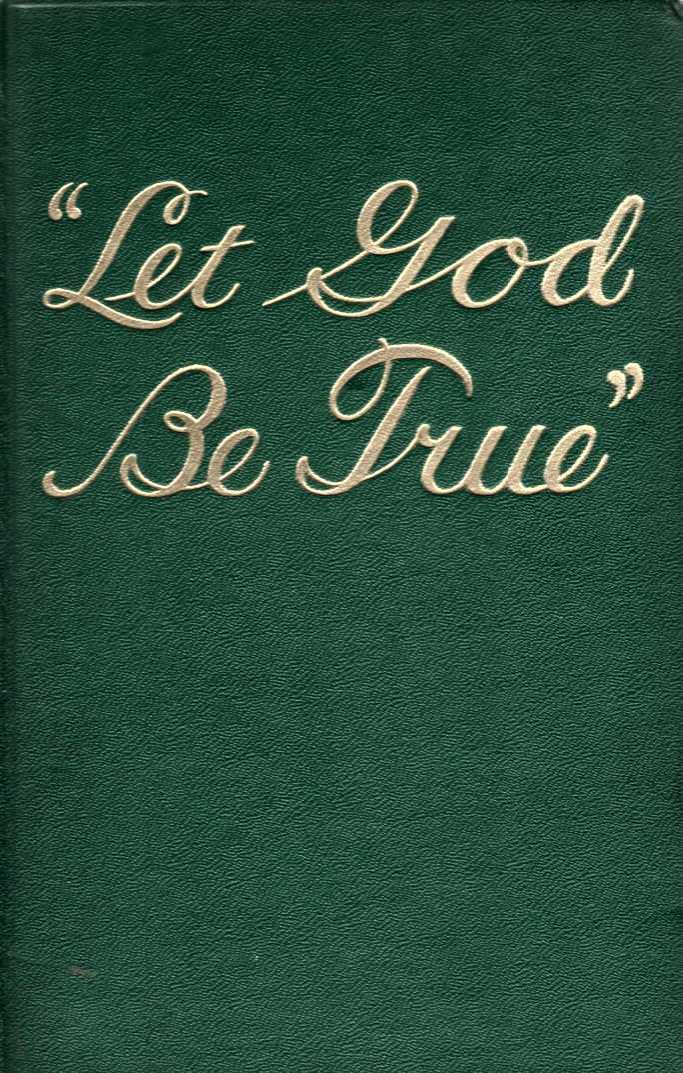
““WW if some did. not believe? shall their un
belief make the faith of
Cjod without effect? (god
forbid: yea, let (god be
true, but every man a
liar; as it is written,
That thou mightest be justified in thy sayings.”
—^Romans 3:3,4.
PUBLISHERS WATCHTOWER BIBLE AND TRACT SOCIETY, INC. International Bible Students Association Brooklyn, New York, U. S. A.
2,000,000 Edition
COPYRIGHT, 1946 by
WATCH TOWER BIBLE AND TRACT SOCIETY
Made in the United States at America
DEDICATED
to the
"a God of truth,”
and in behalf of the
“other sheep” of His
Deuteronomy 32:4 John 10 : U, 14. 16
CONTENTS
chapter page
I. “Let God Be True”
II. “Who Is Jehovah?”
III. “What Say Ye Respecting the Messiah?” 33
IV. Satan the Devil
V. What Is Man?
VI. Hell, a Place of Rest in Hope
VII. Is There a Trinity?
VIII. “A Ransom for Many”
IX. “The Church of God”
X. “The Kingdom of Heaven”
XI. Use of Images in Worship
XII. The Way to God Through Prayer
XIII. The Sabbath: In Shadow and Reality .. 154
XIV. “Not Under the Law, but Under Grace” 170
XV. The Lord’s Return
XVI. Gathering the Jews—Past and Present 197
XVII. Who Are Jehovah’s witnesses?
XVIII. Salutes and Politics
XIX. “The End of the World”
XX. The “New Earth”
XXI. Resurrection
XXII. The Judgment Day
XXIII. Consecration—the Way to Life
XXIV. Serving the True God
“LET GOD BE TRUE”
CHAPTER I
MORE and more the eyes of honest-hearted men and women are getting open to see the world’s religious confusion and the inconsistency of the religious leaders who say one thing and do another. Thinking that those religionists represent and speak for God, many sincere persons begin to wonder if any truth at all exists on earth. They come to the frame of mind of a man of old who wrote in his disappointment : “I indeed said in my despondency, Every man is a liar.”* They are discouraged and sigh within themselves. Doubtless, though, when they hear the pure ring of the truth sounding forth from the right source, despite earth’s religious jangling, they will recognize it and will gladly accept and hold it.
2 The vast universe which we see is founded upon truth, and therefore it moves on orderly and undisturbed regardless of the waywardness of men on earth. Its Creator is the great God of truth. He is the One whom the peoples of “Christendom” have all claimed to worship in
* Quoted from the Bible, at Psalm 116:11, Leeser’s translation.
1. How are many honest-hearted persons inclined to react to the religious situation today?
2. (a) Why could not the Bible be subject to any old interpretation? (b) To what kind of Bible study are readers of this book invited and led?
common, but their centuries-old religious differences, quarrels and errors have brought reproach upon both Him and the written Word which he has given to mankind. The bewildered seekers for truth have in many cases said in hopelessness: “Oh, the Bible is an old fiddle upon which you can play any old tune.” If true, that would mean that the Bible’s Author was all mixed up and divided against himself. But this could not be so of the God whose visible creation of the universe is marvelously harmonious and not divided against itself. Reasonably, then, his Book, the Bible, could not be all mixed up and allowing for just any interpretation. The mix-up lies with its would-be interpreters, the religious leaders of this so-called “Christendom”, who disagree among themselves, and violently so at times. Hence, as the reader approaches the study of the Bible with this book in hand, he is neither being invited nor being led to study God’s sacred Word according to the perplexing, mysterious religious errors of “Christendom”. He is asked to study according to what God himself has to say in His own Word. “For God is not a God of confusion, but of peace.”*
3 To arrive at truth we must dismiss religious prejudices from heart and mind. We must let God speak for himself. Any other course would lead only to further confusion. What if men,
* Quoted from 1 Corinthians 14:33, American Standard Version.
3. (a) To arrive at truth, what must we do? (b) In view of the faithlessness of men, what stand should we take? , religious and non-religious, have discredited and belittled the Bible and have placed their own or other men’s opinions and traditions above the Bible ? What if religious leaders have rejected the Bible’s straight testimony? What if the highly esteemed clergy of “Christendom” have been found false and misleading? Do these shocking and disappointing facts change the Bible itself or its message of truth? Sound thinking assures us that the true and living God must have given searching mankind some inspired written revelation about Himself. That being so, then let our stand be that of one of the writers of the Bible who said: “What if some were without faith? shall their want of faith make of none effect the faithfulness of God? God forbid : yea, let God be found true, but every man a liar; as it is written, That thou mightest be justified in thy words, and mightest prevail when thou comest into judgment.”* The writer there being quoted was an honest man who was courageous enough to confess he was an erring sinner and to justify God as being true in every case. He said to God: “Against thee, thee only, have I sinned, and done that which is evil in thy sight; that thou mayest be justified when thou speakest, and be clear when thou judg-est.”t If we let God be true, he will instruct us in the truth by his recorded Word.
4 To let God be true means to let God have the
* Quoted from Romans 3:3, 4, American Standard Version. t Psalm ol: 4, J.S.P.
4. (a) What does it mean to let God be true? (b) Why is the study course of this book in harmony with Isaiah 8:20? say as to what is the truth that makes men free. It means to accept his Word, the Bible, as the truth. Hence, in this book, our appeal is to the Bible for truth. Our obligation is to back up what is said herein by quotations from the Bible for proof of truthfulness and reliability. That is the course the inspired writers and faithful characters of the Bible took and recommended. Isaiah, an outstanding prophet, writes to this effect: “When they shall say unto you, ‘Inquire of those that have familiar spirits, and of the wizards, that whisper, and that mutter:’ should not a people inquire of their God? (should we then) in behalf of the living (inquire) of the dead? (Hold) to the law and to the testimony i if they are not to speak according to this word, in which there is no light.” (Isaiah 8:19,20, Leeser’s translation) “To the law rather, and to the testimony. And if they speak not according to this word, they shall not have the morning light.” (Isaias 8:20, Douay Version translation) There is no light of truth in the teachings of the men of this world who are under the influence of superhuman invisible demons, wicked spirits that are primarily responsible for the darkness of this world. Unless we seek direct to the law and testimony of God’s written Word, we shall never attain to the light whose beams show that the morning of a new world of righteousness is at hand.
5 Malachi, the very last of the old Hebrew
5. How do the first and the last of the writers of the old Hebrew Scriptures, as well as the writers in between, stand as to teaching? prophets, pointed in the same direction as Isaiah, to the written Word of God. Said he as an inspired spokesman for God: “Remember ye the law of Moses my servant, whom I commanded on Horeb for all Israel, statutes and ordinances.” (Malachi 3:22, Leeser) The writings of the prophet Moses make up the first five books of the present-day Bible; and thus the last of the old Hebrew prophets declares himself in agreement with the very first of the Bible writers who preceded him by more than a thousand years. All the writers in between Moses and Malachi take the same position; and the prophet Moses has preserved in his record the inspired utterances of all the prophets of God who preceded him.
6 None of the Bible writers, from Malachi back to Moses, make any mention of an oral law or traditional law as existing alongside the written Word of God. Nowhere do they declare that the oral traditions of religious men are on an equality with the recorded Word of God or that the written Word is incomplete without such oral traditions. The prophet Moses earnestly declared against adding to God’s given law and testimony the oral traditions of uninspired men. Said Moses: “Ye shall not add unto the word which I command you, nor shall ye diminish aught from it; that ye may keep the commandments of the Lord your God which I command you.” (Deuteronomy 4:2, Leeser)
6. What do Moses and the Proverbs show as to the so-called “oral law” or traditional law?
God’s written Word is pure without such manmade traditions; and those who teach and hold to such traditions and who value them as equal to or even higher than the written Word make liars of themselves. “Every saying of God is purified: he is a shield unto those that put their trust in him. Do not add aught unto his words: lest he reprove thee, and thou be found a liar.” —Proverbs 30: 5, 6, Leeser.
1 God caused his prophet Isaiah to speak out in strong words against those who claim to be God’s people but who practice hypocrisy by following the precepts and traditions of men rather than the inspired Scriptures. “And the Lord said, Forasmuch as this people draw near with their mouth, and with their lips do honour me, but have removed their heart far from me, and their fear toward me is but the acquired precept of men: therefore, behold, I will do yet farther a marvellous work with this people, doing wonder on wonder; so that the wisdom of their wise men shall be lost, and the understanding of their prudent men shall be hidden.” —Isaiah 29:13,14, Leeser.
WRITTEN WORD VERSUS TRADITION
8 Because of this very controversy over the traditions and precepts of religious leaders the great Teacher from Nazareth came into conflict with the rabbis of the first century of our com-
7. With what strong words did Isaiah speak against those following human traditions and precepts?
8. What controversy over tradition is recorded at Matthew 15:1-9, and who were proved true and who liars? mon era. Concerning this we read the following record: “Then came to him from Jerusalem scribes and Pharisees, saying: Why do thy disciples transgress the tradition of the ancients? For they wash not their hands when they eat bread. But he answering, said to them: Why do you also transgress the commandment of God for your tradition? For God said: Honour thy father and mother: And: He that shall curse father or mother, let him die the death. But you say: Whosoever shall say to father or mother, The gift whatsoever proceedeth from me, shall profit thee. And he shall not honour his father or his mother: and you have made void the commandment of God for your tradition. Hypocrites, well hath Isaias prophesied of you, saying: This people honoureth me with their lips: but their heart is far from me. And in vain do they worship me, teaching doctrines and commandments of men.” (Matthew 15:1-9, Douay) Thus the religious traditionalists were proved to be liars and breakers of God’s written law; whereas the honest Teacher from Nazareth was letting God be true because he appealed to God’s written Word and followed it.
9 This is certain: The old Hebrew Scriptures do not teach us to put faith in the oral traditions of religionists, which traditions men have since recorded and published as being equal to the inspired Scriptures or even superior to the Scriptures where there is a conflict between the
9. (a) What is certain concerning the position of all the Holy Scriptures toward human traditions? (b) How did Jesus, in prayer and in temptation, show regard for the written Word? two. It is likewise certain that the inspired Scriptures written in Greek during our first century do not teach us to accept and rely upon the traditions and moral precepts of those who claim to be Christian clergy. Hundreds of times those Christian Greek Scriptures quote and refer to God’s written Word contained in the Hebrew Scriptures. Referring to those Scriptures, which were the only ones he had in those days, Jesus of Nazareth said in prayer to God for his disciples: “Sanctify them through thy truth: thy word is truth.” (John 17:17) When he was tempted by the great adversary during his forty days of isolation in the wilderness, he resisted the enemy’s attacks by using the written Word of God. He used the written Word to show the adversary to be a liar. In meeting the first temptation he said: “It is written, Man shall not live by bread alone, but by every word that proceedeth out of the mouth of God.” In foiling the second temptation he said: “It is written again, Thou shalt not tempt the Lord thy God.” In turning back the third temptation he said: “Get thee hence, Satan: for it is written, Thou shalt worship the Lord thy God, and him only shalt thou serve.” In each case he quoted God’s Word as written down by the prophet Moses.—Matthew 4: 4, 7,10; Deuteronomy 8:3; 6:16; 6:13.
10 In declaring his mission on earth Jesus, while at the synagogue in Nazareth, called for
10. How did Jesus further show regard for the Scriptures in preaching and in advising the unbelieving religionists? the Scripture roll of the prophecy of Isaiah and read from its sixty-first chapter, verses one and two. (Luke 4:16-21) He later said: “Think not that I am come to destroy the law, or the prophets: I am not come to destroy, but to fulfil. For verily I say unto you, Till heaven and earth pass, one jot or one tittle shall in no wise pass from the law, till all be fulfilled/’ (Matthew 5:17,18) To the religionists who did not believe in him he gave the advice to study God’s written Word: “Search the scriptures; for in them ye think ye have eternal life: and they are they which testify of me. For had ye believed Moses, ye would have believed me: for he wrote of me. But if ye believe not his writings, how shall ye believe my words?”—John 5:39,46,47, Authorised Version and Douay.
11 Finally, by the aid of a traitor, his religious enemies were able to take him under illegal arrest. Why did he refuse to resist them ? Because he gave the truth to God’s Word. He said to his disciples as a forewarning of this: “I say unto you, that this which is written must be fulfilled in me, And he was reckoned with transgressors: ic>T that which concerneth me hath fulfilment.” (Luke 22:37, A.S.V.) Some days later, when explaining his strange experiences to his astonished followers, he again magnified the written Word of God as true by pointing out how it had been fulfilled in him. Of his conversation with two of his disciples we read: “And be-
11. Why did he not resist when his enemies arrested him? and how some days later did he magnify God’s Word to his disciples? ginning at Moses and all the prophets, he expounded unto them in all the scriptures the things concerning himself.” Later, in conversation with a larger group of disciples, “he said unto them, These are the words which I spake unto you, while I was yet with you, that all things must be fulfilled, which were written in the law of Moses, and in the prophets, and in the psalms, concerning me. Then opened he their understanding, that they might understand the scriptures, and said unto them, Thus it is written.” (Luke 24:27,44-46) In no case did he appeal to the rabbinic schools of teaching with their traditions and precepts of men. He faithfully referred his disciples to God’s recorded Word, thereby to glorify God as true, although at the same time it proved the publicly respected religious leaders to be liars.
12 The case of Jesus of Nazareth is precedential. It makes certain that men who follow the religious interpretations of religionists and who put human traditions before the sacred written Word will surely oppose and persecute his faithful followers who proclaim the pure Word of God. One of his very own followers uses himself as an illustration to show how a blind adherence to religious traditions and systems leads a person into opposition to those who hold to God’s Word as true. Paul, a follower of Jesus, makes this confession: “Ye have heard of my manner of life in time past in the Jews’
12. What does Jesus’ case make certain as to followers of traditions? and how does his disciple Paul use himself as an example? religion, how that beyond measure I persecuted the church of God, and made havoc of it: and I advanced in the Jews’ religion beyond many of mine own age among my countrymen, being more exceedingly zealous for the traditions of my fathers.”—Galatians 1:13,14, A.S.V.
13 Paul knew how the religious traditions had for a time blinded him to the truth in the writings of Moses and of the other prophets and the psalms. He also foreknew that men pretending to be Christian clergymen would develop a system of religious precepts and traditions and would thereby hide the truth from the members of the religious organizations. Hence he wrote: “Beware lest any man cheat you by philosophy, and vain deceit; according to the tradition of men, according to the elements of the world, and not according to Christ.” (Colossians 2:8, Douay) Paul knew that such traditions would be lies and that they would offer a way of salvation different from what is contained in the inspired written Word of God. The religious people of today whom religious traditions have misled away from the good news as recorded in the sacred Bible do well to consider Paul’s counsel, namely: “There be some that trouble you, and would pervert the gospel of Christ. But though we, or an angel from heaven, preach any other gospel unto you than that which we have preached unto you, let him be accursed. As we said before, so
13. What warnings did Paul write concerning the setting up of a system of religious traditions? say I now again, If any man preach any other gospel unto you than that ye have received, let him be accursed.”—Galatians 1: 7-9.
14 Therefore Paul stuck close to the written Word of God when he taught and preached. He also allowed that his hearers should check up on him with their copies of the Bible. In fact, Paul’s personal physician, Luke, pronounces those persons noble who did so, rather than denouncing them for reading the Bible to test the truthfulness of an apostle. Luke writes: “The brethren immediately sent away Paul and Silas by night unto Berea: who coming thither went into the synagogue of the Jews. These were more noble than those in Thessalonica, in that they received the word with all readiness of mind, and searched the scriptures daily, whether those things were so.” (Acts 17:10,11) Therefore, when a religious organization forbids its members to read the Bible and requires its members to accept what its clergymen teach without comparing their teachings with the Holy Scriptures, such religious organization belies its claim that it is apostolic.
PETER’S POSITION TOWARD THE WORD
15 Paul’s fellow apostle, Peter, was of the same mind on the matter of giving first place to the Holy Scriptures. Peter quoted again and again from the Hebrew Scriptures and wrote: “But the word of the Lord endureth for ever.
14. Therefore what course did Paul pursue toward God’s Word? and what is the noble course toward those who preach?
15. How did Peter show the same mind as Paul en the matter? And this is the word which by the gospel hath been preached unto you.”—1 Peter 1:25, Douay.
16 Nowhere in Peter’s writings or recorded utterances does he lay claim to infallibility or assume any high-sounding religious titles or ask for worshipful honors to be rendered to him. Always he turns his hearers or readers to the changeless Word of God as their shining guide until the day of God’s kingdom should dawn. Peter writes: “We have the more firm prophetical word: whereunto you do well to attend, as to a light that shineth in a dark place, until the day dawn, and the day star arise in your hearts: understanding this first, that no prophecy of scripture is made by private interpretation. For prophecy came not by the will of man at any time: but the holy men of God spoke, inspired by the holy [spirit]. But there were also false prophets among the people, even as there shall be among you lying teachers, who shall bring in sects of perdition, and deny the Lord who bought them: bringing upon themselves swift destruction. ... be mindful of those words which I told you before from the holy prophets, and of your apostles, of the precepts of the Lord and Saviour.”—2 Peter 1:19-21; 2:1; 3:2, Douay.
17 In this book in the hands of the reader we choose therefore to follow the apostolic course. We shall let God be true by turning our readers
16. Does Peter seek to exalt himself? and why does he urge Christians to take heed to God’s written Word?
17. How does this book follow the apostolic course? to His imperishable written Word. Knowing that God by his holy spirit inspired the Holy Scriptures, thus making them reliable, we choose to let Him do the interpreting by his records of fulfilled prophecy and by the things which he has caused to occur in modern history to fulfill prophecies due to come to pass in our day. “Doth not interpretation belong to God?” (Genesis 40: 8, Douay) Yes; and His interpretation is the true one. Accordingly this book will be found to be filled with Scripture quotations and references, and it is suggested that our readers look up in their Bibles all the unquoted references and read them therefrom.
18 Where our quotations are not otherwise marked, they are made from the most popular edition of the Holy Scriptures, namely, the so-called Common or King James Version of the Bible. But our readers will quickly observe in this book that quotations are made from various editions of the Bible, Jewish, Roman Catholic and others, according as each best makes clear the sense of the original Hebrew and Greek text. The questions at the bottom of the pages are for the reader’s self-examination on what he has read in the paragraphs, or for use in Bible study classes with others. The chapters following this one are devoted to a progressive investigation of the primary or essential teachings of the divine Word.
18. What about the quotations, printed questions, and chapter contents of this book?
CHAPTER II
“WHO IS JEHOVAH?”
(C\V 7HO is Jehovah?” That is an old ques-yV/ tion. When it was first asked in that tone, by Pharaoh of Egypt in the sixteenth century B.C., it was asked defiantly and with contempt, and the questioner added: "that I should hearken unto his voice to let Israel go? I know not Jehovah, and moreover I will not let Israel go.” This challenge called forth the following words of comfort to the prophet Moses: "Pharaoh will not hearken unto you, and I will lay my hand upon Egypt, and bring forth my hosts, my people the children of Israel, out of the land of Egypt by great judgments. And the Egyptians shall know that I am Jehovah, when I stretch forth my hand upon Egypt, and bring out the children of Israel from among them.” (Exodus 5: 2 and 7: 4, 5, A.S.V.) In the Bible Egypt is used as a small-scale pattern of this entire world of today. Hence in those words concerning Egypt a prophetic notice is served that all the world will shortly learn and know that the only true and living God is He who is named Jehovah, but in a manner that they will not enjoy. It is therefore well
1. When was “Who is Jehovah?” first asked, and with what importance?
to learn now who and what he is, that we may now act with benefit to ourselves.
2 When Moses stood before Egypt’s Pharaoh and made God’s demands upon him, Moses uttered the name of the God who sent him. Moses did not say, ‘The Lord says so and so’; because Pharaoh and the Egyptians worshiped and acknowledged their own false gods as lords. Even when addressing his own people to explain his returning to them in Egypt, Moses spoke the name of God to identify the particular One sending him back to Egypt. We read: “And God said unto Moses, I AM THAT I AM: and he said, Thus shalt thou say unto the children of Israel, I AM [Hebrew: Ehyeh] hath sent me unto you. And God said moreover unto Moses, Thus shalt thou say unto the children of Israel, Jehovah, the God of your fathers, the God of Abraham, the God of Isaac, and the God of Jacob, hath sent me unto you: this is my name for ever, and this is my memorial unto all generations.” (Exodus 3:14,15, A.8.V.) After Moses and his brother Aaron had appeared before Pharaoh for the first time, we read: “And God spake unto Moses, and said unto him, I am Jehovah: and I appeared unto Abraham, unto Isaac, and unto Jacob, as God Almighty; but by my name Jehovah I was not known to them.” —Exodus 6: 2, 3, A.S.V.
3 We cannot escape it; if we read his written Word, we are confronted with the name of God.
2. By what term did Moses refer to God before Pharaoh and Israel? 3. How does God’s name appear in the Hebrew Scriptures, and why does his name not appear in the Greek Septuagint Version? Nothing is gained by arguing that the name is not correctly pronounced as Jehovah. The Scriptures written before our common era were written practically all in Hebrew, a portion in Syriac; and in those Scriptures the alphabetic letters for God’s name occur, namely, Jod He Vau He (ninb or YHWH), from the first book to the last. This name, symbolized by these four Hebrew consonants, occurs, all together, 6,823 times* in the Hebrew Scriptures. The Hebrew Scriptures were first translated into Greek about 285-247 B.C.; but some time before that the Hebrews began to leave off pronouncing the name, out of a superstitious fear of taking it in vain. Hence whenever they read and came to the name, they pronounced instead the word Adonai (Lord) or Elohim (God). Hence in making that first translation into Greek known as the Septuagint Version (LXX) the translators followed the Hebrew custom and translated the above substitutes for God’s name into their Greek version.
4 The writers of the Greek Christian Scriptures used that Septuagint Version and they quoted its Greek text which omitted the literal name of Almighty God; which partly explains why the name does not occur by itself in the Christian Greek Scriptures. Jerome, in making the Latin Vulgate translation, followed the same practice, and at Exodus 6:3 he used
* Page 39 IT 2 of The Biblical Text in the Making, by Robt. Gordis.
4. Why does the name “Jehovah” not occur in the Greek Christian Scriptures? and why is the use of the name helpful?
the title Adonai instead of Jehovah, all of which explains why the name does not occur in the English Roman Catholic Douay Version. In the Authorized or King James Version we find the name “Jehovah” by itself at Exodus 6:3; Psalm 83:18; and Isaiah 12: 2 and 26: 4. Rotherham’s translation The Emphasised Bible renders the name in its 6,823 occurrences as “Yahweh”; but the American Standard Version renders it every time as “Jehovah”. Even if neither of these pronunciations may be just as God pronounced his name to Moses, yet it helps us to identify instantly who is meant by that name. In like manner the name “Jesus” is not the original way this one’s name was pronounced in the Hebrew or Aramaic; nevertheless this near pronunciation helps us to identify at once who is meant and it does not do any dishonor or blasphemy to him. •
5 To illustrate: The Catholic Douay Version reads, at Psalm 109:1, 2: “The Lord said to my Lord: Sit thou at my right hand: until I make thy enemies thy footstool. The Lord will send forth the sceptre of thy power out of Sion: rule thou in the midst of thy enemies.” But the American Standard Version, at this same psalm of King David (Psalm 110:1, 2), reads: “Jehovah saith unto my Lord, Sit thou at my right hand, until I make thine enemies thy footstool. Jehovah will send forth the rod of thy strength out of Zion: Rule thou in the midst of
5. What is a good illustration of the helpfulness of this name? thine enemies.” Thus this latter translation, by honestly giving due value to God’s name, does away with all confusion of mind; it shows that the one whom David called “My Lord” is the Messiah, whom Jehovah makes a King and Priest according to the order of Melchizedek. When the Authorized or King James Version translates God’s name by the title “Lord” or “God”, it always puts this title in all capital letters, as “Lord”, “God,” to distinguish it from the common words “Lord” and “God”.—Note this at Psalm 110:1.
WHO he is
6 By looking up the verses where the name occurs in the Hebrew Bible we are enabled to find the answer to the question, Who is Jehovah? At Psalm 90 the prophet Moses writes: “Lord, thou hast been our dwelling-place in all generations. Before the mountains were brought forth, or ever thou hadst formed the earth and the world, even from everlasting to everlasting, thou art God. Return, 0 Jehovah; how long? and let it repent thee concerning thy servants.” (Psalm 90:1,2,13, A.S.V.) Who, then, is Jehovah? Jehovah is God and, as such, never had a beginning. His eternalness is declared also at Isaiah 57:15: “Thus saith the high and lofty One that inhabiteth eternity, whose name is Holy; I dwell in the high and holy place.” In view of His eternity, it is outright blasphemy to speak of any woman as “the mother of God”,
6. Who is Jehovah, and for how long? for woman is merely a lowly creature whom God created for man as man’s helpmeet.
’Jehovah eternally reigns over all the universal space. He is worthy of all honor and glory, and one of his inspired writers rightly says: “Now unto the King eternal, immortal, invisible, the only wise God, be honour and glory for ever and ever.” (1 Timothy 1:17) He being eternal and immortal, he is, in this sense, the only Being. There are those who think his name Jehovah means “self-existing or eternal”; and the Bible translation by the Jewish scholar I. Leeser and that also by J. Moffatt render the Hebrew name in English as “The Eternal” instead of Jehovah.
8 There was, therefore, a time when Jehovah was all alone in the universal space. All life and energy and thought were contained in him alone. Yet he could not have been lonesome, for he is self-contained, which means he is complete in himself and lacks nothing. Then the time came when Jehovah began to create. First at that time he came to be God to all his creation. Hence in opening up the account of creation the very first verse of the Bible speaks of him as God. “In the beginning God created the heaven and the earth.” (Genesis 1:1) Because Jehovah is God the Creator, therefore the expression “Jehovah God” is fitting and is used. This expression occurs immediately after the account
7. In what sense is He the only Being?
8. (a) Was he ever alone, and why is the expression ‘‘Jehovah God” appropriate? (b) Why will man never see God? of creation. We read: “These are the generations of the heavens and of the earth when they were created, in the day that Jehovah God made earth and heaven.” (Genesis 2:4, 5, 7, 8, 9,15,18,19, 21, 22, A.S.V.) His first creatures were spirits like himself. We are informed, at John 4: 24: “God is a spirit: and they that worship him must worship him in spirit and in truth.” Because he is a spirit, Jehovah is and ever will be invisible to human eyes. He said to Moses: “Thou canst not see my face: for there shall no man see me, and live.” (Exodus 33:20) He is so glorious that no human creature could endure to see him.
’Although he is the Great Spirit, the great intelligent active Personage invisible to man, yet he has made himself discernible to man by his wondrous works of creation. Therefore those who deny his divinity or his being God the Creator are subject to condemnation. “For the invisible things of him, from the creation of the world, are clearly seen, being understood by the things that are made; his eternal power also, and divinity: so that they are inexcusable.” (Romans 1: 20, Douay) Speaking of His glory as the Creator, the inspired psalmist sang out in faith: “Bless the Lord [Jehovah], O my soul. 0 Lord my God, thou art very great; thou art clothed with honour and majesty. Who coverest thyself with light as with a garment: who stretchest out the heavens like a curtain: who
9. How did he make himself discernible to mankind ? and what did he make his angels?
layeth the beams of his chambers in the waters: who maketh the clouds his chariot: who walketh upon the wings of the wind: who maketh his angels spirits; his ministers a flaming fire.” —Psalm 104:1-4; Hebrews 1: 7,14.
10 As the Creator, Jehovah is the source of all life and power and of every good quality, and his works are perfect. To him Moses sang this song: “I will proclaim the name of Jehovah: Ascribe ye greatness unto our God. The Rock, his work is perfect; for all his ways are justice: a God of faithfulness and without iniquity, just and right is he.” He is therefore the One of whom it is written: “Every good gift and every perfect gift is from above, and cometh down from the Father of lights, with whom is no variableness, neither shadow of turning.” (Deuteronomy 32:3,4, A.S.V.; James 1:17) Hence God never gave the universe a devil, because he never created such a wicked creature. Instead, he is the Author of all the provisions for the saving of humankind from the sin, bondage, sorrow and death which that wicked adversary has brought upon our race. For this reason it is said: “Salvation belongeth unto Jehovah: thy blessing be upon thy people.” —Psalm 3: 8, A.S.V.
HIS UNIVERSAL ORGANIZATION
11 Jehovah God arranged all his holy, intelligent creatures in the heavens into an orderly,
10. How are his works? and to whom is salvation due?
11. How did he set up a universal organization? harmonious, peaceful organization under himself to accomplish his will. All such angelic spirit creatures, being thus arranged, made up his universal organization which is above. All were sons of God, all having received life from him, the Fountain of life. When perfect man and woman were created on the earth and set to fulfilling God’s mandate to them in the Garden of Eden, they were made the visible part of His universal organization. They were his earthly children; for which reason Adam was then called “the son of God”. (Luke 3:38) Adam and Eve lost their relationship as God’s children in his universal organization when they joined in the rebellion against Jehovah’s universal sovereignty.
12 As the Creator and Head over his universal organization of holy faithful creatures, Jehovah rightfully exercises the universal domination; and the great issue before all heaven and earth today is, Who is supreme? Who in fact and in right exercises the sovereignty over all the universe? Jehovah’s primary purpose is to settle this issue, for it means the vindication of his universal sovereignty or domination. The prayer for him to vindicate his supreme position and rulership against all his combined opposers is expressed at Psalm 83:17,18 in these words: “Let them be confounded and troubled for ever; yea, let them be put to shame, and perish: that men may know that thou, whose name alone is JEHOVAH, art the most high
12. What Is the great Issue today, and how will it be settled? over all the earth.” His supremacy will be proved beyond all future denial.
13 When Jehovah thus vindicates his universal domination by the destruction of all his foes in heaven and in earth, then he will be again the great Theocrat or Theocratic Ruler over all creatures that live. His Theocratic Government will govern all inhabited parts of the universe. His Theocratic law will be obeyed everywhere. Then no long-time rebellion such as has existed during man’s six thousand years of existence will again be permitted, for Jehovah God will once and for all time have vindicated his universal sovereignty and his holy name against all false charges, reproaches and challenges of his malicious enemies, demon and human. He is the Almighty and Supreme One. He and his heavenly Son, whom he makes Theocratic King under Him in The Theocratic Government, constitute together “the Higher Powers”, to whom all souls worthy of living must be subject. Jehovah God has ordained it to be so.—Romans 13: 1, 2.
14 That heavenly Son taught his followers to pray, “Our Father which art in heaven, Hallowed be thy name. Thy kingdom come. Thy will be done in earth, as it is in heaven.” (Matthew 6:9,10) He was there referring to the sacred name and kingdom of Jehovah God. God’s name must eventually be hallowed by all creatures who prove worthy of the
13. How will his Theocracy again rule all the universe?
14. Whose name must be hallowed, and how ? right to everlasting life in heaven and in earth. The means by which his name will be proved to be holy and deserving to be hallowed is his kingdom by his Messiah, which will shortly fight the final war of Armageddon against all His enemies. No rebel or idolatrous thing or organization will take the glory from him. Says he: “I am Jehovah, that is my name; and my glory will I not give to another, neither my praise unto graven images.”—Isaiah 42: 8, A.S.V.
THE NAME
15 The name “Jehovah” is a Hebrew verb and literally means “He causes to be”, that is, for a purpose. When making known this name in a special way to his prophet Moses, he did so in connection with declaring His purpose regarding his chosen people, which people were then in bondage to Egypt. Thus, aside from its literal meaning, his name “Jehovah” stands for his purpose respecting his creatures. (Exodus 3:15-21; 6:2-8; A.S.V.) Many times throughout the Bible Jehovah declares his purpose to cause all the nations as well as his own favored people to know that He is Jehovah. In the prophetic book of Ezekiel alone this declaration of his purpose to have all such to know that he is Jehovah occurs more than sixty times. (Exodus 6: 7; Ezekiel 6:7,10,13,14; A.S.V.) Hence an important part of his great purpose is the vindication of his reproached and misrepresent-
15. What does his name mean and stand for ? and what is his purpose concerning it? ed name. His vindication is more important than the salvation of men.
16 Why has this Almighty God permitted his chief adversary and all that wicked one’s servants to live and carry on their wickedness down till the final battle of Armageddon ? In brief explanation Jehovah said to hardhearted Pharaoh of Egypt: “To teach you that there is no one like me in all the world. Otherwise, I would have exerted my force and struck you and your people with pestilence, till you were swept off the earth; but this is why I have kept you alive, to let you see my power and to publish my fame all over the world.” (Exodus 9:14-16, Moffatt; also American Translation; Leeser) Here Jehovah discloses his purpose to raise up his witnesses to declare and publish his fame or name throughout all the earth before all the enemies are destroyed. His Chief Witness is the One whom he makes his Messiah or the Anointed King in his Theocratic Government. But more as to this Chief Witness and his fellow witnesses, concerning which the Bible has much to say from the first book to the last book, we leave succeeding chapters herein to tell.
16. Why has Almighty God permitted the great adversary and his wicked agents to operate down till Armageddon?
CHAPTER III
“WHAT SAY YE RESPECTING THE MESSIAH?”
THE Aramaic-speaking Jews of the first century of our common era called him “Jeshua ham-Mashiahh”. The Greek-speaking Jews and Gentiles called him “Jesus Messias” or “Jesus Christ”. In either language it means “Jesus the Anointed”; and the name Jesus or Jeshua is just the shortened form of the Hebrew name Jehoshua, meaning Jehovah is the Savior. That a Jew bearing that name and title walked and taught in Palestine in the first half of the first century is so fully established by history that it needs no further proof here. Now we take the authentic records written by his personal companions and their friends to learn some details about him.
2 This Jew*s life and teachings have affected the course of all human history and are destined to affect it still further in the next thousand years. Before he appeared on earth he had already had a wonderful past. To get facts about this we turn to the words of a man formerly his bitter enemy but who became a faith-
1. What does the full name “Jesus Christ” mean?
2. What does a former enemy write as to Jesus’ prehuman existence ?
ful friend and who said as regards himself: “Circumcised the eighth day, of the stock of Israel, of the tribe of Benjamin, an Hebrew of the Hebrews; as touching the law, a Pharisee; concerning zeal, persecuting the church.” (Phi-lippians 3:5,6) In this same letter to the Philippian believers tills same Hebrew tells us something as to the prehuman past of Jesus, saying: “Have this mind in you, which was also in Christ Jesus: who, existing in the form of God, counted not the being on an equality with God a thing to be grasped, but emptied himself, taking the form of a servant, being made in the likeness of men; and being found in fashion as a man, he humbled himself, becoming obedient even unto death, yea, the death of the cross. Wherefore also God highly exalted him, and gave unto him the name which is above every name; that in the name of Jesus every knee should bow, of things in heaven and things on earth and things under the earth, and that every tongue should confess that Jesus Christ is Lord, to the glory of God the Father.” -2:5-11, A.S.V.
3 This One was not Jehovah God, but was “existing in the form of God”. How so? He was a spirit person, just as “God is a spirit”; he was a mighty one, although not almighty as Jehovah God is; also he was before all others of God’s creatures, because he was the first son that Jehovah God brought forth. For this reason he is called “the only begotten Son” of God,
3. How was he “existing in the form of God”?
“WHAT SAY YE RESPECTING THE MESSIAH?” 35 for God had no partner in bringing forth his first begotten Son. He was the first of Jehovah God’s creations. He speaks so of himself, at Revelation (or Apocalypse) 3:14: “These things saith the Amen, the faithful and true witness, the beginning of the creation of God.” Also at Colossians 1:15 he is spoken of as the One “who is the image of the invisible God, the firstborn of every creature”. Thus he is ranked with God’s creatures, being first among them and also most beloved and most favored among them. He is not the author of the creation of God; but, after God had created him as his firstborn Son, then God used him as his working Partner in the creating of all the rest of creation. It is so stated at Colossians 1:16-18 and at John 1:1-3.
4 In John, chapter 1, he is spoken of as being the Word of God, that is to say, the mouthpiece or representative speaker for God. In the Greek Bible text the Word is Logos; hence he may be called “the Word or Logos”. Being a mighty one and holding this high official capacity as Logos and being before all other creatures, he was a God, but not the Almighty God, who is Jehovah. This distinction is shown in the Emphatic Diaglott translation of John 1:1-3, as follows: “In the beginning was the Logos, and the Logos was with God, and the Logos was God. This was in the beginning with God. Through it every thing was done; and without it not even one thing was done, which has been done.” (Note:
4. What prehuman office did he exercise?
The typographical difference between God and God is just as found in the Diaglott.) The Dia-glott’s interlinear translation of the Greek, word for word, makes the distinction between Jehovah as “God” and the Logos as “God” still more clear, reading as follows: “In a beginning was the Word, and the Word was with the God, and a god was the Word. This was in a beginning with the God.” (For a further discussion of this text see the chapter on “Is There a Trinity?”) Thus the Logos came into existence long before one of God’s later creatures made a devil out of himself and became, as he is called at 2 Corinthians 4: 4, “the god of this world.”—See the chapter on “Satan the Devil”.
5 That Jesus Christ had a prehuman existence he himself testifies, saying: “What and if ye shall see the Son of man ascend up where he was before?” (John 6:62) “Ye are from beneath; I am from above. . . . Verily, verily, I say unto you, Before Abraham was, I am.” (John 8: 23,58; in the original Greek text this “I am” differs from the “I am” in the Greek Septuagint translation of Exodus 3:14, where Jehovah God speaks.) In his last prayer together with his disciples Jesus said to God: “I have glorified thee on the earth: I have finished the work which thou gavest me to do. And now, 0 Father, glorify thou me with thine own self with the glory which I had with thee before the world was. . . . And now I am no more in the world, but these are in the world, and I come to
5. How did Jesus testify of his prehuman existence?
“WHAT SAY YE RESPECTING THE MESSIAH?” 37 thee.” (John 17:4-11) Less than two months later his faithful disciples, as his witnesses, saw him ascend heavenward and then disappear from their sight. Ten days later they had the evidence by means of the outpouring of God’s spirit through Jesus that he had reached the heavenly presence of his Father above.—Acts, chapters 1 and 2.
6 Prior to coming to earth, this only begotten Son of God did not think himself to be co-equal with Jehovah God; he did not view himself as “equal in power and glory” with Almighty God; he did not follow the course of the Devil and plot and scheme to make himself like or equal to the Most High God and to rob God or usurp God’s place. On the contrary, he showed his subjection to God as his Superior by humbling himself under God’s almighty hand, even to the most extreme degree, which means to a most disgraceful death. To quote the Emphatic Dia-glott translation, at Philippians 2:5-8: “Christ Jesus, who, though being in God’s form, yet did not meditate a usurpation to be like God, but divested himself, taking a bondman’s form, having been made in the likeness of men; and being in condition as a man, he humbled himself, becoming obedient unto death, even the death of the cross.”
7 Jesus asked the Jews concerning the Messiah’s descent, saying: “What think ye of
6. As to Jesus, what do the Scriptures show as to aspiring to be like God?
7. How did Jesus meet the requirement as to Messiah’s line of descent ?
Christ? whose son is he?” His enemies admitted from whose ancestral line the Messiah should come, saying: “The son of David.” (Matthew 22:41,42) Just so, the Son of God on coming to the earth was born in the line of David, for his virgin mother Mary was descended from David. Joseph, to whom the young woman was betrothed, was also a descendant of David, but before Mary was united to him, the angel from God announced her coming motherhood, saying: “Thou shalt conceive in thy womb, and bring forth a son, and shalt call his name JESUS. . . . The holy spirit shall come upon thee, and the power of the Most High shall overshadow thee: wherefore also the holy thing which is begotten shall be called the Son of God.”—Luke 1:30-35, A.S.V.
8 The angel said Mary’s child should be called “the Son of God”. Hence it is blasphemously improper to call her “the mother of God”. That title was borrowed by the Roman Catholic clergy from pagan Babylon, where Rhea (Semiramis) or Venus was worshiped as the “mother of the gods”. Jesus did not address Mary as “Blessed Mother”. In every case on Bible record he addressed her as “woman” (John 2:4; 19:26; Matthew 12:46-50); and his apostle Paul writes: “When the fulness of the time was come, God sent forth his Son, made of a woman, made under the law.” (Galatians 4:4) At the time that the young woman conceived by the miracle-working power of Almighty God
8. Why is it improper to call Mary the “mother of God”?
“WHAT SAY YE RESPECTING THE MESSIAH?” 39 then the life of the Son of God was transferred from his glorious position with God his Father in heaven to the embryo of a human.
0 Mary conceived at the city of Nazareth in Galilee, but, due to Caesar’s taxation decree, she transferred to Bethlehem in Judea, where King David had been born about eleven centuries previous. There Jesus was born, about October 1, B.C. 2. This was in fulfillment of the prophecy at Micah 5:2. To the J ewish shepherds out in the fields that fall night the angel announced: “This day is born to you a Saviour, who is Christ the Lord, in the city of David.” Then a multitude of the heavenly army appeared also and sang: “Glory to God in the highest; and on earth peace to men of good will.” (Luke 2: 8-14, Douay) On the eighth day he was circumcised like any normal Jewish boy, and then after the fortieth day Mary was permitted to enter the temple at Jerusalem and present him. Later the child was carried down into Egypt to escape King Herod’s murderous soldiers, but was brought back at Herod’s death and was taken up to Nazareth to live and grow up. This fulfilled another prophecy, at Hosea 11:1: “Out of Egypt have I called my son.” —Matthew 2:13-23.
10 Jesus’ mother’s cousin married a priest, Zacharias, to whom she bore a son, Jesus’ cousin John. Six months before Jesus became thirty years old, John began to preach as a forerun-9. Where was Jesus conceived, born, and brought up?
10. How did Jesus show forth the primary purpose for which he came to earth?
ner of Jesus and he also baptized in water in connection with his preaching. To the Jews exclusively he preached, saying: “Repent ye: for the kingdom of heaven is at hand.” After this announcement of the Kingdom Jesus went to John, showing the primary purpose for which he came to earth, namely, to bear witness to God’s kingdom which will vindicate the sovereignty and holy name of Jehovah God. When Jesus stood on trial before Governor Pontius Pilate three and a half years later, he said: “My kingdom is not of this world: . . . now is my kingdom not from hence.” “Pilate therefore said unto him, Art thou a king then? Jesus answered, Thou sayest that I am a king. To this end was I born, and for this cause came I into the world, that I should bear witness unto the truth.” (John 18: 36, 37) It was to this kingdom of God that Jesus was anointed to be Jehovah’s Messianic King. When?
' 11 Jesus at thirty years of age went to John the Baptist to be immersed in water. After John had dipped him in the Jordan river and Jesus came out of the water, then “the heaven was opened, and the holy spirit descended in a bodily form, as a dove, upon him, and a voice came out of heaven, Thou art my beloved Son; in thee I am well pleased”. (Luke 3:21-23, A.S.V.) By his water baptism Jesus showed his submitting of himself to do God’s will; and now God consecrated him by His holy spirit. By acknowledging him as His beloved Son, God begot
11. What marked events took place at Jesus’ baptism? Jesus to be his spiritual Son once more instead of a human Son. By pouring out His holy spirit upon the baptized Jesus, God anointed him with the spirit to be the long-promised King in God’s kingdom. By being thus anointed with the spirit Jesus became the Messiah, or Mashiahh or Christ, which words all mean “Anointed”. Thus he became in fact Jesus Christ, or Jesus the Anointed. His Jewish disciple, Peter, declared: “Even Jesus of Nazareth, how God anointed him with the holy spirit and with power.”— Acts 10:38, A.S.V.
12 After spending forty days in the wilderness, where he beat back the Devil’s temptations, Jesus returned to John’s locality, to get in touch with his first disciples. On seeing Jesus approaching, John said to his hearers: “Behold the Lamb of God, which taketh away the sin of the world.” (John 1:29,36) Thus John showed the secondary purpose for which the Son of God came to earth, namely, to die as a holy sacrifice to Jehovah God in order to cancel the sins of believing men and to free them from death’s condemnation, that they might gain eternal life in the righteous new world which God has promised to create. Jesus was suitable to be such a ransom or redemptive sacrifice. By having his perfect, sinless life transferred from heaven to the womb of a Jewish virgin, Jesus was born as a perfect human and grew up to be a perfect man, absolutely sinless, holy, harm-
12. As shown by John the Baptist, what secondary purpose did Jesus fulfill on coming to earth? less, undefiled. (Hebrews 7: 26) Hence, when he presented himself in full dedication to God’s will, Jehovah God accepted him for sacrifice as humankind’s Redeemer. Because Jesus was thereby bound to lay aside his humanity forever as a sacrifice, God begot him by his spirit to become again a spirit Son of God. Hence Jesus said: “The Son of man came not to be ministered unto, but to minister, and to give his life a ransom for many.” (Matthew 20: 28) He therefore laid down his human life forever.
13 On his return visit to Nazareth the anointed Jesus spoke in its synagogue. There he applied to himself the prophecy of Isaiah 61:1, 2. He confessed that he had been anointed with God’s spirit in order to preach the good news or gospel to meek persons seeking release from bondage to sin and religious error. (Luke 4:16-21) After that he preached “The kingdom of heaven is at hand” up and down the land of Judea and Galilee and Trans-Jordan. He gathered about him twelve apostles and other disciples, whom he trained to preach the heavenly kingdom to which he had been anointed. He exposed religious traditions and errors and preached the truth to make men free. This brought him in conflict with the Jewish rabbis, priests and sectarian leaders, who sought his death. At passover time A.D. 33, with the aid of the traitorous apostle Judas Iscariot, they seized Jesus, gave him a mock trial, handed him over to the Gen-
13. How did Jesus on earth fulfill his anointing? and with what outcome to him as a man?
tiles for trial by Pontius Pilate and Herod Antipas, and then blocked his release by stirring up the misguided Jewish people to cry for Jesus to be impaled on a tree like a seditious lawbreaker and blasphemer. He died obedient to God, without ever renouncing God’s kingdom.
14 On the third day of his being dead in the grave his immortal Father Jehovah God raised him from the dead, not as a human Son, but as a mighty immortal spirit Son, with all power in heaven and earth under the Most High God. Says the Jewish witness, Peter: “Being put to death in the flesh, but made alive in the spirit.” (1 Peter 3:18, A.S.V. and Dcniay) For forty days thereafter he materialized, as angels before him had done, to show himself alive to his disciples as witnesses. He then ascended to heaven and appeared in God’s presence with the value of his human sacrifice as God’s High Priest, and this he applied in behalf of all those who should believe in him.—Hebrews 9:11, 23, 24; 10:12,13.
15 God exalted his Son Jesus to be higher than he was before he lived and died as a man. If Jesus had been “equal in power and glory” with the Supreme Being, then Jehovah God could not have elevated his Son any higher than he was in his prehuman state. But now Jesus is made the Head under Jehovah of God’s capital organization over the entire universe. Says the apostle Peter: “By the resurrection of Jesus 14. What took place on the third day of his death and during the forty days thereafter?
15. In what way has the resurrected Jesus been exalted?
Christ: who is gone into heaven, and is on the right hand of God; angels and authorities and powers being made subject unto him.” (1 Peter 3:21,22) This proves Jesus did not take his human body to heaven to be forever a man in heaven, because, had he done so, that would have left him ever lower than the angels. By his becoming a man, “we see Jesus, who was made a little lower than the angels for the suffering of death.” (Hebrews 2:6-9) God did not purpose that Jesus should be humiliated thus forever by being a fleshly man forever; but, after he had sacrificed his perfect manhood, Almighty God raised him to deathless heavenly life as a glorious spirit creature. He exalted him above all angels and all other parts of God’s universal organization, to be next-highest to himself, the Most High God. What Christ Jesus does in this exalted capacity, we leave to succeeding chapters herein to tell.
CHAPTER IV
SATAN THE DEVIL
SO ALIKE has been the pattern of the nations which for six thousand years have successively dominated the affairs of the world that historians have advanced the theory of “history repeating itself”. The manner in which world powers had their beginnings, rose to prominence as world powers, and then declined to a state of obscurity is noted as common to all. Wars were featured by each. Oppression and intimidation were their stock in trade. Religion was an influential part of each.
2 Observing this similarity, and the close parallel to our modern world, thinking men have voiced the questions, “Is it possible that a common invisible power has dominated all nations'? Has the same guiding force been responsible for their similar acts of violence? Why should history seem to repeat itself ? Will it always be thus?”
3 There is no point in guessing at the matter when the Bible, God’s written Word, makes the evidence so plain. In this history of man, dating from his very creation, God proves that the idea of some super-force of wickedness influ-
1. Why have historians advanced the theory of “history repeating 1LSC1J. :
2. Observing these things what questions have thinking men voiced ?
3. Why do we not have to guess at the matter 1 encing both men and nations is not just idle imagination. It is a fact.
4 Consider the occasion of Christ at the beginning of his ministry here on earth. We are told, at Matthew chapter 4, that immediately following his baptism in Jordan Christ was led by the spirit into the wilderness “to be tempted of the devil”. Part of that tempting took the form of three proposals by Satan to Christ, the third of which was as follows:
5 “Again, the devil taketh him up into an exceeding high mountain, and sheweth him all the kingdoms of the world, and the glory of them; and saith unto him, All these things will I give thee, if thou wilt fall down and worship me.” —Matthew 4: 8,9.
6 From this it is unreasonable to think anything else than that all world governments were the Devil’s property. How else could he have offered them to Christ? He was the invisible ruler of them; and for that reason Christ was compelled to say, “My kingdom is not of this world.” “The prince [or ruler] of this world cometh, and hath nothing in me.” (John 18: 36; 14: 30) The Devil’s attributes of greed, cruelty, and selfishness have been characterized by every government on earth. Satan is “the god of this world”.—2 Corinthians 4: 4.
4, 5. What event occurring at the beginning of Christ’s ministry sheds much light on the matter?
6. What conclusion must we draw from the scripture at Matthew 4: 8, 9 ? and, for the same reason, what was Christ compelled to say?
WHENCE CAME THE DEVIL?
7 But from where did Satan come? and why has a righteous God permitted him to remain to influence men to wickedness? Will it always be that way? Is there no way for honest men to keep from under that influence?
8 The Devil was not always the Devil. There was a time when he enjoyed a high position in God’s family. He was a spirit son of God whose name was Lucifer. Contrary to the opinion of some, he was not an ugly creature with horns and tail, but was beautiful. The Bible describes him at Ezekiel 28:12,13: “Thou sealest up the sum, full of wisdom, and perfect in beauty. Thou hast been in Eden the garden of God; every precious stone was thy covering.”
9 In keeping with his being a son of God, he was given a position of great trust and responsibility: that of overlord of humankind. The designated term for this office was, as stated in the Bible, at Ezekiel 28:14, “the anointed cherub that covereth.”
10 God had placed the perfect human pair in the garden of Eden, and it was the spirit Lucifer’s duty to help them keep God’s requirements and to educate them in their proper relationship to their Creator. That is why it could be said" of him, “thou hast been in Eden.”
…