Letter to All Bodies of Elders, 1999-06-28: Appointment and deletion of elders and ministerial servants
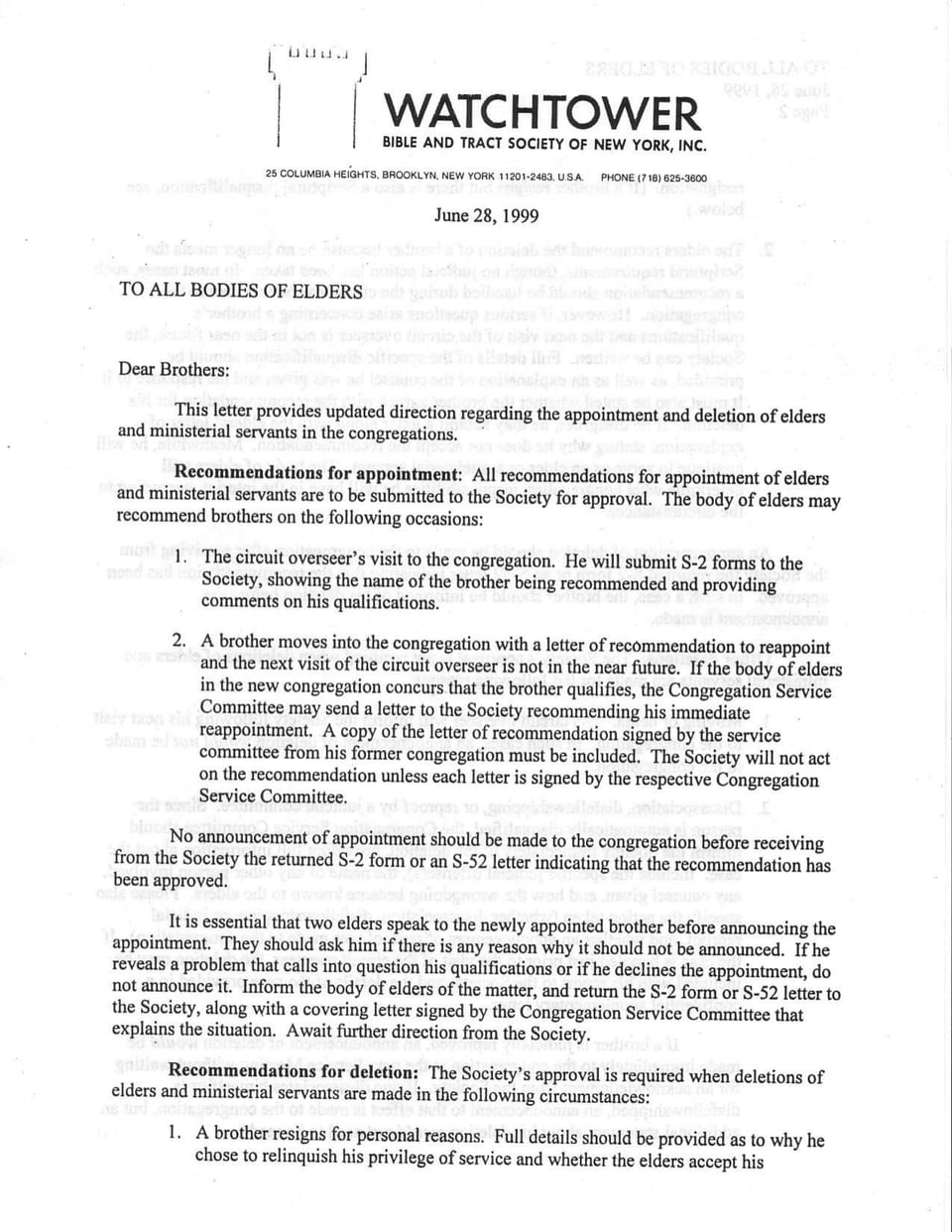
June 28,1999
TO ALL BODIES OF ELDERS
Dear Brothers:
This letter provides updated direction regarding the appointment and deletion of elders and ministerial servants in the congregations.
Recommendations for appointment: All recommendations for appointment of elders and ministerial servants are to be submitted to the Society for approval. The body of elders may recommend brothers on the following occasions:
The circuit overseer's visit to the congregation. He will submit S-2 forms to the Society, showing the name of the brother being recommended and providing comments on his qualifications.
A brother moves into the congregation with a letter of recommendation to reappoint and the next visit of the circuit overseer is not in the near future. If the body of elders in the new congregation concurs that the brother qualifies, the Congregation Service Committee may send a letter to the Society recommending his immediate reappointment. A copy of the letter of recommendation signed by the service committee from his former congregation must be included. The Society will not act on the recommendation unless each letter is signed by the respective Congregation Service Committee.
No announcement of appointment should be made to the congregation before receiving from the Society the returned S-2 form or an S-52 letter indicating that the recommendation has been approved.
It is essential that two elders speak to the newly appointed brother before announcing the appointment. They should ask him if there is any reason why it should not be announced. If he reveals a problem that calls into question his qualifications or if he declines the appointment, do not announce it. Inform the body of elders of the matter, and return the S-2 form or S-52 letter to the Society, along with a covering letter signed by the Congregation Service Committee that explains the situation. Await further direction from the Society.
Recommendations for deletion: The Society's approval is required when deletions of elders and ministerial servants are made in the following circumstances:
A brother resigns for personal reasons. Full details should be provided as to why he chose to relinquish his privilege of service and whether the elders accept his resignation.
(If a brother resigns but there is also a Scriptural disqualification, see below.)
The elders recommend the deletion of a brother because he no longer meets the Scriptural requirements, though no judicial action has been taken. In most cases, such a recommendation should be handled during the circuit overseer's visit to the congregation. However, if serious questions arise concerning a brother's qualifications and the next visit of the circuit overseer is not in the near future, the Society can be written. Full details of the specific disqualification should be provided, as well as an explanation of the counsel he was given and his response to it. It must also be stated whether the brother agrees with the recommendation for his deletion. If he disagrees, he may submit a letter along with the elders' letter of explanation, stating why he does not accept the recommendation. Meanwhile, he will continue to serve as an elder or a ministerial servant. The body of elders will determine what congregation responsibilities he will have in the interim, according to the circumstances.
An announcement of deletion should be made to the congregation after receiving from the Society the returned S-2 form or an S-52 letter indicating that the recommendation has been approved. In such a case, the brother should be informed of his deletion before the announcement is made.
Other deletions: The Society's approval is not required when deletions of elders and ministerial servants are made for the following reasons:
Moving or death. The circuit overseer will inform the Society following his next visit to the congregation. In such cases, an announcement of deletion would not be made to the congregation.
Disassociation, disfellowshipping, or reproof by a judicial committee. Since the person is automatically disqualified, the Congregation Service Committee should inform the Society immediately of the deletion, providing full information about the case. Include the specific judicial offense(s), the name of any other person involved, any counsel given, and how the wrongdoing became known to the elders. Please also specify the action taken (whether disassociation, disfellowshipping, or judicial reproof, and whether an announcement of reproof was made to the congregation). If the case is handled just prior to the visit of the circuit overseer, the deletion may be included with his report to the Society, and the details of the case provided in a confidential supplementary letter.
If a brother is judicially reproved, an announcement of deletion would be made immediately to the congregation at the next Service Meeting without waiting for an acknowledgment from the Society. If one disassociates himself or is disfellowshipped, an announcement to that effect is made to the congregation, but an additional statement about his deletion would not need to be made.
Whenever a deletion is announced to the congregation, the announcement should read as follows: "___ is no longer serving as an elder (a ministerial servant)."
If the presiding overseer or secretary is being deleted, please be sure to fill out and include the S-29 change of address form with the letter of explanation or the circuit overseer's report.
Information concerning the deletion of an elder or a ministerial servant should be retained indefinitely in the congregation file. This would include S-2 forms and S-52 acknowledgment letters from the Society and related correspondence. Such background material will be helpful in supplying the Society with complete details in the event the brother is recommended for reappointment in the future.
The chart on page four of this letter summarizes the points listed above regarding deletions and provides a quick reference to determine when deletions require approval by the Society and which deletions should be announced to the congregation.
It is hoped that this direction is helpful. We take this occasion to send our warm Christian love and greetings.
Your brothers,
Natchtower B. V. G. Society OF NEW YORK, INC.
Instructions on Handling Deletions of Elders and Ministerial Servants
Reason for Deletion
Is Society's Approval Required?
Announce Deletion to Congregation?
Additional Instructions
Moving or Death
No
No
The circuit overseer will inform the Society following his next visit to the congregation.
Resignation for personal reasons
Yes
Yes, after receiving approval from the Society
The elders should provide the Society with full details as to why the brother chose to relinquish his privilege of service and whether they accept his resignation. (If brother resigns but there is also a Scriptural disqualification, see below.)
No longer meets the Scriptural requirements, though no judicial action taken
Yes
Yes, after receiving approval from the Society
The elders should supply the full details of the specific disqualification, as well as an explanation of the counsel he was given and his response to it. It must also be stated whether the brother agrees with the recommendation for his deletion. If he disagrees, he may submit a letter along with the elders' letter of explanation, stating why he does not accept the recommendation. Meanwhile, he will continue to serve as an elder or a ministerial servant. The body of elders will determine what congregation responsibilities he will have in the interim, according to the circumstances.
Judicial reproof
No
Yes, may be announced at next Service Meeting
The elders should inform the Society immediately of the deletion, providing full information. Include the specific judicial offense(s), the name of any other person involved, any counsel given, and how the wrongdoing became known to the elders. Please also specify the action taken (whether disassociation, disfellowshipping, or reproof, and whether an announcement of reproof was made to the congregation).
Disassociation or Disfellowship
No
No