Awake!, September 8, 1980
Download: PDF — Awake!, September 8, 1980
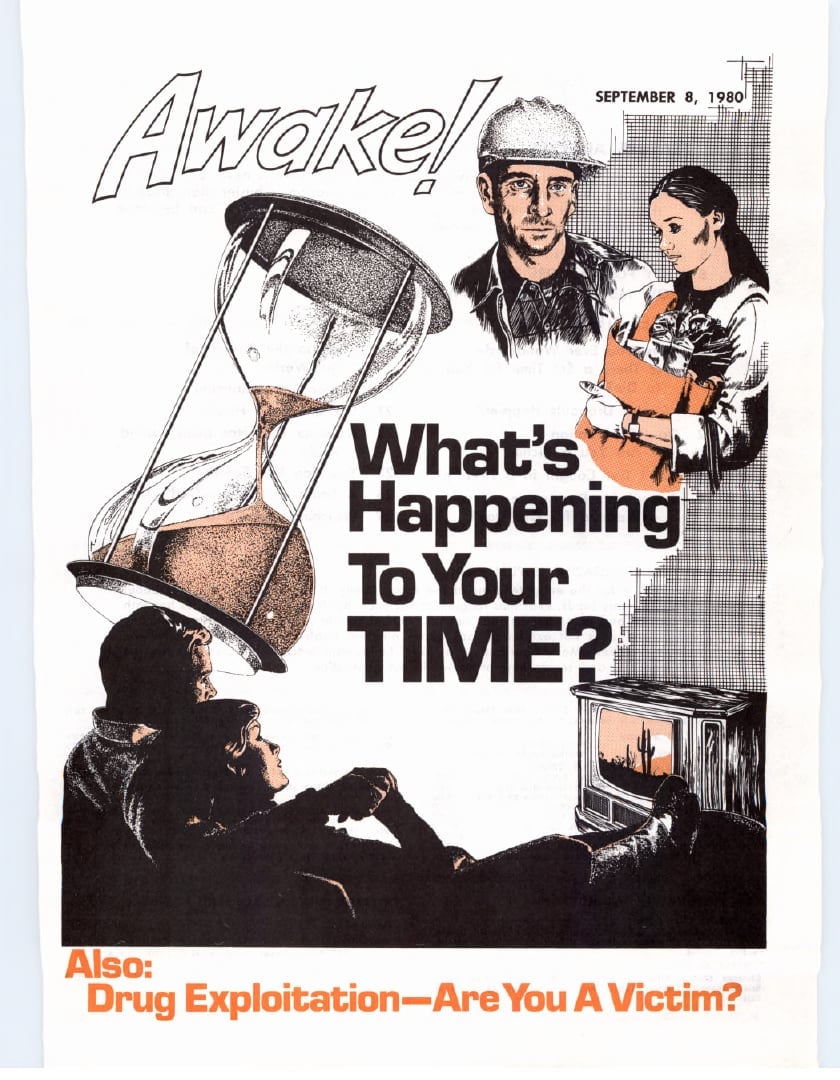
Awake! — September 8, 1980
Source: jw.org
Contents
Page Two
Is There a Set Time for You to Die?
What’s Happening to Your Time?
They Found More Time
How Much Time Do You Want?
“Career Dropouts Happier”
Drug Exploitation—Are You a Victim?
“Above-Ground Mines”
Don’t Get Caught in a Firetrap!
Jerusalem’s Destruction—Warning for Our Day?
Flight to the Bottom of the World
“Bitter Disappointment”
Sex and Your Health
A Name That Has Been Pushed Aside
You Can Sail Safely
A Sense of Humor—God’s Gift
Laughter’s Many Faces
Watching the World
What Is This Thing Called Death?
Hell Is Not Hot!
Page Two
Page Two
Do you feel as if you’re always in a rush, that there is never enough time to get things done? It’s a fact that this generation is busier than those in the past. You will find it helpful to learn why and what can be done to improve matters for yourself
5 WHAT’S HAPPENING TO YOUR TIME?
8 THEY FOUND MORE TIME
9 HOW MUCH TIME DO YOU WANT?
Is There a Set Time for You to Die?
Have You Ever Wondered—
Is There a Set Time for You to Die?
HOW often have you heard the remark: “When your time comes, you just have to go”? Or have you, perhaps after a narrow escape from death, said: “I guess my time was not up yet”? Such expressions reflect belief in what is called “fate,” the feeling that one’s life pattern and time of death are predestined and nothing can be done to change them.
CAN BELIEF IN FATE AFFECT THE WAY PEOPLE LIVE?
It surely can. For instance, many soldiers sincerely believe what military commander Napoleon Bonaparte once wrote: “Our hour is marked, and no one can claim a moment of life beyond what fate has predestined.” Such men were eager to enter into battle, even taking unnecessary risks, because they felt that they would not meet death one moment sooner than if they had stayed at home. But do you really think the battlefield is as safe as home?
Or a car driver may drive overly fast, reasoning that he will not be killed until his time is up. In fact, the European director of the World Health Organization said that many car accidents are “motivated by fatalism, namely, the idea that in reality they cannot be avoided.”
So such belief can affect how we live. It can make us take unnecessary risks, by our thinking that the day of our death is set and that nothing can alter it.
DOES BELIEF IN FATE MAKE SENSE?
Some persons feel that it does not. They reason, for instance, that any safety precautions would be quite unnecessary if everything that happens to a person were predestined. And yet safety measures, such as the wearing of seat belts and the reducing of speed limits, have cut down road deaths.
It is estimated that three of every four car accidents were avoidable if proper care had been taken by the drivers; so such accidents did not “have” to happen. Much depends on how a person drives. It is often just as the Bible says: “Whatever a man is sowing, this he will also reap.”—Gal. 6:7.
Some things, such as prayer, would lose their meaning if everything were predestined. For instance, a seriously ill man was visited by a neighbor who firmly believed in predestination. The visitor offered to pray so that the ailing man would not die. But the sick man asked: “Do you believe that I have a fixed time to die?” “Oh, yes,” came the positive reply. “Well, then, if my time is up, it would be of no use to pray, and if my time is not up, surely there is no need to pray.” Do you agree?
DOES THE BIBLE ENCOURAGE BELIEF IN FATE?
No, it does not. Rather than indicate that each person has a predestined day of death, the Bible says that “time and unforeseen occurrence befall them all.” (Eccl. 9:11) Yes, an “unforeseen occurrence” can happen to anyone. If a person happens to be in the wrong place at the wrong time, he may meet a fatal accident. It was not that this was his predestined “time,” but something occurred “unforeseen” or by chance.
But what about the Bible’s statement at Ecclesiastes 3:1, 2? Doesn’t it prove that there is a set time for a man to die? It reads: “For everything there is an appointed time, even a time for every affair under the heavens: a time for birth and a time to die.” Does this mean that the time of birth and the time of death are fixed for each individual? Remember, it was this same Bible writer who said that ‘time and unforeseen occurrences befall all persons.’ What, then, does the writer mean?
He is merely commenting on the continuous cycle of life and its activities. You have seen for yourself that there is a time when people build and a time when they break down; there is a “time to weep and a time to laugh,” and so on. (Eccl. 3:1-8) So, also, a woman gets pregnant, and when the time comes she gives birth. Then again, the time comes when old age, sickness, or the like, bring death. No, not predestination—just the well-known cycle of life.
Though God has the power to know when a person will die, he does not predestine the specific time. Otherwise, why would the Bible say: “The very fear of Jehovah will add days, but the years themselves of the wicked ones will be cut short,” and that wicked men “will not live out half their days”?—Prov. 10:27; Ps. 55:23.
Our way of life can often affect how long we live. The Bible shows that our fate, to a large extent, is in our own hands.
HOW, THEN, SHOULD WE LIVE?
We should live in a manner that shows we value our life. Conscientiously we ought to try to stop habits and careless ways that can definitely shorten life.
In addition, by learning to show the proper “fear of Jehovah” we may add years to our life. How? Well, the God-given guidelines in the Bible can help us to live a moral life. This enables us to avoid self-centered, uncontrolled pursuit of pleasure, which can shorten life. It is as the wise Bible writer stated: “Do not be wicked overmuch, nor become foolish. Why should you die when it is not your time?” How we live can affect how long we will live.—Eccl. 7:17.
Soon God will “cut short” the years of all those who are wicked. At his set time, his “day of judgment,” he will bring a “destruction of the ungodly men.” Those who ‘fear God’ and obey him will be delivered into a cleansed “new heavens and a new earth.” Even those who met an untimely death, along with all asleep in the graves, will be resurrected to life so that they too will enjoy an earth free of wickedness. God will make provisions for these to live endlessly, never having a time to die.—2 Pet. 3:7, 13; Acts 24:15.
However, you may wonder: Just how near are such blessings? Will they occur during my lifetime? Jehovah’s Witnesses will gladly show you the Bible’s encouraging answers to these questions and many others.
What’s Happening to Your Time?
What’s Happening to Your Time?
‘DO YOU love life?’ asked Benjamin Franklin many years ago. ‘Then do not squander time; for that’s the stuff life is made of.’
Modern men and women are tempted to reply: “Squander it? I’d just like to find a little of it. I spend all day fighting the clock!” Is that how you feel?
Are you among the hundreds of millions of people who work all day at jobs away from home? This used to be mainly the man’s situation. But now more than half of all mothers of school-age children in the United States hold some kind of job. Since 1950 the number of “economically active” women world wide has nearly doubled, and these 600 million working women now represent one third of the world’s total work force. When they come home from their job they don’t have the time or energy they used to have for family responsibilities, much less for leisure.
Perhaps you are a housewife. Does that mean you don’t work? Hardly! Your labor as cook, dietician, purchasing agent, decorator, nurse, housekeeper (and on and on) is said to be worth thousands of dollars each year to your family. But the love and attention you give your husband and children cannot be replaced for any amount of money. Yet, most housewives, like other people, are finding fewer and fewer moments for themselves—for personal reading, or for just some solitude. Why? Where is the time going?
Interestingly, the increased number of material possessions is a big factor. How is that so?
Whether you purchase a new television or a new house, it costs you not only money but also time. For many persons the time required in caring for material possessions is a “hidden cost,” one of which they are not fully aware. But it is a cost that is paid in a variety of ways.
To Get Money Requires Time
When you work for an employer, you usually do it for a certain number of hours a day in exchange for money. You exchange your time for money. Most material possessions are obtained with money, and the more possessions you want the more money you have to earn.
If you are in earnest about wanting more time for other things, you need to take a long, hard look at the number of hours that you devote to earning money. Then ask yourself: ‘Are the possessions that I get in return worth it? Are they all really necessary?’
Some people are making changes, and we will tell you about them later. But first weigh the other hidden costs.
To Spend Money Takes Time
Many housewives spend hours each week in supermarkets comparing a bewildering array of packages of different sizes and shapes all proclaiming themselves to be “the best buy!” To determine which is really the best buy takes time. And when purchases of appliances or home furnishings are made, parts of several days may be spent comparing brands before a selection is made.
What can be done about this hidden cost? Spending money carelessly is a poor solution, but time spent in making necessary purchases can be reduced. How? By making a shopping list. Many wives find that the time spent in planning the family’s meals for the coming week is saved several times over in the grocery store. And, although they are flexible enough to benefit from special sales, they learn to buy what they need instead of spending their time looking at all the things advertisers want to sell.
When shopping for more substantial items, you may benefit from the example of one young housewife who said: “I told my husband that I wanted to buy an electric frying pan, and after two weeks he couldn’t understand why I still had not bought it. I was not spending time looking for it, but I would keep it in mind. Whenever I was in a store on other business, I would always glance at the frying pans. Finally, after a month, I went into a drugstore to buy some items and there was my frying pan! Just what I wanted for half the price in the other stores.” Patience paid off, yet very little extra time was required.
Consider another hidden cost of material possessions:
What You Own Requires Maintenance
Of course, you need a place to live. But what kind of place? If you rent your home, many of the maintenance problems fall to the owner. But if you are the owner, it is your time and your money that are going to be spent.
Nevertheless, in balancing matters out, many families have concluded that, in the long run, it would be more economical to buy a home than to continue to pay rent. But don’t fool yourself into thinking that all you need to do is balance the rent against the purchase price of a house to determine how long it will take for you to get ahead. As owner, the property taxes will be yours to handle, and these don’t end when the mortgage has been paid. Most homes need to be painted every three to five years. A new roof may be needed in 15 years. Furnaces require regular cleaning. Termites must be kept at bay. Sewer problems are not unusual. And this is only a start. Most homeowners will readily acknowledge that there is always something around the house that is clamoring for their time and money.
Yet, with all these considerations, you may conclude that owning a home is best for you. But how big a home? If you really want more time for pursuits that may now frequently be minimized, this is something to think about. If you move into a big home in order to impress other people, you are going to pay a high price—not only for the property but in time that is needed to keep it clean and in good condition. And many parents realize that, once their children have grown up, they no longer need as large a home. They move into more modest quarters so that there will be less housekeeping, less maintenance, and more time for other pursuits.
Another factor, often overlooked, is this:
It Takes Time To Use The Goods You Buy
Suppose you are considering the purchase of a new television. Aside from eating, watching TV is the top leisure-time activity of Americans, occupying up to 45 percent of their free time, and they aren’t the only ones with this problem. You may already feel that you spend too much time watching television, but few people realize how much time they use for TV unless they have personally kept a record. Try it.
If, like most people, you want more free time, perhaps the television is a good place to begin. Simply unplugging your set could give you 20 or more hours of time for other things each week—a bonus equal to half the time you probably spend working!
Now, most people are not willing to live without their TV sets, as illustrated by the fact that more homes in the U.S. (98 percent) have TV than have indoor plumbing. But there are simple ways to control TV and limit its effect on yourself and your family. Many families find it helpful to go over the TV programs for the coming week and decide as a family what will be watched. Sticking to their decision gives all of them more time for other pursuits.
Of course, the same principle applies to other possessions. Using them takes time. So before making any purchase, consider the amount of time you will need to spend on your new possession to make it worth while. Where is the time going to come from? Is that really how you want to use your time?
Don’t forget that, as Ben Franklin said, time is ‘the stuff life is made of.’ If a person exchanges all his time for money by working day and night, the quality of his life will be miserable. If he allows material possessions to take up too much of his time, he will become shallow, his relations with fellow humans will suffer and so will his appreciation for spiritual values. On the other hand, if he insists on setting aside time for truly important things, then his life will take on deeper meaning and he will find greater happiness.
They Found More Time
They Found More Time
THERE are people who are convinced that, as the Bible says, a person’s “life does not result from the things he possesses.” (Luke 12:15) Many of them have learned from experience that day-by-day living is more enjoyable, and far more satisfying, when they can devote less of their time to earning money and more to their family and to pursuits of spiritual value.
Charles was a schoolteacher. He had taught American history for years, but the job was beginning to affect his nerves as each new year seemed to bring a more unruly class than the last. Besides, he wanted to be able to spend more time with his wife, his son and aged mother, as well as in other pursuits. His decision? To quit teaching and take a job driving a school bus in order to get the schedule he wanted. Adjustments were involved, but he found the time gained to be well worth the price.
Sam was an outstanding worker in a Chicago, Illinois, specialty printshop. His boss offered him the position of shop overseer, but Sam refused, despite the increase in pay. He knew that overtime work would inevitably come with heavier responsibilities, and that would cut into the time he could spend with his family, among other things. As a result of turning down the position of shop overseer, Sam was available when another job with the company came along, one that allows him to schedule his own time.
Bill is an electrician in Greensboro, North Carolina. He is constantly under temptation to enlarge his business, fighting what he calls a “never-ending battle to stay small.” He likes the fact that his time is his own, his headaches are relatively few and paperwork is minimal. Rather than going in debt for a large house, Bill started off with a modest trailer, and enlarged it over the years, knocking out walls and gradually transforming his trailer into a beautiful home. “I never had to borrow a lot of money to build this way,” he said, “and I had a hobby. I was always learning something as I worked on the house. I never had to neglect my family either. Instead, working on the house helped to draw us together.”
Mike has a gardening and landscaping business in Washington, D.C. “I have to turn down a lot of business,” he admits. But he adds: “I feel it’s worth it. I value my peace of mind. This is a business where you could easily work seven days a week. There is no shortage of work. I generally work only about three days a week, though, and that allows my wife and me to have a lot more time together for things that are important to us.”
In Japan a young man married his employer’s daughter, and was being groomed to manage the family business, a plant employing 300 people. After considering the toll that such a position would take of his family life and his religious life, the young man declined the management offer and asked to continue simply as an employee of the company. It gives him more time for the things that are truly important to him.
These are just a few examples of the people who have concluded that time—for the sake of their own health, for their family, for helping other people to learn what the Bible says about the real purpose of life—was more important to them than money, a prominent career, or material possessions. None of them regret the decision they made.
Statistics indicate that, even under present conditions, people like these will live longer, and their own testimony is that they are living happier lives than before. As wise King Solomon once put it: “Wisdom is for a protection the same as money is for a protection; but the advantage of knowledge is that wisdom itself preserves alive its owners.”—Eccl. 7:12.
How long can wisdom preserve your life? Longer than you may think!
How Much Time Do You Want?
How Much Time Do You Want?
LIKE it or not, we are all running out of time. According to present standards, a person born in a Western country can expect, on an average, about 26,000 days of life. That’s not many. If each of those days were a U.S. dollar, in most communities they wouldn’t buy a three-bedroom house. By the time you are out of school and ready to begin a career, about 18,000 days are left. When you reach 40, only 11,000 days remain. They cannot be stored in a bank. At death no amount of money can buy them back.
Most people prefer not to think about the shortness of their life, reasoning: “What’s the use? There’s nothing you can do about it anyway.” But there is something you can do about it.
You Can Do Something
Wise use of your time now can give you much more than 26,000 days of life. Indeed, more than 26,000 days of life. Indeed, more than 26,000 years of life can be yours!
Impossible? Why should it be? Scientists admit that the human body is equipped for a lifetime far longer than what we now enjoy. An article in Saturday Review magazine states regarding the brain and related bodily systems: “It is still clear that we are operating with only a tiny fraction of our true abilities. Studying nature, we find that systems are created to be used to the full. What is the purpose of all the unused human capability?” In commenting on the capacity of the human brain, biochemist Isaac Asimov stated that it is “perfectly capable of handling any load of learning and memory which the human being is likely to put upon it—and a billion times more than that quantity, too.”
This is quite in agreement with what the Bible says. Open the Bible and read it for yourself. Again and again it refers to the prospect of living forever here on earth. (Rev. 21:3, 4; Isa. 25:8; John 3:16) Then why do we die?
In the Bible book of Genesis we learn that God made Adam, the first man, from the dust of the ground. Jehovah God planted a garden in Eden, near the headwaters of the Euphrates River, caused to grow in it an abundance of trees that were pleasant to look at and good for food, and in these surroundings he put the man. Adam had a perfect mind and body, and before him was the prospect of living forever. But continued life was conditional. Obedience to God was required. As the Bible says: “Jehovah God also laid this command upon the man: ‘From every tree of the garden you may eat to satisfaction. But as for the tree of the knowledge of good and bad you must not eat from it, for in the day you eat from it you will positively die.’”—Gen. 2:16, 17.
If Adam had been obedient, his children would have been born with the same perfection and prospect for eternal life that he had. But he showed a shameful lack of gratitude to his heavenly Life-Giver. On the day that Adam ate the forbidden fruit, God passed sentence of death on him. He was cut off from the Source of life, Jehovah God, and began to die. Later, after he had fathered children by means of his wife, Eve, he returned to the dust from which he had been taken.
All of us have descended from dying Adam, and just as we have all inherited arms, legs and eyes from Adam, we have also inherited death from him. (Rom. 5:12) The result has been a severe limitation on the time available to each of us at birth, and the consequent pressure to squeeze as much as possible into the few years of life that we have.
Is there anything we can do to improve our situation? Well, we can’t turn back the clock and stop Adam from the action that brought death to us all. Nor is anyone today qualified to undo the damage that he did. But does that mean that the situation is hopeless? By no means!
The Bible states that, by God’s undeserved kindness, he sent his own Son, Jesus Christ, to earth to bring relief that would be possible in no other way. Christ ‘tasted death for every man.’ (Heb. 2:9) As a perfect man, he paid the penalty of death for us. What is required in order to benefit from that provision?
First, that we take time to learn about it. Then, that we exercise faith in it and live in a manner that demonstrates such faith. Listen to how Jesus himself explained the matter: “This means everlasting life, their taking in knowledge of you, the only true God, and of the one whom you sent forth, Jesus Christ.” And: “God loved the world so much that he gave his only-begotten Son, in order that everyone exercising faith in him might not be destroyed but have everlasting life.” He also said that the discreet person is the one “that hears these sayings of mine and does them.”—John 17:3; 3:16; Matt. 7:24.
Would It Be Boring?
“But wouldn’t it be boring to live forever?” some may ask. Why should it be? When was the last time you were bored while doing something you really enjoyed? Boredom is not caused by the length of a person’s life but by a life that lacks quality, one that is lived without purpose. An hour spent in drudgery is far more boring than a full day devoted to something that you enjoy, activity that is filled with meaning for you.
Really, people who fear that they would be unhappy with everlasting life reveal that they are unhappy with their life right now. They shudder at the thought of living that way forever. But it may be that they long for a better, more interesting, more deeply satisfying life.
This is precisely what God promises! Rather than a prolonging of man’s present woes, he foretells a new start for mankind—a new governmental “heavens” and a new “earth,” or human society, along with conditions that will be a new experience for all the offspring of Adam. “There are new heavens and a new earth that we are awaiting according to his promise, and in these righteousness is to dwell.” And concerning the conditions that will prevail here on earth, the Bible says: “‘He will wipe out every tear from their eyes, and death will be no more, neither will mourning nor outcry nor pain be anymore. The former things have passed away.’ And the One seated on the throne [God himself] said: ‘Look! I am making all things new.’ Also, he says: ‘Write, because these words are faithful and true.’”—2 Pet. 3:13; Rev. 21:1-5.
What Will You Do?
You no doubt know that Jehovah’s Witnesses gladly take time to discuss the Bible with interested persons in their homes. There is no charge for this service, and it does not obligate the householder to join anything. World wide, there are over 1,200,000 persons who avail themselves of this service on a regular, weekly basis. Perhaps you have thought about doing so but have felt that you were too busy to take the time.
We hope that this issue of Awake! has given you added insight on why nearly everyone feels as you do—pressed for time. Perhaps it has also helped you to take a fresh look at life and to ask yourself: “Am I using my time for the things that really count in life, or am I allowing these to be crowded out?”
If time is truly precious to you, you owe it to yourself to investigate further what the Bible says about God’s promise of everlasting life. At the same time you will find that study of the Bible equips you with a wealth of practical advice that can help to improve the quality of your life now.
Why not contact Jehovah’s Witnesses in your area, or write to the publishers of this magazine and ask for a qualified person to call on you. The time that it takes to do this is very little, but you may find that you will come to have more time than you ever dreamed of!
“Career Dropouts Happier”
“Career Dropouts Happier”
“Men who leave corporate executive jobs in the middle of their careers for less high paying and high pressure pursuits, often have happier lives and marriages as a result, says a university study. . . .
“‘In general, the men have sought ways in which they could better control their destiny, see the results of their work and help other people at the same time,’ [a researcher] said.”—The Denver “Post.”
Drug Exploitation—Are You a Victim?
Drug Exploitation—Are You a Victim?
By “Awake!” correspondent in Australia
MAN’S most basic desire is to live. Hence, he has always been willing to pay well anyone who can help him to live longer or free him from suffering.
Ancient books abound with remedies for sickness, some beneficial, others downright dangerous. But never has medicine flourished so much as in our 20th century. In addition to continuing developments of new medical techniques, a large number of drugs have been discovered. In a recent year, some 7,200 drugs and drug combinations were on the market.
On the other hand, some feel that the wealthier, more advanced countries have become the most overmedicated society in history. An obvious factor in the world drug situation is the enormous amount of money involved. In Australia alone, with a mere 14 million inhabitants, over $A300 million is being spent annually on medical drugs. Could it be that natural interest in health on the part of millions is being exploited by drug manufacturers?
Aggressive Advertising
Drugstores (in some places called “chemist shops”), supermarkets and many small stores stock drugs that can be bought without a doctor’s prescription. To encourage buying more of these, drug companies sponsor aggressive, highly sophisticated advertising campaigns through newspapers, magazines, billboards, radio and television. Advertising experts research the needs, attitudes and tastes of the “target audience”—persons who might use their specific medicine—and prepare a suitable campaign. Clever slogans, colorful advertisements and eye-catching merchandising in a variety of media encourage you to buy.
Many subtle methods are used to attract your attention. A medicine may be labeled “new” when in reality it is only a different combination of old drugs. A company may claim that their product is special because it has “XYZ,” whereas “XYZ” is only a trade name for a common constituent. Some will amplify small, often insignificant differences between their products and those of a competitor. Reference may be made to laboratory tests or to doctors’ recommendations, or advertisements may be presented by a person dressed as a medical professional.
The immense popularity of pain-killing drugs is one result of massive and incessant advertising. People are encouraged to view taking them as normal, an aid in solving life’s little problems. An efficient sales organization has made them available virtually everywhere.
Many doctors say that aspirin (including soluble aspirin) is a comparatively safe and effective analgesic. However, even simple headache preparations containing aspirin plus another substance, such as phenacetin, can be very harmful, causing serious kidney damage. Hence, many medical organizations have been actively campaigning to remove this type of medication from its present easy accessibility. Some authorities have condemned misleading advertising that says analgesics are safe, will relax, relieve tension, sedate or stimulate.
So when you purchase over-the-counter medicine, be sure first to consider carefully whether you really need it. Keep in mind that no drug is completely safe. The idea that for every minor complaint there is a remedy at the chemist shop may suit the manufacturer, but may not be in your best interests. Remember, too, that these medicines usually relieve only symptoms of an illness, not the cause.
Promotion of “Prescription-Only” Drugs
Because the doctor is the only person who can authorize the obtaining of “prescription-only” drugs, in handling these he becomes the middleman between you and the manufacturer. Doctors, being human, are susceptible to advertising techniques. Hence, they receive an abundance of glossy, eye-catching pharmaceutical advertising literature, skillfully prepared to encourage the doctor to prescribe a particular drug in as wide a field of illnesses as possible.
Of every dollar that Australian pharmaceutical companies spend, 20 cents is used on promotion, 42 percent of that on traveling representatives, whose presentations are tailored to a doctor’s needs. Their interview might conclude by leaving a pad or a pen endorsed with the name of the drug they wish the doctor to prescribe.
Drug manufacturers insist that the process of informing doctors is of utmost importance. Certainly, increasing a doctor’s awareness of a new drug can be valuable. However, much promotion seems aimed at persuading a doctor that a new formulation of an old drug is superior to existing products, and the creating of incentive for that company’s drugs to be more widely prescribed. Doctors have criticized some advertising as being misleading by giving one-sided views and by downplaying adverse side effects of their drugs.
In addition, the drug industry produces expensive audiovisual material, supports conferences and produces medical journals, providing them free to the doctor. While good can come from all of these, at the same time there is a continual underlying promotional effort.
An unfortunate aspect of the situation is that many doctors depend on manufacturers’ advertising, along with limited contact with colleagues, for their knowledge of the uses and side effects of many drugs now available. Not surprisingly, then, the Australian “Buchanan” parliamentary report noted: “There is significant and avoidable over-prescribing, and this contributes to the high cost of the [national health] scheme and to drug-induced disease, as well as reducing the future effectiveness of valuable drugs.”
The position of the doctor, however, is just one of many problems related to medical overuse of drugs. Much of the responsibility for this situation rests on the patient.
The Doctor’s Dilemma
One of the biggest problems facing doctors is the average patient’s avid desire to take medicines. Whereas possibly only rest, time and reasonable care are needed for recovery from an illness, many patients feel that a visit to the doctor without receiving a prescription is a waste of time and money. With an overcrowded waiting room, your doctor may not be inclined to accept the time-consuming and possibly uphill task of convincing you that medicine is not needed. Under pressure from the patient and the drug company, he may find it easier simply to write a prescription.
Drug companies claim that they too are in a difficult position. Ever since the “Thalidomide disaster” resulted in 8,000 babies being born tragically deformed, governments have demanded increasingly stringent tests before a new drug can be marketed. Much expense is involved in research, development and registration of a new drug. Not all new drugs are commercially successful. Even successful ones can be patented for only a limited time. Sometimes a superior drug may be discovered a short time later. Hence, drug companies feel that they must quickly get their drugs used as widely as possible.
What Can You Do to Protect Yourself?
How can you avoid being exploited by those who want you to buy and use more medicines? First of all, recognize that the human body is marvelously designed to cure itself of many ills. As the Australian Prescriber acknowledged: “While drugs are important in the management of many conditions, the problems of many patients are best managed by non-drug therapy. The best treatment does not always consist of pills or medicine.” Giving the body a good rest is often far more beneficial than pumping it with drugs and forcing it to keep going. Sometimes certain foods or natural remedies can be helpful.
Rather than pressuring your doctor to write a prescription, help him to determine whether drug therapy is really needed in the case at hand. If it is, find out what may be the side effects or possible complications of the treatment. Conscientious doctors will gladly provide this information. Could these outweigh the benefits? How large a dose is really needed, and for how long?
Realizing that taking mood-affecting drugs is no substitute for getting to the root of emotional problems can be a great safeguard. If you find life hard to cope with, a frank examination of your way of life and the courage to make needed changes may be all that is necessary.
If it seems essential for you to take drugs, follow closely the directions given by the doctor. Avoid taking a number of different drugs at the same time without medical supervision. Note associated warnings such as avoiding alcohol or not driving while using medicine.
Certainly drugs have saved millions of lives. They have shortened periods of illness and helped to remove much fear of diseases. On the other hand, many have unsuspectingly fallen victim to unnecessary medication, dependence on drugs and to drug-induced diseases. But if drugs are treated with the respect and understanding that they deserve, a person is far less likely to become a victim of drug exploitation.
“Above-Ground Mines”
“Above-Ground Mines”
Scrap yards were called “above-ground mines” by an official of the Canadian Association of Recycling Industries. He said that using scrap metal saves 90 percent of the materials, 74 percent of the energy and 40 percent of the water normally used to make steel from ore. Enough fuel to run over a million cars was said to be saved annually in Canada.
Don’t Get Caught in a Firetrap!
Don’t Get Caught in a Firetrap!
Fire broke out on an upper floor of a New Orleans hotel. As a precaution, guests on the lower floors were phoned and asked to leave the hotel. Five guests chose to use the elevator. The elevator went down about two floors, then reversed and went up until it stopped at the very floor where the fire was. The doors opened—but would not close. Smoke poured in and the five passengers suffocated.
Elevators do strange things during fires. Smoke and heat affect the controls, and one cannot be certain just where an elevator will stop. Moreover, there may be a power failure and one could be stuck in a smoke-filled elevator.
Elevators are not fire escapes or safe exits during a fire. They can be very unpredictable.
Says the book “Fire and You”: “Under no circumstances are you to use the elevator in the event of fire, unless specifically directed by a fire department official on the scene, regardless of the height you are at in an elevatored structure.”
If it is so dangerous to use an elevator during a fire, why do firemen at times use them? If firemen believe that a fire is contained, they may do it to get to the fire area quickly.
But it is often not without danger. In New York city, firemen responded to a fire on the 20th floor of a building. Several firemen took an elevator. They pushed the button for the 18th floor and stopped on the 20th. The door opened to an inferno, staying open long enough for all the firemen to be killed. In recent years, however, a key-operated “fire service switch” has been installed on many elevators. This calls the car to the main level and gives firemen full control over its operation.
As for the wise hotel guest, he does not think of the elevator as a fire escape. Rather, after checking into a room he spends a few minutes to find out where the stairway exit is. If a fire breaks out at night, it may be too late to start hunting. If two are sharing a room, both ought to locate the stairway and discuss its location. Is it to the right or to the left as they leave their room? How many doors must they pass before reaching it? A wise person becomes so familiar with it that he could find it blindfolded.
During a fire, walk down the stairway—do not run. And hold onto the handrail. Some people may be running, and panicky people running down stairways have been known to knock down others who are in their way.
Remember: If a fire breaks out in a hotel or a high-rise building, use the stairway for your exit, not an elevator. Don’t get caught in a firetrap!
Jerusalem’s Destruction—Warning for Our Day?
Jerusalem’s Destruction—Warning for Our Day?
JERUSALEM! The name may be whispered in prayer, shouted in anger, or obscured in diplomatic correspondence, but it often evokes strong feelings. Is it not ironic that this city, the name of which means “Possession [or, “foundation”] of twofold peace,” has long been a center of international controversy?
Jews, Christians and Moslems alike feel that the city is sacred to them, and are quick to refer to the Bible in support of their claims. But what is of special interest is the fact that the Bible contains specific prophecies regarding what would happen to Jerusalem, and these prophecies describe events that were of international interest. May this be significant as to the meaning of what is taking place now?—Matt. 24:3-22; Luke 21:5-24.
In answer, consider first what the Bible and history tell us concerning the first-century fate of Jerusalem. In the year 33 C.E. Jesus Christ foretold the complete destruction of the city and its temple. Why?
Just two days before giving this prophecy, Jesus had ridden into Jerusalem to present himself as their king. But the leaders of the nation rejected him as a ruler sent by God. Later, Jesus told them plainly that the kingdom of God would be taken from them and given to a nation producing its fruits. They themselves would be ‘shattered, pulverized.’—Matt. 21:1-15, 42-46; John 19:12-15.
The facts of history testify that the Roman armies under General Titus fulfilled Jesus’ words to the letter just 37 years later, in 70 C.E. A brief review of how that prophecy worked out is very revealing. Here are a few of the details:
Fortification of Pointed Stakes
As to the accuracy of Jesus’ predictions in his prophecy, we refer to this statement: “Your enemies will build around you a fortification with pointed stakes and will encircle you and distress you from every side.”—Luke 19:43.
Anyone skeptical about what Jesus foretold in 33 C.E. might well have reasoned: ‘What? Build a wooden fence miles long around Jerusalem over difficult terrain? What about enemy harassment and the need to bring wood from great distances? How foolish to prophesy such a thing!’ But what happened 37 years later?
We learn from Josephus that after the Romans had laid siege to Jerusalem and taken two of its three defending walls, they nevertheless became discouraged. Why? Due to the ferocious resistance of the Jews and the high Roman casualties. “Many indeed felt that with conventional weapons they would never take the City.”—The Jewish War, translated by G. A. Williamson, Penguin Classics Edition, 1959, p. 296.a
What was Titus to do? The young general, eager for glory, decided that “if he was to combine speed with safety he must build a wall round the entire City.” The work of building the wall became a contest among the different legions and parts of legions, generating great enthusiasm among the soldiers as they raced to finish their sections first. The result?
“The wall measured 4-1/2 miles [7 km]. . . . Yet the whole task was completed in three days, though it might well have taken months—the speed passed belief.” The very “fortification with pointed stakes” Jesus had predicted! And what results did it produce? Destruction! both for the city and its many inhabitants.
But did you know that Jesus also prophesied about conditions to develop in the years leading up to that tragic finale? Consider what he said about food shortages, lawlessness, and false prophets during those years.
Food Shortages
Jesus indicated that the destruction of Jerusalem was to be preceded by food shortages.—Mark 13:8; Matt. 24:7.
This prediction proved to be true. For instance, Acts 11:27-30 reports: “Now in these days prophets came down from Jerusalem to Antioch. One of them named Agabus rose and proceeded to indicate through the spirit that a great famine was about to come upon the entire inhabited earth; which, for that matter, did take place in the time of Claudius [41-54 C.E.]. So those of the disciples determined, each of them according as anyone could afford it, to send a relief ministration to the brothers dwelling in Judea; and this they did, dispatching it to the older men by the hand of Barnabas and Saul.”
The Jewish historian Josephus apparently describes the same famine in his Jewish Antiquities (Book XX, Chap. 2, par. 5, Loeb Edition). During that time, Josephus says, the city of Jerusalem “was hard pressed by famine and many were perishing from want of money to purchase what they needed.”
Wave of Lawlessness
Food shortages were but one of the problems Jesus had foretold that would affect the world prior to Jerusalem’s destruction. He mentioned also that increasing lawlessness would cool off whatever neighbor love people in general would have.—Matt. 24:12.
Although such lawlessness occurred in many parts of the Roman world, it was especially evident in Judea as the Jewish sentiment for revolt increased. We read of armed groups roaming the Judean countryside in the days of the Roman procurator Felix (about 48-58 C.E.), “plundering the houses of the well-to-do, killing the occupants, and setting fire to the villages, till their raging madness penetrated every corner of Judea.” This occurred before the Christians in Jerusalem fled the city in 66 C.E.—The Jewish War, p. 136.
False Prophets
Nor was this all! Jesus warned that “many false prophets will arise and mislead many.”—Matt. 24:11.
A number of false prophets are described as rising up during the procuratorship of Felix. “Cheats and deceivers claiming inspiration, they schemed to bring about revolutionary changes by inducing the mob to act as if possessed, and by leading them out into the wild country on the pretence that there God would show them signs of approaching freedom. Thereupon Felix, regarding this as the first stage of revolt, sent cavalry and heavy infantry who cut the mob to pieces.” (The Jewish War, p. 135) One such false prophet had been an Egyptian, according to Josephus. Apparently the Roman military commander who arrested the apostle Paul in Jerusalem mistook him for this false prophet.—Acts 21:37, 38.
Not a Stone upon a Stone
One of the most remarkable of the specific declarations in Jesus’ prophecy concerned the temple of Jerusalem. It was not merely to fall into enemy hands, but to be utterly razed, without a stone left resting upon a stone!—Luke 21:5, 6.
It should be remembered that the temple of Jerusalem was a source of pride not only to the Jews but to the entire Roman Empire. Its beautification and enlargement had been planned and begun by Herod the Great, who was king by appointment of the Roman Senate. It was considered an architectural and artistic masterpiece, and incorporated in its construction the gifts of Jewish proselytes and well-wishers from all over the known world.
Josephus boasted: “Viewed from without the Sanctuary had everything that could amaze either mind or eyes. Overlaid all round with stout plates of gold, in the first rays of the sun it reflected so fierce a blaze of fire that those who endeavored to look at it were forced to turn away as if they had looked straight at the sun.”—The Jewish War, p. 394.
When, according to Josephus, General Titus held a council of war and determined not to destroy the temple, it might have seemed that Jesus’ prophecy would go unfulfilled. But what happened? Despite this decision, as the battle for the temple raged, an unknown Roman soldier threw a firebrand into the sanctuary and the magnificent temple quickly became an inferno. Of course, this did not level the massive stone blocks of the temple. Were they to be spared?
With the city finally taken and the temple in ashes, Titus “now ordered them to raze the whole City and Sanctuary to the ground,” leaving only some military towers to show the mighty fortifications the Romans had overthrown. Despite the intentions of both the Jews and the general, Jesus’ words came true!
What About Today?
The Bible shows that people in our day would again be faced with an issue involving rulership. Scriptural chronology indicates that it was at the end of the Gentile Times in 1914 C.E. that Jesus Christ was given kingly authority in heaven to rule all mankind.b By means of a global preaching work carried on by Jehovah’s Witnesses, people in all lands have been put on notice as to the decision that confronts them.
How does the world respond? Most people show no interest. Even of those who profess to be Christian, the majority say by their way of life: ‘We have no ruler but the secular state!’
To what will this lead? Open your Bible and read for yourself what is recorded at Matthew chapters 24 and 25, Mark 13 and Luke 21. It is evident that Jesus was foretelling for this generation many of the same things that he did for the world prior to the destruction of Jerusalem. The foretold wars, food shortages, lawlessness and proclamations of false hopes are clearly evident, as are other aspects of the “sign” that Jesus gave. Just as selfishness and violence were characteristic of the known world back there, the same is true of the world today. Consequently, destruction also lies ahead—for the entire world system of things.—Prov. 2:21, 22.
But for lovers of righteousness, the woes of the present point to deliverance to come. For Jesus also said: “As these things start to occur, raise yourselves erect and lift your heads up, because your deliverance is getting near.”—Luke 21:28.
Deliverance to what? A new order in which all lovers of righteousness will be able to live in true security under the kingdom of God. (Luke 21:31; Mic. 4:3, 4) Does such a prospect appeal to you? If so, now is the time to associate with the people who believe in it and who, at their Kingdom Halls, regularly study the Bible with a view to living in such a way that, not only their speech, but also their actions show that they truly believe in rulership by God.
[Footnotes]
a This edition is cited in all subsequent references.
b See the book True Peace and Security—From What Source?, published by Watchtower Bible and Tract Society of New York, Inc.
Flight to the Bottom of the World
Flight to the Bottom of the World
FOUR days each year Air New Zealand flies to Antarctica, the bottom of the world. I was aboard such a flight on November 21, 1979, as it headed south from Auckland.
Leaving New Zealand behind, the plane gained altitude and settled down for the long haul to the ice. We too settled down as the cabin was blacked out to enable us to view three motion pictures about the South Pole. First was a black-and-white documentary of the 1912 expedition by Amundsen and his team. My, what tough, dedicated pioneers they were! Next were two color movies of more recent expeditions and the setting up of New Zealand’s Scott Base.
A Sight to Behold
The time sped by and soon we were descending through the reflected glare toward a splendid landscape—Antarctica. It is unique among landmasses, the world’s coldest continent—isolated and, until 1977 brought the era of the Antarctic “day trip” by jet plane, quite impossible for the average person like me to visit.
There could be no greater contrast, I feel, than that between the conditions met by the first Antarctic explorers and those experienced by today’s high-flying visitor. A radio report from Scott Base tells us that it is zero degrees Celsius (32° F.) down there, their warmest day for 11 months! From the comfort of our warm plane we peer out of the windows, people leaning over one another to press noses against the glass.
The ice floes resemble smooth scraps of white paper floating in an inky sea, the cracks in the thinner ice producing a marbled effect. It is all so different from what I had imagined, not at all flat and colorless. Rather, it has beautiful variety—sometimes the varying thicknesses of ice produce an opal effect. There are mountain ranges, valleys, huge glaciers, giant crevasses, lacy sea ice meeting solid land ice, steep cliffs dropping down to a sea afloat with chunks of ice.
Everyone aboard has a camera at the ready—some have more than one. A television crew is busy shooting film and interviewing some who have come from Wales, North America and France to make this special day trip. One lady is quickly sketching all she sees. But there has been a constant flow of food and drink, and, sadly, some have drunk so much that they miss much of the fine scenery.
Coming in low over Scott Base we can pick out clearly the buildings and vehicles. Soon the outer William Field Air Base passes beneath us—four aircraft lined up, the whole frozen into a silent black-and-white picture.
We catch glimpses of our plane’s shadow dancing over the ice like a speed skater. It takes us only minutes to cruise over areas that took men days and weeks to traverse early in the century. Scott, the famed British Antarctic explorer, would not have believed it. Today United States’ McMurdo Station can have up to 1,000 in population during the summer, and New Zealand is only hours away.
On board is an explorer who has just been down “on the ice” for a month. He is familiar with the layout of things and keeps up a running commentary on points of interest. To our amazement, we find an active volcano, Mt. Erebus, in this land of constant cold. Flying by the 13,200-foot-high (4,020-m) mountain, we can see that the heat within has melted the snow and ice on top, and it is capped by a white plume as proof that it is still active. It was another British polar explorer of the 19th century, Ross, who named the mountain after his ship and described it as ‘emitting flame and smoke in great profusion.’
Before long it is time to turn back for a final pass over Scott Base and McMurdo Station and then ascend to 33,000 feet (10,000 m) again for the flight home.
Time for Reflection
I close my eyes and reflect on the wonders I have seen, giving silent praise to the Creator of it all.
New Zealand comes into view again, and after a refueling stop of one hour at Christchurch, where our crew is changed, we head back to Auckland. Ten o’clock that evening sees us touch down at Auckland international airport, tired, happy and convinced that we will never forget our experience.
The memories are still fresh in mind when, one week later, my telephone rings persistently. The Air New Zealand flight to Antarctica is reported missing. Many of my friends, knowing of my plans to visit Antarctica, are very much concerned lest I be on the missing plane.
Further news comes to hand confirming what everyone has dreaded: the plane has crashed into Mt. Erebus, killing all 257 persons on board. I feel strange for days. I can’t even look at my lovely photos. News on radio and television describes how rescue teams have had to combat constantly changing weather and difficult terrain as they fly out bodies and parts of the plane left intact. I feel very sad for those with loved ones on board, including my seat companion on my Antarctic flight. Yes, his son had chosen the flight a week later, because they thought that if they took separate flights one of them would be bound to get good weather for photographs.
My journey to ‘the bottom of the world’ has left a marked impression upon me—great appreciation for the Creator’s wisdom and sense of beauty, along with an awesome realization of the uncertainty of life, that ‘time and unforeseen occurrence befall us all.’ (Eccl. 9:11)—Contributed.
“Bitter Disappointment”
“Bitter Disappointment”
On December 8, 1979, the French “Journal des combattants” voiced its disappointment about the U.N.’s inability to establish peace: “Having undergone a ghastly slaughter [in 1914], men—especially the fighters on the opposing sides—decided to form a sort of ‘international team,’ inspired solely by a spirit of peace, and holding almost absolute power to settle any issue between peoples. . . . The League of Nations (i.e., of all the nations) was born, and there was no doubt that, with it, strife would no longer be able to bring men to lock horns. . . . Twenty years later, alas, by the will of one individual, the whole setup collapsed. . . . After 1945, with the return of peace, men’s hearts once again nurtured the idea of an international peace organization. Hence they created UNO. . . . Armed forces were also formed to prevent a renewal of such cataclysms. Their function was to enforce the decisions taken at New York. One would expect to find a dove and olive leaf adorning the United Nations troops. Alas, since UNO was set up, the world has undergone more armed conflicts than ever before, many occurring or having occurred simultaneously. We have already seen Indochina, Algeria, Angola, ex-Spanish Morocco, Korea, the Greece-Turkey duel, South Africa, Mozambique and Portugal. And, sad to say, we have omitted some. . . . All execrators of war are [once] more bitterly disappointed by the blatant uselessness of this new pro-peace organization.”
Sex and Your Health
Sex and Your Health
In “The Western Way of Death,” British pathologist Dr. Malcolm Carruthers comments on the role of sex in connection with heart attacks. He observes that the ‘two-timing’ adulterer is “constantly trying and failing to be in two places at once, and is likely to end up as the rope in an emotional tug-of-war between two dissatisfied women.” The ‘intense effort and excitement of sampling forbidden fruit rather than the home-grown variety’ exposes the man to the danger of a coronary attack. Many men have died of heart attacks that struck them during acts of adultery. Dr. Carruthers contrasts this with the potential physical benefits of sex relations with one’s marriage mate.
Finally, he comments on the unsatisfactory nature of masturbation: “Psychiatrists say that it is basically an aggressive act toward oneself, usually induced by frustration, as the term ‘self-abuse’ suggests. The noradrenaline release is therefore likely to be relatively large and little of the consequent rise in blood fats used up in the muscular activity involved.” He points out that since such blood fats clog arteries, there might be ‘some truth after all’ in the old sayings about physical ill-effects of masturbation.
His overall remarks support the Bible’s recommendation that single persons cultivate self-control. And that married persons should seek beneficial relief of desire in honorable marital relations.
A Name That Has Been Pushed Aside
A Name That Has Been Pushed Aside
There was a time when the name of God was well known and freely used. A common greeting in ancient Israel was: “Jehovah be with you.”—Ruth 2:4.
In more recent centuries, the Divine Name frequently appeared on public buildings, churches, medals and coins. It was either represented by the four Hebrew letters יהוה or spelled in the local language.
Even today, in parts of Africa, the Caribbean, in Latin America and the islands of the sea, the name Jehovah (sometimes spelled Yahweh) is known well enough that some owners of private buses paint it on their vehicles.
But the name of God, the heavenly Father of Jesus Christ, is not commonly used nowadays by church members in Europe and much of the English-speaking world. Why? Because some Bible translators claim that to use it would be “inappropriate,” and so they substitute “Lord” and “God.” But why, since the Divine Name actually appears in the Bible in the original languages more than 7,000 times? In one attempt to explain, a spokesman for the “New International Version” wrote: “You are right that Jehovah is a distinctive name for God and ideally we should have used it. But we put 21/4 million dollars into this translation and a sure way of throwing that down the drain is to translate, for example, Psalm 23 as, ‘Yaweh is my shepherd.’ Immediately, we would have translated for nothing.”
Jehovah’s Witnesses do not share that view. They take pleasure in acquainting others with the personal name of God and the qualities and works of the One to whom the name belongs.
How do you feel about God’s name? Well, how do you feel about your own name? Would you prefer to be addressed as “Man” or “Woman”? When one person truly loves another, it warms the heart to hear that one’s name and it is a pleasure for him to use it.
[Pictures on page 22]
ENGLAND
NETHERLANDS
DENMARK
SWEDEN
SWEDEN
NORWAY
[Picture on page 22]
PRIVATE BUS IN HAITI
You Can Sail Safely
You Can Sail Safely
By “Awake!” correspondent in Japan
OFF the Galápagos Islands in the Pacific Ocean, a man and his wife were sailing their 31-foot (9.5-m) sloop when suddenly it was rammed and sunk by a whale. Thereafter, they spent 117 days afloat in a life raft until they were rescued by a Korean fishing vessel.
Why was it possible for this couple to survive such an ordeal? There is no doubt that endurance was an important factor. However, they also had planned ahead. They were prepared for the journey, even for such an unpredictable event as having their boat sunk by a whale.
You, too, can sail safely, provided that you make good preparation.
Basic Sailing Types
Sailing boats can be classified into three basic groups: the day sailer, the cruiser and the racing type. A day sailer is usually an open boat with no cabin, and it sails in enclosed waters, such as harbors, lakes or close to shore. The cruising type generally has accommodations for sleeping, food storage and cooking so that it can go far offshore for several days or more and even sail at night. A racer is a lightweight boat designed and built especially for racing and has only the necessary accommodations, in order to reduce weight and increase speed.
The boat you select is a major factor in determining the extent of preparations needed to sail safely. Sailing is only as safe as you make it.
Most small day-sailers are filled with flotation material so that, even if the boat should turn over, it will not sink. It is even possible to turn some of these boats upright again, pump the water out and continue sailing. Cruising yachts usually have heavy lead or iron ballast in the keel area to keep the boat stable when the sails are up. The majority of these yachts are designed so that even if the boat should heel 90 degrees or more it will right itself. Knowing these things can give you confidence.
…