Awake!, July 22, 1980
Download: PDF — Awake!, July 22, 1980
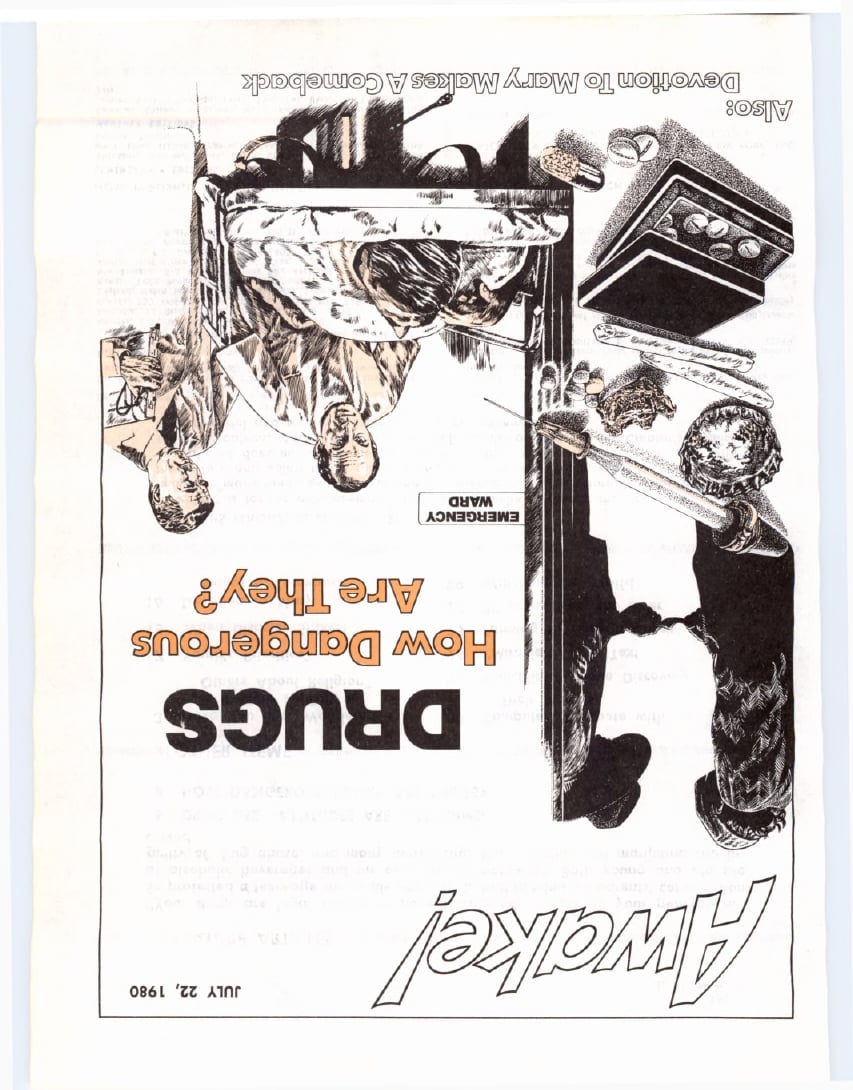
Awake! — July 22, 1980
Source: jw.org
Contents
Page Two
Is It Right to Talk to Others About Religion?
Drug Use—Attitudes Are Changing
Youth’s Priorities?
How Dangerous Really Are Drugs?
When Disaster Strikes!
Devotion to Mary Makes a Comeback
Computers Compete with Their Makers
Penicillin’s Unique Discovery
“Miracle” Greek Text
Fanning the Fire in Caprivi
Blindness from the River
Watching the World
Does Death End It All?
Did You Miss It?
Page Two
Page Two
“Your drugs are legal and mine have been made illegal by your generation.” So protested a teen-age son to his parents. He had in mind his parents’ consumption of alcoholic beverages and his own use of marijuana. Both young and old are guilty of drug abuse, and many more drugs than alcohol and marijuana are involved
5 DRUG USE—ATTITUDES ARE CHANGING
8 HOW DANGEROUS REALLY ARE DRUGS?
Is It Right to Talk to Others About Religion?
Have You Ever Wondered—
Is It Right to Talk to Others About Religion?
RELIGION is front-page news today. Pope John Paul’s journeys, theological dissent in Europe, the rise of Islam and the daily focus on the ayatollahs of Iran, all regularly hit the headlines. So, many people—including those who used to avoid the subject—are now talking about religion.
MUST TALKING ABOUT RELIGION ALWAYS LEAD TO ARGUMENT?
Well, it shouldn’t. It ought to help people to understand why others think and act the way they do. Especially is that true when the Bible is discussed, because it encourages us to love our neighbors.
Don’t you agree that there is a need for better understanding among neighbors? To get to know one another the logical thing is to talk personally to one another. But this is not always easy, especially when religion is involved.
For instance, recently many Asians from India, Pakistan and East African countries emigrated to the British Isles. Naturally they brought with them their colorful cultures, along with their religions. Communicating with this Gujarati-speaking population of close to a half million is no simple task for the Christian! The easiest course: simply don’t bother about it. Most churches in the British Isles don’t. They are quite satisfied with simply coexisting.
On the other hand, many of Jehovah’s Witnesses have undertaken to study the language of their new neighbors so as to speak to them about faith in God. Interestingly, the newspaper “Garavi Gujarat” recently commented: “And now Bible lectures are being given in Gujarati” by Jehovah’s Witnesses on a regular basis. This has generated many friendships because of the increased warmth and understanding shown. In addition to understanding your neighbors better, are there other benefits to these interchanges? In other words . . .
ARE THERE REAL BENEFITS FROM SUCH CONVERSATIONS?
Yes, because all involved can broaden their knowledge of religion and its role in life today. Though religion is a personal matter, there is truth in the wise Bible proverb: “People learn from one another, just as iron sharpens iron.”—Prov. 27:17, “Good News Bible.”
No one has complete spiritual knowledge. We can all “learn from one another,” just as the proverb states. Friendly discussions about religion can uplift as well as provide meaningful answers to vital questions. “Today each person has deep questions inside,” reports one young girl who bemoans: “You don’t find the answers in religion, in the church. Although I have faith, there’s something missing in the church.”
Many agree. They still have faith in God, but have been frustrated trying to find answers to deep questions in the church. For instance, What happens after death? Why has God permitted wickedness? Will he ever do anything about it? What is the purpose of life? How can I keep my family together? Most churches have not given persons satisfying answers. As a result, many have slowly stopped going to church. But this brings us to another thought-provoking question:
DO YOU HAVE TO GO TO CHURCH TO DISCUSS RELIGION?
The example of the Founder of Christianity suggests No. One unusual aspect of Jesus’ preaching activity was that he needed no special building in which to talk with people about religion. He was happy talking about God anywhere at any time. On a hillside, in a marketplace, at the seashore, or just walking along a dusty road. They were natural settings and people were, therefore, relaxed when conversing with him.
Jesus visited people in their homes to talk about religion. In fact, the Bible reveals that some of his most profound teachings were expounded in private homes. To his disciples, he specifically said: “Into whatever city or village you enter, search out who in it is deserving, and stay there until you leave. When you are entering into the house, greet the household; and if the house is deserving, let the peace you wish it come upon it.” Very clearly they were to visit people at home and share what they had learned from Jesus.—Matt. 10:11-13; 13:36.
As the Christian faith grew, the home became the focal point of assembly. Though they eventually had meeting places where the whole congregation came together for Bible study, much of their actual conversing about God occurred in homes. It was this willingness to talk to others on every occasion that contributed to the rapid expansion of Christianity. The zealous disciples set a fine example for Christians today.
Today Jehovah’s Witnesses are willing to do the same thing. They know that the Bible has satisfying answers to the deep questions raised earlier, as well as many more. They will be glad to share such information with you. Each week they visit well over a million homes world wide to conduct regular Bible discussions. You only have to ask to be included in this free public service. Discover for yourself how helpful it can be to talk to Jehovah’s Witnesses about the answers that the Bible gives to the problems of life.
Drug Use—Attitudes Are Changing
Drug Use—Attitudes Are Changing
By “Awake!” correspondent in Canada
THESE are times of change. New viewpoints are replacing the old. One area where this is very obvious is in the attitudes of the younger and older generations about drug use.
The challenge many parents have had to face on the increasing use of drugs by their children is shown by a teen-age son who protests: “Alcohol and coffee are the choice of your generation; drugs are the choice of my generation. We each take them for what we feel are good reasons. The only difference is that your drugs are legal and mine have been made illegal by your generation.”
Who is right? Are people overreacting to drug use? Is this expanding nonmedical use and growing acceptance of drugs a real threat to you and your family? Does the “recreational” use of drugs constitute a truly dangerous situation for society?
There is no doubt that the nonmedical use of drugs is growing. Perhaps you have thought that with the passing of the “hippie” generation the use of drugs fell off, that it peaked in the 1960’s and that the 1970’s were different. Yet research of the 1970’s shows that 70 percent of the students in American universities have used marijuana. Its use by high-school students in Canada jumped from 6.7 percent in 1968 to 22.9 percent in 1974. Now, probably three million Canadians and some 24 to 36 million Americans use marijuana. In some Canadian cities children as young as nine years of age are “shooting speed” (injecting amphetamines), and six-year-olds are getting into “soft” drugs.
As for Europe, a newspaper report says: “Almost every city of Western Europe is becoming a centre of heroin addiction.” In most parts of the world, especially among the well-to-do, high-priced cocaine use is on the rise.
A reflection of the growth of drug use in the United States is seen in a report by a former White House health adviser, Dr. Peter Bourne. He said that marijuana smuggling is now that nation’s third-largest industry. Only Exxon and General Motors do bigger business in the United States. In Florida, it tops even the tourist industry, he claimed, being now the leading money-maker there. Did you know these things?
Such growth in drug use is sure to cause concern for parents and others. They are concerned about the early and long-range effects of drug taking on children and adults, and on society as a whole.
There are those who propose that legalizing drug use would snatch drug trafficking out of the hands of criminals and allow for better control by government agencies. Especially do they argue for this on the basis of the alleged harmlessness of drugs if used moderately. They may then cite reports like the one that appeared in the Montreal Star News and Review of March 31, 1979, which said: “In the past 80 years 13 major national and international commissions have inquired into cannabis [marijuana] and each has reached broadly the same conclusions: that its dangers have been greatly exaggerated.”
Yet in the same city just a few days earlier, another newspaper, The Gazette (March 22, 1979), reported on a Symposium on Marijuana held at Rheims, France, and said: “More than 40 scientists from 13 countries presented the latest findings on marijuana—and they are alarming.” [Italics added] The conflicting reports leave many persons perplexed.
In the case of drugs other than marijuana, advocates of legalized drug use will point to a news report like the one in the Vancouver Sun that told of a prison doctor, Robert Schulze, who would like to see heroin legalized. Dr. Schulze claimed that after performing many autopsies on former heroin users he had seen no damage due to heroin. He added that heroin used over a long period of time would likely be less harmful than candy or aspirin used over the same period of time. He said: “It is a totally harmless thing to have freely available in the community.”
Confused?
The claims by each side are conflicting ones, to say the least. However, since decisions involving your attitude toward the use of drugs are so far-reaching, careful analysis is needed. For example, one argument of proponents is that drug use is becoming more and more acceptable and therefore it is just a matter of time and conditioning before other drugs have the same popular status as coffee, tobacco and alcohol. But does general acceptance by the public argue that a substance is necessarily harmless? Not really. Certainly it has not proved to be so with tobacco.
Despite the contradictions found in the various studies and reports on drugs, especially when dealing with marijuana use, medical men in general and many scientists are not yet ready to give all “popular” drugs a clean bill of health. There are still serious reservations about the long-term effects of even the so-called “soft” drugs. There is growing concern about the effects on the unborn.
Maclean’s magazine reported that due to a lot of pressure on the Canadian government to legalize marijuana, in March of 1979 “each member of Parliament received a letter from a dozen high-ranking Canadian doctors urging extreme caution in this contentious matter.” Why? One would be wise to find out. He should also investigate why, if it is as harmless as claimed, so many using drugs try desperately and repeatedly to break free from drug use.
Therefore, it is important that we answer the question, Are drugs really dangerous? How can you know for sure? Is there enough evidence to assure you of the right viewpoint to take as to what would be best for the health and life of self and loved ones? Should we take a closer look at our own use of drugs? The information that follows should help you to answer these questions.
[Blurb on page 6]
Marijuana smuggling in the United States is that nation’s third-largest industry
[Blurb on page 6]
Is it true that the use of some drugs constitutes no more danger to your health than moderate use of caffeine, alcohol or nicotine?
[Blurb on page 6]
Many scientists are not yet ready to give all “popular” drugs a clean bill of health
[Blurb on page 7]
Does general acceptance by the public argue that a substance is necessarily harmless?
Youth’s Priorities?
Youth’s Priorities?
Advanced journalism students at Gross Pointe South High School in Michigan conducted a survey that may shed some light on what many modern youths put first in their lives. The survey revealed that an average student at the high school spent about $4,400 annually, using almost twice as much for cigarettes, alcohol and drugs as for lunches and clothing. In a month the average student was said to spend: Alcohol and drugs, $80.84; cigarettes, $37.60; clothing, $46.29; lunches, $21.12; automobile expenses, $24.11. What will be the next generation’s priorities?
[Graph on page 7]
(For fully formatted text, see publication)
Spent for cigarettes, $118.44 per mo.
alcohol and drugs
Spent for lunches $67.41 per mo.
and clothing
How Dangerous Really Are Drugs?
How Dangerous Really Are Drugs?
By “Awake!” correspondent in Canada
ALL drugs are potentially dangerous. A drug is any substance that by its chemical nature alters the structure or function of a living organism. It is this “altering” effect that constitutes a definite danger.
The drugs here being discussed are substances that have some effect on the mood, perception and consciousness. According to this definition, a number of things in common use, such as coffee, some tea, cola drinks and alcoholic beverages, although not thought of as drugs in themselves, actually do contain drugs. The drug in the first three is caffeine and, obviously, in the latter is ethyl alcohol. Moderate use of these drinks is not harmful, and may even possess some nutritional or health value. Wine, for example, is specifically recommended in the Bible for health reasons. At 1 Timothy 5:23 it states: “Use a little wine for the sake of your stomach and your frequent cases of sickness.”
But the use of drugs can cause serious problems. The accompanying chart shows what some of these are.
Of course, some drugs are used for healing purposes, or to reduce pain due to illness or surgery. Are there abuses in such medical use of drugs? Certainly. For example, not only is there the overmedication that results from the indiscriminate prescribing of tranquilizers and antibiotics by some doctors, but there is also the overuse by individuals of nonprescription drugs such as aspirin and sleeping pills. And that, too, is harmful and dangerous. But that is something that we will discuss in a later issue of Awake!
Generally, however, the use of drugs in medicine is not the same as drug use by individuals where the purpose and motivation are very different. The results to the recipient are also usually very different.
Just look at what happens to those who abuse drugs for whatever reason. Note carefully what even short-term abuse will bring about. Ask yourself, Are not the dangers to health and life real ones? Consider just a few examples:
AMPHETAMINES: Short-term use results in reduced appetite, increased heart rate and raised blood pressure. Long-term, heavier doses result in restlessness, irritation, malnutrition, increased susceptibility to infections, high blood pressure, a sense of power and superiority, unusual delusions and hallucinations, paranoia, and so forth. Not a pretty list, is it?
BARBITURATES: Short-term effects are slurred speech, staggering, a “high” feeling, and, in large doses, unconsciousness and fatal depression of the respiratory system. Harmless?
COCAINE: Short-term effects are much like those from amphetamines. Long-term, heavier doses bring on bizarre, erratic and violent behavior, paranoid psychosis, and sometimes an irresistible and maddening sensation that something is crawling under the skin.
OPIUM, HEROIN AND CODEINE (the latter used in many cough medicines found in drugstores): Short-term effects of opiates like these include a state of “contentment,” detachment, nausea and vomiting. An acute overdose adversely affects the respiratory function, with danger of death. Does nonmedical use of these sound safe to you?
TRANQUILIZERS: Adverse effects are reduced alertness, slurred speech, dizziness, depression, possible impairment of muscle coordination, urinary retention, low blood pressure, and so forth.
LSD: Effects are usually rapid pulse, distortion of perception, anxiety or panic, feelings of unusual power or importance.
PCP: Effects noted often are shallow respiration, increased blood pressure, muscular incoordination, numbness of the extremities. With larger doses: nausea, vomiting, blurred vision, loss of balance, delusions, confusion, hallucinations, coma, uncontrollable rage, suicidal and homicidal tendencies, death.
Frightening? Yes, and yet the list is by no means complete. Under the influence of these drugs people often lose their lives. In the book Mind Drugs, there is related the account of one young girl who, after taking LSD, jumped to her death on a rocky beach because the ocean below appeared to her as a silky scarf. Then there were the youths who wanted to ‘become one’ with the traffic on a busy thoroughfare. And there was the student who had to be restrained from leaping from an apartment window because he wanted to use his new ability to fly. Long is the list that tells of those who committed suicide or perpetrated terrible crimes after using PCP or LSD.
Imagine its power: an eyedropperful of LSD would be enough to produce a drug experience for 10,000 people. “By weight it is about three million times as potent as crude marijuana,” says the book Mind Drugs.
In addition to the direct effect of the chemicals themselves, many drugs are administered by unsterilized hypodermic needles, adding the dangers of tetanus, phlebitis, hepatitis and inflammation of the lining of the heart and its valves. Sooner or later, too, if a person becomes addicted or dependent, he will find himself in the company of criminal elements and in dangerous neighborhoods as he seeks out sources of his drugs. All of these pose a threat to health and life.
What are your chances of survival on the highways these days with so many under the adverse influences of drugs? Would you be at ease if you knew that coming at you at night from the opposite direction on a highway was a young girl who, due to recurrent effects of a drug she once took, now sees 1,000 pairs of headlights ahead of her, resulting in her not knowing for sure which are your real ones and which are the illusions? In her case, the headlights trigger the recurrence of the drug effect.
And are you at ease on the highway knowing that one of the effects of marijuana is the impairment of the ability to judge distance and time? that coordination is slowed down and that ability to make decisions is affected? What would that mean to you and your family when you are on a busy highway with many cars passing one another? Dangerous? No doubt about it!
Imagine, too, on a job, the danger to persons other than the drug takers. Think of the threat to life from having people afflicted by dizziness, loss of control, blurred vision and hallucinations working on fast-moving machinery and equipment, operating cranes lifting heavy objects overhead, or handling dangerous liquids and explosives. They truly constitute a threat to their own lives and to those of fellow workers. Do people have a right thus to endanger the lives of others? This relatively new safety problem is of serious concern to employers and medical officers at large plants. No wonder some job applications inquire as to the applicant’s previous use of drugs, if any!
There are those who would argue that they are doing better work now that they have used drugs to sharpen their awareness and creativity. But the facts argue otherwise. Take the case of a man who had been a successful international lawyer. For months after his experience with LSD he simply wandered about in the desert pondering his “experience” and its meaning.
A doctor’s report to executives on problems due to the increase of marijuana smoking pointed out that its use has “an adverse effect on performance of high-level jobs. The user is frequently lethargic, lacks motivation, is prone to error, has trouble remembering important details, and cannot think practically about the future.” How can a person’s brain be really aided by something that interferes with perception?
In another case a doctor tells of a transformation in a formerly bright student, studying for his law degree and his Ph.D. The changes came with marijuana use.
In time, thinking became unclear, concentration on schoolwork became more and more difficult and there were problems in his ability to finish work. Later, hostile reactions showed up and there was suspicion of others. The student and two companions were killed a short time later when the small plane he was piloting crashed.
As for cocaine, a report in Psychology Today said that it “gives an often deceptive feeling of improved intellectual and physical capacity.” It added: “The euphoria and confidence induced by cocaine can make the user attribute to the drug effects that have nothing to do with it, and cause him to overestimate the changes it does produce.” Even though amphetamines, since they are stimulants, seem to improve performance of simple tasks, “they do not improve performance on more complex tasks,” explained the same magazine.
The situation with drug use seems to be that the user thinks he is better than ever, but he really is not. The fact of life that must also be appreciated in this matter is that no drug is able in some magical way to develop a talent or an ability that was not there at the start.
Of real concern these days to medical men and many parents is the result of parental drug taking on the unborn. The route for nourishment to a baby is the mother’s bloodstream. Thus the many things a mother eats, drinks or otherwise puts into her body eventually show up in the baby.
Who can forget the tragic results to the unborn in the case of the mothers who took thalidomide as a sleeping pill? Babies were born with malformed limbs or arms and legs missing. There are also cases reported where an infant of a drug-taking mother was born with withdrawal symptoms, and where the baby of an alcoholic mother was born an alcoholic. Now, also, tranquilizers are thought to pose dangers to the young.
No wonder more and more warnings are issued to pregnant women and those who plan pregnancies about the risks involved with drugs, smoking, even aspirin, tea and coffee. Dr. Conrad Schwarz, head of the psychiatric department at St. Paul’s Hospital in Vancouver, said that scientific results have shown that “in pregnancies, the active ingredient in marijuana passes through the placenta to the fetus,” and that “the ingredient also passes through breast milk.”
Add to that the adverse consequences to the kidneys, brain and liver in barbiturate abuse and the inhaling of fumes from various solvents. What a poor start in life drug-taking women give their children!
One of the almost certain results of starting on drugs is the eventual taking of other drugs. Thus, it is not uncommon to find that heroin users are also users of marijuana, that some who take amphetamines to get “high” later take a depressant to bring them “down,” resorting to such drugs as tranquilizers or alcohol. The risk of mixing these drugs can be seen in this explanation:
The effect you desire from one drug, such as a depressant like a tranquilizer, may be canceled out by a stimulant taken at approximately the same time. For example, if one drinks six cups or more of caffeine-containing coffee the “benefit” of a tranquilizer will be nullified. On the other hand, the taking of two drugs of the same kind, such as two depressants or two stimulants, will heighten the effect—but not just a doubling of the effect. And here is where one encounters a very real danger. It is said that one alcoholic beverage plus one barbiturate can have the force of five or six alcoholic drinks. Or, as one pamphlet from a provincial ministry of health put it: “If you weigh 150 lbs., seven drinks in a couple of hours will probably make you intoxicated. If you have taken a cold capsule or some cough medicine as well, you may be unconscious. If you have also taken a barbiturate, you may find yourself in the emergency ward, or perhaps in the morgue.”
What about those who are not drug addicts but who are merely ‘taking what the doctor ordered’? They, too, must be careful and informed. You may be taking tranquilizers or perhaps have had one dose of a cough medicine purchased at the local pharmacy. Either of these mixed with one beer can have the impact of three or four drinks. One who is taking medication for blood pressure, heart problems, diabetes, epilepsy or allergies, should always ask a doctor or a pharmacist about whether any drug preparation he is to take is dangerous with coffee, tea, or alcoholic beverages. Also, tell your doctor or pharmacist what other drugs you are already taking when you have another prescribed or are buying one from your local druggist. Don’t become a statistic in the files of fatalities from drug mixing!
Drugs alter bodily functions designed to continue life. Any interference with or altering of the body chemistry can be dangerous and even death-dealing. Drugs will cause some unbalance in your organism. Their careful use as a prescribed medicine may have the beneficial effect of counteracting some chemical imbalance, but continued experimental, recreational or nonmedical use of drugs is playing Russian roulette with your life. And, if doing so, you are, in the case of those who are working and driving, or in the case of expectant mothers, putting the lives of other persons, including innocent babies, in jeopardy. Is that love of neighbor? Really, is there any valid reason for the current bumper crop of drug abuse?
[Blurb on page 12]
An eyedropperful of LSD would be enough to produce a drug experience for 10,000 people
[Blurb on page 12]
Marijuana users are considered to be a hazard on the highway and on the job
[Blurb on page 13]
Cocaine “gives an often deceptive feeling of improved intellectual and physical capacity”
[Blurb on page 14]
One alcoholic beverage plus one barbiturate can have the force of five or six drinks
[Blurb on page 14]
Continued experimental, recreational use of drugs is playing Russian roulette with your life
[Chart on page 10, 11]
ALCOHOL (Ethyl)
EXAMPLES Beer
Whisky
Wine
MEDICAL CLASSIFICATIONS Central nervous system depressant.
AND USES Used to sedate, promote sleep.
Dilates the blood vessels.
Energy source.
Aid to digestion.
SHORT-TERM EFFECTS Initial relaxation.
Loss of inhibitions.
Impaired coordination.
Slowing down of reflexes and mental
processes.
Attitude changes, increased risk-taking
to point of bad judgment.
LONG-TERM EFFECTS Regular, heavy use adds to chances of
cancer of the gastrointestinal tract,
cirrhosis of the liver, gastritis, heart
disease and pancreatitis.
MAJOR DANGERS Possibility of physical and psychological
dependence.
Social and personal deterioration.
Permanent damage to brain, kidneys and
liver.
ASA (Acetylsalicylic acid)
EXAMPLES Alka-Seltzer
Anacin
Aspirin
Bufferin
Dristan
Frosst 222
Templeton TRC
MEDICAL CLASSIFICATIONS Central nervous system depressant.
AND USES Used for fever, headaches, inflammation,
muscular pain and neuralgia.
SHORT-TERM EFFECTS Reduces fever, inflammation and pain.
Stomach upsets and possible gastric
bleeding.
LONG-TERM EFFECTS Enhances the effect of anticoagulants,
making patients bleed more easily.
Possible side effects are asthma, hives
and irritation and bleeding of
gastrointestinal tract.
MAJOR DANGERS To be avoided if you have blood clotting
abnormalities, ulcers and bleeding
problems, nasal infection, sinus
disease, asthma or allergic conditions
of the nose or sinuses.
CAFFEINE
EXAMPLES Cocoa
Coffee
Cola drinks
Tea
Wake-up pills
MEDICAL CLASSIFICATIONS Central nervous system stimulant.
AND USES Sometimes as mild stimulant.
Acts on kidneys to produce diuresis.
Stimulates cardiac muscle.
SHORT-TERM EFFECTS Greater alertness and increased
sleeplessness.
Involuntary hand tremors.
LONG-TERM EFFECTS Regular, heavy use increases caffeine
dependence (withdrawal symptoms include
irritability, restlessness and
headache).
Also, insomnia, anxiety, stomach and
duodenal ulceration.
MAJOR DANGERS Suspected as cause of heart disease,
bladder cancer and birth defects.
HALLUCINOGENS
EXAMPLES DET; DMT;
LBJ; LSD;
MDA; STP;
Hashish
Marijuana
MEDICAL CLASSIFICATIONS Central nervous system stimulant and/or
AND USES depressant.
No medical use.
SHORT-TERM EFFECTS Reduced appetite; increased energy and
postponement of fatigue; increased heart
rate and blood pressure; dilation of
pupils.
A “high” feeling.
Distortions of perception in colors,
shapes, sizes and distances.
Impairs memory, logical thinking and
ability to perform complex tasks.
LONG-TERM EFFECTS Psychological dependence possible.
Apathy, loss of drive and interest in
continuing activity.
Prolonged anxiety and depression.
Illusions.
Marijuana smoke, due to high-tar content,
carries risk of lung cancer, chronic
bronchitis.
MAJOR DANGERS Bizarre mental effects.
Irreversible personality changes.
Suicidal or homicidal inclinations.
“Flashbacks” may occur even after drug
discontinued.
NARCOTICS (Opiate analgesics)
EXAMPLES Codeine
Demerol
Heroin
Methadone
Morphine
MEDICAL CLASSIFICATIONS Central nervous system depressant.
AND USES Used to relieve pain.
SHORT-TERM EFFECTS Relief from pain; produces a state of
contentment; sometimes nausea and
vomiting.
LONG-TERM EFFECTS Rapid development of tolerance and
physical and psychological dependence.
MAJOR DANGERS Very strong physical and psychological
dependence.
Addictive.
General physical deterioration.
Death from overdose due to respiratory
depression.
NICOTINE (Tobacco)
EXAMPLES Chewing tobacco
Cigarettes
Cigars
Pipe tobacco
Snuff
MEDICAL CLASSIFICATIONS Central nervous system depressant and/or
AND USES stimulant.
No medical use.
SHORT-TERM EFFECTS Increases pulse rate; raises blood
pressure; lowers skin temperature;
raises acid levels in the stomach; first
stimulates, then lowers activity in
brain and nervous system; reduces
appetite and physical endurance.
LONG-TERM EFFECTS Damage to blood vessels in heart and
brain.
Shortness of breath, cough.
Increased respiratory infections.
Chronic bronchitis
Emphysema.
Risk of cancer of bladder, esophagus,
kidneys, larynx, lungs, mouth and
pancreas.
Stomach ulcers.
MAJOR DANGERS With habitual use, cancer of larynx,
lungs and mouth; irritative breathing
syndrome, chronic bronchitis, and
pulmonary emphysema.
Damage to the heart, blood vessels.
Impaired vision.
SEDATIVES AND HYPNOTICS
EXAMPLES Barbiturates
Amytal
Nembutal
Seconal
Tuinal
MEDICAL CLASSIFICATIONS Central nervous system depressant.
AND USES Used in treating insomnia, anxiety,
tension and epilepsy, and in treatment of
mental disorders.
SHORT-TERM EFFECTS SMALL DOSES can relieve anxiety and
tension, bringing calmness and
relaxation of muscles.
LARGER DOSES result in intoxicated
feeling, slurred speech, staggering,
unconsciousness.
ACUTE OVERDOSE can be fatal.
LONG-TERM EFFECTS Rapid development of tolerance and
dependence.
Normal sleep not produced.
MAJOR DANGERS With continual use, high psychological
dependence.
Dangers due to faulty judgment and
coordination.
Possible brain and kidney damage.
Death from overdose or in combination
with alcohol.
SOLVENTS (Deliriants)
EXAMPLES Airplane glue
Dry cleaner fluid
Gasoline
Lighter fuels
Nail polish remover
Paint thinners
Plastic cement
MEDICAL CLASSIFICATIONS Central nervous system depressant.
AND USES No medical use.
SHORT-TERM EFFECTS Extreme excitement; disorientation and
confusion slurred speech and dizziness;
distortions of perception and vision;
auditory hallucinations; loss of
muscular control.
Larger doses result in sleepiness and
unconsciousness and even death due to
heart failure.
LONG-TERM EFFECTS Dependence may develop, craving and
habituation.
Extensive use may bring about kidney and
liver damage.
MAJOR DANGERS Psychological dependence liability.
Potential irreversible damage to the
brain, liver and kidneys.
Accidental death due to choking or
suffocation.
STIMULANTS
EXAMPLES Amphetamines
Benzedrine
Cocaine
Coca leaves
Dexedrine
Methedrine
Phenmetrazine
PMA
TMA
MEDICAL CLASSIFICATIONS Stimulant to central nervous system.
AND USES Relieves mild depression and fatigue.
SHORT-TERM EFFECTS Reduces appetite; increases energy,
deters fatigue; increases alertness;
induces faster breathing; increases
heart rate and blood pressure, risking
rupture of blood vessels or heart
failure.
With LARGER DOSES, talkativeness,
restlessness, paranoia, panic, delusions
of grandeur.
LONG-TERM EFFECTS Malnutrition; increasingly subject to
infections; rapid development of
psychological dependence.
MAJOR DANGERS High blood pressure or heart attacks;
brain damage, malnutrition, exhaustion,
pneumonia.
Coma and death.
TRANQUILIZERS (Minor)
EXAMPLES Equanil
Librium
Miltown
Valium
Vivol
MEDICAL CLASSIFICATIONS Central nervous system depressant.
AND USES
SHORT-TERM EFFECTS Relaxes muscles; calms hyperactivity,
stress and anxiety; lowers emotional
responses to external stimuli.
Reduces alertness; gives short-term
relief from anxiety.
With LARGER DOSES, potential adverse
effect on muscle coordination.
Dizziness, drowsiness, lowered blood
pressure and/or fainting possible.
LONG-TERM EFFECTS Danger of physical dependence.
Similar to sedative hypnotics.
MAJOR DANGERS Dangerous with alcohol.
Produces depression, mental sluggishness,
slurred speech.
When Disaster Strikes!
When Disaster Strikes!
Firsthand account of one street’s suffering from the heavy rains that soaked southern California early this year
THE view on Divina Vista Drive certainly wasn’t divine on Saturday, February 16, 1980. It was 4:45 p.m. Torrential rain was hard hitting all day, after nine days of storms had dumped 17 inches (43 cm) of rain on Monterey Park, a suburb of Los Angeles, California. I looked out of our window. Our sun deck was sagging, the railings leaning over backward. The hill across the street was beginning to give way, endangering the homes below.
Suddenly, police rescue squads were coming up the street, sirens screaming. The paramedics arrived, two fire engines roared up the street, and an ambulance drove up after them. Divina Vista Drive was a rushing river of water and mud. A sound car drove up the street blaring out: “Everyone must leave!”
Out in the driving rain the torrent was so swift in the street that firemen had to carry us across. We went down the hill in the ambulance, but before reaching the bottom a mud slide blocked the street with four feet (1.2 m) of mud. No one could pass until city crews bulldozed a path through for the ambulance. It took us an hour to go 200 feet (61 m).
Our house was not hit as hard as were some others. One home had a mud slide slam through the house, pushing the refrigerator out into the street. Through one of their broken windows their couch was hanging out. Broken parts of television sets, a dining table, sink and ironing board were partially buried in the mud. Farther up the street a mud slide had crushed the walls of a house. The roof landed down on the street below. All their furnishings were in the front yard of the house across the street.
Right next door two men were working at the top of the steps of their two-story home. Suddenly a dreadful rumbling like the roar of thunder was heard, and, boom! the mud slide hit and pinned one of them under a car at the bottom of the street. He was completely buried in mud except for his head sticking out. Neighbors dug him out, alive.
It was heartwarming, however, to see how the disaster brought neighbors closer together. Interesting was their realization of how material things were not of primary importance. One neighbor said: “It’s an awful, sickening feeling—all you accumulate in a lifetime can disappear in the snap of the finger.” Another said: “Having something like that occur to you can really do something. I’ve changed my entire attitude about worrying over petty things.” Still another remarked: “When you’re that close to dying, being alive is really what’s important.”
Public crews were working in the area in 12-hour shifts. Half of the force was on duty all the time. On this one street 10 were injured, including four firemen and three policemen. The California Conservation Corps workers distributed 495 rolls of plastic covering, 12,000 sandbags and 175 tons of sand to control mud slides. All together, in Monterey Park 50 homes were damaged, 15 very seriously damaged and five were demolished. Loss is estimated at $2.5 million.
Court cases are pending as injured parties are seeking damages. Who is responsible? The defendants, including the city of Monterey Park, will argue that the torrential rains and the ensuing damage were an “act of God.” However, it is more accurate to look at the acts of people. Builders bulldoze the natural hillsides into pads and put houses on these lots. Embankments of compacted fill dirt are created, and the natural hillside is weakened. When the rains come the chopped-up hills go.—Contributed.
Devotion to Mary Makes a Comeback
Devotion to Mary Makes a Comeback
“VENERATION for Mary Renewed—Pope leads resurgence of interest in Jesus’ mother.” That four-column headline in the Toronto Star, capping an article that spoke of the upswing of “devotion to the Virgin Mary,” is typical of reports published all over the world. “The Pope has an intense devotion to the Virgin,” wrote the New York Times, adding, by way of proof, that John Paul II has recently visited Marian shrines in Mexico, Poland, Italy and Ireland. In fact, according to Paris daily Le Monde, his entire visit to Ireland had as its keynote “Mary Queen of Peace.”
True, the Second Vatican Council (1962-1965) reaffirmed the traditional Catholic dogmas concerning Mary, but it is generally admitted that Vatican II caused a decline in the devotion to Mary among Catholics in many lands. Already back in 1974, Pope Paul VI felt it necessary to publish a 30,000-word “apostolic exhortation,” Marialis Cultus (Marian devotion or worship), calling for increased devotion to the “Virgin Mary.”
Quite obviously John Paul II feels that Marian devotions need more attention. So he is putting the full weight of his papal authority behind the campaign for renewed devotion to Mary. But what effect is his stand on this dogma likely to have?
Worship of Mary Made a Slow Start
Catholic reference works freely admit that worship of Mary does not go back to apostolic times. The Catholic Encyclopedia states:
“Devotion to Our Blessed Lady in its ultimate analysis must be regarded as a practical application of the doctrine of the Communion of Saints. Seeing that this doctrine is not contained, at least explicitly, in the earlier forms of the Apostles’ Creed, there is perhaps no ground for surprise if we do not meet with any clear traces of the cultus [worship] of the Blessed Virgin in the first Christian centuries.”
The original Nicene Creed (325 C.E.) makes no mention of the “Virgin Mary.” It was not until the Council of Ephesus, held in 431 C.E., that Mary was defined in Catholic dogma as the “Mother of God” (Greek: Theotokos, literally “God-bearer”). And even then, this was more for Trinitarian reasons (to combat Nestorius, who denied that Jesus was brought forth God-Man) than to encourage devotion to Mary. Why this lack of attention to the devotion to Mary?
Because the practice is based, not on the Bible, but on Apocryphal literature, such as the so-called “Gospel of St. James” and the Sibylline Oracles. According to The Catholic Encyclopedia, it was only in the later Middle Ages, after the year 1000, “that the deep feeling of love and confidence in the Blessed Virgin, which hitherto had expressed itself vaguely and in accordance with the promptings of the piety of individuals, began to take organized shape in a vast multitude of devotional practices.” It was at that time that many of the medieval Gothic cathedrals throughout France were built and dedicated to Notre Dame (Our Lady).
As to the “Angelic Salutation” (Ave Maria, or Hail Mary), A Catholic Dictionary informs us that “Parts 1 and 2 seem to have come into common use as a formula of devotion towards the end of the twelfth century; . . . the rest of the verse is believed to have first come into use in the middle of the fifteenth century.” Very late indeed!
The doctrine of the “Immaculate Conception,” which claims that Mary was exempted from original sin from the first moment of her conception, did not become an article of Catholic faith until 1854. Why? The same Catholic reference work tells us that controversy over this doctrine had been raging within the Catholic Church since the 12th century and that some “bishops of great eminence” felt that this dogma had insufficient support in “Scripture or Tradition to be made an article of faith.”
Devotion to Mary received another boost as recently as 1950, when Pope Pius XII defined the “Corporal Assumption of the Blessed Virgin” (that her body was not allowed to decay, but was taken to heaven) as an article of faith, that is, as an obligatory belief for Catholics. It is not strange that fundamental dogmas relating to such devotion came so late if the adoration of Mary is God’s will for Christians?
Did Mary Have Other Children?
No Bible-believing Christian doubts that Mary was a virgin when she conceived and bore Jesus. (Matt. 1:18-23; Luke 1:34, 35) The dogma that separates Catholics from Protestants and that is now even dividing Catholics is the perpetual virginity of Mary. Two recently published books, both involving Catholic authors, provide a new approach to the question of devotion to Mary.
One, written in English by a group of Roman Catholic, Lutheran, Reformed and Anglican scholars, is entitled “Mary in the New Testament.” Explaining the reason for writing this book, coauthor Joseph A. Fitzmyer, of the Catholic University of America, stated:
“Modern Catholics tend to think that everything in our 20th century piety comes from the New Testament, but quite often what we are used to is not what the scriptural writer had in mind but rather the reflections of believers in subsequent centuries.”
Commenting on this book, Tom Harpur, religion editor of the Toronto Star, wrote:
“The team was divided over whether the evidence points to Mary’s having had other children after Jesus or not. . . .
“The book notes, though, that a 1976 commentary by German Roman Catholic scholar Rudolph Pesch comes out with the blunt opinion that these relatives were indeed natural brothers.
“As to the two later doctrines—that Mary was immaculately conceived without sin and later ascended bodily into heaven—the scholars have little to say due to the fact that there is nothing in the New Testament about either belief.”
The other book, written in French by Catholic author Jean Gilles, is called Les “frères et sœurs” de Jesus (Jesus’ “brothers and sisters”). It has caused much controversy among French Catholics. And no wonder, for in conclusion the author states:
“Briefly and in measured language, out of faithfulness to the [Catholic] Church, I believe I can sum up my investigation as follows. . . . The FOUR CANONICAL Gospels provide concordant evidence that Jesus had real brothers and sisters in his family. . . . In the face of this coherent block of proof, the traditional position [of the Roman Catholic Church] seems vulnerable and fragile.”
The Dangers of Devotion to Mary
Acknowledging the dangers of devotion to Mary, The Catholic Encyclopedia states: “That popular devotion to the Blessed Virgin was often attended with extravagance and abuses, it is impossible to deny.” As far back as the end of the fourth century, Catholic “saint” Epiphanius condemned the offering of cakes to Mary, stating: “Let no one adore Mary.” The same encyclopedia tells us: “As early as 540 we find a mosaic in which she [Mary] sits enthroned as Queen of Heaven in the centre of the apex of the cathedral of Parenzo.”
Was it not exactly this kind of pagan worship that provoked God to anger back in the time of Israel? The Bible relates: “The children gather wood, the fathers kindle fire, and the women knead dough, to make cakes for the queen of heaven; and they pour out drink offerings to other gods, to provoke me to anger.”—Jer. 7:18; 44:15-30.a
This danger still exists. Daniel L. Migliore, associate professor of theology at Princeton Seminary, recently wrote: “Our violations of Mary are legion. . . . We have made her the Queen of Heaven.” Catholic Archbishop Carter of Toronto gave the following explanation of the reason why Vatican II tried to tone down adoration for Mary: “The Council had in mind the kind of abuses seen, for example, in some Latin-American countries where Mary sometimes took precedence over everything else.” The “abuses” to which adoration for Mary can lead become very visible at such places of Marian pilgrimage as Lourdes, in France, and Fatima, in Portugal.
In addition to the danger for Catholics, Mariolatry is undoubtedly a divisive factor within Christendom, since most Protestants reject devotion to Mary as idolatry. And the information given above shows that Catholics are divided among themselves over the Scripturalness of Marian dogmas.
It is therefore clear that by reviving the adoration of Mary, Pope John Paul II is doing nothing to unite Catholics among themselves or to draw them nearer to the other religions of Christendom. Worse still, he is doing nothing to revive true Christianity as it was practiced by the apostles and early disciples of Christ.
A Balanced View of Mary
The purpose of this article is certainly not to offend sincere Catholics, especially Catholic womenfolk who have come to consider Mary a loving and tender intercessor, someone who understands the sufferings of womanhood. The Bible allows us to respect and even love Mary as a faithful disciple of Jesus. (Acts 1:14) The Scriptures clearly show that Mary, as an anointed Christian, would be “raised a spiritual body,” to “inherit the kingdom of God,” together with the 12 apostles and other faithful first-century Christians.—1 Cor. 15:42-54; 1 Thess. 4:13-16.
However, nowhere does the Bible authorize us to adore Mary or to pray to her for intercession. Prayers should be addressed to God, through Christ. (John 14:6, 13; Acts 4:12) Catholic women, and men, too, should not feel that they will find less sympathy and understanding when they pray to God in the name of Christ than when they prayed to Mary.
Of God we read: “As a father pities his children, so the LORD pities those who fear him. For he knows our frame; he remembers that we are dust.” (Ps. 103:13, 14) And of Christ it is written: “For we have not a high priest who is unable to sympathize with our weaknesses, but one who in every respect has been tempted as we are, yet without sinning.”—Heb. 4:15; see also Philippians 4:6, 7.
So we invite sincere Catholics who pour out their heart to Mary to learn from the Bible how to pray just as intimately to God through Christ. Start off by reading the above scriptures, all taken from the Catholic edition of the Revised Standard Version. Then get more information by writing to the publishers of Awake!
[Footnotes]
All scriptures quoted in this article are taken from the Revised Standard Version, Catholic Edition.
[Box on page 19]
LET THE BIBLE SPEAK FOR ITSELF
Was Mary the Mother of God?
“Therefore the child to be born will be called holy, the Son of God [not God].”—Luke 1:35.
Was Mary Born Without Sin?
“If a woman conceives, and bears a male child, then she shall be unclean seven days; . . . And when the days of her purifying are completed, . . . she shall bring to the priest at the door of the tent of meeting a lamb . . . And if she cannot afford a lamb, then she shall take two turtledoves or two young pigeons, one for a burnt offering and the other for a sin offering; and the priest shall make atonement for her, and she shall be clean.” (Lev. 12:2, 6, 8) “And when the time came for their purification according to the law of Moses, they [Joseph and Mary] brought him [Jesus] up to Jerusalem to present him to the Lord . . . and to offer a sacrifice according to what is said in the law of the Lord, ‘a pair of turtledoves, or two young pigeons [one as a burnt offering, the other as a sin offering for Mary].’”—Luke 2:22, 24.
Did Mary Remain a Virgin After Jesus’ Birth?
“He [Joseph] took his wife, but knew her not [“had not had intercourse with her”—Catholic Jerusalem Bible] until she had borne a son; and he called his name Jesus.”—Matt. 1:24, 25.
Did Mary have other children after the birth of Jesus?
“She gave birth to her first-born son and wrapped him in swaddling cloths.” (Luke 2:7) “Is not this the carpenter’s son? Is not his mother called Mary? And are not his brethren [Greek: adelphoi, “brothers,” not syngenēs, “kinsfolk” or “cousins”] James and Joseph and Simon and Judas? And are not all his sisters with us?”—Matt. 13:55, 56.
By “Brothers,” Could the Bible Be Referring to Jesus’ Disciples, His Spiritual Brothers?
“After this he went down to Capernaum, with his mother and his brethren and his disciples.” (John 2:12) “So his brethren said to him, ‘Leave here and go to Judea, that your disciples may see the works you are doing.’ For even his brethren did not believe in him.”—John 7:3, 5.
Was Mary’s Physical Body Taken to Heaven?
“So it is with the resurrection of the dead. What is sown is perishable, what is raised is imperishable. It is sown a physical body, it is raised a spiritual body. I tell you this, brethren: flesh and blood cannot inherit the kingdom of God.”—1 Cor. 15:42, 44, 50.
Should Prayers Be Addressed to Mary?
“Jesus said to him, ‘I am the way, and the truth, and the life; no one comes to the Father, but by me. Whatever you ask in my name, I will do it, that the Father may be glorified in the Son.’”—John 14:6, 13.
Computers Compete with Their Makers
Computers Compete with Their Makers
Most people are astounded when they witness a demonstration of what computers can do. Some recent developments add to this impression. A writer for “Smithsonian” magazine tells of an experimental speech-recognition device he witnessed. A researcher spoke the writer’s name into a microphone attached to a computer terminal. Almost at once, he writes, “‘Richard M. Restak.’ correctly spelled, appeared on the viewing screen.” The computer also correctly displayed a sample letter dictated to it. Restak says that soon “inexpensive speech-recognition machines may be available to take dictation of a letter and produce a first draft within a few seconds.” Secretaries, move over!
Not only are computers reducing sound to print, some are producing sound from print. The U.S. Library of Congress has a device for the blind that reads aloud from an open book placed face down over a scanner. This machine’s sound-producing circuits are controlled “in much the same way the human brain controls the jaw, tongue and throat muscles in order to shape the vocal tract for the production of human speech,” says “Smithsonian.” It even “can vary emphasis on particular sounds in a manner similar to natural spoken English . . . emphasizing some words more than others, and pausing at various times to avoid ‘machinelike’ speech,” a failing of other such reading machines.
Other severely handicapped persons may benefit from a computer system that allows them to type merely by moving their eyes. The device is able to follow eye movements that briefly fix on letters of the alphabet. Then it types the letters at a rate that has allowed some volunteers to achieve speeds of 18 words per minute after practice. Another similar computer system for the handicapped is installed on mechanized wheelchairs. It allows paralytics to “order” their wheelchairs wherever they want to go merely by voice commands.
A couple in London reportedly have adapted a home computer to act as a nanny for their baby. The baby’s father, a computer consultant, programmed the computer to respond the instant baby Gemma cries by talking to her in a soothing tone, using parental voices. The surrogate nanny will also tell bedtime stories and teach the baby three languages as she begins to talk. Whether microphones and loudspeakers will be an adequate substitute for the tenderness of human contact is another matter.
A more ominous development comes from Australia, where a computer is said to have written its own program for solving a chess problem. Ross Quinlan of the University of Sydney developed a system of “automatic programming.” The machine-written computer program was five times faster than the best program that Quinlan himself could write for the same purpose. Some experts fear that such systems could develop into a situation where humans could not understand computer “reasoning” on key decisions. Professor Donald Michie of Edinburgh University, Scotland, warns that a “human window” should be built into all computer systems that allows people to query the machine as to why it reached a certain conclusion.
Even in view of such impressive computer accomplishments, “The Brain Book” says that “in terms of its complexity and versatility, the human brain far surpasses any computer on earth.” This recently published volume observes that a computer’s speed in calculations and step-by-step logic is far surpassed by the brain’s ability in “parallel processing, integrating and synthesizing information, and abstracting it from generalities.” And computers do not even come close to the brain’s ability to recognize a face or an object in an instant. “A transistorized computer capable of all the human brain can do would not fit inside Carnegie Hall,” observes “The Brain Book,” and it would weigh more than 10 tons, even using the miniature circuitry now available. In fact, says the book, “the whole of the world’s telephone system is equivalent to only about one gram of your brain—a piece the size of a pea!”
Penicillin’s Unique Discovery
Penicillin’s Unique Discovery
EACH time you take a breath, eat, drink, smell or touch something, your body’s defense mechanism goes to work to protect you from the possibility of harmful bacteria getting into your bloodstream. Millions of white cells floating in the bloodstream literally attack, swallow and digest any harmful invaders. But only in recent generations has the body’s marvelous hygienic patrol been clearly understood.
Previous to our century, infected operation wounds were the cause of many hospital deaths. It began to be realized that bacteria that gained entry at the incision made by the surgeon poisoned the bloodstream. Contaminated surgical equipment, clothing and unwashed hands became suspect. Lives were saved as sterilized equipment, hygienic methods and antiseptics became standard procedure in the operating process. Chemicals such as carbolic acid (phenol), lysol and iodine were used to stop the growth of bacteria. But such discoveries only brought partial success since the antiseptics would only stop the growth of bacteria outside the body.
The doctor’s greatest need, however, was to discover an internal antiseptic capable of destroying bacteria after they had established themselves within the body but without harming the patient. Could any such internal antiseptic be found?
The World of Microorganisms
A spoonful of fertile soil contains millions of bacteria and molds that keep multiplying. Among themselves there is a never-ending struggle for existence. Some fiercely aggressive bacteria, in order to kill their competitors, diffuse minute quantities of deadly poison. It is this poison that is called an antibiotic. Thus, when different poisons are isolated from different types of bacteria, a variety of antibiotics are obtained.
Suppose, for example, that certain bacteria invaded your body. Today it may be a relatively easy process to prescribe a particular antibiotic for your illness. But even as late as the 1920’s the idea of isolating a particular antibiotic from bacteria and injecting it into the bloodstream as a safe internal antiseptic was rejected by the British medical profession. It was generally thought that no substance existed that would attack bacteria cells without harming human cells at the same time. One doctor, however, persisted in thinking differently.
Scottish-born Alexander Fleming spent almost his entire life as a doctor in London, studying the problems of infection and the use of antiseptics. In 1922 he made a remarkable observation. He took a test tube containing water mixed with inoffensive bacteria that turned the water milky. To this he added just one human teardrop. In seconds the milky substance cleared! It was obvious that in human tears there must be a chemical capable of destroying bacteria with astonishing speed. He named it “lysozyme” because it could “lyse,” that is, dissolve, bacteria.
Lysozyme, however, proved disappointing as it was effective against harmless microbes but powerless against those causing disease. The discovery was highly beneficial, however, in that it pointed Fleming to a completely new principle in mankind’s struggle against disease—the destruction of bacteria by using a harmless chemical. It prepared him for a similar incident six years later.
Historic Moment of Discovery
In 1928 in his laboratory, in shallow glass dishes, Fleming was cultivating staphylococci, the bacteria that cause boils. An old friend named Pryce dropped in to see him. Something that was to mean the difference between life and death to multitudes was about to take place. While talking to Pryce, Fleming removed the lids from several of his cultures. Suddenly, he stopped talking. After observing one culture for a moment, he said in his usual unconcerned tone: “That’s funny . . .” On the culture there was a growth of mold as usual. But all around the mold, the colonies of staphylococci had been dissolved. Instead of forming opaque yellow masses, they looked like drops of dew.
Fleming concluded that something produced by the mold was diffusing the bacteria and dissolving them. Today we know that that something was penicillin, a drug that was to revolutionize medicine. The arrival of the right spore itself falling out of the air and into the right culture dish, may have been the accident of all accidents.
Next, Fleming grew some blue-green mold (similar to that which appears on oranges, stale bread, ripening cheese, decaying fruit) on the surface of a liquid meat broth. It absorbed nourishment and diffused its antibiotic. After several days it was filtered as a crude juice that Fleming then named penicillin.
In a test tube his mold juice would destroy gonorrhea, meningitis, diphtheria and pneumonia bacteria. And, most important, it was nonpoisonous to man! Fleming suggested to the medical profession that here might be the ideal antiseptic. His audiences responded with icy indifference. They felt strongly that when bacteria established themselves within the body, they were out of the reach of all chemicals.
Because Fleming and his assistants did not have the know-how to handle the chemistry problems associated with isolating and purifying penicillin, virtually nothing more was done in its development for more than eight years. It seemed penicillin was on the way to being forgotten.
Penicillin Isolated
In 1939, due mainly to the diseases soldiers were contracting on the battlefield, two scientists educated in medicine and chemistry, Howard Walter Florey and Ernst Boris Chain, joined together in England in an assignment to investigate bacteria antagonism. Their research led them to Fleming’s writings on lysozyme and penicillin. Soon, they were working with his mold juice and, after repeated failures, the elusive chemical was finally produced in stable powder form.
There was much excitement when four disease-infected mice were cured. Then, in 1941, the first human was treated successfully. As one scientist reported, “the response to penicillin was considered almost miraculous.” It was demonstrated that penicillin could be diluted 120 million times and still remain effective against bacteria. This was almost unbelievable!
Because of wartime problems, Florey, with his precious mold, transferred from England to Peoria, Illinois, U.S.A. Fleming’s mold was unsuitable for mass producing penicillin. After a very widespread search, Mary Hunt of Peoria, who assisted Dr. Kenneth B. Raper and who was given the title “Mouldy Mary,” found a suitable mold from a rotten cantaloupe. The descendants of its mold have since become the chief source of penicillin. Soon, penicillin was in full production in many countries, and Fleming, Florey and Chain were awarded the Nobel prize for medicine in 1945.
…