Awake!, June 22, 1980
Download: PDF — Awake!, June 22, 1980
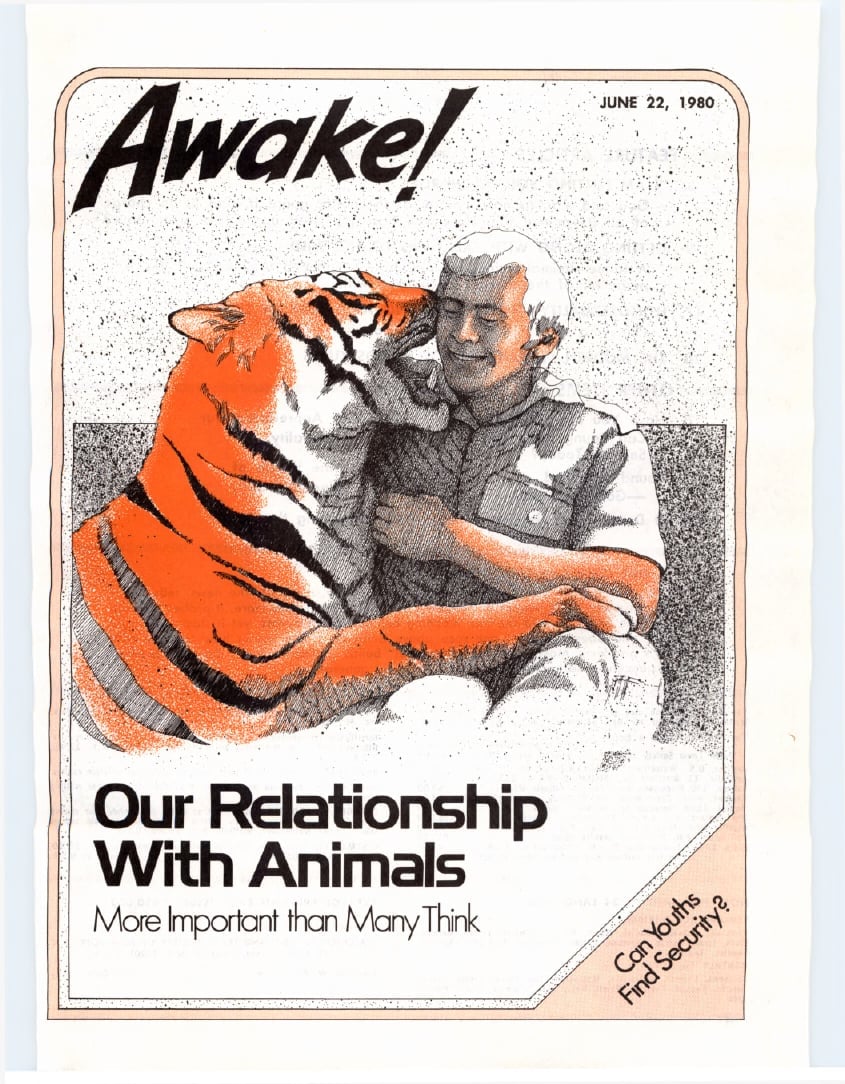
Awake! — June 22, 1980
Source: jw.org
Contents
Page Two
Can Young Folks Find Security Today?
“I Am Putting You in Charge”
Getting Along with Creatures of the Wild
Sound Amplified—Good and Bad
Homosexuality—How Rewarding as a Way of Life?
The Modern “Liberation” of Homosexuals
It Doesn’t Just Happen
They Appreciated Our Hospitality
For the Health of Mind and Body
Watching the World
Why Does God Permit Wickedness?
How to Avoid 5 Major Pitfalls in Everyday Life.
Page Two
Page Two
5 “I AM PUTTING YOU IN CHARGE”
God told man to have control of the earth, guard it, and be in charge of all its animal life. How well has man lived up to this divine trust?
9 GETTING ALONG WITH CREATURES OF THE WILD
A former animal trainer explains how he needed to understand the temperament of the animals he worked with
17 HOMOSEXUALITY—HOW REWARDING AS A WAY OF LIFE?
One who was in it tells how he got out
20 THE MODERN “LIBERATION” OF HOMOSEXUALS
Can Young Folks Find Security Today?
Have You Ever Wondered—
Can Young Folks Find Security Today?
WE LIVE in an unstable, dangerous world. Many people feel frustrated and depressed. For example, a young man of 16 in Britain, on leaving school, tried hard to find a job, but failed. He committed suicide. An exceptional case? So many young folks feel unhappy and insecure that, for example, in Alberta, Canada, it ranks second as a cause of death of youths 15 to 19 years old. Why? How can this feeling be overcome?
WHAT CAUSES THE FEELING OF INSECURITY?
There are many factors involved, such as unhappy homes and bad conditions at school. In many places good jobs are hard to find. So are loyal friends. Marriage seems risky. And the general future looks gloomy.
Parents may be so occupied that they spend little time with their young folks and consider them a burden. If family togetherness is lacking, parents and children become strangers. In some cases parents become strangers to each other. And the family breaks up.
“Student reading skills are declining,” says a report from Canada. In many countries standards of teaching are dropping. Cheating is on the increase. Diplomas are becoming meaningless. Vandalism and violence are driving teachers away. Schools are becoming centers for drugs, drink and illicit sex.
If you are a young person, have you found that, when the “crunch” comes, some of your “friends” prove ungrateful and disloyal? Have you noticed the increasing divorce rate and feel that marriage is not for you?
You young folks today face many problems. You have inherited a world that seems to be going mad. Capping all of this is the stark insanity of a buildup for another global conflict. The very thought of it is frightening. The Bible puts it this way: “Men become faint out of fear and expectation of the things coming upon the inhabited earth.”—Luke 21:26.
Then how or where can you find security and real happiness?
DOES “HAVING FUN” HELP?
Yes, it does. Good clean fun can relax us and help us to face life’s worries better. As the Bible says, there is “a time to laugh . . . and a time to skip about.” (Eccl. 3:4) But just “having fun” is not the real answer. One can go out for an evening and forget everything. But the next day the problems are still there.
Moreover, certain types of “fun” have ugly kickbacks. You can “drown” your worries in alcohol or go on a “trip” with drugs. But they only increase your problems. And you pay heavily—not only in cash but also in health and peace of mind. Do you know of anyone who is not the worse off for taking drugs or for drinking too much?
No, pleasures and trying to escape are not the answer. Then . . .
WHAT IS THE ANSWER?
What a difference it would make if you had a bright hope for the future! What is life without hope? And how much happier you would be if you had lots of true friends—people you could always turn to for encouragement and help in solving your problems. Life is cold and empty without friends.
You may say: “That sounds fine. But what hope is there for the future? Things are getting worse instead of better.”
True. But, interestingly, the Bible actually foresaw that this would happen. It foretold for this time world wars, “food shortages and earthquakes in one place after another . . . increasing of lawlessness.” Then it adds: “And then the end will come.” (Matt. 24:7, 12, 14) Not the end of this beautiful earth. But the end of this corrupt, violent system of things.
Yes, the Bible shows we are fast heading for this climax in human history. A global cleanup! The present world setup will disappear and God himself will bring in a new order of peace and happiness under his own government.—Dan. 2:44; Ps. 37:10, 11.
What a thrilling hope!
You may say: “But, if true, that is still future. I want my problems solved now.” So let’s consider . . .
HOW CAN YOUR PROBLEMS BE SOLVED?
The famous Hindu leader Mahatma Gandhi once said to the British viceroy of India: “When your country and mine shall get together on the teachings laid down by Christ . . . we shall have solved the problems not only of our countries but those of the whole world.”
But problems are increasing. Why? Because people have ignored Christ’s teachings—especially this one: “You must love your neighbor as yourself.” True, Christendom has had the Bible for centuries. But she has not followed its teachings.
The Bible is “beneficial . . . for setting things straight.” (2 Tim. 3:16) For example, note its counsel on a few different matters: “An answer, when mild, turns away rage.” “All things . . . that you want men to do to you, you also must likewise do to them.” What a lot of problems would be solved by following advice such as this!—Prov. 15:1; Matt. 7:12.
You may say: “But are there any people who really do what the Bible says?” You may realize, as many do, that religious organizations are full of people who preach but do not practice.
WHERE CAN YOU FIND TRUE FRIENDS?
You can find them among a people who keep out of political squabbles and violence, who form a loving, united, world family—Jehovah’s Witnesses. They will gladly assist you in understanding fascinating Bible prophecies that will give you a superb hope for the future. (Rev. 21:3, 4) In time, you will find that wherever you go you will have loyal friends. (Prov. 17:17) And they can help you to learn the Bible’s realistic solutions to your problems now.
“I Am Putting You in Charge”
“I Am Putting You in Charge”
Jehovah God told man to have control of the earth and guard it, and to be in charge of all its living creatures. How well has man lived up to this trust?
PEOPLE gaze in awe at the starry heavens overhead. On a dark night the sky seems packed full, but the few thousand stars they see are but a small fraction of the trillions that make up the universe. These myriads of stars move in precise orbits governed by laws of motion that their Creator established. “In the beginning God created the heavens and the earth.” The vastness and the complexity of it boggles the mind of human observers.—Gen. 1:1.
In comparison to the heavens, the earth is a mere speck. But it is huge to us and packed with life. One teaspoonful of soil may contain 5,000,000,000 living organisms, and who can even imagine the number of creatures in the “pastures of the sea”? “How many your works are, O Jehovah! All of them in wisdom you have made. The earth is full of your productions. As for this sea so great and wide, there there are moving things without number, living creatures, small as well as great.”—Ps. 104:24, 25.
The coexistence of such vast numbers on earth could be a problem. A balance must be maintained so that all kinds can have sufficient light, air, water, food, living space and other provisions needed for survival. This is called the “balance of nature,” and if an imbalance occurs the system is self-adjusting. Jehovah has so arranged it. It belongs to him: “To Jehovah belong the earth and that which fills it, the productive land and those dwelling in it.”—Ps. 24:1.
Jehovah has entrusted the earth to man: “To Jehovah the heavens belong, but the earth he has given to the sons of men.” (Ps. 115:16) The responsibility placed upon people was plainly stated to the first human pair: “He created them male and female, blessed them, and said, ‘Have many children, so that your descendants will live all over the earth and bring it under their control. I am putting you in charge of the fish, the birds, and all the wild animals.’” Man’s care of the earth was to be a protective care: “God placed the man in the Garden of Eden to cultivate it and guard it.”—Gen. 1:27, 28; 2:15, Good News Bible.
It is vital that people fulfill this guardianship. They are to be in the likeness of God, which means they were created with certain attributes of Jehovah, such as justice, love, wisdom and power. These qualities equip them to perform their role as caretakers of the earth and its plants and animals, but these attributes, unapplied or misused, also give people the power to upset the “balance of nature.” If their power is used unjustly, unlovingly or unwisely, the self-adjusting processes of earth’s environment will be jeopardized.
Guidelines for Treatment of Animals
In keeping with God’s likeness, man should show a concern for the animals similar to God’s. Numerous Bible texts serve as guidelines for the treatment of animals. People are prone to go to extremes, and positions taken toward animals are no exceptions. Some are ruled by sentimentality, others by cruel indifference. Animals may be used to perform a wide variety of work for people. They are properly used to provide food—milk, butter, eggs, cheese and even meat. Also clothes, not only from their wool or hair but also from their skins—though the steel leg-hold trap is cruel to fur-bearing animals.—Gen. 3:21.
However, a respectful awareness of the sanctity of life is to be shown in these uses of animals. Killing merely for sport shows a calloused indifference toward life. Even hunters killing for food were obligated to show respect for life: “He must in that case pour its blood out and cover it with dust. For the soul [life] of every sort of flesh is its blood.” It was the sanctity of life that caused God to put this restriction upon man: “You must not eat the blood of any sort of flesh, because the soul of every sort of flesh is its blood.”—Lev. 17:13, 14.
If animals may be used as food to sustain people’s lives, it seems reasonable to use them in medical experiments to save lives. However, this is no license for unrestricted and often valueless, repetitious experiments involving intense suffering. Many scientists are questioning the ethics of cruel experiments. Jeremy J. Stone, director of the Washington-based Federation of American Scientists, said: “The lives and suffering of animals must surely count for something.” British physiologist Dr. D. H. Smyth agrees: “Some knowledge can be obtained at too high a price.” In his book Alternatives to Animal Experiments, Dr. Smyth shows many options open to researchers other than torturous animal experiments. The price of knowledge does not have to be such cruelties as shown in the chart on the right.
Destruction of Wildlife
Woe to the animals put in man’s charge. The extinction of one kind has become proverbial: “As dead as a dodo.” Many others have become extinct. Flocks of passenger pigeons once darkened the North American skies. Audubon once estimated a thousand million birds in one flock. A migration of them took days to pass overhead. The last passenger pigeon on earth died in 1914. Once the Western plains of America were black with bison. By 1900 some 50 million had been killed, wastefully and wantonly, bringing the native wild herds to near extinction. Today many wild species are endangered. Materialism, me-ism, poaching, greed, pollution, destruction of habitats, Nimrod-like vanity for trophies—these are the main causes of the destructive assaults on wildlife.
The list of endangered species runs into the hundreds of thousands. It is estimated that one a day is being lost now, and by the end of the ’80’s it will be one every hour. In just two years during the ’70’s the elephant population in Kenya dropped from 40,000 to 20,000, zebras decreased from 15,000 to 1,500, and on Kenya’s Lake Nakuru, where millions of pink flamingos used to gather, only a fraction of “this greatest bird spectacle in the world” remains. Millions have died or left because of the industrial pollution of the lake. The tropical rain forests of the Amazon are now being exploited, and, if this continues, hundreds of thousands of species of plants and animals will be lost by the year 2000. On and on the death list goes, all because man has failed to guard the earth and its plant and animal life.
Vain Attempt to Shift the Blame
At this catastrophe some voices are crying out, “It’s God’s fault!” One such cry comes from the famous historian Arnold J. Toynbee, who said that when God put man in charge he did thereby “license Adam and Eve to do what they liked with it.” To the contrary, God only licensed them to guard it, keep it, take care of it. But that first pair disobeyed this command and the other commands of God, just as their descendants have done ever since. They have upset the “balance of nature,” have polluted the environment and are ruining the earth as a habitable planet. As the Bible says, “Some people ruin themselves by their own stupid actions and then blame the Lord.” The stupid and destructive actions will not be allowed to continue, for Jehovah says: “The time has come to destroy those who destroy the earth!”—Prov. 19:3; Rev. 11:18, GNB.
“A righteous man cares for his beast; but the mercy of the wicked is cruel.” (Prov. 12:10, An American Translation) The wicked will be removed, the righteous will remain: “The upright are the ones that will reside in the earth . . . the wicked, they will be cut off from the very earth.” The earth is to remain forever, be inhabited forever, and be guarded as a paradise forever by men and women who return to God’s likeness and exercise their power over the animals in just and loving ways.—Prov. 2:21, 22; Eccl. 1:4; Isa. 45:18.
Then “the wolf will actually reside for a while with the male lamb, and with the kid the leopard itself will lie down, and the calf and the maned young lion and the well-fed animal all together; and a mere little boy will be leader over them. And the cow and the bear themselves will feed; together their young ones will lie down. And even the lion will eat straw just like the bull. And the sucking child will certainly play upon the hole of the cobra; and upon the light aperture of a poisonous snake will a weaned child actually put his own hand. They will not do any harm or cause any ruin in all my holy mountain; because the earth will certainly be filled with the knowledge of Jehovah as the waters are covering the very sea.”—Isa. 11:6-9.
Then mankind will vindicate the trust Jehovah expressed long ago: “I am putting you in charge.”
[Box on page 6]
GOD’S CONCERN FOR ANIMALS
GOD IS CONCERNED:
“Sparrows . . . not one of them will fall to the ground without
your Father’s knowledge.”—Matt. 10:29.
HE REQUIRES KIND CONSIDERATION:
‘Six days work, on the seventh desist, that your bull and your
ass may rest.’—Ex. 23:12.
“You must not muzzle a bull while it is threshing.”—Deut. 25:4.
“You must not plow with a bull and an ass together.”
—Deut. 22:10.
“Should you see the ass of someone who hates you lying down
under its load, . . . you are without fail to get it loose.”
—Ex. 23:5.
“Who of you, if his . . . bull falls into a well, will not
immediately pull him out on the sabbath day?”—Luke 14:5.
HE PROVIDES FOR SURVIVAL OF THE SPECIES:
“In case a bird’s nest happens to be before you . . . you must
not take the mother along with the offspring.”—Deut. 22:6.
HE PROVIDES FOOD:
“The sabbath of the land must serve you people for food, . . .
and for the wild beast that is in your land.”—Lev. 25:6, 7.
“You open your hand—they get satisfied with good things.”
—Ps. 104:28.
“Observe intently the birds of heaven, . . . your heavenly Father
feeds them.”—Matt. 6:26.
HE PROVIDES WISDOM NEEDED FOR SURVIVAL:
“They are instinctively wise: . . . in the summer they prepare
their food.”—Prov. 30:24, 25.
HE REQUIRES SHOWING APPROPRIATE RESPECT:
“You must not boil a kid in its mother’s milk.”—Ex. 23:19.
[Box on page 7]
MAN’S RECORD OF CRUELTY TO ANIMALS
IN THE NAME OF SPORT:
Bearbaiting. Practiced in England, 11th to 19th century. Chained
bear, teeth ground off, attacked by four dogs, mastiffs.
Bullbaiting. Tethered bull attacked by dog trained to seize
bull’s nose and hang on. Dog after dog attacks until the bull
collapses.
Bullfighting. A mounted picador
plunges his lance into the bull’s neck and shoulder muscles.
Others jab banderillas into its shoulders. After, the matador
tries to kill the animal by driving a sword between its shoulder
blades. If the bull is still alive, its spinal cord is severed
bringing death.
Fox hunting. Hounds and horsemen chase and kill a terrified fox.
Dogs trained for this by killing fox cubs.
Cockfighting. Roosters fitted with steel spurs up to three inches
long fight and often die in this “sport.”
Dogfighting. Puppies given kittens to kill, then cats and small
dogs, until bloodlust created. They become the pit bull terriers
used in illegal dogfights. Covered with blood, eyes torn out,
ears chewed off, moving on stumps of broken or torn legs, they
fight on to satisfy masters who claim to love them. Thousands
die annually.
IN THE NAME OF SCIENCE:
•Monkeys and rabbits forced to smoke until they die of lung
cancer.
•Electric shocks given until animals lie helpless.
•Rabbits pinioned in stocks have boxes of tsetse flies attached to
their ears. Others have eye makeup and hair dyes put into their
naked eyes until eyes ulcerated.
•Monkeys starved, forced to run on treadmills and subjected to
radiation. Average time until death: 37 hours.
•Cats blinded, castrated, sense of smell destroyed, nerves in sex
organs cut, and then tested as to sexual responses.
•Vocal cords destroyed so animals can’t scream.
•In United States alone, 64,000,000 animals killed annually in
such medical experiments.
Getting Along with Creatures of the Wild
Getting Along with Creatures of the Wild
A former trainer in a natural park explains how you must understand the temperament of animals you work with
HE WHEELED in midair to face the lioness, crossing his arms over his chest and face, hoping to fend off her charge. But she was too quick. Her nose plowed through his defense and she flattened him! Her teeth raked across the back of his head, taking off a patch of hair. Somehow he was on his feet and weaving toward an exit. Again she flattened him, but this time she scampered out of the arena.
“She was just playing,” trainer Larry Titus shrugged. “Usually we let the animal out in a larger area and play with it, getting it in the right mood before doing this stunt,” he explained. “This time she was kept in her cage until the last minute and was not prepared to play her role properly. She shouldn’t be blamed. It was our fault.”
Here in this natural park where animals ran free in a habitat that resembled Africa, visitors gathered around a 50-foota arena for special shows. “Imagine you are watching a native running through the jungle,” the announcer would call out. A trainer would burst out of the tunnel with a lion or a tiger after him!
“They would come at 30 milesb an hour and knock us flat, and play with us like a hockey puck. It was rough on us. That’s why we would do it only two or three times a day, and we would take turns.”
The life of an animal trainer can be harried, Larry Titus confessed. “I had both shoulders dislocated within two days. Once was with a mountain lion—the one you see in the car commercials on TV. I was training him with what we call the buzzer call. When I gave the command to come for the meat he came for me instead. I swung the chain in my hand so hard I dislocated one shoulder.”
Next day he dislocated the other one, trying to give an elephant an enema. Chris, his wife, who is an animal handler, snickered. “Tell how you give an elephant an enema.”
“With a water hose. This elephant didn’t like it and kicked me 20 feet across the barn.”
The worst scare of his life came when he was a beginner, a handler. It was in the California mountains at a big game compound where wild animals were trained and used for motion pictures. He gives this account:
“In the elephant barn the stalls were pitch-black until you opened a window. I walked into Squeakie’s stall. Squeakie was a hedgehog. I kept talking to Squeakie to let him know I wasn’t going to hurt him. What I heard was not Squeakie but a deep rumble. Then I saw green eyes. I opened the window and there, draped all the way across the far wall, was a Siberian tiger 12 feet long. Your impulse is to yell your head off. But I knew enough just to keep talking, as though it was Squeakie, as I sidled back to the door and out.
“It was in these mountains of California that my twin brother Gary and I got the training that led to our becoming animal trainers. There were 2,500 to 3,000 animals in the compound. The cages were flimsy, and every day some animal would break out. The management noted that my brother and I had a special knack for capturing the runaways.
“One time we were out chasing a kangaroo. I heard it coming down a ravine, ducked out of sight, and as it went by I jumped on its back. He really took off down the canyon. I lost my shirt and got bruised and scratched from head to foot, but he tired after 20 minutes. I’ve ridden ostriches, giraffes, rhinoceroses, wildebeests, antelopes—anything ridable. After five years of this, Gary and I began to get the feel of training wild creatures.”
Coping with the Killer Instinct
Most of us look at a lion or a wolf or even a giant eagle and feel awe and fright. Professional trainers see the animals in a different way.
“I see their natural wildness,” Larry explains, “the danger in their nature, but not deliberate and vicious like humans. And though they are not domesticated in spirit, they are playful and friendly in their way. They are capable of affection and are friendly as long as you understand that they can only accept it in their way. But in learning how to get along with them, you never want to overlook the killer instinct. It’s the first thing we looked for as we received newcomers to Tiger Island.
“Tiger Island was just off the mainland (California) where the big natural park was—the place where the lioness took a patch of my hair. People circled the island in boats to watch the lions and the tigers running free. I was one of the head trainers who kept the 15 or 20 big cats going through their games. Most of the animals had grown up on the mainland in the show areas. The handlers who cared for them while they were young were mostly women, and sometimes the animals became spoiled—for sometimes women do spoil little creatures. When the animals get big they are sent out to us on Tiger Island, and if they have been spoiled we’re confronted with a real and dangerous problem.
“One day I got a male lion about 11 months old and weighing 200 pounds.c The first thing to do when an animal comes to Tiger Island is to break him of any sense of possessiveness. If he gets ahold of something and has it for any period of time he feels he owns it. Then if you try to take it from him your life could be endangered. I had a way of testing the possessive spirit. I’d give the animal something to play with, then tell him to leave it before he became possessive—possessiveness means the right to tear it apart, and sometime the plaything could be you.
“This new young lion’s name was Dandelion. I gave him a gunnysack. When he started to play with it I told him to leave it. I told him three or four times. He growled, reared up on his hind feet, snapping and biting and boxing with me, right, left, right, left. I’d duck or block his blows, and hit him maybe on the nose. He backed me off several yards, to a tree where I had a club. About that time he dropped to the ground and loped back to his gunnysack.
“I could not let him get away with this. I got the club and kept it behind me as I went back. Again I said, ‘Leave it.’ He snarled. I said ‘Leave it’ again. He lunged. I came down hard on his nose. It was for his good and mine. If he didn’t learn to obey he would be shipped off to a zoo to sit in a cage for the rest of his life. For this young lion that could mean 20 years. An hour later it was time for another lesson. I gave him the gunnysack, but he would have nothing to do with it. I waited until the next day.
“The next day he got possessive again, but after three ‘Leave its’ he left it. Good, but not good enough. He had to learn to leave it the first time. We kept on until he got it down to the first ‘Leave it.’ From then on I could be anywhere on the island, no matter how far, and if he got possessive over anything I’d call out ‘Leave it.’ Dandelion’s ears would fold back and he’d take off. So it was good. It was protection, survival.”
Obedience to the command “Leave it” could mean saving a trainer’s life. Larry’s brother Gary was to work with an African bull elephant at Knott’s Berry Farm in southern California. Its name was Punky, and after its trainer had shown Gary the cues and commands Punky knew, Gary took the bull hook (a two-foot oak club with a hook on the end) and started to put Punky through his paces.
But animals are like children—they tend to test you. Punky wrapped his trunk around Gary’s legs, hoisted him overhead and went running through the compound. The bull hook fell to the ground and Gary thought the end was near. Suddenly the elephant stopped, threw Gary to the ground and raised his foot to stomp him. Punky’s original trainer rushed up, hooked the leg with his bull hook and yelled, “Leave it!” Punky walked off as if nothing had happened.
Getting to Know Their Temperament
The trainer must know the temperament of the animals he works with. One day Larry was feeding Harpie, a South American monkey eagle, the one that made the movie “Harpie.” She weighed 16 pounds, stood 26 inchesd tall and had talons that could wrap around your wrist and overlap some three inches. Her grip could register 700 pounds pressure. This day Larry was feeding her chicken necks as she perched on his arm. He relates the incident:
“I moved my arm a bit and she clamped down. I had done something wrong. She wasn’t swallowing her food as usual, and if she became possessive of the chicken neck she might crush my wrist. Every time I would move even the slightest she would clamp down harder. This went on for 20 minutes. My arm was trembling. My hand was turning blue. Suddenly she swallowed the chicken neck and the pressure was off. For Harpie nothing had happened, but my arm was useless for days.
“It takes years to learn the little dos and don’ts of animal training. Different animals have different temperaments. Some you can train by reprimand. The lion and the tiger react somewhat like a dog. You may even reprimand them with a hit. But you never hit a wolf or a bird of prey. They don’t respond to forceful teaching. And don’t try to scare them.
“I’ve seen experienced trainers get fanged for trying to hit a wolf. A trainer might swing a club on a wolf, thinking, ‘I did it to a lion yesterday and it worked.’ But try it on a wolf and he’ll get teeth into you. The wolf isn’t tuned to that kind of treatment. Nor can you reprimand a bird of prey by a flick on the beak. The only rapport you can have with a bird of prey is peacefulness. No sudden moves, no sharp words. It must feel secure with you. That’s the only method that will work, that and the fact that you’re feeding it.
“And don’t expect every wild creature to respond to human training. Most of my birds of prey I trapped myself out in the wilds. I’d catch 10 or 12 hawks, bring them home and find out which ones would respond to training without damaging them. Then I’d let the rest of them go.”
Larry and Chris worked mostly with lions and tigers.
“Lions are grumpy,” he explained. “They don’t want to be bothered, especially in the heat of the day. With a tiger you can wrestle all day long. But you start pranking with a lion at high noon and you’ve got a fight on your hands.”
When they both worked at the natural park, Naji, a Bengal tiger, was their favorite.
“Naji was calm, cool and collected. He just liked to stroll around. He was really gentle. He would accept just about any routine because he knew he would not be forced. He roamed the island at will.”
“Tell how Naji would protect you,” Chris suggested.
“There was another tiger named Bagdad,” Larry said. “Bagdad was different—aggressive, playful, kind of sneaky. She would tiptoe around the island and hide behind things. When you’d walk by she would rush in from behind and attack. People would almost have a heart attack watching, but she was just like a house cat, overgrown by a few hundred pounds. All she would do was flatten you like a pancake, click her heels in the air and keep running. Now, if Naji was around he would race out and intercept Bagdad and they would have a brawl. Bagdad would run off and Naji would come up and stick by me.
“There was a Siberian tigress called Shantee that was cross-eyed. She would run at me, 10 feet off target all the way, then right at the end swerve in a big loop and be right on top of me. She was playful. Whatever I was in the mood for, Shantee would go for it.
“Another Siberian, a big male 10 feet long, four feet high and weighing over 600 pounds, had a favorite sport. He liked to be ridden. It happened by accident. In the show arena one day he sat down. I walked up and was petting him and threw my leg around him. He bolted straight up and there I was on his back. The audience burst into applause—they thought it was the act. He circled the arena a time or two, then shot down the tunnel like a rocket. After that I’d ride him in the park, anywhere, zooming past the people in a streak. Not many people get to ride a Siberian tiger.”
But this one got too big, maybe 800 pounds and 15 feet long. Siberians are among the largest land predators and, with exceptions, are pretty temperamental, harder to get acquainted with. The Tituses hated to see him go, but management finally shipped him off to China.
Affection Training
“Our shows were not in zoos or circuses,” Larry explained, “but in the natural setting of Tiger Island. We usually raised the animals from cubs. We let them romp and play, then built a show around their natural behavior. Whatever trait we discovered in an individual animal we reinforced it. That way the animal had about 90 percent of the say-so. If he liked to roll over and play with sticks, he’d learn that every time he rolled over we fed him. If he liked to hold a certain position he would be rewarded for that. The system is called affection training.
“Affection training brings out the best in wild animal nature. The average circus act brings out the worst. You see lions and tigers in circus arenas snarling at the whips and chairs and guns. They are goaded into this show of ferocity. The human performers want to make the animals appear dangerous and deadly to impress the audience.
“Backstage in circuses I’ve seen trainers scream and jab at animals to psych them up. I’ve seen them underfed and starved so that they would put on a good show. If they did, maybe they would be fed.”
Now when the Tituses work with animals it is as independent speciality trainers. The circumstances are more delightful.
“For instance,” Larry said, “I managed the animals in a movie called ‘Silence.’ It called for a bear, a cub, a porcupine and two coyotes. The script called for natural behavior. The animals were to go from point A to B, or from C to D. I would lay out a trail of food for the different ones, then walk them on a leash through the trail a couple of times. By not feeding them the night before, they were eager to run the food routes just as the script directed. In one case, the porcupine was to chase actor Will Geer out of the cabin and down the hill. All Geer had to do was get in front of the porcupine on the food trail and the chase was on.”
Chris sums up the present feelings and hopes of both her and her husband:
“You view the creatures of the wild in their natural habitat and it makes you sad to see them taken away and imprisoned like human felons in the cages of zoos and circuses. Sharing what we did with the animals helped us a great deal in accepting the truth of God’s Word concerning an earthly paradise under Christ’s kingdom.
“We were excited to learn of the promised condition of the animals, as mentioned in Isaiah 11:6-9, where it foretells the peacefulness of all kinds of animals mixed together, and a little child leading them. It made us want to learn more of what Jehovah had in store for mankind. Surely Jehovah understood our love for his wonderful animal creations, to have made such a fantastic promise as that.
“Though it’s been some time since we’ve worked with the animals mentioned, we often go back and visit them. Some, like Naji, the Bengal tiger, remember us.
“We hope and pray that Jehovah might have a place for us in his new system having to do with the animals, since animals both wild and domestic may need mankind’s attention. We look forward so much to the new system, and we know that whatever we do in God’s righteous new order will satisfy our heart’s desire.
“We came to learn of the truths about the new order with the help of Larry’s identical twin brother Gary, who a year ago fell asleep in death. He too looked forward to being able to ride on rhinos and fondle lions again, as he and Larry had done together before.
“So you see we have so much to look forward to. What a loving Creator to promise such happiness to all obedient mankind.”
[Footnotes]
a A foot = 30.48 centimeters.
b A mile = 1.609 kilometers.
c A pound = 0.453 kilograms.
d An inch = 2.54 centimeters.
[Picture on page 10]
‘You never hit a wolf—he isn’t tuned to that kind of treatment’
[Picture on page 11]
‘Harpie—her grip can register up to 700 pounds pressure’
[Full-page picture on page 12]
Sound Amplified—Good and Bad
Sound Amplified—Good and Bad
Ancient Amplifier
How was it possible for Jesus and other Biblical speakers to address thousands of people out in open sites without the aid of amplifying devices?
A writer in “Biblical Archeologist” set out to learn the answer. One place he visited was on the Sea of Galilee near the ancient city of Capernaum, which he believed to correspond with the accounts in Matthew 13 and Mark 4. Mark’s gospel (Mark 4:1) states that Jesus “again started teaching beside the sea. And a very great crowd gathered near him, so that he went aboard a boat and sat out on the sea, but all the crowd beside the sea were on the shore.”
The account in “Biblical Archeologist” describes the possible teaching site as a “cove with the appearance of a natural amphitheater, sloping steadily upward from the shore to the modern road.” At this location a technician used acoustical test equipment to determine the sound quality around the site.
He found that his instruments recorded “much more sound activity” when the sound originated out in the water where Jesus’ boat would have been than when the sound came from the water’s edge. “There is no denying that speech communication would have been quite good inside this bowl,” said the technician. He estimated that 5,000 to 7,000 people assembled in the area could have heard clearly.
It is of interest that in recent times an instructor in public speaking illustrated this principle by speaking across a pond near Ithaca, New York, to his students seated on the other side.
The Din Business
According to a recent article in the Paris daily “Liberation,” “Use of the mind will be called into question in the eighties—to think is to regress. All that remains is a body finding its fulfillment in dancing, automatically going through the same elegant or inelegant movements for six hours on end.”
The French weekly “Le Point” reports: “In its heyday, rock’n roll was the expression of an instinctive revolt against the adult world, against the rigid moral code of a blocked society. Later, the punks, who make a point of being nihilists, thumbed their noses at anything foreign to them by means of systematic provocation. Disco has made the crowds indifferent—they follow like a flock of sheep, ask no questions and have no message to convey. They just dance, hypnotized by disco’s standardized 125 beats per minute. . . . As an American journalist put it: ‘They should put up a statue of Narcissus, the presiding deity, in front of every disco.’ . . . In all of these new, depersonalized, ready-made disco supermarkets, the continuous, repetitious beat monotonously booms away like a war drum. But war against what? They say it’s against boredom. However, in the long run, the ordeal of the monotonous music, more flashy than brilliant, full of twitches and tricks, makes you question the efficiency of the remedy.”
Homosexuality—How Rewarding as a Way of Life?
Homosexuality—How Rewarding as a Way of Life?
“The homosexual condition is rarely, if ever, a matter of choice.” This is an official pronouncement of the Roman Catholic Church in the British Isles.
Faced with such thinking, many despair. They feel that, being involved in the homosexual way of life, any transformation is out of the question. But this is not so. In the eyes of the Christian, with God’s help nothing is impossible. As the apostle Paul expressed it: “For all things I have the strength by virtue of him who imparts power to me.”—Phil. 4:13.
Consider the personal experiences of a man in the British Isles who has contributed the following article, and then make your own assessment.
I HAVE always enjoyed the company of the opposite sex, and as a teen-ager I had my share of girl friends. Nevertheless, even in youth, I felt an attraction toward members of my own sex but rebelled against any thought of a homosexual way of life. It did not appeal to me, especially as I weighed up the consequences of what it could mean throughout a lifetime.
In the 1950’s the ‘Gay Liberation’ movement was unknown. By the early ’60’s, however, a new spirit had started to develop and not so many were against homosexuality. It was more acceptable in a big city like London anyway. Even so, I still held back, rejecting the many opportunities offered me to engage in homosexuality.
Homosexual, but Not Hypocritical
I was idealistic, as so many young people are. I had visions of a good world with morals and standards. Only when I started to make my way in the world did I come face to face with its reality. I discovered that the world is corrupt, and that even people who call themselves straight and normal often act very immorally in many ways.
As my youthful ideals were obviously not going to work out, I remember thinking: “What’s the use? What am I gaining by holding back? I may as well go ahead and live as a homosexual and make the best I can out of it.” With this decision, I embarked on a course of life that was to continue for many years.
Initially I felt some relief in being able to lay my cards on the table and say, “Well, okay, I’m gay, so that’s that!” Even if some did view my way of life as immoral, I did not feel that I was any worse than others who engaged in different forms of corruption. In fact, in some ways I felt that I was better because at least I was not hypocritical, seeking to live behind some sort of facade. Once I had embarked on the homosexual way of life I did not care who knew it. There were plenty of opportunities to indulge in it and nobody objected.
Since casual sex and easily broken affairs seemed to be the norm in “gay” circles, it became apparent to me in due course that I would be better off cultivating relationships with men who could bring me up the social scale. Many “gays” do this and, if they are reasonably attractive, are not short of propositions from influential and wealthy men. As a result, I was taken out and given a very good time by many male friends.
My Affluent Way of Life
Eventually I managed to get myself a very rich boyfriend. He bought me fine clothes and introduced me to high-society living where money was no object. He had a flat in an exclusive part of London and also one in the south of France. I was taken on extravagant vacations abroad and it was thrilling for me to rub shoulders with the rich and famous. Being young at the time, I found it all new and exciting.
In London there are plenty of clubs where homosexuals can meet one another. In fact, it surprised me how many people in ‘higher circles’ I was able to get to know—bankers, lawyers and politicians among them. What an inducement all these experiences were for me to stay “gay”!
As far as religion was concerned, I never had taken it seriously. I was not an atheist by any means, reasoning that there must be some supreme power, but never giving the matter much thought. I found that it was a subject homosexuals rarely discussed.
During my years as a homosexual I had several immoral advances from priests and clergymen. So as far as religion was concerned I had no reason to take it seriously. The Christianity that I saw was no different from the world in which I was living.
Life as a “Free-lance” Homosexual
But the glamour of a “gay” life does not last. Its very insistence on never-ending youth and charm has driven many to despair and even suicide, as I well know. Having to live up to certain standards and always to present oneself as a charming attraction can have its drawbacks. In my case I knew that when the charm wore off, or my looks started to fade, I would be finished, thrown out, as so many others have been. So I opted for independence and decided to leave my wealthy boyfriend.
Having tasted such high living, it was not easy for me to settle down to an ordinary way of life. I found it difficult to hold any kind of job and began to drift with a bad crowd. Eventually I became a homosexual prostitute in order to support myself.
This meant a real risk of getting venereal disease, since it is well known that the incidence of VD among homosexuals is very high on account of promiscuity. My own doctor was a homosexual (I had chosen him for that reason), and so I knew there would be no problems in getting treatment for these diseases. Even so, it was not a life-style that I would recommend to anyone, as it brought with it many other dangers besides VD.
A Settled “Married” Life
It was at this unhappy time in my life that I met the man I lived with for the next 10 years. Right from the outset, my new partner and I got on really well. I was extremely fond of him and we began to set up home together much as a normal married couple might do. We viewed our relationship as something rather unique and special. Neither of us felt freakish or strange about it.
As a couple of companions we were very happy. There was an intense, deep and loving relationship between us. In fact, we felt that the love we had was deeper than that of many heterosexual relationships we observed. Though we had many opportunities to go with others and inducements to do so, we always stuck together. Those 10 years he and I were together were among the happiest years of my life up to that time.
The Challenge of Truth
Then one day I obtained a Watch Tower publication. As soon as I started to read it, from the very first sentence, there was no doubt in my mind that it was the truth. As I read on, I could find no fault in what it had to say. It raised no questions for me. I had never studied the Bible, but this just had the ring of truth about it and I remember thinking: “This has got to be the truth!”
My eyes were opened to options that I never knew existed. As I came to learn of the Bible’s hope for mankind, it threw an entirely new light on everything. I had a lot of free time to think. Looking back, I suppose it was a spiritual longing I had, although I did not recognize it as such. I had always felt that there must be a better way to live, not only for myself but for the whole world. The opportunity to choose one that is truly purposeful and satisfying, with everlasting life as the goal, made good sense to me.
It did not take me long to recognize that I was at a crossroads in my life. As my appreciation of Bible truth deepened during my studies, I knew I would have to change my way of life, but would I be able to face up to the challenge?
The Biggest Decision of My Life
I knew by this time all the Bible had to say about homosexuality. Although I had never before been confronted with its statements, I felt instinctively that what it said was right. My life was certainly not a natural one. But I needed the strongest motive for wanting to alter my way of life. It was my growing love for Jehovah God that made me want to change.
My first reaction was to get my companion to learn God’s ways. I wanted him to make the change in his life pattern too. Members of the local congregation of Jehovah’s Witnesses often invited us out to meals and social gatherings. We were shown much understanding. My companion had every reason to see that he was not being left out of things. Indeed, he was being encouraged as much as I was. But sadly, he did not accept the truth as I had hoped.
We eventually divided up our flat, each having his own room. But soon, we had to acknowledge that a split between us was the only solution. How was I going to do it? I remember thinking: “Well, Jehovah will make it possible for me.” I had my trust in him.
The time came and we decided to part. It was like slicing off one whole side of my character, leaving it on the ground.
Consolidating My Faith
You have heard it said, as I have: “Once a homosexual always a homosexual.” But it was not that way with me. I quit, once and for all. Even so, I still have to work on changes in my life pattern. How reassuring it has been for me to bear in mind Jehovah’s all-embracing understanding of my problems! I have grown to realize that he alone knows individual circumstances and backgrounds and takes into consideration damage caused by environment and in other ways as he lovingly gives guidance through his holy spirit.
There have been many times when I felt I would have to give in to the pressures. Yet I knew that I had benefited in so many other ways from the truth. After all, sexual desire is not all there is to one’s life. There is so much more to living, and I found that, having the truth of God’s Word, other avenues opened up to me, helping me in my desire to see changes in myself. Yet, problems take time to resolve. Homosexuality is no exception.
When the apostle Paul wrote his letter to the Corinthiansa he mentioned homosexuality as a gross sin, but he did not particularly underline it as the only one, or as being worse than the others mentioned there. He listed it along with other serious human failings, and surely if we fail in any one of those it means coming into God’s disfavor. But I have found that, when we try to conquer our weakness, Jehovah strengthens us. To expect to get any instantaneous cure would be wrong. But with Jehovah’s spirit helping in the exercise of self-control, I have learned that it is possible to work on in the way of the truth and manifest Christian endurance.—Rom. 5:1-5.
It is humbling for me to know that Jehovah has been able to use me, and despite my imperfections he continually strengthens me.
Many of my Christian brothers have been so very encouraging and kind. I am truly grateful for the loving opportunities and guidance Jehovah has given me through his Word, his spirit and his Christian congregation. It is my heartfelt desire to conform to the life-giving Christian personality and live to bring increased praise to his name.—Eph. 4:22-24.
[Footnotes]
a 1 Corinthians 6:9-11.
The Modern “Liberation” of Homosexuals
The Modern “Liberation” of Homosexuals
UNTIL 1861 homosexuality was an offense punishable by death in England. In fact, the possibility of imprisonment for homosexual acts was not lifted there until as recently as 1967. Many other Western countries have a similar history.
In recent years, however, laws and attitudes have greatly changed. In California, by way of example, a candidate for San Francisco’s office of mayor promised to appoint homosexual to city boards and commissions in proportion to their share of the population, estimated at about 15 percent. As a result, homosexuals gave her their support at the polls.
Men and women prominent in public life can now be homosexuals quite openly. Many clergymen are self-confessed “gays,” freely advocating such a way of life. Homosexuality no longer is viewed by many as having the stigma it used to have. It has achieved a degree of “respectability.”
Since the first world war, the authority of the priests and clergy of Christendom has been challenged. People are no longer willing to accept without question what the churches say. They have demanded greater freedom, especially as far as morality is concerned.
A prime target has been the churches’ traditional stand against homosexuality. The Bible’s statements on the matter are now often said to be irrelevant for this 20th century. Under pressure, many religious authorities have capitulated, abandoned the Bible and openly welcomed this ‘new morality.’
Typical of such an approach is that taken by the primate of the Anglican Church of Canada. He commented: “We have not modified Scripture. We have made an attempt to understand it at a deeper level. . . . Homosexual orientation is not sinful, except in the sense that it may have been conditioned within a sinful world.”
How Much “Liberation”
Is it not time for any religious restrictions to be completely removed? For the social reproach to be eradicated? Many feel this way and seek to emancipate men and women from what they consider to be intrusions on their personal lives. In this atmosphere of change the ‘Gay Liberation’ movements have been conceived and nurtured.
For many, however, this newly found freedom is short-lived. Its “blessings” are mixed and its promised happiness is an illusion.
Francis Cormier, a pastor of a small independent evangelical church in Montreal, Canada, summed up his lifetime as a homosexual. Acting now as a homosexual counselor, he admitted that “most homosexuals are not happy and well-adjusted as claimed by some, but are desperately unhappy persons.” He added: “Many even commit suicide.”
Endorsing these findings An Introduction to the Pastoral Care of Homosexual People, published by the Roman Catholic Church in the British Isles, has this to say: “Homosexuals commonly suffer from lack of self-esteem and a loneliness that heterosexuals find difficult, if not impossible, to comprehend. In ordinary mixed society, homosexuals feel like strangers.” Again: “Many homophiles find the loneliness of their lives a burden.” Such maladjustments are surely a far cry from the “liberation” so eagerly sought after.
Why a Homosexual?
Why, then, do people become homosexuals? What is behind the ever-increasing surge in their numbers? There is hardly an issue that has been more hotly contested in recent years.
The Roman Catholic report mentioned earlier comments: “Most young people appear to pass through a phase when the homosexual tendency is dominant; but the emotional growth can be halted at this stage.” Teen-age years are years of stress. Young boys and girls often find it difficult to relate to one another without embarrassment at that time of life. So we often see polarization—groups composed exclusively of boys or of girls.
Most are able to make the necessary adjustments and achieve a balance in sexual life. Sadly, however, there are many pitfalls. Commenting on some of these, the secretary of the Responsible Society in England said: “We are very worried about the strident proselytizing going out to teenagers from militant homosexual campaigners. There is overwhelming evidence in the American Masters and Johnson survey that homosexuality is learned behaviour.”
High schools and universities are a natural ground for such development. The Little Blue Book passed to Oxford, England, students has this to say: “Many gays ‘come out’ (i.e. start being open about being gay) when they are at college or university. Leaving home perhaps for the first time, is often an escape from certain pressure and expectations. Furthermore students tend to be more tolerant and open-minded towards homosexuals, at least on a superficial level.”
Scotland’s Glasgow University’s free guide to ‘gay sex,’ entitled “Gay Scene,” offers the following advice: “If you find that you are sexually attracted to people of the same sex as yourself, the best thing to do is to accept it.” One incensed parent is reported as saying: “There are many young students who could be corrupted by this sort of material.” In other words—homosexuality can be prevented, just as it can be learned.
Facing Facts
There is one additional aspect of homosexuality that is often pushed into the background. It concerns the incidence of venereal diseases among homosexuals. How serious is this problem?
VD clinics in England get an unexpectedly high rate of homosexuals. Said one health visitor: “I think that’s because they are more promiscuous, making more casual encounters than other people.” Bearing out this fact as a worldwide problem, in New York city 55 percent of the cases of infectious syphilis in 1977 occurred among homosexual males. Free-lance medical writer Terry Alan Sandholzer reported: “Syphilis in gay men has been estimated to account for as high as 50 percent of reported cases in large cities and about a third of the cases nationally.” Surely that is a high price to pay for sexual “liberation.”
As homosexuality has come out into the open, so there has been a concerted effort to impart a new image to the practice. The word “homosexual,” with its accent on “sex,” has been viewed disapprovingly. Into prominence instead is the term “gay.” The Concise Oxford Dictionary notes that this word, used in this sense, is a euphemism, a mild word substituted for a harsh or direct one. The same can be said of “homophilia” and “homophile,” as sometimes used.
If one were going to enter the homosexual world, then it would be wise to face the facts about VD in that world.
Pre-Christian Scriptures
Can the Bible help us at all? Does it relate to modern living and the changing views of morality? Since many still have respect for its authority, let us consider what it has to say.
The law of Moses is unambiguous. Twice in the book of Leviticus the prohibition against homosexuality (and in the same context, incest and bestiality) is clearly stated. The New English Bible’s rendering of Leviticus 18:22 is: “You shall not lie with a man as with a woman: that is an abomination.” In its paraphrase of this same verse, The Living Bible puts it: “Homosexuality is absolutely forbidden, for it is an enormous sin.”
What was the sanction then imposed for this offense? Again, The Living Bible’s paraphrase reads: “The penalty for homosexual acts is death to both parties. They have brought it upon themselves.” (Leviticus 20:13) Elaborating upon the word “abomination” often used in a literal translation of this verse, The Amplified Bible gives as alternatives “—perverse, unnatural, abhorrent and detestable.”
From these two references it is apparent that homosexuality was fully understood and practiced close to 4,000 years ago. Also that Jehovah God took a firm stand against it as far as true worship is concerned. It never was a way of life approved by God.
Testimony of the Christian Greek Scriptures
What stand did the early Christian congregation take in this important matter? The apostle Paul was honest and forthright in speaking about homosexuality. This is what he said, as recorded at 1 Corinthians 6:9-11, according to the New International Version: “Do you not know that the wicked will not inherit the kingdom of God? Do not be deceived: Neither the sexually immoral nor idolaters nor adulterers nor male prostitutes [Greek: malakos] nor homosexual offenders [Greek: arsenokoites] nor thieves nor the greedy nor drunkards nor slanderers nor swindlers will inherit the kingdom of God. And that is what some of you were.”
Malakos is drawn from the root word “soft.” Metaphorically it means “effeminate,” and ‘in this bad sense’ it refers to a practice of forms of sexual lewdness, as W. E. Vine’s Expository Dictionary of New Testament Words points out. Interestingly, malakia is modern Greek for “masturbation.”
Arsenokoites is used again by Paul in writing to Timothy at 1 Timothy 1:10. Translations naturally vary in their renderings—“homosexuals” (Living Bible), “sodomites” (A New Translation of the Bible by James Moffatt) and “perverts” (The New English Bible) by way of example. There is no doubt that the early Christians took such deviations of homosexuality and lesbianism very seriously. A concluding reference to Paul’s writings, this time to the Christians in Rome, explains why.
“Because of this, God gave them over to shameful lusts. Even their women exchanged natural relations for unnatural ones. In the same way the men also abandoned natural relations with women and were inflamed with lust for one another. Men committed indecent acts with other men, and received in themselves the due penalty for their perversion.”—Rom. 1:26, 27, “New International Version.”
The much-disputed Church of England report Homosexual Relationships comments about this as follows: “What Paul means by ‘unnatural’ is ‘unnatural’ to mankind in God’s creation pattern. All homosexual behaviour is a divergence from God’s creation scheme and, in the words of one writer, ‘when set in the context of creation, all homosexual relations are unnatural relations’.”
The report concludes: “What evidence there is seems clearly to show condemnation of homosexual behaviour. For many, this will settle the matter. They will hold that the Bible so plainly indicates the divine disapproval of such behaviour that it must be wrong in all circumstances, and especially so for Christians, who recognize the Bible as an inspired collection of writings which gives authoritative guidance for the conduct of human life.”
The Holy Scriptures are quite clear. Although many seek to justify the homosexual way of life, the Scriptural facts speak for themselves. Is it not logical that the Creator of man knows what is best for him? Should we not look to the Source of life to learn how to live lives pleasing to him?
Over the years, Jehovah’s Witnesses have been privileged to help a considerable number of homosexuals to embrace a happier way of life, conducting themselves in a way that God approves. This help can be yours too.
It Doesn’t Just Happen
It Doesn’t Just Happen
“Extraordinary Lesson in Modesty”
A director of a research department at the Pasteur Institute relates belief in God to modesty, saying: “In the early days of molecular biology we thought that it would be relatively simple to find out why the cells of an organism differentiated themselves during their evolution; why one would become a neuron, another a cell, etc. Twenty-five years later we still do not know, and we really see no way of knowing. Almost inevitably we are drawn to reiterating Hamlet’s words: ‘There are more things in heaven and earth. . . .’ Yes, it is more complicated, more complex than anything yet conceived. And this is where the extraordinary lesson in modesty comes in. . . . If I personally estimate that something that we may call God is at the origin of reality, it is because I consider that there must inevitably be an intelligence holding sway over everything. As the famous Hungarian scientist Szent-Gyorgyi (Nobel prizewinner) says: ‘All the same, there must be something driving it all.’ In my opinion ‘driving’ is just the right term. I do not know who could be doing this ‘driving.’ However, in a nutshell, it is an intelligence, whatever form it may assume.”—“Dieu existe? Oui” (Does God exist? Yes), 1979, Stock Editions.
…