Awake!, March 8, 1980
Download: PDF — Awake!, March 8, 1980
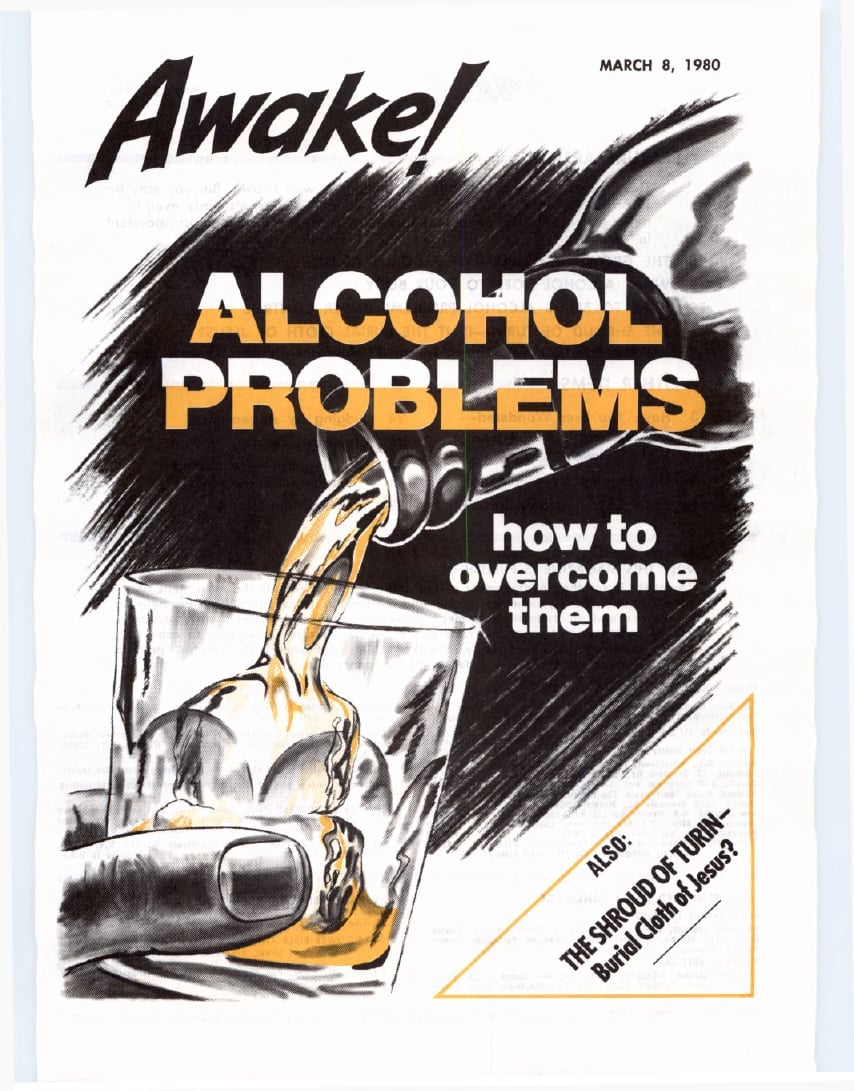
Awake! — March 8, 1980
Source: jw.org
Contents
Page Two
“How Many Real Friends Do I Have?”
The Growing Problem of Alcohol Abuse
What Alcohol Does to Your Body
How to Bring Alcohol Problems Under Control
Transforming Lives in Africa
The Shroud of Turin—Is It the Burial Cloth of Jesus?
The Problem of Soil Erosion
Judging by Appearance
Crossword Puzzle
Hummingbirds—Fascinating Feathered Acrobats
Watching the World
What Happens to Us When We Die?
James Explained—Verse by Verse
Page Two
Page Two
The lack of muscle coordination of a drunk is well known. But you may be surprised to learn what heavy drinking does to a person’s body even if he never gets drunk. This enlightening series was prepared by our correspondent in Australia
5 THE GROWING PROBLEM OF ALCOHOL ABUSE
7 WHAT ALCOHOL DOES TO YOUR BODY
12 HOW TO BRING ALCOHOL PROBLEMS UNDER CONTROL
16 THE SHROUD OF TURIN—IS IT THE BURIAL CLOTH OF JESUS?
What has scientific research revealed? How does it affect your faith?
“How Many Real Friends Do I Have?”
Have You Ever Wondered—
“How Many Real Friends Do I Have?”
OVER 100,000 persons were recently asked what makes them happy. The overwhelming answer: Having a warm, loving relationship with another person—in other words, having a real friend.
Isn’t it true that friendship adds joy to living? Most of us rub shoulders daily with scores of passing acquaintances, but it is with friends that a person can find comfort, share joys and grief.
WHAT IS A REAL FRIEND?
It is someone who really cares about you, a person who shows you unselfish concern. You feel close to that one.
A real friend is loyal. “A friend,” says the Bible, will stick “closer than a brother.” (Prov. 18:24) Even if no one else understands, your friend will.
WHY ARE REAL FRIENDS SO IMPORTANT?
We all need someone with whom to share our feelings. Our joys are doubled when we can share them with a friend. Our griefs are lessened by the sympathetic ear of a friend.
However, one survey found that most persons can count their real friends on one hand. Worse yet, some people have no real friends. They have very lonely lives, and this problem has reached epidemic proportions.
Life’s problems are not quite so heavy if we do not have to face them alone. “A friend is loving at all times, and becomes a brother in times of trouble.” (Prov. 17:17, “The Bible in Basic English”) Who of us has not had such “times of trouble” or may not face such in the future? Severe problems may arise and we may need advice. A good friend can help. We can trust him, because he is seeking our best interest. We know, too, that personal matters are safely kept between us.
To illustrate the importance of a good friend, consider the experience of a family, living in the countryside, who enjoy reading this magazine and its companion “The Watchtower.” Every two weeks a member of the local congregation of Jehovah’s Witnesses in a nearby town would personally bring this family the latest copies. He did this month after month.
One day, upon arriving at the farm, the Witness was concerned when he found nobody there, but instead a note: “Will the Watchtower man please call back. Urgent!” That very night he made a special visit. What had happened?
A serious family problem had arisen. Where could they turn for help and advice? They knew that “the Watchtower man” cared. Did he not come to see them regularly? They trusted him and viewed him as their friend. Instinctively, they knew he would help them. Gladly he did so, and their friendship deepened. He pointed out to them counsel from the Bible that helped solve their problem. How grateful they were for the unselfish concern of a real friend!
HOW DOES ONE FIND REAL FRIENDS?
There are those who have tried to “buy” friends—giving expensive gifts and entertainment—only to find true what one person wrote: “A friend that you have to buy won’t be worth what you pay for him, no matter what that may be.” When you stop giving, he may stop loving.
To have persons show us unselfish love usually requires that we display that same unselfishness. It costs us something—no, not money—but we have to be willing to sacrifice some of our time and show genuine concern for another. There are many ways, even small ones, in which to show that you care about others. At times a gift, not to “buy” a person’s friendship, but as a token of affection, says that you care.
In a conversation with others, listen, show an interest in their feelings. The Bible recommends taking a ‘personal interest in others’ and ‘taking the lead’ in displaying honor to others. Yes, rather than wait for others to befriend you, perform acts of kindness toward others. In time, you likely will have the rich joy that comes from giving to others, and will share a warm friendship.—Phil. 2:4; Rom. 12:10; Acts 20:35.
Jesus said that his followers would be identified by having self-sacrificing love among themselves. (John 13:34, 35) So it should be expected that among His genuine followers one could find pleasant associates who would prove to be real friends.
In an unloving world this unselfish concern for others stands out. For instance, in Europe one Christian couple were dining out. Sitting at the next table were two African men. The menu was in French and the Africans were evidently having trouble making themselves understood by the waiter. “May we help you?” the couple inquired. Such timely assistance was gratefully received. Accepting the invitation to spend the following day at the couple’s home, they also accompanied their hosts to the local Kingdom Hall of Jehovah’s Witnesses. There they were greatly impressed by the friendly spirit of the congregation.
The two Africans happened to be visiting delegates to a conference. How they appreciated not only the act of kindness from two total strangers, but also finding a whole group with such warmth!
Is such warmth typical of all congregations of the Witnesses? Why not go and see firsthand. You may well get to know some whom you will come to cherish as your own good friends.
The Growing Problem of Alcohol Abuse
The Growing Problem of Alcohol Abuse
ALCOHOLIC BEVERAGES can add to a person’s enjoyment of a meal, causing the heart to feel good. However, the abuse of alcohol is having a drastically different effect on a growing number of persons world wide. It is making them addicts. How extensive is the problem?
The Health Department of Italy reports that the alcoholic trend there is “uncontrollable.” A published report states that in France, between 11 p.m. and 6 a.m., at least every 10th car on the road is being driven by someone who is intoxicated! And nearly one half of all hospital beds in France are occupied by alcoholics. It is called France’s “national illness.”
In the Soviet Union, alcoholism is reported to be responsible for 90 percent of all minor offenses and 60 percent of all murders.
In the United States, the number of alcoholics is said to be upward of 10,000,000. A considerable number of these are war veterans.
In many countries, alcohol abuse is responsible for approximately 20 percent of the cases of child beating, 75 percent of all violent crimes, 20 percent of drownings, 50 percent of industrial accidents, 30 percent of suicides, 40 percent of separation or divorce cases, and 20 percent of psychiatric admissions. Obviously, millions of persons are endangered by alcoholism—not only the alcoholics, but also those who live around them.
Increased Consumption
Alcohol consumption per person is increasing at an alarming rate. The World Health Organization reports that in many lands the number of persons experiencing direct adverse effects from alcohol outnumber those affected by all the dependence-producing drugs put together.
The average Italian is drinking twice as much per day now as he did 20 years ago, and the Australian consumes 277 percent more than he did some 30 years ago. Commenting on the problems that alcoholism has caused in industry, the president of the Australian Trades Unions observed that the great Australian thirst is fast becoming the all-Australian nightmare.
In some areas the increase is especially drastic among women. In Western Germany, for example, whereas the ratio of female alcoholics to male alcoholics 10 years ago was approximately 1 to 10, today it is 1 to 3, the same as in Britain. And while the French woman is still considered to be basically a water drinker, her average alcohol intake has now reached 19 percent of her daily fluid consumption.
To what extent are youths involved? Of some 1,400 underage youths interviewed in one Western country, 19 percent bought drinks personally from licensed premises. Of another group of 2,741 adolescents from 30 different schools, it was discovered that 9 percent of all 12- to 17-year-olds claim to get “very drunk” more than once a month and a further 2 percent “pass out” regularly from the effects of alcohol.
How the Problem Develops
Initially, a person may experience that, as the Bible says, wine can make the heart joyful. (Ps. 104:15) Then, as the years pass and as the body’s tolerance for alcohol appears to increase, he may find himself drinking larger quantities and stronger drinks. Generally, he appears to be able to “hold his liquor” satisfactorily. His apparent tolerance for alcohol may even add to his confidence.
Later, he finds himself relying on it more and more. He counts on it for “good times.” It becomes an escape from boredom, and it comes in handy in drowning sorrows. Or, a person may just gradually increase his dosage to get the desired euphoric or anesthetic effects.
Some authorities say that such a person has now reached the stage of psychological dependence. He may be a bit defensive about his position when alcoholism is discussed, but, in most cases, he is not ready to acknowledge that he is becoming an alcoholic. He may never actually get drunk. Nevertheless, an alcohol problem may exist.
If he faces up to his situation at this early stage, recovery is more easily achieved. But if not, he will usually advance to what some call physical dependence, a compulsion to drink regularly to avoid withdrawal symptoms.
Plainly stated, when there is an excessive satisfying of the desire to drink and/or a continuing dependence upon it, a person has an alcohol problem.
Of course, not everyone who drinks is an alcoholic. But it is a good thing to know what happens in the body of a person who does indulge in alcoholic beverages to excess. This is discussed in the following article. Such knowledge can be a protection to you. And if you are one who is having a problem with drink, it may help you to understand the situation more clearly and what can be done about it.
[Box/Picture on page 6]
WHAT IS YOUR ANSWER?
If offered a choice between an alcoholic drink and a nonalcoholic one, is your selection easy to predict?
Do you drink alcoholic beverages as a means to change how you feel?
When you drink, do you often have several before you stop?
Have you learned to “hold your liquor” so that you no longer feel its effects as soon as others may?
YOUR ANSWERS MAY REVEAL MORE THAN YOU REALIZE
What Alcohol Does to Your Body
What Alcohol Does to Your Body
TO UNDERSTAND how alcohol affects your body, you need to know something about the cells and organic systems of the human body. These cells and organs do not regularly work at full capacity. They have what some term a “functional reserve,” available for use when your body is put under extra stress. Thus, one of your kidneys can be completely removed without its interfering with a normal life. Even with about 90 percent of a normal liver removed, or a considerable portion of the brain taken out, a person can continue to perform the normal activities of life.
Because of this “functional reserve” you can put your body under considerable stress by drinking an excess of alcohol without your even being aware of what is going on inside. But you ought to know.
When a cell is put under stress, it enlarges. If the stress is too great for too long, the cell will eventually burst and die. But if the stress is removed in time, the cell may gradually recover its normal size and function. It is only when you have used up the reserve, when too many cells have been damaged or killed, that you will be forced to admit that you are sick and have gone too far over too long a period of time.
For many somewhat heavy drinkers, there is no major health collapse. But there may be a number of alcohol-related sicknesses that the person does not realize result from his drinking habits. His death may appear to be due to some common sickness. Yet, death may come perhaps 10 years before that of others his own age in the community.
Do you use alcoholic drinks? If so, how much do you drink? How much can a person drink without its doing harm to him?
Safe Level of Drinking
The question as to how much alcohol the human body can cope with is very complex. Each person’s capacity is different. What causes no problem for one person may be too much for another. Some persons experience adverse effects when they consume any alcohol at all.
Authorities differ as to what they classify as a “risk level” in regard to daily consumption. However, many of them agree that the body of a normal healthy adult can absorb and break down only one ouncea (one shot) of spirits or two ounces of fortified wine or four ounces of table wine or eight to ten ounces of beer in one hour. Other authorities say that two hours must be allowed. Of course, not everyone is healthy, and that can change the picture considerably.
If a person consumes more alcohol than his body can break down, his blood-alcohol level rises. At first he may feel relaxed, but an increase of alcohol in the bloodstream causes loss of good judgment and of emotional control. Then muscle coordination becomes impaired, and even more serious problems follow.
Most teen-agers would be affected adversely if they tried to imitate the drinking done by average adults. Because their body build is not that of an adult, they usually experience the sedative effects of alcohol more rapidly and to a greater extent. Likewise, because of the state of development of a young person’s emotions, these quickly give evidence of intoxication and he may very easily give in to sexual urges.
Can it be assumed, though, that no harm will result to an adult so long as he spreads his drinks out over a period of time, consuming no more per hour than his body can handle? That does not necessarily hold true. There is a limit to what a person’s body can safely handle in a day. What is that limit?
The World Health Organization (WHO) and medical literature give a wide variety of figures. For example, one report from the WHO labeled 120 grams of alcohol (12 average-sized drinks) as “excessive consumption.” Two years later a WHO report said that the danger level might be at less than half that figure. And a study in France has indicated that women who take even one normal-sized alcoholic drink (of 10 grams of alcohol) on a daily basis are more likely to suffer from cirrhosis of the liver than are nondrinkers, and that two drinks daily can have damaging effects on men.
Why the difference in figures? For one thing, the tests were run with different groups of people. Individuals differ. Not everyone can tolerate the same amount of alcohol. It would be foolish to drink a certain amount each day just because that is what people “are supposed to be able to drink.”
Remember, it is your health that is at stake. If your drinking subjects your body to excessive stress on a regular basis, you are destroying your “functional reserve.” That means that you are headed for trouble.
The Bible plainly condemns drunkenness. (Eph. 5:18; Gal. 5:21) Not only does a drunkard damage his own health and endanger his life; he also puts the lives of others in jeopardy. Additionally, however, the Scriptures warn: “Do not come to be among heavy drinkers of wine.” (Prov. 23:20) The wisdom of that counsel is highlighted by what has been learned about how alcohol abuse affects the various body organs.
Effects You Ought to Know About
If the body is frequently subjected to an overload of alcohol, many parts are affected, and the poisonous effects are cumulative.
LIVER: This organ is one of the body’s principal detoxifiers, neutralizing fumes that we breathe, chemicals from our food and water and from medicine. Drinking too much alcohol not only interferes with that vital work; it adds to the load of chemicals in the body. Furthermore, it reduces the liver’s ability to contribute to the formation of red blood cells, coagulating factors and defense mechanisms against bacteria. Liver damage may result in loss of energy, varicose veins, swelling of the ankles, hormone imbalance, sexual impotence and jaundice, to mention a few.
Normally soft, the liver becomes enlarged and hardens when abused. If drinking stops soon enough, it can return to its normal size. But if heavy drinking has already destroyed a good portion of its cells, it may have shrunk and permanently hardened.
ESOPHAGUS: If the liver is seriously inflamed, pressure on the veins in the digestive tract increases and those located where the esophagus enters the stomach become dilated and thin walled. These easily bleed, sometimes profusely.
STOMACH: While small quantities of alcohol stimulate the secretion of gastric juices, large quantities and strong concentrations of it inhibit their secretion. The stomach becomes inflamed. The surface of the stomach that secretes digestive juices deteriorates and stomach muscles break down. As a result, food does not get sufficiently mixed or chemically broken down. Malnutrition develops, often because the body is not receiving the full benefit from what is eaten, and also because one who drinks excessively satisfies his appetite with alcohol but deprives it of the more necessary food elements.
PANCREAS: The pancreas supplies enzymes to break down food material, as well as insulin to regulate the blood-sugar level. But alcohol excess causes enzymes to attack and kill large portions of the pancreas. As a result, insulin production is reduced, causing mild diabetes, and because of lack of digestive enzymes food is not absorbed properly. An associated danger is that one becomes dependent on drugs (analgesics) because of the pain caused.
HEART AND BLOOD CIRCULATION: Hypertension (high blood pressure) and abnormalities of heart rhythm also develop with excessive drinking. As the heart cells enlarge, the whole heart becomes bigger. The heart valves then fail to function properly, its muscle action weakens and blood circulation is impaired. The entire body is deprived of proper nourishment, and toxins accumulate. The individual so afflicted becomes disposed to heart attacks and strokes.
LUNGS: Chronic bronchitis and pneumonia are common among alcohol abusers. Tuberculosis is a common complication, thought to be due to poor nutrition and a greater susceptibility to lung infections. One study showed that at least 50 percent of those with tuberculosis were alcoholics.
KIDNEYS: The overconsumption of alcohol causes the blood vessels in the kidneys to dilate. The amount of urine discharged becomes excessive, depriving the body of needed fluids.
BRAIN AND NERVOUS SYSTEM: Excesses of alcohol are particularly damaging to the nervous system. The brain, like other organs, has a large “functional reserve,” so many cells may be destroyed without the appearance of disturbing symptoms. But, unlike what happens to other organs, the damage here may be permanent. Brain scanners have shown that, not only alcoholics, but social drinkers who have more than they ought to, experience an actual shrinkage of the brain.
Alcohol’s effect on the nervous system may become manifest in loss of memory. A person may remember drinking, but the next morning he cannot recall how he got home or where he parked his car. Shakiness and lack of muscle coordination, not merely for a few hours, but on a prolonged basis give further evidence that the nervous system is being impaired.
Some people boast about their ability to “hold their liquor.” They may drink heavily but appear to be sober. What has really happened? It is not necessarily that the drinker can consume more with less damage. Rather, he has developed only a seeming tolerance for the alcohol and as a result is consuming more before his brain and the nervous system sound a warning. At the same time, if the liver has been damaged due to excessive drinking, the body’s ability to handle the alcohol has actually diminished. Continued drinking under these circumstances results in increased damage to his entire system. It is nothing to brag about.
The brain and the nervous system also control breathing. So there is severe danger in drinking bouts. When the blood-alcohol level goes too high, vital functions of the body may cease.
Because of the effect of excess alcohol on the brain, the personality of the one who drinks too heavily is adversely affected. This does not await the time when his health has deteriorated to the extent that he seeks medical help. Long before that a man may mistreat his wife physically and he may lose several jobs because of unreliable or irrational behavior.
Knowing what happens inside a person’s body when he drinks too much, and what others see happening to his personality, ought to make any sensible person stop and take a serious look at his own drinking habits. Why wait until your “functional reserve” is all gone before you try to turn back?
Mixing Alcohol with Drugs
The risk of serious organ damage is greatly increased when alcohol is taken with drugs, even such common household drugs as aspirin and antihistamines. One medical study showed that more than 50 of the 100 most often prescribed drugs contain at least one ingredient known to react unfavorably with alcohol. At least one girl, Karen Quinlan in the United States, has been in a coma for a number of years because of having mixed alcohol with tranquilizers.
It is not that a new toxic element develops when two toxic ingredients are mixed, but in many cases one ingredient or the other increases in strength many times when the wrong combination is used. The already weakened liver is faced with a potency far beyond what it can safely handle without further damage to itself.
How to Cope with Alcohol Abuse
The way to cope with alcohol abuse is not by resorting to such things as eating potato chips or eggs to slow down the absorption rate. Drinking cream before an alcoholic binge is not the solution. It is true that slowing down the absorption rate may keep you from becoming tipsy, but you may still be drinking too much.
The answer does not lie in taking a cold shower, drinking black coffee, going out into the cool air, exercising or going for a swim to “liven oneself up.” Such activities may change the way one feels, but they do not change the blood-alcohol level of the body or slow down the cell damage.
What is really needed is to be moderate in your use of alcoholic drinks, if you use them at all. What can help you to do that?
[Footnotes]
One ounce = 30 cm3 or .029 L.
[Diagram on page 9]
(For fully formatted text, see publication)
What happens when you drink too much too often?
HEART
Circulation impaired
LIVER
Toxins accumulate
KIDNEYS
Excessive urination; needed fluids drained from the body
BRAIN
Loss of memory; adverse effects on personality
ESOPHAGUS
Danger of bleeding
LUNGS
50% of TB patients are alcoholics
STOMACH
Digestion impaired
PANCREAS
Partially destroyed
How to Bring Alcohol Problems Under Control
How to Bring Alcohol Problems Under Control
ALCOHOL abuse is a problem that can deeply affect the life of the entire family. So it is beneficial to discuss the subject as a family, to help all within the household to understand it, and to cooperate in avoiding situations that may tend to make one of its members try to drown his problems in drink.
Don’t wait until alcoholism has already marred your family life before you do something about it. Take preventive measures.
In many households, unfortunately, the problem has already developed. What can they do?
When the Problem Already Exists
First of all, there is a need to face up to the fact that there is an alcohol problem. The alcoholic may not believe that he has such a problem. Other members of his family, as well as friends outside the home, may feel that he does. Why? They can’t see whether there is damage being done to his internal organs. But they can see deterioration in behavior.
A person who is becoming dependent on alcohol tends to reach for the bottle when lonely or depressed. He may be embarrassed by his drinking or angered by the criticism of other people, so he tries to conceal the amount he consumes. When he wants a drink, he may be somewhat irritable until he gets it. As a result of his drinking habits, he may become impulsive, less reasonable and may even resort to physical violence against his marriage mate. Even though he does not drink every day, once he begins he has too much. In time, there may be alcoholic blackouts, or perhaps withdrawal fits when he fails to get a drink.
The one who is having trouble with alcohol may know that his family life is deteriorating. He may realize that he is having trouble at work. But if someone suggests that an important reason for this is that he has become overly dependent on alcohol, it is not unusual for such a person to become defensive. If a doctor were to tell him that he was allergic to a certain food and that his health would improve if he would eliminate it from his diet, he would probably do so. Is alcohol somehow different? Yes, it can act like a mood-altering drug, and a person can become dependent on it, both psychologically and physically.
If he is willing to face up to the fact that he has a weakness in regard to alcohol and that it can ruin his life, but that it is possible to get the mastery over it and that it is worth trying to do so, there is hope for recovery. It will require firm determination and a definite program to be followed.
Breaking the Hold of Alcohol Dependence
The problem is not solved by drinking only on weekends. Nor does one eliminate his dependence on alcohol by shifting from hard liquor to wine or beer. A considerable proportion of those who are alcoholics drink beer almost exclusively.
There is a need to clean out the system and allow the cells to restore themselves to the extent that it is possible. Total abstinence is required. Some doctors say that you need to allow at least four days for the body to eliminate completely your last alcoholic drink. However, the restoration of cells that have been damaged as a result of unwise drinking habits may require six months or more, during which special attention is given to good nutrition.
Withdrawal symptoms do not always occur, but they are common in habitual heavy drinkers and alcoholics. As the blood-alcohol level goes down and the nervous system adjusts to the change, a person may experience restlessness, irritability, depression, sleeplessness, confusion, palpitations, sweating, the shakes and nausea. These symptoms usually begin eight to 24 hours after cessation of drinking. If the alcoholic condition has been prolonged or the physical condition is very poor, there may be further severe reactions requiring medical attention.
The extent to which the body will be able to restore damaged organs will depend on the amount of “functional reserve” that was wiped out, the length of time that the condition existed, and the care that is given with a view to rebuilding the body. For those truly addicted to alcohol; in most cases it is unlikely that they will ever be able to return to a normal use of alcoholic beverages. No matter how long it has been, one drink may be too many. It is as if a volcano within is waiting to erupt. In such a case, the only way that one can continue to lead a normal life is to abstain totally.
The Family Can Help
Cooperation of the family is important in breaking the hold of alcohol dependence, and, in most instances, the family is very willing to help. To minimize temptation, it would be wise to remove all alcoholic beverages from the house. And it will make it easier for the one having the weakness if other family members refrain from drinking in his presence.
Of course, there will be times when the person is visiting in the home of someone else. Either because of their not knowing of his condition or out of thoughtlessness, they may offer him an alcoholic drink. What will he do? That is something that he ought to think out ahead of time. He doesn’t need to go into a long explanation, but his refusal should be firm. “No thanks. But I would enjoy a glass of soda [or of water].”
What the Bible says is very encouraging for one who wants to free himself from alcohol abuse. It tells of persons who succeeded in getting the mastery over it (1 Cor. 6:9-11), and of those who for personal reasons abstained altogether. (Num. 6:2, 3) It also recounts events involving entire families that abstained, out of obedience to the family head, to preserve the dignity of the family name. The Rechabite families are given special mention in this regard. They abstained for successive generations, although they lived in the vicinity of other families that regularly used wine. God did not ask those Rechabites to abstain from wine, and neither does his Word require total abstinence today, but he looked favorably on what they did in obedience to their family head.—Jer. 35:5, 6, 8, 18, 19.
Gaining Spiritual Strength
Accurate knowledge of God’s Word will do much to give one the spiritual strength needed to overcome weaknesses. The Bible will show you how to be successful in coping with problems instead of trying to blot out reality by heavy drinking.
Take, for example, one young man in Australia who had a serious alcohol problem. Oftentimes, in order to get home from the pub, he would put his car in first gear, hold the door open and hang his head out to watch for the white line, taking up to two hours to travel the seven miles (11 km) home. He would spend up to $40 on grog in one weekend. He even experienced hallucinations, so he made a vow to stop drinking. But he didn’t succeed.
About this time he started studying the Bible with the help of Jehovah’s Witnesses. He brought up the subject of alcohol and was shown that God does not approve of drunkards, but that everlasting life in a restored earthly paradise is possible for those who live by Bible standards.—Gal. 5:21; John 17:3.
It was not easy for him to change, as he was the live wire of his parties. When he started to quiet down, his drinking friends thought that he had a girl friend but that soon her influence would weaken and he would be back to the parties. But the power of God’s promises had a greater hold on him than his friends realized, and he never did go back to their drunken parties. He says: “Now, 10 years have passed since I was able to get the upper hand on my drinking problem. I am a much happier and healthier person, thanks to Jehovah’s kindness.”
This change did not come overnight. It was a gradual one, as his knowledge increased and his understanding grew. What he formerly had not been able to accomplish alone he succeeded in doing with the help of God’s spirit.—1 Cor. 6:11.
Knowledge of the Bible makes for happier marriages, happier families. It helps to reduce problems by aiding a person to make wiser decisions in life. It helps one to absorb shocks and to understand why evil conditions exist and calamities occur. It describes a new system in store for those who love life and who do God’s will, and it helps a person to develop the motivation needed to change his life pattern so as to be acceptable to God.—Rom. 12:1, 2; 2 Pet. 3:13.
Alcoholic beverages can bring enjoyment if used in the right way. But if you have an alcohol problem, do not let it ruin your life. Come to grips with it. Do it now.
Transforming Lives in Africa
Transforming Lives in Africa
A SOCIOLOGICAL study on the matrilineal (a form of matriarchal) society in the Luapula Province of Zambia appears in the American Ethnologist. Researcher Karla O. Poewe of the University of Lethbridge, Alberta, Canada, considers the effect that religious denominations have on the traditional ways of Luapulans. After her 18 months spent with these people, Poewe concludes that only “Jehovah’s Witnesses succeed” in achieving “change in behavior among their members vis-à-vis kinship, family, and economic activities,” whereas others have “an indifferent record of success in giving direction to practical conduct and holding the individual to such conduct.” Her study includes the following observations:
“In the villages the activities of the [Jehovah’s Witnesses] approximate what one would expect of the best redemptive, nonrevolutionary movements. Members almost imperceptibly restructure their lives and thus, indirectly, their communities for the purpose of becoming full participants in the coming kingdom of God. . . .
“Jehovah’s Witnesses, whose teachings constitute a learning process designed to build mature servants, . . . have earned the reputation among their countrymen of being scrupulously honest and thus are preferred for jobs in which money is handled.”
Describing Luapulan family traditions, researcher Poewe explains that since heritage in their society is traced through the mother’s line, “Luapula matriliny enables women to control the land, collect remittances from children, and divorce ‘useless’ husbands.” She also observes: “Women feel that easy divorces are vital under conditions in which men are not ‘trained’ to be primary providers for wife and offspring.” How well have the Witnesses been able to cope with such traditional marital conduct?
Poewe answers: “Jehovah’s Witnesses experience greater success than members of other denominations in maintaining stable marital unions. As with employers and servants, their success represents a modified exchange relationship between husband and wife, who, in their newly discovered, nonthreatening, cooperative endeavors, have become accountable in their treatment of one another to a new figurehead, God. In exchange for trust, which is so risky for a woman to grant a man other than her brother (in Luapula’s matrilineal society), the Jehovah’s Witness husband is taught to mature into practicing responsibility for the well-being of his wife and children. But in addition to participating in an exchange between trust and responsibility, husband and wife are encouraged to be individuals with integrity (abantu abacishinka). This overriding demand for integrity cements marriage.”
To what does this sociological study credit such a major adjustment in traditional ways among the Luapulans? The writer observes that among Jehovah’s Witnesses “the Bible is treated as a ‘model’ for social life.” As she puts it: “Luapula’s Jehovah’s Witnesses use the Bible to create individuals worthy of participation in a new world.”
The Shroud of Turin—Is It the Burial Cloth of Jesus?
The Shroud of Turin—Is It the Burial Cloth of Jesus?
Is this the face of Jesus Christ? Millions of persons around the world believe it is. Why?
THIS face is part of the image on a piece of linen cloth called “the most important relic in the history of Christianity”—the Shroud of Turin.
This 14-by-3 1⁄2-foot (4.3-by-1.1-m) cloth is claimed to be the “fine linen” (Mark 15:46) used to wrap the body of Jesus after his death. On it is formed the faint image of a blood-stained body with wounds that are said to correspond to those inflicted on Jesus. The cloth, it is asserted, was laid lengthwise over and under the body so that one sees the front and the back of a man, and this is centered between two dark streaks resulting from fire damage.
World attention was focused on the relic when, after a long-awaited public display, which drew millions of observers, permission was granted a team of scientists to examine the shroud carefully. For five days and nights during October 1978, these 45 scientists, armed with four tons of sophisticated space-age instruments, pored over the relic. In fact, Science News reported:
“Five yards of linen kept on an altar in Turin cathedral are the subject of more precise scientific tests than probably any other religious relic.”
Even before the findings of the scientists were published, newspapers and books hailed the shroud as:
● “A Proof of the Existence of God”
● “The Fifth Gospel Written in Blood”
● “A Literal ‘Snapshot’ of the Resurrection”
● “The Photograph of Christ”
What Christian would not like to know the physical appearance of Jesus? To think that there is, as some claim, tangible proof of the resurrection certainly creates excitement. On the other hand, how would you feel if the shroud proved to be a fraud? How misleading! By drawing such great attention, could it be sidetracking persons, causing them to ignore weightier matters?
Would you not want to know all the facts? Just how should a Christian be affected by this relic?
First, let us examine just why so many scientists are excited about the shroud.
Why Are Some Excited?
The herringbone weave of the cloth was popular in Palestine during the time of Christ, and pollen taken from it was found to be from plants that at one time grew in that land. The preservation of linen from Jesus’ day is nothing extraordinary, for linen cloths dating even before then still exist. What makes this cloth unique is the image on it.
Back in 1898, when the shroud was photographed for the first time, something completely unexpected happened that attracted the attention of scientists. When the pictures were developed, the image was found to be in reality a negative. (In photography a negative is what you see on the developed film where the whites and blacks are reversed.) The faint markings on the shroud appeared to come to life in the negatives. With exceptional detail they showed the full figure of a man.
Marks were observed in the wrist and the foot as if these had been pierced. Also noticed were a large bloodstain on the right chest area and numerous dumbbell-shaped wound marks that resemble the lead balls used on Roman scourges during the time of Christ. Bloodstains were seen on the top of the head, suggesting the use of a crown of thorns.
The greatest puzzle is how the image was formed. Recent tests failed to find any traces of pigment known to have been used during the Middle Ages, when the shroud made its first documented appearance. By the use of powerful microscopes, the image was found to be made up of tiny “yellow-red to orange granules” that sat on top of the weave. Whatever caused the image did not penetrate the cloth. Apparently, according to authority Ian Wilson, “it would seem to have been a ‘dry’ process as from some physical force reacting with the surface fibers of the Shroud threads, the granules thereby being formed, as it were, from the fibers themselves.”
The latest theory, according to physical chemist and shroud authority Ray Rogers, is that the image “was formed by a burst of radiant energy.” Some feel this occurred when Jesus was resurrected. However, are all convinced?
Why Some Have Serious Doubts
A number of serious Bible scholars doubt its authenticity because of the Scriptural record. The Scriptures suggest conditions during Jesus’ burial that were contrary to what is seen on the shroud. For the shroud to be authentic, two conditions must have existed when the image was formed: (1) the body could not have been washed, for the bloodstains are clearly visible, and (2) the linen cloth would have to have been laid loosely over the body, not pressed against it. “The figures [on the shroud] had not been produced by mere contact of the linen with human flesh,” affirms shroud backer Edward Wuenschel. He adds: “Such contact would have caused considerable distortion, and there is little or no distortion in the figures on this shroud.”
The accounts of Jesus’ burial by Matthew (27:59, 60), Mark (15:46) and Luke (23:53) are quite brief. But they all say that the body was “wrapped” in “fine linen.” Was the body so quickly prepared that it was not first washed? Such treatment by Jews would be highly unusual. Why? Contemporary Jewish historian Josephus says that, unlike some of their enemies, “the Jews used to take so much care of the burial of men.”
The apostle John, who was an eyewitness, fills in some additional details confirming that “much care” was taken with Jesus’ body before it was buried. He reports:
“He [Joseph of Arimathea] came and took his body away. Nicodemus also . . . came bringing a roll of myrrh and aloes, about a hundred pounds of it. So they took the body of Jesus and bound it up with bandages with the spices, just the way the Jews have the custom of preparing for burial.”—John 19:38-40.
What was the “custom” of the Jews in preparing for burial? Virtually the only contemporary evidence is in the Greek Scriptures. There it shows that the body was first washed and then oils and spices were used to anoint it. (Acts 9:37; Matt. 26:12) The fact that Joseph and Nicodemus made use of the myrrh, aloes and bandages and “bound up” the body indicates that they had at least begun the customary Jewish preparation of the dead.
Ancient Jewish non-Biblical writings also indicate that it was their custom to wash the body and to use spices, but not to preserve or embalm the body as some claim; rather, as the Talmud says, “The spices are to remove the bad smell.” Such preparation of the corpse was not forbidden even on the Sabbath; as the Mishnah (2nd century C.E.) says: “They may make ready [on the Sabbath] all that is needful for the dead, and anoint it and wash it.”—Shabbath 23:5.
That the two men took steps to prepare the body for burial is also indicated by what was found in the empty tomb after Jesus’ resurrection. John tells us:
“He [Peter] viewed the bandages lying, also the cloth that had been upon his head not lying with the bandages but separately rolled up in one place.” (John 20:6, 7)
There is no mention of the “fine linen” (Greek: sindón), but reference is made to “bandages” (Greek: othónia) and a “cloth that had been on his head” (Greek: soudárion). It may be that the “fine linen” was torn up into strips, providing the “bandages.” All of these had to be wrapped around the body. However, if this is true, the bandages would hold the shroud close to the body and cause a “contact print” and not allow the projected image found on the shroud. If the bandages were under the shroud, they would likewise distort the image.
The fact that a separate piece of cloth is mentioned as being “upon his head” shows that a different piece covered his head, whereas the shroud clearly shows the image of the head on the same cloth that covered the body. However, some try to contend that this headcloth is actually the shroud. Yet this Greek word is variously translated as “napkin” (AV) or “handkerchief” (Catholic Confraternity Version), and at Luke 19:20 it is applied to a piece of cloth in which one keeps money. How could this be identified with a 14-foot (4.3-m) shroud! Others feel that this headcloth was a chin strap to hold the mouth of the corpse in place. If so, that would mean the shroud is not mentioned by John as being in the empty tomb. Certainly, since he details the “bandages” and the ‘headcloth,’ would it not seem likely he would have mentioned the “fine linen” or shroud, if it had been there?
The Scriptural account suggests that the body was washed and bound with myrrh and aloes according to the Jewish custom. All was completed except the anointing with oil and spices,a which the women intended to do the following Sunday morning. (Luke 23:55, 56; Mark 16:1) Such preparations would have made impossible the present image on the shroud. Concerning the Bible account, shroud supporter Rodney Hoare admits:
“This section in St. John has for years been the main argument in the attack on the authenticity of the Shroud, and a very powerful argument it is.”—The Testimony of the Shroud, p. 120.
An Unusual Silence of Early Christian Writers
If the graveclothes of Jesus had his image upon them, does it not seem to you it would have been noticed and become a subject for discussion? Yet, beyond what is in the Gospels, there is complete silence in the New Testament about the graveclothes.
Even the professed Christian writers of the third and fourth centuries, many of whom wrote about a host of so-called miracles in connection with numerous relics, do not mention the existence of a shroud containing the image of Jesus. Some claim that the shroud had been hidden during all these years. Still, even after the supposed burial shroud of Jesus had been “discovered,” according to seventh-century writers, there is no mention of an image on it. Shroud advocate P. A. Beecher lists a considerable number of individuals who saw the shroud between the seventh and thirteenth centuries, one who even “kissed it,” and yet not one mentioned the image. This is hard to understand, since 15th- and 16th-century viewers, according to Jesuit scholar Herbert Thurston, “describe the impressions on the shroud as so vivid in detail and colouring that they might have been quite freshly made.”
It was not until 1205 that a French soldier, Robert de Clari, reported seeing “the sindon [shroud] in which our Lord was enveloped . . . stretched upright, so that one could easily see the figure of our Savior.” Concerning this long period of silence, Ian Wilson, a backer of the shroud, asks some very searching questions:
“How could such a fascinating piece of cloth as the Shroud of Turin, if genuine, have gone totally unrecorded over thirteen centuries, suddenly to turn up in fourteenth-century France?
“Could it have been hidden away all the time, due to Jewish and Roman persecution of Christians, followed by the danger to all image-bearing objects during the period of the iconoclastic controversy (725-842)? This was most unlikely.
“There were four hundred years from the conversion of Constantine the Great to the onset of iconoclasm, during which many previously ‘hidden’ relics came to light, including the entire True Cross, the crown of thorns, the nails, the purple cloak, the reed, the stone of the sepulcher, and many others. There was ample opportunity for such an important and unmistakable relic as the Turin Shroud to come to light. Yet there was no record of any such event.”
One cannot but wonder, in view of the significance of this relic, why it took almost 1,200 years before mention was made of the image on it.
Scientific and Historical Problems
Many theories have come and gone as to how the image was formed. Most scientists agree that the latest findings have shown that the whole image was produced from the same cause, perhaps from some process that “scorched” it.
This scientific conclusion presents some problems, for it indicates that the impression on the shroud should be basically one color, simply varying in intensity. Yet 16th-century viewers indicated that it was made up of two different colors. Not only did artistic reproductions of the time show it multicolored, but one observer, Chifflet, said:
“The figure of Turin shows hardly anything but dark crimson stains, . . . the marks of the wounds seem to be painted in over the impression of the body, which is in a thin pale yellow.”
One could wonder if today’s shroud is the same as the one displayed back in the 14th century and labeled a fraud by the then Roman Catholic bishop Henry de Troyes (France) and said to have been “cunningly painted.” Joseph Hanlon, writing in New Scientist, raises an interesting possibility:
“But could there have been a double fake, one in the 14th century and another in the last century? The shroud was widely shown in the 15th and 16th centuries, but not later. Could it be that the first fraud became too obvious? . . . Might the shroud’s owners have done a better job in that time, using modern technology and medical knowledge, including tests such as Barbet’s, and using ancient linen from the middle east? Might a statue have been created solely for this purpose, heated to give an impression on the cloth, and then destroyed? . . . Nevertheless, there have been a number of sophisticated Victorian archaeological frauds, so we cannot ignore this possibility.”
Others have suggested the use of a mixture of myrrh and aloes rubbed over a bas-relief (a picture with three-dimensional features) to produce a similar image. However, Adam Otterbein, president of the Holy Shroud Guild, concluded: “How the image was formed may be a mystery to the end of time. . . . It’s doubtful whether science will ever be able to prove how this was done.”
Does It Affect Your Faith?
Obviously the debate about the shroud will continue for some time. But does this seem to you to be God’s way of verifying the resurrection of his Son? How were persons in the first century convinced? Instead of relying on cloth that once draped a dead man, Jehovah saw to it that over 500 living eyewitnesses testified about the risen Christ. (1 Cor. 15:3-8) In the wake of such evidence, the graveclothes pale into insignificance.
Yet by such publicity could the shroud, even if it were authentic, overshadow this real evidence of the resurrection? Could it sidetrack persons into resting their faith on this piece of cloth? Even shroud scientist John Jackson said:
“But if someone were to base his faith completely on an unusual piece of cloth, that would really be a form of idolatry.”—The Catholic Digest, April 1979.
It is very easy for a person to let his heart become enticed by the intriguing possibilities of the shroud. But will interest in the shroud create genuine faith? Will it help us to keep “walking by faith, not by sight”? (2 Cor. 5:7) What if it is proved to be a fraud? Would you lose your faith in the resurrection or at least develop some doubts? If you are excited by the shroud, just why? Does your faith need a brace such as this? Could it in reality prove to be a weak crutch? These are meaningful questions for every Christian to consider.
Though we live when people thrive on the spectacular, how often such has stolen attention from important matters. For instance, Franco Barbero, a Roman Catholic priest, remarked: “I wonder what would have happened in the Turin Church if all the energy spent and concentrated on this initiative had been concentrated on the preaching of the Word!” (Italics ours)
Yes, the “preaching of the Word,” not the displaying of relics, is what will build genuine faith. It is what will create a sure hope that “does not lead to disappointment.” (Rom. 5:5) This hope assures us that the same One who resurrected Jesus will again act, not by “sending” a piece of cloth to amaze the world, but by using his glorified Son to bring to its end a corrupt world that lacks true faith. At the same time he will deliver into a new order of righteousness persons of genuine faith.—2 Pet. 3:13.
[Footnotes]
Such anointing would not have necessitated the removal of the graveclothes, for they could have merely poured the sweet-smelling oils over the body. (See Mark 14:3, 8; it shows, while still alive, Jesus was “anointed” for burial, yet the woman merely “poured it [oil] upon his head.”)
[Blurb on page 18]
Why did none of the Bible writers or early “Christian” writers mention a shroud with the image of a man?
[Blurb on page 19]
The Bible account is “a very powerful argument” against its authenticity, says one shroud supporter.
The Problem of Soil Erosion
The Problem of Soil Erosion
By “Awake!” correspondent in South Africa
WE ARE surrounded on all sides by soil. It is taken for granted by most people. But, since life on this planet could not exist without soil, it is sobering to learn that in just one country of southern Africa many millions of tons of soil are lost each year. And according to Dr. Kai Curry-Lindhal, UNESCO biologist and conservationist, the world soil loss during the past century was an estimated 2,023 million hectares (5,000 million acres)—about one quarter of the earth’s total farmland.
What causes such drastic loss of valuable topsoil so essential for life? Soil erosion.
What Causes Soil Erosion?
Erosion results from denuding the soil of grass or plants by overgrazing (too many cattle in an area) or plowing and leaving bare the topsoil, which is then blown away by wind or washed away by water. The mantle of soil on the earth is relatively thin, no more than 30 cm (12 inches) deep in many places.
Regarding the effects of erosion, the magazine Veldtrust, of August 1975, said: “The tragedy of South Africa has been the appalling rapidity with which its fertility reserves have been depleted and its thin soil covering washed away. In no other country have the disastrous consequences of erosion followed so quickly after its commencement.”
Farming has changed drastically in South Africa, as in most countries. In earlier years farmers would do what is called “subsistence farming”—they were concerned only with providing enough for their private needs. But as people became concentrated in towns the emphasis was on production. This led to what is known as “soil mining,” that is, exploiting the soil for a maximum return. As a result, the soil was overtaxed, causing the erosion problem that has now taken on national proportions. So man’s misuse of the soil over a long period has been the direct cause of this problem.
In Canada, the pulp industry has denuded huge forests. In Australia, the overgrazing by many millions of sheep has caused erosion. The same thing has happened in Iraq. Forage experts say that the pasturage in northern Iraq could support about 250,000 head of sheep, but there are at least a million grazing there. As civilization has spread, so has erosion.
But what does widespread erosion mean in practical terms? Are its effects overstressed, or does it really pose a threat to man’s continued existence?
The Extent of the Damage
Looked at from the point of view of the farmer, soil erosion means poorer crops, which, in turn, results in poorer feed for his animals. Both crops and animals will be more susceptible to disease and parasites, and this will further affect his production. If the situation goes unchecked, the time may come when his farm can no longer provide him with a livelihood.
Erosion also lessens the water supply in an area. Where there is plenty of vegetation, this helps to hold the water until it seeps into the ground; but where the land is exposed, the water tends to run off into the nearest river and carry with it much valuable topsoil. The fine silt gets to the sea, but the heavier silt is deposited along the lower reaches of rivers, gradually raising the riverbeds and resulting in more serious and more frequent floods. In South Africa, vast quantities of silt have been deposited in irrigation dams built by the State at great cost, and these dams could eventually be rendered useless.
The U.S.A. is also grappling with erosion. It is reputed to have nearly 250 million hectares (600 million acres) of agricultural land, but by 1940, 40 million ha (100 million acres) had been lost, most of it in this century.
Italy revealed to a conference held in Stockholm in 1972 that 80 percent of her grazing land in the Apennines and Alps was seriously damaged. Tanzania’s serious erosion problem has resulted in 30 percent of children under five years in the Dar es Salaam district suffering from malnutrition diseases. And Syria, the Congo, Kenya, Chile, India and many other countries face serious consequences as a result of soil erosion.
Erosion also acts like a catalyst in helping the great deserts to spread. In the last 50 years an estimated 650,000 km2 (250,000 square miles) of farming and grazing lands have been swallowed up by the Sahara along its southern edge, sometimes called the “Sahel.” In the Sahel more than 100,000 people have died as a result of drought and famine. Hundreds of thousands of tribesmen have lost their livestock and gone to refugee camps.
The problem is indeed serious and urgent, especially in the poorer countries. As their land becomes infertile, people move into towns and cities and put an extra strain on the food supplies there. The United Nations secretary-general, Kurt Waldheim, warned: “Countries could disappear from the face of the map. We risk destroying whole peoples in the afflicted area.”
These are shocking realities. But virtually all authorities on the subject agree on the cause—man’s unwise use of the land.
However, you may be surprised to learn that the natural process of soil erosion, when not aggravated by man, is actually a friend!
When Soil Erosion Is a Friend
The natural process of erosion by weathering, wind and water is very beneficial, as it breaks down rocks eventually to form soil. Without this process there would be no soil in which plants could grow, for soil consists largely of mineral grains that come from rocks.
Plants play an important role in keeping this erosion process under control. They tend to hold the soil in place and prevent rainwater from carrying the soil away. The plants trap the water so that it gradually seeps into the ground. Plants also help to contribute to the formation of soil, as their roots are constantly prying rocks apart, helping to grind them up into smaller fragments.
Animals also play an important part by helping to preserve the vegetation. This is well illustrated in South Africa, which used to have a large number of wild animals before man killed the majority of them off. Wrote James Clarke, in his book Our Fragile Land (pp. 69, 70):
“Every species had its contribution to make towards maintaining the soil cover, even if it was merely by donating its droppings or carcass to the replenishing process. Hippos played an important mechanical role by habitually walking away from a river in the direction of its flow so that when the river was in flood the rising waters would finger gently outwards—nature’s own irrigation system. Today, in most areas the hippos have been shot out and the banks of the rivers cultivated so that when the floods come they roll up the land and carry it off into the sea. Elephants had the habit of pushing trees into dongas [gullies]—a strange habit, but one with an obvious element of self-preservation in it, for it helped block the dongas and so they filled up, and as the land scar gradually disappeared the veld flourished once more. And elephants also had the habit of pushing over thorn trees so that they littered the veld. But each fallen tree effectively protected islands of grass from desperate grazers in times of drought. These specially protected grass nurseries would often be the only grasses left after a really severe drought and would seed the veld when spring winds and rains came.”
This is all evidence of a wise Creator who designed the earth and life on it in such a balanced way that everything would run smoothly. But man, by upsetting the balance of life designed by the Creator, has reaped the unpleasant results we see around us today. However, recently men have been trying to overcome the problem.
What Is Being Done
In South Africa, Soil Conservation Acts were passed in 1946 and 1969 to help farmers and encourage their cooperation with the State. As a result, many farmers have improved their farming methods, although there is still much to be done.
In many parts of southern Africa dry, windy weather occurs in winter when the soil is barren. To reduce loss of soil by wind, hedges or windbreaks are planted between arable strips to lessen its force. In some cases winter crops or fodder are grown to help keep the soil in place. The addition of lime causes adhesion of soil particles and also prevents or reduces the loss of soil.
Many farmers now practice contour farming—not plowing up and down slopes, but following the same level of terrain in and out of its contours or curves, thus preventing the furrows from acting as eroding water channels after heavy rainfall. Also, planting strips of grass down the slope of the land at suitable places helps the flow of water to spread and prevents erosive dongas. On some farms, watering the crops is not done by irrigation furrows that carry off topsoil but by spraying, or by other mechanical means. Further water control is achieved by constructing many small dams in valleys and on hill slopes; also, by putting rocks and branches in old dongas so that they get filled up and eventually are covered with grass.
…