Awake!, February 8, 1980
Download: PDF — Awake!, February 8, 1980
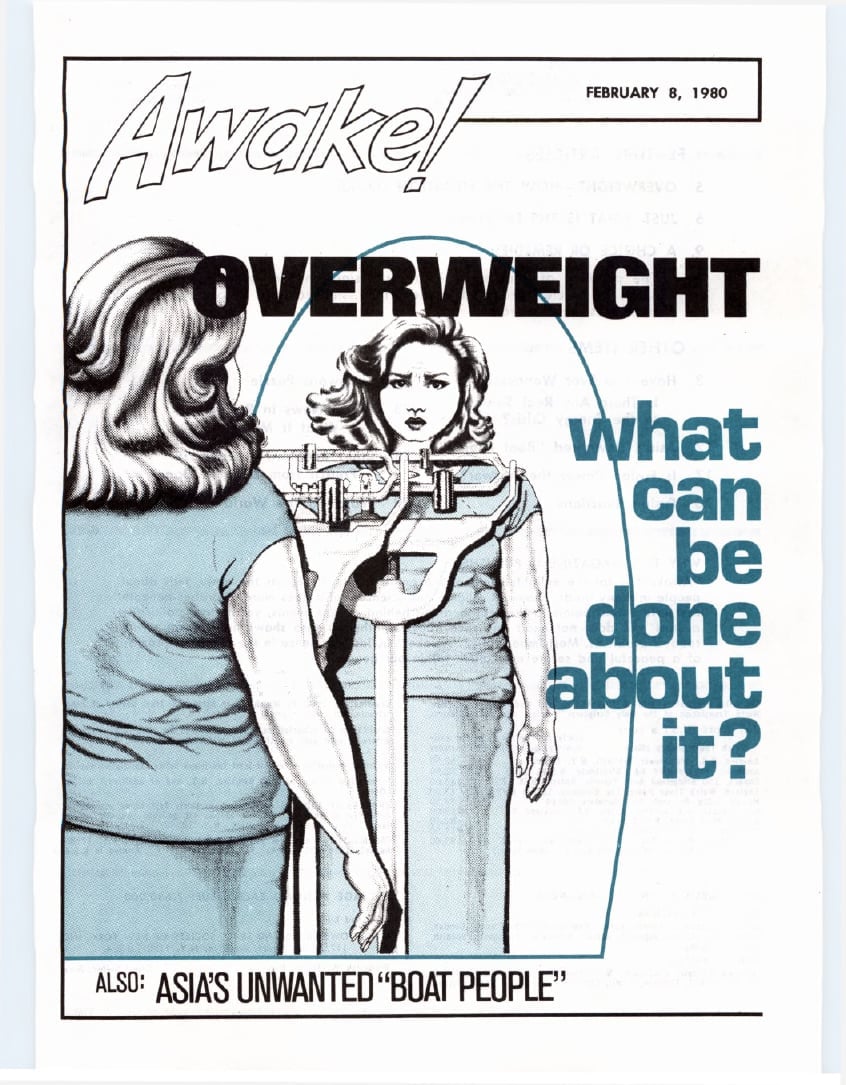
Awake! — February 8, 1980
Source: jw.org
Contents
Page Two
Is There Any Real Solution to the Energy Crisis?
Overweight—How the Situation Looks
Just What Is the Problem?
A Choice of Remedies
Asia’s Unwanted “Boat People”
Is Fusion Power the Answer?
Fusion Reactions
Crossword Puzzle
World News in Review—What It Means
Court Reaffirms Freedom to Preach from Door to Door
Watching the World
What Do Your Clothes Say About You?
Does It All End Here?
Page Two
Page Two
5 OVERWEIGHT—HOW THE SITUATION LOOKS
6 JUST WHAT IS THE PROBLEM?
9 A CHOICE OF REMEDIES
The problem of overweight is a distressing one for many persons. This series of articles, prepared in the British Isles, takes a helpful, fresh look at causes and remedies
Is There Any Real Solution to the Energy Crisis?
Have You Ever Wondered—
Is There Any Real Solution to the Energy Crisis?
THERE is hardly a place on earth where energy is not getting more expensive. Not only the cost of gasoline, but also the bills for heating oil and electricity are going up. All of us would welcome a solution—a real solution—to the energy crisis.
WHAT DO YOU THINK IS CAUSING THE ENERGY CRISIS?
Two of the basic factors are these: First, the amount of energy available; and, second, the way it is being used.
Many nations rely heavily on oil, gas and coal, but these sources of energy can’t last forever. Someday they will run out, and we will have to use something else. But that hasn’t happened yet. Some scientists estimate that there is ample petroleum to last for several decades, and a United Nations report pushes the figure even higher. Obviously, there is more to the problem than that the supply is running low.
Today’s energy crisis finds its real roots in mankind’s selfishness. Not only powerful business organizations but also individuals have been selfish as well as unwise in their use of energy and of the sources from which it is produced. Man himself, for the most part, is creating the problem.
WHAT CAN BE DONE TO EASE THE PROBLEM?
One obvious way to ease the energy crisis is to find and make fuller use of new sources of energy. A second way is to conserve, rather than waste, the energy we already have. This calls for people to be unselfish.
A number of alternative energy sources have been suggested. Attempts have been made to harness the wind, the tides and the movement of the ocean waves. Synthetic fuels derived from a variety of sources—even from garbage—are being developed and tested. And even though the initial cost of equipment is high, an increasing number of persons are turning to solar energy to heat their homes and other buildings.
Most of us could do much more to conserve energy. For example, it has been suggested that Americans could cut down their use of energy by 30 to 40 percent without any decline in economic growth or any major adjustments in their life-style. Many of them are now realizing that such things as added insulation in walls and ceilings, use of storm windows and weather stripping, as well as the shutting off of heat in unused rooms and keeping the doors to those rooms closed, can result in a sizable cut in home heating bills. And many have installed an electric igniter on their stove, instead of letting a pilot light burn. They use only about half as much gas! Conservation is good common sense. It can save you money and will help to make available sources of energy last longer.
IS YOUR SAVING ENERGY THE COMPLETE ANSWER?
You can cut back only so much in your use of energy in today’s world. Even if you lower your thermostat, insulate your home and drive your car less, you still need energy—lots of it. For most of us, alternative sources of energy are either too expensive or simply not available. So there is another basic factor involved in this energy crisis.
The business organizations that develop and sell oil realize its value. They appear determined to squeeze all the profits they can from others who depend so heavily on oil. Does it seem to you that such groups will simply change on their own and generously reverse the trend? Do you think they would welcome a vast change to alternative sources of energy? Just consider the billions of dollars invested in processing plants, equipment and leasing operations by these giants. Would they stand idly by and see all of this become valueless? Hardly. And remember, these are very powerful organizations.
Consider also the millions of persons employed by these organizations that produce oil. A sudden change in energy sources would have disastrous effects on their livelihood. The problem is certainly complicated by the way the present system operates. There is little we can do about it.
The solution would require, first of all, the use of awesome strength. Why? Because in reality, a basic change in the present structure of human affairs would be needed. Additionally, wisdom of the highest sort would be required to create a better system.
WHO HAS THE MEANS TO PROVIDE A FINAL SOLUTION?
All of us will agree that the universe is full of energy. Its Creator is described in the Bible as having an ‘abundance of dynamic energy and power.’ (Isa. 40:26) So God certainly has the power and the technical skill to cope with the problem of energy. The Bible clearly says that he will do so soon.
How God will do this is also explained in the Bible. “Jehovah is guarding all those loving him, but all the wicked ones he will annihilate.” (Ps. 145:20) Yes, God purposes to destroy this present system completely. He will deal with selfish men who refuse to change, by the use of the only thing they understand—power. Removal of such ones will pave the way for those who love God, and who respect this beautiful earth and its natural resources, to survive into a world filled with righteousness.—2 Pet. 3:13; Rev. 11:18.
Certainly the God who sustains all the universe is fully capable of providing proper direction or forms of energy that will then enable all to live comfortably. His Word says of him: “Jehovah himself will not hold back anything good from those walking in faultlessness.” (Ps. 84:11) He will provide man with all the energy he needs! You certainly have nothing to lose by further investigation of this grand prospect. To the contrary, you have much to gain.
[Picture on page 3]
Heating Costs
Oil Profits
Overweight—How the Situation Looks
Overweight—How the Situation Looks
SLIMMING is big business! Little wonder, for one out of five persons living in modern developed countries is overweight. Special foods and diets, along with a bewildering choice of books, paperbacks and magazines about overweight vie with one another for the public’s attention. Medical doctors, psychologists and other “experts” work ceaselessly to cajole, encourage and even frighten people into slimming down.
Will they succeed? Does it really matter if we are fat, or even just a little overweight? What are the facts—and how important are they for our well-being?
Cause for Concern
Since time immemorial, fat persons have been the butt of many unkind jokes. But being overweight is certainly no laughing matter. Even if you weigh only 15 pounds (7 kg) more than the average weight for your height and build, your life expectancy could be reduced by as much as four years.
“Obesity and its problems are now more pressing than cancer,” Scottish family physician Ian Richardson observed recently. Another authority has stated that being just 10 pounds (4 kg) overweight “carries a greater health risk than smoking 25 cigarettes a day.” High blood pressure, heart disease, diabetes, back pains, varicose veins, arthritis, gallstones and a host of other detrimental conditions can be directly related to the problem of excess body fat. Of course, it cannot be said that being too heavy is always the direct cause of these body malfunctions. But there is a definite association of them with overweight. So there is a problem, a truly serious problem, if you carry excess fat, whatever the reason.
But why are so many people overweight?
[Picture on page 5]
HOW TO REDUCE
Just What Is the Problem?
Just What Is the Problem?
WHY are people too fat? Is it usually due to factors beyond a person’s control, such as heredity, gland malfunction or imbalance of hormones? What relationship is there between overweight and eating too much?
At the outset, it should be stated that not all overweight people are voracious eaters. “There are many cases where the appetite and food intake of the obese are quite normal; in some cases even below average,” declares Professor Jean Mayer of the Harvard School of Public Health.
At times excess weight is due to inability of the body to eliminate fluids properly. Hormone imbalance and hereditary factors may also play a part. “Many obesities in experimental animals are genetic in origin,” notes Dr. Mayer. What about humans? “In man there is also good evidence that genetics is very important.” The professor adds:
“The number of fat cells seems predetermined (except perhaps for some increase during the first year under the influence of overabundant nutrition). Obesity runs in families: in the Boston area thin parents have, on the average, 7 per cent children obese at high-school age. If one parent is overweight, the rate is 40 per cent; if both parents are overweight, the rate is 80 per cent. Children adopted from birth do not show this association with the weight of their [foster] parents, showing that heredity, not family food habits, is the crucial factor (a finding confirmed by a large-scale study in England).”—Italics ours.
While this is true, it is evident that far too many people cite glandular disorders or heredity as a reason for being too fat. According to the Encyclopædia Britannica (1976 edition), “the body’s ability to adjust food intake to body needs can be disturbed by numerous factors. Of these, hormone imbalances and glandular defects are believed to be of least importance, being demonstrable in only about 5 percent of all obese individuals.”
Human Energy
The human body can be compared with a precision-made and finely balanced machine. Like any machine, it needs a source of energy to set it in motion and to keep it going. A person’s body draws energy solely from solid foods and liquids.
Depending upon the design, a man-made reciprocating engine can be powered by a choice of fuels. The human body too is designed so that you can select from the wide variety of foods that the Creator has made available to mankind. It has to be understood, however, that the energy values of both foods and liquids vary greatly, and this is a key to controlling body weight.
To measure the energy value of food, there has to be a common unit against which all the different sources of food energy can be checked. The term for this is “calorie,” which, quite simply, means a unit of energy. By various scientific means it is possible to determine how much heat, or energy, a given food will impart to the body when “burned” or utilized. Just as literal fuels, like coal, oil, wood or peat, vary greatly in heat output, so too the foods we eat can be deceivingly different in energy output. From the standpoint of energy, all foods may be divided into three basic kinds.
Carbohydrates, Fats and Proteins
Carbohydrates are our principal energy source. They are found as sugars and starches in potatoes and sweet foods, but particularly in cereals and cereal products, such as bread and flour. When carbohydrates enter the digestive system, they are broken down into simple sugars such as glucose, the body’s basic energy supply. In the event of a surplus of glucose, the body arranges for energy to be stored, either as glycogen in the muscles and liver, or as body fat.
Fats are of two types—saturated and unsaturated. Saturated fats come from animals. Examples of saturated fats are lard, meat fat, milk and its products. Unsaturated fats come from fish and vegetation. They are fish oil, olive oil, corn oil, sunflower oil and the like. As with carbohydrates, so too with fats: if the energy source is not used, it is stored as body fat.
Unlike carbohydrates and fats, proteins are not usually an energy source, but are absorbed mainly for body growth or repair. The human body is unable to store in any large amounts amino acids resulting from breakdown of proteins. Yet without them a child’s development to physical maturity would be stunted. The ready replacement of fingernails and toenails, hair, skin, muscle fibres and even red blood cells would be halted. Our main supplies of proteins come in the forms of meat, fish and eggs, as well as from plant foods like beans, peas and lentils of the legume family, though not all of these are of equal value.
The Natural Balance
What does energy drawn from foods have to do with overweight? Assume that we are to take an automobile trip. The source of energy is gasoline. The amount available at the outset of a journey will gradually diminish. As the car uses up this energy source, the weight of liquid in the gas tank will become less. At certain points it will be necessary to replenish the supply to equalize the availability of energy with the demand.
Our bodies also need enough “fuel,” or calories, to meet our varied needs. A sedentary worker may use about 2,700 calories during a 24-hour period. One who is very active may burn up an additional 900 calories or so. We may eat breakfast upon rising, and this food is readily assimilated and put to work. Then, during the course of our day, we eat other meals, and perhaps have snacks and sweetened drinks. All too often the body’s need for calories is outbalanced by the intake of them.
Hunger is the mechanism that alerts us to the need for more energy. The part of the brain that controls appetite is called the hypothalamus. Experiments have shown that if this part of the brain is stimulated or destroyed in animals, they either start eating voraciously and grow fat, or shun food and have to be forcibly fed.
Metabolism
Even when resting, or asleep, our body has a constant need of energy to keep the heart beating, the lungs breathing and food digesting. This is called basal metabolism. “Metabolism” is a term for all the chemical processes that constantly work to keep us alive. No matter what our body shape or size, we all have an individual rate of metabolism, although how it is regulated is still not fully understood.
What happens if we are unable to eat enough food to meet our calorie demand? The body is then thrown back on its own resources and has no alternative but to utilize the glycogen or fat stored for that purpose. Conversely, if we eat too much, the body stores excess energy potential in the form of fat.
Some fat is necessary both to help keep the body warm and to protect certain vital organs, such as the kidneys. It is excess fat that relates to the problems mentioned earlier.
Some people who eat well without gaining weight seem to have a naturally higher metabolic rate. In certain cases, overweight may result from a metabolic rate that is very low. However, one must beware of citing this too quickly as a reason for obesity. Dr. Judith Rodin, a psychologist at Yale University, states: “The obese person with extremely low metabolism is a rarity. Ninety-eight percent of the housewives who say they can’t lose because they have a low metabolism are wrong.”
Infant Problems
People often speak with approval of fat babies. Yet it is claimed that at least one third of all babies in the Western world are overweight, at least during the first year of life. Why is this? Simply because babies are unable to regulate their own choice of food, and many parents—with good intentions—overfeed them.
Does it matter if a baby is overweight for the first year or so? Yes! Some eminent pediatricians insist that such initial obesity leads to an increase in the body’s fat cells both in size and number. This means, they say, that the child will have to spend the rest of its life fighting to maintain slimness.
As an antidote to infant obesity, many recommend more breast feeding. In addition, the British Nutrition Foundation has long campaigned against early introduction of solid foods (particularly cereals), since they can be detrimental to infants. Baby-food containers in the British Isles now carry the advice that weaning foods are not usually needed before the age of four to six months. This allows the infant time for adjustment of its metabolism to the correct level.
Keeping our bodies healthy is something we all want to do. As we have seen, much depends upon the amount and the quality of our regular food supply. In most cases obesity can be prevented. But how about a cure?
[Blurb on page 6]
‘Excess weight may be due to inability of the body properly to eliminate fluids.’
[Blurb on page 7]
‘Hormone imbalance and heredity may also be factors in weight problems.’
[Blurb on page 7]
‘In most cases, the body’s need for calories is simply being outbalanced by intake.’
[Blurb on page 8]
‘Doctors say that feeding a baby too much during its first year may cause a lifelong problem with overweight.’
A Choice of Remedies
A Choice of Remedies
THE determination to lose weight can lead to extremes. In cases of severe overweight, a modern therapy is to wire together the patient’s jaws. In this way a compulsive eater is forced to sustain himself solely by means of fluids.
Even more drastic is an operation to bypass most of the small intestine and part of the large. Nutrients are absorbed through the walls of our intestines. So this action means that food is passed through the body without being assimilated. Fortunately, this operation is usually reversible. Even so, it carries with it a mortality rate of 5 percent.
Drugs and Slimming Pills
Immediately following World War II, amphetamines were used extensively to check appetite. But the picture changed dramatically. A Working Party set up by the British Medical Association in 1967 reported: “These drugs should be avoided so far as possible in treatment of obesity.” Why? Because amphetamine drugs can lead to serious addiction and they often have harmful side effects.
In more recent years drugs known generally as “anoretics” have been developed. But many individuals have been bitterly disappointed with them. They are advertised as a means of increasing the tissues’ utilization of glucose, leading to less fat being deposited. Are they effective? A British physician, Dr. Michael Spira, reports: “The evidence that this actually happens does not appear very convincing.”
What about “slimming pills”? Some drugs mentioned above come into this category. Also, the market is flooded with pills of all sorts and sizes containing things such as gland extracts, vitamins, methyl cellulose, hormones—or simply just laxatives! The choice of pills is wide indeed, but the proved effectiveness for general treatment in weight reduction is much in question.
Exercise?
Does the answer to weight reduction lie in exercise? Yes, to an extent. After all, we live in a labour-saving world. Normal expenditure of energy in such routine matters as climbing stairs is often set aside for an elevator. Walking to shops, or even to and from school, is exchanged for a ride. Machines undertake much of the energy expenditure in housework. Similarly, sedentary occupations call for little physical effort. In many lands today, bodies tend to be underused, muscles grow flabby and much of the body’s energy supply turns into fat.
To help restore balance, various ideas hit the market from time to time. Some years back “hula hoops” were the rage for reducing midriff bulge. Rowing and bicycling machines, vibrator massagers and a host of other gadgets using ropes and pulleys are always available for buying or are used in clubs, and health clinics.
A very popular form of exercise today is jogging. However, for an obese person to engage in strenuous exercise can indeed be very dangerous. Even for an active person to push himself at jogging without an adequate buildup is hazardous. For persons not in condition to jog, a vigorous walk can be beneficial—yet face the fact that walking an extra mile a day will result in weight loss of less than one pound (0.45 kg) a month! Obviously, however, exercise does help in reducing weight, since any physical exertion means that calories are being used up rather than being stored in the body as fat.
On the whole, many advocates for various methods of losing weight disagree on vital points. Is there no common factor in the maze of weight-reducing remedies? Yes, there is one.
The Fundamental Issue
“Overweight comes from overeating.” Those four telling words are repeated a number of times in This Slimming Business by John Yudkin, emeritus professor of nutrition, University of London, England. The following table is self-explanatory:
INTAKE OUTPUT RESULT
Food 2,000 Energy 2,000 Constant weight.
(Energy) calories calories
Food 2,000 Energy 2,500 Loss of weight as
(Energy) calories calories body draws on reserves
of fat to meet
500-calorie deficit.
Food 2,000 Energy 1,500 Increase of weight
(Energy) calories calories as body deposits
500 surplus calories
in the form of fat.
In all but a tiny percentage of cases, overweight can be solved by regulating food intake. Persons who wish to reduce must consume less calories, either by eating less food or by avoiding high-calorie items such as sweets. If you seek medical advice about a weight problem, chances are that the doctor will recommend some form of diet that will enable you to have an intake of calories commensurate with your expenditure of energy. Initially, though, a stricter form of diet may be needed to bring your weight down to the limits for those of your height, age and build. These figures are readily available from life insurance companies or from diet books or magazines.
There is a great variety of diets. A vegetarian diet obviously will be more expensive (unless you grow your own fruits and vegetables), as will a high-protein one. Bear in mind too that special “diet foods” are usually more costly and of doubtful value, except as temporary food supplements. Beware of any “crash diet” program. Such methods can be very dangerous and lead to serious health problems, such as ulcers.
Some Practical Tips
One way of limiting your intake of food energy is to take note of all that you eat each day, including all snacks between meals. Assess the total caloric content of everything you eat and drink. Train yourself to understand food values and then plan how to cut down systematically each day. There is one danger in this approach. Beware of becoming overly absorbed in the undertaking. It can rob you of time needed for other essential things.
Many find calorie counting far too tedious and soon lose interest. A much simpler means of losing weight is to continue with your normal diet, to enjoy what you eat, but to eat less of it. Instead of three slices of bread, eat two. Take one less potato. Instead of two teaspoons of sugar in your tea or coffee, put just one. If you drink five cups of these beverages each day, that will be a reduction of about 1,000 calories per week—no mean saving! Give special attention to cutting down on calorie intake in the evening, because physical activity is usually limited then. Do not expect spectacular results with this approach. But over a period of time you will lose weight slowly—and that is the best way to do it.
Such an approach to the situation is in harmony with the Bible’s counsel to ‘eat and drink with rejoicing’ but to avoid “overeating and heavy drinking” because of the adverse effects that such abuses produce, not only physically, but in a person’s response to important spiritual matters of life.—Eccl. 9:7; Luke 21:34.
At this point it may be helpful to consider some tips that have proved useful in certain cases. Eat only when you are hungry. Having a light snack instead of a full meal from time to time will do you no harm. Avoid “nibbling” when watching TV, reading or just chatting with friends. Drinking something about half an hour before a meal will take the edge off your appetite and drinking a little with meals will help you to feel full with less food. Thorough chewing brings greater eating satisfaction, and you will find that by so doing you will also eat less. Give yourself time to enjoy meals. Eating slowly can help you to shed excessive fat. Dr. Theodore Van Itallie, a specialist on obesity, said in an interview published in Psychology Today: “The rate of eating may be a factor. There are some people who gobble down their meals very rapidly. Some researchers believe that if you bolt your food, the satiety signals that ultimately tell you it’s time to stop may not have time to go into action.”
Determination and self-control are essential in any progress toward weight reduction. Reading about the problem or consulting doctors is no substitute for personal effort.
[Picture on page 9]
SLIMMING PILLS
[Picture on page 9]
EXERCISE
[Picture on page 11]
EATING LESS
Asia’s Unwanted “Boat People”
Asia’s Unwanted “Boat People”
By “Awake!” correspondent in Hong Kong
IT IS just a dark speck on the horizon when first spotted. But, as it gets closer, the Marine Police can clearly see that it is what they expected. Here is a repeat of an appalling scene that they have witnessed hundreds of times. They see approaching Hong Kong a narrow, 60-foot, weather-beaten, decrepit excuse for a boat crammed with 180 unwanted people who, with meager rations, may have been on board from two weeks to over a month. With barely sitting room, they have navigated some 600 miles (1,000 km) of the South China Sea from Vietnam.
The unstable vessel is towed very carefully to the Quarantine Anchorage, where its occupants will await their turn to touch land at the government dockyard. The “boat people” breathe a sigh of relief, sure that their worst experiences are in the past. But what they do not know is that many months of waiting, in less than ideal conditions, are ahead of them before they again may have a place to call home.
Who are these woebegone travelers, and what is their story?
Refugees
Throughout history, unrest, wars, nationalism, prejudice and related problems have produced refugees. Some may have fled for selfish reasons, but more often than not, such refugees are the innocent victims of circumstances. It is estimated that there are over 11 million refugees in the world at present.
Of the more than 300,000 homeless refugees in Southeast Asia, the “boat people” make up the majority. The rest are mainly the “Kampucheans” who have fled from the war zone in Cambodia to Thailand. These have strained the facilities in Thailand and in some cases just exchanged one type of hardship for another.
However, what has especially drawn world attention to the refugee problem is the saga of the so-called “boat people.” These are refugees from Vietnam who have set sail for other Asian ports in all sizes and shapes of overcrowded, and often unseaworthy, vessels. Some of these boats headed south, landing in Malaysia, Indonesia, Thailand, and even Australia. Others more or less hugged the coast of South China, perhaps stopping at Hainan Island for water and meager supplies and then limping into Macau and Hong Kong. Such journeys are fraught with dangers.
It has been estimated that, of those who headed south, as many as 70 percent were lost at sea, and for those who headed toward Hong Kong, 40 to 50 percent may have gone to watery graves. What has prompted these people to embark upon such a dangerous voyage?
After the Vietnam War ended, many in the South fled for fear of reprisals from the new government, and others fled for selfish reasons. It was thought that this exodus would end in a relatively short time, and, in fact, the number did decrease. But then, on December 23, 1978, a harbinger of what was to come arrived in Hong Kong waters. The “Huey Fong” attracted world attention with its almost 3,400 refugees aboard. In the next few months, and especially following the Vietnam-China border war in February 1979, tens of thousands of ethnic Chinese and a small number of Vietnamese embarked upon a life-or-death struggle in order to reach other countries.
With the exception of minor details, the story told by the Chinese refugees was the same. They reported that a campaign to expel all ethnic Chinese from Vietnam was being carried on. Over 200,000 fled across the border to China before the border war closed this escape. The Chinese still in Vietnam, especially in the North, where that border war had taken place, were clearly told to get out. One man reported: “At first, we were visited once a month by the police, then every week, and finally every day until we started making arrangements to leave. We had to sell our belongings at low prices to the Vietnamese.” Exit fees were paid first for this man’s family, who left by boat for Hong Kong. He managed to scrape together enough to pay for his exit a few weeks later. Since arriving in Hong Kong, he keeps looking hopefully out to sea. His family has never arrived.
Many of the Chinese still remaining in the north of Vietnam were laborers and therefore did not have much in the way of savings. To get exit and transport out of the country, they reported paying comparatively low prices, around $600 (U.S.) per person. The extent to which racketeers and/or government officials were involved is still a subject of debate and denials. Chinese who did not buy their way out of Vietnam were to be sent to new “economic zones,” which are said to be undeveloped areas with no food or water where they are told to start a new life with only a few implements and some seeds.
In the South, many Chinese were better off materially and had either stored up gold bars or bought them following the Vietnamese War. They reported paying 8 to 15 ounces of gold, worth thousands of dollars (U.S.), per adult to buy passage on one of the boats. It appears that those who paid more were allowed onto larger freighters that were pretending to find the refugees at sea but actually were trafficking in human cargo. The “Huey Fong,” which sailed into Hong Kong in December 1978, was such a ship.
“Sardine Ships”
When the “Huey Fong” arrived, it was kept just outside Hong Kong territorial waters. The government held that the ship’s registered first port of call was Kaohsiung, Taiwan, and that the ship should therefore sail on to Taiwan. However, supplies were taken to the ship, sick persons were treated and some even airlifted to the hospital. The almost 3,400 people did not want to stay on board any longer, nor did they want to go to Taiwan, which had already stated that they would not accept the refugees anyway. The captain said he was being threatened by the refugees and was afraid to move the ship. The situation seemed stalemated.
The captain and the refugees claimed that the ship had rescued them from sinking boats and thus asked for permission to land in Hong Kong on humanitarian grounds. After involved diplomatic and governmental negotiations, the “Huey Fong” was allowed into the harbor. In due time, the refugees were taken to crowded, makeshift refugee camps.
The government then started a detailed investigation. There were many discrepancies in the stories told when compared with the ship’s log. In fact, after a thorough search, $13 million (U.S.) in gold was found hidden in the ship. In August 1979, the captain and crew of the “Huey Fong” were brought to trial. Overwhelming evidence was presented proving that this was a gold-seeking venture that had broken many laws and endangered lives. The captain and the crew were sentenced to jail for their part in what the crown counsel called a “journey of deceit.”
Another ship that came into Hong Kong was the “Skyluck.” It arrived on February 7, 1979, with 2,665 refugees on board. Since the ship’s facilities were no better or worse than those of the cramped refugee camps, landing was not allowed. Food and other supplies were sent daily to the anchored ship. This continued for over four months until June 29, when the refugees’ patience ran out and they took matters into their own hands. They took over the ship, cut the anchor chains and let the ship drift until it was grounded precariously on one of the islands of Hong Kong. At this point, the government resettled the refugees in a detention center, which had to be converted from a prison to a refugee camp.
Various cargo ships on their regular routes between Asian ports did truly rescue refugees from sinking boats and then proceeded to their next port of call. However, this caused problems for the shipping companies because the refugees are not usually allowed to land at such ports unless the ship’s country of origin agrees to accept such refugees for resettlement. Thus, a ship may be delayed in a harbor for days and sometimes weeks. Depending on the size and type of ship, such delays could cost the shipping company anywhere from $5,000 (U.S.) to an estimated $20,000 per day in lost revenue. It is feared that such a situation may have caused some captains to shy away from rescue operations.
Cause for Concern
The situation in Hong Kong illustrates some of the reasons why the refugees met with less than a welcome in the places to which they fled. The United Nations High Commission for Refugees (UNHCR) was picking up the bill and organizing care for refugees who had arrived up to the end of 1978. However, when thousands began arriving in 1979, Hong Kong started footing most of the bill with some help from welfare organizations. All sorts of emergency plans had to be made to house the refugees with some semblance of order and hygiene.
But Hong Kong is only about 404 square miles (1,045 km2), about one quarter of which is suitable for urban-type development and agriculture. By mid-1978 there were already 4.7 million people here and the metropolitan areas had a density of over 67,000 people per square mile (2.6 km2). Needless to say, a sudden flood of refugees was a cause for real concern.
Further aggravating the situation, legal immigrants from China during the first five months of 1979 averaged almost 10,000 per month. Tens of thousands of illegals were also streaming over the border. So, then, around 22,000 legal and illegal immigrants and refugees were arriving in the colony every month. Police, military and social services were being taxed to the limit. Yet, as many newspaper headlines kept saying: “And still they come . . .”
Other Asian countries and their inhabitants were getting frightened at the future implications such an influx would have on the local economy, inflation and what they called “ethnic balance.” Thus, when refugees headed toward some shores, local inhabitants would throw stones, and push the boats away from their shores. Malaysia, reeling with more than 70,000 “boat people,” started taking what was described as “desperate action by desperate people.” The authorities began repairing the refugee boats and then towing many of them back out to sea. The small Portuguese enclave of Macau, which was already flooded with immigrants from China, said they had reached the saturation point. So, when these boats reached Macau, they would be provided with food, water and medical supplies and then towed back out to sea to be more or less pointed toward Hong Kong, about 41 miles away.
The Hong Kong government commendably stated that, on humanitarian grounds, it would not turn the “boat people” away. Officials said that to turn them away would be like condemning many of them to a watery grave. But foreign help was sorely needed. By the middle of 1979, the government was spending about $50,000 (U.S.) a day to feed, clothe, and house the refugees not under the UNHCR care in Hong Kong.
International Relief
Asian countries were frantically engaged in diplomatic initiatives with the United Nations and world governments to plead for help. They felt that too much criticism of their refugee facilities and too few offers of help and resettlement were forthcoming from rich nations. Many leaders stressed the urgent need to call an international conference on refugees.
Thus, on July 20, 21, 1979, the United Nations Conference on Indochinese Refugees was called. Representatives from larger countries and Southeast Asian nations, including Vietnam, attended. The outcome of this conference was that Vietnam agreed to slow down the exodus to an orderly, regulated departure. Also, 26 countries agreed to take 300,000 refugees from Southeast Asia for resettlement. According to the South China Morning Post, July 22, 1979, China offered to accept another 10,000 refugees on top of the 250,000 that they already had. Further, they offered to contribute $1 million (U.S.) to the UNHCR to help meet refugee expenses.
As of September 1, 1979, the UNHCR took over full responsibility for the refugees in Hong Kong. It has been promised that all the refugees in Asia will be resettled in the next 18 months. So, plans and promises have been made. Only time will tell what will actually be done.
Now, it seems that patience is needed by the “boat people” in putting up with cramped conditions until their turn in the lineup for resettlement comes. Even when they move to another country, language barriers, prejudice, misunderstanding and even open confrontation with local inhabitants may still await them. One clergyman in Hong Kong well summed up what many people feel about the refugee problem. He said it is “not solvable.” But why?
Because permanently solving the refugee problem would require that wars be eliminated. It would mean doing away with greed and hatred, and removing the nationalistic divisions that prevent the use of earth’s resources for the full benefit of all mankind. There is no human government, or alliance of human governments, that can hope to achieve all of that.
Yet it is these very things that the Bible shows that mankind’s Creator, Jehovah God, will accomplish. How? By cleaning out of the earth all who foment hatred and greed, and those who instigate war. (Ps. 46:9, 10; 1 John 3:15; 1 Cor. 6:9, 10) He has made provision for a government ruling from heaven and that will have ‘all peoples, national groups and languages’ united in its domain. (Dan. 7:13, 14) As they are being given more freedom of movement outside the refugee camps, the “boat people” are having an opportunity to learn of this only reliable hope. It is an opportunity that is open to you too.
[Blurb on page 13]
‘Of the refugees that headed south from Vietnam, 70 percent were lost at sea; of those who headed north, 40 to 50 percent.’
[Blurb on page 14]
“There are over 11 million refugees in the world.”
[Blurb on page 14]
“When refugees headed toward some shores, local inhabitants would throw stones and push the boats away.”
[Blurb on page 15]
‘Around 22,000 legal and illegal immigrants and refugees were arriving in Hong Kong every month.’
[Blurb on page 16]
‘Refugees picked up at sea are not usually allowed to land anywhere unless the ship’s country of origin agrees to accept them for resettlement.’
[Blurb on page 16]
‘Permanently solving the refugee problem would require the elimination of war, doing away with greed and hatred and removing the nationalistic divisions that prevent the use of earth’s resources for the full benefit of all mankind.’
Is Fusion Power the Answer?
Is Fusion Power the Answer?
An atomic scientist frankly analyzes the hurdles that must be cleared before fusion power can be used to fill energy needs
WITHOUT QUESTION, the challenge of controlling fusion (a combining process) is a tantalizing one. If we could carry out even one of the various fusion reactions, say the one involving two deuterium atoms (No. 4 in the chart on page 20), we could tap an endless supply of fuel. One out of every 3,000 water molecules in the whole world, including the great oceans, contains an atom of deuterium. Think of it! One pint of water has the potential to supply 400 kilowatt-hours, a month’s supply of electricity for your household. And we would be rid of the mounting piles of radioactive fission products from the present nuclear plants. Is this not a promising solution to the energy problem?
The apparatus called a cyclotron is useful to study these reactions, but not to produce the energy in usable form. It takes a lot of energy to make millions of particles move fast enough to react, but only a few of them strike other atoms and pay off in energy; all the rest give off their energy in small portions and are wasted. Far more energy is poured into the experiment than can be recovered.
The secret of the sun’s superiority is that its interior is so hot that the particles maintain their high velocity from one collision to another, until they finally react. So you can see why it is so difficult to achieve a useful fusion process on earth. Somehow we must duplicate a bit of the sun’s interior. But how can a batch of hydrogen be heated to millions of degrees and held together until it reacts? No known material would hold it. Substances most resistant to high temperatures melt and vaporize at a few thousand degrees.
True, scientists have demonstrated the power of fusion on earth, but only in the explosion of the fearsome hydrogen bomb. Of course, everything in and around the bomb is vaporized and blasted away in the merest fraction of a second. How could one possibly tame such a ferocious monster and harness its power?
Fusion in Magnetic Containment
Impossible as it seems, there is a way by which the seemingly insurmountable problem may be surmounted. It is by the use of magnetic thermal insulation. Here is how it works. The hydrogen is heated by electric discharge to such a high temperature that it is completely converted into particles called ions. It then consists only of positive nuclei and negative electrons. This is the state of matter called a plasma. If a plasma is surrounded by a strong magnetic field, the charged particles or ions cannot move away in straight lines, but are forced into tight corkscrew paths. If the magnetic field is shaped properly, these spiral paths will be reflected from the two ends of the container, which becomes a “magnetic bottle.”
In another design, the paths are bent into a circle, in a doughnut-shaped field called a torus (a bulge). In such devices, the protons and electrons cannot come in contact with the walls of the metal container, and they can be heated to millions of degrees while the container stays cool. The most successful device of this kind was named a tokamak by the Russian scientists who invented it.
No matter how the plasma is confined by the magnetic field, it must meet three conditions to get fusion to start and continue. These conditions specify the temperature, the density, and the time.
First, the plasma must be heated to the ignition temperature. The reaction of the atoms of deuterium and tritium ignites at the lowest temperature, about 46,000,000 degrees C (82,800,000° F). The plasma can be heated by inducing an electric current in it, or by injecting a beam of high-energy atoms. But always working against the fusion reaction is the loss of energy from glancing collisions. These produce X rays, which readily escape through the magnetic field, thus carrying heat out of the plasma. The plasma must be hot enough that the energy produced by fusion overcomes this loss, in order to attain the threshold for a self-sustaining reaction.
Second, the plasma must be compressed to crowd the particles together at a very high density, 100 trillion (1014) or more in every cubic centimeter. And, finally, these conditions must be maintained for a time interval long enough for a minimum number of collisions to occur. The product of the density multiplied by the time in seconds must reach at least 60 trillion (60 x 1012). This number is mathematically called the confinement parameter. It tells us that if the maximum density can be held for one tenth of a second, for example, that density must be at least 600 x 1012 to attain self-sustaining fusion between deuterium and tritium.
The plasma can be compressed by rapidly strengthening the magnetic field. At the same time that this increases the density, it further heats the plasma. Then, if the magnetic field is rightly designed and able to keep the plasma together long enough, fusion will result. Disappointingly, it has proved very difficult to do this. The plasma is exasperatingly elusive stuff. It finds a weak spot in the magnetic field and squeezes into it to make a pouch through which it quickly blows out. It acts like a bare innertube being overinflated without the support of a tire casing.
Many years and millions of dollars have been spent in frustrating efforts to overcome the instabilities. Only in the past two years have some experiments given hope that the herculean efforts to tame the capricious plasma may finally succeed. At the Massachusetts Institute of Technology a tokamak, called “Alcator,” attained a confinement parameter of 30 trillion. But the temperature fell far short, only about 10 million degrees. In a later test at Princeton, their Large Torus (“bulge”) reached a temperature of 75 million degrees, high enough, for the first time, to kindle the deuterium-tritium reaction. But here the confinement parameter did not exceed one trillion. So the fusion flame again flickered and went out before it was really lit.
These near approaches to the threshold of breaking even on energy have spurred hopes that the next generation of tokamaks, bigger and more expensive, will bring success. In the next two or three years one is to be built at Princeton in the U.S., and one in Europe at Culham, England. Each will cost about $300 million. If these machines successfully demonstrate controlled fusion, then nuclear physicists will be ready to face other obstacles remaining on the path to a commercial fusion reactor.
One problem looming up ahead is the accumulation of impurities in the plasma that poison it. The X-ray losses mentioned above become much greater as the atomic number increases. Even the gaseous element helium causes eight times as great a loss as does hydrogen. Oxygen is 500 times worse. This means that the plasma will have to be kept extraordinarily clean to turn out useful fusion power.
If all these problems can be solved, what might a fusion power plant look like? A design drawn up at the University of Wisconsin, based on the most optimistic data so far available, gives us an idea. The torus, or doughnut-shaped vessel, would be 27 m (89 feet) tall and 44 m (144 feet) in diameter. It would be made in 12 pie-shaped sections, each weighing 3,500 tons. The building housing it would be 102 m (335 feet) high and 120 m (394 feet) in diameter, roughly the size of the Houston Astrodome. These huge sections would have to be fabricated to meet the most rigorous standards for high vacuum. The gigantic magnets enclosing them would be cooled with liquid helium to within four degrees of absolute zero (−273° C; −460° F).
When the plant is operating, with its charge of deuterium and tritium circulating in the torus at fusion temperatures, it will generate 1,400 megawatts. But every 90 minutes, this whole monstrous plant will have to be shut down to pump out the impurities and replace the fuel. Alternate power must be supplied to the electric network for six minutes during this periodic shutdown, 15 times a day. Little wonder that utility managers are not eager to take over such a fitful giant!
Laser Fusion—An Inertial Method
Another possible way to get fusion under control was developed in secrecy and was revealed recently. It is called the inertial method. A device of this kind has a number of laser beams focused symmetrically from all sides so as to intersect at a common point. A microscopically tiny glass balloon containing a mixture of deuterium and tritium is dropped through the point of convergence. When it is exactly in position, the laser beams are fired. They all strike the sphere simultaneously, and heat the pellet with a power of millions of kilowatts for a fraction of a billionth of a second. The sudden heat vaporizes the pellet, and as the outer glass shell explodes, it pushes the gas in, in an implosion. This instantly heats the fuel to an estimated 10 million degrees, and compresses the gas to a density 200 times normal. Although the temperature is considerably less than the ignition temperature, it is high enough to cause some fusion. In some tests, as many as 10 million neutrons have been formed. Almost immediately the mass blows apart, since there is nothing to hold it together. Fusion continues only as long as the inertia of the mass holds the hydrogen atoms together; as soon as the intense pressure blows it apart, it stops.
This method is in some ways more promising for early development than is the magnetic confinement approach. But the present stage of success is no more than a demonstration that the idea is scientifically sound. It takes thousands of times more energy to power the laser beam than is produced in the experiments. With more powerful lasers, a higher temperature can be reached and fusion will become more efficient. Lasers 10 to 100 times as powerful as today’s best will be required to reach the point where as much energy can be produced as is required to operate them.
But breaking even on energy is a long way from breaking even on cost. Even if lasers with the needed power can be made, only a little energy can be gotten out of a single pellet. To achieve useful power would require firing the laser hundreds or thousands of times a minute, while pellets fall in equal numbers through the target point. It will take a major effort to extend the useful lifetime of laser generators and to manufacture the microspheres by the millions at reasonable cost.
Fusion: Clean or Not So Clean?
A problem that blights both methods of fusion is the radioactive pollution. This is true notwithstanding the claims sometimes made that fusion power will avoid this curse of fission power. Some fusion reactions (Nos. 4 and 5) involve tritium, the radioactive isotope of hydrogen. These reactions also produce neutrons, which escape into the surrounding materials and render them radioactive. Looking at the table of fusion reactions, we see that the reactions in the sun are “clean.” They do not involve any radioactivity. But the only other reaction of which this is true is the one (No. 6) between deuterium and helium-3. Unfortunately, these clean reactions all require a very high ignition temperature.
Because the deuterium-tritium reaction (No. 5) has the lowest ignition temperature, it is the only one used in current research, and it is the one that will be used in the first fusion power plants. This reaction produces copious neutrons, far more per unit of energy than does uranium fission. They will radioactivate strongly everything in and around the reactor. So it will be a dangerous task to handle and dispose of reactor parts when they need repair or replacement.
More than the activation, there is the damage done to the metal shell around the reactor, because the neutrons knock the very atoms out of place. This weakens the material, so the doughnut sections of the magnetic reactor, for example, will probably last no more than two to five years. The task of moving these colossal radioactive structures, weighing 3,500 tons and standing nine stories high, out of the plant and disposing of them presents an appalling challenge. The bulk of radioactive waste from a fusion power plant may turn out to be greater than that from present nuclear plants.
Another point often overlooked is that tritium itself is radioactive. Tritium is found in traces in the atmosphere, being produced by cosmic-ray reactions. As for unit quantity for unit quantity (curie), tritium is not nearly as hazardous as such fission products as iodine and strontium, but the quantity required in inventory for a fusion plant would be hundreds of millions of curies. Some leakage is inevitable; routinely, it might be kept as low as 10 curies a day. But an accidental release—after all, hydrogen mixed with air is explosive—would be quickly combined in the form of water and disseminated irrecoverably world wide. The loss of tritium from just one plant could increase the atmospheric concentration globally by 1000 percent.
Periodically we hear optimistic news reports in the U.S. about a new breakthrough on the way to fusion power. These usually seem to happen just about the time for the annual request to Congress for more money to expand the research. But the cold facts are that economic fusion power is a long time in the future, even if all the now recognized hurdles can be cleared. Edward Teller has said that useful power from laser fusion may be two generations yet in the future.
Unlimited Energy from Fusion Power
Really, if one were mentally to construct an ideal fusion energy plant, it would be something like this: First, take enough hydrogen to hold itself together by gravity; that solves all the problems of containment. Gravitational compression of this ball of hydrogen would increase its temperature and density enough to ignite the fusion reaction. The balance between gravity and internal pressure would automatically set the speed of the reaction, so it would neither burn too low nor run out of control.
Instead of building elaborate shields to keep the radiation inside, we would reduce it to a safe level simply by placing this nuclear reactor a tolerable distance away, say 100 million miles. Rather than build power lines to carry the energy to us, we could just have it delivered in the form of radiant energy, heat and light. And, finally, to protect ourselves from any stray protons or neutrons from the reactor, we need only wrap around us a weak magnetic field to deflect and a layer of air to absorb those particles.
The reader will, of course, recognize that this kind of fusion reactor is just what our Creator has provided for us, in the sun. How thankful we should be that an unfailing, unlimited source of energy has been given to all earth’s inhabitants by the wise Maker and Source of all energy. And this comes to us just for the taking. It is not followed by a monthly utility bill.
[Blurb on page 19]
‘If a fusion plant were operating, the whole monstrous thing would have to be shut down every 90 minutes to pump out the impurities and replace the fuel.’
[Blurb on page 21]
“The cold facts are that economic fusion power is a long time in the future, even if all the now recognized hurdles can be cleared.”
Fusion Reactions
Fusion Reactions
The nuclear reactions that give the sun its heat can be duplicated on a small scale in a cyclotron or similar machine. With it the nuclei of light atoms are speeded up in an electric field to very high velocities. Their energies are measured in terms of a unit of one million electron volts (Mev). This is the energy acquired by an electron or a proton—any particle with a single charge—when it is drawn across an electric field of one million volts. A beam of such particles is directed against a target to induce a reaction between the nuclei in the beam and those in the target.
The accompanying table shows some of the fusion reactions that have been studied by nuclear physicists in their laboratories. In each case, one of the particles shown before the arrow is fixed in a target and the other strikes upon it at high velocity. To illustrate, in the first reaction shown, the nucleus of one hydrogen atom strikes another, fusing with it and throwing out a positive electron. There is a shrinkage of mass, which is converted into energy in accordance with Einstein’s famous equation E = mc2. Consequently, the particles formed fly apart with more energy than the merging particles had. In this case the energy gained is 2,000,000 electron volts.
For comparison, when coal is burned the oxidation of a carbon atom yields only four electron volts. In nuclear reactions we are dealing with energies millions of times greater than in chemical reactions.
The first three reactions in the table are believed to be the principal ones taking place in the sun. Some of the other reactions may be easier to achieve in the laboratory. You will note that in reactions 3, 5 and 6, where helium-4 is produced, the energy gain is much greater. This results from the very tight bonds formed between two protons and two neutrons. Helium (He4) is a very stable element.
[Diagram on page 20]
(For fully formatted text, see publication)
H1 PROTON
n1 NEUTRON NUCLEAR BUILDING BLOCKS
H1 HYDROGEN
H2 DEUTERIUM HYDROGEN ISOTOPES
H3 TRITIUM
He3
He4 HELIUM ISOTOPES
ENERGY FROM FUSION REACTIONS
In the Sun:
(1) H1 + H1 H2 + e+ 2.0 Mev
(2) H1 + H2 He3 5.5 Mev
(3) He3 + He3 He4 + H1 + H1 12.9 Mev
Other Reactions:
(4) H2 + H2 He3 + n1 3.2 Mev
H3 + H1 4.0 Mev
(5) H2 + H3 He4 + n1 17.6 Mev
(6) H2 + He3 He4 + H1 18.3 Mev
Crossword Puzzle
Crossword Puzzle
Clues Across
3. Bible book that constitutes a “pronouncement against Nineveh” [5]
6. Eyes are designed to do this [3] (Proverbs 20:12)
8. Reverential wonder or fear [3] (Isaiah 29:23)
9. Associated both with 27 down and the Most Holy of the temple [3] (2 Chronicles 5:4-7)
10. “Every man must be swift about hearing ‐‐‐‐ about speaking, ‐‐‐‐ about wrath” [4] (James 1:19)
11. Father of Gershon, Kohath and Merari [4] (Exodus 6:16)
12. Both Elihu and Jehovah called Job’s attention to the marvel of this [3] (Job 37:10; 38:29)
14. Their king was Chedorlaomer [8] (Genesis 14:1)
15. Leopards have these [4] (Jeremiah 13:23)
17. The “serpent” is to bruise the ‘seed of the woman’ here [4] (Genesis 3:15)
18. He celebrated a feast for a thousand of his grandees [10] (Daniel 5:1)
21. He lived for 969 years [10] (Genesis 5:27)
22. A painted image [4]
24. The first human who got into trouble because of becoming “hot with anger” [4] (Genesis 4:2-11)
25. People regularly mentioned in association with the Medes in both the Bible and secular history [8] (Daniel 5:28)
28. Tool used to make small holes [3] (Exodus 21:6)
29. People from here were exiled by Assyrian King Tiglath-pileser III [4] (2 Kings 15:29)
30. Person named in the human ancestry of Jesus Christ [4] (Luke 3:33)
31. “Get ‐‐‐ of her, my people” [3] (Revelation 18:4)
32. Describes the shape of the rainbow [3]
33. Used for cultivating, weeding [3] (Isaiah 7:23-25)
34. First of the so-called “Minor Prophets” [5]
Clues Down
1. A son of 27 down [7]
2. Wrongly used term for main divisions of most Bible versions [9]
3. Mother-in-law of Ruth [5] (Ruth 4:13-15)
4. A quality of people who will inherit the earth [4] (Psalm 37:11)
5. Sadducean high priest during Jesus’ earthly ministry [8] (Matthew 26:57)
6. Ten men “take hold of the ‐‐‐‐‐ of a man who is a Jew” [5] (Zechariah 8:23, NW; AV)
7. Father of Phinehas [7] (Numbers 25:6-9)
13. Wife of King Ahab [7] (1 Kings 16:30, 31)
16. “Do not become ‐‐‐‐‐‐‐ of the witness about our Lord” [7] (2 Timothy 1:8)
19. Book written by “the son of Berechiah the son of Iddo” [9]
20. Coupled with fear of Jehovah, it results in riches and glory and life [8] (Proverbs 22:4)
21. Alias Mishael [7] (Daniel 1:6, 7)
23. Deity worshiped by King Sennacherib of Assyria [7] (2 Kings 19:36, 37)
24. A Christian woman of Corinth [5] (1 Corinthians 1:11)
26. Region called “ʹAram” in Hebrew text of Scriptures [5] (Hosea 12:12)
27. The third man in history commended for his faith [4] (Hebrews 11:4-7)
CROSSWORD SOLUTIONS, PAGE 28
Answers Across
3. NAHUM
6. SEE
8. AWE
9. ARK
10. SLOW
11. LEVI
12. ICE
14. ELAMITES
15. SPOT
17. HEEL
18. BELSHAZZAR
21. METHUSELAH
22. ICON
24. CAIN
25. PERSIANS
28. AWL
29. IJON
30. ARNI
31. OUT
32. ARC
33. HOE
34. HOSEA
Answers Down
1. JAPHETH
2. TESTAMENT
3. NAOMI
4. MEEK
5. CAIAPHAS
6. SKIRT
7. ELEAZAR
13. JEZEBEL
16. ASHAMED
19. ZECHARIAH
20. HUMILITY
21. MESHACH
23. NISROCH
24. CHLOE
26. SYRIA
27. NOAH
World News in Review—What It Means
World News in Review—What It Means
PEOPLE who really think about what is in the news these days know that something has gone wrong with the world—seriously wrong. There have been times in the past when great empires have experienced turmoil and decay, but never before has the entire world been so gravely afflicted at one time.
…