Awake!, October 22, 1979
Download: PDF — Awake!, October 22, 1979
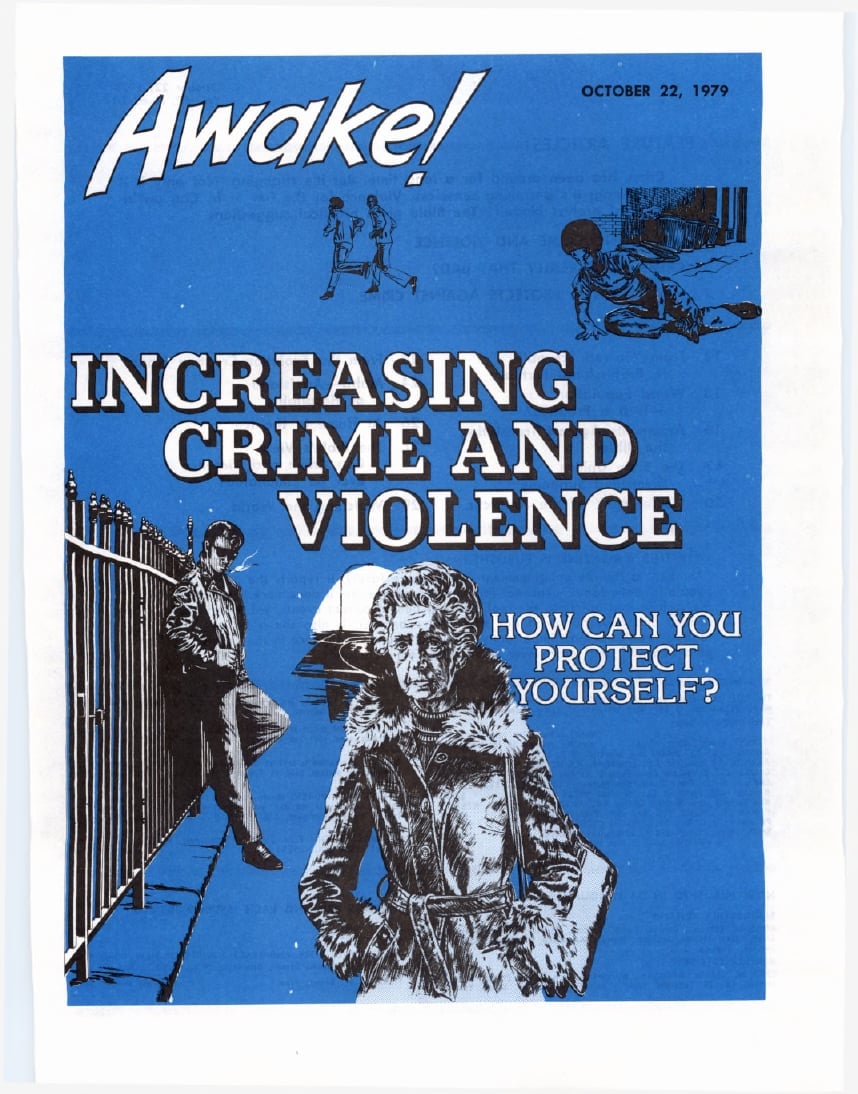
Awake! — October 22, 1979
Source: jw.org
Contents
Page Two
Increasing Crime and Violence
Crime—Is It Really That Bad?
Wise Counsel Protects Against Crime
From “Sacred Scarab” to Professional Fertilizer
World Population—Is It a Problem?
Arguments Against Translating the Bible
The Bible Unifies Diversified Suriname
“Little Men” of the Antarctic
From the Evolution-Creation Front
Malta—An Island of Hospitality
At Home in the Ice
Can Crime and Violence Ever Be Eliminated?
Watching the World
Which Government Will Rule the World?
The Mysterious Beasts of Revelation
Page Two
Page Two
Crime has been around for a long time. But it’s changing. Not only is it increasing; it’s becoming senseless. Violence for the fun of it. Can an individual protect himself? The Bible gives practical suggestions
3 INCREASING CRIME AND VIOLENCE
5 CRIME—IS IT REALLY THAT BAD?
7 WISE COUNSEL PROTECTS AGAINST CRIME
Increasing Crime and Violence
Increasing Crime and Violence
IMAGINE yourself in the position of the man in Italy on his way home from work. Carelessly he left his keys in the car as he hopped out to pick up an item in a neighborhood store. He was gone only a few minutes, but when he returned—you guessed it, no car!
After a restless night, how pleasantly surprised he was the next morning to find his car parked in its usual place in front of his apartment house. A note stuck under the windshield wiper explained: “Sorry to have inconvenienced you. It was an emergency. Accept my thanks and have an enjoyable evening at my expense.” Two theater tickets for that evening’s performance—the best seats in the house—were attached. His faith in mankind had been restored.
At the end of a most delightful evening at the theater, he returned home with his wife, fumbled around momentarily in search of his house key, opened the door and walked into—an empty apartment! Stripped of everything! His renewed confidence in mankind had been short-lived.
Though unique, this true story is only one of many that could be told to demonstrate the brazenness with which crimes often are committed. Of course, this crime was relatively mild in comparison to others, crimes so marked by brutality and sadism that you may have shaken your head in utter disbelief. Small wonder that many persons have lost confidence in humankind and live in fear.
All of us have been victims of crime. Organized crime picks every pocket. Chicago officials estimate that, because of outright extortion by the Mafia or because of extra theft insurance and additional security forces necessary to combat its operations, the average United States citizen pays an additional two cents on every dollar he spends.
Employee dishonesty and shoplifting force businesses to hike prices to regain losses. You are paying for the dishonesty of others. Employee dishonesty in the Federal Republic of Germany, for example, costs taxpayers one billion marks (over $500,000,000, U.S.) annually. Crime is truly expensive, if not for the criminal, at least for the victim, for the victim always has to pay.
Disturbing New Trends
Crime has been around for a long time. But recently it has taken on new dimensions. A steadily mounting wave of crime and violence, not limited to any one country or locality, has caused law-enforcement agencies and laymen alike to take a more serious look at crime and what can be done to combat it successfully.
More and more “senseless crimes” are being committed, crimes with no real motive. They may involve simply smearing graffiti on public property or ripping out the pages of public phone books.
But all too often they take a more serious form, one marked by uncalled-for brutality. For example, two 17-year-old boys recently attacked a 33-year-old man on the outskirts of a German city and took turns stabbing him; police afterward reported finding over 80 stab wounds! When asked, “Why?” the two young men answered: “We just had the urge to do someone in.” In another instance a group of slightly older youths attacked a notary public in Cherbourg, France, and beat him so mercilessly that he lost consciousness and died three days later. Their motive? “Just for the fun of it.”
Another disturbing trend is the increase in female offenders. The terrorist scene in Germany, for example, is unique in that a large proportion of its known members are women. As of February 1979, 12 of the 16 persons on the polices’ most-wanted list of suspected terrorists were women.
But perhaps what worries judicial and legislative leaders most of all is the sharp increase in crimes committed by young people. Time magazine, speaking about the situation in the United States, said: “People have always accused kids of getting away with murder. Now that is all too literally true. Across the U.S., a pattern of crime has emerged that is both perplexing and appalling. Many youngsters appear to be robbing and raping, maiming and murdering as casually as they go to a movie or join a pickup baseball game.”
This trend among young people predicts no good for the future. The Hamburger Abendblatt, commenting on the German situation, said: “According to the latest crime statistics, the number of 14- to 18-year-old suspects arrested since 1975 has risen by 25.1%. In the children-under-14 category, the increase has been 30.8% . . . an end to this trend is not in sight. We must reckon with a further increase in the number of delinquent teenagers and children.”
No question about it. Crime is a problem and one we would do well to take seriously. The French government considered it serious enough to warrant the appointment of an 11-man commission to investigate the matter. For 16 months these men deliberated before submitting a 700-page report with 103 recommendations for alleviating the problem.
The United Nations organization considered the problem serious enough to justify the establishment of a 15-member Committee on Crime Prevention and Control that sponsors a world congress every five years to ponder methods of coping successfully with crime on a global scale. The general theme of the 1975 meeting: “Crime prevention and control—the challenge of the last quarter of the century.” A sixth congress is scheduled for Sydney, Australia, in 1980.
What does today’s steady increase of crime and violence mean? Is it going to grow until there is no hope of recovery? Or is the problem being exaggerated? Is it really all that bad? What do you think?
[Blurb on page 4]
“People have always accused kids of getting away with murder. Now that is all too literally true.”
Crime—Is It Really That Bad?
Crime—Is It Really That Bad?
SOME people are born optimists. Regardless of how bad things seem to be, they always manage to venture a smile and contend that it could be worse. Much can be said in defense of optimism, but it should never be allowed to becloud our vision and prevent us from viewing things realistically. Ignoring problems will never solve them. Refusing to recognize a problem increases the possibility of our becoming its victims.
Now, as regards crime and violence, is it really all that bad?
People who say “No” will be quick to point out that crime and violence are not new. Why, the oldest history book in existence, the Bible, tells us that mankind’s very first family experienced violence of the worst kind. It says: “Cain proceeded to assault Abel his brother and kill him.” Also, in describing the condition that existed over 4,000 years ago in Noah’s day, does it not say that “the earth became filled with violence”?—Gen. 4:8; 6:11.
“Crime is even worse than the statistics reveal”
Granted, crime is not new. Nonetheless, statistics prove that at present it is getting worse. Statistics? Someone may remind us that Oscar Wilde, famous Irish dramatist of the latter part of the 19th century, once said: “There are three kinds of lies: ordinary lies, white lies, and statistics.” His point was that relying too heavily on statistics can be misleading. They can be interpreted in several, sometimes even contradictory, ways. Still, their frequent misuse would not justify one’s rejecting them totally.
For our own benefit let us briefly discuss some of the arguments raised by persons who claim that “it is not really all that bad.” Then we can decide for ourselves.
“Population Growth Accounts for Crime Increase”
Few persons would question that we have witnessed a population explosion during the last few decades. Whereas it took 4,200 years from the flood in Noah’s day (until 1830) for world population to reach one billion persons, it took only 100 more years to reach the second billion in 1930. The third billion was reached in another 30 years (1960) and the fourth in another 15 years (1975). Now, with over four billion persons on earth, it is estimated that by 1985 there will be almost five billion, and well over six billion by the end of the century.
Certainly population growth is a contributing factor to the increase of crime, but it is not its basic or sole cause. If it were, then any increase or decrease in population would logically mean a like increase or decrease in the number of crimes. This, however, is not always the case.
Consider the Federal Republic of Germany. As one of the few countries in the world recently showing a decrease in population—between 1975 and 1977 its population dropped by over 600,000 persons—there should have been, to use this argument, a proportionate decrease in crime. However, government sources say that there were 2,919,390 crimes reported in 1975 and 3,287,642 in 1977, an increase of over 12 percent. This shows that crime is increasing even in places where the population is decreasing.
And far from having any grounds for complacency, those who say that increased crime is only a normal outgrowth of the population explosion face dismal prospects for the future. According to their own contention, today’s wave of crime will continue to mount in keeping with the growth in world population. Just how bad must the situation get before they will be willing to admit, “It really is bad”?
“A More Accurate Tabulation of Crimes Is Now Being Kept”
It is doubtlessly true that a more exact record of crimes is being kept today than 100 years ago. Thus, an accurate comparison of crimes committed then with those committed now would be impossible. But this argument would hardly hold true if we were to compare the records of 1977 with those of 1975, or even of 1970, would you think? And if, as is contended, better records are being kept at present, we should ask ourselves, Why? Would not the need for increased accuracy and thoroughness of record-keeping in itself suggest that things had gotten worse?
How do the police go about compiling such records? Very few crimes are discovered and reported by police officials themselves. A poll conducted by the German Max-Planck Institute revealed that up to 90 percent of police crime tabulations are based on reports made to them either by the victim of a crime or by witnesses. Keeping accurate records therefore is less dependent on the police than it is on the willingness and alertness of the public to report the crimes they see committed.
Is there anything to indicate that people are more accurate or conscientious in reporting crimes now than they were in the past? Not if the findings of this poll are to be believed: it discovered that only 46 percent of the crimes committed against those persons interviewed had been reported. More than half had gone unreported, either because the victim felt that his loss was too small to bother about, because he felt that the prospects of solving the crime were too minute, or because he had other personal reasons.
These figures, which compare favorably to similar findings in Switzerland, the United States, Canada, Australia and Finland, would indicate that crime is even worse than the statistics reveal. This is backed up by the German magazine Der Spiegel, which said: “In truth the number [of burglaries committed during the year] is ten or twelve times higher [than the number reported].” It quoted Werner Hamacher, head of the Nordrhein-Westfalen State Criminal Investigation Office, who likened the number of crimes reported to “hardly more than the scantiest bikini” in covering the body of total crimes committed.
So what do we logically conclude? That the tabulation or registering of crimes is still very incomplete and that statistics at best can only indicate certain trends. But far from overstating the facts, statistics in reality tell only part of the story. So what do you think? Is it really that bad? Or is it even worse?
“Crime May Be Bad in Some Places, but Not Where I Live”
If this is true, be grateful. Rural sections often have lower crime rates than urban sections, and within a city some areas may be more prone to crime than others. Some countries admittedly have a lower crime rate than others. But, of course, the question is not whether there is as much crime in your locality as there is someplace else, but whether it is on the increase where you live.
What have you experienced in your own community? What do older people say, people who have been able to see the development over a long period of time? Are more crimes being committed now than five years ago? Ten years ago? Are they becoming more brutal?
In view of the seriousness of the problem, the next question is: How can I protect myself and my loved ones? What practical steps can I take?
Wise Counsel Protects Against Crime
Wise Counsel Protects Against Crime
ANY number of people have written books and articles advising how best to cope with crime. Many of their practical suggestions are of real value, although at present there is no way to ensure total safety or protection. Yet this does not mean that we cannot do anything. We can, and in view of today’s steadily mounting wave of crime and violence, we should.
For some very practical suggestions, let us turn to a man blessed by God with “wisdom and understanding in very great measure,” yes, a wisdom that made him “wiser than any other man” of his time and made it possible for him to “speak three thousand proverbs.” (1 Ki. 4:29, 31, 32) You may recognize the man as being King Solomon.
The famous Spanish author Cervantes once aptly defined proverbs as being “short sentences drawn from long experience.” No one has had longer experience with man and his problems than man’s Creator himself, who endowed Solomon with the wisdom he needed to compose the “short sentences” that we find in the Bible books of Proverbs and Ecclesiastes. Solomon’s counsel, coming as it does from God, is the very best available. Let us see how we can apply it for our own protection.
FORESEE TROUBLE
“Shrewd is the one that has seen the calamity and proceeds to conceal himself, but the inexperienced have passed along and must suffer the penalty.”—Prov. 22:3.
The underlying principle here is that a person should foresee possible dangers and conceal himself before calamity strikes. In other words, take precautionary measures. This is the very best kind of protection. Examples? There are many.
Keep your doors and windows locked when away from home. In some areas it may even be wise to keep them locked at all times. If you live in a home with adjoining garage, do not overlook the door between it and the main part of the house. Husbands leaving late for work have been known to leave the garage door open, allowing strangers easy entrance to the house through the garage.
What applies to your home also applies to your car. Keep it locked. In some countries it is illegal to leave a car unattended without locking it, and rightly so. Even while driving, you may find it wise to keep the doors locked; otherwise unwanted persons could enter your car while you are waiting at a traffic light. If you must leave your car on the street at night, try to pick as light a place as possible to park it.
Burglars like to work undisturbed and to go unnoticed, so they will generally come to visit when you are not at home. A loud burglar alarm (in the house or in the car) or a barking dog may be enough to convince them that working conditions are unfavorable. If you are gone for a longer period of time, do not advertise your absence by letting newspapers or mail pile up in the front yard or in the mailbox. Ask that they be held for you until you return or arrange that they be regularly picked up by a friend.
A light left burning in the house makes it appear that someone is at home. Of course, leaving it burning day and night for several days would be just as revealing to the observant would-be burglar as no light at all. In cases of extended absence, it might be a wise investment to purchase a device that automatically turns your lights, or even your television set or radio, on and off at certain predetermined times.
Keep your valuable things in a safe place, somewhere that a burglar might not think to look. Even better, keep them in several places, so that if he should succeed in making off with some of them, he will not have gotten them all. It pays to foresee trouble.
AVOID BEING OVERLY TRUSTFUL
“Anyone inexperienced puts faith in every word, but the shrewd one considers his steps.”—Prov. 14:15.
It would be wonderful if we could trust everyone whom we meet, and this is still possible in some parts of the world. But in other places, including many large cities, wickedness abounds and we must be realistic. Here it may be wise to be on guard against questionable persons and situations.
It may be unwise, for example, to invite strangers into your home, even when they appear to have legitimate reasons for calling, unless they can present proper identification. In fact, since even opening the door can be dangerous in some places, you may want to have it equipped with a peephole or a chain if you live where the situation requires it.
Never leave your door key under the doormat or in any of the other generally well-known hiding places. You can trust the person you are leaving it for, but can you trust the one who may find it? It is also unwise to tag your key ring with name and address, thereby ascribing honesty to the person who may find it should it be lost.
Caution is the course of wisdom when a person approaches you on the street, especially at night. His intentions may appear honest, but it could be a trick to get close enough to you to do some kind of harm. Better to be cautious than to become the victim of a mugger. Not going out alone, as far as this is feasible, can also be a protection. Two persons are not as likely to be attacked as one. Ecclesiastes 4:12 says: “If somebody could overpower one alone, two together could make a stand against him.”
When in public places, watch your appearance. The way you dress is important. It could incite others to actions that you would not appreciate.
Also, when attending public gatherings, exercise caution. Leaving valuables on your seat while you go to the rest room or out for refreshments is unwise. It takes only one dishonest outsider in an honest crowd to make you regret your carelessness.
Avoid trying to “look rich.” The man flashing a fistful of bills and the woman loaded down with jewels are asking for trouble. A recent article in Time observed that “largely because of the epidemic of kidnappings and other violence directed against Italy’s rich, the flamboyance—and the flaunting—of the moneyed life-style has all but disappeared.” A wealthy person was quoted as having said: “In Italy now you want to feel rich and look poor.”
PICK ASSOCIATES CAREFULLY
“A man of violence will seduce his fellow, and certainly causes him to go in a way that is not good.”—Prov. 16:29.
Violence is like a contagious disease; it is catching. Even innocent arguments with workmates, friends or relatives can rapidly escalate into violence if one is not careful. It is claimed, for example, that more than one fourth of the murders in the United States are family affairs, often triggered by domestic quarrels. Attend a party where excessive drinking is taking place, or get involved in a protest movement or march where emotions are running high, and the danger of violence is multiplied. How wise, then, to avoid persons given to violence and situations that tend to nurture it!
You should be concerned about your own conduct, but do not be overly concerned about the misconduct of others. If you observe someone acting discourteously or improperly in a public place, it is better to exercise self-control and say nothing as long as life is not being endangered. Proverbs 26:17 explains: “As one grabbing hold of the ears of a dog is anyone passing by that is becoming furious at the quarrel that is not his.” You could easily incite others to violence by inappropriate comments or even by a “dirty” look.
What should a person do if he inadvertently gets caught up in a quarrel not of his own making?
LEAVE, IF YOU CAN
“Before the quarrel has burst forth, take your leave.”—Prov. 17:14.
Do not add fuel to the fire by arguing. Proverbs 26:20 tells us: “Where there is no wood the fire goes out.” An argument can last only as long as you choose to stay upon the field of battle. Avoiding violence by taking your leave is not the mark of a coward, but, rather, of a wise man. The examples of Jesus Christ and the apostle Paul prove this.—See Luke 4:28-30; Acts 9:23-25; 14:5, 6.
But what if your opponent physically prevents you from fleeing? Then speak to him calmly. Remember, “an answer, when mild, turns away rage.” (Prov. 15:1) This calls for self-control, but it may pay in the long run. Women have been known to talk assailants out of rape by remaining calm and explaining to them their Biblical stand on morals.
Of course, there may be times when fleeing is impossible and when calm words fall on deaf ears. Then what? It depends on what the person wants. Does he want your property, your money? If so, let him have it. Material things can be replaced, but not your health or your life. Never put these in jeopardy for purely material things. Having the wisdom and proper discernment to be able to recognize the relative unimportance of material things as compared to life is, as Proverbs 3:14 says, “better than having silver as gain.”
If your assailant is after your virtue or your life, however, the situation is different and you have Scriptural support for defending yourself by whatever means are at your disposal. An article in a north German newspaper recently explained how this might be done. It advised women or young girls confronted by sex offenders to “keep calm,” to “offer resistance” if possible, and “at the same time to scream for help.” (Compare Deuteronomy 22:23, 24.) Those incapable of physical resistance were told to try to outwit the evildoer or “to divert his attention by praying out loud.” This is wise counsel, because it is Biblical. It also leads up to another suggestion made by the wise ruler.
TRUST IN JEHOVAH
“Do not say: ‘I will pay back evil!’ Hope in Jehovah, and he will save you.”—Prov. 20:22.
These words are not to be understood as ruling out self-defense, but they do show us the need for discernment and balance in exercising it.
Basically, crimes are of two kinds: those directed against one’s property, such as stealing or extortion, and those directed against one’s person, such as assault, rape or murder. Since life is of infinitely greater value than property, we would rightly be entitled to a wider latitude of action in warding off crimes against our person than we would in crimes against our property.
“The trend [in France] to rely more upon defending oneself than upon police protection is growing.” So reported a German daily recently. The article told of a self-defense group whose members had been advised: “Arm yourselves and shoot first.” A similar trend is found in other countries. A newsmagazine reported that “West Germans have registered 2,500,000 revolvers and pistols, shotguns and rifles, but they possibly have illegal possession of ten times that number.” The article continued by saying that obtaining weapons is getting easier all the time and that “they are being used with greater ease and brutality—by criminals as well as by well-behaved citizens.”
Some may feel that it can do no harm to have a gun in the house, ‘just in case,’ hoping, of course, that it will never have to be used. In reality, however, the only way to be really sure that you will never use a weapon is not to have it in the first place. How often, under the pressure of fear and nervous tension, persons have made use of weapons, only to regret it afterward. Sympathize with a filling-station owner south of Paris who heard suspicious noises in the middle of the night. Going downstairs, he suddenly saw a shadow and, thinking it to be a burglar, shot. How tragic to discover that he had shot his eight-year-old son who had gotten up to get a drink of water!
Shedding human blood, even when done unintentionally, is a serious matter. Of course, there are other types of weapons, such as gas pistols, that can be used to ward off attackers. Although not intended to wound or to kill, even such “harmless” weapons can, at times, trigger greater violence on the part of an opponent, so the advisability of using them should be weighed carefully.
The so-called martial arts, like judo and karate, are another increasingly popular method of defending oneself. These martial arts train a person to use his hands and body to either injure or kill an opponent, so, in reality, they, too, are weapons. Their pagan background and military usage also raise questions as to their propriety for Christians. Can you imagine the apostle John defending himself with karate chops or Jesus Christ fighting off an opponent with kung fu tactics? (See the December 8, 1975, issue of Awake!, page 28, for a more detailed discussion of this subject.)
How far you can go in defending yourself and your loved ones, as well as the methods you care to employ, are personal matters for you to decide on the basis of a well-trained conscience. Asking yourself a few questions can be helpful, however, in deciding what you should do: Am I fighting to defend life or simply to protect property? Is my motive protection of self and loved ones, or getting even with an evildoer? Have I thought of the effects my actions might have on others, including the evildoer? Would I want to injure him seriously or even kill him? Do I realize that he may be a victim of circumstances, more to be pitied than condemned? Could it be that with proper training, attention and love, he might be willing to develop his latent good qualities and repent of his bad ones? Would I be willing to help him to do so if I had the opportunity?
In summary, Christians, while not categorically opposed to self-defense, ought to be careful to avoid situations that would make it necessary. They recognize that by exercising the spirit of a sound mind, foreseeing trouble, taking necessary precautions, being careful of associations, guarding both tongue and action, avoiding being overly trustful of man, while placing complete trust in Jehovah, they will be pursuing the course of wisdom. This is a better form of self-defense than any based on the use of weapons or martial arts.
ECCLESIASTES 9:18 SUMS IT UP:
“Wisdom is better than implements for fighting.”
Jehovah God, the highest personage in the universe, without whose knowledge not even the smallest crime could take place, is capable of making a completely accurate tabulation of crimes as a basis for settling accounts with wrongdoers. But will he really do so? Is today’s steadily mounting wave of crime and violence destined to continue swelling indefinitely, or will God bring mankind needed relief? For the answer, read the article “Can Crime and Violence Ever Be Eliminated?” on pages 27 and 28.
[Pictures on page 9]
Will learning karate or owning a gun safeguard you?
From “Sacred Scarab” to Professional Fertilizer
From “Sacred Scarab” to Professional Fertilizer
By “Awake!” correspondent in South Africa
BEETLES are everywhere in their millions and in great variety. But what insect has a history more interesting and unusual than the scarab, or dung beetle?
In ancient Egypt this creature moved in the very highest society, its Latin name being Scarabaeus sacer or “sacred scarab.” To the Egyptians it was the symbol of rebirth and everlasting life. Its dung ball was compared to the sun. The horns, or sharp protuberances, on the front part of the body were said to represent the sun-god’s rays, while its 30 segments were viewed as standing for the 30 days of the month. So, in Egypt, the scarab was believed to be sacred to the sun-god. It has even been found mummified. In the British Museum is a colossal figure of the scarab in granite, probably from Heliopolis.
The scarab also is frequently featured in ancient Egyptian paintings and sculptures and very abundantly in the form of seals and brooches. Many have inscriptions on them bearing royal names and supplying data about the ancient Egyptian dynasties.
An Unusual Diet
The Scarabaeidae or dung beetle family is a very large one, there being, it is said, over 20,000 species and they are found in most parts of the world. As the name “dung beetle” suggests, its main source of food is manure. In South Africa it feeds on the droppings of cattle, sheep, horses and other animals. As an old saying expresses it: “There is no accounting for tastes!”
The beetle has a scoop-shaped head, with the mouth and snout facing downward. Its jaws are hard and horny, and it has antennas ending in a paddle or fan of three or more flattened joints that fold one over the other. When scenting its food the beetle fully extends these jointed antennas, sniffing the breeze to ascertain the direction. Then it scuttles off to start work.
The beetle’s body is well adapted to its unusual job. It is short and rounded, with short leathery wing covers. It has six legs, the front pair being short and extremely strong for digging, the middle pair being longer and sturdy, and the hind pair being slightly curved—it is these that grip the dung ball.
Having found a deposit of fresh manure, the beetle sets to work. He works hard and fast. He quickly makes a ball the size of a marble, soon enlarges it to roughly apple size, with some species, and then rolls it with his back legs to a place where the ground is soft. Then he digs a hole in which he hides his ball as a store of food. Since excreta can carry disease and harmful parasites and encourage flies, our humble friend does an invaluable work in cleaning the terrain. Also, many such stores of dung are not used, but they do fertilize the soil. So our little friend is a “professional fertilizer.” Farmers like him!
In Australia the local species of dung beetles have needed help. Before European settlers came, bringing cattle and sheep, these dung beetles had always been nourished on kangaroo droppings. They are not equipped to dispose of the massive deposits of millions of cattle. So different species of dung beetles have been imported from South Africa and these have helped to clean up the millions of tons of cow dung deposited annually in Australia.
Although the dung beetle is no longer associated with the “high society” of “gods” and royalty, he continues with his more down-to-earth profession, the truly useful one for which he was designed.
World Population—Is It a Problem?
World Population—Is It a Problem?
By “Awake!” correspondent in the Philippines
AT ONE time, there was a lot of publicity about the population bomb and the population explosion. Now scientists are telling us that the earth is far from overcrowded and could support many times its present population. What is the true situation?
Recently, in the Philippine capital of Manila, the fourth International Population Conference was sponsored by the World Population Society and the Philippines’ Population Center Foundation. We heard specialists from Asia, Africa and America discuss this problem. We believe that you will find what they said to be interesting.
Is There a Problem?
Someone once calculated that if all the available land and water were evenly distributed among today’s population, each person would have five acres (2.02 hectares) of land and 17 acres (6.9 hectares) of water half a mile (0.8 km) deep! That does not sound like a problem of accommodations space, does it? However, this same person calculated that, by the year 2600 C.E., at a growth rate of 2 percent per year, this would diminish to one square yard (.8 sq. m) of living space for each person. That would be a problem.
Of course, what might happen 700 years in the future is not going to cause us many sleepless nights right now. But even today many millions of people are experiencing the problems of overpopulation in their individual areas. Some exist in a precarious balance between subsistence and starvation; and not a few persons believe that their experience today could be the experience of all mankind in the future.
We heard that 70 percent of the world’s population belongs to the so-called Third World, or the developing countries. The population of these countries is being increased each second by the birth of between two and three and a half babies. The Third World reportedly consumes 8.4 billion pounds (3.81 billion kg) of food, 16.8 billion pounds (7.6 billion kg) of water and inhales 168 billion pounds (76 billion kg) of air daily. While the air is still plentiful (if somewhat polluted in some areas), this population growth has resulted in a shortage of food and water in many lands.
Imagine coming home from a hard day’s work in the fields and finding that there was no water to wash in or even to drink. This is what some are experiencing even now, because too many people are drawing on too little water. The Food and Agriculture Organization was quoted as saying that “the availability of fresh water for all mankind is in doubt at the turn of the century. Global demand for fresh water will increase by 240% by that time.”
Regarding the availability of food, the statement was made that, following the current growth trends, mankind would double in number in the next 25 years. Since millions even now do not get enough to eat, this means that food production would have to more than double. One speaker stated that an increase of 3 to 4 percent annually would be needed over the next 25 years, in order to combat hunger.
Will this be possible? It is true that under ideal conditions this earth could support many times its present population. But conditions are far from ideal. Less developed lands are even now having to struggle to increase their food production. And the economic situation makes it difficult for them to buy from richer nations when they have a need.
Additionally, as poorer countries expand their agricultural lands, they tend to spread toward the forests and mountains. This results in deforestation. Often floods of devastating proportions result. And what if they look to the sea for their needed additional food? Apparently even the resources of the seemingly boundless ocean are limited. Twenty-one million tons of fish were taken from the oceans in 1950. In 1970, this reached 70 million tons. Then the catch declined, and in 1973 only 65 million tons were harvested.
It is obvious that if food and population are not brought into balance, serious problems will continue to haunt mankind.
Why Is There a Problem?
In 1660, it is estimated, there were only 500 million people on earth. The growth rate then was reportedly one tenth of one percent. At that rate, the first billion should have been reached some time in the 24th century. In fact, the first billion came in 1830. The second billion arrived in 1930, the third in 1960 and the fourth in 1975. By the year 2000, a population of between six and eight billion is expected at present increase rates. The year 2000 is not so far away, is it?
Why the increased growth rate? For one thing, the infant mortality rate has been cut, and more babies are growing up and having their own babies. The havoc wreaked by certain epidemics has also been checked. In addition, early marriage and childbearing and, sadly, pregnancies among unmarried teen-agers were mentioned as causes contributing to the continuing acceleration in population increase. Additionally, Mrs. Seria Grewal of the Ministry of Health and Welfare in India was reported as saying that low literacy and low economic status were barriers to government programs of family planning to combat the problem.
There is also a clash between the implementers of family planning programs and their religious opponents. Religious beliefs have encouraged many to have large families. Additionally, in many lands children are viewed as wealth and security. This has resulted in high population growth rates.
Can the Problem Be Solved?
So there is a problem, and we know some of the reasons for it. Now, what is being done about it? It was felt that all countries should respect the right of persons to determine the number and spacing of their children. However, Philander P. Claxton, president and chairman of the World Population Society, felt that countries should keep aiming for the goals set at a previous conference in Bangkok, Thailand, in 1975: that, on an average, within two or three decades, each member nation should achieve a two-child family. Even if this goal were reached, the world population would reach 5.9 billion by the end of the century. Seemingly, however, a four- to six-child family is still common in most developing countries.
The serious way in which some view this problem was seen recently in the Philippines. A bill was introduced in the Interim Batasang Pambansa (the current Philippine parliament) with the stated purpose of balancing food and shelter availability with the number of the country’s future inhabitants by penalizing families having more than two children. The bill proposed that a mother having two surviving children would pay a fine of 100 pesos (about $15, U.S.) at the birth of her third child, 200 pesos ($30, U.S.) at the birth of her fourth, and so forth. This is in line with the comments of some sources that someday parenthood may be a privilege, not a right.
The bill met much opposition, naturally. Foremost opposers were leaders of the Catholic Church. The 80-member Catholic Bishops’ Conference of the Philippines rejected the proposal by stating: “The right of parents to determine the number of their children is an inalienable human right that cannot be removed by legislative fiat. The teachings of the Church on this matter are unequivocal. . . . In view of the inalienable right to marry and beget children, the question of how many children should be born belongs to the honest judgment of the parents. The question can in no way be committed to the decision of the government.”
Progress So Far
In early conferences on population, the stress was laid on centralized population programs for curbing growth. Claims have been made of substantial reductions in birthrates in China, Indonesia, Korea, Thailand, Costa Rica, Colombia, Tunisia, Hong Kong and the Philippines, among others. Sixty-three developing countries have their own family-planning programs.
Fertility rates were said to have dropped in China from an average of 4.2 to 3.2 children per woman of childbearing age. In Indonesia it had dropped from 6.5 to 4.6. The World Health Organization has for 10 years been administering a program of research, development and training in human reproduction. The program is supported by voluntary contributions, and scientists from 62 countries are involved. By 1976, according to reports, almost $1,000,000,000 (U.S.) was being spent to help with family planning.
The Philippine conference did not stress the need for knowledge of family-planning devices and techniques, although these were viewed as important. The emphasis was, rather, on involvement of the community in population problems, and the use of local resources to combat the problems. Health, nutrition and community development were seen as linked with population control. The World Population Plan of Action (adopted by the United Nations World Population Conference in 1974) was quoted as stating: “Population goals are recognized as ‘integral parts’ of social, economic and cultural development.”
Education, employment and general economic development were also seen as tied in with the population problem. Youths make up about 1.3 billion of the earth’s population, hence the experts want sex education and premarital counseling to be available to this large group of people. Mechai Viravaidya of Thailand wanted children to be taught about sex and family planning, not to be embarrassed. He reportedly claimed a pregnancy reduction of 40 percent in a third of the villages in Thailand as a result of the “desensitization” and publicity about family planning. Zahia Marzouk of Egypt is reported as saying: “We were able to raise the economic standards of women by teaching them income-generating skills and as a result there was increased interest in limiting family size.”
There Is a Population Problem
From what was said at the conference, it was very clear to us that there is a population problem. While the earth is far from full now, if the population keeps increasing, one day the earth will be more than full. And although it is true that, if the wealth of the earth were evenly distributed, there would be more than enough for everyone, that ideal situation does not exist. Actually, millions of people are living in overpopulated areas. And while many of the richer countries are not rapidly increasing their populations, poorer countries are. Hence, their problems are likely to become more severe.
Everyone at the conference in Manila was in agreement that population is a big problem. Nations were urged to abandon considerations of national interests and work in this regard for the good of the international community. Rich countries were urged to limit their excessive consumption of the world’s riches, and poorer lands were encouraged to limit their numbers. Cooperation was seen as a means to curb growth. But will it happen?
If it will take international cooperation to solve the population problem, then—judging from this world’s record up until now—this is likely to remain another one of those problems that cannot be solved under the present system of things.
Arguments Against Translating the Bible
Arguments Against Translating the Bible
Speaking against the translating of the Bible, Friar Buckingham used foolish arguments that were no credit to himself or his associates. In a sermon, he said: “Where Scripture saith no man that layeth his hand to the plough and looketh back is fit for the kingdom of God, will not the ploughman when he readeth these words be apt forthwith to cease from his plough, and then where will be the sowing and the harvest? Likewise also whereas the baker readeth, ‘A little leaven leaventh the whole lump,’ will he not be forthwith too sparing in the use of leaven, to the great injury of our health? And so also when the simple man reads the words, ‘If thine eye offend thee pluck it out and cast it from thee,’ incontinent he will pluck out his eyes, and so the whole realm will be full of blind men, to the great decay of the nation and the manifest loss of the King’s grace. And thus by reading of the Holy Scriptures will the whole realm come into confusion.”—How We Got Our Bible, by J. Paterson Smyth.
The Bible Unifies Diversified Suriname
The Bible Unifies Diversified Suriname
By “Awake!” correspondent in Suriname
A DRIVE of 30 miles (50 km) from the airport to Suriname’s capital city, Paramaribo, provides the tourist a cross-sectional view of life in this South American country. The first impression of the traveler is that he has landed in some country in Africa, as he rides by palm-thatched huts, occasionally seeing a half-clad Bush Negro woman preparing her breakfast. But the scene rapidly changes and he gets more of a total world flavor as he passes Caribs and Arawaks, two Amerindian tribes, the original inhabitants of Suriname; East Indians, whose women still wear their traditional head coverings of white lace; Indonesians, characterized by their nicely cultivated gardens; and Chinese, with their businesses on every corner. Within the capital’s old city you still find centuries-old colonial Dutch-style houses.
One can easily see that, with the great variety of peoples and the diversity of languages, backgrounds and customs, any educational work would face problems. Accordingly, the preaching and teaching of the Bible’s good news have required much effort. One of the problems met in teaching the Bible has been illiteracy, especially among those living deep in the jungle. In 1976, the branch office of the Watch Tower Bible and Tract Society tackled the problem by setting up three schools, using the booklet Leri Lesi en Skrifi (Learn to Read and Write) in Sranan-tongo (the language of Suriname), taught twice a week by some of Jehovah’s Witnesses who are professional teachers. Before long a congregation in the bush grew to 27 members when helped by three young Witnesses who moved there to teach in an elementary school. Now the people there enjoy reading their own Bibles. Better understanding of the Bible has brought greater unity among the varied nationalities. In Paramaribo many were helped in the same way and now one congregation of 120 members in that city worships alongside the other 10 Dutch-speaking congregations.
Heading Southward by River
Strong efforts are now being made to reach more remote areas. Come along with us on a visit to a small congregation along the Tapanahoni River.
“Welcome aboard!” greets one of the Bush Negro Witnesses, who regularly spends full time in taking the “good news” to people in hard-to-reach places. We are impressed by the size of the korjaal, a 59-foot (18-m)-long canoe. Four men spent two months hollowing out a giant tree, fashioning it into the biggest boat on the river. When the boat is used to bring the Witnesses to assemblies in the capital or to take them to the various villages for the preaching work, the village children shout, “Noa e psa!” (“Noah passes by!”)
Building a Kingdom Hall
By the time we arrive at our destination, Godo Holo, the village where a congregation is located, we are ready to step off onto land for a while.
This congregation was, in a most unusual way, brought to the decision to build their own hall. During a circuit assembly (several congregations meeting together), the place then used for meeting could hold only 80 of the 100 persons attending. Worse than that, during the public talk, heavy rains suddenly collapsed the whole roof! Happily, no one was seriously injured, but they decided to build a hall.
The forest would have to provide the basic materials. The men went into the jungle, cutting trees for two months, while the women and children busied themselves hauling 250 barrels of sand and gravel to a small hill. But cement, metal roofing and nails were needed. When the Witnesses in the capital heard of the expansion plans, they spontaneously gave financial assistance for obtaining these items. And that invaluable boat Noah transported these building materials to the site.
One of the men is a bricklayer and he taught the others to make bricks. Although building under these circumstances is hard work, there is a certain joy when one knows that practically all the materials and the construction itself is the product of one’s own labor. After one year the hall was dedicated on April 15, 1979.
A Village Gets a New Face
While the Witnesses are overjoyed to have a meeting place of their own, the citizens of the village have also benefited. When the building of a new hall was decided upon, the acquiring of a site was the first problem. Godo Holo is really three villages bordering one another. The originally proposed site was immediately refused by the chieftain of that village. But the chieftain of the middle village was more sympathetic toward the Witnesses and said: “You just go ahead and build on that hill near my village.” His decision brought ridicule upon him, since the majority of citizens in his village scoffed at him. But he stuck to his word.
The Witnesses went ahead with their building. When former villagers now living in the capital city heard what was being done in their village, they sent a letter of protest and by radio even aired threats to destroy the hall. The chieftain, however, sent a reply to the opposers that he was waiting for their attack and reminded them that they had contributed nothing in building better homes for their wives, children, parents and older folks in the village.
The people now admit that the Gado Woortoe sma (God’s Word people), as the Witnesses are called there, have been an asset to their village. The Witnesses brought not only spiritual light to their village, but also literal light. The village now has electricity, thanks to the boat Noah, which brought a generator from the capital right through cataracts to this place. The result of all of this is that, when engaging in the preaching work, the Witnesses are received in a very friendly manner.
Visiting the People with the “Good News”
As your boat docks at this village, your hosts, the boat crew, take you along with them to visit the homes of the people with the “good news.” You find that you cannot merely introduce yourself and get to the point quickly, as is the case in busy city areas. That would be impolite here, for custom requires that you first give the following greeting: “Did you wake up well?” The householder replies: “Yes, I woke up well. How did you sleep?” “I slept very well. How did you sleep?” “I slept quite well, too.” Then you slowly guide the conversation into a Bible discussion.
Returning from this strenuous but enjoyable trip, you are invited to take a journey, this time by road, to the southwest part of Suriname. Some years ago the government started making plans to construct two dams, a bauxite mine and a railroad. In the process, a 220-mile (350-km) roadway was built, also opening up the way to reach the once remote Amerindian villages of Apoera and Washabo on the Corantijn River, which borders Guyana. What a road! Our Land Rover bounces and sways over bumps, holes, dust, ruts and mud. The hardships are somewhat relieved as we stop now and then along the roadside to marvel at the snakes, to admire the hardworking parasol ants or to listen to the cries of the colorful parrots.
At last we reach an American work camp, 30 miles (50 km) from those Indian villages. Our fatigue is quickly dispelled by our two Christian sisters who greet us hospitably. They know we are in need of a bath to wash away the fine red dust covering us and our clothing. A delicious meal restores our strength, and after pleasant conversation and a good night’s sleep we arise the next morning to set out calling on the people with the Bible’s message.
Interest in the Bible among these simple folk is overwhelming. In every hut you find responsive listeners. You think to yourself, How would one ever find the same hut again to make a return visit? All the huts look alike and have no house numbers. But that is no problem, because in every hut people are willing to study the Bible with you. Sometimes you merely set your book bag in the hut and people not only desire one of the Bible books, but help themselves to what is in the bag.
As you return to the capital from this journey, you feel encouraged in the knowledge that the good news of the Kingdom is reaching into all parts of this beautiful country of Suriname.
[Picture on page 18]
“That invaluable boat ‘Noah’”
“Little Men” of the Antarctic
“Little Men” of the Antarctic
By “Awake!” correspondent in Uruguay
“AHOY, I see two ‘little men’ on that iceberg,” shouted a crewman. As these explorers of the Antarctic drew closer, another look through their binoculars showed five “little men.” Soon there were seven. But those early explorers were in for a surprise when they learned that those “little men” were really penguins. As for the penguins, they kept leaping out of the frigid water onto ice floes to get a better look at the strange creatures invading their icy domain.
Penguins are to the Antarctic what polar bears are to the Arctic. Not all penguins are the same, however, and each kind has its own peculiarities and habits that make it different from the others.
The Emperor
The largest and most impressive of all are the emperor penguins, weighing about 40 kg (90 lbs.) each and standing nearly 120 cm (4 ft.) tall. They breed and hatch their young under the most forbidding circumstances of any known creature—with temperatures below −55° C. (−67° F.) in constant gales and severe blizzards.
The female lays only one egg. Then the male and the female take turns holding the egg on their feet, tucked in under a blanket made up of folds of skin that hang down from the body. While one cares for the egg, the other one goes to sea to feed. When the mate returns and the egg is transferred from one to the other, great care is shown so that it does not touch the ice on which they stand.
For protection against the fierce winds in their domain, cooperation is needed. So large numbers of emperor penguins huddle together. And periodically they shift positions so that the same birds are not always bearing the brunt of the blizzard on the outside of the circle.
The Adélie
The Adélie penguin also lives on Antarctica, but it is much smaller than the emperor, and its rookeries are separate from theirs. This one is the clown of the penguin family. It is very curious and its antics are comical, especially the way in which it waddles—Charlie Chaplin-style.
Like other penguins, their tongues have sharp barbs turned inward. How practical when a fish is caught for dinner! With its head pointed down the penguin’s throat, it can go in only one direction.
Several of these penguins have been taken great distances from their rookeries so their navigational abilities can be studied. As is true of other birds, the Creator has endowed them with a built-in system of navigation. It seems to rely mainly on the sun. When it is cloudy, they wander around as if uncertain as to which way to go. But when the sun is visible, they immediately get oriented and head in the right direction to reach home.
The Gentoo
On the Falkland Islands, or Malvinas Islands, there are several species of penguins. Close to Port Stanley tall gentoo penguins come ashore to breed.
From the nearby beach of York Bay, we can watch these “little men” arrive at their rookery. They have just spent months at sea, traveling thousands of miles in search of food and playing in the chilly waters of the South Atlantic Ocean. As we watch closely we can see the penguins swimming to keep pace inside the waves until these are about to break. As a wave breaks, they quickly leap upright and land on their webbed feet. They scramble toward shore as fast as their short legs will carry them so that the next wave will not topple them over and wash them back to sea. Now and then this happens, however, and they have to try again, but running a little faster this time.
When the gentoo penguin is beyond the reach of the waves he gets in line with hundreds or thousands more as they waddle toward the rookery among the sand dunes and clumps of diddle-dee and tussock grass several hundred feet from shore. If one is exhausted and decides to stop or take a nap for a few minutes, the others in the line behind him also stop and uncomplainingly wait until he wakes up and resumes the journey.
Courtship and wedding ceremonies among these penguins are interesting. When looking for a wife, a male will bring a pebble and lay it at the feet of his prospective bride. If she accepts it, they become husband and wife. But it is very difficult to tell the difference between a male and a female. Sometimes even the penguins have this problem, and a male may mistakenly present a pebble to another male. This is an insult, of course, and results in a heated battle.
After an acceptable match is made, the pair forms a crude nest of some grass, sticks and mostly pebbles; then two eggs are laid. Each pair has its own private property boundaries and jealously guards its territory during incubation. But it is not unusual for one penguin to “borrow” pebbles and other building materials from a neighbor’s nest while he is not looking. This makes the rookery extremely noisy. While some engage in territorial disputes, others try to retrieve stolen property. Over such matters they often come to violent blows with beaks, flippers and claws. It is the sort of conduct that the Bible describes as ‘animalistic,’ and it is not meant for humans to imitate.—Jas. 3:14-18.
The parents take turns in caring for the little ones permitting one mate to go to feed on fish, squid, shrimp or other shellfish. When the mate returns the chicks are fed by regurgitation.
At first the chicks are covered with down and are quite helpless. When they are grown and about to take to the water they grow adult feathers—very small ones, smooth in texture and watertight.
Since penguins are awkward on land, when a gentoo is in a hurry and its short legs cannot carry it fast enough, it oftentimes flops down on its belly and propels itself with flippers and feet to scoot over the sand like a toboggan.
The people of the Falkland Islands used to take penguin eggs from the rookeries, since these were considered a delicacy by many. However, the local government has discouraged this practice among the natives so that the gentoo may not become an “endangered species” and later join the many other species of penguins that are now extinct.
The Rock Hopper
Also on the Falkland Islands is found the rock hopper, or macaroni, penguin, wearing tufts of feathers for a headdress. While the gentoos choose sandy areas for their rookeries, the rock hoppers prefer a rocky coastline. Instead of seeking the easy way around a cliff, they like to leap and crawl from one ledge to another up the steepest part of a cliff.
They are alert to their enemies, especially the leopard seal. When they are ready to return to sea, they carefully test the water to see if it is safe. Dozens of rock hoppers will gather along the edge of a cliff or rock and look searchingly into the water to try to spot Mr. Seal. More keep coming from behind and the crowd gets bigger. Suddenly an unsuspecting victim is pushed over the edge into the waters below. Those remaining on top watch to see what is happening to their “fallen friend.” If there is a sudden churning of the water and he disappears, they know it is not safe to jump in then. So they return to the rookery and will try again later on. But if they see him swimming out to sea unmolested, they know the water is safe and the rest leap into the waters and head out to the sea again.
Occasionally, however, a wise and experienced old seal will let the first few swim by unharmed. You can imagine what follows! He and his friends have a real feast after hundreds of rock hoppers leap into what they consider “safe waters.”
Penguins of Many Varieties
As we have observed, there are various species of penguins—17 known to exist today, and each with identifying traits. The blackfoot, or jackass, penguin, is found on the shores of southern Africa and on many islands of the South Atlantic Ocean.
The king penguin is the second largest of all penguins. It is also found on the Falkland Islands and other nearby places.
The Humboldt penguin is named after the Humboldt current of the Pacific Ocean. Its cool waters enable them to live in Chile and Peru and as far north as the Galápagos Islands. This appears to be the farthest north that penguins are found. On the Atlantic side of South America, penguins are sometimes seen as far north as Uruguay and southern Brazil.
The smallest, the pigmy penguin, is only about 15 cm (6 in.) tall when full grown and lives on only a few islands in the South Pacific Ocean. All of them have in common the inability to fly through the air as do other birds. However, they do use their powerful flippers to “fly” under water. As they travel through the water they move their flippers alternately like a swimmer’s arms, rather than simultaneously like wings of birds in flight.
…