Awake!, March 8, 1979
Download: PDF — Awake!, March 8, 1979
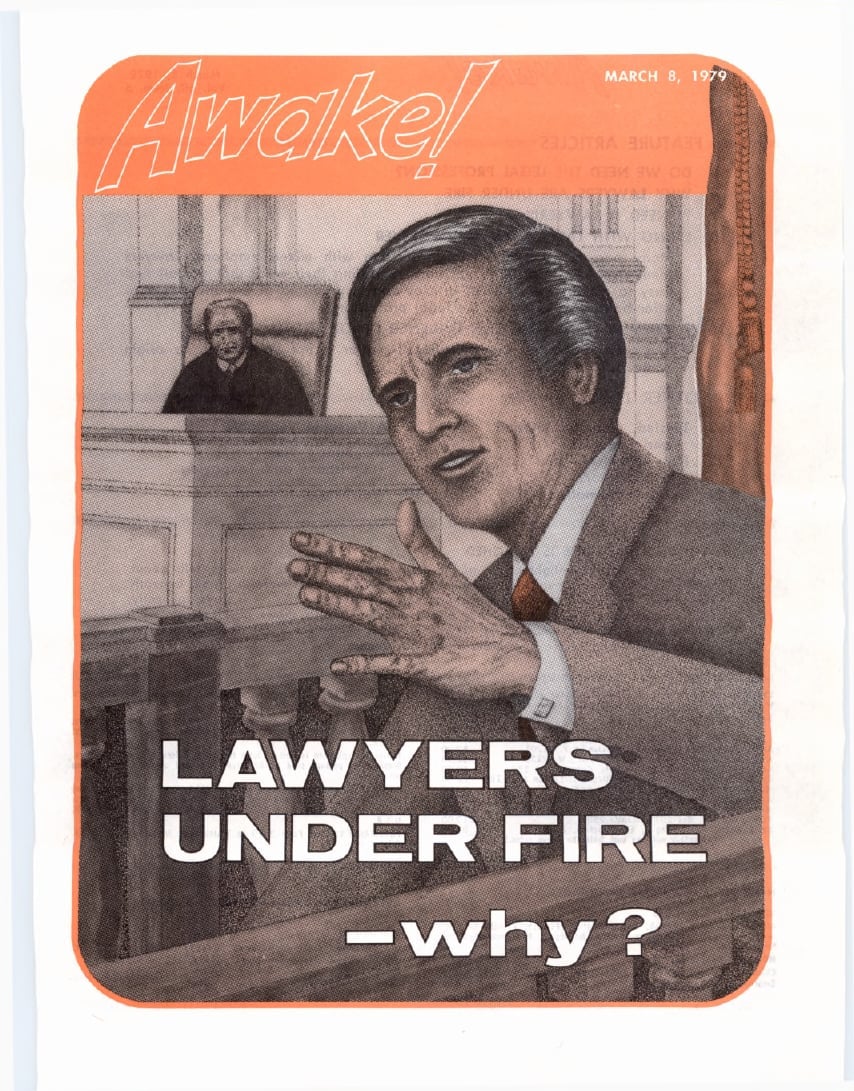
Awake! — March 8, 1979
Source: jw.org
Contents
Page Two
Do We Need the Legal Profession?
Why Lawyers are Under Fire
“I Need a Lawyer!”
Living with Law—Now and Forever
Twisted, Gnarled, Knotted and Beautiful
Dogs Incline to Bite
A Chemist Finds Powerful Evidence of Creation
How Often Are You a Spectator?
Desert Reclamation
A Versatile Vegetable
Christians and Taxpaying
Watching the World
How Valuable Is Your Blood?
My Book of Bible Stories
Page Two
Page Two
3 DO WE NEED THE LEGAL PROFESSION?
4 WHY LAWYERS ARE UNDER FIRE
7 “I NEED A LAWYER!”
10 LIVING WITH LAW—NOW AND FOREVER
Many persons view the legal profession with mixed emotions. Lawyers themselves are faced with decisions regarding their work that not all find easy to make. This series of articles above, prepared in Canada, seeks to offer balanced insight on the legal profession
16 A CHEMIST FINDS POWERFUL EVIDENCE OF CREATION
The facts show that the structure of matter is not haphazard. Its origin could not be accidental
Do We Need the Legal Profession?
Do We Need the Legal Profession?
“The first thing we do, let’s kill all the lawyers,” was the proposal in one of Shakespeare’s plays. And Ives, the patron saint of French lawyers, was described in the 13th century as ‘a lawyer but no crook, a thing which astonished the people.’
Negative views of lawyers and legal systems are as old as history. But such one-sided (and often amusing) quips are not altogether fair. Many lawyers are conscientious and knowledgeable men who use their abilities to help deserving people who are in trouble.
Obviously lawyers and legal systems cannot cure all the ills of modern civilization. If the legal system is not wholly satisfactory, consider the words of a Canadian judge: “Confusion in the judicial system reflects the confusion of society.” Like all human institutions, legal systems have a good side and a bad side.
On the bad side, law enforcement is irregular and often ineffective. Statistics show cluttered courts, expensive lawyers, unequal justice, unpunished criminals, a rising crime rate. Public confidence ebbs.
On the good side, laws and law enforcement are essential to maintaining an orderly society. They benefit all the people, not just those who go to court. The fact that there is law enforcement, even with its weaknesses, does act as a measure of restraint on many potential lawbreakers. As a result, the person and property of most people in civilized communities are relatively safe. Commercial business is able to function, producing goods and foodstuffs, because the legal system enforces contracts and payment of debts. Murderers, robbers and vandals are at least restricted, if not effectively halted, in their evil practices.
Thus it becomes apparent that, although often taken for granted, the legal profession and the law offer valuable services to humanity. Even so, the courts, judges and lawyers are held in low esteem by many. Why?
Why Lawyers are Under Fire
Why Lawyers are Under Fire
IN 1978, a Pennsylvania judge, Lois G. Forer, in an article entitled “The Law: Excessive Promise and Inadequate Fulfillment,” wrote: “The legal profession is today at an all time low in public esteem . . . Disillusionment and dissatisfaction with the administration of justice strike at the very heart of our national well-being and vitality.”
In England, too, critics raise serious questions. The introduction to a study of the legal system there asserts:
“We are taught to have a confident faith in British justice . . . We argue that there are some who never obtain justice.”
Lawyers are influential at all levels of government—in the legislature, in administration, on the bench and at the bar. They also have a monopoly on the practice of law. So the legal profession has to accept some measure of responsibility for legitimate complaints. Consider some of the more common charges:
‘One Law for the Rich, One for the Poor’
Back in 1905, U.S. President Theodore Roosevelt said:
“Many of the most influential and most highly [paid] members of the bar . . . work out bold and ingenious schemes by which their very wealthy clients . . . can evade the laws which are made to regulate in the interest of the public.”
Almost six decades later, little had changed when Attorney General Robert Kennedy said: “Lawyers must bear the responsibility for permitting the growth and continuance of two systems of law—one for the rich, one for the poor.”
Of course, lawyers are not responsible for the fact that there are rich and poor in this world. And they are by no means the only ones whose professional services often cost more than an average working person can afford. But the cost of professional legal services often does put justice beyond the reach of the poor, or even the average wage earner.
As a New York Times news analysis of the legal profession observed: “Critics, both in and outside the profession, contend that there is too much law and too many lawyers and that lawyers are pricing themselves out of the market.” And Chief Judge Charles D. Breitel of the New York State Court of Appeals, speaking of those lawyers that “just grab, grab, grab,” warned that “they may be killing the goose that lays the golden egg.”
Attempts to rectify the inequities caused by high-priced legal help, such as legal-aid systems, have had mixed success. In correcting some inequities, they may create others. In England and the United States, the result often has been that only the very rich and the very poor can afford to go to court. Many times the middle class that does not qualify for legal aid finds legal services beyond its means.
Slow, Complex Court Proceedings
The complexity of modern society and the growing number of laws combine to multiply problems and strain court facilities as never before. The slowness of the system often discourages those who use it. As Chief Justice Warren Burger of the U.S. Supreme Court said: “People with problems, like people with pain, want relief, and they want it as quickly and inexpensively as possible.” Yet these goals are seldom reached, which contributes to criticism of the law and legal institutions.
Drawing attention to another cause of resentment, Time magazine cites a former presidential aide, attorney Fred Dutton, who says: “Lawyers are paid to complicate, to keep a dispute alive, to make everything technical.” He notes that one suit over proper labeling of peanut-butter jars took 12 years, involving 75,000 pages of documents and a 24,000-page transcript! This is not to say that all lawyers make a practice of this, but serious abuses occur often enough to create an impression that is detrimental to the profession.
Some lawyers may take on too many cases and take steps to advance each lawsuit only when the client calls. One practitioner admitted: “If the client keeps after his lawyer, it can mean a difference of months of waiting time saved.” If you have that kind of lawyer and if you want your case to proceed rapidly, you may need to keep calling him. On the other hand, it may be that your lawyer needs fuller cooperation from you to expedite matters. Have you given him all the information he needs? Do you pay him on time?
Conscientious lawyers who work efficiently at reasonable cost for the interests of their clients can be a real source of peace of mind and bring credit to their profession. However, even such men must operate within imperfect legal systems that may promote moral injustices due to their very nature.
Adversary System: Obstruction to Justice
Have you ever felt a sense of frustration when hearing of an apparent miscarriage of justice in the court system? This may be owing to the fact that at the heart of Anglo-American jurisprudence is the adversary system. This system is based on the theory that justice and truth will emerge from the clash between two opposing viewpoints. Of this system, New York lawyer Abraham Pomerantz observed:
“We boast about it, but it’s a very mischievous system designed not to achieve but to frustrate the truth. Each side pulls out the facts that help and ignores those that don’t. Out of that come confusion and distortion, and the cleverer guy wins.”
Each side has a lawyer to fight for his client. In many cases there is no clear-cut moral right or wrong on either side. But the adversary system tends to ignore moral positions and to encourage lawyers to fight for whoever pays their fees.
“So lawyers who belong to a public profession with broad social responsibilities,” writes Wellesley College law professor Jerold S. Auerbach, “proclaim client loyalty as their highest obligation (when they really cherish loyalty to a client’s fee).” This, he goes on to show, points up a fundamental flaw in the adversary system: It “is ill equipped to consider the social good, beyond the implicit assumption that every fight and any winner is good for society.”
This helps one to understand how, from the layman’s standpoint, seemingly absurd court decisions can arise. The lofty ideals in statutes designed to give every possible defense to the innocent and protect the honest can be used very effectively by clever lawyers to help the guilty and the dishonest as well. This is a paradox of man-made legal systems for which lawyers cannot be held wholly responsible. Though justice is the ideal, what often happens in practice among imperfect humans is that the concept of moral right and wrong is replaced with what is “legal.” Describing what he as a law professor sees taking place, Jerold Auerbach says:
“Each year almost 100,000 [American] students are taught to think like lawyers. Teaching someone who for twenty-one years has thought like a person to think like a lawyer is no mean achievement. The lesson requires suspension of belief that right and wrong have any meaning beyond what the adversary process and legal system decide.”
The Lawyer’s Dilemma
Such a viewpoint toward moral values in legal training poses a dilemma for conscientious law students. “I am troubled that Harvard [Law School] pays only minimal attention to ethics in the training of future lawyers,” wrote a graduating law student in an essay published in the New York Times. “In the field of legal and personal ethics, we are left to our own instincts—in my own case, inadequately examined instincts.”
Another aspect of the lawyer’s moral dilemma is voiced by New York criminal lawyer Seymour Wishman: “Fighting as vigorously and resourcefully as possible to win for one’s client is in the highest tradition of the profession. The less worthy the client, the more noble the effort.”
Lawyers who subscribe to this principle may defend people whom they personally know to be criminals of the worst kind, or serve the business or other interests of clients who have morally questionable goals. “Many of my clients are monsters who have done monstrous things,” admits lawyer Wishman. “Although occasionally not guilty of the crime charged, nearly all my clients have been guilty of something.” Many such persons are free to prey on society because they have obtained the services of a “good” lawyer.
Said a Texas prosecutor of one such lawyer: “He’s good, he’s very good. But on account of him, there are a couple dozen people walking free in Texas who wouldn’t blink before blowing somebody’s head off. He’s a menace to society.”
This noted lawyer’s response illustrates the moral weakness of present imperfect human legal systems: “I sleep fine at night. It isn’t my job to be judge and jury, but to do the best I can on behalf of the citizen accused.” Yet there are lawyers who do grapple with this moral quandary.
Many lawyers, however, have evidently concluded that the right thing is to avoid making any personal moral judgments, instead letting the legal process itself be the final arbiter—right or wrong. Whether lawyers, with their special knowledge of client matters, should properly act in behalf of those whom they personally know to be wrong is a dilemma of the profession.
In the view of some, the trend in legal practice seems to be to make use of any “technical” defense available on behalf of one’s client, whether he is innocent or guilty. But lawyers may reply: ‘Why are we to be condemned because we use the rules that have been established by law?’ The answer goes back to that moral dilemma that faces those in the legal profession.
However, it also needs to be observed that, without a doubt, such technicalities have saved many honest and innocent persons from miscarriages of justice. In some cases the lawyers who handled the cases were convinced that their clients were innocent, and that is why they used all the means legally available to help them. Had they not, innocent persons might have been condemned.
Nevertheless, many feel that the situation is as U.S. Supreme Court Justice Harry Blackmun has said: “The balance has been missing. The compass has been askew.” He urged the legal profession to renew its commitment to “what is just and moral as well as barely legal.”
In the meantime people may need to avail themselves of the wide variety of beneficial services that are provided by the law or lawyers. What is the best way to take advantage of the services available? The next article will consider this.
[Box on page 5]
“People with problems, like people with pain, want relief, and they want it as quickly and inexpensively as possible.”—U.S. Supreme Court Chief Justice Warren Burger.
“I Need a Lawyer!”
“I Need a Lawyer!”
WHAT do you do when faced with a legal problem? You may quickly realize the need for skilled help.
Suppose your car has been stolen and run into a tree. The thief is in prison, but now who pays to repair the car? And for the rental car that you need in the meantime?
Perhaps your son has been arrested. Apparently it is a mistake. How can you get him released pending investigation? How do you prove that he was not the guilty party?
How does a deserted wife get maintenance for herself and the children? If divorced, how can she be sure there will be equitable division of the family assets, including the home?
A man has died leaving a widow and three children. He had a small business. The business, now under control of the former foreman, soon starts losing money. What should the widow do to prevent the business and the husband’s estate from being swamped by debts?
The problems that people have, both deserved and undeserved, are unending. Some terrible things can happen to those who do not know how to protect themselves. A competent lawyer may be able to find a solution to problems such as these and many other legal questions that can plague people in today’s complex world.
Why a Lawyer Can Help
A lawyer spends years at law school to gain a basic understanding of the legal system. After that his experience in actual practice helps him to solve many problems effectively. Another asset that a respected lawyer may come to have is the trust of officials, judges and businessmen in his integrity and good judgment. Behind him, too, may be a backup system—partners for consultation, a library of legal references, younger lawyers, secretaries—all part of the legal organization needed to get things done.
Hence, it is not just time that a lawyer has to offer. All his assets must be considered when setting legal fees. So it would be unfair to criticize a lawyer’s fee merely because you do not understand or see everything that he does for his clients.
Before choosing a lawyer to help you with your particular problem, you should have some understanding of the different fields of law so you can ask whether your case is within his type of practice. The complexity of present-day life and business affairs has led to increasing specialization in legal practice. A lawyer who was effective in purchasing your friend’s house or probating a will may not be the right man to conduct a personal-injury suit or a malpractice action.
The Different Fields of Law
One field of law involves transactions where there is no argument, such as buying and selling houses, making wills, administering estates, financial settlements arising from uncontested divorce; and, in the commercial world, incorporating companies, loaning and collecting money, making contracts, and so forth. Such legal matters seldom go to court and are classified as uncontested or “noncontentious.”
In England and certain other countries, the legal profession is divided into two sections, barristers and solicitors. Solicitors are office lawyers; barristers plead in court. Where the profession is thus divided, lawyers are not allowed to practice in both capacities. However, in the United States, they may.
Questions and disputes that normally have to go to court because the parties cannot agree come under another field—“contentious civil law.” This includes motor-accident cases, contested divorces, enforcement of contracts and other matters that involve disagreements. Disputes with governmental bodies over taxation, zoning, building permits and business licenses are also areas of contentious civil law.
The loser in such cases can be ordered to pay money to the winner, or, to hand over a car or a piece of property. But the civil judgment is against his assets. He cannot be sent to prison if he does not have the money.
Criminal law covers threats to the public: theft, fraud, violence, trafficking in drugs, murder, and so forth. Punishment can be by fines, imprisonment, or even death. Enforcement of criminal law in reality provides the shelter that protects society from the storm of lawlessness that could otherwise destroy public order.
Finding the Lawyer That You Need
If you need a lawyer and do not know one, make some judicious inquiries. Do not be uneasy about asking questions. You could call the bar association or legal-aid office, if there is one. Often, a local businessman, a tax consultant or a personal acquaintance may be able to direct you to a lawyer with the needed skills. Or you could telephone some law firms to ask what type of law they practice. In some places, lawyers can now legally advertise their specialties, even showing price scales.
If you make an appointment to see a lawyer, do not feel obliged to retain the first one you meet. Briefly outline your problem and see what he proposes. You can reflect on the matter or even interview another practitioner before deciding whom to use. However, you may be charged a consultation fee for your first interview, depending on the amount of time taken.
Do not feel awkward about finding out what the lawyer proposes to charge for his service. Would you buy a car without asking the price? For ordinary business law such as a house purchase or the incorporating of a company, there should be no problem in deciding what the charge will be. But a lawsuit, for example, involves many uncertainties, so an exact figure usually cannot be supplied at the outset. Even so, the lawyer should be able to approximate at least the range of costs, and also the rate that is to be charged.
Beware of the lawyer who promises too much in the way of sure success in a contentious case. Lawsuits are uncertain at best. Also beware of the lawyer who agrees to work for fees that are too low: he may be incompetent or not intending to give proper attention to your problem.
In many cities legal clinics are springing up. They offer routine legal services at lower prices, which they say are possible because of high volume and streamlined procedures. These clinics are often criticized by orthodox lawyers on the grounds that quality may be sacrificed at such low prices.
However, a recent University of Miami study of one law clinic’s customers concluded that “quality need not drop and may even increase” in some cases. “To the extent that, for example, the clinic increases specialization and better control over caseload,” said law professor Timothy Muris, “quality may increase.” But for some persons the emotional outlet and support offered by a more personally oriented attorney at a distressing time in their lives may be worth the extra cost.
How You Can Help Yourself
Can you be your own lawyer? The nature of the problem and your own personality and abilities will determine. If you have no previous experience and the case is important, such as divorce, custody, serious accident, or if a large sum of money is involved, then you ought to be cautious.
Another thing to consider is that one of the fundamental reasons for using an attorney is to have someone not emotionally involved and who can view the circumstances objectively. Emotions can becloud the issues and a person’s judgment.
There can also be pitfalls in such matters as wills; these could even result in a lost bequest. Sometimes the cost of using a lawyer’s special knowledge is covered many times over by the money saved in the outcome. So it is wise not to overestimate your own abilities when deciding whether to do it yourself.
But if you feel that yours is a matter that you can handle mentally and emotionally, then necessary blank forms can be purchased at any law stationers. In certain noncontentious matters, there are “how to” books, even complete self-help packets, available.
Should you get the case started and later find it too complex, it may still be possible to obtain a lawyer to overcome the difficulty or conduct the remainder of the case. However, a lawyer with experience in such matters cautions: “It almost always costs less to get the proper guidance in the initial stages of a matter than to get it straightened out after the damage has been done.”
If your proceeding involves a relatively small amount of money and is in the small claims court, you may decide to conduct your own case. In lower courts proceedings are less rigid. But it is often helpful to go to the court some time before your trial and watch how things are done. Many judges are kind to those trying to conduct their own cases.
A beneficiary of an estate thought that the lawyer’s fee charged to the estate was unreasonable. The young man talked it over with a lawyer friend who pointed out where the charges were too high. After careful preparation, he went to court himself. He was well prepared, determined and unafraid. The judge reduced the lawyer’s fee by $6,000 (U.S.).
So, in some circumstances, you can help yourself, acting as your own lawyer. Nevertheless, in many circumstances a lawyer’s expertise and services can be indispensable; and you may find the foregoing information helpful in wisely selecting a lawyer when you do need one.
Will there ever be a time when no one needs a lawyer, when the legal profession as we know it ceases to exist? The next article discusses how, even now, strides in this direction are being taken.
[Box on page 9]
Do not hesitate to ask questions. Determine the field of law the lawyer practices; see what he proposes to do; find out what he plans to charge.
Living with Law—Now and Forever
Living with Law—Now and Forever
THERE are extremists who have adopted a negative and destructive attitude toward law in some countries. Nevertheless, though legal systems have many weaknesses, fair-minded people recognize the benefits that even these imperfect systems bring to the nations. The law and the courts certainly provide a means for correcting many injustices. Serious and conscientious judges have offered much wisdom and discernment in resolving legal problems.
Even the Bible recognizes the right of nations to make and enforce laws for the good of the people.
“Good behaviour is not afraid of magistrates; only criminals have anything to fear . . . The state is there to serve God for your benefit. If you break the law, however, you may well have fear.”—Rom. 13:3, 4, The Jerusalem Bible.
Accordingly, good citizens appreciate the contribution that law makes to public welfare. They do what they can to assist police, judges and other conscientious officials to maintain law and order, thereby contributing to an orderly society.
Staying Out of Court
Another contribution that citizens can make is in the matter of resolving disputes and problems where possible without burdening the legal system. In fact, many disputes could be avoided in the first place merely by making a written record of agreements. It is too easy for conversations to be forgotten or misunderstood. A memorandum of agreement need not be a complicated contract drawn up by a lawyer. The house owner can simply write the other party, for example, a painter (or, a carpenter, a mechanic, a plumber) stating: “This is to confirm our conversation of last Thursday in which you agreed to paint my house with two coats of white latex paint and the trim with green. You are to supply the paint of good quality. The work is to be completed before the end of July 1979, for the sum of $750.00 payable on completion.” A simple note of this kind would prevent much needless and unhappy contention.
But when problems do arise, many people in developed nations, and the United States in particular, seem to think that going to court is the best solution. “Can it actually be good for a society to be quick to quarrel in court?” asks Columbia University law professor Maurice Rosenberg. “Americans increasingly define as legal problems many forms of hurts and distresses they once would have accepted as endemic to an imperfect world.”
There are many problems that the law simply cannot rectify. A court may order a man to give money for the support of his family, but it cannot force him to keep working so he has money. The law cannot force either a man or a woman to show to their children the love, kindness and warmth that make a happy and balanced home. These essentially human areas of responsibility can be covered only by willing individuals themselves.
Why call in lawyers and judges to decide questions that sensible people should be deciding for themselves? By going to law, people often evade their own basic human responsibility to be fair, reasonable and kind to their fellowman. (Matt. 22:39) When this happens it can truly be said: “As the laws multiply, so also does the civilization decay.”
“Many lawyers nostalgically recall the days when a person could informally work out his problems with his neighbor and his corner retailer,” observes a New York Times analysis of the problem. Efforts along this line are being made in some jurisdictions by using impartial mediators rather than the courts to resolve many disputes.
In such cases the mediator listens to both sides and tries to work out an agreement with which they both can live. If they fail to reach an accord in this way, then often it is agreed beforehand that the arbitrator will devise a settlement that he feels is just, and this becomes binding. “The basic idea is ageold.” says The Wall Street Journal. “Primitive societies have long relied on local officials or even family members to resolve problems between individuals.”
Recourse to law, then, should be taken only when all avenues of reasonable negotiation and accommodation have failed. In such circumstances, if the case is a serious matter, with a good chance of success, a person may decide to use the courts.
Even after a lawsuit has started, however, it is good to listen to reasonable offers of settlement. Prominent American lawyer-writer Louis Nizer has put it succinctly: “There is a time to settle and a time to fight, and sound judgment in making the choice is an invaluable attribute of an adviser.”
Similarly, in his Sermon on the Mount, Jesus Christ gave some practical legal advice, setting forth principles that have much merit even today:
“Be about settling matters quickly with the one complaining against you at law . . . if a person wants to go to court with you and get possession of your inner garment, let your outer garment also go to him.”—Matt. 5:25, 40.
A settlement requires reasonableness on both sides. Seldom in any lawsuit can it be said that there is 100-percent right on one side and zero percent on the other.
Disputes Within the Christian Congregation
Recognizing that some disputes would be found even among believers within the Christian congregation, the Bible kindly, but realistically, gave guidelines for ending contention.
Jesus showed how consultation, first privately, and next with the cooperation of other witnesses to the facts, can be effective in settling disputes. (See Matthew 18:15-17.) This procedure is most practical. Thoughtful and practical lawyers will acknowledge this. Both parties are thus brought into a position to consider openly the facts of the case. If mutual acknowledgment of the facts cannot thus be achieved, then, within the Christian congregation, a judicial committee made up of elders can handle the matter.
This was similar to the village courts of ancient Israel. A quick, practical system of justice was administered locally by nonprofessionals, the experienced and wise older men in the community. They were ready to decide the disputed question and this without expecting a percentage of the proceeds of the case, as is the custom of many professionals in modern times.—Ex. 18:13-26.
Should Christian disputes today carry over into the secular courts? The apostle Paul emphasized the need of the Christian community to settle its own internal disputes: “If one of your number has a dispute with another, has he the face to take it to pagan law-courts instead of to the community of God’s people? . . . Can it be that there is not a single wise man among you able to give a decision in a brother-Christian’s cause? Must brother go to law with brother—and before unbelievers? Indeed, you already fall below your standard in going to law with one another at all. Why not rather suffer injury? Why not rather let yourself be robbed?”—1 Cor. 6:1-7, The New English Bible.
Of course, this is not to say that all court procedures between fellow Christians are ruled out. If, for example, obtaining compensation from an insurance company, the probating of a will or some other circumstance required court action, there may be no discredit to the Christian congregation, since there is no actual contention between Christian brothers in such instances. But for handling most differences between Christians, men well grounded in Biblical principles are available in the congregations. They are even now helping many to resolve such matters without the public notice and consequent reproach of court action. In some cases Christian love may even move one to “suffer injury” rather than harm the good name of the congregation before those outside.
When True Justice Prevails
In today’s world, human imperfection looms large in both the systems of justice and the persons using them. But this will not always be so. Mankind’s Creator has promised soon to remedy the present failure of governments to provide true justice for all their peoples. Under God’s kingdom, perfect justice will be possible because its administration will no longer be in the hands of mere humans.
Lawyers and human legal systems will be a thing of the past. Instead, with superhuman insight, God’s chosen judge, Jesus Christ, “will not judge by any mere appearance to his eyes, nor reprove simply according to the thing heard by his ears. And with righteousness he must judge the lowly ones.”—Isa. 11:3, 4.
Mankind will not miss the legal profession and its imperfect attempts to get justice. They will rejoice in the exercise of true justice forever. “His royal power will continue to grow; his kingdom will always be at peace. He will rule . . . basing his power on right and justice from now until the end of time.”—Isa. 9:7, Today’s English Version.
[Box/Picture on page 11]
“Can it actually be good for a society to be quick to quarrel in court?”—Columbia Law Professor Maurice Rosenberg
[Box/Picture on page 12]
“Can it be that there is not a single wise man among you able to give a decision in a brother-Christian’s cause?”—1 Cor. 6:5, The New English Bible.
Twisted, Gnarled, Knotted and Beautiful
Twisted, Gnarled, Knotted and Beautiful
By “Awake!” correspondent in Spain
What is twisted, gnarled, knotted and beautiful? What is it that can supply fuel to chase away winter’s cold, shade to alleviate summer’s heat, dressing for your salad, balm for your wounds and even light for night’s darkness? The answer is the tough, sinewy, old olive tree, known by the experts as “Olea europaea.”
Have you ever seen an olive tree? If you live near the Mediterranean, surely you have, for these trees seem to thrive even in the driest and most inhospitable terrain. As one authority puts it: “The unique importance of this plant lies especially in its characteristic permanent cultivation, . . . producing harvests even in the most difficult conditions. It resists long periods of almost total abandonment and it easily recovers from critical periods caused by climatological accidents or problems of cultivation.”
The cultivated olive tree has abundant foliage, consisting of long, narrow leaves with a pale-green face and a gray-green reverse side. The olive groves at Andalusia, in the south of Spain, stretch for miles, with row after row of well-kept trees. When a breeze rustles through, the dual coloring of the leaves creates a beautiful shimmering effect.
Some olive trees adopt strange shapes. Trunks seem to intertwine and twist, giving the impression of wrestlers locked in combat, or of serpents writhing and rising from a nest. Of course, it takes many years for this to happen. But the olive tree is in no hurry.
It may take up to 50 years for one of these trees to reach a peak of olive production. Many in mainland Spain are over 400 years old. In Syria, Palestine and Tunisia, some base trunks have been alive for more than 1,000 years. The Spanish Balearic island of Majorca is also known for its millenarian olive trees with their massive girth and endless variety of forms. According to the viewer’s imagination, the tree trunks seem to take different shapes.
Nothing is wasted in the olive tree. Its leaves serve as animal fodder, its roots as firewood, and its timber, although knotted and gnarled, can be polished to a beautiful high amber with a grain finish. Of course, its most important product is the olive berry that has supplied man with oil for thousands of years.
The olive berry comes in a variety of sizes, from one to four centimeters (.4 to 1.5 inches) in diameter, depending on whether it is round or oval. Olives also appear in a variety of colors. Some are green, some are black, and others display different hues of reddish purple. Why the difference? Actually, most varieties pass through the green stage first, then turn reddish purple on their way to becoming black, when they are truly ripe. So the color depends on when the berries are picked; and that, of course, influences the taste as well as the oil content.
If you travel through an area where olive trees grow, do not feel tempted just to pluck an olive from a tree and eat it. If you do, you will get a bitter surprise, because olives are not really edible until treated.
To neutralize that bitter taste, olives are soaked in a dilute alkali solution (lye, sodium hydroxide) that is allowed to penetrate about two thirds of the olive flesh, leaving just a trace of bitterness around the pit to impart flavor. After the lye solution has been drained off, the olives are covered with water that is changed several times during a period of one to two days to eliminate most of the lye. Here in Spain, they are then transferred to 180-gallon (680-liter) vats of brine in which they remain for a period of one to six months. The final product is preserved with brine in sealed glass jars or small plastic bags for sale to the public. Larger quantities are put in barrels and metal containers for export and for sale to shops, bars, hotels and restaurants.
How Olive Oil Is Obtained
The olive’s main product is its oil, which has been highly valued by man for millenniums. How is it obtained, and what are its use?
The most laborious part of the harvesting process is the picking of the olives from the trees. There are two ways to do this. The slower method is by hand picking, which guarantees a better quality oil, while the most popular method is vareo, or beating the branches with long rods to make the berries fall on fine netting or plastic that is spread under the tree. This system, which was also used in Bible times, is quicker but causes damage to the trees and the berries. (Deut. 24:20; Isa. 24:13) When the olives are black and ripe, they have their maximum oil content, which may range from 20 to 30 percent of the fresh fruit’s weight.
After being harvested, the olives are washed and then passed through a mill to be crushed. The resulting mass is transferred to a hydraulic press that squeezes out the vital oil. This contains impurities and foreign matter that are strained off through a series of decantation vats. Nowadays, in well-equipped factories, much of this process is accelerated by the use of modern machinery such as centrifugal separators. The end product is fine olive oil.
The Olive in Bible Times
A well-known Bible encyclopedia states that “no tree is more frequently mentioned by ancient authors, nor was any one more highly honored by ancient nations.” Certainly, the olive figures prominently in the Bible, along with the vine and the fig tree. This is to be expected since Palestine lies between the latitudes in which olive trees prosper.
The earliest Biblical reference to the olive is in the book of Genesis, where it states that when the floodwaters of Noah’s day had abated, a dove returned to the ark “and, look! there was an olive leaf freshly plucked in its bill.” This indicated that the waters had receded.—Gen. 8:11.
Another early reference to the olive appears in the book of Job and gives an interesting insight into the olive tree’s flowering habits. Eliphaz the Temanite is quoted as saying: “He will thrust away his unripe grapes just like a vine, and cast off his blossoms just like an olive tree.” (Job 15:33) The facility with which olive blossoms fall from the tree makes the cultivator dread any untoward wind or breeze that would abort the tree’s fruitfulness.
King David held the olive tree in high esteem when he made this poetic expression: “But I shall be like a luxuriant olive tree in God’s house; I do trust in the loving-kindness of God to time indefinite, even forever.” (Ps. 52:8) This and other figurative Biblical uses of the olive tree help us to see that it was an appropriate symbol of fruitfulness, beauty, dignity and prosperity.
Another noteworthy Scriptural reference to the olive tree is found in the apostle Paul’s illustration of a wild olive being grafted into a cultivated olive tree. This, in fact, is completely contrary to normal practice, as Paul obviously would know. To get good fruit from a wild olive tree, a branch from a cultivated one has to be grafted in. Nevertheless, with this unusual allegory, Paul indicated that, by God’s favor, the “wild olive” Gentiles had been grafted into the “garden olive” Jews to form the spiritual “Israel of God.”—Rom. 11:17-24; compare Galatians 3:28; 6:16.
For centuries the olive has been part of the staple diet for Spanish people. Apart from its culinary uses, olive oil is employed in the textile industry, in the manufacture of toilet and cosmetic products, as a lubricant and for medicinal purposes. The next time you see a twisted, gnarled, knotted old olive tree, meditate on its beauty, on its long and humble service to mankind, and thank God for providing such a versatile tree.
Dogs Incline to Bite
Dogs Incline to Bite
The United States Health Service made a study of dogs, to determine which types are the most likely to bite. Three were found to be more aggressive than others, and they are, respectively: German shepherds, chow chows, and poodles.
A Chemist Finds Powerful Evidence of Creation
A Chemist Finds Powerful Evidence of Creation
By “Awake!” correspondent in Finland
Dmitri Ivanovitch Mendeleyev
A LITTLE over 100 years ago, Russian Chemist Dmitri Mendeleyeva sat pondering the inter-relationship of the elements. On the basis of his research, he came to the conclusion that certain elements were yet to be discovered. Was he right? If so, would this indicate that all matter came into existence just by blind chance? Or would it prove that the earth and the entire universe were designed by an intelligent Creator?
By the 1860’s, 63 of the 103 elements now known to man had been identified. Mendeleyev was studying the properties of these elements to find some order or pattern. From the relative atomic weight assigned to each one, he already knew their relationship by weight. Also, he had noted similarities between pairs or in families of elements. Many resemblances are familiar to us in everyday life. For example, for dietary reasons, some persons substitute potassium chloride for sodium chloride as table salt. Copper readily replaces gold or silver in coins or jewelry. Magnesium and calcium are so alike that they fit interchangeably in the mineral structure of dolomitic limestone. Mendeleyev wondered why some elements are so similar and others so different.
Mendeleyev set out the details of each element on a card and began pinning his cards to the wall. He arranged and rearranged them, endeavoring to get them in order by weight, at the same time taking their various properties and characteristics into consideration. Soon a pattern began to emerge. He found that if he put the first seven elements (with the exception of hydrogen, which is really in a class by itself) in order in a column and then listed the next seven beside them, there was a remarkable similarity between each pair of elements. Sodium fell beside lithium, these being two of the elements called alkali metals because they react with water to form strong alkalis. Chlorine was paired with fluorine, two gases called halogens because of their notable tendency to form salts. These were the first two “periods” in what became his periodic table.
Continuing in a third column, Mendeleyev found that potassium fell beside sodium, then calcium beside magnesium. So far, so good. But from there on, things became more complicated. After trying various arrangements of his cards, he found that he could place all the following elements up as far as iodine in two long periods, of 17 elements each. By dividing the short periods, as shown on the chart, he found two rows at the top of each period and three rows at the bottom that corresponded exactly to well-known families of chemical elements. In the middle of the long periods, he found the metallic elements, including those metals most familiar to us in daily experience.
However, in order to achieve this beautiful arrangement, Mendeleyev had to leave several gaps, three in the first long period and one in the second. These blank spaces did not deter him from publishing his table. So strong now was his confidence that the elements had been created in an orderly pattern that he boldly announced that elements as yet unknown would be discovered to fill the gaps. With presumptuous audacity, he went so far as to describe the properties of these missing elements. He predicted their atomic weights, densities and the types of chemical combinations that they would form. He gave them tentative names, “eka-boron,” “eka-aluminum” and “eka-silicon,” in line with their expected family characteristics.
His confidence in the orderliness of “nature” was not misplaced. Much sooner than anyone might have expected, his missing elements started turning up. Gallium (eka-aluminum) was discovered in France in 1876, scandium (eka-boron) in Sweden in 1879, and, in 1886, germanium (eka-silicon) was discovered in Germany. Astonishingly—to everyone but Mendeleyev—the physical properties and atomic weights of each element were almost precisely what he had predicted. Incidentally, germanium has found an indispensable place today in the production of transistors.
After these discoveries, scientists who at first had paid little attention to Mendeleyev’s table came to acclaim him internationally as a scientific genius. His periodic chart came to be an indispensable aid in chemical research and teaching, and is to this day found everywhere on the walls of chemistry classrooms and laboratories. No one doubted that the other elements needed to fill in the blanks in the table would ultimately come to light.
Room for an Unexpected Family
Later discoveries were destined to expand Mendeleyev’s table. In 1894 John Rayleigh and William Ramsay separated from atmospheric nitrogen a rare gas that they named argon because it would not combine with any other element. A year later, Ramsay found an even rarer inert gas in an ore of uranium; he identified it as helium, which had been seen in the sun’s spectrum during an eclipse in 1868, but was not then known to exist on earth. Where could these unexpected elements be fitted into the periodic table?
Mendeleyev followed up Ramsay’s speculation that perhaps the periodic table was not complete. He proposed to introduce the two elements as members of a new family, of inert gases, in a group ahead of the alkali metals. But this meant that three more inert gases would have to be found to fill up the new row in the table. Sure enough, within only three years, in Ramsay’s laboratory three more tiny constituents of the atmosphere were found—neon, krypton and xenon. Their atomic weights put them in exactly the right places in the periodic table.
Evidence of Creation?
Does this really provide evidence of creation? Well, if the elements had just fallen together by chance, why wouldn’t their atomic weights be clustered around some average value, with maybe a few light and a few heavy ones? And why wouldn’t the properties such as density, melting point or chemical reactivity vary at random from one element to another? Why expect any correlation between one and another? There would be no reason to expect the elements to be grouped into families with well-marked similarities.
But Mendeleyev’s table demonstrated that the whole structure of matter is not haphazard. Its very orderliness proves that its origin could not possibly be accidental. A very intricate pattern in this most basic organization of matter gives evidence of design.
Now, do you not agree that this provides powerful evidence of the existence of an intelligent Designer, a wise Creator? Or do you desire more proof? Well, further evidence was yet to come to light. Indeed, the addition of the group of inert gases, which had lengthened the short periods to eight elements and the long periods to 18, proved to be the foundation on which the forthcoming theory of atomic structure would depend for its perfection.
Additional Evidence
Further pioneering research opened up the atom for a more detailed look at what it is like inside. First, J. J. Thomson showed that negatively charged electrons could be separated from atoms of all kinds. Ernest Rutherford showed that the positive charge of the atom was concentrated in a very small volume, called the nucleus. Niels Bohr conceived of an atom as being like the solar system, with numerous electrons in various orbits around the nucleus at the center. The positive charges came in multiples of a unit charge. The hydrogen atom had just one unit of charge; it was called a proton. Different elements had atoms each with a certain number of protons, and the protons in the nucleus were neutralized by an equal number of electrons in orbit.
A remarkable discovery by Henry Moseley made it possible to tell just how many protons and electrons are in each kind of atom. He measured the energy of X rays emitted by various elements when the innermost electrons are disturbed. Moseley found that this energy increases in a mathematically regular fashion from one element to the next in the order of Mendeleyev’s table. Where there was a gap, the energy jump was twice as much. He proposed putting a serial number on each element, starting with hydrogen as number 1, helium as number 2, and so on. This atomic number is the number of protons in the nucleus, as well as the number of electrons, in each kind of atom.
This number turned out to be even more fundamental than the atomic weight in fixing the properties of an element. The elements ordered by atomic number fell exactly into their places in the periodic table, without exception! Mendeleyev had found it necessary to put argon before potassium, although argon’s atomic weight is 40 and potassium’s is only 39. Other cases where he had reversed the order for the sake of chemical harmony were vindicated by the order of Moseley’s atomic numbers, that being so in every case. All the discrepancies were gone. Also, the exact assignment of atomic numbers made it possible to say positively just what elements were still missing, and to make it certain that no other gaps were left. There is no room to fit in another family the way the inert gases were squeezed in.
By 1925 it was definitely established that the whole roster of elements from hydrogen to uranium fell into exactly 92 spaces in the periodic table, with only four spaces still blank. Two of these, Nos. 85 and 87, were expected to be radioactive, just as are all the other elements beyond bismuth. The other two, Nos. 43 and 61, were diligently sought among ores of other rare elements, but in spite of claims to discovery by several chemists, their existence was not confirmed.
Electrons in Shells
Bohr introduced the idea, and others refined it, that the electron orbits lie in shells, each of which has a certain maximum capacity. The innermost shell, where electrons have the smallest possible orbits, can hold only two electrons. In the next shell, with somewhat larger orbits, up to eight electrons can be accommodated. The third will hold 18, the fourth 32. These numbers were derived from a study of the different possible shapes of the orbits, circular and elliptical, according to Bohr’s “quantum” theory.
The extent to which these shells are filled depends on the number of electrons in any given atom, that is, its atomic number. Thus, in helium, with two electrons, the innermost shell is filled. The elements from lithium to neon, Nos. 3 to 10, have successively one to eight electrons in the second shell. The next elements, sodium, with 11 electrons, has a single electron in the third shell, and so on.
The electrons in the outer shell control the atom’s interaction with other atoms; so the chemical behavior of an element depends on how many electrons occupy the outer shell. Now we can see why lithium and sodium are in the same family. They each have a single electron in the outer shell. This is also true of the other alkali metals, potassium, rubidium and cesium. In the halogen family, fluorine, chlorine, bromine and iodine each have seven electrons in the outer shell.
It turns out that in each of the inert gases—neon, argon, krypton and xenon—there are eight electrons in the outer shell. Eight electrons form a very stable arrangement. We might say that such atoms are well satisfied with themselves, and smugly resist all offers to give or take electrons. By contrast, the loose electron in sodium or potassium is easily lost. Such metals react vigorously with almost any substance, even air or water. At the other end of a period, fluorine or chlorine will try to take an electron from another element, to attain the stable number of eight. So these elements, too, are chemically active, but for the opposite reason.
The activity of sodium metal makes it quite dangerous to handle, and elementary chlorine gas is very poisonous. But move a single electron from sodium to chlorine and see what a difference it makes. Chlorine now has its deficiency satisfied, with a full shell of eight like the inert gas argon. And sodium has left a similar shell of eight, like neon. So in the compound sodium chloride (common table salt) both elements are quite innocuous, even safe to eat.
The Neutron Completes the Picture
But knowledge of one basic part of the atom was still lacking. Looking at the table, the reader will note that all the elements, hydrogen excepted, have atomic weights that are at least twice the atomic numbers. Since the proton has a weight of only one unit, why does carbon, for instance, with only six protons, have an atomic weight of 12? This piece of the puzzle was filled in when the neutron was discovered in 1932. This is a particle with nearly the same weight as the proton, but without any electric charge. So, as we understand it today, carbon has six protons and six neutrons in the nucleus, and, orbiting the nucleus, six electrons that balance the charge of the protons.
Many elements have isotopes, in which the nucleus contains a different number of neutrons. In a small percentage of carbon atoms, for example, there are seven neutrons instead of six. This does not alter the charge, or the arrangement of the electrons, but does effect the atomic weight. This variation in the number of neutrons is a reason why Mendeleyev found the atomic weights out of order in a few cases.
Most of the volume of the atom consists of empty space, but the high speed of the orbiting electrons and their behavior give the appearance of a solid or fluid state. The protons, neutrons and electrons are the same in all atoms, no matter what the substance is. All matter is built from just these three building blocks. What, then, makes one substance differ from another? It is simply the number of protons in the nucleus and the number and arrangement of the electrons in the shells around it. And just think how infinitesimally small all of this is! The diameter of an atom is only about one hundred millionth of an inch (2 or 3 hundred millionths of a centimeter)!
So modern atomic theory has wonderfully vindicated Mendeleyev’s faith that the elements were created according to an orderly plan. It has explained why the atomic weights put the elements very nearly in the right families, and it has justified the exceptions that he felt it necessary to make. It explains the chemical similarities in the families of elements. Truly they form a beautiful, harmonious system. We properly give high credit to the one who discovered the system. How much more should we praise the One who devised the system and made the elements according to such a purposeful pattern!
The Table Completed
Today, all the blanks in Mendeleyev’s table have been filled. Elements Nos. 85 and 87 were found, as expected, as rare, transient members of the series of radioactive decay products of uranium. Elements 43 and 61 were created artificially, by nuclear transmutation induced in a cyclotron or a nuclear reactor. Several isotopes of each have been made, but they all turned out to be radioactive, decaying completely in far less time than has elapsed since the earth was formed. That is why they were never found in “nature.”
More than that, the Periodic Table has been extended far beyond the original quota of 92 elements by the creation of “transuranic” elements. Again, the nuclear reactor and the cyclotron have been the means by which this has been accomplished. Of course, all such elements are radioactive; and the heavier they are, the more unstable they are. Elements all the way to No. 103 have been identified. But with lives measured in minutes, the fleeting existence of the heaviest ones makes it more and more difficult to capture and study them.
With every element accounted for, right up to No. 103, the table that Mendeleyev struggled to put together 100 years ago is now complete. No more elements can be found between any of those now known. If new elements are discovered, they will have to go beyond the end of the table. Some Russian and American scientists claim to have discovered elements 104 and 105, but these have not been confirmed.
Creation or Blind Chance?
Much more could be said about the atom, and our consideration here has been limited. But do you not agree that this amazing order and symmetry is powerful evidence of creation, proof that there is a Master Creator who knows what he is doing? Who could imagine that all the complex matter around us, yes, even we ourselves, could all be made out of three simple building blocks—neutrons, protons and electrons! Yet, look at the tremendous variety. Observe the beauty and harmony of it all.
No doubt, much more is to be learned about matter, atoms and elements. Nevertheless, even this brief look at the basic arrangement suffices to show us that what we now know constitutes powerful evidence of the handiwork of an intelligent Designer and Creator. (Heb. 3:4) No, it could never have happened by blind chance!
[Footnotes]
Dmitri Ivanovitch Mendeleyev was born in Tobolsk, Siberia, in 1834 and died in St. Petersburg, Russia, in 1907.
[Chart on page 19]
ARRANGEMENT OF ELECTRONS IN SHELLS
No. Elements 1st 2nd 3rd 4th 5th 6th
1 Hydrogen 1
2 Helium 2
3 Lithium 2 1
4 Beryllium 2 2
5 Boron 2 3
6 Carbon 2 4
7 Nitrogen 2 5
8 Oxygen 2 6
9 Fluorine 2 7
10 Neon 2 8
11 Sodium 2 8 1
12 Magnesium 2 8 2
13 Aluminum 2 8 3
14 Silicon 2 8 4
15 Phosphorus 2 8 5
16 Sulfur 2 8 6
17 Chlorine 2 8 7
18 Argon 2 8 8
19 Potassium 2 8 8 1
20 Calcium 2 8 8 2
21 Scandium 2 8 9 2
26 Iron 2 8 14 2
30 Zinc 2 8 18 2
31 Gallium 2 8 18 3
32 Germanium 2 8 18 4
33 Arsenic 2 8 18 5
34 Selenium 2 8 18 6
35 Bromine 2 8 18 7
36 Krypton 2 8 18 8
37 Rubidium 2 8 18 8 1
38 Strontium 2 8 18 8 2
53 Iodine 2 8 18 18 7
54 Xenon 2 8 18 18 8
55 Cesium 2 8 18 18 8 1
56 Barium 2 8 18 18 8 2
82 Lead 2 8 18 32 18 4
[Chart on page 21]
(For fully formatted text, see publication)
MENDELEYEV’S PERIODIC TABLE OF THE ELEMENTS WITH APPROXIMATE ATOMIC WEIGHTS
2 10 18 36 54
Helium Neon Argon Krypton Xenon
4 20.2 40 38.8 131.3
1 3 11 19 37 55
Hydrogen Lithium Sodium Potassium Rubidium Cesium
1 7 23 39 85.5 133
4 12 20 38 56
Beryllium Magnesium Calcium Strontium Barium
9 24.3 40 87.6 137.3
5 13 21 39 57-71
Boron Aluminum Scandium Yttrium *
10.8 27 45 89 139-175
22 40 72
Titanium Zirconium Hafnium
48 91.2 178.5
23 41 73
Vanadium Niobium Tantalum
51 93 181
24 42 74
Chromium Molybdenum Tungsten
52 96 183.8
25 43 75
Manganese Technetium Rhenium
55 99 186.2
26 44 76
Iron Ruthenium Osmium
55.8 101 190.2
27 45 77
Cobalt Rhodium Iridium
59 103 192.2
28 46 78
Nickel Palladium Platinum
58.7 106.4 195
29 47 79
Copper Silver Gold
63.5 107.9 197
30 48 80
Zinc Cadmium Mercury
65.4 112.4 200.6
31 49 81
Gallium Indium Thallium
69.7 114.8 204.4
6 14 32 50 82
Carbon Silicon Germanium Tin Lead
12 28 72.6 118.7 207.2
7 15 33 51 83
Nitrogen Phosphorus Arsenic Antimony Bismuth
14 31 75 121.8 209
8 16 34 52 *
Oxygen Sulfur Selenium Tellurium
16 32 79 127.6
9 17 35 53
Fluorine Chlorine Bromine Iodine
19 35.5 80 127
This table is in the form of the original published by Mendeleyev in 1869, but includes the revisions he made in 1871. In more recent forms of the table, the periods are usually put on horizontal lines and the family groups in vertical columns. Many of the atomic weights are given here more accurately than they were known in his day. Elements discovered since 1871 and the atomic numbers, assigned since 1913, are shown in color.
* Mendeleyev put in the third and fourth groups, between barium and tantalum, the four rare earths known to him: Lanthanum, cerium, erbium and didymium (later found to be a mixture of neodymium and praseodymium). All together, 15 of these rare earth elements were found, all belonging to the same family as yttrium.
* Thorium and uranium, two elements heavier than bismuth, not shown here, Mendeleyev put into a sixth period, in the fourth and sixth families respectively.
How Often Are You a Spectator?
How Often Are You a Spectator?
By “Awake!” correspondent in Australia
IF YOU are a spectator, then you are wanted! Your time is wanted, your money is wanted and sometimes your actual presence is wanted. You are an indispensable part of investments and organizations involving millions of dollars.
Sports and entertainment events require spectators. The electrifying atmosphere surrounding a football, soccer or baseball match would be nonexistent without thousands of cheering, chanting onlookers. How the players respond to the crowd’s enthusiasm! Spectators also provide needed funds for renting facilities and paying the players, entertainers and officials. Moreover, there is usually enough left over for promoters to take home a sizable profit.
…