Awake!, November 22, 1978
Download: PDF — Awake!, November 22, 1978
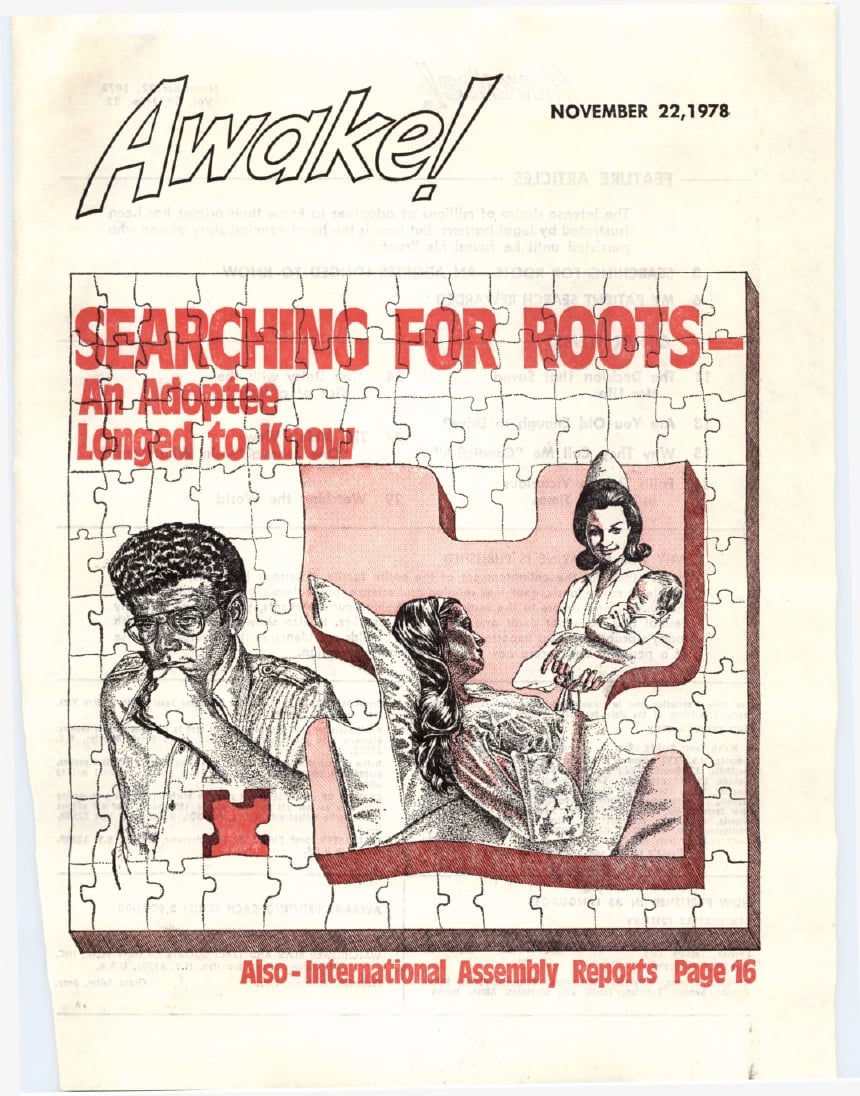
Awake! — November 22, 1978
Source: jw.org
Contents
Page Two
Searching for Roots—An Adoptee Longed to Know
My Patient Search Rewarded
The Decision That Saved Her Life
Are You Old Enough to Drive?
Why They Call Me “Candlefish”
Faith That Is Victorious in Modern Times
“The Daisy with the Kick of a Mule”
“One Jehovah”—In What Sense?
Watching the World
Why Does God Permit Wickedness?
Where Did Cain Get His Wife?
Page Two
Page Two
The intense desire of millions of adoptees to know their origins has been frustrated by legal barriers. But here is the heartwarming story of one who persisted until he found his “roots”
3 SEARCHING FOR ROOTS—AN ADOPTEE LONGED TO KNOW
6 MY PATIENT SEARCH REWARDED
Searching for Roots—An Adoptee Longed to Know
Searching for Roots—An Adoptee Longed to Know
Legal Wall of Secrecy
LAST year my wife and I watched portions of the week-long television special entitled “Roots.” Perhaps more than most viewers, I could fully understand why many desire to know their origins. It’s only natural to wonder where you came from, and what your parents and other relatives are like. Interestingly, recently more and more persons have been searching for their roots.
“The quest for personal origins has turned phenomenal,” noted a feature Newsweek article. A spokesman for a genealogical library observed regarding this growing quest: “The reason people give is almost invariably, ‘I just want to know who I am.’”
There is a segment of the population, however, that has a special interest in their origins. It is we who are adopted by foster parents. But most of us who have tried have been frustrated at practically every turn in our attempt to discover the identity of the parents who caused our birth.
Do you know what’s responsible for this secrecy? Is there good reason for it?
Legal Wall of Secrecy
Laws in the United States mandate secrecy. When a child is adopted, a new birth certificate is issued; the idea, in effect, is that the child receives a ‘new birth.’ The original birth records of adoptees are sealed, and they remain sealed against almost every appeal of an adoptee to see them. Fines and imprisonment are sometimes imposed on persons who break the seal contrary to the law’s provision.
In virtually all states in the U.S., even when adoptees reach adulthood, they are prohibited from seeing their birth records. Laws in other countries are different. In such places as Israel, Finland and Scotland, for instance, adult adoptees may obtain their original birth certificates.
Adoption laws in the U.S. affect literally millions of persons, including the some three to five million of us adoptees, as well as our natural and adoptive parents. It is said that the number of adoptions here are greater than the total for the rest of the world! In 1970, a high of 175,000 adoptions was reached in the U.S., but then the number started declining.
Development of Adoption Laws
A few years ago I became interested in learning more about the subject of adoption. From reading the Bible, it became apparent that the procedure evidently was an old one. For example, the Israelite baby Moses was taken from the Nile River and adopted by Pharaoh’s daughter, “so that he became a son to her.” (Ex. 2:5-10) I later read that provisions for adoption were incorporated in the ancient Babylonian Code of Hammurabi, the Hindu Law of Manu, as well as in Assyrian, Egyptian, Greek and Roman laws.
A particular purpose of these adoption laws was to prevent the extinction of family lines and to create legitimate heirs. Thus it is interesting to recall that Abraham, the father of the Israelite nation, evidently considered his slave Eliezer to be in line for a position similar to that of an adopted son. For Abraham said: “I am going childless and the one who will possess my house is a man of Damascus, Eliezer.”—Gen. 15:2-4.
In more recent times, adoption was unknown in English common law, on which United States law is based. So legal adoption did not exist in the U.S. until the individual states began passing laws permitting it sometime around the mid-1800’s. It was not until 1926 that the Adoption of Children Act made adoption legally possible in England. When the child is adopted, he is legally no longer related to his biological parents, but only to the parents who adopted him.
Humane Provision
I can personally testify to the benefits of these modern provisions for adoption. In the past, babies that parents either did not want or could not provide for were commonly reared in institutions. Generally, these children fared badly, and mortality rates were high. How much finer when couples who really want children can adopt little ones and give them the loving attention that they need!
My adoptive parents gave me such loving care, and I will always be grateful. They reared me as though I was their very own. At the same time, however, they let me know at a very early age that I was adopted. Adoptive parents are wise to tell their children this. When children learn it from others—and they are likely to do so—they usually are not only shocked but feel deceived by their adoptive parents who tried to keep the adoption a secret. However, the best time to explain to them about their having been adopted is when they can understand it a little better, perhaps when they are six to eight years of age.
In recent years, I have learned the great importance of environment on early child development, which makes me even more appreciative of my adoptive parents. For example, in the United States black children typically have not had the same educational and cultural advantages as have whites. Thus black children reared in white homes, where they have more educational advantages, usually achieve higher IQ scores than do other black children.
Source of Adoptable Babies
During the late 1960’s and early 1970’s, many white parents were adopting black children. In fact, over one third of all black adoptees were, for a time, being placed with white parents. But then black leaders began protesting vigorously. They said that, in the long run, these children would have greater problems when they grew up to face the real world. They would be rejected by whites, the critics said, because of their skin color, and by blacks because of their vastly different values and behavior.
But why, you may wonder, are many whites eager to adopt black and biracial babies? It is because of a severe shortage of adoptable white babies. Waiting lists at agencies are years long, and some agencies won’t even accept new applicants. But why is there a shortage? Since the major source of adoptees has always been illegitimate babies, why, with the skyrocketing illegitimacy rates, are there fewer adoptable infants?
Particularly, it is because an unwed mother is no longer frowned on by today’s changing society. Famous rock music stars and movie stars rear their illegitimate children, and hit songs such as “Having My Baby” have glamorized the trend. Thus, a few years ago, about 80 percent of unmarried mothers in the U.S. were giving up their babies for adoption. More recently, however, only about 20 percent have been relinquishing them—hence, fewer adoptable infants.
Do mothers who give up their babies ever wonder about them? Why do adoptees want to find these biological parents?
The Desire to Know
Ever since I was a child, I wondered what my mother and father were like, and this despite my fine relationship with my adoptive parents. I’ve since learned that most other adoptees feel similarly, as if “a piece of themselves was missing.” It is as Dr. Arthur D. Sorosky, who has studied the subject extensively, says:
“We’ve found that the adopted child’s curiosity does not depend on whether or not he has a good relationship with his parents. It is a simple, universal need to know one’s roots. The adoptee’s desire for genealogical information—or even to meet his natural parents—is a need which can’t really be comprehended by a non-adopted person. Nor can it be discounted as occurring only in emotionally disturbed individuals.”
Also, I’ve since learned that biological mothers often long to know about the child that they gave up. I can remember my adoptive mother, a very sensitive and sensible woman, mentioning on my birthday, ‘Your mother, wherever she may be, is probably thinking about you today.’ I’m thankful that both Mom and Dad have been so understanding. When I finally determined to make the search, they helped me in it.
A study has revealed that most adoptees who have found their biological parents are happy that they made the search. Even when what they found was not pleasant, not knowing was considered even more unpleasant. I can vouch for this.
But I realized that the finding of my physical roots was not of primary importance to the finding of real happiness. For, after all, when traced back far enough the roots of the entire human family lead to the patriarch Noah, who survived the global flood. So what is truly vital is finding, not our physical roots, but a favorable relationship with God, our spiritual Father. Although treasuring this relationship with Jehovah God as most important, still I desired to find my natural parents. Let me now tell you the results of my search for my roots.
My Patient Search Rewarded
My Patient Search Rewarded
ALL the information about myself and my family, as far as I knew, was contained in a set of court papers. My adoptive parents first showed these to me when I was about seven or eight years of age. They had received them when they legally adopted me as an infant. Later, when I was an adult, they gave me these papers. My family legacy was two names on a piece of paper, my mother’s and mine.
Although from an early age I desired to know more about my origins, it was not until I was in my 30’s that I was moved to do something about that desire. In the meantime, my life took on a whole new direction as a result of a study of the Bible.
By 1967, I had adjusted my affairs so that I could share more fully with others what I had been learning. Eventually I served for nearly four years as a missionary in the Pacific Islands of Truk, Kosrae and Ponape. Then, in 1973, I was invited to join the headquarters staff of Jehovah’s Witnesses in Brooklyn, New York.
This was a time of retrospect for me—questions about my background began nagging me. Who are my mother and father? Do I have brothers and sisters? Am I of Spanish, French or of some other background? I also had a more important reason for finding my biological family—to share with them the “good news of the kingdom.”—Matt. 24:14.
But where could I start looking?
Beginning the Search
From the papers that I was given, I knew this much: My mother’s full name, the name given me at birth, the name of the adoption agency, the date of my birth, and the hospital where I was born. I began my search by writing a letter to the adoption agency in the state of my birth, California.
That proved to be my first frustrating encounter with the wall of intense secrecy. Being bound by the law, the agency could neither confirm nor deny by name who my mother was. However, they did tell me the state from which the woman about whom I was inquiring had come—Oregon. They also provided a few other facts about her, including that she was of German-French extraction, had average grades in school, and had played an instrument in the high-school band.
Next, I wrote to the Department of Vital Statistics in Portland, Oregon. Enclosed I sent a fee, plus what little information I had about my mother. In a few days I had an answer. A person with the same name had indeed been born in that state 24 years prior to my birth. However, I was told that it would be impossible for me to obtain a copy of her birth certificate—it was against the law for them to provide this.
After a few days of head scratching and research, I decided to write again and request a copy of the law that prohibited my obtaining her birth certificate. In due time a copy was sent. The law said that the birth certificate would be issued only to a blood relative, the individual himself, or a court attorney. Happily, I was sent a copy of the entire page on which that particular law was printed. Looking the page over, I found another law that said a person could petition the county court for any vital record that was denied him.
Seizing on this provision, I made a copy of my adoption papers, had them notarized, and forwarded them to the court with a request for the birth certificate. The result? In a few weeks I received the birth certificate that I wanted. The person named—Grace Faulman—was the same person listed on my adoption papers as my mother! Also, the names of her parents were given.
I had every reason to believe that Grace Faulman was my mother, for it was unlikely that another person with that name gave birth to a baby with the same name as mine on that same day, May 23, 1939. Yet, how could I be positive? And how could I locate Grace Faulman or her parents, assuming that they were still alive? After all, about 60 years had passed since that birth certificate was issued. I determined to continue my search.
I wrote the school superintendent in Astoria, Oregon, the place where Grace was born. Also, I inquired of the postmaster there regarding information on the Faulman family. But all efforts to trace my mother in this way were fruitless. Apparently the family had left the area soon after Grace’s birth. So I needed to find another way to trace her.
A Breakthrough Comes
Significantly, the settlement of the United States came through westward expansion. From the year 1790, when the first Federal Census was taken, families, singly and in groups, migrated westward. Thus, although Grace Faulman was born in the far western state of Oregon, her birth certificate revealed that her father and mother had been born in Michigan.
I tried without success to obtain the birth certificate of Grace Faulman’s father—apparently it doesn’t exist. However, I did succeed in obtaining her mother’s birth certificate. This provided me with the name of Grace’s grandparents, since their names, of course, appear on their daughter’s birth certificate.
Next, I sent another fee and requested the marriage certificate of Grace’s grandparents. I provided their names, taking them from the birth certificate of Grace’s mother. In time the marriage certificate, dated February 3, 1894, was sent to me. Now I was able to take advantage of a peculiarity of the 1880 Federal Census. An index was made of that 1880 Federal Census. Thus all family heads who had children 10 years of age and under in 1880 have their names, along with other information about them, indexed.
I submitted a request to the National Archives in Washington, D.C., where such census copies are preserved. I provided the name of Grace’s grandfather, Henry Monroe (he was born in 1871 and so was under 10 in 1880), asking for a search of the index. Shortly, I was rewarded with a copy of the census page on which the names of him and his family were enumerated. Importantly, that page also had the name of the town in which Henry was then living, East Jordan, Michigan.
Later, this single document and a single act of kindness proved to be the keys that unlocked my past. However, at the time, I didn’t see how this information would be of help to me. So I began to trace other branches of what I believed to be my family, writing scores of letters in the process.
Living in Brooklyn, quite close to the Long Island Historical Society, I began to spend some time each Saturday afternoon checking old census records and other historical documents. Eventually, by tracing relatives of Henry Monroe, I discovered a woman, whom I believed to be one of my great-grandmothers. She had lived in Cobleskill, a small town in upstate New York. Curious to know whether any of her family might still live there, I wrote a letter to the small weekly newspaper. To my surprise, a week later I received a letter. The woman who wrote was the niece of this supposed great-grandmother of mine!
I was welcomed by this woman to come up on a visit to Cobleskill. There I spent a most enjoyable weekend learning about the family and the history of their previous 200 years in the area. Further evidence that I was indeed on the right track was forthcoming—the ladies of the family all remarked that I had inherited the family nose! Another warming fact was that three of the lady’s grandchildren and I shared the same faith.
Unfortunately, the family in upstate New York had not been in contact with Grace Faulman’s side of the family for more than 50 years, and had no idea where they were. So, while I had made some progress, the prospects of finding my mother were still not very bright. But then an idea came to me.
The Lead That Opened My Past
I recalled the information filed away in my drawer from the 1880 Federal Census about Henry Monroe, Grace Faulman’s grandfather. I thought: ‘If I could get results by writing to the newspaper about the family in Cobleskill, New York, why not write the postmaster in that small Michigan town of East Jordan where Henry and his family lived?’
This is what I did. I told the postmaster that I was trying to locate distant relatives. I asked if he knew of anyone by the name of Monroe in the town, and if he did would he please pass my letter on to that person. Having mailed the letter, I promptly forgot all about it.
Checking the mail at noontime one day a couple of weeks later, I found a self-addressed envelope waiting for me. (I always sent queries with an enclosed self-addressed stamped envelope.) Opening it, to my amazement I found that the writer was none other than the first cousin of Grace’s mother. That postmaster had kindly forwarded it to her. I could hardly keep my mind on my work the rest of the day, so elated was I.
Striking up a friendship by mail with this woman whom I was almost certain was my relative, I gradually made cautious inquiries as to Grace’s mother. Yes, I was told, she was still alive. And she had a grandson living in Alaska. Here was real news! I had a brother! But, through this correspondence, I learned that Grace had died. Now what?
I felt the need to be discreet, since I didn’t know the circumstances surrounding my birth. I finally decided to tell my grandmother’s cousin everything. I enclosed a copy of my adoption papers and asked her to serve as a go-between for me. ‘Would she reveal my identity to my grandmother?’ I asked.
Reunion
The days passed slowly. Finally, a letter came from my grandmother. She was overjoyed. Yes, there was a “missing grandson”—but she thought he was dead, having been told by her daughter that he died in infancy. Yes, her daughter was the person listed on the court records. I must call my brother in Alaska immediately, she urged. The phone number was listed. ‘And when, oh, when, could I come to California so that she could see me?’ she wanted to know.
The phone call to my brother was made. My first word to him was: “Brother!” His first words: “I can’t believe it!”
He, too, had been told by our mother that I died in infancy, but then, about 15 years ago, our father had told him that I had been adopted. He tried to find me, but all his efforts were thwarted by the legal wall of secrecy.
The trip to California and the meeting with my family was no doubt one of the most satisfying times of my life! True, I was disappointed to learn that my mother and father (who I learned was named John Rapoza-Vierra) had both been dead for some years. But my grandmother, brother and I spent hours together, along with my adoptive parents, who, from the beginning, had supported all my efforts. In fact, they had gone to great lengths themselves to learn what they could. Interestingly, I was also able to meet my natural father’s family and learn of their Azores Islands-to-Hawaii-to-California migrations. He was Portuguese.
I had done it! My patient search was rewarded. ‘And what was the cost in effort?’ you may ask. Over 400 replies alone to letters that I sent, plus the cost of postage, fees, and Saturday afternoons at the library.
Hope for the Future
I was particularly happy that I was able to share with these family members the comforting hope that the Bible provides for the future. I told them that there is good reason to believe that Grace and John will be favored by Jehovah God with a resurrection to life again on earth. (John 5:28, 29; Acts 24:15) How fine, then, it will be to become acquainted with them! I realize that they made bad mistakes, even living immoral lives. But for those who are resurrected, there will be opportunity to learn of God’s requirements and to conform to the righteous Kingdom administration that will then be in control.
To me, learning about my physical roots has been well worth the effort. Interestingly, the Bible contains extensive information about the genealogies of various people. Evidently it is natural for humans to be concerned about their physical origins. But I realize that this is not of principal importance, and that there is danger of placing an overemphasis on such matters.—1 Tim. 1:3, 4; Titus 3:9.
Jesus Christ forcefully showed the relationships that are even more important than physical ones. Once, when spoken to about his relatives, he said: “‘Who is my mother, and who are my brothers?’ And extending his hand toward his disciples, he said: ‘Look! My mother and my brothers! For whoever does the will of my Father who is in heaven, the same is my brother, and sister, and mother.’”—Matt. 12:48-50.
I’ve found this to be so true. Sharing the same faith in God and having the same hope in his promises bring persons closer together in bonds of love than do even blood ties. My wife and I have just attended the 65th class of the Watchtower Bible School of Gilead. We now have the grand privilege of going to another land to share with people there the Christian faith that can enable them to enjoy such a fine relationship with fellow humans, and especially a good relationship with Jehovah God.—Contributed.
The Decision That Saved Her Life
The Decision That Saved Her Life
I’LL never forget Saturday, November 6, 1976. The place was Scotland Neck, North Carolina. I had been looking forward to getting out and sharing in the distribution of the Kingdom News tract “Why So Much Suffering—if God Cares?” But I woke up sick.
Waking up sick was not unusual, because, for the past three months, I had had spells of sickness due to internal bleeding. Our family doctor said that I needed an operation, but that I needed to be built up physically first. Then, about seven o’clock that evening, the hemorrhaging increased until finally I collapsed. I soon regained consciousness. My husband rushed me to the hospital hoping that the bleeding could somehow be stopped.
In the emergency room the doctor discovered that I had a tumor that was causing the hemorrhaging. He said that it needed to be removed immediately. But then real trouble started. There in the emergency room I twice went into shock because of the loss of blood. My heart stopped beating for a few seconds, and the doctor worked feverishly to resuscitate me. Soon I regained consciousness, and the doctor and nurses heard me whispering, “no blood, no blood.” They knew then that I must be one of Jehovah’s Witnesses.
The doctor thought that perhaps I did not understand the seriousness of the situation and told me that if I did not take blood I would die. He said that he could not attempt to operate with my blood volume so low. But I stayed firm about God’s law and quoted the scriptures at Genesis 9:4 and Acts 15:20, 28, 29. There the Bible says: “Blood—you must not eat,” and “keep abstaining . . . from blood.”
I told the doctor that if I did die, dying was not the worst thing that could happen to a person. He appealed to my husband, but my husband told him that he, too, was one of Jehovah’s Witnesses and believed as I did. An elder in our congregation was called.
The nurse assisting with the phone call told the elder: “She cannot live without packed cells [blood]. She is bleeding badly right now. It is just a matter of time. It is like having a child stand in the highway with a truck coming. You know what is going to happen.” When my husband and I continued to refuse a blood transfusion, the doctor administered some blood expanders and went home.
The elder from our congregation came to the hospital, and he and my husband called the doctor to try to convince him to return and operate. The doctor hesitated, saying: “Really, what is there to talk about? She is too weak to survive the operation.” But my husband and the elder explained that all of us would appreciate his coming over to do whatever he could without blood. Then, if death occurred, he would not be held accountable.
The doctor said that we all failed to understand the gravity of the situation. He said that I had almost died in the emergency room and that, with my continuing to lose blood, death was fairly certain. He said that to put a patient in my condition under anesthesia would only hasten death. “Since she is already dying,” he continued, “what you want me to do is take her into the operating room and finish her off.”
But then there was an abrupt change in his line of argument. “But I’ll do it,” he said, meaning that he would do his best. The elder assured him that this was the wish of both the family and myself. “Yes, I know that,” the doctor answered. “She’s cool about all of this. She’s up there dying, and I’m the one doing the worrying.”
Most of the doctors in that particular hospital decline to treat Jehovah’s Witnesses if they foresee problems involving refusal of permission to use blood. So it was of interest when the doctor next said: “I have often wondered what I would do in a situation like this. Now here it is. If we operate, at least we will be doing something.”
It was about five o’clock in the morning. He summoned the surgical team. The anesthesiologist appeared, and after verifying that I knew what I was requesting he immediately began preparing for the operation with no argument or objection. That was a relief!
Just before I was wheeled out of the room, the doctor came by again. He said: “Now you know you are asking me to operate with one hand tied behind me.” I told him to go ahead and Jehovah would look after me. I had confidence that even if I should die I would come back in the resurrection of the dead.
In about two hours the operation was over and the doctor came out to talk with my family. He said: “Thus far she is doing all right. I think we did the right thing. I am not sure that we got all the bleeders tied off because her blood volume was so low it is difficult to tell. But she is doing as well as can be expected.” Then to the happy surprise of my family, he added: “I believe Jehovah was helping me in there.”
After four days of being in critical condition, I was transferred to a regular hospital room. After a few more days I was released. When I went back for a checkup one month after the operation, my blood count was normal. We all thanked this surgeon for his helpfulness. The following is part of a letter he later wrote to the elder in our congregation:
“Thank you for your recent letter with respect to Mrs. Christine Smith. Hers certainly was an amazing case. She was a very strong and determined woman, and both you and her relatives furnished her beautiful support.
“Thank you very much for helping me to have a better understanding of the faith of you and your people. I believe the experience with Mrs. Smith will improve my judgment when dealing with a Jehovah’s Witness in the future.”
Through it all a good witness regarding our Christian faith was given. Now, thanks to Jehovah’s help, I am back at meetings with his people and active in his service.—Contributed.
“Indeed toward God wait silently, O my soul, because from him is my hope. Indeed he is my rock and my salvation, my secure height; I shall not be made to totter. Upon God are my salvation and my glory. My strong rock, my refuge is in God. Trust in him at all times, O people. Before him pour out your heart. God is a refuge for us.”—Ps. 62:5-8.
Are You Old Enough to Drive?
Are You Old Enough to Drive?
What a Father Might Say to His Son
“YOU have been waiting for a long time to drive, haven’t you, son? But if you value anything enough, then it is worth waiting for, isn’t it? You can get a lot of practical use and pleasure from owning and driving a motor car. You’re also taking on quite a responsibility!”
About Your Car
“Remember a few years ago how you wanted a gun because all the other boys of your age had one? We talked about the dangers involved with firearms and you were so concerned then that you decided it would be better not to own one. Now, I don’t want to talk you out of owning or driving a motor car, but I want you to do it safely, for yourself and for others.
“The gun was dangerous because of the energy released when the trigger was pulled. The only way to control the energy released in a gun is to be careful where you point the barrel. A gun’s source of energy is from an explosion in a confined space. The expanding gases in the firing chamber must find an escape and this they do by taking the line of least resistance—down the gun barrel.
“In the engine of your car a similar explosion takes place when an electrically induced spark ignites the vaporized fuel within the confined space at the top of the cylinder when the piston is at the top of its stroke. The expanding gases take the line of least resistance and force the movable piston downward, converting the downward thrust to a circular motion in the crankshaft, and that eventually is transferred to the wheels of the car.
“So, instead of sending a lead bullet through the air, a series of explosions sends you and your vehicle speeding along the road. Not quite as fast but, hopefully, under control.
“We’ve discussed before the mechanical controls in the car itself, the steering for directing the ‘missile,’ the clutch for engaging and disengaging the power, the throttle for increasing or decreasing the power and, of course, the brakes for bringing the vehicle to a stop. Your safe enjoyment of the car depends to a large degree on the mechanical efficiency and condition of these controls. Always remember, your speeding vehicle can be more dangerous than a bullet.”
About You
“There are other factors involved in safe and enjoyable driving: road conditions, the driver’s experience, his skill and health, his attitude, emotional state and attentiveness. Not only must the car be controlled, but the driver must be also!
“Remember the film that we saw the other night? It illustrated that. Even the rally and competition drivers showed a marked decrease in driving ability when under the influence of small amounts of alcohol. The skilled competition and rally drivers were able to perform more routine actions automatically than the less experienced everyday driver, but still could not cope with emergency situations. Didn’t we laugh when we saw the test drivers in the film run through the imaginary end of their garage and sideswipe the imaginary wall as they backed out, or overrun the markers in the stopping test? But would we have laughed if the markers were real live pedestrians crossing a street?
“Why does alcohol have such an effect? Because it slows down our reaction time. It relaxes us, and while a driver should not be tense, he does need to be wide awake and alert. Your car is moving speedily. While you are thinking about what to do, it is still moving. While you are reacting, it is still moving. While the vehicle is responding, it is still moving.
“Let us look at a possible incident. You’re driving along a reasonably quiet suburban street when suddenly a ball bounces onto the road a short distance in front of your car. Then a small boy dashes after it! Some very complicated computer work has to go on within the mind and body of the driver. The information is recorded by the eyes and transmitted to the brain where it is related to the facts you have already stored there. The things that you already know about little boys, road conditions, the condition of your car, the car’s abilities, your own abilities, possible actions to be taken and their possible consequences—all of these have to be considered before a decision is made.
“If the car is traveling at 45 kilometers per hour (about 28 miles per hour), in just one second it will have covered 13 meters (about 43 feet). In just one second! If the driver is tired or his reactions are affected for any reason at all, reaction time can be up to three times as long! Of course, different people react in different ways and different cars respond differently, but at high speeds, say 90 kilometers per hour (56 miles per hour), half a second can be the difference between life and death.
“So far we have only mentioned reaction time, but it takes a lot longer after you have reacted to a situation to bring the car to a stop. At a speed of around 110 kilometers per hour (about 70 miles per hour), the limit often set on expressways here in Australia, it can take up to 96 meters (315 feet) to bring the car to a standstill. That’s a long way!
“Remember, these distances will increase if you are tired, angry, ill, worried, or if you have been drinking or taking drugs, or are in deep conversation with the person traveling with you, or if for any reason your judgment, reflex response and fine movement are reduced.
“Son, in the driver’s seat you don’t have a new toy; you have a potentially dangerous weapon in your hands! It can be used wisely and enjoyed, but it depends on you, the driver, and your attitude.”
The Follies of Youth
“‘Foolishness is tied up with the heart of a boy.’ You remember that, don’t you, found in the Bible at Proverbs 22:15? Some of us ‘oldies’ like to be ‘boys’ too, when we get in a motor car. Boys like to see what a car can do; they like to try out their own capabilities and have a tendency to overlook the consequences of their actions. Seeking excitement and thrills can impair one’s judgment about the dangers involved, and a lack of experience can cause a person to overlook the need for greater caution.
“Let’s look at some Bible principles that will help you to avoid these pitfalls of youth:
1. Love of neighbor. (Matt. 22:39; 1 Cor. 16:14) The Golden Rule. (Matt. 7:12) Why is what we are doing more important than what others do when driving our cars? How does the way we drive affect the lives and happiness, the well-being and health of others?
2. The sanctity of life. (Lev. 17:11; Num. 35:33; Acts 15:29; Ps. 55:23) Do we drive for thrills? Do we like the sound of tires squealing on the road? Is our driving putting in danger the lives of others? True Christians view life as valuable, as belonging to Jehovah.
3. ‘Pay back, therefore, Caesar’s things to Caesar.’ (Matt. 22:21; Rom. 13:1-4) It is not just a question of knowing Caesar’s laws. The Bible indicates that our attitude should be one of respect to the governments of this world. Again, it’s a question of attitude. Do we feel that we can make a flash decision while traveling at high speed over an unfamiliar road, assuming that the men who have studied the road surface and conditions before setting the speed limit were wrong and that we are right?
“According to Caesar’s laws, you’re old enough to drive. But remember that driving is a weighty responsibility. Thousands of lives are lost each year through car accidents. About a quarter of a million die in road accidents world wide each year; 50,000 in the United States, 16,000 in France and the Federal Republic of Germany, 3,689 here in Australia in 1975.
“We thought that guns were dangerous, didn’t we? Comparatively few lose their lives from accidents with firearms each year; 1,300 each year in the United States, and only 27 in Australia in 1975.
“Are you ready for this responsibility? If you can have both yourself and your vehicle under control at all times, you can have pleasure and practical use from your car. Can you? If so, you are old enough to drive!”
Why They Call Me “Candlefish”
Why They Call Me “Candlefish”
Greetings! I’m a saltwater member of the smelt family and you will find me in the North Pacific. True, I am rather small—only some eight inches (20 centimeters) long. But I’m delicious! At least many folks think so. Since people desire my tasty meat, fishermen catch me in rivers when I enter to spawn during February to April. But, why have I been named “candlefish”? Well, it all started years ago with a practice of Indians living on North America’s west coast. They dried members of my family and then used them as torches or candles.
Faith That Is Victorious in Modern Times
Faith That Is Victorious in Modern Times
POVERTY, hunger, sickness, crime, hatred and violence. These major problems surround us and are becoming more and more serious in modern times. Seemingly stable marriages are breaking up, families are falling apart, and the future of young people is threatened by increasing immorality and drug abuse. With less and less friendliness, and more and more fear, insecurity and mistrust, there is steady deterioration in the quality and enjoyment of life.
What a distressing picture! Yet, to some degree, each of us must face these problems. Would we be helped by faith that is based on the Bible? Or, is such faith too old-fashioned and outmoded to cope with the problems of modern times?
Applying the Bible in Life
At the “Victorious Faith” International Conventions now in progress around the world, Jehovah’s Witnesses are enthusiastically affirming a “Declaration of Our Faith.” In it, among other things, they acknowledge the major problems facing humanity and the growing climate of mistrust, fear and insecurity. Nevertheless, their Declaration forcefully states:
“By contrast, we have seen and personally experienced what the faithful application of God’s Word can do, the remarkable changes it has accomplished in our own lives and homes, the benefits in contentment and peaceful relations and the warmth of unselfish love. We have seen the power the ‘good news’ has in appealing to honest-hearted persons of every conceivable background, in the Western world and in the Orient, in all continents and islands of the sea. We have seen what faith can produce on a global scale; how God’s spirit has produced something that remains unique: an earth-wide ‘association of brothers.’ (1 Pet. 2:17) ‘By this all will know that you are my disciples,’ Christ Jesus said, ‘if you have love among yourselves.’ (John 13:35) We rejoice to be part of the only real international brotherhood on the face of the earth, a brotherhood bound together in unbreakable love—for God and his Son, for truth, for what is right, and for one another.”
Is that just meaningless rhetoric? Or, do these Christians really believe the Bible’s statement that God “made out of one man every nation of men”? (Acts 17:26) And do the Witnesses form a brotherhood bound together by love? Well, what do outside observers have to say?
Referring to one of the “Victorious Faith” International Conventions held in New Orleans, Louisiana, The States-Item said:
“A sense of brotherhood filled the Louisiana Superdome as young and old, black and white Jehovah’s Witnesses settled down to begin a 5-day learning and sharing experience.
“The atmosphere during this week’s international convention confirms that racial discrimination—still an issue in some churches—is not a problem for Witnesses.”
Because Jehovah’s Witnesses conscientiously apply the Bible in life, they do enjoy an international brotherhood that is genuine and unique. That spirit of brotherhood is evident at their “Victorious Faith” International Conventions. For instance, assembling at Montreal, Quebec, were delegates of various racial and national backgrounds—so much so that sessions were held in Arabic, English, French, Greek, Italian, Portuguese and Spanish. Since a football game ended about 11 p.m. on the evening before the opening convention day in the Olympic Stadium, Witness workers had less than 12 hours to install an elaborate sound system. The problem was compounded by the need for seven simultaneous language presentations, requiring careful installation of a completely independent public-address system for each tongue. Connecting the system called for a full six miles (10 kilometers) of cable. There was no time to modify the installation. It had to work the first time—and, for the most part, it did function very well.
Faith Evident in Various Ways
Faith in Jehovah God and the applying of his Word in life have enabled thousands of persons to become unified in an international brotherhood, and thus they have gained a spiritual victory in this divided world. But victorious faith is evident in many other ways. Of course, since trust in God and the application of his Word in life are factors responsible for these evidences of faith, credit for desirable attitudes and actions primarily goes to God. However, what do some keen observers have to say about Jehovah’s Witnesses and their current international conventions?
A unique feature of certain “Victorious Faith” International Conventions is a trailer and/or tent city. For instance, one laid out by workers near Montreal, Quebec, accommodated some 4,000 tents, campers and motor homes, housing over 15,000 persons. Destructive earthquakes that had struck Thessalonica, Greece, in June had made hotels and houses there so dangerous that thousands of convention delegates had to be accommodated at a rather large tent city. In fact, thought had been given to canceling the convention in Thessalonica, but, after fervent prayer, the Witnesses decided to go ahead with it in faith.
Near Stockholm, Sweden, an airfield was rented as a campsite. The runways formed streets of a trailer and tent community for 12,000 people, and the sailplane hangars were turned into cafeterias. All of this attracted the attention of the Swedish press and television. Svenska Dagbladet said that this “suburb” had been erected with “colossal organizational skill” and then remarked that the Witnesses “are admirably skilled in arranging everything in a practical way, sensibly and nicely.” According to the newspaper Expressen, the camp was “well organized,” had “lots of cozy tents and trailers,” and there was “no litter to be seen anywhere.” Also Aftonbladet commented: “You can see that this is not an ordinary camp. No litter. Not a single empty beer can. And—no smoking.”
A “Victorious Faith” International Convention was held at Washington, D.C. After viewing the assembly facilities that the Witnesses used there, Brian Murchison wrote in The Washington Star: “The stadium, usually a litterbug’s paradise, looked as if it had come up against a white tornado for the first time. Even at lunch time, volunteers served food and cleaned up almost simultaneously.”
A staff member of the sports facilities used by Witness conventioners at Lisbon, Portugal, remarked: “When people ask me what I think of you, I can’t tell a lie. I tell them that Jehovah’s Witnesses have very good manners, cleanliness and organization. . . . if you happen to soil one thing, you clean 99!”
At Milwaukee, Wisconsin, Jehovah’s Witnesses met in a stadium. After 20,000 to 25,000 people had been there for a double-header baseball game, there were tons of debris. “This is normal,” said the grounds’ keeper. “You might liken it to wall-to-wall garbage. But Jehovah’s Witnesses cleaned it up in half the time it would normally take.” He added: “In other words, it goes from absolute chaos to efficiency. When you folks leave the stadium, it is ready for the next event. You don’t have to worry about a nail or a piece of glass. It’s clean.”
But what does cleanliness have to do with victorious faith? Well, in writing to fellow Christians, the apostle Paul urged: “Let us cleanse ourselves of every defilement of flesh and spirit, perfecting holiness in God’s fear.” (2 Cor. 7:1) Also, when leaving Babylon centuries earlier, God’s people were commanded: “Turn away, turn away, get out of there, touch nothing unclean; get out from the midst of her, keep yourselves clean, you who are carrying the utensils of Jehovah.” (Isa. 52:11) Hence, spiritual and physical cleanliness are associated with the proper application of the Bible in life and with the pursuit of victorious faith.
Conduct That Draws Commendation
Often mentioned in connection with cleanliness is general conduct. For example, the manager of the hall used by Witness conventioners in Helsinki, Finland, said: “We had a good opportunity to make comparisons when you last had a meeting here. There had been a pop concert the day before, and there was a lot of noise and many drunks. It was all very dirty. All your arrangements work surprisingly well . . . This is the largest crowd of people that has ever been in our hall at one time. We have seen many types of meetings here, but this is the best-behaved group.”
At Vienna, Austria, the administrator of the stadium used by Jehovah’s Witnesses found the teamwork within the convention administration to be “absolutely fantastic” and said that the conduct of the delegates was outstanding. Also, speaking frankly, one employee at the State Sport Center remarked: “Exemplary cleanliness is the order of the day among Jehovah’s Witnesses here. One should be prompted to follow their example. On the other hand, when our athletes take over here, they stumble over their own cigarette butts and the litter they leave behind.”
With reference to the international convention in Montreal, Quebec, an administrative official of the 1976 Olympic Games remarked: “Never in my life have I seen such a well-disciplined and well-organized convention. And mark my words, . . . I attend many conventions.” Similarly, the inspector of certain facilities used by the Witnesses at Copenhagen, Denmark, commented: “Many organizations have had events here, but none of them have shown anything comparable to what you do with regard to planning, order and cooperation with such a fine spirit.”
Following the convention at Copenhagen, a Witness employed by the telephone company was told by a superior living beside the assembly site: ‘I have never seen Idrætsparken so clean and decorated so attractively, or the parking problem solved so smoothly and elegantly. I have never seen so many persons assembled that were so neatly dressed and well groomed, and I have never seen so many people conduct themselves in such a well-disciplined, orderly and peaceful way.’
Fine conduct does draw commendation. But Jehovah’s Witnesses are not saying that they have independently developed a life-style that is commendable. Rather, reliance upon Jehovah God and application of his Word, the Bible, produce faith that is victorious over undesirable human traits and tendencies so common in these “last days.” (2 Tim. 3:1-5) It is because of their faith based on the Bible that these Christians manifest a good spirit, are orderly and “seek peace.” The Scriptures urge them to ‘maintain their conduct fine among the nations,’ and this they do, not for their own glory, but for that of the God whom they serve.—1 Cor. 10:31; 14:33; Philem. 25; 1 Pet. 2:12; 3:11.
Faith Affects One’s Viewpoint
Faith is not too old-fashioned to accomplish good things in modern times. In fact, it changes people, improving their viewpoint and the quality of their life.
Consider the case of one man who symbolized his dedication to Jehovah God by water baptism at the Cincinnati, Ohio, international convention. He admits: ‘I had always worn a gun and had it on during the first two Bible studies conducted with me. The hate I had for everything and everybody slowly left, however, and my whole attitude changed so much that my mother encouraged me to keep studying, for my family had thought that the only place for me was jail or death. But prayers to Jehovah changed me.’ Yes, true faith gains the victory over blind hatred and teaches honest-hearted people that they should not “be owing anybody a single thing, except to love one another.”—Rom. 13:8.
Then there was the young Bolivian woman who suffered paralysis as a result of an automobile accident. Her hopes for a career in the medical world had been dashed, and several times she had attempted to commit suicide. Well, in the hospital she studied the Bible with one of Jehovah’s Witnesses and soon was able to say that she would never again seek to take her life. In fact, she said that never in her life had she been happier. Today a baptized Witness, she was present for the Spanish and English international conventions in London, England. Though she is confined to a wheelchair, her pleasant countenance and smiling face provide evidence that true faith is victorious in modern times.
Among those baptized at the international convention in Philadelphia, Pennsylvania, was a 26-year-old man who had become addicted to narcotics while in Vietnam. Notice what initially drew him to true Christianity. He commented: “After returning to the United States, I was attracted by the contrast presented by Jehovah’s Witnesses. Many times I observed their happy faces . . . So, one day I just walked up to some Witnesses . . . and I asked to study with them.” Soon the young man realized that he had to stop using narcotics. But participation in a drug-withdrawal program proved useless, and he said: “Jehovah God, through his Word, helped me to conquer the craving; the drug program did not. It was the truth that helped me to overcome drugs.”
Indeed, true faith does change people. It has a beneficial effect on their viewpoint and improves the quality of their life. Proof of this is seen on the happy faces of individuals and families attending the “Victorious Faith” International Conventions.
A Tranquil and Happy Home
Even in these modern times, when so many marriages are breaking up and families are falling apart, victorious faith is producing tranquillity and happiness in the home. It is noteworthy, too, that an entire day of the current international conventions carries the theme “Have Faith to the Saving of Your Household.” (Heb. 11:7) Much sound Scriptural counsel on marriage is being provided for the benefit of assembly delegates. Here is evidence that it is having an effect:
Present for the convention in Edinburgh, Scotland, was a woman who was separated from her husband and was in the process of arranging for a divorce. However, he went to the convention to help his wife care for their children. This couple listened intently to the discussions on marriage, and the wife said: “I realized that perhaps I could do more in an attempt to save my marriage.” After the sessions that day, she and her husband had a long discussion, making use of the principles discussed on the program. The result? They decided on a reconciliation. Indeed, faith in God and the Bible is not too old-fashioned to be helpful in solving marital problems in modern times.
“To serve Jehovah faithfully, I knew that I would have to change my whole life-style, because Satan was glued to me,” said one delegate to the international convention in Dublin, Ireland. He and his wife had had many difficulties, and he admitted: “I smoked a lot, spent a lot of my time in the pub on weekends, and forgot that I had a wife and family at home. Eventually, I packed up [I quit] the cigarettes and stopped spending my time gambling. . . . Now I give most of my time to my wife and family.” Both the man and his wife were baptized at the Dublin convention, and he remarked that, as he watched her being immersed, “it was the same as starting a whole new life . . . I felt so happy!”
A happy home and tranquillity within marriage can be a certainty if all members of the household apply the Bible in their everyday life. (Eph. 5:21–6:4) But what about younger ones?
Do the children of Jehovah’s Witnesses find their religion boring? Well, younger persons attending the “Victorious Faith” International Conventions find that an entire day has the theme “Youths, Be Examples in Faith.” (1 Tim. 4:12) In fact, through the thought-provoking Bible drama “Youths—What Is Your Goal in Life?” all convention delegates were able to profit from considering the faith displayed by the young man Timothy, an associate of the apostle Paul.
But does faith have true meaning for teen-agers? Quite apparently it does. One such young person was so impressed by the drama on Timothy’s life that, on the way home from the convention in Cincinnati, Ohio, he requested an application for regular pioneer service, or full-time preaching work. Schedule changes were made at school and the lad gave a fine witness to his high school principal, who then allowed him to graduate during mid-term. The young man began serving as a regular pioneer on September 1, 1978.
Even the very young give evidence that they comprehend Scriptural truths. For example, it is not impossible for many of them to understand that the first human pair, Adam and Eve, disobeyed God and that “through one man sin entered into the world.” (Rom. 5:12) To illustrate: With regard to the convention program at Grenoble, France, the French daily Le Dauphiné libéré reported: “During an interview on the platform a father asked his little boy: ‘Are you always obedient?’ The reply was: ‘Yes. Well—not always, because of Adam and Eve.’”
Victorious Faith Commands Attention
In city after city thousands of Jehovah’s Witnesses have been gathering to promote victorious faith. This, in turn, has resulted in notable press, radio and television coverage of their current assemblies. For instance, factual news media reports on the international convention in Helsinki, Finland, evidently reached witnesses of Jehovah in nearby areas of the Soviet Union.
Regarding the “Victorious Faith” International Convention at Barcelona, Spain, at least 20 different newspapers published a total of 2,377 column inches (some 6,000 centimeters) of material, including 71 photographs. Also, the assembly was featured on television and radio programs, among them a 10-minute national TV-network presentation that included part of a Bible drama, the singing of the audience, and interviews with various Witnesses. What a contrast from just 10 years ago when Jehovah’s Witnesses enjoyed no legal recognition in Spain!
Government officials have also acknowledged awareness of the conventions and activities of Jehovah’s Witnesses. For example, the mayor of New Orleans, Louisiana, where two “Victorious Faith” International Conventions were held, proclaimed June 1978 to be Watchtower Bible and Tract Society month in that city. Similarly, the acting mayor of St. Louis, Missouri, and the governor of New York State, each made proclamations designating certain days as ‘Jehovah’s Witnesses Day’ in connection with assemblies held in their administrative areas.
State and city officials at Munich and Düsseldorf, Federal Republic of Germany, gave official recognition to the international conventions in those cities. The lord mayor of Düsseldorf invited 84 Witnesses (including missionaries from 19 countries) to a reception and banquet at the city hall on Tuesday evening, August 1, 1978. During a short talk on that occasion, Mayor Kürten said, in part: “I think a person can attest to the fact that you are welcome and good guests wherever you go. That may be due to what has brought you together. And when you have gathered together here in Düsseldorf under the theme of victorious faith, it is more than just the theme of a meeting; it is, rather, a confession, a confession of the convictions that you are now demonstrating here in this city, and that I believe, when viewed from a historical standpoint, you have always demonstrated regardless of the agreement or disagreement of the political powers. You have always stood up for your convictions, and a word of thanks for doing so is here appropriate.”
Victorious Faith in Action!
Jehovah’s Witnesses are convinced that Bible-based faith is not old-fashioned and outmoded, but has true meaning in modern times. Moreover, they are eager to share with others the “good news” of God’s kingdom. (Matt. 24:14) So, witnessing from house to house and elsewhere is an important part of their regular service to God. However, a special endeavor is being made on Friday morning of the “Victorious Faith” International Conventions. It is being set aside for witnessing activities in the field. And convention delegates are participating in this special effort with real enthusiasm. As an example, at Pittsburgh, Pennsylvania (where the peak assembly attendance was 37,208), an estimated 28,000 Witnesses shared in this activity.
In some cases, news media personnel have accompanied the Witnesses in this special activity. For instance, a Philadelphia, Pennsylvania, television station sent cameramen along with a group of them. On camera, an interested person was contacted, a witness was given, and arrangements were made for a personal Bible study. This, along with other films from the field, was shown on an evening news program.
On Friday morning of the convention in Montreal, Quebec, a prominent journalist said over the radio: “You will probably receive a visit from Jehovah’s Witnesses this morning because they are calling on the people of Montreal to invite them to their assembly. They have little yellow bags and they will be offering you their pamphlets. Take one, give them a little of your time, and listen. Don’t think you are doing them a favor—they are doing you a favor.”
Too Old-fashioned for You?
What about taking the advice of the journalist just quoted? When Jehovah’s Witnesses call at your home in the course of their regular activity, would it not be wise to “give them a little of your time, and listen”? That, of course, is for you to decide.
The fact remains, however, that the Witnesses possess a faith that is victorious in these modern times. That Bible-based faith is not too old-fashioned or outmoded to help them to cope successfully with the problems that surround all of us—poverty, hunger, sickness, crime, hatred, violence, drug abuse and other distressing troubles that can rob us of the enjoyment of life.
The current “Victorious Faith” International Conventions are impressing Jehovah’s Witnesses with the need to continue building strong faith. They have found that the proper application of the Bible has accomplished good things in their own lives and homes, has produced contentment and peaceful relations with others, has made them part of the only real international brotherhood and has given them a sound hope for the future. That faith meets the challenges of modern times. Does it appeal to you? If so, learn how you, too, can acquire victorious faith.
[Picture on page 17]
Victorious Faith prompts conventioners to engage in special witnessing
[Picture on page 18]
Witnesses, including entire families, clean every seat at convention site in Munich
[Picture on page 19]
Convention delegates share the “good news” with others
[Picture on page 21]
Many convention delegates were baptized, giving evidence of faith
[Picture on page 23]
A stirring Bible drama indicates that Victorious Faith was displayed by the young Christian Timothy
“The Daisy with the Kick of a Mule”
“The Daisy with the Kick of a Mule”
By “Awake!” correspondent in Kenya
IT LOOKS like a pretty little daisy. Yet it is deadly. No, not to man or his pets and domestic animals, but deadly to pests. Whether lodged in an opening in a home or hiding in a food store, almost all pests are conquered by this diminutive member of the chrysanthemum family. Even the toughest mosquito and the “super cockroach” find themselves no match for this “daisy with the kick of a mule.” With its thin white petals and bright-yellow buttonlike center, pyrethrum is attractive enough to be placed in a vase to decorate your table. However, it can do much more for you!
In powder form, the pyrethrum has been used as a very effective insecticide for thousands of years. Its use for that purpose was widespread in ancient China, and later in parts of Europe, Japan and other areas. Despite the advantageous properties that make the pyrethrum the solution to many problems created by synthetic insecticides, it has remained largely unknown to the modern world. Why? Because manual labor and other factors connected with its growth and harvesting created fluctuations in production levels. However, its future as your household friend is brightening.
…