Awake!, April 22, 1978
Download: PDF — Awake!, April 22, 1978
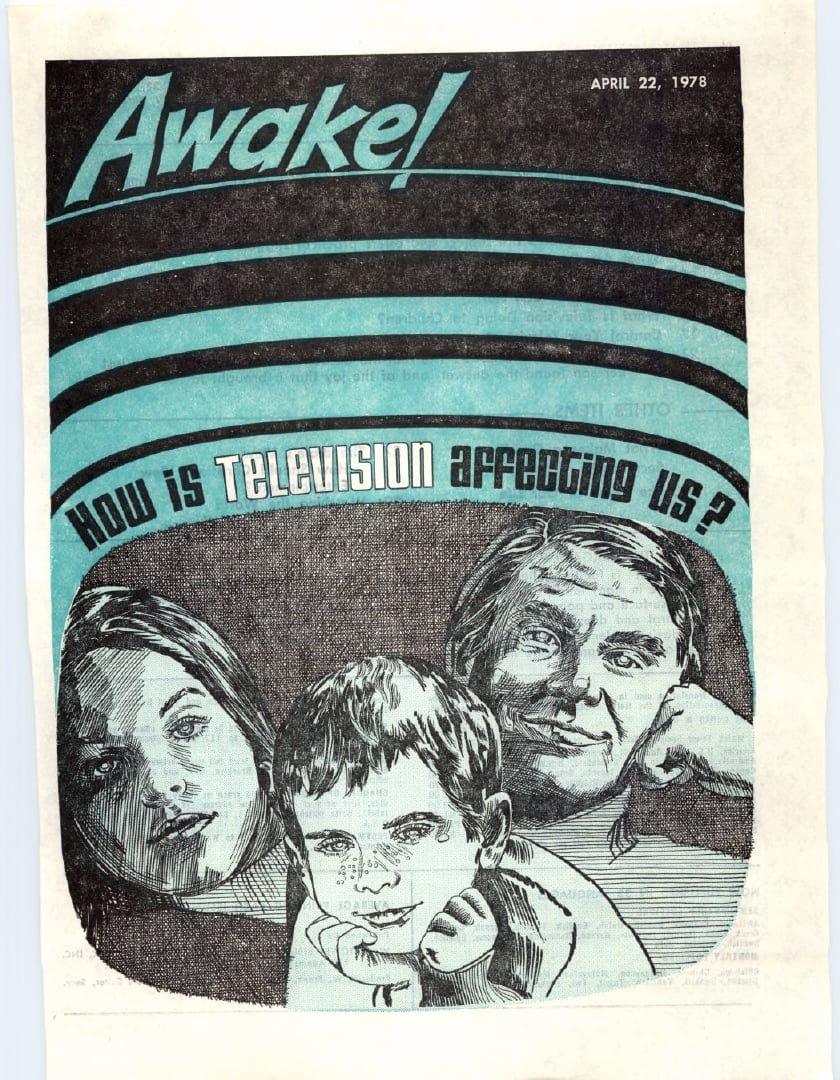
Awake! — April 22, 1978
Source: jw.org
Contents
Page Two
What Are People Saying About Television?
Can Television Benefit Us?
How Television Can Hurt
What Is Television Doing to Children?
Control Your Television!
Did My Baby Go to Limbo?
What Makes a Good Secretary?
The Years of Our Life
How Should Christians View Entertainment?
Watching the World
Is Television Your Baby-Sitter?
Where Did Cain Get His Wife?
Page Two
Page Two
In some lands, more hours are spent watching TV than in doing anything except working and sleeping. Used properly, TV is beneficial. But it can also do damage, both to you and to your children. You owe it to yourself to know the various ways in which this is true. The following series of articles explores the subject and offers practical suggestions.
3 What Are People Saying About Television?
4 Can Television Benefit Us?
7 How Television Can Hurt
12 What Is Television Doing to Children?
17 Control Your Television!
21 Did My Baby Go to Limbo?
The real-life account of how a mother who lost her son found the answer, and of the joy that it brought to her
What Are People Saying About Television?
What Are People Saying About Television?
IS TELEVISION one of the most beneficial inventions ever devised by mankind? Or is it one of the greatest curses?
However you may answer, one thing is certain. As far as this world is concerned, television is here to stay. It has had a dramatic growth since it burst on the world scene right after World War II. Now there are more television sets in the world than there are telephones—nearly 400 million!
In the industrial countries, almost every home has a television set, some a second or a third one. Television’s use has spread also to poorer countries. In such lands, many homes that do not have running water have a television. Why, even in the United States more homes have TV than have indoor plumbing!
How much time do people spend watching TV? In many nations, adult TV viewing ranks only behind sleep and work for time consumed by a single activity. For example, the average Japanese housewife is said to watch television more than five hours a day. The average American household watches it over six hours a day. And nearly everywhere children spend more time watching TV than do adults.
Powerful Force
All this TV watching must have an impact. Indeed, it can safely be said that no other force, in so short a time, has exerted such a powerful influence on so many people. In just three decades it has had an enormous effect on family relationships, entertainment, education, politics, advertising, news, sports, and other areas of human endeavor.
Television’s attraction is such that when one woman’s set broke down she said: “It’s like somebody in the family just died.” Some admit to being “TV-intoxicated,” needing a “daily fix” of it, as a drug addict would need drugs. One person said: “I took to TV like an alcoholic to demon rum; I was hooked.” He watched it for days at a time, once for four straight days and nights, with only a little sleep intervening.
Thus, for some people, a cartoon in an Argentine publication is not far from the truth. The cartoon showed a father, a mother and a child prostrate, with faces to the ground, arms reaching out toward the TV set, in worship of it.
What Kind of Influence?
Because of television’s influence, some people are saying that it can be blamed for many of this world’s ills. An editorial by William Shannon in the Seattle Post-Intelligencer declared: “If we are a less happy, less confident, less intelligent people than we were 30 years ago, a generation of television watching is largely responsible.”
In the book The Plug-in Drug, author Marie Winn claims that television is largely responsible for a serious decline in reading and writing skills, the tearing apart of the family, the rise of the drug culture, the emergence of a new breed of vicious young criminals, and a generation of children suffering from no less than an imbalance of the mind.
A family man in the United States said: “I am old enough to remember when families or children didn’t have television. I believe television has been one of the most damaging influences to the modern-day family. The extent of the damage is now becoming more evident.”
In Japan, Mrs. Kimiko Takisawa, a leader of the Society for Responsible Television, said that TV has “brought about our cultural destruction.” And the Melbourne, Australia, Sun reported: “Television viewing can have the same effect as severe brain damage.”
How much truth is there to all of this? Is television responsible for so many of mankind’s present ills? Can it be used for the good of mankind, having its proper place?
[Blurb on page 3]
Some admit to being “TV-intoxicated,” needing a “daily fix” of it, as a drug addict would need drugs.
Can Television Benefit Us?
Can Television Benefit Us?
WITHOUT a doubt, television is one of mankind’s most amazing inventions. It is today’s ultimate in one-way communication over long distances. And, when used properly, it can have a number of beneficial features.
For one thing, it brings information about current events to us faster than do magazines or newspapers. And it does so in a form that is highly interesting to the eye: in motion pictures. We feel as though we are actually present, witnessing what is going on many thousands of miles away.
For example, were you watching TV on that memorable day in July 1969? Hundreds of millions of persons all over the world were. Some say that 500 million were watching the same program! That was when the first astronauts set foot on the moon. It was a triumph of communication technology, highly interesting and historic.
Almost routinely now, by the use of communications satellites orbiting high in space, events taking place in one part of the world can be seen instantly by people in another part. Never before was that possible. Thus, people today have more information about what is taking place in world events than any other generation in human history has had. Of course, narrow interests, such as nationalistic propaganda, can distort TV news and information. But then, so can radio, magazines, newspapers and books.
Television has proved to be of benefit in producing information about a wide variety of subjects. The average person would have access to but a small part of such information in a lifetime. Many worthwhile programs have discussed historical events and scientific studies, as well as social, economic, religious and other matters. These programs can broaden a person’s views, giving him better insight into what is happening around him.
Too, TV has proved to be beneficial to many poor people who would not be able to afford other forms of information and entertainment. Elderly shut-ins, the sick and the handicapped also have found TV useful, since it helps to dispel loneliness.
A Teaching Aid
Another beneficial use of TV is in teaching. Good TV programs can certainly teach children (and adults) many things.
In the United States about one out of every three students in elementary and secondary school had instruction supplemented by regular classroom use of TV. This involved about 15,000,000 students and 727,000 teachers. The teachers felt that this classroom use of TV adapted to teaching had a positive result. In fact, most said that not enough use was made of this teaching aid.
Television has also been used in experiments to help to overcome certain fears. In one case, youngsters who were abnormally afraid of dogs were shown TV movies of children playing happily with them. Afterward, more of the children who watched were willing to do the same thing, with proper instruction, of course.
Similarly, children who were very fearful of dentists were shown a TV film of a boy climbing fearlessly into the chair, having a dental examination and his teeth cleaned. The film also portrayed his little sister watching apprehensively, but then getting into the dentist’s chair too, her fears having subsided. The TV film succeeded in removing much of the fear of dentists in the children who watched it.
Used properly, TV can even stimulate reading. It can present ideas that encourage viewers to want more information; so they will get reading matter that adds to their knowledge of the subject. Parents, especially, can be alert to encourage their children to do this.
Its Greatest Use
In all countries the greatest use of TV at present is in providing entertainment. For instance, in the Soviet Union only 8 percent of broadcast time is said to be devoted to social and political information, about 17 percent to newscasts, and the remaining 75 percent to entertainment, including sports events.
Some may object to TV as entertainment. But, when used with good judgment, it is not much different from going to a theater for two or three hours, or attending a concert or a ball game. Some would prefer to be more comfortable at home and to watch TV for much the same types of entertainment. And if what they are viewing does not meet their standards, they can turn off the program. The fact is that today TV has become the main source of entertainment for most people who have a set.
Why, then, are there such strong criticisms of television? The problems have to do with the content of the programs, and also with the viewing habits of people, especially children.
[Blurb on page 6]
TV has been helpful in several ways, such as supplementing instruction in schools and combating loneliness for many people.
[Picture on page 5]
TV can bring information faster than newspapers and in an interesting format. Events can be seen instantly anywhere on earth by the use of communications satellites orbiting in space
How Television Can Hurt
How Television Can Hurt
AT ONE time, some researchers thought that television programs did not have any lasting negative influence. A few even claimed that programs featuring violence could help by serving as “safety valves,” helping to curb such tendencies in people.
But that was before there had been enough time to analyze the effects of the viewing of TV programs for years. Now, prolonged studies almost unanimously agree that, when improperly used, TV can hurt, and hurt badly.
It Does Influence
The claim that a steady diet of TV programs featuring violence, depravity and immorality has little or no effect does not stand up to scrutiny. If this is so, then why do companies spend billions of dollars advertising their products and services on TV?
These advertisers know that TV, as a medium of communication, has a profound effect. Their advertising conditions people mentally so that they will buy their products. Surely, the commercial leaders of the world are not so simple-minded as to throw away money if TV advertising has little or no effect.
The same is the case with the content of TV programs. People are bound to be influenced one way or another by spending large amounts of time watching them.
To say that a steady diet of bad TV programs has little effect on the mind is like saying that a steady diet of bad food has little effect on the body’s health. To a large extent, your body’s health depends upon good food. Eat bad food long enough and your health will be damaged. In the same way, your mental health is largely determined by what you feed your mind. Too much bad mental food over a long period of time can adversely affect your mind.
The facts show that what a person sees on TV does influence him. The magazine TV Guide acknowledged: “Although a few early scientific studies suggested that TV violence might actually make viewers less aggressive, by allowing them to release or ‘cathart’ their pent-up hostility vicariously, later research has contradicted this theory.”
Hence, there are good reasons why much is being said that is critical of TV. There is genuine concern about the polluting of the mind, just as there is genuine concern about the literal pollution of air, water and food.
Yet, in spite of this concern, the steady diet of bad TV programs continues. Younger viewers may not be able to note the deterioration that has taken place in programming, but older viewers can make the comparison. An example of this is when writer Michael Dean returned to Australia after a long absence. He wrote in The Australian, a Sydney weekly: “Seeing Australian TV again after thirteen years is a body-blow to one’s native optimism. It’s as though Hans Andersen had returned to his childhood pond to find that the ugly duckling had become an uglier swan.”
True, violence, crime, immorality and depravity were not invented by TV. But the evidence shows that these things are made worse by TV. This is particularly so in countries where commercial TV has practically a free hand, or where censors are very liberal, allowing things to be shown that would have been unheard of decades ago.
One Way It Hurts
There are a number of ways in which bad television hurts. One way is in regard to the actual physical health of people.
The American Medical Association states that television depravity and violence can make some people physically ill. Many of the doctors surveyed said that the effects of such TV programs are showing up in their offices and hospitals. Similarly, more than 22,000 California doctors—the vast majority in that state—have jointly testified in court supporting the diagnosis that TV violence and depravity is “a hazard to health.” It can affect the emotions in a bad way, leading to literal physical problems.
Another hurtful aspect relating to health is that TV watching requires nothing of the body. But prolonged periods of inactivity are bad for physical health. Lack of exercise is a killer. Also, many people eat between meals while watching TV, contributing to excessive weight problems.
Doctors are finding that a large number of patients with blood clots have a long history of too much TV. Such prolonged inactivity does not provide enough contractions of the muscles of the lower limbs. The deep veins of the legs and feet, if not activated by muscular contractions that come from walking and exercising, may develop blood clots that can kill a person.
Lack of proper sleep is another hurtful effect of watching too much TV. Television has a type of ‘hypnotic power,’ in that one program often leads to the next. As a result, many people keep watching late into the night when they should be in bed sleeping. Since they still have to get up at the same time to go to work the next day, this means a loss of sleep. Insufficient sleep is a serious health hazard.
In addition, some programs stimulate the mind to the extent that when a person does go to bed, he often finds that he cannot get to sleep for a long while. When invited to tour the United States, a group of workers from the Soviet Union, where television is state controlled, said: “Television was another disappointment. We watched television the first night we were there and could barely sleep afterward with the killing we saw.”
Does TV Encourage Violence?
A serious effect of bad TV programming has to do with violence. TV Guide states: “One psychology professor recently summed up the evidence by saying, ‘There is little doubt that, by displaying forms of aggression or modes of criminal and violent behavior, the media are “teaching” and people are “learning.”’”
In a typical experiment, one group of adults was shown TV programs aimed at encouraging good relations between people. Another group was shown programs with the usual amount of violence and depravity. At the end of the test period, researchers said that the results were “startling.” Those who constantly watched the bad programs became increasingly hostile and aggressive. They were grouchier with their families, less tolerant of their children, and they generally engaged in more hurtful behavior.
In Canada, a government study claimed that 20 percent or more of the aggression and violence in Canadian society could be attributed to the short-term effects of such TV shows. An additional 10 percent was attributed to the long-term effects. The report stated: “Watching violence increases aggression and can trigger violent attacks.” It warned: “Even if aggressive attacks are triggered in only a small proportion of viewers, when as many as 40 million people watch a brutal scene people will be hurt as a result.”
This study also rejected the idea that a person can ‘let off steam’ by watching violent programs. Instead, it stated that “observation of violence tends to increase subsequent aggressiveness.”
In addition, in some people it causes a mental state that makes it difficult for them to separate myth from reality. Thus, when a patient in a psychiatric hospital hit an employee on the head with a pool cue, he was baffled because the employee failed to get up. The patient could not understand why the employee was unconscious because on TV people often get right up again after being hit on the head.
Convicts have admitted getting ideas for crimes by watching programs on prison TV. A surprising 90 percent in one survey said that they had actually learned ways to improve their criminal techniques. Four out of 10 said that they had already tried specific crimes that they first saw on television. One declared: “TV has taught me how to steal cars, how to break into establishments, how to go about robbing people, even how to roll a drunk. . . . Everybody’s picking up on what’s on the TV.”
Tolerating Violence
Another grim aspect of TV violence is noted by behavioral scientists. They now believe that a steady diet of watching television violence, not only makes many people more aggressive, but also makes them more insensitive to violence committed against others.
Columnist Harriet Van Horne wrote in the New York Post: “Something dreadful has happened to decent, ordinary people. Something shaming, alarming.” She commented that when many people observe an act of violence against someone else, “they will watch and do absolutely nothing,” as though they were seeing it on TV. They will not lift a finger, not even to call the police.
True, there always have been persons who did not want to get involved. But is TV making this problem worse? Columnist Van Horne concludes: “Violence, pain and death do not shock us as they once did. . . . Has 20 years of TV mayhem shriveled the good Samaritan in us? Reluctantly, one says yes.”
Hurting Family Relationships
Still another bad effect is that too much TV watching of poor programs can hurt a family’s relationships. Indeed, watching too much of any kind of program can.
True, a family may watch together, but this does not bring them closer together mentally, emotionally or spiritually. Many family members admit that they feel farther apart when they spend too much time viewing TV. There already is a communication gap in many families, and television can make it worse. Indeed, some even say that TV is the main cause of this gap in many homes.
Not only does watching TV take away time that could be spent in the normal give-and-take of family communication, but it makes it harder for some people to relate to others. As noted in the book The Plug-in Drug, one woman states: “I have trouble mobilizing myself and dealing with real people after watching a few hours of television. It’s just hard to make that transition from watching television to a real relationship. I suppose it’s because there was no effort necessary while I was watching, and dealing with real people always requires a bit of effort. Imagine, then, how much harder it might be to do the same thing for a small child, particularly one who watches a lot of television every day.”
All too many TV programs degrade family life. In the daily El Nacional of Caracas, Venezuela, José Ricardo Eliashev tells of two privately owned TV stations whose programs are filled with “[illegitimate] children, unrevealed fathers, and unknown brothers.” He observes that in these programs, “children are not creatures deserving of love and unconditional tenderness. Instead they are used and manipulated by adults—kidnapped, abandoned, renounced, or otherwise victimized.” He concludes: “Family structure, at least in Christian terms, is destroyed.”
And that is one of the things that particularly disturbs God-fearing people. They are also disturbed because many TV programs undermine high standards of morality. The programs condone fornication, adultery, homosexuality. And frequently, the atheistic viewpoint is promoted.
Commenting on this, the editorial in a recent issue of U.S. News & World Report declared:
“Executives of television can excuse even their most banal programs by saying they will be eaten alive unless they give the public what the public seems to want. But they deserve blame. They could at the very least exercise courage and imagination in considering what the public is to be shown, instead of trying to outdo each other in drivel and bad taste. . . .
“Congress wouldn’t stand still for a minute if a prominent industry pocketed a billion dollars in pretax profits—as commercial broadcasting did last year—while piping sewage into our rivers and lakes. Yet neither Congress nor the Federal Communications Commission raises an eyebrow while commercial TV stations pipe their raw ‘entertainment’ garbage into American homes, polluting our minds.”
But the mental polluting continues. And nowhere are the results more unfortunate, even devastating, than in connection with the minds that are least able to cope with it. These are the minds of children.
[Blurb on page 10]
There is already a communication gap in many families, and television can make it worse.
[Blurb on page 11]
Many TV programs undermine high standards of morality by condoning fornication, adultery and homosexuality.
[Picture on page 9]
Too much TV robs one of the activity needed to sustain good health—it is hazardous mentally and physically
What Is Television Doing to Children?
What Is Television Doing to Children?
THE effects of television on adults can be significant. But what television can do to children goes much deeper.
No other technical development in history has as directly affected this most vulnerable part of the population as has TV. Indeed, a survey of schoolchildren in Sydney, Australia, reveals that TV may already have replaced the school, religion and the family as the main influence in the values many children learn.
Far Too Much
In countries where TV is widely available, it consumes more of the average child’s waking hours than does any other activity.
For example, the average American child will have spent from 15,000 to 20,000 hours in front of TV by the time he is 16 years old. This compares with about 11,000 hours of classroom instruction. Many children now watch TV for five, six, seven or more hours a day, especially on days home from school.
Would the average parent let his children go to two or three motion picture shows a day at the local theater? Likely that would be out of the question, even aside from the cost. But the uncontrolled watching of TV at home amounts to much the same thing.
There is no doubt that many children are vastly overexposed to TV. Why, then, do so many parents allow this? Many use the TV as a baby-sitter. In effect, they say to their children, ‘Here, sit in front of the TV and don’t bother me.’ As a mother of three admitted: “I’m afraid not to have a TV set even though I know the kids would probably be a lot better off without it. I can’t imagine managing without it. I’m hooked on using it.” But, of course, for thousands of years parents managed without TV.
“Almost Hypnotized”
Many parents say that their children are “almost hypnotized” by TV. One said of her young son: “He watches in a real trance. It’s almost impossible to get his attention. He’ll watch like that for hours, if I let him. He just seems mesmerized.”
The book The Plug-in Drug states: “Again and again parents describe, often with considerable anxiety, the trancelike nature of their children’s television watching. The child’s facial expression is transformed. The jaw is relaxed and hangs open slightly; . . . The eyes have a glazed, vacuous look. . . . There is certainly little indication that the child is active and alert mentally.” Thus, with good reason did a headline in the Toronto Star declare: “CHILDREN SLAVES TO TV.”
Common sense tells us that a child sitting for long hours, day after day, in front of a TV in such a mental state, uncommunicative, cannot be doing himself good. It is not possible for a young mind to be exposed to thousands of hours of TV programs, many containing violence, depravity and immorality, and not be adversely affected.
Health Problems
One effect of excessive TV viewing, especially late into the evening, is observed in class. In the Federal Republic of Germany, Professor Heinz-Rolf Leuckert of Munich University states: “Washed out faces, tired, drawn eyes and listless expressions are the order of the start of the day. Apart from affecting their physical health, loss of slumber means they are not so bright at school—and they do not learn so readily as classmates who have had a good night’s sleep.”
When TV viewing was drastically cut down, or cut out altogether, most cases of such chronic fatigue disappeared in a few weeks. Of course, too much TV is not the only reason for fatigue, but it certainly has added to the problem. Incidentally, those children who went back to watching too much TV found that their symptoms of fatigue returned.
Other symptoms of uncontrolled TV watching that were made worse in some children were loss of appetite, headache, vomiting and irritability. Lack of proper exercise also was involved, since it can lead to a degeneration of the body’s normal activities.
Television advertising can contribute to poor health in children in another way. They are constantly bombarded by advertisements offering “junk” foods with little nutritional value. Many highly sugared foods are made to look attractive, but they work against good health. One observer said that the child “is fooled into believing that the foods that are most harmful to him are those that he must have.”
Eye specialists say that too much TV can harm the eyes, not giving them the proper exercise needed. Instead of developing good eye coordination by doing things that require “three-dimensional” vision, children watch the “two-dimensional” TV screen too long. In the United States, it is estimated that up to 30 percent of the children who watch TV have some eye problems. Some doctors refer to “clumsy eyes” that will not follow a printed line, but stumble along, missing words and phrases.
Mental Problems
Too much TV takes away time that children could better spend reading, building things, talking with others, or playing. A school librarian said of TV-addicted children: “They don’t initiate ideas or activities. They can’t think anything through. They want everything laid out so all they have to do is watch or do what you tell them.”
A New York City elementary school teacher observed: “Children do not play the way they used to. . . . They don’t seem to have as much imagination, either in verbal expression or in the ways they play or in the things they make.” Another, with 35 years of experience, added: “There’s a greater passivity about their play. They’ll get interested in something, but then if it means they have to do something themselves they’ll lose interest.” These teachers say that watching too much TV is largely to blame.
Educators note that reading skills are more poorly developed than they were years ago. But it could hardly be otherwise when children are allowed to substitute so many uneducational TV programs for reading. And since reading takes effort, and TV does not, it is obvious which one the child will prefer if left to decide for himself.
Not only are reading skills hindered, but TV-addicted children often have more difficulty responding to real persons. Why? Because real people may not arouse the same interest that a television character does. And, often, what a child learns from television regarding human relations has little bearing on real life.
This is also the case inside the family circle. Getting along with other family members must be learned, experienced by actually doing things, conversing, interacting. The child has a great need to develop such skills so that he can become a good parent himself. Nothing can substitute for the give-and-take of mother, father, sisters and brothers.
There is a need for a child to communicate constantly in the family so that he can have questions answered, wrong views corrected and right views encouraged. But there is every indication that too much TV has a destructive effect on viewpoints. And it will take a further toll later, when today’s TV children have their own offspring.
What Violence Can Do
One of the most frightening aspects of what television is doing to children concerns violence. In country after country the evidence mounts that many children who watch too much TV violence tend to be more violent in their everyday behavior. And they are also more tolerant of violence inflicted on others.
An article in The Journal of the American Medical Association shows that the average American child, by the time he graduates from high school, “will have witnessed some 18,000 murders and countless highly detailed incidents of robbery, arson, bombing, forgery, smuggling, beating, and torture.” It observed that there is about one act of violence per minute in the standard TV cartoon for children under the age of 10.
Some parents notice an immediate reaction when their children watch too much TV violence. One said: “There’s a rapid rise in their inability to control themselves. They whine, they fuss, they absolutely regress. . . . it takes them a while before they’re back to normal.”
But the effects can be far more than just temporary irritability. For instance, consider that 146 scientific documents reporting on research studies involving 10,000 children all reached similar conclusions. They showed that TV violence produced in children an increase of aggressive behavior that may be long-lasting.
Nor is this merely an American condition. A headline in Hong Kong’s South China Morning Post declared: “TV VIOLENCE HARMS CHILDREN—EXPERTS.” The newspaper reported: “Children in Hong Kong are particularly likely to be affected by violent television programs, educationalists, social workers, psychiatrists and psychologists said.” And a report from Japan, appearing in Atlas magazine, shows that children there “are offered almost unlimited blood and violence” on TV.
In Canada, a 91-page report by the Hamilton, Ontario, Board of Education to the government’s Royal Commission on Media Violence said: “Violence on television can create anti-social behavior, unrealistic fears and desensitize children from emotions in the world around them.”
The Commission was also told that the effect of TV violence on children could be likened to the planting of a bomb that might explode within 10 to 20 years. The report said: “Every murder or violent act a child witnesses on TV is like a small, even a minuscule weight placed on the balance. . . . no psychologist could guarantee that the balance would not tip, triggering violent acts by people who had appeared normal.”
In England, a two-year study concluded that bad TV programs were indeed causing an increase in crime by young people. Another study, over a six-year period, involving 1,565 boys aged 13 to 16, found that those who watched TV brutality often were about 50 percent more likely to resort to violence than were boys who did not regularly view such programs.
Much the same conclusion was reached by research studies commissioned by the United States Surgeon General. From watching TV violence, children learned to act more violently. This was true regardless of the child’s economic background, family characteristics, or neighborhood.
Regarding a 10-year experiment, Science Digest reported the following: “A boy’s aggressiveness at age 19 was directly and significantly related to the amount of violent television he watched at age eight regardless of his initial level of aggressiveness, social status, intellectual ability, or parents’ behaviors.” This publication warned: “Scientists are discovering that certain effects, notably increased aggression, may last a lifetime.”
Many parents have had experiences similar to those of the one who wrote this to the Washington Post:
“I’ve watched the effect of television on my own child and some of what I see I don’t like. His vocabulary, for instance, has become increasingly violent.
“He is forever ‘killing’ me or ‘dying’ himself or ‘shooting’ something or someone with any household article that in the least way resembles a gun.
“He is sometimes a monster or a pirate or simply a bad guy. He talks of jail and at night, when the lights are out, strange creatures come a-visiting.”
Judges are now seeing the evidence of this callousness toward violence. Juvenile Court Judge Patrick Tamillia, of Pennsylvania, says that young offenders have become increasingly hardened by TV crime. He states: “Kids don’t cry much in court anymore; the hardness of heart is just incredible. They look at violence on TV, where there is really no remorse shown. So when they hurt somebody else, they don’t feel they’ve done it to a human being.”
Police records show that young people who imitate TV crimes are far more numerous than most people think. For instance, a 17-year-old boy admitted killing a young woman in a planned reenactment of a TV show that he had seen. A seven-year-old boy who was found sprinkling ground glass in the family’s lamb stew said that he got the idea from a TV program. Two boys who tried to extort $500 from a company through a bomb threat got the idea from TV. A nine-year-old boy who gave his teacher a box of poisoned candy for Christmas said that he learned this from a TV program in which a man killed his wife that way without getting caught. A six-year-old son of a policeman asked his father for real bullets so that he could make his little sister “die for real,” as he thought that people did on TV.
A number of sexual assaults carried out by teen-age boys were almost identical to what TV shows had portrayed, resulting in one parent’s suing a TV network. And a mother who had been unconcerned about TV violence changed her mind when her four-year-old son tried to smother the family dog with a pillow right after seeing a man do this to another person on TV.
Children have also put their own lives in danger as a direct result of watching TV. In Perth, Australia, a four-year-old girl tried to hang herself to imitate a hanging in a TV cartoon. Children have broken bones or have otherwise injured themselves by jumping from high places, imitating TV characters of the “superman” or “batman” types. Bicycle-riding youths have suffered numerous injuries trying to imitate TV motorcycle stunt riders.
Thus, more and more studies of short-term and long-term effects point to the conclusion noted by Parade magazine: “TV violence . . . is harmful to children in three ways: They learn and remember—and many copy—aggressive behavior; it is easier for them to be violent, and they are less anxious about it; it heightens, rather than ‘drains off,’ their aggressiveness.”
Of course, it is true that aggression and violence have occurred among young people for centuries. But the fact is that, however bad the situation was previously, a steady diet of unsuitable TV programs is making the situation worse.
What, then, can parents do to counteract these trends? What should adults do for themselves to avoid the bad effects of poor TV programming?
[Picture on page 13]
How many hours has your child spent watching violence on television?
Control Your Television!
Control Your Television!
PROPERLY controlled, television can inform, educate and entertain. It can add to the enjoyment of life. Without proper control, it can become destructive. So learn to control it before it controls you—and your children.
Writing in the New York Daily News, Dr. Saul Kapel stated: “The time to doubt the research has long passed. It is time now for parents to act upon it . . . and pay more attention to how much TV and what programs children watch.” The same can be said for the TV-viewing habits of adults themselves.
Are You a TV Addict?
It would be good to take an honest look at how much time you and your family spend watching TV. You might even place a sheet of paper and a pencil near your TV set, and for one average week write down, every day, how much TV is watched and by whom. Then add it up. The results might shock you.
Also, to help to determine if you are becoming addicted to TV, ask yourself questions such as the following:
1. Do you look forward to the end of the day so that you can watch your favorite TV programs?
2. Do you keep the TV on after your favorite programs are over, and keep watching others?
3. Do you do the above (1 and 2) night after night?
4. Would you rather watch TV than be with friends or do things with the family?
5. Do you turn the TV on in the morning if you have the opportunity?
6. Do you keep the set on even when you are not actually watching it?
7. Are you irritable during an evening if you cannot watch TV?
8. Do you become defensive if accused of watching too much TV?
9. Do you make excuses for watching too much?
10. Do you spend more hours watching TV than in all other leisure activities combined?
If you have answered “Yes” to a number of these questions, then this suggests that some degree of TV addiction has already set in.
Getting Control
How can excessive TV watching be controlled? First, there is the need to recognize that nearly everything in excess can become harmful to humans.
Eating good food is beneficial, but is gluttony? Drinking alcoholic beverages can be enjoyable, but is alcoholism? Sleep is vital for good health, but too much can work against the body and mind.
However, recognizing something as potentially harmful may be easier than taking steps to control it. And this certainly is the case for many with TV watching.
What good control requires is discipline. And that requires the right motivation.
It may be of help to approach the problem as you would if your doctor told you to avoid a practice that was damaging your health. Watching too much TV is a practice that can be harmful to mental and physical health. Knowing this may motivate some to develop the discipline needed for moderation.
To help to control TV, some have put their set in a place where it is inconvenient to spend long hours with it. This may be in a room that is more widely used by all family members. Some have put the TV in a cabinet or a closet, requiring effort to prepare for viewing. Also, since a bedroom is too conducive to lying down and watching for long periods, many will not have a TV there.
Some families have a schedule, watching TV just for certain programs, and the set remains off the rest of the time. Substituting other activities helps too, such as setting aside certain evenings for family discussions, reading, or other types of recreation that involve the entire family.
Of course, even moderation can be unproductive if the programs watched highlight wrong ideas. So attention needs to be given to program content.
Controlling Children’s Viewing
Parents have a serious responsibility to direct the TV habits of their young ones. Some parents will say a firm “No” to a child who wants to play on a busy street, since danger is involved. But the same parents will let their children have uncontrolled access to TV. So they must learn to make their “No” mean just that. And most children will stop nagging parents about TV when they realize that their parents will not give in.
Of course, no one can set rules for what parents should do in this matter. But it is of interest to see what others have done with success. For example, some limit the number of viewing hours they allow their children during school days to just one hour a day, or a half hour a day, and an hour or two on weekends. Other parents have eliminated TV for their children totally during school days, allowing a limited amount on weekends and vacations.
Many parents will not allow TV viewing by anyone during mealtimes, or when it is time for study or doing chores, or at bedtime. And they will not permit their children to have a TV in their own rooms.
However, some have observed that trying to regulate children’s TV habits does not work well. One mother said that after a while her control “just becomes less and less, and pretty soon the kids are watching all the time.” Since she could not remain firm on limitations on a daily basis, she found that the only solution was total abstinence from TV for the children during the school week.
Parents also need to select programs carefully for their children. Some questions that might be asked in this regard are:
1. Is the program suitable for the child’s age?
2. Does the program show problems and conflicts that a child can understand, and positive ways to resolve them?
3. Does the program show morals, family life, marriage, and relations between the sexes in a wholesome, positive way?
4. When a child is allowed to watch certain cartoon entertainment, what is he likely to learn?
5. Does the program encourage constructive activities, or at least enhance the quality of a child’s play?
Benefits
One American mother who kept her TV on during much of the day “just for company” noticed that her one-and-a-half-year-old son slept fitfully, and was crankier and more restless than normal. So she turned off the TV, and her child’s behavior greatly improved. He slept better, was less irritable and improved his ability to concentrate on his own play.
When the TV of a family in Japan broke down, the mother wrote this to a newspaper: “The life pattern of my two children, seven- and five-year-old boys, has since shown a remarkable change. Before the TV broke, my boys watched TV only after dinner. They never listened to my suggestions to read books. But now that the TV is broken, they are quite eager to read books.” Many other Japanese parents wrote of similar improvements in behavior and schoolwork after controlling their children’s TV habits.
In the United States, parents have had similar experiences when the TV broke down and was not soon replaced. One said: “At first my children were lost. What should they do with their time? Gradually, however, other activities took over. We began to play family games together, and reading picked up. Family conversations became more frequent and prolonged, with an exchange of opinions and feelings, and more time seemed to be spent in outdoor activities.” This family did get another TV set, but had by then learned to control it.
Another parent who learned to control TV said: “I am thrilled about how much we all talk to one another now. The TV doesn’t delay those things the kids are avoiding—chores, homework, baths, bedtime.”
Conscientious parents are particularly concerned that nothing stand in the way of the home education of their children. Intelligence levels and abilities of children are greatly increased when parents help them to learn how to read, and expose the children to educational materials even before they are of school age. It has been found that even a brief home program of such kind makes a difference. Yes, the more exercise the young mind gets, the better it will serve later.
This is why parents who are Jehovah’s Witnesses are encouraged to include their children of all ages in educational activities centered around the Bible. As a result, many of their children develop into competent readers, which helps them greatly in their schoolwork and also in later life. Such parental home education, coupled with children’s literature that explains the high moral principles of the Bible, provides a foundation of great value. It helps to counteract the bad influences so plentiful in this world.
Too, since Jehovah’s Witnesses accept the Bible as God’s Word, they also accept the fact that it requires “self-control,” which would include controlling TV. Indeed, such self-control is an indication that they are letting God’s powerful active force, his holy spirit, work in their lives, since self-control is a “fruit,” or product, of that spirit.—Gal. 5:22, 23.
Thus, parents do well, not only to control their children’s TV viewing, but to make every effort to replace it with upbuilding activities. And surely, the same principle would apply in the life of the parents themselves, for thus they would be setting a good example for their children.
Yes, television can be of benefit. It can instruct, inform and entertain. But it can also tear down and corrupt, influencing a person toward immoral behavior, hostility, violence and even disbelief in God. Therefore, wise persons work to keep their TV under control so that it does not control them.
[Picture on page 19]
By controlling television, parents can communicate more with their children and help them to develop their mental abilities
Did My Baby Go to Limbo?
Did My Baby Go to Limbo?
THE funeral was over, but not the ice-cold shock. That snow-white coffin lay buried beneath the scorched earth. It seemed incredible that only a few weeks earlier my little boy had been taking his first steps, his small face aglow with a grin of sheer triumph. But now Andrew was dead!
As Andrew’s mother, imagine my shock on discovering him lifeless in his cot, his deep-blue eyes staring upward out of a sickly face. The doctor had injected two ampuls of nikethamide straight through the rib cage into the heart. But this had failed to start it beating again.
Yes, there were letters and telegrams of condolence, but there was little comfort. Night after night the sleeping pills prescribed by the doctor were unable to bring the required relief to my tired brain. I kept standing by the window, looking out into the night, searching the heavens. “Where is the little fellow now?” I wondered. “Is he somewhere up there in heaven among the stars?”
My eldest child was home from boarding school for a short stay. Faced with the tragedy, almost her first words were: “Andrew is in Limbo.”
This heartrending experience took place in the year 1956. But it is vividly etched in my mind. It all happened at Empangeni in the heart of Zululand.
Young Andrew had never been baptized and so there was deep concern. Was an unbaptized baby lost forever in Limbo, as the Catholic Church taught? As a heartbroken mother, I simply had to know the truth. Did God really demand that all people, including babies, be baptized? What is Limbo, anyway?
What Is Limbo?
The New Catholic Encyclopedia says under “Limbo”: “Today the term is used by theologians to designate the state and place either of those souls who did not merit hell and its eternal punishments but could not enter heaven before the Redemption (the fathers’ Limbo) or of those souls who are eternally excluded from the beatific vision because of original sin alone (the children’s Limbo). . . . The word in our times refers to the place or state of infants dying without the Sacrament of Baptism who suffer the pain of loss but not the pain of sense. At times its signification is broader and denotes a state or place of natural happiness for these infants as well.”
However, this reference work also states: “The fate of infants dying without Baptism is indeed a very complex problem. . . . The question of Limbo still belongs among the unsettled questions of theology. An official endorsement of Limbo’s existence by the Church is not to be found.”
Be that as it may, Limbo is accepted by devout Catholics in place after place throughout the earth. Surely, you can understand why a bereaved and grief-stricken mother needed to know whether Limbo did indeed exist.
Learning About the State of the Dead
I continued to pray very earnestly for the right understanding about the condition of the dead. Not long after the tragedy our family moved to the city of Pietermaritzburg. One Saturday there was a knock at the door. On opening it, I discovered two ladies with a small boy. Why had they come? To discuss the Bible. Once invited inside, before long they were telling me what the Scriptures had to say about the state of the dead.
For instance, my attention was drawn to Ecclesiastes 3:19-21. Though a Catholic, I had been using the Authorized Version (AV) or the King James Version Bible. It read: “For that which befalleth the sons of men befalleth beasts; even one thing befalleth them: as the one dieth, so dieth the other; yea, they have all one breath; so that a man hath no preeminence above a beast: for all is vanity. All go unto one place; all are of the dust, and all turn to dust again. Who knoweth the spirit of man that goeth upward, and the spirit of the beast that goeth downward to the earth?”
Indeed, man may think he has a soul that goes upward to heaven. But in this, I could see that he errs, “for that which befalleth the sons of men befalleth beasts,” and ‘as the one dies, so the other dies.” Hence, Andrew must be in the grave. It was just as the psalmist said: “Put not your trust in princes, nor in the son of man, in whom there is no help. His breath goeth forth, he returneth to his earth; in that very day his thoughts perish.”—Ps. 146:3, 4, AV.
The two ladies also showed me these words from the book of Ecclesiastes: “For the living know that they shall die: but the dead know not any thing, neither have they any more a reward; for the memory of them is forgotten. Also their love, and their hatred, and their envy, is now perished; neither have they any more a portion for ever in any thing that is done under the sun. Whatsoever thy hand findeth to do, do it with thy might; for there is no work, nor device, nor knowledge, nor wisdom, in the grave, whither thou goest.”—Eccl. 9:5, 6, 10, AV.
Now it was evident that the dead were not suffering torments in a burning hell. The visiting witnesses of Jehovah clearly explained that the Hebrew word Sheol and the Greek term Hades, sometimes rendered “hell,” denote the common grave of mankind. Moreover, my visitors pointed out that “God is love,” and that it was an insult to the Creator to believe that he tortured people, either for a little while or forever, in a burning hell.—1 John 4:8.
But then I wanted to know more. Was the grave the end for those who had died?
Is There Nothing More?
“To the contrary,” I was told, “the time is coming when the dead will hear Jesus Christ’s voice and come forth in a resurrection.” What comfort there was in the words of Jesus Christ! “Marvel not at this,” he said, “for the hour is coming, in the which all that are in the graves shall hear his voice, and shall come forth; they that have done good, unto the resurrection of life; and they that have done evil, unto the resurrection of damnation.” (John 5:28, 29, AV) The prospect of a resurrection was wonderful! But there remained the burning question . . .
“Will Jesus Resurrect Those Not Baptized?”
My visitors assured me that, according to God’s Word, unbaptized babies, like little Andrew, were not excluded from God’s marvelous provision of the resurrection. Indeed, the vast majority of the dead in memorial tombs will be raised to life here on earth under the heavenly kingdom of Jesus Christ.
To me, what those ladies had presented was fantastic. It was something I had never heard before. When they offered to help me to search for further Bible truths, I gladly accepted. And as time passed, much more was learned about baptism.
For instance, Jesus Christ had said to his followers: “Go therefore and make disciples of people of all the nations, baptizing them in the name of the Father and of the Son and of the holy spirit, teaching them to observe all the things I have commanded you.” (Matt. 28:19, 20) This meant that before a person was baptized he would have to be acquainted with God’s name and purposes. He would have to learn about the role played by the Son, Jesus Christ, in God’s arrangement of things. The individual would also need to know something about the working of the holy spirit, God’s active force. Obviously no infant could understand these things. So it became plain to me that baptizing a babe in arms was unscriptural.
Moreover, I learned that Christian baptism was not a mere sprinkling. Jesus himself was fully immersed in water to symbolize the presentation of himself to Almighty God. (Matt. 3:13-17) And when the Ethiopian eunuch was baptized in symbol of his dedication to God “a certain body of water” was the chosen place of baptism. Both he and the evangelizer Philip “went down into the water,” and Philip baptized the eunuch by dipping him under the water and then raising him up.—Acts 8:35-39.
But imagine my great delight on realizing that little Andrew was not in Limbo! In fact, the New Catholic Encyclopedia admits: “The word [Limbo] is not employed by the Fathers, nor does it appear in Holy Scripture.” It is not found in the Bible because there is no such place or state. What joy there has been in learning these things!
Within a year of little Andrew’s death, I gave birth to a baby girl. Unhappily, however, that infant lived only some twenty minutes. Yet, how grateful I was to know of Jehovah God’s marvelous provision for ransoming imperfect mankind and resurrecting those in his memory!—Matt. 20:28; Acts 24:15; Rom. 5:12.
Some twenty years have passed since the untimely deaths of little Andrew and his sister. But I now have a sure hope for the future. And what a pleasure it is to share this grand hope with others, telling them about Jehovah, the God of the resurrection, and pointing to the marvelous gift he gives—“everlasting life by Christ Jesus our Lord”! (Rom. 6:23)—Contributed.
What Makes a Good Secretary?
What Makes a Good Secretary?
Is it a dying profession?
Or is there a shortage?
Is it really demeaning?
“SUDDENLY, A New Shortage of Secretaries”—so said Business Week of August 8, 1977. Commenting on the relative scarcity of women available for such work, this journal adds: “Executives everywhere stress that the lack of skills—in shorthand, typing, and just plain use of language—ranks with the lack of available bodies in creating the secretarial shortage. . . . Good typing and shorthand have become such rare skills.”
Contributing to the shortage of female secretaries are feminist attitudes and government pressures on companies to give “equal opportunity.” The term “secretary” has become a “dirty word” to some women. Recently, the journal Mademoiselle stated that ‘secretaries who’d do anything rather than admit they’re secretaries, along with “Women’s Libbers,” are, according to a survey by the National Secretaries Association, giving the job a bad name.’
What is it that makes a secretary truly valuable? It goes beyond her very important typing and shorthand skills. Many of the qualities needed are those that apply to any job or responsibility in life.
Keeping Confidences
For example, the secretary needs to be one who can be trusted with confidential information. The word “secretary” comes from a Latin word meaning “confidant,” and one of the original meanings of the English word is “one entrusted with the secrets or confidences of a superior.” The secretary must prove herself worthy of being entrusted with those secrets, and this kind of secretary-executive relationship can make her job very fulfilling.
The head of a leading United States firm specializing in locating people for management positions, when asked what quality was vital for a woman working as an executive secretary, replied: “She must be confidential. She carries many of the company secrets, and unless she is careful, without even knowing it she can let something slip—there are some in the office who will deliberately try to ‘pick her brains.’”
Also, a letter of recommendation written by the president of a company for his former secretary stated: “These are a few of the many traits that make [this woman] exceptional. However, I was particularly impressed with another that I considered the most important of all; she never gossiped nor talked about company business. This alone put her a cut above the average secretary.”
Helpful, Willing and Punctual
Further, the secretary’s role is one of helping kind. McCall’s, March 1976, said: “The job of secretary is primarily a helping job: a supporting rather than a starring role . . . to save her boss’s time and energy by relieving him or her of mechanics and detail and by protecting him from interruption—in so doing, to increase his productivity at more creative levels.” The secretary’s attitude toward this “helping” role—realizing that by handling the little hassles and details she can contribute toward her executive’s being more productive—makes these minor and sometimes rather boring aspects of her job take on more meaning.
By demonstrating willingness and ability in handling detail work, a secretary proves herself capable of assuming greater responsibilities. As an example, an executive secretary may compose letters and memos for her executive once she becomes aware of his way of thinking, and in many companies special jobs are turned over to the secretaries for their own handling.
The skilled secretary should show a willingness to work, even working uncomplainingly extra hours when the situation calls for it. Being punctual, not taking extra-long lunch hours, being clean and neat, and avoiding undue absenteeism should normally be taken for granted, but today these qualities are hard to find and are highly prized.
Recognition for Good Work
Each of us likes to be recognized for doing a good job. But at a seminar for Executive Secretaries—Administrative Assistants, one of the major complaints on the part of those attending was that there was not enough appreciation and recognition of their work.
There does, however, seem to be a gradual change in regard to this lack. As U.S. News & World Report, June 27, 1977, said: “Despite their complaints, most secretaries will declare they like their jobs and feel their work is important—even crucial.” A $15,000-a-year secretary quoted in this article “no longer describes herself as ‘just a secretary’ to new acquaintances. ‘My opinion changed,’ she says, ‘when I realized that if you take all the secretaries out of the building, they would have a [hard] time running it.’”
Recognition of and reward for good work is shown in the trend toward higher salaries for secretaries. A Federal Government survey of private-sector wages showed top-rated secretaries earning an average of $12,342 a year—slightly less than a beginning chemist—and these wages go as high as $20,000 annually. Often another benefit is company-paid, company-time attendance at schools and seminars, not just in the secretarial field, but in management, decision-making, people-orientation, and so forth.
It was at one of these seminars (mentioned earlier) that the consultant brought an interesting aspect of praise or recognition to the attention of those in the audience. After asking them to make a list of all the recognition they had received within the past month, she asked them to make a list of all the times they had given words of praise to their executives. There was a rather stunned silence. “Your executive is in a position where very few people will offer him criticism—or praise. You, as his assistant, can offer him the much-needed, sincere recognition of his best efforts and achievements.”
Christian Qualities and Morality
One who is a true Christian has particular qualities to offer as a secretary, qualities that mean much: patience, honesty, truthfulness, humility, industriousness, peacefulness, kindness, self-control. (Eph. 4:25; Col. 3:23; Gal. 5:22, 23; Heb. 13:18; 1 Pet. 5:5, 6) These Christian qualities will aid her to get along with the many people she must deal with, as well as to adapt herself to her executive’s needs and to put his business interests ahead of hers.
A true Christian woman, however, would want to be cautious in her relationship with her executive. U.S. News & World Report said that secretaries “complain . . . of suffering the sexual advances of their superiors.” Although many executives may not be in this category, in any relationship in which the two work closely together with respect for and trust in each other (as in an ideal secretary-executive situation) care must be exercised, for Christian principles of morality must always be followed. In fact, if in all her actions the secretary conducts herself in line with God’s Scriptural guidelines, this in itself is usually a deterrent to an executive’s even thinking in this direction.
…