Awake!, January 22, 1978
Download: PDF — Awake!, January 22, 1978
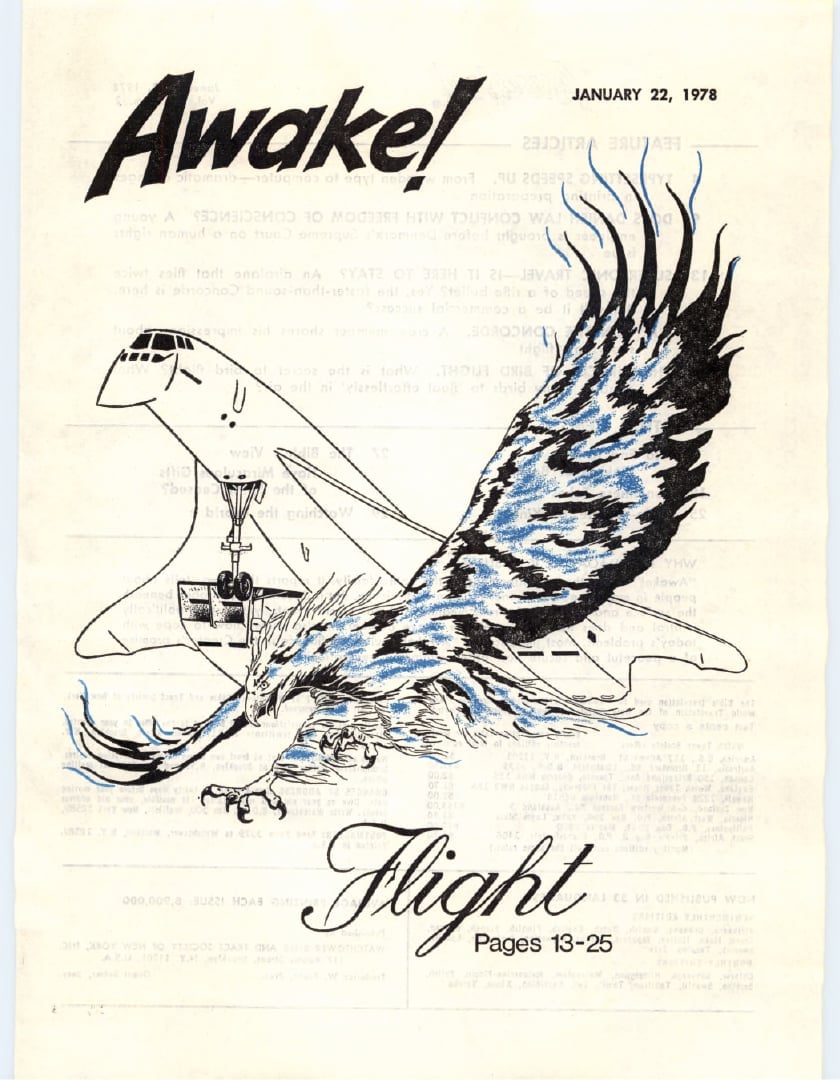
Awake! — January 22, 1978
Source: jw.org
Contents
Page Two
‘No End to the Making of Books’
Typesetting Speeds Up
Does Danish Law Conflict with Freedom of Conscience?
Loneliness Takes a Toll
Supersonic Travel—Is It Here to Stay?
I Fly on the Concorde
The Miracle of Bird Flight
Jade—Stone of Kings
Have Miraculous Gifts of the Spirit Ceased?
Watching the World
Does It Matter Which Bible You Use?
The Mysterious Beasts of Revelation
Page Two
Page Two
4 TYPESETTING SPEEDS UP.
From wooden type to computer—dramatic changes in printing preparation
9 DOES DANISH LAW CONFLICT WITH FREEDOM OF CONSCIENCE?
A young engineer is brought before Denmark’s Supreme Court on a human rights issue
13 SUPERSONIC TRAVEL—IS IT HERE TO STAY?
An airplane that flies the approximate speed of a rifle bullet? Yes, the faster-than-sound Concorde is here. But will it be a commercial success?
18 I FLY ON THE CONCORDE.
A crew member shares his impressions about supersonic flight
20 THE MIRACLE OF BIRD FLIGHT.
What is the secret to bird flight? What enables many birds to ‘float effortlessly’ in the air?
‘No End to the Making of Books’
‘No End to the Making of Books’
EVERY year billions of copies of books roll off the presses, eventually finding their way into homes, offices and libraries throughout the world. In the United States alone, each year sees the introduction of over 20,000 new books, not including textbooks and reference works. Add to this more than 8,000 reprints and revisions.
Clearly, no one person could ever hope to read all the books that have been published. In view of today’s fast printing methods, the following words written about 3,000 years ago are even more appropriate than when they were first recorded: “To the making of many books there is no end, and much devotion to them is wearisome to the flesh.”—Eccl. 12:12.
One “wearisome” factor is that publications dealing with the various fields of knowledge may present conflicting views. So, the person who centers his whole life around books can tire himself out reading, comparing and trying to resolve contradictions. Particularly when it comes to philosophical studies, often it is just a matter of one opinion versus another opinion.
Since a person obviously cannot survey the whole field of human knowledge and theory, he must be selective. Just what writings are most beneficial and can safely be used as a guide for life? Wise King Solomon, the one who wrote about the making of many books, provides the answer: “The words of the wise ones are like oxgoads, and just like nails driven in are those indulging in collections of sentences; they have been given from one shepherd.”—Eccl. 12:11.
According to this, the most valuable writings are those that originate or are in agreement with the “one shepherd.” Who is this “one shepherd”? King Solomon’s writings are a part of the Holy Scriptures and, therefore, the “shepherd” must be the one referred to in those Scriptures. At Psalm 23:1, for example, we read: “Jehovah is my Shepherd.”
In view of Solomon’s words, the greatest benefit comes from a careful study of the Scriptures that are inspired of God. This will not tire one out, as can vain efforts to resolve the conflicting theories of men. By putting the Bible’s guidelines into application, millions of men and women have come to appreciate the truth of what we read at 2 Timothy 3:16, 17: “All Scripture is inspired of God and beneficial for teaching, for reproving, for setting things straight, for disciplining in righteousness, that the man of God may be fully competent, completely equipped for every good work.”
The wisdom that is Biblically oriented can indeed affect us like the oxgoad mentioned by Solomon. This implement, the oxgoad, with its sharp metal point, is designed to prick a draft animal, prompting it to continue moving in a certain direction. Similarly, the words of those having godly wisdom can prick the listeners or readers to advance in harmony with the wisdom expressed, to their benefit. Also, persons who occupy themselves with “collections of sentences,” that is, truly beneficial wise sayings or proverbs, are like nails. How so? This is because nails can provide support for something or can stabilize it. Likewise, by their sound words of wisdom, “those indulging in collections of sentences,” can have a stabilizing and supportive effect on others.
Hence, do not permit yourself to be distracted by the multitude of books that are continually being printed. Take time to consider the most valuable book of all, the Bible, and publications that are in harmony with it. Then, concerning the Bible, you will not feel as did the American patriot Patrick Henry who, shortly before his death, said to a friend: “This is a book worth more than all the others that were ever printed. It is my misfortune not to have found time to read it with the proper attention and feeling till lately.”
Typesetting Speeds Up
Typesetting Speeds Up
By “Awake!” correspondent in South Africa
THE printed word is a permanent record of the spoken word. For that reason it is important. Understandably, it has become a part of our way of life. But just how is the printed word put together? You may have tinkered with a rubber-type kit at some time and, besides learning to mind your “p’s” and “q’s,” you probably have some idea of what type is and how the image is transferred to paper. The composing of type is a graphic art called typesetting. Because people are concerned mainly with the end product—the printed page—few are aware of the dramatic change that has taken place in this field in recent years.
Consider for a moment the page you are now reading. Notice how the type is set out in two columns; each line is exactly the same length and is aligned on a common base line. The overall effect of the page is an even-gray tone without blotches or black areas. This is the result of many years of refining and effort on the part of typographers, who have endeavored to produce text that is easily readable but not tiring or distracting to the eye.
The printing methods of today contrast sharply with the painstaking efforts required for type composition in years past. Before movable type came into existence in the fifteenth century, printing methods were inflexible and crude. For any practical purpose, duplication of a document had to be done by hand. One can only marvel at the scrupulous care and fidelity of the copyists in producing such works as the Alexandrine, Vatican, Sinaitic and other manuscripts of the Bible.
As the need for multiple copies developed, the concept of individual-letter type arose. This was more flexible and practical than the laboriously hand-carved wooden blocks containing an entire page or a section of one. The first known movable type was the invention of a Chinese alchemist of the eleventh century, who used a mixture of clay and glue, hardened by drying. But the process did not become widely used. The invention of a movable type that really came into practical use is generally attributed to Johannes Gutenberg, in Germany, about 1450 C.E. The printer could now assemble pages without great difficulty from cases of type blocks, and each letter was reusable. Though a slow process, founders’ type, as it is generally known, is still used by many printers.
Toward the end of the nineteenth century the need for a faster and more economical method of typesetting became urgent. An answer to this problem was provided by Ottmar Mergenthaler, who developed a fully automatic machine capable of casting an entire line of metal type from small brass molds that were assembled by means of a keyboard. Known as “Linotype,” this machine was acclaimed as the long-awaited answer for printers and publishers. Today improved versions of the Linotype are used throughout the world. Awake! is among many publications typeset in this way.
Though the Linotype was adequate for immediate needs, other successful typesetting machines made their appearance. Notable among these is the Monotype machine, which, as the name suggests, casts individual characters in metal type. Printers hold this machine in high esteem, as it is capable of producing type of superior quality and is especially suitable for intricate work.
Typecasting machines offer an advantage in that they are relatively simple in construction. They can be maintained by small establishments. After each use, the metal type is melted down and recycled.
However, in recent years a number of developments have caused many printers and publishers to take another serious look at the requirements of typesetting. What are these factors?
First, it was realized that the concept of metal type has an inherent disadvantage. It is inseparably bound by mechanical limitations. The casting of molten metal cannot be hastened beyond a point. Furthermore, the weight and physical nature of the type set limitations that, in turn, affect speed. Since the type is not the end product, it was argued, Could it not be dispensed with altogether? Was there not a more direct way to print? The realization of this possibility would, not only liberate the printer from the three-dimensional and mechanical restrictions, but open up to him the possibilities of utilizing other principles, such as light, magnetism and modern electronics.
About the middle of this twentieth century the climate was favorable for a change. The slowness of the typesetting process made it hard for printers to meet rapidly increasing demands. Problems were being experienced in obtaining skilled craftsmen, and strikes by militant workers did not improve the situation. On the other hand, photographic technology had increased to the point where it was possible to make etched plates from plastic or metal. These could be wrapped around the cylinders of conventional printing presses and used in a number of ways.
Furthermore, many printers found that, because of expansion, floor space was at a premium. Thousands of tons of printer’s metal lay tied up in pages of type, stored for future use. In many instances the factories covered the full limit of ground available. Might the solution to this problem not lie in expanding within the existing shell? The search for the answer pointed to the development and combining of two techniques, namely, the printing processes of lithography and phototypesetting. This is a natural marriage, as neither requires metal type and both are photographic by nature.
It was this realization that caused a flood of ideas, patents and machines to appear on the market. One survey showed that early in 1970 there were no fewer than 80 different photosetting machines on review. Caution in buying was justified, because newer and better models made their appearance with alarming regularity. Rather than purchasing a machine that would be outdated within a few months, many printers took a “wait and see” attitude, realizing, nevertheless, that a change was inevitable in the future. Andrew Bluhm, in his book Typesetting, summed up the position as follows:
“The pace of technological progress is now so rapid that printers and manufacturers are obliged to develop new methods and machines when their existing ones have scarcely had time to be introduced on a profitable scale and it’s all too often true to say, ‘if it works, it’s obsolete.’”
Despite the measure of uncertainty, one thing seemed clear: photosetting had made its mark and was there to stay.
Attractive features of phototypesetting systems are that they save both labor and time. Monotonous tasks and routine decisions are typically taken over by a minicomputer. The text is set on a keyboard, frequently without regard to line endings or hyphenation, simply indicating the typeface and size to be used and how long the lines should be. The composition computer then takes over, automatically composing lines to be typeset and generating commands necessary to drive the photosetter. The text must originate at a keyboard, however. No photosetter or computer can assume this basic function, nor can either one make up for inaccurate entry of the text on the keyboard. Human hands are still the initiating force.
To eliminate duplication of effort, since the keyboard operator usually copies already-typed material, machines such as the Optical Character Recognition (O.C.R.) units have been developed. These are capable of “reading” certain typewritten copy and translating it to a form that a computer can digest—usually from punched or magnetic tape. On the output side of the picture, the speed of the photosetters can be unbelievably high in relation to the fair rate of about two characters per second on a Linotype. Sophisticated photosetters are theoretically capable of setting as many as 10,000 characters per second, and speeds of 8,000 per second are commercially available. For good measure, they will also reproduce pictures!
Early in the race to compete with metal typesetters were the “strike-on” systems—so named because they operate much like a typewriter “striking” the image through a carbon ribbon onto paper. Though potentially efficient, especially when operated by computer, some systems are subject to rapid wear. This can have no small bearing on the quality of the type produced. Nevertheless, this is a very popular method of typesetting and is used extensively in the producing of newspapers and periodicals.
First-Generation Photosetters
As printers became more and more aware of phototypesetting, manufacturers intensified their interest in producing a machine that could set a type image efficiently, speedily and with knife-edge quality. Foremost among these manufacturers were the regular makers of type-metal casting machines. A number of successful photosetters were produced that closely resembled their “hot metal” counterparts. For this reason they are referred to as first-generation photosetters. Instead of molds and molten metal, the machines were equipped with film and image-bearing templates or matrices, as they are referred to. Though capable of setting type of good quality, these machines achieved no real advantage in speed. In most instances, they are operated directly from a keyboard and are limited to the speed of the operator. Swiftness was yet to come.
Second-Generation Photosetters
A distinguishing feature of the next generation of photosetters is the swing farther away from mechanical principles and the centering of emphasis on electro-optical technology. Also, because of the high setting speed, which may vary from 20 to 40 characters per second, a number of independent keyboards are required to generate enough text input to drive the machines efficiently.
Though varying considerably in approach, in the main these photosetters operate by projecting a filmed image of each character individually through lenses, after which it is flashed into position on a film, or on bromide paper.
Whatever the design, the heart of the mechanism lies in the matrix or image carrier. One system, for example, has eight complete typefaces located along the rim of a glass disk. As the disk revolves at high speed the light source flashes the image of the individual characters along a system of mirrors to a revolving turret containing lenses, where they are enlarged to the typographer’s preference. The same character can be reproduced in any of 16 sizes!
Other designers have located the light source within a revolving drum, the typefaces being located on the drum’s surface. As the drum spins, light is flashed through the characters on the drum’s walls and into the lenses. One ultrafast system is designed much like the honeycomb of a beehive. Each character, located within a grid, has an independent light source. Physical movement is kept to an absolute minimum. An advantage of optical systems is that the photo images of the letters are not subject to wear and tear as are the matrices of metal casting machines. Another advancement has been realized with the introduction of more flexible minicomputers. Instead of utilizing a computer system that is rigidly made to perform a present function, the computer’s capacity can now be used in a variety of applications by simply running a small program tape through the memory.
In this way, a computer with a small capacity can be used to its maximum advantage. In addition, the number of key strokes can be reduced by storing, in the computer’s memory, the routine instructions and even repetitious words, phrases and portions of the text of the material to be printed.
Third-Generation Photosetters
On a much larger scale, a third generation of machines has been developed. They are classified in this group because of the absence of almost all mechanical principles. Unlike second-generation setters that carry the image of the letters in a grid, or a rotating drum or disk, the characters are now recorded in digital form in a computer’s memory. This will allow access to thousands of characters at any one time, and at astounding speeds. When recalled, this information is amplified and converted to a visual type-image on a cathode-ray tube or screen, where it is photographed. Not dependent on visual origin, by electronic manipulation the type can be enlarged, expanded or condensed—even slanted into a pseudoitalic!
It is appropriate to ask, Has this brought the printer and publisher all the benefits they have sought? Admittedly it has done a great deal. It has been claimed that, in addition to increasing the typesetting capacity, about 40 to 50 percent of the existing floor space has been retrieved. Tons of idle printing metal have been released and the new equipment is about one eighth to one tenth the weight of equivalent “hot metal” machines. Also, the composing room has changed. A gloomy atmosphere has been changed into an officelike environment that is relatively noise free.
On the other hand, it has come at a price. Phototypesetters are not self-maintaining. Costs of materials and equipment escalate in proportion to the increased expansion and output. A breakdown with computerized equipment can be disastrous. Unlike the linecasting setters, which are usually maintained locally, technicians are required to handle even minor faults. To avert such disruptions, some printers have found it necessary to invest in backup equipment, which, with the high rate of obsolescence, has caused a situation where there is an overequipped potential when it is least desired. Many printers reason that they must accept the situation in order to stay in the race.
Whereas it is due to commercial pressure that many of these advancements in typesetting have been brought about, it is significant that they utilize laws and principles that already exist. Light, magnetism and the finest data storage systems are to be found throughout creation. After all, man can only copy and make application of the principles that the Creator himself has established.
[Diagram on page 7]
(For fully formatted text, see publication)
Light source
Matrix type image
Lens
Film or bromide paper
Does Danish Law Conflict with Freedom of Conscience?
Does Danish Law Conflict with Freedom of Conscience?
By “Awake!” correspondent in Denmark
IS Danish law in conflict with an internationally recognized principle of freedom? A decision handed down by the Supreme Court of Denmark some months ago seems to answer, Yes.
The principle is included in the International Covenant on Civil and Political Rights, to which Denmark subscribed in 1971. The principle holds that a person cannot be punished more than once for one violation of the law.
However, the Supreme Court of Denmark has decided that a person can be sentenced twice for the same violation. The decision involves those who are conscientious objectors to compulsory military or alternate service.
The Case
The matter began in a lower court. It involved the case of a young engineer, one of Jehovah’s Witnesses. Because of his strong belief in God’s laws, he conscientiously objected to military or alternate service.
The court sentenced the young man to jail. After serving his term, he was again called up for compulsory service. He maintained the same position based on his conscientious beliefs in God’s laws, and refused to be inducted. The court again sentenced him to prison, this time for a longer period, eight months.
However, this sentence was appealed to a higher court, the Superior Court, on the grounds that a person cannot be sentenced twice for the same violation. The court avoided taking a stand one way or another regarding the principle at issue. But it did shorten the prison term to three months.
The case was then appealed to Denmark’s highest court, the Supreme Court, on the grounds that the judgment should be declared void because the first punishment should have been sufficient. A second sentence violates the principle that Denmark agreed to when it signed the International Covenant on Civil and Political Rights.
What Others Have Done
In the young man’s defense before the Supreme Court, it was noted that a number of countries have changed their views on this matter. Years ago, many countries sentenced conscientious objectors who were Jehovah’s Witnesses to severe prison terms.
At times, the sentencing was done in such a way that the Witnesses were called up again and sentenced anew to an additional prison term. This was repeated, over and over. Many thus served between 10 and 20 years in prison because of this.
But gradually, in other countries, particularly in the Western world, many authorities felt a growing distaste for such heavy sentences. They saw the unreasonableness of sending to prison young men whose only conflict with the law was on the matter of faith and conscience.
Hence, many lands have since modified the punishment for conscientious objection. For example, in the Netherlands, officials have chosen not to sentence such conscientious objectors who are dedicated Jehovah’s Witnesses. In Sweden, the authorities make a separate investigation in every case of a conscientious objector who is a Witness. On the basis of the investigation, the government decides not to call up the Witness at present. This procedure has been followed for 11 years, and a recent investigation has led to the suggestion that Jehovah’s Witnesses be exempt from being called up in the future.
Also noted were the actions of the constitutional court of the Federal Republic of Germany. Several years ago it handed down a decision that freed Jehovah’s Witnesses from being sentenced more than one time. This decision rested on the principle ne bis in idem, that is, double jeopardy. This principle holds that a person cannot be put on trial and punished more than once for the same violation.
Also, the country of Greece has recently modified the punishment for conscientious objectors, and now a law requiring that conscientious objectors who refuse to serve in the army due to their religious beliefs be sentenced to a prison penalty also stipulates that, when released from prison, they are to be exempt from such service or training.
Thus, the attorney for the defense asked the Danish Supreme Court: “How can it be that Jehovah’s Witnesses in Germany can be released on the basis of this principle, but not in Denmark?”
Law Improperly Framed
The thought was expressed to the court that the members of Denmark’s parliament may not have been aware of the fact that this legal principle against double jeopardy was included in the International Covenant that Denmark signed. Had they been aware of it, then a 1975 change in the military law allowing for repeated convictions likely would not have been made. The law would have been formulated in another way to incorporate the fine principle of the International Covenant regarding double jeopardy.
True, this change in Danish military law might now allow for repeated convictions of conscientious objectors. But it should not be interpreted that way in view of the covenant, the attorney for the defense told the court.
He also asked if it was not the responsibility of the Minister of Interior (who called up the conscientious objectors twice) and the responsibility of the Minister of Justice (who brought charges against them twice) to see that the law was not interpreted wrongly.
Respect for Human Rights
The point was made to the court that demands have been raised internationally that human rights be respected. It has become a major issue world wide. In view of this, should not a country such as Denmark follow principles protecting human rights where conscientious objectors are concerned, just as do Sweden, the Netherlands and the Federal Republic of Germany?
It was observed that the issue of human rights includes the mistreatment of Jehovah’s Witnesses. For example, in an opinion before the court, Professor Erik Siesby of the University of Copenhagen remarked: “The treatment of military objectors, especially persons who, as members of Jehovah’s Witnesses, are military objectors on the grounds of conscience, is right now the subject of international investigation and debate.”
Professor Siesby said that the case before Denmark’s Supreme Court “will arouse international attention, and the decision will become a significant interpretative basis, among other things, in relation to the International Covenant on Civil and Political Rights.”
Yes, other nations will see how Denmark has handled the cases of these conscientious objectors. And even those who have signed the covenant on civil and political rights may view Denmark’s decision as a precedent, a very bad one, for handling their own conscientious objectors.
Why Punished Twice?
But why are Jehovah’s Witnesses punished twice for the same violation in Denmark?
The defense attorney for Jehovah’s Witnesses offered some thoughts on this to the Supreme Court. He stated: “Repeated punishing of military objectors, who are motivated by their religious conviction, can be rationally explained as an expression of doubt on the part of the authorities as to the strength, seriousness and perseverance of the religious conviction. By calling up again a member of Jehovah’s Witnesses who has already served his punishment for military objection, with a renewed threat of punishment, is expressed the hope that either the sentence served will cause the convict to change his mind, or that the renewed threat of punishment will cause him to abandon his conviction or to act in conflict with it.”
However, the court was told that Jehovah’s Witnesses do not abandon their convictions based on God’s laws. For example, the accused in this case wrote a letter to his conscription board while he was serving the first sentence. His letter was read aloud to the court. He stated: “I will not change my stand even though you sentence me to several hundred years in prison.”
An additional negative factor in repeated punishment is that it brings greater interference in the life of a person than does one combined sentence. With one sentence served, the person can then resume his normal life. But repeated sentences leave the person in a constant state of uncertainty, greatly disrupting his life.
Thus, the Dutch lawyer Hein Van Wijk, considered the person best acquainted with the legal treatment of conscientious objectors in Europe, fittingly compared the practice of sentencing objectors several times to a cat playing with a mouse.
Decision Handed Down
The appeals and reasonings proved futile. Denmark’s Supreme Court handed down its decision confirming the judgments of the lower courts. The conviction would stand.
The court also added that the prison sentence should be changed from three months back to eight months! And the accused was ordered to pay all the costs incurred in the case.
Does this decision of Denmark’s Supreme Court show that Danish law violates the principles of the International Covenant on Civil and Political Rights? Does the decision violate common decency as well? Impartial observers agree that it does.
[Blurb on page 10]
“The case was then appealed to Denmark’s highest court, the Supreme Court, on the grounds that the judgment should be declared void because the first punishment should have been sufficient.”
[Blurb on page 11]
“The treatment of military objectors, especially persons who, as members of Jehovah’s Witnesses, are military objectors on the grounds of conscience, is right now the subject of international investigation and debate.”—Professor Erik Siesby, University of Copenhagen
[Blurb on page 11]
“His letter was read aloud to the court. He stated: ‘I will not change my stand even though you sentence me to several hundred years in prison.’”
Loneliness Takes a Toll
Loneliness Takes a Toll
THE mortality rate among unmarried persons is significantly higher than for married people in the same age groups, says Dr. James Lynch of the University of Maryland. A study of statistics on deaths from various causes in the United States indicates that mortality rates for widowed and divorced persons are particularly high.
For example, death from heart disease is two to five times higher for the unmarried. Suicides and time spent in mental institutions and prisons are much higher for unmarried persons. The study shows that bachelors had 23 times more chance of spending time in a mental institution than did married men, and unmarried women 10 times more than married women. The detention rate in prison was 20 times higher for divorced men than married men, 18 times higher for separated men, and seven times higher for widowed men.
Evidently, loneliness, without hope for a better future and without helpful and loving associations, brings mental and emotional anguish that shortens life.
Supersonic Travel—Is It Here to Stay?
Supersonic Travel—Is It Here to Stay?
A NEW age in aviation began on January 21, 1976. Two sleek, beak-nosed planes, one in London, the other in Paris, raced down their runways for near-simultaneous takeoffs. Commercial supersonic air travel in the Western world was inaugurated!
The plane taking off from Paris was on its maiden flight to Rio de Janeiro, Brazil, by way of Dakar, Senegal. As the aerial speedometer (called a Machmeter), within view of passengers up front, reached the speed of sound, one of them reported: “There were gasps and cheers. Then came an announcement from the cockpit: ‘Ladies and gentlemen, you have just become the first 100 passengers in the history of the world to pass the speed of sound in a scheduled flight.’”
Actually, the Soviet Union began supersonic service first—with its TU-144, in December 1975—but it was for mail and cargo only. Not until November 1977 did the Soviets commence scheduled supersonic passenger service from Moscow to Alma-Ata in central Asia.
The plane that inaugurated supersonic passenger service is the Concorde, produced jointly by Britain and France. Sixteen Concordes either have been built or are under construction, and nine are now in service.
In their first year the Concordes had 45,000 fare-paying passengers. There would have been many more if it had not been for the great opposition to these planes. Regular flights into the Washington, D.C., area were not permitted until May 24, 1976. And it was another year and a half before scheduled flights were allowed into New York city late in 1977.
Why is there opposition to supersonic passenger jets? Is the continuance of their service really in jeopardy? What are the advantages of supersonic travel?
Faster than Sound
The obvious advantage is speed, getting places faster. Generally, flight in a subsonic jet from Paris to Washington, D.C., takes between seven and eight hours. However, a Concorde passenger observes: “Air France’s Concorde Flight 53 departed Charles de Gaulle Aeroport [Paris] at 8:00 P.M. and touched down at Dulles International Airport [near Washington, D.C.] at 5:55 P.M. . . . The trip had taken precisely 3 hours, 55 minutes.”
That’s right, passengers traveling westward on the Concorde actually reach their destinations at an earlier hour than when they departed. This is because the Concorde flies faster than the sun moves across the sky. Thus, one can leave Europe after watching a sunset and arrive in the United States during daylight and watch the sun set again that same day! Or one can leave Paris during the early morning of, say, January 22, and arrive in New York on the night of January 21.
The Concorde cruises at the approximate speed of a rifle bullet. Less time in flight reduces travel fatigue, and this is cited by passengers as a real advantage. Little passenger comfort is sacrificed; it is comparable to that experienced in other airliners. One traveler declared: “Once you’ve gone Concorde, you’ll never go any other way.”
Public preference has long been for an aircraft with a speed advantage. In the 1930’s the DC-3 made the Boeing 247 obsolete by cutting the flying time across the United States from 19 hours to 15. After World War II, passenger planes kept getting faster and faster. Then, in 1958, when passenger planes began to employ jet propulsion, flying times suddenly were reduced even more, and piston-engined planes became obsolete.
Jet passenger planes soon began approaching the speed of sound. And, in view of the military’s development of supersonic planes, it seemed only logical that civilians, too, should travel faster than sound.
The Sound Barrier
In warm air at sea level sound travels about 760 miles per hour (1,220 kilometers per hour), while at a height of about 37,000 feet (11,200 meters) the speed is only 660 miles (1,060 kilometers) per hour. Air has great elasticity, and when a plane is moving at slower speeds air molecules move fast enough to get out of the plane’s way. But when the speed of sound is reached this is no longer true.
A supersonic aircraft overtakes the moving air molecules and compresses layers of air in its flight. This produces great frictional forces that cause strong vibration and heating of the plane’s outside surface. As a result of the tremendous air resistance, many once thought that there was a so-called “sound barrier” that could not be broken.
However, improved design of aircraft reduced friction and eventually made it possible to surpass the speed of sound. This was first accomplished by a manned aircraft—a rocket plane—on October 14, 1947. But it was not until 1953 that the North American F-100 Super Sabre jet fighter became the first jet to fly faster than sound in level flight. By the late 1950’s, supersonic military planes had come into use. In tests during the early 1960’s, a DC-8 became the first passenger liner to break the sound “barrier.” By that time supersonic passenger planes were already on drawing boards.
Development
The Soviet Union, the United States, Britain and France were all interested in building such a plane. Due to the size of the undertaking, Britain and France signed an agreement on November 29, 1962, to coordinate their efforts. At the time it was anticipated that there would be a world market for up to 500 supersonic passenger planes. A British Aircraft Corporation sales manager was predicting sales of 225 Concordes by 1975.
In time, preproduction models of the Concorde were produced. The first one flew on March 2, 1969, and in 1970 supersonic speeds were first attained. But there were problems that kept running up production costs. At the same time, opposition to the whole idea of supersonic flight became very strong. Thus in the spring of 1971 the U.S. scrapped its plans for the project when, after spending nearly $1 billion, Congress cut off all further government funding.
The hoped-for sales of the Concorde did not materialize. The highest number of options to buy them was only 74. Then, on January 21, 1973, a major blow came when Pan American World Airways and Trans World Airlines canceled their options to buy 13 planes. Other carriers later also dropped options to buy. Thus, besides British Airways and Air France, which are the only airlines that have Concordes, only Red China and Iran National Airlines still have orders to buy them.
Another major blow fell in June 1973. It occurred during the Paris Air Show. The Soviets were demonstrating a preproduction TU-144 supersonic plane when it crashed and killed at least 13 persons. This worried those who still had options to buy Concordes; they wondered about its safety too. Also, the Soviet program was set back, so that the Soviets were eventually almost two years behind the British and French in initiating supersonic passenger service.
On December 6, 1973, the first production Concorde began flying. Flight tests took it all over the world. It visited over 40 countries and landed at 70 international airports. After over 5,000 flying hours the plane was given a certificate of airworthiness and, as already noted, began regular air service in January 1976.
Travel by Concorde means that a person is less than 12 hours away from practically any place on earth. It often cuts in half the time it takes other planes to get to places. Why, then, is there such strong opposition to its operation?
Possible Atmospheric Damage
At a height of about six miles (10 kilometers) over the poles and 10 miles (16 kilometers) over the equator the stratosphere begins. From there the stratosphere extends up to about 30 miles (50 kilometers). Its lower layer remains cold and clear, and this is where the supersonics fly. Scientists, however, see the possibility of the planes’ polluting this atmosphere, perhaps disastrously affecting life on earth.
Some have said that nitric oxides emitted by the jet exhausts could degrade the stratosphere’s ozone. The ozone provides a protective umbrella to prevent excessive ultraviolet radiation from the sun from reaching the earth. According to some estimates, only a small decrease in the ozone could result in a big increase in the amount of ultraviolet radiation reaching earth. With what consequences?
Food crops, forest ecology, insect life, plankton in the oceans and, of course, human life could be adversely affected. In fact, some have feared that even a limited six flights a day of the Concorde could lead to an increase of skin cancer. Of course, this is only a speculation, but certainly it is one for consideration.
A U.S. senator, however, notes that military planes have made more than a million supersonic flights without any apparent damage to the ozone layer. If supersonic flights are really a serious potential danger, why not ban military supersonics? The following letter to the New York Times makes a worthwhile point about this:
“It is with some amazement that I realize the Senators and Representatives who voted to ban the SST [Supersonic Transport] because of its effect on the ozone layer are the same people, by and large, who have voted to approve funds for the B-1 bomber—$21 billion for the production of 244 supersonic bombers. The media also has kept a low profile on the fact that for more than a decade there have been regular and very numerous supersonic military flights . . . It seems very hypocritical to me to vote to ban one without banning the other.”
However, the opposition to the Concorde—which has taken the form of demonstrations that clogged roads leading to New York’s Kennedy Airport for hours—is based primarily on another objection—Noise.
Noise Pollution
Anyone who has spent time close to a modern airport can surely sympathize with persons who have to live close to one. The whining and screaming of modern jets can be deafening. And the Concorde has the reputation of being the loudest of them all, although its noise is somewhat different.
“It’s a lower, deeper sound,” observes Dexter Davis, manager of Dulles Airport near Washington, D.C. “I find it much less irritating than a whining sound.” A resident near London’s Heathrow Airport says: “I know when it’s a Concorde. The noise is totally different. The windows shake in our porch from vibration. And when I am at my friend’s house in Hatton Cross I have to cover my ears with my hands.”
There are differences of opinion regarding the objectionableness of the supersonics as compared with other jets. The Wall Street Journal commented editorially: “Those of us who have heard the Concorde land and take off can distinguish very little difference between its noisiness and the noisiness of a 707.”
However, the Concorde often registers more noise than other jets. Yet the New York Post of November 4, 1977, reports: “The Federal Aviation Administration said yesterday that the average noise level at each of seven locations where it took readings during test flights [of the Concorde] was within acceptable limits.”
Surely, though, this is little comfort to persons living near airports. Already they suffer with noise that they, and probably anyone else living where they do, would consider unacceptable. And now the prospects of an aircraft, even noisier, landing and taking off is understandably a reason for them to wish they could move away.
Sonic Boom
Opposers of the Concorde also point to the sonic boom it produces. As military supersonics have demonstrated, the “booms” can be strong enough to shatter glass. “They sound very much like exploding bombs,” writes one person, “causing the curtains of my bungalow to blow inward and parts of the building to creak.”
Sonic boom is caused as an aircraft traveling faster than sound compresses the air. This suddenly compressed air forms shock waves that can be heard and felt miles away. It is similar to thunder; in fact, the noise caused by a lightning stroke is also a sonic boom.
A common misconception about an aircraft’s sonic boom is that it is produced only at the moment that the plane passes the “sound barrier.” Actually, as the plane travels along at supersonic speeds, the boom is continuous. It can be heard on the ground 10 miles (16 kilometers) below by persons who happen to be living in a wide area along the flight path of the plane.
Obviously sonic boom can be very objectionable. So Concordes fly principally over oceans where the shock waves do not disturb anyone or cause damage. When the planes near populated areas they slow down to below the speed of sound in order to avoid producing sonic boom. Thus the Concorde is limited principally to overseas routes. Because of this limitation, other jets can provide service about as fast over populated land areas, and for a much cheaper fare.
Here to Stay?
This is a meaningful question, and principally because of this very matter of money. Over the years the French and British governments have spent over $3 billion to develop the Concorde. One now costs about $80 million, or almost twice as much as a jumbo jet. Further, for the number of passengers carried, it also is more costly to operate a Concorde than other jets.
A Concorde is only a third the size of the jumbo 747 jet, and carries fewer than a third the passengers. So the cost is about 20 percent more to fly on the Concorde than to fly first class on other jets. A round-trip flight between New York and London is $1,586, compared to first-class round-trip seats on other jets for $1,312, and about $700 for tourist-class fare.
The question is: Will persons be willing to pay the extra money to get places faster? So far it has not looked good. Supersonic flights have not made money. In fact, in 1976, the two airlines flying Concordes lost a combined total of $54 million!
A particular problem is that presently few routes are serviced by the Concorde. British Airways has flights to Washington, D.C., to Singapore and to Bahrain, on the Persian Gulf. And Air France has been flying to Washington, D.C.; Caracas, Venezuela; and Rio de Janeiro, Brazil. Only since November 1977 have the two airlines been able to begin flights between their national capitals and New York city.
It is obvious that to remain operational the Concorde needs regular routes to important business and population centers such as New York. But a major shortcoming is Concorde’s lack of range. With a capacity load of about 100 passengers, it can barely carry fuel sufficient to make it from Paris to Washington, D.C.
Thus the problems of the Concorde are serious. It probably means that no more than the 16 Concordes will be built. Yet, because of public preference for speed advantage, it seems likely that supersonic aircraft will continue to fly. In fact, in November 1977 the U.S. National Aeronautics and Space Administration awarded Lockheed-California Company a new $270,000 federal contract to study the design of a yet more advanced type of supersonic aircraft.
The proposed new plane would carry 200 passengers at a cruise speed of 4,000 miles (6,440 kilometers) per hour. Its range would be 6,000 miles (9,660 kilometers), and it would fly at about 120,000 feet (36,500 meters), at which altitude the sonic boom would not be objectionable by the time it reaches earth. It will be interesting to follow further developments in supersonic travel.
[Picture on page 17]
The “sonic boom” is heard along the flight path wherever the shock wave intersects with the ground
I Fly on the Concorde
I Fly on the Concorde
As told to “Awake!” correspondent in the British Isles
ALMOST two years ago I was transferred to work as a cabin crew member on the Concorde. First, each crew member received special training for the job. This meant going back to “school,” where the new meal-service routines, equipment handling, crew duties and safety procedures had to be learned in a training center close to London’s Heathrow Airport.
At this training center there is a “mock-up” or exact replica of the forward galley (kitchen) and part of the cabin of the aircraft. Even the angle of the floor is slightly tilted to simulate the true flying attitude. Here the crew can serve a group of “passengers” without leaving the ground. Thus, before actually flying, the crew will have served meals, become familiar with the oven timings and learned to work in the space available on the real aircraft.
Then came the time to see the Concorde while it was in the hangar. One is impressed by its streamlined shape. It conveys the idea of speed even when standing still. Because of its drooped nose, so clearly seen during takeoffs and landings, the aircraft reminded me of a fast bird of prey—an eagle. The plane certainly has an outstanding and distinctive design.
First Flight
The Concorde’s cruising speed is around 23 miles (37 kilometers) a minute, twice the speed of sound. Its cruising altitude is between 50,000 and 60,000 feet (15,240 and 18,250 meters). Yet, the cabin is pressurized to correspond to the comfortable air pressure encountered at an elevation of 5,550 feet (1,700 meters).
Compared to more conventional aircraft, the Concorde’s takeoff and climb is extremely rapid. Soon one is up above “the weather” in brilliant sunshine. But when looking out of the windows, a person may be surprised to see that the sky is a very dark blue. This may well bring to mind the phenomenon of the “black” sky reported by the first astronauts on their trips farther into space. The changes in color take place because the higher the altitude the less dense the atmosphere. Hence, the marked scattering of the blue elements in the sun’s light, so evident at ground level, is greatly reduced the higher one goes. Too, at our flying altitude, the curvature, or “circle,” of the earth becomes very noticeable, even as the Bible accurately observes.—Isa. 40:22.
On account of the high speed of the Concorde, the temperature on the nose of the aircraft reaches 127 degrees Celsius (261 degrees Fahrenheit), when the outside air temperature is −52 degrees Celsius (−65 degrees Fahrenheit). The outside skin of the plane gets almost as hot as the nose. This is due to the great friction when the plane flies faster than the speed of sound. But the high temperature has no adverse effect on the aircraft’s special structure.
A Machmeter, showing the craft’s air speed relative to the speed of sound, is in the cabin so that we can tell how fast we are flying. There is no sensation at all of rapid travel while cruising. But, when accelerating through the sound barrier, the feeling is rather similar to a slight nudge in the back, comparable to an automatic gear change in a car.
Food on Board
Because of the short flight, the type of meals served had to be planned carefully by chefs and a staff having many years of experience with flying. Also, because of the limited space available, the catering equipment was an important detail to be considered. The high-quality food served—not on plastic but on china—is complemented by excellent French wines in specially designed glassware used exclusively on the Concorde. Five courses ensure that passengers are well satisfied during each flight. Champagne can also add to one’s enjoyment of the meal, giving a distinctive French flavor to this Anglo-French undertaking.
I have enjoyed working on this first supersonic passenger aircraft, for it is an advancement over other forms of air travel. But I am also grateful because by being on the Concorde I am able to attend meetings of Jehovah’s Witnesses more regularly than would be possible if I had been working on other aircraft. Bible studies at home can also be held on a more regular basis, as Concorde trips are more standard in length and in time away from my family. So, my association with the Concorde is beneficial and rewarding.—Contributed.
[Box on page 19]
Why is the Concorde’s nose different on pages 13 and 18?
To ensure maximum pilot visibility the nose is lowered on takeoff and landing. But when flying it is raised to streamline the aircraft for supersonic speed
The Miracle of Bird Flight
The Miracle of Bird Flight
By “Awake!” correspondent in Australia
A CROWD gathers at Stirling Castle in Scotland to witness a spectacular event. There on the roof is an Italian alchemist who had announced that he would fly to France using specially designed wings well endowed with bird feathers.
He is off! But where does he alight? At the foot of the castle, with a broken thigh bone! So ended a sixteenth-century attempt to imitate the miracle of bird flight.
People have always been fascinated by the flight of birds. About three thousand years ago a keen observer of the world around him stated that “the way of an eagle in the heavens” was just “too wonderful” for him to understand.—Prov. 30:18, 19.
Many persons long felt that if man simply possessed feathers like a bird and flapped wings up and down he could fly. However, over the last two centuries or so, man has come to realize that birds are more marvelously equipped for flight than previously thought. This unique equipment includes their feathers, wing shape, specialized muscles, body shape, bone structure and, of course, their instinctive ability to handle the many variable factors of flight. Man has learned much from the birds, and he has invented machines that can clumsily imitate their flight. But he is just not designed to fly as they are!
The Need to Fly
Man, of course, does not need to fly to survive, although most birds do. They are very active creatures, requiring large quantities of food. For example, their hearts beat between 200 and 1,000 times per minute, and they have a body temperature of between 102 and 112 degrees Fahrenheit (39 and 44 degrees Celsius). It has been estimated that the common swift may fly 12 to 14 hours daily at speeds of about 40 miles (65 kilometers) per hour in normal hunting flight. When feeding its young, this bird may cover about 600 miles (960 kilometers) a day.
For short periods, some birds can fly at tremendous speeds. Falcons have been known to dive at about 180 miles (290 kilometers) per hour. In India, spine-tailed swifts have been timed at about 200 miles (320 kilometers) per hour.
As an observer watches a bird fly so effortlessly, he cannot help but wonder: How do birds do it? How do they manage to stay up in the air?
The Secret of Flight
Although we cannot see the air around us, we know that, when it is in motion, it can be very powerful. In a storm, trees can be uprooted and roofs can be lifted off houses. Similarly, air moving around the specially shaped wings of a bird provides enough upward lift to counter the pull of gravity and prevent the creature from falling to the ground. Without the effect of moving air, a bird would drop to the ground like a stone.
A bird’s wing is so shaped that the air must travel farther over the top of the wing than underneath it. Hence, the air above the wing travels faster to ‘catch up,’ as it were.
Due to increased speed, the air above the wing is “thinner” than the air below. The compressed “thicker” air under the wing exerts greater pressure and pushes the bird up, providing the needed lift. Something similar occurs when you drink with a straw. As you suck on the straw, you are thinning out the air inside the straw. The normal air outside is then “thicker” and pushes the liquid up the straw.
The air striking the underside of the bird’s wing also tends to lift it. At the same time, however, the creature has to use some of its strength to overcome the air’s dragging effect.
To get airborne, a bird usually jumps into the air, flapping its wings. At first it may seem that the bird just flaps them up and down. But closer investigation reveals that this flapping flight is far more complex. The bird pulls its wings down and back with the feathers tightly closed and wings outstretched, thereby pushing as much air as possible. Then it pulls the wings forward and up with the feathers separated to allow the air to pass through. The wings are also pulled in close to the body so that there is minimum air resistance.
Wing movement provides lift as well as the propulsion needed to overcome “drag” and to gain speed. The bird’s wing movement might be compared to a swimmer’s doing the “butterfly stroke.” His arms rotate around his shoulder joint, as he throws them forward through the air and then pulls them back through the water. Flight, however, is far more complex, involving the rotation of the wing and the relative movements of various parts of it.
The faster the bird travels, the more lift will come from the air passing around the wings. It has been calculated that a pigeon first taking off uses five times as much energy as when it reaches steady flight.
With most larger birds, the increased wingspan is still not large enough to cope with their extra weight and greater drag, especially when taking off. So some of these, such as the pelican, run on the ground for a few feet to gain speed for lift. Others, such as the vultures, land on a tree or fence and then, by jumping off, gain enough speed through the pull of gravity for their wings to provide lift.
The heaviest bird that can fly is the trumpeter swan, weighing up to 40 pounds (18 kilograms). Heavy birds are limited in the amount of flapping they can do because of the strenuous effort involved. However, this does not restrict their ability to fly, for they are masters of another form of flight.
Soaring and Gliding
Large birds can fly for hours over great distances with hardly a movement of their wings due to their use of air currents. We might draw from common experience to illustrate what these currents are. Whenever you put your hand above something hot, you can feel the warm air rising. Similarly, when the sun heats the earth, some areas heat up more than others, depending on the nature of the surface. This causes the air above the surfaces to rise, producing a strong current of air, even though on the ground everything may appear quite still. These updrafts, called “thermals,” are doughnut-shaped bubbles of hot air and have been known to rise to heights of 10,000 feet (3 kilometers).
Another way an updraft is produced is when the wind strikes a hill or a mountain. The wind is forced up the mountainside, and this air movement continues past the mountaintop.
When a bird finds an updraft that is rising at a faster rate than the bird would be descending, it can “ride” on it, usually circling as it goes, to stay within the rising air. Like a sail, the outstretched wings catch the updraft. Thus birds can gain altitude with virtually no effort. This type of flight is called “soaring.”
Associated with this is “gliding” flight, in which the bird descends with its wings outstretched and all surfaces expanded to slow its descent. The best gliders can travel a distance of about 20 times the altitudes from which they start to descend.
Gliding birds, such as vultures, gulls, pelicans, hawks and eagles, can travel vast distances with very little effort by rising in one updraft and then gliding till they reach another. Through wing movements they can just hover at the same height in an updraft or change from a glide to a soar in an instant. Some bird varieties can travel this way at speeds of 30 to 50 miles (48 to 80 kilometers) per hour for most of the day, thereby conserving their energy. Usually one can tell when birds use this type of flight, for they will circle for a while as they rise and then change into a long, straight glide.
Birds such as the albatross are experts at handling the strong winds over the ocean. With the wind behind it, the albatross starts a long glide toward the water’s surface, gathering speed. A few feet from the water it turns into the wind and is lifted up by it, gaining altitude but losing speed. Then it turns and starts the cycle again. By adjusting the distances traveled in any part of this cycle, the bird can travel in any desired direction. By this technique, the royal albatross, for example, can travel at 50 to 70 miles (80 to 110 kilometers) per hour for long periods. The only effort required is that the bird must keep its wings extended and occasionally flap them once or twice.
Since flapping requires great amounts of energy, large birds use soaring and gliding whenever they can. They use flapping mainly to move from perch to perch and to assist in their takeoff. These birds beat their wings only from one to three times per second, while most songbirds beat about twice that fast. A hummingbird, just two inches (5 centimeters) long and weighing only one tenth of an ounce (3 grams), beats its wings 60 to 70 times per second. It can hover like a helicopter and is the only bird that can actually fly backward.
The Art of Turning and Landing
The control that birds have in the air is amazing. They can turn by beating one wing more rapidly than the other. This also causes the wing to be lifted up, enabling the bird to turn quite sharply. The tail feathers also play their part in this. Additionally, they help to provide balance and act as a brake when needed. The way birds dart in and out, dodging branches and avoiding near collisions with one another, shows that they are indeed masters of the air.
As far as landing is concerned, birds possess all the essentials to accomplish almost unbelievably perfect landings. A bird must consider its height, speed and direction and any wind currents so that it does not hit the ground hard or topple over on landing. Some heavier birds must run along a few feet to keep their balance.
Birds skillfully use their wings and also their tails to reduce speed and control the landing, enabling them to descend on a branch in such a way as barely to disturb it. This is quite an acrobatic feat when one considers the speed at which they approach the landing spot. Sometimes birds actually beat their wings opposite the direction of flight to slow themselves down quickly.
Marvelously Designed
That birds are designed for flight is very evident when we look at their bone structure and covering. They have an upper arm fitting into a shoulder joint and a two-boned forearm. Because of the way the bones are connected, they move freely up and down and can also turn. The bird’s chest bone, instead of being flat like ours, is shaped like the keel of a boat. This provides a large area for the specialized and extremely powerful flight muscles to be attached on both sides of the chest bone.
The bones themselves are ideally designed. They are mainly thin-walled tubes, or, in the case of larger birds, are delicately strutted on the inside. As a result, the bones provide light yet extremely strong support. For instance, the whole skeleton of a frigate bird, with a seven-foot (two-meter) wingspan, may weigh as little as four ounces (113 grams). The larger bones also contain air sacs. These sacs are ancillary, or supplementary, to the lungs and, as needed, provide an extra oxygen supply for sustaining a bird’s high rate of activity.
…