Awake!, August 22, 1976
Download: PDF — Awake!, August 22, 1976
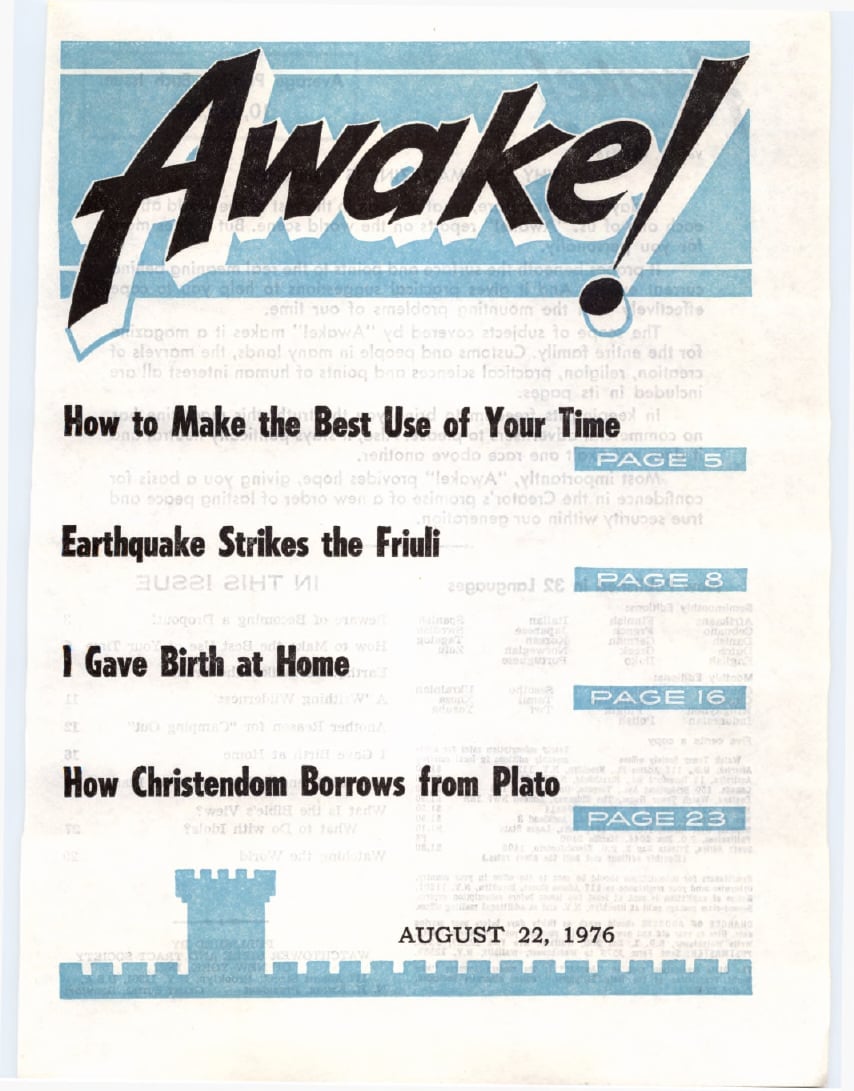
Awake! — August 22, 1976
Source: jw.org
Contents
Beware of Becoming a Dropout!
How to Make the Best Use of Your Time
Earthquake Strikes the Friuli
A ‘Writhing Wilderness’
Another Reason for “Camping Out”
I Gave Birth at Home
How Christendom Borrows from Plato
What to Do with Idols?
Watching the World
Do You Read Signs?
Why Does God Permit Wickedness?
Beware of Becoming a Dropout!
Beware of Becoming a Dropout!
‘WHEN my son shuffled into the kitchen, still in pajamas although it was past noon, I wanted to take him by the shoulders and shake him until his teeth chattered. I knew he would lie around most of the afternoon listening to rock records on his stereo set until, in a burst of energy, he’d pull on jeans and a sweater and zoom off to town on his motorbike. My son had dropped out of college completely. He had simply given up and chosen, as far as we could see, to spend the rest of his life drifting aimlessly.’a
Does this experience of a concerned parent sound familiar to you? Today large numbers of people are ‘dropping out,’ not only from school, but even from the most basic responsibilities, such as those associated with marriage, family life and with working to earn a living. What causes individuals to become dropouts?
Many complain of feeling as if they were on a treadmill, expending vital energy each day but ‘getting nowhere.’ For such people life lacks purpose. To escape frustration they simply drop out from what they may like to call ‘the system.’
Does getting frustrated with human pursuits indicate serious defects of personality? Not necessarily. The Bible acknowledges the frustrating nature of most human endeavors, saying: “I saw all the works that were done under the sun, and, look! everything was vanity and a striving after wind.” (Eccl. 1:14) As to ‘getting ahead’ in this world, the same Bible writer declares: “I myself have seen all the hard work and all the proficiency in work, that it means the rivalry of one toward another; this also is vanity and a striving after the wind.”—Eccl. 4:4.
The solution, however, is not to be found in dropping out, drifting aimlessly. Humans need a purpose in life, something that gives them a sense of worth. The Bible provides for this. And in doing so, it outlines a marvelous hope for the future of all mankind.
Did you know that the Scriptures foretell that God will soon destroy the present frustrating system of things and replace it with a new one in which “righteousness is to dwell”? (2 Pet. 3:11-13) At that time God “will wipe out every tear from [mankind’s] eyes, and death will be no more, neither will mourning nor outcry nor pain be anymore.” (Rev. 21:4) Is that not the best of news? But when will it take place?
As a ‘sign of the conclusion,’ or final time period of the present system of things, Jesus foretold unprecedented wars, food shortages, epidemic diseases, increasing of lawlessness and other frightful woes. (Matt. 24:3-12, 34; Rev. 6:1-8) Mankind has seen these things on a world scale since the year 1914. Together with fulfillment in our day of numerous other Bible prophecies, the occurrence of the sign that Jesus gave means that we are now more than sixty-one years into “the last days” of this system. (2 Tim. 3:1-5) This opens up the opportunity for people today to have a marvelous purpose in life. How so?
Because Jesus foretold, as a further feature of the ‘sign of the conclusion,’ that “this good news of the kingdom will be preached in all the inhabited earth for a witness to all the nations; and then the end will come.” (Matt. 24:14) More than 2,000,000 individuals in 210 lands and islands of the sea are accomplishing this worldwide witness work today.
But even preachers of the “good news” face the danger of becoming dropouts. Why? Because they frequently encounter indifference and sometimes outright opposition to their message. This can be discouraging, as was the case with Jeremiah, who wrote: “The word of Jehovah became for me a cause for reproach and for jeering all day long. And I said: ‘I am not going to make mention of him, and I shall speak no more in his name.’”—Jer. 20:8, 9.
Might preachers of the “good news” today become similarly discouraged? In his great prophecy about the “conclusion of the system of things” Jesus forewarned his followers: “Then people will deliver you up to tribulation and will kill you, and you will be objects of hatred by all the nations on account of my name.” (Matt. 24:3, 9) How should they react?
Consider the example of Jeremiah. He refused to become a dropout. He knew that people needed to hear God’s message. “In my heart,” continues Jeremiah, “it proved to be like a burning fire shut up in my bones; and I got tired of holding in, and I was unable to endure it.” (Jer. 20:9) Jesus urged his disciples to follow a similar course, saying: “He that has endured to the end is the one that will be saved.” (Matt. 24:13) Are you determined not to allow indifference and opposition to slow down your service of God?
There is yet another area from which pressure to drop out may come. ‘And what is that?’ you may ask. Consider the case of Demas, a onetime faithful Christian and fellow worker with the apostle Paul. (Col. 4:14; Philem. 24) During his second imprisonment at Rome, however, Paul wrote to Timothy: “Demas has forsaken me.” Why? “Because he loved the present system of things.”—2 Tim. 4:10.
Attractive indeed to unwary persons are the material wealth, sexual immorality and other enticements and so-called “freedoms” of this world. So much so that toward the end of the first century C.E. the apostle John found it necessary to write: “Do not be loving either the world or the things in the world. If anyone loves the world, the love of the Father is not in him; because everything in the world—the desire of the flesh and the desire of the eyes and the showy display of one’s means of life—does not originate with the Father, but originates with the world.” (1 John 2:15, 16) Are not Christians today in even greater danger of dropping out from their service to God because of worldly allurements?
Besides these things, Christians face pressures from within their own sinful flesh as well as from superhuman wicked spirit forces. (Rom. 7:13-23; Eph. 6:12) Crucial indeed is the Scriptural warning: “Beware, brothers, for fear there should ever develop in any one of you a wicked heart lacking faith by drawing away from the living God.”—Heb. 3:12.
The urgent need for preachers of the “good news” today makes it possible for all to have a meaningful purpose in life. Have you accepted that responsibility? If so, do not drop out from it. Instead, be of the same mind as the Bible writer who declared: “We are not the sort that shrink back to destruction, but the sort that have faith to the preserving alive of the soul.”—Heb. 10:39.
[Footnotes]
Good Housekeeping magazine, March 1976.
How to Make the Best Use of Your Time
How to Make the Best Use of Your Time
SINCE his beginning, man has measured events in a framework of time. Though no man knows exactly what time is, it is reckoned among the most valuable things of which man is aware. A segment of time that has passed by can never be retrieved.
Everyone has the same amount of time at his disposal each day. Time is valuable, however, only when it is used for a good purpose. Many persons allow precious hours and days to slip by with little or no accomplishment. Others frantically try to keep working every moment, only to end up nervous wrecks.
What about you? Do you find that time slips away easily? Are you able to complete necessary tasks in the allotted time? Could you make better use of your time?
Solving the Problem of Wasted Time
If you were to write down, hour by hour, what you do in a typical day, you would probably be surprised at the amount of time wasted. Many exclaim: “I simply don’t know where the time goes.” What can help people to solve the problem of wasted time? R. Alec Mackenzie, a leading management consultant, answers:
“Self-discipline. Before you can master time you must first master yourself. And the rewards make it eminently worthwhile.”
Could your problem be that time is lost just in your getting started? Many waste valuable minutes lingering in bed in the morning or at the breakfast table. Then, when they arrive at work, they may socialize or care for a number of personal matters before beginning work. Is that what you do? Why not try getting up fifteen minutes earlier each day, readying your clothes or briefcase the night before, or getting down to business as soon as you reach your place of work? This small effort may have a beneficial effect on your whole day.
Interruptions in the form of telephone calls or unexpected visitors can easily foil well-laid plans for a productive day’s work. Does this happen to you regularly? If so, do not feel that it is impolite to tell people that you are busy. If you specify when you can give them more of your time, they will be assured of your interest in speaking with them, and, after a while, your acquaintances will become accustomed to periods when you are not available for conversation.
Fatigue is a great robber of time. What can you do about it? Perhaps all you need is a change of pace, switching from mental to physical work, or vice versa. Keep in mind that you have certain energy peaks each day. Though these vary with different persons, many find that their most productive hours are during the late morning or the early afternoon. What do you do during your energy peaks?
Too much emphasis on leisure may rob one of valuable time. But even those who are ambitious may waste time. How so? Some try to tackle everything at once. Instead of working systematically, completing each step before proceeding to the next one, they nervously dart back and forth among matters unrelated to one another. This results in frustration and tension, with little being accomplished.
Certain persons have the habit of taking on more responsibility than they can reasonably carry out. Are you among those who lament that they “just can’t say No” when asked to do something? How unwise to be that way! Surely you cannot make the best use of your time fretting about a pile of work that you will never get to do.
Never be afraid to let others lend a helping hand. Housewives, for instance, can delegate innumerable minor chores to their children. Even little tots can learn to put their clothes away, put dirty dishes in the sink, tidy up their rooms and run errands. You will find, too, that children are happier when kept busy, whereas long periods of inactivity are sure to breed frustration.
Goals Are Time-Savers
Have you noticed the number of people who squander years of their lives “hanging out” in taverns, on street corners, or engaging in leisurely pursuits? What is lacking in the lives of these people? Worthwhile goals. Knowing what you want to do and planning in advance to meet the goals that you set will help you to make better use of your time.
What are your goals in life? Have you given this matter much thought? When you do, remember the Bible’s wise counsel at Ecclesiastes 5:10: “A mere lover of silver will not be satisfied with silver, neither any lover of wealth with income. This too is vanity.” Proverbs 16:16 stresses the value of spiritual goals over material ones, saying: “The getting of wisdom is O how much better than gold! And the getting of understanding is to be chosen more than silver.” Making the very best use of your time, therefore, calls for “buying out the opportune time” for Bible study, which is the only source of godly wisdom and understanding.—Eph. 5:16.
Once you have decided on your most important goals, write down the progressive steps that will lead up to each of these, including the very next step that you expect to take in the near future. Then read over what you have written. Check to see if there are any steps that can be skipped. Eliminating them in advance will enable you to reroute time for things that really need to be done.
Use the same method for your more immediate goals at work or in the family. Let us say, for example, that you want to paint the inside of your house. As a whole, this may seem like too big a job to undertake. But, if you break it down into progressive steps, say, one room at a time, it will seem much easier to achieve. And each completed step serves as an incentive to press on to finish the job.
Obviously some of your goals will be more important than others. Be sure to work at things of greater importance first; and heed the advice of the publication How to Organize Your Time: “You can do only one thing at a time. If you try to do that one thing while worrying about the other jobs . . . you’ll take longer on the job you are doing and get still further behind the 8-ball.”
Deadlines Can Be Beneficial
Professor C. Northcote Parkinson observed: “Work expands so as to fill the time available for its completion.” You have probably noticed that, if you have a whole day to do something, you will most likely spend all day on it; whereas under pressure you might have completed the same task in a few hours. Many have found that making better use of their time calls for imposing reasonable deadlines upon themselves. Joseph D. Cooper writes in How to Get More Done in Less Time:
“There are advantages to performance under pressure. You get into a driving spirit that countenances fewer marginal actions, fewer interruptions . . . Your pace quickens, you become more decisive. You infect others with your own businesslike effort. You discourage them from interrupting you or otherwise tampering with your own rate of progress.”
Some might fear that they would be unable to work under the pressure of a deadline. But setting reasonable time limits for each step in a project may actually serve to lessen the intensity of pressure later by distributing it more evenly over the whole job. A person who does this challenges himself to keep within his time budget. And what a relief not to have to face frenzied cramming at the last minute!
When you set deadlines, though, avoid being overly rigid. Revise them if they prove unattainable. And do not fail to allow some time for unexpected mishaps and interruptions. Management consultant Mackenzie, quoted above, recommends that a person leave 20 percent of his day unplanned, “just to be able to cope with unanticipated developments.”
Keep in mind, too, that making the best use of one’s time does not mean working at something every minute. Eric Johnston, an adviser to executives, wrote: “Each man at some point during each day should set aside a shred of time in which to do absolutely nothing. That’s right—nothing.” Periods of relaxation are indispensable. They refresh both body and mind and enable people to return to work with heightened interest and determination.
Some Time Resources Often Overlooked
People who wish to make the best use of their time will do well to reflect on time resources that are often overlooked. Consider some of these: Many people in the industrialized world have about forty minutes from the time that they get up until they leave for work; when they arrive home from work there may be another four or five hours before retiring. That amounts to well over twenty hours a week. Two-day weekends provide about three months a year of free time.
Of course, much of this time is spent in dressing, eating, sleeping or in family activities. But could not some of it be channeled to necessary reading, mowing the lawn or doing other odds and ends that need attention?
Easily overlooked, too, is time spent in waiting. Every day thousands of people wait in lines, in waiting rooms, or for others to show up for appointments. In an article entitled “Getting the Most Out of Odd Moments,” the author remarks:
“None of us would think of throwing away the nickels and quarters and dimes that accumulate in our pockets. But almost all of us do throw away the small-change time—five minutes here, a quarter hour there—that accumulates in any ordinary day. I figure I probably threw away a full working day in the dentist’s office this past year, flicking sightlessly through old magazines.”
The writer of the aforementioned article became a “wait-watcher,” putting her waiting time to work writing letters and caring for other correspondence. She was delighted with the results.
How can you make the best use of your time? Establish worthwhile goals and work at them step by step; give yourself a push by getting started on time and setting realistic deadlines for each stage of your work. Self-discipline and good organization will help you to use your most productive hours wisely. And do not fail to dip into your resource of odd hours that may otherwise be wasted.
Earthquake Strikes the Friuli
Earthquake Strikes the Friuli
By “Awake!” correspondent in Italy
“THE cement floor began to shake violently. I tried to remain standing but finally fell to the floor, as did others. The noise became ever more deafening, as if debris were falling upon us. Suddenly the lights went out and a certain panic began to develop among us. Small children kept crying out, ‘Daddy! Daddy!’”
That is how Anacleto Martin of Gemona, Italy, described the main tremor of a devastating earthquake that struck the Friuli locality on the evening of May 6, 1976. The Friuli comprises an area of some 2,767 square miles (7,166 square kilometers) in northern Italy. It is part of the province of Udine.
The earthquake rocked 117 communities. Many hundreds died and the destruction of property was tragic. About 100,000 persons lost their homes. Some of the houses collapsed; others were left in such poor condition that they had to be demolished. One man was observed standing before his half-destroyed home, head in hands, sobbing, “Twenty-five years! Twenty-five years!” He had worked that long abroad to be able to build his home. Now it was ruined.
If you lived through an earthquake, when the rumbling stopped, what would be on your mind? After thanking God for permitting you to remain alive, likely your thoughts would turn toward loved ones and other companions. Did they too survive? That question weighed on the minds of Jehovah’s Witnesses after the quake. A traveling minister who serves several congregations in the Friuli area reports:
“By 6 a.m. the following morning news reports indicated that the earthquake had been of catastrophic proportions. I headed by car for towns where our brothers lived. By 8 a.m. I arrived at the provincial capital of Udine. For the most part the city was deserted; its inhabitants had found refuge in outlying areas. Udine was not badly damaged. After learning that all of Jehovah’s Witnesses there had survived and were well, I headed toward San Daniele.
“There I met Lino Culotta, an elder in the local congregation. He assured me that all the Witnesses in that town were alive, though some had lost their homes and were forced to live out in the open. On my way to Gemona, farther north, I passed through Osoppo, where I knew of four families of Witnesses. This town had been isolated by authorities. Nevertheless, I succeeded in reaching the home of Amabile Tandoi. Though damaged, the house had not collapsed. Tandoi, however, was not there, and this suggested to me that he had survived.
“All around I witnessed heartrending scenes. It was horrifying to see men digging persons half alive out of the ruins. Many others were not so fortunate.
“I pressed on to the town of Gemona, among the places hardest hit by the quake. How had my fellow Christians fared in this area? It was impossible to reach the town by automobile, for ruins blocked all the streets. I left the car and proceeded on foot. My landmark for finding the Kingdom Hall was a nearby Catholic church. This church, however, lay in ruins. A house on one side of the church was partly destroyed and the next house had crumbled.
“I knew that the Kingdom Hall, where Jehovah’s Witnesses were holding a meeting when the earthquake struck, was at the next corner. It seemed to me unlikely that many could have survived. I went on with my heart in my mouth. Then I saw it! The building containing the Kingdom Hall was still standing, whereas everything around it had collapsed. Even books in the display window were still there. No Witnesses were there. But this indicated that here, too, they had survived.”
When the Quake Hit
The epicenter of the earthquake was at Tolmezzo. Renato Abramo, presiding elder of the congregation of Jehovah’s Witnesses in that town, reports: “Our Kingdom Hall is situated on the ground floor of a new, three-story condominium. When the quake hit, we were holding our usual Thursday night meeting, with twenty-four present.
“The meeting had already started when we began to feel the first tremor. That was a mild one. When it was over, Maurizio Rossi cried out, ‘Come here!’, pointing to a beam supported by a pillar of reinforced concrete.
“The second tremor was much worse. Suddenly the lights went out. Thoughts of dying or at least suffering from live burial under ruins flashed through my mind. I asked myself: ‘Where will the first object hit me? In the head? On the left or right shoulder? On the side?’ I closed my eyes and prayed to Jehovah. In fact, all of us did the same thing. The prayer said out loud was mutually comforting. Though clearly in danger of death, we took comfort in the Bible’s promise of a resurrection.—John 5:28, 29; Acts 24:15.
“But just when it seemed that all was to cave in on us, the tremor ended. Delighted to be alive, we fled into the street and made our way to a nearby camp. There we lit a fire and spent the night.”
Help Pours In
The next day aid began to pour in to the devastated area. Not only Italians, but people from nations bordering Italy volunteered their services. As for Jehovah’s Witnesses, those in Trieste arranged to provide food, clothing and money for fellow Christians who had suffered loss from the catastrophe. A center for coordinating relief work was set up at Udine, where one of the elders volunteered the use of his home. The Rome branch office of the Watch Tower Bible and Tract Society formed a committee to expedite this work. “It was a moving sight,” remarks one of the volunteers. “Witnesses from all nearby congregations and even from Austria and Germany came to help.”
From hard-hit Gemona, Anacleto Martin relates: “Brother Montori returned to the apartment above the Kingdom Hall. He helped the eighty-year-old father of the landlord down to the street and to a safe place in the country. Other Witnesses busied themselves trying to rescue persons buried under the ruins of nearby houses. The following morning each of us separated to find out what, if anything, remained of our homes. The day after that, help began arriving from our Christian brothers living close to the area. The provisions included much-needed tents.”
Renato Abramo of Tolmezzo reports: “Due to the repeated tremors, it seemed wise for us to remain in the open. I pitched my tent and shortly we got another tent. Some of us slept in the tents; others in cars. The following Monday we were delighted at the arrival of a truck bearing the words ‘Watch Tower Aid.’ Here were Witnesses bringing us food, tents, medicines, covering. Thus we were able to pitch additional tents for ourselves and for other Witnesses from nearby villages, and also for some of our neighbors with whom we were happy to share what we had.”
A traveling representative says of the Witnesses’ relief coordinating center at Udine: “I’ve seen so much material arrive at this house that it would be difficult to take inventory. The readiness to help on the part of Jehovah’s Witnesses from other cities and other countries was indeed moving. The commodities that poured in included even diapers for babies. Two sisters served as interpreters to overcome the language problem for volunteers from Austria and Germany. Overwhelmed with appreciation, we asked what we, in turn, might do for those who had come such long distances to help us. What about a plate of spaghetti? It was the least we could do for them.”
Something More Important
In the midst of the hustle and bustle of caring for one another’s food, clothing, shelter and other material needs, Jehovah’s Witnesses in the Friuli area concerned themselves with something that they considered even more important. From Gemona comes this report:
“We arranged to transfer the chairs and other furnishings of the Kingdom Hall to San Daniele, and on May 16, in a large hangar built by brothers, we held our public Bible lecture and Watchtower study.” Renato Abramo relates concerning the Tolmezzo area: “By the Sunday following the earthquake we were in position to hold our first meeting under the tent.” A report from the Watch Tower Society’s branch office at Rome states: “Almost all the affected congregations were able to hold their regular meetings on the Sunday following the quake. In one location four large tents accommodating about 100 persons served, not only as dormitories, but also as Kingdom Halls.”
What was the overall effect of the earthquake on Jehovah’s Witnesses in the Friuli area ? Housing presented a problem. The homes of some sixty-four families either collapsed or were damaged so badly as to require demolition.
On the positive side, none of Jehovah’s Witnesses died or were seriously hurt. Their attitude toward what had happened was well expressed by an elder involved in the relief work: “It is my hope that what has taken place does not happen again. On the other hand, working to lessen the suffering of fellow humans has been a pleasure. We look forward to the establishment in the near future of God’s new order, where suffering, calamity and death will be no more.”—Rev. 21:3-5.
[Blurb on page 8]
An eyewitness report from northeastern Italy
[Blurb on page 10]
“It was horrifying to see men digging persons half alive out of the ruins. Many others were not so fortunate.”
[Blurb on page 10]
“The building containing the Kingdom Hall was still standing, whereas everything around it had collapsed.”
[Blurb on page 11]
“it was a moving sight to see how Witnesses from all nearby congregations and even from Austria and Germany came to help.”
[Map on page 9]
(For fully formatted text, see publication)
AUSTRIA
TOLMEZZO
GEMONA
OSOPPO
SAN DANIELE
UDINE
WHERE THE EARTHQUAKE STRUCK
A ‘Writhing Wilderness’
A ‘Writhing Wilderness’
● “The voice of Jehovah itself makes the wilderness writhe, Jehovah makes the wilderness of Kadesh writhe,” so reads Psalm 29:8. Evidently the voice of Jehovah is here being compared to a violent storm rushing from the mountains in the north to the region of Kadesh in the south. That wind blows the sand about in a way that makes it appear that the dry wilderness is writhing, that is, twisting and turning as if in pain.
Another Reason for “Camping Out”
Another Reason for “Camping Out”
By “Awake!” correspondent in Ecuador
IN MANY lands, booming sales of camping equipment and vehicles attest to the popularity of “camping out.” Many a city dweller has discovered that a camping trip brings temporary relief from the pressures of urban living and builds appreciation for the beauties of creation. At the same time, most persons would agree that such an outing usually renews appreciation for the comforts of home. For that and other reasons, not many people have ever considered “camping out” as a permanent way of life.
We know of seven young people, however, who have been “camping out” for over a year in an isolated region of the Andes mountains here in southern Ecuador. Moreover, they plan to continue on indefinitely. Their presence in this area seldom visited by tourists has attracted considerable attention. Our own curiosity aroused, we decide to pay them a visit.
It is daybreak when we arrive at their campsite, near the town of Cariamanga. At the foot of towering El Ahuaca peak, we find a motor home and a camper, along with a small Land Rover and a motorcycle. All are parked in a grassy meadow near a stream. As the sun rises over brush-covered mountains, banishing a lingering mist with its welcome warmth, we notice a stirring in the camper, followed by a clattering of utensils in the kitchen of the motor home. Soon the come-and-get-it aromas of breakfast reach us, mingling pleasantly with the fragrance of still-damp grass and eucalyptus trees. Certain that the young folks are up and about, we approach and make known our presence.
An Unusual Trip Begins
We are greeted by Carlos and his wife Cecilia, who introduce us to Rigoberto and Santiago, fellow Ecuadorians, and to Mark, Gerd and Kemp, from the Galápagos Islands, Germany and the United States respectively. Almost immediately we are attracted by the evident spirit of friendliness among the members of this international group. Also, we are impressed by the businesslike way in which they set their camp in order and prepare to depart for the day’s activities. Noting our interest in their planned excursion, they invite us to accompany them. We accept and soon are bouncing along in the rear seat of the Land Rover, furthering our acquaintance with these new friends and appreciatively taking in the changing panorama of rugged mountain scenery as we head for our as yet unknown destination.
We have not traveled far when the jeep unexpectedly pulls over to the side of the road and stops. Carlos hops out and asks if we would like to accompany him for a little while. Curious, we agree and follow as he starts up the hillside along a trail barely visible from the road. We find ourselves approaching a small adobe farmhouse. The householder quiets his barking dogs and greets us politely with an inquisitive look. His intelligent eyes light up with interest as he grasps the purpose of our visit. Carlos offers to study the Bible with him and his family, free of cost and in his own home. The farmer is surprised and pleased. He holds a Bible in his hands for the first time in his life, and contemplates our offer. After a few more words it is agreed that Carlos will return within a few days for the first Bible study. We say good-bye and retrace our steps to the waiting jeep.
Why Such a Journey?
Upon returning to the jeep, we comment that this is surely one of the most unusual camping trips we have ever been on. Our friends smilingly agree that not many persons would think of using campers and motor homes for this purpose. They had come here to work, instead of vacation, to find people instead of get away from them. So, this is how they spend their time all day, every day.
Mark, who had been driving, explains more fully: “As Jehovah’s Witnesses, living here in Ecuador, we are interested in reaching people in all parts of the country with the Bible’s urgent message, ‘the good news of the kingdom.’ Up until just a little over a year ago this southern region of the province of Loja, covering an area of approximately one hundred and twenty square miles (311 square kilometers), with over a hundred thousand inhabitants, had been an untouched territory as far as our preaching activities are concerned. We had heard of the successful use of motor homes by groups of Witnesses in Peru, preaching in similarly isolated areas of their mountain territory, and decided that similar use of such equipment could be made here.”
“Our goal,” he continued, “was not primarily to accomplish the distribution of Bible literature . . . but, rather, to establish regular home Bible studies and eventually organize congregations . . . That is why we camp, more or less permanently, near a given town for several months before moving on, using that camp as a base from which we travel regularly to other villages throughout the area, conducting Bible studies with as many as one hundred persons during the three weeks it takes us to complete our scheduled circuit. At the larger meetings conducted in towns, on an average, around fifty persons are presently attending.”
“Who provides the equipment, and how are expenses met?” we wanted to know.
Privately donated funds have covered most of the expenses, we are told, including the initial purchase of the camper and motor home, which were designed and built here in Ecuador with this unique purpose in mind. Five of the seven making up the traveling group of full-time preachers are enrolled by the Ecuadorian branch office of the Watch Tower Society as “special pioneers,” who receive a small monthly allowance for living expenses.
“Roughing It”—For a Good Reason
Thinking of the extra work involved in cooking and housekeeping, we wonder about Cecilia. She assures us that everyone has assigned duties, including a cook day each week, and adds that she has never been burdened with more than her share of the housework. Her husband points out that she has been an incentive for many women to accept Bible studies and attend meetings.
Everyone in the group has been “roughing it” for a good reason—so as to aid others spiritually. In order to continue in this work, there have been things to learn. For instance, some members of the group literally learned to cook during their first weeks together, while the rest good-naturedly endured the results and offered encouragement. Other skills had to be acquired. Gerd rode a horse for the first time in his life. Others learned to drive a car or ride a motorcycle. Everybody learned a lot about automotive mechanics.
Already we have noticed that the roads are mostly narrow, unpaved and not always well maintained. We are told that Rigoberto, an experienced mechanic, is constantly kept busy repairing one or the other of the cars—in addition to spending over 150 hours each month in the Kingdom-preaching work.
At times, bad road conditions have been a source of real danger. Why, the jeep once overturned on a narrow, slanting stretch of road, leaving Rigoberto dangling from his fastened seat belt! A large rock that projected through the window opening held the car fast and kept it from rolling over the bank and tumbling into a gorge over a hundred meters (328 feet) below!
Their Efforts Are Rewarded
Some interested Bible students live in areas accessible only on foot or by horseback. But efforts to contact them can prove to be very rewarding.
To reach one group of such persons requires a three-hour trip by jeep or trail bike, followed by a two- to five-hour hike, depending on the condition of the hiker and the trail. Add to all of that a river crossing. We ask Mark to tell us about one of his trips in to visit this family.
“When we started off,” said he, “the roads were a mess . . . Finally, the jeep could take no more and we parked it at a nearby home and started out on foot. We hiked about five kilometers (c. 3 miles) down to the river, talking about the Bible to whomever we met along the way. After lunch at a small store by the riverside, we waded across and began what we thought would be a four-hour hike up to this interested family. It began to rain and we all got wet to the skin. Adding to this, nightfall came before we arrived at our destination. It was pitch-dark. If it had not been for the native Witness who was guiding us, we surely would have gotten lost. You could not see your hand in front of your face. . . .
“By the time we arrived, everyone was in bed, but I shall never forget the hospitality of this humble family. The mother got up and fixed us supper and we were invited to stay the night, although really there was hardly any room in this small house. Two of us bedded down on the floor with our wet clothes on and I spotted a dry place up in the attic where the corn was stored. The next day was spent studying the Bible with this eager family, as well as witnessing to the nearby homes. We decided to spend the night there before starting the trip back the next day.”
That return trip had its problems too. But the effort was worth it because this isolated family appreciated Bible truth. In time, they were visited by two nuns and two catechists, who had come there to “straighten out” this “erring” family. Mark relates what happened: “A young man of the family showed them from the Catholic Bible that the use of images was wrong. Then the nun said that the Church did not now encourage the use of images and that only the very ignorant Catholics used them. On hearing this, another person who was listening objected. He had been accompanying the two nuns and just the day before he had heard her say to another family that it was quite all right to use them. He was surprised and disgusted at this type of double standard presented by the nun. They left shortly and no further effort was made to ‘help’ this family that was ‘straying from the flock.’”
This isolated family is now spending time preaching to their neighbors about what they have learned. Recently, all three who were studying attended a large assembly of Jehovah’s Witnesses in the city of Cuenca where they were baptized in symbol of their dedication to Jehovah God. One of them, seventeen-year-old Santiago, now is part of this traveling group of Jehovah’s Witnesses.
Incidentally, a local priest recently gathered 120 persons to hear him “expose” the Witnesses. This isolated family attended and used the Catholic Bible to expose the error of using religious images. When the discussion turned to religious titles, the priest said that he did not object to the Witnesses calling him “Mister” instead of “Father.” Asked if he would say the same thing to all present, the priest was speechless and said that he really had called the meeting to warn the people against the Evangelists and not Jehovah’s Witnesses. This caused an uproar, as many of his followers had heard him say bad things against us. After this meeting, a number of this family’s neighbors formerly opposed to the Witnesses began showing interest in Bible truth. One neighbor had said that he would take the family’s Bible, cook it up with a batch of hominy, and make the Witnesses eat it. After this community meeting with the priest, however, this man apologized and began studying the Bible.
As our interesting visit with these young Christians continues, we accompany our hosts on various house-to-house visits. Most of the people we meet are alert, friendly, literate and interested in knowing more about the Bible. One elderly man commented that he had waited a lifetime for someone to come and help him to understand the Bible. Before we realize it, hours have passed. It is late afternoon and time to return to the motor home for supper.
Our Intriguing Visit Ends
While Kemp competently prepares the meal, a guitar is strummed in the background. We hear how Santiago once rescued Rigoberto and his baggage from a swollen river after he tried to cross without assistance and was swept under by the swift current. And what about the time of that strong earth tremor? One of the Witnesses decided to wait in the jeep while the other two made their way up to a nearby house. Suddenly, there were frantic movements inside the jeep. Their waiting companion was desperately trying to get out, while the jeep rocked violently from side to side. “An earthquake!” he thought. When he finally got outside, there was his “earthquake”—a huge hog scratching its side on the rear bumper of the jeep!
After our meal, we help with the dishes, then reluctantly take our leave, but not without some reflections on the past. The enthusiasm of our new friends and their willingness to put up with inconveniences, even hardships, for the sake of their preaching work remind us of the early Christians. They also worked hard and apparently were interested in anything that might contribute to the rapid dissemination of the good news. Thus they were early users of the codex, which rapidly replaced bulky scrolls as a means of transmitting the written message of the Scriptures. And so here, in our times, we see how the camper has been adapted in much the same spirit to meet the needs of modern-day preachers of the good news.
I Gave Birth at Home
I Gave Birth at Home
One woman describes why she chose to give birth at home, and how she prepared for the event.
HERE in the United States one sometimes hears of a baby surprising his parents and being born, contrary to plan, somewhere other than in the hospital. But one seldom hears of parents planning it that way. We did, however. Why?
Although the question of finances entered into our decision, it was not a case of being so destitute that we couldn’t afford the services of a hospital. Nor was it a rash decision made in ignorance of the risks involved to mother and child, including possible complications at the time of birth.
Our decision, rather, was based on what to us was a balanced view of all the factors involved—first, the risks of childbirth, which we believe are not nearly so great as most people think, and, secondly, the value of hospital care, which we believe is also, in many instances, not nearly so great as most people think.
Hospital Care
As a young girl I, like perhaps most people, believed a hospital to be a place in which the infirm are under careful, highly specialized surveillance. However, when I was nineteen I was employed as a nurse’s aide in a small community hospital in southern California.
True, modern hospitals have wonderful equipment available and skillful personnel ready to help patients in emergencies. But I was surprised to see how much of the care one receives and pays for is not of such a specialized nature. It seemed to me that many patients could have received similar care at home, with more love and for less money.
I remember the first day working in the hospital I was assigned to the labor and delivery rooms in obstetrics. I was taken to a woman in labor, and her progress was explained to me without so much as a “hello” to the patient. I remember thinking, ‘Here, at one of the most important occasions in her life, this woman has become a mere topic of disattached discussion.’ I introduced myself, and found her to be a very nice lady who, although in some physical discomfort, was very calm.
I asked her how many children she had. This was to be her seventh. She asked me the same. I told her that I was unmarried. She patted my hand and smiled as if to say, “Don’t worry; I’ll get you through this just fine.”
After a while she said that she was ready to deliver and asked me to call the nurse. I did so; but the nurse informed me that the doctor had checked her dilatation (the extent to which the mouth of the uterus was opened), and that it had not been sufficient for her to be delivering yet. So I, a teen-age virgin, hung up the phone and informed her that she was, indeed, not having her baby yet. However, baby number seven put forth his head a minute later. The doctor didn’t arrive until the birth was almost completed. And I must say that this also occurred in other cases I later witnessed.
Obstetricians’ Attitude
I was often irritated by the rude arrogance of certain obstetricians whom I observed at close range in the delivery room. Lacking in human kindness and common courtesy they seldom spoke to mothers during delivery, and then only abruptly. “Scoot down.” “Put your legs up.” “Who’s the doctor here, me or you?” “Are you going to do as I say, or shall I leave?”
Of course, not all doctors are by nature so unfeeling and abrupt; many are compassionate. And I realize that some are overworked, and this is no doubt a contributing cause to their impatience. But, nevertheless, it hurt me to see their disregard of a patient’s wishes—like those of a woman who begged not to be given “gas,” pleading that in previous deliveries it had upset her stomach. Yet her wish was ignored without explanation or apology.
I was later shocked to read that a danger during delivery is that the mother, lying on her back in a stupor from the drugs, may suffocate in her own vomit and that the “gas” may contribute to this. Despite the fact that many medical authorities feel that excessive medication is hazardous, drugs are often routinely given to mothers to lessen their discomfort. I also read that these drugs cross the placenta and reach the baby, concentrating in the liver and the brain. One of every thirty-five American babies is significantly retarded, and I wonder how much of this harm is done by medical procedure in which unnecessary drugs and artificial practices, such as induced labor, are used.
I saw only one birth-related death in that hospital. It occurred due to an adverse reaction to the blood transfusion the mother had received. I noted that, in spite of the well-known risks involved in blood transfusions, many obstetricians prescribed them almost routinely after delivery. I cannot help wondering if that woman might not be alive today if she had been too poor to have her baby in the hospital.
I don’t doubt that some lives are saved in the maternity wards. But how many, really? And how does that number compare to the lives that are lost? In 1972, fifteen other countries in the world had lower infant mortality rates than the United States. In 1965 about 69 percent of the babies born in the Netherlands were born at home, yet the infant mortality rate was only 14.4 per 1,000 births. But, alas, in the U.S., where over 97 percent of the births took place in hospitals, the death rate was 24.7 per 1,000 births!
Skyrocketing Cost—A Consequence?
My mother was the first woman in all the generations of our family to give birth in a hospital. Now most persons seem to have forgotten that babies were ever born anywhere else. And as dependence upon hospitals has grown, so have the prices.
When I was born thirty-two years ago, my father paid $75 to the doctor and another $75 to the hospital for a ten-day stay for my mother and me in Los Angeles. Today in California a family may expect to pay from $620 to $1,500 or more for a normal pregnancy and birth!
Care of the Newborn
In the hospital where I worked the nursery was, for all practical purposes, under the charge of a nurse’s aide. Although she was an intelligent and kindly person, she had no more specialized training than many parents. The fact that she had several children of her own was considered to be her qualification for the job.
However, if that qualified her to take care of newborns, why doesn’t it qualify parents, grandparents, aunts and uncles to care for babies born into their own families? Who do you think will examine, kiss, hold, smell and look at your baby more—the delighted family, or a nurse’s aide who has many babies in her charge?
A case in point is the experience of a family in our hometown. The mother took her newborn home after the usual hospital stay. On the second day home the mother was worried. The child hadn’t had a bowel movement. She was taken to a doctor to be examined. He found that she had an abnormality. She couldn’t possibly have had a single bowel movement since birth, yet this had gone unnoticed during her four-day hospital stay. Don’t you think the mother would have noticed such a thing sooner if she had been caring for her newborn at home from the very start?
Also, many doctors admit that the hospital regimen is not conducive to successful breast-feeding. The breast needs the frequent stimulation of a sucking child to establish a good milk supply, yet in many hospitals the mother is discouraged from breast-feeding, sometimes not even being allowed to suckle her child for as long as the first eighteen hours after birth. Even after the hospital-born baby is finally brought to the mother, it is usually only briefly and at strictly kept intervals.a
So there were a number of reasons why my husband and I decided that our third child should be born at home. We realize that others may have had different experiences, and so will not agree with our decision. Our purpose isn’t to recommend home birth for others, especially for women bearing their first child since this is generally a more difficult delivery. However, after careful consideration, we felt that, at least for us, the advantages of home birth outweighed the possible disadvantages. So we went ahead with preparations.
Advance Preparation
I fully appreciate the value of a mother’s receiving special care before the birth of her baby. Complications can occur—a woman may not have a large enough opening for a normal birth, or a breech birth may occur, in which the baby is not delivered in the usual head-first position, or a woman may have a multiple birth. In the past, such conditions or circumstances often resulted in deaths, but modern medical techniques now save many of these babies. So I checked with a doctor in advance, and found that all indications were that mine would be a normal birth.
I desired to have a professional midwife attend me. But in California professional midwifery is illegal; only a licensed physician may charge for his services. However, the authorities with whom I discussed the matter, including a person on the district attorney’s staff, said that a woman may have anyone aid her just as long as there is no fee involved. So I arranged for a friend to serve as “midwife.”
I must say, I’m often surprised at how little knowledge of the birth process many women have, including those who have given birth under heavy sedation. They ask, “Who made the baby breathe?” “Did you have to massage his heart?” “How did you know what to do?” “Weren’t you afraid of making some serious mistake?” “What is the umbilical cord connected to?” “How did you tie it and cut it?” “What equipment do you need to give birth at home?”
In these days when the attitude toward so many institutions long taken for granted is changing, perhaps it would be good for married women of child-bearing age to inform themselves on the subject of birth. They might do well to review in their minds what they would do if they should find themselves, either by choice or by inadvertent circumstances, giving birth outside a hospital.
What is needed to give birth at home? First, a clean place to squat, or lie down if preferred. It can be as simple as that. What special instructions are needed? Actually the great Giver of life has seen to all the important details, leaving only the very obvious to the mother’s instinct and intelligence. During labor and birth the mother does what the body compels her to do to bear her child, and that turns out to be the right thing.
To make matters more convenient and sanitary, I went about making certain simple preparations. We planned that I should give birth on my mother’s sewing table. So I purchased a couple of large plastic drop cloths at a paint store to protect it from moisture. I also washed some old sheets and towels. After they dried, I sealed them in a brown paper sack and I baked them for several hours in the oven at a low heat. The sheets were to squat upon, and the towels were to be used as needed. The terrible cases of maternal infections in the past were not generally contracted by mothers giving birth at home, but were due to medical personnel passing on these infections when they attended the mothers in hospitals.
I next purchased at a drugstore a rubber-tipped ear syringe for clearing mucus from the baby’s nose, if needed. I boiled it in water along with a pair of scissors for cutting the umbilical cord. Then I dropped each into a plastic “baggie” and sealed it up. In addition, I baked in the oven a package of white hem-binding tape, purchased at a sewing supply center. This was for tying the cord. Also, I bought a good supply of large sanitary napkins and, of course, packed some clothes for the baby.
Realizing that it is good to be aware of potential complications, we reviewed what we would do in an emergency. If labor didn’t progress normally, we would go to the hospital. It isn’t far from my parents’ house, which is why we chose to have the birth there. Also, I would go to the hospital if, after giving birth, the uterus should fail to firm up; it should draw into a hard knot after delivery to stop the bleeding.
If the baby should seem to have an obstruction in his throat at birth, we would clear it out with a finger. This isn’t so difficult; parents must sometimes do this with older children when they get something lodged in their throat. If the baby should be slow to breathe, we’d hold him upside down, or give him mouth-to-mouth resuscitation. This is something all parents should be prepared to do, for even toddlers are in danger of choking, or drowning or being electrocuted, which are all situations that could require artificial resuscitation.
Labor Begins
My labor began on a Monday evening. It was helpful to me to have learned beforehand basically what is happening during its various stages. The explanation most helpful to me described the uterus, or womb, as a rubber bottle with the mouth, or opening, that is held tightly closed by a set of muscles that work something like drawstrings. Early in labor the woman feels intermittent contractions, or squeezings, of the uterus, at intervals of about twenty or thirty minutes. They last about forty seconds. If she puts her hand on her abdomen, she feels a hard mass rise and then become soft again as the contraction subsides. This mass is her uterus, a huge muscle, which holds her baby.
As labor progresses, the contractions become more frequent and more intense. The uterus squeezes until the pressure forces open the ‘drawstring’ muscles that have held it closed during the pregnancy. This gradual opening of the cervix, which can be compared to the mouth of the bottle, is known as “dilatation.” This constitutes the first stage of labor. It all takes place involuntarily, without any help or attention from the mother.
Finally, toward the end of the first stage of labor when dilatation is complete, the contractions become so hard and frequent that a woman finds it difficult to think about anything else. I measure the progress of labor, not by the increasing frequency of the contractions, but by my own ability to concentrate. When I can no longer concentrate on any other matter, then I know that it is time to turn my attention to having the baby. This begins the second stage of labor.
It was early Tuesday morning that I realized that the time to give birth had drawn close. So, leaving our children with their aunt, my husband and I drove to my parents’ apartment.
As my parents and husband sat around in housecoats and slippers, I paced the floor. To me pacing is the most natural behavior during labor. It seems to aid the body in its downward pushing efforts. Also, it serves as a distraction from the discomfort. Singing aloud, too, helped distract me from the discomfort, and I also found it helped me to keep my breathing from becoming tense.
During the second stage of labor, the uterus, which now has its mouth wide open, begins to act as a mighty piston. It pushes the baby’s head against the narrow, bony passage of the pelvis. Yes, labor is well named. No matter what the “mean-wellers” try to tell expectant mothers, it is very unpleasant.
The contractions are ruthless in their efforts to push the baby into and through the birth canal. The sensation of the head lodging ever deeper into the pelvis is very disconcerting. Yet nothing is gained by trying to resist the force. In the hospital I occasionally saw women stiffen their bodies and try to stop the force of the contractions. They were soon hysterical from the frustration.
As the head lodges in the pelvis, the woman feels the urge to “bear down” or “push.” She should go along with this urge, though at the time of delivery it is wise to let up on the pushing, since too explosive a delivery can result in vaginal tears. My instinct was to lock my breath for a moment at the peak of the contractions and push, as one does when pushing a heavy object, such as a car. This aids the uterus in its efforts, and makes the force of the contractions much easier to bear.
It seemed natural to me during these hard contractions to stop my pacing, spread my feet in a wide stance, drop into a sort of squat, and then, excuse the expression, to grunt. This might seem a little crude to a prissy person, but this is a good time to forget the childish ideas as to what constitutes feminine behavior. After all, what’s more distinctively feminine than giving birth?
Here in my parents’ front room I paced, squatted, and grunted. The familiar faces and their voices and smiles were comforting to me. This seemed a good, natural atmosphere in which to receive a new family member.
Giving Birth
When the bag of waters broke (the sack containing the amniotic fluid), I knew from previous experience that the baby was only a few grunts away. I covered my feet with clean knee socks, and my husband helped me up onto the sewing table. The table was spread with clean sheets.
I’d decided to squat on the table rather than on the floor, so as to be easily observed and aided. It seems instinctive to seek aid and comfort during this experience, but there was really no point during the birth at which I couldn’t have cared for matters successfully without help.
During the delivery of my first two children I paced as long as the doctor allowed, and then reluctantly lay down on the delivery table just before the actual birth. I was glad that this time I would give birth in the position comfortable to me instead of the position convenient to a doctor. As it turned out I delivered in a half-standing and half-squatting position. I believe that a deeper squat would have been even more accommodating to the birth if I’d had something on which to support myself in such a position. I remembered that the Hebrew women assisted by midwives were supported on some kind of birth stool, and I can really see the advantage of such a support.—Ex. 1:16-19.
The woman friend who had agreed to serve as midwife had not yet arrived. So my mother and father stood behind me, one on each side of the table, and held out their hands across the table to receive their third grandchild—a boy. He began crying before his body was completely born. It was 4:15 a.m. as I peeked over my shoulder to see my new baby, Paul.
The umbilical cord connected to little Paul’s belly was still attached at the other end to the placenta, which was still inside me. The placenta is that marvelous organ by means of which the unborn baby breathes, gives off wastes and is able to perform other functions necessary to life. For several minutes the cord was black and full of blood. But, as my mother continued to hold Paul beneath my body, the blood drained into its rightful little owner. The cord then collapsed into a white piece of lifeless skin. It now, obviously, was time to cut it.
By this time the originally intended midwife had arrived, and she tied the cord in two places a few inches from Paul’s body, and then cut between the two ties. There appeared to be no danger of bleeding with or without the ties. In a few days the remains of the cord dried up and fell off.
Care Afterward
Soon Daddy and Granddad were giving Paul his first bath in the kitchen, cleaning him with olive oil. He soon smelled like an Italian delicatessen. We had borrowed a pair of baby scales for the occasion. A baby can certainly survive without being weighed at birth, but it makes registration a little simpler, since many states wish to record the birth weight. By now the entire family was in the kitchen inspecting Paul, and so I found myself standing alone in the sewing room awaiting the final stage of labor.
After about fifteen minutes I expelled the placenta, the final stage of giving birth. We examined it to see if it appeared to be smooth, showing no signs of damage. A piece of placenta left in the uterus can later cause hemorrhaging. We disposed of it in a plastic sack that was put into the trash can.
I now felt, for the first time since the onset of hard labor, like lying down. My friend, who was knowledgeable about such matters, examined me for vaginal tearing. I had planned to go to the hospital outpatient treatment center for stitches if any had been necessary. My mother and friend helped me to change into a clean gown and outfitted me with sanitary napkins. I then stepped off the sewing table and walked to my parents’ bedroom, where a warm bed awaited me.
…