Awake!, May 22, 1976
Download: PDF — Awake!, May 22, 1976
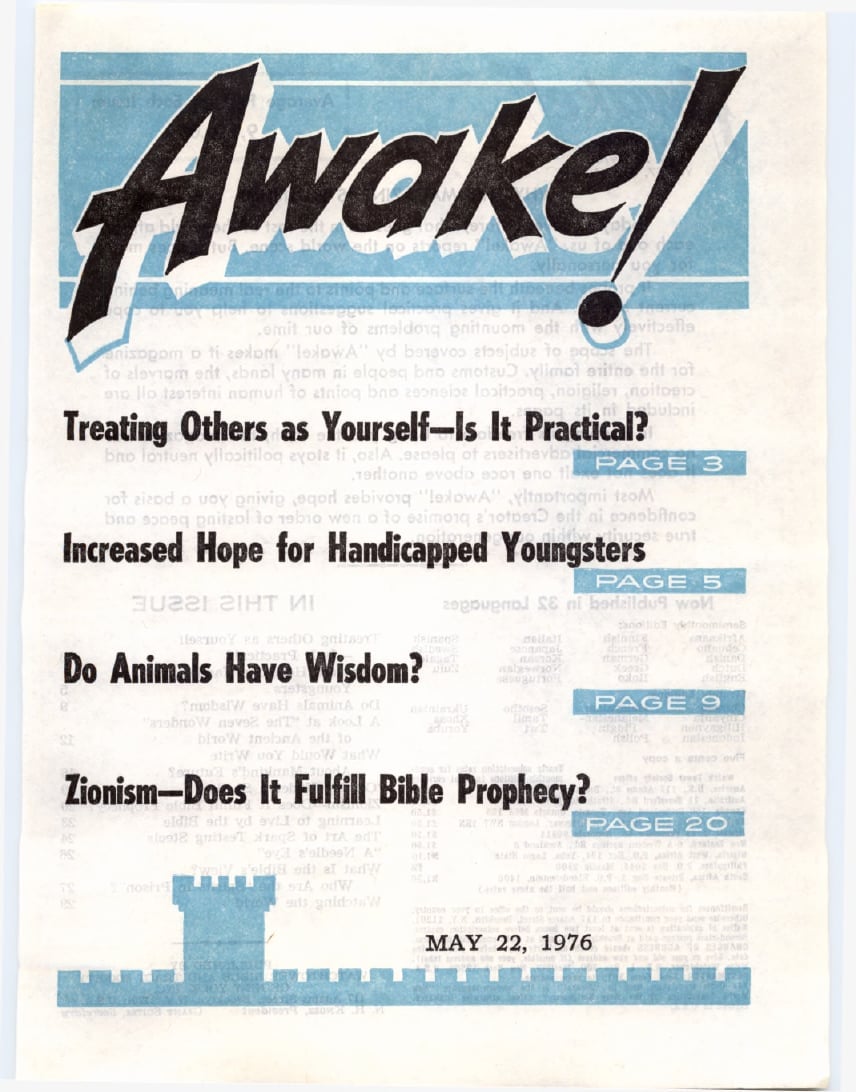
Awake! — May 22, 1976
Source: jw.org
Contents
Treating Others as Yourself—Is It Practical?
Increased Hope for Handicapped Youngsters
Do Animals Have Wisdom?
A Look at “The Seven Wonders” of the Ancient World
What Would You Write About Mankind’s Future?
‘Coming Under a Shadow’
Zionism—Does It Fulfill Bible Prophecy?
Learning to Live by the Bible
The Art of Spark Testing Steels
‘A Needle’s Eye’
Who Are the “Spirits in Prison”?
Watching the World
“Who Made the Pretty Flowers?
Does It All End Here?
Treating Others as Yourself—Is It Practical?
Treating Others as Yourself—Is It Practical?
LIFE is pleasant indeed when one is treated with consideration! But today many persons give little thought as to how their words and actions affect others. They expect their fellowmen to be kind and to deal fairly with them. But at the same time they may think nothing of profiting at the expense of someone else.
Such persons may condemn the wrongs of fellowmen while excusing their own serious moral failings. They may be incensed about robberies and rapes occurring in their city. Yet they overlook the fact that they themselves are guilty of other wrongs. How so? They may misrepresent their income to gain tax advantages, cheat customers, loaf on the job, or engage in adultery or premarital sex. While decrying religious and racial bias when they are in the minority, they may themselves trample upon the rights of others if they later are able to attain greater power or control.
Many people are like the prominent nation that is heard preaching “peace” but that sells more arms than any other nation. They are like nations that suffered under colonial rule but, upon gaining independence, become oppressive themselves.
However, one of the most ancient guides for living, the Bible, counsels against applying a different standard to others from what we do to ourselves. It states: “A cheating pair of scales is something detestable to Jehovah.” (Prov. 11:1) “All things . . . that you want men to do to you, you also must likewise do to them.” (Matt. 7:12) “Do not you people be owing anybody a single thing, except to love one another . . . Love does not work evil to one’s neighbor.” (Rom. 13:8, 10) But is what the Scriptures outline really practical in a dishonest world?
Ask yourself, Has disregard for the Bible’s counsel worked out to the good of humankind? Surely the answer is all too obvious. Fraud, corruption, crime and violence are making daily life ever harder for millions. In many places people must be on constant guard so that they will not be cheated. Business establishments have to raise prices to offset losses from employee and customer theft, or to cover expenses for increased security measures. Dishonesty in the form of shoddy workmanship and the use of inferior building materials may cause serious injuries and even fatalities. The mental and emotional hurt resulting from trampling upon others’ rights is incalculably great.
While a person may think that he must look out exclusively for his own interests if he is going to survive in this world, his ignoring others’ rights is certainly not going to improve relations with his fellowmen. He would simply be adding his share to the unpleasantness that has resulted from disregarding right principle.
In actuality, the person who is genuinely interested in his neighbor gains rich dividends. What are some of these?
Benefits to Oneself
One great benefit coming to those who uphold right principle is personal happiness and satisfaction. This is in harmony with the words of Jesus Christ: “There is more happiness in giving than there is in receiving.”—Acts 20:35.
Doubtless you yourself have observed the outworking of this principle. Among the happiest people are those who really care about their fellowmen. They find delight in being helpful and accommodating. Content with what they have, they do not greedily strive for more nor do they worry unduly about financial matters. On the other hand, the stingy, greedy person is never satisfied with what he has. When he gives, he does so grudgingly, under compulsion or with some ulterior motive in mind. For instance, he may wish to secure some favor from the receiver of the gift. He misses out on the joy that comes from making others happy by giving unselfishly of his time, energies or assets.
The person who treats others as he wishes to be treated often gains the respect and admiration of his fellows. His course of action appeals to their conscience—that inner sense of right and wrong inherent in humankind. Also, is not the honest, dependable worker preferred by employers over one that is dishonest, unreliable and lazy? Do not even persons who may be unprincipled themselves want to deal with people whose word can be trusted?
Principled men and women also maintain their own self-respect. They are not plagued by a guilty conscience. Their life is free from the fears of being exposed and disgraced as lawless citizens. They enjoy peace of mind because of knowing that their conduct is above reproach.
An Approved Relationship with the Creator
Most importantly, those not yielding to the temptation to adopt a selfish attitude can maintain a clean standing before the Creator, Jehovah God. In striving to conduct themselves aright and working for the good of others, they are obeying the admonition of Jesus Christ: “Make purses for yourselves that do not wear out, a never-failing treasure in the heavens, where a thief does not get near nor moth consumes.”—Luke 12:33.
Through unselfish giving, the servant of God builds up a fine record with the Most High. That record is like a treasure deposited in heaven. Neither moth nor rust nor anything else can destroy that record. It is a real treasure, since Jehovah God will reward individuals according to the record that they have made with him. For example, regarding those who give out of a pure motive, without drawing attention to themselves, Jesus Christ said: “Your Father who is looking on in secret will repay you.”—Matt. 6:4.
Furthermore, God’s approved servants are on the way to receive the greatest gift of all. What is that? Everlasting life in a righteous new order, where the problems that have resulted from people’s living by a double standard will be things of the past. The Bible tells us: “The gift God gives is everlasting life by Christ Jesus our Lord.” (Rom. 6:23) And “there are new heavens and a new earth that we are awaiting according to his promise, and in these righteousness is to dwell.”—2 Pet. 3:13.
Treating fellow humans as you would like to be treated is practical indeed. You thereby avoid needlessly hurting others and, instead, appeal to their conscience. You maintain happiness, contentment and self-respect. Above all, sticking to right principle contributes toward maintaining a fine relationship with Jehovah God—a relationship that can last for all eternity.
Increased Hope for Handicapped Youngsters
Increased Hope for Handicapped Youngsters
AMONG the most precious gifts that the Creator has bestowed upon humankind is the gift of reproducing our kind, of having children. The birth of an infant brings great happiness to its parents. As Jesus, the Great Teacher, said: “A woman, when she is giving birth, has grief, . . . but when she has brought forth the young child, she remembers the tribulation no more because of the joy that a man has been born into the world.”—John 16:21.
But at times that happiness is all too short-lived. When is that? When an infant is born with some kind of handicap—mental, emotional or physical. At present there are said to be seven million children in the United States suffering from one form of handicap or another. Particularly is it an incredible shock when parents learn that their newly born baby suffers from some form of mental retardation such as mongolianism.a
Years ago there were few professional agencies to which parents could turn for counsel and support in doing the most loving and helpful thing for such a retarded child. But today the situation is different, especially in the larger cities. So much has this situation changed that some say that the present could well be “the dawn of a golden age for the retarded.’’
For one thing, among recent reports is one appearing in Psychology Today (April 1975) telling of the trend toward caring for handicapped children as far as possible in close association with average or normal children. Instead of having all such handicapped youngsters kept in institutions by themselves, as has been the custom, more and more of them are being cared for in a way that allows them to associate with average children. This is proving very beneficial.
Improved Methods
Typical of the improved way of dealing with handicapped youngsters is the Washington, D.C., program sponsored by the United States Department of Health, Education and Welfare. It takes youngsters from mental institutions and gives them specialized training, at the same time weaning them away gradually from drugs—something institutions often heavily depend on in dealing with retarded or other mentally ill patients. As a result, many of these youths are able to take their place in regular schools, or to hold down jobs if beyond school age.
Today throughout the United States there are “Infant Development Programs” ready to help retarded youngsters. According to a report, these “infants of any intelligence level can develop and learn if the special training they need is set in motion soon enough.” Even more encouraging is the position taken by the Pacific State Hospital at Pomona, California, “that there is no level at which children are ‘hopeless.’”
It has been learned that most babies are eager to explore their surroundings, and so are able to develop mentally and physically on their own even when their surroundings are not ideal. Retardation, however, can result when the environment is really very bad. The retarded child, on the other hand, must be coaxed along if it is to develop intellectually. In fact, its mother must devote all the time she possibly can to such coaxing. That means talking to the child, entertaining it, encouraging it to be physically active.
Just how to go about this task most effectively requires instruction and training, and this mothers can obtain in many of the larger cities. Some of these services provide professional help; workers spend an hour and a half each week teaching both mother and child right in their own home. Some communities also have provision for letting retarded children stay at such centers for a period of weeks, receiving instruction and training. Those involved in this activity say ‘it is a tragedy to give up on a retarded child and send it to an institution.’
Stressing the importance of physical activity for retarded youngsters is the report made by a committee of the American Academy of Pediatrics. The retarded child needs more physical activity than does the normal child, yet it is likely to get less. Neglect along this line both worsens his mental handicap and harms him physically, resulting in poor coordination and obesity. One private agency in Philadelphia, Pennsylvania, encourages mothers to begin teaching their mongoloid infants when they are but five weeks old.
New and Successful Approaches
Another form of treatment that has produced striking results in severely retarded children is what is known as the “BallBird-Stick” method. It is based on the premise that all letters of the alphabet are formed either by a circle (a ball), a triangle (a bird) or a straight line (a stick). By this method psychologists have been able to teach children with an IQ of only twenty or thirty to read and write. And with this mental improvement comes also an improvement in personality.
Typical is the case of one severely retarded eighteen-year-old girl who kept throwing tantrums, had little spontaneous speech and spent most of the day rocking in a rocking chair. As a result of the “BallBird-Stick” method, she now talks freely, rarely has tantrums, no longer spends her day rocking and has developed a sense of humor. In fact, it is the rule that retardees trained by this method, some as old as forty-nine years, greatly improve in personality, manifest an upright rather than a slumped stance, and no longer spend the day rocking in a chair. Moreover, they manifest concern about their appearance, wanting to look presentable. These are all healthy signs. The staffs at such centers report that, while at first these retardees seemed to be “nonpeople”—as far as communicating with them was concerned—as a result of such training they now impress others as actually being people.
Another successful approach to the mentally retarded, either due to mongolism or to some type of brain damage, has been by means of music. The originator of this method, Richard Weber of Peoria, Illinois, has used a musical system by means of which many retarded children are learning to play an instrument. One child, whom it was impossible to live with and who seemed unable to learn anything, soon became quite normal by the aid of this system. By means of Weber’s “Musicall” method, as he calls it, hundreds of children, some of whom were severely retarded and had never spoken a word, have been brought to the point where they “learn to learn.” Concerning this method, a director of a retarded-children’s center stated: “Weber’s innovations are destroying a number of stereotyped notions. Since we began using his methods, we see children changing from vegetables into persons.”
Hyperactive Children
The young child mentioned above, with whom it seemed impossible to live, was actually a hyperactive youngster. Hyperactivity (also known as hyperkinesia) is afflicting more and more children, mostly boys. It is marked by extreme restlessness and diminished attention span, such hyperactive children being unable to keep their young developing minds on any one subject long enough to add to their fund of knowledge. Complicating matters is the fact that such children are likely to be unruly, stubborn, and five times as likely to get into the poison bottle as are other children. Truly they are a problem for their parents.
The most common and popular method of treating these children is by resorting to various drugs—strange to say—drugs that stimulate adults but seem to calm these children. But more and more voices are being raised objecting to the drug approach to this problem. For one thing, there is always the danger of children becoming addicted and so requiring drugs after they become adults. Also, there is the question of the harm that these drugs can do. And further, such drugs are likely to disguise personality problems or disorders that often lie at the bottom of hyperactivity. For this reason, more and more child psychiatrists recommend that parents be quite firm in dealing with such children.
It is also an unfortunate fact that, as one psychiatrist observed, the physical examination is often overlooked, which, really, should be the very first step. Time and again this psychiatrist found that the child’s hyperactivity was due to some physical flaw such as a defective heart valve or some metabolic deficiency. According to him, “it makes no scientific sense to suppress hyperactivity with drugs without diagnosing and then correcting the underlying medical or physiological problem.” To cite one example, a hyperactive boy kept setting the family couch on fire. Upon being given drugs, he desisted. But when the drug treatment was suspended, on the assumption that he had been cured, what did he do? He burned down the family garage!
Various “Somatic” Programs
Still another approach, and one that has proved to be extremely effective time and again, is nutrition. Time and again a boy’s hyperactivity is caused, strangely enough, by low blood sugar, a condition known as hypoglycemia. This can be treated by a highly restricted diet that is rich in protein and low in carbohydrates and, in particular, one that avoids all the “junk foods,” which include soda “pop,” all “goodies” containing refined sugar, and potato chips. At the same time, the metabolic approach includes giving a boy large doses of certain vitamins, as well as essential trace minerals. Such treatment has also been very effective in treating children suffering from the opposite extreme of hyperactivity, namely, autism and even those afflicted with schizophrenia.
Then again, more than one psychiatrist has found that food additives, such as artificial colors and flavors and antioxidants (added to keep food from spoiling) may cause a child to become hyperactive. When these were removed from the food that the hyperactive children ate, they became normal. This furnishes no small problem, as about 90 percent of foods that kids like to eat contain such elements, among the chief offenders being hot dogs.
Within the past year another factor has been implicated as a probable cause for hyperactivity in children, namely, artificial lighting, especially fluorescent lighting. Thus one psychiatrist found that, when he changed the lighting fixtures so as to include the natural spectrum of light rays and shielded the children from the X rays that usually are emitted from the cathode ends of these lamps, the hyperactive children became normal.
Nor should the approach advocated by Nobel Prize winner Nicholas Tinbergen for some types of emotional problems be overlooked. In Science, July 5, 1974, he tells about the value of the muscular approach, which might be termed a gentle but very knowledgeable, properly administered massage from head to foot that releases body tensions and causes the muscles and nerves to function normally. Tinbergen, on the one hand, was pleased to note how many men known for their great learning have spoken favorably about it, but, on the other hand, he was alarmed “because we found this corner of psychiatry in a state of disarray, and because we discovered that many of the established experts—doctors, teachers, and therapists—are so little open to new ideas and even facts.”
“Check-Mark” Methods
All the foregoing ways of treating hyperactivity might be said to be “somatic” approaches, in that they attack the problem through the body. In contrast is the “Check-Mark” program, which uses psychological means, namely, training and teaching methods. In this new educational program children are given “checks” and “marks” depending on how well they behave and perform, and this allows them to choose certain rewards. It requires a great deal of patience and understanding on the part of the teachers, for the children need sustained individual attention. Some 80 percent of hyperactive children are returned to normal in about eighteen months, the remainder taking somewhat more time.
Truly, from all the foregoing it is clear that there is increased hope for children suffering from either retardation or hyperactivity. Not only do their parents have a choice of many kinds of professional help available, but also implied is that there are many things that the parents themselves can do that could prove very helpful.
[Footnotes]
Mongolianism is caused by a chromosomal defect. the cell nucleus having 47 instead of 46 chromosomes. In the United States one out of six hundred births is a mongoloid.
Do Animals Have Wisdom?
Do Animals Have Wisdom?
WISDOM is the ability to use acquired knowledge to solve problems and avoid dangers. For humans, wisdom involves the use of reasoning powers. Is this also true of animals?
Cats, for example, have been known to open doors by moving a latch. Is this an evidence of their reasoning out the solution to a problem? Consider the results of some scientific experiments.
A scientist placed a cat in a cage equipped with a door that could be opened by moving a latch. He reached through the bars of the cage and pressed one of the cat’s paws against the latch, thereby opening the door. When the door opened he gave the animal a piece of fish. Despite the scientist’s repeated efforts to teach the cat to open the door in this manner, the animal never did learn how to do it.
Thereafter the researcher put a number of cats into the cage. The animals tried everything to get out. They pawed, scratched and chewed all around the cage. In time, by trial and error, they succeeded in moving the latch. But when returned to the cage, the cats again resorted to the trial-and-error method. While they eventually became quite adept in escaping confinement, manifestly they had not been able to reason out the solution.
What about such animals as chimpanzees? They can be trained to sit at a table, eat with knives, spoons and forks, ride bicycles and engage in various other human activities. Does this not indicate that they have reasoning faculties as do humans? To answer this question, we might examine the results of a number of experiments conducted with chimpanzees.
A banana was placed outside the cage beyond reach of a female chimpanzee. Inside the cage there were sticks that could be used to gain access to the fruit. Did the chimpanzee recognize the hopelessness of getting the banana without employing one of the sticks? No. She tried in vain to reach the fruit with her arms. Finally she did use a stick to bring the fruit toward her. But when faced with the same situation later on, the chimpanzee again ignored the stick.
Another chimpanzee acted similarly when he saw a banana hanging high above him. Even though a box was available to stand on, the chimpanzee vainly tried to reach the fruit by jumping. Then the box caught his attention. Despite earlier experiences with boxes, however, he did not move it directly underneath the banana. He merely shoved the box in the direction of the banana and then jumped from it to seize the fruit.
In another experiment, a chimpanzee used two boxes, placing one on top of the other to reach the banana. When this still did not bring the banana within reach, he pulled out the bottom box and attempted to place it on top of the second box.
These and similar experiments have demonstrated that chimpanzees vary considerably in their ability to solve problems and that they cannot reason as do humans. Observes the book Animals Are Quite Different: “The monkeys realized, at least some of them did, though even those only occasionally, that a purpose can be achieved by the use of auxiliary appliances, when the arms prove too short for the end in view. But while a human being, even quite a small child, deduces general laws from his experiences and always draws valid conclusions, the monkeys did not show in any way that they grasped the meaning of anything as a whole. . . . All performances by monkeys subjected to intelligence tests invariably proceeded with a view to perfectly material ends. Unless a banana or some other bait were available they utterly declined to concern themselves . . . Their behaviour was invariably directed purely by the eye. If the stick happened to be in sight, well and good, they seized it and started fishing for the banana lying outside the cage. But if the stick was behind them they never noticed it.”—Pp. 68, 69.
Evidently animals learn by trial and error rather than by drawing logical conclusions from experience. This is well illustrated by what can happen to a dog. The animal may pass a certain corner. Suddenly he may be pounced upon by a larger dog and seriously injured. From then on, the animal may do everything possible to avoid passing the corner where he had the bad experience, even though the large dog may not live in that area at all. Though having learned something from what happened, the dog is unable to reason out that the corner itself had no relation to the unpleasant incident.
Evidence of Logical Thinking?
Yet it may be asked, Have there not been horses and other animals that were able to solve mathematical problems? Appearances are at times very deceptive. Take the case of the horse known as “Clever Hans.” This horse could seemingly add, subtract, multiply and even spell according to a system worked out by his trainer. For example, if asked, ‘How much is one-third plus one-fourth?’ the horse would stamp seven times and then twelve times, indicating that the answer was seven-twelfths. How would this be possible for an unreasoning horse? In his book Animal Behavior, J. P. Scott writes:
“A committee of zoologists and psychologists studied Hans and found that the horse could indeed do the sort of thing which had been reported. One of the first hints of how Hans got his results came when they found that he always failed when no one present knew the answer to a problem. This suggested that the master, who apparently was standing perfectly still and waiting for the answer, was in some way giving Hans an unconscious signal when he got the right answer. Sure enough, when a screen was put between master and horse, Hans lost his powers entirely. All that really happened in the case of this wonder horse was that he had been taught to paw the ground, and if he pawed long enough, he would inevitably come to the right answer. At this point his master would feel relieved and relax slightly, and Hans saw that this was the time to stop. Hans was a highly trainable and observant horse, but he could not do arithmetic.”—P. 161.
Instinctive Wisdom and Acquired Experience
While animals are incapable of reasoning like humans, they have all the faculties needed for the preservation of their kind. This is built into them as instinct. Often their instinctive wisdom is amazing.
An interesting example is the emperor penguin, which mates during the bleakest time of the year in the coldest parts on earth. Once the female lays the egg, she turns it over to her mate. The egg then comes to rest on his webbed feet, which are richly supplied with blood vessels and therefore can keep it warm from below. A fold of skin or pouch fits snugly over the egg, keeping it warm from above. After a “ritualistic” parting ceremony, the female leaves. By this time the male already has not eaten anything for about a month or so and must endure another two months without food in temperatures plunging to 85° below zero Fahrenheit (65° below zero Celsius), accompanied by great blizzards. How do the male penguins survive? Whenever a storm breaks loose, some five to six hundred of them bunch together to form a solid moving circle. The penguins affected most by the wind move toward the protected side and those that were shielded submit themselves temporarily to the worst of the blizzard. Thus, by mutual cooperation, stemming from instinctive wisdom, the male penguins keep themselves alive.
Besides the benefit of instinct, many animals have the ability to learn a great deal from experience. As a result, they may seem to reflect reason, logic and very human emotions when viewed through the eyes of men and women. Because of looking at the behavior of animals as they do upon the actions of humans under similar circumstances, many people mistakenly attribute human feelings to animals.
Of course, animals do have feelings. The Creator took this into consideration when setting forth specific laws for man’s guidance. For instance, the Israelites were commanded: “You must not muzzle a bull while it is threshing.” (Deut. 25:4) The animal was not to be tormented with hunger while grain was so near and he was exerting energy to thresh it.
Though pointing out that animals have feelings, the Bible definitely shows that man alone is made in the Creator’s image. Man, therefore, possesses qualities lacking in the animal creation. (Gen. 1:27) That is why gratitude, sympathy and similar human traits cannot be found among animals. Animals at a zoo may roughly snatch food from hands extended toward them. Their manner shows that they know no gratitude or appreciation. The alarming squawks of a chicken have no meaning to the wolf that starts devouring the bird from the tail end. He never reasons that it would be more merciful to bite off its head first, thereby putting it out of its misery. To the wolf, the chicken is only food. No matter how affectionate an animal may seem to be, it cannot understand what the loss of a dear friend or relative can mean to a human.
Truly, the Bible is very realistic in speaking of animals as “unreasoning.” (2 Pet. 2:12) They have instinctive wisdom, and many possess surprising learning ability. But humans alone have the reasoning faculties and moral capacity to display unselfish love and intelligent compassion. That is why the person who tries to find among animals what he failed to find among humans—understanding and heartfelt sympathy—will in time be woefully disappointed. Animals simply are not endowed with the capacity to express the feelings and concerns that rightly motivated humans can.
A Look at “The Seven Wonders” of the Ancient World
A Look at “The Seven Wonders” of the Ancient World
IF YOU were asked to name seven manmade “wonders” of the modern world, what would you mention? The Eiffel Tower in Paris, France? Perhaps the Empire State Building in the city of New York? What about the Suez Canal? Explorers and travelers have listed all three, as well as other notable things.
But suppose you had lived over two thousand years ago. Then what would you have named as the Seven Wonders of the World? The Greeks and Romans had various lists of notable works of art and architecture. For instance, Philo of Byzantium gave one list, Antipater of Sidon another, differing somewhat. As it is, however, a traditional list has come down to us, and it includes man-made things that were either colossal in size, of great splendor or outstanding because of other extraordinary features.
The Pyramids of Egypt
Of the “Seven Wonders” of the ancient world, only the Egyptian pyramids stand today. Most important are the three situated at Giza, on the west bank of the Nile River near Cairo. They are mammoth tombs built for certain pharaohs. The first and largest was the Great Pyramid. This gigantic tomb of Pharaoh Cheops (Khufu) was expected to be a secure place for the king’s remains and the treasures buried with them.
Covering an area of thirteen acres, the Great Pyramid has a square base and triangular sides, each facing one of the four points of the compass. This pyramid is 482 feet high and was constructed with 2,300,000 individual stones. These stones range in weight up to 5,000 pounds each! How were such huge stones quarried, transported and put in place? This cannot be said with certainty. But it has been concluded that a labor force of some 100,000 men toiled for twenty years to complete the Great Pyramid.
Why were the pyramids built? Well, the ancient Egyptians believed in life after death. But if the soul was to live on, they thought that a person’s fleshly body had to be preserved. So, they embalmed their dead. Moreover, valuables were buried with the deceased for his use in the spirit world. No wonder some pharaohs built gigantic, seemingly impenetrable tombs!
The Hanging Gardens and Walls of Babylon
If tourists of the past were drawn to the pyramids, it is likely that their ‘travel guides’ would urge them on to Babylon. According to certain traditions, both that city’s massive walls and its Hanging Gardens were among the ancient world’s “Seven Wonders.”
Babylon’s walls were constructed by King Nabopolassar of the seventh century B.C.E. and his successor King Nebuchadnezzar II (624-581 B.C.E.). The city was built on both sides of the Euphrates River, and there were walls with a number of gateways along the river’s banks. Additionally, Babylon was surrounded by double walls, the outer wall being buttressed by towers. In it there were a number of massive gates. (Isa. 45:1, 2) Two Greek historians of the fifth century B.C.E. wrote about Babylon’s walls. Ctesias indicates that they were some 300 feet high, whereas according to Herodotus the walls were about 335 feet in height and 85 feet wide. Be that as it may, the width of Babylon’s wall must have been great, for Herodotus stated: “On the top, along the edges of the wall, they constructed buildings of a single chamber facing one another, leaving between them room for a four-horse chariot to turn.”
If a traveler was impressed with those towering walls, surely he would no less consider the Hanging Gardens of Babylon to be a “wonder.” Nebuchadnezzar II built them, apparently for his Median queen Amytis, who found the flat Babylonian countryside disappointing and longed for the trees and hilly terrain of her native land.
The Hanging Gardens consisted of a series of manmade terraces joined by marble staircases and possibly rising to heights of 75 to 300 feet above the plain. On the earth-covered terraces grew many flowers, shrubs and trees. It is said that slaves worked in shifts turning screws of some sort that lifted water from the Euphrates to the gardens. From cisterns on the highest terrace, the water was piped to fountains that provided for needed irrigation. Extraordinary though they were, however, those famed Hanging Gardens no longer exist.
The Temple of Artemis at Ephesus
When the Christian apostle Paul visited the renowned city of Ephesus in Asia Minor during the first century of the Common Era, among its notable buildings was the temple of the goddess Artemis (the Roman Diana). An original temple, designed about 550 B.C.E., was destroyed in 356 B.C.E., but it was replaced by an edifice more magnificent than the original.
In the apostle Paul’s day this resplendent temple stood on a platform measuring about 418 feet by 239 feet. The building itself was approximately 343 feet long and 164 feet wide. Its inner sanctuary, about 105 feet long and 70 feet wide, is thought to have been open to the sky. An image of the goddess Artemis may have stood behind the altar in this sanctuary. Of this impressive marble temple with roof tiles of white marble and over a hundred massive columns, nothing remains but the foundation and some relatively minor portions. The Goths destroyed the temple about 260 C.E. True, devotees of the goddess once shouted “Great is Artemis of the Ephesians!” Yet, that ‘greatness’ and her once-glorious temple have faded into the past.—Acts 19:34.
The Statue of Zeus at Olympia
Similarly, the noted Greek sculptor Phidias thought he was fashioning a god when he completed one of the ancient world’s “Seven Wonders” about the year 435 B.C.E. It was a forty-foot-high statue of Zeus (the Roman Jupiter) seated on a cedar throne decorated with ebony, ivory, gold and precious gems. The statue represented that false god with an olive wreath on his head. Using wood as a core, Phidias made the flesh of ivory, the robe of gold. In the god’s right hand he put a gold-and-ivory figure of Victory, and in the left a scepter topped by an eagle.
This gigantic statue was placed in the temple of Zeus at Olympia, Greece, and its admirers included many athletes and other sports enthusiasts who flocked to the area for the famous Olympic Games. During a later century, Roman Emperor Theodosius I had the statue taken to Constantinople, where fire destroyed it in 475 C.E.
The Mausoleum at Halicarnassus
When King Mausolus of Caria in Asia Minor died in 353 B.C.E., evidently his wife Artemisia felt that her husband’s name and fame should live on. Therefore, she had a splendid sepulcher constructed in his memory. It was the Mausoleum, located at Halicarnassus, in southwestern Asia Minor. Interestingly, even today elaborate buildings providing burial space are called mausoleums.
The tomb of Mausolus was designed by the Greek architects Pythios and Satyros. It was some 135 feet high and had a rectangular base surmounted by a colonnade of thirty-six pillars. Resting on the colonnade was a stepped pyramid, and atop it a statue of Mausolus in a chariot. All of this for one man!
Impressive though it was, the Mausoleum was destroyed by an earthquake. By the fifteenth century C.E. the building was gone. Only some pieces of the once magnificent tomb exist today.
The Colossus of Rhodes
Popularly called the Colossus because of its immensity, a statue of the sun god Helios once stood near the harbor of the island of Rhodes in the Aegean Sea. This statue of bronze was about 120 feet high, about the same height as the Statue of Liberty in New York harbor. And a colossus it surely was. Why, one finger was larger than many an ordinary statue! To support this hollow representation of Helios, its Greek sculptor Chares of Lindus, Rhodes, used some seven and a half tons of iron bars besides blocks of stone. Chares labored for twelve years, finally completing the statue in 280 B.C.E. Incidentally, the statue did not straddle the harbor with ships passing between the legs, as some have said. Rather, it apparently was erected on an embankment facing the sea.
Yet, just think! The Colossus of Rhodes stood for a mere fifty-six years. An earthquake toppled it in 224 B.C.E. Reportedly, the broken fragments lay on the rocks for over 800 years, until sold as scrap metal in the seventh century C.E. An inglorious end for one of the ancient world’s “Seven Wonders”!
The Pharos of Alexandria
A virtual “skyscraper” and another “wonder” of the ancient world was a towering lighthouse on an isle in the harbor of Alexandria, Egypt. Called the Pharos for the island (today a peninsula) on which it stood, this lighthouse was so famous that pharos came to be applied to lighthouses in general.
While reports vary, the Pharos of Alexandria appears to have been some 440 feet high. Its designer was the Greek architect Sostratus, and it was built about 270 B.C.E., during the reign of Ptolemy II Philadelphus. This lighthouse was constructed in three sections on a stone base. The lower portion was square, the middle section eight-sided and the upper part circular. The topmost portion was roofed, but open, with bronze columns round about.
Through a central shaft, by means of a windlass, wood was brought to the open upper level, there to feed the fire that provided light. It is said that a mirror reflected the fire by night, as well as the sunlight by day, so that the light could be seen at least a hundred miles away.
What happened to the Pharos of Alexandria? An earthquake partially demolished it on August 7, 1303, and its ruin seems to have been completed during the same century. Yet, the renowned lighthouse stood for over a thousand years.
Was All the Effort Worth While?
In retrospect, you may well conclude that some “wonders” of the ancient world served a useful purpose. Certainly, Babylon’s Hanging Gardens were a delight to the eye, and the city’s formidable walls provided a measure of protection. And the Pharos of Alexandria aided mariners.
But what about the great temple of Artemis, the statue of Zeus at Olympia and the Colossus of Rhodes? As works of art and architecture, they were extraordinary indeed. Yet, how misspent the effort put forth to fashion or construct them! Surely that was realized by servants of the true God, Jehovah, for any of them living when those “wonders” still stood were guided by His Word. About 460 B.C.E. before Phidias lavished great labor on his mammoth statue of Zeus, the Bible book of Psalms was completed. Moved by the spirit of the living God, Jehovah, the psalmist had declared: “The idols of the nations are silver and gold, the work of the hands of earthling man. A mouth they have, but they can speak nothing; eyes they have, but they can see nothing; ears they have, but they can give ear to nothing. Also there exists no spirit in their mouth.”—Ps. 135:15-17.
Consider, too, the pyramids of Egypt and the famed Mausoleum. The desire to be remembered and honored has driven some to construct impressive monuments. Yes, they have also had other reasons. But how sobering the divinely inspired words of wise King Solomon, who said: “There is no remembrance of people of former times, nor will there be of those also who will come to be later. There will prove to be no remembrance even of them among those who will come to be still later on.” (Eccl. 1:11) The pages of history are filled with many names, but these mean little in the lives of people today. Only with Jehovah rest any prospects of remembrance and restoration to life by a resurrection.—Job 14:13-15; Acts 24:15.
[Map on page 13]
(For fully formatted text, see publication)
Black Sea
Mediterranean Sea
Red Sea
GREECE
EGYPT
BABYLON
What Would You Write About Mankind’s Future?
What Would You Write About Mankind’s Future?
By “Awake!” correspondent in Denmark
“FINAL examinations.” What does that bring to your mind? If you are in school, it may evoke thoughts of your coming efforts to remember facts or to solve problems so as to advance in school. If you are long out of school, it may bring back memories of critical tests that would determine whether you would graduate. But whether you are now in school or not, do you normally link these two things: mankind’s future and school final examinations?
On May 12, 1975, most of the 14,700 senior high school students in Denmark saw a connection between them. Imagine yourself in their situation. In their final examinations they had to write an essay on “Mankind’s Future.” They had six hours to study a twenty-four-page booklet and write their essay involving its contents.
Extremely different possibilities for the future were suggested by the illustrations on the booklet’s front and back pages. The cover showed a woodcut by artist Palle Nielsen. It was the “World of War.” Then on the back was a beautiful scene of paradise, with people playing with various animals and picking fruit. Below this picture was a partial quotation of Revelation 21:3, 4 from the final book of the Bible. The booklet explained that this picture was taken “from Jehovah’s Witnesses’ publication The Truth That Leads to Eternal Life.”
Perhaps, as with some of the students, those two illustrations suggest to you two vastly different futures—mankind in ruin or in paradise. Yet, note briefly the six parts of this specially prepared booklet. As you do, think of what you might have written about mankind’s future.
The Views
The school booklet contained six printed excerpts, each being one to three pages long. The first text was from Aldous Huxley’s book Brave New World, which the Encyclopædia Britannica (1974) says presents “a pessimistic vision of a world state” in the future. The book “describes a world in which people use all the newest inventions of science and are miserable and unhappy because they do not know how to love one another.” It is indeed a depressing “vision” for mankind’s future. Would you write in that vein?
The next excerpt was from Der afsindige menneske (in English entitled “The Crazy Ape”), a book by Nobel Laureate biologist Albert Szent-Györgyi. He states: “Today is the first time in man’s history that he is able to truly enjoy life, free of cold, hunger and disease” and “also the first time in his history that man has the capability of exterminating himself in one blow.” The excerpt continued: “One would expect that any idiot could make a wise choice between these two alternatives. It is basically a choice between pleasure and pain. Yet man seems to be bent on choosing the latter.” The biologist then questions: “How can we get out of the fatal groove we are in, the one that is leading towards the brink?” He does not think that there is any religion “which embraces all mankind or appeals to all mankind,” so he rules out religion as a possible remedy. He is particularly critical of the “church imperialism” of Christendom, for it “has a very poor record.” On the other hand, he points to science and its “method for building a safe new world, resolving the differences between nations, creating peace without fear, hunger and disease, with undreamt-of wealth, dignity and happiness; a world not based on force but on decency, equity and good will.” Would you feel this to be a realistic view on which to write?
You can give thought, as did the students, to the third excerpt presented in the school booklet. It set forth the future that the Communist Party of the Soviet Union has as its goal for tomorrow. In part it said: “Communism also implies a new man, a man of spiritual richness, moral purity and physical perfection. A high communistic consciousness, love of work and discipline and devotion to the interests of the community—those are the inseparable qualities of this person.”
Many of the Danish students might have been surprised at the nature of the booklet’s fourth text; you might be too. Introducing it, the examination booklet said: “The Revelation is the last book in the New Testament. Here the Apostle John relates his visions of the Last Day, when the dead are being raised from their graves to be judged either to salvation or perdition.” A quotation of Revelation 21:1-8 followed. In part that says: “The tent of God is with mankind, and he will reside with them . . . And he will wipe out every tear from their eyes, and death will be no more, neither will mourning nor outcry nor pain be anymore. The former things have passed away.” Is that not thought provoking?
Now, nearing the end of the booklet, the fifth text was introduced with this comment: “Jehovah’s witnesses: The Truth That Leads to Eternal Life. In the following is described the final battle between Jehovah and Satan and the conditions after the battle. The references in the text apply to passages in the Bible.” You may have a copy of that Bible-study aid, for eighty million copies have been produced in ninety-four languages. The examination booklet presented extracts taken from pages 100-106, the chapters “The Last Days of This Wicked System of Things” and “Righteous Rule Makes Earth a Paradise.” The extracts showed from the Bible that Jehovah God and Christ will intervene in human affairs, wiping out wickedness on earth and doing away with the evil influence of Satan the Devil and his demons. Then, under the rule of the Prince of Peace, men of faith can enjoy peace and unity. All men will be brothers. War will be no more. With Christ as a righteous king, oppression and corruption will not exist on earth. Humans will enjoy peace and freedom from fear.
After reading such an appealing description, you, as were the Danish students, might be jolted by the contrast in the final excerpt. It was from a 1968 book by Sven Holm, Min elskede—en skabelonroman (My Beloved—a Pattern Novel). Like Huxley’s book, this Danish novel sets forth a very pessimistic view of the world of the future.
Well, if you had been in the situation of those students and had studied the six excerpts, what would you write about mankind’s future? Consider the guidelines that the students were given.
Take Your Pick
Each student taking the final examination was given the option of choosing any one of the following six exercises:
1. Characterize some of the views and attitudes about mankind’s future expressed in the booklet’s six excerpts. Use at least three of them in developing the theme “Future Perspectives.”
2. Characterize the fifth-text (Jehovah’s Witnesses) as to style and language used. Discuss how the language used has been influenced by the book’s object, the subject and the readers to which it is directed. Examine how it is related to the fourth excerpt (Revelation). Support your characterization with examples from the excerpts. Use the theme: “A Textual Characterization.”
3. Compare the future visions in the extracts from the novels by Aldous Huxley and Sven Holm. Consider their visions in the light of reality that you know. How do you estimate these excerpts as to being prophecies? Theme: “Fancy or Reality?”
4. Mankind’s future has often been dealt with in science and the arts. Explain one or more presentations of the matter that you know, describing whether they are of future hope or of future ruin. You may choose your own theme.
5. In your opinion what factors will determine what the world will be like in the year 2000? Theme: “The Year 2000.”
6. Interpretation of the excerpt from Sven Holm’s novel. Theme: “My Beloved—a Pattern Novel.”
Which of the six essays would you have picked to develop? You can see that two of the texts express in fiction the pessimism that has prevailed since World War I. While many persons would like to believe that the future will be brighter, is there not ample basis for pessimism?
Going farther, while the promises of science that Dr. Szent-Györgyi mentions may sound fine, are you thoroughly confident that they will be realized? After writing his essay one Danish student was quoted in Copenhagen’s Berlingske Tidende as saying: “If science is given too great power, it is going to be a cold and hopeless world.” Do you see truth in that conviction?
Well, does the outlook presented in the Communist excerpt sound noble and attractive? Everyone answering “Yes” then faces the question of whether it seems probable that this outlook will be realized. Has your experience borne out the likelihood of all humans willingly accepting Communistic indoctrination and producing a “new man, a man of spiritual richness, moral purity and physical perfection”? Or, in many Communistic lands are not party policies pursued basically through force and repression?
Frankly, many observers of human nature and of the world scene would agree with another Danish student who was quoted in the Berlingske Tidende: “We can only hope for a miracle to avoid a third world war—a nuclear war that will destroy the planet in a few seconds.” So what could you accurately write about mankind’s future?
This last-quoted student actually provided a clue. She spoke of something miraculous happening. That is in essence what the other two excerpts point toward, intervention by the Creator of the earth and of mankind. That is no mere idyllic dream; it is just as real and substantial a prospect as the earth and mankind are real.
Many persons seem to think that the Bible book of Revelation sets out a gloomy message of a coming Doomsday and that this is what Jehovah’s Witnesses stress in their preaching. On the contrary, though, God’s intervention—described in Revelation and taught by Jehovah’s Witnesses—is a rescue! “How so?” you may wonder. Note what Revelation 11:18 foretells: “Your [God’s] own wrath came, and the appointed time . . . to bring to ruin those ruining the earth.” Far from being a Doomsday for all mankind and the earth, the foretold intervention by God will mean the elimination of only those who threaten the welfare and peace of mankind. Thus, The Truth That Leads to Eternal Life could point to this result:
“There will be complete freedom from fear of any harm. Nevermore will anyone be afraid to stroll through a park at night to view the starry handiwork of the Creator. . . . then in a literal way, ‘they will actually dwell in security, with no one to make them tremble.’—Ezekiel 34:28.”
The subject that the Danish students were given to develop, “Mankind’s Future,” is truly of immediate importance to all of us. Considering the matter carefully, a person ends up with the question: Am I to put my future and my trust in the hands of man or of God? The very fact that all of us are dependent on the Creator for the life we have and the air and other means to sustain life certainly recommends that we look into what he has to say regarding the future. He is involved in mankind’s future. He is involved in your future. Why not study His Word carefully to find out what He expects of us now so we will be in position to benefit from what he determines for mankind’s future?
[Picture on page 17]
On its front and back cover, this booklet offers two different views of mankind’s future—mankind in ruin and mankind in paradise. Which do you think correctly foresees what is to come?
‘Coming Under a Shadow’
‘Coming Under a Shadow’
A shadow cast by a crag, cloud, building, tree or some other object can provide welcome protection as, for example, from the hot sun. That is why the Biblical expression to ‘come under the shadow of something’ means to come into a place of protection, security or refuge. For example, Lot said to the men of Sodom regarding his angelic guests: “Only to these men do not do a thing, because that is why they have come under the shadow of my roof.” (Gen. 19:8) See also Isaiah 32:1, 2.
Zionism—Does It Fulfill Bible Prophecy?
Zionism—Does It Fulfill Bible Prophecy?
ON Monday, November 10, 1975, it came, after warning tremors. Like an earthquake it rocked the world of Christendom and Jewry. The United Nations General Assembly, by a two-to-one majority vote, adopted a resolution declaring Zionism a form of racism and racial discrimination.
Seventy-two nations voted in favor of this resolution, while thirty-five voted against it. There were thirty-two nations that abstained, and three were absent. Supporters included also the Communist countries, except Romania, which was absent. Most Asian nations approved, along with Cyprus, Turkey, Guyana, Portugal and Mexico. The majority of African nations joined in condemning Zionism.
Opposers of the resolution were mainly nations professedly Christian. These included the nine nations of the European Common Market, all the other Scandinavian countries, a number of the British Commonwealth and the United States.
What is Zionism? Why was it condemned? As defined in general news releases, Zionism is “the movement for a Jewish national homeland in Palestine, realized with the creation of Israel and propagated today as the guiding philosophy of the Jewish state and its supporters.”
Reasoning Pro and Con
The impact of the resolution produced immediate shock waves. Israel’s ambassador Chaim Herzog furiously tore the resolution to pieces there on the dais in front of the assembly. Former U.S. ambassador Daniel P. Moynihan angrily accused the assembly of an “infamous act.” Rallies and demonstrations in protest of the U.N. action sprang up in many places.
Many considered it a direct blow against Jews and Judaism. Ambassador Herzog, for example, linked Zionism with Jewish worship, saying: “The Zionist ideal, as set out in the Bible, has been and is an integral part of the Jewish religion.” At a convention in Atlantic City, 3,000 orthodox Jews condemned the resolution as “an attempt to deny the divinely accorded rights of the Jewish people to the Holy Land, and as such an abominable act against the entire Jewish people.”
Backers of the resolution, however, contended that the vote was not against Judaism and Jews. Instead, they claim that Zionism is a political ideology rather than a religious one. It is Zionist politics, they say, that displaced from their native lands thousands of Palestinian Arabs. “Most galling to the Arabs,” noted Time magazine of November 24, 1975, “is Israel’s Law of Return, which grants instant citizenship to any Jew who immigrates to Israel from anywhere in the world, while Palestinian Arabs who fled their homeland during the 1948 war are still, in most cases, prevented from returning.”
Opposition by Religious Jews
Is Zionism a religious movement? Does it perhaps relate to Bible prophecies about a return of the Jews to their homeland?
The earlier Jewish rabbinical writings do mention a future return of Jews to the Promised Land under the leadership of the Messiah. Early in the nineteenth century, however, certain Jews came to believe that this should come about, not by miraculous intervention from on high, but through human effort.
One who felt that way was Rabbi Judah Alkalai (1798-1878). According to the Encyclopaedia Judaica, in the mid-nineteenth century Alkalai “became convinced that the era of the Messiah had arrived and that the redemption would have to be achieved by human action . . . He tried to induce people to join an organized resettlement of Jewry, or some part thereof, in their homeland and to equip themselves with the attributes of a modern nation.”
Right from the start, however, many Jews opposed Zionism for religious reasons. Why? Says The Jewish Encyclopedia: “Orthodox Judaism in Europe at first held severely aloof . . . [Zionism] was supposed to be forcing the hand of Providence and to be contrary to the positive teachings of Orthodox Judaism in regard to the coming of the Messiah and the providential work of God in bringing about the restoration.” To this day the same reasoning prompts ultra-orthodox Jews to reject the state of Israel and the aims of present-day Zionism.
Religion did not prove to be the motivating force behind Zionism. Concerning “the early pioneers” who settled in Palestine at the turn of the twentieth century, Israeli author Amos Elon writes in The Israelis: Founders and Sons: “Some inevitably rationalized their action by reference to religious ties; but most were decidedly irreligious. One avowed atheist wrote shortly after his arrival in 1907: ‘What I do is not God’s will—for I do not believe in God but what simply is right morally and in practice absolutely necessary.’”
But if not religion, what was the main motivating force? What prompted thousands of Jews to leave their native lands to take up residence in Palestine?
Zionism’s “Dominant Element”
It was “in reaction to tsarist pogroms,” declares the Encyclopaedia Britannica (1974 edition), that eastern European Jews “formed the Hoveve Zion (‘Lovers of Zion’) to promote the settlement of Jewish farmers and artisans in Palestine.”
This reference work continues: “A political turn was given to Zionism by Theodore Herzl, an Austrian journalist who regarded assimilation [of Jews into Gentile society] as most desirable, but in view of anti-Semitism, impossible to realize. Thus, he argued, if Jews were forced by external pressure to form a nation, they could lead a normal existence only through concentration in one territory.” With this agree the following remarks in the Encyclopaedia Judaica:
“The dominant element in creating many more candidates for immigration to Palestine than were ever permitted to arrive was not Zionist ideology, at least not in its cultural, ‘synthetic’ form, but the growing horror of anti-Semitism, at a time when other doors to safety were closing or were entirely closed to Jews. The sense of disaster was already deeply embedded in the consciousness of European Jews by the events which followed right after the end of World War I.”
The Role of Christendom
Though most persons link Zionism with Jewish people, much of the responsibility for the return of thousands of Jews to Palestine in recent years rests with Christendom. A Bible educator who has lived in the State of Israel for more than two decades made the following remarks in an interview:
“Moslem Arabs and Hebrews alike agree that Christendom touched off the migration of Jews back to their ancient homeland. Christendom’s Roman Catholic West and Orthodox East got the movement under way by their inhuman religious persecutions.
“For example, when Jews poured in from Russia in the late nineteenth century, they were not coming for particularly religious reasons. These refugees were fleeing pogroms fomented by the Russian Czar under influence of the Orthodox Church. Later, Christendom’s Protestant system set the stage for further gathering of Jews to Palestine. By means of the Balfour Declaration after World War I, Britain provided for setting up a Jewish home in Palestine.”
What About Bible Prophecy?
The Hebrew Scriptures contain numerous prophecies about the return of the nation of Israel to the Promised Land. Not only many Jews, but multitudes in Christendom look forward to a future, literal accomplishment of such prophecies.
Do Zionism and the State of Israel constitute fulfillment of Scriptural predictions of the restoration of Israelites to their homeland? Let us see what the Bible actually says on this matter. With regard to liberation of the Jews from captivity to ancient Babylon, God foretold through the prophet Isaiah:
“It is I who say of Jerusalem, ‘It shall be inhabited,’ and of the towns of Judah, ‘They shall be rebuilt; and I will restore their ruined places.’ . . . [I] am the same who says of Cyrus [the king of Persia], ‘He is My shepherd; he shall fulfill all My purposes! He shall say of Jerusalem, “She shall be rebuilt,” and to the Temple: “You shall be founded again.”’”—Isa. 44:26-28, Jewish Publication Society, 1973.
…