Awake!, February 22, 1976
Download: PDF — Awake!, February 22, 1976
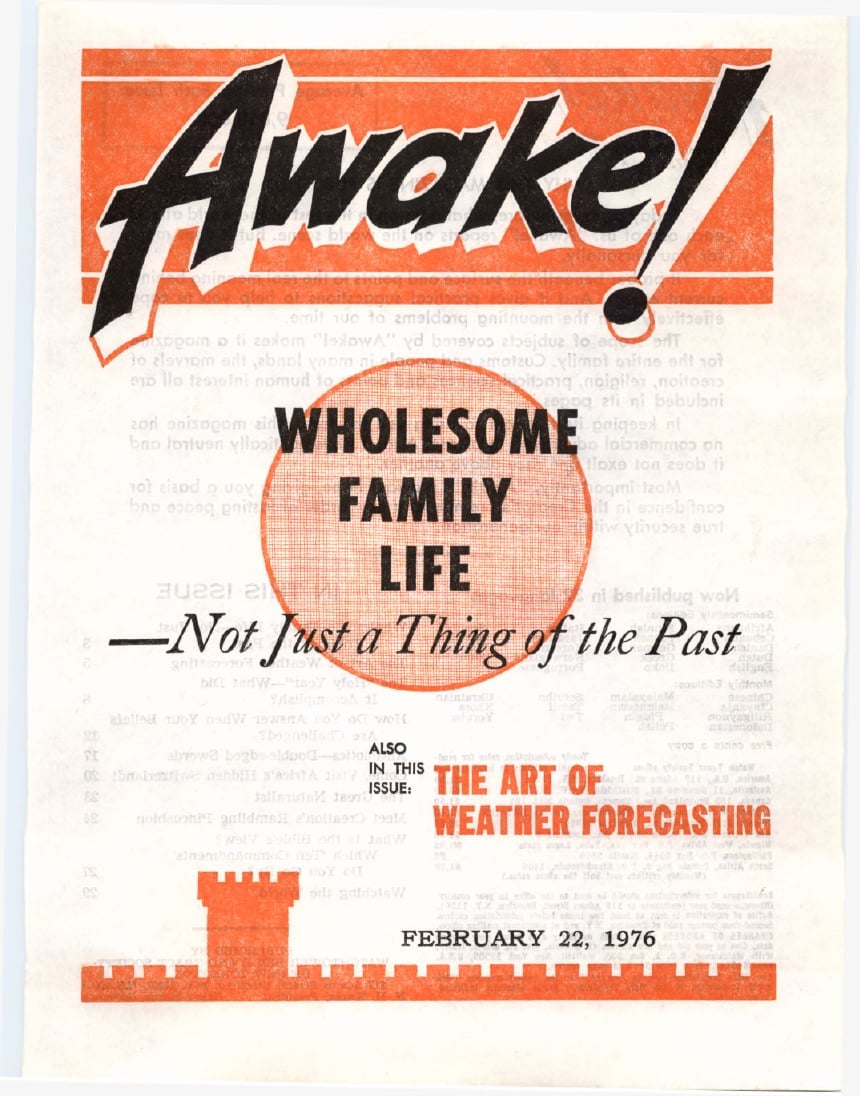
Awake! — February 22, 1976
Source: jw.org
Contents
Wholesome Family Life—Not Just a Thing of the Past
The Art of Weather Forecasting
The “Holy Year”—What Did It Accomplish?
How Do You Answer When Your Beliefs Are Challenged
Antibiotics—Double-edged Swords
Come, Visit Africa’s Hidden Switzerland!
The Great Naturalist
Meet Creation’s Rambling Pincushion
Which ‘Ten Commandments’ Do You Go By?
Watching the World
The Bible and Ancient History—Do They Agree
Who Rules the World?
Wholesome Family Life—Not Just a Thing of the Past
Wholesome Family Life—Not Just a Thing of the Past
FAMILY life has changed considerably within the present generation. Have you noticed the change? Has it affected your family?
“When I was a youngster,” noted an elderly gentleman, “our family always ate together and enjoyed conversation at mealtimes. We sought recreation as a family, taking walks and going fishing. And we worked together to get things done around the house.”
Is that the way things are in your household? In some homes today family members hardly speak to one another. They may even eat at separate times or in separate rooms. What is responsible for the breakdown in wholesome family life?
The growth of industry shares much of the blame. Today men work in factories and offices, rather than at home. In many cases society, rather than the family, cares for the sick, educates the children, prepares much of the food that people eat and even sees to their entertainment. Besides this, current emphasis on personal satisfaction leads many to draw away from family life to pursue individual goals or careers.
Has this eliminated the need for wholesome family life?
“A new survey sponsored by the Institute of Life Insurance revealed,” according to a news report last year, “that 80 per cent of Americans over age 18 choose ‘a happy family life’ as their number one goal. A happy family life was selected over ‘the opportunity to develop as an individual’ . . . ‘a fulfilling career’ . . . and ‘making a lot of money.’”
Is wholesome family life an important goal to you? How can you achieve it? Let us consider some basic responsibilities of family members.
The Father—More than a Breadwinner
Persons who study human behavior repeatedly emphasize the importance of the father’s role in family life. “More and more studies affirm,” remarks writer Ana Honig of the Women’s News Service, “that father-deprived youngsters may be emotionally crippled.”
Are you a husband and father? Doubtless you have a deep love for your family. You may even ‘burn yourself out,’ so to speak, in your efforts to provide food, shelter, clothing and other comforts for them. But if that is the extent to which you are involved with your family, you may be making a serious mistake. Why so? Consider a letter written to a newspaper columnist by a thirteen-year-old boy:
“Sometimes I wish [my father] would holler at me, so I’d know he cared. If I want to go anywhere or do something, I’m supposed to ask Mom. He says his job is to provide money. I’d like to have a father who sits down and talks with a guy, who has time to go to the woods with him or just walk. My father doesn’t fuss even when my grades go down. He says, ‘Let your mother look into it!’”
The Bible, too, stresses the need for fathers to take a personal interest in the development of the children, saying: “You, fathers, do not be irritating your children, but go on bringing them up in the discipline and mental-regulating of Jehovah.” (Eph. 6:4) Are you familiar enough with the Word of God to provide that vital “mental-regulating” for your offspring?
The Role of a Mother
Mother’s role is an especially important one too. Besides caring for numerous household duties, usually the mother is with her children for most of each day. If she displays tenderness and warmth in dealing with her little ones, and encourages them to treat one another in the same way, there is little likelihood that the kids will desire to escape such a loving home atmosphere to go off on their own.
Commenting on the wife’s role in wholesome family life, Theodore R. Van Dellen, M.D., writes in his column “Family Doctor”:
“A good wife maintains a calm and relaxed household in which love and trust flourish. She knows that the emotional and psychic aspects of marital life are important to the well-being of her husband and children. . . .
“Unpleasant situations at work are out of her jurisdiction, but she is in control at home. Spare him as much as possible by not accepting too many social engagements. Help him plan and enjoy his leisure time. . . . Be a sympathetic listener when he tells you his problems.”
Youngsters can do their part, too, especially by cooperating with their parents when asked to do things. Keep in mind the Scriptural advice: “You children, be obedient to your parents in everything, for this is well-pleasing in the Lord.” (Col. 3:20) A fine Scriptural principle for wholesome family life is: “Let each one keep seeking, not his own advantage, but that of the other person.”—1 Cor. 10:24.
Doing Things Together
For homelife to be most enjoyable, however, family members must do things together. But what can members of a household do together in a big city where industry has taken over most family functions? Consider a few of the things that a New York father of two young boys found successful:
“From their earliest childhood my wife and I have taught the boys how to do things around the house. I’ve noticed that the youngsters are willing to do even dirty work, like cleaning out a toilet, if they see us doing similar things.
“When the boys were old enough to understand, I took them over to the toolbox. I explained every tool to them, its function and how to use it. Now they enjoy doing household chores.”
Do you encourage members of your family to work together in that way? Work, however, is not all there is to wholesome family life. The father quoted above adds:
“Everyone needs some relaxation. We’ve found it beneficial to pursue recreation together as much as possible. In New York, for example, there are all sorts of things that can be enjoyed free or for a minimal expenditure of money. We often take walks to the botanical gardens or to the park to play ball. Sometimes we’ll spend time browsing through bookstores, going to museums or to free concerts.
“Of course, a family doesn’t have to go out to enjoy recreation together. Sometimes we sit and read the Bible together or other good literature, such as classics. Recently the boys and I built a wagon together. It took quite a while and there were some setbacks. But it was a delight to see it take shape and to look upon the completed job, realizing that we had built it with our own hands. Activities like this help the kids not to want to be out on the street getting into trouble with delinquents.”
Do you take advantage of opportunities to do things with your family? Thousands of families throughout the world have found that applying Bible principles, such as those mentioned above, have resulted in greater happiness in their households. Would you enjoy learning how to apply Scriptural counsel to your own family? Jehovah’s witnesses will be happy to help you by conducting a free Bible study with you in your home or at any convenient place.
The Art of Weather Forecasting
The Art of Weather Forecasting
By “Awake!” correspondent in Honduras
YOU probably listen to a weather forecast every day. Nearly everything that you do is affected by the weather. Have you ever wondered how it is possible to predict something as changeable as the weather?
On the other hand, why is it that the weatherman is so often wrong? In order to appreciate the weatherman’s task, we need to understand something about the nature of weather, and what causes it.
Above the earth’s surface, the atmosphere extends hundreds of miles into space. But we are concerned here with only the bottom layer, some six to nine miles thick, called the “troposphere.” This layer contains some five quadrillion tons of air, and it is within it that all the weather happens. There are three primary properties of the atmosphere involved in the weather—temperature, pressure and humidity.
Temperature
The fundamental cause of all weather is the unequal heating of the atmosphere by the sun’s rays. This comes about because the atmosphere itself is transparent and absorbs very little energy directly from sunlight. The sun’s rays go through to the earth’s surface, where they are reflected or absorbed, in varying degrees. Water reflects more light, and land, especially dark-colored earth, absorbs more. If the surface absorbs a lot, it is warmed. If it reflects a lot, it remains cooler.
The equatorial regions receive more heat because the sun’s rays hit vertically. In the polar regions, they strike obliquely, so the heat energy in an equal “bundle” of rays is spread over a larger area. Also, the snow cover at the poles reflects most of the sunlight. Consequently, it is colder at the poles. Temperature differences caused by this process, called “insolation,” put in motion a chain of consequences that brings about the great variety in our weather.
Pressure
An important factor is changes in pressure. Since air at a higher temperature is less dense than the cooler air over another area, it rises. This movement, in turn, generates differences in pressure between different areas.
A barometer, which measures the weight of atmosphere above it, will show a lower pressure under a rising column of warm air, which displaces the cooler, relatively more dense air above it. On the other hand, a descending column of cool air will cause higher pressure below it. The pressure difference at the surface causes a wind to blow from the region of higher pressure toward that of lower pressure. It is similar to what happens when an inflated balloon is opened at one end. The high-pressure air inside rushes out into the surrounding area of lower pressure. The greater the pressure difference, the stronger the wind. This principle operates on a global scale.
Warm air near the equator rises and moves toward the poles. In turn, the cooler polar air is drawn beneath, toward the equator. The earth’s rotation diverts these currents into prevailing easterly and westerly winds at different latitudes and altitudes.
These global movements of air masses in different directions generate turbulent motions where the main streams brush against each other. There are additional effects from topography—the irregular outlines of continents and the complex patterns of mountains and plains, deserts and forests.
Humidity
As air masses move across the surface of the earth, they pick up water. Most of this is vapor from oceans, but some comes from moist earth. Since warm air has greater capacity for moisture, air masses drawn toward low-pressure areas have relatively higher humidity. The fact that water vapor weighs less than an equivalent volume of dry air further contributes to the lightness of columns of warm air rising in low-pressure areas.
What happens when humid air rises? Pressure on it decreases, it expands and cools. When the temperature falls to the level where the air becomes saturated, water begins to condense in droplets or ice crystals, forming clouds. From these, rain or snow may fall. The air, thus dried, descends in high-pressure areas, bringing clear weather.
The Weather Chart
Meteorologists note the air’s varying properties of temperature, pressure and humidity. At each weather station there are instruments to measure all of these. A weatherman also studies wind direction and speed, the nature of clouds, visibility, whether it is or has been raining or snowing, and how much.
These data are organized for comparison with readings at other locations. To facilitate this, all weather stations have a fixed hour by Greenwich mean time for gathering the needed information.
The observer must take into account that barometric pressure decreases with altitude under constant weather conditions. In fact, the difference even at an altitude of one thousand feet is greater than that caused by changes in weather. So a correction is applied to the reading at each station, to put all the readings on a common basis, as if taken at sea level.
With the help of such detailed information from weather stations over a wide area, a meteorologist plots a chart in a special “language” created by the World Meteorological Organization. In this language information appears as numbers instead of words, making possible its transmission between ships at sea and land stations in various countries without need of translation. Weather charts are then drawn with irregular curving lines called “isobars” that connect places reporting the same pressure. Some of these lines form closed curves around regions that are thus identified as high- or low-pressure areas or, for short, “highs” and “lows.” This gives the weatherman a good picture of the weather as it was at the time of the observations.
The Weather Forecast
However, discerning what the weather is at a given moment is one thing; telling what it will be tomorrow or several days hence is quite another. This requires examining a number of charts drawn up over a period of time. Since each chart is like a photograph that pinpoints the weather at a given moment, by arranging several charts in order the weatherman views a “motion picture” of atmospheric movements. Based on the most recent shifts of the highs and lows, he marks out their probable position for tomorrow. Thus he can get a good idea of how the weather will change in the immediate future.
In view of today’s sophisticated equipment and scientific know-how, why are weather forecasts often wrong? Why are meteorologists at times unable to foresee devastating storms that cause vast damage to property and loss of lives?
It is important to realize that your weatherman can only observe what is happening and tell us what he believes will happen next, but he cannot control weather conditions. We cannot expect, in the nature of his task, pinpoint accuracy. For instance, he may predict showers in a given area. But these are often local manifestations. One locality might enjoy a heavy rain, and another, only a few miles away, might remain perfectly dry.
And there are other unpredictable factors. Just as differing currents exist at various depths of the sea, so too the atmosphere at varying altitudes has different winds and air masses that influence one another. Charts of higher altitudes contain fewer details, making it difficult to know in advance the effect of these more remote conditions on our weather.
When developing his forecast, the meteorologist must ask himself questions such as: Will this low-pressure center continue at the same speed tomorrow? Or might it slow down, or turn aside? Is there any indication that the disturbance is weakening and might disappear? Will the approach of the “low” to a stationary “high” interfere with it? Which will probably prevail?
Far from being simply a matter of guesswork, however, weather forecasting is an art that involves detailed knowledge and skill. Your weatherman can indeed help you to plan activities in advance, but he cannot guarantee what the weather will be. And now you know why. There are so many factors beyond his control.
The “Holy Year”—What Did It Accomplish?
The “Holy Year”—What Did It Accomplish?
THE year 1975 was designated a “Holy Year” for the Roman Catholic Church world wide. It was inaugurated on Christmas eve, December 24, 1974, when Pope Paul VI opened a “holy door” in St. Peter’s Basilica in Rome.
Now the year has ended. What was accomplished? Were the aims of this holy year achieved? Have conditions at least within the Roman Catholic Church improved as a result? Surely if the holy year was an event that had God’s backing, then we should logically expect his blessing upon it.
Purpose of Holy Years
Holy years in the Roman Catholic Church began in the year 1300. At that time Pope Boniface VIII decreed a special year of “grace.” Catholics were invited to come to Rome to venerate ancient places regarded as sacred. Those worshiping in the prescribed way were given indulgences, that is, remission of punishment for sins.
At first, holy years were held every fifty years, then every twenty-five years, except when wars or plagues made travel to Rome impossible. In our century, there have been regular Holy Years in 1900, 1925, 1950 and 1975. At times special holy years are decreed, and one such was in 1933.
What was the purpose of the 1975 Holy Year? The Cleveland Press observed: “While interior renewal is uppermost in the Pope’s mind, one high-ranking prelate close to Paul VI says the pontiff is also pinning hopes on the Holy Year to heal the deep rifts in the Roman Catholic Church caused by the wave of reforms which have followed the Second Vatican Council,” held ten years ago.
In recent years the Roman Catholic Church has been struck by a hurricane of dissent within its own ranks. Priests and laymen alike have argued over, and challenged, Church doctrines and practices. As a result, very deep divisions have been caused. This headline in the Muskegon, Michigan, Chronicle describes the condition: “Catholic Church Flounders in Seas of Change.”
In country after country, that situation confronts the Church. It is in very deep trouble everywhere. Hence, late in December of 1974, as the Holy Year was about to begin, Pope Paul appealed for unity and reconciliation. He said that the Church was gravely threatened by the “polarization of dissent.” In fact, he had previously called it an “epidemic” of dissent and said that it involved “dangerous” political and social views that were spreading. The pope lamented: “This phenomenon, spreading like an epidemic in the cultural spheres of our community, is causing us great pain.”
The pope also declared that “challenging sons” had inflicted “sharp wounds” on the Church. He accused both conservatives and liberals of threatening its unity. He appealed for reconciliation from “Catholic disagreement, from habitual contestation, from bitter criticism, . . . from underhanded or open minded defection.”
Another Hope
It was also hoped that the Holy Year would see some alleviation of another critical Church problem. This was the fact that many priests and nuns, as well as ordinary churchgoers, are abandoning religious life.
At an audience in the Vatican, the pope had told a delegation of Italian priests: “Our suffering because of the many priests who are defecting is our crown of thorns.” He has since repeatedly expressed anguish over these ‘defections of the clergy, and of the laity as well.
Thus, just before the Holy Year began, Epoca of Rome reported: “The dramatic alarm was made by Paul VI: the house of God ‘seems destined to extinction.’”
Epoca added this comment: “Numbers prove a decline that could not be stopped: from the end of [World War II] till today 10 thousand priests gave up the frocks in Italy, during the next 10 years most of our seminaries must close up, only 30 per cent of the faithful go to Mass, only 10 per cent receive the Communion on Sunday.”
Did the Holy Year accomplish its aims? Was its primary purpose of “renewal and reconciliation” achieved? Was there a healing of the tremendous divisions that have grown in recent years? Has the tide of defections halted?
No Healing
Observers agree that the 1975 Holy Year provided no healing. There was no “renewal” or “reconciliation” of any substance.
This is acknowledged even by Catholic authorities. Priest-sociologist Andrew Greeley stated in an article published by the San Francisco Chronicle: “There is a conspiracy on to discredit the Catholic Church. Unfortunately the conspiracy is internal,” that is, it is being accomplished by leaders within the Church, the very ones who claim to want healing.
Greeley claimed that, despite the desire for renewal and reconciliation during this Holy Year, Church authorities took actions to widen wounds, not to heal them. He noted the following examples:
“The Congregation of the Faith (formerly the Holy Office, formerly the Inquisition) recently issued a condemnation of the conservative Swiss theologian Hans Kung even though Kung had already agreed to write no more on the subject under dispute.
“The same congregation celebrated the twentieth anniversary of the death of the great paleontologist and mystic, Pierre Teilhard de Chardin, by reasserting all the old regulations on book censorship . . .
“Bishop Leo Maher of San Diego has denied the sacraments to all members of the National Organization of Women (NOW) for supporting abortion.”
Greeley said: “Mind you, all of this is during the Holy Year of reconciliation.” He continued: “No reconciliation, however, for Hans Kung. No liberation for the members of NOW. And no liberty for Catholic authors.” This despite the fact that “many church [authorities] are pushing a kind of soft-core socialism called ‘liberation theology’ and the, American church is working on a Bicentennial discussion book entitled ‘Liberty and Justice for All.’”
This priest noted, however, that none of the restrictive actions taken by Church authorities would make much difference anymore. Why not? Because, he said, “priests will still give holy communion to members of NOW, Hans Kung’s book remains on top of the German best seller list, and very few Catholic authors will take the new censorship regulations seriously.”
Thus, despite the leaders of the Church issuing calls for “reconciliation and renewal,’’ they also issued condemnations, excommunications and censorship decrees during the Holy Year. These, in turn, were hotly contested or ignored by others within the Church. How obvious it is that the Holy Year produced no significant “reconciliation” or “renewal” among the Church’s clergy or laity.
All of this led Greeley to declare: “It is, of course, the last twisting of the tail of a dying beast. The death throes of an old ecclesiastical bureaucracy.”
Deterioration Continues
The Holy Year also had no effect on the pope’s “crown of thorns,” that is, the loss of priests and nuns. Nor did the Holy Year stem the tide of defections on the part of the laity.
The bishop of Providence, Rhode Island, Louis Gelineau, said during the Holy Year that the Catholic Church was “experiencing a certain ‘coming apart’ as an organization.” He noted a serious drop in the number entering the priesthood, and also a serious drop in attendance at Catholic services. He added: “Many Catholics have become more formed by the world and its opinions than by the mind of Christ and the Church.”
At the start of the Holy Year the Toronto Globe and Mail told of the “desperate shortage of priests and nuns.” That shortage continues, and worsens. Fewer and fewer are taking up the religious life. According to official Catholic reports in America, “the number of seminarians has decreased by 55.5 per cent, the total of women entering novitiates has dropped by 81.2 per cent.”
Thus, there are fewer and fewer replacements for the priests and nuns who are quitting the Church or dying. One evidence of the trend was observed by the Detroit Free Press late in 1975 when it declared: “The number of Roman Catholic nuns in the world has dropped 24.6% in the past four years.”
Regarding the laity, Time magazine reported that, in the United States, only 50 percent of Catholics now attend weekly Mass, compared to 71 percent in 1963. Indicating how the thinking of many Catholics now differs from official Church doctrine is the report that after decades of anti-abortion teaching, 70 percent of Catholics now think that a legal abortion should be available for married women who want it. Few approved such a procedure before.
Also, 83 percent of Catholics now approve artificial contraception for birth control, compared to about half that number ten years ago. Today only 32 percent of Catholics accept the dogma of papal infallibility. And only 42 percent now accept the teaching that Jesus handed over the leadership of his church to the apostle Peter.
In country after country, the situation is the same. Church authorities in Italy, for example, acknowledge that fewer than one out of three Italians now go to church regularly. In Hungary, only about a quarter of that nation’s six million registered Catholics are considered active churchgoers. And from London, a report issued during the Holy Year stated: “The Roman Catholic Church in England and Wales is losing members at the rate of 250,000 a year. The number of converts it is winning has fallen to the lowest level in this century.” It spoke of a “wholesale loss of faith among English and Welsh Catholics.”
No, the 1975 Holy Year had no substantial effect in providing “reconciliation” or “renewal” among either the clergy or the laity. The turning away from the Church continues.
Ominous Trend for Church in Italy
A very threatening change has taken place in the heart of the Catholic Church—in Italy. Not only has Church attendance fallen, not only is there a growing shortage of priests and nuns there, but now another ominous threat to the Church is looming.
What is this threat? It is the inroads that an archenemy of the Church is making among Italy’s population, especially among the young people. That enemy of religion is Communism. While it is true that Communist teaching does accommodate itself at different times to both religion and other political ideologies, the long-range goal of Communism has not changed. That goal is to eliminate religious influence and power wherever Communism is in control.
In Italy, the Communist party has come very close to control or participation at the highest levels of government. The New York Times of December 2, 1975, reported: “Already, Communist control or participation in local government extends to five of Italy’s twenty regions, one-third of its 94 provinces, and, except for Rome, every major city from Naples north.”
Such inroads into the political power once exercised by the Church, or the parties it favors, were evidenced during the last elections, held in June of the Holy Year. In spite of Vatican support for the political party it favored, Communist candidates made the largest gains nearly everywhere. They won political dominance in every major city in the north. They also penetrated the south, even installing a Communist mayor in Naples.
Now, nationally, Communist votes are only about 2 percent behind those obtained by the party in power. And perhaps the most ominous trend for the future is the fact that the majority of younger voters cast their ballots for Communists.
For the past thirty years official Catholic doctrine in Italy has been against Communist candidates for office. Repeatedly, Catholics are warned not to vote Communist, at the threat of excommunication. In July of the Holy Year, the Roman Catholic bishops of Lombardy said that priests who encouraged Italians to vote Communist must recant or face excommunication.
The Vatican newspaper l’Osservatore Romano published a statement by northern Italian bishops expressing their “pained disapproval” over the outcome of the June elections in which the Communists gained 2.5 million votes and nearly outpolled the Vatican-backed party in power. And late in the Holy Year, in November, Pope Paul issued new warnings against Catholics who support the Communist Party. But it has been apparent for some time that such warnings are falling on a growing number of deaf ears.
Hence, when we consider all the facts, we must conclude that 1975 was anything but a “Holy Year” for the Roman Catholic Church. There has been no “reconciliation.” There has been no “renewal.” Instead, its troubles continue to mount everywhere, even at the very center of its power, in Italy.
No, 1975 was no “Holy Year” in any true sense of the word. And the most crucial reason why it was not was simply that it was not God’s doing. As Psalm 127:1 states: “Unless Jehovah himself builds the house, it is to no avail that its builders have worked hard on it.”
How Do You Answer When Your Beliefs Are Challenged
How Do You Answer When Your Beliefs Are Challenged
“TWO things I never talk about are religion and politics,” is the response of many people when these subjects come up. They know that unpleasant arguments and even loss of friends can result. So they avoid such subjects.
No doubt you also have your own convictions about such matters—and you may feel that you are right. Likely you do not feel that your beliefs should or could be changed. And if your convictions are unpopular or misunderstood, you know what strong feelings arise if you talk about them.
On the other hand, making a response when your beliefs are questioned often can be mutually beneficial. Open discussion may even remove groundless barriers and open others’ minds to new ideas that can truly benefit them. However, the way that you respond to those who disagree with you is often the key to whether the outcome is beneficial or harmful.
To strike out aggressively with your best arguments may at first seem the best way. But this can often be counterproductive, causing resentment. Better is the sage Biblical advice: “Always have your answer ready for people who ask you the reason for the hope that you all have. But give it with courtesy and respect.”—1 Pet. 3:15, 16, Jerusalem Bible (JB).
“Courtesy and respect” for the other person’s sincerity in his own beliefs help to avoid arousing harmful emotions when one is discussing controversial matters. That is why the Bible also recommends that when a person is defending his Christian faith, he is “not to engage in quarrels, but . . . to be kind to everyone, a good teacher, and patient. He has to be gentle when he corrects people who dispute what he says.”—2 Tim. 2:23-25, JB.
What Christ Jesus had to say in his day ran counter to strongly entrenched and cherished beliefs of most of the people to whom he spoke. Yet he won many hearts because he showed respect for others, even when under attack for his controversial teachings: “He was insulted and did not retaliate with insults.”—1 Pet. 2:23, JB.
The beliefs of some Christians today are misunderstood and may even be attacked by people who hold more conventional or popular views. Certainly those who profess to be Christians should reflect Christ’s way of answering, just as his early disciples did. When people observed how convincingly Peter and John spoke, for example, and “perceived that they were men unlettered and ordinary, they got to wondering. And they began to recognize about them that they used to be with Jesus.”.—Acts 4:13.
A modern illustration of how Christian principles can be used effectively was presented on a television program seen in many parts of Canada. A representative of Jehovah’s witnesses was questioned about some of their more controversial beliefs at Ontario’s McMaster University. The amphitheater of this modern university was filled to capacity with about 400 students. Under bright TV lighting, the moderator, a prepared panel of three students, and other students from the audience probed the Witnesses. Portions of the transcript follow.
Televised Questioning
Early in the discussion, the moderator asked a question the wording of which seemed to make Jehovah’s witnesses appear biased. Note how this problem was confronted directly, yet tactfully.
Moderator: “Why do you think that other religions are oppressive?”
Witness: “Of course, a statement made like that does sound rather blunt at first, but what we have in mind is that history shows that often religions, when coming into great power, [and] making unions with certain political systems, have been oppressive.”
Moderator: “Let’s take a branch of a religion, the Jesuits, for example. Do you think in their history they have been oppressive?’’
Witness: “Apparently many countries have thought so. There have been times when, for example, Jesuits have been expelled for meddling in political affairs of nations. There was even one time in history when the Pope himself felt it necessary to restrict them quite a bit. . . . If one has ever seen, for example, the murals of Diego Rivera in Mexico, these show quite plainly the cruel treatment of the native peoples, and other peoples, in an effort to force religious views and religious control.”
Allowing history to answer the question focused attention on the real problem. Then some questions were raised as to the politically neutral position of Jehovah’s witnesses.
Moderator: “Now, Jehovah’s witnesses urge their members to refrain from voting in elections and showing their allegiance to the flag in some countries. Why is that?”
Witness: “Well, to rephrase it slightly for the sake of clarification: It’s an individual choice on the part of each member on the matter of voting; but we believe that historically, Biblically, we are sound in this position of not being involved in the political scene. Christ himself told a Roman politician, nearly two thousand years ago, ‘My kingdom is not of this world.’ . . . [The historian] Augustus Neander, writing on the church in the first three centuries, plainly says that they stood aloof from the political state and they felt that what they could inject into the community was a more holy way of life that would be an example to others, and invite others to follow that. So what we feel [is]—they’re in their realm, we’re in ours—we’re trying to achieve similar goals; in certain cases, the identical goals. The Christian method is simply different from the political methods.”
The Witness continued on the matter of declining to pledge allegiance to any national flag:
Witness: “This is not disrespect, no more than the historical case of William Penn’s refusing to take off his hat before the king was disrespect. To him it was strictly a matter of conscience. With us it is. Anyone can check a reliable reference work—encyclopedia—on the origin of flags and find out that they were originally religious symbols and that various approaches made to recognizing them, saluting them, etc., pledging allegiance, had a religious background. To us, it’s a form of an idol. It’s a political image. It is a form of state worship, and we simply decline, respectfully, to participate, but we do not try to hinder anyone else.”
As the program proceeded, questioning was turned over to a preselected panel of three students who were evidently prepared to ask about matters on which they believed Jehovah’s witnesses to be vulnerable.
Questions from Students
First Panelist: “Christ spoke the Gospel of Good News. Good news to the poor, release to the captives, freedom to the oppressed. I’m wondering why your Gospel does not speak these things to people. Your Gospel is bad news, bad views, not good views.”
Witness: “It’s bad news for some people, Paul, because it means the end of a system that they’ve preferred to one that’s upright, just, to the blessing of the human family. . . . What we have preached to the people in those lands where many people thought it was bad news, was a release to the captives, a hope for the future, a release from sin and death through Christ.”
First Panelist: “Liberty to the oppressed is physical. It is not liberty to the oppressed in a spiritual sense, but in a physical sense. Good news to the poor means . . . giving them food. You see, you’re only concerned about the souls, saving people. The Gospel of Good News is to the whole man.”
Witness: “Yes.”
First Panelist: “Are you doing this?”
Witness: “Yes.”
First Panelist: “Are you feeding the sick?”
Witness: “Yes.”
First Panelist: “Are you going to the physical man and giving him the things that he needs?”
Witness: “Right. [Audience reaction indicates that they realized that the questioner had made wrong assumptions.] In fact, I can tell you that right now—Jehovah’s witnesses don’t generally advertise this because Christ himself said not to let your one hand know what the other is doing in the matter of giving—but right now, we have a ship on the way to Honduras loaded with material for people who are suffering there.”
First Panelist: “That’s the . . . first kind of charitable act I’ve ever heard attributed to your organization.”
Witness: “Well, that’s the first you’ve heard of, but that isn’t the first occasion of it.”
First Panelist: “Well, this is all news to me.”
Witness: “Good. This has been beneficial and enriching then.”
First Panelist: “Your attitude that the world is bad and destined to destruction releases you from any responsibility towards the world, towards the environment, towards poverty, towards war prisoners, all the atrocities, injustices of our society. This is a modern heresy, totally unbiblical. How do you justify it?”
Witness: “Well, we don’t really fit what you’ve described.”
First Panelist: “But if you preach that the world is coming to an end so imminently, you have no concern for the world.”
Witness: “Yes [we do]. Because it means the end, not of the planet, not of human society, but the end of all those injustices that you are so concerned about. It means the terminating of that which has been so oppressive to man throughout the centuries so that there will be no more of these things. That’s good news!”
The fact that Jehovah’s witnesses have produced the New World Translation of the Holy Scriptures still concerns some, as it did the next panelist.
Second Panelist: “Why did you go to all the work of having your own translation made when the King James Version already exists as a universally accepted translation?”
Witness: “For the same reason that Goodspeed produced his translation and Moffatt produced his.”
Second Panelist: “Can you tell me, who was the man that did this translation?”
Witness: “This was done by a body of men and they remain anonymous by their own wish . . . In fact, you have to do some searching today to find out who the translators were of the King James Version. The thing that proves the worth of the translation is not who the translators were, but the translation—the work itself.”
The third panelist was concerned about ‘setting dates’ and predicting the end. Answers made it clear that 1914 was only the beginning of the time of the end.
Third Panelist: “Well, anyhow, if it is the beginning of the end, . . . then the end must be very close?”
Witness: “Very.”
Third Panelist: “Then why are you investing all this money in real estate and new Kingdom Halls, and the new printing presses, when if you wait until the end you could have it all for nothing?”
Witness: “The reason why we’re doing it now, Eric, is because we have to, because of the tremendous growth in our organization, the demand for Bibles and Bible literature. And one thing is certain, once this system comes to an end any funds we have are not going to be usable or necessary then. So there is no point in hoarding it up and becoming a rich organization financially, investing it in other areas. We are using it for the purposes for which it was contributed by our own members, and that is, to spread the Gospel further.”
People often question the refusal of Jehovah’s witnesses to accept blood transfusions. During the questioning, a student raised hypothetical emergency situations in an effort to bypass the Scriptural prohibition mentioned in Acts 15:20, 29.
Student: “Well, suppose somebody was just coming to the hospital. They’ve got a few seconds to live. The only possible way out is a blood transfusion. Well, what’s your answer to that? I mean, that’s murder if you don’t let them accept that.”
Witness: “That situation doesn’t exist. Wherever there are cases where a person . . . let’s say comes in off the highway here . . . and there is extreme loss of blood. Every emergency room, in every hospital, has a plasma volume expander which can . . .”
Student: “Plasma doesn’t replace blood, though.”
Witness: “The need there is to keep the volume up in the system. It’s not the blood so much that’s needed then, but the volume that must be replaced. These expanders will do it. They are used in emergency situations; they are recommended by Civil Defense organizations when blood is not available. Obviously it works—it has worked on thousands of Jehovah’s witnesses.”
People often question Jehovah’s witnesses about their public method of preaching.
Student: “Don’t you think that the door-knocking techniques of your members to sell the religion infringe on a person’s privacy?”
Witness: “No more than that of anyone else who calls at the doors, but we realize that it does disturb some people. And if you are among those who are disturbed by it, of course you’d be sympathetic about that situation, but frankly a lot of people tell us how much they appreciate our calls . . . Because you’re not of those people, it doesn’t mean it doesn’t happen. I can tell you both sides of the matter. You know only yours, but the fact is that many people thank us for calling. Often they tell us we got them to reading the Bible again. So while it is, at times, something that disturbs people, we do it because we believe it’s commanded in the Scriptures. We believe it’s an effort to show love for fellowman, to benefit him by what we can share with him; and, finally, I think it’s worth while mentioning here, that it’s eminently successful because we reach a lot of people that need to be reached and aren’t reached by other religious groups.”
Sometimes those who question another’s beliefs are guilty of the very objections that they raise, as was the case with another student.
Student: “I’m interested to know what gives you the power or authority to feel that your religion is superior to, say mine, which is Christianity.”
Witness: “Do you feel mine is Christianity?”
Student: “Uh-mmm, no, I don’t.”
Witness: “What gives you the authority or power to feel that yours is superior to mine? You see, I don’t mean to embarrass you here, but . . .
Student: “You did!”
Witness: “This is always the thing with this type of questioning. It’s a two-way street and people who can’t understand why others take their views so seriously have their own [views], and what you have to do is be willing to dignify the other person with respecting the fact that he does take it seriously and then go to the Book which is supposed to have the answer to find out: Now which one of us is looking at this the right way? We have no argument with individuals. . . . We believe judgments are left to God. But we do believe that what the Bible says is true and if it says something about a matter that others believe that is different to what it says, we have to disagree with them.”
A Good Effect
These straightforward, honest answers reflected an understanding for other persons’ points of view. Hence, this Canadian television program helped many to see that there is another side, even when it comes to controversial beliefs such as those of Jehovah’s witnesses. What seems to have impressed viewers most, even among non-Witnesses, was the way that the Witness representative remained calm and maintained Christian dignity even when questioners displayed a measure of hostility. He knew the truth of the wise proverb: “An answer, when mild, turns away rage, but a word causing pain makes anger to come up.”—Prov. 15:1.
Hence, snappy comebacks that attempt to destroy opposers outright are out of place. A Christian desires to help all persons—even those who consider themselves to be opponents—to be attracted to the truth. Thus he conducts himself when under attack so that others incline to recognize that what he has to say is not of his own originality, but solidly founded on Biblical “wisdom from above” because it is “in the first place pure; and then peace-loving, considerate, and open to reason; it is straightforward and sincere.”—Jas. 3:17, New English Bible.
[Picture on page 12]
Should differing views alienate people? A Canadian television broadcast illustrates the value of displaying courtesy and respect for others even though you disagree
Antibiotics—Double-edged Swords
Antibiotics—Double-edged Swords
PENICILLIN, the first and most widely used antibiotic, was discovered back in 1928 by the British bacteriologist Alexander Fleming. But he and his colaborers had many obstacles to overcome, and so it was not until World War II that it finally came to be recognized for its value in combating infections.
The results with penicillin were so remarkable that it was termed a “miracle” or “wonder” drug, and since then many, many other antibiotics have been developed, both organic and synthetic. There is no question about these antibiotics, such as penicillin, having accomplished much good, saving many a life, shortening the recovery time of many a victim of accident or illness.
But the use of antibiotics has not been an unmixed blessing. Why not? Because of the very nature of antibiotics. The name itself should prove a warning, for it comes from two roots: anti, meaning “opposed,” and bio, meaning “life.” So an antibiotic is an agent opposed to life, that is, it is a killer. A killer of what? Of germs, bacteria, microbes, for which reason “antimicrobials” seems to be preferred in medical literature. “Antimicrobiais” are said to have “toxicity,” that is, poisonous characteristics as well as other harmful potentials in addition to therapeutic qualities.
Thus Dr. Robert C. Zurek, writing in Diseases of Medical Progress, states: “Whenever we employ an antimicrobial agent, we are wielding a truly double-edge sword. We take a calculated risk.” That is, the physician hopes to kill certain microbes without harming the cells of the body.
But is this fact fully appreciated by the medical profession, not to mention the public at large? Apparently it is not, for as Dr. F. D. Adams states in the foreword to the above-mentioned textbook “drugs are frequently administered . . . apparently without due regard for their disquieting and sometimes dangerous potentialities. One need but mention, for example, the widespread use of antibiotics for trivial upper respiratory infections and comparable minor ailments—a practice that seems to continue in spite of the exhortations of many qualified authorities that these agents are, as a rule, ineffective in such cases.”
A committee for the United States Health, Education and Welfare Department brought out that in one study of 1,045 patients, 340 were receiving antibiotics but only 13 percent of these (or some 45) actually should have received such medication. In another report a physician tells that from “90 to 99 percent of those who were receiving chloramphenicol were getting it for a non-indicated purpose.” And Drs. Silverman and Lee, in their book Pills, Profits, and Politics, state that at times antibiotics “have caused illnesses more severe than the diseases they were intended to combat.”
Indicative of the overuse of antibiotics is the fact that in the United States, in the 1971-1972 fiscal year, roughly 26,400 tons of antibiotics were produced and certified for distribution. This is enough for fifty doses for every man, woman and child in the country. According to Dr. H. F. Dowling, a highly respected authority on this subject, “it is doubtful that the average person has an illness that requires treatment with an antibiotic more often than once every five or ten years.”
Helping to account for this great consumption of antibiotics is their use in hospitals. On an average day some 40 percent of the patients are given at least one antibiotic. According to a leading authority on this subject, “it is inconceivable to me . . . to believe that 40 percent of the patients in the hospital require an antimicrobial drug. . . . I think that there is no question but that these drugs are . . . used excessively.”
Obviously, all such overuse of drugs results in much needless expense for the patients or their families or whoever else pays the bills. One hospital, recognizing this problem, organized an antimicrobial committee to monitor the use of such drugs. As a result, it was able to cut down the use of them by 20 percent. If all hospitals in the United States followed suit, it would mean an annual saving of $117,000,000. Another study showed that 93 percent of the patients receiving an antibiotic costing $12 a prescription were receiving it needlessly.
Cutting the Wrong Way
Just how serious is the double-edged aspect of antibiotics? According to Dr. Zurek, “the list of untoward effects is enormously long,” and “it would seem there is a true ever-increasing incidence of adverse drug reactions.”
While some may hold them to be exceptions, take note of these examples: There was a man of twenty-five years with a sore throat. His doctor gave him an antibiotic, chloramphenicol, for nine days. In less than two months he had very severe symptoms caused by this drug and in six months he was dead.
Then there was a woman forty-seven years old who was treated for a sore throat with penicillin. In three days she had all manner of complications, such as red lumps on her body, itching and difficulty in urinating. In spite of the use of an artificial kidney machine, she died.
In another instance a twelve-year-old girl was treated with chloramphenicol. It resulted in her being afflicted with a dangerous blood disease, from which she died. According to another report, hundreds of persons have died from chloramphenicol (trade name “Chloromycetin”), and in spite of the fact that for more than twenty-five years doctors have been warned about this drug, it is still being prescribed unnecessarily.
Why this overuse of antibiotics? With the advent of antibiotic therapy, the treatment of most infectious diseases took on a new specificity. At least something was available that could attack the germs causing the disease. Where a cause could not be isolated, the antibiotic was given empirically, that is, without sound basis, by enthusiastic doctors. And what is more, the patient many times demanded it. As a consequence, there has been much unjustified use of antibiotics.
No doubt another reason for the overuse of antibiotics is the desire of doctors just to do something, tending to consider only the potential benefits of these drugs. Still another reason, suggested by S. M. Wolfe, director of Ralph Nader’s Health Resource Group, is the possibility that for information about drugs doctors depend too much on the biased sales pitches of drug company representatives.
Why Two-edged?
Why do antibiotics help many people but not help all? Why are they so often two-edged swords? One factor is the physical condition of the patient. Powerful antibiotics are likely to have powerful toxic side effects. It is the function of the liver and the kidneys to get rid of toxic agents. But if the liver is diseased or the kidneys function inadequately, they may not get rid of the toxic residues of the antibiotic and, as a result, the cells of the body succumb to the poisons and the patient sickens and may even die.
An even more frequent cause of complications resulting from the use of antibiotics is allergy or some type of intolerance. Any patient may be allergic to one or more antibiotics, as a result of which harm and even death may come to the patient. For example, of more than a thousand reported life-threatening reactions caused by antibiotics, the vast majority involved penicillin, and, of these, 10 percent were fatal.
There is also the problem of microbes developing drug immunity, resisting the bacteriocidal effect of the antibiotic. This has been seen recently in the treatment of gonorrhea. For years the gonococcus germ causing this disease was extremely sensitive to penicillin so that recovery from this disease was almost certain if the antibiotic was administered. Lately, however, penicillin-resistant strains of gonococcus have developed, so that now other, less effective drugs have to be used.
Still another reason why an antibiotic may turn out to be a double-edged sword is that it may wipe out all except certain strains, which then increase and cause completely new or complicating diseases. Such “superinfections” are caused by the microbes not susceptible to the antibiotic but which have been kept in check by the other microbes in a sort of “natural” balance.
Regarding this aspect of matters, The Sunday News, Detroit, Michigan, July 28, 1974, told of doctors warning that overuse of the most widely administered antibiotic has fostered development of a new resistant kind of infant brain inflammation. The antibiotic is ampicillin, a synthetic form of penicillin. According to Dr. S. Ross of the Children’s Hospital in Washington, D.C., “ampicillin has been beaten to death by being used indiscriminately by physicians both inside and outside the hospital.” It “used to be the drug of choice for . . . a serious intestinal disease. In 1967, 5 percent of [such] cases were resistant to it. Now 95 percent are resistant. . . . The growing resistance scares . . . us.”
An example of this is the potential effect of some antibiotics on the intestinal flora, the useful bacterial population of the intestines so essential to the proper and maximum assimilation of food. According to many practitioners, continued use of antibiotics may kill not only harmful bacteria but also much of the intestinal flora. For this reason certain practitioners urge the use of yogurt or like milk products whenever a person is taking antibiotics.
What Can You Do About It?
Some might conclude from the foregoing that all this information is the concern of physicians, not of their patients. But is that so?If so many doctors are not sufficiently cautious, even as their own spokesmen confess, perhaps the “layman” should show concern. That is the position taken by Science Digest, January 1975. It states: “All antimicrobials—as a group—are overused and abused by physicians in general to the point where the public must learn to protect itself by learning the dangers, for clearly doctors as a group are blowing it.”
From the foregoing it is apparent that you should be very careful about using antibiotics. Never urge your doctor to prescribe antibiotics. Never use those prescribed to others; never experiment yourself. Let your doctor know of your past use of antibiotics, whether unfavorable or not; also let him know what other drugs you may be taking. If he prescribes antibiotics, inquire as to an alternate treatment. If they seem imperative, then follow his instructions closely.
To sum up, we cannot do better than to quote from the “Concluding Remarks” in Dr. Zurek’s chapter, “Antibiotic-induced Diseases”: “It is hoped this review of untoward reactions to antimicrobial agents will foster appropriate respect for these drugs. Their use has produced tragedies as well as miracles. None are completely without hazard. . . . Successful antibiotic therapy can be achieved only by knowledge of the capabilities of these agents and a constant awareness of their hazards.”
Come, Visit Africa’s Hidden Switzerland!
Come, Visit Africa’s Hidden Switzerland!
By “Awake!” correspondent in Zaïre
HIGH up in the heart of Africa is an area having some of the continent’s most beautiful lakes, most interesting mountains, greenest valleys and most spectacular scenery. Rightfully it can claim to be a “tropical Switzerland.”
Yet it was one of the last parts of Africa to be visited by explorers, just about a hundred years ago, and even today it is not on the great tourist circuits. No wonder, because this lovely country is at least 600 miles from the ocean and is fenced off by dense tropical vegetation, swamps and disease-infested areas. But the few who venture past these natural barriers will be richly rewarded. Here they will meet both the tallest and the shortest people in all of Africa. They will find a wealth of animal life and an abundance of crops. They will see fire-spitting volcanoes and hot springs. And as a striking reminder of Switzerland, they will behold snow-covered peaks as high as the Matterhorn, beautiful waterfalls, great lakes, lush valleys and picturesque villages seemingly glued to steep slopes.
This hidden “Switzerland” comprises the southern part of Uganda, the countries of Rwanda and Burundi, and the adjoining part of Kivu Province in eastern Zaïre.
Our Journey Starts
We must warn you, even today traveling in this area is not easy. Wherever you go, you have to expect a bumpy ride, and a slow one.
The first leg of our exciting trip will be from Kabale to Kisoro. The bus is old, is packed out with more than sixty passengers and has still more weight on its roof: bicycles, furniture, all kinds of crates, bundles and bags of foodstuffs and live animals.
Finally the bus is loaded and we are off! We pass a few villages, and as we wind up the switchback road the air gets fresher, less humid at higher altitudes. In time, we are able to see Lake Bunyoni, a pearl, as it were, or perhaps more like the end of a fjord, but one in a setting of tropical sun and lush vegetation, fringed by a curved shoreline and with a beautiful island in its midst. We go higher and higher, with our view constantly improving, enhanced now by the red of the African flame trees dotting the mountainside. In the other direction we have a far-distant view into the deep valleys below, with their cultivated slopes and small villages clinging to the sides. We stop here and there to let one or two persons get off, each taking his belongings—bags, bottles, chickens, baskets, stools, bowls or whatever—which are handed down from the roof of the bus.
But, look! On our left is the town of Kabale. Why, that was our starting point! After almost five hours of winding through the mountains, and after traveling almost fifty miles on this winding mountainous road, we are only about ten miles away from Kabale, as the bird flies. Amazing indeed!
Now we are driving through a forest of bamboo that is so dense that the road seems to be in a tunnel, and suddenly we come out to a fabulous view, the well-known Kanaba Gap. We can now see the Virunga volcanoes stretching into three countries—Uganda, Rwanda and Zaïre. On the slopes of the closest volcano is one of the last homes of the wild gorilla.
Into Rwanda
In this “land of a thousand hills,” which, by the way, is quite an understatement, traveling may seem more leisurely but still very scenic. Head and shoulders above the rest, there is Karisimbi, with an altitude of 14,786 feet (about 4,500 meters), the highest volcano in the Virunga range. South of it lies Ruhengeri, surrounded by extensive banana groves. Here we see very attractive houses made of lava bricks, with the mortar between them painted white. Here too is Lake Bulera and Lake Ruhondo, which remind us of beautiful Lake Bunyoni.
This is an agricultural country. All suitable land seems to be used to raise coffee, potatoes, millet, beans, peanuts, maize, cassava and other crops—sometimes on a forty-five-degree angle on the slopes. Here and there we pass brick factories with their typical ovens, in which a variety of gray, yellow and red bricks are produced.
But soon we are climbing again, on our way up to more than 7,000 feet (2,100 meters). For many miles it seems that we are driving along on top of mountain ridges. The equatorial sun playing on the countryside gives an added splendor to the various shades of green. There are many trees mingled with eucalyptus trees, and, in the latter, reed baskets have been attached to provide homes for honeybees.
Somebody on the bus says that we are approaching Kigali, the capital. If that is so, we have not done badly on this part of the trip, having covered about eighty miles of dirt road in four and a half hours, and this morning we have added another stretch of twenty-five miles.
One thing that has impressed us in the last hundred miles is not seeing any large villages, only one or two small ones of no more than ten houses each. But we are reminded that this is typical of Rwanda, a small country of four million people, with a density of population comparable to that of Europe, and yet most of the people live in single houses scattered over the countryside. When we passed a marketplace, however, we quickly realized how many people there are.
…