Awake!, February 8, 1975
Download: PDF — Awake!, February 8, 1975
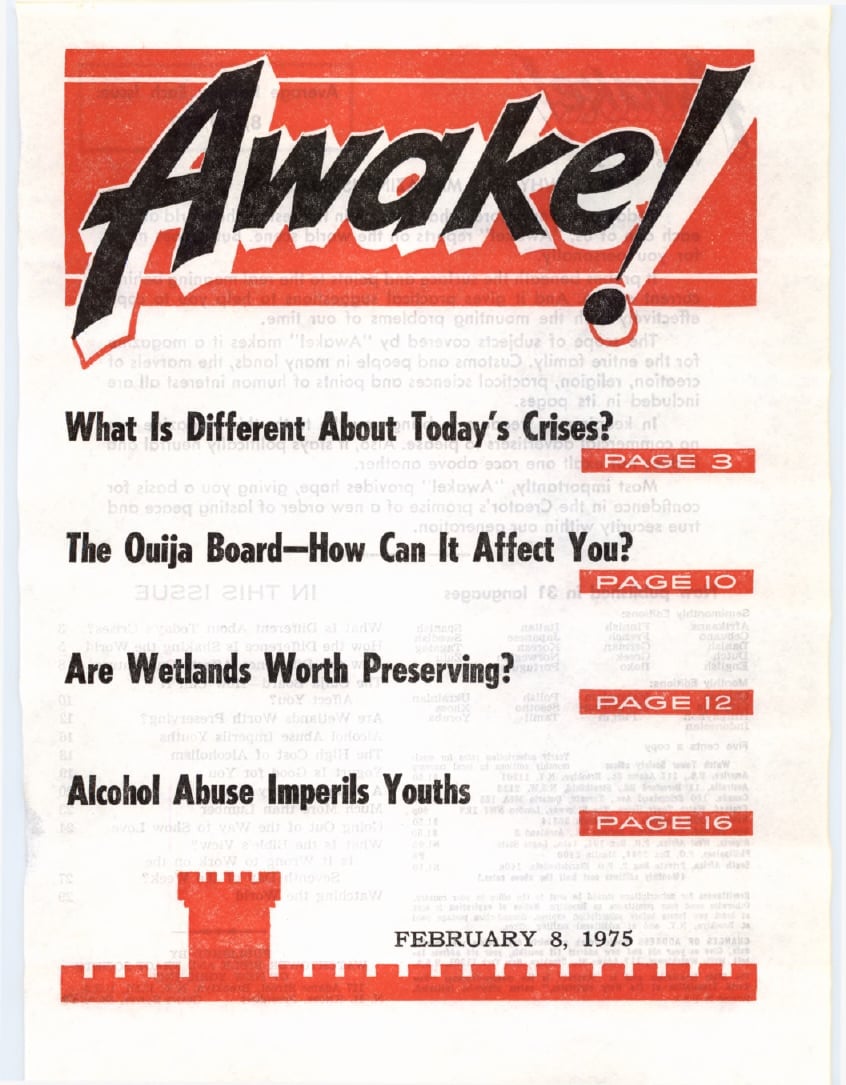
Awake! — February 8, 1975
Source: jw.org
Contents
What Is Different About Today’s Crises?
How the Difference Is Shaking the World
How the Difference Affects Our Future
The Ouija Board—How Can It Affect You?
Are Wetlands Worth Preserving?
Alcohol Abuse Imperils Youths
The High Cost of Alcoholism
Yogurt Is Good for You
A Bouquet Every Day
Much More than Lumber
Going Out of the Way to Show Love
Is It Wrong to Work on the Seventh Day of the Week?
Watching the World
Answers at Your Fingertips
Can Anyone Bring Stable Government?
What Is Different About Today’s Crises?
What Is Different About Today’s Crises?
ON AUGUST 25, 1974, the Bulletin of the Atomic Scientists moved its front-cover “doomsday clock” three minutes closer to midnight. These scientists thus signaled their fear that the threat of nuclear holocaust recently grew by that much, bringing the clock to nine minutes before midnight.
However, those who are aware of the clock’s history know that, since 1947 when the atomic scientists started it ticking, their clock has moved eight times, but in both directions.
Many people believe that the course of history is very similar to that “doomsday clock.” They say that crises come and crises go but somehow mankind always muddles through. Their outlook is just what a discerning prophet 1,900 years ago said it would be: “Why, from the day our forefathers fell asleep in death, all things are continuing exactly as from creation’s beginning.”—2 Pet. 3:4.
It is obvious, these persons agree, that global economic and political systems are currently under severe stress, but are not the world’s best minds focusing on the problems? The United Nations special session on natural resources and recent world conferences on the sea, population and food demonstrate unprecedented unity of effort, do they not? And does not growing détente between East and West brighten the picture even more? “It’s really détente,” says West German Chancellor Helmut Schmidt. “It is a much less dangerous world . . . The menace has gone, at least it has shrunk.”
Optimists are also sure that, given enough time, technology will figure out a way to restore shrinking food supplies, check swelling populations and develop new resources to meet growing energy demands. As one publication promoting technology says: “Science and technology must answer our problems. If they don’t, nothing else will.”
Time, technology and diplomacy have managed to keep mankind out of the ultimate crisis before. Why should today’s crises be any different?
Understanding the Difference
Atomic scientists and world leaders have for years feared a nuclear doomsday, and that threat continues, especially in view of the suddenly escalated arms race. But now something new has been added. What?
Secretary-General Waldheim told the U.N. special session on natural resources:
“What is new is the sudden and dramatic urgency of the present situation and the acute acceleration of the historical process which has brought us face to face with a global emergency.” (Italics added)
What does that mean? We can better understand it if we compare the past six thousand years of recorded history with a span that is easier for our minds to grasp. Think of this period as if it were scaled down to thirty years in the life of your own family, and note the “acceleration” of problems.
Imagine that you start out with just one child, an eight-room house and a steadily growing income. Even on such a reduced time scale, it would be twenty years before your family would have a second child to provide for! And not until the twenty-ninth year would it grow again—this time by two more children—to four.
But suddenly, in the thirtieth and last year, your household and its needs mushroom. During just the next eight months, it quadruples—to sixteen suddenly filling your eight-room house to capacity! Imagine your consternation if you were told that the number in your household would double again—to thirty-two—within just two months! But mere numbers are not the only problem that confronts you.
Suddenly spurting family needs during the past eight months have already used up your savings and driven you into debt. Also, your home has just reached capacity—at the very time that family growth is really gaining momentum. There is not the time or money to expand it. Everything must go into just keeping up. Thus your household is at a turning point. From now on, it is more and more dependent on each member’s sharing what he has.
But suppose five members of the household insist on having over two thirds of the food and other provisions. The remaining eleven, then, just have to divide up what is left the best they can. Thus the demands of a few stretch your home and income to their limits even more quickly than otherwise. Your problems are entirely different from just a few months before.
Is the foregoing illustration just exaggerated fiction? Not according to a swelling number of world leaders and scientific experts.
Little more than 2 percent of recorded history has suddenly witnessed about 75 percent of humanity’s increase in numbers. In fact, Waldheim asserts that about a fourth of the people who have ever lived are alive today! Continued growth at even the present rate would put one person on every square foot of the earth—oceans and all—in less than 700 years.
Thus numbers alone make a turning point quickly inevitable. “Without doubt,” says Scientific American magazine, “this period of growth will be a transitory episode in the history of the population.” (Italics added) But the problem right now is not so much mere numbers as it is the sudden rapidity with which they came upon the world’s already shaky institutions.
Suddenly exploding numbers have brought exploding needs for food, clothing, shelter and education. But for the first time, the ability of science and technology to keep pace with these demands is in question: “Technology, long the hope of believers in miracles,” declares The Wall Street Journal’s chief European correspondent, “is being overtaken so rapidly by population growth that even the world’s top scientists are throwing up their hands in despair.”
But even more restricting to earth’s capacity than technology’s failures are the artificial limits imposed by selfish and divisive economic, political and religious barriers. As a result of these, for example, less than a third of earth’s people are using about two thirds of its food and almost all its energy and resources. The other two thirds of humanity must divide up (usually unequally) what little is left.
These pressures are converging on the world at the very time in history when earth’s capacity, under its present administration, is buffeting the limits. Is it any wonder that formerly stable institutions are staggering under the burden? This “acute acceleration of the historical process” has suddenly brought the world to a turning point. Says Nobel-Prize-winning Harvard professor George Wald:
“Human life is now threatened as never before, not by one but by many perils, each in itself capable of destroying us, but all interrelated, and all coming upon us together.’’
The “interrelated” nature of today’s perils is in itself convincing evidence that they are truly different. Let us see how these newly interrelated crises are affecting the world.
[Graph on page 3]
(For fully formatted text, see publication)
THE PAST 2 PERCENT OF RECORDED HISTORY HAS SEEN 75 PERCENT OF THE POPULATION INCREASE
6,000 Years of Recorded History
1850–1974
Billions of People
—4
—3
—2
—1
[Picture on page 4]
DEMANDS OF RAPIDLY GROWING POPULATION
WORLD’S SCIENTISTS
How the Difference Is Shaking the World
How the Difference Is Shaking the World
“THE ground on which we stand is shaking. The familiar landmarks have gone,” complained West German government official Walter Scheel at the U.N. special session. Formerly, individual nations seemed able to manage their own problems. “But that is no longer the case,” declared U.S. Secretary of State Kissinger in a recent address to the U.N. General Assembly.
A world that now operates at the very limit of its capacity has resulted in new and fragile balances among the nations. Economic and political thrusts that used to affect the world about as much as a flea does an elephant now seem to strike with the force of a lion on a mouse.
“If we do not get a recognition of our interdependence,” warns Kissinger, “the Western Civilization that we know is almost certain to disintegrate” as a result of selfish nationalistic rivalries. “We are delicately poised” between “joint progress and common disaster,” he cautions.
Why? A few specifics will illustrate how fundamental differences in the way our world now functions serve to intensify problems into seemingly insoluble crises. Let us start with . . .
Resources
Suddenly quadrupled oil prices, more than any other single thing, shook the world into recognition of its newly precarious condition. The London-based International Institute for Strategic Studies pronounced the price increases to be “the greatest shock, the most potent sense of a new era, of any event in recent years.” The chain reaction in the industrial world’s economic structure from this act alone threatens to shatter it, as world leaders have clearly said.
But oil is only one symptom of the underlying difference in the world market for natural resources. What was once a “buyers’ market,” before the turning point, has suddenly become a “sellers’ market” in which suppliers of raw materials can charge almost anything they wish.
Since much of these nations’ prosperity has been built on having plenty of cheap raw materials from certain underdeveloped nations, this change alone threatens their entire way of life. “The Europe we have to build now is a Europe of penury [extreme poverty],” sorrows French President Giscard d’Estaing.
Economics
Closely related to the resource crisis is the economic one. The worst worldwide inflation in history suddenly affects us all. You feel the effects every time you go shopping. Inflation among industrial nations as a whole recently jumped to a pace about four times that of the 1960’s! At the same time those nations have just “gone through the most exceptional deceleration of [economic] growth ever experienced,” observes a recent report from the international Organization for Economic Cooperation and Development.
The struggle just to keep pace with rapidly accelerating prices and demands has suddenly thrust many nations deeply into debt. “We banks are up to our limits for financing Italy, France, Britain and others,” warns former managing director of the International Monetary Fund (IMF) Pierre-Paul Schweitzer.
The U.S. economy is not immune. Total U.S. public and private debt is now over six times as much as it was at the end of World War II, “and the sharpest gains have come since 1960,” notes Business Week.
The world economy functions so differently now that most economists readily admit that their much-vaunted formulas for “fine-tuning” national economies are suddenly obsolete. Thus Business Week predicts that even if the world escapes economic “disaster, . . . there is no way it can escape change.” What kind of “change”?
For the first time, many respected authorities are predicting that collapsing “free world” economies will invite dictatorial or Communist solutions, and the loss of personal freedoms.
Food
Also interrelated with exploding resource and economic problems is the food crisis. “History records more acute [food] shortages in individual countries,” says a report prepared for the U.N.’s World Food Conference, “but it is doubtful whether such a critical food situation has ever been so worldwide.” And U.S. Department of Agriculture (USDA) economist Don Paarlberg asserts that “it is obvious that we are at some kind of hinge point” for agriculture. Why now?
Different agricultural methods. Modern farming depends on energy—for fertilizer, tractors, water pumps, pesticides, transportation, and so forth. A ton of fertilizer can mean as much as ten tons of grain in many areas. Sudden energy shortages and skyrocketing prices have struck hardest where these methods are needed most and farmers can least afford them. Recent massive crop losses in northern India, for example, could have been reduced had there been a steady supply of power for irrigation pumps.
Different grain reserve level. Sudden disappearance. of formerly huge reserves has already driven farm prices to several times their former levels. Now the USDA’s world grain forecast is for reductions in world output that will “likely result in a further lowering of world wheat stock levels” in 1975. Many experts believe that there is just not enough margin for error. “For the first time in 50 years, there is no one country in the world with sufficient food to save the starving hordes,” should drought strike, worries a U.S. cabinet official. And there are at least two billion more mouths to feed now, twice as many as there were fifty years ago!
Different weather prospects. Climatic reverses have been a key cause of recently declining food reserves. What hope is there for a return to more agriculturally favorable weather? “It must be remembered that crop-production weather during the 15 years or so preceding 1972 was the best it’s been in the past century and a half,” reminds weather expert Reid A. Bryson. “The chances of its recurring are about one in 10,000.”
After considering the foregoing, the question arises: How can a world that has had thousands of years to feed and care for its population and failed—except for a privileged few—ever hope to do so when, according to its own estimates, it has only thirty-five years to provide for double its present number?
Even now authorities are considering a chilling answer for the first time—national triage—the policy of giving aid first to nations with the best chance for survival. Thus if a world famine should strike, whole nations would be ‘cast adrift’ by food suppliers in favor of those deemed better able to survive. Many experts warn that producing nations may face this harsh moral decision within a year.
World Leaders React
These crises, together with unprecedented poverty, pollution and others, are shaking most national leaders into recognition of the fact that they are facing something different from what they did just a few short years ago. Their reaction itself is the most striking evidence of the change. For the first time, national heads are making unparalleled moves toward international cooperation in a desperate attempt to save themselves.
Emphasizing this point, U.S. President Ford recently told the U.N. General Assembly that the “nations are forced to choose between conflict and cooperation” and that now, “more than at any time in the history of man, nations . . . must turn to international cooperation” to manage their resources.
But are these moves motivated by any new love the nations have for one another? No. It is only “the very seriousness of the situation,” answers U.N. Secretary-General Waldheim, that “may bring about those developments in international relations which all appeals to reason and goodwill have so far been unable to achieve.”
Admittedly, then, any unified action among the nations is erected on a shaky foundation of self-interest and self-preservation, not genuine interest in one’s fellowman and righteous principles. Will efforts founded on such a basis succeed?
How the Difference Affects Our Future
How the Difference Affects Our Future
THE world situation that we just reviewed was forecast with startling accuracy in the Bible. It predicted that in a period of just one “generation” mankind would see developments that would cause “on the earth anguish of nations, not knowing the way out” and that men would “become faint out of fear and expectation of the things coming upon the inhabited earth.” (Luke 21:25, 26, 32; see also Matthew 24:3-8.) In an effort to cope with these new global challenges, the nations confer increasing authority on the United Nations.
Accurately foreseeing this development, Bible prophecy reveals this international organization to be “an eighth king” that springs from the seven preceding “kings” or world powers that successively dominated Bible history. (Rev. 17:10, 11, Berkeley Version; NW) The Bible often uses animals or their “horns” to represent governments. (Dan. 7:17, 23, 24; 8:20-22) Thus this composite political power is here represented by a “beast,” this one having “seven heads,” to represent the seven previous world-dominating “kings” from which it has sprung. But it also has “ten horns.” (Rev. 17:3, 7) What they represent and what they do are very significant.
The “ten horns,” continues the prophecy, “are ten kings, who have not as yet received a kingdom [in the prophet’s time]; but for one hour they will receive royal authority along with the beast.” (Rev. 17:12, Berkeley; NW) The prophetically complete number of “ten kings” represents the totality of political governments today that are ruling for a short time along with the U.N.
During this short period, like “one hour” compared to past history, conditions would be such that, for the first time, though disagreeing on almost everything else, they would finally come to “have one purpose; they give over power and authority to the beast [the U.N.]” in a human scheme for establishing global peace and security.—Rev. 17:13, Berkeley; NW.
Recognizing that they face crises different from any that have gone before, the nations finally band together in an all-out attempt to save their national sovereignties. They desperately hope that such united action will rescue the crumbling “civilization” upon which those sovereignties are founded. Admits Secretary Kissinger:
“As a historian, you have to be conscious of the fact that every civilization that has ever existed has ultimately collapsed. . . . one has to live with a sense of the inevitability of tragedy. As a statesman, one has to act on the assumption that problems must be solved.”
Will they? Bible prophecy does indicate that the nations will apply a temporary, superficial patch to their decaying “civilization,” just sufficient to provoke the cry “Peace and security!” But at that point, says the Bible, “sudden destruction is to be instantly upon them just as the pang of distress upon a pregnant woman.” (1 Thess. 5:3) Why? For two reasons:
First, nothing fundamental has really changed. Can any number of agreements among nations restore human society’s foundations that are already rotted through with greed, crime, violence, immorality, family breakdown, racial and religious hatreds? The situation is much like what the famed Norwegian explorer Thor Heyerdahl said about the recent U.N. Conference on the Law of the Sea:
“I have the feeling that the delegates . . . are discussing how to divide and make the best use of an apple which is on the way to rot, and they leave it rotting while they try to find a way to divide it.”
Second, in giving over their “power and authority to the beast [the U.N.]” in an abortive attempt to save their own earthly sovereignties, the nations are rejecting God’s way to bring true peace and security. They are spurning His promised kingdom, founded on lasting, righteous principles. (Dan. 2:44; 7:13, 14; Matt. 6:10) That is why, after the “ten kings” give “power and authority” to the U.N., the prophecy says: “They will war against the Lamb [the Kingdom ruler, Jesus Christ], and the Lamb will conquer them.”—Rev. 17:14, Berkeley; NW.
Thus the stage is set. Those who believe that human diplomatic and technological efforts will solve the multiplying crises of the world are due for a rude awakening. “They willfully ignore the fact that long ago,” warns the Bible, “the then existing world was destroyed” in Noah’s day by forces at God’s command. Today’s crises provide abundant proof that “the heavens and earth are by the same word stored up for . . . the destruction of godless people.”—2 Pet. 3:3-7, Berkeley.
If the escalating differences so obvious in today’s crises do not convince such persons, then they will soon be shaken awake to what is happening. Their short-lived cry of “Peace and security!” will be suddenly interrupted by a “great tribulation such as has not occurred since the world’s beginning until now, no, nor will occur again.” (1 Thess. 5:2, 3; Matt. 24:21) That is certainly not the time for us to face up to the fact that today’s crises are different.
Rather, those who appreciatively accept this fact as proof of the nearness of God’s promised righteous Kingdom rule are in a position to act wisely now. Since the present world system is going to be destroyed, the Bible urges, “what sort of persons ought you to be in holy acts of conduct and deeds of godly devotion, awaiting and keeping close in mind the presence of the day of Jehovah.” That “day” will be followed by God’s foretold “new heavens and a new earth” in which “righteousness is to dwell.” What a worthwhile reward for those willing to learn the meaning behind today’s different crises and act accordingly!—2 Pet. 3:11-13.
The Ouija Board—How Can It Affect You?
The Ouija Board—How Can It Affect You?
“THE year 1967 was a historic mile stone for the United States toy industry,’’ writes John Godwin in Occult America. “In that year Americans ditched their longest-standing favorite among board games, Monopoly, and elevated Ouija boards to its place.”
During the following six years Americans purchased some ten million Ouija boards, which, in turn, lured an estimated twenty million persons to try them out. They are also popular in other countries.
What is the Ouija board? Why does it attract so many people? If you were to use it, how could the Ouija board affect you?
What Is the Ouija Board?
The Ouija board, about two feet long, a foot and a half wide and a quarter of an inch thick, contains on its surface the letters of the alphabet in two arcs, one under the other. Below these in a straight line from left to right are the numbers 1 to 9 and 0. Underneath the numerals is the phrase “Good Bye.” In the top left corner is the word “Yes,” and in the top right corner “No.”
Upon the polished surface of this board rests a small heart-shaped indicator mounted on three felt-tipped pegs with a transparent disk toward its pointed end. Usually two persons place their hands lightly on the indicator and ask questions of the board. In many cases the indicator moves from letter to letter spelling out words and sentences in answer to the questions. Sometimes the answers are amazingly accurate, even foretelling events that actually take place.
A Result of the “Subconscious”?
What makes the indicator on a Ouija board scurry back and forth spelling out messages? Is it due to the “subconscious” of the person (or persons) working the board, as some have suggested?
Evidence indicates otherwise, for information received through the Ouija board often is not and could not be known or produced by the person operating it. Russell Chandler, religion writer for the Los Angeles Times, explains: “A reporter tried unsuccessfully to get any of three physicists queried at Caltech in Pasadena to offer a scientific explanation for Ouija power.”
What Makes It Work?
The Bible, however, sheds light on what makes the mysterious Ouija board work. How so?
As a way of probing into the unknown, the Ouija board is a form of divination. The Bible, at 1 Samuel 15:23, places divination parallel with the use of “uncanny power.” Many who use the Ouija board attest to acquiring “psychic” ability, a truly uncanny, mysterious power that enables them to know things about other persons and events without using normal means of communication. What could be behind that power?
The Bible book of Acts of the Apostles pinpoints the source of a certain servant girl’s ability to predict the future as being “a spirit, a demon of divination.” When the apostle Paul ordered the spirit to “come out of her,” she lost her power of prediction. (Acts 16:16-19) Could the Ouija board, too, involve wicked spirits, or demons?a Consider some effects of its use.
“Some researchers warn,” observes Russell Chandler, “that the game can lure the susceptible into the weird world of spirit communication—even demonic possession.” Harold Sherman, president of the ESP Research Associates Foundation in Little Rock, Arkansas, observes: “The majority who have become involved with possessive and other spirit entities came by this experience through the Ouija board.”
Writer Alan Vaughan, who never had a psychic experience until the age of twenty-eight and had been skeptical about such things, relates what happened to him:
“It began on November 7, 1965, when I was trying out a newly purchased Ouija board to amuse a friend convalescing from an operation. . . . ‘Spirits’ began to appear on the board. One, who called himself ‘Z,’ answered our questions accurately and with a peculiarly old-fashioned vocabulary.
“Later, I began to experiment alone with the Ouija and soon found myself ‘possessed’ by a rather neurotic personality who called herself ‘Nada.’ . . . But then, both to my fascination and fear, ‘Nada’ got inside my head. I could hear her voice repeating the same phrases over and over again. . . . I took my Ouija to visit a friend to investigate further what was happening. I felt the presence of ‘Z’ and across the room my friend announced that the pointer was starting to move. It went to ‘Z’ and then spelled out a message: ‘Awful consequences—possession.’ At that point I became alarmed, for it had not occurred to me that having a strange voice in one’s head was tantamount to possession.”
A Pennsylvania woman tells of an experience in her family as a result of using a Ouija board:
“It told us many lies but it also told us many things which were true. . . . Then one night when we were all in bed, my mother was having her usual bedtime snack before turning in. All of a sudden we heard a crash, a yell and a cat hissing and spitting and running like mad around the kitchen. When we got up to see what was wrong, we found my mother on the floor, tea spilled all over her and the cat half out of its mind.
“Immediately we got out the Ouija board . . . We asked, ‘What happened?’ Answer: ‘I broke your mother’s chair and I scared the cat.’ ‘Why?’ ‘For fun.’ ‘Who are you?’ Then this thing slowly spelled out ‘D-e-v-i-l.’ . . .
“It also (previously) made many indecent proposals to my sister, spelled out filthy words, and scared her half to death!”
“Psychological Russian Roulette”
Some object that most people do not have such unusual experiences with the Ouija board. But should that make any difference? Should you explore something that both the Bible and real-life experiences show can be related to “wicked spirit forces”? (Eph. 6:12) Surely the Scriptures are reasonable when asking: “Can a man rake together fire into his bosom and yet his very garments not be burned?”—Prov. 6:27.
Many indeed have been “burned,” adversely affected, by experimenting with the Ouija board or in other ways trying to develop psychic powers. Says Dr. Harmon H. Bro, social scientist and specialist in psychology: “Psychic development is like playing psychological Russian roulette—like being hypnotized by a stranger of unknown training and intent.”
The connection of the Ouija board with divination, spiritism and “uncanny power,” all of which God disapproves, along with the frightening experiences that many have had, makes it plain that experimenting with the Ouija board could have only a detrimental effect on you.—Deut. 18:10-12.
[Footnotes]
See The Truth That Leads to Eternal Life, chapter 7, “Are There Wicked Spirits?”
Are Wetlands Worth Preserving?
Are Wetlands Worth Preserving?
YOU may call them marshes, swamps or bogs. They are areas that are permanently moist or wet, often being completely covered by fresh or salt water. There are thousands of square miles of such coastal wetlands in the United States alone.
Are these wetlands worth preserving? This is a question now argued heatedly by citizens in many communities. Why so? Because this land is desired for many uses.
As communities grow, more space is needed for housing, for waste disposal, airports, power plants, recreational facilities, and so forth. Wetlands commonly are taken over for these purposes. But now there are voices that say these wetlands should be preserved. So tempers flare, and legal battles rage.
The Fight That Goes On
“You call it wetland,” declared a retired New Jersey citizen. “I call it a wasteland.”
The land under dispute is a 186-acre sea-grass and sand-swamp tract on the Jersey Shore. Environmental experts say it is an essential part of the 1,000 acres of wetlands on Raritan Bay. Here the Jersey Central Power and Light Company desires to build a plant. And many citizens want them to.
“We need electric power and we need jobs and we need tax returns that can help us save and restore our town,” explained a chemical-plant worker.
Another resident added: “We reached the good life and now they say ‘cut down’ and they tell us to ‘cut back’ to save the birds and the fish. We are concerned with our families . . . it is not only a power plant, it is our lives.”
In another instance early last year, the American Dredging Company of Philadelphia was told that it could not dump dredge spoils on its own 149 acres of tidal marsh in Gloucester County. The company challenged the constitutionality of the New Jersey wetlands law and its implementation.
On September 1, 1973, a New York State Tidal Wetlands Act went into effect to preserve that state’s remaining tidal marshes. Almost immediately legal battles began. “FIRST CASE FILED ON WETLANDS LAW” proclaimed a front-page New York Times heading on November 15, 1973. A few days later, further challenges of the law by builders were announced.
And so the fight goes on. It rages in community after community along the eastern coast of the United States. On one hand, there are those who claim that wetlands are vital in many ways. But, on the other hand, there are those who view these areas as “wastelands,” and say that they should properly be used for industrial and community expansion.
The fight is a relatively new one, for only recently have many of the laws protecting wetlands been enacted. In the past, little if any thought was given to preserving these areas.
Diminishing Wetlands
Much of New York city was formerly wetlands. However, by 1900 the once-extensive Manhattan marshes were practically filled in and built over. In 1900 there were still some 42.5 square miles of marshes in other boroughs of the city, but now only about 6 square miles remain. The filling in and building over of wetlands has also occurred extensively around other metropolitan areas.
From 1954 to 1965 some 45,000 acres of salt marsh were destroyed along the Atlantic coast from Maine to Delaware. New York’s Long Island lost nearly 30 percent of its marshes during this period. Thousands of acres of marshes in New Jersey, Delaware and Maryland have disappeared. It is said that in the last thirty-five years a quarter of the nation’s marshes have been destroyed by pollution, landfill or dredging!
But is this really so bad? Is not much of this land being put to better use now? For example, are not New York’s LaGuardia and Kennedy airports, the huge Co-op City in East Bronx and beautiful Shea Stadium of much greater value than the marshes that once existed in these places? Why have laws been passed to preserve wetlands?
More than Meets the Eye
Tidal marshes understandably appear to be wastelands to many persons. The flat expanses of coarse grasses seem unvaried and monotonous. Yet these marshes, bonds between sea and land, provide valuable services.
For example, marshes protect the land so that waves do not eat away shores and their human settlements. When they are destroyed, an environmental irony commonly results. Thus, after the marshes of southern Brooklyn and Queens in New York city had been filled in, the Army Corps of Engineers proposed construction of a $55.5-million hurricane barrier at the mouth of Jamaica Bay!
Also, marshes support many forms of wildlife that bring people pleasure. In the remaining salt marshes of New York’s Jamaica Bay, fishermen may still be seen, with skyscrapers in the distance, angling for flounder, striped bass and snapper. Digging for clams is another enjoyable pastime in tidal marshes. Or there is the thrill of seeing thousands of Canadian geese feeding on marsh ponds or filling the sky in great flights over Chesapeake Bay. When marshes are destroyed, ducks and herons and other birds and animals must leave an area or die.
Persons unacquainted with marshes may not know of these benefits. And yet, even when they learn of them, they may still argue that a marsh should be put to more profitable use. The tax revenue enjoyed when a marsh is developed into new housing or an industrial complex, they may claim, is of greater value to a community.
But is this really so? An understanding of marshes, and of recent world developments, is necessary in order to answer that question properly.
Appreciation for Value Grows
There is an admitted tendency to undervalue certain land—for example, a fertile wheat or corn field. This land may not appear very valuable. In fact, an acre of it may sell for only a fraction of what city property costs. But when you are hungry, what is more valuable—the farmland that produces food, or the land upon which there is a new home, a factory or some other building?
The answer, of course, is obvious. “But,” you may ask, “what has this to do with a tidal marsh?” A great deal. For it has been discovered that these marshes actually yield more food than do even the best wheat or corn fields! The book Life and Death of the Salt Marsh, by John and Mildred Teal, observes:
“The salt marsh produces nearly ten tons of organic matter on every acre in a year. By comparison, an average yield of wheat is about one and one half tons per acre per year, including stems and leaves. The best hay lands in this country produce about four tons per acre per year and the best wheat yields in the world exist in northern Europe where, with great effort, the farmers are able to coax seven tons per acre per year from the land.”
Marshlands are indeed tremendous food producers! But someone may be quick to point out that humans cannot live on marshland grasses, the principal ones of which in the eastern United States are the cordgrasses Spartina alterniflora and Spartina patens. This may be true. And yet, just as we eat the beef, lamb or pork raised on farmland grasses, so we can eat the animals that live on marsh vegetation.
Most marsh animals depend for nourishment on the tall coarse-leaved Spartina alterniflora. Some animals feed directly on this grass, but many more eat the products of its decay. The grass dies and breaks down into minute organic particles that fill the waters in the surrounding estuary with rich nutrients for marine life.
This nourishment can be utilized to produce fantastic yields of food. Parts of marshes and associated estuaries can be used for aquiculture (water farming). The raising of water animals is done in some Far Eastern lands, where over 1,000 pounds of shrimp and 2,000 pounds of fish are produced on each acre of marsh pond every year. And, amazingly, yields of up to 50,000 pounds of oyster meat per acre have been obtained in Japan’s Hiroshima Bay!
Aquiculture could also serve as an additional food source in the United States, that is, if the marshlands are preserved. But even when aquiculture is not practiced, some marshes along the Atlantic coast yield more food per acre in shellfish than the best cattle-raising land. For instance, the Niantic River estuary yields about 300 pounds of scallops per acre per year. And in one Massachusetts marsh, more than $300,000 worth of clams are harvested in a year.
But is food really so valuable that the rich food-producing marshes should be preserved? Well, how do you react when you hear that tens of thousands of people in the world have starved in recent months? And what do you think when you read such reports as that in the Ithaca Journal of March 22, 1974, which said: “Normally restrained experts on energy, agriculture, population, and the global economy are starting to predict bankruptcy, social breakdown, and starvation for as many as one billion people by late this year or early 1975”? Even the United States is threatened by this world food shortage.
In view of this, should men be destroying some of the best food-producing land on earth? Many people do not think so. And what has helped to influence their thinking has been a better understanding of the effect of the marshes upon ocean fish.
Farmlands and Nurseries
Marshes do not provide food simply for the animals living in the immediate area, but for fish in the coastal waters of the ocean as well. It is from these waters that 80 to 90 percent of the fish caught for world markets is estimated to come. And the food upon which most of these fish along the Atlantic coast depend for survival comes from the marshes—which are, in effect, farmlands for the fishes of the ocean.
Furthermore, many of these ocean fish are spawned in the protection of the marshes, or spend much of their early life there gaining strength and size. It is estimated that about two thirds of the commercial catch of fish on the East Coast of the United States live part of their lives in marsh estuaries. What happens, then, when the marshes are destroyed?
Consider New York city, for example. It once had a profitable fishing industry. But since most of its marshes have been destroyed and the waters polluted, its fishing industry is no more. This seems to be a trend. In fact, it is said that between 1955 and 1965, the haul of estuarine-dependent fish caught off the East and Gulf Coasts of the United States dropped by more than 100 million pounds!
Scientists are disturbed by such trends. John Gottschalk, as director of the U.S. Interior Department’s Bureau of Sport Fisheries and Wildlife, was emphatic: “There’s no doubt in my mind that the loss of wetlands is altering the ecology of the continental shelf.” “It is no longer a luxury item to save our estuaries,” declares Dr. Eugene P. Odum, as director of the University of Georgia’s Institute of Ecology. “It is a scientific necessity.”
In the March 1974 issue of National Parks & Conservation Magazine, naturalist John Hay wrote: “If we are to think of the marsh ‘realistically,’ we must understand that the land is more productive as the cradle of the sea than as housing developments. Without the tidal marsh, saltwater fish would not be spawned to grow up and go to sea and bring money to fishermen who catch them. Commercial fishing fleets along the Atlantic Coast are not doing very well these days, but they still net some $75,000,000 worth of fish that were nurtured in the coastal marshes and estuaries. Both the saltwater sports industry, which has an enormous cash income, and the shellfish industry are dependent on the nursery of coastal wetlands.”
Laws That Make Sense
Some people look to benefit financially by filling in and using marshes for other purposes. But as more knowledge regarding the value of marshes has been gained, laws have been passed to protect these areas. But still, people in community after community are fighting these laws, seeking to destroy the wetlands. The New York Times of February 21, 1974, had an interesting editorial on this matter, which concluded:
“So laws are passed to protect the wetlands for the ‘interest of the public welfare.’ And those laws are often challenged by developers for their own economic gain. Why does anyone try to get away with such action? Why? Because most people have no knowledge of why narrate created swamps and marshes nor of their immeasurable value to man.”
So often, humans act without knowledge of the marvelous way in which the earth is designed, with its many wonderful interdependent operations. Surely we are wise to learn as much as we can about this grand home of ours, and endeavor to care for it as our Creator purposed.
Alcohol Abuse Imperils Youths
Alcohol Abuse Imperils Youths
DID you know that about fourteen of every one hundred male high school seniors in the United States get drunk once a week? Approximately 23 percent of all high school students drink to intoxication at least four times a year. This is what is indicated by the Second Special Report on “Alcohol and Health,” recently submitted to Congress by the National Institute on Alcohol Abuse and Alcoholism.
The Institute’s director, Dr. Morris E. Chafetz, has reported that young persons are turning to alcohol with “near universal use” and a “high rate of misuse and abuse.” According to Don Phelps, the Institute’s director of prevention, 50 percent of the 18- to 21-year-olds surveyed admitted using alcohol in connection with automobiles. And he stated, “More and more are turning on to drugs and alcohol at the same time. . . . Then they overdose on two types of drugs instead of one.”
Alcohol abuse has been called the ‘Number one drug problem’ in the United States. It also imperils youths in other lands. France long has had a serious problem of alcoholism among children.
When youngsters who have been drinking alcoholic beverages get in the driver’s seat, dangers increase measurably. For instance, a sociologist found that in London, Ontario, Canada, auto crashes involving eighteen- and nineteen-year-old males who had been using alcohol more than tripled after the legal drinking age was lowered to eighteen in 1971.
Many of England’s teen-agers are making the switch from narcotics to alcohol. Why? Because they cannot pay the extremely high prices that drug pushers demand. Marcus Grant, director of London’s Alcohol Education Centre, says: “By the time they are 18 and are legally able to enter a British pub, many are on their way to becoming full-fledged alcoholics.”
Do not think, however, that alcohol abuse among young persons imperils only teen-agers. Far from it! Severe alcoholism has been found in children nine to twelve years old. Take the example of one girl now nineteen years of age. She began drinking at eleven. “I drank on the way to school and kept it [liquor] in a baby bottle so I could sip it all day long,” she admits. In the United States there are an estimated 450,000 teen-age and child alcoholics.
In a school cafeteria, students may add a dash of Scotch or gin to their milk. Some youngsters skip school sessions to drink stolen alcoholic beverages, or those that older persons buy for them. Other students drink during recess, at sports events and during afterschool parties. Concerning a party held by a group of college students at the end of the semester, one adviser declared: “I never saw anything like this year. They were drinking like there was no tomorrow.”
What Difference Does It Make?
Some young persons may feel that it makes no difference that they drink alcoholic beverages. In fact, many parents do not seem to mind. According to Don Samuels, a drug-education coordinator: “Often when we report to a parent that his kid isn’t acting the way he should and smells of liquor the reaction is: ‘Thank God! I thought he was on drugs.’” Yet Dr. Morris E. Chafetz has called alcohol “the most devastating drug—the one most widely misused of all.” Is it really that bad?
“Even slight amounts of alcohol in the bloodstream tend to affect the nervous system as a depressant, and concentrations of 0.4 per cent (four-tenths of one per cent) and up will cause coma and death,” wrote Michael P. Acker, M.A. (in The Wets and The Drys, Drinking—What Are The Risks?). Among other things, he stated:
“In moderate amounts and in low concentrations, alcohol increases the desire for food, stimulates the flow of digestive juices, and promotes digestion. Large amounts of alcohol in high concentrations may lead to digestive disturbances. If intoxication is reached, digestion may be stopped and vomiting may occur. . . .
“Small amounts of alcohol in the blood also mildly affect vision, judgment, deliberation, and muscle control. Large amounts seriously impair and even block these sensory and mental faculties. When judgment and discrimination are impaired, the drinking individual may act with a kind of freedom, which gives the impression that he is stimulated. Actually the higher centers of the brain are depressed rather than stimulated. The alcoholic ‘high’ results from the elated feeling caused by reduced inhibitions and impaired judgment.”
Interestingly, the Bible says: “Wine is a ridiculer, intoxicating liquor is boisterous, and everyone going astray by it is not wise.” (Prov. 20:1) This does not mean that it is a “ridiculer” in itself, but partaken of to intoxication, wine has effects that are not beneficial. It twists the brain functions of the intemperate drinker, making him appear ridiculous.
Sensible youths do not view alcohol abuse lightly, shrug their shoulders and remark, “What difference does it make?” The physical and mental perils linked with overindulgence are common knowledge.
Even those who drink to excess may realize that the situation can become perilous. A youth in Los Angeles, California, admitted: “I started boozing when I was 9. . . . I quit when I was 15. Why? I was dying.” He continues:
“I’d been drunk most of the time for years. The last eight months before I sought help I stayed in my darkened room except to get alcohol. I didn’t eat for weeks toward the end; just stared at the TV and drank until I passed out. My mother brought me food. I let it lie on the floor. I could hear cockroaches scrambling for it. I was weak.
“Then one day I knew I had a choice: Try to stop drinking, go insane, or die.”
Coping with the Causes
Why do so many young persons find themselves imperiled by alcohol abuse? There are many reasons. Note some major contributing factors and what might be done about them.
In many places drinking alcoholic beverages has become fashionable. Youths see adults drinking at home, in restaurants and elsewhere. Perhaps you are a parent with very young children. It may be time to think seriously about the use of alcohol in your home. Your children are likely to follow your example. Is it a good one? In some places, of course, the law bars even parents from giving alcoholic beverages to their minor children.
Are you a young person? Well, possibly other youngsters will tease or ridicule you if you do not join them in drinking alcoholic beverages. They may say that you are not mature, a strong person, if you cannot hold plenty of beer, wine or liquor. But think about that. Which course really is easier? To drink with the crowd, or to say No ? Who is stronger? The young person whose courage crumbles, or the one having enough good sense to refuse? The answer is obviously, is it not?
The fact is that abusers of alcohol are not displaying maturity. “The alcoholic is retreating from the adult world into infancy, physically and psychologically,” according to Dr. Giorgio Lolli, who added: “His mental perceptions and bodily sensations become indistinguishable. Like the infant, he becomes helpless and requires a baby’s care.”
Why do fellow youths want to get you drunk anyway? They may hope to make sport of you when you say foolish things, stumble and fall or lose control of yourself otherwise. Then they may laugh and treat you cruelly. Is that what you want?
If you overindulged, you might become so ill that you would vomit. Do you think the other youngsters would help you? Or would they abandon you because of your condition? Not a pleasant thought, is it? Well, is this what you desire?
Suppose you are a young girl and other youths get you drunk. Upon recovering, likely you will feel disgraced. But what if their motives were grossly immoral? With inhibitions removed, perhaps even in helplessness, you might engage in improper sexual conduct that could ruin your life. Do you want that to happen?
It is wise to consider the possible consequences. As a parent, why not find out whether your children are experiencing alcohol-related pressures or problems? Kindly speak to them about such matters. If a change is necessary in their associations, require that some adjustments be made. And, youngsters, talk frankly with your parents or guardians about these things. Act to escape the perils of alcohol abuse.
The High Cost of Alcoholism
The High Cost of Alcoholism
Alcoholism and related problems are costing the United States a fabulous sum. According to a recent report, the cost is more than $25 billion a year. This vast sum is five times the amount of money needed to provide food for all in the country who are afflicted with hunger. Also, it would be enough to build about 1,750,000 low-cost houses. Indeed, alcoholism is expensive.
Yogurt Is Good for You
Yogurt Is Good for You
YOGURT is riding high on a crest of popularity these days, at least in Europe and in the United States. Americans annually spend well over one hundred million dollars on this milk product, eating more than 200,000,000 pounds of it each year.
While the use of yogurt in these lands seems to have caught on since World War II, the use of yogurt may well go back to early Bible times. At least so we are told by the McKibbins in their publication Twelve Foods from the Bible. One particular instance is about the Kenite woman Jael, who gave Captain Sisera “curdled milk,” the curdled milk quite likely being yogurt.—Judg. 5:25.
What accounts for the popularity of yogurt? It has a pleasant taste, is slightly tart when eaten plain and not too sweet or filling when flavored or prepared with fruit preserves. There is a wholesomeness about its custardlike body or texture. As the commercial product is usually made with skimmed milk, it is especially low in calories—another reason for its popularity with people who are watching their weight. A drink popular with Turks and other Near Eastern peoples is made with equal portions of yogurt and ice water, to which a little salt is added, and then thoroughly mixed.
Yogurt is eaten as a snack between meals, as a part of a light lunch or as a dessert. It might be said that seldom has it been that something so extremely popular is also as good for you as is yogurt. It is curdled milk and therefore digests from two to three times as quickly as ordinary milk. Moreover, yogurt has valuable bacteria, the Lactobacillus bulgaricus and the Streptococcus thermophilus.
Because of the properties of yogurt, many believe that it aids people with intestinal problems. That is why some doctors prescribe it for restoring what is known as the “intestinal flora,” which may be destroyed when patients receive a lot of antibiotics or sulfa drugs.
Still another factor in its favor is that yogurt often replaces other foods that are not nearly as wholesome or that are too rich. For many people it serves to replace such foods as pies, cakes, puddings and pastries, which are rich in refined carbohydrates. According to Dr. Denis P. Burkitt, a Nobel laureate, cancer of the intestines and other intestinal disorders are related to diets high in refined carbohydrates.—Medical Tribune, October 3, 1973.
Obviously, replacing such foods with yogurt does cut down greatly on one’s intake of calories. A piece of apple pie may contain 330 or more calories, whereas a cup of plain yogurt has only one third as many. Even a fruit yogurt has a third less of calories. To cut down on calories, you can also use yogurt to replace oily salad dressings or mayonnaise or in the place of sour cream on fresh fruits.
How is yogurt made? Very simply. Merely take some ordinary or skim milk and heat it to a boil and then pour it into a container. If you want your yogurt to have a thicker consistency, then add some powdered skim milk, even as many commercial producers do. Let it cool off until it feels comfortably warm to the tip of your finger, and then add the yogurt culture or some yogurt, such as you buy in a store, about half a cup to a quart of milk. If you are concerned with cutting down on your calories, then you will want to be sure to use fat-free or skim milk. Stir well so that no lumps remain.
Then cover the vessel and wrap it in a blanket or keep it in a warm place, about 110 to 115 degrees Fahrenheit, for from four to six hours or overnight. Because of the problem of keeping the milk warm some have chosen to buy one of the “yogurt makers,” which keeps the milk at a certain temperature. Others solve the problem by using widemouthed thermos bottles, as these also ensure keeping the milk warm while it is fermenting. It is also important that you do not disturb the vessel while the fermenting process is at work or the milk may not set. Once it has thickened you can put it in a refrigerator or in some cool place until you want to eat it.
From the foregoing, you can see that yogurt has much to recommend it. It is tasty, high in food value, low in calories, easily digested, easy to make, economical and enjoyable to eat!
A Bouquet Every Day
A Bouquet Every Day
By “Awake!” correspondent in Rhodesia
AFRICA! What is the first ‘thought that comes into your mind when you read that word? Animals? Well, if the questions that both adults and children ask of the returning traveler who has been favored with a trip to Africa is any indication, then, yes, you thought of animals. Home folks eagerly ask: “Did you see a lion? An elephant? A snake?” But few inquire: “What exciting flowers did you see?”
Rhodesia, in the south-central part of Africa, has both animals and flowers in abundance, so, for a change, let us have a picture of the plant life, starting with the urban community.
Looking on the Cultivated Side
A quick overall view of what can, and does, grow under cultivation by way of blossoms is found at the flower market in Salisbury’s Cecil Square. From across the street you see it as one great dazzling splash of color, but, now, draw closer. Buckets and half barrels filled with water hold the tightly tied bundles of many-hued snapdragons; lavender and pink lupines; yellow and orange calendulas; and many others too numerous to mention. Some of the more exotic blooms are incredible in their petal-and-leaf arrangement and their color combination. Some may remind you of the head of a long-beaked bird; others may give you the impression that they are artificial because they are so perfectly fashioned of the most costly royal-purple velvet.
The African sellers vie with one another for your patronage: “Here! Madam, very nice carnations! You want white? Pink? Maybe red?”
“Here! Sir, here! The best cornflowers, red, white, pink, blue! Roses, too, very nice! Buy now. Cheap, very cheap!”
“Please, Miss, these strawflowers last a long time and are cheap too. Do you want brown, orange or yellow?”
There are attractive, covered, brick stalls, but most sellers prefer to be in the open right next to the sidewalk. Here you will see them in sunshine or rain every month of the year. You have no excuse to be without a bouquet every day.
Too costly, perhaps? Then you are in for a pleasant surprise, I’m sure. Tell me what you fancy most. One dozen beautiful, half-opened, perfectly formed, pink rosebuds? Very well. The seller says he wants just 45 cents (U.S., 78 cents). Do you not agree that the price is reasonable indeed?
You will want to see the city park, but on the way take note of the gardens of the private homes. They are so much like miniature parks, and if we had the time to tour all this widespread city, or any other community, you would see a similar scene many times over in varying dimensions. Depending on the time of the year, trees that will delight your eyes are the purple jacaranada with their thick blossoms, lacelike and bright-red flamboyant (well named!), fragrant and creamy franjipani, and the African flame, which produces huge, lily-shaped, red-orange blooms.
Householders have a wide choice of hedges, but the favorite is the bright-green hibiscus showing its pink or red flowers as though someone had pinned them on in just the right places. Enterprising homeowners camouflage rock outcroppings with aloe gardens, and how surprised we are at the seemingly endless variety of cacti putting forth flowers to compete with roses for beauty! Paths and drives are often bordered with neat shrubs, perennials, annuals or a combination of plants that lead you to the “Welcome” mat at the front door.
Now, if you roll all these home gardens into one you will have a description of the city park, and what a breathtaking blend it is! Skilled horticulturists and their helpers, working in harmony with laws set in motion at creation, have learned when, where and how certain plants and flowers will bloom. They are, therefore, able to set before us a panorama of color patterns such as an artist might do with oil paints. At any season of the year there are always bright and cheerful floral arrangements awaiting you in the park.
While shopping in the heart of the city, one is happily confronted with shrubs, aloes and flowers in every possible place—in window boxes, in built-up curbs between walkway and road, in out-size vases and tubs placed in vestibules and foyers. And were you to return in three or four months the sight would be different but equally beautiful. It seems that, while one plant is putting on a showy display, another is waiting in the wings for its own turn to perform.
Vital electric-power structures with their ugly network of wire and steel, and oft-unsightly concrete water-supply tanks are softened, if not hidden, by green or flowering creepers, bougainvilleas in orange or red, climbing either right on the structures or clinging to the tall protective fencing around them.
Four thousand miles of smooth-topped roads in Rhodesia are made enjoyable for the motorist by cultivated patches of vivid-red poinsettias, bottlebrush trees, and flowering pomegranates. All of this soothes the passengers but, at the same time, does not distract the driver.
Should you wish for a roadside picnic, there are stopping places (called “laybys”) with sturdy tables and benches under shady fig, msasa, acacia, or other indigenous trees.
A Visit with African Friends
But let us branch off onto the graveled roads and to the Africa you have visualized. As we enter what is known as Tribal Trust Land we see clusters of thatched pole-and-mud huts strung along the roadside. We could stop at any one of these “villages” and the people there would make us most welcome, but since we do not understand their language and there is not always one on hand who understands ours, we shall go on until we reach a schoolhouse. Then, perhaps, a teacher will consent to accompany us as interpreter and guide.
Oh, did you notice that baobab tree? “Not much beauty there!” you say. Granted, at times during the year it resembles a giant, upside-down turnip with its roots to the sky, but there are other times, when its leaves and large white flowers appear, that it is quite presentable, and it is best (so children will tell you) when it bears its hard, coconut-shaped fruit containing edible white pulp.
If it is shade and beauty that appeal to you, then look over there in the pasture. That is a wild fig tree, and if you note the twenty or more cattle standing under its leafy branches you will appreciate the great size it must be. I don’t recommend its fruit to you if you are squeamish about worms.
The long, low building made of home-burned bricks that we are approaching is the school, and do you not think that the children have done a good job beautifying it with those pretty daisy bushes? However, it is their vegetable gardens that receive the most attention. Remembering that there is no running water, and that often water must be carried a great distance, we will understand why that which feeds the stomach comes ahead of that which feasts the eyes.
I want to introduce you to the headmaster, Mr. Mubata. He suggests that we leave the car now and take a twenty-minute walk to the village of his friend. He promises that the jaunt will be botanically educational and that you ladies will have a bouquet—the most unique in your life! His only regret is that there are no flame lilies at this season. It has become the national flower of Rhodesia, and gets its name from the six elongated red petals reaching up like tongues of fire.
…