Awake!, November 22, 1974
Download: PDF — Awake!, November 22, 1974
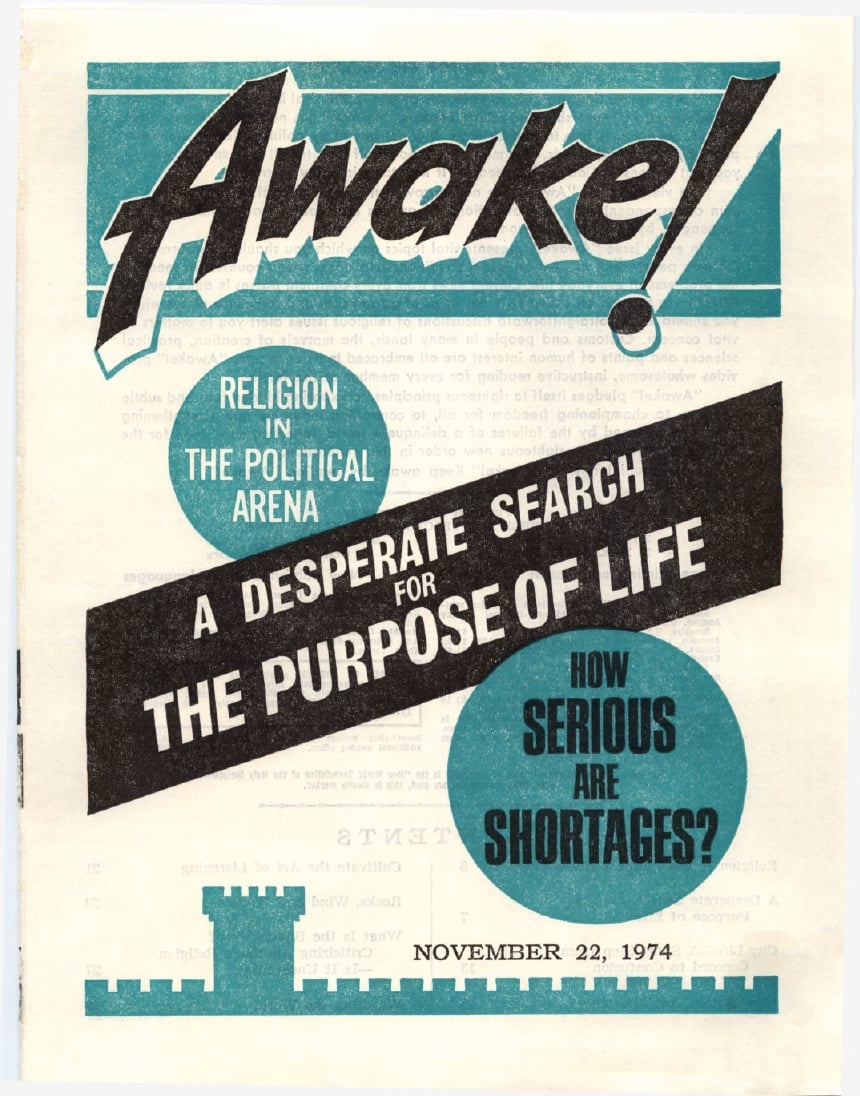
Awake! — November 22, 1974
Source: jw.org
Contents
Religion in the Political Arena
A Desperate Search for the Purpose of Life
City Life—A Short Step from Concord to Confusion
How Serious Are Shortages?
Cultivate the Art of Listening
Rocks, Wind and Women
Criticizing Another’s Religion—Is It Unchristian?
Watching the World
Can You Find Bible Verses?
What Is This?
Religion in the Political Arena
Religion in the Political Arena
RELIGIOUS news was once reserved for the back pages of the local newspaper. But today one is just as likely to read about the actions of the clergy on the front page. Why?
Because now, more than ever, religion is involved in politics. And politics is front-page news. At every political level, from local precinct elections to international conferences, the clergy are having a vigorous share.
Of course, in a certain sense this is nothing new. The churches of Christendom have always entwined themselves in the state’s business. However, in recent years the clergy have also assumed a much more aggressive role in political matters. The road for this change was paved by the second Vatican Council, in the early 1960’s. It urged Catholics to be more wrapped up in social and economic issues. Protestants have followed suit. The desire to help other people is commendable. But the vital question is, How should this help be given?
Jesus Christ said: “My kingdom is no part of this world.” (John 18:36) Probably every clergyman knows those words from memory; a true Christian believes them. The latter knows that if one acts contrary to Jesus’ words the results will not be good. Then, why is it that the clergy still insist on getting involved in political matters and, as it were, try to make God’s kingdom “part of this world”?
Because, frankly, they believe that the political organizations, not the religious ones, have “clout” or power today. Thus the “Reverend” Carl McCall of New York city reasons: “Politics is the only base on which the people respect a clergyman today.’’ And the 1971 Synod of (Catholic) Bishops said that politics is where “action on behalf of justice” takes place.
Not surprisingly, therefore, Louis R. Gigante, a New York City councilman, who is also an associate pastor of St. Athanasius Roman Catholic Church, asserts that there is only one way for him to get things done: “By power. It’s all power. . . . one of the reasons I’m in politics is to become a political boss, and I want to be a boss to get the power.”
But what are the results of such reasoning—good or bad? Let us look first of all at South America and see.
South American Revolutionaries
Says the Jesuit weekly America: “Keeping the Catholic Church out of partisan politics in Latin America is easier said than done.” Why? One reason is that the Church has always been in Latin-American politics. But here, too, the clergy’s stance has changed radically in recent years.
At one time the Church was the darling of the wealthy classes. Bishops in northeastern Brazil admitted as much in a pastoral letter last year: “The Church not infrequently was equated with those who held cultural, social and political domination. Many times she identified herself more with the rulers than with the ruled. . . . The Church became, for this domineering culture, an assistant.”
The results, in the opinion of those bishops, were intense suffering for the common people. So, now, they want to swing the Church around behind “the march of the people to liberate themselves.” But are the results of doing this any better?
The Brazilian bishops liken political liberation to salvation and believe it will come by violent revolution. Already Brazilian priests have been convicted of cooperating with urban guerrilla movements. Similarly, in Colombia, an organization known as “Priests for Latin America” has been accused of favoring revolutionary upheaval.
Now, as a consequence, the Brazilian government has charged that at least one Catholic Church education program is really a front for promoting Communism. The government states that in the past “Marxists considered Christianity a part of the capitalist regime. Today, they point to Christ as a bulwark of communism, and through this they succeed in getting the support of religious people.”
However, at the opposite extreme, during a recent Venezuelan presidential election, Catholic bishops strongly condemned what they called the ‘ambiguities’ of socialism and Communism. Meanwhile, Chile’s bishops have openly criticized the political policies of that country’s ruling junta. In Argentina, the political meddling of priest Carlos Mugica led to his assassination last May.
Thus, at one extreme the Church is said to support Communism; on the other, she is denouncing it. In between these two poles are varying shades of political ideology espoused by members of the South American clergy. And sandwiched in the middle are the common people, confused—hardly ‘liberated’—by a lack of unified Church leadership. Understandably many of them wish the Church would just stay out of politics. But, as America noted, that “is easier said than done”!
Other Religious Rebels
The revolutionary priests of Latin America have set the example. They have been followed by Philippine Island priests and nuns. The results have been similar.
One Communist underground movement, the New People’s Army, was raided by the Philippine government last year. Who was the rebel leader? The “Reverend” Luis Jalandoni, a highly respected Philippine priest. With him was his wife, a former nun, as well as a .38-caliber revolver and writings of Mao Tse-tung.
In Africa the clergy’s political interference has highlighted another bad result: it divides the churches internally. African black church members are told to gain dominance over white churchmen. Burgess Carr, canon in residence at Trinity Episcopal Cathedral in Monrovia, Liberia, a black, says:
“Any outright rejection of violence is an untenable alternative for African Christians.
“If, for no other reason than this, we must give our unequivocal support to the liberation movements, because they have helped the church to rediscover a new and radical appreciation of the Cross.
“In accepting the violence of the Cross, God, in Jesus Christ, sanctified violence into a redemptive instrument, bringing man into a fuller human life.”
Such arguments ignore entirely that Jesus said that those who live by violence will die by it. (Matt. 26:52) Nevertheless, black members of Christendom’s churches violently oppose white “Christians,” even if they are members of the same religion. Division results. People far outside Africa are indirectly involved in creating and deepening such hatreds and divisions. In what way?
Well, did you know that the World Council of Churches has supplied money to African terrorist organizations? The Council has said that in the past it used “quiet efforts . . . through established institutions‘’ in Africa to try to accomplish its aims. More recently, however, the Council claims that “a significant number of those who are dedicated to the service of Christ and their neighbor assume a more revolutionary position.”
Now consider: Some 400 million persons around the earth belong to churches in the World Council of Churches; that is almost four out of every ten people who claim to be Christian. Possibly even the church you attend supports the World Council. Did you realize what your donations were being used for? Would you say it is contributing to unity?
Not to be overlooked is the fact that the clergy’s political activities have brought death to many. In Ireland, both Protestants and Catholics have been behind violence that has taken over a thousand lives, many of them innocent children. WBBM in Chicago expressed the views of many when it said in a radio editorial: “Religion’s hands are blood red in Ireland, just as they were in the Crusades in days long past and in world wars of more recent vintage. . . . the more reprehensible group of all is the clergy, and let no one tell you differently.”
Yes, wherever you look—in the Americas, Asia, Europe or Africa—the story is the same. The clergy of virtually every religious stripe are in the political arena. But who can say that the results are good?
What About the Results?
Just review what we have discussed so far. Religion in politics has divided priests, preachers, nuns and laymen in their opinions and activities; it has turned some to radical left political activity while others support the rich on the right; it has brought death to many and oppression upon multitudes, rather than liberation; it has indirectly implicated people all over the world in revolutionary activities; it has split the churches both within the ranks of the clergy and among their flocks. Those are hardly good and desirable fruits. But that is not all.
The clergy have lost the respect of the very ones whose favor they have often sought to curry. Thus Anthony Lejeune straightforwardly writes in London’s Daily Telegraph:
“When Christ said ‘My kingdom is not of this world’, he was, according to a clergyman recently, making a ‘political and earthly’ statement, dissociating himself from the ‘imperialism, exploitation and oppression’ represented by the government of the day. The Gospel . . . in that clergyman’s view . . . is . . . a call to political action. . . .
“The tendency of the modernist clergy towards socialism goes with an exaggerated faith in political solutions; with a belief, in short, that Christ’s kingdom is of this world. Of course, Christ said it was not: but that difficulty can be overcome by a little convenient reinterpretation. . . .
“Men thirst for a kingdom which is not of this world: and, if the Christian Church no longer offers it, they will seek it elsewhere.”
Writing in a similar honest vein, To the Point, a news magazine published in Johannesburg, South Africa, said in an editorial:
“The churches must decide what is their essential job. If they propose to set up a secular power or ‘kingdom’, they will use the dangerous weapons that go with it. But then they must stop pretending to act in the name of one who said ‘My kingdom is not of this world’.”—April 12, 1974.
The clergy’s hypocritical and unprincipled actions have made them few real friends among men.
Even more importantly, religion’s involvement in politics has made her ‘an enemy of God.’ (Jas. 4:4) Jesus knew that his kingdom was heavenly and that it would, in due time, end all oppression and wickedness. The facts indicate that we live near the time when that event will take place.—Dan. 2:44; Matt. 6:9, 10; chapters 24 and 25.
In the meantime, Jesus said, his disciples were to ‘pay back to Caesar the things that are Caesar’s and pay back to God the things that are God’s.’ The Christian apostle Paul also said: “Everybody must obey the civil authorities that are over him.” Of course, if the “civil authorities” told Christians to do something that God said is wrong, then true Christians would “obey God as ruler rather than men.” (Matt. 22:21; Rom. 13:1, C. B. Williams’ Translation in the Language of the People; Acts 5:29) But ‘obeying the civil authorities’ would not allow a Christian to be a revolutionary, would it?
The Biblical viewpoint is supported by the clear statement in the book Church and State in Scripture History and Constitutional Law by James E. Wood, Jr., E. Bruce Thompson, and Robert T. Miller (1958): “Jesus was no political revolutionary and steadfastly refused to become involved in political revolution, preferring death to insurrection . . . Paul’s extant writings contain no direct attack on the imperial government of Rome.”
Just think: the results of the clergy’s involvement in politics seem deplorable to humans. Imagine how disgusting they must look to God, whom the clergy claim to represent. We may be glad, as the Bible tells us, that all such false religion will soon be destroyed forever by God. On the other hand, true worship will endure.—Matt. 7:15-20; Revelation chapters 17 and 18.
Jehovah’s witnesses are known internationally as neutrals toward this world’s affairs. They really believe Jesus’ words: “My kingdom is no part of this world.” (John 18:36) Do you?
Would you like to have a hand right now in assisting those who are downtrodden—but doing so in a way that God approves and that really works?
If so, visit a Kingdom Hall of Jehovah’s witnesses and learn about those Christians who are in truth “no part of this world.”
A Desperate Search for the Purpose of Life
A Desperate Search for the Purpose of Life
WHERE did I come from? Why am I here? What purpose really is there in life? I wondered deeply about such questions. And somehow a saying had stuck in my mind that encouraged my search, “Keep on seeking, and you will find.”
In an attempt to find answers I began taking psychedelic drugs, to open my mind and gain insight. I also delved into Eastern religions. Such studies convinced me that we have an immortal soul that survives the death of the physical body.
Accepting this belief, I found logical the teaching of certain religions, that we have lived before as other people. Our souls, according to this teaching, have experienced a series of reincarnations. I wanted to know about my past, and I was led to believe that the use of “mind-expanding” LSD could help me to investigate.
After taking the drugs, I would be drawn to a mirror where I peered for long periods of time into the pupils of my eyes. Under the influence of the drugs, the pupils would increase in size to almost the size of the iris. After many minutes of intense observation, I began to hallucinate and see what I believed were previous incarnations of myself. For instance, I saw myself as an evil warlord and an egocentric dictator who were responsible for the deaths of thousands of people.
Once while observing such an evil person in the mirror, I heard a voice saying: “You’ll have to suffer for these evils that you have done!” It was terrifying.
As a result, I felt I was destined to suffer and die, and then suffer again and again in successive reincarnations. I wished it could be avoided! But how could I deny what I had seen and heard when peering into the mirror? Other persons I knew were also led to believe in reincarnation by such experiences, for, as they say, “seeing is believing.”
I felt myself in a terrible dilemma, with no way out. Yet I kept searching, traveling to distant places and consulting reputedly wise men. Eventually, deeply depressed, I attempted to kill myself.
Then something occurred to change my outlook. Despair turned to hope. Why? Details of my search for the purpose of life may help you to understand.
Looking for Something
I was born in Edmonton, a good-sized city in western Canada. My parents seldom went to church. And the few times I went proved disappointing. Even as a youngster I wondered about the purpose of life, but the church failed to provide the answers.
I left high school in grade eleven, and opened up a small porcelain-repair business. I was just sixteen at the time, but I enjoyed considerable financial success. However, in less than a year I became dissatisfied and began looking elsewhere.
Hippies seemed to have something new, and they were springing up all over in the 1960’s. So I decided to “drop out” of the establishment, and get involved in something “meaningful.” In a short time I changed into a long-haired hippie. Psychedelic drugs became a major part of my life.
After taking LSD and using marijuana for a few months I became convinced that a “high” society, a society in which everyone was under the influence of psychedelic drugs, was the solution to man’s problems. To me, the hippies were the “love” children—full of peace and happiness.
Since I thought psychedelic drugs were a panacea, I began supplying drugs to others. Also, I vowed to deal only in psychedelic drugs, which affect the mind, and not in hard drugs that addict the body. Psychedelic drugs, I thought, could help a person to gain enlightenment.
With the money that I had made in the porcelain-repair business, I bought large quantities of drugs. Realizing that what I was doing was illegal and could cost me many years in prison, I took no chances. I hired conservative-looking girls to transport the drugs for me, and I made it a policy not to handle the drugs directly. Soon I was making about $2,000 a week.
Money was not my goal, however. I was really interested in becoming enlightened as to the purpose of life, but drugs did not seem to be helping me.
Search in Eastern Religions
I started to investigate Eastern religions, spending entire days reading about occultism, astrology, palmistry, I Ching, Buddhism and other Eastern thoughts.
Convinced by these studies that the soul survives death, I took a dose of LSD seven times as potent as the regular dose, with the hope of peering into my past. It was then that I saw the visions that I considered to be scenes from previous lives and heard the voice saying that I had been a vicious killer.
This horrifying experience marked a turning point in my life. From this time onward I felt uneasy with myself. I could not understand why I had been so wicked. To comprehend this, I decided to get a guru who could teach me the deeper things in life.
Pilgrimages to Distant Places
Early in 1970 I shaved my head and took a flight to India. The first place I went to was Bodh (Buddh) Gaya, where Buddha supposedly attained enlightenment. Here I met a French Hindu named John, who was deeply engrossed in Eastern thought. He became my first guru.
Together we traveled on pilgrimages to Srinagar, Benares, Katmandu and many other places. John taught me a basic knowledge of the Hindu faith. I changed my way of life and appearance. I lived now like millions of Indians, and dressed in Eastern garb. We would often meet sadhus and yogis on our travels, and while we listened to their stories we would smoke marijuana together.
After traveling together for four months John decided that I should progress by getting a more knowledgeable guru. However, I was not satisfied with the Hindu faith. So I went to Dharmsala, where the Tibetan Dalai Lama and High Lamas resided.
Here was a monastery where other Westerners were studying Tibetan Buddhism. I decided to join them. However, I was struck with a severe case of dysentery. So I changed my plans and set course for Europe to receive better medical services.
Arriving in Greece, I was admitted to a hospital. I weighed only a hundred pounds and was in terrible shape. But soon I recovered and from there I traveled to Holland.
Deeper Involvement with Spiritism
Once I left India, I thought that my days of dabbling in spiritism were over. But I was wrong. In Holland I met an Indonesian man who had supernatural powers. He told me he was a guru, and I accepted him as my teacher. Through him the spirits worked amazing feats, such as mind reading, precognition, telepathy and hypnotism. Soon I totally believed whatever he told me, because he appeared so wise. I was convinced that spirits really exist since I could see evidence of their power.
My guru offered these powers to me, saying that he had connections with the spirit realm. But I had not been searching for power. Rather, I wanted to know the purpose of life. I told him that I must first find this out.
However, he was not pleased and tried to discourage me. He reminded me of what I had seen in the mirror a few years before while under the influence of LSD. He said that now, in this life, I would have to reap all the evil that I had sown in past incarnations. He embedded this thought so deeply in my heart that I could not forget it. I felt haunted by spirits and was in a state of terror and utter confusion.
Early in 1971 I left this guru and joined the Hare Krishna Temple in Amsterdam, shaving my head for the second time. Every day I studied the Bhagavad Gita and chanted the Hare Krishna mantra (prayer) for a few hours with the hope that this chanting would purify my soul and provide relief from the spirits. But, instead, they intensified their haunting of me. At times I begged only to die and never be born again—to become nothing.
All my searching seemed in vain. A great many of these Krishna worshipers were self-seeking and selfish, offering me little consolation and comfort. So, finally, in the spring of 1971 I decided to return to Canada.
No Relief at Home
Arriving home, I was overjoyed to see my family again. But to them I appeared very strange. I saw my brother for the first time in a year. He, too, had changed greatly.
Before I left for India I had told him about reincarnation, and in the meantime he had delved deeply into such studies. In fact, he now believed that he had been an angel in his former life, and in his present incarnation had come down to earth to help mankind with world problems. He received these “revelations” while under the influence of LSD.
I still felt haunted by spirits. They tormented me to the point that I thought I was losing my sanity. I was terrified. Desperately, I kept searching for a way out. As my depression grew, I never smiled or had a happy moment for weeks. Finally, I made several attempts to commit suicide.
About this time I came in contact with Dale, who had also gone through the drug experience and was involved with spirit powers. We were living together in Edmonton when something occurred that pointed me toward the answers I was seeking.
A Basis for Hope
It happened one morning in June 1971. Dale and I had been smoking marijuana, when a middle-aged lady called at our door. She was quite brief because, I think, she must have smelled the drugs. She spoke about God and that it was his loving purpose to establish a kingdom for the blessing of mankind. It was not so much what she said that impressed me as her sincere attitude, her obvious desire to help me. She offered the Watchtower and Awake! magazines for ten cents, and I accepted them.
Impressed by her sincerity, I began reading one of the magazines. Slowly a wonderful feeling came over me; I started to feel relief. Why? Because for the first time I began to believe there was hope.
The magazine spoke of God’s kingdom, which the lady had mentioned. It showed that under the rule of the Kingdom there would be no human suffering. But what really impressed me was the indication given that all persons could have opportunity to attain to the blessings of God’s kingdom, regardless of the wrongs they had done in the past.
What a wonderful thought that was to me! It meant, as I understood it, that the loving Creator would not hold against me the terrible things that I thought I had done in previous lives. You cannot imagine my relief! I was determined to investigate further.
On the back of one of the magazines was an advertisement for the book The Truth That Leads to Eternal Life. I filled out the coupon and was ready to mail it. But before I did I learned from the people downstairs that they had obtained the very book I was about to order and that I could have it. As I began reading, every chapter strengthened my hope and relieved anxiety, especially chapters five and seven, “Where Are the Dead?” and “Are There Wicked Spirits?”
From the teaching of the churches, as well as Eastern religions, I was convinced that death was only a separation of the soul from the body, and that the soul was released by death to take up life in some other living thing. But the Bible did not say that. I obtained a copy and checked for myself.
It says, for example, at Ecclesiastes 9:5, 10: “For the living know that they shall die: but the dead know not any thing . . . Whatsoever thy hand findeth to do, do it with thy might; for there is no work, nor device, nor knowledge, nor wisdom, in the grave, whither thou goest.” (Authorized Version) But does not the soul survive to carry on a person’s conscious existence? Not according to the Bible. I was referred to many scriptures similar to the one at Ezekiel 18:4, which says: “The soul that sinneth, it shall die.”
If this is true, I concluded, a person could not have had past lives. So this meant that I could not have committed those horrible deeds that the voices said I had! And, therefore, I did not have to pay for those deeds! But what, then, was the source of the voices and the supernatural powers some persons exercise?
Source of Mankind’s Troubles
I, of course, believed that spirit creatures exist. I felt that some were bad but that most were good spirits that look after the affairs of earth. But now, from reading the chapter “Are There Wicked Spirits?” I realized that there are many wicked spirit creatures, or demons. Also, I learned that the wicked spirit person, Satan the Devil, is identified in the Bible as “the ruler of this world,” as well as “the god of this system of things” who is blinding the minds of people. This helped me to begin making sense of things.—John 12:31; 14:30; 16:11; 2 Cor. 4:4.
The voices I heard, as well as the supernatural powers certain acquaintances exercised, clearly originated with the demons. I started to discern that these wicked spirits had been blinding me, and even trying to drive me to self-destruction. It also began to become clear to me that they were not good spirits, but Satan and his demons who are controlling the world of mankind.—1 John 5:19.
As understanding of these things set in, it was as if heavy weights were lifted from my mind and heart. I quit taking drugs and destroyed all my books dealing with occultism and began to study only the Bible.—Acts 19:19.
Finding God and His People
A few days later some of us moved away from Edmonton to a forest area near Hinton, where we built a log cabin. Here in these peaceful surroundings in the wooded foothills of the Rocky Mountains, I absorbed myself in reading the Bible as well as rereading the book The Truth That Leads to Eternal Life.
Now I realized I was coming to know the true God. For the first time I prayed to him by his name Jehovah. (Ps. 83:18) Several times a day I prayed, asking Jehovah for more understanding of the truth concerning life and its purpose. I began to appreciate that the very purpose of life should be to serve our Creator. But how?
I noted that the Truth book pointed to the need for association with God’s people. And the book said that these people are the Christian witnesses of Jehovah, providing a number of reasons for claiming this. Dale observed that Jehovah’s witnesses often offered magazines on street corners in Edmonton. So the next morning we were on our way to find them.
Locating an elderly Witness on the street, we learned from him the address of the Kingdom Hall, where Jehovah’s witnesses hold their meetings. The following day we attended the meeting. I could not help but be impressed by the genuine interest the Witnesses had in us. They surely did manifest the love that Jesus said would identify his true followers.—John 13:35.
One of the Witnesses offered to study the Bible with me free of charge on a regular basis. Gladly I accepted.
Fulfilling the Purpose of Life
In these studies I soon saw how I could serve God. It is simply by doing out of a willing heart what God says. For instance, his Word the Bible urges: “Become kind to one another, tenderly compassionate, freely forgiving one another . . . and go on walking in love.” (Eph. 4:32-5:2) Now, would not life on earth be grand if everyone made it his purpose to do this?
Obviously it would. Many of us hippies had also been urging people to love one another, but something basic was missing in our concept. What was that? Practicing what Jesus pointed to as the principal requirement of God’s Word, namely: “You must love Jehovah your God with your whole heart and with your whole soul and with your whole mind and with your whole strength.”—Mark 12:30.
Yes, we had left out love of God. Yet this should come first in a person’s life. And proof that it really does is shown when a person obeys God’s laws. (1 John 5:3) But we hippies did not do this; in fact, most of us never knew what the laws of God were. And so we commonly practiced things that God condemns in the Bible.—1 Thess. 4:3-5.
However, I also came to appreciate that more is involved in serving God than simply refraining from breaking God’s moral requirements. I learned that a world change is at hand, necessitating special service to God. The time has arrived for God to fulfill his purpose to destroy Satan and this entire wicked system of things, as the Bible foretells: “The God of heaven will set up a kingdom that will never be brought to ruin. And the kingdom itself . . . will crush and put an end to all these kingdoms, and it itself will stand to times indefinite.”—Dan. 2:44.
We hippies had seen a need for such a change. And now I was delighted to learn that God did too! But God’s crushing of all present-day governments must be announced. That is why Jesus said: “This good news of the kingdom will be preached in all the inhabited earth for a witness to all the nations; and then the end [of this system] will come.”—Matt. 24:14.
But who will do the special work of preaching this message? Why, those who have found the true purpose of life! I quickly saw this, and so right away began sharing in the Kingdom-preaching with Jehovah’s witnesses. In time I dedicated my life to serve Jehovah, and in August 1972, along with my friend Dale, symbolized my dedication by being baptized in water.
Many young persons were in the habit of coming to our house. So Dale and I would invite them to the congregation meetings. Sometimes a dozen or so would come along with us to the Kingdom Hall. Eventually most of them quit coming, but others continued to respond to the Kingdom message. Among these were my brother and sister. They have since both been baptized, and they are now serving as regular full-time preachers of the Kingdom good news.
Many times over the years people would tell me that I should not be so concerned with the meaning and purpose of life, but that I should just live it. However, rather than listen to them, I would remember the words, “Keep on seeking, and you will find.” By heeding this sound advice, not only have I come to realize true happiness, but I have had the privilege of helping others to appreciate the purpose of life and thus to realize the blessings this brings.—Contributed.
[Picture on page 8]
Bodh (Buddh) Gaya, India
[Picture on page 9]
Hare Krishna worshipers chanting the mantra (prayer)
City Life—A Short Step from Concord to Confusion
City Life—A Short Step from Concord to Confusion
By “Awake!” correspondent in Ireland
PEOPLE unaccustomed to city life often question the sanity of those who choose to live there. They are awed by these vast complexes of concrete, steel and glass. They stand aghast at the sheer bedlam of activity of the great masses of humanity herded together in these places.
Have you ever stopped to consider how and why these cities grew? If you pause in the center of any large city, especially at the peak of the rush hour, you cannot help but wonder from where it all came. Wearied pedestrians fight with vehicles that are pouring pollutants into streets jammed with traffic. The noise level becomes nearly intolerable.
Besides wondering from where cities came, one cannot help but consider: Just how real is the danger that city life may break down? With such masses of people living and working together in such congested spaces, there is, without a doubt, a tremendous need for great cooperation to keep things working smoothly. But just how short is the step from cooperation to confusion?
First, let us take a brief look at some of the factors that have contributed to the development of cities in different locations. A glimpse of the past can help us to appreciate just how different life is today.
What Accounts for the Cities?
Some cities have just “grown naturally” as a result of geographic and strategic factors. Others have been “forced along” to satisfy, say, industrial or political interests.
For instance, here in Ireland, Dublin just grew. Its history stretches back to the invasions by the Norsemen and beyond, while Belfast is a comparative newcomer to the city status.
Dublin’s growth came from its strategic position on the river Liffey. Succeeding conquerors of Ireland recognized the possibilities of the location and so the city expanded under the influence of the Norsemen, the Normans and the English. Each group left their mark on the city.
In contrast, Belfast is very much the result of modern-day industrial development. It was not until the close of the eighteenth century that it began to grow to its present stature. Up to that point it was, according to one historian, “still a small, dirty, crowded town on the west bank of the river Lagan.” Its growth from a small group of habitations to the densely populated industrial center it is today was almost entirely a result of the growth of the linen and shipbuilding industries in this area.
Around these industries evolved the commercial houses, the stately homes, the shops and offices, the accommodations for the vast working population that gravitated here, and all the other paraphernalia that goes to make up a modern city.
Thus these massive concentrations of buildings and people we call cities expanded, often in a way that produced many shades of grime rather than the beautiful results of the Creator’s handiwork seen in the rest of the country. In sheer complexity today they stagger the imagination.
Complexity of Cities Today
Just stop and consider what the developments of history have produced. Layers upon layers of interrelated avenues of human activities. Great networks of roads connect the diverse enterprises. Multitudes of hidden pipes, cables, tubes and conduits serve to bring the essential power to keep everything functioning and to carry away the incredible amount of waste produced.
Think of all the various services that must work together to maintain city life with any degree of harmony—power supplies, commodity supplies, transportation services, communication services, water supplies, sewage disposal, health services, roads, housing, and so on and so forth.
We are inclined to accept these things as facts of life, as if they had always been there. But not so long ago many of these things just did not exist.
It has taken an immense amount of labor to produce the cities of today, not to mention the planning and preparation of countless designers and farsighted authorities. But the very nature of these cities makes them susceptible to sabotage and chaotic breakdown.
This was demonstrated recently when certain sections of the community in Belfast withdrew their labor to give active protest against certain political developments. A look at what happened, quickly illustrates how easily a modern-day city can grind to a halt.
Breakdown of City Life
Wednesday, May 15, saw the beginning. After a long period of general unrest over political events, a general strike was declared. Very rapidly the industrial life of the city died.
One of the first actions by the strikers was a cutback of electricity supplies. They declared that only enough electricity would be generated to supply essential services, such as hospitals. A city without power supplies is like a body without life. So many modern-day conveniences depend absolutely on this power source. Now, instead of a regular electricity supply, consumers were getting three or four hours on and then being cut off for long periods, without warning or advance notice.
Those living in the ultramodern, recently developed housing estates often found themselves with absolutely no form of heating, lighting or cooking facilities. Invalids and sick persons were put at grave risk, not to mention those who had to climb what must have seemed like endless stairs to get to their homes in multistory flats!
Hospitals were placed in difficult circumstances as the power situation worsened. Often they had to rely on emergency generators. This was not the easiest of situations with which to cope in the middle of a delicate and possibly lifesaving operation. Even such things as maintaining an adequate supply of clean linen can present very real problems when laundry facilities are curtailed.
Traffic flow, always a headache to city planners and administrators, became chaotic. Traffic lights failed sporadically in various parts of the city.
The commercial life of the city was badly affected. Those who traveled to work each day in the city’s center found it increasingly difficult to get to work. Protesters set up road blocks, thus preventing freedom of movement throughout the city. City bus services were suspended after some of their vehicles had been hijacked and used to form barricades. Private vehicles were stopped and checked as protesters dissuaded from going to work any who might have wished to do so.
Those who did finally manage to make their way to work found conditions almost impossible. Offices were without power for all their equipment. Shops had only emergency lighting in the way of candles or bottled-gas lights. These conditions were a shoplifter’s delight.
Food supplies, of course, were considered “essential” by the protesters, but these also were affected as distribution was disrupted by the generally chaotic conditions. Milk supplies, for instance, were erratic for some time after several delivery vehicles were hijacked and robbed. Supplies of many fresh foods were limited as cargoes piled up at the docks.
Those retailers with refrigerated units found themselves in great difficulties as power supplies became increasingly undependable. Supermarkets were forced to sell much of their perishable goods at half price. Children in some areas were delighted to find that their local sweetshops were giving away melting ice-lollipops.
Of course, without power for home refrigerators, it was impossible to stock food there, unless one had a gas-powered refrigerator, in which case one was all right for the moment. This led to panic buying of canned and nonperishable goods, and this only added to the confusion.
Supplies of bottled gas very quickly dried up as householders tried to arrange some form of emergency cooking and lighting equipment. Candles became as scarce as rain in a drought-stricken land.
When, eventually, gas supplies also were cut off, troubles increased. Dropping gas pressure to homes also produced the danger of explosion because of the possibility of air and gas mixing in the pipes, producing a highly explosive mixture.
Petrol stations had to ration supplies and motorists were forced to line up for hours to fill their tanks. With devastating effect the strikers shut down the bulk of petrol retailers and began to issue passes for petrol to those whom they considered “essential” travelers. Slowly but surely, as existing supplies were used up, all traffic movement in the city ceased, to all intents and purposes.
Besides the ever-growing threat to health caused by the uncollected refuse from thousands of homes, a further danger arose. Workers threatened to cease pumping operations at the sewage-disposal works. With much of Belfast built on low-lying areas, this presented the prospect of untreated sewage backing up the drains and sewers onto the streets.
The overall effect of this strike proved too drastic for the authorities to cope with. After fourteen days of increasing chaos they gave in to the demands of the protesters.
Belfast was pulled back from the very brink of absolute disaster. One day it was a busy, industrious city; and then it took that short step toward becoming a stricken thing fighting for survival.
How Serious Are Shortages?
How Serious Are Shortages?
IN THE past, little thought was given to the limits of our earth’s resources. Its wealth of raw materials was largely taken for granted. So for centuries its minerals, fossil fuels and other supplies have been exploited as though they were unlimited.
Today the story is different. No longer is the earth considered a source of never-ending material wealth.
Promoting Growth
Until recently, most economists accepted the ideas promoted by Britain’s John Maynard Keynes. His view was that economic problems, including depressions and unemployment, could be remedied by encouraging mass consumption of goods, even if people, businesses and governments had to go into debt to do so.
It was thought that the continual increase of demand for goods would require more production, hence more factories, jobs and income for all—thus “prosperity.” And for decades now, this has been the general policy followed in Western economic life.
But it has finally become apparent that there might be something drastically wrong with the idea of constant growth, aside from the fact that mounting debts could become an intolerable burden. What brought the matter to a head more quickly than anticipated was that the world’s population began to “explode.” This was due to a continued high birth rate and a new, dramatic decrease in the infant death rate through better disease prevention.
Especially after World War II, world population began to grow faster than ever before. Now there are nearly four billion people on earth, and almost 80 million are being added each year. At this rate, population would double in just thirty-five years. It appears to world leaders that the earth cannot indefinitely support such an “exploding” population.
Running Out?
Does this mean that the earth is running out of resources? No, not really. At least not now. The main problem is the way human society is presently constituted, with its emphasis on more and more industrialization.
A mining executive noted in Vital Speeches: “Since mineral resources are non-renewable, undeniably at some future date exhaustion of economic resources will occur—but that day seems quite distant. The shortages experienced in the last 15 months have not been caused by lack of available reserves.”
But while there are ample reserves still in the earth, getting sufficient quantities to the nations that need them, quickly enough and cheaply enough, is something else. What makes the matter critical for western Europe, Japan and even the United States is that now the best reserves of most minerals and energy sources they need are not found within the borders of these countries. And the reserves they do have are not enough, and are being used up faster and faster because of the enormous appetites these nations have. Thus, these nations are suffering a serious and growing shortage of raw materials.
Gigantic Demand
Formerly, when the human family lived a largely agricultural life, the demand on earth’s resources was very small. But with the coming of the industrial age several centuries ago, demand for raw materials grew at a tremendous pace.
Industrial societies need factories, offices, apartment buildings, power plants, machines, transportation, energy. These things cannot be built without steel, aluminum, copper, concrete and other materials. And industrial civilization is fueled chiefly by petroleum.
In the industrial lands of western Europe, Japan and North America, the demand for all such resources has been growing several times as fast as their rate of population growth. But this growth in demand is getting another push—from the exploding populations in what is called the “underdeveloped” world.
People in these poorer lands also want the machines and other material goods that they see in the industrial nations. And their leaders are pushing those countries into the industrial age as fast as they can. An example of how much this can increase demand for all sorts of goods can be seen from just one item involving an industrialized land, as noted in the book Introduction to Geology: “The consumption of iron in the United States increased some twenty times while the population of the country doubled.”
Yes, when a nation becomes highly industrialized, its appetite for raw materials increases all out of proportion to its population increase. And in the poorer countries, there are billions of people demanding the goods turned out by industry. As ecologists Paul Ehrlich and Dennis Pirages state in their book Ark II: “This crisis of numbers is exacerbated by a worldwide revolution of rising expectations. Materialism has become a universal religion. Continued increases in production of artifacts are regarded as a necessity by almost everyone.”
Thus, the overall population explosion in the world, plus the insatiable demand of the already industrialized nations, and now the growing expectations of poorer nations all add severe strains on the availability of earth’s resources. How severe is noted by political scientist William Ophuls in Harper’s magazine:
“To accommodate world population growth, we must, in roughly the next thirty years, build houses, hospitals, ports, factories, bridges, and every other kind of facility in numbers that almost equal all the construction work done by the human race up to now. . . .
“Problems now develop so rapidly that they must be foreseen well in advance. Otherwise, our ‘solutions’ will be too little and too late. . . .
“Only the most exquisite care will prevent the collapse of the technological society on which we all depend.”
The strain was clearly visible in 1973 and early 1974. Then, due to generally “booming” economies throughout the world, demand for goods rose swiftly. Governments had borrowed and pumped more and more money into their economies to sustain this prosperity. But while demand suddenly rose, newer factories and mines were not being built fast enough. Inventories were exhausted in a short time. A typical example was that of copper, which had an average production growth of about 4 percent a year since the early 1950’s. But in 1973 demand for copper in the Western world increased by more than 10 percent. Thus, demand for goods outstripped the ability to produce them, which also helped to bring about rampant inflation.
With inflation, the cost of borrowing money rose swiftly. This made it more costly to build newer production facilities. As U.S. News & World Report observed: “In one industry after another, shortages of materials and capacity are intensified by what is, perhaps, the most critical shortage of all—money. . . . Industry is hard pressed to find ways to pay for the manufacturing capacity to keep up with demand.”
Prices—Up, Up, Up
Prices, of course, fluctuate. Sometimes they go lower, especially when there is a surplus of certain goods. But the steady increase in demand year by year, the growing shortages, and competition for earth’s resources have put a generally upward pressure on prices. Examples of this can be noted in the accompanying chart of sample wholesale price increases.
But there is another reason that prices of metals and other materials have gone up. The “underdeveloped” lands that have the raw materials want more money for their products so they can buy the items they want from the industrial lands. The example of a fourfold increase in the price of petroleum is fresh on the minds of all nations. And this is also true of other commodities.
For instance, Jamaica and a few other lands, such as Guinea, Guyana and Surinam, have rich deposits of bauxite, the basic ore for making aluminum. Their prices have been rising significantly. Copper faces the same future, since Chile, Peru, Zambia and Zaïre supply most of the world’s exportable surplus. The same is true of tin, since about 70 percent of the exports come chiefly from Bolivia, Malaysia and Thailand. Many other basic commodities follow the same pattern.
Dependent on Imports
Few people in the industrial societies fully realize the growing degree to which their way of life depends on imports. Many of these imports are needed because shortages exist within a country and the product must be obtained elsewhere.
For example, the Netherlands imports most of its protein foods, all its cotton, and about 80 percent of its wool. It also imports all its antimony, bauxite, copper, gold, iron ore, nickel, phosphate and potash fertilizers, tin, zinc and many other commodities, including oil. Other European nations are in a similar situation.
Regarding oil, most of western Europe is totally dependent on oil imports, producing very little of its own. The oil embargo in late 1973 revealed how fragile the prosperity of these nations is. Interruption of oil imports could destroy their way of life in short order.
Japan is often looked to as an example of material progress. But it has been accomplished largely with the resources of other nations. In addition to importing much of its food supply, Japan imports most of the raw materials used in its industry. This includes 92 percent of its iron ore, 59 percent of its coking and bituminous coal, all its bauxite ore, 84 percent of its copper, and 99.7 percent of its petroleum. Yes, Japan’s “prosperity” too is built on a fragile foundation.
United States Imports More
The United States is regarded as the most productive nation on earth. Yet its predicament is now much the same as that of Japan and western European industrial lands. Hence, U.S. News & World Report stated:
“America—blessed in the beginning with a wealth of natural resources—is becoming a ‘have not’ nation.
“Hard facts show the U.S. is leaning more and more on other countries for the raw materials that are so vital to its status as the world’s most prosperous land. These materials, Americans are being told, will not be easy to come by in the future.”
Many of the “easiest” sources of raw materials in the United States already have been exploited. For instance, the rich iron deposits of the Mesabi Range in Minnesota are largely exhausted. Lower-grade ores are more expensive to mine. The “easiest” petroleum fields already have been tapped. That is why offshore oil drilling is expanding. Also, oil wells on land are being drilled deeper and deeper. And oil from Alaska will come in by pipeline. Even now the country imports about a third of the petroleum products it uses.
Also, the United States now depends on other nations for nearly a third of all the minerals considered essential to its industry. It is felt that by 1985 this dependence would rise to one half. The cost? In 1970 production of minerals within the United States fell nearly 9 billion dollars short of its requirements. And a government official estimates that this deficit will reach 31 billion dollars by 1985, and 64 billion by the year 2000. All that must be made up by imports. And these estimates were made before the rampant inflation of prices in 1973 and 1974!
The United States also has a huge appetite for fresh water. Industry consumes enormous amounts, about 100,000 gallons being needed to manufacture just one automobile. At the present rate of usage, it is estimated that in only 25 years the country will need about 250 billion gallons of fresh water each day for production and another 450 billion gallons to carry off wastes. Yet, the present dependable flow of surface water is only an estimated 100 to 125 billion gallons a day.
Is there any industrial nation on earth today largely self-sufficient in natural resources? Yes. That nation is the Soviet Union, which still has incalculable material wealth to be tapped. And yet, its soil is not as rich as that of the United States, so the Soviets experience frequent crop setbacks and must import food.
Heading for a Change
The industrial nations, especially the highly developed ones of western Europe, Japan and the United States, have worked themselves into a trap. To sustain their present standard of living they now must import increasing amounts of the raw materials and energy sources they need. But the poorer nations that have these resources now demand more money for them.
The immediate result of this is that these industrial nations are going more and more into debt to pay for the things they need. Just the petroleum bill in the past year has staggered the economies of the entire Western world. Nation after nation is going deep in debt to pay the higher petroleum costs. Thus, aside from the fact that it is getting harder and harder to obtain the raw materials and to produce the things that are demanded by people, the financial situation of the industrial lands has become desperate.
Economists agree that it is not possible to continue in this way much longer. Something has to change. The deficits in the international balance of payments of these nations mean that soon a sharp readjustment must take place. While borrowing billions from the now wealthy oil-producing lands helps to stave off disaster for a while, such borrowing cannot continue indefinitely, since the sums needed are enormous. It could mean that these nations will simply no longer be able to afford all the imports to keep up their way of life. That would mean a drastic revision in the standard of living of the people.
The capacity of people to readjust to a lower standard of living is questionable. A hint of things to come may be this item carried by the New York Times recently:
“CAIRO, Aug 10 (Reuters)—Two people were killed and five injured in the rush to buy a piece of soap, which is scarce in Egypt these days, the newspaper Al-Ahram reported today.
“In a fight over the last piece of soap in a shop in Rozeik village, the grocer and his son were killed, the newspaper said.”
British historian Arnold Toynbee comments that the industrial nations “are going to find themselves in a permanent state of siege, in which the material conditions of life . . . will become progressively more severe.” He adds:
“Within each of the beleaguered ‘developed’ countries there will be a bitter struggle for the control of their diminished resources. . . .
“Consequently, in all ‘developed’ countries, a new way of life—a severely regimented way—will have to be imposed by a ruthless authoritarian government.”
It is apparent to many observers that a huge readjustment in world affairs cannot be far off. The problems have become too critical. The authors of Ark II put it this way: “We know that the old system will not hold together much longer.”
[Chart on page 18]
WHOLESALE PRICE INCREASES WITHIN THE UNITED STATES IN JUST ONE YEAR
COMMODITY MID-1973 MID-1974 INCREASE
Newsprint, ton $169.00 $205.00 21 percent
Steel scrap, ton 53.00 145.00 174 percent
Sulphuric acid, ton 31.00 41.00 32 percent
Tin, lb. 2.18 4.49 106 percent
Copper, lb. .60 .86 43 percent
Aluminum ingot, lb. .25 .33 32 percent
Zinc, lb. .21 .35 67 percent
Gasoline, gal. .14 .28 100 percent
Fuel oil, gal. .11 .23 209 percent
[Picture on page 17]
KEY FACTORS PRODUCING SHORTAGES
Population Explosion
Emphasis on Industrialization
Depletion of Raw Materials
Increased Expectations
Political Differences
Cultivate the Art of Listening
Cultivate the Art of Listening
TODAY there are all manner of “gaps” between people. There is the “generation gap” between old and young. There are gaps between parents and children, between schoolteachers and their students, between employers and employees and between religious leaders and their flocks.
What are the causes of these gaps? No doubt they are varied and many, but quite likely one of the main ones is failure on the part of both parties to communicate. This, in turn, is largely due to each party’s failing to listen to the other. So often persons are thinking of something else while someone is talking to them, instead of paying attention to what is being said. Husbands are prone to do this, especially if they have talkative wives.
Mastering the art of listening is particularly important for parents, for schoolteachers, for men with responsibility in business and industry, and for all who would counsel persons with emotional problems.
What Is Listening?
Listening means really paying attention with both our mind and our heart, with both our ears and our understanding. “Pay attention” is an appropriate expression because doing so will cost you something. What? Especially time, but also self-interest, for you will have to put the interests of another ahead of your own. In other words, it will require a measure of unselfishness, wisdom on your part, also patience and self-control.
There might be said to be three basic kinds of listening. (1) Listening for information, for facts and figures, for the thought content. (2) Also listening for emotional content, paying attention to the tone of voice and whether the speaker is happy or depressed, pleased or angry, proud or humble. The emotions manifested by the speaker, if noted, will go far toward throwing light on what is said. Empathy is all-important for this kind of listening. And (3) there is also the matter of listening for that which is not said. How can you do that? By noticing what is implied but not stated, what is left unsaid. What seems to be the purpose or motive behind what is said? A person may be inhibited from coming out directly with what is on his mind because of pride or shame, because of being too emotionally involved, or because of his concern not to offend a superior.
Listening to Children
Both parents and schoolteachers have many opportunities to be helpful by listening to their children or pupils. Thus schoolteachers have been told that “one of the most basic and useful competencies for a teacher to acquire is the art of listening.” And a school principal, who at the same time is a mother of four children, stated: “Listening is the most effective tool I’ve found for helping my own children and my students to work out their own problems. You’d be amazed how beautifully they do when given half a chance.”
At times parents are keenly disappointed because of the wayward course taken by one or more of their children. They simply cannot understand it. But if they had been good listeners, they might have heard signals that warned that something was wrong. For example, they might have heard that the words of their children did not match their emotional content, that they were giving merely lip service to their parents’ wishes, that they were covering up a spirit of independence or rebellion.
Listening to children requires patience and tact and, above all, sympathy, empathy and understanding. Is it wise to begin censuring the child immediately if something has gone wrong or if he expresses a wrong sentiment? The result may be that he will hide his feelings, and hidden feelings are more dangerous than those openly expressed, for then the lines of communication are severed.
Listen to the emotion behind the child’s words, whether of joy or anger, delight or defeat, and respond in a sympathetic manner so the child realizes that you are listening. True, this takes time and patience, but wise parents realize that one of the most worthwhile investments of time is in listening to their children.
Do not only be willing to listen, but know how to encourage the child to speak, how to draw him out. Lean forward, give full attention, expect him to speak, encourage him with such expressions as, “Tell me, what’s wrong?” “Yes?” “And then what?” Tune in on his emotional wavelength, as it were. And instead of immediately telling wherein he erred or is mistaken, why not ask questions that will help him to see his mistake without your saying it? By proving yourself a parent that listens with understanding, with awareness, with tact, sensitivity and empathy, you will be providing your child with the right kind of environment for growing up emotionally as a trusting and hopeful person.
Listening to Subordinates
The importance of good listening is also being driven home more and more to those who have positions of oversight in business and industry. It is said that the average executive spends 40 percent of his time in listening and that he absorbs only 30 percent of what he hears. Because of this there are business courses for such men where they are taught the art of listening.
In such courses men are taught to keep their minds on what is being said—a real problem because the mind can think so much faster than the mouth can speak. So they are counseled (1) constantly to analyze what is said; (2) to screen out the irrelevant; (3) to categorize the important points; (4) to weigh what is said against what they themselves know; (5) to look ahead to see where the speaker is going; (6) to listen for what is not said.
…